



Abstract
Policies for biodiversity no net loss and net gain underwrite narratives for green growth through advancing reparative logics to ongoing habitat impacts. By enabling offsetting practices that risk accommodating rather than averting land change developments, net principles are said to resemble modes of ‘accumulation by environmental restoration’. Biodiversity net principles are frequently depicted visually as a diagram of the mitigation hierarchy for communicational ease and have proliferated over recent decades despite little evidence for their ecological effectiveness. This paper combines economic sociology, visual media analysis of the net diagram and political ecology to account for the stabilisation of net principles in policy frameworks. It highlights the upstream imaginative work that this visual tool and its wider assemblages perform to support offsetting and habitat banking practices on the ground. The paper positions the NNL diagram as a conceptual and ideational technology. It traces the practices through which biodiversity is rationalised by the Cartesian coordinates of an XY schematic, and en-framed as a measure of numerical value on a vertical scale. The effect is to engender coherence to the idea of netting out differences in aggregate sums of biodiversity unit value, making nature conceptually offset-able.
I develop this account through a history of the diagram as well as the broader processes that have shaped the policy and its arrival in English planning frameworks. Observers increasingly question how biodiversity offsetting and no net loss/ net gain have become so popular when their empirical foundations are so weak. This paper proposes that within the wider assemblages of actors, one answer is located in the potency and mobility of conceptual technologies such as diagrams of no net loss or net gain of biodiversity and the logic of balance-sheet accounting that is imbricated within the visual design.
Introduction
A cursory glance through many an institutional, infrastructural and governmental environmental strategy today is likely to uncover at least somewhere close to the top, a commitment to delivering the ‘no net loss’(NNL) or ‘net gain’ (NG) of biodiversity. A net principle in conservation facilitates compensation for development-related impacts on wildlife habitats by offsetting ‘equivalent’ and additional biodiversity values or units elsewhere or in the future
In England, to account for development-related habitat losses, NNL was inscribed into the country's National Planning Policy Framework in 2012 (DCLG, 2012). The principle was migrated across to the Government's Dept. for Environment, Food, and Rural Affairs’ (DEFRA's) long-awaited 25-year environmental strategy appearing as an ‘environmental net gain’ principle in 2018 (DEFRA, 2018). 1 Biodiversity ‘net gain’, denoting at least a ten per cent uplift in original baseline value, is expected to be mandatory on all residential developments in England by 2023. The approach is deployed specifically in relation to the mitigation hierarchy (Gardner et al., 2013) which is an affiliated but older regulatory model. The mitigation hierarchy specifies the sequence through which impacts must be remedied, starting with avoidance, then minimisation and with biodiversity compensation only as a last resort. Predicating conservation objectives on quantifications involving net differences in summed totals signal important shifts in conceptualising the nature of what is deemed to be protected towards a biotic world of equivalences and exchangeability (Apostolopoulou et al., 2018; Carver and Sullivan, 2017). These shifts are seen to reflect a changing of emphasis from environmental protection to ecological restoration and repair that specifically follows a ‘calculus of casualty’ (Sullivan, 2013). The logic of repair arises from the assumption that development-related biodiversity impacts will continue or even accelerate. They are positioned against projections for global infrastructure investment to reach $60 trillion by 2040 (zu Ermgassen et al., 2019a) and £650 billion in the UK by 2031 (UK Infrastructure and Projects Authority, 2021). The UK Conservative Party government came to power with a flagship 2019 manifesto promise to build 300,000 new houses a year in the context of widespread affordability and availability crisis, spelling further spatial challenges for reconciling nature restoration and urban development.
In England and in particular, since 2010, the entangling logics of ‘green growth’, discursively aligned to these ambitious targets for housing and infrastructural development, have unfolded in the context of public sector financial austerity and planning deregulation. These conditions provided an enabling policy and governance framework (Lockhart and Rea, 2019; Sullivan, 2013,) that shaped the political context in which NNL found favour there in 2010. Given the wider political economy of land development in combination with a low institutional capacity within the planning and ecology sector in England (Robertson, 2021) and alignment with theory more generally (Spash, 2015; Walker et al., 2009) it has been anticipated that NNL or NG are likely to weaken rather than strengthen environmental protections in England (Carver, 2017). As such, it is expected that no net loss and offsetting are strategies that normalise and can enable the processes this special issue addresses, namely accumulation by restoration (Huff and Brock, 2017).
Compensatory and offsetting mechanisms have been well theorised in political ecology literature. Empirical studies, for example, have traced how they economise (Carver and Sullivan, 2017), commodify (Dauguet, 2015) and quantify the value of biodiversity in natural capital accounting frameworks (Sullivan, 2018). Scholarship has traced how valuation metrics and techniques of offsetting bare responsibility for the production of ecosystems in the economised or commoditised form (Robertson, 2012). Far less importance, however, has been attributed to the models or sociotechnical imaginaries (Jasanoff and Kim, 2009) that perform the conceptual, psychological and intellectual work upstream to these calculative tools (Ouma et al., 2018) despite several genealogical accounts of the instruments themselves (Benabou, 2014; Bonneuil, 2015). To focus on one important tool within this sociotechnical repertoire I foreground the diagrammatic and graphical model of NNL which circulates as a companion to the policy standard. The expression NNL usually refers to a contemporary policy framework that enfolds the previously separate mitigation hierarchy within it. Both NNL and the mitigation hierarchy are depicted as one and the same through a widely recognised visual schematic or diagram shown in Figure 1.
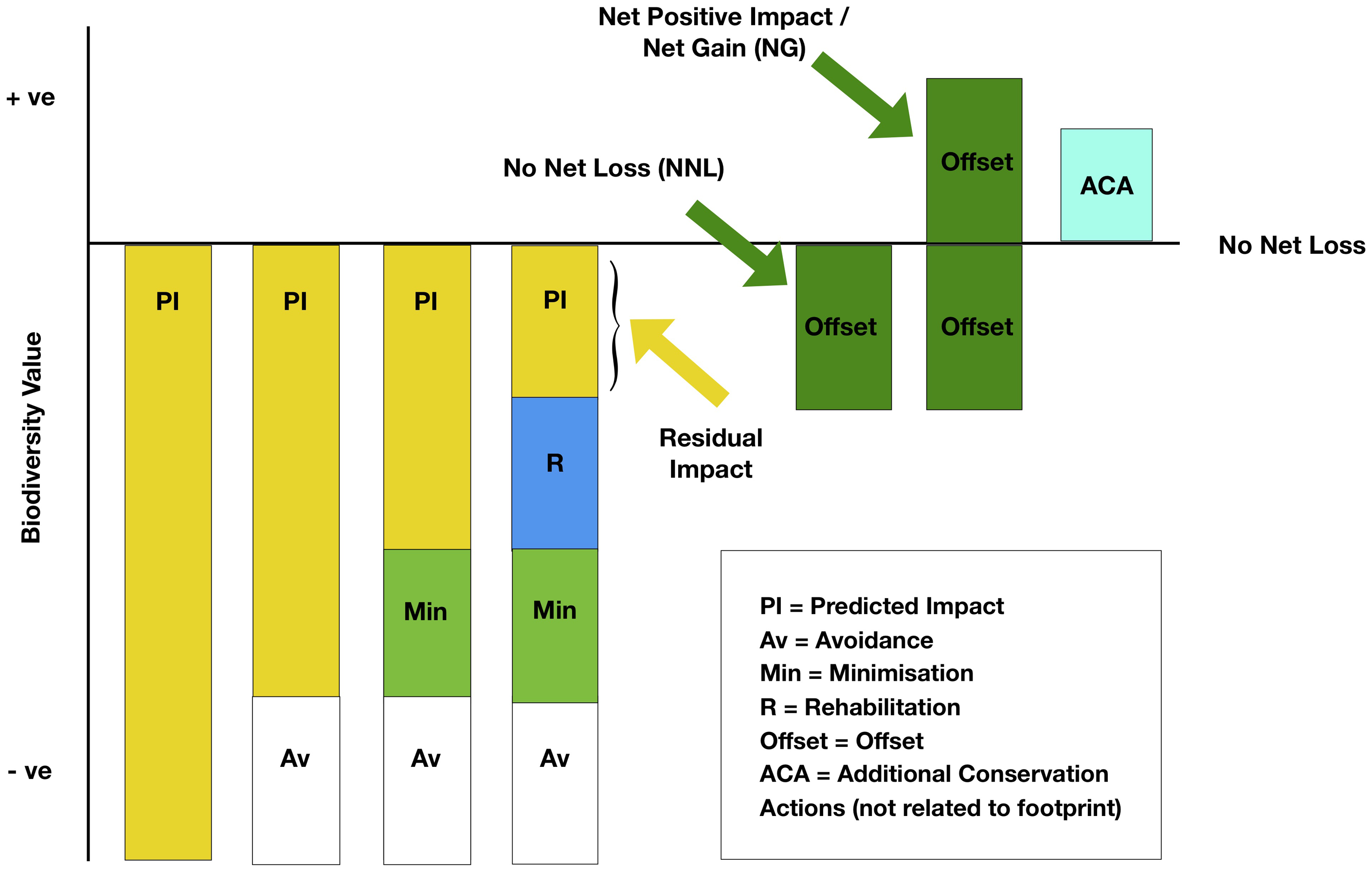
The ‘no net loss’ of biodiversity within the mitigation hierarchy. Adapted from the Business and Biodiversity Offset Programme (BBOP, 2013). Original source: Rio Tinto and Govt. of Australia.
A central goal of the subsequent discussion is to trace the origins of this diagram, the epistemic and political commitments that lead to it as well as its capacity to shape perspectives that afford intuitive legitimacy to offsetting approaches. I ascribe the term conceptual technology to this schematic, to convey the ways that it makes nature appear coherently ‘offset-able’ as a precursor to biodiversity offsetting programmes on the ground. A primary focus of my argument, therefore, is to locate the conceptual work that NNL performs in its visuality. I also note the important dynamics of actors, institutions and discourses which helped to convene this wider assemblage (Li, 2007).
As well as being commonly used in corporate and policy discourse, NNL has engendered a sizable and still growing scientific literature on related ecological measurement techniques and policy design (Gibbons et al., 2016; Griffiths et al., 2019; Maron et al., 2017). Within this literature, the difficulty in actually delivering a no net loss of biodiversity is shown to arise generally from institutional, political and technical shortcomings, which underline it as extremely hard to achieve in any realist sense. Empirical evidence on the ecological effectiveness of biodiversity no net loss policies has not been available during their global uptake over the past 20 years. Emerging data, however, highlights that despite their proliferation in policy around the world, there remains a large gap between proclaimed effectiveness and outcome (zu Ermgassen et al., 2019b). A global review shows that of all biodiversity no net loss/ compensation studies evaluated only one third achieved some kind of success and even this number was qualified by the authors as likely exaggerated due to the contested measures used to define success (zu Ermgassen et al., 2019b).
The effect of these scientific perspectives and literature is to provoke important questions about why not only policymakers and corporations but also ecologists in all sectors continue to elevate NNL and NG. Why do supporters appeal to its urgency despite the paucity of evidence for its conservation success and indeed widespread criticism? My argument accounts for some of these fissures by demonstrating how NNL has been incrementally assembled as an idea and visual representation and fixed in place through the interlocking effects of discursive, institutional and technological practices (Bracking et al., 2018; Li, 2007). The downstream effect of these techniques is to render offsetting coherent in three simultaneous ways – scientifically, economically and ethically. The diagrammatic NNL is a performative artefact upstream to the environmental valuation technologies within reparative and restorative accumulative strategies applied in practice (Huff and Brock, 2017).
My argument is built through tracing three chronological moments, the first and last of which are almost half a century apart. The purpose of this history is to highlight the mobility of NNL from its 1970s origins in Washington to Westminster almost 40 years later. After a section on theoretical approach combining critical visual studies, political ecology and economic sociology, the first period highlights the origins of the conceptual and visual schema of NNL and its role in making nature appear offset-able. This section foregrounds the underlying role of aggregate rules (Sullivan, 2018) as the basis for balance sheet accounting models in conservation governance and downstream mechanisms of biodiversity offsetting. Here I trace the emergence of the principles which later became cemented as a visual model. The next section follows the growing mobility of this schematic as it is becoming translated to new contexts through practices extension and enrolment (Wilshusen and McDonald, 2015) in the concerted work of policy entrepreneurs at the Business and Biodiversity Offset Programme (BBOP) at the turn of the millennium and onwards. Lastly, to highlight the success of NNL approaches, and their compatibility with contemporary discourses of ‘green’ growth, I situate the discussion within biodiversity strategies in England, illustrating how the standard was instrumentalised to justify and enable regimes of habitat and biodiversity offsets for planning reforms. Even while the word ‘offsetting’ has been dropped from the policy lexicon in England for political reasons around 2015, no net loss and net gain policies structured efforts to carry it forward. I argue it is the rationality and authority of the NNL logic that makes BDO so difficult for so many actors within the conservation community to think beyond. The conceptual performativity of this peculiarly iconic artefact which has found its way to the heart of 21st-century conservation governance has ostensibly rendered it as an almost unchallengeable orthodoxy. The effect is to naturalise modes of accumulation by restoration in ways that could undermine rather than support stronger conservation outcomes into the future.
A conceptual technology for valuation
The analytical framework is hybrid, combining economic sociology, visual media studies and the political ecology of conservation, illuminating the political economy of scientific knowledge and its relationship to environmental trading mechanisms (Lave, 2012). Findings are drawn from a data set developed over 36 months of intermittent participant observations in England between 2013 and 2016. Methods included conference ethnographies of three biodiversity offsetting and natural capital summits, interviews with planners, developers, ecologists and policymakers and institutional document analysis, including grey literature and contemporary as well as a historical examination of the NNL diagram. The analysis lifts from theoretical developments arising at the nexus of critical geographies of value and economic sociology. This literature traces value as something that is socially and materially produced by the practices and techniques of measurement, qualification and quantification (Bigger and Robertson, 2017; Kjellberg and Mallard, 2013). The starting point, therefore, is not so much on what is being valued but how something is conceptualised and defined as measurable (Gifford, 2020). This focus on measurement replaces the sense of ‘value’ a priori with value instead produced as a social achievement made through practical acts of valuation (Muniesa, 2012) sometimes using calculative, qualifying devices (Callon and Muniesa, 2005) by a community of actors invested in these exercises. Value is in this sense, performed rather than discovered (Bracking et al., 2018). My interest in the diagrammatic form of NNL advances a wider understanding of the role of calculative devices as agents in the performativity of economic value making from biodiversity (Carver and Sullivan, 2017).
Although engagement with visual methodologies is common in human geographical scholarship (Cutler, 2017; Rose, 2001) they remain marginal in critical geographies of conservation (although see Igoe’s (2010) work on spectacle and Seagle’s (2012) study of mimesis). This is surprising given the field's deep interest in the role of narratives and framings as well how environmental change is understood and to whom responsibility is attributed (Demeritt, 2002; Stott and Sullivan, 2000). Diagrams and visual schema as devices that produce effects in conservation are interesting precisely because of their representational pluralities and plasticity. Diagrams can provide a variety of functions ranging from ‘resemblance, symbolic reference, similitude, abstraction, exemplification, expression’ (Woolgar and Lynch, 1990: 15). They are therefore operative. Diagrams as devices do not merely depict something but can act performatively in working to ‘shape and format’their subject ‘rather than simply observing how it functions’ (Çalışkan and Callon, 2009: 369). Deleuze and Guattari (1987: 165) discuss the diagrammatic form as a generative ‘…abstract machine [that] does not function to represent, even something real, but rather constructs a real that is yet to come, a new type of reality’.
In so far as graphics and diagrams are cognitive as well as communicative devices in fostering novel modes of perception, they can be said to be cultural techniques (Krämer, 2010), which often predate the cultures they produce (Macho, 2013). Their communicative and ideational functions are achieved through speeding up and shaping perception by their ability to condense vastly disparate phenomena over different physical dimensions and repackaging this information into a coherent summary picture. Krämer (2010: 29) writes that ‘…in contrast to the sequentiality of auditory and tactile impressions, seeing is grounded in simultaneity, [when] our eyes are presented with things that are next to each other, we gain an overview…’. This overview effect is also what makes visual schematics translatable and mobile, amenable to transmission and reproduction, circulation and translation. It is not just the content of inscriptions that is interesting but their ability to gather mobility, shrink spaces between sites and operate at distance (Latour et al., 1992; Law, 1984). The NNL diagram has become a hinge between the substantive economised nature principles that underpin regimes of compensation based environmental policies and their application in situ. The novel modes of perception offered by the overview effect in this graphical conceptual technology are anticipatory for and performative of what I am calling offset-able natures.
Aggregate rules and the production of quantitative wholes: Inventing NNL as a unifying concept
The concept of ‘netting’ arises from the ‘aggregate principle’ (Sullivan, 2018) and it is here that a financial accounting logic elevates techniques and imaginaries of repair and restoration under the green economy (Fairhead et al., 2012). Aggregate principles underwrite practices for measuring the net differences between quantities of biodiversity. Such measurements are premised on the impression that what is being measured comprises comparable phenomena that can be cumulatively combined and amassed as a whole. Only in reference to a sum of aggregate uniformity is it possible to talk about net gains or losses in a coherent way, since the value that is being measured is of the same kind, such that it can be exchanged and balanced. The origins of the environmental policy innovations that produced the aggregate rules subsequently underwrite the potency of ‘net’ as a frame (Sullivan and Hannis, 2015) which positions targeted environmental phenomena as summable values of nettable difference. In exploring the origins therefore of nature's ‘offset-ability’, it is productive to explore the origins of the aggregate principle as a quantitative norm in environmental trading policy mechanisms. This history builds on other accounts of biodiversity offsetting's genealogy attributing it to origins to US wetland no net loss policies in the 1980s. Instead, it looks to the political struggles over seminal pieces of emissions legislation in the states almost 50 years ago.
The moment is 2 January 1970 and President Nixon has signed into legislation the seminal regulatory framework under Natural Environment Policy Act (NEPA). By the end of the year, The President's office will have created the Environmental Protection Agency (EPA) and shortly thereafter, the Clean Air Act (CCA), the Federal Water Pollution Act and the Endangered Species Act. The substantive knowledge infrastructures for the NNL of biodiversity were coalescing during this time, even while the abstract term of ‘biodiversity’ would not exist for another two decades (Farnham, 2007) and ‘biodiversity offsets’ for another four. Historians and scholars of cap and trade mechanisms (Bigger, 2015; Bonneuil, 2015; Lane, 2012; Voß, 2016) – which are shown to have iteratively emerged from efforts to implement the CAA – demonstrate how the growing fetishisation of efficiency shaped struggles over what was perceived to be an untenably expensive version of command and control regulation and cheaper form of voluntary compliance (Lane, 2012). The ad hoc assemblages arising from struggles to shape environmental regulation around the CAA underpinned the emergence of the ‘bubble policy’ or a ‘no net increase’ of emissions as part of what Lane (2012) identifies as controlled breaches in regulatory emissions objectives. Instead of meeting uniform emissions limits, the bubble policy was conceptualised to create an imaginary dome or ‘bubble’ over production facilities. The bubble would permit reductions in one area of operations to offset continued or even higher emissions in another so long as the aggregate total of emissions under the allocated bubble's threshold was lower overall (EPA, 1982) producing an overall ‘net loss’ or ‘no net increase’ in pollution. Emissions reduction banking in parallel would enable firms to make trades between each other over time by storing as credit, emissions reductions beyond the amount required by law. An EPA press release from 1979 described this new framework as an ‘innovation inducing, cost-cutting ‘bubble’ policy’ allowing industry management to figure out the best way to clean up air pollution at individual plants’ (EPA, 1979: no page). EPA Administrator at the time, Doug Costle argued, ‘We’ll get further by regulating the results, not means’ in what he considered ‘will prove to be the most important single reform of the regulatory process’ (EPA, 1979: no page). Lane (2012) articulates how the key innovation was as the EPA intended, the separation of the means of regulation from the ends. Under bubble policy arrangements, firms were no longer regulated on specific mitigation activities (the means) but emissions outcomes (the ends) (Lane, 2012). Within the bubble threshold, emissions were considered uniformly exchangeable, as part of an aggregate whole. The objective of regulatory de-coupling was to enable conditions of flexibility and voluntarism at the level of individual firms in respect to meeting overall capped emissions thresholds. The cap, i.e. the end to be reached was the regulation but the means of meeting this was flexible and voluntarily decided. When the cap proved too expensive surplus emissions from from other parts of operations were amenable to trade, forming early emissions trading markets (Bonneuil, 2015).
The capitulation, therefore, of environmental policy to aggregate rules as a cumulative mass of environmental units, was a reform to make environmental policy compatible with industrial growth. It was enacted according to entrenching neoliberal fetishes for firm flexibility, efficiency and voluntary compliance. Indeed, the ‘abstract social natures’ (Moore, 2014), thus produced, as aggregated wholes through regulatory innovations, were in service to economic growth specifically as Lohmann (2016: no page) articulates ‘for their ability to economise on the protection of older frontiers from becoming dysfunctional as sources of negative value’. That is, they were able to transcend limits on profit-making arising through regulation. Aggregate wholes enable trades that make regulation cheaper for industry in ways to serve accumulation, not so much as commodification and financialisation on the exchanges per se, but instead through regulatory cost avoidance (Lohmann, 2016).
Robertson (2000) describes equivalent compromises in relation to the Clean Water Act (CWA) in 1977, to the ones which led to the ‘no net increase’ of emissions through the bubble policy under the CAA. It is the delicate balance of these settlements and compromises that has come to characterise the innovation more recently theorised as ‘command and commodify’ (Lockhart and Rea, 2019), which underwrites the political valency of environmental offsetting schemes. A crucial moment in this history can be traced to the CWA which adopted the aggregate principles but inverted the maximum cap of emissions under the CAA's bubble policy and set the regulatory threshold instead as a minimum ‘baseline’. The inversion arises from the different nature of the public goods under consideration. One sought to quantitatively lower the number of emissions, the other to achieve more acres of wetland. The minimum threshold (or inversion of a cap), denoted the quantity above which wetland habitat should remain. 2 The significance of both policy innovations – ‘no net gain’ (emissions bubble policy) and ‘no net loss’ (of wetland acreage) – was their ability to invoke threshold baselines (as maximum or minimum quantities at the edges of the aggregated bubble). The quantitative baseline mechanism as well the invention of a common unit of measurement as a currency (tonnes of atmospheric pollution, acres of wetland) shaped the socio-technical frameworks for the commensuration of material natures through universal abstractions and exchange value of environmental units. ‘No net loss’ of wetlands was formally initiated as policy in 1988 cementing the representation of wetlands (Robertson, 2000) as existing uniformly according to a spatial scale, as a quantity of acres. A confluence of political compromise, economic pragmatism, industrial interests and market rationality formed the substantive organising principles for a generation of environmental trading instruments framing and managing nature aggregates to follow.
Making a hybrid model: No net loss with the mitigation hierarchy
When President Nixon created the EPA in 1970 along with Environmental Impact Assessments (EIA) and Statements (EIS), something called ‘the mitigation hierarchy’ also emerged. The framework was intended to help regulators assess the environmental impacts of a land-use change before granting permissions on major developments. Under the terminology of clause 1508.20 (CEQ 40CFR) of the NEPA, the mitigation hierarchy is defined as follows:
Avoiding the impact altogether by not taking a certain action or parts of an action. Minimising impacts by limiting the degree or magnitude of the action and its implementation. Rectifying the impact by repairing, rehabilitating, or restoring the affected environment. Reducing or eliminating the impact over time by preservation and maintenance operations during the life of the action. Compensating for the impact by replacing or providing substitute resources or environments. (Council for Environment Quality Executive Office of the President ([CEQ] 2005: 28).
The contemporary NNL diagram (Figure 1) enfolds the mitigation hierarchy within it, communicating the sequential steps of impact mitigation that must be taken before seeking compensation for residual harm. Indeed, it is often referred to in shorthand simply as ‘the mitigation hierarchy’. Of significance here are the ways that this hybrid device performatively shapes the conditions for operationalising BDO into both policy and conservation common sense. The cognitive work lending coherence to biodiversity offsetting is observable in the duel ways the mitigation hierarchy can be represented, before and after it was combined with net principles. The first, and original NEPA mitigation hierarchy appears as a linear model outlining individual decision gateways through which regulators might assess a project's environmental impacts (Figure 2). The latter method is a hybrid and attaches an aggregate rule to the schema (Figure 1) enabling debit and credit values to emerge. This is the version that became widely promoted by international bodies like the BBOP and was used by Rio Tinto for communicating and promoting biodiversity offsetting in the early 2000s. Under this hybrid model (Figure 1) which was invented by Rio Tinto to communicate offsetting, the mitigation hierarchy becomes a two-dimensional diagram with an x and y-axis. The vertical axis represents biodiversity value as an aggregate sum (amenable to bubble trades) and the horizontal axis represents an imaginary baseline at a moment before and after impacts (threshold of the bubble). The net threshold on the x-axis indicates the ‘limit’ or ‘cap’, with the possibility for the trade of baseline surplus thereafter. Compensation as the final step in the mitigation hierarchy is made coherent by the framing of biodiversity in flat quantitative value terms – as either positive or negative value on the y-axis. Under the net principle most clearly revealed through the coordinates or the XY diagram, biodiversity's relational, contextual or temporal specificity is effaced through its representation in the abstract aggregate on the y-axis, as ‘value’ (see Figure 1).
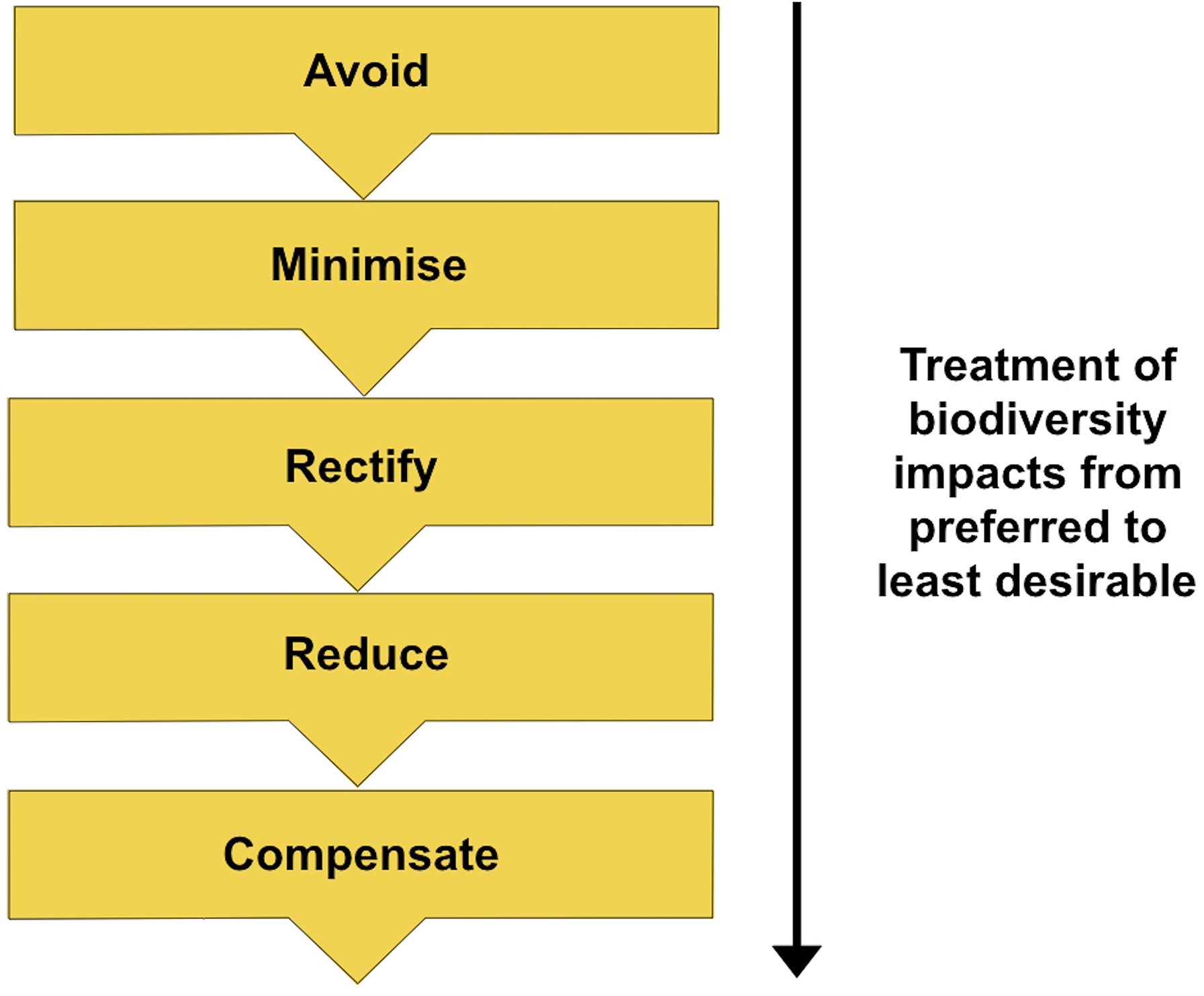
The mitigation hierarchy as a linear gateway model prior to the ‘net’ aggregate rule. Adapted from Council for Environment Quality Executive Office of the President, 2005.
The net of a biodiversity baseline (x-axis) in combination with the aggregate quantitative vertical plane (y-axis) creates idealised movable natures that align with regulatory efficiency and flexibility. By positioning biodiversity value on a linear scale, the y-axis configures substitutability between numerical units, legitimising the notion of exchange between environmental loss for gains in quantitative terms. It is consequently this net principle, which amounts to efficiency and regulatory cost avoidance envisaged under the mechanism in the Clean Air Act. Bigger (2015), for example, notes within the climate market policy of Cap and Trade, the cap is the environmental protection, the trade is simply perceived to make it cheaper. In other words, the cap is the ‘end’ and trade is the ‘means’. Wilshusen and MacDonald (2015: 16) propose the mitigation hierarchy ‘provides a framing mechanism that schematically abstracts, simplifies and homogenises biodiversity in ways that compartmentalise negative impacts and enable compensatory trade-offs’. But this only became the case as it morphed into a two-dimensional X-Y model as combined with the diagram of NNL (as in Figure 1), which directly reduces the holistic character of biodiversity to a linear scale. The hybrid version introduced flexibility and latitude in conservation compliance almost three decades after the original mitigation hierarchy was invented.
Several kinds of abstraction are at play here (e.g. capitalist, spatiotemporal, semiotic and graphical). These collectively underwrite the transformational work the NNL diagrammatic graph performs. Drawing a few connections through these kinds of abstraction brings us to the productive seam between economic sociology/ science studies and structuralist strains of political economy to trace which kinds of value making are being practised (Bigger and Robertson, 2017; Lave, 2012) in the ‘green’ economy. The abstract space embodied by the graphical diagram derives from its origins as a Cartesian coordinate system marrying two-dimensional geometry with a mathematical ideal plane (Krämer, 2010). The Cartesian coordinate system as a series of statistical charts including the scatter plot, line and bar graph was developed and popularised in the late 18th century by the English political economist William Playfair specifically to represent abstract aggregate data of measurable phenomena in economic planning. The bar chart was invented to represent commercial events of trade imports and exports against years as time series (Tufte, 2001). William Playfair's Commercial and Political Atlas (1786), which was the first of three editions, set out a vast range of innovative graphical devices to hasten the communication of financial information against time and place. The bar chart was an innovation to support new imaginations of the economy in the abstract (Fisher and Stedman, 2020) and make it more efficient to do so.
Marxist geographers have long expounded on the role of spaciotemporal abstraction in the self-reproducing systems of capitalism (Harvey, 1996; Lefevbre, 1991 both cited by McCormack, 2012). Diagrams and graphs participate in this calculative reason as they abstract from context, obscure corporeal difference and lived experience (McCormack, 2012). The word biodiversity is itself a monolith denoting other categories of species, habitats and genetic diversity underneath it (Dempsey, 2016). Fredriksen (2017) reminds us that biodiversity is a modern invention arising from positivist ontologies that abstract place-based and embedded social natures into one term. Abstraction to universal quantity makes things calculable through fabricating generality between them spatially or functionally (Castree, 2003). This kind of abstraction is also intrinsic to the making of imaginary units of universal equivalents for exchange (Callon and Muniesa, 2005). These effects combine to enable the imagination of an individuated unit of biodiversity value and the pervasive logic of valuing nature using offsetting (Carver, 2015). It is here that restoration ecologies of repair are made to appear coherent when units of health and harm translate seamlessly into the gridded cells of an Excel spreadsheet (Carver and Sullivan, 2017).
Another achievement of visual abstraction, of course, is to attain heightened mobility across contexts. This was more than apparent to William Playfair, who in the late 18th century declared that the visual representation of data in graphs would arouse a ‘…sufficiently distinct impression… to remain unimpaired for a considerable time, and the idea which does remain will be simple and complete…’ (Playfair, 1801, cited by Tufte, 2001: 32). Playfair had an instinctive appreciation for the perceptual and cognitive potency of the statistic graphs, advertising that ‘Men of high rank or active business, can only pay attention to outlines…’, and that ‘…with the assistance of the charts, such information will be got without the fatigue and trouble of studying the particulars.’ (Playfair, 1801: xiv). ‘No net loss’, which is a diagram that symbolises and projects normative improvements in quantified nature (as though the remedy has already been delivered), has travelled across time and space as a policy standard in conservation strategies and visited every scale of environmental governance. The successful mobility of NNL is not, of course, authorless and I do not mean to suggest it moves on its own. Various invested actors have helped to institutionalise NNL outside of the regulatory contexts of US environmental policy. It is to this period of NNL's history – which acts as a bridge between the US 1980s and the bureaucratic policies of England 40 years later – that I now turn.
Attaching biodiversity to ‘no net loss’ and going global
Without rehearsing the well-told histories (Benabou, 2014; Bonneuil, 2015; Lockhart and Rea, 2019) of the origins of biodiversity offsetting through the early parts of the 21st century, it is perhaps worth revisiting some specific facets of this record. Of particular interest are the processes of translation through which NNL as an approach travelled from its origins in wetland policy in the US, to be taken up by the transnational mining sector (see also Brock, this special issue) and then landed in English land planning policy two decades later. Beyond the visual potency of the NNL/mitigation hierarchy diagram, other lively actor assemblages converged in ways that supported the conditions for the idea's mobility, as well as state-sponsored mediations (Ouma et al., 2018). It is many of these wider ‘mundane conditions’ that are responsible for helping to produce and reproduce the conditions for the transference of scientific representations across contexts (Woolgar and Lynch, 1990: ix). Tracing these institutional, political and policy relations help us see how NNL attains and maintains ‘representational adequacy’ (Robertson, 2012), for policy entrepreneurs, government officials and ecologists from different sectors.
Operating under the umbrella of Washington based, market-focused environmental think tank Forest Trends, the BBOP was a central node in this translational network. Between 2004 and 2018, BBOP worked to authorise the expert knowledge and language of no net loss and offsetting approaches, principally through forging alignments (Li, 2007) between individuals and institutions in stabilising the idea and policy goal. Lovell and MacKenzie (2011) outline a similar process whereby accounting professionals inadvertently make up a central role in actively producing a new carbon economy through reports, narratives, depictions and conventions. BBOP worked to stabilise the idea of a biodiversity offset economy institutionally through prolific report writing and the building of epistemic communities by convening spaces for professional networking and collaboration. Former barrister and director of investor responsibility at international asset management firm, Insight Investment, Kerry ten Kate as Director for the organisation authored a seminal report as one of BBOP's initial contributions Biodiversity offsets: views, experience and the business case (ten Kate et al., 2004). The report became a bridge for NNL approaches between US wetland and species mitigation techniques into the rest of the world (Calvet et al., 2015). Varieties of wetland or species offsets had been developing for the previous two decades in the US. But this was the moment when the word biodiversity became attached to offsets and presented for use in an international and voluntary rather than a regulatory context. The translation is significant. To offset something called ‘biodiversity’ is a wholly different proposition to offsetting acres of wetland or habitat for a single species. 3
In the early 2000s players across the extractive and conservation industries were seeding working alliances within what has been characterised as a wider ‘renegotiation of organisational order’ (MacDonald, 2010). These novel coalitions helped mining firms ameliorate reputational pressures arising from civic institutions and green lobbies (Benabou, 2014). Early articulations of alliances for ‘business and biodiversity’ were institutionalised in membership NGOs like BBOP (Wilshusen and MacDonald, 2015) who promoted offsetting mechanisms to business and investment communities as strategies to manage these reputational risks and capitalise on public perception of social responsibility (Benabou, 2014). The rhetoric of innovation and pragmatism also served to generate additional affective appeal (see also Brock, this issue). In 2004, Rio Tinto adopted the ‘net positive impact’ principle into its Biodiversity Strategy and launched a version of the visual diagram of NNL as shown in Figure 1. In so doing, it positioned itself at the forefront of this voluntary initiative (Benabou, 2014) and invented a curiously successful and iconic image to find favour by industry and biological conservation actors simultaneously.
Over the subsequent 14 years, BBOP published dozens of papers, technical reports and guidelines. These include the widely circulated industry and policy guidelines Biodiversity Offsetting Handbook (BBOP, 2009) showing the NNL/mitigation hierarchy diagram (Figure 1) and the BBOP Standard (BBOP, 2012). The effect was to mainstream biodiversity offsetting through institutional conservation actors by growing an organisational membership in BBOP. Until it disbanded in 2018, BBOP positioned its role as ‘coordinating an international community of practice’ amongst auditors, developers, conservation groups, communities, governments and financial institutions 4 . It also frequently enrolled technical experts from conservation consultancies such as The Biodiversity Consultancy and eftec, with whom individuals from its Secretariat co-authored BBOP reports and scientific papers including a 2010 article by two of its founding members in the journal Nature (Bayon and Jenkins, 2010). The institutional and organisational networks of this field were quite small meaning many of the same individual promoters appeared repeatedly in the context of different reports, conferences, and programmes. The work involved reaffirming the technical and empirical legitimacy of NNL as an approach through varied but often overlapping fora. By 2010 the agenda filtered through into the global policy infrastructures of the Convention for Biological Diversity (CBD) and the strategic priorities of IUCN under the rubric of the ‘green economy’ more generally (MacDonald, 2010). In this context, BBOP promoted biodiversity no net loss in parallel with what was to become an iconic moment for natural capital valuation through The Economics for Ecosystems and Biodiversity (TEEB) study. No net loss was later incorporated into the Jakarta Charter in preparation for The CBD Nagoya meeting and the Aichi targets that followed (CBD, 2010). By now, NNL had attained legitimacy at the highest policy levels. The literature from both biological and social science disciplines, however, highlighted problems. In a review article, for example, conservation biologists Walker et al. (2009) surmise that biodiversity offsetting in practice operated as little more than a symbolic policy used by regulators with limited interest in addressing the wider causes of biodiversity loss. But the policy-oriented technical literature of BDO continued to present these theoretical and practical problems as being inherently resolvable. Better scientific techniques, more resources, refined administration (Gardner et al., 2013) and simply more and better policy guidance (Pilgrim et al., 2013) are discussed as ways BDO could overcome its technical challenges.
Drawing from Li’s (2007) terminology ‘practices of assemblage’ which converge in ways to stabilise forest governance norms, similar processes of ‘refinement’ continue to affirm the potential for offsetting. Strategies to ‘render technical’ and ‘manage failures’ (Li, 2007) are characteristic of policy orthodoxies that remain contested. The policy literature identifying programme limitations (often authored by members of the epistemic community from the BBOP assemblage discussed) does not question the internal logic of biodiversity offsetting and NNL. Instead, the papers narrativise, reaffirm and reproduce the basic axioms of aggregate rules and trading instruments. This stabilisation of BDO's enabling assumptions is consistent with the expectations of assemblage theory in general. Agency here is credited to ‘…situated subjects who do the work of pulling together disparate elements without attributing to them a master-mind or a totalising plan’ (Li, 2007: 265). ‘Habit, accretion and bricolage’ (Li, 2007: 265) ensure substantive assumptions tend to go unchallenged.
How did biodiversity offsetting and NNL become so popular when its empirical foundations were so weak (Benabou, 2014; Calvet et al., 2015)? This paper accounts for the agency of a conceptual technology in relation to narratives and institutional dynamics that support accounting imaginaries for environmental debits and credits. I have used the term conceptual technologies to capture the cognitive and psychological dimensions which circumscribe certain technical (and measurable) solutions, occluding wider debate about the systemic drivers of biodiversity loss in the first instance. It is in these ways that NNL and the mitigation hierarchy are performative of offset-able natures. There is in addition a moral imperative at play aligned to an ethical framework for action. NNL is therefore performative in a circular sense – it expands our ‘capacity to envision’ (Li, 2007) biodiversity as an economic abstraction and calculable entity, while simultaneously relying on such frames for its legitimation. The recursive logic to NNL naturalises restoration and accumulative strategies. Our journey now turns to the specificities in how NNL became an ethical environmental as well as an economic growth norm in England several years later.
Net loss to gain in England and misadventures in offsetting
NNL found its feet in England in an official sense in 2012 through the reform to land planning policy produced in the National Planning Policy Framework (NPPF) (DCLG, 2012). In the three years before, ideas were refracted through a prism of technical reports and economistic environmental studies, a strengthening language of valuation, a revolving door of consultants and policy advisors as well as a set of wider enabling political factors. The Conservative lead new coalition Government in 2010 under a banner of ‘localism’ was seeking to deliver on its manifesto promise to reform the land planning system it had described as a “barrier to growth and wealth creation” (Conservative Party of United Kingdom Party Manifesto, 2010: 20). Re-drafts to specific language in the planning framework laid the policy scaffolding for NNL by incorporating the conceptual techniques developed in the US environmental policy 40 years earlier. The mitigation hierarchy was emphasised and compensation was strengthened as a ‘last resort’ but most importantly the ‘no net loss’ (NNL) and ‘net gain’ (NG) (DCLG, 2012: 3) principles appeared for the first time in English planning guidance. Other kinds of ecological compensation in English planning existed beforehand (Treweek et al., 2009; Whatmore and Boucher, 1993). These changes, however, represented a new level of calculative precision in that guidance stipulated biodiversity gains must be ‘measurable’, denoted through metrics and proxy scores and sustained over time (DEFRA, 2013). No net loss and NG replaced the prior Planning Policy Statement 9 (PPS9) Biodiversity and Geological Conservation policy that until this point required development to have ‘minimal impacts’ and enhancements ‘wherever possible’.
The NPPF also included the pervasive ideological reformulation for a ‘presumption in favour of sustainable development as a golden thread running through planning’ (DCLG, 2012: 4)
In tandem with a new policy agenda, a deepening project of austerity underscored a mismatch between the rhetoric of the ‘greenest government ever’ while withdrawing government spending on the environment. The moment was one of a stabilising consensus for ecosystem valuation and market mechanisms to stimulate innovative sources of funding for nature (Comerford et al., 2010) 5 in line with financial austerity and the green economy. These dynamics merged with an economic recovery agenda characterised by deregulation. In what would later inspire Donald Trump's early presidential moves, David Cameron presented a quantitatively defined ambition for the overall net loss in business regulation through a ‘one in, two out’ rule. This was latterly stepped up to a one in, three out rule expected to ‘cut a further ten billion pounds of red tape’ (Dept. Business Innovation and Skills et al., 2015). The Cabinet office maintained a website called Cutting Red Tape emblazoned with a logo illustration of red tape being cut by scissors to emphasise the point. 6
Indeed, a paradox that faced the UK's Treasury in 2015 were the difficulties with setting up efficient trading arrangements for conservation ‘values’. Units of biodiversity were after all new inventions and not familiar to an ecological institution used to counting different things. The DEFRA metric was designed to make biodiversity units as a currency for the basis for netting out exchange (see Carver and Sullivan, 2017). But this is a compound metric that combined both spatial measurements with other scores for categories of habitat characteristics (distinctiveness and condition). Environmental values that are more complicated to measure than equivalents in mass or area, like tonnes of emissions or acres of wetland, produce tensions and frictions at the point of trade through high transaction costs (Sulzman and Ruhl, 2000). Emissions trading schemes are economically attractive partly because it is possible to exploit the cost differences in reduction activities that can show ‘like for like’ with uniformly accepted equivalences. Efficiency gains for the biodiversity offset, however, are constrained by stringency requirements which fetter the spatial, temporal and categorical exchange rules (often to a specific area or habitat type). To try and make the measurement of biodiversity units efficient in this process, often the search for scientific precision rubs up against the policy and economic pragmatisms (Carver and Sullivan, 2017). Over this period of experimenting with offsetting, it became progressively clearer to the government that the system would cost developers more to obtain development permissions even while it was supposed to cost them less. The deregulatory commitments in England meant that the economic, as well as the political costs of imposing mandetory biodiversity compensation payments for NNL, were simply not tenable for the Coalition Government months before the next general election in 2015. As such, after the election, the name ‘biodiversity offsetting’ quietly faded out of sight and mind as the policy cycle moved on. Notably, however, offsetting in practice continued and accelerated, with recourse to the ‘no net loss’ policy written in the NPPF. Motivated local government ecologists and developers based on a social license to operate, continued to use the national planning policy in addition to the measuring tools supplied by DEFRA in its biodiversity metric. With the imagination of a biodiversity accounting framework in NNL, there is no need for programmes to be called offsetting. The conceptual tools for net principles are already in place and increasingly taken to be an ethical norm.
Scrambling in the years that followed the unexpected and unplanned for Brexit referendum vote in 2016, the UK Government's long-awaited 25-year environment plan eventually materialised in 2018 (DEFRA, 2018: 32). The Plan put forward a ‘environmental net gain’ as Principle number 1 of Chapter 1. An updated version of the National Planning Policy Framework (NPPF) was published in 2018 (DCLG, 2018: 170) and stipulated plan making must minimise ‘…impacts on and provide net gains for biodiversity’. It is noticeable that during this period speaking of ‘net gains’ has become a vernacular way of communicating a commitment to biodiversity outcomes, in general. Using an accounting imaginary of gains and losses, NNL and NG have come to embody a primary ethical norm for conservation in ways that naturalise offsetting without even using the term. DEFRA did not publish the diagram of NNL as shown in Figure 1. Throughout the early years of the textual standard arriving in England, however, the visual component circulated through the publications and websites created by a range of ancillary advocates, including industry bodies, consultant ecologists, planning consultants, and the wider social ecosystem of land governance actors in England. The balance sheet imaginary invoked by the net gain principle in the Government's 25-year environment plan is now, however, rendered explicitly as a visual metaphor of a scale balance, conflating the regimes of value across forms of measurement and social worth (see Bracking et al., 2018). This is evidenced by an image weighing forest value against housing value (Figure 3) produced by a firm of consultant planners to promote their expertise to residential developers.
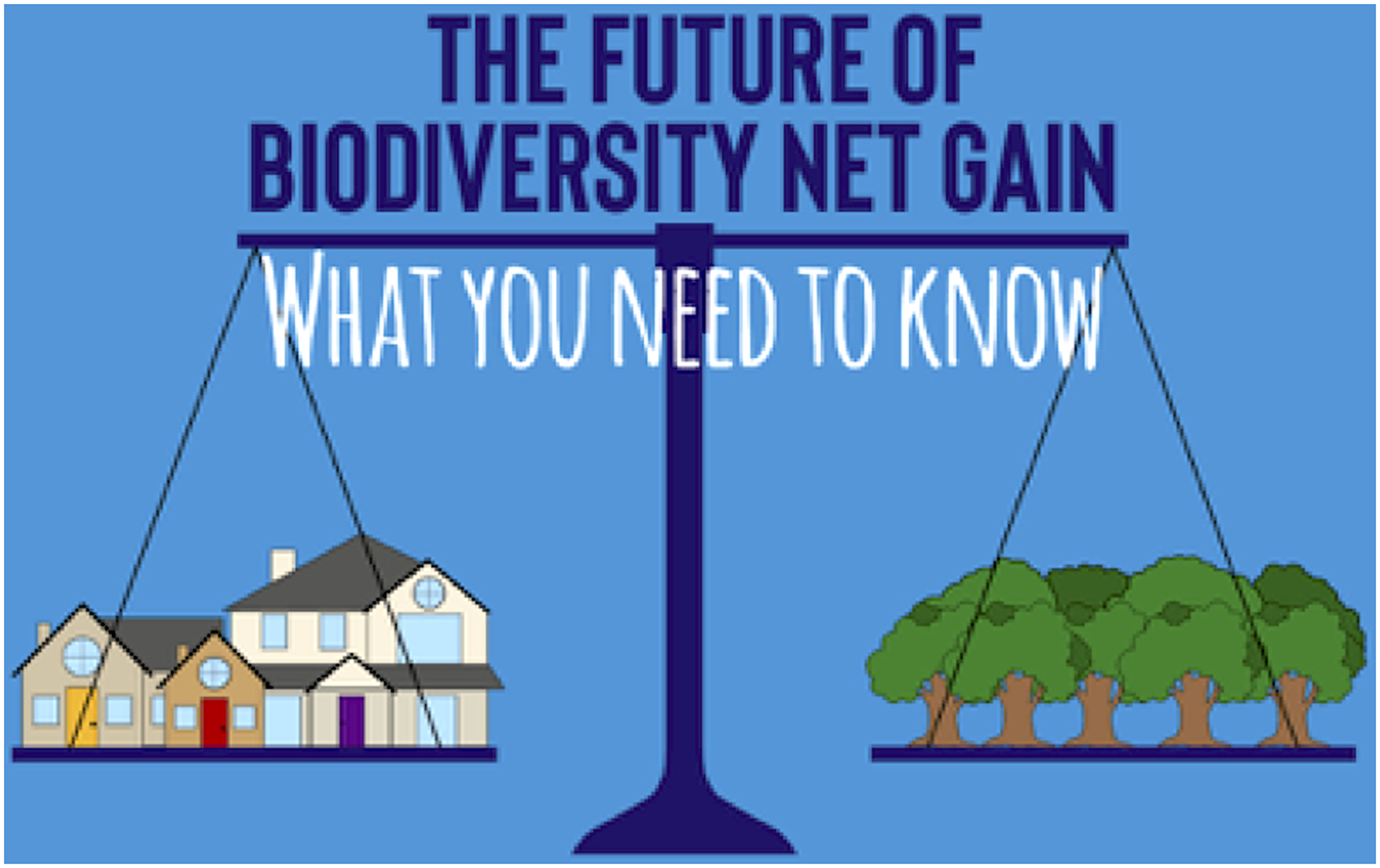
Translations to a scale balance.
Interestingly, the visual metaphor as scale balance, links to the ancient symbol of justice held by the icon Lade of Justice celebrateing the rationalising capacity for administrative legal processes to weigh two sides of an argument; two values. Indeed, ideas linking the weighing of equivalent values to rationality stretch back to Plato, who considered it necessary to render ethical values commensurate, to prioritise them (Espeland and Stevens, 1998). The Commensurable and measurable values, however, are rooted in the principles of flexibility and efficiency produced through the aggregate rules aggregate rules, as discussed above, The construction of commensurate values in nature however, is useful for capital accumulation precisely because it can successfully transcend the locational specificities of biologic relations otherwise blocking development processes. It is in this way that when afforded a unit value, biodiversity can be rationalised through a singular order of worth (Boltanski and Thévenot, 2006) weighable with other so-called equivalent unit values. The effect is to make existing habitats and ecosystems compliant with the spatial demands of capital associated with expanding residential and infrastructural developments (Carver, 2017). As Pawliczek and Sullivan (2011) point out, under these conditions, conservation, counter-intuitively, can easily become ‘development-led’. In this instance, actual funding for biodiversity protection or enhancements can become bound to the spatial, temporal and financial dynamics of infrastructural or residential developments and land-use change. Instead of the alleged rationale for introducing NNL in service to ‘making space for nature’ (Lawton et al., 2010), according to these logics, it could be said the net principle instead works to make space for development, through the production of offset-able natures which can be moved around.
Rational and offset-able natures: Some concluding thoughts
The historical account presented above outlined the origin of aggregate rules and no net increase in the US environmental policy and concluded with the deployment of no net loss and biodiversity offsetting in English planning processes 40 years later. As well as emphasising the cognitive role of the visual schematic, it has illuminated the mesh-like nature or latticework of elements that have facilitated the translation of NNL across time and space. These elements include a variety of institutional alignments between business, biological and economic thought and conservation (Dempsey, 2016); persuasive discourses enacted through influential individuals; the stabilisation of dominant imaginaries (particular quantitative framings biodiversity and associated ethical frameworks); and the specific convergences in ideological and political circumstances in which such ethical frameworks appear scientifically coherent and politically convenient simultaneously.
In addition to its material consequences for biodiversity habitats, NNL also consolidates a popular imaginary of biodiversity's ‘state-based ontology’ (Maier, 2012), serving to ‘recursively amplify’ (Sullivan, 2017) a logic of the ‘offset mindset’ (ten Kate et al., 2004) or ‘offset ideology’ (Seagle, 2012). This mindset supports restoration ecologies of repair and accumulation strategies through legitimising development, supporting cheaper and reduced regulation and binding the Cartesian logics of aggregate growth to those constructed for wildlife conservation. And yet the no net loss of biodiversity is generally seen as a good thing. It is an increasingly popular and idealised standard that conservationists now tend to invoke as the goal of conservation generally. Yet, as a policy standard, NNL is the defining feature of balance sheet logic within environmental value making of ‘green’ growth that degrades the potential for regulatory protection (Spash, 2015). It is in this way that Robertson (2012: 386) suggests that NNL and the technologies of measurement it precipitates, permits planners to ‘arrive at ecosystems already encountered in commodity form’. No net loss frames and performs exchange values of biodiversity. It is emphatically not, therefore, a trivial or neutral development, but seemingly escapes the wider circuits of debate and controversy associated with its downstream policy applications like offsetting and ecosystem valuation and trading technologies. The latter are often seen explicitly as the devices that drive commodification and can enable accumulation. Instead, this paper has emphasised the anticipatory, generative and cognitive effects of NNL, which also through its deployment as a visual device facilitates a conceptual ordering in the ‘mind's eye’ (Krämer, 2010) to make nature offset-able in an idealised sense.
By way of some concluding thoughts that may take us towards more affirmative possibilities for abstractive practices (McCormack, 2012) I return to Krämer (2010: 22) who suggests ‘diagrammatic artefacts are a hinge between thinking and intuiting’. One wonders what kinds of intuition and thought such artefacts may make possible. Or, if the science-policy nexus of biological conservation is already performative in material ways (Bowker, 2000; Carver and Sullivan, 2017; Lorimer, 2006), what scope is there to turn this cycle between fact and values into a virtuous one (Kearns, 1998)? Feminist strands of affirmative political ecology (Alhojärvi and Sirviö, 2018) are increasingly committed to ‘making other worlds possible’ (Roelvink et al., 2015). This involves actively foregrounding and mobilising reparative alternatives to neoliberal imaginaries. Diagrams are ‘machines of translation’ and ‘eyes to the mind’ (Krämer, 2010: 29). Whether speculative or realist, questions arise as to the novel perception affordances and translations which could unfold through mobilising more emancipatory and hopeful conceptual technologies, myths and metaphors. Which possibilities (and indeed paradoxes) emerge for diagrams and abstraction tools to embody and amplify post-capitalist axioms and feminist, heterodox and decolonial ethics and epistemologies? What are the lifeworlds and broader assemblages that these might inhabit and help cohere? It seems to me that these now present themselves as opportunities and priorities for the critical geographies of the green economy and beyond. The task ahead is to look towards the openings for visual and other creative media as not only as methodologies for understanding the origins of scientific policy processes but as artefacts that will be generative of other worlds, in their own right.
Footnotes
Acknowledgements
I gratefully acknowledge research and writing support by the Leverhulme Trust (RP2012-V-041).
Declaration of conflicting interests
The author(s) declared no potential conflicts of interest with respect to the research, authorship and/or publication of this article.
Funding
The author(s) disclosed receipt of the following financial support for the research, authorship and/or publication of this article: This work was supported by the Leverhulme Trust (grant number RP2012-V-041).