




Abstract
Defensive urban design, also known as hostile or exclusionary design, refers to the deliberate or incidental use of design elements to obstruct or exclude certain users from public spaces. This article explores the valuation processes involved in defensive urban design, focusing on Brunnsparken, a city square in Gothenburg, Sweden. Using a valuation studies framework, we investigate how different stakeholders assess and assign value to users and uses during the redesign process. Our study reveals that defensive urban design is not solely about exclusion but represents a spectrum of valuations, involving both positive and negative assessments that shift throughout different stages of urban redevelopment. This complexity shapes the governance of public spaces and challenges the simplistic notion that defensive design exclusively targets marginalised groups. By examining these nuanced processes, we contribute to a broader understanding of the moral and social implications of defensive urban design, highlighting its capacity to simultaneously foster inclusion and exclusion. Our findings underscore the need for thoughtful approaches to public space design that can balance diverse user needs and promote equitable urban environments.
Introduction
Defensive urban design, also known as hostile, disciplinary, unpleasant or exclusionary design, refers to the intentional or incidental use of design elements that obstruct or exclude certain users and uses from public spaces (de Fine Licht, 2017; Johnsen et al., 2021; Petty, 2016; Rosenberger, 2020; Smith and Walters, 2018). Examples of defensive design include anti-homeless benches, skate stoppers and public structures intended to discourage loitering. These practices have raised ethical questions about the inclusiveness of public spaces and about who gets to decide the conditions of access. This article aims to explore how different users and uses are evaluated in defensive urban design processes and how these valuations shape both process and outcome.
The study of the mechanisms through which actors get excluded from public space is by no means new. Many scholars have demonstrated that space is not an empty container. Instead, space, and who gets access to it, is socially produced through the interaction of spatial practices, physical design and the mentalities of different actors (Gottdiener, 1985; Lefebvre, 1991). Other researchers, following these traditions, have shown that space actively produces and reproduces social relations, including power structures and inequalities, meaning that spatial justice and injustice are manifested in spatial configurations (Dikeç, 2001; Fainstein, 2010; Marcuse, 2009; Soja, 2010). This foundational understanding highlights how spatial practices shape societal relations and the role of power in determining who has access to urban environments, providing a critical perspective for understanding defensive urban design.
Building on these foundational critiques, scholars have argued that the commodification of urban space under capitalism threatens the right of all inhabitants to access and shape both cities and their own identities within urban space (Harvey, 1973, 2008; Lefebvre, 1996; Mitchell, 2003). The trend of privatisation and commercialisation of public spaces has shown how these transformations affect access, use and governance through mechanisms such as restrictions on behaviour, sanitation requirements and consumption-orientated environments (Atkinson, 2003; Banerjee, 2001; Low and Smith, 2006; Mitchell, 1995; Sorkin, 1992). Moreover, the production of certain atmospheres and ambiances can exclude by inclusion – creating spaces that cater to specific user groups while marginalising others (Allen, 2006; Thörn, 2011). This also includes the redesign and repurposing of public spaces to cater to more affluent communities, leading to gentrification and displacement of marginalised groups (Lees, 2008; Smith, 1996; Zukin, 1995).
The increased militarisation and control in contemporary cities have further contributed to exclusionary dynamics. Practices and technologies such as law enforcement, surveillance, walls, gates and tracking and monitoring are used to protect urban space from perceived threats, exacerbating social inequalities and exclusion (Davis, 1990; Graham, 2010; Low, 1997). These measures create a highly controlled and selective environment, which often disadvantages already marginalised groups. Furthermore, formal and informal networks, particularly those involving coalitions between governmental and non-governmental actors, frequently align local governments with private sector elites to prioritise economic vitality and exchange value over the use value for marginalised communities (Flyvbjerg, 1998; Logan and Molotch, 1987; Stone, 2004). These practices contribute to the exclusion of disadvantaged groups from public spaces.
In contrast to these economically driven perspectives, some scholarship has focused on the potential for public participation and dialogue to foster spatial inclusion. Scholars such as Innes (1995), Forester (1999) and Healey (1997) argued that consensus-driven decision-making could create urban spaces that reflect diverse interests. However, other researchers have pointed out that these processes often conceal power imbalances and favour hegemonic actors, framing exclusionary measures as technical solutions rather than political decisions (Huxley and Yiftachel, 2000; Fainstein, 2000; Swyngedouw, 2005). This critique has led researchers like Purcell (2008) and Mouffe (2008, cited in Wallenstein, 2023) to advocate for open, agonistic debate as a means to transform power relations and promote inclusivity.
Cultural factors also play a significant role in producing spatial exclusion. Researchers have, for example, examined how individuals’ embodied and often unreflexive skills, habits, preferences, tastes and other resources, derived from their life experiences and positions in the social structure (e.g. in terms of class and gender), influence their capacities to access and shape urban space in competition with other actors (Dovey, 2010; Soja, 2000; Wacquant, 2008; Zukin, 1995). Public spaces are often organised in ways that reinforce existing social hierarchies and cater to the preferences of urban elites, frequently excluding or rendering marginalised groups invisible. Recently, new research streams have also arisen that adopt more materialist and processual views on how spatial exclusion is produced. This research has mapped how urban territories are built from the ground up, viewing them as the contingent outcome of temporarily stabilised assemblages or networks of humans and non-humans. From this perspective, spatial inclusion and exclusion are never fixed or predetermined; rather, they are continually negotiated through processes of territorialisation and deterritorialisation (Farías, 2010; McCann and Ward, 2010; McFarlane, 2011). These perspectives emphasise the fluid and dynamic nature of urban space, challenging static notions of inclusion and exclusion.
The shift from a broader critique and examination of urban exclusion to a focus on defensive design reveals how specific interventions in urban environments may enforce exclusionary logics. Many scholars argue that defensive urban design, including approaches like Crime Prevention Through Environmental Design (CPTED), manifests socio-political dynamics that deliberately restrict access and regulate behaviours, potentially entrenching social inequalities. Notable examples include Rosenberger’s (2017) concept of ‘callous objects’ and Petty’s (2016) discussion of the London spikes controversy, which illustrate how elements like anti-homeless spikes exclude marginalised individuals. These features embody societal callousness and, in some cases, even an ‘unjustified form of violence’ (Petty, 2016: 77). Chellew (2019) expands on this by examining defensive design beyond urban centres, while Smith and Walters (2018) introduce the concept of ‘desire lines’ as a form of resistance, highlighting how marginalised groups navigate and reclaim spaces despite defensive measures. Koskela (2000) explores how video surveillance targets behaviours like loitering and skateboarding, reinforcing exclusionary practices. More recent research examines the broader impacts of defensive design on public health, environmental sustainability and social dynamics (e.g. Giamarino, 2022).
However, while these perspectives have significantly advanced our understanding of defensive urban design, they often overlook the complex, granular and changing processes of valuation that occur during urban development. Specifically, there has been a lack of focus on how different stakeholders, ranging from policymakers to designers, assign value to various users and uses of public space. Recent calls in the field (Carmona, 2021; de Fine Licht, 2023; Johnsen et al., 2021; Rosenberger, 2020, 2023) have emphasised the need for a more nuanced and comprehensive understanding of defensive urban design processes. Our study aims to address this gap by applying conceptual tools from valuation studies (Helgesson and Muniesa, 2013) – a largely unexplored perspective in this field – contributing to the broader discourse between valuation studies and urban studies (Metzger and Wiberg, 2017; Molnar, 2022).
Valuation studies, as introduced by Helgesson and Muniesa (2013), provide a framework for analysing how different actors in real-life settings assess and assign value to people, activities and spaces. Unlike traditional sociological approaches that primarily focus on the outcomes of exclusion or specific values, valuation studies allow us to unpack the processes through which worth is negotiated, contested and embedded in urban design decisions (Helgesson and Muniesa, 2013; Lamont, 2012). A focus on valuation practices means capturing a diverse array of value expressions under a single concept –‘valuation’. These can be articulated in various forms, such as numbers, words, body language or images, and can refer to different types of values, including environmental, economic and social aspects.
Valuation can involve standardised calculations or more judgment-driven assessments, including forms like critique, praise and denouncement. By examining these diverse valuation activities, our approach highlights the cultural and material factors that influence valuation in specific situations, along with their effects. This perspective shifts the focus from merely identifying the actors involved or their respective interests to examining how situational factors shape valuation practices. In doing so, valuation studies provide an important perspective to understand the production of defensive urban design beyond typical concerns such as privatisation or biopolitics. Thus, our unit of analysis differs from previous defensive design research by focusing on the processes of valuation that underlie design decisions, rather than merely the outcomes of exclusion.
Given these gaps in existing research, our study aims to explore how defensive urban design processes incorporate various explicit and implicit valuations that may influence inclusion and exclusion in different, and potentially contradictory, ways. By examining these valuation processes, we aim to provide a more granular understanding of how urban design decisions are made, contributing to a nuanced perspective on the shaping of public space. Thus, in this article, we address the following research questions: (1) How can different categories of users and uses be evaluated in defensive urban design processes? (2) What are the patterns of agreement and disagreement in these evaluations? (3) How do these evaluations influence the shaping and governance of public space?
Our study, focusing on Brunnsparken’s regeneration in Gothenburg, Sweden, reveals that defensive urban design involves a nuanced interplay of both positive and negative assessments of a wide range of users and uses – including the public, consumers, workers and even non-human animals – rather than merely excluding marginalised groups. These evaluations are not static; they feature both harmonious and dissonant valuations, occurring not only between different stakeholder groups but also within individuals over time. This evaluative complexity significantly influences the shaping and governance of public space, affecting design decisions such as the removal of certain structures, the addition of features like lighting and seating and the implementation of security measures.
Importantly, our findings challenge the simplistic narrative that defensive urban design exclusively prioritises middle-class consumption, showing that it sometimes strives for inclusivity, making public spaces more accommodating for diverse users. Thus, our research presents a more comprehensive understanding of the valuation processes inherent in defensive urban design, providing a foundation for deeper analysis of its ethical implications and contributing to a more nuanced discourse on urban space transformation. Defensive urban design processes indeed involve exclusion, where certain users and uses are intentionally obstructed or discouraged. Even so, this article demonstrates that the valuation of users and uses is more plural than simply devaluing marginalised groups while ascribing positive value to middle-class consumers and other attractive groups. Since we know that these expressions of value at least sometimes shape public spaces, it becomes evident that one way of understanding the varied manifestations of defensive design is by following the chains of valuations they are constituted by.
The remainder of this article is organised as follows: first, we describe the theoretical framework, followed by a methodology section. We then present our findings, focusing on the valuation processes in Brunnsparken, and discuss their implications. Finally, we conclude by exploring how defensive urban design involves a spectrum of valuations, highlighting both inclusionary and exclusionary dynamics.
Theoretical framework
The recently proclaimed and interdisciplinary field of valuation studies examines the social practices through which humans and non-humans pragmatically assess, produce and negotiate the value of persons, objects or events (Helgesson and Muniesa, 2013). Valuations, in this sense, are everywhere, although they are seldom referred to as such. Instead, they tend to be embedded in practices with other names, such as talking, writing, sketching or observing (Farías, 2015). Any individual act of valuation can vary in terms of what means of expression it uses (e.g. numbers, gestures, words or visuals), their degree of formality/informality, the relative importance that subjective judgement and/or objectified calculation plays in them, as well as what values and principles they draw from (e.g. aesthetic, monetary, moral, cultural–historical and social) (Helgesson and Muniesa, 2013; Waibel et al., 2021).
Coming from a pragmatist and practice-orientated tradition and drawing heavily from materialist and spatial turns in social theory, this tradition of research tends to take as its starting point the practice or situation as part of which value is expressed. This means that exactly how the value of something is articulated in a particular situation is dependent on various situational and relational properties. These include who is performing the valuation (the valuator), who is observing the valuation (the audience) and what is being valued (the value) (Waibel et al., 2021). Furthermore, cultural–material factors, such as the rules, principles, understandings, devices, spatial configurations and resources that are present at any time and place, also influence the valuation (Waibel et al., 2021).
From this follows that any articulation of value can never solely be explained by references to the preferences, personality, habitus or social identity of the individual doing the valuing. Similarly, even though the act of valuing can at times function as a way of furthering personal or private interests, it can also be directed towards furthering the interest of others, or be more exploratory or spontaneous (Eranti, 2017).
This also means that clashes between acts of valuing, as well as attempts at resolving them, can indeed function as manifestations of more underlying conflicts of interests. However, valuation conflicts also come in other forms. Indeed, research has shown that individuals with the same basic goals and interests (e.g. belonging to the same organisation, social group or community of practice) can evaluate the same object in conflicting ways, whilst the opposite is also true. Similarly, individuals have also been shown to sometimes shift the way they value some entity over time or depending on the context (Eranti, 2017).
Lastly, research has shown that whilst valuation conflicts can be highly destructive, in daily life they can often be resolved, or at least temporarily settled, through the production of shared understandings, compromises, local agreements or acts of persuasion or domination (Molnar and Palmås, 2021).
Methodology
Employing a single case study design of Brunnsparken’s regeneration, we conducted nine two-hour-long thematic open interviews. To provide a comprehensive overview of the scheme from multiple perspectives, the researchers chose to interview individuals who had played a significant role in Brunnsparken and were employed by various organisations active in the area. While three of the interviewees worked for different municipal departments, the remaining six were employed by separate organisations, including public infrastructure companies, architecture firms, business membership organisations and law enforcement (see Table in Appendix A). Their professional roles included strategists, architects, planners, social inclusion specialists and a police officer.
It should be noted that we did not interview some of the marginalised groups affected by the design, as they were not directly involved in the design process, aside from possibly responding to a questionnaire conducted in 2017. In this study, we focused on professional evaluators, whose judgements are often influential and subject to scrutiny in these scenarios. Nonetheless, we interviewed representatives from social services who were involved in the design process and were responsible for considering the perspectives of these vulnerable groups.
We also compiled public and internal documents related to the scheme, including websites, news reports, plans and designs, studies, policies, workshop documentation and raw data from a citizen survey. The empirical data, 500+ A4 pages of text and images, was formatted similarly and then went through four cycles of abductive coding and analysis, eventually resulting in broader categories and themes used to write the article. Abductive coding is an approach that combines deductive and inductive reasoning, allowing researchers to move between data and theory to generate new insights and explanations. This method was particularly suitable for our study as it enabled us to explore unexpected findings and develop new theoretical understandings. The coding process was done following a careful, transparent and systematic open-ended process shifting back and forth between individual reviews and discussions within the two-researcher team (see Watkins, 2017).
Results and analysis
This section analyses Brunnsparken’s regeneration, focusing on the continuous valuation of users and uses performed by different valuators using various valuation devices. We also examine moments of dissonant valuations and how these were resolved.
The regeneration begins
In 2017, when this study began, Brunnsparken had been a focal point of discussions and debates in Gothenburg’s political forums and media for several years. These discussions often attributed positive value to Brunnsparken for its important cultural–historical significance, stemming from its centuries-old status as a public square and park. Brunnsparken was also frequently valorised for some of its users and uses, though many of these values were perceived as latent and untapped.
The site’s value was linked to its status as one of the city’s most visited public spaces and transport hubs. Daily, many users crossed the site on foot or by bike, waited for public transport, shopped, participated in political demonstrations or enjoyed street performances. Notably, these positive valuations were performed by a diverse range of actors, including journalists, politicians, public servants, police officers, local businesses and property owners (e.g. Boscantin, 2017; Dalman Eek, 2017; Göteborgs Stad, 2018; Interviewees 6 and 7).
However, the actors who praised the site also criticised it. These criticisms typically targeted Brunnsparken’s intensive public transport environment, which made it dangerous for transport users, pedestrians and cyclists. The site’s dense, darkness-inducing canopy of trees, combined with excessive noise, made it less attractive for public lingering. Additionally, the site’s flooring, made partly of fine-grained rock flour and partly of cobblestones, was criticised for being uneven and full of cavities, creating accessibility issues and risks of tripping (and slipping during winter) for the elderly and those with limited mobility. Consequently, some members of the public avoided entering Brunnsparken, especially its central park area, opting instead to move along the edges of the site. As journalist Fröken Fingal (2017) observed: ‘In Brunnsparken there exists a very strange behavioural pattern. You don’t visit Brunnsparken, you walk around it … No experienced Gothenburger enters the real Brunnsparken’. Ongoing criticisms were also directed at certain users and uses that had recently gained increased presence at the site, primarily drug dealers engaging in open drug dealing but also marginalised users such as people with alcohol issues, drug users, panhandlers, beggars, homeless and asylum seekers lingering at the site individually or in groups. These criticisms were based on principles of safety, security, beauty, pleasurability and social order. Moreover, non-human users like rats, pigeons and seagulls were prominent objects of criticism due to their perceived negative impact on human health, social order, aesthetics and cleanliness. The following newspaper quote by Moderate (liberal-conservative) politician Tykesson (2017b) encapsulates several of these criticisms:
1
A place that could be a beautiful oasis in the middle of the pulsating Gothenburg … has during recent years become a place associated with garbage, vermin, disturbances of order and criminality. Here groups of people gather, both in daytime and during the late evening, to loiter, meaning to place themselves on benches and do nothing.
Thus, the criticism of Brunnsparken’s physical space was intertwined with both the appreciation of some users and uses, and the disapproval of others. City politicians across the political spectrum largely shared these views, prompting the ruling majority to commission a pre-study to explore whether a physical upgrade could make Brunnsparken safer and more welcoming to the public while reducing its criminality and social problems (Göteborgs Stad, 2017b).
A stakeholder dialogue
A small team of municipal employees from the Parks and Nature department (P&N) led the pre-study. Over several months, they organised various activities, including a tree inventory, sound study and cultural–historical assessment.
The stakeholder dialogue process stood out as an activity focused on valuing users and uses. This process included a series of six expert workshops, which served as valuation practices (Petersson and Soneryd, 2022). Each workshop gathered a small group of public, private and civil society professionals with expertise in specific areas such as urban planning, security, accessibility or social welfare. These experts evaluated Brunnsparken’s strengths, weaknesses, opportunities and threats using a SWOT analysis (Göteborgs Stad, 2017b), which functioned as a valuation device.
Workshop records show that many criticisms were similar across individual sessions and echoed earlier political and media discussions. The site’s criminal activity (drug and stolen goods sales, physical abuse, violent fights) and presence of marginalised groups were frequently disparaged, as they were perceived to make the area less safe and more unwelcoming to the public. Brunnsparken’s heavy and noisy traffic, poor lighting and uneven ground were again faulted for impeding accessibility, safety and navigation for favoured users such as pedestrians, cyclists and people with visual or mobility impairments. Several workshops also expressed disapproval of pigeons, seagulls, rats and those who feed birds, citing concerns about cleanliness, health and social order.
Positive assessments of uses and users were also consistent across workshops and previous discussions. All sessions highlighted the site’s high foot traffic and diverse activities, including eating, drinking, socialising, street performances and political demonstrations. These favourable views were rooted in concepts of vitality, social interaction, democracy, creativity and economic value. Some workshops also praised Brunnsparken’s mix of residents from various parts of Gothenburg and different socio-economic backgrounds, emphasising the benefits of diversity and inclusion.
Another part of the dialogue was an online citizen survey on Brunnsparken’s present and future functionality open to anyone who wished to answer it (Göteborgs Stad, 2017a). Here, the survey instrument, consisting of three open-ended questions, functioned as a valuation device (on citizen surveys as sites for valuation, see Krarup, 2023). Compared to the expert workshops, the survey enrolled citizens rather than professionals as valuators, and included a larger group, namely 199 individuals compared to around 20.
Despite this difference, common criticisms largely aligned with those from the workshops. Respondents focused on Brunnsparken’s criminal activities, marginalised groups and bird and rat problems (‘It would be nice if ordinary people hung out there instead of just drug users and bird feeders’). They also mentioned the busy traffic environment (‘it is EXTREMELY unsafe to walk among all the streetcars and buses’) and the noisy, dark and dirty park with uneven flooring and physical obstacles (kiosks, public toilets, signage, etc). One respondent suggested: Remove all the benches as they’re covered in bird droppings and only used by beggars, alcoholics and drug addicts. Plant smaller, attractive trees as the larger ones reduce visibility. Clean up the canal walls. Get rid of the gravel. Install nets to keep birds out. Add more lighting.
The survey’s positive feedback also echoed the workshops, highlighting Brunnsparken’s public transport, high visitor numbers and diverse commercial and social activities. Similar to the workshops, respondents frequently praised Brunnsparken’s mix of users from different residential and socio-economic backgrounds. One participant emphasised: ‘The mix of people: in Brunnsparken you can see all of Gothenburg represented’.
While major themes aligned between the survey and workshops, the survey naturally encompassed a broader range of opinions, some of which were more unconventional. These included ambitious design proposals (‘It would be nice to move the trams underground to create more park space’) and the use of hostile or derogatory language towards specific users.
It is worth noting that the dialogue data does not include explicit examples of open conflicts; it does however reveal implicit contrasting views on users and uses. Both workshops and survey responses contained simultaneous positive and negative assessments of Brunnsparken’s high visitor numbers (vibrant atmosphere versus stress and crowding), its commercial functions (social interaction and enjoyment versus concerns about inclusivity and public access) and its diverse visitors (social mix versus presence of unwanted groups).
Finalisation of the pre-study report
In the summer of 2017, the P&N team produced a pre-study report aimed at ‘weighing and valuing different interests and developing an analysis and well-functioning concept proposal based on these considerations’ (Göteborgs Stad, 2017b: 5). This practice required the team to evaluate and prioritise various articulations of material space, uses and users from previous practices and documents (Interviewee 3), effectively employing them as valuation devices. This may explain why many of the valuations of users and uses in the pre-study report align with those from the dialogue process, including devaluations of the site’s criminality, social problems, birds and rats, intensive traffic and dark, inaccessible park environment, as well as valorisations of its large quantity and mix of different types of users and uses.
The report’s production involved creating a ‘concept proposal’ consisting of rudimentary site plans proposing design principles for future regeneration (Göteborgs Stad, 2017b; Interviewee 3). As valuation devices, these site plans not only proposed physical changes but also included explicit and implicit valuations of users and uses, including:
removing darkness-inducing trees and introducing artificial lighting, thereby making the site feel safer and more pleasurable for pedestrians and less so for criminals;
removing barriers, such as two kiosks, a public toilet and signage, whilst creating more distinct entrances and walking corridors and evening out the ground, thus increasing accessibility and orientability for pedestrians and people with disabilities;
introducing planters with flowering greenery, a variety of types of seating and sound barriers to make the site more comfortable to linger in for the public and less attractive for unwanted users.
The concept proposal’s production differed from previous practices by limiting the redevelopment area to only the central park in Brunnsparken, excluding the surrounding canal, public transport infrastructure, pavements and building ground floors. This limitation resulted from P&N’s inability to coordinate with the Traffic department, which owned much of the surrounding land (Interviewees 3 and 4). This spatial delimitation of the valuation object influenced how users and uses would be valued throughout the rest of the scheme, as many previously discussed interventions, such as reducing public transport and covering parts of the canal, were no longer feasible.
After the report’s completion, city politicians reviewed it (Interviewee 3), assuming the role of assessors. This process sparked public disagreements among politicians in media and political forums. Social Democrats endorsed the idea of attracting more people to the site as a means of enhancing safety and security (Dalman Eek, 2017). In contrast, members of the Moderates (liberal-conservative) argued that making the park more comfortable and enjoyable might inadvertently strengthen the presence of criminals and marginalised users. They advocated for increased security measures, such as additional police officers and patrolling security guards (Tykesson, 2017a, 2017b; see also Andersson, 2017), thus prioritising these users and uses.
Ultimately, the political majority approved the pre-study, deferring the aforementioned disagreement to the future. The approval process involved not only an endorsement of the pre-study’s assessments but also an economic appraisal of the cost (or worth) of implementing the pre-study, estimated at approximately 20 million Swedish kronor (Göteborgs Stad, 2017c; Hagström, 2017).
Three alternative designs
In early 2018, the P&N team commissioned White Architects to create an architectural design based on the concept proposal and budget (Interviewees 3 and 4). These documents served as guiding principles for the design process (on visuals and budgets as guiding tools, see Farías, 2015 and Styhre, 2013 respectively).
White initially produced three alternative designs. All aimed to attract pedestrians and encourage lingering. They incorporated elements from the concept proposal, such as removing trees and barriers, introducing lighting and seating and creating footpaths and entrances. The first design envisioned the park’s structure with straight, distinct and symmetrical footpaths flowing through the site at various angles, bordered by planters. The second alternative arranged trees and seating in a historically inspired grid-like structure. The third featured large, organically shaped flower beds with integrated seating in the park’s centre (White, 2018b; Interviewees 3 and 4).
The team then organised meetings for stakeholders, including many expert workshop participants, to discuss and review the three alternatives (on evaluation in review meetings, see Farías, 2015). Ultimately, the team chose the structure of the first alternative while incorporating lighting and seating ideas from the other designs (Interviewees 3, 4 and 8).
A final design proposal
Over the following months, P&N and White developed a final design proposal (White, 2018a, 2018c). They detailed the park’s spatial structure, considering which footpath widths and angles would best accommodate valued users such as pedestrians, people with disabilities and maintenance vehicles (Interviewees 3 and 4). One participant explained: ‘We wanted calm pathways where one could wander around and maybe take a seat for a minute. But first and foremost, it [the design] was about getting people there [to the park]’. The team added an open area in the park’s centre for food trucks, coffee carts, art exhibitions and public performances, as well as reviving an earlier idea for a food and drink parlour in the same location (Interviewees 3, 4 and 6). These proposals prioritised users and uses related to food and beverage consumption and arts and culture.
The team also created various seating designs to attract a larger, more diverse group of users. They placed long benches along the canal for solitary, contemplative users and integrated benches into raised planters for those wishing to linger amidst pedestrian flows (Interviewees 3, 4 and 8). However, this latter design sparked disagreement when the city’s accessibility council noted that it would reduce the planters’ function as tactile support for visually impaired users. The design was ultimately retained due to majority support (Interviewee 8).
Disagreements also arose over proposals for tiered seating by the canal and a large roof over existing public transport stops, likened to a ‘bazaar’ (White, 2018b; Interviewee 3). While various actors, including P&N, White, businesses and property owners, supported these designs for creating lingering opportunities, others, notably the police, opposed them, fearing they would attract drug dealers and homeless individuals (Interviewees 3, 4, 5, 6, 7 and 9). One participant highlighted this conflict: What kind of place do we want? If we make it very nice as the idea is of the tiered seating, then people will sit there and have a nice time. And it is not only those with high purchasing power but also those that will continue laying there in the warmth and have a nice time at night.
Several interviewees argued that it was the police’s emphasis on safety issues, combined with budgetary constraints, that, in the end, resulted in P&N changing their mind and abandoning the designs (Interviewees 3, 7 and 9). Consequently, this constitutes an example of design revaluation related to users and uses.
The building design also underwent scrutiny. Existing structures like a doughnut shop, ice cream parlour and public toilet had been criticised for impeding pedestrian flow and creating dark, secluded areas conducive to drug use, dealing and prostitution (Göteborgs Stad, 2017b; White, 2019; Interviewees 3, 4, 5 and 6). These buildings were also faulted for providing poor working conditions for staff (Bjarnefors, 2018; Lyrheden, 2018; Interviewees 4, 7 and 9). Conversely, some actors defended the buildings for catering to families and the elderly, promoting diversity and inclusion. Despite this debate, the proposal to demolish the buildings ultimately gained sufficient support.
Approximately six months after work on the design proposal began, it was reviewed and approved by Gothenburg’s political majority (Hermansson and Dalman Eek, 2018; Moberg, 2018; Rooth, 2018). This approval lent increased legitimacy to the proposal’s embedded assessments of users and uses.
From design proposal to an opened park
In the autumn of 2018 (September–November), P&N and White focused on the site’s technical design and programming, with construction work beginning almost a year later (Enström, 2019; Kågström, 2019). These phases also involved assessments of users and uses.
The actors worked on detailed landscaping. White developed a list of greenery for the raised planters, evaluating plants based on their ability to provide pleasant experiences for the public year-round, while both walking and sitting in Brunnsparken. P&N maintenance staff then reviewed the list, considering which plants would be practical and economically viable for long-term care (Göteborgs Stad, 2022 [2020]; Interviewees 3 and 4). The maintenance staff’s evaluations of plants were based on their own future needs as users, prioritising principles of robustness, effectiveness and economic value.
Users and uses were also considered when commissioning materials. Flooring materials were explored in product catalogues and websites (Interviewee 3 and 4), which served as limiting factors for alternatives. Evaluations considered not only monetary worth but also whether materials would provide safe and smooth access for users with impaired mobility and maintenance staff (including their vehicles). Aesthetic assessments of materials were made, considering both beauty and whether various colours would create contrasts to aid wayfinding for visually impaired users. The durability of materials was also evaluated in terms of their ability to withstand large numbers of individuals, including groups and gatherings, over many years, thus considering present and future generations (Interviewees 3 and 4). Interestingly, when discussing robust materials, one participant remarked: ‘There should be space [in Brunnsparken] for hooligans as well. But they shouldn’t be able to make too much negative impact on public property’. Similar evaluative work occurred when commissioning furniture, such as the raised planters. According to several interviewees, the choice of planters involved considering whether they would encourage a range of valued uses, including walking, sitting, observing flowers and children’s play. The planters’ colours – a mix of brown, green and gold – were reportedly selected to avoid appearing ‘too stiff … and fancy’, making the site welcoming for people from different socio-economic backgrounds (Interviewees 3 and 4). This exemplifies the intertwining of distinct principles; in this case, aesthetics and inclusivity.
Lastly, evaluative work focused on security and crime prevention. Two measures involved installing security cameras and ‘chaos lighting’, the latter allowing police to ‘drown the park in light’ when needed by over-dimensioning certain lamps’ capacity (Kruse, 2018). Various evaluators, including police, citizens, journalists and politicians, praised these ideas, attributing value to the police as users and to activities such as crime investigation, arrests and surveillance. Conversely, some evaluators, including members of White and again the police, criticised the proposals for potentially compromising public integrity and safety (Dahlström, 2018; Hedin, 2018; Interviewees 3, 4 and 7). A high-ranking police official was quoted in a newspaper as saying: At the same time there is a moment of ‘big brother sees you’ to weigh up [with chaos lighting]. How will it be received by people? … Some actions can generate unsafety instead of safety, even though the ambition is actually good. (Kruse, 2018)
These events further exemplify the conflicting assessments of users and uses. In this case, the disagreements were resolved when the proposals gained sufficient support among decision-making authorities.
Similar assessment work took place regarding the municipality’s proposal to allow patrolling security guards. Some stakeholders, such as police members, were hesitant, questioning the necessity of security guards due to insufficient criminal activity at the site. They instead advocated for an increased presence of social workers and night-time place-making activities to enhance public safety. Other stakeholders, including certain politicians and journalists, strongly supported security guards, believing they would effectively improve safety and security (Göhtlin, 2019; Lindström, 2020; Pbuske, 2019; Interviewees 6, 7 and 9). At times, the support for security measures was intertwined with criticisms of the idea of combating crime and disorder through physical design. Architectural critic Isitt (2020) rhetorically asked, ‘How is a landscape architect supposed to remedy that chaos?’, emphasising security guards and social interventions instead (see also Perlenberg, 2019).
In spring (March–May) 2020, the police approved security guards in Brunnsparken (Möller, 2020; Interviewees 6 and 9), demonstrating another re-evaluation of users and uses. Around the same time, construction work was completed, the site’s surrounding barriers were removed and Brunnsparken reopened, except for the cafe building which was scheduled for construction in the second half of 2024 (Berg, 2020; Yousuf, 2020; Interviewee 3).
Discussion
Defensive urban design is often conceived as the intentional use of design to obstruct or exclude certain users and uses from public space, typically poor and marginalised groups. The Brunnsparken case supports this notion, as one of its objectives was to reduce the presence of marginalised users, such as the homeless, beggars and groups of migrants. These users were continuously devalued through practices like media debates, surveys, architectural design and political approvals, influencing decisions such as the removal of the toilet and kiosk buildings, the introduction of lighting and surveillance and the decision not to build tiered seating and a roof.
However, using valuation studies, we see that these processes are imbued with practices through which users and uses are continuously devalued, ultimately shaping the governance of public space in ways that involve devaluations of a much broader range of users and uses. One category is related to people working at the site, including commercial uses, place-making activities and security guards. Another category concerns criminal behaviour, most notably drug dealing but also violence and the selling of illegal goods. Yet another category involves non-human animals, such as rats, seagulls and pigeons, which were devalued in Brunnsparken.
Research has shown that processes aiming to exclude users and uses are often intertwined with aims to include others, typically the middle class and consumers. Defensive design schemes are thus linked to valorisations of these users and uses. In Brunnsparken, one category that was consistently valued was the public, often referred to as ‘Gothenburgers’, which partly included the middle class. Another valued category related to consumers, evident in proposals for kiosks, food trucks, coffee carts and private seating.
Defensive urban design can also include positive valuations of a larger range of users and uses beyond the middle class and consumption. There are instances where poor and marginalised users are positively valued. In Brunnsparken, such valorisations were performed by various actors and manifested in design choices such as the colours of planters and an emphasis on public seating. Additionally, residents were also positively valued, including nearby residents in need of greenery, residents from other parts of the city providing socio-economic diversity and residents from outside Gothenburg. Positive valuations also extended to those working at the site, including shop and restaurant workers, musicians, police officers, tram drivers and maintenance staff. Positive evaluations also related to mobility and transport. In Brunnsparken, this was exemplified by efforts to make the site accessible and safe for public transport users, pedestrians and bicyclists. People with disabilities were also positively valued, with design elements like smooth flooring, contrast markings and guided paths implemented to improve accessibility for users with impaired mobility and vision.
Defensive design is typically viewed as revolving around conflict. However, it is important to note that defensive urban design processes can also involve consonant valuations of users and uses. These valuations can be performed by individuals from different or the same groups. For example, in Brunnsparken, certain users and uses, such as criminals, birds and rats, were consistently devalued by citizens, police, politicians, journalists, business representatives and property owners. Similarly, some users and uses, like food and beverages, maintenance and mobility, were consistently valued.
That said, dissonant valuations of users and uses also exist in defensive urban design. These dissonances are not limited to conflicts between privileged and marginalised users but can involve other categories as well. In Brunnsparken, one dissonance involved some actors devaluing marginalised users, while others valued their presence, ultimately resulting in the decision to introduce more public seating. Another dissonance was between positive valuations of users with visual impairments and design choices that made the site less accessible to them, such as integrating benches into planters and creating spaces for noisy performances. Dissonant valuations can also occur within the same group or even within the same individual over time. In Brunnsparken, dissonant valuations arose among police officers, with differing opinions on security guards, and among public servants, with divergent views on the need for public toilets. Individual police officers also changed their views over time regarding the value of security guards.
Our findings suggest several directions for future research. First, there is a need to explore the local nuances in how users and uses are categorised, compared and evaluated, as our study has begun to do. This could involve mapping the valuation of other types of users and uses not present in our case study, such as those related to neurodiversity, sexuality, gender, religion and subcultures. Second, future studies should consider the valuations performed by those marginalised by defensive design, which we could not address in our study. A third key area involves detailed examinations of individual practices and devices that structure valuations. Lastly, the moral implications of defensive design warrant deeper analysis, particularly through the lens of moral philosophy. While our study focused on practices surrounding the Brunnsparken project, evaluating its long-term impacts from a moral standpoint could offer valuable insights into the ethical dimensions of urban design.
Conclusion
Our study aimed to explore the valuation processes involved in defensive urban design by examining the regeneration of Brunnsparken in Gothenburg, Sweden. We asked: (1) How are different categories of users and uses evaluated in defensive urban design processes? (2) What patterns of agreement and disagreement exist in these evaluations? (3) How do these evaluations influence the shaping and governance of public space?
Our findings reveal that defensive urban design is not strictly about exclusion but represents a spectrum of valuations that can shift during different stages of a redesign, influenced by varying stakeholder interests and processes. Rather than presenting a clear dichotomy between inclusion and exclusion, our study demonstrates that defensive urban design involves a dynamic interplay of both positive and negative assessments of diverse users and uses. This spectrum of valuation reflects the competing visions for what Brunnsparken should become. The inclusion of public seating and footpaths, for instance, shows an intent to welcome a broader range of users, even those without purchasing power, while the rejection of certain features like the tiered seating and the roof highlights concerns for controlling unwanted behaviours.
The devaluation of certain users and uses – such as marginalised groups or non-human animals – has significant social implications, raising questions regarding who public spaces are designed for and who is deemed deserving of belonging. Defensive urban design that undervalues particular users risks reinforcing existing inequalities by reshaping public spaces into exclusionary zones. The impacts include reduced accessibility for vulnerable populations and diminished inclusivity. Ultimately, our findings contribute to the broader discourse on urban space transformation by illustrating that defensive design involves a range of considerations that can balance both inclusionary and exclusionary tendencies. Understanding these nuanced processes is crucial in informing future approaches to designing public spaces like Brunnsparken in a way that accommodates diverse users and needs.
Footnotes
Appendix
Interviewees.
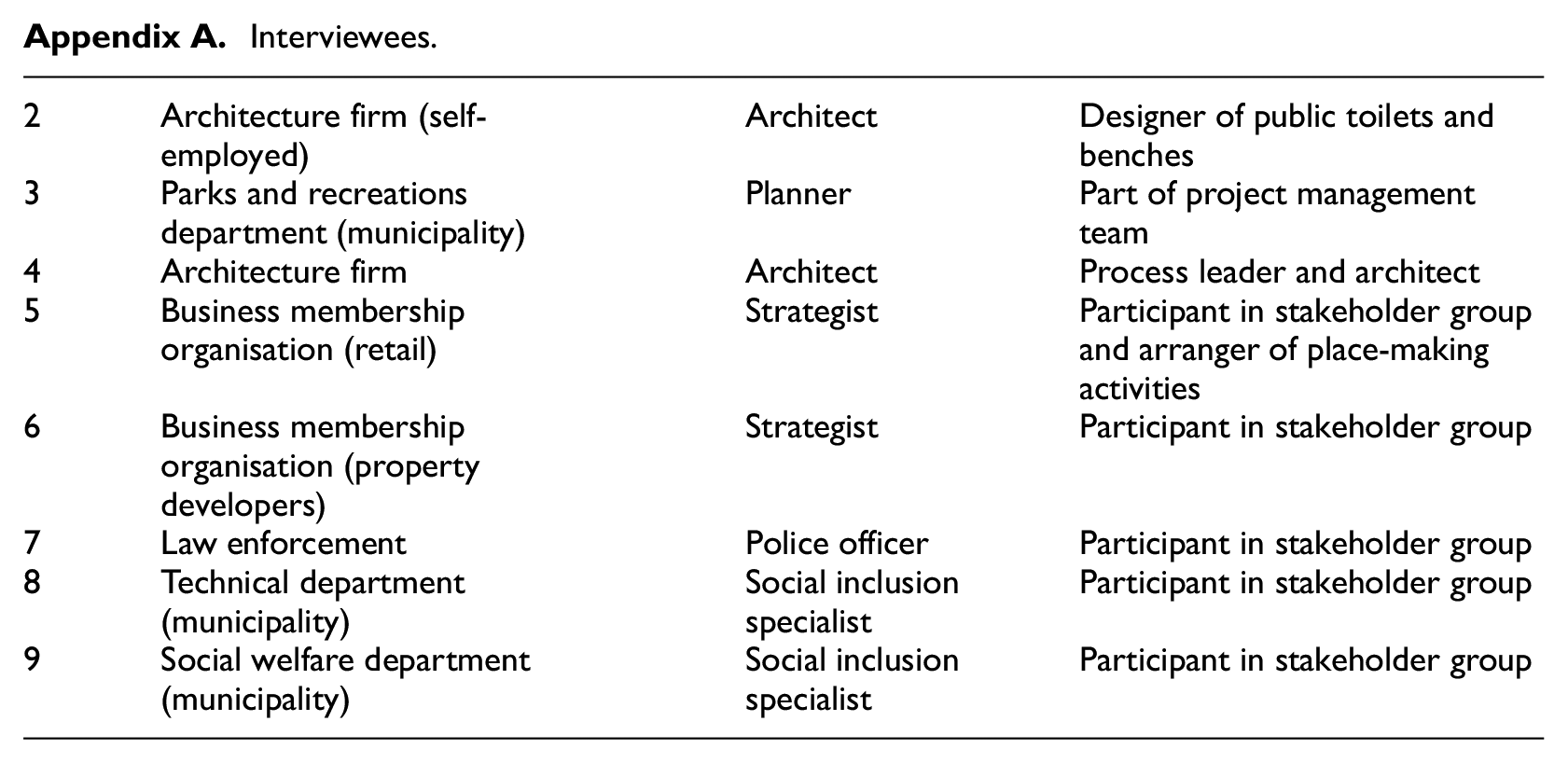
| 2 | Architecture firm (self-employed) | Architect | Designer of public toilets and benches |
| 3 | Parks and recreations department (municipality) | Planner | Part of project management team |
| 4 | Architecture firm | Architect | Process leader and architect |
| 5 | Business membership organisation (retail) | Strategist | Participant in stakeholder group and arranger of place-making activities |
| 6 | Business membership organisation (property developers) | Strategist | Participant in stakeholder group |
| 7 | Law enforcement | Police officer | Participant in stakeholder group |
| 8 | Technical department (municipality) | Social inclusion specialist | Participant in stakeholder group |
| 9 | Social welfare department (municipality) | Social inclusion specialist | Participant in stakeholder group |
Acknowledgements
We would like to thank the editor and the reviewers for their insightful comments and suggestions on an earlier draft of this article. We also extend our gratitude to all the interviewees for generously giving their time and sharing their perspectives, which were invaluable in shaping this study.
Declaration of conflicting interests
The author(s) declared no potential conflicts of interest with respect to the research, authorship, and/or publication of this article.
Funding
The author(s) received no financial support for the research, authorship, and/or publication of this article.
