




Abstract
Across the field of biodiversity conservation, talk of the ‘finance gap’ for nature – the shortfall of money needed to meet global targets to halt extinction and ecological collapse – abounds. This paper asks how the finance gap, and its assumption of limited state capacity and funding, inform what solutions for ecosystem conservation and restoration are pursued. By analyzing a leading ‘nature-based solution’ – the mangrove forest – this paper examines how the consensus that government budgets are, and will be, insufficient for ecosystem restoration is foundational to the rationale and social license of carbon crediting projects. Putting the history of mangrove degradation into conversation with current efforts for mangrove restoration reveals how both degraded natures and degraded state capacity are rendered dependent on private finance for their restoration – an outlook Bigger and Nelson term ‘austerity natures’. Drawing from critical scholarship on filling ‘finance gaps’ left by state austerity, this paper puts the mangrove forest, and other efforts to make markets out of degraded ecosystems, into conversation with this broader reorientation of state capacity towards enticing private finance into funding societal objectives.
Introduction
Across the field of global biodiversity conservation, talk of the ‘finance gap’ for nature – the shortfall of money deemed necessary to meet global targets to halt extinction and ecological collapse – abounds. From influential conservation reports (Parker et al., 2012; The Nature Conservancy, 2019) and finance briefs (Gros, 2022) to multilateral agreements and academic literature (Anyango-van Zwieten, 2021), this gap is measured and publicized to show that, without a powerful finance-raising strategy, global biodiversity targets will continue to fail. In 2020, the Paulson Institute, The Nature Conservancy and the Cornell Atkinson Center for Sustainability’s Financing Nature: Closing the Global Biodiversity Financing Gap calculated the global gap at between $598 billion to $824 billion per year (Deutz et al., 2020), which was then enshrined by the Convention on Biological Diversity at $700 billion per year (Convention on Biological Diversity, 2022).
The gap is a source of anxiety about how global objectives will be met, and a site of debate over who will fund global biodiversity action. Central to these debates is the idea that there is not enough public finance, such that biodiversity conservation efforts will need to build a strategy to attract private investment (Dempsey, 2016). This gap is a number, then, but also an idea: that current levels of government spending on conservation are inadequate, fixed and must be supplemented with private, return-seeking capital (Biodiversity Capital Research Collective, 2021). With this gap comes a suite of policy proposals to fill it via private finance: from wildlife conservation bonds to biodiversity credit markets to ecosystem-based insurance instruments (Christiansen, 2021; World Economic Forum, 2024). As such, this ‘gap talk’ (Bryant and Webber, 2024) can have the effect of reframing complex, highly political, resource governance issues as problems to be overcome by lowering investment barriers into conservation.
How the gap is deployed – how it narrates the barriers to achieving societal objectives – therefore provides important information about the types of solutions deemed necessary to overcome it. From this vantage point, this paper asks: what is the relationship between this framing of the problem and the conservation solutions that follow? How does the search for private finance to inform the design of biodiversity policy solutions?
A wide body of literature has pursued these questions with the intent of apprehending the relationship between market-based environmental efforts and their distributional effects (e.g. Bakker, 2010; Castree, 2008; Heynen et al., 2007). In this paper, I address only one part of this agenda: the relationship between the finance gap for nature, and the production of ‘additionality’ in forest carbon markets. Based on an examination of contract documents for 24 mangrove carbon projects, I analyze how project additionality – the foundation of the carbon market – is frequently undergirded by a consensus about weak state capacity for environmental management.
After introducing a conceptual framework, I explore this more localized iteration of the ‘finance gap’ for biodiversity conservation, expressed as the immediate limits on state capacity and funding for mangrove conservation and restoration projects. In contrast to research which documents observed socio-ecological outcomes or evaluates claims of emissions reductions, this research uses project documents to examine how private finance is enshrined as a viable policy option. I interrogate this case through the framework of ‘austerity natures’ to describe the connection between the degradation of these ecosystems and their subsequent production as ‘investable’ (Bigger and Nelson, 2020). This concept emphasizes the interrelated political-economic and ecological conditions under which private financing of restoration becomes a rational and desirable policy option. As such, I put the conditions of mangrove degradation into conversation with the conditions of its restoration, exploring the shared roots of state incapacity to restore mangroves and the conversion of mangrove ecosystems into commodity frontiers in the latter 20th century. While the finance gap narrative recognizes both of these developments as a problem, it treats them as a baseline for mangrove commodification and market exchange, and therefore as a source of potential value, rather than a root cause to be addressed.
Indeed, the relationship between lacking state capacity and additionality is so foundational to the carbon market that some might argue it does not warrant analysis. Yet I argue that this relationship has yet to be explored as a site where state austerity and sustainable finance meet to produce new socio-ecological relations. Though this analysis is exploratory and conceptual, it points to the risk that conservation finance mechanisms may be acting at odds with efforts to scale up public investment and regulation, re-entrenching conditions of austerity and limiting public capacity to manage ecosystems. It further explores arguments that the widespread acceptance of austerity influences the distributional form of ecosystem protection and restoration projects. Ultimately, this paper reintroduces the political-economic conditions under which ecosystem loss occurs, peeking behind the curtain of the ‘baseline scenario’ to link the construction of additionality to the political-economic conditions that shape how natural resources are governed and towards what ends. In contrast to the fixed baseline of the finance gap, the concept of austerity natures keeps in view the historic and ongoing distributional patterns that shape political, institutional and ecological constraints on action in the present.
Biodiversity finance gaps versus austerity natures
The frame of the finance gap is not unique to biodiversity. From climate adaptation (United Nations Environment Programme, 2022) to infrastructure (Zelikow and Savas, 2022) to peace (United Nations Peacebuilding Support Office, 2021), finance gaps have become a dominant way of narrating collective problems and their solutions. Owing to failure of the Millennium Development Goals to raise more than 0.7% of their funding targets in Official Development Aid (ODA), the United Nations ‘Billions to Trillions’ programme sought a new strategy to raise capital for the Sustainable Development agenda (Mawdsley, 2018). Given the shortcomings of ODA, it was proclaimed that only private finance would have both the capital and the risk tolerance to make up the difference (World Bank, 2020), but that it would have to be incentivized into filling these gaps by multilateral institutions, NGOs and governments. The result has been a shift in development policy which asserts that ‘the role of ODA and other forms of public finance should be to “unlock,” “catalyse” and “leverage” much larger flows of private finance for “development”’ (Mawdsley, 2018). Across the international agenda for climate and conservation, the inability to fill these finance gaps is understood as a central barrier to meeting national and international policy objectives.
As a result, new and innovative financial mechanisms are deemed necessary to unlock private money for sustainable development. This requires a new policy relationship between governments and holders of private capital, in which ‘development interventions are defined as policies that create risk buffers to render development projects “investible”’ (Gabor, 2021: 433). Yet instruments structured along these lines are often critiqued for how they ‘skew the risk-reward ratio in favour of investors while exposing different publics to increased financial and environmental risk’, (Jones et al., 2020) producing ‘grave distributional consequences’ by prioritizing investors’ returns in development projects (August et al., 2022).
In addition to political outcomes, critical scholarship has also argued that this agenda has explicit political objectives: to redirect state capacity to meet the needs of private capital while tempering political momentum for more redistributive projects. Gabor (2021), for example, argues that one of the political goals of this consensus is ‘to reorient the institutional mechanisms of the state towards protecting the political order of financial capitalism against climate justice movements and Green New Deal initiatives’ (431). In this outlook, what is often framed as objective, measurable reality – a number of dollars needed to meet nature, or climate, or infrastructure goals – is instead understood as a project to reconstitute the role of public money and capacity as one of facilitating concessional finance for private investment (Gabor, 2021: 431).
At today’s impasse – of slashed ODA, concentrated private wealth and rising geopolitical tensions – even the stumbling, scandal-ridden market for private biodiversity finance (Christiansen et al., 2025; West et al., 2024) may appear more promising than appealing for more public funds. Yet as even projects aided by philanthropy, development institutions and governments struggle to generate returns, biodiversity largely remains on the sidelines of the mainstream de-risking agenda. This poor track record of return-seeking private finance for biodiversity conservation has led Dempsey (2025) to term this the ‘bake sale’ approach – a small, highly subsidized effort that does more to perform the theatre of a market than to raise capital efficiently or at scale (see also: Christiansen et al., 2025; Dempsey, 2016; Suttor-Sorel, 2019; Suttor-Sorel and Hercelin, 2020). Recognizing that the bake sale does not actually solve the financing problem, Dempsey asks what other problems this strategy is solving and for whom.
For example, conversations about the biodiversity finance gap rarely focus on what it would take for states to fund environmental protection more, including examining the conditions that limit public spending on social and environmental objectives. This, even as conservation finance reports consistently note that public finance remains, by far, the largest and most important source of funding for meeting global biodiversity objectives – and will be necessary for meeting global targets (Convention on Biological Diversity, 2020; Gonon et al., 2024; Organisation for Economic Co-operation and Development, 2020). Yet in multilateral fora which have enshrined the ‘common but differentiated responsibilities’ to pay for environmental harms, governments still insist that the gap will have to be filled made up by private capital. The gap is therefore a tool not only for advancing ideas about private financial mechanisms as a dominant solution to the biodiversity crisis, but also for managing responsibility to pay for, and reform, the impacts of climate change and ecological degradation. In this sense, the biodiversity finance gap may be interpreted in line with more political assessments: that it serves multiple, overlapping political problems, one of which may be to temper demands for more redistributive approaches to uneven socio-ecological crises.
Austerity natures
In contrast to the finance gap, the framework of ‘austerity natures’, borrowed from Bigger and Nelson (2020), describes the ‘socio-ecological conditions by which private interventions on public lands become actionable and investable, in terms of producing landscapes in need of investment and of states that rely on private finance to do the restoration’. 1 In this definition, austerity is understood not only as a philosophy of state budgetary management, but also a set of interrelated conditions that have bearing on the environment, both directly (through deregulation and cuts to agencies that manage the environment) and indirectly (through increasing pressures on land use change to manage fiscal crisis). Together, these conditions deepen the consensus on attracting private investment into ecosystem management.
The concept of austerity natures was formulated through Bigger and Nelson’s study of the California forestry sector (see also Webber et al., 2022), where budget cuts and declining state capacity – in the face of increasing wildfire risk and forest management needs – produced a consensus that attracting private capital was the only available solution for additional management of public lands (Bigger and Nelson, 2020). In the face of a rollback of state investment in forestry and forest management, subsequent wildfire crises and limited state support to manage said crisis, Bigger and Nelson argue that California’s ‘Forest Resilience Bond’ operates as a socio-ecological fix for the overaccumulation of capital, underproduction of nature and crisis of state legitimacy to manage its lands (Bigger and Nelson, 2020).
That wreckage incurred from capitalist development creates new opportunities for profit is well-established in the critical literature on neoliberalism in general (e.g. Harvey, 2007), and environmental market-making in particular. A range of scholarship has identified how austerity and disinvestment creates new spaces of accumulation (Knuth et al., 2019) including for ecological repair (Cohen et al., 2022). In the context of the ecosystem-based carbon market, Bumpus and Liverman (2008) write that as ‘capital turns specific instances of environmental degradation into opportunities for continued profit’, it creates new frontiers of accumulation out of landscapes that have been rendered waste or surplus. As a result, the critical literature on forest conservation has variously described these projects as processes of ‘accumulation by conservation’ (Büscher and Fletcher, 2015), ‘accumulation by restoration’ (Huff and Brock, 2017), ‘accumulation by alienation’ (Dunlap and Sullivan, 2020) and ‘accumulation by decarbonization’ (Bumpus and Liverman, 2008). This literature broadly critiques environmental efforts that facilitate capitalist accumulation and the ‘exclusionary, racist, and violent trajectory’ for conservation upon which it profits (Huff and Brock, 2017). While the actual accumulation of capital via conservation may be less than straightforward, the disruptive, marginalizing and occasionally violent impacts of such projects are a theme in this literature.
Yet, in contrast to Knuth et al.’s (2019) observation that ‘interrelations between sites of de- and revaluation [are] usually considered separately’ (Knuth et al., 2019), the frame of ‘austerity natures’, keeps both the process by which a landscape becomes a degraded, and the conditions under which such degradation becomes a potential for accumulation, in view. This framework is particularly relevant to the case of the mangrove, where austerity programmes have been linked to major drivers of mangrove deforestation. Structural adjustment programmes – generally ‘designed to reform economies to a more export-oriented and liberalised market economy while down-sizing governments’ (Kessler and Van Dorp, in Munasinghe, 1998) – included two key policy prescriptions relevant to the case of the mangrove: trade policy meant to encourage commodity exports from developing to developed countries and fiscal policy meant to eliminate deficits through the contraction of public spending (Reed, 1992: 26). This type of trade policy – along with sector-specific loans – led to the explicit promotion of industries that converted mangrove forests in the name of exports from the Global South to the Global North. Simultaneously, prescribed fiscal policy often led to decreases in state capacity, impacting environmental regulatory agencies which may have been able to better manage the unfolding ecological problems associated with this type of trade policy (Reed, 1992: 26).
The period following structural adjustment saw the greatest loss of mangrove ecosystems globally, with much of this loss atributable to commodity production. While country-level impacts may be much higher (Cf. Armitage, 2002; Huxham, 2022), a recent review of 200 scientific papers estimated that 47% of the world’s mangrove loss has been due to conversion for aquaculture and agriculture (Bhowmik, 2022; see also Spalding and Leal, 2021; Turschwell et al., 2020). One of the sectors most implicated in this loss was shrimp aquaculture. Intensive shrimp farming was developed in the mid-20th century as part of a broader ‘Blue Revolution’, (Chamberlin in Alday-Sanz, 2010) and subsequently promoted and funded by International Financial Institutions and Global North development agencies (Hamilton and Stankwitz, 2012) as a method to resolve international financial and debt crises with export-oriented development. By intensifying production in the face of a global decline in wild fisheries stock, and providing an export destined for consumers in developed countries, this strategy was meant to strengthen the exporting nation’s balance of payments and foreign exchange reserves (Armitage, 2002; Gronski, 2001; Rivera-Ferre, 2009).
Many of these balance of payments crises were themselves a result of the colonial structuring of national economies around certain commodities, the subsequent fall in price of these commodities, as well as associated biological crises of production. In Ecuador, for example, intensive shrimp farming was one of many attempts at transforming socio-ecologies into disease-vulnerable monocultures to meet the needs of export-oriented growth in a context of declining wild abundance (Veuthey and Gerber, 2012: 614). As a result, ‘in only 30 years following the construction of the first shrimp ponds in 1969, 57% of Ecuador’s mangroves had been cleared for shrimp farming’ (López-Angarita et al., 2016).
While this strategy was endorsed and subsidized by policy action from governing parties (see Ilman et al., 2016; López-Angarita et al., 2016), between 1988 and 1995, development banks provided 69% of total investment in shrimp aquaculture (Hamilton, 2011: 40), leading researchers to conclude that shrimp aquaculture was promoted and financed by international financial institutions as a way to make austerity and economic liberalization agendas salient (Martinez-Alier, 2001; Patil, 1999; Rivera-Ferre, 2009). As a result, between 1976 and 2006, 75% of total export value from farmed shrimp came from developing countries with imports primarily flowing to the USA, Japan and the EU (see Rivera-Ferre, 2009: 304 for list of top producers; Josupeit, in Alday-Sanz, 2010).
At the same time as these structural adjustment programmes were promoting export-oriented development through clearing mangroves for shrimp ponds, other conditionalities incentivized and sometimes mandated fiscal austerity, weakening state capacity (Reinsberg et al., 2019). These austerity measures had widespread impact upon societies, but most pertinent to this study were reductions in public spending which often disproportionately hit environmental agencies. In Venezuela (which would become a top shrimp exporter during this period), International Monetary Fund deals meant that the Ministry of Natural Resources ‘lost almost one-third of its payroll of 6,100 employees between 1989 and 1994, cutting the professional and technical staff in half. Real budgets in 1993 were just over one-half those in 1988’ (Reed, 1992: 212). In Mexico, another top shrimp exporter which saw multiple periods of structural adjustment, the Bureau of Urban Development and Environment ‘generally had a derisory budget, and in periods of fiscal cuts, the environment-related budget, which includes national parks, [fell] faster than that of government spending in general’ (Reed, 1992: 82). While each country’s context differed, this turn towards austerity and fiscal discipline can be understood as one key limit on environmental agencies and capacity, while simultaneously increasing pressures on export, and therefore on natural resources. Mangrove degradation, then, can at least partially be seen as a result of economic liberalization and the turn towards export-oriented development. This process cut public spending and opened up these biodiverse and carbon-rich ecosystems for exploitation to earn foreign exchange, repay external debts and manage fiscal crises.
This pattern of austerity and ecological decline differs from Bigger and Nelson’s case of an advanced economy in the Global North, which shapes not only the form of austerity in question, but also the nature of pressures on forests, and the type of private financial solutions available (Christiansen et al., 2025). In this study (with projects located across the Global South, where the majority of the world’s mangroves are found), the underproduction of mangrove ecosystems comes about not primarily through the retreat of active state management, but through transitions in land use for commodity production. As such, in this paper, I experiment with applying this framework in outside of the Global North.
In the following sections, this paper explores the verification of additionality in the mangrove carbon market, which requires that states have not regulated ecosystem protection or restoration and are unable to perform conservation or restoration activities without the sale of carbon rights. I aim to show how dynamics of ‘austerity natures’ are co-constituted on the ground, becoming viable policy options while reinforcing the conditions that are still ‘producing landscapes in need of investment’ (Bigger and Nelson, 2020). Though the projects analyzed in this paper are not explicitly linked to shrimp aquaculture, I place these findings within this broader history of global mangrove loss, arguing that ‘austerity natures’ elucidates an alternative narrative of the finance gap for nature; one that recognizes that these patterns of large-scale ecosystems destruction are not incidental to the political economy that now informs what conservation solutions are viable.
Mangrove forest carbon offsetting
At the leading edge of the endeavour to overlap climate and biodiversity goals is the mangrove: a functional definition for over 70 species of salt-water-tolerant trees that grow in tropical and subtropical zones around the Equator. Mangroves are celebrated for a long list of abilities: they mitigate the impacts of climate change (such as storms, flooding and sea level rise), provide critical habitat that increases fish and shellfish stock and sequester substantially more organic carbon per land area than terrestrial forests (Thiele et al., 2020). The fact that the mangrove has so many valuable services is a key part of what makes it an exciting proposition for nature and climate policy makers alike, as a proof of concept for ‘nature-based solutions’ to climate change, also known as ‘natural climate solutions’ (The Nature Conservancy, 2024). This approach to ecosystem governance has become dominant within UN agencies (Convention on Biological Diversity, 2022), government bodies, and as a top-level priority for the G20’s Sustainable Finance Working Group (2024), where ‘investing in nature-based solutions’ is understood as a key strategy for filling the finance gap (United Nations Environment Programme, 2023).
Mangroves also provide hope in the face of a falling price for carbon and a legitimacy crisis in verification methodology (Haya et al., 2023; West et al., 2023), which have led to the now-common assertion that ‘offsets aren’t delivering’ (Blanchard et al., 2024) on carbon metrics, let alone ecological and social goals. 2 Moreover, where multiple iterations of forest-based carbon crediting came under scrutiny for deleterious social, ecological and economic outcomes locally (Asiyanbi and Lund, 2020; Holmes and Cavanagh, 2016; Miles, 2020), return-generating mangrove projects promise ‘co-benefits’ for local communities in the form of ‘natural infrastructure’, ‘poverty reduction’ and ‘food security’ (IUCN, 2012). Mangroves renew hope that this market will be able to reach scale, that carbon projects can support, rather than dispossess, Indigenous peoples and local communities, and that multiple values of nature can be monetized such that ecological integrity is preserved. For all these reasons, mangroves provide an important vantage point from which to study the finance gap for nature, and the carbon market-based approach to climate and biodiversity funding.
Methodology
To examine mangrove carbon projects, verification documents were analyzed from 24 mangrove carbon projects under the Verra Carbon Standard (VCS), the biggest third-party verification company for carbon offsets (Salzman and Weisbacht, 2024). 3 Accessed through Verra Carbon Standard’s publicly available registry, these documents provide information about how mangrove carbon projects conceptualize their efforts and rationalize them as policy solutions. But they also exceed the category of policy narratives, as they contain information required for the verification of emissions reductions. Such verification is foundational to the contracts in which the future rights to carbon resources are signed over to project developers, and in which the subsequent sale of carbon credits is validated to the buyer. The consensus expressed in project documents is thus highly consequential in that it forms the basis for market making and reflects the assumptions under which carbon rights are transferred.
My objective in assessing project documents is not to treat project proponent discourse as a causal force in social and ecological change, but to examine the assumptions and arrangements under which contracts are made and agreed to. While numerous studies of forest-based carbon projects, including mangrove carbon projects (e.g. Hiraldo, 2021; Hiraldo Lopez-Alonso, 2017; Song et al., 2021), have engaged with the outcomes of such projects on the ground, this case study examines these contract documents in order to understand the foundations upon which contracts for both carbon rights (legal ownership of the commodity) and carbon credits (the economic, social or political viability of the commodity) can be constructed. By looking at the verification documents, which represent the basis of the contract at the beginning of the project, rather than outcomes, this research stays focused on attempts to secure the ‘input legitimacy’ of carbon projects, rather than their ‘output legitimacy’ (Lederer, 2011).
Further, contracts, as ‘tools through which economic practice is literally written into being, are nodes of articulation between legal and economic spaces’ (Potts, 2016: 524). To this wemight also add articulation with scientific data. For example, the likely ecological trajectory of a restored mangrove forest must be measured against biological models, but also against factors such as who owns the land and what competing uses are viable or profitable for the area. This is because carbon verification relies on establishing a consensus around a counterfactual trajectory for the landscape, in which all parties agree that emissions reductions would not take place except for in the case of the sale of carbon credits. In Verra’s methodology, this is referred to as the ‘baseline scenario’; in the documents surveyed here, this scenario was justified through a ‘barrier analysis’, which must demonstrate that there exists a technical, investment or financial barrier – that the project would not take place without the carbon credit market, and is therefore ‘additional’. Though mangrove carbon projects are no longer required to undertake barrier or investment analyses by Verra, 4 all but two of the documents analyzed still included this justification section. It was these sections that were compiled and analyzed. Documents were also searched for mention of community benefits or compensation, as well as analysis of who legally owned the rights to carbon resources.
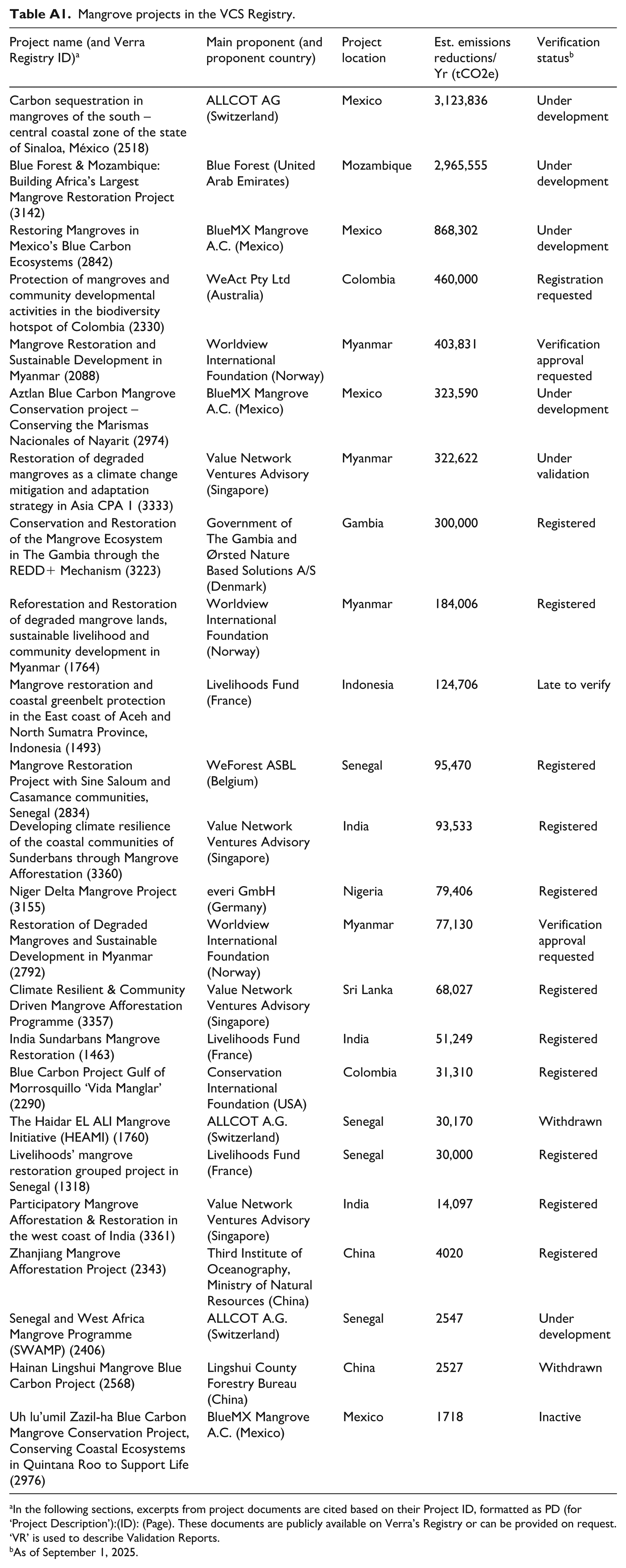
The vast majority of the projects in this data set are located in Global South countries but are developed by organizations based in the Global North (see Table A1 in Appendix A, Column 2). However, the arrangements between project developers, government agencies, local NGOs and local communities are not homogenous, with various project designs and funding arrangements represented within this dataset. These projects also represent a large range in size of estimated annual emissions reductions (see Table A1 in Appendix A, Column 4) as a result of various features such as size of the project, local geophysical processes and the methodology used for measuring reductions. Though the findings from this study are limited to this data set and verification system, this diversity of projects provides some insight into the broader patterns of this policy option across the ecosystem-based carbon market.
Findings
My analysis found that half of these projects name limited state capacity and/or limited state budgets in their rationale for the necessity of carbon finance. In these cases, the consensus about austerity therefore undergirds claims that mangrove carbon offsets are ‘additional’, and rightfully owned by project developers. These explanations for additionality and ownership shed light on the internal logics of these offsetting projects, showing how they are designed to fit the conditions expressed through the finance gap – those in which government budgets for ecosystem conservation and restoration are insufficient and cannot change.
Project documents also show that while carbon credits are largely owned by investors and project developers, communities are most often projected to receive only, or mostly, ‘co-benefits’ associated with ecosystem restoration and protection as their compensation. The resulting question is whether ecosystem management under carbon market finance takes on a particular distributional form as a result of the assertion that there are no alternatives toprivate finance. Analysis of the project document finds that the ‘co-benefits’ that communities receive are sometimes used as evidence that this solution provides an equitable method for managing the degradation and deforestation of mangrove ecosystems.
As such, in the case of the mangrove forest, I argue that the consensus around te finance gap – and what to do about it – informs mangrove carbon project’s marketability, social license and distributional form. These themes and their significance are described in further detail in the next two sections. This analysis of project documents highlights how dynamics of ‘austerity natures’ are used as justification for the baseline scenario of conservation finance projects, helping them to become viable policy options.
Additionality and limited state capacity
Additionality is at the heart of the legitimacy and form of the carbon market. In order to sell carbon credits, ecosystem restoration and conservation must be measurably ‘additional’, meaning that carbon sequestration is being protected or restored in such a way that it is above and beyond what would occur (Ellis et al., 2024). As stated in the VCS Standard: ‘A project activity is additional if it can be demonstrated that the activity results in emission reductions or removals that are in excess of what would be achieved under a ‘business as usual’ scenario and the activity would not have occurred in the absence of the incentive provided by the carbon markets’ (VCS Standard V4.3, 2022: 34). Without a strong basis for additionality, claims of emissions offsets from crediting projects are weak, leading to controversy and volatility in the ecosystem-based carbon market. While many academic and policy studies have critiqued the carbon offsetting market on these grounds (e.g. Haya et al., 2023), this study is less concerned with evaluating additionality claims than with how this calculation borrows from, and reinforces, the general discourse of a finance gap for nature.
In describing barriers to conservation and restoration efforts, project documents occasionally describe the local community as incapable of undertaking restoration on their own: ‘Local communities do not have the capacity for implementing the project without the support of [the project partner]’ (PD 1463: 37); ‘Although the local communities are interested in planting mangroves, there is a lack of sufficient access to technical and organizational support without carbon credits’ (PD 1764: 47). In a handful of projects, no specific actor is named, though it may be stated, for example, that previous projects ‘failed due to lack of technological capacity and financing’ (PD 2518: 36).
More frequently, however, the lack of capacity to restore mangroves is explicitly named as a lack of government capacity (see Table 1). In the following quote, one can see how the common sense of the finance gap for nature is reflected in the assertion that public investment or state capacity would not be capable of supporting such a project: Mangrove restoration activities in Mexico have historically only happened with direct government funding. This funding is no longer available or only in limited cases where matching funds can be provided by project developers. (PD 2848: 20)
Investment barrier descriptions in VCS mangrove project documents (sorted from most estimated annual emissions reductions to least).
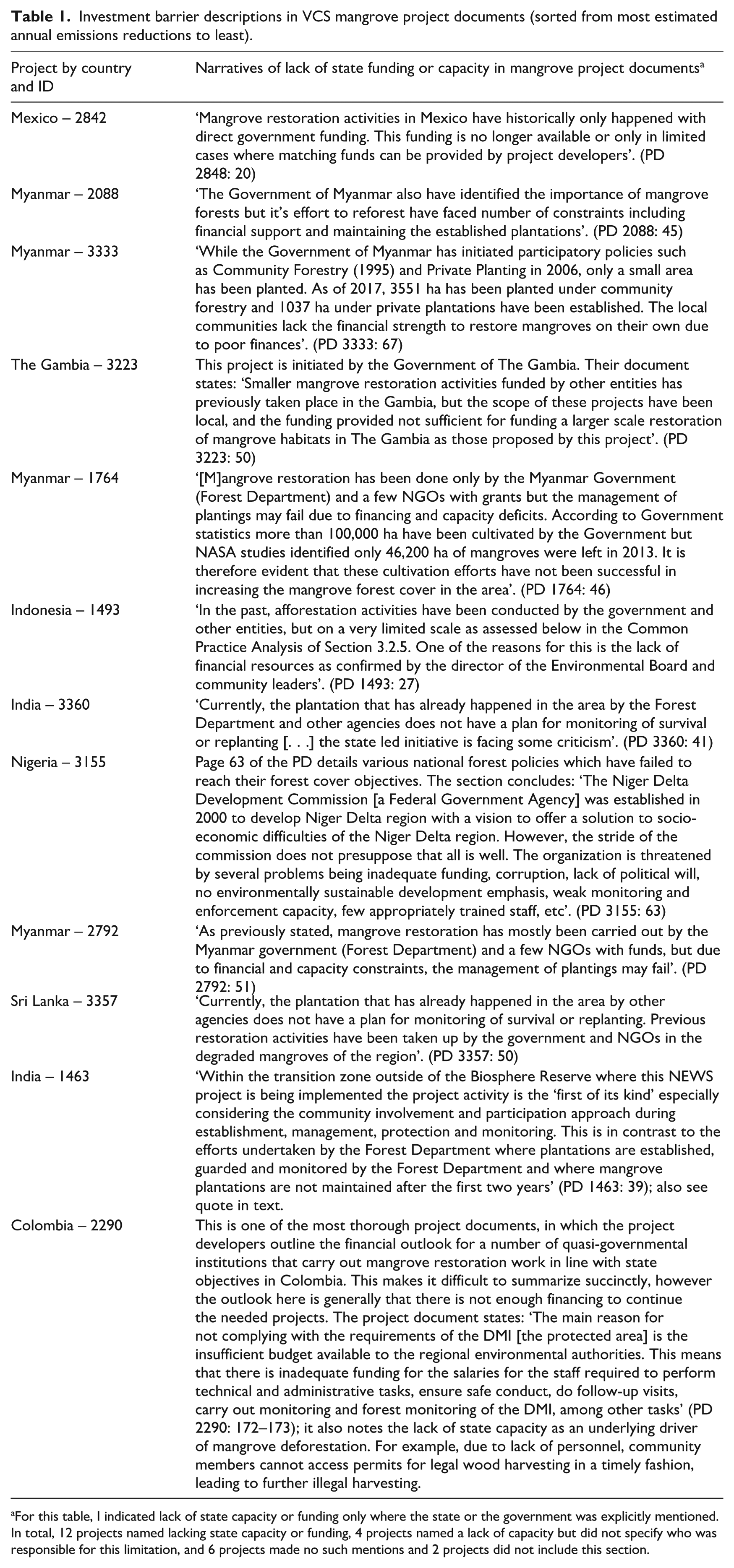
For this table, I indicated lack of state capacity or funding only where the state or the government was explicitly mentioned. In total, 12 projects named lacking state capacity or funding, 4 projects named a lack of capacity but did not specify who was responsible for this limitation, and 6 projects made no such mentions and 2 projects did not include this section.
In this case, it is taken as a given that the government has no or limited money to contribute to the restoration of mangroves. Therefore, the likelihood that the investment barrier would be overcome without the sale of carbon credits is presented as slim in the assessment of baseline scenario change: without private financing, these mangroves will not be restored or conserved.
Other project documents rationalize this deficit differently; in some cases, it is representatives of government agencies themselves that have confirmed that they do not have the capacity to undertake the restoration. Take this description of the investment barrier from a Livelihoods Fund project in the Sundarbans in India: One of the reasons is the lack of financial resources as confirmed by the representative of the Department of Forests. Private credits for these activities do not exist in the market as confirmed by the Department of Forests. Carbon benefits would help to overcome this barrier as the main reason for starting the project by Livelihoods are the carbon benefits. (VR 1463: 24)
But narratives of insufficient state capacity are not only related to the financing of mangrove restoration directly. In the same project, the barrier analysis also notes the lack of state capacity to confront the ‘social barriers’ facing mangrove restoration. That is, the project states that the government lacks capacity to engage local stakeholders, which limits the success of the mangrove restoration project, and therefore supports the basis for the sale of carbon credits by the project developer: Such social barriers are primarily related to a lack of transparent government capacity to engage with stakeholders. The lack of capacity has been documented in recent World Bank assessments, which generally identify inadequate training, inadequate intergovernmental coordination, and inadequate budgetary resources for the weakness on the government institutional side. (PD 1463: 38)
To generate alternative budgetary resources, some project documents note that international finance, in particular, is necessary for their projects to succeed. One small-scale mangrove restoration project in Myanmar elaborates: ‘Mangrove reforestation financing are [sic] being rejected by Myanmar’s banks. The reasons include the risk of the nature of the project and the unavailability of assets for the specific project’ (PD 2792: 50). There is neither state capacity to execute this project via state agencies (as they describe in other sections of this document), nor capital within the nation willing to support these projects. As these project documents make clear, because these aren’t profitable investments in typical terms, it’s challenging to secure loans for them in general. A project document from a Senegal-based mangrove project puts it bluntly: ‘No commercial loans are available in Senegal or in general in the world for activities without revenue’ (PD 1318: 22). Private, international investment and intervention is therefore deemed the most realistic scenario under which ecosystems will be conserved and restored.
It may be confusing why international finance would be more willing to fund activities without revenue. The mangrove project undertaken in partnership with the Gambian government provides some context. This project is currently grant-funded by Danish renewable energy company Ørsted. Carbon revenues are expected to ‘start flowing in 2027 and be fully owned by Gambian communities and reinvested in marine protection’ (The Ten-Point Plan, 2024), with Ørsted as the primary purchaser to fulfil obligations of corporate social responsibility (Kristensen, 2024). The concessional grant-funding given by Ørsted, as well as the company’s willingness to purchase the credits, was required to participate in this market get this project off the ground.
Thus, even as this private finance is often not return-seeking in the typical sense, its willingness to fund carbon market development overcomes the limits of state capacity, and, in so doing, justifies the ‘additionality’ that makes these carbon credits legitimate and marketable to begin with. The next section explores how the acceptance of these conditions of state austerity may inform what constitutes an ‘equitable’ distribution of benefits.
Distribution of benefits
Project documents show that while carbon credits are largely owned by investors and project developers, communities are most often projected to receive only, or mostly, ‘co-benefits’ associated with ecosystem restoration and protection as their compensation. Though gaps in these project documents limit the depth of evaluation, it is frequently implied in project documents that this arrangement is acceptable because there is only private finance available. One document, from a project in Mexico, insinuates this relationship: At the moment, there is little to stop the conversion [of mangroves] except for the possibility of carbon financing, which is deemed the most equitable method to battle the threats against degradation and deforestation. (PD 2848: 11)
No further evidence is given about how carbon financing has been deemed ‘the most equitable’ method to battle deforestation, or by who. These limitations – to what can be known about the distribution of benefits from project documents – persist throughout this study. However, some basic trends can be elaborated on.
Project documents must indicate how the rights to carbon credits have been shifted to those who will sell the credits, which involves identifying who currently owns those rights. This can include the state, private owners or other collective ownership structures, though these categories are not always clear and may be grounds for accusations of land grabbing (Bryan et al., 2020). To address this concern, project documents often describe how the carbon credits are being distributed or monetized, and/or where the associated revenues flow.
In return for signing over the control of carbon credit revenues emerging from these sites, communities involved are frequently framed as receiving some kind of ‘co-benefit’. This reflects the way in which it has become, to some extent, expected that the project will deliver local benefits in exchange for the rights of the project developer to own the carbon credits (this being a major factor in the transition from REDD to REDD+ in 2010). One project document explicitly described this shift compared to previous iterations of forest-based carbon offsetting: Traditional plantation models based on concessions which involve transfer of ownership have proven socially, politically and environmentally unsustainable. Therefore the project proponent has realized that a sustainable model that minimizes the political risk of the investment needs a strong element of corporate social responsibility and has to respect traditional rights of land ownership. This has caused the project proponent to design and implement activities in social and legal terms resulting in extraordinary costs of this pioneer project. (PD 2088: 47)
In addition to describing this shift in legitimacy of the carbon market, the above quote points to the costliness to providing equitable management. As scholars of market-based conservation efforts have long-noted, the high transaction costs associated with quality projects remains a major barrier to the scale, and therefore impact, of such a policy solution (see review in Biodiversity Capital Research Collective, 2021). But this also means that, as confirmed by many of the project documents, the revenues generated from the sale of carbon credits flow largely towards covering the costs of implementing the project. This may include the costs of mangrove restoration efforts, but also ‘alternative livelihood activities’, which promise to provide some form of economic opportunity to community members who were dependent on the mangrove ecosystems or the activities which threatened them. Though carbon revenues are often described as a source of project finance, few projects are explicit about what amount of carbon revenues flow back to the community, or how the revenues would be distributed among that community. One projects that put a specific number to this distribution describes its model below: An agreement has also been signed with the government of Senegal (who owns the land), to carry out the project without legal impediments. This project aims to return 10% of the benefits generated by the sale of carbon credits to the communities so that they can also enjoy the benefits of managing their resources. This fact is reflected in each of the signed Agreements. (PD 2834: 47)
It is unclear from this text whether these benefits are returned in the form of payment or investment in development or livelihood activities. More often, no percentage or number was given. In a project in Mexico, for example, landowners would get a share of the carbon finance, but it was not stated what percentage or how much (PD 2842: 5). This rare indication of shared financial benefit is likely a result of the project’s legal analysis, which ‘confirmed that the landowners have the exclusive rights to all environmental services provided by their land, including any ecosystem payments that cover the cost of restoring and planting mangroves in exchange for the carbon reduction benefits’ (PD 2842: 5).
Though not always explicitly stated, it can be assumed that project developers feel some pressure to show why communities or governments would be incentivized to sign away their carbon rights. In most cases, however, the benefits expected to flow to communities were described as ‘indirect’ and ‘difficult to quantify’; for example: The project activities do not provide any other direct revenues than the possibility for carbon finance. It is expected that the restoration of the ecosystems will improve fisheries and potentially increase opportunities for ecotourism. However, these potential benefits are indirect, limited and difficult to quantify. (PD 2842: 20)
Described co-benefits range from increased protection from storms to short-term paid labour in restoration efforts – largely considered a ‘livelihood opportunity’, rather than employment. This was a theme across project documents: that local communities and states receive ecological or development support, while the carbon credits are used by private companies who pay project developers based in the Global North. Occasionally, these carbon revenues are described as going directly to typical development projects, such as a project in Myanmar in which 30% of project budget will be directed towards ‘public education, social mobilisation, livelihood creation, micro-loans, cottage industries, aquaculture, scholarships, distribution of solar lamps, and subsidy for fuel saving stoves, women projects and scholarships’ (PD 2088: 5). In these cases, the revenues from the carbon credits are reinvested into other livelihood opportunities for community members – particularly where their current economic activities impact mangroves and therefore must be changed for carbon values to persist. But these co-benefits are most often described as indirect benefits from increased mangrove productivity, such as ‘an increased ecosystem productivity of fish, oyster and the like’ (PD 3223: 49). This gives the impression that restoring ecosystem productivity is itself considered adequate compensation for the right to carbon resources.
As Nelson and Bigger (2022) point out, this ‘language of “co-benefits” papers over the precarious and undervalued labors underpinning the “business case” for infrastructural nature, reframing conservation jobs as altruistic benefits rather than value-producing labor’ (p. 11). Researchers have noted that the conditions of these ‘livelihood activities’ often mirror the circumstances of precarious workers in under-regulated industries worldwide. Neimark et al. (2020) argue that the labour involved in, or created by, market-based conservation projects represents a new ‘eco-precariat’: an unprotected, unorganized and underpaid labour force. They critique the notion of ‘local participation’ – used by both conservation projects and the scholarly literature – for obscuring the social relations of labour within conservation and restoration projects (Neimark et al., 2020). Consistent with this view, the jobs that emerge from the projects in this study – which are described as increasing livelihoods for the community – are often short-term (planting mangroves, for example) or otherwise limited labour opportunities.
Further, in certain projects, these livelihoods activities are not only ‘co-benefits’, but are themselves part of a strategy to reduce deforestation, by transitioning local peoples’ livelihoods away from activities that depend on forest resources, and towards more formal types of economic activities – even as these economic activities appear limited and precarious. For example, in Nigeria, ‘the local forestry department and NGOs will organize trainings to help the community take up alternate livelihood options thereby helping to provide additional economic capabilities’ (PD 3155: 87). In Myanmar: ‘The project involves low income families in the area who will get more opportunities to increase their income and thus be less prone to pursue unsustainable practices that might increase CO2 emissions, harm the environment and further reduce the mangroves’ (PD 1764: 4).
Though this section has zeroed in on an analysis of project documents, it recognizes that many project developers are responding to real baselines of austerity and degradation, aiming to thread the needle between providing positive social and ecological impact while producing a marketable good. The point is not that project developers or environmental ministries are fabricating a false sense of resource scarcity (though perhaps some would follow this line of argumentation), but simply that the consensus around a lack of public capacity or funding plays a role in the resulting distribution of the benefits from the sale of carbon credits. Possibilities for greater community compensation, jobs, or benefits are limited by the lack of public finance for nature, and the high transaction costs associated with carbon market projects. While this research is limited to a data set of 24 projects in one ecosystem type, it points to an emerging pattern in the promotion of nature-based solutions, where the co-benefits of ecosystem restoration are deemed adequate compensation for the sale of carbon rights and the imposition of new forms of environmental management.
Conclusion: Shifting (political-economic) baselines
This paper has explored how the framing of the finance gap for nature informs the ecosystem-based carbon market, introducing the concept of ‘austerity natures’ as an alternative framing of this conjuncture. Specifically, this analysis demonstrated how the consensus around a baseline scenario – state incapacity to restore degraded mangrove ecosystems, and the need for private finance – forms the foundation of mangrove carbon credit marketability. This means that, in such cases, the finance gap justifies not only the need for private finance, but also the viability of the policies to attract it. The lack of public regulation or resources recursively justifies the very basis of the market itself.
The implications of this finding are twofold. On the one hand, by potentially disincentivizing activities that would undermine additionality (ecosystem protections, regulations or financing for restoration), while redirecting state and conservation capacity toward chasing private finance and verifying the marketability of credits, these experiments in conservation finance may in fact stabilize the status quo – the baseline scenario – rather than disrupt it. On the other, in solidifying the common sense that there is no more public money for conservation – because the lack of any alternative has been independently verified – these projects create a common sense around the equitable distribution of benefits from ecosystem-based carbon markets. As governments and other land-holders sign away their rights to carbon credits, environmental justice is recast through inclusion in carbon finance and the re-establishment of ecological functions that are now understood as ‘co-benefits’.
The outcome of these routine methodological practices may best be understood in terms of shifting baselines, a term that is commonly used in the biological sciences to describe how collective perception of ecosystem health is determined in relation to present conditions (see Pauly, 1995). The risk of shifting baselines is not only that we forget past abundance, but that our metrics or standards deteriorate overtime. As Collard and Dempsey write of the use of shifting baselines in Environmental Impact Assessment in Canada, ‘It is difficult to overstate the power of this baselining, a brilliant and devious tactical manoeuvre that resets a violent past: “we start from now forward.” Historical landscape change is bracketed out; current, already disturbed and degraded landscapes and diminished ecologies are taken as the starting point, normalised as the beginning of the “from-here-on-out.” Time starts anew with the selection of the baseline’ (Collard and Dempsey, 2022: 1557). Expanding on this definition of baselining, this paper has aimed to show that these baselines are not only biological – concerning the number of species, or extent of degradation. Rather, they are also political and economic, in that they take current patterns of resource use, levels of state funding and international financial conditions which incentivize ecosystem conversion as baselines which are fixed, unchangeable and without history.
Additionality makes a market out of these grim baselines, seeking private finance to cope with the fallout of resource exploitation and limited state capacity. One need not find this particular practice objectionable in order to recognize that the structural pressures that keep public resources scarce and pressures to export commodities high will likely threaten progress on environmental objectives. Further, where these structural problems are replaced by the problems of risk-return ratios for investors and strengthening market verification practices, both states and conservation efforts are redirected to the task of making private finance to crowd in to social objectives, rather than asking why state capacity to manage public goods and collective problems is so limited. While this may respond to real world conditions, August et al. (2022) argue that it can also lead to ‘a kind of inertia or path dependence – a narrowing of imaginations and a reorientation of institutional frameworks through which the state’s capacity to conceive, plan, and deliver nonmarket solutions (such as stimulus in times of crisis) is eroded’.
For Christiansen (2021), these critiques, combined with the lacking track record for innovative mechanisms, together ‘raises the normative question of whether de facto subsidizing the sometimes-elusive promises of markets is the best sustainability policy’ (p. 94). If the carbon market were booming and attracting major new private capital into the protection and restoration of ecosystems such questions may seem irrelevant. Yet, across the voluntary carbon market, the Forest and Land Use market saw the biggest declines in 2024, while facing ‘intense scrutiny, particularly around project additionality calculations’ (Forest Trends’ Ecosystem Marketplace, State of Voluntary Carbon Market, 2024). Mangrove and other coastal ecosystems (known together as ‘blue carbon’) have also faced challenges of scale. According to the State of the Voluntary Carbon Market 2024, ‘[t]he volume of Blue Carbon credit transactions [. . .] fell by 88 percent from 2022. In 2023, a much larger proportion of Blue Carbon credits traded were less expensive credits from Wetland Restoration/Management projects without associated Afforestation, Reforestation, and Revegetation (ARR) activities, driving prices down for this cluster of project types’ (Forest Trends’ Ecosystem Marketplace, State of Voluntary Carbon Market, 2024).
This market-wide outlook does not negate the significance of the material impacts this approach may produce in specific locales (e.g. hectares of restored mangroves, new resources for education efforts about mangroves), even if these material impacts remain wrong-sized for the full scope of the problem. But despite the flashy headlines and the monetary values now attached to their services, mangroves remain one of the world’s most threatened ecosystems – a baseline that continues to sink, re-setting the conditions under which ecosystem restoration is considered just or feasible, and who should be responsible for the costs associated. At the very least, such an outlook should compel our attention toward all of the ecosystems that continue to be lost or degraded while the ‘finance gap’ remains the dominant framing of the problem of ecological crisis.
Footnotes
Appendix A
Mangrove projects in the VCS Registry.
| Project name (and Verra Registry ID) a | Main proponent (and proponent country) | Project location | Est. emissions reductions/Yr (tCO2e) | Verification status b |
|---|---|---|---|---|
| Carbon sequestration in mangroves of the south – central coastal zone of the state of Sinaloa, México (2518) | ALLCOT AG (Switzerland) | Mexico | 3,123,836 | Under development |
| Blue Forest & Mozambique: Building Africa’s Largest Mangrove Restoration Project (3142) | Blue Forest (United Arab Emirates) | Mozambique | 2,965,555 | Under development |
| Restoring Mangroves in Mexico’s Blue Carbon Ecosystems (2842) | BlueMX Mangrove A.C. (Mexico) | Mexico | 868,302 | Under development |
| Protection of mangroves and community developmental activities in the biodiversity hotspot of Colombia (2330) | WeAct Pty Ltd (Australia) | Colombia | 460,000 | Registration requested |
| Mangrove Restoration and Sustainable Development in Myanmar (2088) | Worldview International Foundation (Norway) | Myanmar | 403,831 | Verification approval requested |
| Aztlan Blue Carbon Mangrove Conservation project – Conserving the Marismas Nacionales of Nayarit (2974) | BlueMX Mangrove A.C. (Mexico) | Mexico | 323,590 | Under development |
| Restoration of degraded mangroves as a climate change mitigation and adaptation strategy in Asia CPA 1 (3333) | Value Network Ventures Advisory (Singapore) | Myanmar | 322,622 | Under validation |
| Conservation and Restoration of the Mangrove Ecosystem in The Gambia through the REDD+ Mechanism (3223) | Government of The Gambia and Ørsted Nature Based Solutions A/S (Denmark) | Gambia | 300,000 | Registered |
| Reforestation and Restoration of degraded mangrove lands, sustainable livelihood and community development in Myanmar (1764) | Worldview International Foundation (Norway) | Myanmar | 184,006 | Registered |
| Mangrove restoration and coastal greenbelt protection in the East coast of Aceh and North Sumatra Province, Indonesia (1493) | Livelihoods Fund (France) | Indonesia | 124,706 | Late to verify |
| Mangrove Restoration Project with Sine Saloum and Casamance communities, Senegal (2834) | WeForest ASBL (Belgium) | Senegal | 95,470 | Registered |
| Developing climate resilience of the coastal communities of Sunderbans through Mangrove Afforestation (3360) | Value Network Ventures Advisory (Singapore) | India | 93,533 | Registered |
| Niger Delta Mangrove Project (3155) | everi GmbH (Germany) | Nigeria | 79,406 | Registered |
| Restoration of Degraded Mangroves and Sustainable Development in Myanmar (2792) | Worldview International Foundation (Norway) | Myanmar | 77,130 | Verification approval requested |
| Climate Resilient & Community Driven Mangrove Afforestation Programme (3357) | Value Network Ventures Advisory (Singapore) | Sri Lanka | 68,027 | Registered |
| India Sundarbans Mangrove Restoration (1463) | Livelihoods Fund (France) | India | 51,249 | Registered |
| Blue Carbon Project Gulf of Morrosquillo ‘Vida Manglar’ (2290) | Conservation International Foundation (USA) | Colombia | 31,310 | Registered |
| The Haidar EL ALI Mangrove Initiative (HEAMI) (1760) | ALLCOT A.G. (Switzerland) | Senegal | 30,170 | Withdrawn |
| Livelihoods’ mangrove restoration grouped project in Senegal (1318) | Livelihoods Fund (France) | Senegal | 30,000 | Registered |
| Participatory Mangrove Afforestation & Restoration in the west coast of India (3361) | Value Network Ventures Advisory (Singapore) | India | 14,097 | Registered |
| Zhanjiang Mangrove Afforestation Project (2343) | Third Institute of Oceanography, Ministry of Natural Resources (China) | China | 4020 | Registered |
| Senegal and West Africa Mangrove Programme (SWAMP) (2406) | ALLCOT A.G. (Switzerland) | Senegal | 2547 | Under development |
| Hainan Lingshui Mangrove Blue Carbon Project (2568) | Lingshui County Forestry Bureau (China) | China | 2527 | Withdrawn |
| Uh lu’umil Zazil-ha Blue Carbon Mangrove Conservation Project, Conserving Coastal Ecosystems in Quintana Roo to Support Life (2976) | BlueMX Mangrove A.C. (Mexico) | Mexico | 1718 | Inactive |
In the following sections, excerpts from project documents are cited based on their Project ID, formatted as PD (for ‘Project Description’):(ID): (Page). These documents are publicly available on Verra’s Registry or can be provided on request. ‘VR’ is used to describe Validation Reports.
As of September 1, 2025.
Declaration of conflicting interests
The author declared no potential conflicts of interest with respect to the research, authorship, and/or publication of this article.
Funding
The authors disclosed receipt of the following financial support for the research, authorship, and/or publication of this article: The author acknowledges the support of the Social Sciences and Humanities Research Council of Canada in funding part of this research.
