




Abstract
German energy giant and coal mine operator RWE makes two products: cheap electricity and ‘pretty new landscapes’. These ‘pretty new landscapes’ are biodiversity offsets to compensate for the destruction of the ancient Hambacher Forest for the world’s largest opencast lignite coal mine in the German Rhineland. Drawing on in-depth fieldwork including participant observation and interviews in and around the mine and its offset sites, this paper explores the relationship between coal mining, spectacularisation of conservation, the ecotourism–extraction nexus and accumulation by restoration. I illustrate the historic and contemporary importance of restoration activities to the accumulation process and explore the recent engagement of mine operator RWE in the provision of restored nature (in the form of ‘eco-points’), which constitute new business opportunities. The significance of RWE’s biodiversity work for accumulation by restoration lies not only in its profit opportunities but its productive power: the legitimation of coal mining and the making of new, ordered ‘ecologies of repair’. This productive power operates through the mobilising function of RWE’s offsetting work, which forms the foundation for corporate partnerships and alliances with conservation groups and volunteers. These lend legitimacy to RWE’s ‘repair work’ and form the basis for the ecotourism–extraction nexus by turning the mine and its offsets into ‘extractive attractions’ for visitors and ‘nature lovers’. Its power further manifests in the way it captures imaginations through novel imaginaries and narratives of sustainable coal mining, supposedly creating not only a ‘better nature’ but a ‘better future’. Positioning offsetting as social technology of governance, I explore RWE’s spectacular performance of sustainability and the ontological flattening to facilitate claims of commensurability and ‘offsettability’ of nature. These are integral to the ecotourism–extraction nexus and grounded in the belief in the human/corporate ability to recreate nature, a fascination with huge earth-shifting machinery and a commitment to high-modernist ideologies of control.
Keywords
Introduction
German energy giant and coal mine operator RWE, I am told by an RWE interviewee, makes two products: cheap electricity and ‘pretty new landscapes’. These ‘pretty new landscapes’ are meant to compensate for the destruction of the Hambacher Forest: the old-growth forest that is giving way to the encroachment of the Hambach mine, the world’s largest opencast coal mine in the German Rhineland (see Figure 1). The same ‘offsetting’ logic is being applied to the over 5000 residents who have lost their homes due to the mine over the past 40 years. Resettled residents are promised ‘bigger’ and ‘better’ housing in new villages that are being ‘built from scratch’. 1 Both the human and the nonhuman ecological ‘costs’ of the mine are being compensated in remarkably similar ways. Despite acknowledgement of ‘irreversible loss’ for the sake of the ‘greater good’, this compensation is based on similar assumptions of fungibility, equivalence and restorability of human and nonhuman environments. This paper focuses on the latter – the role of compensatory restoration of nonhuman nature (operationalised as ‘biodiversity’) and the creation of biodiversity banks in securing old and generating new forms of ‘accumulation by restoration’ (Huff and Brock, 2017) in the German Rhineland. Compensatory restoration, I argue, is at least as much a social and political activity as it is an effort to manage ecological impacts. This is because offsetting works to invisibilise the human and ecological ‘costs’ of extractive development and the multiple forms of violence it encompasses, to pacify potential obstacles to – and create new opportunities of – accumulation.
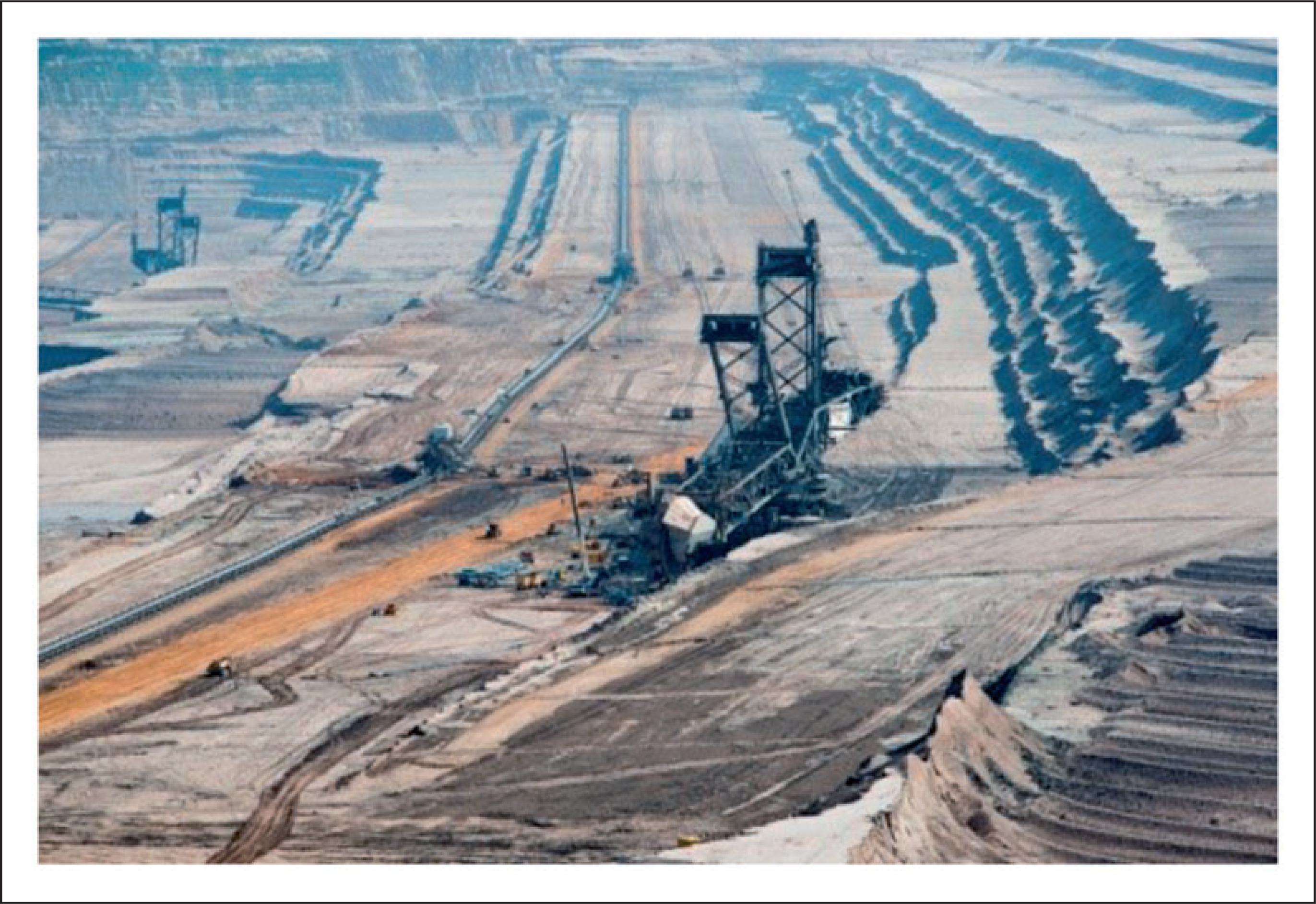
Hambach mine. Source: Perschke (2012).
This article thus explores the various ways in which Europe’s biggest lignite coal mine operations are entangled with accumulation by restoration to expose the intricate and self-reinforcing relationship between extractivism, corporate power, state violence and the ‘economy of repair’ (Fairhead et al., 2012: 242). These processes, I argue, are based on ‘ontological flattening’ to facilitate claims of commensurability and ‘offsettability’ and play into the spectacularisation of conservation and coal mining, grounded in conservation partnerships and integral to the ecotourism–extraction nexus (Büscher and Davidov, 2013). The ecotourism–extraction nexus conceptualises how touristic development and extraction – often imagined to be contradictory activities – go hand in hand and are grounded in the same political economic structures of power and control, affecting communities in remarkably similar ways. ‘Ontological flattening’ here differs from the critiques sometimes levied against Latour, Deleuze or Guattari but refers to the active process of reducing the multi-complexity and diversity of nature(s) to its easily quantifiable properties, in other words the invisibilisation of complex social relations and uniqueness for the sake of domination, domestication, categorisation and quantification (see also Sullivan, 2017). I am thus interested in how coal mine operator RWE not only justifies the killing of forests, ecosystems and the earth, but how the company then profits from its ‘repair work’ to manage this destruction.
The significance of RWE’s nature restoration work for accumulation lies in its productive power: the manufacturing of legitimacy for coal mining and the creation of new, ordered ‘ecologies of repair’. RWE’s Hambach mine is hotly contested. The neighbouring forest is home to a long-standing forest occupation and over the last years, the expansion of the mine, the destruction of local biodiversity and climate impacts have become a topic of national debate, mobilising tens of thousands of people to take to the streets (Brock, 2018, 2019; Brock and Dunlap, 2018). The productive power of RWE’s offsetting work operates through its mobilising function as an anchor for partnerships and alliances to ‘undo’ the damage to local biodiversity – the ‘better nature’ that the mine operator alleges to create is a product of collaboration with conservation groups and volunteers that lends the legitimacy needed for such claim making, and then forms the basis for the new coal tourism and conservation experiences of ‘nature lovers’. Its power further manifests through the way it captures imaginations through novel imaginaries and narratives of sustainable coal mining, creating not only a ‘better nature’ but a ‘better future’. RWE mobilises these narratives to establish itself as good corporate citizen and responsible neighbour, effectively managing and pre-empting dissent and maintaining a favourable regulatory environment while producing and hiding forms of harm and violence associated with coal mining locally and globally.
Biodiversity offsetting – based on the contested idea that the destruction or degradation of nature can be meaningfully compensated by restoration practices or avoided loss of nature elsewhere – has become a popular corporate tool in the mining industry and is fundamental to accumulation by restoration (Brock, 2019). Often embedded in No Net Loss and Net Gain policy frameworks based on the mitigation hierarchy (explained in Figure 2), major mining and infrastructure projects have come to rely on offsetting to secure local acceptance and broader legitimacy – so-called social licence – in the face of opposition across the world.
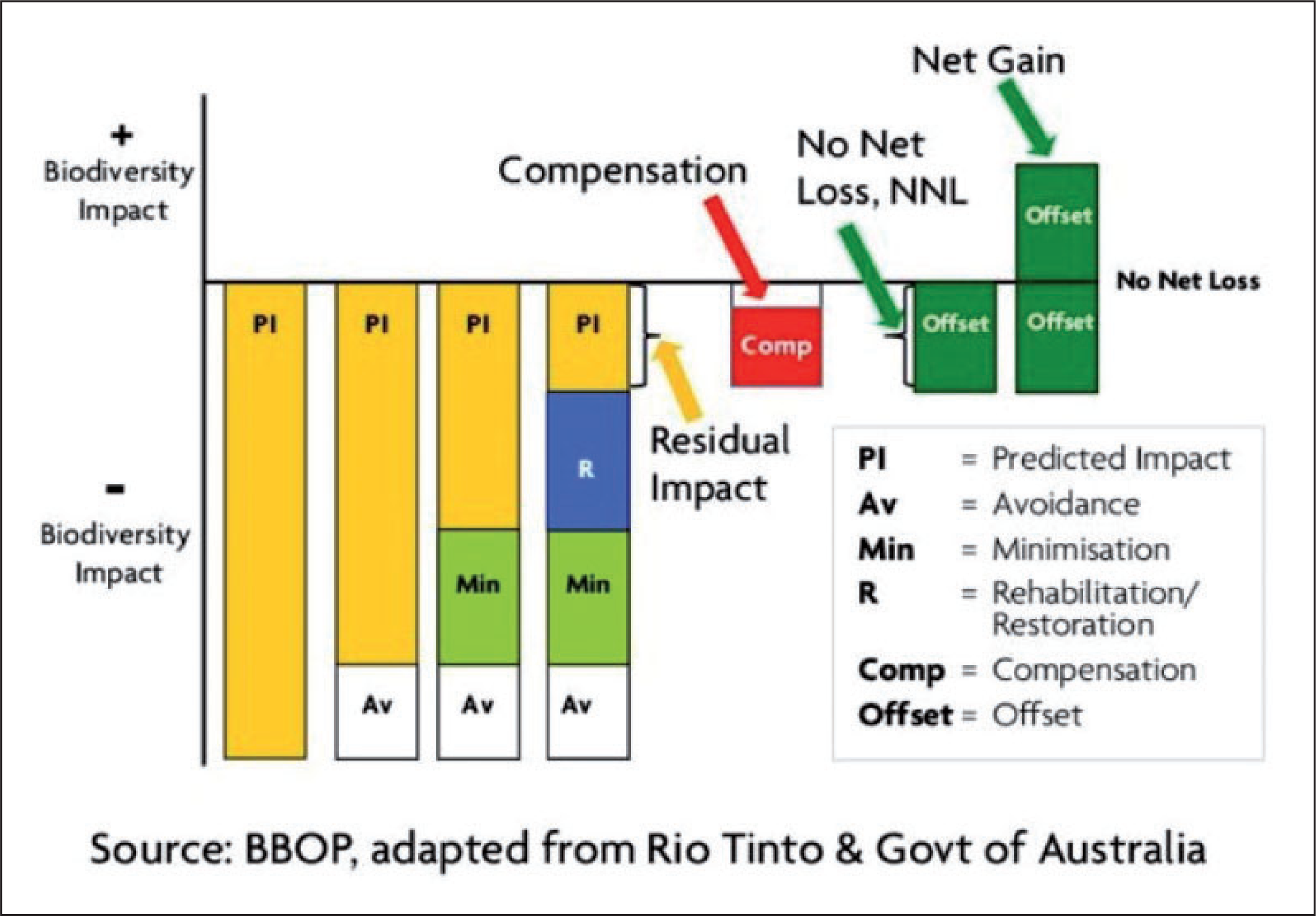
The mitigation hierarchy. Source: BBOP (2018).
Offsetting critics – from grassroots organisations, social and natural scientists – have pointed to the many practical, theoretical, ethical and philosophical problems associated with what is framed as a ‘new frontier’ (Sullivan, 2013a) in the commodification, financialisation of ‘neoliberalisation’ of nature. Experiences across the world (Burgin, 2010; Gordon et al., 2015; Kaiser, 2001; Kihslinger, 2008; Maron et al., 2015, 2012; Robertson, 2004, 2012; Santos et al., 2015; Brock, 2015, among others) have shown that the ecological ‘success rate’ of offsetting was questionable at best. They point to the problems of measurements, accounting methods and lack of fungibility and commensurability of nature (Maron et al., 2015; Niner et al., 2017; Pawliczek and Sullivan, 2011; Robertson, 2004, 2012; Sullivan and Hannis, 2015). Scholars have illustrated the value struggles and the politics around offsetting tools and measurements (Robertson, 2012; Sullivan and Hannis, 2015), and offered compelling critiques of the economic rationality and quantitative frameworks underlying the offsetting ideology and the profit accumulation through offsetting (e.g. Maron et al., 2015; Niner et al., 2017; Pawliczek and Sullivan, 2011; Robertson, 2004, 2006). These are grounded in and further exacerbate what Dunlap and Sullivan (2019) call ‘accumulation by alienation’. This alienation – grounded in indifference – promotes separation and lies at the hearth of market relationships to nature that allows destructive economic choices and associated accumulation processes. Louise Carver, in this Special Issue, outlines the roots and genealogy of No Net Loss and offsetting in US American environmental regulation, the move to aggregate thinking, prioritisation of efficiency and corporate flexibility (see also Brock, 2019; Lane, 2012).
Few studies, however, have analysed the close relationship between the emergence and current practise of offsetting and the mining industry, grounded in the need to ‘green’ mining or to make mining ‘sustainable’ following the industry’s loss of legitimacy and increasing resistance in the 1990s (notable exceptions include Benabou, 2014; Brock, 2019; Huff and Orengo, 2020; Kirsch, 2010; Seagle, 2012; Sullivan, 2013b). While Andrea Furnaro (2019) recently demonstrated the indispensability of so-called renewable energy to mining operations in Chile, Brock and Dunlap (2018) and Dunlap (2019a) locate ‘greenwashing’ as a ‘soft’ counterinsurgency strategy and social technology of pacification, respectively. They not only further legitimise extractive operations, Dunlap (2019a) argues, but simultaneously serve as another investment frontier. While historically, many mining operations – including the Rhinish coal industry – have relied on restoration and recultivation for their ‘license to operate’, biodiversity offsetting as part of No Net Loss or Net Gain policies has now emerged as an important accumulation strategy.
Understanding accumulation by restoration through the lens of coal mining and offsetting in the German Rhineland contributes to the political economy analyses of neoliberal natures and processes of commodification and financialisation of nature outlined above, positioning offsetting as social technology of governance to manage resistance (Brock, 2019) and – building on previous work (Brock and Dunlap, 2018) – to invisibilise the violence inherent in industrial activity, and extractivism in particular. Ecological restoration occurs in parallel with displacement and restoration of human habitat and agricultural land. The case is illustrative of how capitalism in ‘repair mode’ (cf. Fairhead et al., 2012) facilitates continued profit making while allowing for displacement, coal mining, catastrophic climate change and mass extinction to go on unhindered and even accelerated. These processes constitute novel instances of the spectacular performance of sustainability that are fundamental to understanding green transformations and green capitalist false solutions as part of the economy of appearances that sustainability has become part of.
This research draws on 40 qualitative semi-structured interviews with actors involved in the resistance against RWE’s mining operations, governmental representatives, biodiversity consultants and RWE employees between 2016 and 2019. They were chosen through a combination of targeted and snowball sampling. All interviewees were promised anonymity. In addition, the article is based on close readings of policy documents, media articles, reports and legal texts. I undertook a number of field visits into and around the Hambach coal mine, its main offsetting site Sophienhöhe, the Hambacher Forest, information centres and viewpoints. Lastly, this research is grounded in my own long-term involvement in the opposition movement and the experiences of corporate and state responses to it, as well as having grown up close to the mine, in an area that is shaped – politically, physically and culturally – by RWE’s mining operations.
The article proceeds as follows. The second section introduces the concept of accumulation by restoration, embedded in the wider literature on neoliberal conservation and neoliberal natures. I then, in the third section, explore the role of offsetting in RWE’s spectacular performance of sustainability, historicising its role in legitimising extractive processes and examining RWE's engagement in mining restoration and the provision of ‘new’ or ‘upgraded’ natures (in the form of ‘eco-points’) elsewhere. This section further analyses RWE’s work to create forest commensurability to make offsetting possible in the first place. In section four, I explore how offsetting relates to the company’s spectacularisation of coal mining and nature conservation work, feeding into accumulation by restoration. In the fifth section, I argue that the significance of these processes not only lies in their ‘material manifestation’ and the profits realised, but in its productive power, legitimising RWE’s operations through novel partnerships and alliances, and creating new, ordered ecologies of repair. I ask, in other words, how offsetting renders mining legitimate, and even virtuous, while invisibilising both conflict and ecological costs of coal mining. These ecologies of repair, I show, are integral to the ecotourism–extraction nexus in action. They produce and hide forms of harm and violence that are outlined in the sixth section, while establishing RWE as good corporate citizen and responsible neighbour.
The spectacular performance of extractive sustainability: Offsetting destruction to secure accumulation by restoration
I don’t see myself why mining can’t be just as responsible as the tourism which we run in our national parks in the U.S., with all the roads and hiking trails and the campgrounds and facilities required for tourists. With mining, they could come into a conservation area for 20–30 years and leave an endowment; whereas with tourism, when do we get rid of these people and what do they leave behind? (Frank Vorhies, Senior Advisor for IUCN, in Hamrick, 2014)
Biodiversity offsetting, I argue through the lens of RWE’s coal mining, is vital to the emerging new ‘restoration economy’ (WRI, n.d.), enabling and securing processes of ‘accumulation by restoration’ (Huff and Brock, 2017; see also the introduction to this Special Issue). This mode of accumulation relies on capitalist repair work to undo – and profit from – the very destruction brought about by capitalist accumulation. These processes mark the fundamental shift from protection and conservation of ecosystems to an ‘economy of repair’ (Fairhead et al., 2012: 242). ‘Rather than addressing the drivers of economic and ecological crises’, we have argued, accumulation by restoration ‘further ingrains the dominant “exploit-deplete-mitigate” green growth paradigm, facilitating socially and ecologically destructive development through a spectacular high-stakes “shell game” involving the spatial, temporal, and social displacement of both destruction and culpability’ (Huff and Brock, 2017).
Accumulation by restoration builds on a rich empirical and theoretical breath of scholarship of neoliberal conservation (Brockington et al., 2008; Büscher and Dressler, 2007; Büscher et al., 2012; Büscher and Whande, 2007; Igoe and Brockington, 2007; Sullivan, 2006) and neoliberalisation of nature (Bakker, 2005; Heynen et al., 2007; McCarthy, 2006; McCarthy and Prudham, 2004; see reviews by Castree, 2008a, 2008b). Scholars have illustrated the diverse ways in which conservation and capitalism have become intertwined through novel partnership, alliances and funding arrangements (Brockington and Scholfield, 2010; Igoe et al., 2010; MacDonald, 2010) and highlighted the ways conservation becomes packaged and sold through different (commodity) formats and products (Corson, 2010; Neves, 2010). The capitalist ‘making of nature’ relies on the legitimacy and input of NGOs (Corson, 2010; Neves, 2010) and operates through a nature-based commodity fetishism (Carrier, 2010), or ‘fetishized commoditization’ (Neves, 2010: 719). Neoliberal conservation thus sits at the very intersection between consumerism, commodification and conservation; creating ‘new symbolic and material spaces for global capital expansion’ (Corson, 2010: 578). Through particular representations of nature and conservation needs, and by mediating and legitimising knowledge, NGOs effectively (re)produce desires for versions and visions of wilderness and ‘wild landscapes’ which enable particular forms of capitalist conservation and spread capitalism (Brockington and Scholfield, 2010: 551). While conservation NGOs have come to rely on corporate funding, MacDonald (2010) shows that it has been corporations that have approached NGOs, and that have profited most – materially and symbolically – from such corporate conservation collaborations. In other words, corporate and political leaders are given ‘a critical stamp of environmental stewardship’ (Corson, 2010: 579).
Neoliberal conservation goes hand in hand with spectacular media presentations of nature (Brockington and Duffy, 2010) and the spectacularisation of the ‘performance’ of conservation (Igoe, 2010). Offsetting projects hinge on win-win-win spectacles that allege to solve ecological, social and economic crises in order to secure investments while obscuring social and ecological conflicts (Cavanagh and Benjaminsen, 2014). They feed into the creation of ‘desire’ and inform particular representations and narratives around nature. West calls these narratives ‘eco-neoliberal fiction’ (2010: 691). She analyses the (Polanyian) ‘disembedding’ of coffee consumption from its social relationships and its consequent ‘re-embedding’ into romanticised and exoticised narratives about coffee production and the poverty of producers to entice specialty coffee consumerism (West, 2010). These imaginaries, she argues, ‘divert our attention away from the structural causes of environmental degradation and social injustice’ (West, 2010: 691).
Accumulation by restoration underpins these dynamics. Based on corporate–capitalist alliances, it reinvigorates the racist and exclusionary trajectories of neoliberal conservation (Huff and Brock, 2017). All too easily, these trajectories legitimise ‘green grabbing’, the elite expropriation and enclosure of land or resources for ostensibly environmental purposes (Corson et al., 2013; Fairhead et al., 2012). Following David Harvey’s (2004) work on accumulation by dispossession, scholars have identified and criticised associated accumulation dynamics. Doane (2012, 2014) and Büscher and Fletcher (2015) both explore ‘accumulation by conservation’ to critique neoliberal conservation initiatives. Doane uses the concept to analyse the ‘enclosure of value’ (2012: 166) based on appropriation of ‘non-capitalist or peasant conservation achievements’ (2014: 234), such as nature preservation by Northern environmental organisations. Her use of the term focuses on ‘symbolic accumulation that adds value to our market-based cultural, political, and economic system, by asserting that it is a source of, or force for, ecological sustainability’ (Doane, 2014: 234).Büscher and Fletcher (2015), on the other hand, define accumulation by conservation as a ‘new mode of capitalism’ that builds on the environmental contradictions of, and the increasing importance of conservation to, contemporary capitalism and refers to the enclosure of space. Dunlap and Sullivan (2019) bring these diverse accumulation dynamics together as ‘accumulation by X’. At their core, they argue, lies a profound alienation and separation from eco-social relations (Dunlap and Sullivan, 2019). This alienation consists of a ‘deficient relation one has to oneself, to the world, and to others, characterized … by indifference, instrumentalization, reification/fetishism, absurdity, artificiality, isolation, dissociation, disconnection, meaninglessness and impotence’ (Dunlap and Sullivan, 2019: 17). The resulting disconnection underlies the separation, reduction and abstraction of nature that is necessary for nature’s commodification and making nature ‘offsettable’; the abstraction and extraction of value from ecosystems, and the consequent deepening – rather than refraction – of the alienations underpinning the ecological breakdown (Dunlap and Sullivan, 2019). Accumulation by restoration plays into the very same ‘entanglement of alienation with commodification’ (Dunlap and Sullivan, 2019: 17), based on the objectification and quantification which feminists have long criticised (e.g. Merchant, 1983; Plumwood, 1993). It goes beyond the enclosure of space, as in accumulation by conservation, by capitalising on the production of ecologies of repair. Accumulation by restoration is thus not only based on conservation activities, but specifically enrols human-led restoration activities into capitalist market dynamics. The technologies of repair which enable accumulation by restoration – offsetting metrics and techniques to quantify ecological damage – underlie these restoration activities and feed the commodity fetishism that is increasingly normalised in offsetting (Sullivan and Hannis, 2017).
In other words, accumulation by restoration brings ecological repair work into capitalist accumulation dynamics based on separated and alienated relations. Ecologies of repair, I argue, have become vital to the spectacular performance of sustainability of the mining industry (Brock, 2019). The following section will introduce the German legislative context in which RWE’s compensatory nature recultivation takes place, before analysing the company’s activities and their role in legitimising and creating new avenues for accumulation.
Rhinish coal mining and compensatory nature recultivation
The history of coal mining in the Rhineland is also a history of nature restoration. Many of the area’s recreational green areas are restored mining areas and many of its historic sites and tourist attractions are associated with the mining industry. The German term Baggerseen, which translates into ‘digger lakes’ and refers to flooded pits, has become a widely used term in the German language. Mining recultivation was conducted as early as 1784 and has historically had economic reasons, including dependence on forests as an important economic resource. In the 20th century, companies started experimenting with ‘greening land’ through planting different kinds of trees to stop land erosion, increase land value and create hunting opportunities (Schumacher et al., 2014).
According to German mining laws, mining companies have a duty to reclaim or restore areas that are used for mining purposes (BBergG, 1980: §55), and they are required to offset the permanent loss of habitat under the Federal Nature Conservation Act (BNatSchG, 2009; Van Mäßenhausen, 2016). If recultivation measures do not suffice, other compensatory/offsetting measures are required. These may involve forced displacement of people, according to mining laws (BBergG, 1980: §77). The German Impact Mitigation Regulation is grounded in the 1976 Federal Nature Conservation Act and the Federal Building Code (BauGB, 1998) and dictates avoidance of damage, restoration and compensation for ‘residual unavoidable impacts’. It also applies to the mining industry, despite the ‘special status’ of mining operations (Van Mäßenhausen, 2016).
The Federal Nature Conservation Act (BNatSchG, 2009) now allows for the creation of ‘compensation pools’ which resemble habitat banks where offset credits are accumulated. Such pools facilitate the bundling of offsetting needs and thus enable large-scale offsetting, meant to increase efficiency and cost-effectiveness of compensation measures (BMU, 2004). Offsets can be undertaken anywhere in the state. Eighty per cent of compensation pools are run by local governments (Bennett et al., 2017: 47), while compensation agencies provide offsets to developers. These transactions are highly regulated. Recent reforms, however, led to a more flexible system with ‘more market-like features and involving private operators’, attracting more private investors (Ecosystem Marketplace, n.d.) and facilitating more destructive development, according to campaigners. 2 These amendments differentiate between replacement compensation measures (Ersatzmaßnahmen) and restoration compensation measures (Ausgleichsmaßnahmen) (IEEP, 2014). Whereas the latter is spatially, functionally and temporarily linked (on-site and in-kind), supposed to ensure ‘equal ecological functioning and [ecosystem] values’; the former allows for more functional and spatial flexibility, i.e. out-of-kind and off-site measures (IEEP, 2014: 16). The Nature Conservation Act, in its ‘technical criteria’, stipulates in-kind or out-of-kind compensation (BNatSchG, 2009), preferring (but not legally requiring) restoration compensation over replacement compensation. Compensation payments are considered a last resort within the mitigation hierarchy.
Private companies, including RWE, can receive eco-points for enhancing and upgrading natural areas and sell them to municipalities as offsetting measures (Küpfer, 2008; Steinbach, 2015). These eco-points, attributed to the outcomes of compensation measures as well as development impacts, become the measurement unit for environmental gains and loss – or credits and debits – to allow for No Net Loss claims (IEEP, 2014).
No Net Loss of trees: Offsetting RWE’s coal mining impacts
Ever since the beginnings of their mining operations in the Rhineland over 100 years ago, RWE has devoted substantive financial resources to nature recultivation in order to gain and maintain a social licence and to manage reputational risks associated with operating in a densely populated area, RWE interviewees tell me. To compensate for the loss of the 12,000 years old and highly biodiverse Hambacher Forest, over the last few decades the company created the offset site Sophienhöhe. Sophienhöhe is an artificial low mountain range – the largest artificial mountain in the world – covering 13 square kilometres and praised for its ecological success in creating highly biodiverse habitat, according to RWE. It was also, coincidentally, a convenient way to dispose of the initial 2.2 billion cubic metres overburden that were generated in the first six years of the mining operation before any lignite layers were reached at all (Imboden and Moczek, 2015). The restoration and forestation of the area, following reclamation, blending and depositing of soil, forms the heart of the biodiversity management plan of the Hambach mine. Some of its forested areas are designated for future timber harvesting, while the area is also used for recreational purposes. Sophienhöhe contains 150 kilometres of hiking and cycling trails leading to visitor points on top of the hills and different ‘eye-catchers’ including a Celtic tree circle, lookouts and a ‘giant redwood trail’ as well as, initially, a mouflon wild park (see Brock and Dunlap, 2018 for more details). The company offers guided tours and maps of the offsetting site, regular events and annual recultivation conferences.
Additional conservation measures include a network of ‘bat highways’ (double-tree lines that attract insects for hunting) which are meant to facilitate the migration of the threatened Bechstein bat 3 by connecting remaining fragments of old woodland surrounding the mine, a €4 million ‘green bridge’ over the nearby A61 highway to serve as ‘crossing aid for the bats from Hambach For[e]st’ (RWE AG, 2015: 53), as well as wooden boxes to catch and relocate the threatened hazel dormouse.
These activities are not promoted as offsetting. Offsetting continues to be a divisive concept for many conservation organisations and communities, and the company has only recently adopted the language of ‘offsetting’ internally, following an IUCN partnership and evaluation of its restoration work from 2013 to 2015. Yet, RWE promotes that Sophienhöhe leads to No Net Loss, and even a net gain of trees, with a diversity of unique ecosystems that have facilitated the return of rare species in the area, their recultivation expert explains. 4 Indeed, they emphasise, Sophienhöhe exceeds previous rehabilitation and compensation efforts or legislative requirements; it has become a restoration laboratory site of scientific interest, and plays a crucial role in securing acceptance for creating ‘Europe’s biggest hole’.
Yet, many argue that the area cannot compensate for the loss of this ancient forest (Jansen, 2012 5 ) – ‘it might take 100 years for the new forests to equal the rich biodiversity of the ancient woodland, particularly the old growth oak stands’ (Imboden and Moczek, 2015: 18). ‘We want this craziness to end, not to be offset’, a local resident tells me. 6
Of eco-points and biobanks: Pooling offsets and securing compensation
RWE is not only involved in compensatory cultivation around its mining operations but is further entangled in the generation of eco-points across the state. German legislation, outlined above, enables private companies to sell eco-points for enhancing the status of natural areas they own. The ‘upgrade’ of a spruce forest to a beech tree forest, for instance, constitutes a compensatory measure that can be sold to a developer (Steinbach, 2015). The mining industry is involved in the provision of such compensation areas and has accumulated the ecological expertise and methodologies for this work. In North Rhine Westphalia, the agency responsible for the provision of offsets, the private enterprise Landschaftsagentur Plus GmbH, constitutes a joint venture of RAG Montan real estate – daughter company of anthracite mining company RAG – and green area management firm HVG. RWE has offered specialist environmental and recultivation services in the past (RWE Technology International, n.d.) and has advised the German government on mine rehabilitation (RWE Power International, 2008). The company sells eco-points to German municipalities (Hupp, 2016). The Rhinish city of Brühl, for instance, bought eco-points from RWE to compensate for the expansion of its giant theme park, Phantasialand, and the associated forest loss (Bezirksregierung Köln, 2015; Kirfel, 2013; Stadt Brühl, 2014). Other areas are used for rewilding projects in collaboration with local authorities and conservation organisations (e.g. Beckum, n.d.). RWE’s eco-points are generated through forest ‘upgrading’, converting agricultural land into grasslands (Stiftung Rheinische Kulturlandschaft, n.d.), or planting fruit orchards (Schröter, 2013). The company maintains a number of eco-accounts (similar to biodiversity banks), such as Villewälder in Weilerswist which offset housing developments (Schwarze et al., 2016: 22), and manages other eco-accounts via daughter company RWW, which generates eco-points through reforestation and rewilding work (RWW, n.d.). Previously mined areas sometimes become compensation areas themselves, as the compensation concept for environmental impacts of the city of Hürth shows (Stadt Hürth, 2006). In addition to eco-points, daughter company RWW offers a ‘complete service’ to developers, including ‘planning and implementation of compensation measures’, ‘long-term maintenance’ and ‘regular monitoring’ (RWW, n.d.).
Both of these dimensions of RWE’s compensation work – the restoration work to offset the impacts of its coal mines and its generation of eco-points – rely on the reduction, abstraction and quantification of forests, grasslands and fruit orchards into ‘net’ numbers and categories of hectares, trees and habitat. These processes of reduction and quantification are the foundation for accumulation by restoration, which depends on the ability to make nature legible in the eyes of economic and numerical valuation, ‘alongside the institutionalization of the technical language of “neutrality” or “net gain” of land, biodiversity and other characteristics and functions of nature’ (Huff and Brock, 2017). These are the processes to which I will now turn. The next section thus examines the processes through which (the illusion of) commensurability is created.
Making things the same: Creating forest commensurability
The creation of equivalence and commensurability starts with the process of mapping, visible in the two maps inserted below, both taken from RWE’s conservation concept for the management of the Hambach mine (RWE Power, 2013a). In Figure 3 we can see how the ancient forest (in the centre of the map, clearly ‘in the way’ of the mine) and the artificial ecosystem (top left, in the shape of a half-moon) become indistinguishable – topographically and ontologically ‘flattened’ (Sullivan, 2017), and reduced to mere surfaces in the same shade of green.
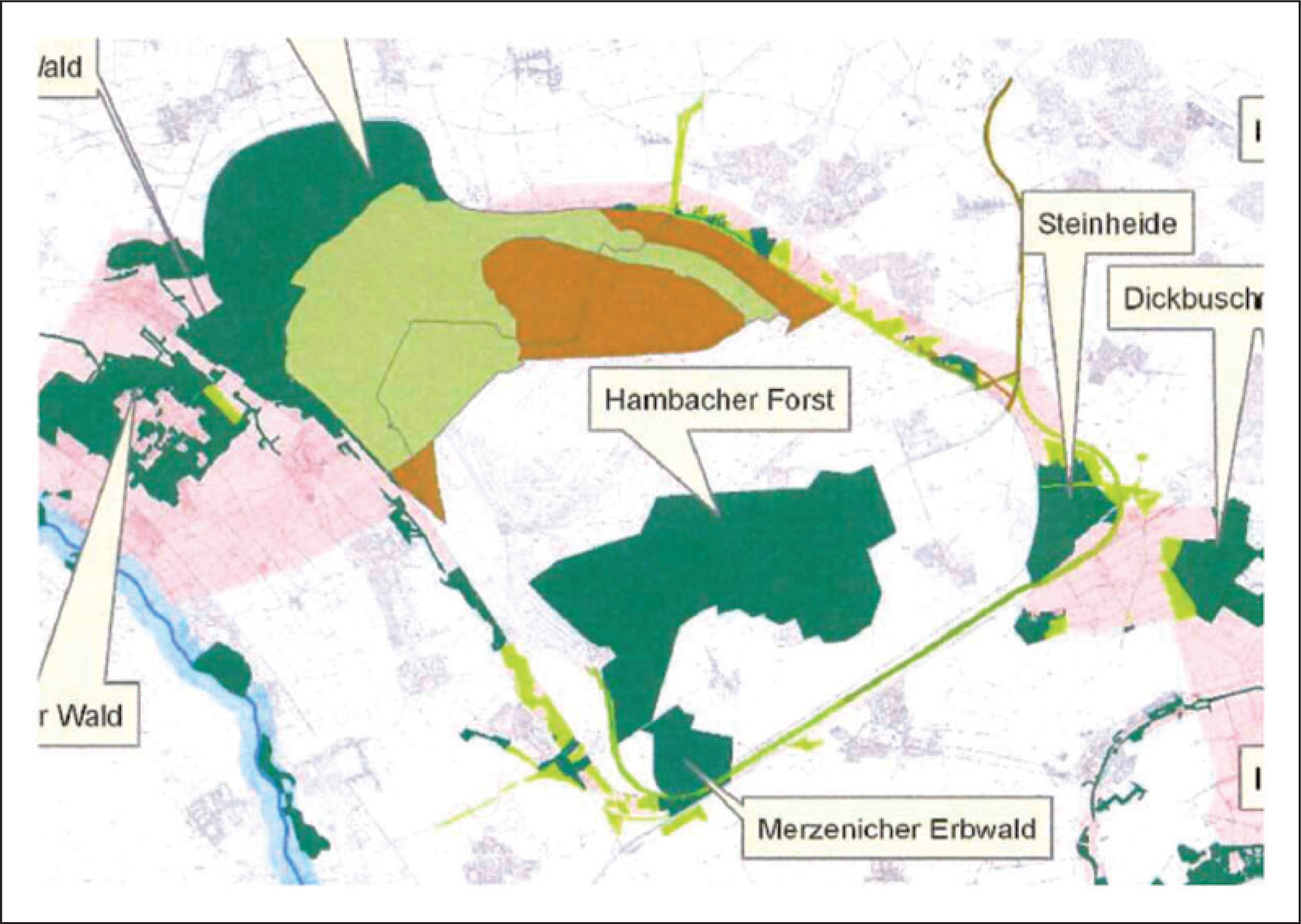
Map of the mining area from Schutzmaßnahmenkonzept. Source: RWE Power (2013a).
On the next map (Figure 4) Sophienhöhe (now in brown) becomes a ‘mitigation measure’ for bats and other species and given points in the ‘impact balance sheet’, and the Hambacher Forest disappears altogether – just like the human settlements that have already been displaced or are expecting displacement in the next few years.
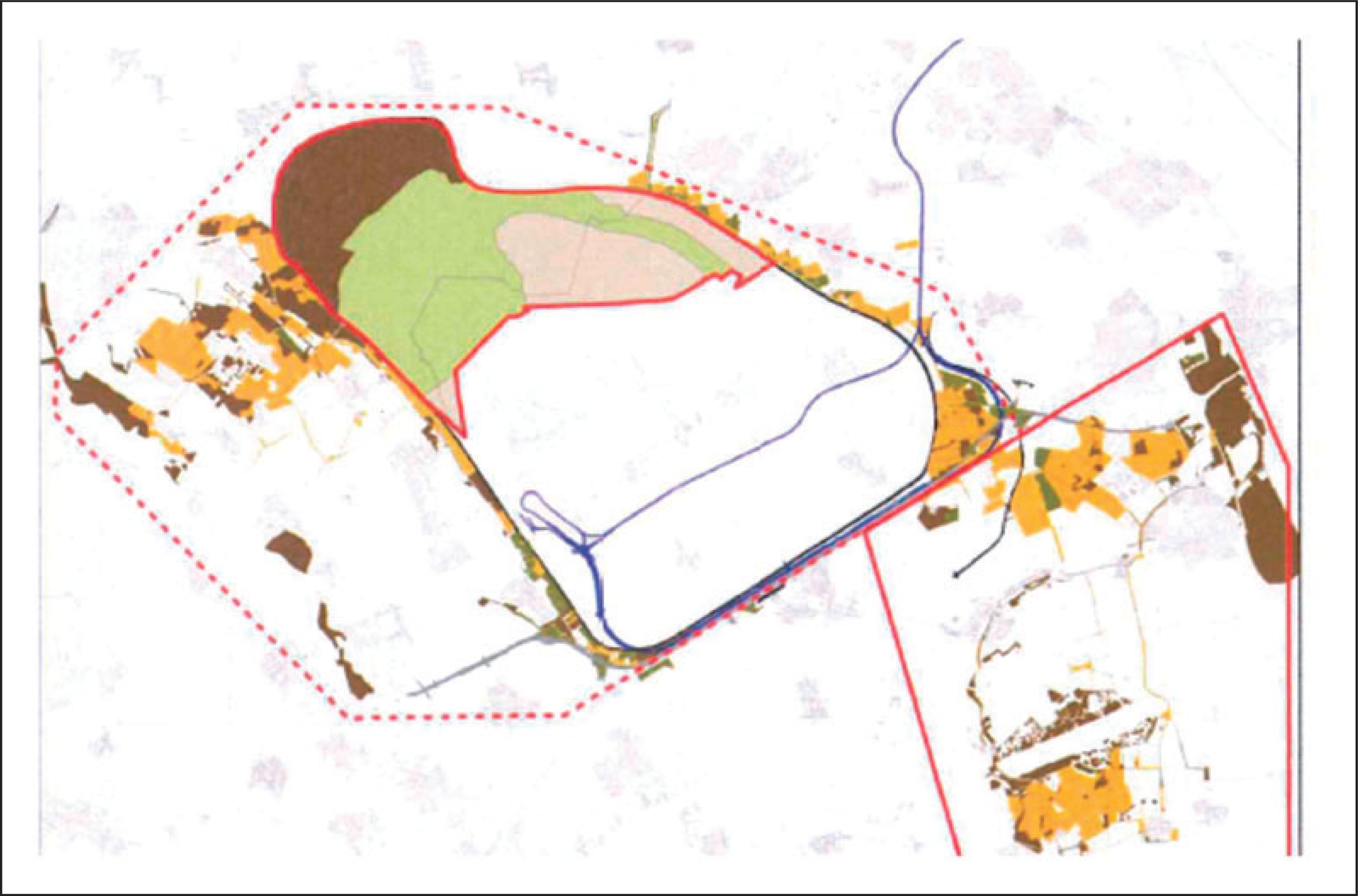
Map of the mining area with designated offsetting areas. Source: RWE Power (2013a).
The mapping exercise hints at the double process of detachment and attachment that has generated increasing scholarly attention, particularly in relation to carbon offsetting (Huff, forthcoming; Nel, 2017; Paterson and Stripple, 2012). ‘Offsetting involves a complex process of “detachment” in which the asset form itself is abstracted from the entangled biophysical and social relations that underlie its production to make it mobile and substitutable across space and time’ (Huff, forthcoming, drawing on Spash). This detachment is visible through the processes of ontological flattening outlined above. Yet, the realisation of offsets requires subsequent attachment to create the green credentials and social acceptance that (mining) companies rely upon for their operations. This attachment, Paterson and Stripple (2012: 565) have argued, operates through the interplay of ‘virtuality’ – the technical rendering of abstraction – and ‘virtue’ – the appeal to RWE’s moral and ethical qualities, or allegedly serious efforts to ‘green’ their operations. In her work on mangrove carbon credits, Amber Huff (forthcoming) argues that ‘this results in a materialized abstraction inhered with a self-evident moral quality that functions to neutralize resistance and critique’. The imaginations of these new intangible commodities – offsets – ‘are immediately normatively infused in ways that render resistance problematic’ (Paterson and Stripple, 2012: 569). Following Deschenau and Paterson, this also shows how offsetting taps into a desire for ‘green Public Relations’, mobilising the idea of neutrality and net gain, in combination with love for forests, and manifest in ‘net gain of trees’.
The creation of ‘virtuous biodiversity offsets’ through ‘virtual technologies’ is closely entangled with spectacularisation: ‘The real becomes that which can be represented on the screen’ (Paterson and Stripple, 2012: 568). It ‘break[s] the difference between the real and the imaginary, between true and false’ (Paterson and Stripple, 2012). As visible in the maps above, the ‘rendering virtuous’ further helps create the image of the ‘migrating mine’, as RWE claims (e.g. in its mine tours, the Pfaffendorf exhibition and in personal communication), rather than an ‘expanding mine’ – or as ‘a hole that migrates through the landscape’. 7 On its website, the research centre recultivation describes: ‘First come the diggers … then nature returns’ (Forschungsstelle Rekultivierung, 2016). Underlying its wider PR material as well as these maps – only slightly more differentiated in personal communication – is the assumption that, at the end of the day, soil is soil and tree is tree. This facilitates the legitimisation of the mine as ‘temporary use of the land’ and the (widely spread) claim that the mine will leave no permanent impact. All disturbance, it is claimed, is purely temporary – a claim that is difficult to counter. ‘Maybe in 12,000 years, Sophienhöhe will be like the Hambacher Forest’, a research participant states, ‘but not any time soon. And even then – it will always be an artificial forest’. 8
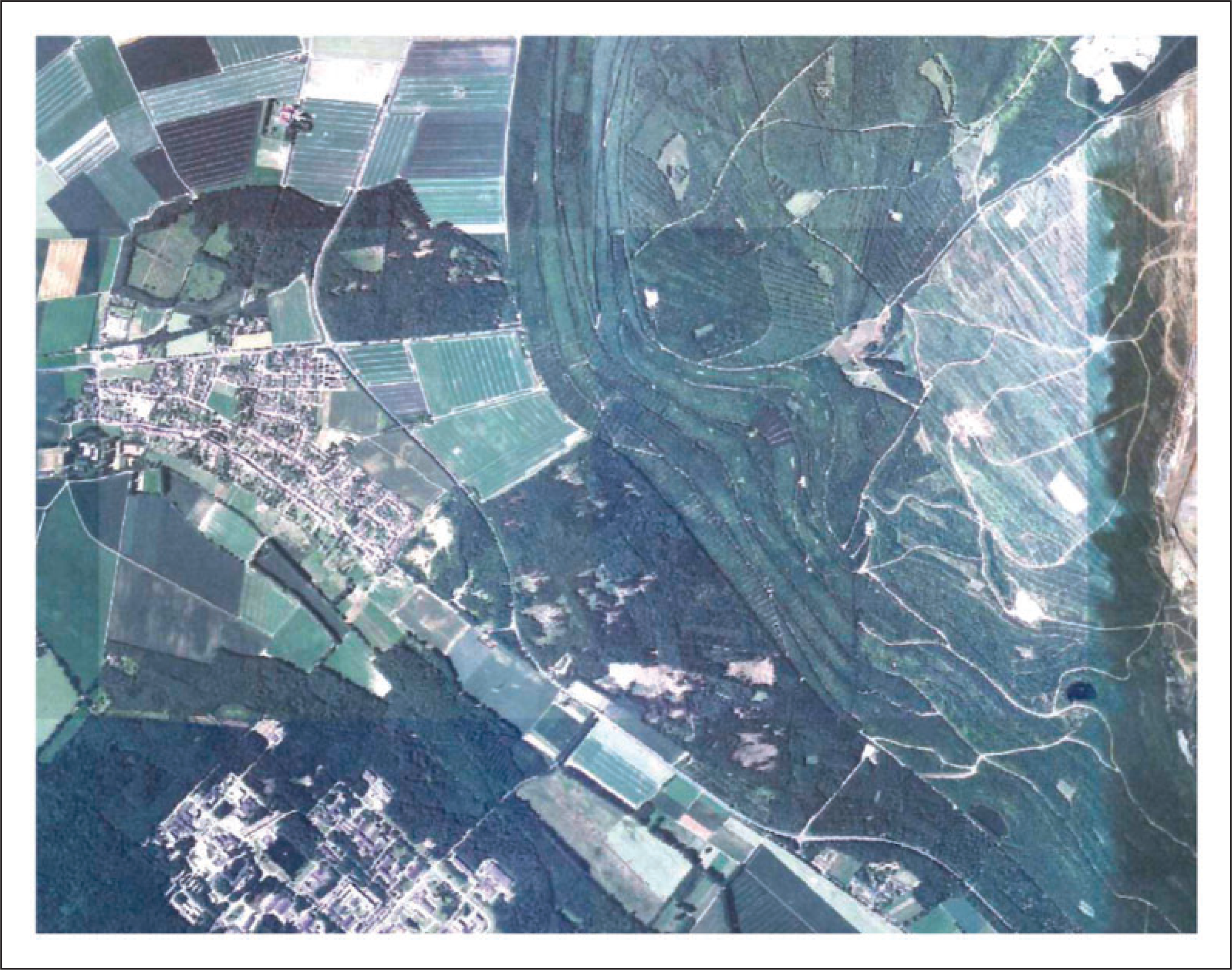
Arial image of the Western side of the Sophienhöhe (top right), adjacent old-growth forest (bottom left) – the Hambach mine begins on the right side. Source: RWE Power (2013a).
When looking at aerial images of the forest, or walking through and experiencing both forests first-hand, the differences between the ancient Hambacher Forest and the newly-planted Sophienhöhe become apparent (Figure 5).
Energy giant RWE, screenshot of RWE’s promotional video. Source: RWE (2009).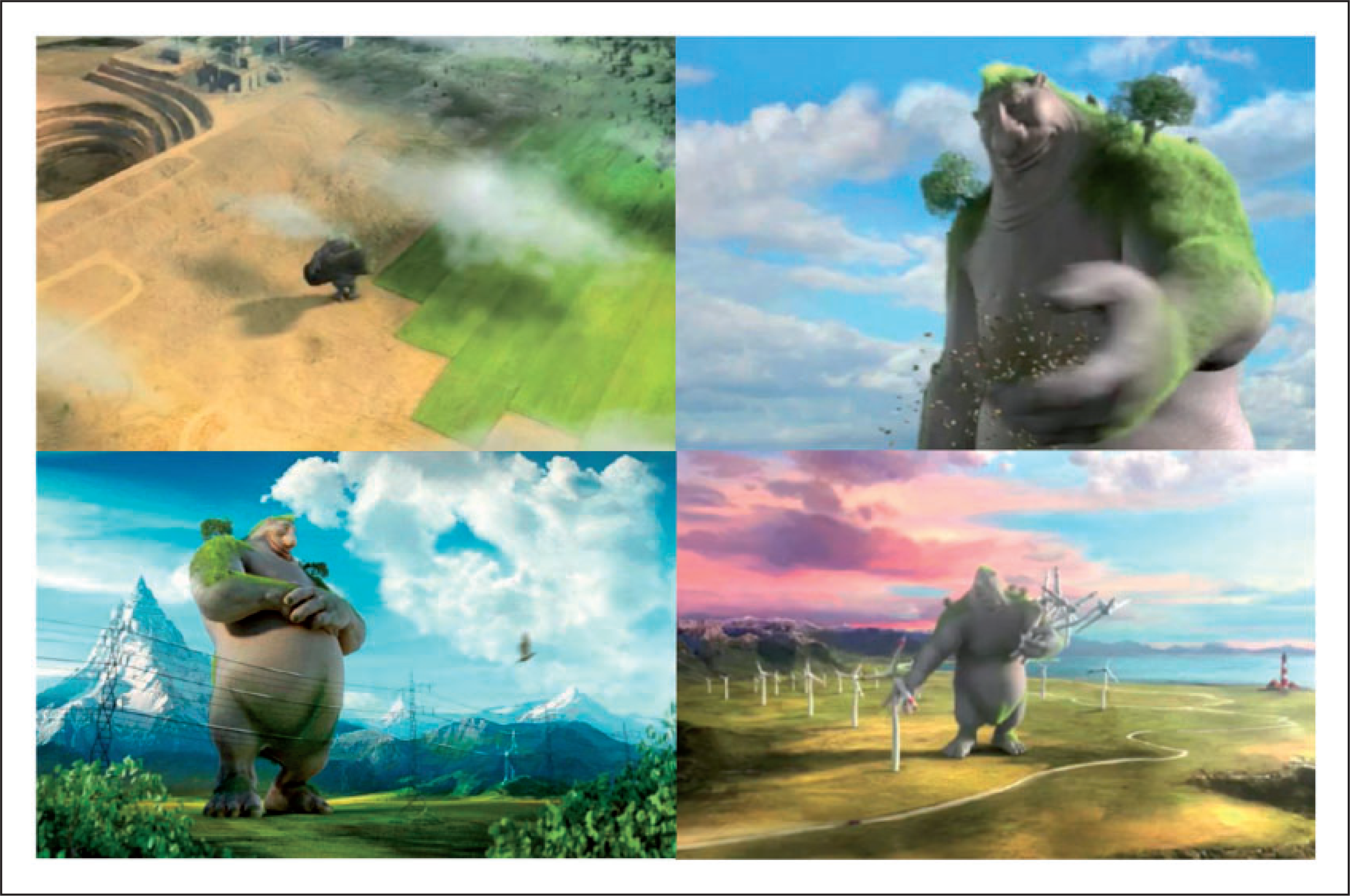
After having introduced the work that goes into the commensuration to make offsetting possible, the next section analyses the way it is then spectacularised to feed into RWE’s publicity work, contributing to its accumulation by restoration and narratives of the remaking of nature. In other words, how does RWE ‘perform’ sustainability?
Spectacularisation, sustainability, coal and the remaking of nature
To analyse the role of imaginaries in RWE’s messaging, it is useful to turn to Debord’s (1967) concept of ‘spectacle’. Spectacle imposes a sense of unity in situations of fragmentation, legitimising and justifying political systems and dominant power relations, and stipulating consumption as the (only) way of engaging with the world. It is grounded in the presentation of the world as quantifiable and commensurable, creating the appearance of exchangeability while concealing conflicts and contradictions, reifying the same conditions and relationships it is based on (Debord, 1967). It is further intensifying the alienation among humans and between human and nonhuman nature that offsetting plays into. Drawing on Debord, Igoe (2010) explores the role of images and imaginaries not only in ‘shap[ing] people’s perceptions of the world, but mediat[ing] social and human-environmental relationships … in late capitalism’ (375). I see these imaginaries as part of RWE’s efforts to ‘remake nature’ and transform (the image of) nature from mining landscapes to wind parks. Corporate-driven ‘spectacularisation of conservation’ mediates the relationships between residents/mining tourists, RWE and our (natural) environment. The way in which RWE is incorporating and shaping its surroundings and using it for rendering a positive image of its operations, I show in the next section, helps mediate people’s relationship to coal itself.
RWE’s representation and spectacularisation of its restoration work, exploited for marketing purposes, is instructive here. To illustrate, let us turn to the company’s 2009 advertising video (RWE, 2009), which was meant to establish the company as environmental leader but caused controversy because of blatantly false insinuations about its investments into renewable energy (Lobbycontrol, n.d.). In the same video, RWE appears as sweet-natured ‘energy giant’ (a phrase recurring in much of its advertising material) resembling popular Disney character Shrek, actively restoring and repairing the natural environment that was devastated by coal mining. The advert was shown prior to cinema screenings of Shrek 4 and Harry Potter, among others. Along to the popular children’s song ‘I love the Mountains’, and with trees growing on its shoulders, the friendly giant spends all day erecting windmills, building tidal power stations, repairing grid infrastructure and – more importantly – moving mountains, planting trees, sowing plants and rolling out lawn (Figure 6) to create the ‘better nature’ that RWE promotes (Figure 7).
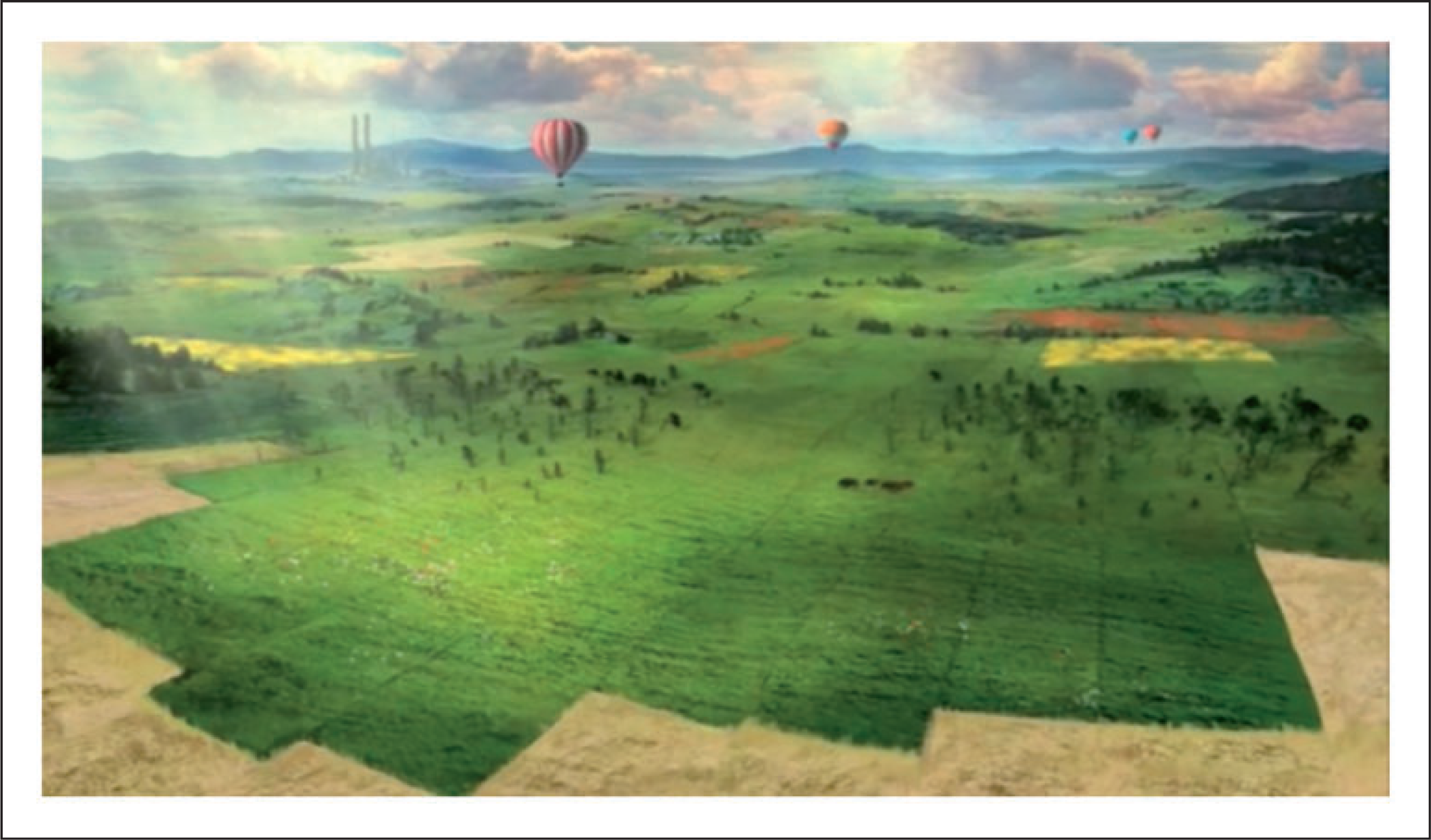
Nature restored – the view at the end of the day. Source: RWE (2009).
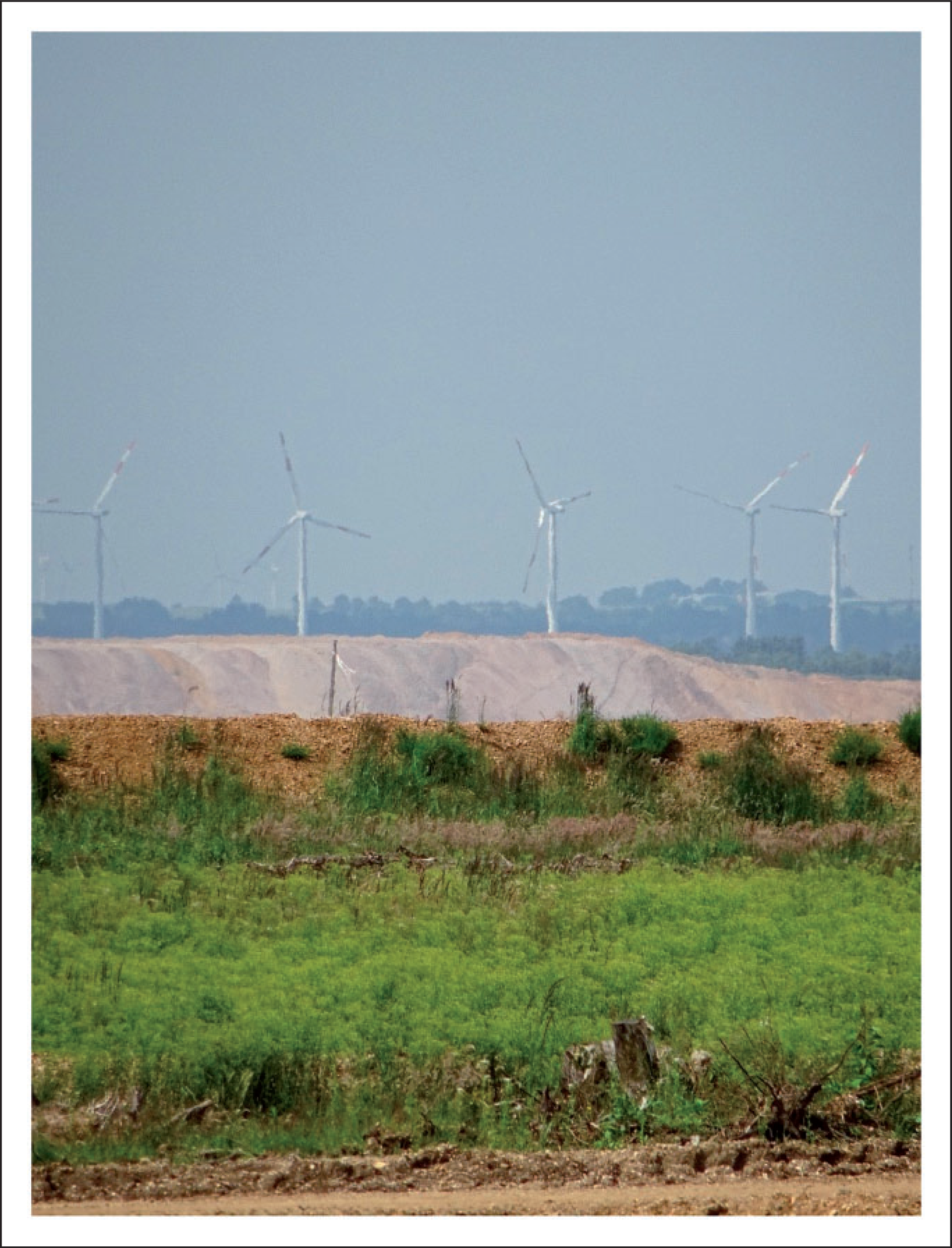
Windmills at the edge of Hambach mine. Source: own photo.
In addition to these digital representations, RWE’s spectacle involves the strategic positioning of windmills around the edges of the mine (Figure 8) and its sponsored ‘trees of the year’ plantation next to the new highway along the edge of the mine (Figure 9), both of which serve to signal its environmental stewardship and responsible behaviour, caring about the climate, and about educating those who drive past its mining operations.
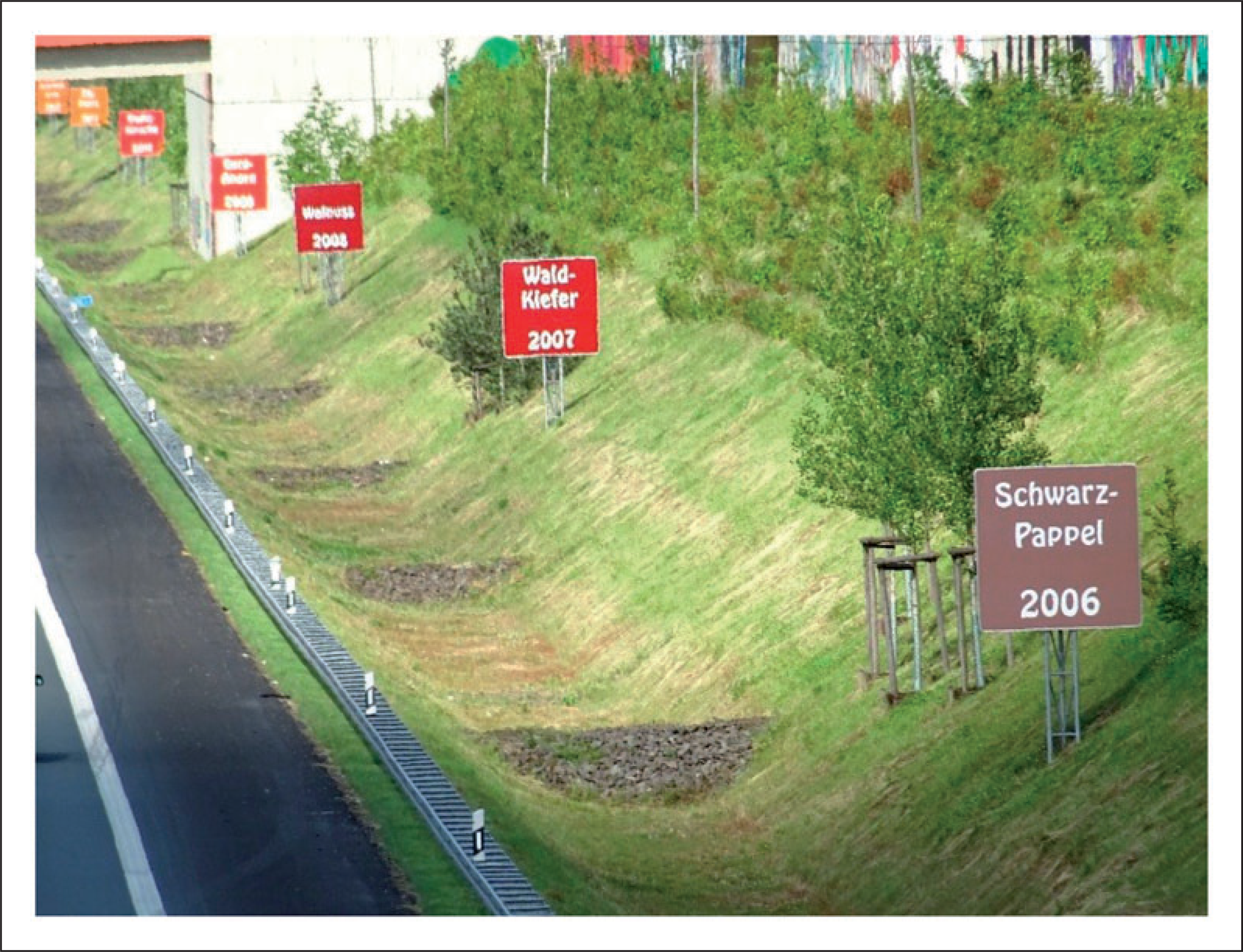
RWE-sponsored ‘trees of the year’ along the newly re-built highway. Source: own photo.
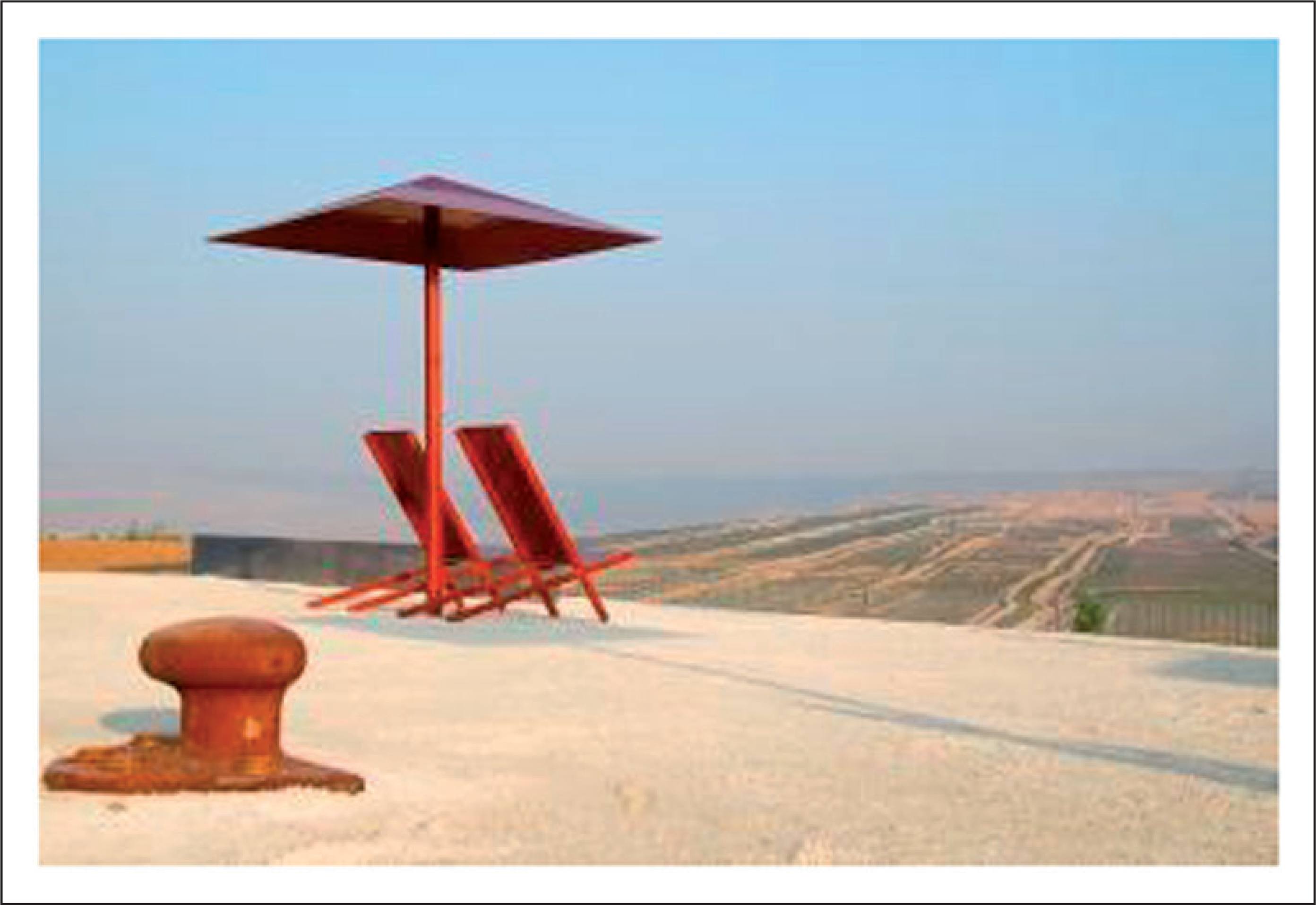
‘Waiting for the water’. Source: Melzer (2014).
The third example is :terra nova, a restaurant, bar and information and visitor centre modelled after a beach resort. Complete with sunbeds, playground with wooden ship-wrack and outdoor gym overlooking the mine, :terra nova is embedded in an artificial dune landscape. The mine, which tourists and visitors can admire from the facility’s terrace, will become Germany’s second largest lake upon mine closure, according to RWE, and the company is already capitalising on the reputational and material gains associated with the future touristic expansion through the resemblance with a ‘shoreline’, inviting visitors to ‘wait for the water’ (Johnen, RWE, in Wonnemann, 2013, Figures 10 and 11). RWE
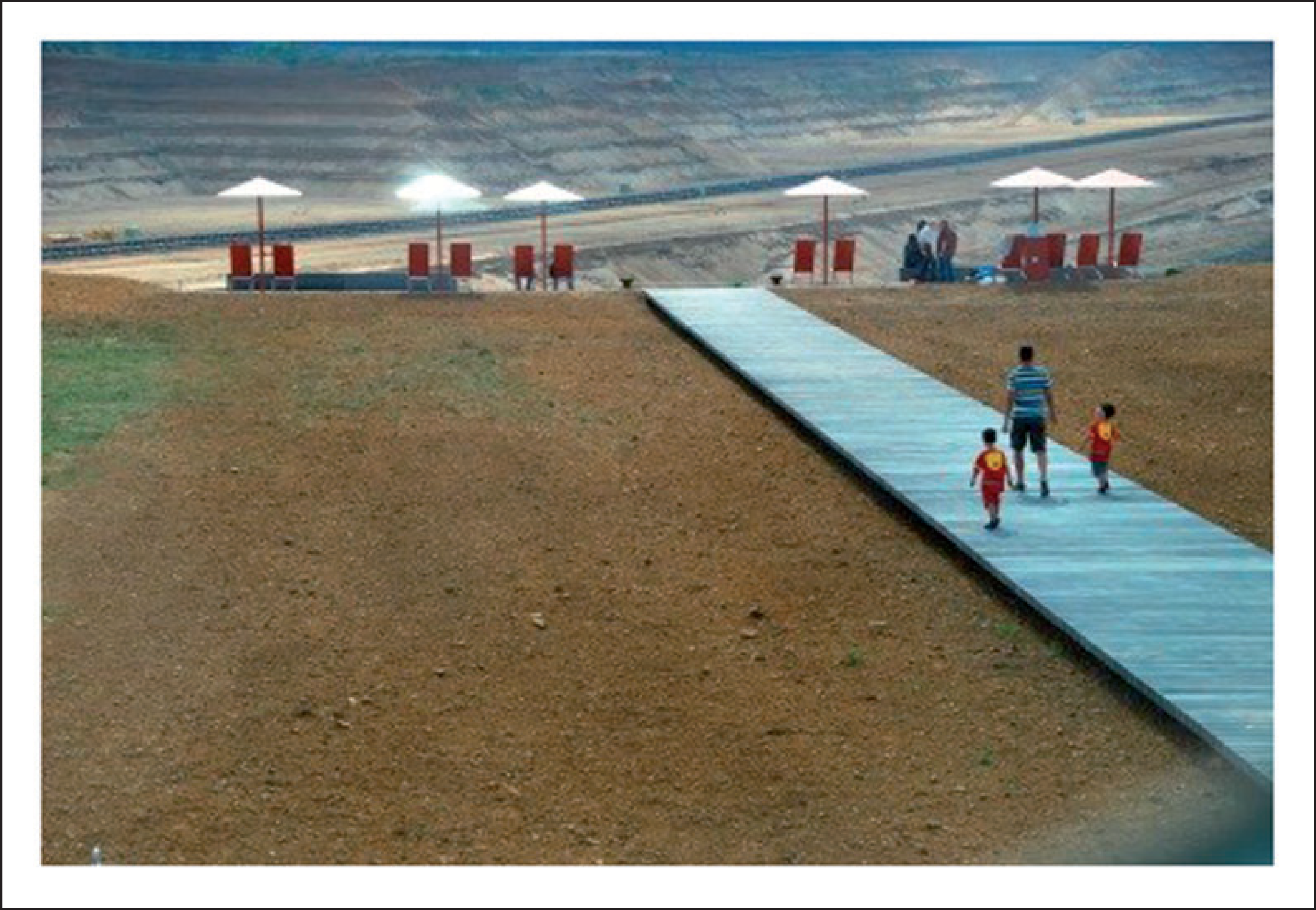
The jetty connecting the restaurant with the shore. Source: Melzer (2014).
attempts to market the re-imagining of the future, constructing a win-win solution where coal mining leads to a better life and, importantly, ‘better nature’, with a new lake and commercialised recreational opportunities waiting at the end of the mining tunnel. These new infrastructures are intimately tied to RWE’s greening efforts and claims of ecological sustainability, representing the neoliberal belief in consensus and seductive win-win solutions, based on the compatibility of capitalist growth and ecological sustainability (Büscher et al., 2012) – but also the capturing of imaginations founded on the erasure of the interconnectedness of natures, spaces and previous inhabitants (human and nonhuman) and the projection of new, artificial and mediated relations. This erasure and reconstruction of interconnection is a discursive and practical act of violence that is being invisibilised by RWE’s attempts to ‘green’ mining. (Brock and Dunlap, 2018: 40)
Not only does it hold the promise of a better future, a future where people will be able to enjoy the recreational opportunities that RWE is providing for them (just as many lakes in the Rhineland are former mining sites that have been restored to create recreational opportunities including swimming, water-skiing and cycling along the shores). But at the same time, it resembles the political ‘threat’ (or promise) that RWE has been able to institutionalise in the political arena, nationally and especially in the state parliament (and constantly reiterates in its publications): coal is still the future – coal will be with us for a long time. This present and this future are to be consumed through the commodified ‘enjoyment’ of the view over the mine, connected – physically through a ‘jetty’ (Figure 7) – to consumption of food, drinks and football-golf, but also beautifying visitors’ relationships with RWE.
These three spectacular performances of sustainability – the advertisement, the windmills and :terra nova – are integral to RWE’s corporate display of good guardianship and responsible citizenship, once again remaking the (human) landscape and communicating the reconcilability of sustainability and coal. The newly planted ‘trees of the year’ (Figure 9) and the friendly giant (Figure 6) remind the passing passenger and the cinema-goer, respectively, of RWE’s ecological concerns, green credentials and commitment to recultivation work, creating a sustainable future. :terra nova illustrates the ecotourism–extraction nexus that will be explored further in the next section. The windmills (Figures 6 and 8), lastly, represent a different kind of ‘progress and modernity’ in times of energy transition and climate change, thus simultaneously serving as compensation measures for the mine while concealing the equally, if not more ecologically disastrous mining operations and displacement required elsewhere for the resources necessary for these windmills (Dunlap and Brock, forthcoming; Dunlap and Jakobsen, 2019; Sovacool et al., forthcoming). In her analysis of the Chilean political economy of energy and mining, Furnaro (2019) argues that renewable energy investments should be understood as ‘socioecological fix’ through which ‘new appropriations of nature are used to alleviate the threatened accumulation process of its energy-intensive mining economy’ (2). They point to the recent nexus between conventional and green extraction technologies that allow for allegedly ‘green’ extractivism (Dunlap and Jakobsen, 2019). The positioning of renewable energy in the service of fossil fuel extraction illustrates what we have elsewhere called the ‘renewable energy-extraction nexus’ (Dunlap, 2018; Dunlap and Brock, forthcoming), effectively illustrating its function as ‘Fossil Fuel+’, securing the continued legitimacy of coal, rather than providing a real alternative.
Of nature lovers, better futures and ecologies of repair: Exploring the productive power of offsetting
[Compensatory] Recultivation is our business card for us mining companies … It continues to be important to us to remain a reliable neighbour. (RWE’s recultivation conference, 2017)
Biodiversity offsetting, this article argues, operates as a social technology of governance which facilitates accumulation by restoration by legitimising coal mining in the face of ecological crisis and by creating new accumulation opportunities (see also Brock, 2019). As I show elsewhere with Alexander Dunlap (Brock and Dunlap, 2018), biodiversity offsetting helps manage resistance against the mine and greenwash RWE’s operations. This section explores how this productive power operates by, first, illustrating how RWE’s compensatory recultivation work mobilises and derives credibility from conservation partnerships by engaging, co-opting and silencing critics and conservationists. Second, I examine how RWE creates new, ordered, ‘ecologies of repair’, based on narratives of better nature and better future and feeding, third, into the ecotourism–extraction nexus (Büscher and Davidov, 2013). The latter is illustrated by RWE’s attempts to turn the world’s largest hole and the largest human-made mountain into extractive attractions (Brock and Dunlap, 2018: 40) – enrolling visitors, residents and ‘nature lovers’ by building ‘affective attachments’ (Descheneau and Paterson, 2011; Huff, forthcoming) that play into modernist fantasies of controlling and domesticating nature.
Legitimising offsetting, legitimising mining: Partnerships for green credentials
Biodiversity offsets are more about managing communities and livelihoods than about managing biodiversity per se. (Conzo, 2012)
The quote by Lori Anna Conzo, Environmental Specialist from the International Finance Corporation, illustrates the important social function of biodiversity offsetting – enrolling potential critics and building alliances with conservationists and communities. A biodiversity consultant working on large offsetting projects for mining corporations explains to me their strategy to minimise local resistance: The advice I always give really early on … is to go to these groups individually. Often, they are fighting amongst themselves. [Make use of] messy relationship between them and between government NGOs, work out stakeholder group and talk to them … [tell them:] you won’t like what we do, but we are trying to minimise impacts. Often, we end up hiring people, specialists, through these NGOs.
10
Similarly, RWE’s biodiversity recultivation work embeds and anchors partnerships and collaboration with conservation groups, Naturliebhaber (‘nature lovers’) and conservation scientists that help co-opt critics and divide-and-conquer resistance. The Sophienhöhe presents an ideal laboratory for researchers investigating ecosystem restoration, animal and plant behaviour and species diversity in artificial environments. RWE’s annual restoration conference provides a platform where this restoration work is spectacularised, and scientists, conservationists and the interested public are invited to discuss its success. Local volunteers’ contributions to RWE’s restoration work are praised, renown scientists and political figures are invited to speak, and RWE staff and the conservation community can mingle. The annual conference is embedded in a series of almost weekly events and tours to market and promote RWE’s restoration work throughout the year – regular hikes and excursions, ‘deer safaris’, a public lecture series, and a number of outdoor events targeting children and adults. The conference is organised by RWE’s recultivation research centre which oversees the company’s recultivation work, in collaboration with the Cologne Bureau for Faunistics and countless volunteers. The research centre is not only responsible for the planning and implementation of RWE’s recultivation work but appears to undertake PR and stakeholder outreach, promoting the company’s biodiversity management to external parties, student groups and politicians. It further coordinates the numerous local volunteers and conservation organisations which collaborate in biodiversity data collection and invites them to the restoration conference, where their work is showcased, publicly acknowledged and applauded. This work, and the data they collect, are ‘very important to the restoration success’, I am told, 11 and RWE’s recultivation centre entertains close contact and personal relationships with these groups and individuals. In return, conservationists abstain from criticising RWE’s coal mining operations and the cutting of the Hambacher Forest. 12
Collaboration with conservation NGOs is further institutionalised at different levels – internationally (through the Bettercoal Initiative), on the company-level (through partnerships with IUCN, other German NGOs and government bodies), as well as locally, through collaborations with nature volunteers and the Kölner Büro für Faunistik (Cologne Bureau for Faunistics). In the past, the company enrolled two very prominent German environmentalists on its Corporate Responsibility Stakeholder Council: Christoph Bals, director of Germanwatch, and Professor Manfred Fischedick, vice president of the Wuppertal Institute for Climate, Environment and Energy. In its leading role in the Bettercoal Initiative, RWE claims to promote corporate sustainability in the international coal supply chain by auditing and stakeholder engagement. Meanwhile, campaigners criticise RWE for ‘outsourcing’ their responsibilities to divert attention from their destructive operations. The secret nature of the internal audits and their outcomes, and the ‘forward-looking approach’ of ‘continuous improvement’, 13 which allows for ignoring the corporate crimes committed by RWE’s supply partners, make for what one research participant describes as a ‘perfect greenwashing tool’. 14
In the run-up to the 2013 World Economic Forum in Davos, RWE announced a controversial biodiversity partnership with IUCN, the world’s largest conservation organisation, which involved a study of RWE’s biodiversity management and restoration work around the Hambach mine. The study recommends: [B]iodiversity loss is a risk factor to the company. However, if projected risks are managed properly (e.g. on the basis of the mitigation hierarchy), they can often be turned into opportunities to provide positive outcomes for biodiversity … such management methods can improve the company’s “social license” to operate. (Imboden and Moczek, 2015: 3)
Engineering nature, new ecologies of repair and better natures and better futures
The great thing is … that the restoration work is better than [what was there] before. We can plan a new landscape … It’s a unique opportunity. We can accommodate all interests. (RWE interviewee)
The recultivated Sophienhöhe is framed to contribute to a ‘net gain of nature’ as the result of RWE’s coal mining operations in the Rhineland. Indeed, RWE derives legitimacy from its claims that the company has ‘planted more trees that it had to fell’, a research participant explains
16
– over 10 million new trees in the past three decades (RWE Power, 2014). While downplaying and naturalising forest destruction, RWE sees this as an opportunity to improve nature: ‘intervention in the natural world is an inevitable part of what RWE does, which is why we go out of our way to preserve and upgrade the habitats of native flora and fauna wherever possible’ (RWE, n.d., emphasis added). This trust in the company’s capacity to engineer and remake nature for their own purposes is grounded in what James Scott (1998) describes as ‘high-modernist ideology’, characterised by overly optimistic self-confidence about scientific and technical progress, the expansion of production, the growing satisfaction of human needs, the mastery of nature (including human nature), and, above all, the rational design of social order commensurate with the scientific understanding of natural laws. (4)
RWE’s recultivation and compensation work, which the company praises as ‘exemplary in the world’ is taking this belief in the ability to engineer, recreate and control ecosystem service development to the next level – visible not only in the Sophienhöhe, but also in their plans to turn the Hambach mine into an enormous lake following mine closure. The lake is designed to occupy an area of over 4000 hectares, up to 400 metres deep and meant to be filled, over a 40-year period, with four billion litres of water, diverted from the Rhine river (Nowicki und Benden, 2017). The river ecosystem is scheduled to be finished by 2080, although the feasibility and safety of these plans is questioned by ecologists 17 (BUND, n.d.).
Accumulation by restoration is thus very much based on this human ability to recreate and ‘repair’ habitat or to re-build it from scratch. The links between ‘leading’ restoration practice with the mining industry are especially interesting here – and not a coincidence. Not only is the mining industry particularly dependent on access to land, and in need of a licence to operate, but it is an industry that is particularly characterised by mechanisation; an industry that shifts more soil than any other sector; an industry that has ‘mastered’ the domination of nature – and an industry that has historically celebrated this mastery of nature. Worth quoting at length is Jeffrey H. Michel’s (2005: 18) portrayal of the nature of mining and the mining of nature in the Rhineland: Finite resources of coal and mineral deposits are considered expendable for sustaining the mining guild, whose tradition of self-confident rationalization has been captured in a slogan that resounds throughout the industry: “I am a miner. Who is more?” … This robust profession is outfitted with suitable artifacts of masculine sensual gratification, from churning machinery and billowing smokestacks to the violent disfigurement of landscape that is reminiscent of World War I battlefields … The unconstrained virility implicit to penetrating the bowels of the Earth was captured by Friedrich von Hardenberg in his “Song of the Miner” … in 1802: A miner, the “Lord of the Earth”…, becomes passionately enflamed in the depths of the mine, as if that were his bride.
‘Extractive attractions’: The ecotourism–extraction nexus in action
Coal mining and tourist development go hand in hand. That is why RWE is allowed to dig and maintain this hole. (RWE coal mine manager, personal communication)
As has become clear by now, RWE’s ‘repair work’ not only fulfils legislative requirements and contributes to the greenwashing of Europe’s single largest source of greenhouse gases (Michel, 2005). RWE’s offsetting work goes hand in hand, to use this RWE manager’s words, with the eco-touristic development of the mining area as well as the ‘extractive engineering’ that captures imaginations through novel imaginaries and narratives of sustainable coal mining and a better future on the shore of a lake.
Residents, interviewees report, 20 are told to expect rising property values and made promises of luxury apartments with lake views, touristic development and new jobs. 21 Yet, the mine itself has already become an ‘extractive attraction’, with its own TripAdvisor page and regular tours through the mine and the neighbouring power stations. Bus tours are advertised on regional tourism websites, 22 upcoming events are promoted multilingually and local newspapers raffle jeep tours through the mine (Pluwatsch, 2018). The range of viewing platforms and lookout towers, from which the largest mobile machines of the world can be seen in action, is frequented by visitors from across the country, as well as neighbouring Belgium and the Netherlands. Regular concerts and other cultural events tend to attract local and regional visitors.
As explored elsewhere in more detail (Brock and Dunlap, 2018), RWE’s offsets also host a diversity of recreational and educational opportunities – 150 kilometres of cycling and hiking infrastructure including the novel ‘speedway’, guided hiking tours through Sophienhöhe, exhibitions and museums illustrating and romanticising the history and present of coal mining, cultural events and the multiple attractions that can be found in the offset site (including the Celtic tree circle, viewing points, ‘giant redwood trail’ and showcased wildlife
23
mentioned above). On the Straße der Energie (energy route), a ‘tourist route through the Rhinish lignite mining area’ (RWE, n.d.), the visitor can witness RWE’s mines, recultivation work, processing facilities and electricity production from lignite coal, wind and solar. These tours accompany numerous RWE publications outlining maps, regional information and trail suggestions, as well as general promotional material. (Brock and Dunlap, 2018: 40)
RWE’s compensation work, this section has shown, thus involves new value creation through the restoration process itself, e.g. new profit opportunities through the sale of eco-points and associated environmental services. More significant, however, is the securing and protection of existing and increasingly ‘at risk’ (shareholder) value creation against the political threat of coal phase-out. This value creation relies on the legitimacy rendered by restoration, collaboration and new partnerships with ecological groups, conservation organisations and ‘nature lovers’. The political effects of these processes will be outlined in the next section.
Securing accumulation by restoration through hiding harm and imaginations of better natures and better futures
The ‘extractive attractions’ analysed above works to further normalise the mining processes that are being militantly resisted. 24 The successful mediation of this relationship and the different interests – ecological, social, economic – contribute to Guy Debord’s ‘omnipresent justification of the conditions and aims of existing systems’ (Igoe et al., 2010: 492) – a capitalist industrial system based on social and ecological injustice and exploitation, encouraging consumption as (the only) way to relate to one’s surrounding.
Mining, in turn, is associated with (technological) progress and modernity, with conquest over nature and engineering dreams. RWE’s promotional material – and the mining-ecotourist infrastructure explored – appeal to this fascination with big machinery symbolising modernity, showcasing its huge diggers, the ‘largest mobile machines of the world’ (RWE Power, 2013b), steered through the most up-to-date GPS technology (RWE Power, 2014). This fixation with power and control now finds its continuation in the nature restoration processes that rely on similar mythologies of total control.
These processes legitimise and intensify accumulation processes, and construct corporations as benevolent citizens, bringers of prosperity and saviours of natural environments. The granting of citizenship has historically been politically contested (e.g. to people of colour and women) and points to the crucial role of the state in enforcing corporate ‘rights’, legitimising RWE’s operations and suppressing resistance. Ultimately, it is the state who grants citizenship and builds regulation ‘for’ rather than regulation ‘of’ business (Newell, 2001), and the ontology described above relies on the state as ultimate authority, playing an active role in protecting citizens’ (= RWE’s) rights.
States and corporations create the discursive spaces where the impacts and the risks of coal mining are normalised and naturalised ‘as the inevitable consequences of modernity’ (Kirsch, 2014: 1). Such discourses have traditionally been invoked by the mining industry to warn of deindustrialisation and the return of the dark ages that would follow the end of mining, or coal phase-out. In his ‘sustainable mining vision’, mining engineer Ghose (2009) claims: ‘Mining is, was and shall continue to be the cornerstone of human civilization … without mineral raw materials human race literally regresses to a caveman existence’ (2).
RWE’s discursive work to naturalise its operations and secure accumulation (by restoration), and the imaginations of a ‘better future’, need to be read against the ‘threat’ of a political decision to phase-out coal, but also a certain German nostalgia, romanticism and mythological attachment to (ancient) forests. Instead, RWE promotes a medium-term future with coal, harmoniously co-existing with the slow (corporate-controlled) expansion of renewable sources of energy (or ‘Fossil Fuel+’, Dunlap, 2018, also Dunlap, 2019b) and the creation of a ‘better nature’ to compensate for the destruction of the Hambacher Forest.
Conclusion
This article has illustrated how accumulation by restoration plays out in the German Rhineland. It is through the spectacular performance of sustainability – as illustrated on three different examples – that RWE mediate their social and political relationships to secure the legitimacy needed to continue coal mining in an age of ecological crises.
RWE’s nature recultivation work is fundamental to its accumulation. It can neither be reduced to a ‘greenwashing’ exercise nor can it be explained as ‘rollout’ of neoliberal market-schemes for the governance of nature or the continuation and intensification of financialisation. Based on state support and the structural dependence of regional state actors, it contributes to the further legitimisation and entrenchment of corporate and police violence against activists, residents, nonhuman nature and the planet itself (Brock and Dunlap, 2018). It is complemented by RWE’s novel processes of accumulation through eco-points and biobanks – the creation of new ‘intangible commodities’ (Huff, forthcoming) – and agricultural subsidies. 25
Nature restoration in the German Rhineland, I have shown, forms the heart of the ecotourism–extraction nexus in action. The feasibility of RWE’s compensatory restoration work relies on the willingness of academics, conservation organisations and ‘nature lovers’ to form partnerships that draw in critics and serve to enact the spectacularisation of conservation, turning RWE’s restoration and mining activities into ‘extractive attractions’. Both restoration and mining tourism are a manifestation of the same belief in total control over nature, the ability to engineer and ‘improve’ nature, and a fascination – or obsession – with large machinery and scientific processes to shape and dominate nature. The belief in the restorability of nature is based on ontological flattening to facilitate claims of commensurability and ‘offsettability’, coupled with the utilitarian-economic outlook inherent in offsetting. Nature is now reshaped by RWE’s developers who reconcile and manage different interests and reconfigure environments into carefully integrated zones of commercialised nature consumption that serve to justify the industrial electricity production system so fundamental to capitalism.
The creation of this ‘better nature’ is based on the very same violent processes of classification, quantification and measuring of life – what Moreno et al. (2015) have called ‘ecological epistemicide’ – ignoring interconnections and social relations to the land and enabling claims of ‘net gain’ of trees. RWE’s nature recultivation work that is so vital for accumulation by restoration is the outcome of the company’s efforts to make nature commensurable, legible and controllable, requiring continuous surveillance, monitoring and ‘careful management’. It is grounded in the same belief in the human ability to dominate and engineer nature, mechanisation and rationality that mining is based on. It represents the need to manage the growing and intensifying resistance against the continued processes of human and nonhuman exploitation, displacement, violence and alienation inherent to extractivism. These processes need further scholarly attention.
Highlights
Explores the relationship between coal mining, biodiversity offsetting, spectacularisation of conservation, ecotourism–extraction nexus and accumulation by restoration in Germany. The significance of offsetting lies not only in profit opportunities but its productive power: legitimising coal mining and ‘ecologies of repair’. This productive power operates through mobilising function of RWE’s offsetting work which forms the foundation for corporate partnerships and alliances with conservation groups and volunteers. These lend legitimacy to offsets, form the basis for the ecotourism–extraction nexus by turning the mine and offsets into ‘extractive attractions’. Based on 40 in-depth interviews, site visits, event ethnographies, participant observation and tours through the mine, offsets and neighbouring communities.
Footnotes
Acknowledgements
I would like to thank all research participants, and particularly those who are resisting coal extraction in the Rhineland and across the world. Solidarity! Special thanks to Amber Huff, James Fairhead, Peter Newell, Sian Sullivan, Ian Scoones and two anonymous reviewers whose comments and suggestions have significantly improved the paper. Research data is confidential and cannot be made public.
Declaration of conflicting interests
The author(s) declared no potential conflicts of interest with respect to the research, authorship, and/or publication of this article.
Funding
The author(s) disclosed receipt of the following financial support for the research, authorship, and/or publication of this article: Research for this paper was financially supported by the ESRC (ES/JS00173/1) and the German Studies Foundation.
