



Abstract
In the last two decades, we have extensively explored the semantic classifiers in ancient Egyptian scripts, showing how they encode the world from two complementary perspectives: universal cognitive tendencies of classification along with Egyptian society's categorization of the world. Our central hypothesis is that each graphemic classifier in the Egyptian writing system heads a conceptual category. The assemblage of words classified by a particular classifier presents us with a dynamic map of an emic category in the mind of a culture. Classifiers in the Egyptian script allow us to trace central and marginal members of conceptual categories, spot interrelations and overlaps between categories, observe diachronic developments and changes, and discover incompatibility of categories. The number of classifier occurrences in complex script systems amounts to millions (i.e., big data). In the last decade, we developed in the ArchaeoMind Lab the digital tool iClassifier 1 (© Goldwasser, Harel, and Nikolaev) designed to check our hypothesis on a large scope of texts from different periods and different scripts. We mark classifiers in imported digitalized corpora—in ancient Chinese, ancient Egyptian, and Sumerian cuneiform. This contribution introduces the reader to the rules of the classifier system in the Egyptian script and presents new results from a pilot project on a genuine Egyptian corpus (variants of the Story of Sinuhe).
Introduction
The topic of this article is the phenomenon of semantic classifiers (or determinatives) that make up an important part of the hieroglyphic writing system. The ancient Egyptian script is a complex writing system actively used for over 3000 years (Gardiner, 1957; Polis, 2023). It is made of signs that can take three basic semiotic functions—logogram, phonogram, and classifier. The term classifier refers to the specific function many hieroglyphs perform in the ancient Egyptian script. The same hieroglyph that functions as a classifier may perform other graphemic functions. When playing the role of classifier, the hieroglyph is unpronounced. Classifiers are seen but not heard. They refer to concepts and not to words in the lexicon. Egyptian classifiers always appear in the end position in a word or compound. The example in Table 1 illustrates the same hieroglyph  in the three possible semiotic functions (all classifiers are colored in
Graphemic functions of Egyptian hieroglyphs. The sign
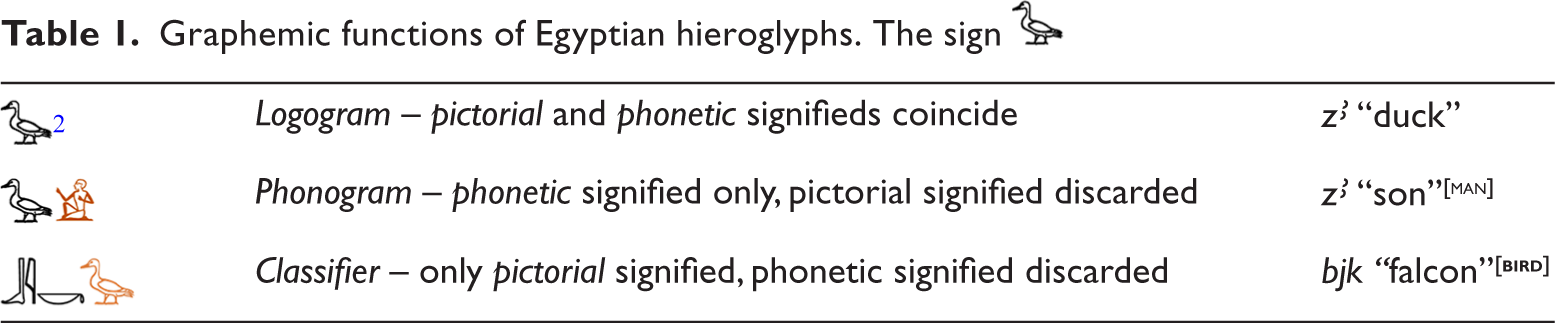
Graphemic functions of Egyptian hieroglyphs. The sign
These three basic functions can be subdivided into more specific uses (Polis, 2018). Logograms include hieroglyphs of high iconicity
3
(e.g.,  “duck,”
  “crocodile”) and icons of lower iconicity (e.g.,
  “house”). The same icon
  can function as a phonogram, as in the example
  (here the seated man is the classifier, classifying the “son” to the category [
 , which is a triliteral sign. The icon
  represents the ruler metonymically by his prototypical scepter. However, the word could also be written
  ḥqꜣ, with two redundant, unpronounced uniconsonantal hieroglyphs,
  q and
q and  ꜣ, that are phonetic complements (Faulkner, 1962: 178). Biliteral and triliteral phonograms are more rarely activated in this role.
5
ꜣ, that are phonetic complements (Faulkner, 1962: 178). Biliteral and triliteral phonograms are more rarely activated in this role.
5
When functioning as a classifier, the hieroglyphic icon loses all phonetic realization and carries semantic information alone. In most cases, the classifier functions as a representative of a whole category, and as such, its meaning is extended considerably. Such is the case of  “falcon” (e.g., CT
6
I 97), where the duck
“falcon” (e.g., CT
6
I 97), where the duck  hieroglyph gets the extended semantic meaning [
Hieroglyphs that function as classifiers are always attached to a host lemma, compound, or root. Semantic classifiers always show a motivated relationship with their host. We think that the term classifier should replace the old term determinative coined by Champollion (1836) himself, the decipherer of the ancient Egyptian hieroglyphic script. 7
Efforts of classification and categorization are visible in all human activities. In language, classification surfaces at different linguistic levels: lexicon, grammar, and script. Classifiers are part of this effort. They appear in many oral language systems 8 (as pronounced morphemes), in signed languages (as gestures), and in complex scripts (as unpronounced graphemes). Whatever the linguistic medium in which they are present, they are manifestations of the same cognitive effort. Therefore, when appearing in writing systems, they are not simply representative of phenomena particular only to scripts.
Graphemic classifiers, despite the traditional argument, are not mere graphic devices activated to clear up script ambiguities or mark the boundary of a word. As will be demonstrated, referring to this function as classifier instead of determinative is not mere relabeling. Consequently, classifiers must be investigated from a typological perspective, as a system, open to comparison with other scripts and languages. Indeed, once Egyptian classifiers are put in the framework of modern classifier studies, we can better understand, explain, and even predict their behavior.
Almost all parts of speech in the Egyptian writing system could take a graphemic classifier. They appear as a rule after the host word. The classifier's appearance with a lexeme is not compulsory and may be subjected to scribal traditions, materiality, idiosyncratic choices, space limitations, and diachronic changes. Script variations (Hieroglyphs, Cursive [linear] Hieroglyphs, Hieratic, and Demotic) show different classification tendencies and different diachronic developments (e.g., Chantrain, 2014a, 2021). Finally, we must consider the unusual phenomenon of multi-classification in the Egyptian writing system: a single host may take one to four or even five classifiers and in another text not be classified at all, as Egyptian does not have a canonical spelling for words. 9
In the first section of this article, we briefly review some of the essential characteristics of the Egyptian graphemic classifier system, as far as space limitation allows us. First, we present the possible parts of speech that can function as hosts. Then, we exemplify the identification of most classifiers as prototypes of the conceptual categories they represent. Finally, semantic relations between a classifier and its host are presented, and alternating classification and multi-classification and their possible reasons are shortly discussed. Encyclopedic versus pragmatic classification and the emergence of semantic roles in verbal classification are also discussed. This section ends with a short mention of indoctrination by pictorial models in the script. The second part of the article is a pilot corpus linguistic study on the Story of Sinuhe, a prominent literary text of ancient Egypt. It is a data-based statistical effort to test our theory of classification. We imported the main versions of the text (courtesy of the Thesaurus Linguae Aegyptiae, see corpus credits) into our digital research tool iClassifier. We proceeded then to analyze the data with this digital tool. Some of the results are presented on network maps and tables. The last section presents the repertoire of classifiers that appears in Sinuhe in comparison to general lists of Middle Kingdom classifiers.
Classifier position and word class of host
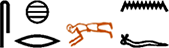
Classifiers classify nouns, verbs, deverbals, adverbs, and even pronouns. When classifying a noun or a verbal root, classifiers appear as a rule before suffixes and grammatical markers, which follow the classifier.
 šrj [
šrj [ šrj.t “female child” the classifier still appears after the root in most cases before the female ending
  t. The uniconsonantal hieroglyph
  t is the female marker of nouns and comes at the end of the word. In the above example we see that the classifier is attached to the root before the
  . However, sometimes the classifier may also appear after the female marker
  t, e.g.,
  . In this example
  classifies the female child, into the
  [
[
 n, e.g.,
  sḫr[
sḫr[ [
[ šm[
šm[ [
[
 qd[
qd[ [
[ stands in taxonomic relation to the host, classifying “builder” into the [
 dj [
dj [ [
[
 jnk[
jnk[ [
[ pꜣy.j[
 pfꜣ[
pfꜣ[ tfꜣ[
tfꜣ[ nfꜣ[
nfꜣ[ [
[
Cultural power struggles within the script: How is a hieroglyph chosen to represent a whole category?
Due to the script's high iconicity, we can observe that the signs that function as classifiers in the script are mainly created from cultural prototypes. At a particular moment, the script draws on prototypical members of a particular category to stand as the pictorial “best example” of a certain word, i.e., to represent the iconically diverse referents or signifieds of the word in the real world (Goldwasser 1995: 32–33). For example, one chosen dog, the greyhound,  plays the role of signifier in the script for all kinds of dogs (see Goldwasser, 2002: 91–108, 24*–25*). This dog was the breed that the king and the elite owned. Humanity is represented in the hieroglyphic script by a young, slim Egyptian man, as we can see clearly in a detailed example of the
  [
[ —a hieroglyph from a queen’s tomb in the New Kingdom. The correct “best exemplar” of [
Another prototype that reflects its cultural background is the duck  (see Table 1), which was originally the logogram for “duck.” It can also assume the role of classifier representing the generic category [
 extends later into an even more encompassing category [
 became the classifier of the generic category [
A good example of the cultural pressures at work behind the choice of a prototype is the history of the all-important generic category [ as the “god par excellence” and, therefore, as the [
 —a seated male human figure wearing a beard. The new classifier probably emerged from circles championing the power of the anthropomorphic god Osiris (Shalomi-Hen, 2006: 71–95). The script mirrors the struggle between the crucially different conceptualizations of the divine, the zoomorphic, and the anthropomorphic (Hornung 1982: 33–66; 100–109). This negotiation was never decided in the Egyptian culture, as the two classifiers continue to appear side by side during the whole life span of the script (Goldwasser, 2002: 19–24, and discussion below). Differently from Egyptian, in the Sumerian writing system, the classifier [
 signaling a stellar prototype (Selz et al., 2017: 290). In Chinese, it is a sacred religious item,
One important exception to the observation that classifiers in the Egyptian script always represent prototypes of generic categories is the widespread classifier  [
[ depicts the hide and tail of a dead leopard. Interestingly, the Egyptian lexicon has no word parallel to the English “animal.” However, this covert category of the Egyptian mind surfaces in the script system (see detailed discussion in Goldwasser, 2002: 57–89; 2023b: 129–148 with Figure 5.5.).
Semantic relations between classifiers and their host words
Semantic classifiers may stand in taxonomic or schematic relations to host words (for terminology, see Goldwasser 2002: 25–38). In all cases, relations between classifier and host are motivated. For example, in  ḫꜣr.t[
 [
[ [
[ ḫꜣr.t[
 [
[ [
[ reflects, in this case, an emic social judgment in the culture. We know from Egyptian texts that widows were vulnerable and of low social status in ancient Egyptian society. Therefore, in the second spelling, the widow is classified into the taxonomic category
  [
[ [
[
Multi-classification, classifier order, and alternative classification
Cases of multi-classification (2–5 classifiers) appear mostly in verbs and deverbals (but also with nouns). In almost all cases, the order of classifiers is rule-governed (Goldwasser and Grinevald 2012: 33–35). As we have already seen in the examples above, classifiers that stand in schematic (metonymic) relation to the host word would precede taxonomic classifiers.
In the word  mḥw[
mḥw[ “ship,” and the second is the patient of the act,
  “fish.” The last taxonomic classifier informs us that the hunter is “a kind of”
  [
[ wḥꜣ.(w)[
 [
[ [
[ [
[ [
[
Verb classification—exposing semantic roles
In the case of verbs, a variety of semantic roles may be exposed by classifier choice (Kammerzell, 2015). A typical example is the verb  swr[
swr[ “water” (schematic relation, water being “part of” the action of drinking). The second classifier
  [
[ znb[
znb[ [
[ [
[ ꜥḥꜥ [
ꜥḥꜥ [
The verb  nꜥ [
nꜥ [ [
[ jwj[
jwj[ —the “missing vehicle” classifier. In Egypt, where the Nile is central, “boatless” means “helpless.” As a rule, lemmas that refer to deficiencies are put into the category of the “missing ability,” e.g.,
  šp[
šp[ [
[
Repeater classifiers
Repeater classifiers are a widespread phenomenon in the Egyptian script. They do not “classify” in the full sense of the English word. However, they are an integral part of all systems of classifier languages and classifier scripts worldwide (Senft, 2000). They represent a specific type of taxonomic classification. In Jakaltek, a Mayan language that shows a system of spoken noun classifiers, we find: ix ix = [
In Egyptian, the large taxonomic category  [
[ ḥm.t[
ḥm.t[ is an example of a repeater classifier, repeating the information that a woman is part of the category
  [
[ is also found with all female personal names, as in Jakaltek, activated as a generic taxonomic classifier, e.g.,
 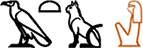 tꜣ-mj.t[
 ṯsm[
ṯsm[ ṯsm [
ṯsm [
Encyclopedic versus pragmatic classification
In most cases, classifiers refer to encyclopedic knowledge. Still, we also find pragmatic classification referring to a particular referent in a specific text, which differs from the encyclopedic classifier. The word  ꜥw.t means “livestock” and normally gets a prototypical animal as a classifier. However, in one particular context in the Coffin Texts, it shows the referential classifiers
  [
[
Classifiers in a supplementary grammatical role
Classifiers add morphological transparency to the Egyptian script system and testify to an emic Egyptian “grammatical awareness.”
As we have seen above, human classifiers, e.g.,  or
or  , appear as classifiers in deverbals, where the generic taxonomic category [
 Sbk-Rꜥ(w) the name of the god “Sobek-Re,” a combined god-crocodile and sun god. The crocodile god
  Sbk “Sobek” is classified by the prototypical
  [
[ Rꜥ “Re” is written by phonograms and then classified by the repeater classifier
  [
[ appears a second anthropomorphic [
 . In this example, the last classifier, the prototypical seated human god
  , may classify the second divine element “Re,” or better classify the whole compound, “Sobek-Re,” into the
  [
[
Classifiers as tools of cultural indoctrination in hieroglyphic inscriptions
Classifiers are a rare mine of emic information in all cultures, mostly reflecting the “collective culturemes” of elite members of a specific culture. However, compared with other writing systems, they could also serve as pictorial indoctrination tools of the power-holders in ancient Egypt due to their very detailed degree of iconicity. For example, when the word 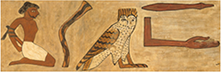 ꜥꜣmw[
ꜥꜣmw[ , it a priori classifies all Asiatics, even those who come in peace to Egypt, as potential state enemies (Goldwasser, 2023a: 199).
A pilot corpus-linguistic study on a sample text by iClassifier: Classifiers in the Story of Sinuhe
This section of the article attempts to test to what extent the theoretical framework presented above manifests itself in a “real” text. Susana Soler marked and analyzed the classifiers in the imported corpus of texts (courtesy of TLA; see corpus credits). Due to space considerations, only a few issues and results are presented and discussed in the following.
The sample corpus: The Story of Sinuhe
The Story of Sinuhe 15 is a masterpiece of ancient Egyptian literature, highly appreciated by the Egyptians themselves. It was written, rewritten, and copied from the Middle Kingdom to the New Kingdom 16 (Parkinson, 1997, 2009; Winand, 2014). It has reached us in several preserved copies on papyri and ostraca. This textual transmission allows a study of variation and diachrony in the text, including in its classifier system. The versions 17 of Sinuhe used for our analysis are four Middle Kingdom (henceforth MK) copies: 18 Papyrus Berlin P 3022 and Papyrus Amherst fragments m-q (B), Papyrus Buenos Aires (BA), Papyrus UC 32773 (Harageh 1) from el-Fayum (H), Papyrus Berlin P 10499 from Thebes West (R); and six New Kingdom (henceforth NK) copies: Ostracon Senenmut 149 recto (TT 71) (S), Ostracon Ashmolean Museum 1945.40 from Deir el-Medina (AOS), Ostracon BM 5629 from Thebes West (L), Ostracon Borchardt (also known as Uni Zürich 1892) from Biban el-Muluk (Bdt), Papyrus Moscow 4657 (Golenischeff) (G), and Ostracon Cairo CG 25216 from the tomb of Sennedjem TT 1 (C). The whole corpus is written in the hieratic script, mainly used on papyri and ostraca in ancient Egypt. This script variety is a cursive variation of the pictorial hieroglyphs, showing a much lower level of iconicity. Papyri and ostraca, the most common supports of hieratic texts, enhance some particular classification tendencies. Yet, this script variation preserves all the semiotic and grammatical rules of the lapidary hieroglyphs. 19
Our current corpus encompasses 7733 tokens representing 1068 different lemmas. 20 Approximately 45% of the tokens present semantic or pragmatic classifiers (excluding personal pronouns). 21 All results presented below were obtained by using the digital research platform iClassifier (© Goldwasser, Harel, Nikolaev). This tool enables in-depth research on classifiers from many angles (see Harel et al., 2024). A collaboration with the digital dictionary and textual databank Thesaurus Linguae Aegyptiae has supplied the digitized texts for the corpus (lemmas, transliteration, translation, etc.). 22
Methods
Due to space limitations, we discuss only some of the research methods in the following.
Network maps: The general vista
In recent years, the social sciences methodology known as network analysis has been applied to many disciplines, including linguistics. Therefore, the lexicon has been read as a network 23 structured by different types of connections. As demonstrated in the first part of this article, classifiers perform significant roles in the lexicon, reflecting emic semantic networks that encode the categorization patterns modeling the ancient Egyptian view of the world.
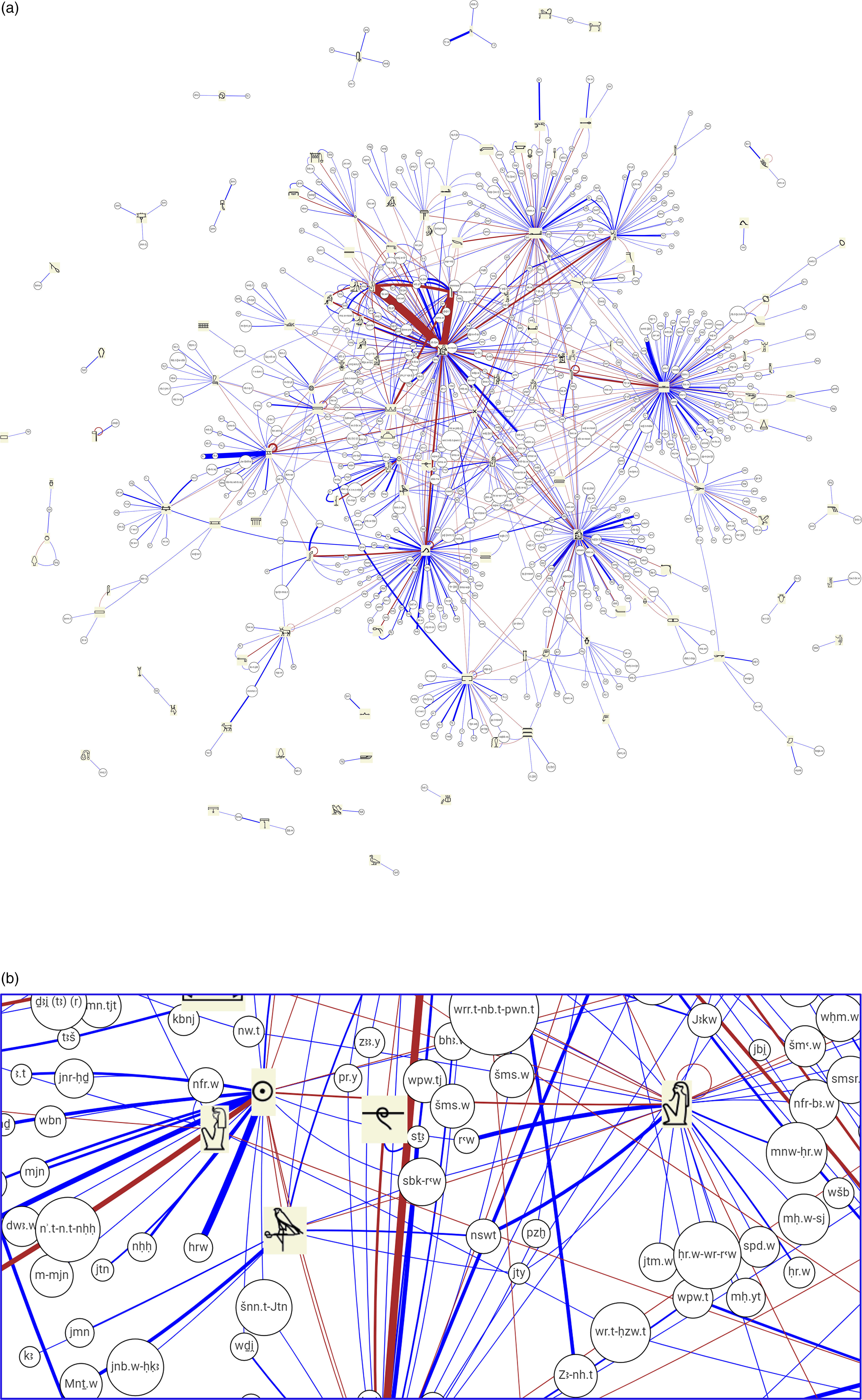
(a) Middle Kingdom network map of classifiers in Sinuhe.© iClassifier, Susana Soler. Data imported from TLA. (Enlarge for details.) (b) Close-up of [
iClassifier is designed to enable semantic network analysis according to the classifiers in a script (Harel et al., 2023). It presents the visualization of categories and their members in classification patterns, including semantic relations between hosts and classifiers and intra-connections among classifiers (for Chinese mapping by iClassifier, compare Xu, 2024). In network maps generated by iClassifier (e.g., Figure 1(a)), the blue lines connect the classifiers to all the lemmas that use them, and the red lines connect the classifiers that co-occur in a word, i.e., visualizing the multiple classification cases of a few classifiers in a single lemma. The thicker the lines are, the more frequent these connections are, revealing the consistency of classification for a given lemma with a classifier (blue). Classifier clusters formed by a combination of classifiers are also clearly visible (red). For example, in the MK network map of Sinuhe (Figure 1(a)), a group of signs connected by thick red lines forms an example of multiple classification described above. What we learn from the map is that already in the MK, a classifier cluster that originates in a reoccurring composite classifier is created:  [
[ [
[ [
[ [
[ ṯmḥj.w[
 , which connects ethnicity and “foreign land,” is not a steady part of this compounded classification in Sinuhe until the New Kingdom (see Figure 7), when it will also show the more usual arrangement of signs of this cluster of classifiers, e.g.,
  ṯmḥw “Libyans” [C 2] or
  štt.tjw “Asiatics” [AOS 34].
A broad look at the map in Figure 1(a) immediately reveals the central categories in the MK texts of Sinuhe— Y1
25
[
Y1
25
[ A1 [
A1 [ D54 [
D54 [ A2 [
A2 [ A24 and
  D36,
27
embracing the semantic category [
D36,
27
embracing the semantic category [ P1[
P1[ N23 [
N23 [ G37 [
G37 [ N5 [
N5 [ O1 [
O1 [ ,
,  , and
, and  do not seem to share any lemma in Sinuhe. Other small categories with few members appear to be “islands” disconnected from the rest.
Another sort of data visualization is the frequency bar chart, 28 which clearly shows the distribution of classifiers in lemmas and tokens. Figure 2(a) displays the classifiers in MK versions of Sinuhe by frequency of lemmas and tokens. The resulting graph presents what is called a “long-tail” distribution, 29 meaning that a few classifiers concentrate most classified words.
Figure 2(b) shows a detail of the previous graph showing the first 40 classifiers out of 122 counted in Figure 2(a). This group, which makes up about one-third of the list, contains classifiers that occur with 100 to four lemmas each (blue column). All remaining classifiers outside this graph are attested with only three to one lemmas.
The number of lemmas ascribed to a single classifier reflects the centrality of the specific classifier category as it is represented in a certain text. Alternatively, tokens appearing repetitively with a certain lemma reflect the centrality of certain words and topics in a specific corpus. The semantic network map of MK versions of Sinuhe (Figure 1(a)) had already revealed the central categories of this corpus:  [
[ [
[ [
[ [
[
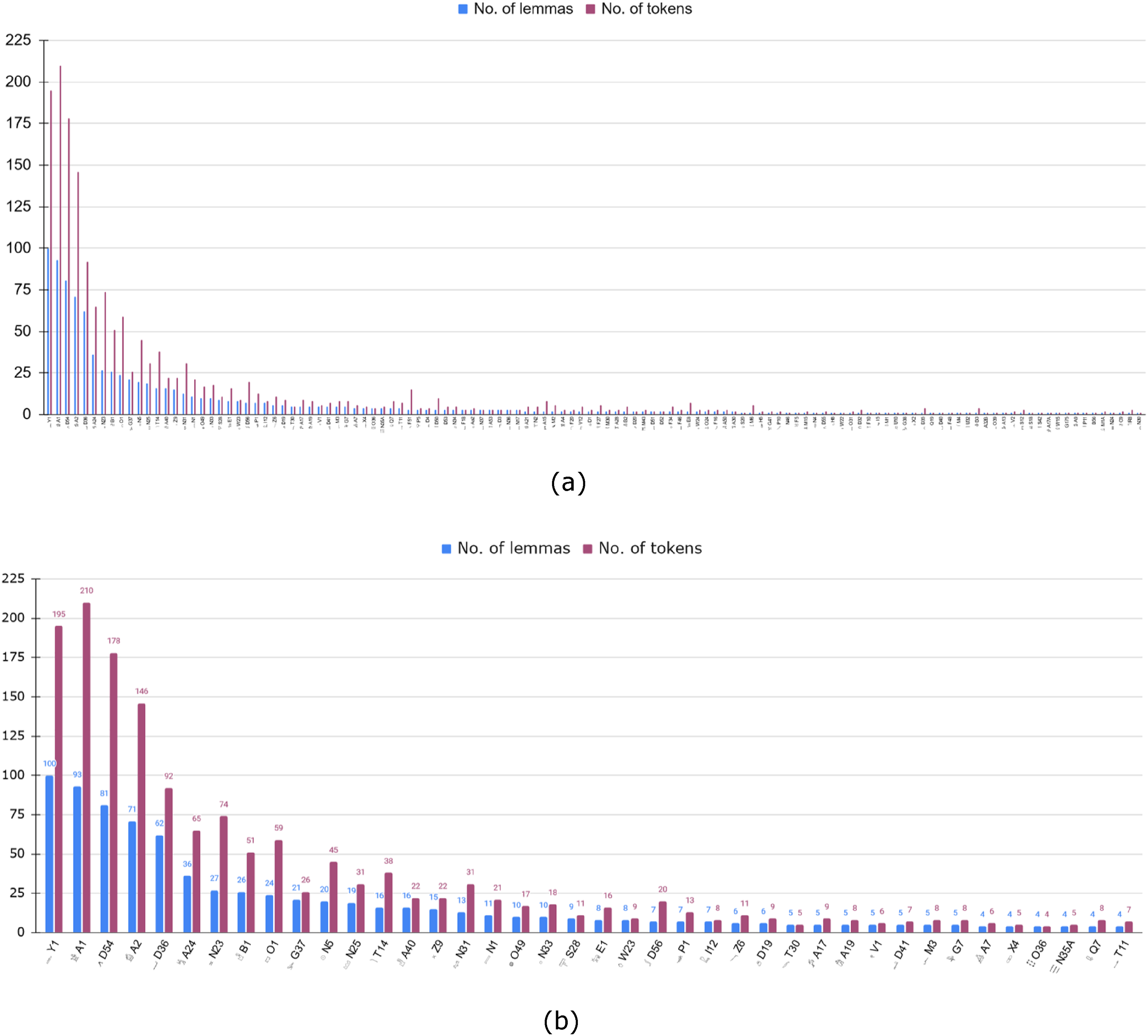
(a) Graph showing all the classifiers (122) in Middle Kingdom versions of Sinuhe by frequency of lemmas and tokens © iClassifier, Susana Soler. Data imported from TLA. (b) Detail with the 40 first classifiers of (a), Middle Kingdom © iClassifier, Susana Soler. Data imported from TLA. (Enlarge for details.)

 depicts a rolled and tied papyrus scroll. While probably the most frequent classifier in the Egyptian script, it still represents a challenge for Egyptologists. It has been considered as head of the category [
 wḏw.w “command, decree” [B 178],
  ṯꜣz “saying, utterance” [B 184] or
  zẖꜣ.w “writing, record” [B 311], while the large majority of lemmas should be already assigned to the extended category of [
 in all its occurrences in Sinuhe is
  rḫ “know.”
31
Interestingly, this lemma is always classified in the text with a single classifier
rḫ “know.”
31
Interestingly, this lemma is always classified in the text with a single classifier  . The high number of occurrences of the verb rḫ “to know” reflects the many mental and cognitive transpositions that the hero of the story goes through.

 jb “the one who is thirsty” [B 94]. The most attested lemma in the
  category is the compounded lemma
  bꜣk jm “thy humble servant”
32
(14 occurrences). This compound, literally meaning “servant there,” is used by Sinuhe to refer to himself when addressing the king. In the example above, the classifier appears in the midst of the compound after the word “servant.” In New Kingdom versions, we see that the compound is now understood as a single linguistic unit (noun + adverb) referring as a whole to the human speaker, with the repetition of the classifier
bꜣk jm “thy humble servant”
32
(14 occurrences). This compound, literally meaning “servant there,” is used by Sinuhe to refer to himself when addressing the king. In the example above, the classifier appears in the midst of the compound after the word “servant.” In New Kingdom versions, we see that the compound is now understood as a single linguistic unit (noun + adverb) referring as a whole to the human speaker, with the repetition of the classifier  at the end of the compound, i.e.,
  [AOS verso 4] (on classifiers in compounds, see Section 1.7). Another highly attested lemma with the [
 [B 17] and
 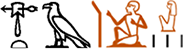 [R43] sṯ.tjw “ Asiatics” (10 occurrences, referring to the ethnic group, no location classifier). In the last examples, the number of tokens reflects firstly the centrality of the discourse with the king and the pivotal role of the Asiatics in the plot. Besides the counted semantic classifiers
  , there are also about 300 tokens consisting of 1st person pronouns showing
  as a pragmatic/grammatical classifier (see note 9).

 šmi̯ “to go” (10 occurrences),
  ꜥḥꜥ “to stand” (9 occurrences), or
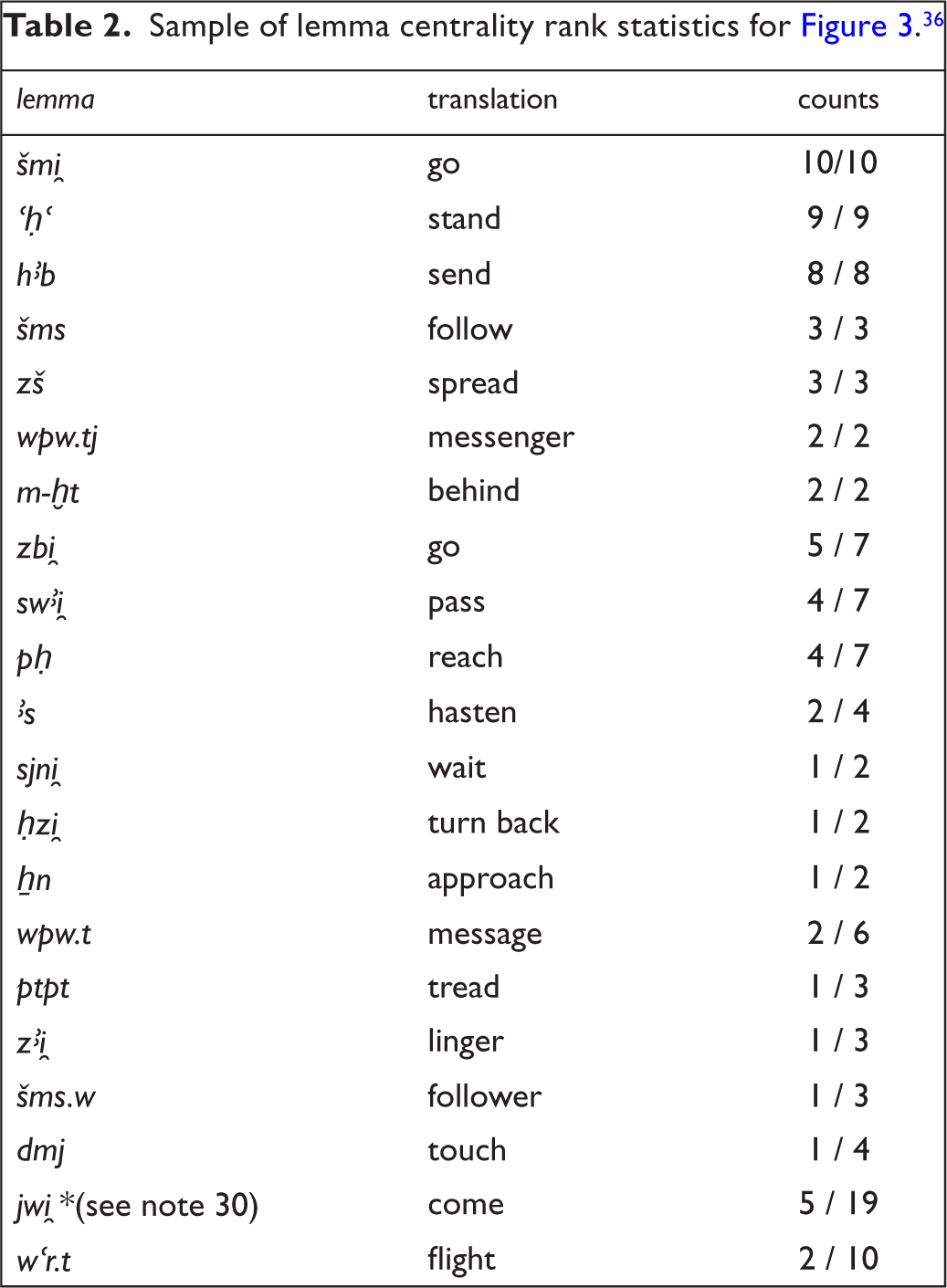
  hꜣb “to send” (8 occurrences). In these verbs, we witness a 100% occurrence of the classifier. Figure 3 displays a query for centrality in the use of this classifier in MK versions. In this graph, the differences in the shade of red mark whether a specific lemma is always classified by
  or seldom classified by it.
33
The values of the shades of color are clarified with percentages below the graph. Thus, the darker red circles mean that the lemma is always or very frequently classified by
or seldom classified by it.
33
The values of the shades of color are clarified with percentages below the graph. Thus, the darker red circles mean that the lemma is always or very frequently classified by  as in hꜣb “to send,” and a light red circle indicates that the lemma is only rarely classified by it. One of the examples is the verb
  dmj “to touch,” which is only once classified by
  (1 out of 4 examples in the MK corpus in Figure 3, and 1 out of 7 in all versions, see Figure 4). It occurs in a sentence where dmj has the meaning of “arrive/approach (to a destination)”: “(After) I had given the way to my feet to the north, I came near (
 , lit. “touched”) the Walls of the Ruler” [R 42]. The lemmas in Figure 3 also includes compounds and collocations in which the classifier can appear in the middle, after the word (mostly a verb) expressing [
 ʿḥʿ-ỉb “standing-minded”
34
[B 57] (after Stauder 2023: 287–291). This means that the compound form is not lexicalized and can even allow other components to break the compound, such as in
ʿḥʿ-ỉb “standing-minded”
34
[B 57] (after Stauder 2023: 287–291). This means that the compound form is not lexicalized and can even allow other components to break the compound, such as in 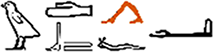 wḏb = f ꜥ, where the personal suffix pronoun f
  (“he”) is in the midst of the compound wḏb (ꜥ) [B 163] “turn the hand away; desist” [B 163].
35
(“he”) is in the midst of the compound wḏb (ꜥ) [B 163] “turn the hand away; desist” [B 163].
35

The classifier in Middle Kingdom Sinuhe. Edge by centrality rank © iClassifier, Susana Soler. Data imported from TLA. (Enlarge for details.)

Classifier alternation graph and co-occurrence table for dmj “touch,” MK and NK. © iClassifier, Susana Soler. Data imported from TLA.

The classifier in Middle Kingdom Sinuhe. Edge by no. of examples © iClassifier, Susana Soler. Data imported from TLA.

 plays the role of an extended generic classifier, which covers three semantic fields: [
 in MK versions of Sinuhe. This is another type of data visualization in iClassifier that informs about the centrality of a lemma in a certain classifier category in the text by displaying a wider connecting line that depends on the number of tokens for a given lemma. As a result, we can see that
  snḏ “fear,”
  mrj “love”
39
(with the nominal form mrw.t), and
mrj “love”
39
(with the nominal form mrw.t), and  kꜣj “to think about, plan” are central in the text. They are the lemmas with the greatest number of tokens for this classifier in Sinuhe. However, the largest number of lemmas classified by
  belongs to the semantic field of [
Finally, the semantic field [ wnm.t “food”
40
[B 104],
wnm.t “food”
40
[B 104],  jb.t “thirst” [B 21], or even ḫnm “to breathe” [B 234]. We suggest that the last verb is an example of the broader scope of this category—the body can be filled not only with edibles and beverages but also with air and scents.
The first effort to discuss the diachrony of classifiers in Sinuhe was made by Lincke (in Polis, 2023: 193). She published a table (Figure 6) presenting a diachronic comparison between the 20 most frequent classifiers in the two best-preserved copies of Sinuhe: Middle Kingdom (B) and New Kingdom (AOS). The four largest categories described in the previous chapter keep the top occurrence rate in the New Kingdom version of Sinuhe, as we see now in Lincke’s table.
A clear change in what she describes as the “number of attestations” could be observed. The classifier  shows more attestations in the NK (compare Kammerzell, 2015). On the other hand, the classifier
  has somewhat fewer attestations,
  augments in number, and the classifier
  is rather similar in the number of attestations in the NK and MK versions.
According to Lincke’s table, a remarkable diachronic change in the use of classifiers can be observed in the [ that was used in MK (version B) disappears completely. The use of the classifier
  increases significantly in the NK (version AOS).
In the NK network map of Sinuhe (Figure 7) created by iClassifier, we can clearly follow these changes in detail. The [ , which appeared only in MK version B, has disappeared
41
(compare the MK map Figure 1(a), including a close-up of Figure 1(b)). The Horus classifier
, which appeared only in MK version B, has disappeared
41
(compare the MK map Figure 1(a), including a close-up of Figure 1(b)). The Horus classifier  , the first prototypical member of the [
 [B 197] or
  [B 264], takes in all NK examples the additional classifier
  after the word nswt “king, royal,” e.g.,
  [AOS 9] (see the map in Figure 7, including a close-up).
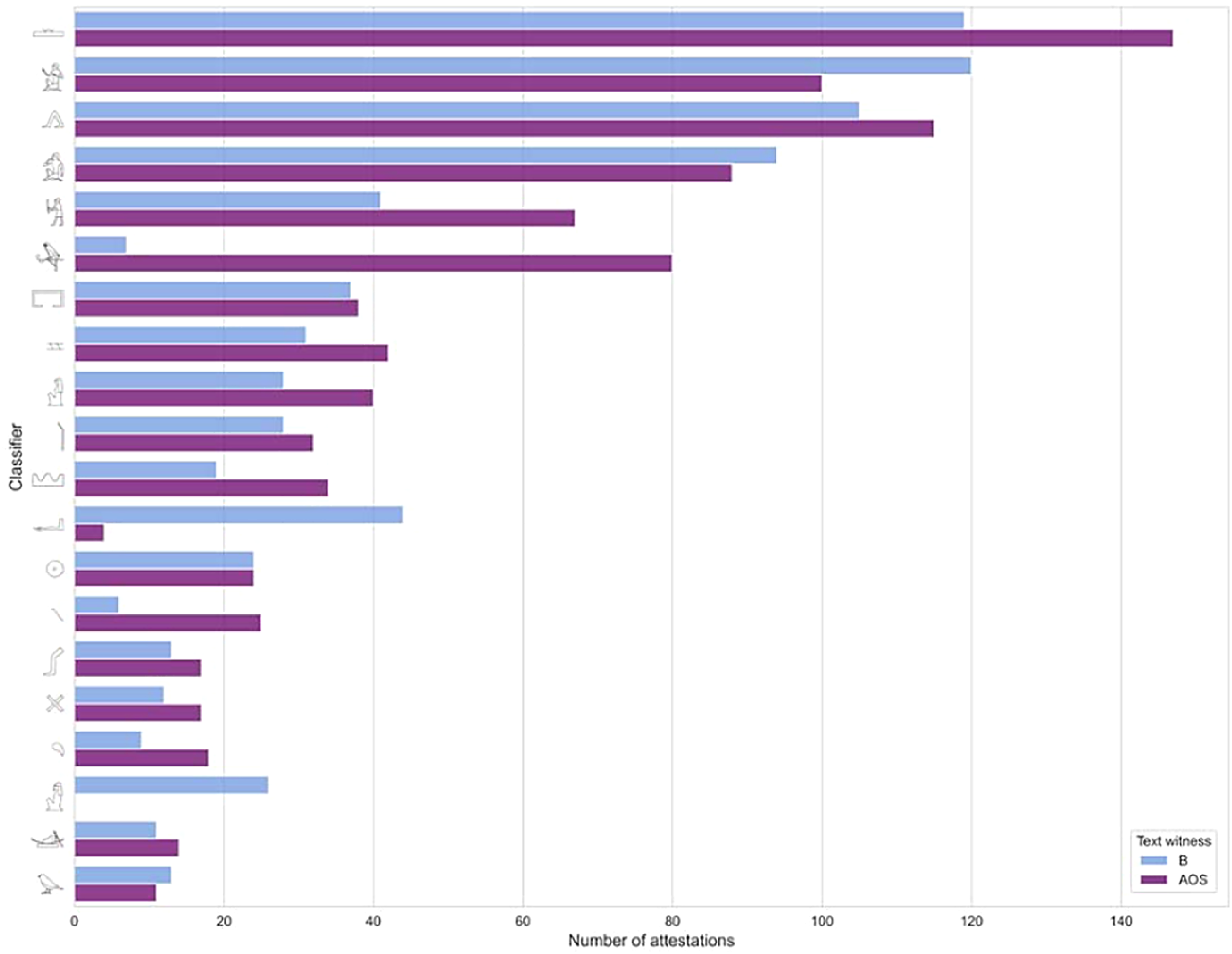
After Lincke, in Polis (2023). Guide to the Writings from Ancient Egypt, p. 193.
An enlightening example of the classification of the king as [ zꜣ (=f) smsw m ḥr,j jr,j nṯr-nfr Z-n-wsr.t “(His) son[
 [
[ .
.
Finally, the categorization as [ ḥm.t-nswt “king’s wife” [AOS 2] (see discussion below), or
  ꜥḥ.t “palace” [AOS 64] versus MK
  [B 166].
The female divine classifier  I12 is not included in Lincke’s list. Here, a cobra goddess was selected to classify all goddesses, including anthropomorphic ones. The classifier
  is well known in the MK versions of Sinuhe, mostly with names of goddesses (e.g.,
  Sḫm.t “Sakhmet” (a lioness goddess) [B 45]). Interestingly, Sakhmet is also known in the Coffin Texts with this classifier, although the sign
  is barely attested with a classifier function in these funerary texts (Shalomi-Hen 2008: 187 n.17). The category
  [
[ Ḥw.t-ḥr.w “Hathor” [AOS verso 23], usually manifested in a human or cow form. Her compounded name, meaning the “Chapel of Horus,” is classified by
  , while the word ḥw.t “chapel” that makes the first part of her name correctly gets the
  [
[ Nw.t “Nut” the sky goddess [AOS verso 25] or
 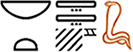 nb.t-tꜣ.wj “mistress of the two lands” = the queen [AOS verso 56]. In the title
  ḥm.t-nswt “king’s wife” [AOS 2], the first word within the cartouche, “king,” is classified by
  and the word “wife”—being the queen, here the divine wife—is classified by
  , while the whole compounded female royal title closed in the royal cartouche is again classified into the
  [
[ already in the Old Kingdom Pyramid Texts but only in the later pyramid of Teti.
43
already in the Old Kingdom Pyramid Texts but only in the later pyramid of Teti.
43
There is another hieroglyph that functions as a generic taxonomic classifier for the [ R8. This sign, commonly used as a logogram
44
for the word nṯr
R8. This sign, commonly used as a logogram
44
for the word nṯr  , may be used as an unpronounced classifier in the names of different gods, and it is well documented as a category-head of [
 and
and  already in the MK Coffin Texts
45
(see discussions in Goldwasser, 2002: 113–114; Shalomi-Hen, 2008: 185).
already in the MK Coffin Texts
45
(see discussions in Goldwasser, 2002: 113–114; Shalomi-Hen, 2008: 185).
Indeed, in Sinuhe, the classifier  is known in the MK manuscript [B 207] with the single lemma
  psḏ.t “Ennead” as a triple repeater classifier to indicate the plurality of nine gods. In the only parallel for this word from the NK
  [AOS verso 24], we see the use of
  as a triple repeater that now gets the additional generic
  [
[
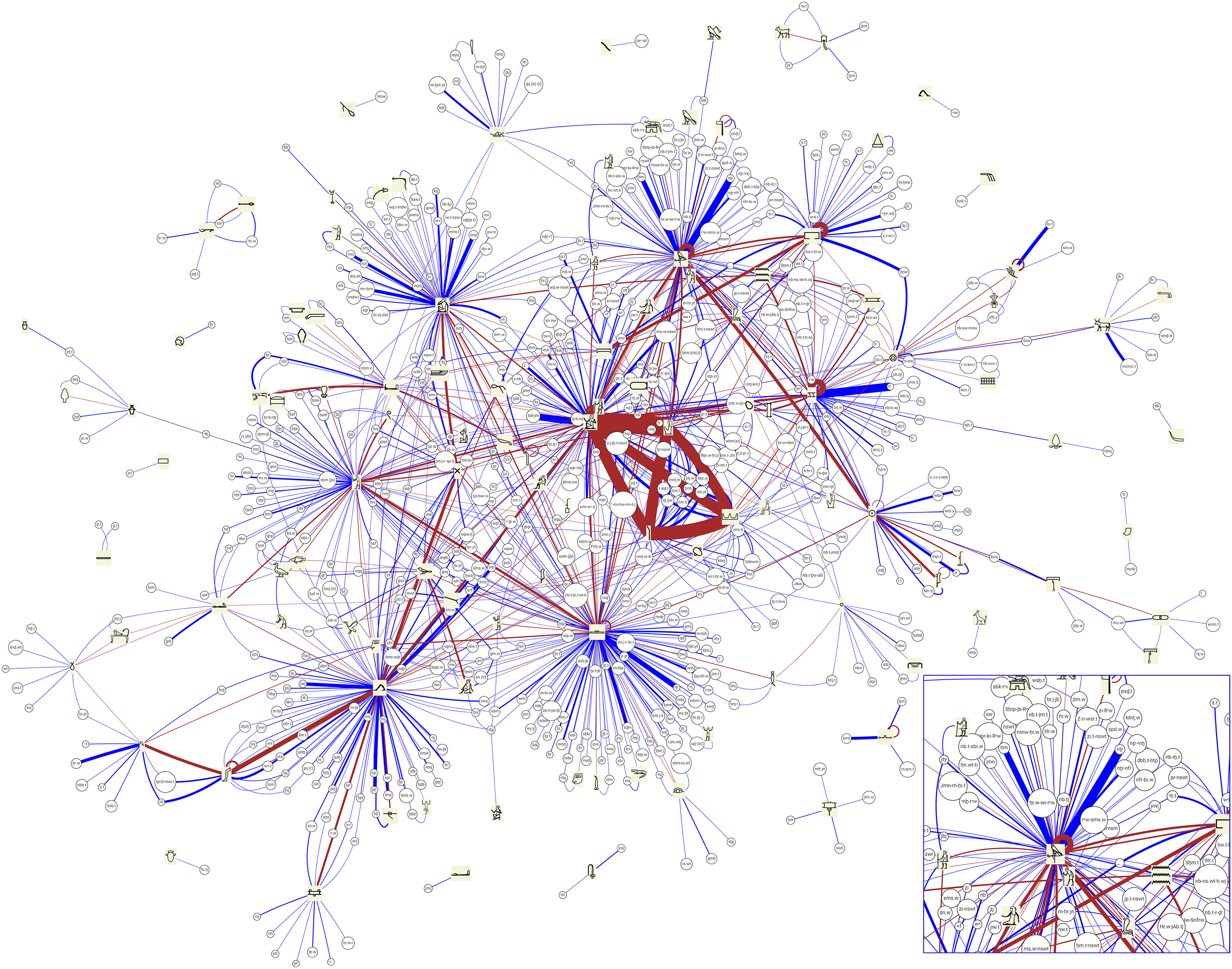
New Kingdom network map of classifiers in Sinuhe © iClassifier, Susana Soler.
In the case of the hieroglyph  , the image chosen to represent the idea of the divine is not “an example of” the divine, a specific god, such as
  ,
,  , or
, or  , but a metonymic representation of the divinity, i.e., the flagged pole that was marking temple buildings in ancient Egypt (Hornung, 1982: 33–66, Goldwasser, 2006b: 274).
The classifier  may be compared to the semantic classifier
The use of [ Jtn-Aten, “sun disk,” which later became the name of the monotheistic god of the Amarna period in the New Kingdom.
46
However, the Aten was classified during the Middle Kingdom in all Egyptian texts only by the sun disk
Jtn-Aten, “sun disk,” which later became the name of the monotheistic god of the Amarna period in the New Kingdom.
46
However, the Aten was classified during the Middle Kingdom in all Egyptian texts only by the sun disk  as it was not yet conceptualized as a full-fledged god. Accordingly, the lemma Jtn “sun disk” appears in the MK versions of Sinuhe only with the sun classifier (e.g.,
  [R 7]). At the beginning of the New Kingdom, during the 18th Dynasty before Amarna, the
  Jtn-Aten sun disk is officially made a member of the Egyptian Pantheon and may get like all other Egyptian gods the divine classifiers
  ,
,  ,
and
,
and  (e.g.,
  pEbers XCII,14). A surprise awaits the student of the Egyptian culture when, during the Amarna period, the Aten becomes the single official god. When the Aten is proclaimed to be the one and only god during the Amarna period, it is written systematically
  without any [
 “sun” classifier. However, a closer look reveals an astonishing correlation between the hieroglyphic script's spelling and the abrupt changes in beliefs in the Amarna time. As the revolutionary decrees of King Akhenaton in Amarna officially erase all the other gods,
  Jtn cannot take any [
Immediately after the Amarna period, the New Kingdom versions of Sinuhe show that the Aten has already become again a steady member of the revived [ [
[ [Sinuhe NK version AOS versus 35]). The cultural and religious changes are again accurately reflected in the script. According to the classifier system, after a short interval of less than 20 years, Egyptian religion returned to full-fledged polytheism, which is clearly reflected also in texts and all sources of material culture of the time. The category [
As indicated previously (Section 1.3), words may appear in different spellings with different classifiers and with more than one classifier in Egyptian. Classifiers may alternate during the same period due to the extension of meanings and be assigned to different categories. Diachrony also exposes changes in classification and classifiers combinations; see the following example of the verb dmj “touch,” discussed above with Figure 4.
The prominent classifier in the MK is  [
[ ) gets a referential classifier—the generic
  [
[ [
[ [
[
Classifier lists: How many classifiers does the Egyptian script use?
Gardiner created the primary sign list of the most common generic classifiers in his grammar book (1957: 31–33; see Table 3). His list contains 93 hieroglyphs that may function as classifiers. The list is principally organized according to the order of hieroglyphs in his full sign list, which appears at the end of his grammar book (1957: 439–548). The corpus of texts that Gardiner used for creating his general list dates mainly to the Middle Kingdom and the 18th Dynasty. It includes around 743 hieroglyphs, with specifications of their possible semiotic functions and a few examples of each use. It is in no way a comprehensive list of all known hieroglyphs. A complete digital list of hieroglyphs of all periods and their possible functions is currently built in the online digital project Thot Sign List (TSL) http://thotsignlist.org, headed by Stéphane Polis. 47 Table 3 presents Gardiner’s classifier list in conjunction with the codes of the hieroglyphs from his general sign list by the end of his book.
Gardiner’s list of common “generic determinatives” with added code numbers from his general list of hieroglyphs. Order and category description (“names”) according to his publication. Read the list from left to right.
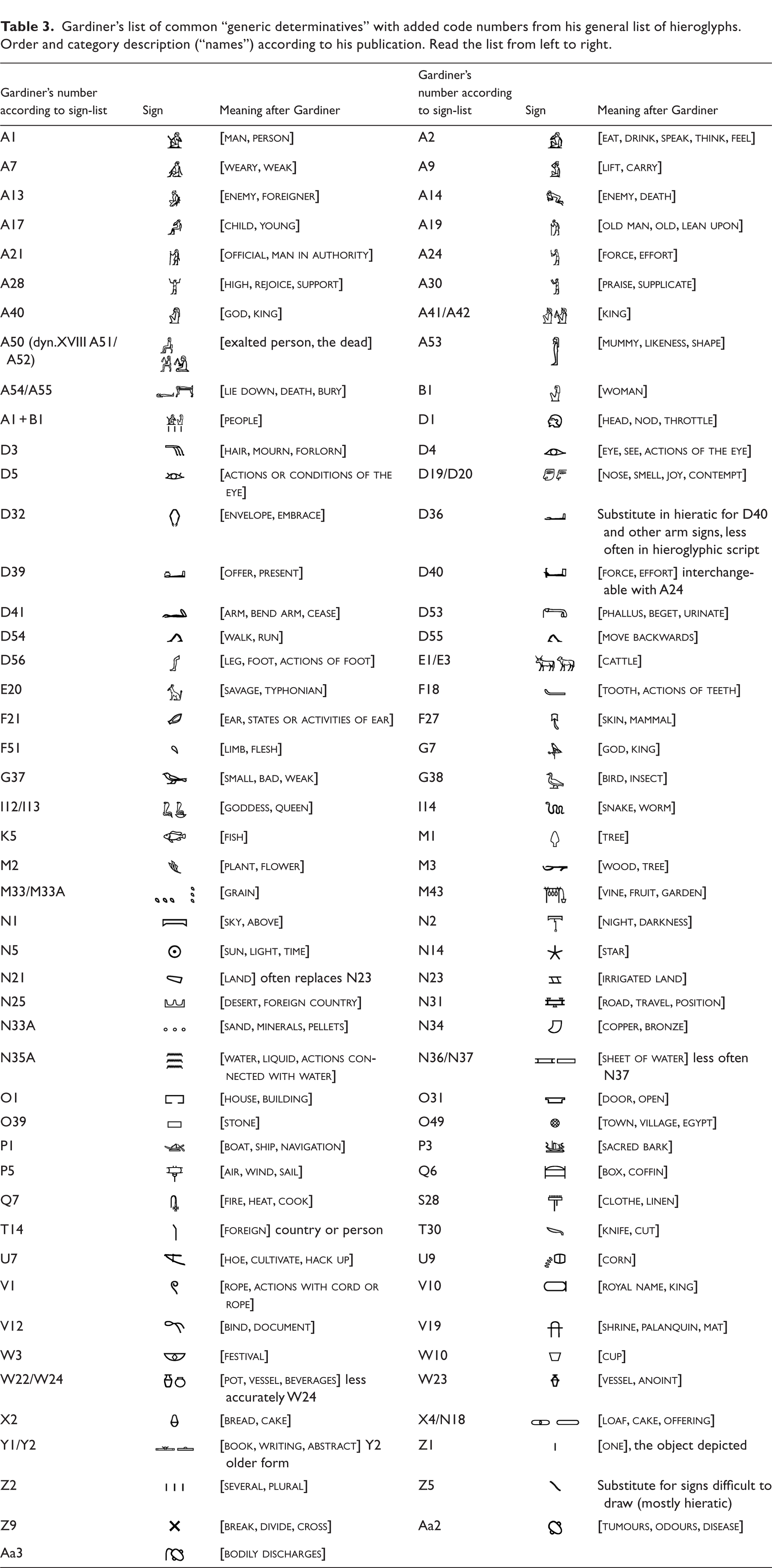
Gardiner’s list of common “generic determinatives” with added code numbers from his general list of hieroglyphs. Order and category description (“names”) according to his publication. Read the list from left to right.
The main shortcoming of Gardiner’s “list of generic determinatives” is that it presents together without any remark “determinatives” that head large-scale categories comprising dozens of members (e.g.,  [
[ [
[ [
[
Winand and Stella (2013), who published a new classifier list, took a big step forward in classifier studies in Egyptology. Their book Lexique du Moyen Égyptien comprises around 2500 words selected by authors’ criteria, mainly from Faulkner’s Dictionary (1962) and Gardiner’s glossary (included in his Grammar). The chronological period covered by the Lexique starts from the First Intermediate period to the 18th Dynasty (Middle Egyptian and “Traditional Egyptian”), excluding vocabulary from the Coffin Texts. Their book offers a much more extended classifier list encompassing 343 hieroglyphs with the necessary inventory of words that make each category according to their collection, i.e., presenting category members and, thus, categories’ size in their corpus. However, the members (lemmas) in the categories are not sourced. In their list, 202 classifiers take only one or two lemmas. In an additional list, they signal out the largest classifier categories of the script based on their sources (see Table 4). This small list of classifiers that can occur in 20 or more words is what they consider to be the list of “generic classifiers.”
We observe that the three largest categories in their corpus are in this order:  [
[ [
[ [
[ and
and  as representing together the category [
Classificateurs génériques after Winand and Stella (2013: 129). * Bold numbers mark the largest categories (added by Goldwasser-Soler). Blue marks the categories and discussed above.
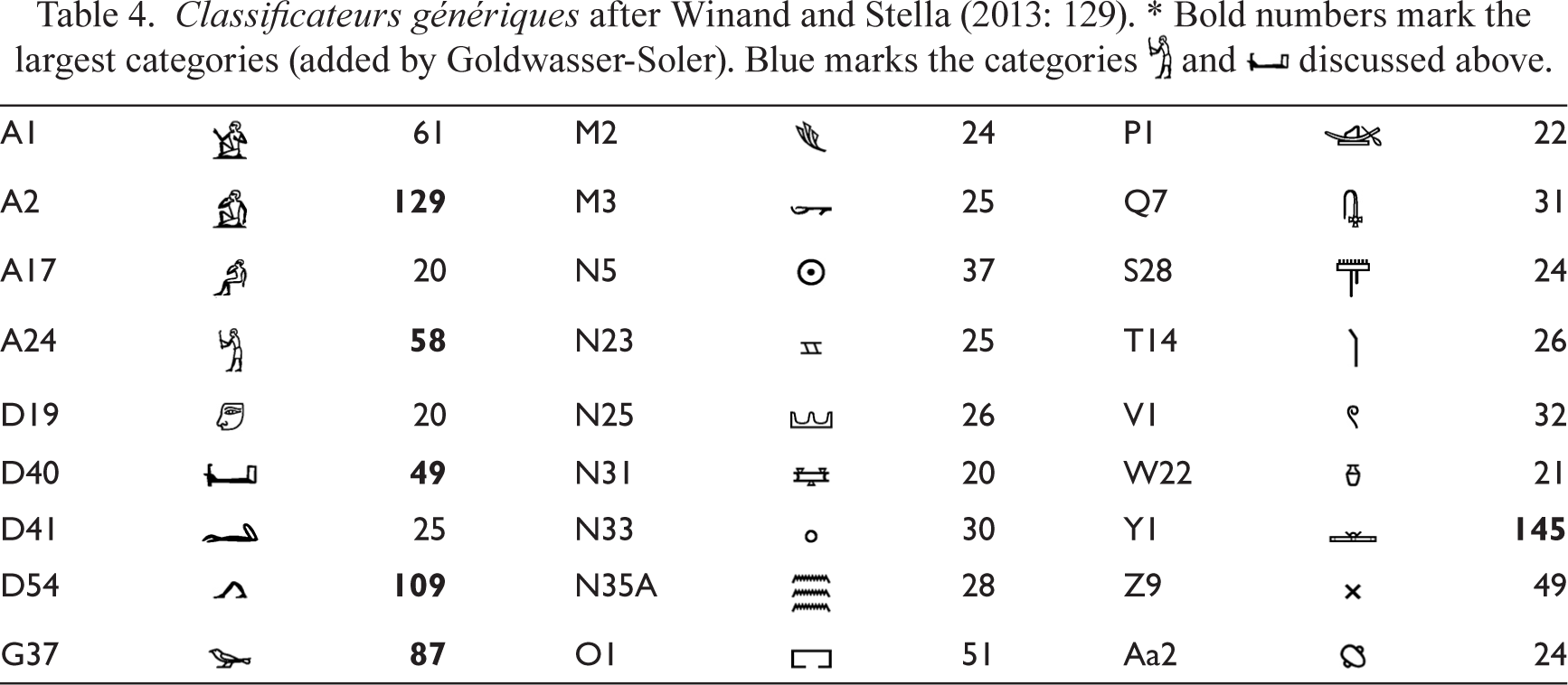
The classifier  embracing the category [
 [
[ [
[
Surprisingly, in our small, studied corpus of Sinuhe texts of the MK, most classifiers of the basic Gardiner list of classifiers (Table 3) are present. The absence of a few members of the Gardiner list that head categories of medium or small scale may be explained by the range of vocabulary used for the literary text. For example, the classifiers  V19 [
V19 [ M33 [
M33 [ [
[ [
[
The most prominent tokens of the collective nouns including the classifier  are
are  wḥyt “tribe” and
  ms.w-nswt “royal children, royal escort.” In all MK examples in Sinuhe the word tribe takes additionally the
  [
[ [B 86],
  [R 52]).
On the other hand, some classifiers used in Sinuhe are missing in Gardiner’s list of classifiers. The hieroglyph  O36 [
O36 [ heads a medium category in the script system that includes a few taxonomic relations such as “types of walls” as well as a set of schematic roles of “types of buildings” (e.g.,
  jnb “fortification” [R 141]) of which the wall is an essential part (metonymic relation).

Classifier alternation graph for ḏr, MK and NK.
The classifier  is used in a MK version of Sinuhe [B 198] in the word
  ḏr “grave in a foreign land,” which may refer to the typical Canaanite tomb where a rectangular brick or stone wall enclosed the dead.
50
This is a further example of a metonymic relation with the “host” word since the “wall”
ḏr “grave in a foreign land,” which may refer to the typical Canaanite tomb where a rectangular brick or stone wall enclosed the dead.
50
This is a further example of a metonymic relation with the “host” word since the “wall”  is a part of the “grave.” In a personal letter addressed to Sinuhe in exile, the Egyptian king says “(it cannot happen) that you will die in the desert! Asiatics will not bury you! You will not be put in the hide of a ram as they make your grave
  [ḏr]” [B 197–198].
51
Remarkably, the classification strategy for ḏr in the same passage of NK version of the text (AOS) presents a radical change (Figure 8). Here,
[ḏr]” [B 197–198].
51
Remarkably, the classification strategy for ḏr in the same passage of NK version of the text (AOS) presents a radical change (Figure 8). Here,  ḏr [AOS verso 18] is classified into the taxonomic category
  [
[ [
[ . By metaphorical extension, the category [
 [
[
Once more, when, after long years, an old Sinuhe presents himself in front of the king, the ruler first criticizes him for his reckless disregard of his funerary rites: “Your wanderings have taken a toll on you, Old Man!
53
You have reached [old age]. This is no small matter, the burial of your body! Your burial
54
will [not] be by the foreigners! Your grave  [ḏr] was not made (by them)” [AOS verso 47–48].
55
This sentence contains the third and last example of
[ḏr] was not made (by them)” [AOS verso 47–48].
55
This sentence contains the third and last example of  ḏr, [AOS verso 48] in Sinuhe, this time only in the text's NK version (AOS). In this last occurrence, ḏr repeats the
  classifier, thus keeping the “foreign tomb” consistently in the [
Finally, when employed in verbs, the  classifier plays the semantic role of a prototypical patient as in
  znb “overleap” [R 141], nicely exemplifying this semantic role (see Section 1.4).
Another “missing classifier” in both lists (Tables 2 and 3) is  B56 [
B56 [ , is known to classify goddesses also in MK hieroglyphic inscriptions. The above depiction of the iconic hieroglyphic sign comes from the niche of the tomb of Sarenput II in Aswan from the 12th Dynasty (MK), where it occurs in the name of the goddess
 St.t “Satet.” In Sinuhe, the classifier
  appears only in the MK text [R] with the compound lemmas ḥm.t-nsw.t “king's wife,” ḥn.wt-tꜣ “mistress of the land,” jr.jt-pꜥ.t “hereditary princess,” wr.t-ḥzw.t “great of praise (the queen),” and the name of queen Nfr.w “Neferu.” Therefore, the Egyptian queen is classified in this text version [R] as a [
 ḥn.wt-tꜣ that shows in text [R 194] the
  classifier, appears in the other major Middle Kingdom papyrus [B 166] as
  with the classifier
  , the [
 ḥn.wt-tꜣ presents the generic
  [
[
Due to space considerations, we could comment only briefly here on the topic of the classifier repertoire. In the future, the Egyptian lists will be compared with Chinese lists of classifiers, such as the one compiled by Xu (2024) for the corpus of Guodian texts. 56
To sum up, the relatively small hieratic corpus from the Middle Kingdom (i.e., MK versions of Sinuhe) chosen by us for our pilot research in corpus linguistics shows a few very clear and fundamental results: The small corpus of MK versions of Sinuhe presents almost all the repertoire of generic classifiers compiled by Gardiner. Albeit some small differences related to the story's plot, the most frequent classifiers are the same classifiers singled out by Winand and Stella as the most central classifiers. Thus, these seem to be the main categories or hubs of knowledge organization in the Egyptian mental organization during the Middle Kingdom. These hubs organize many concepts that materialize in different words and are connected through fringe members to other categories (see the network map Figure 1(a)). All semantic classifiers and their host words show clearly motivated relationships. All classifier variations and diachronic changes can be matched with referential reasons or cultural changes known from other sources.
From the theoretical point of view, this state of affairs reiterates the conclusion that classifiers are a system in the Egyptian script. As every Egyptian text shows a consistent repertoire of grammatical forms obeying a defined set of grammatical and syntactic rules of the period, we can expect that texts would also show a consistent repertoire of classifiers that are a rule-governed system in the script, as was suggested in the first part of the article. This hypothesis should be verified in future corpus linguistic studies of classifiers. The classifier phenomenon belongs to the cognitive-linguistic space of language (Lakoff, 1987). Classifiers dissect the universe of knowledge and vocabulary into categories, offering faster access to word meanings (Kemmerer, 2016; Goldwasser, forthcoming). The system is deeply rooted, on the one hand, in the cognitive abilities of the human mind and, on the other, in the layered cultural knowledge acquired over generations in every single culture.
Footnotes
Authors’ contributions
Orly Goldwasser: classifier theory, methodology, data analysis, review; Susana Soler: data processing of Sinuhe and analysis in iClassifier, review and editing.
Declaration of conflicting interests
The authors declared no potential conflicts of interest with respect to the research, authorship and/or publication of this article.
Corpus credits
Frank Feder, with contributions by Altägyptisches Wörterbuch, Peter Dils, “Die Geschichte des Sinuhe” (Object ID 22MH4NS75ZDABGD5ZPLC2NMAPY) < >, In: Thesaurus Linguae Aegyptiae, Corpus issue 17, Web app version 2.0.2.1, 8/8/2023, ed. by Tonio Sebastian Richter and Daniel A. Werning on behalf of the Berlin-Brandenburgische Akademie der Wissenschaften and Hans-Werner Fischer-Elfert & Peter Dils on behalf of the Sächsische Akademie der Wissenschaften zu Leipzig (accessed: 9/6/2023).
Funding
The author(s) disclosed receipt of the following financial support for the research, authorship, and/or publication of this article: ISF [grant number 1704/22], “Exploring the minds of Ancient Egypt and Ancient China—a comparative network analysis of the classifier systems of the scripts,” and ISF [grant number 735/17], “Classifying the other: The classification of Semitic loanwords in the Egyptian script.” ArchaeoMind Lab, The Hebrew University Jerusalem (). PI Orly Goldwasser.