



Abstract
This article explores the role of unpronounced semantic classifiers, also known as graphemic classifiers or determinatives, in three ancient complex scripts: Egyptian, Chinese and Sumerian. These classifiers are silent hieroglyphs, Chinese characters or cuneiform signs that are combined with other signs that carry phonetic information to form a complete written representation of a word. While these classifiers are written and visible, they are not pronounced. They add silent, motivated semantic information related to the meaning of the word. These classifiers can be found in various positions within words, reflecting cultural and referential information. Classifier studies, in general, have gained significant interest at the intersection of linguistic typology, cognitive linguistics, semiotics of scripts and neuroscience. The research field examines classifiers in oral languages, signed languages and complex scripts, emphasizing that regardless of modality they reflect a shared cognitive effort to organize knowledge. It is our hope that the scholarly contributions in this issue will open up a new chapter in classifier studies and in comparative script analysis. Theoretical and analytical work undertaken in the last few decades has been done primarily by individual researchers specializing in one language or script. Our approach combines large-scale corpus data with comparative script analysis carried out by teams of collaborators who can contribute specialized expertise in different ancient writing systems. The research possibilities opened by our newly developed digital tool iClassifier are presented in detail in the other contributions in this issue. This work has laid a strong comparative foundation that we can now build on, to develop new insights into the early history of script development and the commonalities and differences among ancient cultural conceptualizations of the world.
This short contribution serves as an introduction to a special issue of Journal of Chinese Writing Systems that deals with a unique script

The signs “house” and  “tree” in three possible functions. When functioning as semantic classifiers they are unpronounced. All signs in
 [
[ [
[
In this volume, we deal with ancient Egyptian hieroglyphs, Sumerian cuneiform and ancient Chinese characters, hoping to expand the scope to other scripts in the future. Ancient Egypt, Ancient Sumer and Ancient China are three great civilizations of the past, removed from one another both geographically and culturally. Nevertheless, the scripts they used are remarkably similar in key semiotic respects, despite their (apparently) independent origins and differences in form.
As mentioned above, this issue concentrates on the unpronounced semantic classifiers (graphemic classifiers) in scripts. This phenomenon is known in Egyptology and Assyriology as “determinatives” or “classifiers” and in Chinese studies as “semantic components,” “semantic determinatives,” or “semantic classifiers” (Handel, 2015; Polis, 2018; Selz et al., 2017). We use the term “classifier” as a comparative concept, referring to the signs that play this role in the respective scripts. Classifiers are unpronounced hieroglyphs, Chinese characters or cuneiform signs that combine with other signs that present phonetic information (the phonetic part) to represent a word altogether. The signs that perform the function of “classifier” are written and seen, yet they are not heard. They add silent, motivated semantic information for the reader, always related to the host word at the time of character/word creation (Selz et al., 2017, Egyptian and Sumerian scripts; Boltz, 1994; Chen, 2016; Handel, 2023 and Xu in this issue, Chinese scripts). For example, the word “younger sister” is written in ancient Chinese by the compound graph  (mèi, Old Chinese *mə̂, Yin Zhou Jinwen Jicheng (Compendium of Yin and Zhou Bronze Inscriptions) No. 4589_Songgongluanfu). The right-side component 未 (wèi, Old Chinese *məs, “not yet”) is the phonetic element.
2
The left-side component
(mèi, Old Chinese *mə̂, Yin Zhou Jinwen Jicheng (Compendium of Yin and Zhou Bronze Inscriptions) No. 4589_Songgongluanfu). The right-side component 未 (wèi, Old Chinese *məs, “not yet”) is the phonetic element.
2
The left-side component  is an unpronounced semantic classifier adding to the phonetic part the silent information [
 mwt “mother” in Egyptian, also shows as phonetic part mwt
  , and an unpronounced semantic classifier
  [
[ šag4-zu “midwife,” where the phonetic part šag4-zu
  follows the unpronounced semantic classifier
  [
[
These three complex scripts reflect through the silent semantic classifiers that younger sisters, mothers and midwives in the respective cultures are prototypically women.
Classifier studies in general
Classifier studies in languages and scripts is a relatively new research field in linguistics and cognitive linguistics. Presently, the field enjoys considerable interest. It is located at the crossroads of linguistic typology (Senft, 2000), cognitive linguistics (Lakoff, 1987), semiotics of scripts (Polis and Rosmorduc, 2015) and lately neurosciences (Kemmerer, 2016, 2017; Goldwasser, forthcoming). Classification may surface in various linguistic manifestations: in the lexicon, grammar or script (Bauer, 2017; Bisang, 2017; Grinevald, 2015). Classifiers, which are part of this general human practice of classification, appear in oral language systems as pronounced morphemes (for example, the numeral classifiers found in many languages, including Chinese), in signed languages as gestures (Brentari, 2023; Grinevald, 2004; Lincke and Kutscher, 2012), and in complex scripts as unpronounced graphemes (see Chen, 2016; Handel, 2023; Payne, 2017; Selz et al., 2017, Anatolian hieroglyphs). Whatever the linguistic modality in which they are present, they manifest the same cognitive effort to organize the world. Early on, classifier studies were concerned only with spoken (pronounced) classifiers, a widespread phenomenon in world languages (Aikhenvald, 2000; Grinevald, 2004 3 ) that is well attested in modern spoken Chinese (Sybesma, 2015; Zhang, 2013). Denny (1976) was the first to promote in contemporary linguistics the classifiers’ semantic value in his influential article, “What are noun classifiers good for?” Craig’s seminal edited book Noun Classes and Categorization (1986) and Lakoff’s Women, Fire, and Dangerous Things (1987) established classifier studies as a discipline. It was in Craig’s book that the linguist Noel Rude (1986) suggested for the first time that “determinatives” in cuneiform and hieroglyphic scripts are also classifiers. Later, the role of classifiers as “referent tracking” devices was established by Croft (1994). The first two decades of the 20th and the beginning of the 21st century saw lively discussions of pronounced classifiers in various languages and theoretical analyses of classifiers’ sorts in different cultures and languages (e.g., Aikhenvald, 2000, 2021; Allassonnière-Tang et al., 2021; Bauer, 2017; Bisang, 2017; Bisang and Wu, 2018; Contini-Morava and Kilarski, 2013; Grinevald, 2004, 2015; Senft, 2000), as well as some assessments of their cognitive role across the world’s languages (Imai and Saalbach, 2010; Saalbach and Imai, 2007).
Classifier research in Egyptology
The study of the
Classifier research in Sumerology
Clearly influenced by Champollion’s description of “determinatives,” Edward Hincks introduced in 1847 “determinatives” to designate unpronounced signs—semantic classifiers—for texts written in cuneiform (Selz et al., 2017). Sumerian, the language of the earliest Mesopotamian documents, shows many such classifiers, even while their precise number is still disputed. Based on earlier accounts, Selz compiled a new list of semantic classifiers (Selz, 2021; Selz et al., 2017; Selz and Zhang, 2024). Selz described the semiotic role the semantic classifiers play in Sumerian when compared to Egyptian. He also advocates for the Sumerian system’s possible pronounced origin, which leans strongly on various compounding processes (Selz, 2021).
Classifier research in Sinology
The modern Chinese spoken languages (of which Mandarin is the most thoroughly analyzed) include a developed system of pronounced numeral classifiers (Sybesma, 2015; Zhang, 2013). These classifiers are not part of our discussion here. Graphemic classifiers have been present in the Chinese script from its earliest attested uses, while the spoken language did not become a classifier language until the transition between the Old Chinese and Middle Chinese stages—more than a millennium after the invention of the script (Peyraube, 1998).
In the Chinese script, the long-recognized components termed “bùshǒu”
5
were employed as a grouping mechanism in the character dictionary Shuō wén jiě zì 說文解字, compiled by Xu Shen (Xŭ Shèn 許慎, c. 58–147
Because of their classificatory function in his dictionary, we can refer to Xu Shen’s bùshǒu as “class heads” or lexicographic classifiers in English. However, not all of Xu Shen’s 540 bùshǒu are considered by all modern scholars to have semantic function when they occur as a component in the characters listed under them.
Li (1996) writes that only 374 bùshǒu could be analyzed in a function similar to
In her book, F Chen (2006) conducted pilot research on 38 semantic components (classifiers) from the perspective of structural semantics and cognitive semantics. She also discussed prototype theory and cognitive models such as metonymic and metaphoric models by giving examples from Shuō wén jiě zì.
In the last decade, YS Chen (2016) offers in an article the first comparative analysis of Chinese “semantic determinatives” and Egyptian classifiers/determinatives using the tools developed by Goldwasser. Based on examples taken from Xu Shen’s dictionary Shuō wén jiě zì, he highlights the semiotic similarity of the Chinese and Egyptian semantic classifiers. He compares a few object categories of the two scripts:  [
[ [
[ [
[ [
[ [
[ [
[ and
and  [
[ [
[ [
[ [
[ [
[ “woman” that when used as a classifier not only can mean [
Wang (2015) takes a corpus linguistic approach when he examines the repertoire of words that take the  [
[ [
[
Some comparative facts on the graphemic classifier systems in Egyptian, Sumerian and Chinese
Egyptian
Sumerian
Chinese
Chinese and Egyptian—Three comparative notes on sign function and classification
There are many different typologies of Chinese character structure, most of which take as their starting point the six-type classification in Shuō wén jiě zì (for an example of an innovative typology, see Behr, 2010).
The character types (or word types in Egyptian) relevant to our discussion are those of the compound character/word type. We discuss below two types of compound characters in Chinese:
In
An example of a
安 (ān, Old Chinese *ʔân). The Shuō wén jiě zì entry reads: “‘to be stable’. From [semantic component] 女 ‘woman’ and [semantic component] 宀 ‘house’.”
While Xu Shen and his contemporaries recognized
On the other hand, even if not entertaining the crypto-phonetic hypothesis, one might still argue that the above graph 安, looked upon from a diachronic perspective, did not originally combine two distinct graphs for their individual semantic functions. It could be viewed as a pictographic representation of a single scene (a woman inside a house) whose elements only later became graphically atomized as the script developed.
A somewhat similar, though rare, phenomenon can be observed in some cases in the very early Egyptian script. For example, the word nbi “swim” is written with the pictorial logogram  , and in the earliest examples from the Archaic Period, the man clearly swims in the water (Kahl, 1994: 430, note 64). Somewhat later, we see the tendency to extract the image of the man and he may be shown above the water
  (after Regulski, 2010: 336–337), creating a kind of an Egyptian
  and later
  , the components behave as graphs in the script system, bound to the rules of script and not picture, by relative size, position, use, and so forth (Goldwasser, 2016; Vernus, 2020).
As mentioned above, Xu Shen did not distinguish between semantic classifiers as we understand the term and the bùshǒu 部首 under which he grouped graphs as the primary organizing principle of his dictionary. Xu Shen understood 宀 “house” to be a semantic component in 安, and he accordingly placed the character 安 in the 宀 section of the dictionary, even though the “house” element does not classify the word “to be stable” in a taxonomic sense. Unlike in the
This is the most commonly occurring type of graph in the Chinese writing system of all periods. An example of a  , writing the word meaning “guest”:
 (kè, Old Chinese *khrâk). The Shuō wén jiě zì entry reads: “‘to entrust’. From [semantic component]
  ‘house’; 各 (gè, Old Chinese *krak, ‘go to’) is the [phonetic component].”
Like the example given earlier of an  in the 宀 section of the dictionary. In this case, however, we can understand the
  “house” element as a semantic classifier. Generally speaking, the
In Egyptian,  mentioned above. The two first hieroglyphs
  (reading from left to right) contain the full phonetic information mwt. The
  is not pronounced and classifies the word into the super category [
Although not one of the basic types of graphs identified by Xu Shen, a significant number of compound graphs could be analyzed as having properties consistent with both the  , analyzed in Shuō wén jiě zì as “from [semantic component]
  ‘leather’ (classifier) and from [semantic component]
  ‘to be stable’; 安 (ān, Old Chinese *ʔân) is also the phonetic [component].” The character is listed under the
  [. The 宀 “house” does not function here as a classifier on the top level of the word.
From our modern perspective, we can see that
It is worth pointing out that in an
A rare example of a somewhat similar compound  “bring,” built of the compounding of two logograms
  nw “vessel” and
  iw “come.” The compounded hieroglyph
  creates a kind of
  , the hieroglyph
  nw is a logogram that carries at once the semantic information “vessel” and the phonetic information nw. As the Egyptian script system presents mostly consonants, when
  enters the compounded hieroglyph
  with the meaning “bring,” it also keeps its phonetic meaning (phonogram), additionally providing the consonant “n” for “ini.” Thus
  may be perceived as a sort of Egyptian (
 “vessel” +
  “come.” Yet,
  is a kind of
  creates a new, slightly surrealistic, image of an “arriving vessel” that seems to embody in the pictorial the meaning of the hieroglyphic sign, including the semantic property “movement” which is included in “bring.” A full iconic realization of the hieroglyph is offered by the Egyptians themselves. In the Late Period, almost 3000 years later, we find the rare variation
  for the same word, where the more concrete image clearly shows that the
  vessel is the prototypical item that is brought (Goldwasser, 1995: 23; Goldwasser and Grinevald, 2012: 39. For the earliest occurrences of
  , see Regulski, 2010: 207, 702–703).
Another sort of 
 “fowler,” which is made of two pictorial graphs that are not compounded. The word is read from left to right. The first hieroglyph
  “boat” is a phonogram carrying all the necessary phonological information , functioning in a parallel fashion to a Chinese phonetic component. The hieroglyph
  functions as the semantic component, disambiguating the possible other meanings of and classifying the fowler into the generic category
  [
[ provides simultaneously additional
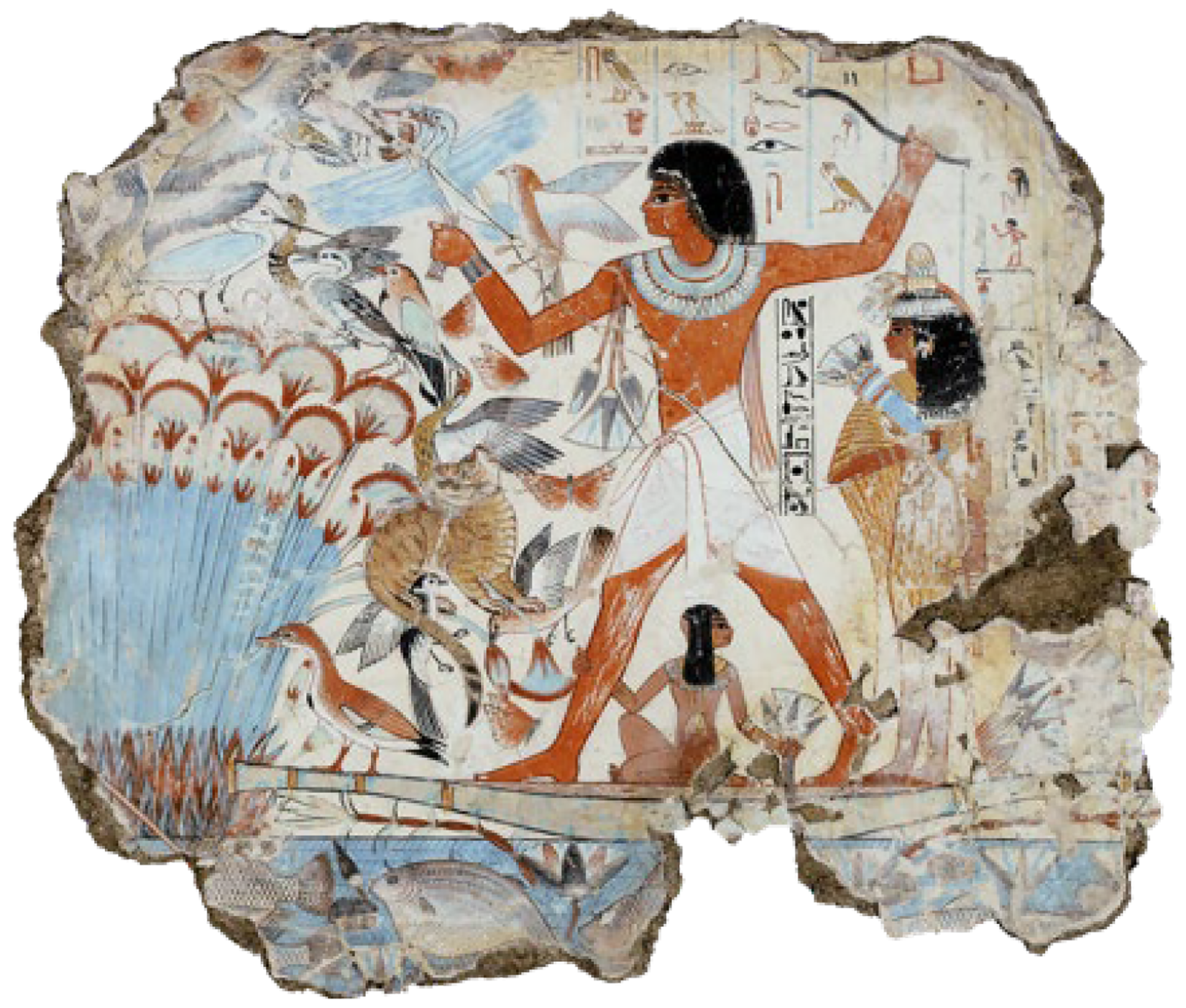
A fowler in the Tomb of Nebamun, 18th Dynasty (image courtesy of British Museum, no. EA37977, © The Trustees of the British Museum).
Classifiers as maps of knowledge organization
Our central hypothesis is that each semantic classifier signals a “category head” in the knowledge organization in each culture (Lakoff, 1987; Goldwasser, 2002, 2022, forthcoming; Handel, 2023). Suppose we collect all words that are written using a particular classifier; this collection will provide us with members of a category in the ancient culture’s “collective mind,” reflecting the rich palimpsest of different conceptualizations during different periods and places. Preliminary studies conducted in Egyptian, Sumerian and Chinese in the past two decades have confirmed this hypothesis (e.g., Allon, 2007; Chen, 2016; Goldwasser, 2002, 2010, 2023; Selz et al., 2017; Stauder, 2020). Recently, Handel (2023) has undertaken a preliminary corpus-based model study on classifier categories in the modern Chinese script. Multi-classification and classifier alternation signal overlapping and interconnections between categories, as shown in the examples mapped in other articles in this issue.
Graphemic classifiers represent, abstractly, a set of conceptual categories. Their semantic values in the script are derived from a combination of cultural-cognitive classification of the world and the structural systematicity of their use in the inherited writing system. We focus on both the similarities and the differences in how cultures organize their universe according to the scripts’ respective classifier systems.
New research methods used in the study of semantic classifiers
In order to create “mind-maps” of cultures according to the classifier systems, and as the corpus of classified words in texts in Chinese, Egyptian and Sumerian amounts to millions (i.e., “big data”), we have built in the ArchaeoMind lab (https://archaeomind.huji.ac.il/) a digital research tool for the collection, marking and analyses of classifiers. We start from a defined corpus of ancient texts in each script and assemble our lemmas (and tokens) from them. After marking the classifiers by tildes, the words are filtered by our digital tool iClassifier (©Goldwasser/Harel/Nikolaev).
12
iClassifier is designed for a context-sensitive analysis of classification in scripts and languages. It provides maps of categories, their interconnections and their members. It signals prototypical members, members intersections and categories inner structures (center vs. edge, etc.; see 2024 Harel et al.; Goldwasser and Soler; Selz and Zhang; Xu). Classifiers are analyzed in accordance with their semantic relations to their host word: taxonomic, schematic, or metaphoric. In the case of verb classifiers (only Chinese and Egyptian), semantic roles which are represented by the classifiers are identified (after Kammerzell, 2015: 1400). Some similarities in verb classification in Chinese and Egyptian can be observed. An example of a verb classifier in ancient Chinese script is  [
[ (fù, Old Chinese *buk, “return,” Guodian bamboo manuscripts_Taiyishengsui 2, 9). The iconic meaning of 辵 is “foot walking on a road.” This sign is in origin composed of two parts: 彳 “road” and 止 “foot.” The part above is 彳, which in turn is in origin an abbreviated form (left part) of the sign
  行 “crossroads, intersecting roads” (Guodian bamboo manuscripts_Laozi C 9, 7). The part below is a pictogram of a foot, which was also used as the logogram
  止 (zhǐ, Old Chinese *təʔ, “foot,” Guodian bamboo manuscripts_Liude 26, 7). The character 辵 is generally used as a semantic classifier in
 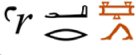 “go upwards” that may take the
  [
[ [
[ is one of the largest (by number of members) categories in the Egyptian script. However, the largest categories in Egyptian and in ancient Chinese script are the two comparable categories
  [
[ [
[
The research possibilities opened by iClassifier are presented in more detail in the other contributions in this issue. It is our hope that the scholarly contributions in this volume will help to open up a new chapter in classifier studies and in comparative script analysis. Theoretical and analytical work undertaken in the last few decades has been done primarily by individual researchers specializing in one language or script. Our approach combines large-scale corpus data with comparative script analysis carried out by teams of collaborators who can contribute specialized expertise in different ancient writing systems. This work has laid a strong comparative foundation that we can now build on, to develop new insights into the early history of script development and the commonalities and differences among ancient cultural conceptualizations of the world.
Footnotes
Authors’ contributions
Orly Goldwasser and Zev Handel: classifier theory, methodology, data analysis. We are grateful to Yanru Xu for very fruitful discussions.
Declaration of conflicting interests
The authors declared no potential conflicts of interest with respect to the research, authorship and/or publication of this article.
Funding
The authors disclosed receipt of the following financial support for the research, authorship and/or publication of this article: ISF grant 1704/22 “Exploring the minds of Ancient Egypt and Ancient China —A comparative network analysis of the classifier systems of the scripts,” PIs Orly Goldwasser and Zev Handel. The ArchaeoMind Lab, The Hebrew University of Jerusalem, PI Orly Goldwasser ( ).
).