




Abstract
Over the past decade, cloud software has transformed numerous industries—from finance to logistics, marketing to manufacturing. The simplified aggregation of data, enabled by cloud computing, empowers individuals to glean insights and make data-driven decisions rapidly. In science, however, such a transformation has yet to emerge. The domain lacks centralized, machine-readable repositories of scientific data; this absence inhibits analytics and expedient decision-making. Recently, the Internet of Things (IoT) has served as a catalyst for digitizing and automating science. IoT enables the centralized collection and analysis of scientific data (e.g., instruments, sensors, and environments). Here, we discuss this new technology trend, its applications in laboratories and promise as a platform for improved efficiency, more innovative capabilities, and machine learning/artificial intelligence.
Introduction
The past 5 years has been filled with buzz about the Internet of Things (IoT). From aviation 1 to healthcare, 2 IoT promises to upend a myriad of industries. However, like many novel technologies, IoT creates value uniquely in each individual industry. From this perspective, we highlight how IoT may impact the laboratory, science at large, and select opportunities presented for science and automation as a field.
What Is IoT?
IoT refers to physical objects—sensors, devices, equipment, and so forth—that are connected to the Internet. Whether via Wi-Fi, ethernet, cell networks, or some other means, a myriad of industries have connected devices to the Internet for the past several decades. Among the most prominent of examples is Nest, 3 the smart thermostat. By connecting one’s home to the Internet, owners gain unparalleled visibility (e.g., the current or past temperature) and control (e.g., remotely via an app). Further, with Internet-enabled thermostats in multiple homes in a neighborhood, aggregating the data across those abodes can provide insight into energy usage and preferences. In an industrial context, manufacturing plants are rapidly IoT enabling their equipment. Why? To provide operators and managers with similar real-time visibility into the state of their production lines. Further, by analyzing the data produced by this equipment, data scientists can predict when those systems will fail, thereby limiting downtime and production delays.
How Does IoT Manifest in the Laboratory?
Interestingly, IoT is not a new concept in the laboratory. Fundamentally, laboratory automation is a predecessor to IoT and has served as the foundation for today’s manifestation. Lab automation has been a key area of investment and growth for the past two decades; the miniaturization of technology and new capabilities drive this growth. 4 From instrumentation, like liquid handlers and plate readers, to software platforms, like schedulers and Laboratory Information Management Systems (LIMSs), adding a digital interface to scientific processes has been a critical focus area. Further, software platforms like LabView (from National Instruments) and Matlab, have enabled more rapid development of automated systems. Yet, to date, the majority of automation systems have produced clusters of instrumentation that are tailor-made for specific workflows. Rarely are conventional automation systems flexible or ubiquitous. Further, sophisticated training and extensive investment are required to add digital capabilities to physical processes. As a result, in many labs, especially in the life sciences, automated systems are less common than independent instrumentation and software systems. In this light, IoT has emerged as a bridge between the physical world of science and the digital world of data. IoT adds connectivity to physical scientific processes, namely through instrumentation or sensors. This connectivity subsequently enables automation-like capabilities—remote control, notifications, and dashboards, among others—at the scale of individual workflows and instruments. Further, laboratories, unlike other use cases, are designed to produce data. IoT in the lab offers to collect scientific data more seamlessly and centrally than ever before.
Disrupting Science
As the scientific instrumentation and automation industry adds Internet connectivity to their devices, how can these smart systems change the way we do science? From our perspective, we see that IoT can yield step-function improvement in science by improving operational visibility, facilitating centralized data collection, and providing a foundation for advanced analytics.
Operational Visibility
Many laboratories are composed of instruments spread across numerous benches and rooms throughout a facility. For some companies, labs span multiple cities as well. As a result, the geographic spread of assets makes it difficult to have visibility into the operations of these devices to optimize their investment, repair, and use. IoT can change that. We have seen how IoT can help answer key business questions in this regard ( Fig. 1 ). By providing a dashboard of individual and fleets of instruments, IoT can enable executives and operations teams to review the health 5 of their most critical assets. Some of the highest-priority environments include freezers, incubators, cold rooms, and labs themselves. IoT-enabled sensors can stream these parameters (e.g., temperature, CO2, and humidity) to a single cloud-based dashboard. Second, by being able to tap into the instruments in real time (e.g., chromatography systems and sequencers), teams are able to analyze usage patterns to plan servicing and subsequent capital investments. In the aggregate, this dashboard helps provide better visibility to scientists and managers alike and provides real data to drive better decisions for capital and operational budgets.
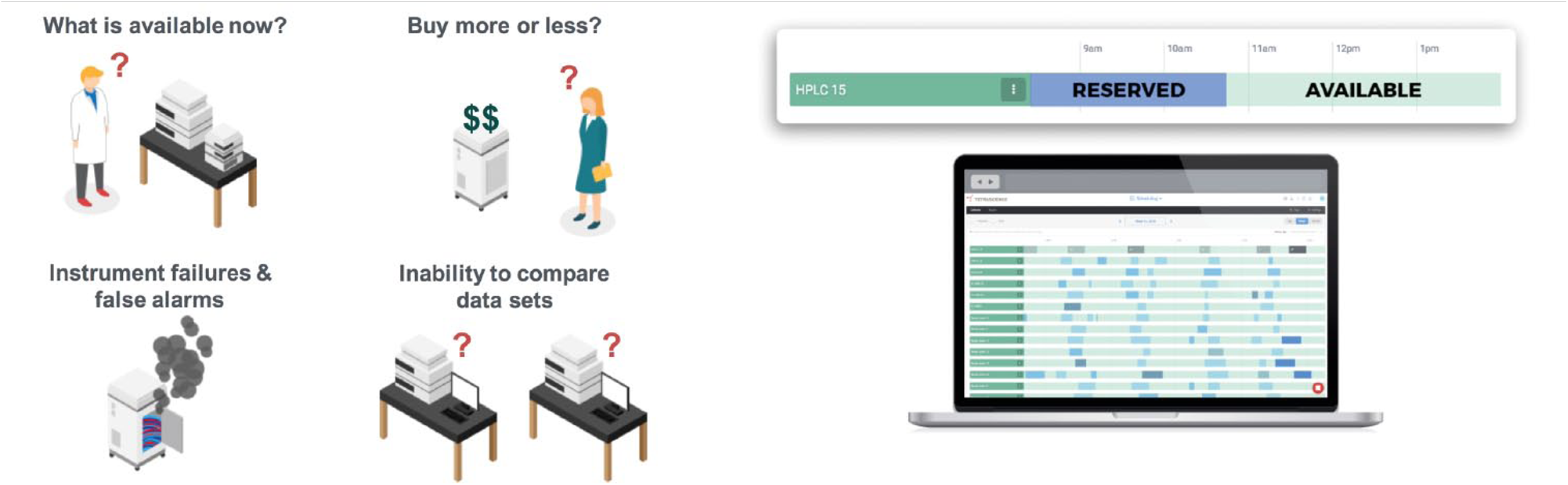
Left: Common operational questions that arise in the laboratory. Right: Example of instrument scheduling and metadata to improve operational efficiency. The screenshot shows TetraScience Scheduling.
Centralized Data Collection
Laboratories produce vast amounts of data. From high-throughput screening facilities to chemical synthesis, much of the data that are produced are lost. In laboratories, a key challenge is data aggregation and data management. Much of the data that are produced in a lab are sequestered—within an Electronic Laboratory Notebook (ELN), on a USB drive, or on an instrument’s PC. The result is a diverse, fragmented collection of data silos that preclude cross-functional analytics and ease of access.
Using IoT, raw data sources like instruments can stream data directly to a central repository ( Fig. 2 ). That repository could be a data lake, for example, or an industry-specific application like an ELN or LIMS. A data lake is an approach for storing data within a single system that includes aggregating and co-locating data of different formats. Open-source software, like Apache Hadoop, can be used for data lakes as they are scalable and facilitate data analytics in situ. 6 Data lakes, historically, are often used with collections of data files. For aggregating time-series data, software like Kafka, TimescaleDB, and Sentenai could be used.
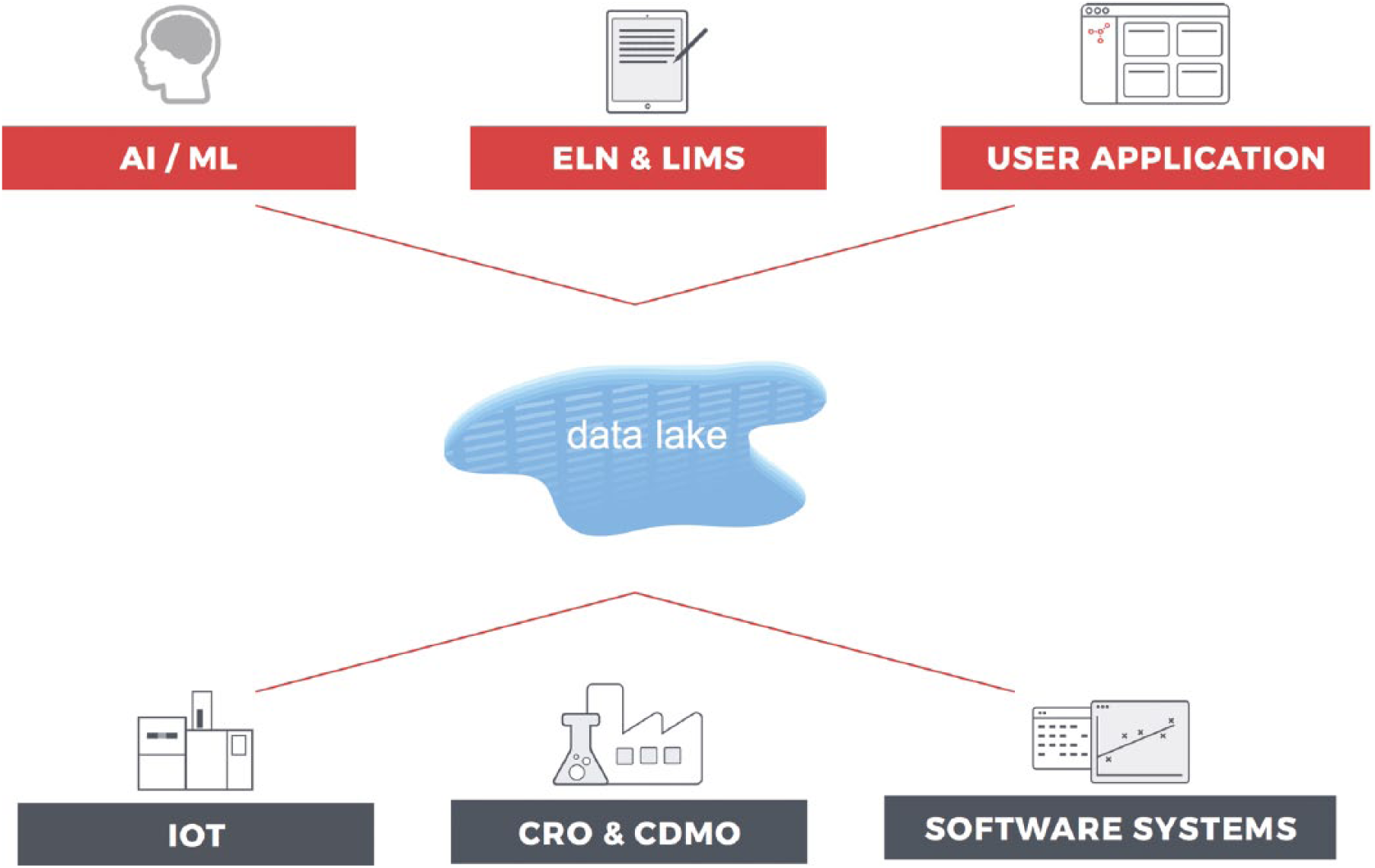
Centralizing data can help organizations derive more value from the data that they generate. Independent of the source—IoT, CROs, software systems—scientists and data analysts can deploy advanced analytics, integrate data across repositories, and build customized applications on top.
With a longer-term trend toward centralized data and advanced analytics, IoT can be a valuable data stream. Workflows involving balances and pH meters, for instance, can readily be improved as data transcription from these systems is costly and error-prone. Further, co-locating analytical data (e.g., chromatograms and weights) versus process data (e.g., synthetic parameters) can drive better decisions about critical measurements and experiments. 7 This approach facilitates harmonized data across the enterprise and ensures better data quality. With data-producing systems generating auditable scientific results, IoT enables the aggregation of data across various instruments, labs, and sites in a single, centralized repository.
A Foundation for Machine Learning, Artificial Intelligence
As IoT enables the collection of scientific data in a single repository, projects involving machine learning and artificial intelligence have become more tenable. Historically, more than 70% of the work associated with machine learning projects relates to data preparation. 8 IoT promises to solve this problem as data can be centralized and standardized from a variety of instrumentation and systems. Using data lake technology, like Hadoop, one can perform cross-functional analytics and generate valuable insights in real time from individual or fleets of experiments ( Fig. 2 ).
Opportunities for IoT in the Lab
Ecosystem
Every laboratory is best characterized by the word ecosystem. Any lab is composed of a myriad of instruments, software systems, workflows, and scientists. In science, there are 4000+ vendors of scientific instruments, 9 150+ vendors of scientific software, and no less than 200 unique workflows. As a consequence, success in IoT enabling the laboratory requires a philosophy that supports the vendor ecosystem. There are numerous consortia that are developing best practices for handling R&D data. The Pistoia Alliance, Allotrope Foundation, and SiLA are great examples of precompetitive alliances that are forming to drive broader ecosystems and digital solutions to key problems in science.
New Business Models
As IoT becomes more pervasive in the laboratory, new business models for labs and instrumentation are emerging. There are three new opportunities on the horizon: (1) predictive maintenance, (2) science-as-a-service, and (3) remote experimentation. As instruments are able to stream data in real time, customer service and repair teams employed by instrument manufacturers can monitor the health of their instruments in the field. With such services, labs can ensure that instruments are properly functioning. Furthermore, capital equipment can exceed $50,000 per device, along with an annual service contract. Using IoT, device manufacturers are exploring science-as-a-service models. This approach offers customers a low- or no-cost device but only charges the end user when instruments are used. Lastly, smaller labs may not have the resources to perform every type of scientific measurement. In this case, companies are setting up centralized laboratories with IoT-enabled workflows and instruments. These systems provide scientists the ability to run experiments on state-of-the-art equipment remotely, from anywhere in the world.
Conclusion
IoT is a rapidly growing technology that is upending the traditional, pen-and-paper handling of data in labs. By connecting instruments to the Internet—from freezers to balances to high-performance liquid chromatography—scientists can automatically capture data, track processes, and monitor their lab from anywhere. Such capabilities provide a foundation for next-generation analytics and new business models to advance science.
Footnotes
Declaration of Conflicting Interests
The author declared no potential conflicts of interest with respect to the research, authorship, and/or publication of this article.
Funding
The author received no financial support for the research, authorship, and/or publication of this article.