




Abstract
The sudden outbreak of COVID-19 has created dramatic challenges for public health and textile export trade worldwide. Such abrupt changes are difficult to predict due to the inherently high complexity and nonlinearity, especially with limited data. This article proposes a novel modified discrete grey model with weakening buffer operators, called BODGM (1,1), for forecasting the impact of pandemic-induced uncertainty on the volatility of cotton exports in China under limited samples. First, the Mann–Kendall test examines how pandemic-induced uncertainty affects cotton exports, based on China’s monthly cotton export data from June 2014 to August 2022. Second, buffer operators are employed to weaken the nonlinear trends and correct the tentative predictions of the discrete grey model. Then, the BODGM (1,1) model was validated by comparison with four alternative models. The results indicate that the BODGM (1,1) model was particularly promising for identifying mutational fluctuations in cotton exports and outperformed the GM (1,1), DGM (1,1), ARIMA and linear regression models in fitting and prediction accuracy under volatility and limited data. The BODGM (1,1) model forecast results for China showed that cotton export volume was expected to show signs of recovery over the next 12 months. The findings of this study may provide a basis for formulating trade policies to mitigate the impact of the COVID-19 outbreak on export resources and build their resilience to future pandemics.
Keywords
Introduction
China is one of the world’s largest cotton producers and consumers, and cotton export trade is crucial for the supply chain security of the textile industry.1,2 However, the uncertainty caused by COVID-19 has had a massive impact on the global textile supply chain, with typically stringent prevention and control measures likely to hurt cotton exports due to misallocation of resources and loss of efficiency.3,4 Owing to the rapid and unexpected spread of the coronavirus, cotton supply chains in China have suffered dramatic losses in a short period of time, significantly weakening business trade and jeopardizing the projected recovery in global growth. Hence, identifying and predicting how epidemics heavily affect cotton exports may enable decision-makers to formulate countervailing export policies to mitigate losses.
Previous studies5–8 have investigated the political and economic impacts of major epidemics (e.g. SARS, H1N1, Ebola virus and COVID-19), which have caused significant disruptions to manufacturing supply chains. These pandemic outbreaks have severely threatened the supply chain management of the textile industry by creating uncertainty and challenges in the export trade system. Several forecasting tools, including the time series model,9,10 regression model,11,12 artificial neural networks,13–15 support vector machines (SVM), 16 autoregressive integrated moving average model (ARIMA) 17 and hybrid forecasting models,18–20 have been put forward to solve the nonlinear export trade prediction problem. Although the above techniques can achieve high levels of prediction accuracy based on abundant data, these unavoidable limitations cannot be overlooked in practice. First, existing models commonly have high requirements regarding the amount and quality of data. Unfortunately, the availability of long-term follow-up data and statistical information is limited due to various factors (e.g. time and cost constraints). Second, actual data are often incomplete, complex and thus hard to interpret since cotton exports are nonlinear, stochastic and highly nonstationary. 21 Finally, most previous studies consist of qualitative studies with few quantitative investigations, and abnormal mutation mechanisms are poorly understood, especially under disasters, unpredictable events and volatile market conditions.22,23
Driven by these questions, a novel modified grey discrete model with buffer operators, called BODGM (1,1), was proposed to address the problems of limited sample sizes and fluctuations. When forecasting with insufficient information, grey theory is useful and is widely applied to the short-term apparel retailing, fashion trends, and export forecasting industries.24–26 Cotton exports could be regarded as a grey system, as the influencing factors include economic, social and policy changes; thus, the GM (1,1) or discrete GM (1,1) was recommended. However, the typical grey model is not directly applicable to the abrupt discontinuity in the monthly outflow due to the sudden COVID-19 shock in the observed data.27,28 To this end, the Mann–Kendall test is used to detect abrupt phenomena, and the buffer operator is used to weaken the inherent nonlinearity and complexity of the generated system. Since the variables are nonlinear, time-varying, periodic and exhibit additional evolutionary features, the imperfections still do not fully reflect the predicted trends; however, the combined prediction approach can compensate for these shortcomings. 29 Hence, the buffer operator can be applied to long-term data sequence features with large stochastic fluctuations, which has a larger predictive power than the grey model alone.
To our knowledge, this is one of the first attempts to forecast the impact of the COVID-19 outbreak on cotton exports, using total export time series data to understand how the textile industry can quickly recover from the disruption. The main contributions of our study are as follows: (1) it provides a general overview of the state of cotton exports in China before and after the pandemic and observes a significant nonlinear effect of the pandemic on cotton exports; (2) a novel BODGM (1,1) model is developed for solving the forecasting problem of limited data containing nonlinearity and uncertainty; and (3) it validates the credibility and superiority of the BODGM (1,1) model in comparison with four existing commonly used forecasting models within the acceptable error ranges. Overall, this study provides a roadmap for applying an optimized modified grey model with limited data to forecast the impact of the COVID-19 pandemic on textile export trade and theoretically infer the mechanism of anomalous mutation phenotypes.
The remainder of this article is organized as follows. The Data and Methodology section offers context for the data source and the construction of the proposed BODGM (1,1) model. The Results section conducts an empirical examination and compares forecast results using GM (1,1), DGM (1,1), ARIMA, linear regression and BODGM (1,1) models. The Discussion section discusses principled findings, methodology and applications, mutation mechanisms, policy recommendations and limitations. The Conclusion section concludes the present study.
Data and Methodology
Raw Data Collected
This study surveyed monthly data on cotton exports from China since the beginning of the recorded history, spanning from June 2014 to August 2022. All these data sets were obtained from the General Administration of Customs, P. R. China (http://www.customs.gov.cn/customs/302249/zfxxgk/2799825/302274/302277/4185050/index.html) on 24 September 2022. At the time of writing, data for September 2022 were not yet available. Data collected before COVID-19 were used as a control group, and data collected after the initial outbreak were used as an experimental group. This article intends to investigate the impact of COVID-19 on China’s cotton exports, and as such, we use the Mann–Kendall test to detect its trend from December 2019 to August 2022 from the time of the outbreak. The samples were divided into 70% training (December 2019 to October 2021) and 30% test samples (November 2021 to August 2022).30,31 All analyses were performed using MATLAB software (version 2021b).
Mann–Kendall Test
We applied the Mann–Kendall test32,33 to detect mutations in derived cotton export monthly sequences and determine when they occur. The mathematical formula for computing the Mann–Kendall test is provided below. 34
Suppose the following rank series for a time series

where
When the value of
Under the assumption that the time series

where


Traditional DGM (1,1) Model
The grey system theory’s most fundamental model is the GM (1,1) model. Although these predictions are examined accurately, many studies have argued that their accuracy can change over time. Because of the unacceptably high prediction error that frequently plagues researchers who have attempted to utilize the traditional GM (1,1) model, Xie and Liu 35 proposed a novel discrete grey model. The DGM (1,1) model was the discrete form of the GM (1,1) model with the following modelling procedure:

Theorem 1. Set


Among them:

If
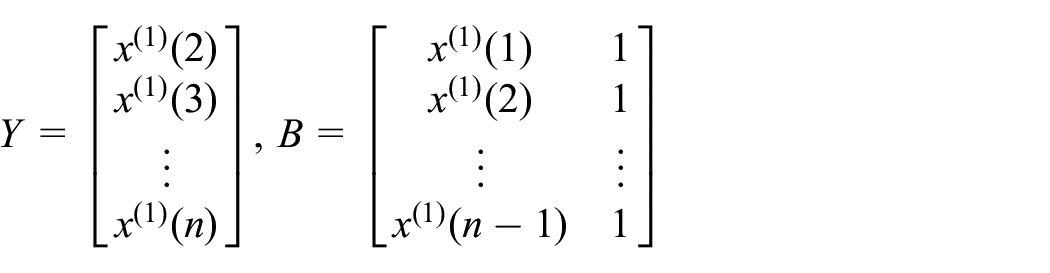
Then, the least-squares estimation parameter column of the grey differential equation

Theorem 2. Put

Set

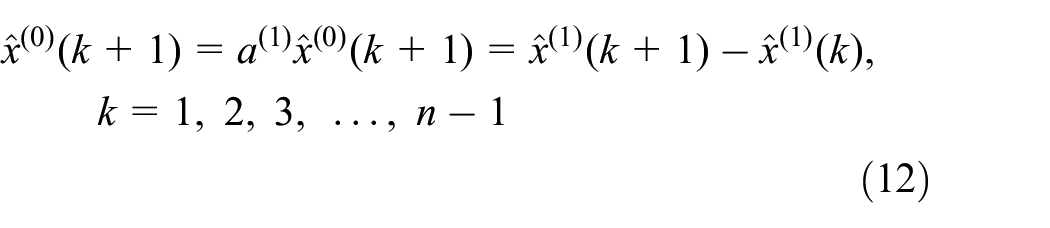
The restored value is:
Construction of the BODGM (1,1) Model
It is generally accepted that DGM (1,1) can simulate a pure exponential series; ideally, it is an exponential series. 35 Unfortunately, random factors complicate cotton exports. Practical applications of the DGM (1,1) model have restricted its greater prediction ability. Due to the significant changes found, the Mann–Kendall test is suitable for detecting the location of the mutation. In addition, we use buffer operators to disrupt the nonlinear trends and numerically adjust the tentative prediction results of the discrete grey model. The construction of the BODGM (1,1) model followed these steps, and its flow chart is given in Figure 1.
Step 1: Identify mutations in historical series of cotton export data sets.
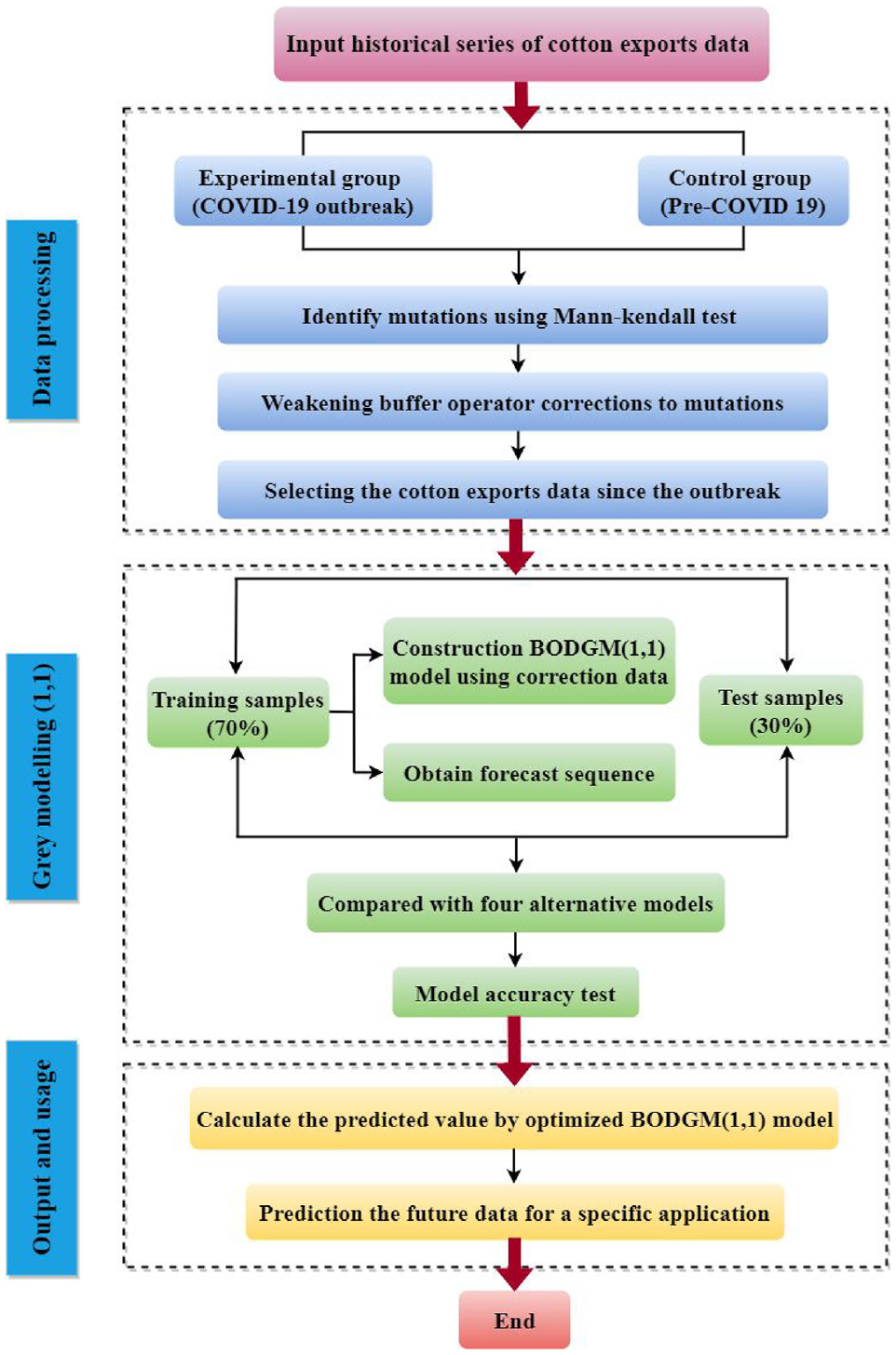
Flowchart of the proposed BODGM (1,1) model.
The Mann–Kendall test determines whether China’s cotton export data experienced sudden changes during the COVID-19 pandemic. Overall, an increasing tendency demonstrates that the value of forward sequence (UF) or backward sequence (UB) exceeds zero, whereas a decreasing trend indicates that the value of UF or UB is less than zero. Assume that a critical intersection occurred and was crossed when the critical value of 1.96 (a = 0.05) was reached, resulting in UB or UF moving up or down, respectively. A mutation may occur due to a sequence of events ranging from low to high or high to low, reflecting a watershed moment.
Step 2: Numerical correction by weakening buffer operators.
By applying buffer operations36,37 to the original data series, the general trend is weakened, and abnormal data are reduced in influence, enhancing prediction accuracy.
For the original sequence:

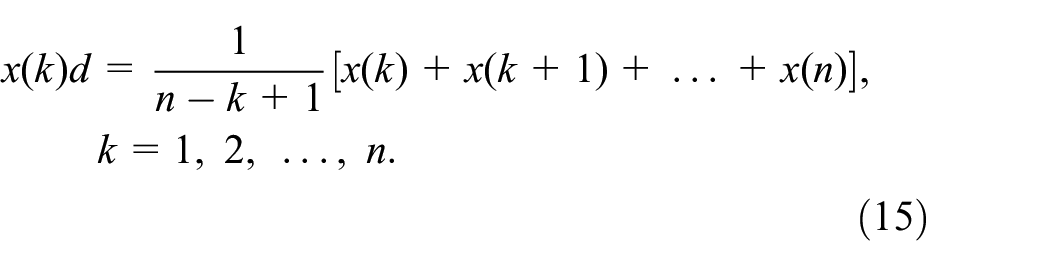
Let:

where:
Step 3: BODGM (1,1) prediction and comparison with other methods.
The training set is used for the first 23 months of data from November 2019 to October 2021. From November 2021 to August 2022, the last 10 months will be used as a verification set to evaluate the BODGM (1,1) forecasting ability. For the convenience of comparison, the GM (1,1), DGM (1,1), ARIMA, linear regression and BODGM (1,1) models are simultaneously established for the same training sets, and predicted values of random sequences are employed in each model.
Step 4: Model accuracy test.
Additional testing is required to determine the reliability and validity of the BODGM (1,1) model. To calculate it, we compared the three metrics of average absolute percentage error (MAPE), the mean absolute error (MAE) and the mean square prediction error (MSPE), which were calculated as follows: 38



where
Results
Overview Characteristics of Cotton Exports in China
To investigate the impact of COVID-19 on China’s cotton exports, we compared their status during the epidemic with those during the pre-epidemic period. Figure 2 summarizes the impact of the COVID-19 pandemic on China’s cotton exports, based on temporal change analysis of total cotton export data before and after COVID-19 and seasonal variability. The figure shows that there was a significant difference (p < 0.001) in China’s cotton exports before and after the COVID-19 pandemic. Moreover, seasonal variations in China’s cotton exports were also evident. It is essential to note that cotton exports in China were relatively low in the first quarter (Q1) and significantly fluctuated compared with the third quarter (Q3) and fourth quarter (Q4) (p < 0.05). In the second quarter (Q2), cotton exports to China were not low but fluctuated relatively. Hence, due to the significant impact of the epidemic on cotton exports, we should use data from the post-outbreak period for our analysis.
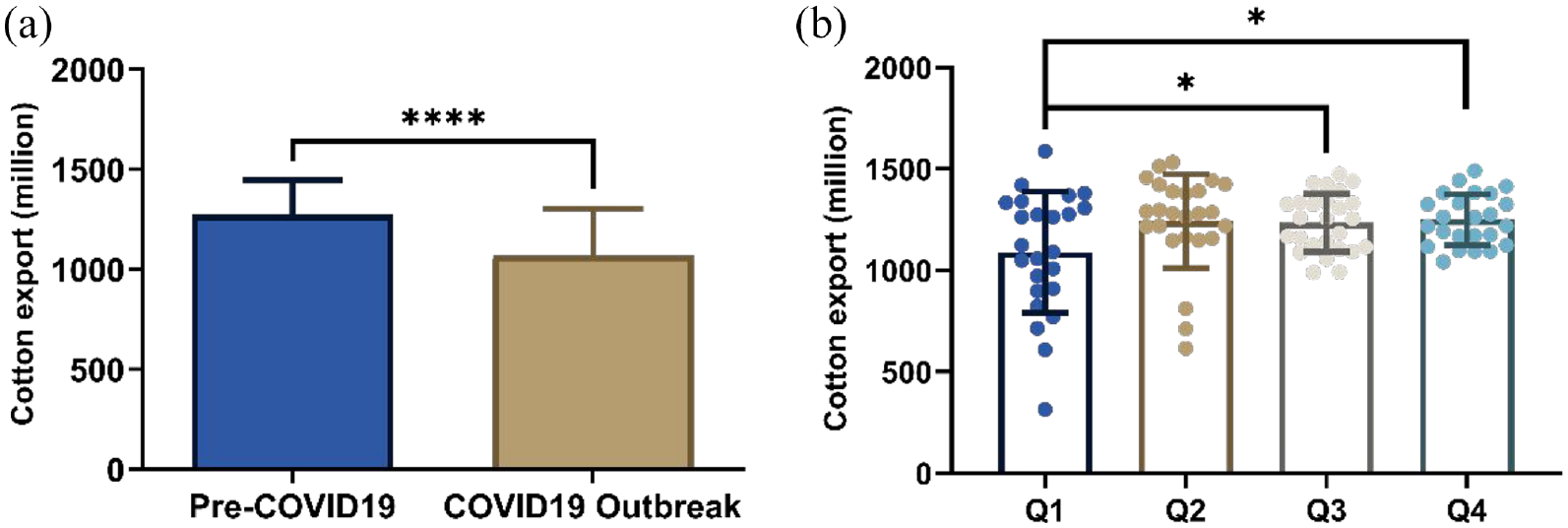
The impact of the COVID-19 pandemic on China’s cotton exports. (a) Temporal change analysis before and after COVID-19. (b) Seasonal variation in total cotton export data.
Mann–Kendall Mutation Test
The Mann–Kendall test was used to determine the critical UF and UB values for China’s monthly cotton exports from December 2019 to August 2022 (Figure 3). The results indicate UF and UB values of 1.96 and −1.96, respectively, with a confidence level of 0.05. From the figure, we found that the UF and UB curves intersect five times between the 1.96 thresholds, namely January 2021, March 2021, April 2021, May 2021 and June 2021, indicating that the total number of mutations experienced by the five cotton exports is significantly different. Hence, cotton exports in China can be roughly divided into three phases: phase 1 (from December 2019 to December 2020) was the initial period of the epidemic, phase 2 (from January 2021 to June 2021) had a severe impact on cotton exports, and phase 3 (from August 2021 to August 2022) was the recovery period following the epidemic.
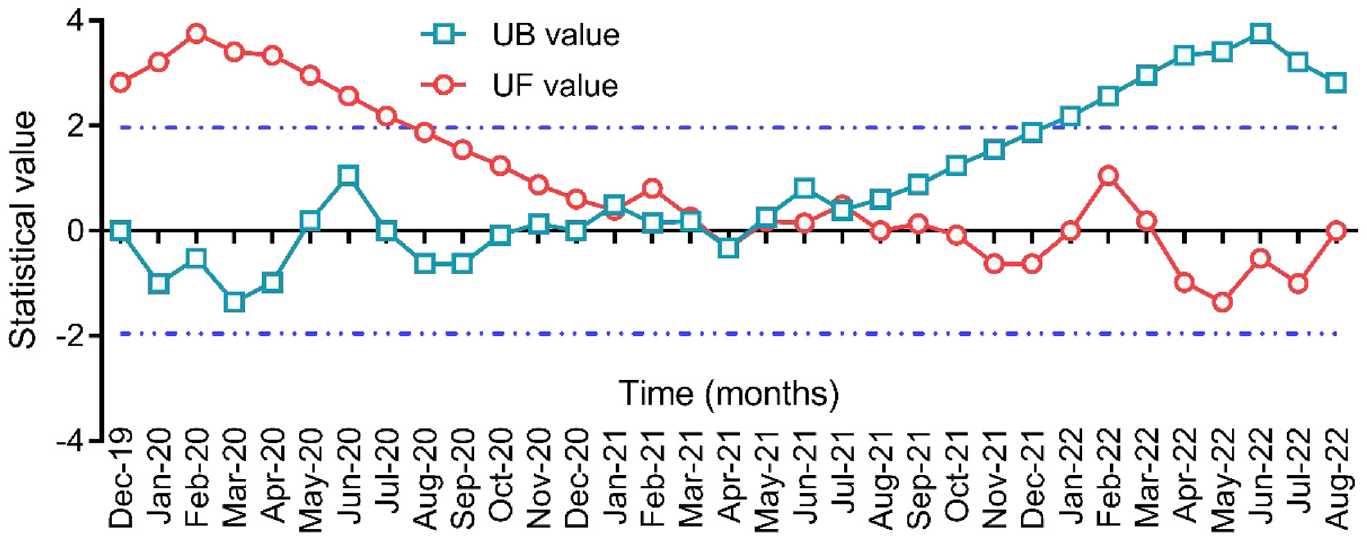
Cotton export mutation detection.
Since the onset of the COVID-19 pandemic, the curve has fluctuated upwards and downwards, indicating that cotton exports are recovering from the pandemic. A monthly analysis of Figure 3 shows that the UF curve is greater than zero from December 2019 to March 2021, indicating that cotton exports are increasing and a strong hysteresis in the impact of COVID-19 on Chinese cotton exports. Cotton exports were severely impaired from January to June 2021. Cotton exports fluctuated greatly during the period, indicating that the epidemic caused significant economic losses to the textile industry. The fact that cotton exports are entering a relative decline after August 2021 shows that the COVID-19 pandemic has profoundly affected cotton exports and has had an immediate and lasting impact on the textile sector.
Weakening Buffer Operator Corrections to Mutations
By selecting an appropriate initial value, we can guarantee faster convergence of the grey prediction model to the actual value than if we applied the buffer operator approximation (Figure 4). We find that the buffer operator can weaken the volatility of the raw series data, thus eliminating the derived systematic effects and interference. The original data are disrupted by external factors and lose their original character; however, their purpose is to reduce these nuisance factors and to understand the true shift law of the time series, thus enhancing the accuracy of the discrete grey model simulations and predictions. Consequently, identifying and rectifying the distorted data may improve the performance of the fitted and predicted models.
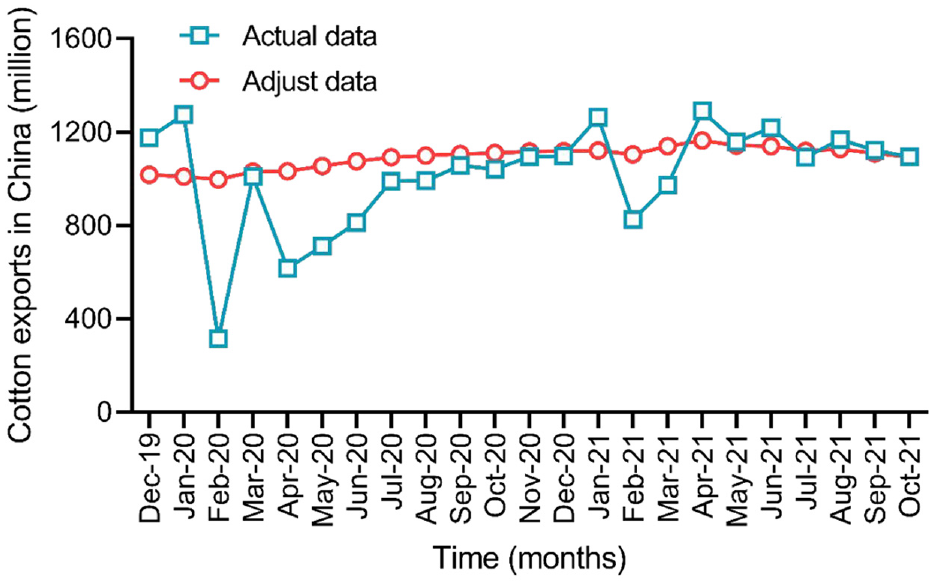
Cotton export data adjusted by weakening buffer operators.
Model Performance Comparison and Validation
Tables 1 and 2 provide the training and testing results for the GM (1,1), DGM (1,1), ARIMA, linear regression and BODGM (1,1) models with limited data, and Figure 5 shows the fitting error and prediction error for these five models. Based on the fitting effect, the BODGM (1,1) model has an MAPE of less than 15%, implying that the fitting effect is highly accurate compared with other models. Moreover, the MAP and MSPE metrics outperform those of other alternative models. In terms of the prediction effect, the results showed that the prediction errors for the GM (1,1), DGM (1,1), ARIMA, linear regression and BODGM (1,1) models were 21.69%, 21.10%, 16.49%, 15.79% and 12.74%, respectively. The BODGM (1,1) model showed the highest forecasting accuracy when applied to noisy and nonlinear data, followed by linear regression, ARIMA, DGM (1,1) and GM (1,1).
Forecast values and errors (December 2019–October 2021): GM (1,1), DGM (1,1), ARIMA, linear regression and BODGM (1,1) models (unit: million dollars).
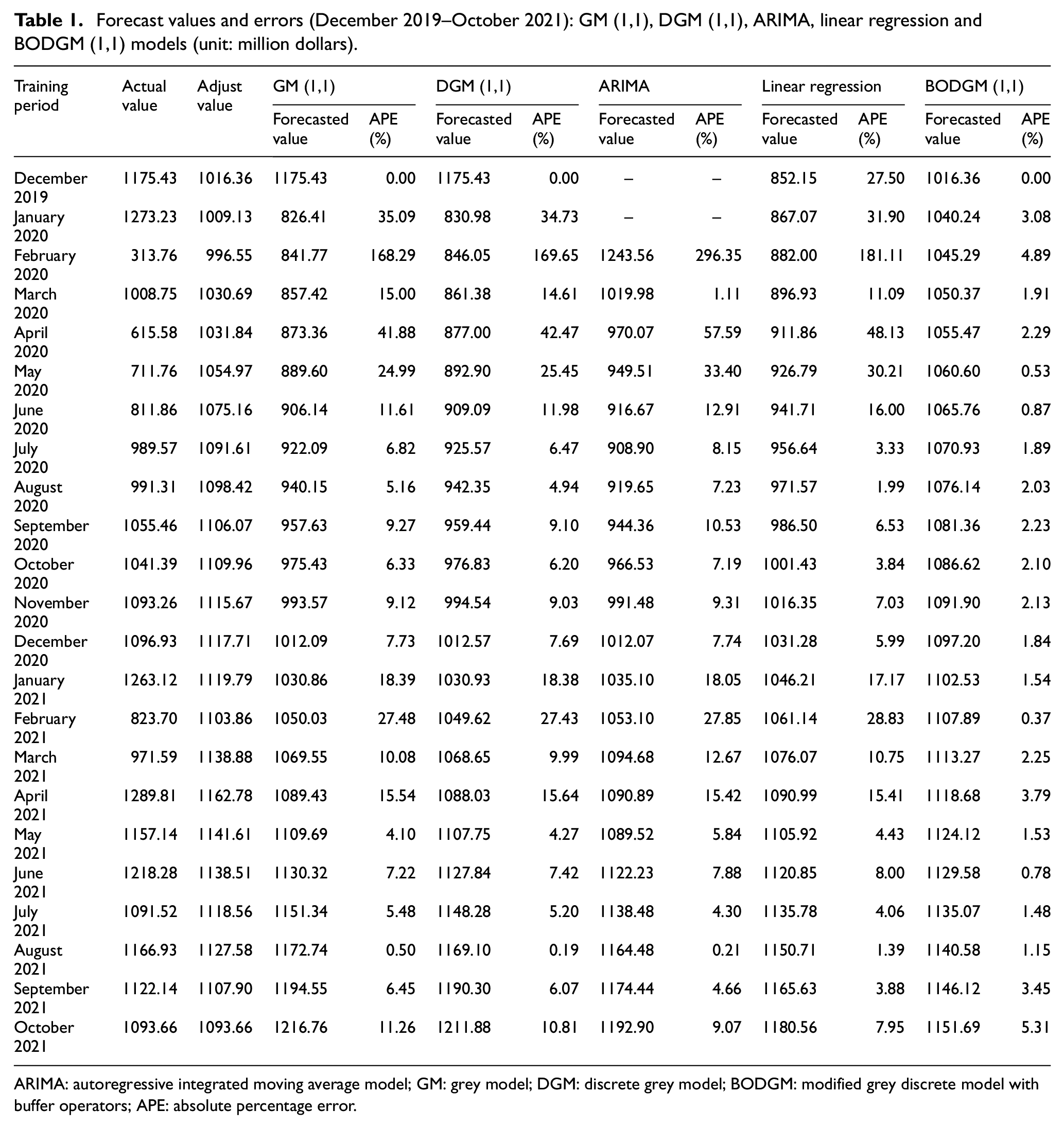
ARIMA: autoregressive integrated moving average model; GM: grey model; DGM: discrete grey model; BODGM: modified grey discrete model with buffer operators; APE: absolute percentage error.
Forecast values and errors (November 2021–August 2022): GM (1,1), DGM (1,1), ARIMA, linear regression and BODGM (1,1) models (unit: million dollars).
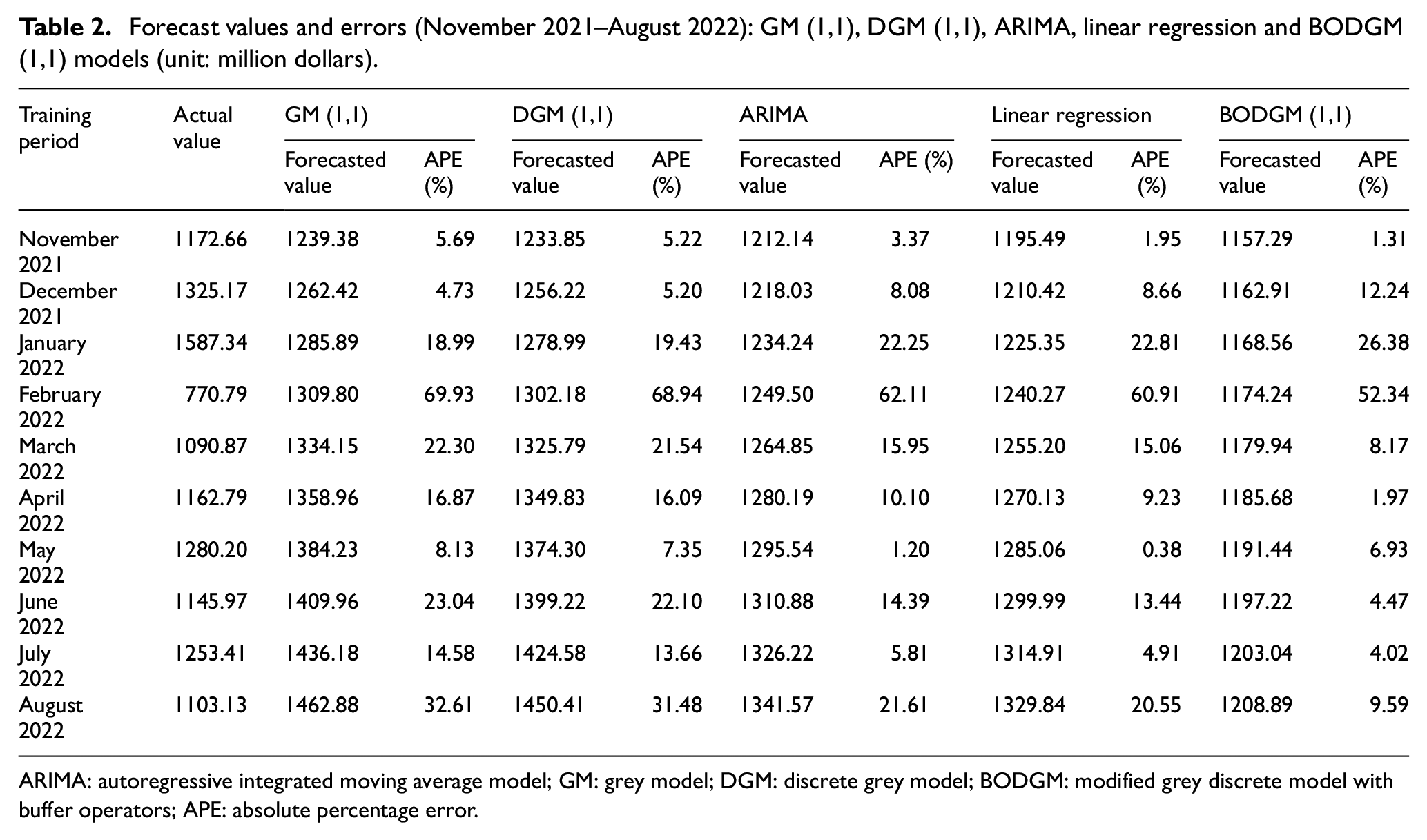
ARIMA: autoregressive integrated moving average model; GM: grey model; DGM: discrete grey model; BODGM: modified grey discrete model with buffer operators; APE: absolute percentage error.
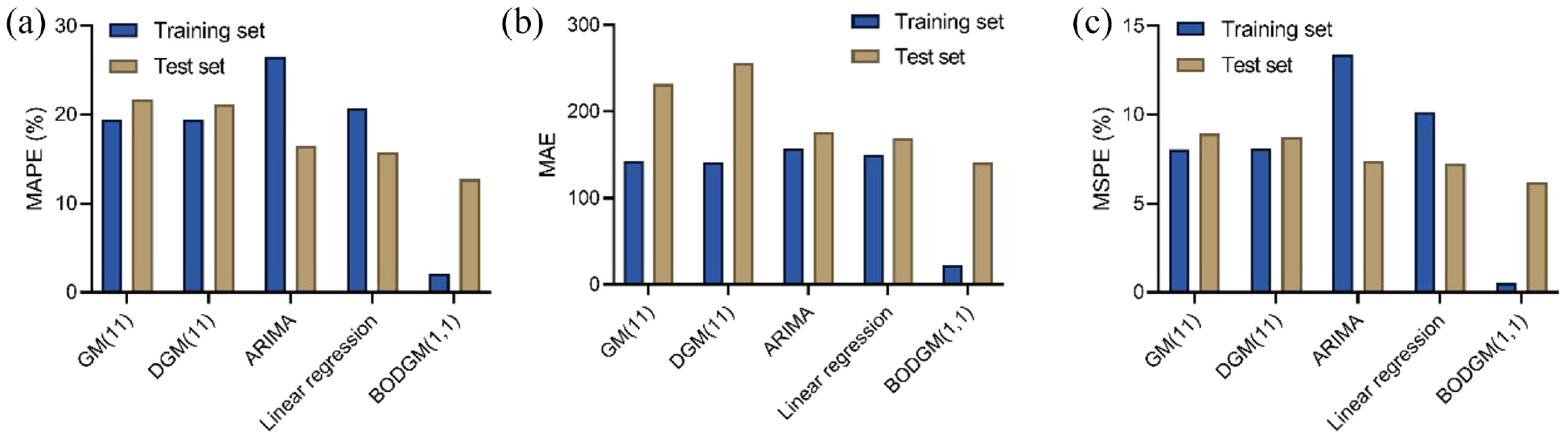
Comparison of five models in fitting error and prediction error.
Prediction of Cotton Export in China in the Next Year
The above results demonstrate that the OBDGN (1,1) model is more effective at predicting fitting and prediction than the alternative five models. Based on the OBDGM (1,1) model, this article forecasted China’s cotton exports from September 2022 to August 2023, as shown in Table 3. As predicted, cotton exports to China are expected to reach $1,281.28 million by August 2023, with an average monthly growth rate of 8.91%. Therefore, there is no question as to whether China’s cotton exports will soon show signs of recovery. The recorded values are still slightly lower than before the COVID-19 outbreak, but it would not be unexpected to see an increase as early as 2023. The proposed model, however, is not exhaustive, and the predictions are not entirely accurate. Thus, to maintain a current picture of the state of the derived system, it is necessary to update this information on a timely basis.
China’s predicted cotton exports from September 2022 to August 2023.
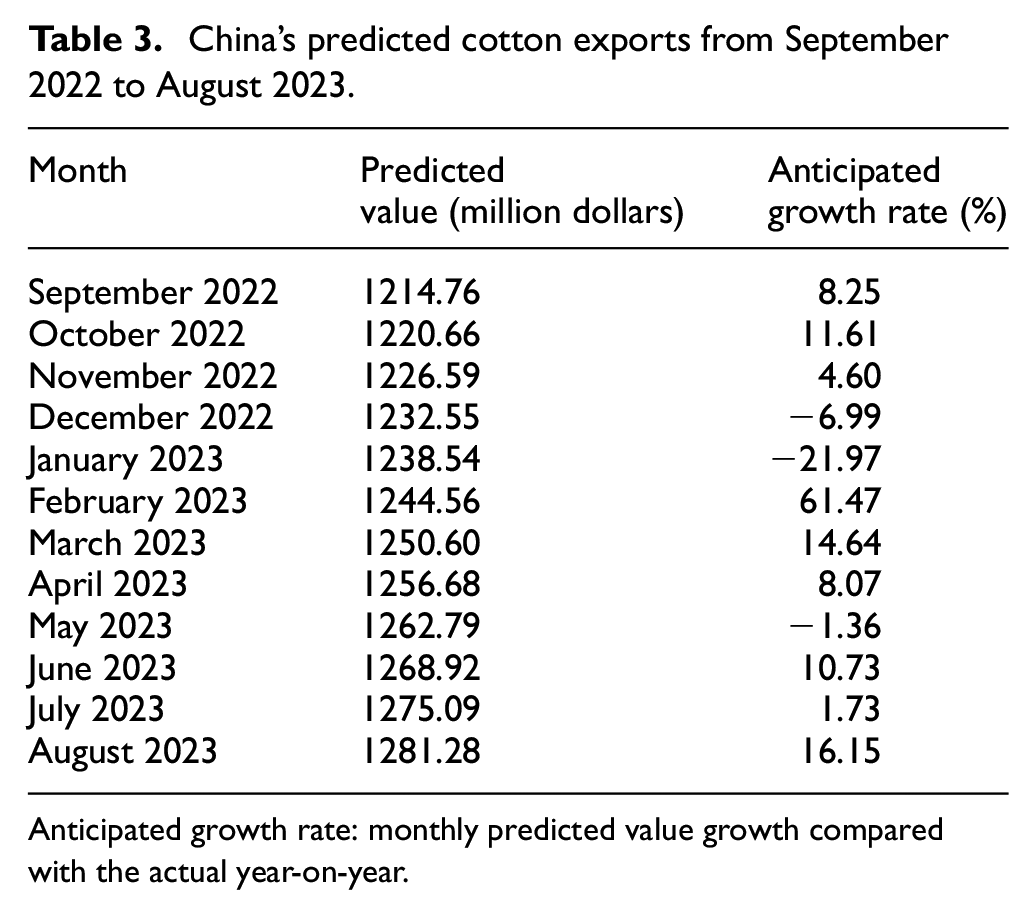
Anticipated growth rate: monthly predicted value growth compared with the actual year-on-year.
Discussion
To our knowledge, this is one of the first early attempts to forecast the impact of the COVID-19 outbreak on the textile industry with limited historical data. The main contribution of this study was developing a novel BODGM (1,1) model that outperformed the GM (1,1), DGM (1,1), ARIMA and linear regression models in fitting and prediction accuracy. According to our findings, the COVID-19 outbreak has adversely affected cotton exports in China; further research is necessary to investigate predictive models and mechanisms to mitigate its alarming impact.
Principal Findings
The first finding is that the COVID-19 outbreak has had an enormous impact on textile export trade, causing large fluctuations in China’s cotton exports. From Figure 2, we conclude that COVID-19 has greatly attacked cotton exports before and after the COVID-19 pandemic. In addition, seasonal variability cannot be neglected. Five mutations were identified based on the Mann–Kendall test results between December 2019 and August 2022; thus, China’s cotton exports can be classified into three phases. Among these, phase one (December 2019 to December 2020) was the initial period of the epidemic, phase two (January 2021 to June 2021) was the severe impact on cotton exports, and phase three (August 2021 to August 2022) was the recovery period following the epidemic. The affected sectors are recovering due to the near-term adaptation of supplier chains and export strategies, but research has yet to fully assess the recovery challenges. The global COVID-19 pandemic has significantly impacted manufactured textile exports, and China’s largest cotton market provides an excellent example of how the pandemic has affected manufactured textile exports.
The second finding was that various factors (e.g. government intervention, economic, social and environmental policies) appeared to affect the prediction of cotton exports, resulting in a typical grey system.24,39 In reviewing previous research, several forecasting tools have been proposed to solve the problem of nonlinear export trade predictions, including the time series model,9,10 regression model,11,12 artificial neural networks,13–15 SVM, 16 ARIMA, 17 and hybrid forecasting models.18–20 Fluctuations in the annual data are smaller than those in the monthly data, making it difficult to identify effective strategies for dealing with nonlinear monthly data with long delays. While machine learning has many advantages, such as its ability to leverage large amounts of data, many parameters, and structurally complex systems, it also has limitations. Moreover, due to time and cost constraints, cotton export data or statistical information is not readily available, making it difficult for researchers to accurately forecast the spread of COVID-19. This solution would address this issue by validating the ability of the grey model to make predictions using a small data set of 33 months in uncertainty and limited data, as is the case for cotton exports. The prediction accuracy is high if the MAPE value is less than 15%. The results revealed that the OBDGM (1,1) model could accurately predict cotton exports. It is important to point out, however, that extraneous effects can affect the variability of the data, lowering its validity.
The third finding is that the accuracy of the predictions can be improved by data correction. During the modelling process of OBDGM (1,1), a new trend could emerge, leading to complicated changes due to randomness and volatility. Consequently, we have to account for significant anomalies that deviate from the original trend and prevent our original data series from deviating from the true data when correcting the data series. The anomalies found during the correction process and the updated data should be weighted appropriately to balance current trends and forecast sensitivity. The buffer operator is used to weaken the inherent nonlinearity and complexity of the derived system since the variables are nonlinear, time-varying, periodic and exhibit additional evolutionary features.36,37
Methodology and Applications
Forecasting tools of the OBDGM (1,1) model have a wide range of applications, including identifying and predicting how outbreaks will heavily affect cotton exports so that countervailing export policies can be formulated to mitigate and compensate for losses caused by epidemics. Nonetheless, there are many challenges associated with forecasting cotton exports in the presence of COVID-19, as there are very few data sets available for this purpose. The current crisis is also likely to be a long-term problem and will require an effective strategy for recovery following the crisis.
A major concern is the sample size of China’s cotton exports. Due to the short duration of the COVID-19 pandemic, monthly cotton export data can only be accurately analysed at the monthly level. Since the COVID-19 outbreak in December 2019, we have contained only 33 monthly series of the proposed OBDGM (1,1) models for forecasting, resulting in a small sample size and limiting our approach to grey theory. Using other emerging prediction techniques, such as machine learning, we may be able to process these data further as more observations are collected over time. Future studies will examine additional influencing factors, including the size of the fashion industry, global cotton imports and exports, and export and import values of complementary cotton materials, to address more complex environmental forecasting issues. The proposed methodology and larger sample size would address more complex environmental prediction problems.
Another concern is the applicability of our predictive model. This article developed a novel OBDGM (1,1) model for investigating nonlinear, stochastic and highly nonstationary trend shifts with limited data and incomplete information, regardless of where such changes occur or their fundamental assumptions. By incorporating the buffer operator into the discrete grey model, the BODGM (1,1) model can somewhat adjust the characteristics of nonlinearity and uncertainty of the data series.36,37 As the BODGM (1,1) model has a high level of accuracy, future studies could examine whether the same methodology can be applied to compare and analyse recovery challenges across different nonlinear complex time series forecasts. It is possible to generalize the findings of this study to emergent crises in general, including other types (e.g. global financial crisis or natural disasters such as flooding or earthquake), other times (e.g. 2008 financial crisis, 2011 Japan earthquake, 2014 Ebola virus), and other related dominant (the apparel retailing market volume) affected by the pandemic that may also consider utilizing the proposed model. Consequently, this study has the potential to be expanded into a thorough empirical analysis to assist in formulating recovery strategies and evaluating their impact on the challenges associated with recovery.
The third consideration is the multivariate predictor of the remaining covariance. The proposed BODGM (1,1) exhibits significant improvements over the traditional model; however, this still requires the development of a multivariate grey model to predict cotton exports by considering the relevant factors. Additional steps should be taken to further enhance cotton export prediction accuracy. In essence, the proposed model is a univariate model confined by the statistics on cotton exports, so it is easy to disregard in the modelling process the potential influence factors that influence them (e.g. fashion market volume, global cotton export/import sizes and cotton’s complementary materials export/import values). In upcoming studies, common factors of textile industry demand will be considered and analysed using multivariate predictive models to identify key features of cotton exports and improve the application value of the model. It should be noted, however, that a longitudinal study of these changes would be beneficial to understand how they relate to each other as the pandemic progresses.
Mechanisms of the Impact of the COVID-19 Outbreak
The Mann–Kendall mutation test indicates that the COVID-19 pandemic has profoundly affected cotton exports and has had a lasting impact on the textile industry. OBDGM (1,1) also demonstrated that cotton exports are complex systems influenced by both external (e.g. policy, economy and culture) and internal (e.g. life cycle) factors, as well as discontinuity properties that make it difficult to explain their underlying mechanisms. The impact of the COVID-19 pandemic on cotton exports cannot be predicted due to this uncertainty. Until now, there has been a failure to explain how cotton exports move domestically and abroad in the short term. Based on Figure 6, we propose to adopt a theoretical concept for cotton export changes and study the mechanisms underlying the phenomenon of cotton export changes to explain the mechanism of COVID-19’s impact on cotton exports in China.
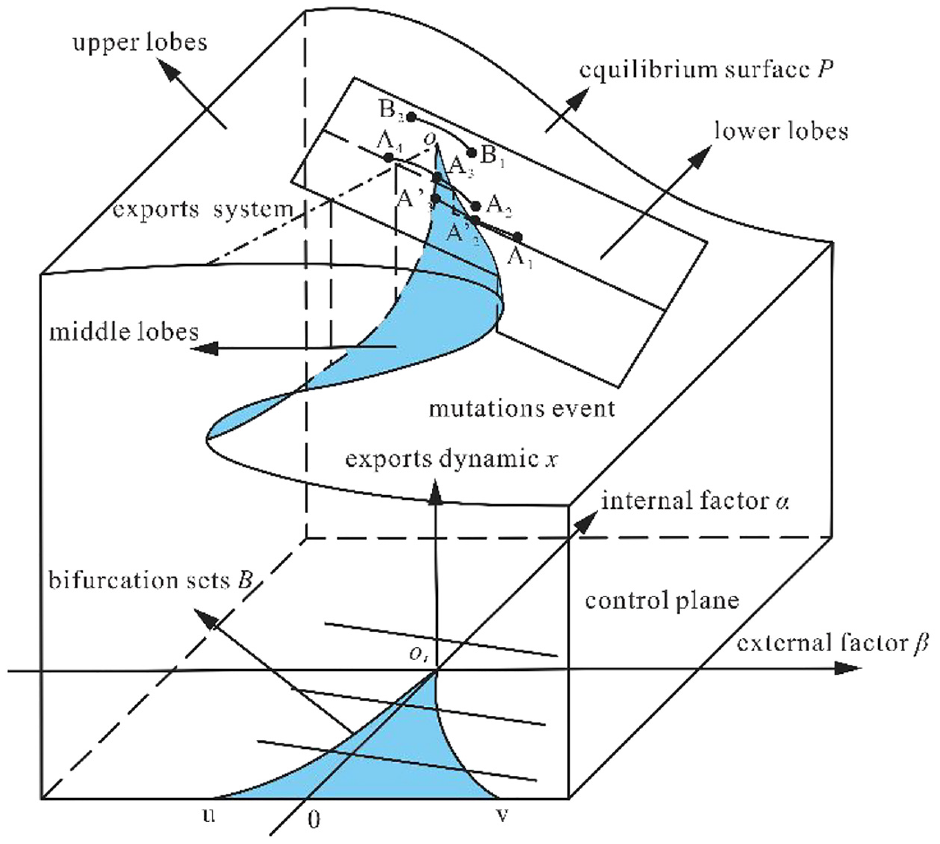
Mechanisms of the impact of the COVID-19 outbreak on cotton exports.
From the figure, the system exists in three states, stability, mutation, or instability, demonstrating the reliability of our findings in the Mann–Kendall Mutation Test section. We roughly divided cotton exports in China into three phases: phase 1 (from December 2019 to December 2020) was the initial period of the epidemic, phase 2 (from January 2021 to June 2021) had a severe impact on cotton exports, and phase 3 (from August 2021 to August 2022) was the recovery period following the epidemic. Second, along the path
Policy Recommendations
This study aims to provide quantitative evidence on the trade-off between pandemic control and textile export recovery in the formulation of government policy. Given the severity of COVID-19, our findings may stimulate policy discussions on how to mitigate its negative effects and promote Chinese cotton exports. Several applicable recommendations can be implemented to mitigate and recover the damages caused by COVID-19 to our societies and economies.
First, governments must prioritize short-term, medium-term, and long-term textile trade policies to promote global and regional cooperation. Short-term strategies include addressing the impact of the pandemic and restoring employment, while long-term plans may enhance long-term productivity and resilience to mitigate the impact of future pandemics and other socioeconomic shocks.
Second, practitioners involved in managing value chains are encouraged to rethink their supply chains in light of potential future outbreaks. It recommended restoring the production capacity of major textile enterprises, building effective supply chains, reducing transportation costs and organizing the cross-regional operation of machinery.
Third, since the crisis is not yet over, there are no complete data to comprehensively study it and investigate its full range and multidimensional impact. A more accurate prediction of pandemic progression could be achieved by incorporating various viral mutations or additional pandemic scenarios.
Limitations
There are several limitations to the present study. First, we examined cotton export data in isolation and constructed a univariate model, disregarding the effects of potentially influencing factors (e.g. government policies, supplier chains). Second, the authors are limited in collecting sufficient data for model construction, making it challenging to develop state-of-the-art models capable of handling more complex situations. More extensive and detailed data sets are needed to generalize such models. Third, since the grey model is better suited for short-term prediction, it may introduce a bias in long-term prediction. Future research could consider other optimization methods to optimize the model parameters. Last but not least, developing an early warning system for China’s cotton exports requires developing a forecasting model based on quantitative market research that includes a detailed analysis of expert opinions.
Although further investigation is required to highlight the link between mutation and actual market research by evaluating expert perceptual cognition, our findings clearly support the use of an improved modified discrete grey model to predict the impact of the COVID-19 outbreak on cotton exports in China.
Conclusion
This article proposed a novel modified discrete grey model derived from a combination of data distortion corrections. The proposed algorithm is the first application of greyscale in forecasting with buffer operators and a greyscale prediction model, and it is applied to compare the greyscale approach to traditional prediction techniques. The experimental results indicate that the OBDGM (1,1) models perform with higher fitting and prediction accuracy than conventional alternative models (GM(1,1), DGM (1,1), ARIMA and linear regression models) among the five methods. Our findings proved that OBDGM (1,1) forecasting could have a bright future when a system undergoes abrupt changes to handle limited, fuzzy and nonlinear data. Further discussions on improving the grey model will be explored in future studies, and modified discrete grey models will well address other types of textile exports.
Footnotes
Acknowledgements
We thank The 3rd Artificial Intelligence on Fashion and Textile International Conference (AIFT 2022) for nominating this article to the AATCC Journal of Research for further review and publication. In addition, we thank the editor, the anonymous reviewers for their comments, and American Journal Experts (AJE) for English language editing, which assisted us in refining our article.
Declaration of conflicting interests
The author(s) declared no potential conflicts of interest with respect to the research, authorship, and/or publication of this article.
Funding
The author(s) disclosed receipt of the following financial support for the research, authorship, and/or publication of this article: This work was supported by the Fundamental Research Funds for the Central Universities (Grant No. 2232021G-08).
