



Abstract
Development of biocide-based antimicrobial textiles is proving to be a concern for the economy, and more evidently, for the environment and health. On the contrary, probiotic (beneficial bacteria) can replace these traditional biocides in order to overcome the toxicity and resistance problems. This paper elaborates an adapted sol–gel coating process to embed such beneficial spores on the polyester woven surface, and their viability is studied along with the characterization of the physical properties of the coated fabric. The results illustrate successful incorporation of the beneficial spores with an adequate number of living organisms (even after repeated washing cycles), sufficient tensile strength, and good abrasion resistance properties with the opportunity to improve surface wettability maintaining sufficient adhesion between the fibre and the coated layer.
Introduction
Over the past few years, a great deal of attention has been focused on incorporating biocides on textile surfaces. In line with this, surface modification through fabric finishing techniques comprising conventional methods, i.e. exhaust and pad-dry-cure coating along with the state-of-art plasma and nanotechnology-based methods, i.e. sol–gel, microencapsulation, remains the more popular approach [1]. Mahltig et al. [2–4] have shown the effectiveness of silver, silver salt and quaternary ammonium salt-based inorganic biocides for antifouling purpose embedded on textiles through sol–gel coating by varying the ratio of silane to antimicrobial compound and curing temperature along with their resistance to laundering . Sol–gel process consists of three basic steps, starting by the formation of nanosol through hydrolysis of the precursor material followed by condensation reactions, then coated on the substrate by dipping, spraying or padding to form a large three-dimensional network of silicon polymers called lyogel film, and finally thermally treated to form an amorphous porous structure, the so-called xerogel [5,6]. The silica-based precursors can make covalent and/or hydrogen bonds to the fibre surface such as polyethylene terephthalate (PET) [5], as illustrated in Figure 1; however, additive materials such as the bacteria can be physically entrapped in the polymer matrix without any further chemical modification [7].
Hydrogen bond formation between silane precursor and fabric surface.
Sol–gel is an energy efficient coating process that can be performed in the room or low temperatures, requires less amount of chemicals, and recognised to be an environment friendly process by limiting the use of many hazardous chemicals unlike conventional coating methods [8].
Many pathogenic bacteria have been reported to build up resistance to the traditional biocides, requiring the use of more cleaning chemicals, and thus provoking both health and environmental hazards. An alternative approach has been studied by Saxelin et al. [9], which reviews the antimicrobial or antagonistic effectiveness of various commercially available probiotics against pathogens by the competitive exclusion. In conjunction, review by Fijan includes evolving of pH change through the production of organic acids or hydrogen peroxide along with bacteriocins and development of antioxidants as mechanisms of antimicrobial actions [9,10]. Although the mode of action of probiotics cannot be understood completely, it is supposed that their broad antimicrobial activity is related to the combination of their antagonistic and antimicrobial activity. The challenge remains on the low diffusion of antimicrobials agents/beneficial bacteria and spores toward substrate surface to interact with pathogens and extreme processing conditions such as high temperature. To overcome these problems, surface modification methods may be useful to incorporate probiotics in the textile surfaces. Especially, silica precursor-based sol–gel coating technique may be an efficient route for such nano scale microbial incorporation. However, the inclusion of living probiotics through any of such methods is rare. The method used in this process includes bacterial stability to chemicals (ethanol, HCl). It is important that adequate amounts of probiotics are survived after coating, further durable on several laundering cycles. Thus, this paper aimed to research the potential of silica precursor-based sol–gel coating technique in incorporating probiotic spores on textile surfaces. For this purpose, two different types of probiotic suspensions were entrapped in sol–gel paste and then PET-based fabrics were coated with these pastes. The success of incorporation process was evaluated by the viability of bacterial growth.
Experimental
Materials
PET-woven fabric reinforced with carbon threads was supplied by FOV Fabrics AB (Sweden). The fabric had 2/2 twill weave with 40 picks/cm and 55 ends/cm of PET threads and carbon thread density was maintained to be 1 per 23 picks and 1 per 25 ends of PET threads constructing a fabric weight of 146 g/m2.
Tetraethyl orthosilicate ≥99.0% (GC), hydrochloric acid 37% from Sigma-Aldrich Co. and Ethanol 96% from Fisher Scientific were purchased. Hydrophilic silicone-based wetting agent Tubingal HWS was provided by CTH Bezema (Germany). Commercial probiotic finishing agent Tana® Biotic DC was obtained from Tanatex Chemicals (Netherlands) and the suspension of Bacillus spores was supplied by Innu Science (Canada).
Sol–gel coating
Ingredients of the samples.

Viability test
To validate microbial growth of the incorporated probiotic spores, viability or quality indicator tests were done by using sample ready 3 M™ Petrifilm™ aerobic count plates which contain a water-soluble gelling agent, nutrients and indicator that are needed for microbial growth to be indicated by red coloured colonies on the plate. Sample fabrics were cut into pieces in the size of 4 × 4 cm and heated in an aluminum foil at 75℃ for 1 h to make them free from any kind of bacterial contamination. Then, the Petri films were wetted with a 1 mL of demineralized water and the samples were set in the middle of the films. Afterwards, the Petri films were placed in an oven to be incubated at 32℃ for 72 h and after the incubation, they were evaluated visually.
Washing test
The durability of the coated samples after several washes was evaluated with washing tests. The coated samples were washed following ISO 6330 standard procedure for domestic washing and drying, where horizontal axis, front loading type washing and tumble drying unit of Electrolux Wascator were used as per textile testing laboratory compliance. For each wash cycle, ECE non-phosphate powder detergent without optical brightener and enzymes of James Heal UK was used at an amount of 20 g on 2 kg of total wash load consisting of test specimens and polyester ballasts. Each washing cycle comprised 15 min of wash time at 60℃ and three consecutive rinses. After that, the samples along with ballasts were tumble dried at a temperature not exceeding 80℃. Past researches on antimicrobial textiles showed that the high rate of release of antimicrobial agents generally occurs up to five washes; therefore, the samples were washed for five times [14]. After three and five wash cycles, the viability of probiotic bacteria on each sample and weight loss of each sample were evaluated. For determining weight losses, the dry weights of each sample after three and five washing cycles were measured and the weight loss of the samples was determined by comparing initial dry weights.
Wettability test
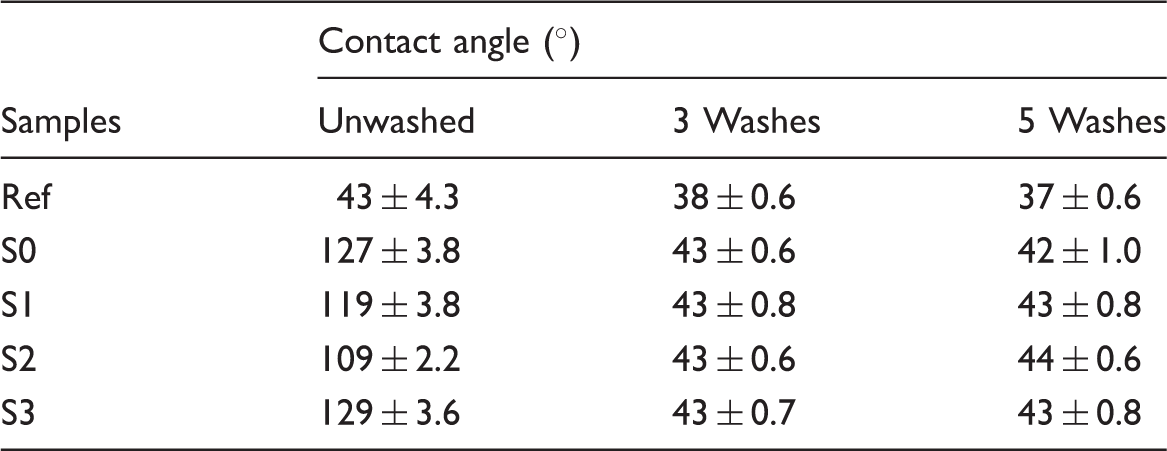
Wettability is one of the important parameters which affects the viability of the probiotic bacteria on coated fabrics. With increasing wettability, the comfort of the fabrics and viability of the probiotics increase. In order to determine the wettability of the coated and washed samples, Attension Theta (Biolin Scientific AB) optical tensiometer equipped with a high-speed camera was used to measure the contact angle of water on the sample surface along with the speed of absorption following ASTM D7334-08 standards. The mean value (five observations for each sample) of the static contact angle for the duration of the standing water on sample surfaces was measured with sessile drop of volume approximately 2.5–3.0 μl.
Tensile strength test
In order to investigate the applicability and strength of the coated fabrics, their tensile properties were measured according to ISO 13934/1 standard. For this purpose, five dry test specimens from both warp and weft direction of each samples were tested at a pretension of 2 N having width of 50 mm (excluding any fringe) and a gauge length of 200 mm on a semi-automatic electronic strength tester, Tensolab (Mesdan S.p.A). The rate of elongation and rate of extension were maintained to be 50% per minute and 100 mm per minute, respectively. The tensile tests of each sample were repeated five times and results were evaluated statistically.
Abrasion resistance test
Abrasion resistance is important to determine the performance of the obtained fabrics. Martindale abrader (SDL Atlas) was used to determine the abrasion resistance of the dry-coated surfaced of the prepared samples against a wool abrader fabric following ISO 5470-2 standard. A force of 9 kN was applied for testing of each sample. At prescribed number of revolution cycles, specimens were removed temporarily to inspect any damage and compared against piece of same material to rate the observed alteration under bright lighting condition.
Results and discussion
Surface wettability
Surface wettability results of the samples.
Weight loss of the samples after repeated washes.

Viability and effect of washing
The success of the embedding process of probiotic spores in sol–gel coating is highly related to viability of probiotic bacteria on coated fabrics. It is very important to obtain higher bacterial growth when the proper conditions were obtained. Viability of the probiotics was determined with 3 M™ Petrifilm™ Aerobic Count (AC) plates. After 48 h and 72-h incubation, the petri films in (Figure 2) were observed and probiotic bacteria colonies were clearly seen as red dots on the samples.
Bacterial growth on the samples.
The density of colonies appeared on the Petri films varies according to the washing cycles. Unwashed specimens of all three samples show the lowest colonisation which may occur due to the hydrophobic nature of the coated surface, and thus less solubilisation of the indicator gel layer and less contact with the embedded probiotic spores. Hydrophobicity of these samples can be reduced through partial curing and through a study on the effect of curing time–temperature upon the surface wettability. However, inactivity of the probiotics on the fabric surface could not be concluded from the appearance of these low numbers of dots and indeed upon further washing of the surfaces, the numbers of colonised dots are seen to be increased to a greater extent. It is evident that with the increase of washing cycles, the amount of hydrophobic substances on the outer surface of the coated layer reduced (Figure 2) thus enabling more number of probiotic spores to come in contact with the Petri film and showing higher growth. As shown in Table 3, the weight loss results confirmed the reduction of the coated layers.
When compared between the two types of probiotic spores used with the same amount (2.5 mL), Innu Science sample (S2) showed higher number of bacteria grown than for Tana® Biotic DC sample (S1). However, for the samples coated with same probiotics type with differing amounts, the number of growth colonies is not significantly different for the amounts (S2 and S3) as much as 10 times (2.5 mL and 25 mL). Therefore, a suitably smaller amount of probiotics can be used with similar effectiveness. With the increased number of washing cycles, the colonies appear to become smaller in size but more spread over the surface and hence can be interpreted as their uniformity and activeness even after a required number of washing cycles. Besides that, Ciera et al. [16] search on the viability of beneficial spores in the fibres which were produced by melt spinning process and obtained similar viability results. As a concluding remark, both types of probiotics studied here are sustainable to withstand prolonged processing time during sol–gel coating, exposure to high temperature during curing process as well as durable to repeated washing; therefore it is suitable to be manufactured as a protective coating on hospital textiles.
Tensile properties
Mechanical properties of the samples.

Here it is evident that the change of elongation at maximum force values between uncoated reference and coated samples is not significant (p > 0.05) for both fabric directions, whereas the values of maximum force exerted to facilitate elongation show significant increase (p < 0.05) in the weft direction of the samples. On the other hand, few coated samples require insignificantly (p > 0.05) lower force at breakage in warp direction when compared to untreated reference sample. Overall, it can be concluded that the coating, padding, probiotic addition, and any subsequent processes of this sol–gel technique have no significant effect on the tensile properties of the obtained samples.
Abrasion resistance
Abrasion resistance results of the samples.

Conclusion
Among various application fields, sol–gel technology is gaining attention for textile applications due to a number of reasons such as ease of processing and universality. However, the knowledge of integrating living organisms such as probiotic spores in textiles using this technology is very limited. In the present study, the incorporation of probiotic spores in polyester woven fabric surface using sol–gel dip coating method was investigated. The growth of adequate amount of living bacteria was found on the coated textiles even after a long period of coating and thus realised to be used in healthcare environments to combat the pathogens. By varying the thermal treatment parameters, the same coating process could be used for strong embedment of the probiotics on the fabric surface as well as possibilities to attach loosely and thus could be released to create an appropriate inhibition environment. Whereas the coated fabric exhibits satisfactory tensile and abrasion resistance properties, the challenge remains to make the surface softer and hydrophilic without compromising the adhesion of the coated gel and probiotic spores to the fabric surface. In the future study, competitive exclusion analysis against pathogens including Staphylococcus aureus, Escherichia coli and Klebsiella pseudomonas will be focused to determine their potential to combat these nosocomial pathogens.
Footnotes
Author's note
Aysin Dural-Erem is the corresponding and the primary author for this article.
Acknowledgements
The research is performed in the framework of the I-Tex project (Intelligent Användning Av Innovativa Textilier för en friskare patient nära sjukhusmiljö / intelligent use of innovative textiles for a healthier hospital environment). The authors would like to acknowledge Per Wessman (SP Technical Research Institute of Sweden, Chemistry, Materials and Surfaces) Steve Teasdele (from Innu Science Canada) Birgitta Bergström (SP Technical Research Institute of Sweden, Bioscience and Food), Ulrika Husmark and Carolyn Berland (SCA Hygiene products AB) for sharing insights on potential and requirements while developing spore containing coatings and testing the viability of beneficial bacteria.
Declaration of Conflicting Interests
The author(s) declared no potential conflicts of interest with respect to the research, authorship, and/or publication of this article.
Funding
The author(s) disclosed receipt of the following financial support for the research, authorship, and/or publication of this article: I-Tex project is supported by a grant of Vinnova (2014-00719).