




Abstract
Urban theorists and observers have pointed towards a persistent if elusive character of incompleteness within cities. This paper responds to these ideas both theoretically and visually. Building on a definition of incompleteness as encompassing a perceptual absence or missing, the paper addresses a gap in theoretical understanding of how incompleteness can be critically understood and depicted as a temporal urban process. The focus goes beyond a singular state or built quality towards continuums of re-construction, fragmentation and re-imagination. These notions inform a practice-driven interrogation of incompleteness in graphic terms. The case study is a five decade microhistory of ongoing change in a central city block in Sydney, Australia. An approach to analytical and speculative drawing is presented to enable a conceptual and analytical investigation of incompleteness as a regenerative process of city-making.
Keywords
Introduction
The compelling if somewhat elusive notion of ‘incompleteness’ presents a distinctive framework to understand complex social urban systems with a focus on their temporal and shifting plurality (Chatterton, 2010; Hirayama, 2003; Sassen, 2017b; Simone, 2016). Incompleteness differs from mainstream perceptions of architecturally delineated development processes as autonomous, measurable and finalized (Frampton, 1991; Hillier, 2007; Jones, 2009). Sassen (2014, 2017a, 2017b) has advanced incompleteness as the right to choose an uncertain future and to build new histories, particularly for those without power. This paper refines this definitionally into delineating a perceptual ‘absence’ or ‘missing’. It draws on Chatterton’s (2010: 236) interpretation of a phenomenon where ‘untold other paths’ may be sited. Conceptually these paths represent ‘subterranean conditions that need to be brought aboveground’ (Sassen, 2014: 222). Innovative visualization techniques are advanced to describe and understand incompleteness as an historical condition for framing and depicting processes of ongoing incremental urban change.
Three main concepts are used to explore these ideas. The first and most fundamental is ‘re-construction’, denoting not only the endless physical transformation of the city that provides both the dynamic backdrop and detailed churn of development but also the ideological underpinnings of the drivers of change. The second, ‘fragmentation’ of material space, originates from Lefebvre (1991), Vidler (2002) and McFarlane (2018, 2021) and propels us toward a finer-grained appreciation of urban space. The third idea of ‘re-imaginaries’ encounters changing perceptions of the urban environment in drawing from the literature on urban imaginaries and time-geography (Corboz, 1983; Leurs and Georgiou, 2016; Lindner and Meissner, 2019; Pred, 1984). These concepts are linked through a practice-based visualization method to capture how incompleteness can be distinguished as an innate urban process embedded in material and morphological change in land use and architecture. The focus is on the flux of time-based micro-occupancy. The central research question is how can a built environment of incompleteness be critically depicted and better understood as a temporal urban process?
The paper has four major sections. First, relevant theoretical literature on city incompleteness is reviewed to position the innovative visualization approach adopted. The discussion is structured around the interweaving of the three conceptual threads identified above. Second, practice-based methods are elaborated, detailing the investigative making of speculative diagrammatic images drawing on graphic and comic techniques. Third, these are applied to a case-study site in the central business district (CBD) of Sydney, Australia from the 1960s to 2020. Fourth, the findings are presented and reviewed through several different graphical modes. The paper’s conclusions propose that microhistory and graphic practice of the kind experimented with here can provide innovative representations of and insights into city incompleteness.
Theory
A continuum of re-construction
The literature on city incompletion is linked to broader urban research on informality and participation (Miessen, 2010; Neuwirth, 2005; Sassen, 2017a) and wider themes of social justice and autonomy (Certeau, 1984; Frichot et al., 2016; Harvey, 2012). The concept has been invoked to describe cities in times of duress with abandoned homes, zombie subdivisions, empty commercial sites and industrial decay (Stoner, 2012). Hirayama’s (2003) Incomplete Cities is an early invoking of incompleteness through an examination of events in Kobe after the 1995 earthquake: In any experience of ‘destruction/construction’, the question arises: how are the myriad views voiced in the ‘space of competition’ to be respected? As long as, and precisely because, the city is incomplete, emphasis on any particular direction calls forth dissent and challenges; that in turn opens up new possibilities (Hirayama, 2003: 3).
Hirayama (2003) introduces the idea that a materially and temporally bound site shaped by extra-physical processes is generative of new directions. This state of incompleteness has been written about by Sassen (2009, 2016, 2017a, 2017b) as ongoing, ubiquitous and critical. This is a reorientation of discussion from cities as being in totalizing or singular states of disaster, downturn or division towards a continual process of re-construction. Relating Hiriyama’s observations with Sassen’s continuum of incompleteness requires a temporal view. Even if there is not the physical vacating, emptying or destruction of a site, there remains a persistent malleability – a perception – of possible untold future directions.
Malleable incompleteness (Jose Zapata Campos et al., 2023: 138) is complex idea, and one that Sassen has widely focused on as leaving an ‘historic trace’ within a built continuum, albeit in dense urban settings also ‘threatened by the surge in large-scale corporate redevelopment and privatizing of urban space’ (Sassen, 2017b: 125). Large-scale projects of urban renewal may form an antithetical ‘completeness’ but are not necessarily definitive end-products in themselves. Chatterton (2010) highlights shifting and conflicting extra-physical forces that come into play enabling more participatory outcomes. His critique fixes on the erosion of egalitarian power relations and the ‘right to the city’ (Brenner et al., 2009; Harvey, 2008; Mitchell, 2003), with a focus on the ‘urban possible’: Cities are unfinished stories, and anyone who claims a right to the city has to move with this dynamic. If we inject a sense of movement and possibility into our analyses we begin to explore what ideas, social forces, class alliances and interventions actively make and remake the city. When we do this we begin to see the city not just as a static noun, but as an active verb (Chatterton, 2010: 235).
Within this framing, the ongoing re-imagining and material re-construction of space marks incompleteness as a process actively shaped by participation in urban change. A call for new research approaches is at the centre of this: What are not considered are the untold other paths which could have been explored… what if we want neither dereliction nor gentrification, but the right to determine our own cities, to intervene in their governance, their spaces, factories, lofts and old industrial spaces (Chatterton, 2010: 236).
While Chatterton’s observations are not focused on a typological reduction of incompleteness, the temporal implications of a process of intervention into existing spaces echoes Sassen’s (2009, 2016) use of Solà-Morales' (1995) concept of the ‘terrain vague’ as a typological remnant of incompleteness within industrial abandonment. As a perceptual ‘missing’ (Deacon, 2011: p. 328), similar to Hirayama’s observations of incompleteness in sites of destruction, a terrain vague is similarly marked by temporal disjuncture of ‘underutilized or abandoned space that lies forgotten among massive structures and construction projects’ (Sassen 2016: p. 138). This perception of missing or absence addresses the central idea of incompleteness in this paper in denoting even vacant spaces as parts of an evolving whole and in their own right ‘full of past events [and] identity marks’ (Mendes, 2013: 529).
Guma (2020: 734) interpretation of incompleteness also relates to an ongoing state and ever-present ‘potency’ of city sites in constant shifting, mutating and enduring states that are ‘always subject to temporality’. He conceptualizes an ‘incompleteness infrastructure’ that is both intentionally and unintentionally deployed and embedded within city sites. Three fundamental capacities of city sites to form ‘continuity’, ‘transiency’ and ‘contingency’ give an elemental continuity to incompleteness, as each quality builds on previous temporal states. Also drawing on Simone (2016), Jose Zapata Campos et al. (2023) develop a tripartite model of incompleteness as an ‘infrastructural feature’ allowing adaptation, an ‘organisational strategy to keep communities illegible and invisible’, and a ‘representation … contingent on imaginaries of values, beliefs and positionality’ (Jose Zapata Campos et al., 2023: 131).
These research perspectives on incompleteness as a re-constructive continuum all highlight interdependencies between the materiality, temporality and imagabiliy of urban space. This is developed next through the granular composition of the built environment.
A continuum of city fragmentation
The concept of fragmentation has been extensively explored by theorists in relation to the way cities change over time (Lefebvre, 1991; McFarlane, 2018, 2021; Tursić, 2019; Vidler, 2002). For Lefebvre, fragmentation is an abstraction of space through economic instruments of exclusion (Lefebvre, 1991). A multiplicity of meaning generated by intersecting ideas of what a city site is or was ‘fragments’ it into multiple virtual meanings (Lefebvre, 1991). McFarlane (2018: 1008) emphasizes that global urbanization proceeds not in spite of fragmentation but through it. He identifies fragmentation as a ‘generative’ force wherein the residuals of everyday life continuously reshape cities. Fragmentation embodies ‘fragments of things, lives, and spaces’ (McFarlane, 2021: xii) presenting both material and social connections.
Fragmentation may be understood to capture the inherent tension between what was and what could be as a perceptual absence or missing (Deacon and Cashman, 2016: p. 328). Fragments are ‘incomplete pieces of a potentially complete whole’ that point toward a future ‘world of harmony’ yet remain suspended between what they represent and the ‘utopia’ they promise (Vidler, 2002: 150). These fragments are ultimately bound by their incompleteness, caught between material realities and the re-idealized futures they gesture toward: Objects, rooms, buildings, areas of a city became so many fragments at different scales, incomplete ‘types’ conveying all the force of a dream to be fulfilled, a space to be occupied, a life to be lived (Vidler, 2002: 151).
In contrast Beauregard and Haila (1997: 327-328) write about cities within the contemporary era of globalization as ‘fragmented, partitioned and precarious’ and as ‘hollowing’ out precarious sites of production for the proliferation of new landscapes of consumption. Incompleteness from this perspective arises out of ‘novel social, economic, and political arrangements but [also] the interaction of the old and the new [and] the enduring and the emerging’ resulting in an ‘unavoidable’ incompleteness of cities (Beauregard and Haila, 1997: 339). In this context, fragmentation as an underlying process of city incompleteness links to Lefebvre's (1991: 174) cities as a continuum ‘split and divided, as a realm of merely virtual or deferred tensions and contacts … as a medium of far-off possibilities, as the locus of potentiality’.
McFarlane (2018) further argues that fragments can challenge or reshape the very processes that fragments themselves are formed by and thus should be seen as ‘verbs’ in constant transformation. McFarlane’s (2018) perspectives are much like Chatterton's (2010: 235) ideas about city incompleteness as an ‘active verb’ where the fragments are manifested through competing ideas of what a city site is for, and the unresolved ‘utopic imagining’ of a wider, virtual and imagined totality (Vidler, 2002: 150).
A continuum of re-imaginaries
From an outsider’s perspective (Sassen, 2009: 228) the fragments referred to above may be seen as a process of re-imagining, where re-idealized meaning delaminates and makes a site malleable for re-making. The concept of ‘urban imaginaries’ has generated a considerable literature on how urban space is ‘simultaneously material, conceptual, experienced, and practiced’ (Lindner and Meissner, 2019: 2). The idea of urban imaginaries extends the physicality of a site and its fixed spatial coordinates into other virtual realms of perception and intersubjective meaning. Within these sites of parallel reforming, a malleability of place can be used to ‘build solidarities’, ‘sustain intercultural communication’, and generate ‘support networks’ (Leurs and Georgiou, 2016: 3704). In this way, meaning is detached from its site and re-imagined.
For Leurs and Georgiou (2016: 3704), urban imaginaries inform ‘collective, discursively constructed processes that involve mental mappings of city spaces as sites of opportunity or exclusion’. They also extend from the time-geography concept of ‘there is no land without imagining a land’ (Corboz, 1983: 18). Pred (1984: 286) describes an intersubjective mental apparatus characterized ‘by a repeated dialectical interplay between corporeal actions and mental activities and intentions, between what one does and what one knows, thinks, and dreams’. Chatterton (2010: 236) similarly refers to the idea of imbuing imagination to transmute the urban ‘possible’ into the ‘impossible’, in which ‘the seeds of countless possible urban futures’ are shaped and laid by social forces inside and outside the dominant power structures.
The rise of ‘transclaves’ evidences these ideas, wherein spaces of commodified ethnicity are created at the intersection of political, economic, and sociocultural forces ranging upward to the global level (Kim, 2018). Georgiou (2006) argues that ‘mediated spatialities’ hybridize urban sites with appropriated digital communication technologies to form ever-changing urban constructs. A reforming of the site within these virtually connected realms opens up possibilities for reconstituting ‘hybrid cultures, identities and alternative scenarios for inclusion and participation [which] emerge, next to others of exclusion, discrimination and racism’ (Georgiou, 2006: 120).
Literature review insights
The literature on city incompleteness is challenging but this brief review reveals understandings which inform the methodological investigation which follows. First, a continuum of re-construction in a materially and temporally bound site is always under incomplete conditions which can be generative of untold new directions. Second, tensions of incompleteness arise from the projection of competing ‘utopic imagining’ onto the assemblage of site fragments (Vidler, 2002). Third, the concept of urban imaginaries frames these processes as collective and discursively constructed. There are repeated dialectical interplays between corporeal encounters and mental mappings, shaping sites of opportunity or exclusion, and infusing new convergences into the remaking of city sites over time. Conceptually understanding incompleteness along these temporal lines of parallel continuums of re-construction, fragmentation and re-imagination requires methodological tools to depict incompleteness as a temporal urban process.
Method
Experimental inquiry by practice is the approach adopted here to address the main research question of what visual approach might best serve the portrayal of incompleteness (Hensel, 2012). The methods adopted represent a novel cross-disciplinary approach through (1) the assembly of site microhistory emerging from empirical and archival study of occupancy over time paired with fieldwork, and (2) the making of analytical, architectural, diagrammatic and speculative drawings merging with graphic novel and comic techniques. Contributions by speculative graphic practice, diagramming and microhistory in examining incompleteness as a temporal process within cities are briefly described below and elaborated in greater detail in the online Supplementary Material accompanying this paper.
Graphic practice
The focus on the city in states of incompleteness is an undercurrent within speculative graphic practice. To a large degree attention has been hinged on moments in time that reveal an embedded plurality to the production of cities (Bruno et al., 2015; Price, 1964; Woods, 1992) or the temporal dimensions of city-making through memory and meaning (Lim, 2017). Practice-based researchers have focused on urban abandonment or destruction, such as the graphic sectional re-construction of the Kowloon Walled City by Kani (1997) or Lim’s (2017) axonometric re-envisaging of London in continual state of preparedness for flooding due to catastrophic sea level rise. Other depictions of transition, such as MOTOElastico’s Borrowed City, construct visualizations where themes of construction and deconstruction are applied in 24-h cycles (Bruno et al., 2015).
Contributions from art practice have challenged textual thinking about cities. Graphic approaches and visual narrative have been a provocation to conventions in urban design and planning (Carmona, 2014). They have increasingly become a focus in urban theorizing, assisting the exploration of ‘transmission’ and ‘plurality’ (Crang, 2000) and ‘formal and cultural boundaries’ (Labio, 2015) between the ‘epistemological’ and the ‘real’ (Nunes, 1999).
Theoretical conceptualizations of diagrams (Dortdivanlioglu, 2018) highlight procedural potency as ‘thinking tools’ (Frichot et al., 2016: 6). A diagram has two ‘functions’ – the analytical, scientific or explanatory (Kwinter, 2010) and the less definable performative and illocutionary, giving insights ‘from the braided intelligences of beings, emotions and desires all tangled with lines of reason’ (van Schaik, 2010: 110). In this context, drawings are not simply illustrations. They are instrumentalized in an experimental and generative process of drawing lines ‘to harness [complexity] in all its possibilities in order to better grasp the “in–between” dimensions of reality’ (De Landa, 2000: 34).
A generative method is used for capturing ‘essences’ or ‘wisps’ of critical thinking. Through this, drawings operate as a form of mental sketching that begins with the more speculative elements assembled within the works and then cumulatively points towards processes of ‘filling in’ with analytical inputs to identify the key propositions. The process thus oscillates between the making of drawings and their reflexive analysis. The drawings themselves are dense and complex to capture the rich but rewarding detail demanding to be processed even in small urban spaces bounded in space and time.
Microhistory, archives and case-study engagement
The case study which follows applies these methods to a single urban site intended to reveal the ‘codes, forces and processes’ that have instrumentally shaped, re-imagined and re-constructed it (Stieber, 1999: 383). The research began with microhistorical study of the case-study site. Peltonen (2014: 106) describes microhistory as a framing of temporality within a disciplinary practice of historiography, based on ‘strange detail’ that reveals a ‘wider totality’, echoing literature on fragmentation. Methodologically, microhistories reveal ‘larger patterns of cultural production’ through the ‘study of individual experience’ (Stieber, 1999: 383). Microhistory enables interpretations of ‘cultural form’ to reveal a ‘richness of relationships … over the simplicity achieved by systems or abstractions’ (Stieber, 1999: 383).
This research draws from a wider base of archival materials, which themselves are not uncontested but are reflective of ‘distortions, omissions, erasures, and silences… [because] not every story is told’ (Carter, 2006: 216). Each artifact, webpage, or document assembled may be understood as containing traces of situated fragmentary microhistorical evidence for mapping in new ways the continual evolution and incompleteness of a place. An original practice of drawing and diagramming was thus devised to compose certain microhistory framings of an ‘untold other path’ (Chatterton 2010, 236) into wider temporal and visualized interpretations.
Case study
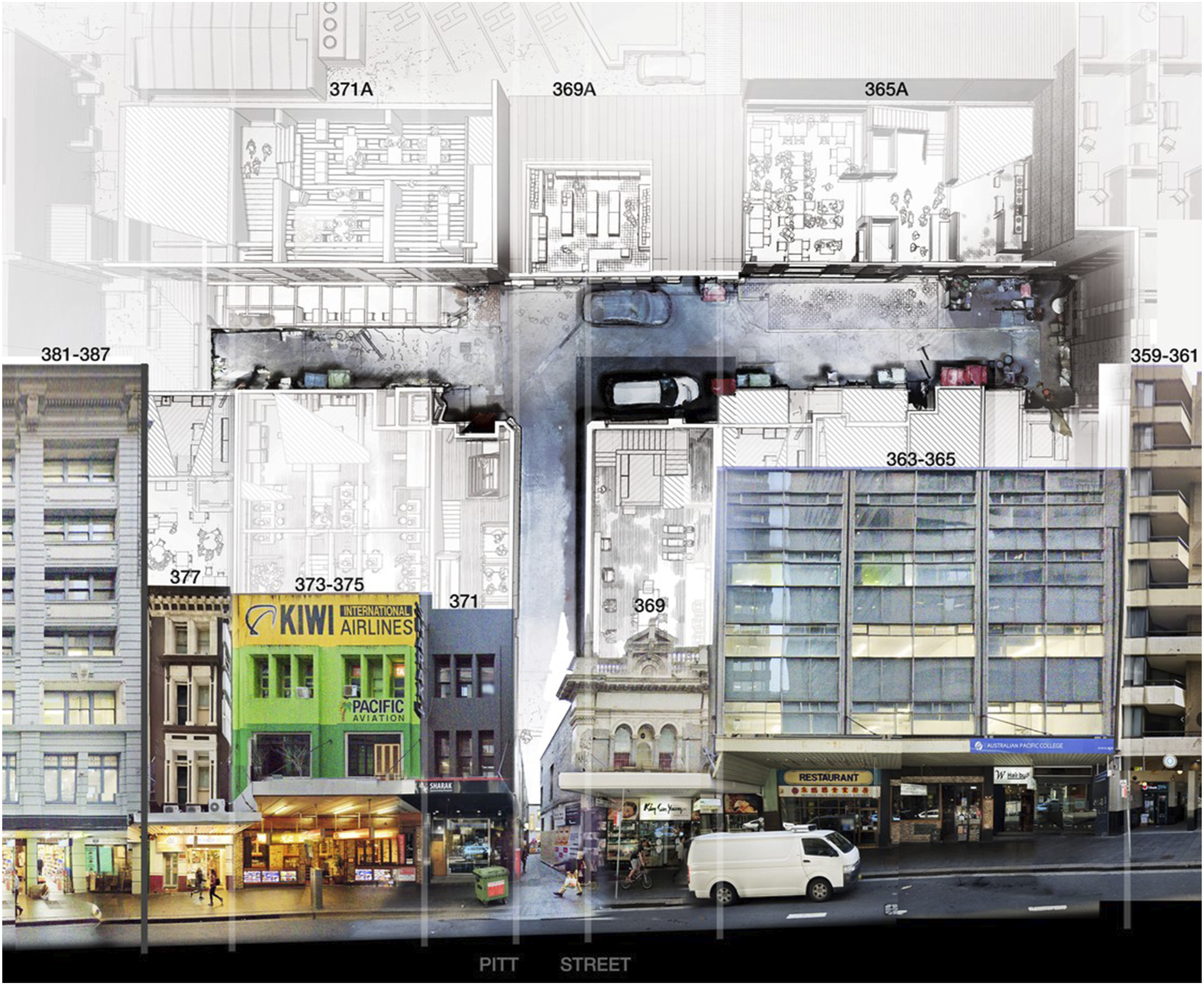
The case-study site chosen in central Sydney, the state capital of New South Wales, Australia is located on the western side of Pitt Street between Liverpool and Central Streets (Figure 1). Beyond the western side of the site is George Street, historically, the high street of central Sydney (Edwards, 1978). Adjacent immediately to the west, the Central Local Courts and their curtilage is an institution of colonial origins dating from the 1890s. To its north is the now-vacant Sydney Central Police Station and attached barracks of similar vintage, with additions through to the 1950s. The courthouse, police station and barracks split the block into two higher density urban forms to the east and west. Figure 2 in composite shows the Pitt Street frontage and adjoining T-junction laneway behind in plan, providing access to rear warehouses. Plan of the case-study site in the southern part of the Sydney CBD. A site streetscape of composite images with photogrammetry surveying of a back alley and overlaid sketched interiors of site buildings.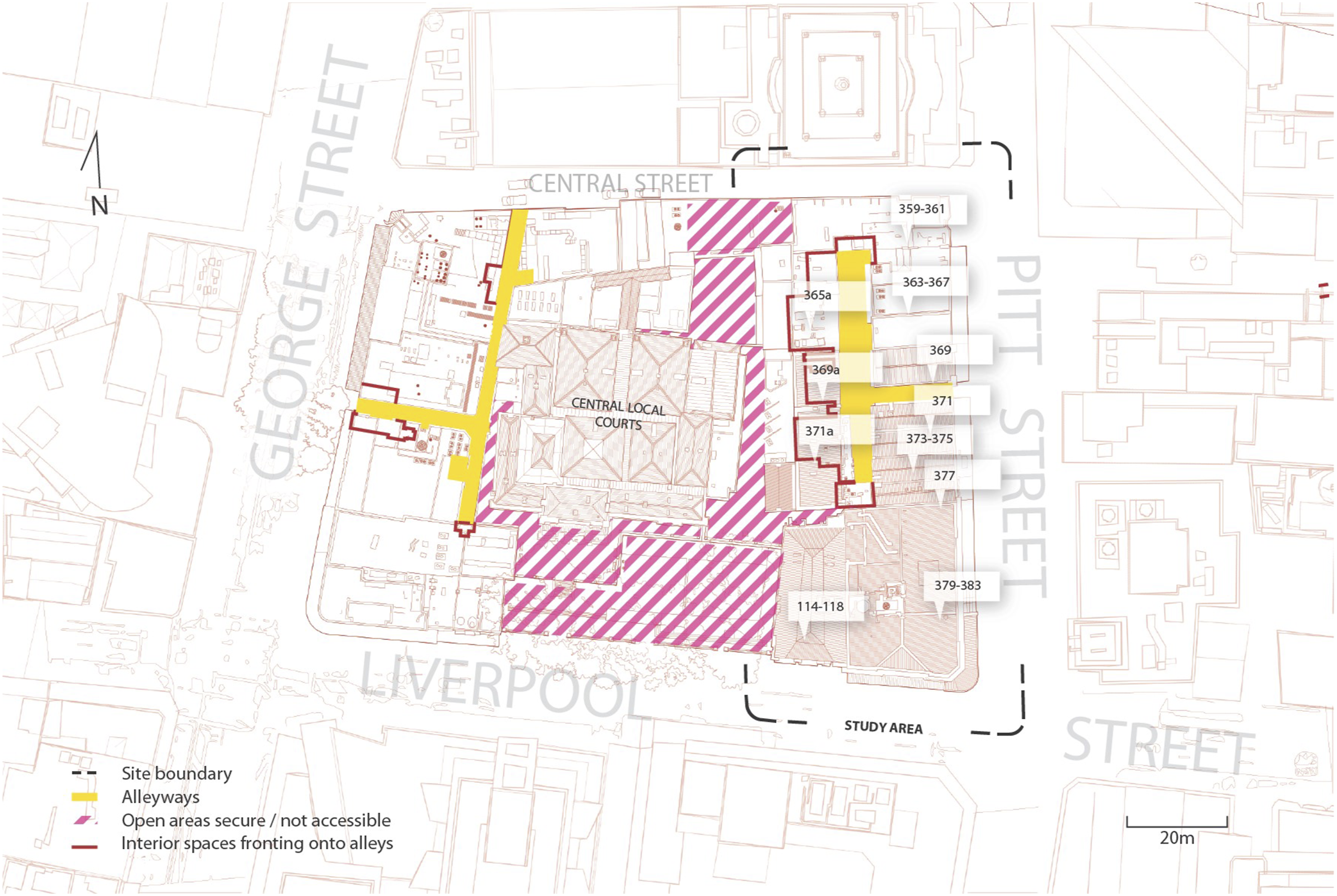
The site was chosen for several reasons. First, a central consideration for the selecting of a case-study location in Sydney was its possibility to identify ‘untold other paths’ as a key quality and context to incompleteness (Chatterton, 2010: p. 236). Second, it had the requisite complexity and evidence of incremental re-construction, morphological fragmentation and perceptual re-imagination over an extended period to enable a critical design-led investigation of incompleteness. Third, it is representative of a precinctual type: mixed-use trans-generational CBD blocks with evidence of adaptive reuse located on the edge of the more prestigious vertiginous city core (Lippmann, 2019). Fourth, it is set for major redevelopment with a large hotel planned on the footprints of 371-373, 371A and 375 Pitt Street constituting a significant departure from its historic development path of incremental change.
A fifth and final reason was the prospect of good documentation of the dynamics of economic, social and physical change from multiple sources including local government development applications, weblogs, print media, journals, commercial directories, the Wayback Machine Internet Archive, and on-the-ground surveying. The archives researched represented important framings of the ‘big stories’ (Simone, 2016: 157) of abstracted and fragmented development processes through city planning documentation, architectural plans, building exterior and interior photographs, and scrawled onsite construction meeting notes. For analytical manageability, the core focus of the research was an investigation of a key period for late post-war change in the CBD from 1965 to 2020.
Findings
The findings reveal and record distinct phases of land use and occupation over time, discussed below. Visualization distils complex and ongoing multi-dimensional change into layered, interconnected forms, illustrating continuums of urban transformations.
Land-use phases
Figure 3 unfolds the process of incomplete change in space and time over five decades of occupancy through a patterned array. Black and white floor plans are exploded in axonometric and coloured diagrammatic elements – yellow arrows indicating continued occupancy, black hatched fills indicate vacancies in time, and red hatched fills denote an omission of records from archive searches. The extent to which a building or floor was occupied is also indicated via graphic ‘signposts’ featuring the associated name and date range. Site-wide floor plan cuts form along a zig-zag and explode upwards showing each floor-level. A patterning is formed where incrementalized analogous ‘core’ samples are drawn every 5 years, situated at each zig or zag cornering and representing the passing of 5 year increments. The image can be viewed as a complete temporal and abstracted urbanscape or zoomed in and viewed for single buildings. A highly fragmented and clustered investigative drawing depicting a developed ‘temporal urbanscape’. Five-year increments of axonometric building floor plans were exploded spatially upwards from the basement levels to upper floors (bottom to top) and though time (left to right).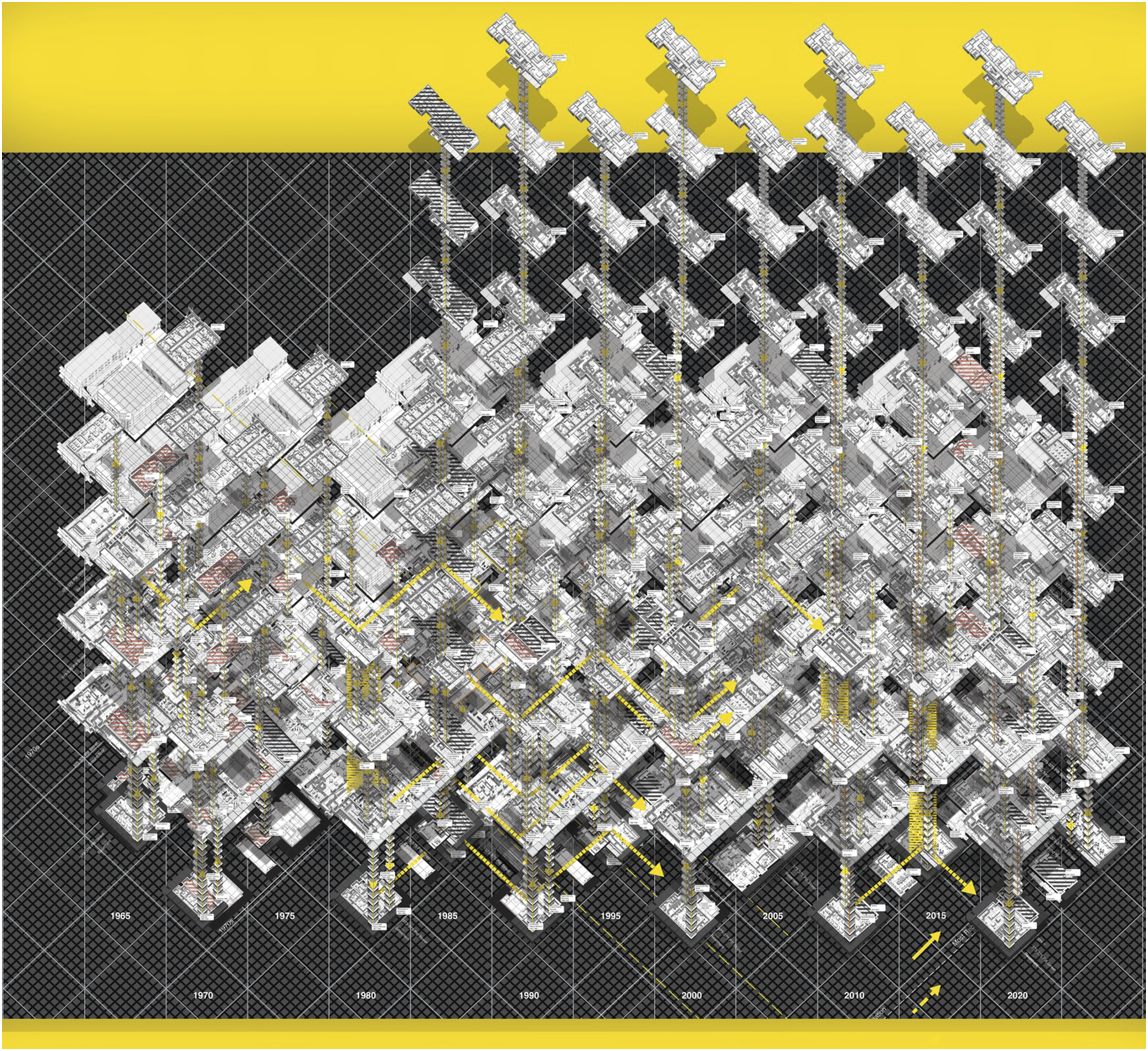
The density of information and complexity of Figure 3 represents a culmination of archival research needed to construct a continuous diagram of occupancy. It represents the ‘ground’ as a preliminary step in the making of further figure-ground diagrammatic work (Figure 5). However in realizing this, additional analytical and graphic exploration was undertaken (Figures 4 and 6) to further examine the evolution of the precinct. A timeline of occupation from 1965 to 2020.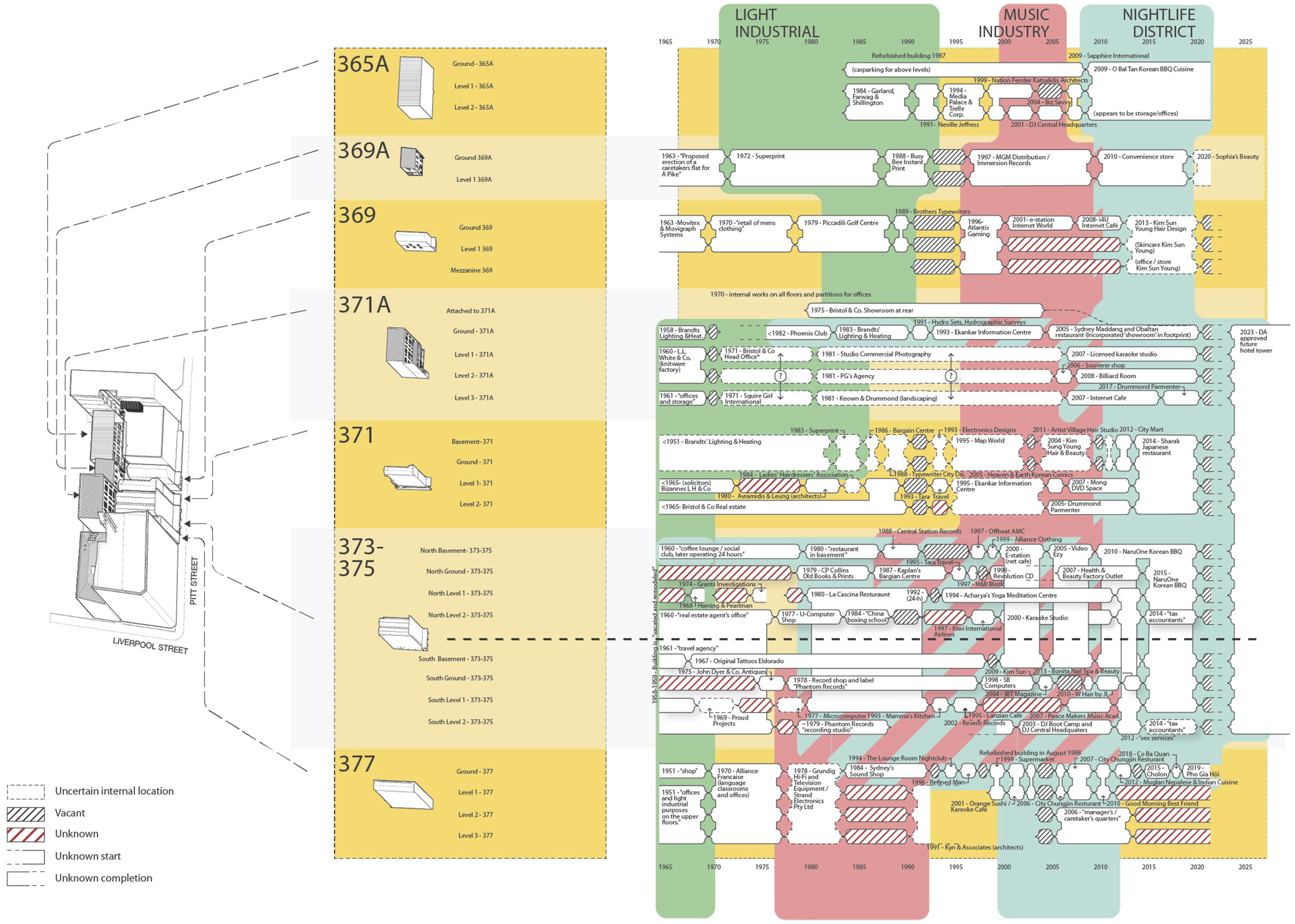
Figure 4 diagrams three distinct but overlapping phases of land-use dominance from ‘Light Industrial’ (1960s-1992) through ‘Music Industry’ (1978-2012) to ‘Nightlife District’ (1960s-current). The timeline begins with an inheritance of light industrial occupation, the first major transitional land use within the study period. Even though the City of Sydney lacked both strategic and comprehensive statutory plans until the early 1970s (Freestone and Baker, 2025), the early inclination was to phase out industrial uses. Guidance was afforded by the Cumberland County Council (1948), a state government body responsible for preparing and overseeing the implementation of metropolitan Sydney’s first planning scheme. The aim was to disassociate the ‘county centre’ from industrial uses: Despite its size and importance, the City as a Centre lacks the importance and dignity that should accompany it… numerous small industries, principally clothing and printing, are located in what appear to be office buildings… The clearing away of such intrusions as the result of planning will therefore not cause the City’s importance to recede, but rather will it advance the City’s interests (Cumberland County Council, 1948: 31).
Several applications for dry cleaners were refused in the 1960s as an undesirable form of development. These decisions serendipitously aligned with the incursion of cultural activities attracted by the relatively central but affordable location. Already known for its cluster of secondhand record shops (Berry, 2012), a dominant land use phase emerged based around music businesses from the late 1970s. The co-location of record shops, labels, distribution and recording studios embedded re-imagined meanings that coalesced, reinforced and built upon themselves.
The beginnings of nightlife activity within the study site also coincided with the arrival of independent (‘indie’) music uses. La Cascina Restaurant (1980-1993) traded upstairs from a ground floor record shop and below a recording studio at 373-375 Pitt Street. As the phase of music industry related land use diminished along the Pitt Street boundary of the study site, the ground, first and second floors of a former warehouse at 371a Pitt Street were integral to the rise of a Korean quarter in the Sydney CBD with the establishment of a late night restaurant, Sydney Madang (2006-2021). Within a few years there were Korean hair salons and grocery stores along with karaoke studios (Savill, 2011). The formation of a transclave signed and promoted by the City of Sydney as Koreatown in 2022 cemented the transitionary shift from its music industry interlude.
A second temporal urbanscape drawing is representative of the intersection between all three land-use phases (Figure 5). The exploded floorplans of each building are clustered around a more restricted date range (1970-1995), where ‘paths’ as coloured bars or pipes link occupancies of shared land use. Culminating speculative and investigative graphic representation of an intersection point showing distinct yet overlapping dominance of land use phases. A continuum of change and occupancies is diagrammatically represented by interlinked coloured pipes from ‘Light Industrial’ in green (1960s-1992) through ‘Music Industry’ in pink (1978-2012) to ‘Nightlife District’ in blue (1960s-current).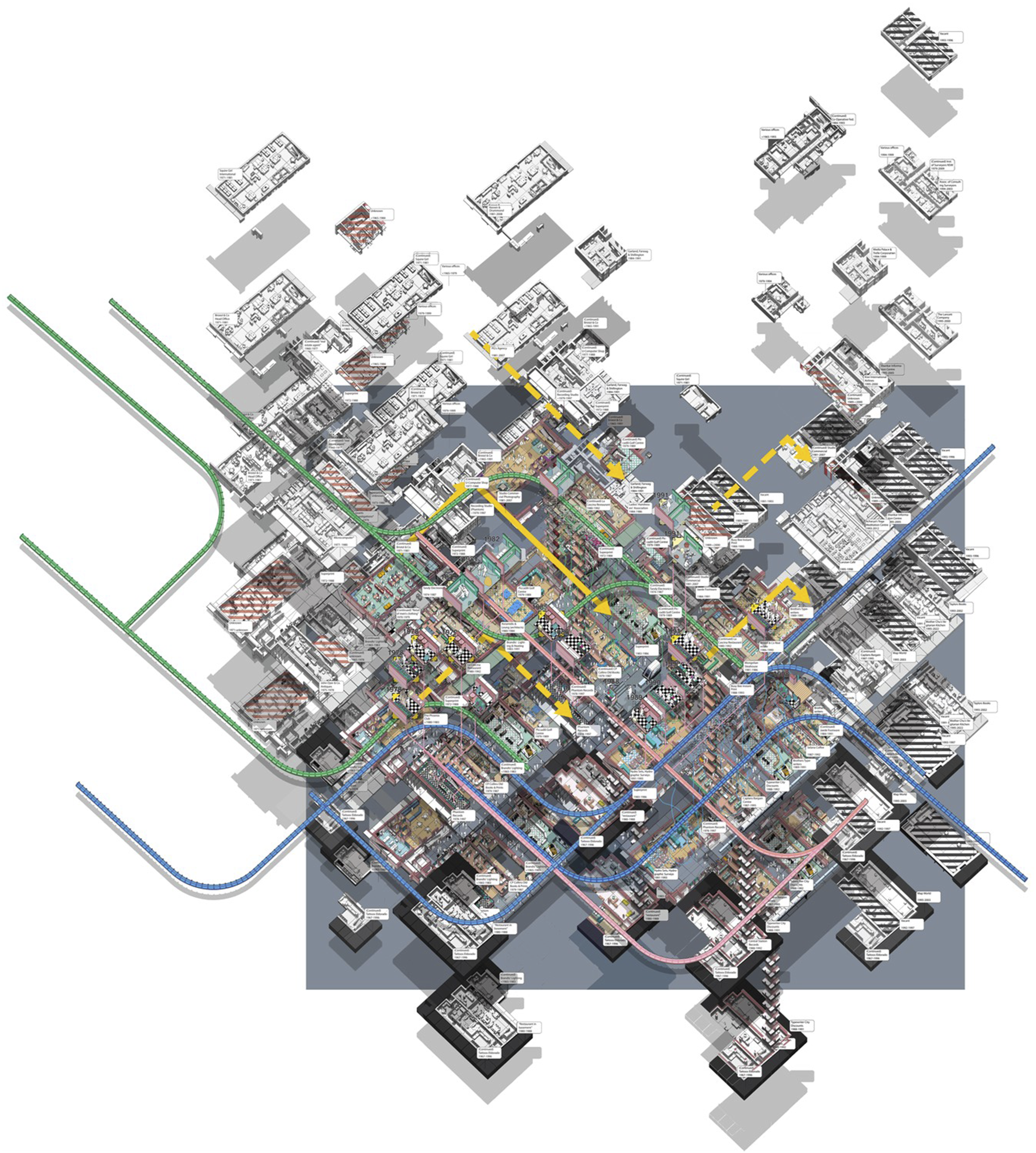
The music industry phase
The interpretation in Figure 6 concentrates on the Music Industry period which captures the agglomerative and sub-cultural forces at work in the rise (and fall) of an ephemeral creative precinct (Bell and Jayne, 2004). The drawing details this through the depiction of a taxonomy of spatial memory. This detailed composite drawing is central to the analysis of incompleteness showing a continuity of what Chatterton (2010) and McFarlane (2018) would term ‘active verb fragmentation’. Examining this phase when record shops, recording studios and record labels clustered together captures a collective re-imagining recorded by online text-based conversations, such as blog posts and related commentaries and print media ‘fanzines’, as well as music industry retrospectives. The importance of this phase to an emerging Sydney ‘inner city sound’ punk and indie-music scene is highlighted by music historian Clinton Walker (2005: 8). A graphically diagrammed taxonomy of ‘spatial memory’ in Phantom Records (1978-1997) at 365-367 Pitt Street featuring extracts of written text from Gardener (2011), Berry (2012), and Hulme (2021), with accompanying spatial imaginaries. To the right, these are located within the building’s ground floor record shop and second level recording studios.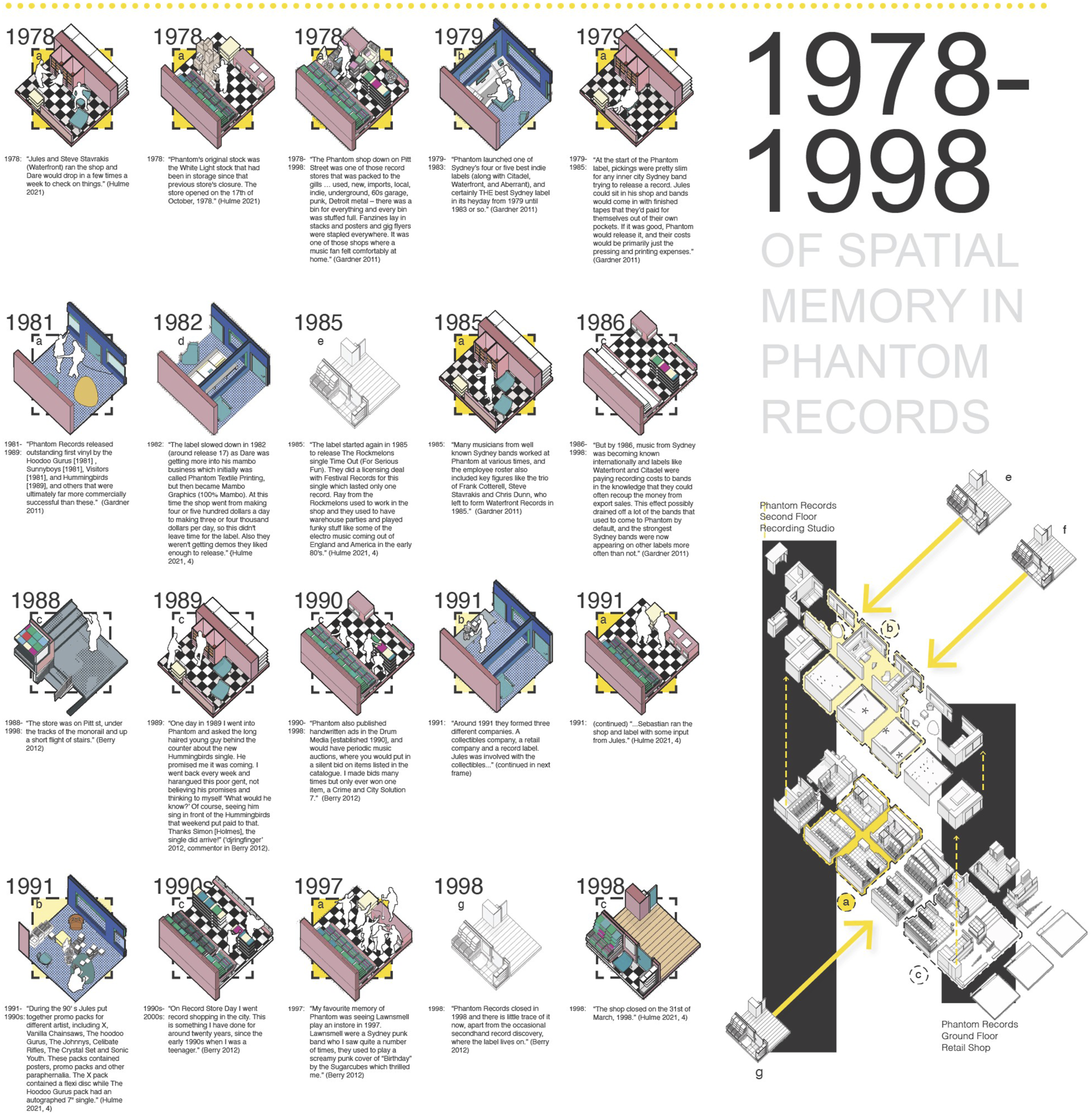
Figure 7 zooms in on a portion of Figure 5 as a base to the diagrammatic work, while adding colour, human figures and importantly, incorporating active verb fragments lifted from the spatial memories featured in the taxonomy of Figure 6. At this scale, the ‘lines of becoming’ of the inner city sound represented by the pink pipe (Music Industry) reveal how each memory fragment is diagrammatically connected within a broader spatio-temporal framework. A diagrammatic interpretation of a temporal urbanscape of incompleteness. The drawing maps spatial memories and meanings located within the relative fixity of externalized built fabric.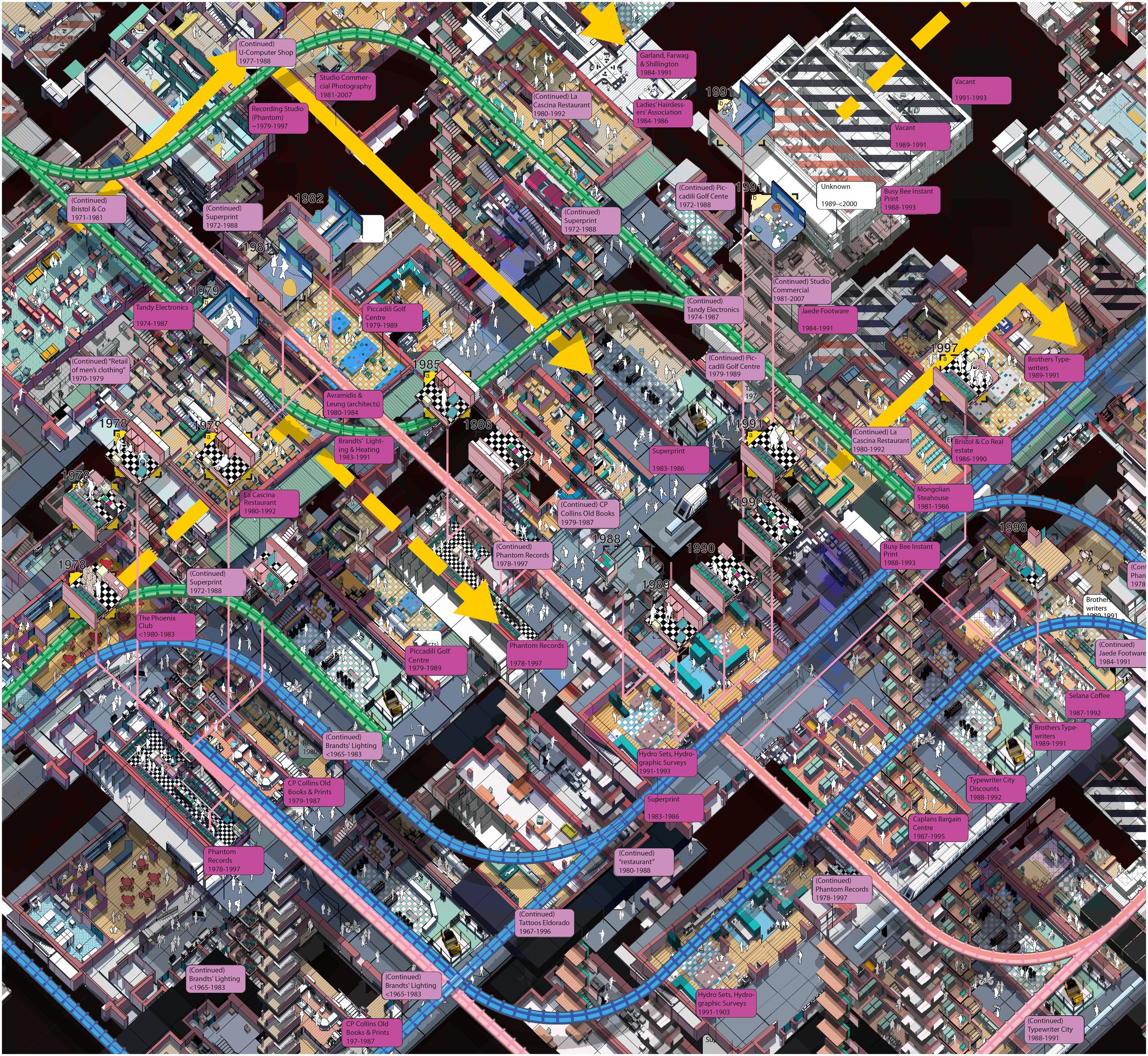
Phantom Records established by Dare Jennings in 1978 began as a record shop featuring local and imported punk and indie bands with much of the music being sourced in Los Angeles (Hulme, 2021). Phantom Records soon launched an accompanying record label in 1979, with recording studio additions in the upper floor of the building. Integral to the nascent inner city sound in Sydney, Phantom Records was described as ‘THE best Sydney label in its heyday’ (Berry, 2012). Importantly, the origins of Phantom Records were marked by a perceptual absence or missing around which participation formed: At the start of the Phantom label, pickings were pretty slim for any inner city Sydney band trying to release a record. Jules [Normington] could sit in his shop and bands would come in with finished tapes that they’d paid for themselves out of their own pockets. If it was good, Phantom would release it, and their costs would be primarily just the pressing and printing expenses (Gardener, 2011).
Surrounding the building were other independent music-related occupants. Ashwoods was a second hand record shop dating back to the 1930s (Berry, 2012). In addition to the arrival of Phantom Records in 1978 came Sydney’s Sound Shop (1984-1993), Central Station Records (1988-1992), MGM Distribution (1997-2010), and Velvet Sound Recording Studios (1997-2009).
Phantom Records comprised a shop on the ground floor and recording studio shared with ‘merchandising/collectables’ on level 2 (Hulme, 2021). Phantom Records emerges and shifts in its own internal spatial re-imaginings over time, expanding upstairs in re-constructed spaces as a recording studio (1979-1988) and then later splitting off into Reverb Records (1988-2002) within the same site, generating a sequence of re-imaginings with new meanings and directions. It formed part of the ‘Pitt Street Record Zone’ (Berry, 2012). Berry (2012) writes about memories and experiences from the 1990s onwards, while commenters on her blog-page fill in their own experiences from earlier periods. Less specific temporal descriptions often merged into identity markers, such as in Hulme (2021) where Phantom Records is related to ideas of what record shops were in the 1980s or 1990s: The Phantom shop down on Pitt Street was one of those record stores that was packed to the gills … used, new, imports, local, indie, underground, 60s garage, punk, Detroit metal – there was a bin for everything and every bin was stuffed full. Fanzines lay in stacks and posters and gig flyers were stapled everywhere. It was one of those shops where a music fan felt comfortably at home (Gardener 2011).
These memories form a central liveliness to the conceptual understanding of how several nested identities and ideas about the music industry phase emerged over time as tabulated and mapped in Figure 6. Comments recount how closely linked the Phantom Records shop was as a physically constructed site with the creative production of independent music that extended through and beyond the shop itself: One of the key things about record stores in those days was that the staff knew their stuff, they were often in bands or ran labels … One day in 1989 I went into Phantom and asked the long haired young guy behind the counter about the new Hummingbirds single. He promised me it was coming. I went back every week and harangued this poor gent, not believing his promises and thinking to myself ‘What would he know?’ Of course, seeing him sing in front of the Hummingbirds that weekend put paid to that. Thanks Simon [Holmes], the single did arrive! (‘djringfinger’ 2012, comment in Berry 2012).
Continuums of change
Beyond 2010, there is little physical trace of the Sydney CBD ‘record music zone’. Global forces of technological discontinuity have been widely understood as ‘dematerialising’ the recorded music industry with closure of retail shops due to the rise of digital music platforms (Daniel, 2019; Moreau, 2013). These economic and fragmentary forces have been instrumental in the loss and erasure of the Pitt Street Record Zone and the associated meanings and occupancies of the site. Memories form an integral part of the legacy in recollections on weblog sites. However, the cultural production sparked by Phantom Records had lasting effects, such as the formation of Mambo Graphics from owner Dare Jennings’ upper floor merchandising business (McAuliffe, 2017). Mambo has since gone onto global commercial success (McAuliffe, 2017: 164-173).
In place of the music zone, a strong new identity of Koreatown coalesced in the mid-2000s and continued into the early 2020s. This represents yet another chapter in the continual unfolding of ‘untold other paths’ (Chatterton, 2010: 236) in the occupational evolution of the case-study site. However, new processes are underway to significantly undermine this character. Although not yet delivering sweeping ‘completeness’, a City of Sydney development approval (2020) for a 34-storey hotel within the study site has injected another bout of transitional change in triggering numerous vacancies in its footprint. With demolition commencing in 2024, the quarter now sits in limbo, and only one Korean restaurant, Madang Korean Barbeque (2012-current) remains on Pitt Street.
Overall, despite evidence of continuous change from the mid-1960s, the Sydney study site to date has evinced remarkably little major physical modification in external built fabric. Adaptation occurred mainly through shifting occupations, adaptive reuses of buildings, shop fit-outs, and signage. Incompletion is most apparent as an ongoing continuum of re-construction within building interiors. The early decision by local government to curtail industrial use in the CBD was a key initial catalyst for these changes.
Conclusion
Change of spatial use can be seen as fragmentations (Lefebvre, 1991; Tursić, 2019; Vidler, 2002) leading to re-imaginaries that are cyclical and informed by wider economic, social and technological dynamics. While previous research has often focused on states of incompleteness generated by economic instruments of exclusion, where hollowed out zones of industrial decay or abandonment form perceptual ‘voids’ to which untold other paths may be imagined and emerge (e.g. Beauregard and Haila, 1997), this study reveals how incompleteness can be understood along a continuum of re-construction.
Incompleteness is illustrated in this study as a temporal urban process significantly conditioned by a mix of planning controls and imaginaries, diverse property ownership, physical heterogeneity, trends in popular culture, and the opportunism of capitalism. The widening participation in commercial land-use decision-making drives further possibilities for unforeseen new development paths to emerge.
The underlying processes sustaining incompleteness have implications for methodology, theory and urban design and policy. First, a model has been presented for visualizing city incompleteness through the constant micro-evolution of urban land use. Development approvals, commercial directories, memory and a fluidity of associations and other markers of change can be a challenging mix to integrate over time. But through spatial-temporal diagrammatic drawings of the kind developed in this investigation, a visual scaffold can be constructed to allow for different scales of time and space to be related. Smaller incremental elements such as memories were collected alongside developmental records, each illustrating and providing generative insights as to how narratives of change can be mapped and attributed. A fresh historical appreciation of critical missing fragments – both material and mental – in development timelines is revealed through the visual practices documented in this paper and the online Supplementary Information.
Second, by visualizing land-use as an intersection of overlapping fragments, a site becomes embodied temporally and present conditions can be visually traced back to prior states of emergence. This erodes the strict linearity of time and extends understandings of incompleteness beyond any one singular momentary perspective. The fine-grained techniques employed engaged with the multi-dimensionality of sites and provide a deep interrogation of vital but easily overlooked interior spaces in the processes of urban change.
Third, incompleteness offers rich contributions to the cultural and economic rights to the city, and their significance should be acknowledged along with the imperatives of the ‘big stories’ of urban renewal that so commonly dominate discourse (Simone, 2016). The high-level takeaway is a theorized and visual confirmation of Sassen’s (2017b: 120) characterization of cities as ‘complex but incomplete systems that cannot be fully controlled’ and it is this condition which has given them ‘long lives across enormously diverse historical periods’.
Supplemental Material
Supplemental Material - Visualizing city incompleteness: Incremental urban change in Sydney 1965–2020
Supplemental Material for Visualizing city incompleteness: Incremental urban change in Sydney 1965–2020 by Jeffrey Tighe, Robert Freestone and Ainslie Murray in Environment and Planning B: Urban Analytics and City Science.
Footnotes
Acknowledgements
We thank Mike Batty and two anonymous referees for their constructive input. An early version of this paper was presented at the Joint Conference of the Society of Architectural Historians, Australia and New Zealand (SAHANZ) / Australasian Urban History Planning History (UHPH) Group held in Wellington, Aotearoa/New Zealand in November 2022.
Declaration of conflicting interests
The author(s) declared no potential conflicts of interest with respect to the research, authorship, and/or publication of this article.
Funding
The author(s) received no financial support for the research, authorship, and/or publication of this article.

Data Availability Statement
Data sharing not applicable to this article as no datasets were generated or analyzed during the current study.
Supplemental Material
Supplemental material for this article is available online.
References
Supplementary Material
Please find the following supplemental material available below.
For Open Access articles published under a Creative Commons License, all supplemental material carries the same license as the article it is associated with.
For non-Open Access articles published, all supplemental material carries a non-exclusive license, and permission requests for re-use of supplemental material or any part of supplemental material shall be sent directly to the copyright owner as specified in the copyright notice associated with the article.
