




Abstract
Current imaginaries of urban smart grid technologies are painting attractive pictures of the kinds of energy futures that are desirable and attainable in cities. Making claims about the future city, the socio-technical imaginaries related to smart grid developments unfold the power to guide urban energy policymaking and implementation practices. This paper analyses how urban smart grid futures are being imagined and co-produced in the city of Berlin, Germany. It explores these imaginaries to show how the politics of Berlin’s urban energy transition are being driven by techno-optimistic visions of the city’s digital modernisation and its ambitions to become a ‘smart city’. The analysis is based on a discourse analysis of relevant urban policy and other documents, as well as interviews with key stakeholders from Berlin’s energy, ICT and urban development sectors, including key experts from three urban laboratories for smart grid development and implementation in the city. It identifies three dominant imaginaries that depict urban smart grid technologies as (a) environmental solution, (b) economic imperative and (c) exciting experimental challenge. The paper concludes that dominant imaginaries of smart grid technologies in the city are grounded in a techno-optimistic approach to urban development that are foreclosing more subtle alternatives or perhaps more radical change towards low-carbon energy systems.
Introduction
Smart grid technologies play an increasingly important role in imaginations of urban low-carbon transitions. Particularly in the context of Germany’s Energiewende, smart grids are being hailed as environmental innovations and an indispensable means to achieve the mass integration of renewable energies in cities. Although only vaguely defined, smart grids integrate information and communication technologies (ICT) into electricity networks. The use of ICT in electricity networks is seen as a means to achieve low-carbon energy production through the integration of more (fluctuating) renewable energy sources, higher energy efficiency through the real-time coordination of resource flows, greater supply security through automatic grid reconfiguration and more active consumer participation in energy markets. Moreover, the digital enhancement of urban electricity grids is seen as an opportunity for increasing economic competitiveness through high-tech infrastructural modernisation and the attraction of high-skilled, well-paying jobs. The imaginaries associated with urban smart grid infrastructures are inspiring unlikely alliances across different expert domains and stimulating visions of environmentally sustainable and economically thriving urban futures.
This is happening at the height of the global smart city paradigm. Cities across the world are increasingly relying on high-tech innovation to solve a variety of urban problems, from transport congestion to citizen participation and environmental degradation. Urban administrations are instituting smart city strategies and opening urban laboratories, innovation spaces or other sites of technological experimentation to attract ICT companies and compete in the race for digital modernisation and progress. Urban studies researchers have amply criticised the smart cities paradigm as a corporate-driven strategy for promoting neoliberal agendas (Hollands, 2008; Sadowski and Bendor, 2019; Söderström et al., 2014; Vanolo, 2014) and as techno-reductionist in its claims to solve complex social and environmental problems (Luque-Ayala and Marvin, 2015; Luque et al., 2014; Viitanen and Kingston, 2014; Wiig and Wyly, 2016). Nevertheless, smart urbanisation is rapidly being put into practice in a myriad of projects across the world (Karvonen et al., 2019).
Against this backdrop, it is worth asking how local imaginaries of the smart grid fit into the logics of ‘low-carbon’ on the one hand and the global logics of ‘smart cities’ on the other. The question, therefore, is whether and how visions of smart grids are opening pathways for the achievement of urban low-carbon transitions and how this relates to the logics of ‘smart’ that might simultaneously be at work. To answer this question, it is important to understand how and by whom smart grid futures are being imagined at the local level. Guiding questions for this research, therefore, were:
How are smart grids being locally imagined?
Who is promoting these imaginaries?
How does this relate to the global smart city paradigm?
We conceive of smart grids as socio-technical infrastructure systems that are deeply entangled with the social, political and cultural shaping of cities (Hommels, 2005; Hughes, 1983), and whose development is driven by visions and imaginaries that nurture certain assumptions about desirable and attainable urban futures. Although the environmental promises associated with smart grids attract many (non-corporate) experts who are intrinsically motivated to make urban energy transitions work, we argue that dominant imaginaries accompanying the development of smart grid infrastructures at the local level are currently reinforcing the largely uncritical, techno-positivist logics of the global smart city paradigm.
Our analysis of three smart grid pilot sites in Germany’s capital Berlin reveals that – just as with smart cities – the imaginaries associated with smart grids have become quasi hegemonic and thus irresistible to urban administrations, businesses and researchers alike. Because smart grids are still at an early stage of development, these emerging imaginaries are currently being advanced by a small community of experts mostly through involvement in three of Berlin’s so-called ‘future sites’ (Zukunftsorte) – or urban laboratories for developing, testing and showcasing smart grids in the city. By disentangling the imaginaries that are associated with smart grids in the city of Berlin, this article discusses which urban problems smart grids seek to address, critically engages with the solutions that urban smart grids promise to provide and asks questions about who is currently involved in producing and reinforcing these imaginaries in the city. It starts by briefly contextualising our research within existing social and urban studies scholarship on smart grids, followed by an illustration of the conceptual framework of our research approach, including methods of data collection and analysis. It then goes on to discuss the research findings along the lines of the three dominant socio-technical imaginaries we identified, which link smart grid futures with urban futures. Finally, we conclude und discuss our research results.
Background: Smart grid imaginaries and the city
Smart grids are challenging the socio-technical systems that comprise urban electricity grids as we know them. Traditionally, urban electricity networks distribute stable loads uni-directionally from a small number of centralised (mostly fossil fuel based) power plants to many local consumers, and are centrally managed and controlled by a few large network operators. By contrast, smart grids are conceived to accommodate fluctuating (renewable) electricity loads, enable flows to and from various decentralised sources, and respond flexibly to customer-specific demand. These features are enabled by an ‘energy information system’ (Bichler, 2012) that coordinates a complex web of producers, consumers and storage units. Visions of the smart grid also involve the integration of infrastructural sectors other than electricity, such as water, gas, heating, cooling, waste management and electric mobility. Together, smart grids therefore offer a cleaner energy system based on more renewable energy sources, more efficient energy use through novel forms of storage and increased user participation through the integration of small-scale units of production.
These visions have major implications for the configuration of urban electricity systems. Not least, the ubiquitous dissemination of energy sensors and automatic control mechanisms across urban infrastructures and into urban homes raises questions about the privacy and controllability of urban movement and urban energy flows (Luque-Ayala and Marvin, 2020). Moreover, their dependence on high-speed internet connections could affect differences in the quality of energy access and result in new forms of urban fragmentation. In addition, new actors and forms of market participation are challenging traditional governance arrangements, giving rise to novel forms of socio-spatial collaboration, for example in smart urban energy districts (van Summeren et al., 2020).
Yet, while a growing body of especially science, technology and society (STS) research has engaged with smart grids as social endeavours (Kumar, 2019; Meadowcroft et al., 2018) and socio-technical imaginaries (Ballo, 2015; Köktürk and Tokuç, 2017; Skjølsvold and Lindkvist, 2015; Tricoire, 2015), there is still relatively little urban studies literature on the topic (for exceptions see Bulkeley et al., 2016; Levenda, 2018; Levenda et al., 2018; Luque-Ayala, 2014; McLean et al., 2015). Social scientific research has found that the production of smart-grid-related imaginaries is often confined to relatively small communities of experts, mostly in the context of bounded sites of experimentation (Engels and Münch, 2015; McLean, 2013). Recent studies have voiced criticism that imaginaries of emerging smart grid infrastructures are depicting largely positivist notions of sustainability, reliability, efficiency, transparency and security (Ballo, 2015; Palensky and Kupzog, 2013; Skjølsvold et al., 2015; Wentland, 2016), while impeding more comprehensive, critical public debates (Lösch and Schneider, 2017; Luque-Ayala, 2014; Vesnic-Alujevic et al., 2016). Moreover, smart grid experts have been found to communicate mostly positive views of energy system automation, consumer engagement and security of supply to the general public, while hiding their concerns about risks and uncertainties (Luque-Ayala, 2014; Vesnic-Alujevic et al., 2016). Selected empirical case studies have also pointed to the co-constitutive relationship of smart grids and materialised ‘politics of urbanism’ (Bulkeley et al., 2016; McLean et al., 2015), yet a broad empirically grounded discussion on this relationship is lacking.
Urban studies research has focused more generally on the increasing convergence of smart and low-carbon urban imaginaries (Caprotti, 2014; Haarstad, 2017; Haarstad and Wathne, 2019; Martin et al., 2019; Paskaleva et al., 2017). While some of these studies find that the so-called ‘smart-sustainability fix’ is amplifying ecological modernisation agendas and forms of entrepreneurial urban governance (Martin et al., 2019), others have found more nuanced, two-way relations (Haarstad and Wathne, 2019). This scholarship forms part of a broader effort to engage with the situated practices and material realities of the ‘actually existing smart city’ and how these are playing out in specific contexts, places and ways (Shelton et al., 2015).
This article aims to expand on this literature by exploring what kinds of urban futures are being imagined and implemented through the development of smart grid infrastructures in the city of Berlin, Germany, and how they relate to questions of ‘smart cities’ on the one hand, and questions of ‘sustainable’ and ‘low carbon cities’ on the other. We argue that in Berlin, imaginaries of a future smart grid city are being co-produced through policies and implementation practices that are mutually reinforcing and which are being nurtured as much by environmental ideals as by the technical solutionism of the smart city.
Conceptual framework: Imagined futures and the shaping of urban realities
Our analysis is based on the concept of socio-technical imaginaries and the notion that they exert a strong influence on processes of political, social and spatial development in the present. Often these imaginaries are built around conceptions of technological and societal progress, for example of network-induced hygiene in the sanitary city or car-enabled mobility in the modern functionalist city. Urban infrastructures and the imaginaries they inspire anticipate future states (Lösch et al., 2019), serve as collective visions of a good, desirable future (Böhle and Bopp, 2014; Dierkes et al., 1992; Ferrari and Lösch, 2017; Jasanoff and Kim, 2009; Sand and Schneider, 2017) and thus configure urban reality. Recent scholarship underlines this by showing how science fiction (Cowley, 2016) and storytelling (Potter, 2020) are entangled in the making of urban (energy) realities. This work resonates with long-standing debates about visions as goals and methods of urban planning (Shipley and Michela, 2006; Shipley and Newkirk, 1999).
In their work on socio-technical imaginaries, Jasanoff and Kim (2015) argue that once certain claims about the future are sufficiently widespread, they develop into ‘collectively held, institutionally stabilised, and publicly performed visions of desirable futures, animated by shared understandings of forms of social life and social order attainable through, and supportive of, advances in science and technology’ (Jasanoff and Kim, 2015: 4). These imaginaries can mask the political interests and power constellations that drive the development of infrastructural systems and act as somewhat fuzzy, implicit, broadly accepted and culturally embedded understandings of the ‘good life’ or the ‘good future’ that promote mostly positivist, seemingly value-neutral, apolitical notions of modernity and progress (Jasanoff and Kim, 2015). Whose visions take root in the collective imagination and how this influences what people consider to be ‘modern’, ‘progressive’ and ‘up-to-date’ as opposed to ‘backwards’ or ‘forgotten’ then becomes a highly political issue. As McFarlane and Rutherford put it: ‘what is often at stake here is not simply the provision of infrastructure, but the conceptualisation of the city’ (McFarlane and Rutherford, 2008: 366).
As Jasanoff and others have shown, future imaginaries only develop this kind of normative force if they are communicated and reinforced through (policy) narratives, images, material manifestations or representations and (public) performances (see Figure 1) that make them ‘stick’ until they are shared collectively (Hajer and Pelzer, 2018; Jasanoff and Kim, 2015).
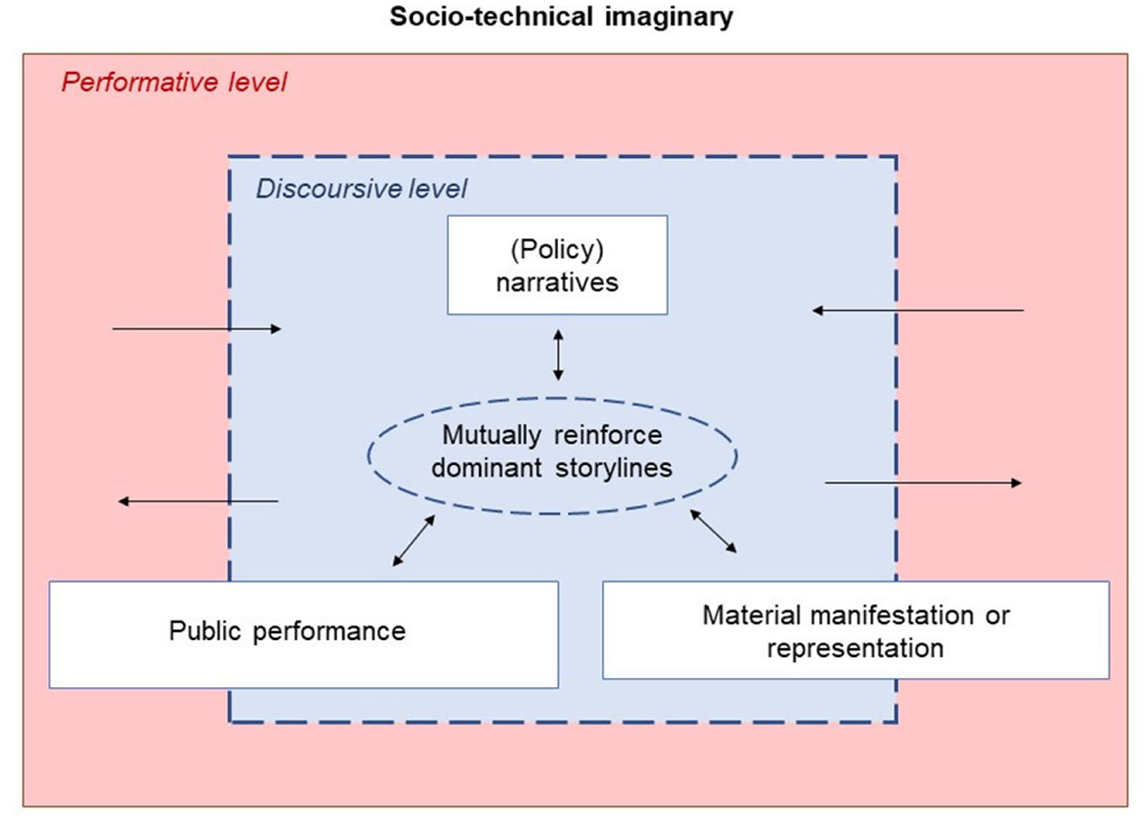
Socio-technical imaginaries and their development from discourse to performativity.
Visions, therefore, depend on continuous repetition and real-life enactments as a means of perpetuation and diffusion. In the case of smart grids, urban laboratories play an important role in fulfilling this purpose by providing a space for articulating and negotiating socio-technical futures, as well as implementing and showcasing them to a broader public. By means of technology trials, they facilitate new policies, actor coalitions, institutional arrangements and cultures around issues such as energy, mobility and the like, and should therefore be understood as spaces not only for envisioning but also for governing and actively creating the city (Bulkeley and Castán Broto, 2013; Bulkeley et al., 2019; Caprotti and Cowley, 2017). In a similar vein, Van Lente argues that a cycle of continuous reinforcement can also result in a paradoxical dynamic, such that ‘a compelling constellation of promising claims that enforces action in a way that perhaps none of the companies or researchers themselves would have chosen. Participants will reason in terms of “not missing the boat”, but the “boat” only exists due to the collective decision not to miss it’ (van Lente, 2012: 773). The irrationality and contingency of this process resonates with what the social studies of infrastructural development have called technological ‘fetishism’ (Kaika and Swyngedouw, 2000; Larkin, 2013). As Brian Larkin argues, technological infrastructures are far from purely rational in an economic or even a technical sense, but ‘emerge out of and store within them forms of desire and fantasy and can take on fetish-like aspects that sometimes can be wholly autonomous from their technical function’ (Larkin, 2013: 329). Imagined socio-technical futures, therefore, carry much more than the relatively mundane promise of solving an engineering problem but are intermingled with emotions of awe and hope that can be highly seductive.
Methodological approach
This article investigates the future imaginaries promoted through smart grids in urban development and implementation circles. These imagined futures manifest themselves in discourse. We base our analysis on the sociology of knowledge approach to discourse (SKAD), which understands discourses as narrative and material processes of sense-making that create social reality. SKAD emphasises the importance of practices, materialities and infrastructures as integral parts of these sense-making processes and thus as objects of analysis (Keller, 2011). Most importantly, however, it recognises that discourse is the place where ‘creativity, interpretation, fantasy, imagination and desire come to the fore’ (Keller and Truschkat, 2013: 35). To understand how smart-grid futures are being imagined in Berlin, we analysed the smart-grid-related narratives as well as their public performance and material representation at three spatial levels in the city:
three smart grid implementation projects, including selected institutions, companies and/or individuals involved;
three so-called future sites (Zukunftsorte) or urban laboratories, which host these smart grid projects;
Berlin’s political administration as well as relevant institutions and companies working in the field of smart grids in Berlin.
We traced these imagined smart grid futures in documents and through interviews with key actors involved with smart grids at all three levels. We analysed a total of 42 publicly available policy documents and grey literatures such as laws, strategy papers, reports, policy briefs, company websites, advertisements and informational brochures (see overview in the Appendix). We complemented our document analysis with a total of 16 in-depth, semi-structured interviews that lasted approximately 1 hour each (see overview in the Appendix) and were conducted with experts from Berlin’s energy, ICT and urban development sectors. Overall, our data cover material from city government and administration, the electric grid operator, the newly founded public services company, two civil society organisations, the local energy agency, two electronics companies, two project development companies and various research institutions. Based on SKAD’s analytical framework, we then systematically coded all documents and interviews in MAXQDA and identified common frames, classifications and phenomenal structures, which resulted in three dominant storylines relating smart grids to the city. We call these storylines Berlin’s imagined smart grid futures.
Berlin as case study city
The city of Berlin has set ambitious goals for becoming a leading ‘smart’ and ‘green’ European metropolis. In doing so, the city is attempting to position itself as frontrunner in the advancement of Germany’s Energiewende and global competitor in the field of digital industries. These aspirations are based, among others, on the city’s growing self-confidence as Germany’s start-up capital. After a long phase of economic stagnation following the city’s reunification, the prospect of developing leadership in a growing industrial field is being embraced by the city government as an opportunity to secure competitive, well-paying jobs. In 2015, the government passed a Smart City Strategy (Berlin Senate, 2015b) that details how it aims to support the equipping of numerous areas of urban life with digitised technologies over the coming years. This strategy has since been complemented by a less formalised digital agenda, which outlines the city’s approach to confronting the so-called digitisation challenge. 1 In 2014 and 2015 the city administration also commissioned two studies called Climate-Neutral Berlin 2050 (Reusswig et al., 2014) and New Energy for Berlin (Enquête-Kommission, 2015), which were translated between 2016 and 2018 into a binding local Energy Transitions Law (Berlin Senate, 2016b) and related Energy and Climate Protection Program 2030 (Berlin Senate, 2016c). These programmes and strategies all emphasise the necessity of digitising the city’s electric grid infrastructure.
In the past few years, civil society organisations have also gained influence in the politics of Berlin’s electricity grid. Since 2014, they have effectively campaigned to reinstate public ownership of the grid. In doing so, these citizen-led initiatives have put Berlin’s electric grid back on the political agenda, turning electricity infrastructure into a highly politicised, highly disputed issue. Yet, while struggles over grid ownership have gained significant public and political attention, questions of digitising the grid or ‘making it smart’ are not among the top priorities of these initiatives and have remained largely under the popular radar.
Meanwhile, Berlin’s urban administration has designated ten so-called ‘future sites’ (Zukunftsorte) for pioneering and showcasing different kinds of novel digital technologies, at least three of which are dedicated – among other things – to the development of smart grids. These are the EUREF Campus, the Technology Park Adlershof and the TXL Urban Tech Republic (see Figure 2).
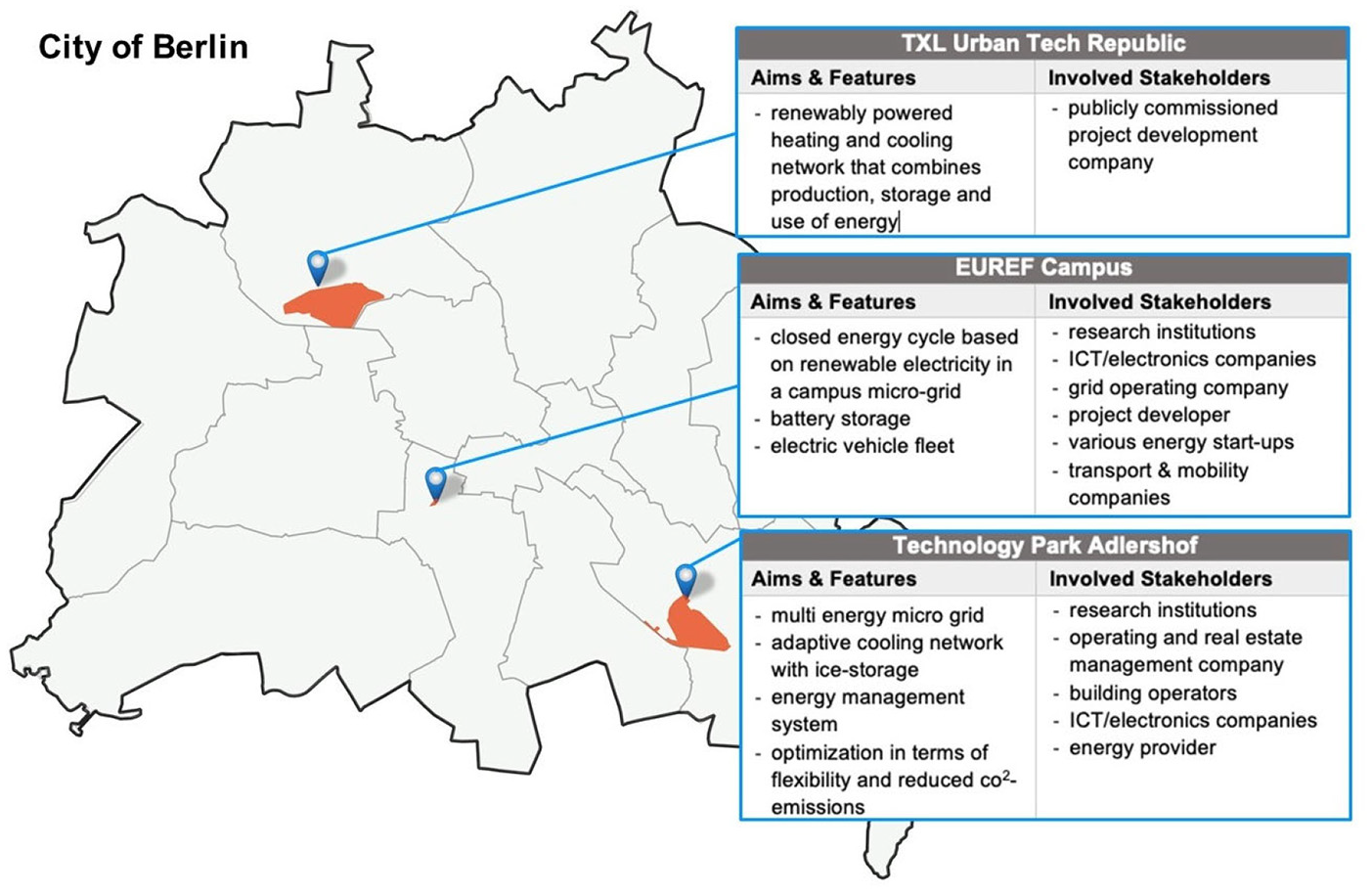
Location of ‘future sites’ and smart grid pilot sites in Berlin.
At these sites, different stakeholders collaborate to develop, test and practically implement pilot versions of smart grid technologies under ‘real-life’ conditions. These expert coalitions include researchers, ICT companies, project developers, utilities, energy start-ups and consumers. Along with the city’s policies and strategies, Berlin’s future sites have thus become important spaces for negotiation and exchange, providing those involved with an opportunity for envisioning and making the ‘smart grid city’. While the projects at EUREF Campus and Technology Park Adlershof are well underway, implementation activities at TXL Urban Tech Republic have been stalled because of problems with the project site – the city’s current airport. Instead of being replaced in 2012 as originally planned, the airport remains in use and TXL Urban Tech Republic continues in a state of seemingly never-ending expectation: always at the brink of realisation but never implemented. The material gathered in relation to this site is therefore informed by plans and aspirations rather than the details of actualisation. The smart grid projects on the three sites focus on different technologies and processes (see Figure 2).
Results: Imagining and making smart grids in Berlin
Our findings reveal three dominant imaginaries that relate smart grid technologies to the city, promoting them as (a) an environmental necessity for advancing Berlin’s local Energiewende, (b) an economic imperative to secure Berlin’s future as a thriving metropolis and (c) an exciting experimental challenge to modernise the city’s infrastructure. Overall, smart grid technologies evoke a fuzzy but enticing urban imaginary that merges technological optimism with fantasies of economic achievement and environmental health. Among others, this fuzzy imaginary of a future smart grid city promotes a modern, eco-progressive ‘Zeitgeist’ that blurs the lines between the means and ends of ‘smart’: does Berlin need to advance the smart city to advance its smart grid? Or does it need a smart grid to become a smart city?
Our findings show that Berlin’s modern, eco-progressive smart grid imaginary is being mutually reinforced by urban policy narratives and corporate marketing strategies on the one hand and by research and implementation practices on the other. This co-constitutive process of imagining and making the smart grid city is driven by a relatively small circle of experts. While urban policy experts and corporate professionals are primarily using smart grids as a marketing tool to attract businesses and professionals, researchers at the implementation level are mostly committed to smart grids in a genuine effort to contribute technological solutions to Germany’s Energiewende. Together, they are imagining and enacting an urban future that is driven by techno-optimism, built on few peoples’ perspectives, lacks critical negotiation and is strongly embedded in the economic opportunities associated with the smart city.
Smart grids as environmental necessity for advancing Berlin’s Energiewende
Berlin’s urban and energy policies primarily depict smart grid technologies as a necessary prerequisite for achieving Berlin’s local Energiewende. This expectation goes hand in hand with an increasing overall reliance on technological development to solve urban environmental problems. In Berlin, imaginaries of low-carbon urban futures are becoming increasingly interwoven with imaginaries of ‘smart’ technological progress, merging notions of environmental consciousness with notions of high-tech development and digital sophistication. Among others, the current city government’s energy policies aim to help advance the city’s Smart City Strategy and turn Berlin into a ‘Smart Energy City’ (Berlin Senate, 2016a). The Smart City Strategy, in turn, describes the development of ‘intelligent’ supply infrastructures as its ‘backbone’ (Berlin Senate, 2015b). 2 Similarly, a report commissioned by the urban administration in 2015 entitled ‘New Energy for Berlin’ states that Berlin should introduce smart grids ‘so it can become a “Smart City” that contributes to the Energiewende’ (Enquête-Kommission, 2015). The ‘smartification’ of electricity grids is therefore not only being justified with energy-related goals, but with the vague and overarching aim of digitising urban life in general. The Masterplan Energy Technology Berlin-Brandenburg further underlines this by stating that ‘energy is part of an interconnected smart city and region’ (Clustermanagement Energietechnik Berlin-Brandenburg, 2017). This shows how closely Berlin’s urban policies and programmes link imaginaries of resource-efficiency and sustainability with notions of digitisation and vice versa. They portray the interface between energy and ICTs as a natural and inevitable process that goes hand in hand with the increasing digitisation of everyday life. By linking the smart city to local energy transitions, smart technological solutions are being depicted not only as healthy and clean but also as part of a response to the pressing global challenge of climate change and thus as a seeming moral imperative. Concomitantly, these urban development narratives are systematically linking imaginaries of the smart city to notions of climate-friendliness and sustainability, describing the smart city of Berlin as ‘resource-efficient’ (Erbstößer and Müller, 2017), ‘post-fossil’ (Berlin Senate, 2015a), ‘ecologically modernised’ and ‘green’ (Berlin Senate, 2016a). In Berlin’s local policies, low-carbon transitions are therefore imagined to be inherently ‘smart’ and smart cities are imagined to be ‘low-carbon’.
The seemingly inevitable connection between technology and environmental protection is being strengthened by smart grid imaginaries at the city’s future sites. TXL Urban Tech Republic, for example, advertises that ‘we need new solutions for mobility, for energy and for resources. And we need new materials and intelligent systems to make these solutions possible. We need Urban Technologies. Technologies for the cities of tomorrow’ (Tegel Projekt GmbH, 2015). According to this advertisement, there seem to be no alternative ‘solutions’ to technological advancement. Moreover, these technologies are claimed to be ‘what will keep alive the growing metropolitan centres of the 21st century’ (Tegel Projekt GmbH, 2018), and thus depicted as a fundamental prerequisite for the sake of pure survival. The same is true for the EUREF Campus, which claims to bridge solutions not only for the ‘intelligent transformation of the energy sector’ (Technische Universität Berlin, 2012) but also for the intelligent city: We are discussing the global context, how to design the future intelligent city? […] and [for me] a smart grid is part of that. (Personal interview, researcher at EUREF Campus, 2017)
Here, too, smart grids are depicted as an ‘intelligent’ and necessary means of urban environmental protection. Only one interview partner in Berlin, notably from an environmental NGO, actually looked into alternatives, asking: What is the goal of smart grids? If the goal of smart grids is, let’s say, climate protection, which is actually our overarching goal; and climate protection in terms of energy use means avoidance, efficiency, and the rest renewable; then I think there are a lot of good alternatives. You don’t need the intelligent house; it’s a question of habits and how to address habits. (Personal interview, 2018)
There is a growing debate over how the smart grid should finally look, what it should do and how it should be understood (Skjølsvold et al., 2015). Although smart grid technologies are (to some extent) necessary for integrating renewables at scale, contrary to dominant smart and low-carbon imaginaries the growing reliance on digitised technologies is significantly increasing overall electricity consumption and resource use and therefore counteracting long-term environmental objectives (Lange and Santarius, 2018: 146).
Smart grids as an economic imperative to secure Berlin’s future as a thriving metropolis
Berlin’s city administration also depicts smart grids as an attractive opportunity for boosting the low-carbon economy, evoking visions of a thriving and industrialised, yet post-fossil urban future (Berlin Senate, 2015a). The current government underlines this by stating that ‘a smart city, an intelligent city, is able to increase growth while decreasing resource-use’ (Berlin Senate, 2016a: 51). Among others, smart grids are envisaged to ‘increase industrial value generation, expand technological expertise, create new jobs and increase urban quality of life’ (Berlin Senate, 2015b: 28). These promises are built to a large degree on Berlin’s existing strengths in the fields of research and digital industries. As well as hosting numerous renowned research institutions, Berlin has become Germany’s leading hub for the (digital) start-up scene (Kollman et al., 2019). The urban administration therefore views smart grid technologies as a way to combine the city’s socio-economic capital with its energy transformation goals and for leading it into a ‘green’ economy: The Energiewende offers Berlin’s businesses unique opportunities on the future markets of a resource-efficient economy based on renewable energies. The extension and advancement of an intelligent electricity grid, smart grid, are important technological challenges that Berlin is especially suited for due to its combination of scientific research and industry. (Berlin Senate, 2015b: 26)
The city’s future sites advertise the same combination. At EUREF, the project development company states that ‘we all benefit from this topic; we benefit, the companies benefit, and the idea behind it does too’ (personal interview, project development company, 2016). And then adds: I want to prove that what we are doing here is not more expensive than what we have now. The Energiewende will only succeed if customers don’t end up paying more. Maybe even pay less […]. I think that this is a commercial project that we are doing here. (Personal interview, project development company, 2016)
This corporate actor therefore depicts smart grids as an economic opportunity that will help the Energiewende, not the other way around. Similarly, large businesses involved in Berlin’s future sites are primarily driven by the opportunity for expanding into an emerging market: Suddenly the grid becomes a huge data project, and that makes it interesting for us. […] Wherever data packages are transmitted based on internet protocols, independent of whether it’s video live streams or stock market data or private emails, we don’t really care what it is, as long as it’s a lot. That pretty much sums up our interests. (Personal interview, ICT/electronics company, 2017)
Not surprisingly, large ICT companies are participating in Berlin’s future sites primarily because they see a chance to increase their specialised knowledge and turn it into standardised products that can be transferred to multiple systems and situations. They are especially interested in devising ‘cookie-cutter’ solutions and developing them into mass-products (personal interviews, ICT/electronics companies, 2016, 2017).
At the same time, these optimistic, forward-looking narratives are also built around a number of fears. They convey a strong sense of urgency and inevitability that depict smart grids as progressive technologies that are not only necessary but also without alternative. Berlin’s digital agenda, for example, describes digital technologies as Berlin’s ‘only chance’ at securing its economic competitiveness. There is a sense that Berlin needs to ‘catch up’ both in environmental and in technological terms (personal interviews, project development company at TXL and public energy agency). This is echoed by experts from Berlin’s future sites: New York is ahead; Amsterdam, Copenhagen are also ahead of Berlin in many points. They have a more flexible administration, that isn’t so stuck in the 80s and 90s as it is here. [Their administration] isn’t as ideological, more pragmatic. (Interview, TXL Urban Tech Republic, 2017)
Urban policy makers, researchers and businesses alike are conveying a sense that digitisation is coming and that Berlin can either keep up with the pace of technological development or lose out in the run for global competitiveness. Asked about possible alternatives, an expert from the city’s network operator responds: ‘Adobe huts. Then we won’t need electricity, we won’t need hot water; it’ll be one cold shower a week […] Of course, then we’ll use much less energy per person, but I don’t know if that’s really the path Germany wants to take’ (personal interview, network operator, 2018). Smart grids, in this expert’s view, are needed to avoid regression, underdevelopment and cold. The city of Berlin, in this reading, has to make a choice between being a pioneer or a loser, a world-class competitor or a poor house. There seems to be no middle ground and no time for considering possible risks or alternatives.
The smart grid as an exciting experimental challenge
These visions are met with positive notions of smart grids as an exciting collaborative challenge and an interesting opportunity for techno-scientific experimentation. Researchers, engineers and businesses are all highly motivated to ‘make the Energiewende work’ (personal interviews with researchers at Adlershof, EUREF and TXL), while their efforts are largely removed from broader social or urban development considerations. Instead, most engineers are driven by a sense of being at the cutting edge of research and development and by an interest in advancing and exploiting the full potential of existing technological possibilities (personal interviews with researchers at Adlershof, EUREF and TXL). They are motivated by a strong belief in the necessity of integrating more renewables into the city’s energy system and by the prospect of contributing to global climate protection. Moreover, they view their work as an exciting possibility to build an attractive, interesting, modern and highly functional technology, thinking only marginally about risks or social consequences (personal interviews, researchers at Adlershof and EUREF). Among other things, they view smart grid technologies as ‘stylish’ (personal interview, public service provider, 2018), ‘sexy’ (personal interview, project development company at TXL, 2017), ‘progressive’ (personal interview, researcher at EUREF, 2017) and ‘cool’ (personal interview, researcher at Adlershof, 2017). These attributes stand in stark contrast, for example, to questions of costs, which they perceive as mundane and reactionary (ewig gestrig) (personal interview, ICT entrepreneur at EUREF, 2016). While the city government is aware of costs, it too regards smart grids as a ‘sexy’ technology that small and medium sized enterprises need to be convinced of (personal interview, Berlin Senate Department for Economics, Energy and Public Enterprises, 2018). Most engineers and researchers involved in Berlin’s future sites view smart grids as a personal opportunity for creating something new and the Energiewende thus takes on a quality of being ‘the next big thing’ in technological advancement.
As the city government designates more and more spaces as experimental urban laboratories, these spaces are becoming important sites of urban (energy) governance, where Berlin’s urban futures are not only imagined but materialised (Bulkeley et al., 2013; Castán Broto and Bulkeley, 2013; Engels and Münch, 2015; Evans et al., 2016; Hoffman, 2011; McLean et al., 2015). In Berlin, these laboratories are explicitly envisioned as places for advancing ‘urban Energiewende innovations’ (Berlin Senate, 2016c: 32), such as virtual power plants, heating and cooling networks, vehicle-to-grid technologies or other (micro-)smart grid technologies. The city government is marketing them as spaces for pioneering technological advancement and offering cutting-edge research and development opportunities. These sites are supposed to ‘make Berlin future-proof, shape its economic profile, and increase its international visibility’ (Berlin Senate, 2015a: 54). They are depicted as ‘hot spots’, and ‘innovation spaces’ (Berlin Senate, 2018) for showcasing urban energy technologies to the world, and increasing Berlin’s global competitiveness (Berlin Senate, 2015a). Adlershof even boasts to be Berlin’s Silicon Valley (Tagesspiegel, 2018). Beyond their function as local testbeds, these sites are conceived as ‘lighthouses’ and shining examples with an outreach and impact far beyond the region (TSB Technologiestiftung Berlin, 2012: 26). In other words, they are explicitly designed to provide development impulses for the broader city and region. A brochure advertising TXL Urban Tech Republic underlines this by saying that ‘energy transformation policy is not only decided here; it is made here’ (Tegel Projekt GmbH, 2015: 13).
However, Berlin’s urban laboratories are designed for an exclusive urban business and research establishment, catering to the young, creative, intelligent, cosmopolitan elite. They invite ‘students, entrepreneurs, industrialists and researchers’, to ‘learn from one another and come up with new ideas together’ in a joint ‘democratic ambition’ for making ‘the cities of the future’ (Tegel Projekt GmbH, 2015). Urban scholarship has shown that urban laboratories are often designed as privileged sites of formalised knowledge production that favour certain actors and interests over others (Evans and Karvonen, 2014). More often than not, ‘the social aspects of urban development and issues that do not fit into the nexus of economic development and environmental protection are largely ignored’ (Evans and Karvonen, 2014: 425). In Berlin, experimentation with smart grids has likewise been confined to a relatively small community of experts, mostly from the business and research domains. Interaction with the public is limited to showrooms that explain certain energy technologies and visualise flows but regular citizens are not part of the projects. This raises important questions about who gets to develop the city of the future and whose imaginaries are part of the process. In Berlin, this is currently a mix of researchers, engineers and business people – but hardly any citizens.
Discussion and conclusion
This article has attempted to disentangle and critically discuss dominant imaginaries of the future smart grid city and how they are being (co-)produced in Berlin’s policy and implementation circles. We identify three dominant imaginaries that depict the smart grid city as a progressive, eco-friendly, economically thriving, attractive and liveable city of the future that is largely without alternatives and also without risks. We have shown that these dominant urban imaginaries merge notions of techno-scientific progress (most notably digitalisation) with the achievement of Berlin’s urban energy transition, thus latching onto the techno-positivist gravitation of Berlin’s smart city paradigm. Put differently, these imaginaries depict urban smart grid technologies as a necessary prerequisite for developing Berlin into a low-carbon city on the one hand and a smart city on the other, making ICT-implementation seem like a natural and inevitable process (i.e. ‘the smart city will have smart grids’ (Erbstößer and Müller, 2017: 11)). Moreover, we have shown that these imaginaries are in part driven by a sincere interest in making Berlin’s energy transition work but also in part by economic concerns and the pure thrill of spearheading technological development. They thus emphasise promises of economic competitiveness and (global) leadership over risks and vulnerabilities. Moreover, we have shown that in Berlin, dominant imaginaries of the smart grid city remain largely uncontested. Instead, the combined promises of the smart grid city are being pursued and marketed by Berlin’s urban policymakers, researchers and businesses alike, be they from the energy, ICT or urban development sectors. We argue that the imaginaries that are created, reproduced and publicly promoted through urban laboratories are thus reinforcing what the city government is promoting in its policies and vice versa, and that a broader, more inclusive and possibly controversial debate is lacking.
We draw three main conclusions from these findings. First, imaginaries of the future smart grid city are not only fuelled by urban (energy) policy but also gain traction through material manifestations in urban laboratories. In Berlin, this co-productive process of mutual reinforcement has created a spiral of reciprocal encouragement and affirmation rather than controversial debate or critical scrutiny. Smart grids have arguably taken on the fetish-like qualities of a technological fix or a ‘boat’ that is not to be missed, rather than one arising out of various means to an end. We are critical that these imaginaries are thus foreclosing debate about other pathways towards low-carbon urban development such as digitally sufficient alternatives (Lange and Santarius, 2018), and that techno-scientific and economic rationalities are concealing the transformative potential of challenging incumbent infrastructural arrangements, for example, through commoning (Hall et al., 2019) or citizen participation (Parks and Rohracher, 2019). Therefore, Berlin’s smart grid development is an example of how positivist imaginaries can serve as catalysts for technological change but largely without reflecting on the complex, interconnected, imperfect and very human realities of urban existence (Greenfield, 2013).
Second, current smart grid imaginaries are emphasising (possible) technological benefits instead of weighing them against the environmental costs of technological expansion or the risks of digitally born vulnerabilities. They also convey a sense of fear and urgency that barely tolerates opposition. With the rising use of ICT-devices, data traffic and data centres are responsible for increasing energy consumption (Lange et al., 2020). In policies, implementation projects or the minds of local stakeholders, risks are rarely mentioned and only in a vague and unspecific way. Only a few critical voices or alternative futures are making themselves heard in the city of Berlin. Issues such as supply security, data security and cyber security are mentioned as necessary prerequisites for smart grid implementation, yet they do not feature as part of the project design. Instead, possible costs are perceived as the most important ‘risk’ or obstacle to smart grid implementation. Urban policies should engage more in discussions about the risks, environmental impacts and implications for inclusive urban development when it comes to smart grid implementation projects instead of advocating material-intensive smart grid futures as the unalterable solution that will solve all urban energy challenges we are currently facing.
And third, Berlin’s smart grid city imaginaries are being promoted by a relatively small community of experts, not least because urban laboratories are limiting – instead of encouraging – necessary public debate. Currently, Berlin’s future sites are being marketed as showcases for new technological developments and urban space is painted as an experimental playground for engineers and tech-enthusiasts to pursue these inspiring high-tech innovations. Instead, urban laboratories could be designed to include a broad cross-section of urban actors, notably also citizens, civil society organisations and planners. On a more general level, our study shows how the interplay of smart grid narratives and implementation practices at urban laboratories (i.e. policy narratives, corporate marketing strategies, research and development initiatives) can mutually reinforce each other to produce certain dominant imaginaries of urban smart grid futures at the expense of more nuanced, comprehensive, possibly controversial discussions. We hope that these lessons might inform the design of experimental sites and smart grid projects in other cities, so that they may become places for inclusive, controversial and democratic discussion and thus potential catalysts for urban change.
Footnotes
Appendix
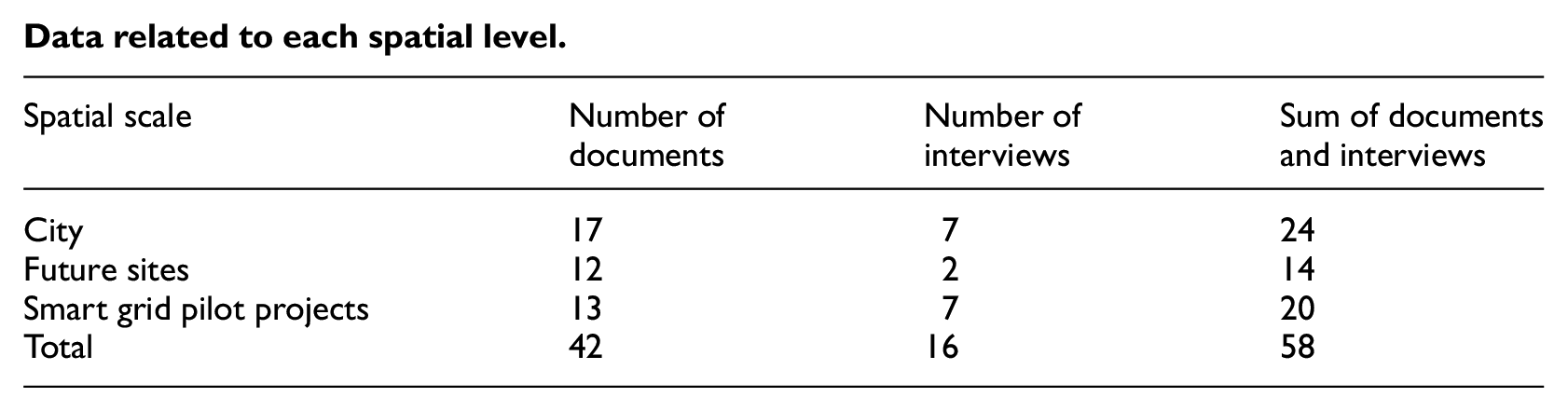
| Spatial scale | Number of documents | Number of interviews | Sum of documents and interviews |
|---|---|---|---|
| City | 17 | 7 | 24 |
| Future sites | 12 | 2 | 14 |
| Smart grid pilot projects | 13 | 7 | 20 |
| Total | 42 | 16 | 58 |
Acknowledgements
We would like to extend special thanks to Dr John Perkins, Visiting Scholar at UC Berkeley, for his detailed feedback on various earlier versions of this paper. We would also like to thank our colleagues from the ‘Science Policy Research Group’ at WZB and from the ‘Digitalisation and Sustainability’ research group at IÖW for their comments.
Declaration of conflicting interests
The author(s) declared no potential conflicts of interest with respect to the research, authorship, and/or publication of this article.
Funding
The author(s) disclosed receipt of the following financial support for the research, authorship, and/or publication of this article: The contributions of the second author, Friederike Rohde, were funded by the Federal Ministry of Education and Research (BMBF) under Grant Agreement No. 01UU1607B within the framework of socio-ecological research (SÖF).
