




Abstract
This article asks why institutional designs for urban governance are so often incomplete and what a critical perspective on incompleteness may offer. We develop a novel conceptual framework distinguishing between incompleteness as description (a deficit to be ‘designed-out’), action (‘good enough’ design to be worked with and around), and prescription (an asset to be ‘designed-in’). An extended worked example of city regional devolution in England illuminates the three types of incompleteness in practice, whilst also identifying hybrid forms and cross-cutting considerations of power, time and space. Perceiving institutional incompleteness as a design logic in its own right, held in tension with completeness, could help augment institutional design repertoires and even enhance democratic values.
Introduction
Urban governance is replete with examples of institutional blueprints that have gone awry, governance reforms that are never accomplished, and policy regimes that are inadequately specified for implementation in diverse contexts. As one urban governance practitioner put it, witnessing the end of a time-limited area-based regeneration initiative in the early 2000s was like ‘rolling a ball half way up a hill’, only to see it roll back down again (Durose and Richardson, 2009). The judgement on such initiatives is often highly normative, and centred on the idea of institutional failure. In this article we ask what a critical perspective on incompleteness may offer to our understanding of institutional design in urban governance – in retrospect and prospect.
A focus on incompleteness illuminates important and often under-acknowledged aspects of institutional design. First, it reveals that much of the conventional discourse on institutional design in urban governance is characterised by an expectation of completeness. Institutions are seen as something to be realised, with reforms to be rolled out or scaled up, and policies to be delivered. However, it is incompleteness rather than completeness that is endemic in the labyrinthine and continually changing landscape of urban governance, where complementary and conflicting intentions and interests are negotiated through multi-level yet locally specific governance institutions (Lowndes, 2005). Second, expectations of completeness may give normative primacy to the perspective of the state, assuming a rational or functionalist approach to institutional design (Goodin, 1998; Pierson, 2000). Incompleteness may serve dominant institutional actors in urban governance or more marginal ones. For example, incompleteness may be either a de facto policy choice that serves dominant interests, or serve to open up ‘pre-figurative spaces’ (Cooper, 2017), characterised by the inclusion of non-state actors, democratic contestations (Lowndes and Paxton, 2018) and acknowledgement of local or experiential expertise (Durose and Richardson, 2016) For these reasons, rather than ‘wishing away’ incompleteness, we need to engage in further conceptual work to understand why incompleteness is pervasive in institutional design, how it operates in urban governance and what its effects might be.
We first set out the case for taking seriously the role of incompleteness in institutional design within urban governance. Next, we develop a novel conceptual framework that distinguishes forms of incompleteness. We differentiate between incompleteness as description (a deficit to be ‘designed-out’), action (‘good enough’ design to be worked with and around), and prescription (an asset to be ‘designed-in’). These forms of incompleteness are linked to three distinctive institutional design logics: instrumental, pragmatic and emergent. These conceptual propositions are then elaborated in the context of urban governance, through an extended worked example focusing on the institutional design of city regional devolution in England, specifically post-2010. Our analysis reveals that, in practice, there is interaction between plural logics, producing hybrid outcomes. We show that understanding the dynamics of incompleteness in institutional design also requires an appreciation of the cross-cutting factors of power, time and space. Nevertheless, the design logics framework serves as a useful heuristic for understanding incompleteness in practice, whilst also informing an expanded repertoire of institutional design strategies, and challenging the default to completeness.
Why research institutional incompleteness in urban governance?
Traditional theories of local government relied upon a rational-functionalist view of institutions, collapsing the diverse and dynamic processes affecting urban communities into the working of elected local government. From the 1960s, under pressure from a variety of intellectual currents (pluralist, behaviouralist and Marxist), such certainties were challenged with the emergence of an ‘urban politics’ approach dedicated to taking seriously non-governmental influences - the role of business, new social movements, intergovernmental relations and change within capitalist economies (Judge et al., 1995). From the late 1990s, there was a flourishing of ‘urban governance’ scholarship, focusing on the ‘hollowing out’ of traditional local government institutions, through privatisation, new public management and greater roles for non-state actors. Whilst some researchers went as far as disavowing the significance of institutions in this context (Bevir and Rhodes, 2006; Harding, 2000), others argued that it was actually the character of institutions that had changed (Lowndes, 2001). As processes of urban governance ‘peeled away’ from the single institution of elected local government, the rules and norms that shaped urban politics were becoming increasingly fluid and differentiated. Such variegation has continued across Europe, with the spread of marketisation, partnerships, co-production, digitalisation, ‘upscaling’ (municipal amalgamations) and ‘transcaling’ (inter-municipal cooperation) (Bergstrom et al., 2020). Drawing examples from six continents, Russell (2019) has pointed to more defiant responses to austerity and neoliberalism via a ‘new municipalism’ characterised by the in-sourcing of services and new alliances with social movements.
Researchers influenced by ‘new institutionalism’ have sought to theorise these novel and variegated institutional formations both within and alongside elected local government (Lowndes and Lempriere, 2018; Entwistle, 2011; Gardner, 2017). The point is not simply to enumerate different types of institutions; rather, it is about challenging what constitutes institutional design – in actuality and in prospect – and recognising that the institutions of urban governance are not necessarily coherent or complete. As a result of political struggles and compromises, and/or technical logjams, institutional arrangements may remain in transition, or take the form of provisional hybrids made up of old and new elements. To understand the dynamics of incompleteness in institutional design, we need to challenge what Pierson (2000: 475) calls the ‘marked tendency to fall back on implicit or explicit functional accounts’ within public policy. Such accounts are characterised by assumptions that institutions fulfil the social functions assigned to them and are designed via rational, evidence-based processes. Hindmoor and Taylor (2018) argue that rational choice theorists see institutions as subject to intentional design, aimed at solving collective action problems and capturing gains from cooperation via the manipulation of rules and incentives (although scholars like Ostrom, 2005, have developed more nuanced accounts). While rational choice theorists start from individual actions, there is an older tradition in organisation studies that has ‘extolled the virtues of completeness’ (Garud et al., 2008: 351). Herbert Simon’s ([1969] 1996) ‘rational model’ assumes the pre-specification of both problems and alternatives, and the selection of the most optimal design. Garud et al. (2008: 351) argue that: ‘Such a scientific approach to design pervades much of management thinking, education and research’. As Pierson (2000: 477) summarises: ‘a simple vision of institutional design focuses on the intentional and far-sighted choices of purposive, instrumental actors’, in which institutional effects are seen ‘as the intended consequences of their creators’ actions’. Pierson acknowledges that this view may not be expressed in such a blunt form, but argues that it forms the basis of ‘hidden assumptions’ that underpin the analysis of institutions.
However, the plausibility of such accounts depends upon a set of favourable conditions at the design stage or the presence of particularly conducive environments. Hence, such premises should be acknowledged as only one way of understanding institutional design and should be supplemented with other plausible explanations. The critical literature on institutional design points to the shortcomings of ‘functionalist’ (Pierson, 2000), ‘scientific’ (Garud et al., 2008) and ‘rational’ (Goodin, 1998) approaches, all of which see design as a linear and ‘completable’ means-end process. Pierson (2000: 477) argues that evidence suggests actors are neither instrumental nor far-sighted in their behaviour and that institutional effects frequently do not fulfil the functions their designers may have intended. Institutional designs are, in fact, rarely complete or coherent, let alone efficient. Institutions may instead reflect a search for legitimacy (via Meyer and Rowan’s, 1977, ‘rationalized myths’), the limits to innovation derived from path dependency (Pierson, 2000), or more subtle processes of learning and adaptation (Lowndes, 2005). Such brakes on rational and functional design are particularly pertinent in urban governance. Urban policymakers face grave informational challenges (given the range and complexity of the issues they address), competing and vociferous interests (expressed through electoral means and local campaigns), the pull of local traditions (civic, political, social and economic), the need to secure legitimacy in the eyes of both citizens and ‘higher’ levels of governance (from which resources may be derived), and the need to adapt broader public service regimes to fit specific city contexts.
Arguing against the ‘myth of the intentional designer’, Goodin (1998: 28) notes that: ‘Institutions are often the products of intentional activities gone wrong – unwanted by-products, the products of various intentional actions cutting across one another, misdirected intentions, or just plain mistakes’. Rather than seeking to squeeze out or correct such phenomena, Goodin (1998: 29) advises that institutional designers should recognise that institutions develop through ‘lots of localised attempts at partial design cutting across one another’. Indirect and collaborative approaches to institutional design – that harness multiple and serendipitous efforts – may turn out to be more robust and resilient in the longer term. Such approaches may also challenge the power dynamics associated with the typically ‘top-down’ search for completeness (Lawrence and Buchanan, 2017), opening up generative spaces for alternative approaches to urban governance characterised by the inclusion of new actors and new ways of working (Cooper, 2017). In rapidly changing and ‘radically uncertain’ (Hajer and Wagenaar, 2003) environments, ‘a design approach that attempts to fix boundaries, goals and purposes is potentially counterproductive’ (Garud et al., 2008: 367). Instead, there may be merit in the blurring of boundaries between designers and users, and allowing design goals to emerge through interaction rather than top-down planning (in the context of ongoing rather than ex-post environment scanning). In short, completeness may have both practical and normative limitations, and incompleteness may be more than a connotation of failure. Despite the many changes in both scholarship and practice since the 1960s, we argue that institutions remain important in urban governance but take varied and messy forms, being in many cases partial, fractured and overlapping. Next, we develop a conceptual framework for researching incompleteness in institutional design in urban governance.
Conceptualising incompleteness in institutional design
Our conceptual framework distinguishes between different types of institutional incompleteness and the design logics that underpin them. Institutions are understood as set of formal rules and informal conventions that, in Ostrom’s (2005) words, ‘prescribe, proscribe and permit’ certain forms of action. As such, institutions are not always synonymous with formal organisations; institutions may take the form of ‘rules-in-use’ that shape behaviour across a range of organisations. We use the term ‘design logic’ to refer to a specific rationale for the process of institutional design. This refers not to the substantive character of the resultant design, as in the sociological concept of ‘institutional logic’ (Skelcher and Smith, 2015), but to features of the design process itself. The logics have implications for design strategy and design goals, and have distinctive normative connotations when it comes to understanding the role and value of incompleteness. In developing the concept, we follow Goodin’s (1998: 39) advice that, in matters of institutional design, it is advisable to build ‘middle-range’ theory that relates to, and seeks to connect, ‘both empirical and normative realms’.
In summary, we argue that incompleteness can be conceptualised in three alternative ways, reflecting different design logics (see Table 1):
A conceptual framework for incompleteness in institutional design.
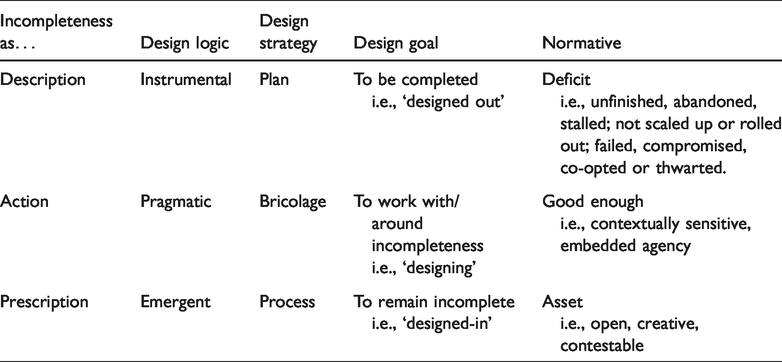
An instrumental design logic leads to incompleteness being regarded as a ‘description’, reflecting a foundational or reforming moment within a process of institutional design. Here, an institutional design is ‘incomplete’ on its way to becoming ‘complete’. Moreover, completeness is an implied normative goal.
A pragmatic design logic sees incompleteness in terms of ‘action’, aimed at securing ‘good enough’ design. Incompleteness is seen as inevitable, rather than necessarily desirable, because institutional design is necessarily contingent and subject to continuous revision.
An emergent design logic understands incompleteness as part of a deliberate and purposive design strategy. The objective of such a strategy is for the design of institutional arrangements to emerge over time and through use. Here, the normative goal is reversed, so incompleteness is understood as a design value in itself.
The conceptual framework is discussed in more detail below and illustrated through an extended worked example of institutional incompleteness in urban governance, specifically that of English city regional devolution. A ‘worked example’ is best understood as ‘a step-by-step demonstration of … how to solve a problem’ (Clark et al., 2006: 190). A worked example is different from a case study, which provides a detailed analysis of an empirical phenomenon based on primary research. In this paper, the worked example provides ‘scaffolding’ for addressing the puzzle of institutional incompleteness, step-by-step. The example is worked through a series of boxes, based on secondary research, which explore different aspects of incompleteness using the three analytical lenses identified in our framework.
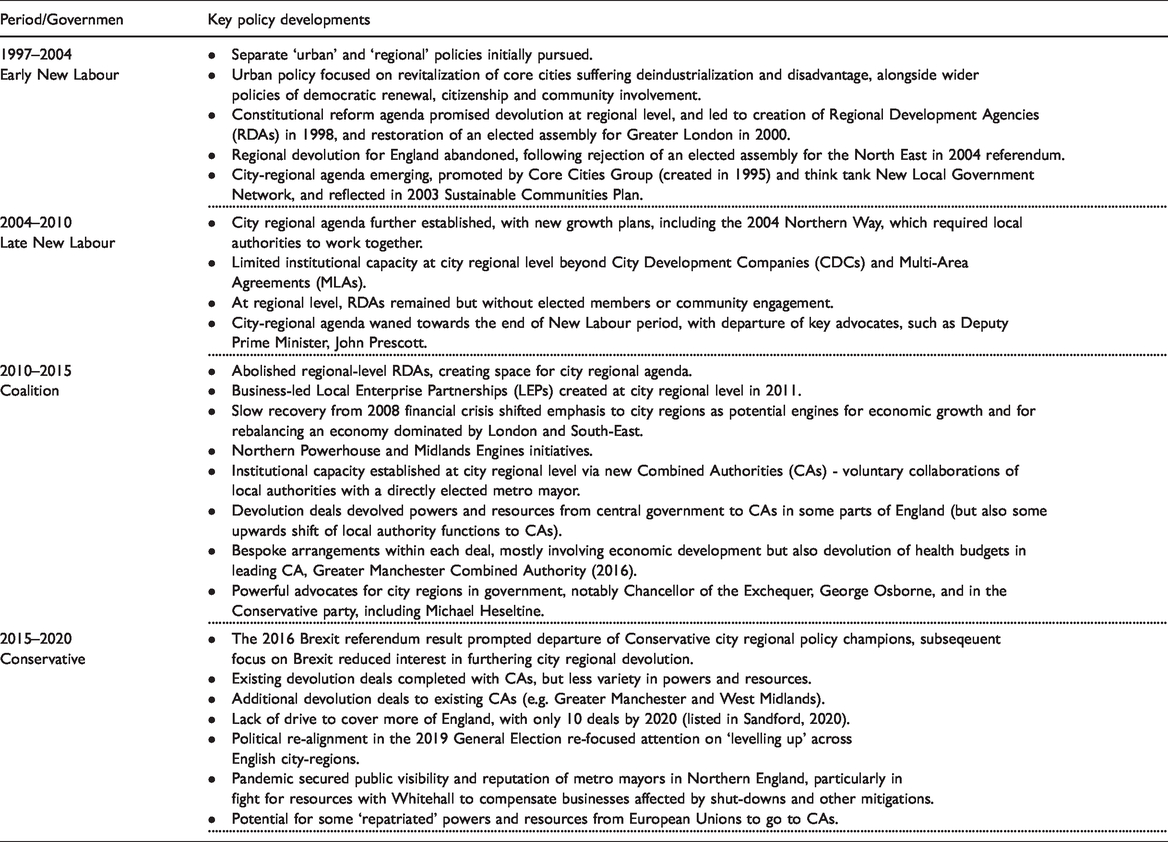
Table 2 provides the background for our example, listing key events in the turn to city regional governance in England from the mid-1990s. We have used dotted lines between the rows of the table in order to soften the initial impression of a linear movement between distinct phases. Moreover, when we examine the contents of the table, it is clear that city regional policies have been elaborated, shelved and yet re-emerged. Initiatives have been launched with great fanfare but remained unfinished, stumbling to a standstill or remaining as lonely pilots. Such a pattern has persisted for more than twenty years, despite changes in governments, individual champions, and external environments. Harrison (2012) compares city regionalism with a fireworks display, noting that each initiative is launched ‘with a crescendo of noise, only to sparkle for a short time, before appearing to fizzle out and fall slowly back to earth’ (p. 1255). Referencing the ongoing incompleteness of city regional devolution, Lord (2009) notes that each policy draws upon ‘the flotsam and jetsam of past policy experimentation’ (p. 78).
Institutional incompleteness of city-regional devolution over time.
An instrumental design logic: Incompleteness as description
In conceptualising institutional design as a description, we are referring to a specific moment in the design process that could be described as ‘incomplete’. This moment may be foundational: the design process is incomplete because it has just started. But, it may also be a reforming moment: it is incomplete due to a change in direction or because prior institutions prove tenacious. Incompleteness may arise because of gaps between ‘old’ and ‘new’ institutions – where new rules and practices are introduced but traditional arrangements persist, either existing alongside as a parallel rule set, or incorporating or undermining new rules (Lowndes, 2005; Mahoney and Thelen, 2010). What ties these moments together is that institutional design has the goal and indeed expectation of completeness. Incompleteness is not an end state but something to be ‘designed out’ on the way to completing the institutional design.
The normative expectation in this case is completeness, where benefit is assumed to flow from the completing of incomplete processes. Completeness is perceived to allow in advance for not only the specification of a problem, but the possible alternatives and the selection of the optimal solution (Garud et al., 2008). Planning is the dominant design strategy, existing within an instrumental or technocratic logic. Incompleteness may reflect a situation in which institutional design has stalled, failed or been abandoned, or there has been a lack of attention to the enforcement of institutional rules. In a condition of incompleteness, institutional design is regarded as ‘unfinished business’. For rational choice theorists, remedying incompleteness is generally associated with tweaking incentives, information flows and pay-offs in order to deliver the ‘right’ framework for collective action (Hindmoor and Taylor, 2018); for technocrats it is about perfecting the plan, identifying more comprehensively inputs, throughputs and outputs (Boyte, 2005). An instrumental approach, which sets out and seeks to realise a given plan, aims to mitigate against the over-design of the ‘congested state’ (Skelcher, 2000), and instead promote legibility, transparency, accountability and coherence. Box 1 returns to the example of English city regional devolution to illustrate this instrumental logic of incompleteness in practice. Here, the institutional design of English city regional devolution is situated within the prevailing central-local settlement. Incompleteness as description in English city regional devolution.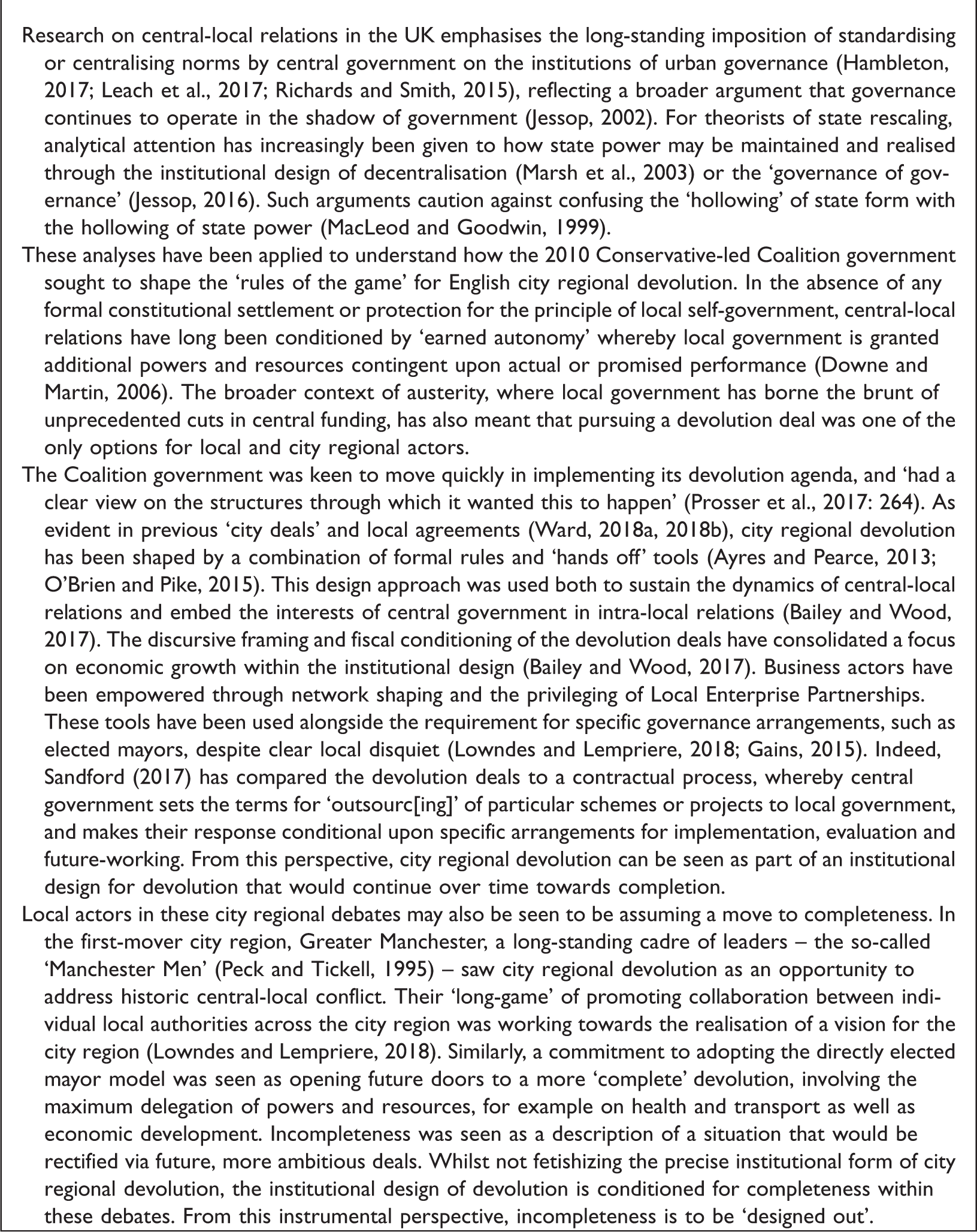
A pragmatic design logic: Incompleteness as action
The second conceptualisation of incompleteness is based upon an acceptance of the practical limitations of traditional rational models of institutional design. Attention is drawn to the necessarily partial and incomplete access to information experienced by designers, their limited cognitive capacity to model and undertake cost-benefit analysis of all possible alternatives, and the stickiness or path dependencies of existing institutions (Pierson, 2000). This conceptualisation is not an assertion that institutional incompleteness is a good or bad thing in itself, but rather that it is an intrinsic property of institutional design.
Charles Lindblom (1959) famously analysed the predominance of pragmatic approaches - the ‘incremental method’ and a ‘science of muddling through’ – within US public administration. Hennessy (1996) explains the historical robustness of the unwritten (in effect, incomplete) British constitution as the outcome of ‘intelligent muddling through’. Simon (1996) observes in matters of institutional design, a practice of ‘satisficing’ – a combination of ‘satisfy’ and ‘suffice’ – as a practical alternative to the rational (but unfeasible) pursuit of ‘maximising’. In this vein, institutional designs are not expected to be ‘complete’ but rather ‘good enough’. Considering institutional design in the context of developing countries, Grindle (2004: 545) argues in favour of a strategy of ‘good enough governance’, noting that institutional reforms inevitably take place ‘in the midst of conflict, confusion, cross-purposes, inefficiencies, and learning-by-doing’.
Lanzara (1998: 27) draws attention to the role of ‘institutional bricolage’, tinkering or patching-together, in contrast to the formulation of grand plans: ‘Seldom are institutions created from scratch. Most often they are the outcomes of the recombination and reshuffling of pre-existing components or other institutional materials that… can serve new purposes’. Bricolage may offer an opportunity for institutional innovation in the face of path dependency, and in a broader context of resource constraint, risk aversion and lack of trust. The notion of bricolage also resonates with that of ‘street level bureaucracy’, which recognises that frontline actors in urban governance have to interpret institutional designs on an ongoing basis, using discretion and improvisation to fit cases to rules and resources, in changing environments (Durose, 2011; Lipsky, 1980). Even in legal matters, Sunstein (1995: 1736) has drawn attention to the role of ‘incompletely theorized agreements’ as a means of securing settlements within conditions of social pluralism, providing ‘an important source of social stability and an important way for diverse people to demonstrate mutual respect’. The focus is on securing relative agreement on particulars rather than complete agreement on abstract principles. In a similar vein, reviewing theories of democratic design, Hendriks (2011: 59) criticises a relentless pursuit of ‘purity’, pointing instead to the potential benefits of ‘pollution’ whereby different democratic variants are mixed in response to real-life contexts. Hendriks argues that: ‘purity means vulnerability in the real world of democracy; hybridity means vitality’.
Design here is a verb rather than a noun, connoting an ongoing and contingent process of designing. The outcome is likely to be what Crouch (2005) refers to as ‘recombinant’ institutions, which represent an inevitably unfinished (and probably temporary) ‘institutional fix’ enabling collective action in specific temporal and spatial contexts. Box 2 offers a different take on English city regional devolution, elaborating a pragmatic design logic for incompleteness. Here, the institutional design of English city regional devolution is understood as contingent, with a more fluid and differentiated relationship between the centre and localities. Incompleteness as action in English city regional devolution.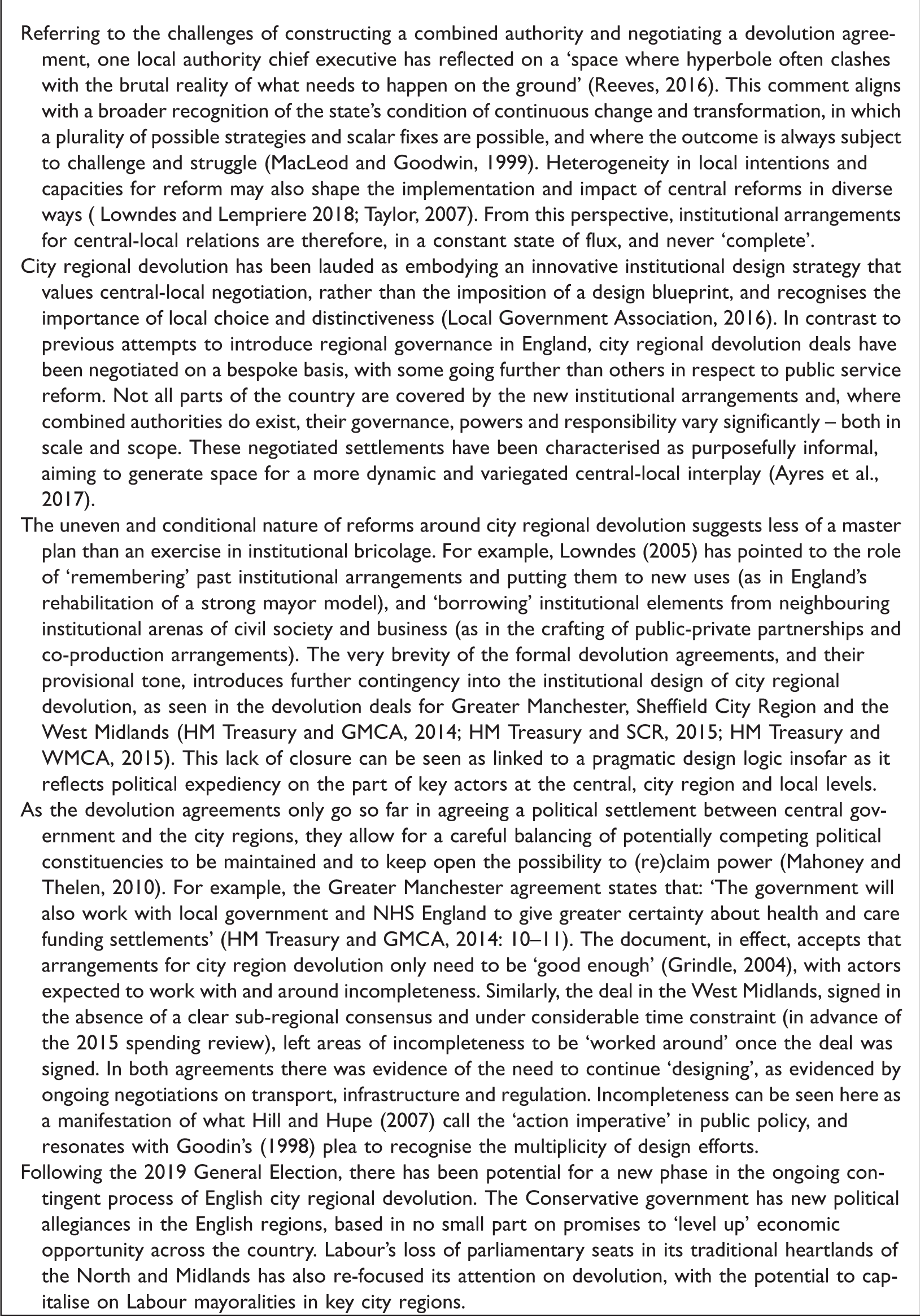
An emergent design logic: Incompleteness as prescription
Our third conceptualisation sees incompleteness as a prescription, indicating that institutional design can be incomplete as a deliberate and purposive strategy. Rather than something to be ‘designed-out’, incompleteness is ‘designed-in’, with the intention that design should necessarily remain incomplete. Here, incompleteness represents a critique of instrumental institutional design. This logic challenges the ‘common sense’ view of incompleteness as implying that something is missing from an institutional design or indeed that we are failing to focus on the achievement of tangible goals, privileging means over ends. In this conceptualisation, incomplete design is underpinned by a belief that it can improve upon traditional institutional designs by being adaptable to a dynamic wider environment (Garud et al., 2008). Acknowledging and celebrating incompleteness as a normative design value in and of itself resonates with concepts of postmodernity (contrasting with modernist assumptions of progress toward completeness). Here, we are invited to embrace the uncertainty of incompleteness for both its practical benefits and its democratic values of inclusion, participation and contestability (Lowndes and Paxton 2018; Griggs et al., 2014; Moon, 2013).
There is substantial research on failing institutions that raises questions as to whether coherence and completeness are assets or curses (Jas and Skelcher, 2005). Goffman’s (1961) work on ‘total institutions’, and indeed Foucault’s (1982), alerts us to potential links between institutional design and domination. Such critiques of rational institutional design see the goal of completeness as enabling a technocratic logic to dominate, which privileges certain imperatives and specific forms of expertise (Durose and Richardson 2016). The goal of completeness, where the optimal solution has already been determined prior to implementation is seen to enforce rigidity, restrict options and exclude more diverse forms of expertise from the design process. In the quest for completeness, we may also be ‘designing out’ opportunities for experimentation, learning and adaptation. Its technocratic assumptions are also likely to underestimate the inevitability of actors contesting institutional arrangements that do not favour their interests or reflect their identities, creating a further source of instability. An instrumental logic therefore runs the risk of designing ‘brittle’ institutions that are not able to withstand changing demands and environments.
In contrast, incompleteness may be seen to be driven by an imperative to allow institutional design to remain open to being shaped by those using and affected by it, thus reflecting a broader democratic logic (Fung, 2001). An institutional design is incomplete in that the design allows ongoing iteration and amendment (Burns et al., 2006: 21, 26). As such, incompleteness reflects a positive, normative connotation of an open institutional design. The associated design strategy is to view design as a process, in contrast to a pre-determined plan. The purpose of the design is revealed through the process itself. This perspective is understood to offer several advantages, not only in encouraging improvisation and challenge but the potential to catalyse action, and to develop the design in perhaps unforeseen or innovative ways (Durose and Richardson, 2016; Garud et al., 2008). This notion of deliberately incomplete design resonates with a celebration in the institutionalist literature of concepts of ambiguity (Mahoney and Thelen, 2010), heterogeneity (Schneiberg and Clemens, 2006), redundancy (Crouch, 2005) and emergence (Lowndes, 2005), all of which challenge traditional rationalist thinking. In her work on ‘common pool’ resources, Ostrom (2005: 283) argues for polycentricity in institutional design, arguing that multiple and overlapping governing authorities at different scales will better facilitate the adaptation of institutional designs to local circumstances and the sharing of learning from such experimentation. Mahoney and Thelen (2010) show how ambiguities in design reflect compromises built into institutions at foundational moments (reflecting power dynamics between different interests), which can later become resources for institutional adaptation (especially in the context of changing institutional environments). By this logic, being incomplete can enhance the sustainability of institutions over time.
Indeed, we can also acknowledge incompleteness as a means to enhance democratic values and practice in urban governance. In a context of deep cultural pluralism and interdependence and where trust in politicians is eroding, the traditional primacy of technocratic expertise is open to challenge (Durose and Richardson, 2016; Hajer and Wagenaar, 2003). Incompleteness in institutional design may here be allied with an agonistic perspective that values democratic contestation and seeks to realise it through an institutional design process imbued with the principles of contestation, contingency and interdependence (Lowndes and Paxton, 2018). This view prioritises diverse and inclusive participation in the process of institutional design, thus enabling space for generating alternatives (Cooper, 2017) and harnessing perspectives on problem-solving that are closer to those affected (Ostrom, 2005). Hence, an incomplete process of institutional design also has the potential to enhance democratic values, providing a means of building the legitimacy of governance institutions, enhancing their effectiveness, and advancing justice (Fung, 2006). Box 3 offers a further perspective on the design logics underlying on English city regional devolution, elaborating an emergent design logic for incompleteness, with positive implications for innovation and inclusion. Incompleteness as prescription in English city regional devolution.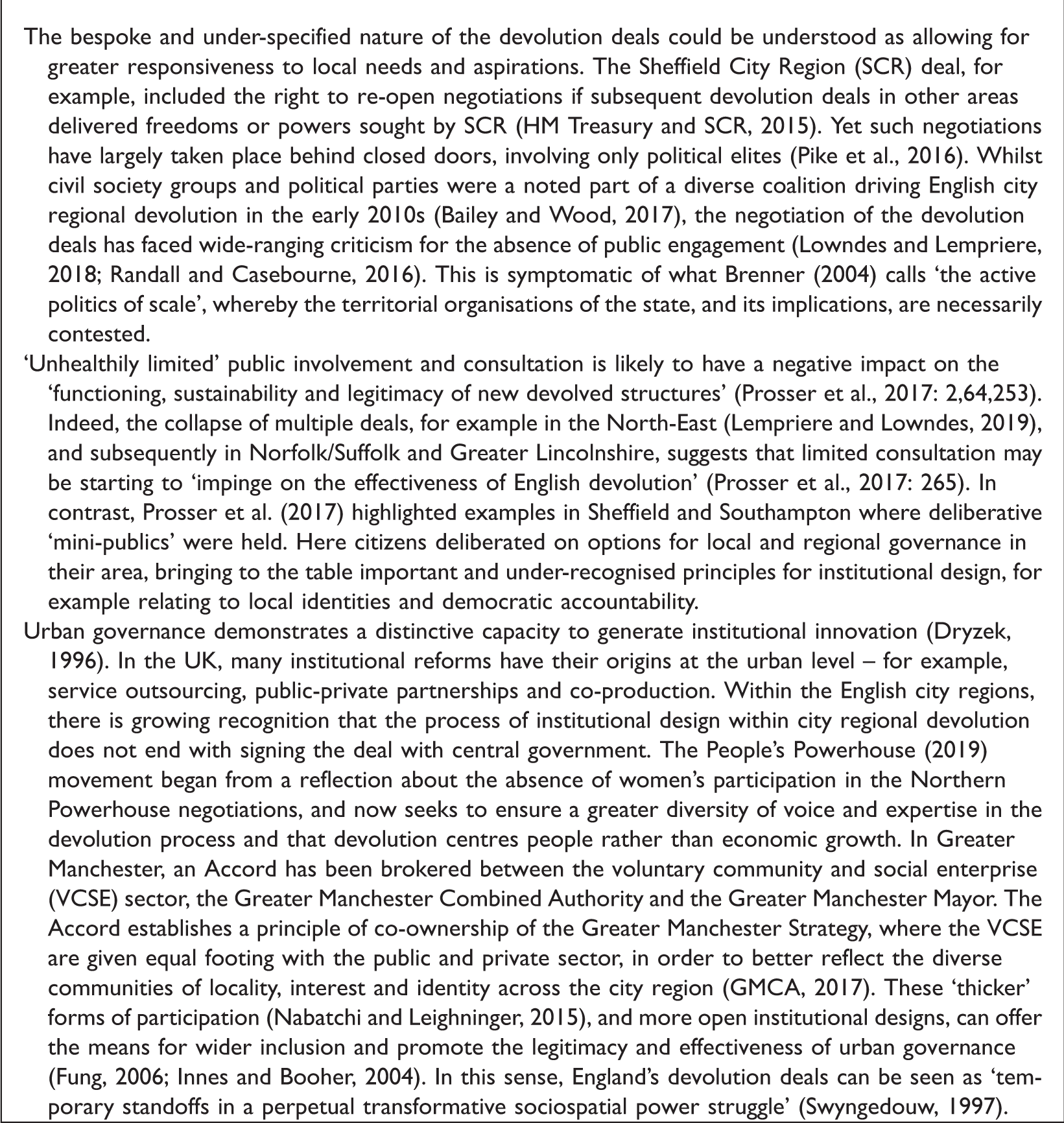
Informing institutional design through incompleteness: Plurality and hybridity
The elaboration of our conceptual framework through the extended worked example of English city regional devolution has demonstrated how different types of incompleteness, and associated design logics, are in play concurrently. Surfacing the often hidden and implicit instrumental logic of completeness allows us to recognise its limits. In this section of the article, we consider whether alternative logics can be intentionally put to work in institutional design. How can pragmatic and emergent logics be deployed by those engaged in the design of urban governance, as alternatives or in combination with an instrumental logic?
Theories of hybridity draw our attention to opportunities presented in surfacing plural design logics and acknowledging the role of incompleteness in institutional design (Hargrave and van der Ven, 2009). As Skelcher and Smith (2015) argue, institutional designers are themselves ‘situated agents’ who work in the context of multiple, and not necessarily compatible, frames of meaning. Designers (at both the central and local level) may find potential advantages in accepting contradiction and friction, rather than seeking closure and completion. Box 4 points to the likely advantages and limitations of each design logic in the climate of continued uncertainty surrounding English city regional devolution, and the opportunities posed by plural and hybrid logics of incompleteness. Plural and hybrid logics of incompleteness in English city regional devolution.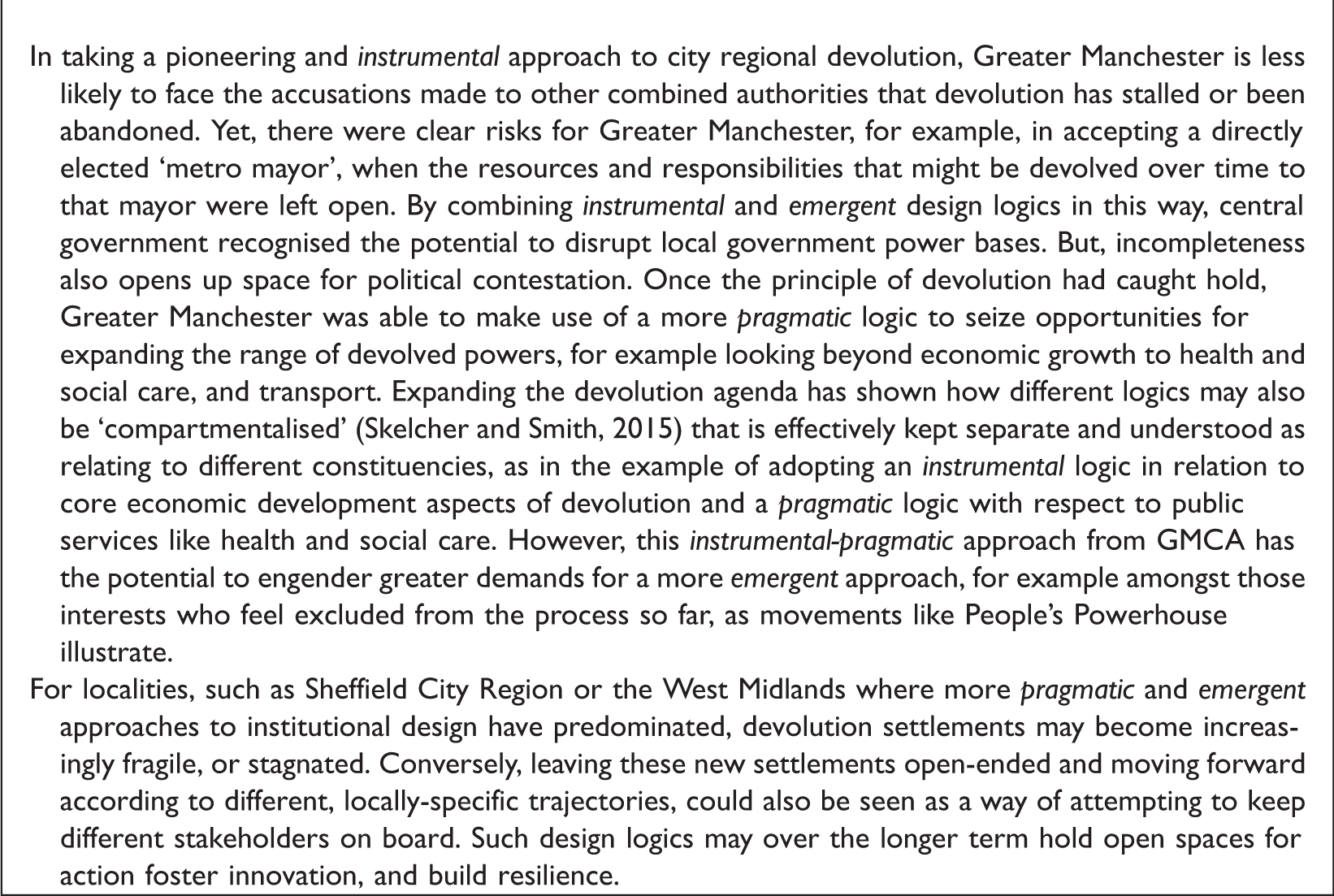
Mediating incompleteness in institutional design: Power, time and space
Analysis of incompleteness in institutional design has also revealed the importance of cross-cutting factors of power (incomplete for whom?), time (incomplete when?) and space (incomplete where?). As we have seen, debates on institutional design inevitably take place against the backdrop of prevailing power relations. A focus on incompleteness may allow us to discern the contours of how power is maintained through institutional design, both in terms of formal rules and resource allocation, but also agenda-setting and network-shaping. It may also help to illuminate how institutional design opens up space for contestation, where ‘soft’ power and influence become crucial, and actors can engage critically with existing power settlements (for example through mobilising different stakeholders). The question of actors’ time horizons is also a central issue for analysts of institutional design (Lowndes, 2005; Pierson, 2000). Policymakers’ limited attention spans and timescales for credible commitment, along with the appeal of the new, have tended to shape a continuous and restless search for the appropriate scale and intervention to tackle what Swilling and Annecke (2012) call the ‘urban polycrisis’. Spatial factors are also important in understanding the dynamics of incompleteness in institutional design, which can be due to a failure to scale-up or roll-out new arrangements, resulting in a disorganised or discontinuous institutional landscape. Conversely, as well as spatial constraint, where institutional designs are only partially fulfilled, incompleteness may also arise from spatial promiscuity where, as the demands of scale change, institutional design may be stretched too far. Box 5 shows how the mediating factors of power, time and space have shaped English city regional devolution. Power, time and space as mediators of incompleteness in English city regional devolution.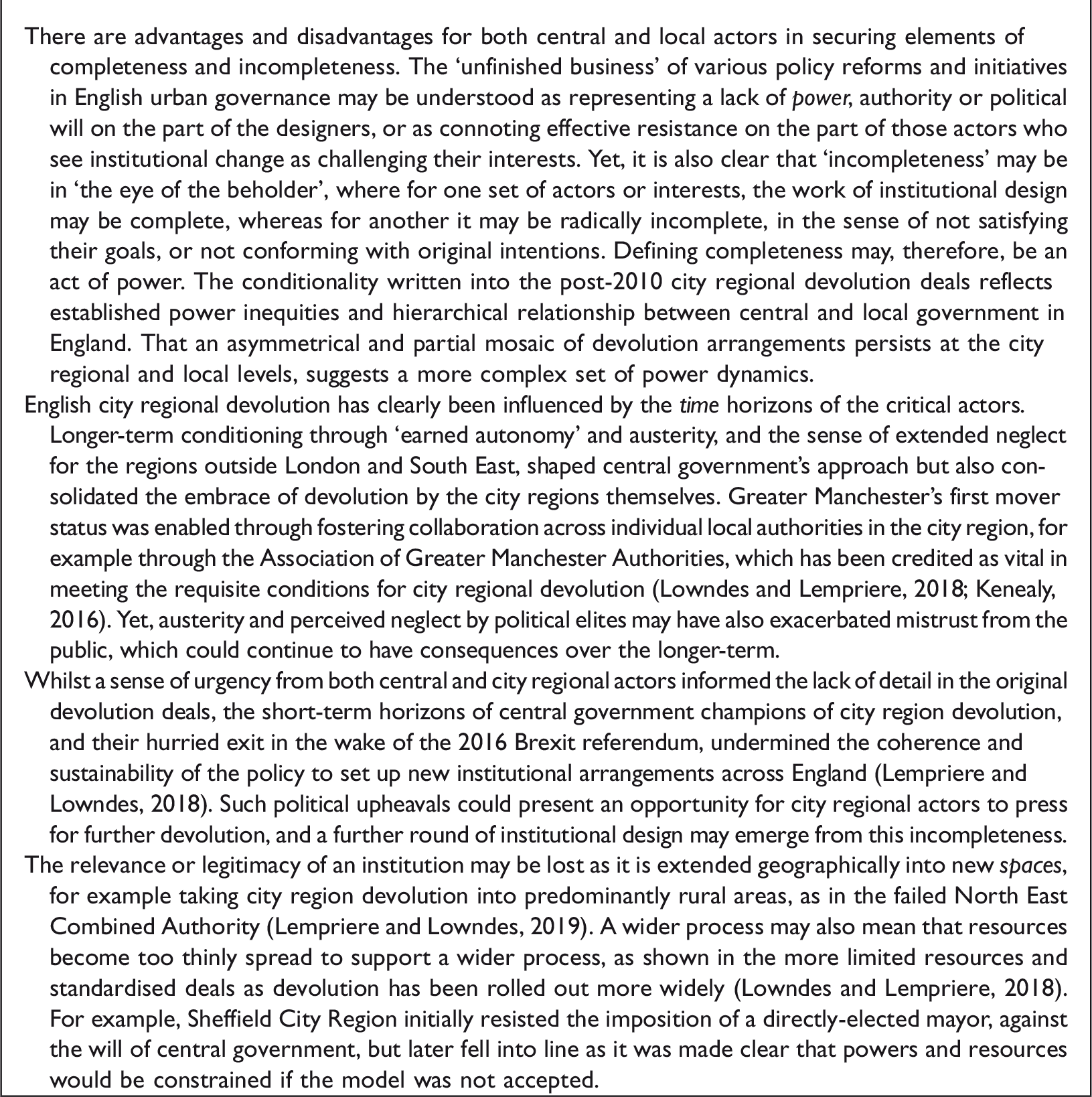
Conclusion
In this article, we have demonstrated how a design logics approach can advance analytical understanding of incompleteness in urban governance, orienting our attention to the limits of a functionalist approach to institutional design and the associated default to notions of completeness. It has also opened up alternative theorisations of incompleteness, and the institutional design process itself. Our analysis has highlighted not only the inevitability of incompleteness in institutional design - even where an instrumental design logic is pursued - but also its potential benefits within urban governance, which are expressed via alternative design logics of emergence and pragmatism. The argument is not that outcome specifications for institutions should be abandoned, but rather that pre-set or prescribed solutions are not necessarily the most effective or even efficient way to achieve them. A focus on incompleteness acknowledges not only the need to respond to complex and dynamic contexts within urban governance, but also the opportunity to create institutional designs that facilitate the ongoing negotiation of such contexts, including by actively creating and maintaining spaces of incompleteness. Such spaces can facilitate the engagement of new actors and enable ‘good enough’ design to emerge in-use.
Theoretically, the article has served to deepen our understanding of incompleteness in institutional design through the development of the three-fold framework. We used an extended worked example of English city regional devolution to test the concepts in practice and leverage further analytical insight into the sources and dynamics of incompleteness in institutional design. The analytical generalisations that emerge could form a basis for future research on incompleteness in a broader range of reforms in English urban governance or a comparison with institutional innovations in other countries.
We also show that the concept of institutional incompleteness can be useful in explaining the outcomes of power struggles in ambiguous and uncertain institutional contexts. In urban governance, the institutional landscape of devolution has many constituent elements, and a variety of means by which these elements might be designed-in, designed-out or left open. Furthermore, our analysis demonstrates that incompleteness opens up space for political contestation, offering an opportunity to engage beyond the political elites by opening up pre-figurative spaces in which new actors may be engaged in the design process in new ways. Each of our three ways of understanding incompleteness – instrumental, emergent and pragmatic – contains its own limits. Yet, perceiving institutional incompleteness as a goal in its own right, held in tension with ideas of completeness, could help in managing expectations across the urban governance landscape, developing new design strategies and enhancing democratic values.
Footnotes
Acknowledgements
The authors would like to thank Alison Gardner (University of Nottingham) and colleagues at the Institute of Local Government Studies (University of Birmingham) for their comments on earlier drafts of this paper.
Declaration of conflicting interests
The author(s) declared no potential conflicts of interest with respect to the research, authorship, and/or publication of this article.
Funding
The author(s) received no financial support for the research, authorship, and/or publication of this article.