




Abstract
This paper investigates urban imaginaries conveyed in publications in ecology over the past century. We examine some urban ecologists’ view that urban areas have been disregarded by ecology due to negative views on cities and urbanisation. Inspired by previous work on imaginaries in social and cultural geography and political ecology, and by textual data analysis methods, we adopted a methodological framework that applies both quantitative and qualitative methods in the analysis of a corpus of 960 articles (published 1922–2018) drawn from 10 long-standing international journals in ecology. Our hypothesis is that ecology has embraced an anti-urban imaginary that is manifested in urban invisibility as well as the recurrent expression of negative ideas about cities (constituting an ‘anti-urban bias’). Our results partially confirm this hypothesis. We show that until the 1970s only a few papers were published on cities. We identify nine main themes relating to cities around which ideas about cities have been constructed (threats, pests, refuges, fragmentation, gradients, pollution, homogenisation, planetary urbanisation, and planning) and show how these ideas have been mobilised in the articles since the 1920s. We discuss the way in which these evolving ideas reflect a move from an essentially anti-urban imaginary to a more complex and ambivalent one. This shift coincides with the rise of the idea of planetary urbanisation in ecological publications, increasing recommendations regarding urban planning, and more generally, growing conceptual debates on the ecological impact of cities.
Introduction
Urban ecology has gained momentum in the past thirty years. The growth of this field, often defined as a ‘sub-discipline of ecology’ (Rebele, 1994: 174) and more specifically as ‘the study of spatiotemporal patterns, environmental impacts, and sustainability of urbanization with emphasis on biodiversity, ecosystem processes, and ecosystem services’ (Wu, 2014: 213), has been described as exponential (Barot et al., 2019; McDonnell, 2015; Tan, 2020). Numerous syntheses on the topic have been published (e.g. Alberti, 2009; Douglas et al., 2020; Gaston, 2010; Knapp et al., 2021; McDonnell, 2011; McDonnell and MacGregor-Fors, 2016; Pickett et al., 2011) and new journals (Walbridge, 1997) or journal sections (Pataki, 2015) have been created since the 1990s.
Ecology’s current interest in cities stands in sharp contrast with pre-1990s research agendas. As part of the natural history tradition (Sukopp, 1998), observations of nature in cities were recorded as early as the 16th century (Weiland and Richter, 2009), and investigations into urban flora (e.g. Deakin, 1855; Nylander, 1866) and urban fauna – notably through birdwatching (Douglas and Goode, 2011) – took place in the 19th century. Yet, from the end of the 19th century and for most of the 20th century, ecologists paid little attention to anthropogenic environments (Johnston and Daniels, 2006; Young, 2009). Many urban ecologists have stated that despite some pioneering studies (e.g. Duvigneaud, 1974; Kieran, 1959; Kühnelt, 1955; Kunick, 1974), until the 1990s, little literature existed in ecology on cities (McDonnell, 1997; Wu, 2014). To explain this gap, urban ecologists have underlined that ecologists previously disregarded urban areas and cities as possible study sites (Anderson and Elmqvist, 2012; Grimm et al., 2008; Marzluff et al., 2008; McDonnell, 1997; Niemelä et al., 2011), considering them ‘unworthy of scientific research’ (Wu, 2014: 211), and have mostly attributed this disdain to the perception of cities as unnatural (Gilbert, 1989; McDonnell, 1997; McDonnell and Pickett, 1993; Wu, 2014), as ‘detritus ecosystems ’ (Stearns, 1970: 1006), as ‘anti-life’ and inhospitable from a biological viewpoint (Sukopp, 1998). As Trepl (1996) provocatively summarises, ecology was an ‘anti-urban affair’ and embraced a romantic vision of nature associated with a condemnation of the modern city rather than merely commenting on the city’s inhospitable characteristics.
This opposition between nature (represented as ‘good’) and the city (perceived as ‘bad’) has been said to have characterised fields such as environmental ethics and environmental philosophy (de-Shalit, 2003; Gunn, 1998; Jameson, 2003; Light, 2001), biogeography (Head and Muir, 2006), environmental history (Cronon, 1992; Melosi, 1993) and political ecology (Heynen et al., 2006), as well as environmental movements: In the development of the modern environmental movement in the 1960s and 1970s, it became fashionable to consider everything to do with cities as bad and everything to do with wilderness as good. Cities are polluted, dirty, artificial, and lack wildlife; therefore, urban environments are bad. Wilderness is unpolluted and full of wildlife and native plants; therefore, it is good. (Botkin and Beveridge, 1997: 4)
Such views on cities have been linked to an explicit or implicit conceptual division between nature and culture as opposing spheres of moral and political concern (Latour, 2005; Rolston, 1998 in Light, 2001), and a the ‘geographical dualism’ between wilderness and city (Light, 2001), the latter seen as having no natural value and harbouring no ‘true nature’. This ideological position tends to perceive nature as a virtuous and invaluable counterpoint to cities (Castree, 2003; Gandy, 2006). Gandy (2006) argues that in the 19th and 20th centuries, cities were ‘widely perceived to reside outside nature or the “natural order” as parasites or monsters’ (p. 65).
The work of these authors highlights the impact that such a prejudice against cities may have on urban planning and nature conservation (Salomon Cavin, 2013). However, since the start of the 21st century, both the abovementioned fields and the environmental movement (Salomon Cavin et al., 2010) seem to have ‘come to town’, apparently reconciling the geographical dualism between wild versus urban environments (Light, 2001) and restoring urban nature as a legitimate and valuable political and scientific subject.
In this paper, we further explore views on cities and the city–nature dichotomy, specifically in terms of ecology. Our main hypothesis is that ecology embraced an anti-urban imaginary expressed through urban invisibility as well as an anti-urban bias. By ‘urban invisibility’ we mean the absence of cities in studies in ecology, and by ‘anti-urban bias’ we mean a recurrent negative appraisal of nature in cities in ecological studies (Salomon Cavin, 2013).
Two main questions have oriented our work: (1) What is the place of the city in ecology, and how has it evolved through time in the ecology literature? (2) What have been the main ideas associated with cities since the 1920s and do they reflect an anti-urban imaginary?
Although urban invisibility and anti-urban bias are often mentioned by urban ecologists, they have rarely been the focus of research. While many works on the history of urban ecology which have demonstrated its complex (McDonnell, 1997; McDonnell and Pickett, 1993; Wu, 2014), interdisciplinary and plural origins (Gandy, 2015), few have focused on the place and significance given to the city in ecology. The importance of scrutinising the city’s significance in ecology is not only in terms of its historical trajectory but also to shed light on ecology’s current challenges.
Indeed, while urban ecology seems to be taking off, some authors also point out that the majority of ecologists continue to ‘shun the urban jungle’ (Corbyn, 2010) and overlook urbanisation as a topic for ecology (McPhearson, 2016). In his provocative recent work Darwin Comes to Town, Schilthuizen (2019) suggests that an anti-urban bias remains dominant among his colleagues and prevents them from studying the novel ecosystems that could be the chief form of nature in the future: ‘For a biologist, the inner city is an unlikely place for any professional activities. The unwritten rule among biologists is that, when prompted, one should answer gruffly that cities are only necessary evils where a true biologist spends as little time as possible’ (p. 6). This suggests that the historical ontological opposition between nature and cities persists and continues to influence ecology despite the emergence and growth of urban ecology. Moreover, attending to the historical evolution and permanence of these biases in ecology matters because of their performative value and effectiveness (Salomon Cavin and Kull, 2017). Indeed, previous studies on other topics such as urban natural parks have shown that such biases continue to inhibit the implementation of effective conservation strategies (Salomon Cavin, 2013). This has also been suggested regarding conservation science in the city (Sanderson and Huron, 2011). Critical analyses of urban invisibility and anti-urban urban bias are vital for understanding their consequences.
Building on previous studies in social and cultural geography and in political ecology, in exploring the anti-urban bias we use the concept of the ‘imaginary’. We understand the anti-urban imaginary as ‘an enduring, far-reaching and deeply ingrained contemporary imagining […] of urbanity as profoundly and inherently “negative”’ (Kraftl and Horton, 2009: 94). More generally, an imaginary can be understood as a ‘constellation of ideas’ (Davis, 2011); imaginaries are ‘shared and collective endeavours, tying groups together through shared values, ways of knowing and understandings of social and material order, including how it was, is and ought to be’ (Helliwell et al., 2020: 4). While imaginaries are often viewed as discourses (Peet and Watts, 1996; Watkins, 2015), they are not purely representational; most authors agree that imaginaries do not merely reflect social and political processes but also have performative value (Watkins, 2015). Finally, the notion of the imaginary is also often connected with conceptualising the future as well as the past and the present (Blecha and Leitner, 2014; Cidell, 2017; Helliwell et al., 2020; Hirsch, 2020).
Constellations of ideas in connection with nature and cities have been variously characterised as ‘urban ecological imaginaries’ (Coates, 2019; Gandy, 2006; Millington, 2013) and ‘urban environmental imaginaries’ (Gabriel, 2014; Zimmer et al., 2020). The former has been defined as a set of ‘ideas or metaphors drawn from the biophysical and medical sciences’ which ‘have been used to understand the form and function of the modern city’ (Gandy, 2006: 63) and the latter as ‘conceptual framings and systems of meaning related to urban environments, including assumptions about the nature of the city and the nature of nature’ (Gabriel, 2014: 39).
Here, we do not explore the way ideas drawn from ecology are more generally used to understand the city (i.e. ‘urban ecological imaginaries’), nor do we explore ideas about the nature of the city and the nature of nature (i.e. ‘urban environmental imaginaries’). Instead we focus on urban imaginaries in ecology, by which we mean ecologists’ shared and often implicit understandings of the city, that is to say, their underlying conceptions of the city through which they observe reality and orient the production of knowledge on cities, through specific practices (see also Debarbieux, 2015; Taylor, 2002). In particular, we aim to investigate the ecological dimension of the anti-urban imaginary by considering whether the ecology literature reflects this imaginary, with its hostile and negative view of the city, as opposed to an idealised view of nature and of the countryside. This particular ‘way of seeing and treating cities’ (Slater, 2009) as negative can have multiple dimensions – economic, political, social, moral, aesthetic or environmental (Salomon Cavin and Marchand, 2010; Slater, 2002, 2009).
We begin by presenting the conceptual and methodological framework we developed to explore urban imaginaries in ecology and their historical development. Our framework, which rests on a textual data analysis (both quantitative and qualitative) of a corpus of 960 papers drawn from ten long-standing ecology journals, allows us to identify the main ideas that have informed urban imaginaries in ecology. In the results section, we highlight three periods in ecology’s shifting interest in cities. We then examine the successive appearance of nine themes or areas of focus relating to cities and urbanisation identified in the textual data analysis around which ideas have been constructed – threats, pests, refuges, fragmentation, gradients, pollution, homogenisation, planetary urbanisation and planning – and which figure in the imagining of cities and urbanisation. Finally, we discuss how such ideas can inform the debate on the anti-urban imaginary in ecology. We highlight that while the trend in the literature in terms of ideas relating to cities and urbanisation suggest urban invisibility and even an anti-urban bias, some of the ideas do reflect a more complex and ambivalent relation to city, particularly in recent years.
Our contribution is mostly empirical, through the historical trends it reveals in ecology’s relation to the city, and methodological, in the method we suggest for exploring imaginaries through the analysis of texts produced over a long time span. We also argue that our results may have political and planning implications as they show how ecology has increasingly engaged with urban planning, in particular as its relation to the city has become more complex and ambivalent.
Looking into urban imaginaries in ecology: a focus on ideas relating to the city through textual data analysis
In this section, we first argue how textual data analysis can be used to explore imaginaries (see the sub-section Grasping imaginaries using textual data analysis?). We then describe how we built our corpus of literature to explore ecology’s urban imaginary (see the sub-section Building a corpus: 960 articles from ten long standing ecology journals). Finally, we explain step by step the analysis that we conducted to pinpoint ideas and reflect on imaginaries (see the sub-section Analysing the corpus: Textual data analysis in practice).
Grasping imaginaries using textual data analysis?
Recent academic works in various fields have focused on the analysis of text corpora to reflect on imaginaries. Different methods have been used to explore the discourses conveyed in the text corpora and which then lead the authors to discuss imaginaries (for a ‘content analysis’ see Gross et al., 2019; for a ‘corpus-assisted discourse analysis’ see Matthews, 2020).
Purely quantitative text corpus analysis methods may not enable reflection on imaginaries (Pearce et al., 2019) as structures of meaning of a higher order than themes may be difficult to extract automatically (Veltri and Atanasova, 2017: 735). For this reason, we chose to rely on a mixed method, specifically textual data analysis. Textual data analysis can be defined as a set of methods which relies on statistics to analyse text corpora and on qualitative tools (Lebart et al., 2019). Textual data analysis differs from bibliometric methods: while the former was developed within linguistics (Tournier, 2010), the latter stems from scientometrics and more broadly from the development of statistics in scientific literature (Godin, 2006). Bibliometrics focuses on the analysis of information on publications (particularly authors and citations) and are often used to identify collaborations between authors and to map research fields (Newell and Cousins, 2015 offer an interesting example of bibliometrics applied to the analysis of the ‘urban metabolism’ metaphor), whereas textual data analysis focuses on words, expressions, phrases and texts and allows for the identification of regularities in a corpus of texts (Beaudouin, 2016). Textual data analysis has been used to explore discourses on different environmental subjects such as invasive species (Cottet et al., 2015), rivers (Comby et al., 2019), hydraulic infrastructure (Flaminio et al., 2021) and water conservation (Boyer et al., 2021). It has also recently been used to explore corpora of academic literature, mainly article abstracts (Dufour et al., 2019; Flaminio et al., 2022).
While textual data analysis methods can be used to identify the main themes within a corpus (notably through clustering methods), they also enable the identification of recurrent words, expressions and statements which can carry ‘ideas’, that is to say, thoughts, conceptions, and understandings. Ideas are key constituents of imaginaries (Davis, 2011; Davison, 2008; Gandy, 2006; Helliwell et al., 2020). We identified ideas relating to cities in the ecology literature comprising our corpus by studying the association between specific themes, statements, words and ‘keywords that underpin [academic] analyses’ (Greer and Cameron, 2015: 452) and urban areas or urbanisation; we interpreted how cities are pictured and described based on such associations.
Building a corpus: 960 articles from ten long standing ecology journals
To conduct the textual data analysis, we assembled a corpus of academic articles. Since articles are strongly standardised (length, structure, etc.), they facilitate the construction of a ‘homogeneous’ (Pincemin, 1999) corpus composed of formally comparable texts (Figure 1). To narrow down our research on the ecological literature, we decided to focus on a selection of ecology journals. We selected ten of the oldest ecology journals, all launched before the 1990s (Figure 1), i.e. before the ‘boom’ in urban ecology (Goode, 2021). The journals were chosen for the historical depth they offer but also because they are topically broad including topics in ecology and conservation biology, are often cited by urban ecologists and are highly valued in ecology. As textual data is only possible on monolingual corpora, we focused on journals which publish papers in English. We therefore could not analyse literature in other languages, and in particular some of the pioneering publications from Central Europe, which has a long tradition in urban ecology (Niemelä et al., 2011). This constitutes one of the main biases and limitations of our corpus. Yet, the journals we selected are not all Anglo-American: Oikos is a Nordic Society journal originally produced in Copenhagen, and Oecologia, today published jointly with the International Association for Ecology, is derived from Zeitschrift für Morphologie und Ökologie der Tiere, produced in Berlin from 1924 to 1967. Moreover, some journals are associated with the British Ecological Society (Journal of Ecology (focused on plants), Journal of Animal Ecology and Journal of Applied Ecology) while others are connected to the Ecological Society of America (Ecology and Ecological Monographs).
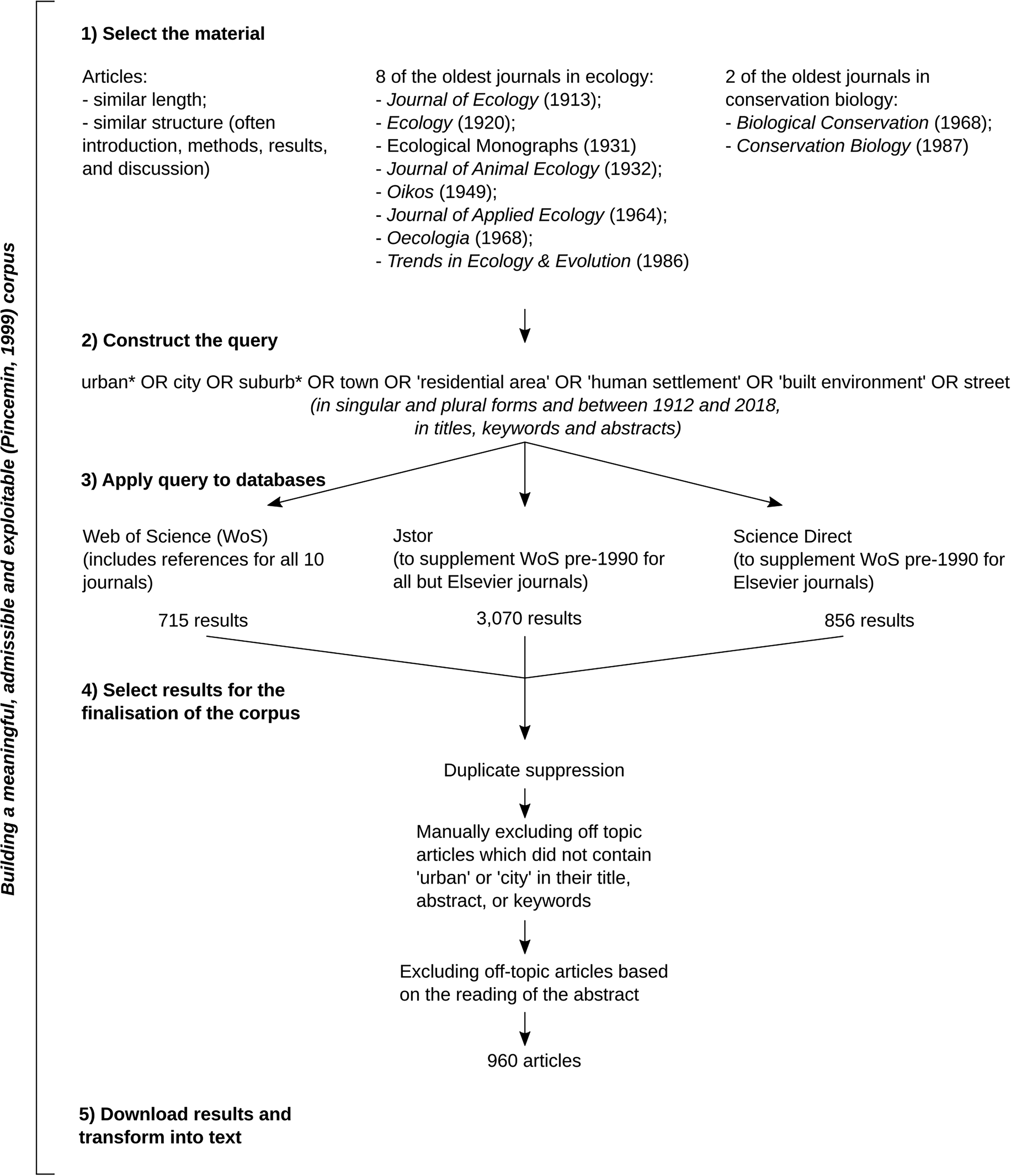
The steps for construction of the corpus. Step 1: We selected the journals on which we chose to focus. Step 2: We identified articles based on a broad query. Step 3: We performed searches in three databases: Web of Science (WoS), JSTOR and ScienceDirect. The latter two were used to limit the biases of WoS, for which the information on its articles, such as the abstracts, is often incomplete for papers published before 1990. Step 4: We sifted through the results: For the articles which did not contain the words ‘urban’ or ‘city’ in the title or abstract, we performed a manual check. We read the abstracts of the remaining 1105 articles to exclude from the corpus papers that only made marginal reference to urban areas or urbanisation. Step 5: We collected the articles in PDF format and batch converted them into text files (using the open-source command-line utility pdftotext, and the online tool PDF2Go when the characters were not recognised in the PDF file). Finally, we semi-automatically (using the open-source programs Regexxer and Notepad + +) erased information from the articles which risked biasing the textual data analysis or interrupting the text structure such as author names, journal names, acknowledgements, and figure and table titles.
We built a query and applied it to three different databases, downloaded the results and finalised the corpus on a qualitative basis (Figure 1). For each article we then read the abstract and the introduction (Figure 1) as well as the methods section in order to identify whether it was primarily empirical or conceptual (e.g. a review article, an article based on laboratory research, etc.).
Analysing the corpus: Textual data analysis in practice
To explore our corpus and identify recurring ideas, we used the open-source program TXM (Heiden et al., 2010) which offers a wide range of statistical tools but also allows for qualitative analyses.
First, from a quantitative perspective, we explored the corpus using the ‘co-occurrence’ 1 function, which generated a list of words commonly associated with the words ‘urban’, ‘city’ and ‘urbanisation’.
Second, we used the ‘concordance’ 2 function to understand the context in which these words were used. In parallel, from a qualitative perspective, through the reading of the abstracts and the introductions of the papers, we identified other words and expressions that were used to describe cities or urban processes, then looked up their frequencies and considered their concordances to see whether they were used in other papers and to observe the contexts in which they were used. The thresholds used to identify expressions (and notably the distance between two words) were determined by the reading of the abstracts and introductions and adjusted through the observation of our first results.
Third, we explored the evolution in time of the occurrences of the words or expressions using the ‘progression’ 3 function.
Fourth, based on these findings regarding co-occurrences, concordances and the over time in the frequency of words or expressions, we sought to determine the main ideas associated with cities and chart their development.
Throughout the analysis, we alternated between quantitative and qualitative methods and constantly returned to the text (which was greatly facilitated by TXM since the program enables navigation between the results of the quantitative analysis and a full view of the texts) to understand the context in which the words or expressions were used.
Ecology and the city: trends in ecological publications and in ideas relating to the urban
In this section, we briefly describe the distribution in time of the papers which compose our corpus and identify three main periods in the publication of articles on cities and urbanisation: 1920–1970, 1970–2000 and 2000–2018 (see the sub-section Three main periods in the publication of articles on cities and urbanisation). We then focus on the successive rise of nine themes relating to cities and urbanisation which we identified through the textual data analysis, taking on salience in the first period (threats, pests, refuges) (see the sub-section Ideas on cities and urbanisation originating in articles pre-1970: Threats, pests, refuges), the second period (fragmentation, gradients, pollution) (see the sub-section Ideas from the 1970s onwards: Fragmentation, gradients, pollution) or the last period (homogenisation, planetary urbanisation, planning) (see the sub-section New ideas since 2000: Homogenisation, planetary urbanisation, planning).
Three main periods in the publication of articles on cities and urbanisation
A quick overview of the distribution of the articles in the corpus according to their publication year shows that before the 1960s, few articles focus on or mention urban areas or urbanisation, no more than three per year, and some years there were no articles at all (Figure 2). On average the articles in the corpus represent 0.4% of the total number of articles published in the journals in this period, a proportion not very relevant given the small number of articles published at the time.
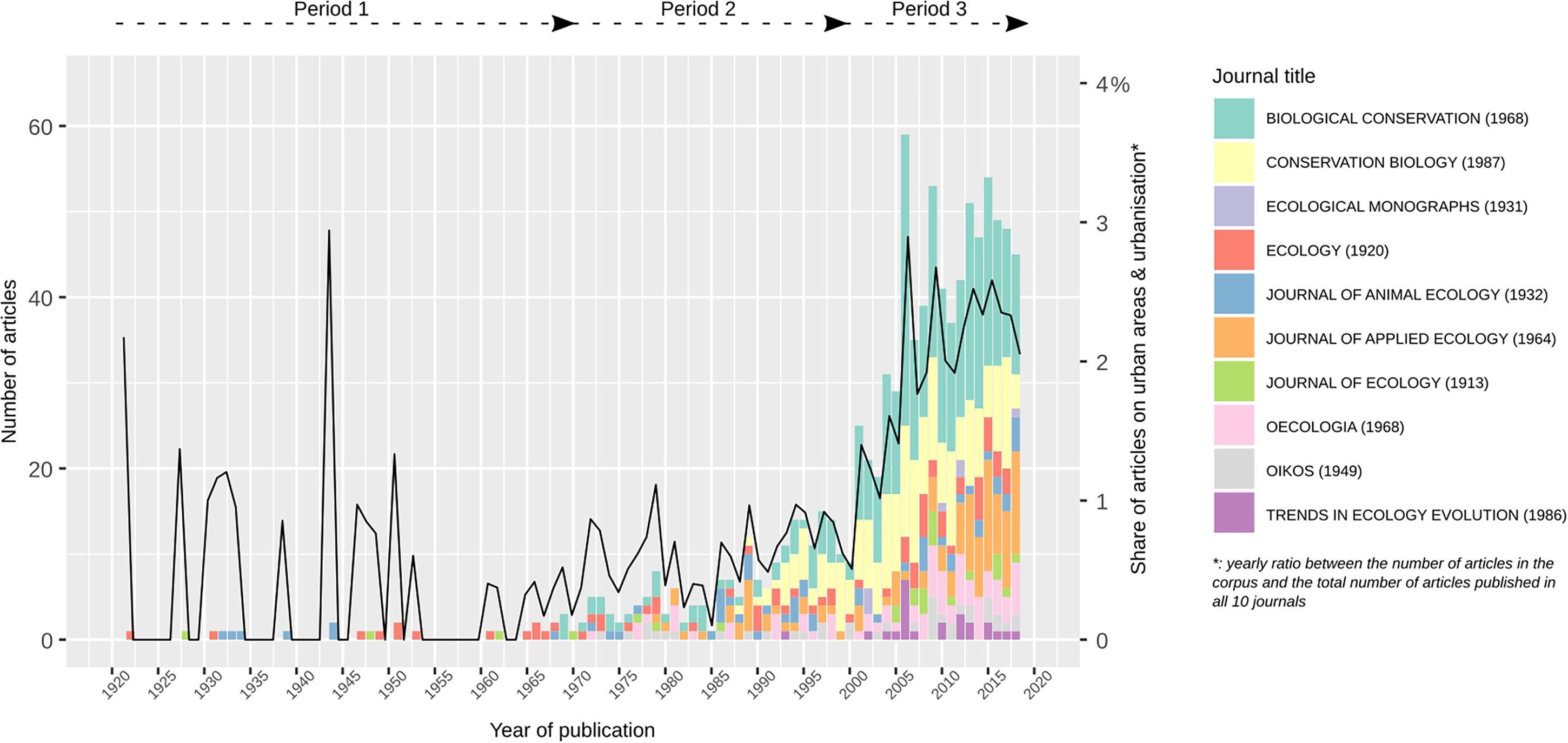
Publications in ecology on cities based on our corpus (n = 960). Stacked bars correspond to the y-axis on the left and represent the number of articles on an urban topic per year for the 10 journals. The y-axis on the right represents the ratio between articles on urban areas and urbanisation and the total number of articles published on any topic in all ten journals considered, represented by the continuous black line.
After 1970, there is more focus on cities (Figure 2), with at least one article per year, and often more, in the corpus between 1970 and 2000, comprising an average 0.6% of all ecology publications in this period and with fewer extreme values in the ratio curve. Very shortly after their founding, the conservation-oriented journals began to regularly publish articles on urban areas and urbanisation, with 53 articles on the topic in Biological Conservation, and 39 in Conservation Biology, between 1969 and 2000.
In the 2000s and the 2010s, the average number of articles per year in our corpus reached 38.6, and the percentage of all articles published in the journals – which never went below 0.5% – reached 1.9% between 2000 and 2018 (Figure 2). The increase appears to be particularly strong in the early 2000s; after 2005 the yearly proportion oscillates between 1.8% and 2.6%. This development therefore does appear substantial during this period and is not limited to specific journals.
Ideas on cities and urbanisation originating in articles pre-1970: Threats, pests, refuges
From the 1920s to the 1960s, a few articles provide detailed descriptions of cities, describing the structure of the city or of buildings within the city, and even the construction materials used for housing: The Baltimore city block is characterized by 2- or 3-story brick structures arranged in solid rows facing the streets, and having narrow back yards which extend to an alleyway which usually runs the length of the block. Solid wooden fences constructed along the property lines generally separate the yards in the rear. Portions of many yards are paved with concrete or brick, which, when defective or improperly constructed, form excellent harborage for rats. (Orgain and Schein, 1953: 467)
However, in articles published in this period, cities are rarely defined, and few articles have strong conceptual dimensions. Nonetheless, from the 1920s, cities and urbanisation seem to be associated with three different ideas: threats, pests and refuges.
Threats
During the first period, various articles present cities and urbanisation as changes in land use that should be studied because they represent ecological threats. Some authors express concerns regarding changes taking place at the time that were in part connected with the ongoing process of urbanisation. In the 1920s, Richards, a British botanist who specialised in the study of mosses, focused his research on different varieties of moss in the county of Middlesex (1928). He describes London as having already extended into Middlesex and states that ‘the rest of the county is covered with towns, villages and suburbs, all increasing so rapidly that it will be soon be possible to consider the whole of it as part of the “Greater London” ’ (p. 271). A few years later, in a study on house martins (Delichon urbicum) and swallows (Hirundo rustica), ornithologist Cramp and his colleague Ward (1934) begin a paper by recounting what appears to be an ongoing debate on the decline of certain species and its possible link to spreading urbanisation: Some believe that the considerable slaughter of the migrating birds which occurs annually at numerous places on the Continent is largely responsible [for the species’ decline]. Others suggest that modern civilisation is the real cause – the number of suitable nesting sites, particularly in the case of the swallow, being reduced by the continuous process of urbanisation, whilst the now almost universal method of tarring roads affects both the supply of mud for nesting purposes, and the insect life which is their sole source of food. (p. 2)
Engineer and conservationist Preston and his colleague Norris (1947), members of the Ecological Society of America, underline that the ‘distribution [of bird nests] appears to be interesting of itself, and to permit a simple quantitative study of the effect of the coming of an urban, or suburban, civilization into a rural environment’ (p. 242).
These three studies all conclude by highlighting the negative consequences of urbanisation. Richards (1928) expresses concerns regarding the loss of species diversity which he attributes to urbanisation. Cramp and Ward (1934) conclude that ‘the spread of houses appears to have a definite adverse effect upon the swallow’ and a more moderate effect on house martins whose distribution has become ‘patchy’ (p. 6). Preston and Norris (1947) assert that birds encounter ‘perpetual alarms’ in suburban areas and that ‘when we reach the conditions of downtown Manhattan we are left with a few hole-nesting species like the house sparrow and starling, with feral rock-doves, and perhaps a duck-hawk or two’ (p. 272). The consequences of urbanisation are also put forward through comparative studies, and in particular studies which compare urban environments with rural ones (Neville, 1968; Winterbottom, 1933).
Papers published between 1970 and 2000 continue to describe and analyse the ongoing process of urbanisation and its negative consequences in ecological terms (Figure 3). In some cases, urbanisation is overtly presented as a ‘threat’. Urbanisation is not the only process presented by ecologists as endangering ecosystems and biodiversity; the extent of agriculture (Cardel et al., 1997: 19) or changes in agricultural practices (Goldsmith, 1974) are also often described in similar terms. Moreover, only a few papers adopt a strong critical tone towards the process of urbanisation. This quote, from an article on great tits (Parus major) and blue tits (Parus caeruleus) in suburban Cardiff, is representative of some of the critical statements made by ecologists, with zoologists Cowie and Hinsley (1988) simply beginning the introduction with statistics they consider ‘alarming’ and necessitating ecological investigation: In the last 40 years approximately 40% of the ancient and semi-natural woodlands in Britain have disappeared (Grove 1983) and up to 11% of England and Wales is now classified as urban land (Best 1981). Despite these alarming statistics little research has been directed at discovering how our wildlife populations are adapting to this rapidly changing environment. (p. 611)
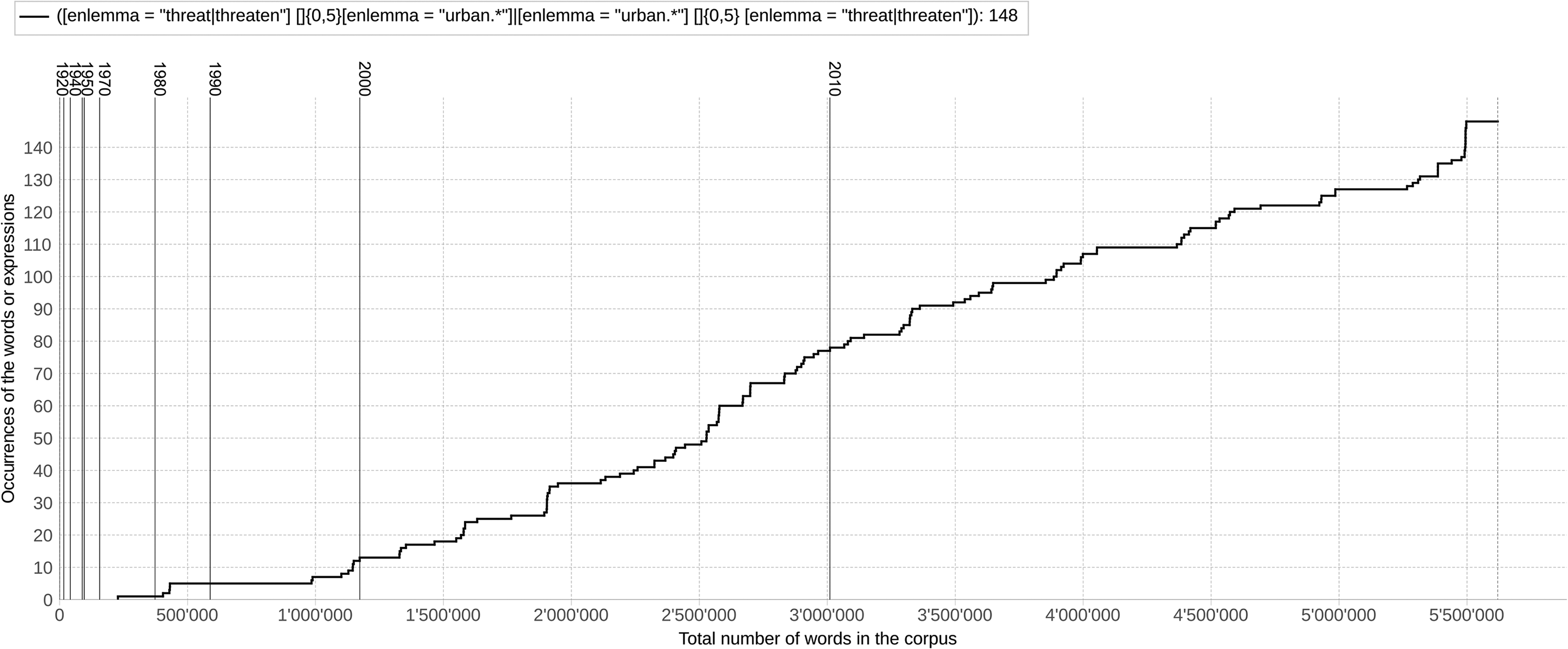
Cumulative frequency of all expressions containing the words ‘threat’ and ‘urban’ separated by no more than five words (e.g. ‘threats arising from urbanisation’, ‘threatened by urban development’) throughout the corpus. The figure illustrates how such expressions first appear during the 1970s yet are mostly used in post-2000 articles. The general trend is close to being linear between 2000 and 2018.
They continue their article by describing their method and results and do not bring up land-use changes and urbanisation in their discussion.
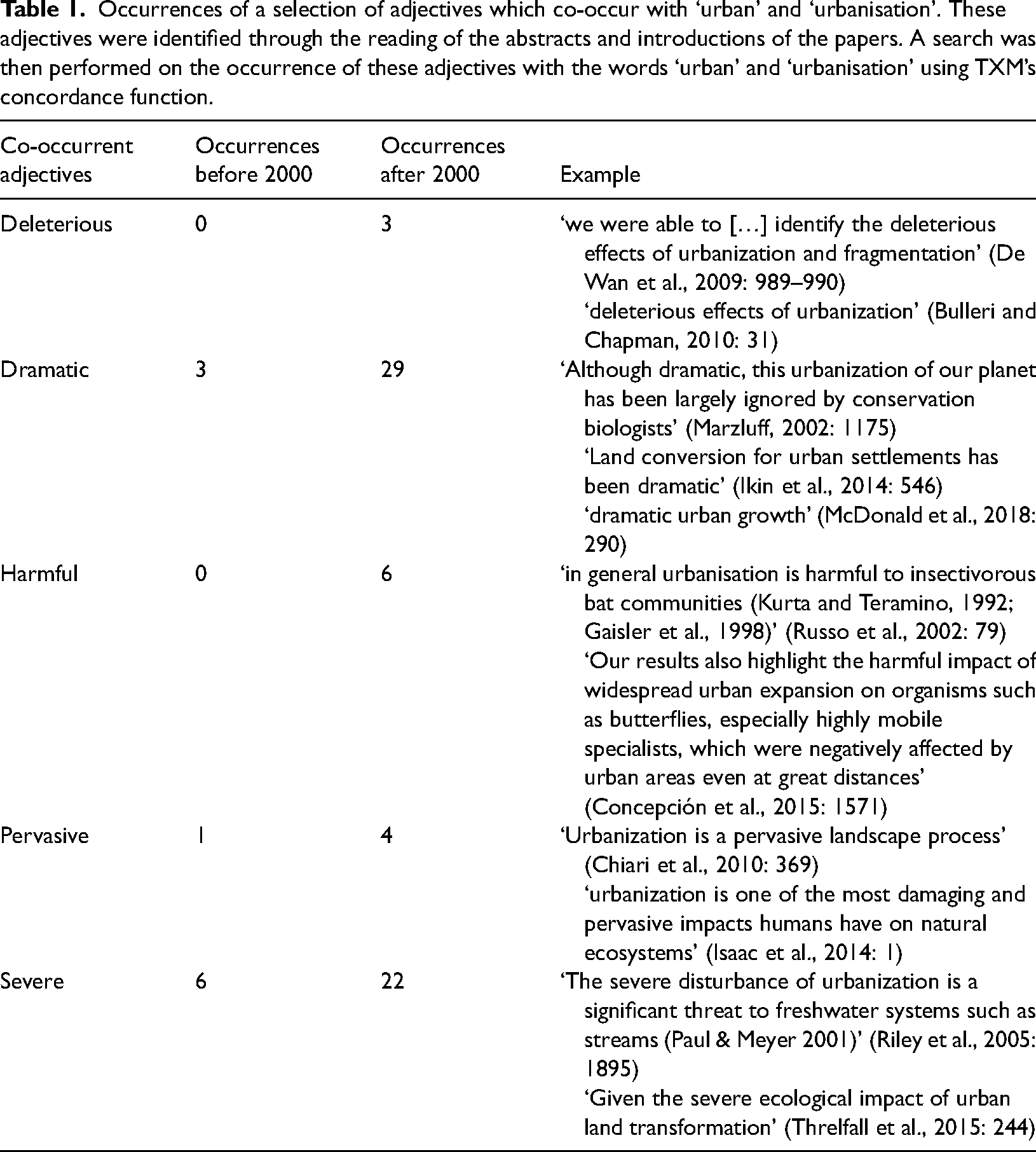
In later papers, and in papers published after 2000, the ongoing process of urbanisation is more frequently associated with the idea of threat. The words ‘urban’ or ‘urbanisation’ and ‘threat’ or ‘threaten’ appear together 148 times in 84 papers published between 2000 and 2018 (Figure 3); taking a closer look at the content of these papers, our qualitative analysis shows that these occurrences mostly highlight the negative consequences of urbanisation. Some authors begin their abstracts or introductions by characterising urbanisation as a menace and briefly describing its effects on the object of their study, e.g. ‘Urbanization and habitat fragmentation are major threats to wildlife populations’ (Riley et al., 2003: 566). Such assertions often appear with references to previous work, revealing the importance of the trope of urbanisation as a threat, which extends beyond the corpus: ‘Urban habitats are expanding throughout the world, and the processes of urbanization threaten the persistence of many plant and animal species (Burgman & Lindenmayer 1998; McKinney 2002)’ (Parris, 2006: 757). Adjectives with negative connotations or stressing the impact of the environmental changes are also used to describe urbanisation (Table 1).
Occurrences of a selection of adjectives which co-occur with ‘urban’ and ‘urbanisation’. These adjectives were identified through the reading of the abstracts and introductions of the papers. A search was then performed on the occurrence of these adjectives with the words ‘urban’ and ‘urbanisation’ using TXM’s concordance function.
Pests
Within the corpus, much attention is paid to pest, unwanted, invasive or exotic species. Various articles from the first period hint at a growing interest in – from a scientific point of view – and concern about – from both a scientific and social perspective – unwanted species which, according to the articles, seem to thrive in urban areas. The focus is mostly on animal species, from terrestrial gastropods such as slugs (Barnes and Weil, 1944) to mammals. In the latter case, ecologists expressed a concern on the relation both between animals and other nonhuman and living entities and between animals and humans. For example, Matheson (1944), a zoologist from the National Museum of Wales, in his study on cats in Cardiff and Newport, highlighted the need to quantify the cat population, including ‘stray and unwanted cats’ (p. 133), in order to better understand ‘other species in the urban fauna’ and consider ‘the relations of the cat to human health’ (p. 132).
Research continues to be carried out on unwanted species after 1970. Diseases such as rabies (Figure 4) and the risk these diseases could represent in densely inhabited areas are put forward as a reason to study specific species such as foxes. This argument is advanced by a team in Bristol, directed by zoologist Harris, who conducted a series of studies on urban foxes (Vulpes vulpes) – ‘In the event of a rabies outbreak in urban foxes, information will be needed on the numbers and distribution of foxes in urban areas’ (Harris and Trewhella, 1988: 435) – and by other researchers in Edinburgh (Kolb, 1984) and in Oxford (Doncaster and Macdonald, 1996). In most papers from this second period, no judgements are made regarding the urban environment, though in one article, on house crows (Corvus splendens) in Mauritius, the authors suggest ‘improvements in urban hygiene’ as a measure of crow ‘population control’ and to prevent further ‘urban and environmental problems’ (Feare and Mungroo, 1990: 63).
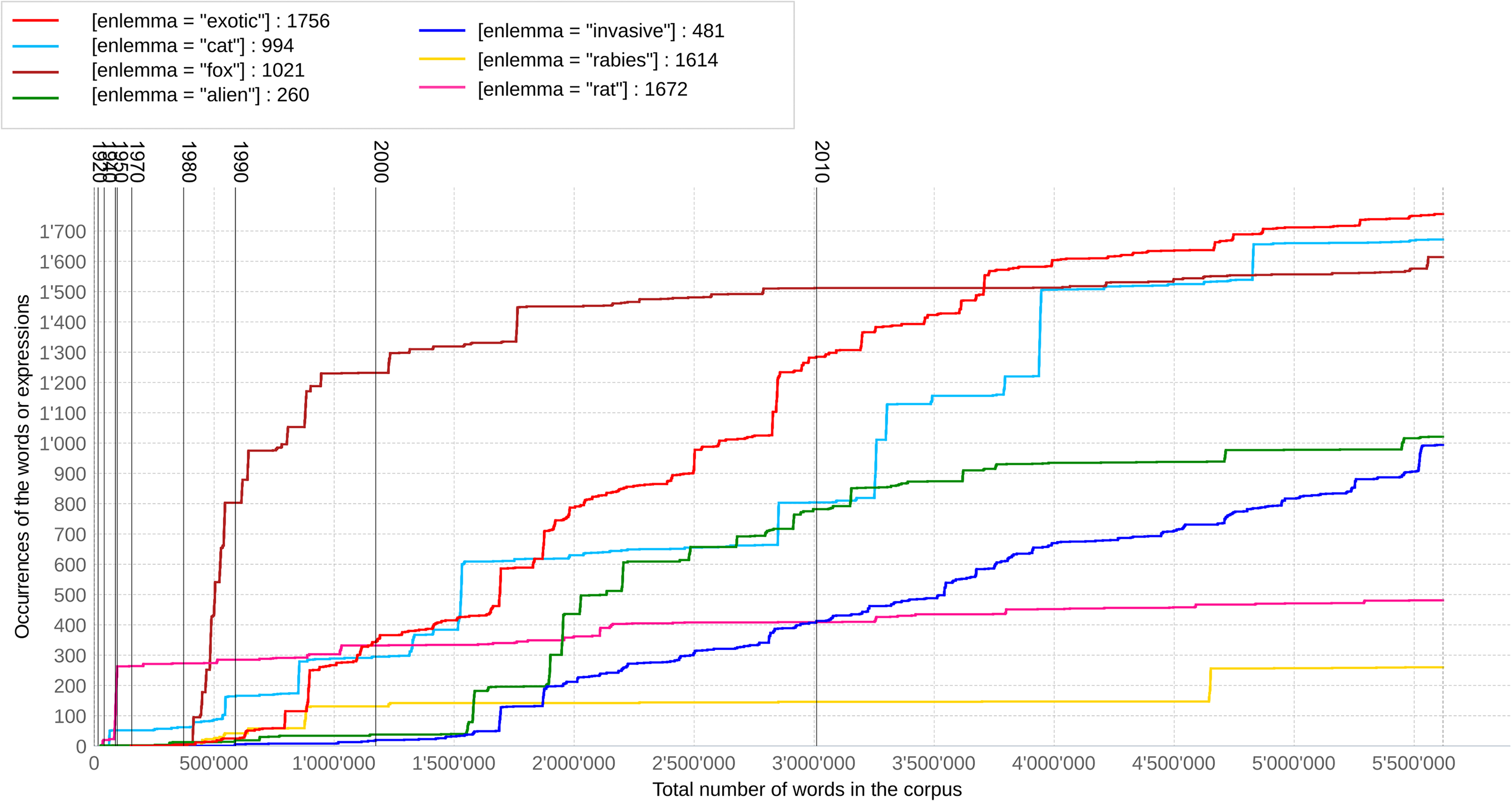
Cumulative frequency of the words ‘exotic’, ‘cat’, ‘fox’, ‘alien’ ‘invasive’, ‘rabies’ and ‘rat’. The figure shows the number of occurrences of different words – adjectives such as ‘exotic’, ‘invasive’, ‘alien’, names of diseases such as ‘rabies’, or names of species – that epitomise the idea of pests throughout the corpus. Some unwanted species are primarily mentioned in articles before the 1970s, e.g. rats, and others mostly in articles from the 1980s and 1990s, e.g. foxes. ‘Alien’, ‘exotic’ and ‘invasive’ species have mostly become a concern since the 2000s. Overall, the figure illustrates the durability of the topic of unwanted species, even if the species under study have changed through the study period.
Towards the end of the second period, particularly during the 1990s, and during the third period, more and more studies are published on ‘exotic species’ and on ‘invasions’; the words ‘exotic’ and ‘alien’ in particular are more and more used (Figure 4). The development of exotic species in urban environments becomes topical and urban areas are represented as specifically vulnerable to invasions: ‘Urban centers act as refugia for exotic species, many of which probably cannot invade sites with more pristine habitat’ (Smallwood, 1994: 256). The idea of the city as a haven for unwanted and exotic species gains momentum. In a paper on the Hemidactylus frenatus gecko in urban and suburban areas of the Pacific basin, ecologists Petren and Case (1996) underline some characteristics of urban environments which explain the species’ success – ‘clumping of food resources, high resource levels, and reduced structural complexity of the urban environment’ (p. 119) – and conclude that their ‘results implicate human activity as largely responsible for facilitating this invasion and the resulting competitive displacement. Humans created urban habitats, producing favorable situations for population growth and range expansion of the invader’ (Petren and Case, 1996: 119). In articles published after 2000, increasing efforts are made to explain why alien species thrive in urban areas, for example, by conducting for example genetic analyses on plant species (Ricotta et al., 2009).
Refuges
Right from the earliest publications, some studies have stressed that urban areas can also, in some cases, offer features attractive for plant and animal species and may possibly have some positive effects, including in terms of diversity. Cambridge botanist Rishbeth (1948) pointed out the variety of plants growing on his city’s walls. He attributed it not only to the material of construction of the buildings (brick and not concrete) but also to the ‘freedom of the town from smoke’ (Rishbeth, 1948: 137) in comparison with other cities and towns. Wynne (1932) offers a second example of the positive effects that urban areas may have on living species. He expresses a sense of surprise having observed, in a survey on the rookeries of the Isle of Wight, that ‘there are quite a number of rookeries actually in the towns’ (p. 170–171). Neither of these authors draw conclusions suggesting that specific modes of urbanisation may have positive effects from an ecological point of view; nonetheless these examples show that urban areas, possibly small ones, for ecologists may not necessarily have adverse effects on species numbers and diversity.
The question of the best urban models for guaranteeing favourable habitats appears in later articles published towards the end of the 1960s. In a short article Lord Hurcomb (1969), chairman of the committee on Bird Sanctuaries in the Royal Parks, presents London as a city which harbours biodiversity through ecological corridors and parks. He insists on the benefits parks offer for conservation in cities: ‘in spite of the inevitable increase in population pressure, wildlife can be enabled to hold its own, and some further species may be enticed to enter’ (Hurcomb, 1969: 169). All three examples, in different ways, suggest that some forms of urbanisation may be compatible with plant and animal species diversity. More generally, these results suggest that positive ideas regarding cities are also present in some articles published before the 1970s.
Later articles also advance this positive correlation between urban areas and the development of certain species, with authors sometimes expressing a sense of surprise at their results. For example, in an article on British alien and native urban plants, Thompson and McCarthy (2008) write: ‘At first sight, the strong tendency for success in urban habitats to be linked positively to plant height is surprising, given that cities are generally regarded as rather disturbed places, which might be expected to favour ruderality’ (p. 857). Some authors were led to nuance the ‘threats’ represented by urbanisation in the introductions of their papers, for e.g., ‘Urban development poses some of the greatest threats and challenges for biodiversity conservation in the 21st century […]. Yet it has been shown that cities can harbor a rich diversity of species that sometimes even exceed that found in neighboring greener environments’ (Shwartz et al., 2013: 285). While the data and conclusions vary considerably according to the species analysed, some authors portray cities as possible refuges for endangered species (Calver et al., 2011; Dearborn and Kark, 2010; Hall et al., 2017).
Ideas from the 1970s onwards: Fragmentation, gradients, pollution
Since the 1970s, ecologists have paid increasing attention to the characterisation of cities and have associated them with various ideas, particularly around the themes of fragmentation and gradients, that support different views of the city and inform definitions of cities and urbanisation. Cities also began to be described as polluted places as pollution became topical in the second period.
Fragmentation
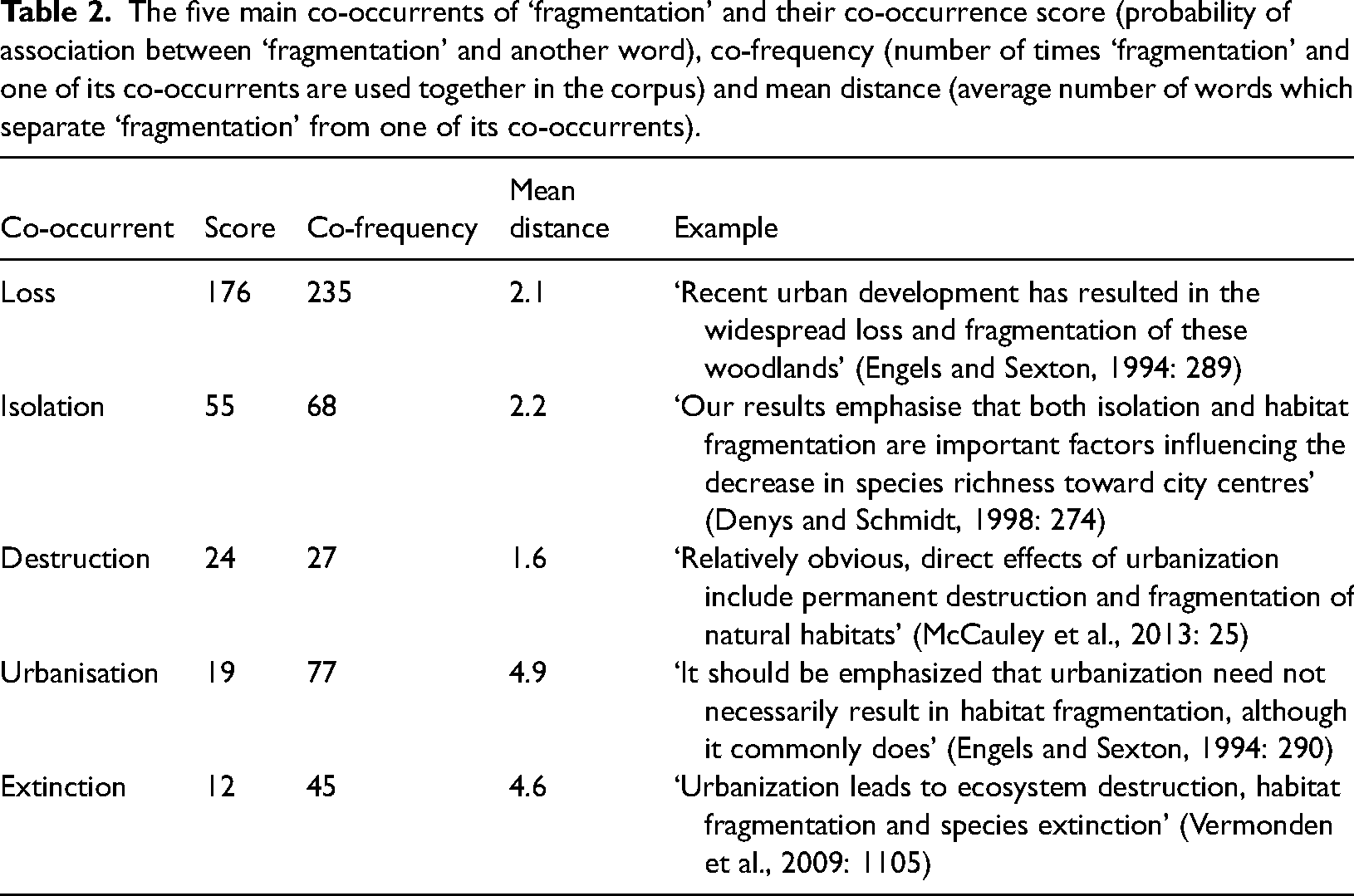
After 1970, the metaphor of the fragment is used to characterise the structure of cities; cities are portrayed as made up of different fragments. This conceptualisation of cities is inspired by ‘fragmentation research’ and the heritage of island biogeography (Haila, 2002). When describing the city parks of Cincinnati, biologists Faeth and Kane (1978) compare the parks to islands and show that ‘Diptera and Coleoptera in these parks are as isolated as many species which occur on true oceanic islands’ (p. 127). The areas beyond the parks’ limits within the city of Cincinnati are likened to an ocean: ‘Each park is a forested, or at least partially forested, island-like area surrounded by an urban “ocean” that is presumably less inhabitable to the insects studied’ (Faeth and Kane, 1978: 128). Towards the end of the 1980s and in the 1990s, fragments are described more and more notably in relation to infrastructure and its influence on borders within cities: ‘A conspicuous consequence of urbanization is that it fragments the natural environment into a mosaic of patches of differing size and shape. […] Patches are usually surrounded by cleared areas, roads, buildings and other man-made environments, and, in general, become smaller and more isolated towards the urban centre’ (Dickman, 1987: 337). In many articles, urbanisation is presented as a land-use change producing fragmentation which in turn may lead to species isolation, extinction and more generally habitat degradation or loss (Table 2).
The five main co-occurrents of ‘fragmentation’ and their co-occurrence score (probability of association between ‘fragmentation’ and another word), co-frequency (number of times ‘fragmentation’ and one of its co-occurrents are used together in the corpus) and mean distance (average number of words which separate ‘fragmentation’ from one of its co-occurrents).
Gradient
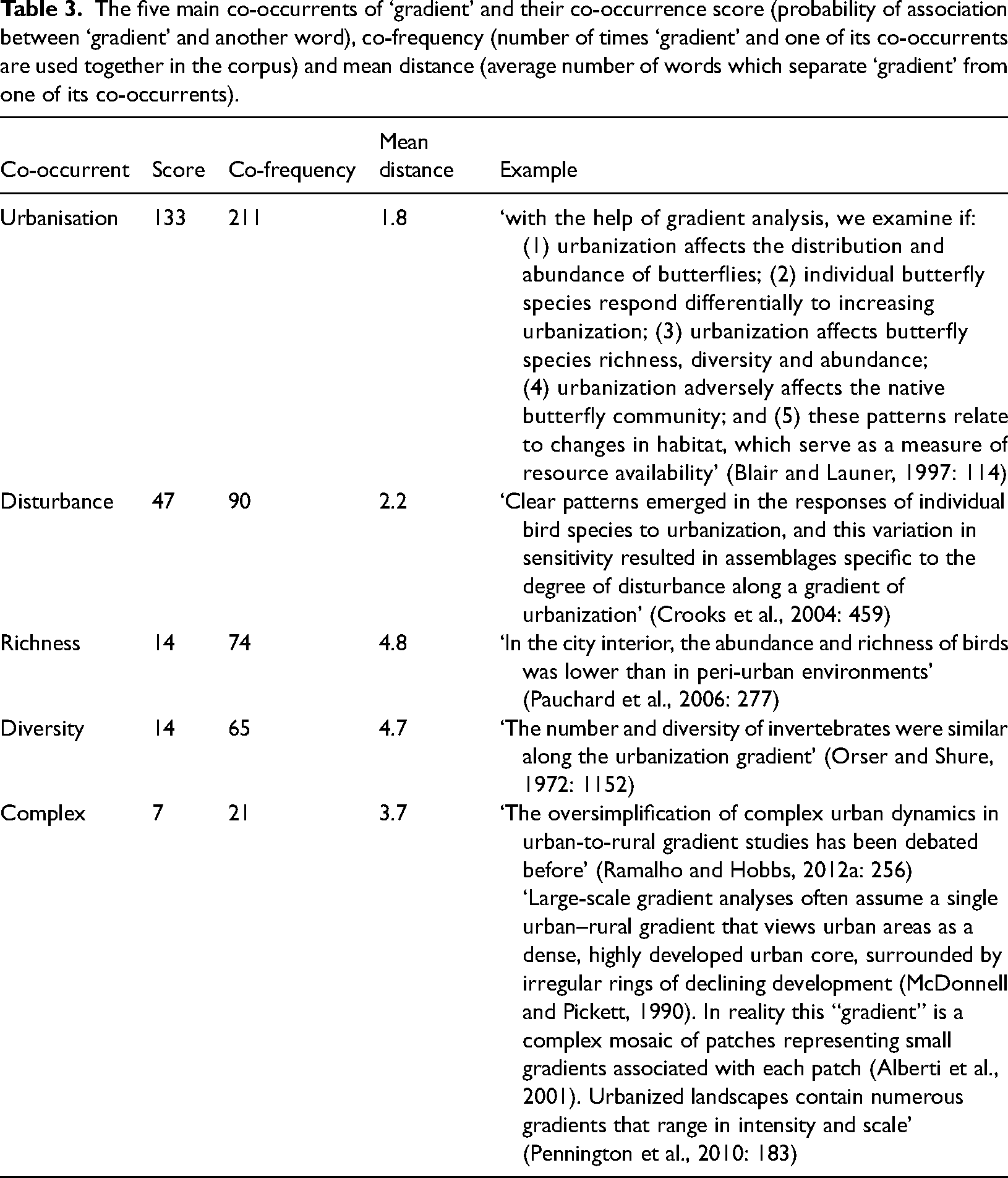
‘Gradient’ refers to a paradigm and a method developed by ecologists for studying change along a transect. The concept is evoked in a 1944 article but is mostly used in papers published after 1970. Applied to cities, it is mobilised to describe and analyse ‘the gradients of change that occur in ecosystems as one moves from rural to urban environments’ (Matson, 1990: 1231). The gradient is also used to characterise the shape and structure of cities. In an article on lichen in Freiburg (Germany) and ‘injurious anthropogenous influences’, botanists Wirth and Brinckmann (1977) explain that urban infrastructure such as streets and roads can be considered as gradients: ‘That such a gradient might exist was suggested by the fact that the avenue runs radially towards the city center’ (p. 88). The idea was popularised with the publication of a special issue in Ecology in 1990 (Matson, 1990) which includes McDonnell and Pickett’s (1990) seminal article ‘Ecosystem Structure and Function along Urban–Rural Gradients’. In this paper, the authors describe the city by distinguishing a dense centre from more scattered forms of development in the periphery: ‘Because urban areas appear so often as a dense, highly developed core, surrounded by irregular rings of diminishing development (Dickinson 1966), the gradient paradigm is a powerful organizing tool for ecological research on urban influences on ecosystems’ (McDonnell and Pickett, 1990: 1233). The ‘gradient’ is often used to reveal centre–periphery contrasts – possibly masking other urban characteristics (Table 3) – and differences between areas considered as ‘urban’ and others as ‘nonurban’ or even ‘natural’, especially in terms of species diversity and richness (Pennington et al., 2010; see Tab. 3). While the gradient is often used to describe levels of disturbance (Table 3), in some cases this approach also leads to highlighting similarities between different areas that are, more or less urbanised (Table 3).
The five main co-occurrents of ‘gradient’ and their co-occurrence score (probability of association between ‘gradient’ and another word), co-frequency (number of times ‘gradient’ and one of its co-occurrents are used together in the corpus) and mean distance (average number of words which separate ‘gradient’ from one of its co-occurrents).
Pollution
After 1970, many articles examine pollution and its forms considered to be particularly pronounced in cities. Until the early 1990s the focus was mostly on water pollution (Jaag, 1972; Jusi, 1989), air pollution (Cao, 1989; Johnsen and Søchting, 1973) and heavy metal pollution (Johnson et al., 1978), in particular in relation to industrial activities (Figure 5). Links between urban development and pollution are described and asserted by ecologists; for example, zoologists Dallinger et al. (1992) begin their article on terrestrial isopods by stating that ‘[e]nvironmental pollution by toxic metals is widespread in urban areas’ (p. 32). Mostly, the focus is on habitat degradation or species decline in connection with urban pollution. Some authors even describe cities as ‘deserts’ for certain plant species due to pollution: ‘Within the city […] hardly any epiphytic lichens are found at SO2 concentrations in the air exceeding 0.10 mg/m3 (Kirschbaum et al., 1971). Such an area is termed a lichen desert and has been described in many urban centers’ (Lotschert and Kohm, 1977: 61). Others, however, have highlighted that some urbanised and polluted areas can nevertheless host biodiversity: in a review paper, ‘Wildlife, Urbanisation and Industry’, one author states that ‘[e]xcept in the most highly disturbed or polluted areas […] natural recolonisation by plants and animals takes place and a new equilibrium is established’ (Davis, 1976: 249). Finally, recent articles, mostly published after 2010 (Figure 5), highlight other forms of pollution such as light pollution (Gaston et al., 2012; Minnaar et al., 2015) and noise pollution (McMahon et al., 2017).
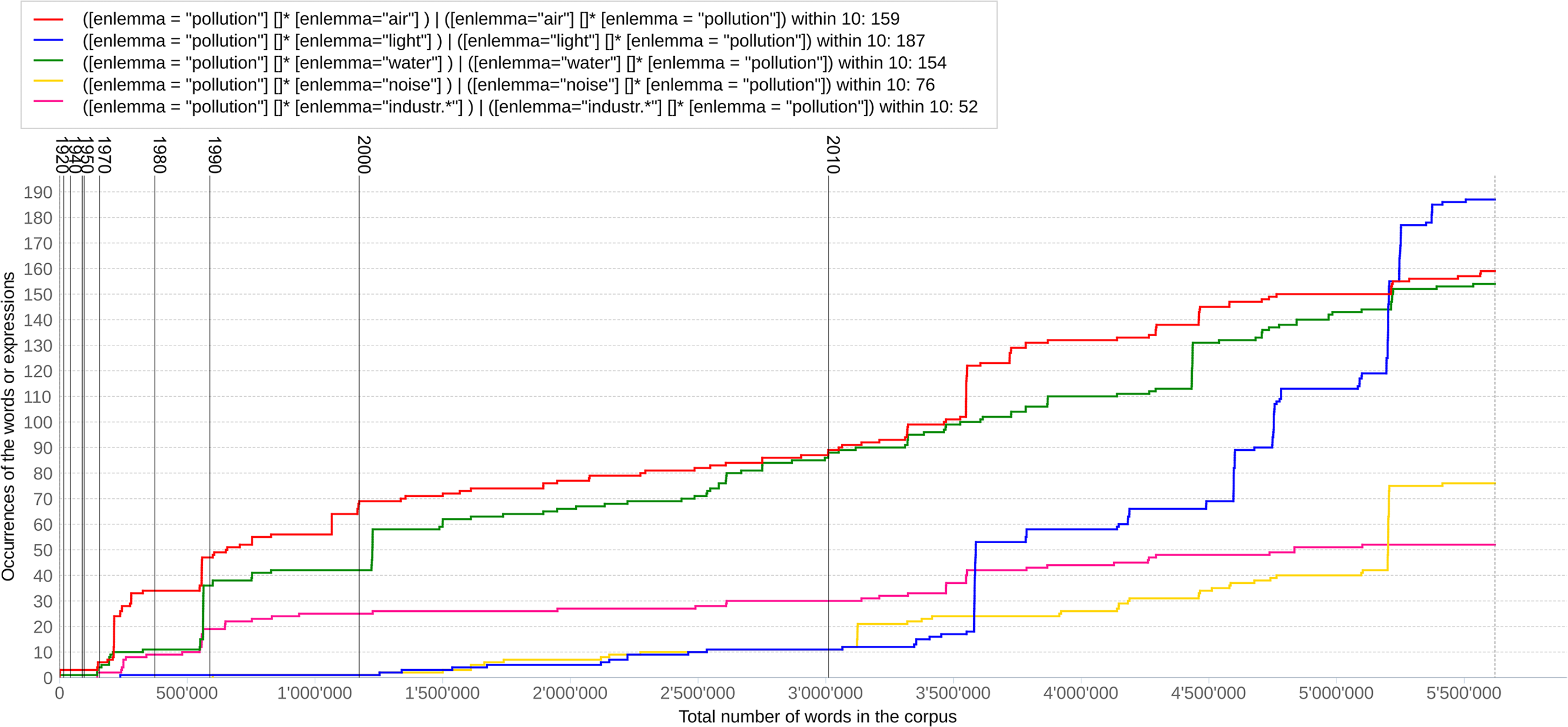
Cumulative frequency of the words ‘pollution’ and ‘air’, ‘pollution’ and ‘light’, ‘pollution’ and ‘water’, ‘pollution’ and ‘noise’, and ‘pollution’ and words beginning with ‘industr’, within a distance of ten words. The figure shows the number of occurrences of different expressions with relating to pollution (e.g. ‘light pollution’, ‘pollution of the air’, ‘pollution caused by industry’). The figure shows that such expressions hardly occur before the 1970s. Air and water pollution occur particularly from the 1970s to the beginning of the 1990s. The occurrences of the different expressions continue during the 1990s and 2000s but are less numerous with respect to the previous decades. After 2010, there is a surge in the occurrences of different types of pollution, particularly regarding light and noise pollution.
New ideas since 2000: Homogenisation, planetary urbanisation, planning
Since the 2000s, ideas formulated on cities and urbanisation in ecology have become more and more specific and structured. Debates have arisen relating to ideas about ecological homogenisation, planetary urbanisation has been increasingly referred to, and ideas have been formulated in relation to planning.
Homogenisation
Since 2000, conceptual papers have been more and more common (17.4%) and various definitions of ‘urban’ and ‘urbanisation’ appear in the corpus, both in conceptual articles and in empirical ones in the presentation of the methodological framework and description of the research subject. These definitions combine different elements such as land-use (Bonnington et al., 2013), building structure (Moller, 2009) and human density (Shochat et al., 2006). As cities are more and more often defined and conceptualised, the articles engage in debates on the nature of cities and urbanisation, and in particular on their spatial and ecological unity/diversity in relation to the concept of ‘homogenisation’. For example, ecologist McKinney (2006) explains that ‘urbanization is one the most homogenizing activities of all’ (p. 248). He connects this statement to the ‘uniform nature of cities’ and considers that ‘cities are habitats constructed almost exclusively to meet the relatively narrow demands of just one species, Homo sapiens’ (McKinney, 2006: 248). This leads him to conceptualise cities as spatial entities which vary very little from one to another: ‘cities are physically very similar throughout the world: roads, skyscrapers, and residential housing in the suburbs are almost indistinguishable’ (McKinney, 2006: 248).
However, some papers underline the diversity and the spatial and ecological complexity of cities, for example by stating that ‘urbanisation is a complex process that cannot be simplified to urban areas vs. non-urban areas’ (Clergeau et al., 2006: 337), by defining cities as ‘heterogeneous mosaics’ (Matteson et al., 2013), by recalling that ‘[u]rban ecologists are fully aware that modern cities do not develop as concentric rings, but instead grow in […] spatially and temporally complex, non-linear ways’ (McDonnell et al., 2012: 255) or by putting forward differences between urban ecosystems in developing and in industrialised countries (Pauchard et al., 2006).
Finally the uniqueness of cities is also described in some recent papers to oppose the use of the concept of homogenisation with regards to cities, and calls are made to integrate into ecological studies elements on the history of a city, its urban development and its connection with other places. The uniqueness of each city is for example hinted at in a recent paper by a team of ecologists focusing on human influence on ‘community assembly’: ‘Literature on biotic homogenization suggests that the common features of cities – impervious surface, fragmentation of green space, high rates of disturbance from human activities, area dedicated to lawn – create conditions that promote the selection of species with similar traits and life histories. Yet, each city is unique because of its development history, demographics, cultural attributes, types and density of infrastructure, and the amount and connectedness of green space’ (Aronson et al., 2016: 2955).
Planetary urbanisation
Since the 2000s, ‘planetary urbanisation’ is commonly referred to in opening sentences in our corpus, not necessarily framing the process as negative but merely describing it as change. For example, Pickett, an urban ecologist specialised in the ecology of plants and former director of the Baltimore Ecosystem Study, and landscape and urban ecologist Cadenasso (2008) mention in an abstract that ‘[u]rban areas, including suburbs and exurbs, are expanding rapidly worldwide’ (p. 8).
The focus is also on the majority of the world’s population today being urban, e.g. ‘About 50% of the world’s people live in cities, and that proportion will continue to grow’ (Miller et al., 2004: 87). Such statements appear 75 times in articles published after 2000. 4 They are advanced not only to highlight the growing importance of urbanisation as a land use and way of life but also to justify the study of urban ecosystems. For example, after having presented urbanisation as an ecological threat, ecologists Teillac-Deschamps et al. (2009) explain in the introduction of their paper on the management of urban green spaces that ‘urban biodiversity cannot be simply ignored in conservation practices, at least because cities accommodate a majority of the global human population’ (p. 2259).
Planning
While references to ‘planetary urbanisation’ are common in opening sentences, the conclusions of many papers published after 2000 often present recommendations and represent cities and areas which may undergo urbanisation in the future as places in need of planning. Many authors conclude their papers by explaining how their results can ‘inform conservation’, ‘inform planning’ or ‘inform management’ 5 , and by suggesting ‘management recommendations’ or stating ‘we recommend’. 6 These recommendations can be either very specific – e.g. listing possible technical responses to light pollution (Bennie et al., 2018) – or more general – e.g. suggesting that ecologists must work hand in hand with urban planners to implement conservation measures (Goddard et al., 2010). Urban futures and their ecologies seem to have gained the attention of ecologists, who formulate two main ideas in relation to planning, often presented as complementary (Soga et al., 2014). The first is ‘land sparing’ (e.g. Lin and Fuller, 2013), with some authors making recommendations regarding future urban growth and underlining the importance of protecting areas which have not yet been urbanised. In particular, some ecologists suggest protecting specific areas such as urban fringes (Geschke et al., 2018) or keeping ‘relatively large consolidated greenspaces free from development’ (Soga et al., 2014: 1387). The second is to adapt urban planning within cities. For example, some authors call for ‘better-designed urban landscapes [to] sustain more biodiversity in the future’ (Pennington et al., 2008: 1236) and more generally engage discussions on how to ‘urbanize sustainably’ (Hall et al., 2017). As shown in their increasing emphasis in the conclusions of their articles on the practical implications of their research in urban environments, ecologists have, in the 2000s, sought to establish themselves as stakeholders in the futures of cities and their planning.
From an anti-urban imaginary to a complex and ambivalent urban imaginary in ecology?
Through a quantitative and qualitative analysis of a corpus of 960 articles published in ten long- standing journals in ecology, our paper critically examined whether the relationship between ecology and the city has been characterised by urban invisibility and an anti-urban bias. We considered how the number and proportion of papers on cities and urbanisation in ecological publications have changed over time, and based on a textual data analysis we identified and charted nine main themes on which ideas about cities have been constructed. In this last section, we discuss whether articles in ecology reflect an anti-urban imaginary and conclude by highlighting the contributions of our conceptual and methodological framework and its limitations.
First, our analysis of publications in ecology suggests that in a similar way to other fields of study relating to the environment, ecology has at least in part disregarded the urban. While urbanisation and urban places such as towns, cities or suburbs have never been completely absent from ecological publications, the number of papers published on these places and topics before 2000 was relatively small. This corroborates previous findings of an increase in such publications in the 1990s and even more so in the 2000s (Barot et al., 2019; Clergeau, 2010). Nonetheless, based on our corpus we were not able to confirm that the surge in publications has been exponential (e.g. Barot et al., 2019). The percentage of publications on cities may have quadrupled after 2000 in the journals we considered, but they still represent only 2% of all papers published in those journals between 2000 and 2018 (see the sub-section Three main periods in the publication of articles on cities and urbanisation). Instead, our results are relatively consistent with those of Miller and Hobbs (2002) in their study of a corpus of publications in biological conservation which sought to identify the proportion of publications that considered human settlements. Moreover, we have shown that until the 1970s, cities and urbanisation were not often defined, and they only seem to have been conceptualised as such in papers published after 2000. Altogether, our results suggest that from the 1920s to the 1970s, ecology was characterised as an ‘urban blind spot’ (Light, 2001) similar to other environmental research fields (Salomon Cavin and Kull, 2017), and that urban areas have been more visible since 1970, especially in recent years, even if they have not become a major study site for ecologists.
Second, through our analysis we identified a set of recurring themes relating to the city, between the 1920s and 2018 (Figure 6). Ideas based on these themes, such as the city and urbanisation seen as ‘threats’, evoke an imaginary in which nature and society are at odds with one another. Even if cities are not represented as threatening and infringing on nature, urban nature can be represented as ‘a threatening “other”’ (Biehler, 2010: 69) through descriptions of unwanted species or polluted places. Concepts used to study cities and urbanisation or describe processes relating to them, such as ‘gradient’, ‘fragmentation’ or ‘homogenisation’, tend to see the urban and the ‘natural’ as opposites. The comparisons between urban and rural environments in some of the early articles of our corpus, and which are frequent in papers mobilising the concept of gradients, have also been shown as frequently connected with an anti-urban imaginary (Salomon Cavin, 2013; Slater, 2002, 2009). Discussions of homogenisation – a process which is strongly associated with the idea of an overall loss and tends to essentialise the urban – are mostly recent, revealing that negative views of the city and urbanisation are not restricted to older papers. These results provide some indication of an anti-urban bias in ecology that may be present in papers old and recent. Nonetheless, our results also show that few articles adopt a truly negative vocabulary – e.g. adjectives such as ‘deleterious’ or ‘pervasive’ are used in only a few of the 960 papers that we analysed (Tab. 1) – and that some articles, even the earliest ones, associated the city with the more positive idea of a refuge. Moreover, gradient and fragmentation are examined as possible drivers of species diversity and composition within cities.
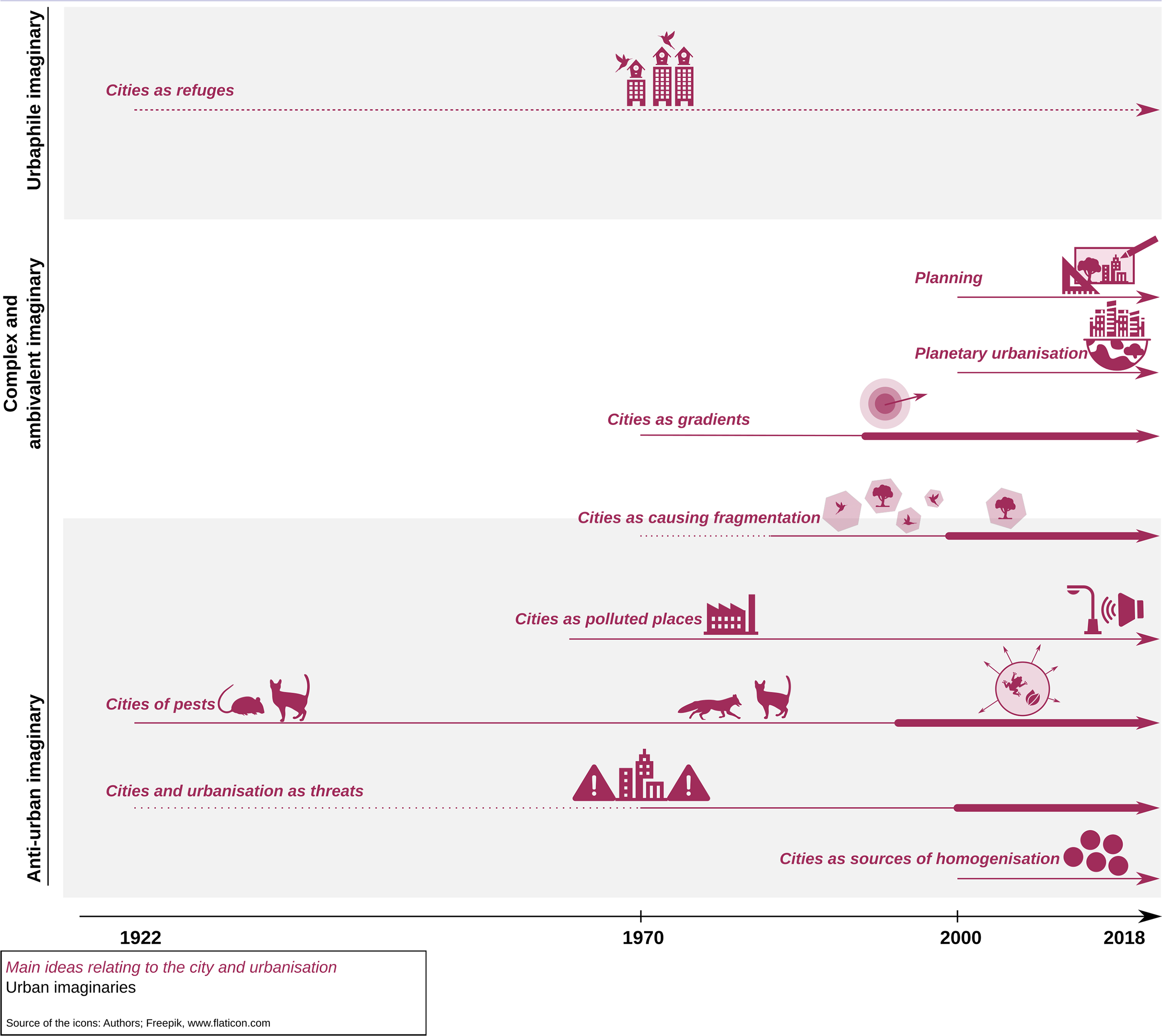
Towards a complex and ambivalent imaginary that goes beyond the anti-urban and the urbaphile. This figure summarises the different ideas on cities identified through the analysis of the corpus and their evolution in time. It relates them to three different urban imaginaries: Cities as anti-urban, cities as complex and ambivalent, and urbaphilia. The prevalence and intensity of the ideas are represented through different line thicknesses.
Altogether our analysis reflects a trend from an anti-urban imaginary towards a more ambivalent and complex urban imaginary in recent years that associates both positive and negative ideas with cities and urbanisation (Figure 6). In recent papers, debates surrounding the definition of the city show how urban areas have become fascinating and important for some ecologists. The city is described more and more as a complex socioecological hybrid, a place where most of humanity is concentrated – with the idea of planetary urbanisation increasing in prevalence in articles in the past decade – and offering possible refuges not only for domestic or exotic species but also for wild and native ones. These results corroborate Newell and Cousins’ (2015) analysis on the urban metabolism and urban ecology; according to these authors, the ‘city is conceptualized as a relational, hybridized set of nature–society processes’ (p. 715). The city whose planning could be adapted becomes a place where all is possible, both a source of environmental problems – threatening for certain species, featuring different forms of pollution, favoured by invasive species – and a refuge, a place of potential in terms of biodiversity and ecological lessons (e.g. Sattler et al., 2010). Associated to this complex imaginary, the city has become a legitimate place of analysis for ecology and one that ecologists can ‘remake’ (Biehler, 2010) and transform. This is all the more obvious in recent articles in which ecologists offer recommendations regarding future urban planning. Contributing to existing discussions on imaginaries and more specifically urban imaginaries, their performative dimensions (Helliwell et al., 2020; Salomon Cavin and Kull, 2017; Watkins, 2015) and their political implications (Slater, 2009), our analysis highlights that urban imaginaries in ecology becoming more complex and ambivalent coincides with the development of ideas around planning and an increase in conceptual debates on cities and urbanisation. Future studies focusing on ecological planning within the city and the role played by ecological science within urban planning projects, as well as studies based on interviews with ecologists, could further highlight the performative aspects of ecology’s urban imaginaries.
Third, throughout our analysis we sought to illustrate how textual data analysis can be fruitful for discerning imaginaries through text sources, in particular over a long time span. Through this method our study was not limited to a merely quantitative picture of ecology’s neglect of the city through assessment of the absence or presence of articles on cities in ecology. Focusing on the notion of the ‘constellation of ideas’ (Davis, 2011) allowed us to delve into the content of articles and focus on how ecologists write about cities to then untangle urban imaginaries and how they have developed through time. This could be complemented by analyses of different types of corpora. Our corpus was focused on articles in English in international long-standing ecology journals, which lent itself to large-scale analysis; future research could focus on ‘meso’ and ‘micro’ scales based on corpora in other languages and thus examine what has taken place in non-Anglophone countries and universities whose role in the development of urban ecology is acknowledged (Norra and Petney, 2016). Non-anglophone corpora may also reveal other ideas about cities and urbanisation and complement our discussion on imaginaries in English-language articles. Future research could also focus on the works of specific authors, include more recent and more specialised journals, incorporate other types of publications such as book chapters and even be complemented with other research material such as interviews with ecologists. Such a study could help contextualise urban imaginaries associated with specific places, within different subfields, schools and research agendas (in particular through a bibliometric approach), and within shorter time spans. We hope that this methodological contribution will appeal to other researchers interested in (urban, environmental and ecological) imaginaries and how they change over time.
Highlights
According to urban ecologists, cities have been disregarded by ecology
To reflect on urban imaginaries in ecology, we analyse a corpus of 960 articles in ecology (1922–2018)
Our investigation reveals both neglect of urban environments and the recurrence of negative ideas about cities in the ecology literature
Since 1970, publications on cities have increased and ecologists have developed new ideas relating to cities
Ecology’s engagement with cities has evolved from reflecting an essentially anti-urban imaginary to a more complex and ambivalent one
Footnotes
Declaration of conflicting interests
The author(s) declared no potential conflicts of interest with respect to the research, authorship and/or publication of this article.
Funding
The author(s) disclosed receipt of the following financial support for the research, authorship and/or publication of this article: This work was supported by the Schweizerischer Nationalfonds zur Förderung der Wissenschaftlichen Forschung (grant number 179082).
