




Abstract
Cities are home to a vast array of amenities, from local barbers to science museums and shopping malls. But these are unequally distributed across urban space. Using Google Places data combined with trip-based mobility data for Bogotá, Colombia, we shed light on the impact of neighbourhood amenities on urban mobility patterns. By deriving a new accessibility metric that explicitly takes into account spatial range, we find that a higher density of local amenities is associated with a higher likelihood of walking as well as shorter bus and car trips. Digging deeper, we use an effect modification framework to show that this relationship varies by socioeconomic status. Our main focus is walking and driving, finding that amenities within about a 1-km radius from home are robustly associated with a higher propensity to walk and shorter driving time only for the wealthiest group. These results suggest that wealthier groups may weigh the proximity of local amenities more heavily into travel decisions, perhaps based on differentiated time-money trade-offs. As cities globally aim to boost public transport and green travel, these findings enable us to better understand how commercial structure shapes urban mobility in highly income-segregated settings.
Keywords
Introduction
Playing a key role in the urban economy, neighbourhood amenities are thought to attract people to live and spend time in vibrant cities. Glaeser and coauthors pioneered the idea of the ‘consumer city’ – suggesting that American cities’ growth in modern times is largely due to the consumption-related benefits of living in a city rather than wage premiums (Glaeser et al., 2001). Their seminal paper made the case that cities with many amenities have grown faster than low amenity cities and that urban rents have grown faster than urban wages. Recent work in a variety of global settings has expanded on this finding – showing that cities with more amenities and more amenity diversity tend to be more attractive to tourists (Carlino & Saiz, 2019); and neighbourhoods with more amenities draw more visits and also have higher real estate values (Chong et al., 2020; Öner, 2017). However, this evidence has recently been subject to some pushback in the Global South, with recent evidence from Colombia suggesting that amenities have not had a significant effect on urban growth patterns (Duranton, 2016), signaling further need for research on amenities in developing country contexts.
Within the context of a global policy push towards mixed use developments in many urban settings (Bank, 2015; Adler et al., 2018; Department for Levelling Up HC, 2021; Molina, 2014), ‘walkability’ – the ease with which residents can walk to nearby stores, parks, schools, shops, cafes and other amenities – has emerged as an important and popular feature of cities and individual neighbourhoods (Quastel et al., 2012; Rauterkus & Miller, 2011; Xia et al., 2018). Most recently, the COVID-19 pandemic has renewed and placed further focus on neighbourhood amenities, and various ideals of a post-pandemic walkable neighbourhood have emerged (Guzman et al., 2021; Moreno et al., 2021; Willsher, 2020; Yeung, 2021). The concept has even entered the public discourse. For instance, Anne Hidalgo’s successful mayoral campaign in Paris popularized the ‘15 minute city’ concept in which each arrondissement would have an accessible array of amenities (Moreno et al., 2021; Willsher, 2020). Yet, behind all of the debate and hype surrounding walkable communities, there lies a key question: do amenities actually encourage more walking and less driving in practice?
Many scholars emphatically insist that having nearby neighbourhood amenities – like proximity to city centre (Næss, 2006; Næss et al., 1995) or compact development in general (Ewing & Cervero, 2001, 2017; Ewing et al., 2015; Kramer, 2013) – encourages people to drive less and walk more. Closest to our work, a trio of studies from Sweden (Elldér, 2020; Elldér et al., 2020; Haugen & Vilhelmson, 2013) suggest that the presence of neighbourhood amenities – such as grocery stores, restaurants, convenience stores and banks, which we henceforth simply refer to simply as amenities – influences travel time, mode and distance. Additionally, there are a variety of other important factors that appear to decrease car travel and increase walking, for instance, transport structure and pedestrian safety (Ewing & Cervero, 2001; Koschinsky et al., 2017).
The majority of existing research on the relationship between amenities and transport behaviour is concentrated on Sweden (Elldér, 2020; Elldér et al., 2020; Haugen & Vilhelmson, 2013), while most analysis of the relationship between the built environment more generally and transport decisions focuses on the USA, Europe or China, with relatively few papers focused on developing country settings. Due to a rapid rise in automobile ownership (Yañez-Pagans et al., 2019), there is a pressing need to study the determinants of transport behaviour in Latin America in order to understand the extent to which built environment interventions might have the capacity to mitigate rising car use.
Furthermore, despite a growing consensus on the impact of amenities on mobility behaviour (at least in highly developed places), what is less clear in the literature is the impact of income or socioeconomic status on this relationship. In other words, does the presence of local amenities influence travel decisions more for poorer or richer residents? Socioeconomic status influences transport decisions (Barbosa et al., 2021; Ewing & Cervero, 2001; Mondschein, 2018), and so it stands to reason that amenities may have different effects on transport decisions for different income groups. Here we investigate the open question of whether SES is an effect modifier for how the built environment, specifically the presence of amenities, affects travel behaviour. This issue is of key importance for development projects which aim to increase active transport and reduce car travel. For instance, increasing the amenity supply via commercial development in a wealthy suburb might have different effects on local transport decisions as compared to a blue collar neighbourhood or an informal settlement.
In this study, we shed light on the role of socioeconomic status in the relationship between amenities and mobility behaviour using data from a large and congested Latin American megacity, Bogotá, Colombia. We use amenity location data derived from Google Places to construct a neighbourhood-level measure for accessibility to amenities. Importantly, this measure is adaptable to the various spatial scales relevant for walking and driving. Using survey data on non-work trips, we investigate the effect of amenity accessibility on residents’ travel duration across various travel modes, as well as on their tendency to make walking trips. Then, using an effect modification framework, we investigate how these effects differ for distinct socioeconomic groups. We also vary the spatial scale of the accessibility measure in order to better understand how distance to amenities influences our results. Our key finding is that amenities have a significantly larger impact on travel behaviour for the wealthy.
Literature review and context
Policy context
Since at least the 1980s, there has been debate about whether compact, dense development is good for cities, but most planners today view it to be overall beneficial for urban mobility (Ewing, 1997; Ewing & Cervero, 2001, 2017; Ewing et al., 2015). Compact urban development, as opposed to sprawl, is thought to reduce residents’ overall car travel time and distance travelled as well as to increase their tendency to make walking or biking trips (‘active transport’). Aiming to operationalize this concept, cities around the world are moving more towards mixed-use development – which brings residential housing closer to commercial amenities and away from purely residential development – so as to increase walking and reduce car travel.
For instance, the World Bank regularly advocates for mixed use planning in its master planning guidance (Bank, 2015), while the Inter-American Development Bank also frequently cites it as a development priority (Adler et al., 2018). The UK Department for Levelling Up, Housing & Communities identifies mixed-use planning as ‘the way forward’ and a key priority for its 10 billion pound development plan (Department for Levelling Up HC, 2021). Latin American cities are similarly embracing mixed-use development (Molina, 2014) while U.S. cities are slowly moving away from residential zoning (Advisors, 2021).
There is particular interest in creating walkable communities as a key component of urban revitalization plans with a social sustainability focus. For example, the $170 million (USD) ‘Parques del Río’ project in Medellín is a megaproject aiming to inspire mixed-use development by revitalizing select areas, highway relocation, infrastructure development and improved riverside connectivity. Planners envision that the project will lead to a revaluation of riverside single use land, which will also be targeted for mixed-use investments in housing and commerce (Moss, 2015). In particular, there is a focus on increasing amenity accessibility for the cities’ blue collar population and developing low-income areas that formerly were associated with violence (Moloney, 2015).
At the same time, there are challenges to creating walkable mixed-use communities in low- and high-income areas alike (Grant, 2002) due to a combination of cultural and economic forces. Mixed-use investments are expensive and frequently require tax incentives to be viable, with more limited investment low-income areas (Freemark, 2018). Such developments also frequently face resistance from local communities, who may be either reluctant to see neighbourhood change or are concerned about increasing real estate prices (e.g. gentrification). For instance, critics of Medellín’s development projects cite both their heavy price tag and their disruption to the ‘location, land and social capital’ of low-income communities (Anguelovski et al., 2019) as well as the security of upper income communities (Ortego, 2015).
Hence, due to the large cost and difficulty of moving cities towards mixed-use neighbourhoods, there is an urgent need for rigorous and broad-based investigation of the expected impacts and implications of increasing amenity access.
Compact development
Despite widespread adoption in a policy setting, the academic evidence for the relationship between compact or mixed-use development and mobility remains inconclusive and the subject of debate. Most studies on the relationship between the built environment and travel behaviour are focused on the impacts of the ‘five Ds’ of the built environment (Ewing & Cervero, 2001) which include the following1: • diversity in land use; • density, either in terms of population or jobs; • destination accessibility, for example, distance to the city centre; • design of the street network, often measured in terms of the density of street intersections; and • distance to transit.
In one such example, the effect size of compact development on car travel has come under much debate – articles on this topic include some of the most read and cited articles ever in planning journals (Ewing & Cervero, 2001). In particular, Mark Stevens (Stevens, 2017) argues via meta-regression (a form of cross-context analysis) that the (negative) effect size of compact development on driving distance is actually relatively modest, finding what he considers to be a relatively low elasticity (−0.22) of population density on driving distance (and even lower elasticities for other factors except distance to the city centre). Susan Handy, Reid Ewing, Robert Cervero and others (Ewing & Cervero, 2017; Handy, 2017) argue to the contrary that compact development is very important, both proposing alternative results and also disputing Stevens’ interpretation of his low elasticities. In perhaps the most well-known effort to establish causation, Susan Handy and coauthors showed that changes in the built environment over time do lead to changes in transport behaviour (Handy et al., 2005).
Neighbourhood amenities and travel behaviour
Traditional measures of the built environment, such as urban density, are easy to conceptualize and doubtlessly have practical planning utility, but these are hard to measure at high precision in a highly localized intra-urban setting (Handy et al., 2002). Recently, more wide-spread availability of geolocated amenity datasets, along with developments in geospatial data science, has opened the door for more detailed investigation of the role of local amenities in travel patterns. Many daily activities – like shopping, dining, errands, leisure and recreation – clearly are related to amenities, and so it stands to reason that local accessibility to amenities is likely to heavily influence urban mobility. In a recent perspective ‘Enough with the “Ds” Already — Let’s Get Back to “A”’(Handy, 2018), leading expert Susan Handy argues that accessibility to destinations around the city, especially amenities, is more important than the Ds for urban planning for practitioners and researchers.
We now discuss in more detail the results of three recent studies (Elldér, 2020; Elldér et al., 2020; Haugen & Vilhelmson, 2013) that leverage Swedish micro-data on amenity location in combination with travel surveys. First, consistent with the literature on compact development, Ellder and coauthors (Elldér, 2020) show that having more amenities nearby is associated with reduced travel time and more active transport, even when controlling for the five D’s of the built environment. At the local scale, amenities have a strong impact on vehicle kilometers traveled as well as the tendency to use active transport (e.g. walking and biking), while variables such as street network design, density and diversity are less important.
Second, Haugen and coauthors (Haugen & Vilhelmson, 2013) point to the importance of spatial scale. While higher ‘local accessibility’ (amenities within 1–5 km) is associated with less distance traveled, higher ‘regional accessibility’ (more amenities within 50 km) is associated with greater distance traveled. This finding echoes earlier US-based work (Handy, 1993), which shows that neighbourhood and regional levels of accessibility – measured in terms of service/retail employment – both impact travel behaviour. However, local accessibility to amenities influences travel patterns most when regional accessibility is low. These studies highlight the need for a better understanding of spatial scale in amenity accessibility.
Third, Ellder and coauthors (Elldér et al., 2020) show that the effect of amenities on travel behaviour varies according to the setting. In a wider, regional analysis, the authors find that amenities have distinct effects on travel behaviour in urban versus rural settings. Distance to a few nearby amenities (especially essential ones like grocery stores) plays a more important role in driving time in a rural setting versus a city setting wherein there are more choices.
However, urban versus rural is of course not the only type of context that is likely to affect people’s dependence on amenities. What factors might influence dependence of amenities on travel behaviour in a highly urban setting such as Bogotá? For instance, there is vast literature investigating travel behaviour by gender, educational attainment, age and socioeconomic status (Duchène, 2011; Paul et al., 2015). There are reasons why demographic groups might be affected by amenities differently with regards to their transport behaviour. For instance, older or less physically active people may be less willing to walk 1 km to an amenity than their peers.
SES, amenities and mobility
In this study, we focus on the role of SES in the relationship between amenities and mobility. Why might accessibility to amenities affect travel decisions differently based on SES? Or, equivalently, why would the effect of amenities on mobility behaviour not be generalizable across SES groups?
There is much existing literature regarding the effect of SES on travel mode choice. Ewing and Cervero (Ewing & Cervero, 2001) surmise that – unlike in the case of travel distance – SES is perhaps more important than built environment factors when it comes to travel mode choice. The relationship between SES and walking can vary according to location and the type of trip. For instance, in US cities the rich walk more than the middle class but less than the poor (Mondschein, 2018), possibly due to recreational walking (Agrawal & Schimek, 2007). This relationship has also been affected by the pandemic, as wealthier groups have increased their leisure walking relative to pre-pandemic levels (Hunter et al., 2021). In Colombian cities, it is clear that low-income groups make far more trips by walking (Guzman & Bocarejo, 2017) and as well as more local trips (Marquet et al., 2017). The latter finding has been used to argue that low-income groups have a closer relationship to their immediate environment (Marquet et al., 2017). In a related strand of work, Vallee et al (Vallée et al., 2021) find that in many contexts spatial accessibility to services has a strong effect on health outcomes for poorer and lower education people, yet little or no effect on many types of health outcomes for wealthy people.
There is also some previous work aimed at understanding how SES and urban structure affect residents’ car travel distances. Ewing and Cervero (Ewing & Cervero, 2001) find that factors related to the built environment are generally more important for residents’ travel distance than SES, although both are significant. More recently, the availability of mobile phone data has further illuminated the relationship between SES, urban structure and mobility. In a recent cross-city analysis focusing on US and Brazilian cities, Barbosa et al (Barbosa et al., 2021) found that when the cities have low public transport availability and the wealthy live further from amenities, the rich travel further than the poor. When cities have more public transport and services are more distributed, this discrepancy in mobility disappears.
Overall, the literature does not provide any clear evidence on whether amenities influence travel behaviour differently across SES groups. On one hand, various studies point to the fact that the poor walk more often (Guzman & Bocarejo, 2017) and tend to make more local trips (Marquet et al., 2017), and so are thought to have a closer relationship to their local environments. Hence, we might conjecture that the poor would be more impacted by the presence of local amenities. Yet, others suggest that it is not SES but other factors such as the built environment which most impact travel behaviour (Barbosa et al., 2021; Ewing & Cervero, 2001). Overall, we consider this an open question which we tackle here.
Bogotá
We chose Bogotá as our study region on account of its rich variation in both urban form and mobility. As in many other Latin American metropolises, Bogotá has high socioeconomic spatial inequality (Morales et al., 2008) and is characterized by a large number of densely populated low estrato (socioeconomic stratum) areas. Car ownership varies across the city, with lower income areas having approximately 0.2 cars for every household while wealthier areas have 1.3 cars for every household (Guzman & Bocarejo, 2017). One of the largest cities in the world with no intra-urban rail system, traffic in Bogotá is regularly cited as among the worst (Bogotá y municipios vecino, 2020), even though it has improved considerably since the introduction of bus rapid transit (Hidalgo et al., 2013) as well as congestion pricing (the well-known ‘Pico y placa’ programme). Like density, congestion and high travel time disproportionately affect low stratum residents (Guzman & Bocarejo, 2017; Bogotá y municipios vecino, 2019).
Many studies on mobility inequality – especially in Bogotá – have focused on the spatial separation between residents and jobs (Bocarejo et al., 2016; Guzman & Bocarejo, 2017; Guzman et al., 2017, 2018). These studies point towards the fact that the city is monocentric with regards to the concentration of employment, and SES decays linearly with distance to the city centre, giving rise to burdensome home-work separation for poorer citizens. While this is understandably a key area of concern, work-related travel constitutes less than 1/3 of all trips in metropolitan Bogotá (Bogotá y municipios vecino, 2019), signaling a need for further study of non-work travel behaviour.
Data
Study area: Our study focuses on the metropolitan area of Bogotá, including the 19 urban localities of the municipality of Bogotá itself as well as five contiguous municipalities in the metropolitan area (Soacha, Mosquera, Chía, Funza and Cota). In other statistical delineations of the metropolitan area (Guzman & Bocarejo, 2017; Guzman et al., 2017), 12–17 municipalities are included. However, many of these municipalities are small and/or are not fully integrated into Bogotá (Guzman et al., 2017) and hence we exclude them. While we investigate the impact of amenities on the probability of walking or trip duration at a trip level, we also construct several variables at the level of urban zonal planning units (Unidades Territoriales de Análisis de Movilidad), which we henceforth refer to as zones. There are 954 of these in the study area, and they have a median area of 0.38 km2. The next level of aggregation is cells – there are 121 cells in the study area with a median area of 3.58 km2.
Mobility survey: In order to study the effects of amenities on residents’ trip behaviour, we utilize the 2019 Encuesta de Movilidad survey which is a survey of 21,208 respondent households throughout the metropolitan area. The dataset covers a total of 134,498 trips and includes information on trip purpose, modality, origin/destination zone, time of day, time of week and time elapsed.
We primarily use the survey data to analyze effects on travel behaviour for amenity-related trips originating from the respondents’ home zones, focusing on trip duration and trip modality. The survey includes information related to trip purpose and mode. Trip modality can broadly be distinguished as walking, cycling, driving (car/motorcycle), bus (including many different bus categories), taxi, informal transport and a few other categories. Trip purposes include work, work-related business, school/university, visiting friends/family, returning home, looking for someone, looking for a job, helping someone and what we consider as amenity-related travel: receiving health attention, looking for something, going out to eat/drink, shopping, errands, recreation/culture, religious activities and exercise/sports. Amongst these categories, we find 15,133 trips home-originating within the study area. Finally, because the survey is matched to respondent-level characteristics, we can control for demographic factors, including socioeconomic stratum, age, gender and whether the household has a motorized vehicle.
Amenities: Our main source data on amenities comes from the Google Places API. Downloaded in March–April 2021, the data contains the location, name and class for a wide range of amenities in the study area. Google Places data is sourced from a combination of publicly available data, crowd-sourced and licensed data from third parties. 2 Amenities from Google Places are most aptly characterized as focusing on customer-facing businesses and neighbourhood points of interest. These fall within nearly 100 classes, but we focus specifically on 18 amenity classes which we choose in order to include a breadth of different activities including retail, health, food/beverage consumption, physical exercise, haircare, personal finance and libraries (see Figure 2(a) and Supplementary SI Sec. 8 for more details). We do not include certain classes, for example, schools, for which transport-related decisions depend heavily on specific considerations such as parental working hours and school bus routes. In total, we extract 105,322 amenities across the entire study area.
As noted by Hidalgo et al. (2020), there are of course deficiencies in this dataset. Firstly, some amenities may be multiply counted due to multiple labels (e.g. convenience stores that are also electronics stores), and some places may have labels that are incorrect (e.g. a park field labeled as a gym). Additionally, the dataset is not dynamic and some places are mislabeled as operational when they are closed. Nevertheless, the dataset is widely considered to have more extensive coverage than alternative comparable datasets (e.g. OpenStreetMaps and Foursquare) (Safegraph, 2021; Cherednichenko, 2021).
In a setting where many businesses do not have business licenses and so are not registered with the official directory of establishments (Straulino et al., 2021), the Google Places dataset has clear advantages over the official registry (i.e. the directory of establishments held by the local chamber of commerce). For example, just 1165 firms are registered as retail firms not at a residential address (sector: ‘Retail trade in non-specialized stores’ (CIIU 471)), yet there are 8240 convenience stores in the Places database within the Bogotá municipality. Moreover, as we further investigate in Supplementary SI Sec. 3, Google Places seems to have better representation in low-stratum areas in comparison to the registry.
Socioeconomic stratum: In order to proxy for socioeconomic status, we use granular data on socioeconomic ‘strata’ (Departamento Administrativo Nacional De Estadística (DANE), 2020) constructed by the national government and based on visual characteristics of housing, and the quality of the structure, front yard, facade, construction materials, access roads as well as neighbourhood attributes such as the presence of parks. Stratum is known to (imperfectly) correlate with household income (Cantillo-García et al., 2019) and other wealth-related variables, for example, ownership (Guzman et al., 2018). This data is provided in the form of survey indices for each census block, with values ranging from 1–6: 1 denotes very poor quality, often informal housing, a majority of residents live in mid-stratum areas 2–4, while 5–6 include the city’s most expensive areas. Stratum tends to be spatially autocorrelated, owing to socioeconomic segregation (Morales et al., 2008), as can be seen in Figure 2(b).
D’s of the built environment: Our work builds on a wide literature that examines effects of density, diversity, distance to transit, street design and destination accessibility on transport behaviour. We include the former four variables here (see Supplementary SI sec. 9 for more details), using similar definitions to previous literature noted in the introduction, while we exclude five as amenities encompass destination accessibility. In order to control for quantities of street design and transit access, we extract the street network from OpenStreetMaps (OSM) and attain the average number of nodes (nontrivial road intersections) within 1 km for each zone. Additionally, we use OSM to attain the locations of bus stations/stops and compute the average distance from each zone to a bus stop. We use the mobility survey to extract locations of homes and jobs as in Guzman et al. (2018). Because the sampling and weighting procedures may not accurately quantify the number of homes or jobs precisely at the zonal level, we aggregate these numbers to the cell level. At this level, we geolocate over 9.5 million homes and 2.5 million jobs across the study area. We take density as the number of homes per square km and diversity as the ratio of jobs to homes (e.g. Ewing et al., 2015; Elldér et al., 2020).
Variables and methods
Amenity accessibility metric: We begin by computing at the zone-level the count of amenities for each class. We denote this

While equation (1) can be used to capture the accessibility of amenities of a particular class, we aim to develop a composite measure which captures the accessibility across the range of classes. In order to do this, we simply normalize the individual amenity accessibilities and then take the mean across amenity classes in order to obtain the mean share of accessibility to amenities:

This two-step approach has the advantage of capturing accessibilities to multiple amenity classes. For instance, not differentiating by class as we do in step one might give way to a high accessibility value in zones wherein one type of amenity is very well-represented but others are sparse. An alternative way to capture accessibilities to various amenities would be to use an entropy or diversity measure. However, our proposed metric has the advantage of also utilizing a gravity-based approach to proportionally weight nearby amenities, enabling us to compute the accessibility of a zone as a function of spatial scale, whereas diversity metrics (that we know of) typically account for amenities just within a particular spatial area. Our metric is quite similar to a select number of similar recently developed metrics that capture composite or integrated accessibility to various neighbourhood amenities (Ashik et al., 2020; Li et al., 2021), but our metric also allows for varying the distance decay parameter in order to take into account various spatial ranges.
Urban mobility and amenity accessibility: We examine the effect of amenity accessibility on urban mobility, focusing on trips that relate to use or patronage of amenities as described above. Specifically, we investigate the effect of amenity accessibility on two important dimensions of respondents’ travel behaviour: 1. Trip modality, specifically the likelihood to make a trip by one particular mode as opposed to others, denoted by Pr(mode = m). 2. Trip duration in minutes, denoted duration.
3
Easy to extract from trip survey data, these variables are traditionally used to capture everyday mobility patterns and are similar to those considered by Cooke and Ross (1999), Elldér (2020), Ewing and Cervero (2001), Ewing (1997), Stevens (2017), Schwanen et al. (2002) and other studies. Another common metric deployed in the literature is trip distance. While both distance and duration are subject to reporting error, we use travel duration as in (Ewing et al., 2018) instead of distance as the latter is not reported at a sufficiently granular level in our dataset. Additionally, travel duration is especially pertinent in a highly congested intra-urban setting in which distance might not well proxy for travel time. A general summary of our trip variables may be found in Figure 1. Summary of dependent trip behaviour variables. Subfigure (a) displays the distribution of time per trip across the three types of modes we study. For instance, about half of car trips take less than or equal to half an hour, while only about 20% of bus trips are this short. Subfigure (b) displays the distribution of trip modes for the particular non-work trip purposes we study.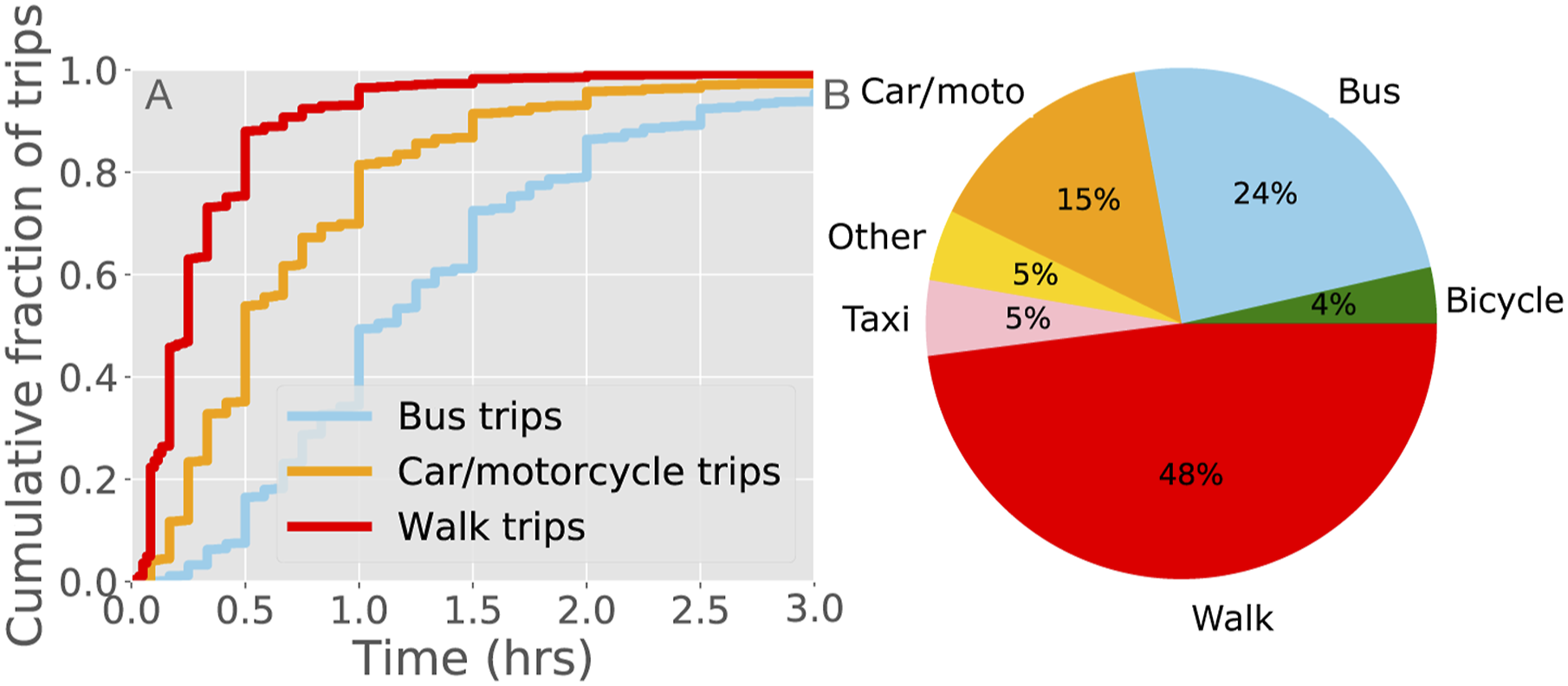
We deploy two related sets of models, one for the probability of mode choice (selection) and the other for trip duration (regression) according to various trip modes. It has been observed that performing selection/regression independently introduces bias in the regression model due to selectivity, and therefore we use Heckman’s correction (Heckman, 1979) in order to fit both models jointly, in similar fashion to Cooke and Ross (1999) and Schwanen et al. (2002). For each trip mode, we model mode selection using a probit model:

For the trip-level controls, we include controls for individual characteristics (age/gender), whether the household has a motorized vehicle, as well as controls for the purpose of the trip (see Data section). Importantly, Heckman’s correction requires that the independent variables in the two equations must not be the exact same. Hence, we drop age, gender and motorized vehicle ownership in the regression equation (4).
For the spatial controls, we include variables corresponding to urban form (i.e. the D’s of the built environment) and SES. For the D’s, we include the following terms – noting that home/jobs are only reported at the more aggregate cell level (see Supplementary SI Sec. 9): • density
c
– the cell-level density of residents’ home locations. • diversity
c
–– the cell-level ratio of home density to job density. • log dist transit
z
– the logarithm of zone-level distance to bus stops/stations. • design
z
– the zone-level density of intersections.
These estimates in equation (3) for the probability of choosing mode m are then transformed via the inverse mills ratio into a variable Λ
t
, which is implicitly a function of the independent variables in equation (4). By simultaneously fitting equation (4), we model trip duration for trips of mode m (‘uncensored’ trips) according to the following equation:

The coefficient on the inverse mills ratio necessarily depends on the correlation between the residuals of the two equations (Heckman, 1979). We have taken the logarithm of dependent/independent variables of interest in order to compute elasticity as in Ewing and Cervero (2017). For each type of trip modality, we use a maximum likelihood estimation (MLE) framework to fit equations (3)–(4) simultaneously.
We do not include an additional variable for destination accessibility, as we include access(λ) to amenities as our variable of key interest – and further incorporating additional variables results in increased multicollinearity (see SI for a detailed analysis of multicollinearity). In practice, we find considerable multicollinearity between access(λ) and control variables, especially for increasing λ – and hence we limit our analysis to λ ≤ 3. Additionally, we also report regression results when these spatial controls are excluded, calling this model I/II and the full model IA/IIA.
Finally, finding that SES is a modifier for the effect of amenity accessibility on trip behaviour (see SI), we use an effect modification setup for recovering effects of amenities within specific SES groups. That is, we modify equations (3) and (4) to include interaction terms to separate effects of access(λ)z(t) for different levels of stratum (low: 1–2, medium 3–4 and high 5–6). In this equation, we also include fixed effects for the medium- and high-stratum groups. The normal intercept is kept as a term for the low-stratum group only. We henceforth denote the original model (Equations (3) and (4)) Model I and the model with effect modifier interaction terms Model II.
Results
How are amenities distributed?
Before examining the effect of amenities on urban mobility, we first note that individual amenity classes have differing spatial distributions throughout the city. Even though all classes broadly depend on the distribution of potential customers throughout the city, we would expect, for example, significant differences between the distribution of convenience stores and physiotherapists. And, as observed in Chong et al. (2020), wealthier areas have more diverse amenities (see, for instance, Fig. 2D-E). We investigate these differences in the SI.
While we observe differences in how the various amenity classes are distributed across the city, our metric access(λ) is intended to quantify the composite spatial accessibility to a broad range of amenity classes. However, does the heterogeneity among the amenity distributions render this goal inappropriate? We show in the SI that the first principal component (PC) of the matrix of amenity counts by class and zone explains 75% of the variance. Hence, since the variation in amenity distribution across zones is reasonably well-aligned, we deduce that we can aggregate amenity classes across zones in our accessibility metric.
We display the spatial distribution of accessibility for varying λ in Figure 2(e)–(g). For low λ, we observe a very peaky distribution, with very high density all around the city centre and also many local maxima scattered throughout the study area. As we increase λ, we observe increasing smoothness in the accessibility distribution. Whereas at λ = 0.5 km, we see that amenity hotspots are frequently surrounded by low accessibility zones (e.g. yellow zones surrounded by blue), increasing λ to 1.5 km has the effect of spreading out these hotspots into nearby zones. Distribution of amenities in Bogotá. Subfigure (a) enumerates the county of each amenity class throughout the study region. Subfigure (b) shows the spatially averaged stratum (a proxy for SES) of each zone, in addition to the city’s generally recognized city centre. Subfigures (c–d) contrast the building density and amenity intensity of low- and high-stratum areas using satellite imagery. Lower stratum areas are home to many convenience stores (pink points), but lack the diversity of upper stratum areas. Subfigure (e) displays the raw amenity density throughout the city centre, while (f–g) display the distribution of amenity accessibility at two spatial scales. In F, only nearby amenities contribute substantially to the metric, while more distant contributions give rise to a spatially smoother distribution in G.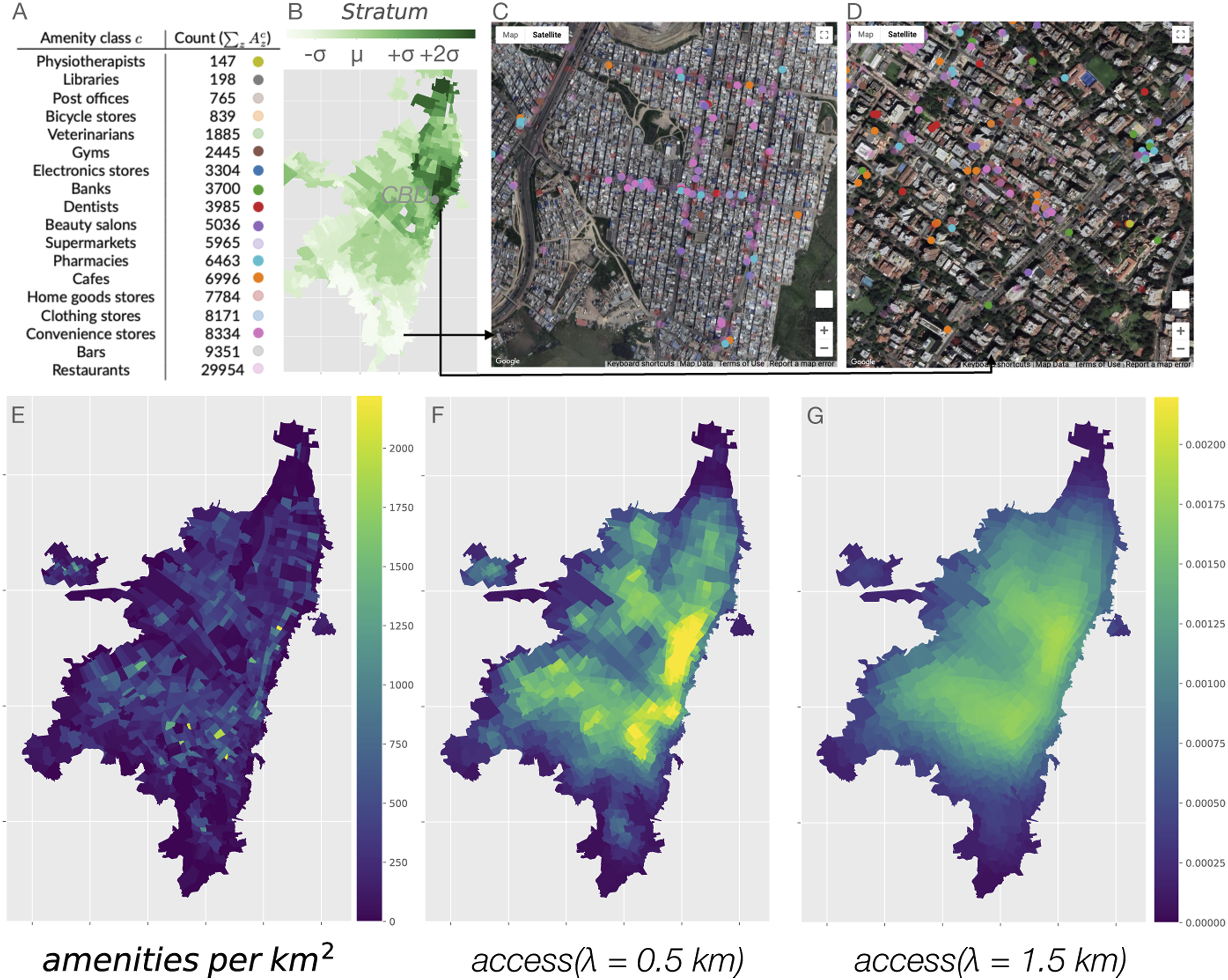
Amenity accessibility impacts mobility behaviour
The primary goal of our work is to further untangle the relationship between accessibility to amenities and urban mobility patterns. For example, does an abundance of local amenities increase our propensity to walk in the local area? Does it reduce the need for long car journeys? We organize our discussion according to trip modes.
Walking
Effects of access on automotive and car duration.
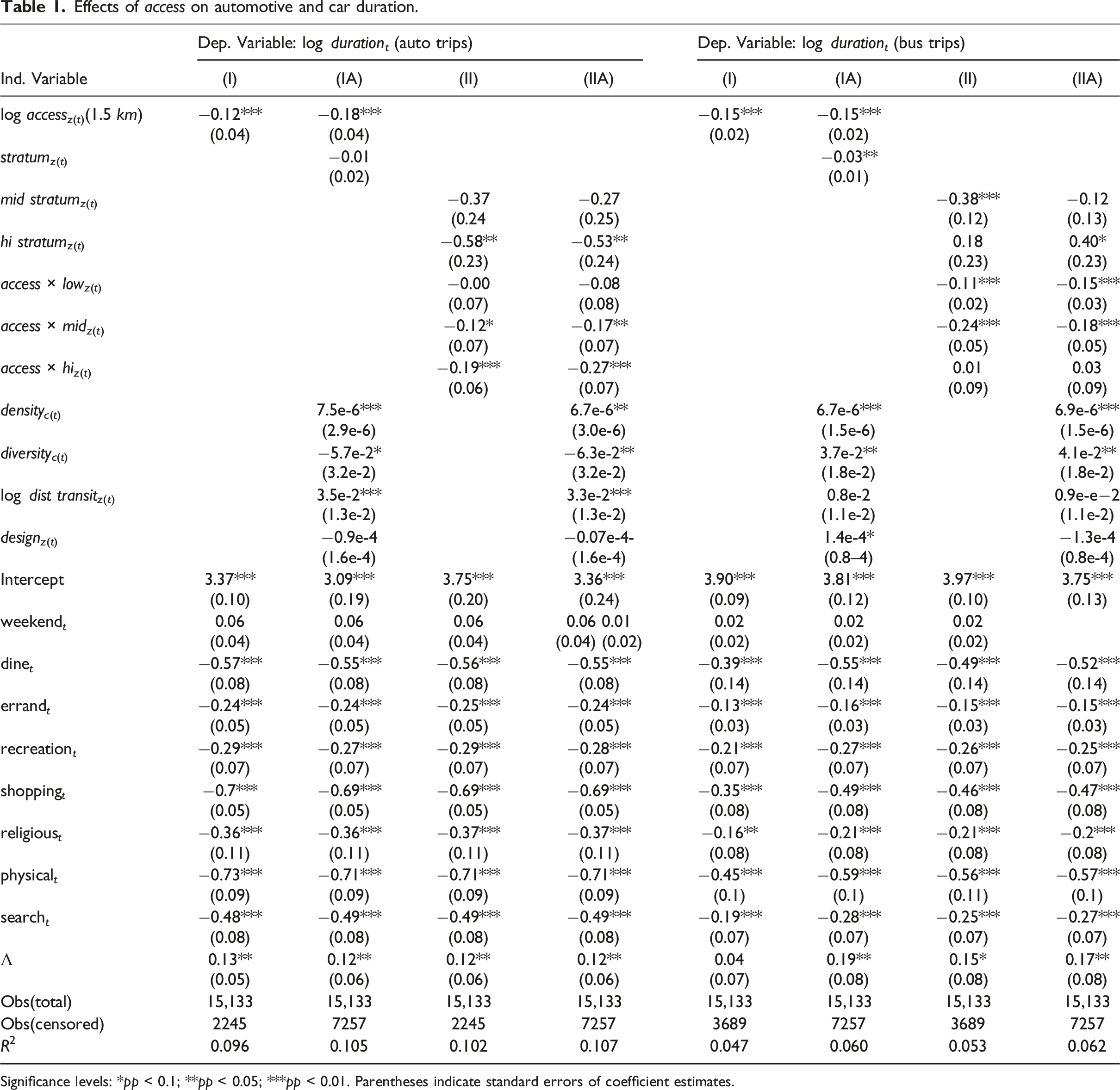
Significance levels: *pp < 0.1; **pp < 0.05; ***pp < 0.01. Parentheses indicate standard errors of coefficient estimates.
Next, we wish to better understand how amenities impact the tendency to make walking trips for specific SES groups. For example, does having amenities nearby have a different influence on trip behaviour for poorer vs richer citizens? That is, we move to our effect modification analysis (Model II), wherein we drop the control for stratum and investigate the interactions between stratum groups and accessibility. We both present the results in the third/fourth columns of Table 1 (Model II/IIA) as well as depict the results visually for model IIA in the upper left panel of Figure 3 (corresponding figures for model II are found in the Supplementary SI Sec. 7). Effects of accessibility on tendency to make walking trips (first row) and walking trip duration (bottom). The first column displays the elasticities of log access(λ) at λ = 0.5 km first according to Model IA (no effect modification terms) and then for the various interaction terms in Model IIA. In the second column, we display coefficients/confidence intervals for the full sample as well as SES subgroups (grey corresponding to all respondents, light green corresponding to elasticity within the low-SES subset, etc.). Solid lines indicate significance (p < 0.05), whereas dashed lines indicate insignificance. In the right panel, we plot the probability of walking across increasing deciles of accessibility for each SES group.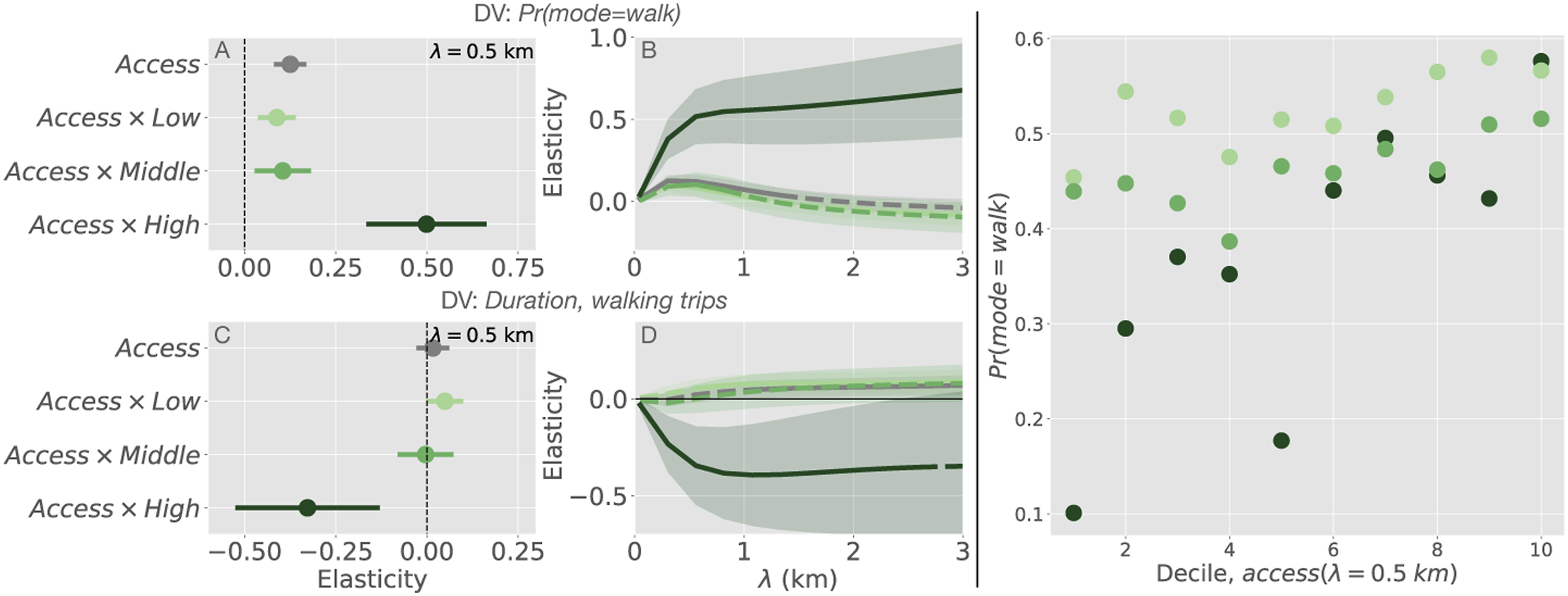
We find that effects of amenities on the likelihood of walking are strongest for the wealthiest group. At λ = 0.5 km (Model IIA), a 1% increase in accessibility results in a 0.50% increase in the likelihood of walking vs about a 0.00−0.10% increase for the lower and middle SES groups (left column of Figure 3).
Our results point toward an important role for amenities in the mobility behaviour of high-SES residents, but less so for low/middle SES residents. In order to illustrate this, we compute Pr(walk) for each decile of accessibility for each SES group in the right panel of Figure 3. For the high-SES group, we find that the probability to walk clearly increases with accessibility. In contrast, we observe at best a weak pattern for the low- and middle-SES groups.
We also consider variation in the spatial scale parameter λ for the effect of amenity accessibility on walking trip propensity. Specifically, we examine the elasticity of amenity accessibility as a function of λ on trip mode propensity (see second column of Figure 3). A peak for smaller values of λ implies that only close-by amenities are associated with trip behaviour, whereas a peak for a larger value means that amenity hotspots within the general area of the city play a role.
The high-SES group exhibits a strong association between amenity accessibility and the probability of walking. The coefficient for this group increases significantly between λ = 0.1 − 0.7 km and then more or less levels off with no further significant increase. This suggests that nearby amenities heavily influence walking for this group, while more distant amenities have little additional influence. The coefficient for the other two groups peak for small λ, and both become insignificant for higher λ. Again, this suggests that only nearby amenities influence the propensity to walk for these groups.
In addition, we investigate effects on walking duration – which we fit according to equation (4) simultaneously with equation (3) via MLE. Again, we first choose λ = 0.5 km and later investigate effects for varying λ, reporting results in the right four columns of Table 1 and depicting them visually in Figure 3. The coefficient of accessibility for the full sample is insignificant for all λ – suggesting that while amenities do influence people to walk, they do not reduce the length of the walking trip in general. This is not so surprising: walkers in amenity-rich areas may not seek to minimize time as they are more likely to be taking recreational trips and visiting multiple amenities (trip chaining). Nor do we find significant effects for stratum or for most built environment controls, with the exception of street design. We do find significant effects for the inverse mills ratio, indicating that modeling walking propensity and walking duration independently (i.e. without our use of Heckman’s correction) would result in selection bias.
We do find some differences in the effects of accessibility on walking duration for the various socioeconomic groups. That is, we find that there is no significant effect for the low/middle SES groups, but find evidence for a reducing effect for the high-SES group. That is, a 1% increase in amenity accessibility for this group is associated with a corresponding 0.33% decrease in walking duration (Model IIA). These findings seem to hold across a broad range of λ. Hence, higher amenity accessibility is significantly associated with shorter walking trips for high-SES residents, but it has no effect on walking duration for the low- and middle-SES groups.
Overall, we find that higher amenity accessibility is associated with a higher probability of walking but has very little effect on walking trip duration. By far, the strongest effects for walking propensity emerge for the wealthiest group. The coefficient for the high-SES group tends to increase until about 0.7 km, at which point it levels off.
Car and motorcycle
How does the presence of amenities influence the probability of taking other modes of transport besides walking? If amenities increase the probability of walking, then they decrease the probability of not walking, for example, travelling by car or bus. In the SI (Supplementary Sec. 6), we show that this is the case: amenity accessibility is (for all spatial scales) associated with lower probability of taking the bus, or – for the wealthy subgroup only – the car. Unexpectedly, more amenities actually mean a higher probability of driving versus taking the bus for the low-SES group.
Effects of access on walking behaviour.
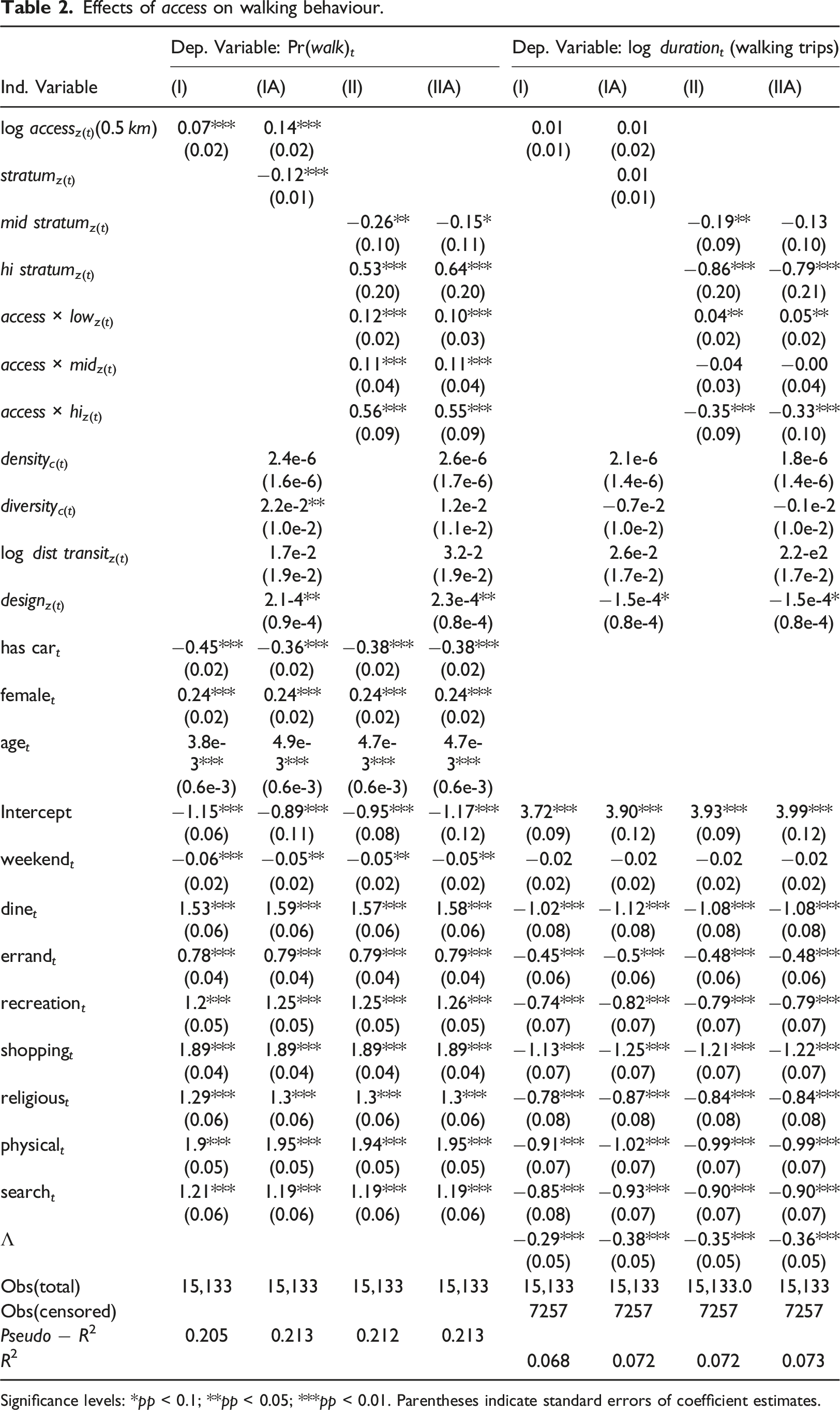
Significance levels: *pp < 0.1; **pp < 0.05; ***pp < 0.01. Parentheses indicate standard errors of coefficient estimates.
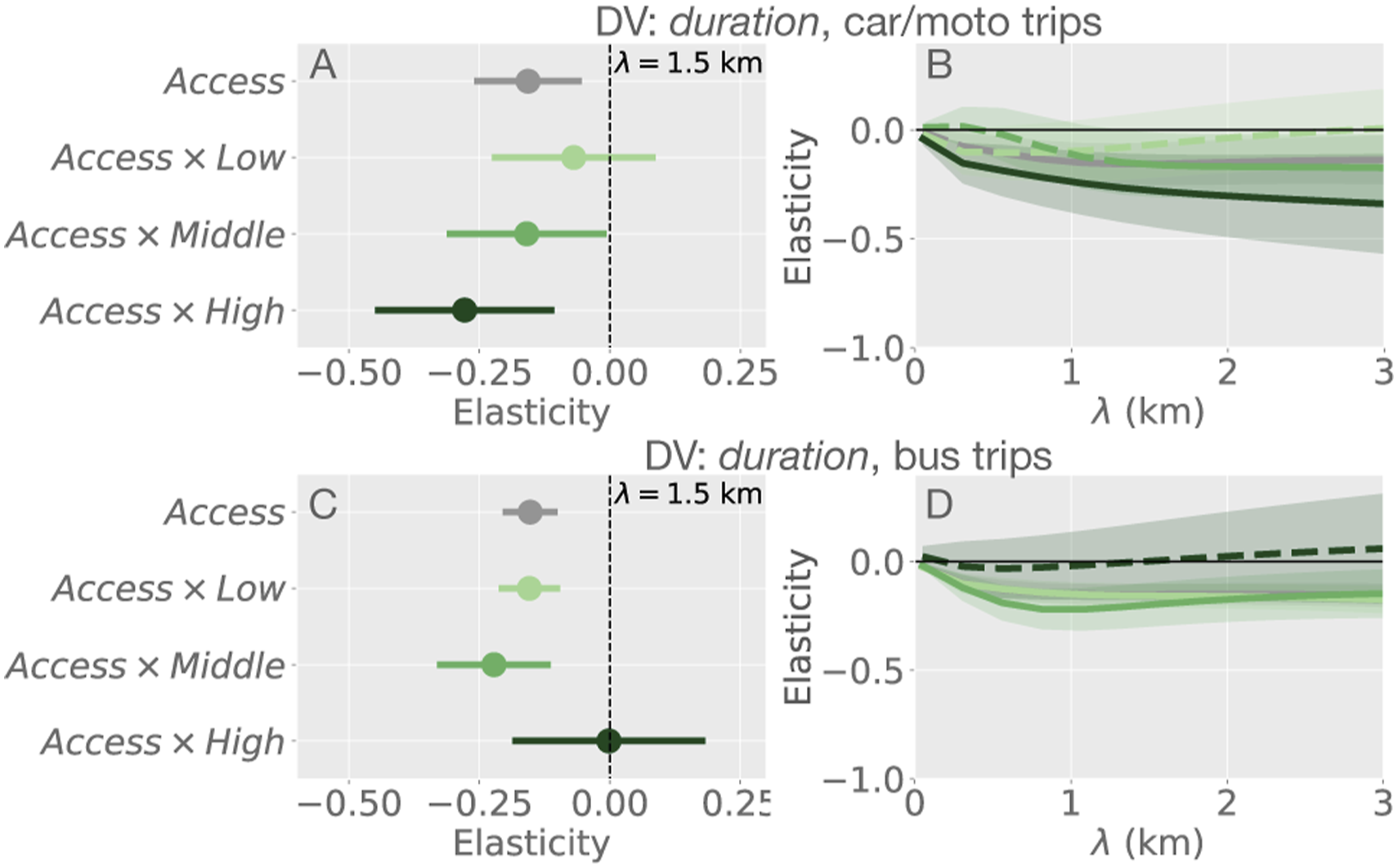
Effects of amenity accessibility on bus and auto trip duration. Rows correspond to effects on the various dependent variables. For each row, the left column displays the elasticity/confidence intervals for log access effects at fixed λ both for all respondents and then for low/middle/high SES groups. The right column displays the elasticity when we let λ vary across a range of spatial scales.
By disaggregating effects by SES group, we find that at λ = 1.5 km, amenity accessibility is only associated at the p < 0.05 level with reduced car trips for the upper- and middle-SES groups. The effect is substantially stronger for the high-SES group. When we vary λ, we see a robust effect for the high-SES group, but the middle-SES group coefficient is only significant for λ > 1.2. As above, both of these coefficients initially increase in magnitude for increasing λ, but gradually level off. The low-SES group coefficient is not significant for any λ.
Hence, it seems that the association of amenity accessibility and car trip duration is modified by SES. That is, for high- and perhaps middle-SES residents, having more amenities nearby is associated with reduced car trip duration. However, there is no significant association between amenities and car trip duration for the low-SES group.
Bus
Regarding bus trips, we find that higher amenity accessibility is associated with shorter bus trips, with or without built environment controls (see right four columns of Table 2 and the second row of Figure 4). In fact, our results are strikingly similar between models I and II here, with the elasticity of amenity accessibility being − 0.15 in both cases. Hence, bus trips beginning in areas of the city with higher amenity accessibility tend to be shorter. SES has a robust negative effect on bus trip duration, meaning that higher stratum residents take shorter bus trips. On the other hand, density and diversity are again associated with longer trips, perhaps signalling congestion. Distance to transit doesn’t seem to greatly affect bus trip duration – as we show in the SI (Supplementary Sec. 9), this distance does not vary greatly across most of the study area and hence may be less informative. Effects for trip purpose are generally significant, and the significance of the inverse mills ratio (Λ) varies by model.
When we examine specific SES groups, we see that this negative effect on bus trip duration holds for the low- and middle-SES groups, but does not extend to the high-SES group. Next, we vary the spatial scale parameter λ. Focusing first on the full sample (grey), the coefficient decreases steadily with increasing λ until about 0.7 km, at which point the coefficient seems to level off. This suggests that amenities within about 0.7 km are most associated with lower bus trip duration. Looking at the individual SES groups, we see that for low/middle SES groups, the coefficient tends to exhibit similar behaviour as in the model without effect modification, while the upper SES coefficient is insignificant for all λ. The middle-SES group coefficient tends overall to be slightly stronger than the lower-SES group coefficient.
Here, we find that amenities are associated with reduced bus trip duration for the low- and middle-SES groups, but not for the high-SES group. As is the case with car trip duration, effects on bus trip duration tend to increase in magnitude with the spatial scale λ until around 0.7 km before leveling off.
Discussion
In this paper, we investigate the role of socioeconomic status in the relationship between local amenities and mobility patterns. In particular, we leverage data from a large internet repository of location data on amenities and use this to construct an amenity accessibility measure. Our results show that on the whole, having more amenities nearby leads to a modest reduction in car and bus travel distance and increases residents’ tendency to walk, in line with other recent work on amenities in Sweden (Elldér, 2020; Elldér et al., 2020; Haugen & Vilhelmson, 2013). However, SES seems to modulate this relationship in an important and hitherto unrecognized manner. Specifically, we find that the presence of amenities increases walking trip propensity and decreases car travel duration for the wealthiest group only. Effects are either insignificant or very small in magnitude for the lower- and middle-SES groups. On the other hand, amenities tend to reduce bus trip duration (which has been studied less in this literature) for just the low- and middle-income SES groups.
We suspect that different socioeconomic groups make travel mode decisions based on different factors, particularly in the case of walking. In addition to being much more likely to walk overall, low-income people are thought to choose walking for different reasons than wealthy people (Boarnet and Crane, 2001; Mondschein, 2018). For example, lower income people may see the cost of driving or taking a bus as a more costly alternative and factor this cost more heavily into their decision to walk. A longer walking trip may be more preferable than paying a bus fare or paying for gas – lowering sensitivity to the immediate amenity supply. By contrast, this cost weighs less heavily on the wealthy, and their decision to walk may depend less on cost and more on the proximity to amenities. Wealthier suburban residents with relatively few amenities nearby can much more efficiently get what they need by driving than by walking. By contrast, inner-city high-SES residents live in amenity-rich ‘walkable’ neighbourhoods and are hence much likelier to walk. This narrative is consistent with our results which highlight the much stronger effect of amenities on the tendency of the wealthy to walk relative to the low- and middle-SES groups.
Our measure captures average accessibility across all amenity types, but one possible confounding factor is that people residing in lower SES areas may be more separated from the specific amenities that they need or wish to access. Indeed, more specialized amenities tend to be rarer in low-SES areas, as we confirm and elucidate in Supplementary SI Sec. 10. Previous research has shown that poorer neighbourhoods have lower accessibility to banking and more access to alternative financial institutions (e.g. payday lenders) in the US (Small et al., 2021), so residents needing, for example, mortgage advice would need to travel further even when the composite local amenity supply is higher. Additionally, it is well known that poorer areas are often associated with more fast food and fewer supermarkets (Sharkey et al., 2009), and so local residents may be travelling further for their own needs which are not met by the local amenity supply. This topic merits further attention – for instance, our work could be adapted to further examine effects of specific amenity classes on trip behaviour (similar to Elldér et al., 2020). Additionally, specific amenity accessibilities could be matched to particular trip types (e.g. shopping trips to specific retail amenity classes).
Our accessibility measure was constructed specifically to measure proximity to amenities at various spatial scales. A priori we might expect that close-by amenities would influence the propensity to walk, whereas further away amenities might impact car trip duration. However, in our analysis, we find similar behaviour with regards to spatial scale for all three modes studied. Specifically, the coefficients peak in a short range of 0.5–1 km and then typically level off. We could interpret this as suggesting, for example, in the case of car trip duration, is that what matters is not so much the presence of further away amenities, but the absence of nearby amenities. This topic merits further study and perhaps a more sophisticated framework for amenity accessibility that takes into account local versus regional amenities as well (similar to Haugen and Vilhelmson, 2013).
Finally, we point to some limitations of this work, primarily related to data availability. First, we note issues of spatial aggregation. While the zone sizes we use are relatively small relative to the city (median area 0.38 km2) and relative to units used in peer studies in Sweden
4
(Amcoff, 2012; Elldér, 2020; Elldér et al., 2020), walking behaviour in particular may depend on a very granular spatial scale (Handy et al., 2002). For instance, supposing the median cell is a circle with all amenities in its centre, two respondents in the same median-size zone have the same amenity accessibility value when in reality one respondent residing in the centre would be
Moreover, while the five D’s of the built environment are the most studied influences on transport behaviour especially in Global North cities, perception of traffic safety and security are both undoubtedly very important for transport decisions, particularly in Latin America (Arellana et al., 2020). Future work might look to examine how different SES groups take safety and security into account in their transport behaviour, perhaps using a similar modelling framework to our own.
Conclusions and policy implications
Overall, our results suggest that low-income groups’ walking and driving behaviour depend less on the availability of neighbourhood amenities within their local environment relative to wealthy residents. This result somewhat contrasts previous characterizations of the poor as being more connected to their local environment when it comes to transport behaviour (Marquet et al., 2017), although we note that commercial development is only one dimension of the local environment. For instance, in the context of urban health, many studies show that the relationship between the local environment and health is stronger for low-income people (Vallée et al., 2021).
These findings generate important nuance in the debate on the development of more walkable neighbourhoods via bringing residents closer to amenities (‘15 minute cities’ or ‘walkable mixed use communities’). While our study is cross-sectional, our results suggest that adding amenities to a low-income or a wealthy neighbourhood may have different effects on residents’ transport behaviour. In a wealthy area, amenities alone may drive residents to walk much more. However, while amenities provide many types of neighbourhood benefits beyond the scope of this study, other neighbourhood improvements may be more impactful when it comes to changing travel behaviour for low- and middle-income communities.
Supplemental Material
Supplemental Material – Are neighbourhood amenities associated with more walking and less driving? Yes, but predominantly for the wealthy
Supplemental Material for Are neighbourhood amenities associated with more walking and less driving? Yes, but predominantly for the wealthy by Samuel Heroy, Isabella Loaiza, Alex Pentland and Neave O’Clery in Environment and Planning B: Urban Analytics and City Science.
Footnotes
Acknowledgements
The authors would like to thank Tim Schwanen (Professor of Transport Studies, University of Oxford) for helpful comments and especially analytical suggestions, as well as the editor Seraphim Alvanides (Associate Professor of Architecture and the Built Environment, Northumbria University) and three anonymous referees. All errors are those of the authors alone. The views expressed in this paper do not necessarily reflect the position of the Federal Reserve Bank of Richmond or the Federal Reserve System.
Declaration of conflicting interests
The author(s) declared no potential conflicts of interest with respect to the research, authorship and/or publication of this article.
Funding
The author(s) disclosed receipt of the following financial support for the research, authorship and/or publication of this article. SH and NO acknowledge support from the PEAK Urban programme, funded by UKRI’s Global Challenge Research Fund, Grant Ref: ES/P011055/1.

Supplemental Material
Supplemental material for this article is available online.
Notes
References
Supplementary Material
Please find the following supplemental material available below.
For Open Access articles published under a Creative Commons License, all supplemental material carries the same license as the article it is associated with.
For non-Open Access articles published, all supplemental material carries a non-exclusive license, and permission requests for re-use of supplemental material or any part of supplemental material shall be sent directly to the copyright owner as specified in the copyright notice associated with the article.
