




Abstract
In the international competition for talent, local and national policy makers are keen to better understand the location choices of highly skilled workers in order to design more effective policies geared towards the group’s attraction and retention. In this study, we explain whether and to what extent the local living environment, in particular characteristics at the neighbourhood and urban regional level, affect the residential choices of foreign highly skilled workers. We make use of register data from Statistics Netherlands on the residential locations of all of these migrants who entered the Netherlands between 2000 and 2009. We combine this dataset with data on relevant characteristics at the neighbourhood level as well as with relevant amenities and labour market characteristics at the regional level. We estimate a negative binomial regression model to test which characteristics of neighbourhoods and urban regions are associated with high inflows of foreign highly skilled workers at the neighbourhood level. We find that, besides labour market characteristics, the characteristics of the local environment do matter for location choices of foreign highly skilled workers in the Netherlands. This group tends to settle in higher income, inner city neighbourhoods that offer a high degree of urban vibe. Furthermore, residential choices differ between single and multi-person households and change with duration of stay in the country.
Introduction
Across the globe, urban economies are becoming ever more dependent on knowledge-based activities such as services, including finance and trade, communication, education and information technology. For cities to gain a competitive edge in these industries and to achieve global status, the attraction of foreign highly skilled talent is often seen as vital, with global champions Paris, London and Los Angeles having established themselves as ‘urban knowledge capitals’ according to Sassen (2012; Richardson, 2016). Many cities are striving to become urban knowledge capitals (though of a lower league), where different professionals from all parts of the world meet, and there is a growing interest among urban policymakers and academics in better understanding the drivers and processes that explain why foreign highly skilled workers migrate to specific urban regions and neighbourhoods and not to others.
This article contributes to the literature on the global competition for foreign talent, in particular the competition between urban regions, by extending our knowledge on whether and to what extent characteristics at the neighbourhood and urban regional level affect the residential neighbourhood choices of foreign highly skilled workers. Large-scale empirical evidence derived from the Dutch Social Statistical Database (SSD) on all highly skilled workers who entered the Netherlands in the period 2000–2009 documents the workers’ initial regional and intra-municipal residential location choices to test the relevance of local characteristics and answer the central research question: To what extent do characteristics of the neighbourhood and urban region affect the initial and subsequent residential neighbourhood choices of foreign highly skilled workers in the Netherlands?
This article contributes to closing two gaps in the present streams of literature: first in the literature on the residential location choices of international highly skilled labour migrants, and second in the literature on urban amenities and the creative class. Regarding the first, a wealth of literature addresses the determinants of international labour migration in general (see e.g. Lowell, 2009, for an overview) and also, more recently, focuses on the specific group of highly skilled labour migrants (Boeri et al., 2012; Mahroum, 2000). However, by and large these studies explain the country choices of these migrants, but little is known about the factors that explain the migrants’ location choices within these countries (Frenkel et al., 2013). In particular, little empirical study of inter-city competition for foreign talent exists that documents the relevance of specific local factors, such as urban amenities, in attracting this group (Richardson, 2016); yet many cities invest in measures aimed at enhancing what Florida (2002) termed ‘place-specific attributes’, to lure the creative class, foreign and native alike.
Second, the article’s focus on the potential relevance of urban neighbourhood characteristics alongside city level characteristics is innovative for the literature on local amenities and the presence of the creative class. Following the seminal work of Florida (2002), much scholarly and policy attention is given to the local presence of the creative class as a potential engine of urban economic growth and recovery (Boualam, 2014). In this literature, the quality of soft location factors such as urban amenities (e.g. schools, theatres, restaurants, cafes) is emphasised as an important attraction factor for this group, but most studies treat the city as a single space, disregarding the fact that local manifestations of the creative class happen in specific areas of these cities that embody symbolically important loci for the local gentrifying community. These urban areas or neighbourhoods are characterised by the presence of cafes, restaurants, boutiques and art galleries, consumptionscapes that provide a locus for the articulation and display of an affluent gentrification-derived identity (Rofe, 2003). An important part of this identify also seems to be the notion of belonging to a global elite community; however, it remains unclear to what extent this actually requires the local presence of highly skilled foreign migrants, as literature falls short of making the distinction between native and foreign members of the creative class.
This article is structured in five sections. Following this introduction, the next section contains the literature review. We then discuss the microdata that we used, as well as the research design. The fourth section contains the findings from the study, including the descriptive statistics and results from the econometric analyses. The final section provides the conclusions from the study.
Neighbourhood choices of highly skilled international workers and the role of urban and neighbourhood characteristics
Although many scholars around the world (e.g. Richardson, 2016) have underscored the vital importance of the attraction and retention of highly skilled foreign workers for the growth of regional clusters of knowledge-intensive industries, little empirical study on the inter-city competition for foreign talent is found. Existing large-scale studies on the living location choices of highly skilled international labour migrants focus on country or region choices (e.g. Lowell, 2009; OECD, 2010); there is a lack of studies at the lower levels of spatial aggregation explaining in which urban neighbourhoods (the lion’s share of) these migrants settle and how these decisions are influenced by the local characteristics of these neighbourhoods and the surrounding urban area. Given this literature gap, our literature review builds on the large body of relevant scholarly work explaining the residential location choices of households in general, before discussing a growing stream of literature on specific features of the residential preferences of highly skilled workers. However, contributions explicitly addressing the preferences of highly skilled foreign workers remain scarce.
The residential location choices of households and the role of urban and neighbourhood characteristics
Traditionally, the literature on the residential location choices of households has focused on the economic and demographic determinants of this choice (e.g. Lawton et al., 2013). According to economic theory, people compare the costs and benefits of various residential locations and choose the location that maximises their net benefits. Aspects that are considered in this regard are the availability of jobs, regional wage levels and the local presence of (dis-)amenities. The latter include natural attraction factors, such as climate and landscape; cultural attraction factors, such as theatres, restaurants, cafes, festivals, children’s attractions and recreational facilities; and social attraction factors, such as local safety, criminality levels, status or image, nuisance and pollution levels and the quality of schools (Devogelaer, 2004; Henderson, 1982; De Graaff et al., 2008).
A number of specific factors related to the local environment have been shown to be important in determining household residential location choices. At the neighbourhood level, areas with better accessibility and proximity to jobs and to the city centre, where most urban amenities (e.g. shopping facilities, theatres, restaurants, cafes) are concentrated, are perceived as more attractive to live in. Apart from this, the quality, housing tenure and housing stock composition in the neighbourhood also matter for an area’s residential attractiveness. Generally, areas with higher quality and more diverse housing tend to be more attractive (Devogelaer, 2004). Also, neighbourhoods with higher shares of owner occupants or higher average rents are viewed as more desirable (Quigley, 1985). The ethnic composition of the neighbourhood also affects residential location choices. Immigrants are found to be more likely to settle in neighbourhoods with a higher share of co-ethnics (Zorlu and Mulder, 2008). Finally, the provision level of urban amenities determines residential attractiveness, whereby neighbourhoods with higher provision levels of amenities (e.g. restaurants and cafes) are more appealing, especially so for younger urbanites (Nechyba and Strauss, 1998; Quigley, 1985).
Many studies have looked into the determinants of residential preferences and choices at the urban regional level. Regions with more and higher quality amenities, such as restaurants, theatres, recreation facilities and events, are seen as more attractive (e.g. Blomquist et al., 1988). Also, Devogelaer (2004) finds that regions with universities or that are (state or provincial) capitals have a more favourable image and are better known, which makes people more likely to move there.
Prior research has shown that residential preferences and choices vary throughout the different life-cycle stages of households (e.g. Clark and Huang, 2003). A common finding (e.g. Devogelaer, 2004) is that singles at an early stage in adulthood prefer more compact and centrally located, commonly rental, housing, whereas larger households tend to prefer more spacious, owner occupied housing – often linked to the desire to establish a family – housing that is not easily found in city centres at affordable prices. For families, as compared to single person households, the accessibility of high quality schools (Henderson, 1982), leisure and recreation spaces, neighbourhood safety and a socially homogeneous neighbourhood population are found to be more important (Hur and Morrow-Jones, 2008). Finally, for larger households with children, longer commuting distance to work tends to be less of an issue than for single person households (Kim et al., 2005).
High income households and higher educated households will be more successful on the housing market and therefore be more likely than other households to select into ‘attractive’ neighbourhoods. Accessibility, amenities, safety and other variables that determine neighbourhood attractiveness will thus have a stronger impact on the neighbourhood selection of higher educated and high income households.
Specific features of the residential preferences of (international) highly skilled workers
A recent stream of literature investigating local factors that influence the residential preferences of highly skilled workers provides valuable insights for our analysis, although this literature generally fails to distinguish between highly skilled workers of native and foreign origin. The findings from this literature suggest that the above stated economic and demographic factors are also highly relevant for the residential preferences of the highly skilled (e.g. Sleutjes, 2013). Liu and Shen (2014), who study the interprovincial migration patterns of skilled migrants in China, and Arntz (2010) in a study on interregional highly skilled migrants in Germany, find that career opportunities are more important than amenities.
Besides work and career-related aspects, preferences are largely affected by the availability and accessibility of high quality and affordable housing (Buch et al., 2014) and the quality of schools and of cultural and recreational facilities in the neighbourhood and region (Buettner and Janeba, 2016; Florida, 2002; Frenkel et al., 2013; Lawton et al., 2013; Yigitcanlar, 2010). These studies find no uniform pattern of residential preferences among highly skilled workers, including highly skilled international migrants (Bontje et al., 2009; Sleutjes, 2013), but heterogeneity in preferences, most likely explained by differences in household type, job type and length of the (intended) stay abroad. Bontje et al. (2009) point to the diversification of the group of highly skilled international migrants, with a growing number of non-expats who stay for a longer time or permanently in the country. According to the authors, in contrast to general expat preferences, the latter migrants are less orientated towards the higher segments of the housing market in central locations and more towards lower priced flats in suburban areas.
Research findings on the residential preferences of the highly skilled will therefore vary with the personal characteristics of the group under study. A US-based study by Felsenstein (2002) and an Amsterdam-based study by Musterd et al., 2007 suggest that the highly skilled have a preference for suburban neighbourhoods where housing is more spacious. On the contrary, a second study from the Netherlands by Van Oort et al. (2003) finds a preference for areas in proximity to the city centre, close to cultural amenities.
Rofe’s (2003) study on the gentrifying neighbourhoods of Glebe and Inner New Castle, Australia, documents how global talent is attracted by the seemingly sophisticated and global attributes of these locations that are characterised by an affluence of cafes, good restaurants, boutiques and art galleries. The author argues that premised upon notions of affluence and prestige, numerous gentrifiers pursue a local socio-spatial strategy of identity construction by which they aim to actively position themselves as an emergent global elite community.
Frenkel et al. (2013) investigate to what extent local amenities, accessibility, housing preferences and leisure activity affect the location choices of skilled workers at the intra-metropolitan level in the Tel Aviv metropolitan region. The authors find that these workers seek affordable housing preferably in dense urban environments of large cities. Moreover, they have a preference to live in well-established knowledge communities that are located in close proximity to good schools and their work, and where cultural amenities and recreational facilities are abundant.
Lawton et al. (2013) study the residential preferences of the ‘creative class’ in Dublin and also include a subsample of migrants to find that classical factors such as the cost of housing, accessibility and travel time to work are most relevant as residential location determinants. Their outcomes also illustrate the relevance of the life-cycle stage for residential decision-making; specifically, the decision to have a family directly affects residential choice considerations. Younger workers tend to select city centre locations, whereas older workers prefer peripheral locations. The findings of Richardson (2016), who studies regional attraction and retention strategies for expats in the biotechnology sector of the Vancouver region, also underscore the role of the spouse enabling longer term stay in the region, particularly in times of economic downturn.
Finally, Van Oort et al. (2003) study the residential preferences of employees in the ICT sector in the Netherlands. They find that these preferences are similar to those of the Dutch population in general. The authors distinguish between two groups of respondents with differing residential preferences: a group of young people that prefers a location in or near the city centre with all the urban amenities, and a group of older, more settled people with a preference for greener, quieter, suburban areas or locations outside the cities. About two-thirds of all respondents, however, indicated that they would like to live within reach of a city centre to have urban amenities at hand. Almost all respondents find accessibility to their work important; however, this group also shows an exceptionally high commuting tolerance as compared to native ICT professionals. Thus, characteristics of the home, the residential area and the availability of certain facilities are viewed as more important than living close to the workplace.
Research design
Research on highly skilled international workers is troubled in two ways. On the conceptual side, there is no agreed definition across countries and among scholars of what exactly constitutes a highly skilled person. Common approaches to define this group of migrants are based on the type of job carried out, the level of highest achieved education or the earned income level (Charloff and Lemaître, 2009). On the practical side, there are problems associated with gathering and finding data on the international migration of highly skilled workers, as often educational and job classification data are not available.
This research makes use of the Dutch Social Statistical Database (SSD), which is unique micro data containing the personal characteristics and residential addresses of all inhabitants of the Netherlands from 1999 onwards. With the SSD, individuals can be followed over place and time, so the initial and subsequent residential neighbourhood choices of highly skilled international workers in the Netherlands can be studied. 1
As in the SSD there is no information available on educational level and occupational status, we define highly skilled workers based on age-specific income criteria that are derived from an in-depth analysis of the relationship between educational achievements, occupational status and income using a representative subsample of the Dutch population (Labour Force Survey). 2 See annex 1 in Raspe et al. (2014) for further details. Validity checks of the used definition carried out with the Labour Force Survey show that there is a large overlap in who is included in the definition of highly skilled, whether defined based on occupational status, educational level or age-specific income criteria (Raspe et al., 2014). Therefore, we expect to find similar location preferences for highly skilled workers if criteria based on educational level or occupational status is used. The included age differentiation is important in the identification of the highly skilled, as not even those employees with high educational achievements and high potential tend to start their career with high salaries. We apply this definition to the data on immigration from the SSD and define foreign highly skilled workers as all individuals who migrated to the Netherlands in that year and who meet these criteria in the respective year or the year after (Raspe et al., 2014).
In the period 2000 to 2009, 3 54,255 highly skilled workers migrated to the Netherlands, which is a relatively low number by international comparison, but the annual inflows strongly increased over the period (Docquier and Marfouk, 2005). The SSD contains information on their personal characteristics such as age, nationality, household type and residential address. We focus our analysis on urban regions in the Netherlands. There are 22 urban regions in the Netherlands, which are central cities with surrounding suburban and rural municipalities that together function as one labour market and housing market area. We only focus on the urban regions, and not on the areas in between urban regions, to be able to use urban regional level data on labour market characteristics and amenities. Eighty-four per cent of the foreign highly skilled workers choose a neighbourhood of first residence that is located in one of the 22 urban regions. A total of 1566 neighbourhoods 4 are located in these regions; however, data are not available for all neighbourhood characteristics for all neighbourhoods. In neighbourhoods with few dwellings or inhabitants, data on average household income or land value are missing; therefore, these neighbourhoods had to be excluded from the analyses. 5 For 1457 neighbourhoods, data are available on all independent variables. These neighbourhoods are the first place of residence for 45,473 foreign highly skilled workers (64 people settle in neighbourhoods with missing data and are therefore excluded from the analyses). The models are thus estimated on 45,473 foreign highly skilled workers, of which 25,537 are singles and 19,936 live in larger households.
To establish which characteristics determine the location choice of these highly skilled workers, we estimated negative binomial regression models (Cameron and Trivedi, 1998). 6 For every neighbourhood in the 22 urban regions, we calculated the number of foreign highly skilled workers who selected that neighbourhood as their first residential address in the Netherlands. Multilevel negative binomial regression models explain the number of these individuals who selected a certain neighbourhood (count data) from characteristics of the neighbourhood and characteristics of the larger urban region. The models take into account the multilevel structure in the data by using clustered standard errors for urban regions. Three separate models are estimated to explain neighbourhood choice of: (1) all foreign highly skilled workers; (2) foreign highly skilled workers who live alone; and (3) foreign highly skilled workers who live in larger households.
To facilitate the interpretation of our regression findings, we show the incidence rate ratios (IRR) in the findings section; these are the exponentiated regression coefficients. The IRR expresses the change in the dependent variable in terms of a percentage increase or decrease that corresponds with a unit increase in the independent variable. It is either above or below 1. For example, an IRR of 1.05 for the independent variable distance to school (measured in kilometres) would suggest that the number of foreign highly skilled workers in a neighbourhood increases by approximately 5 per cent with every additional kilometre distance to an international school. Conversely, an IRR value of 0.95 would imply a 5 per cent decrease of these migrants in the neighbourhood.
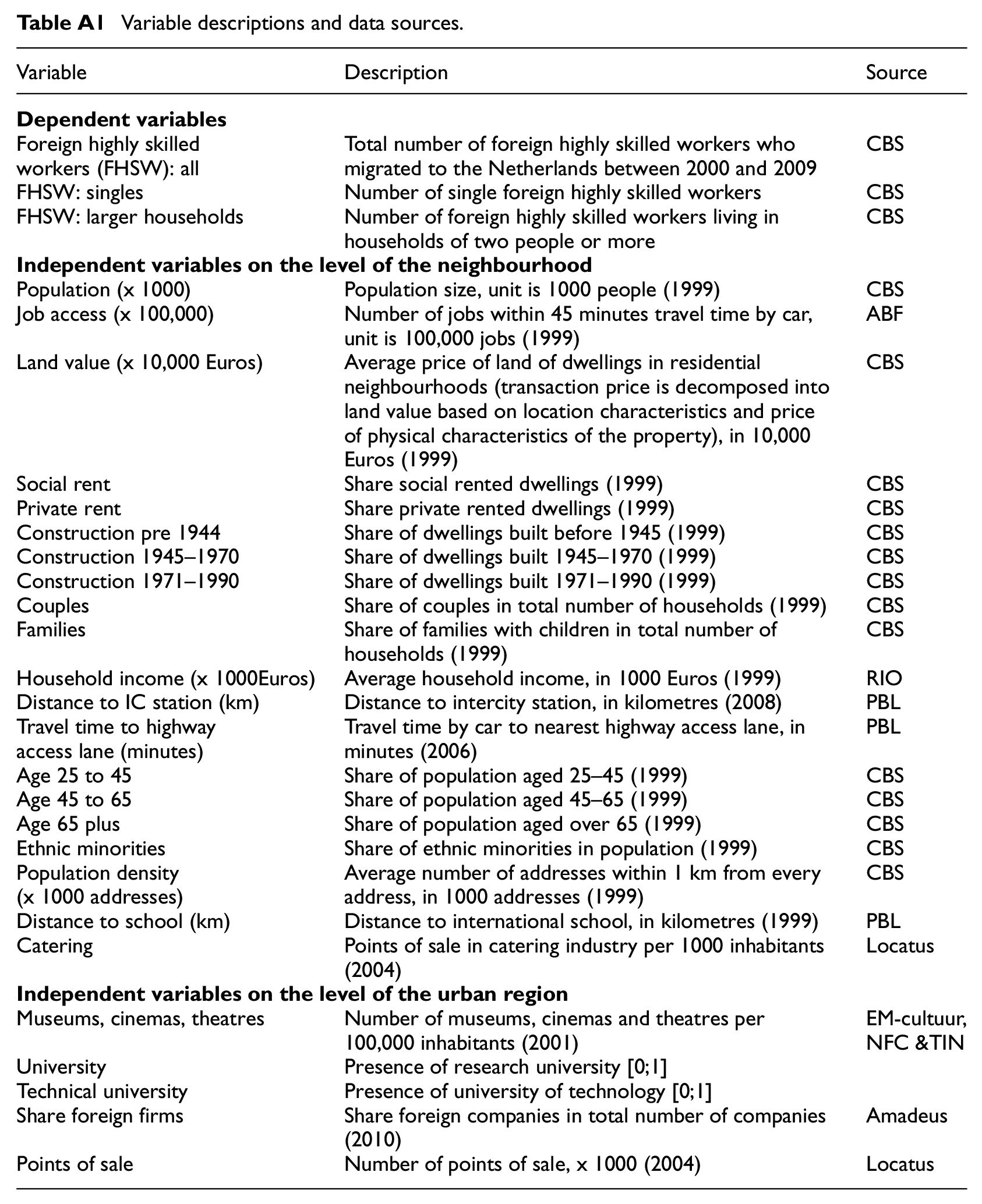
We use independent variables on both the neighbourhood and urban regional levels to explain the number of foreign highly skilled workers in a neighbourhood. Independent variables such as the neighbourhood population, household and dwelling composition, accessibility, number of points of sale, foreign companies, museums and cinemas in the urban region explain which neighbourhoods are attractive residential areas for this group of migrants. Descriptions of all variables are found in Table A1 in the Appendix; Table 1 provides the variables’ descriptive statistics. 7
Descriptive statistics of dependent and independent variables.
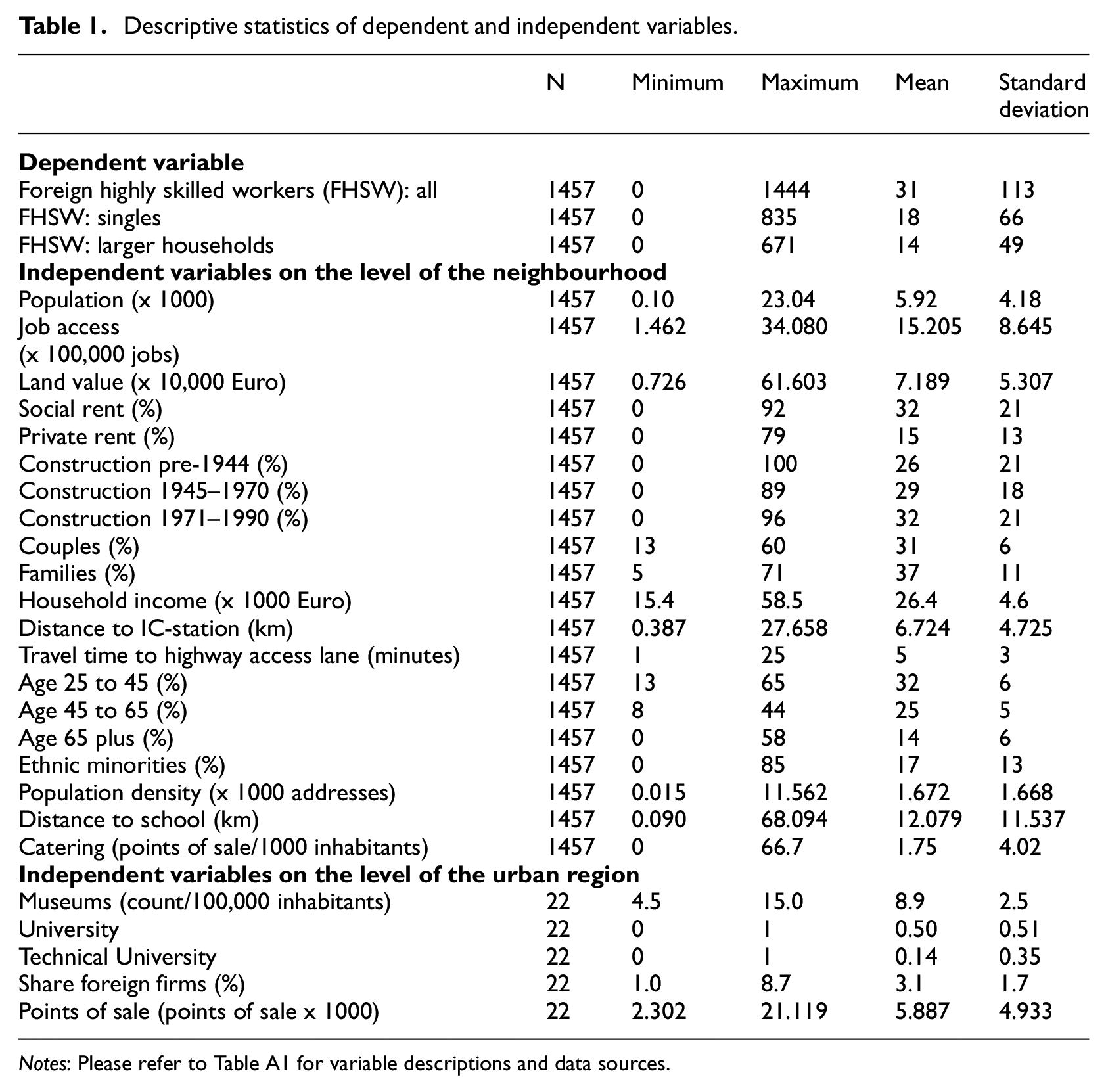
Notes: Please refer to Table A1 for variable descriptions and data sources.
Results
Descriptive statistics
Between 2000 and 2009, 54,255 foreign highly skilled workers arrived in the Netherlands. Migrants from Western countries account for three-quarters of this group; only a quarter has a non-Western background. The annual inflow of these migrants fluctuates greatly over this period; notably, in years of economic growth more migrants arrive in the Netherlands.
Of these 54,255 highly skilled workers who came to the Netherlands over the period 2000–2009, 30,270 migrants are singles (56 per cent) and 23,985 people live in larger households (44 per cent). A total of 45, 537 migrants, 84 per cent of all foreign highly skilled workers who came in this period, settled in the 22 urban regions. Most of these migrants settled in the urban region of Amsterdam, followed by The Hague and Rotterdam, which is not surprising as these are the largest and most international regions of the Netherlands, accommodating a large number of international firms and organisations.
Considering the spread of these migrants across residential neighbourhood types in the 22 urban regions (where 84 per cent of this population resides), we find a strong over-representation in city centres. In these areas, foreign highly skilled workers account for 2 per cent of the population. These are generally areas with high population density, where housing is most expensive, but which offer the highest provision level of urban amenities (e.g. cafes, restaurants, museums, theatres). A much smaller group of these migrants resides in urban areas outside the city centre and urban areas with generous provisions of green. In these areas, these migrants account for about 0.4 per cent of the population. The more quiet residential settings of villages and the countryside are not very popular among these migrants. Being little bound by financial constraints in most cases, foreign highly skilled workers are clearly urbanites, choosing residential locations in central locations with good accessibility and in proximity to jobs. This holds in particular for migrants in single person households, but it also holds for migrants living in larger households.
Explaining the initial neighbourhood choice of foreign highly skilled workers
Above, we have discussed the distribution of foreign highly skilled workers across regions and residential settings. In the analyses to follow we explain the residential neighbourhood choice of these migrants from characteristics of the neighbourhood and the urban region. The findings from the negative binomial regression models are shown in Table 2.
Neighbourhood choice of foreign highly skilled workers according to household type.
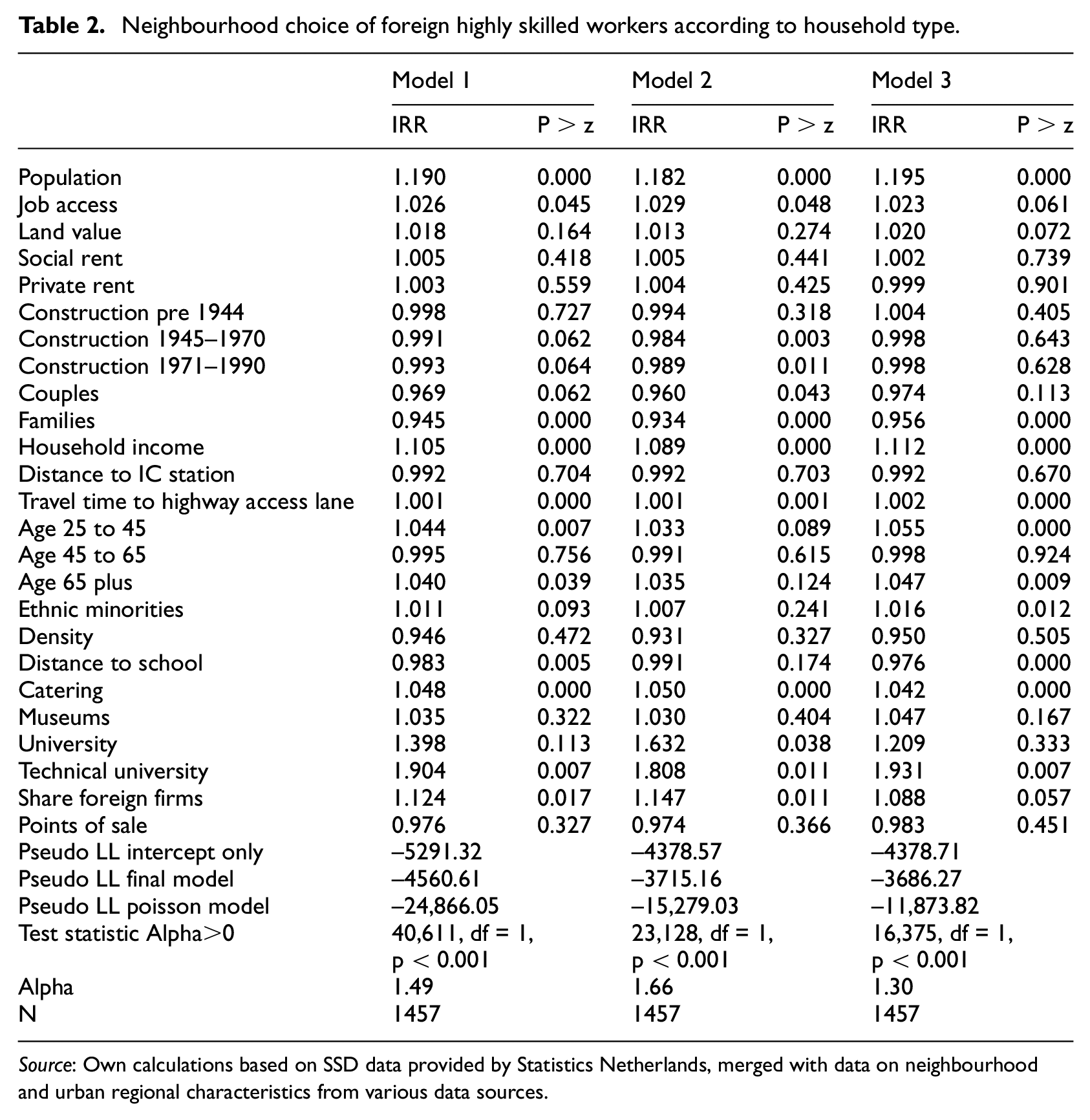
Source: Own calculations based on SSD data provided by Statistics Netherlands, merged with data on neighbourhood and urban regional characteristics from various data sources.
Model 1 explains the neighbourhood choice of all foreign highly skilled workers who arrived in urban regions in the Netherlands between 2000 and 2009. A number of observations can be made about the influence of neighbourhood variables on this outcome. The number of inhabitants in the neighbourhood is included as a control variable for population size differences. As expected, more migrants settle in more populated areas. The area’s address density has no significant effect at the 5 per cent level. Although foreign workers mostly settle in dense urban areas, this effect is explained by other variables such as job access. In line with many earlier studies (e.g. Arntz, 2010; Lawton et al., 2013), we find that job access has a positive effect on the neighbourhood selection of foreign highly skilled workers. The land value, tenure composition and the construction period of the dwellings in the neighbourhood have no significant effect on the inflow of these migrants at the 5 per cent level. Foreign highly skilled workers more often settle in neighbourhoods with lower shares of families with children and with higher household income levels. Accessibility by train or car seems not to matter for the location choices of these migrants. Whereas the neighbourhoods’ distance to a train station is insignificant at the 5 per cent level, travel time to a highway access lane has a positive, but small effect, which indicates that foreign highly skilled workers select neighbourhoods further away from access lanes. Possibly this can be explained by their choice of inner-city locations instead of suburban new housing estates that are often closer to highway access lanes.
The age composition in the neighbourhood also affects the settlement of these migrants; neighbourhoods with a high proportion of 25 to 45 year olds, or with high numbers of inhabitants above age 65, are more popular than neighbourhoods with many children (under age 25) or many people aged 45 to 65. The share of ethnic minorities in the neighbourhood has no significant effect on the settlement of these migrants at the 5 per cent level. The distance to an international school has a significant negative effect on the settlement of these migrants; the migrants thus select neighbourhoods that are closer to international schools. A final neighbourhood aspect that is relevant for the presence of foreign highly skilled workers in urban neighbourhoods is the quantity of points of sale in the catering industry (e.g. restaurants, cafes and takeaways) per 1000 inhabitants. This has a positive effect on settlement for this group, which is in line with earlier research (Rofe, 2003; Quigley, 1985) that indicated a preference for lively neighbourhoods with many urban amenities. 8
On the level of the urban region, some indicators measuring the provision level of urban amenities are included; these are the number of museums, theatres and cinemas per 100,000 inhabitants and the number of points of sale. These variables, however, have no significant effect on the settlement of foreign workers at the 5 per cent level. Urban regions with a university of technology and urban regions with a high share of foreign companies do attract many foreign highly skilled workers.
Model 2 explains the neighbourhood choice of foreign highly skilled workers who are living alone at their first residential address (singles hereafter). A number of observations can be made about the influence of neighbourhood variables on this outcome. As in Model 1, which includes all foreign highly skilled workers, this subgroup tends to reside in more populated neighbourhoods; neighbourhoods with good access to jobs, higher household incomes and a higher supply of catering facilities; and ones which are a large distance from highway access lanes. However, contrary to the findings in Model 1, for the subgroup of singles the construction period of housing in the neighbourhood does matter. Singles tend to live in neighbourhoods with higher shares of housing constructed before the Second World War and after 1990. Whereas the age structure of the population in the neighbourhood does not seem to affect the inflow of this group, the household composition does. Neighbourhoods with higher shares of couples and families accommodate fewer single foreign highly skilled workers. A final finding related to the neighbourhood characteristics is that, for the group of singles, the distance to an international school does not matter for their living choice, which seems logical.
On the urban regional level, the results for singles are similar to the results in Model 1. Foreign companies and technical universities attract highly skilled workers, with the addition that non-technical universities also attract single foreign highly skilled workers.
Model 3 explains the neighbourhood choices of foreign highly skilled workers who live in larger households. As in Models 1 and 2, these migrants in larger households also select more populated neighbourhoods with lower shares of families, higher average income levels and a higher density of catering locations. As was found in the overall model, these migrants in larger households tend to reside in neighbourhoods with higher shares of residents in the age groups 25–45 and pensioners. Contrary to the findings of Models 1 and 2, here the presence of ethnic minorities in the neighbourhood increases the presence of these migrants in larger households. Job access has no significant impact on the residential location choices of these migrants in larger households, while singles do select into locations with many jobs within commuting distance. Again, as in Models 1 and 2, the distance to a train station does not matter, whereas the distance to the highway access lane is relevant. Also, larger households settle in neighbourhoods further away from highway access lanes. These migrants in larger households select into neighbourhoods close to an international school, while the distance to an international school has no significant effect on singles.
On the level of the urban region, only the presence of a university of technology has a significant positive effect on the neighbourhood choices of these migrants in larger households. The other characteristics of the urban regions, the proxies for the provision levels of urban amenities, the presence of a general university and the share of foreign companies are not significant at the 5 per cent level.
Discussion of findings
A number of findings are particularly noteworthy and deserve further discussion. From the descriptive analysis it appears that most foreign highly skilled workers settle in the Randstad, the economic heartland of the Netherlands, and in city centre neighbourhoods. The model shows, not surprisingly, that more of these migrants settle in regions with a university (of technology) and in regions with a high number of foreign companies, as these organisations employ a great proportion of this group. With regard to their inner-city location, we find more foreign highly skilled workers in neighbourhoods with higher incomes, especially in those with many catering facilities and many singles; that is, in the most lively inner city areas.
Next to these overall findings, we see three notable differences in the residential choices between the groups of these migrants who live in single households and those who live in larger households. Singles tend to opt for neighbourhoods with a high share of housing from the pre-war and most recent construction periods and neighbourhoods where many other singles live; for migrants in larger households these aspects figure less prominently in their location choices. Larger households settle in neighbourhoods with a slightly more balanced mix of household types, high average income levels and with more ethnic minorities. Second, whereas singles opt for neighbourhoods close to jobs, migrants in larger households opt for neighbourhoods close to an international school. This likely suggests that compared to singles, larger households have different location preferences, with the school location of children taking priority over job accessibility. A third, somewhat puzzling finding is that single migrants tend to settle more in regions with a general university, whereas migrants in larger households do not. This might simply be yet another indication that migrants in larger households tend to live further away from their jobs, e.g. to be closer to their partner’s job or to the international school; as many foreign highly skilled migrants work in university cities and migrants in larger households accept further commutes to work, this implies that fewer individuals in this group live in urban regions with universities. Another explanation might be that areas around technical universities provide more diverse employment opportunities for migrants than general universities. If an urban region can provide employment for both partners, it becomes more attractive for highly skilled workers in larger households. Technical universities tend to boast notable spin-off activities that create longer term employment.
A distinct feature of the residential preferences of foreign highly skilled workers as compared to those of the highly educated native population (see for the latter group e.g. Devogelaer, 2004) is that the former group tends to be more inclined to stay in highly urbanised neighbourhoods once they enter the family formation stage in their life cycle, whereas native households tend to move to a larger extent to residential areas in the urban suburbs or in the periphery of cities. Plausible explanations why migrant households are more tied to central urban locations could be these areas’ higher provisions of migrant-specific goods and services, their international atmosphere or the location-specific co-ethnic social networks there, attributes that this group values.
Residential dynamics and neighbourhood choice five years after immigration
The residential choices of foreign highly skilled workers likely change as migrants stay longer in the country. Moreover, short-term stayers likely make other housing choices than longer-term stayers to start with, with the former in the case of expats often making use of employer-provided housing. To find out to what extent the above findings based on the initial neighbourhood choices of migrants are relevant for their longer stay in the country, we study their residential dynamics and estimate the same regression models as above for the subgroup of migrants that still resides in the country five years after immigration. 9
We find considerable residential dynamics for these highly skilled migrants: of all highly skilled workers who entered the country between 2000 and 2009, 76 per cent lived at the first address of registration at least half a year, 58 per cent at least one year and 35 per cent at least two years. After five years, 93 per cent did not live at the same address anymore, 58.5 per cent had left the country and 34.5 per cent had relocated within the country.
Given the large residential dynamics, it is striking that five years after immigration, with hardly any exceptions, the same local characteristics are relevant for migrants’ neighbourhood choices as at the moment of first settlement. These exceptions do yield some additional insights that are worth discussing. Five years after immigration, these highly skilled migrants live in neighbourhoods with high concentrations of ethnic minorities, while the share of ethnic minorities had no effect on initial location choice. This might be explained by a difference between short stay migrants who live in employer-provided housing, and migrants who stay longer in the Netherlands who find a dwelling via their co-ethnic network, are attracted to ethnic-specific facilities or prefer to live among other ethnic minorities (see also Zorlu and Mulder, 2008). Another difference between initial and later location choices is that the share of foreign firms in the urban region no longer affects migrant neighbourhood choices. It seems that the presence of foreign firms is particularly relevant as location factor for short-term stayers, a group including many expats who tend to live nearby their job in employer-provided accommodation. Also, longer term stayers likely work to a larger extent for Dutch employers and choose accommodation further away from their work.
Conclusion
In the international competition for foreign talent, little is known about which regions, municipalities and neighbourhoods attract foreign highly skilled workers and why. This case study from the Netherlands contributes to this debate by providing large-scale empirical evidence on the relevance of neighbourhood and urban regional characteristics for the residential neighbourhood choices of foreign highly skilled workers. This article is innovative as it is one of the first to focus on the importance of amenities at the neighbourhood level in the attraction of foreign talent. We find that highly skilled foreign workers select high income neighbourhoods with a large supply of catering facilities and good accessibility to both jobs and international schools.
Secondly, we add to previous research by providing insights into the heterogeneity of the settlement preferences of foreign highly skilled workers. In this study, a first step towards the systematic exploration of this heterogeneity was done, by contrasting local characteristics of residential location choices of single and larger households. Further research can contribute to our understanding of this heterogeneity by looking at other distinguishing features, such as the type of job or sector of work, and conducting a more fine-grained exploration of the life-course developments and countries of origin. Particularly interesting in this regard is our study’s finding that in larger households location trade-offs seem to be made taking into account proximity to work as well as to (international) schools. However, whereas native households tend to move to a larger extent to suburban areas once they start living together or enter the family formation stage (Devogelaer, 2004), we find that among foreign highly skilled workers larger households are also more inclined to stay in highly urbanised neighbourhoods. This suggests that these migrant households have a stronger preference for central urban locations, possibly due to the greater availability of migrant-specific goods and services, the more international atmosphere or the location-specific co-ethnic networks there.
Our definition of foreign highly skilled workers is based on age-specific income criteria, as income is a return to both skill level and labour market experience and because the micro data do not contain information on educational level or occupational status. Validity checks on a dataset that does include these variables (Dutch Labour Force Survey) show a high degree of overlap between the highly skilled based on educational level, occupational status and our age-specific income criteria; therefore, we expect to find similar results if criteria based on education or occupation were to be used.
This article uses revealed preferences data – data on the actual location choices of foreign highly skilled workers. These highly skilled migrants have relatively high incomes and will therefore have a privileged position on the housing market, which might enable them to settle in neighbourhoods of their preference. However, also for this group, not only preferences but also dwelling availability and local housing market conditions determine where they will be able to find a dwelling.
This article provides novel policy-relevant insights on local attributes, including urban amenities, that seem to affect the residential choices of foreign highly skilled workers and that therefore might be valuable for local and regional policy makers interested in attracting this group. The findings of this study are based on the case of the Netherlands, a small country known for its internationally-orientated economy, but that except for Amsterdam perhaps lacks cities that compete among the top global urban knowledge capitals (Sassen, 2012). We thus expect our findings to be particularly interesting for the many mid-sized cities aspiring to become globally connected by attracting foreign highly skilled workers.
Firstly and most notable, foreign highly skilled workers have a strong tendency to live in centrally located urban neighbourhoods with high provision levels of urban amenities. Local policy makers may thus be able to woo this group of migrants by ensuring a sufficient supply of up-market housing in these areas while safeguarding or promoting the areas’ urban vibe that results from an attractive mix of cafes, restaurants and other cultural amenities.
Secondly, good news for mid-sized cities, as our study has shown that the provision of catering facilities and museums at the urban regional level does not have a positive effect on attracting these migrants, implying that these cities do not need to compete with global champions in the provision of city-wide amenities. Instead the local provision of these amenities in the neighbourhoods where these migrants reside seems good enough for attracting this group.
Thirdly, a considerable proportion of the foreign highly skilled workers bring their partners and children along. For this subgroup, high quality provisions of family-related facilities, most notably international schools, are relevant in attracting migrants and their families to live in particular urban areas.
Finally and most importantly, this group of highly skilled migrants is becoming ever more diverse, including next to short-term stayers as expats and scientists, a growing number of longer term stayers, many with partners and children. Whereas short-term stayers tend to choose accommodation close to jobs and in central urban locations, for the latter group housing market preferences seem more varied. To be able to optimally cater to the housing demands of a diversifying group of foreign highly skilled workers, local policy makers interested in attracting and retaining this group are advised to gain a more thorough understanding of the varied natures of their residential preferences.
Footnotes
Appendix
Variable descriptions and data sources.
| Variable | Description | Source |
|---|---|---|
|
|
||
| Foreign highly skilled workers (FHSW): all | Total number of foreign highly skilled workers who migrated to the Netherlands between 2000 and 2009 | CBS |
| FHSW: singles | Number of single foreign highly skilled workers | CBS |
| FHSW: larger households | Number of foreign highly skilled workers living in households of two people or more | CBS |
|
|
||
| Population (x 1000) | Population size, unit is 1000 people (1999) | CBS |
| Job access (x 100,000) | Number of jobs within 45 minutes travel time by car, unit is 100,000 jobs (1999) | ABF |
| Land value (x 10,000 Euros) | Average price of land of dwellings in residential neighbourhoods (transaction price is decomposed into land value based on location characteristics and price of physical characteristics of the property), in 10,000 Euros (1999) | CBS |
| Social rent | Share social rented dwellings (1999) | CBS |
| Private rent | Share private rented dwellings (1999) | CBS |
| Construction pre 1944 | Share of dwellings built before 1945 (1999) | CBS |
| Construction 1945–1970 | Share of dwellings built 1945–1970 (1999) | CBS |
| Construction 1971–1990 | Share of dwellings built 1971–1990 (1999) | CBS |
| Couples | Share of couples in total number of households (1999) | CBS |
| Families | Share of families with children in total number of households (1999) | CBS |
| Household income (x 1000Euros) | Average household income, in 1000 Euros (1999) | RIO |
| Distance to IC station (km) | Distance to intercity station, in kilometres (2008) | PBL |
| Travel time to highway access lane (minutes) | Travel time by car to nearest highway access lane, in minutes (2006) | PBL |
| Age 25 to 45 | Share of population aged 25–45 (1999) | CBS |
| Age 45 to 65 | Share of population aged 45–65 (1999) | CBS |
| Age 65 plus | Share of population aged over 65 (1999) | CBS |
| Ethnic minorities | Share of ethnic minorities in population (1999) | CBS |
| Population density (x 1000 addresses) | Average number of addresses within 1 km from every address, in 1000 addresses (1999) | CBS |
| Distance to school (km) | Distance to international school, in kilometres (1999) | PBL |
| Catering | Points of sale in catering industry per 1000 inhabitants (2004) | Locatus |
|
|
||
| Museums, cinemas, theatres | Number of museums, cinemas and theatres per 100,000 inhabitants (2001) | EM-cultuur, NFC &TIN |
| University | Presence of research university [0;1] | |
| Technical university | Presence of university of technology [0;1] | |
| Share foreign firms | Share foreign companies in total number of companies (2010) | Amadeus |
| Points of sale | Number of points of sale, x 1000 (2004) | Locatus |
Acknowledgements
The authors would like to thank their colleagues at the PBL Netherlands Environmental Assessment Agency and VU University for their support, in particular Otto Raspe and Stefan Groot, and Statistics Netherlands for making the data available.
Declaration of conflicting interests
The author(s) declared no potential conflicts of interest with respect to the research, authorship, and/or publication of this article.
Funding
The author(s) received no financial support for the research, authorship, and/or publication of this article.