




Abstract
This paper’s conceptual contribution is to highlight the need to place the identification and analysis of institutional logics at the centre of the hybrid framework for policy analysis, with a focus on air pollution as a wicked problem. Different post-structural approaches to policy development have been developed but there is a need to conceptualise and theorise further how different institutions, organisations, and groups, with different institutional logics, contextualise, construct and prioritise wicked problems as policy challenges; additionally, challenges encountered in specific local contexts have to be untangled. Conflicting institutional logics play an important but overlooked role in the analysis of regional policy cycles. This is the first paper to engage in these debates by identifying and exploring the role institutional logics play in conceptualising wicked problems as policy priorities. To do so, it applies and develops post-structuralist approaches to policy analysis developed in education, combined with an institutional logics approach to explore why no effective air quality policy is yet to emerge in East Africa and specifically in Addis Ababa (Ethiopia), Kampala (Uganda) and Nairobi (Kenya). Four contexts of policy formulation and implementation are identified: context of influence, policy formation, implementation and outcomes along with three types of institutional logics: ‘science’, based on rigor to render societal problems visible; ‘influencer’, led by NGOs and other stakeholders (e.g. citizens) involved in translating problems to foster awareness and support/fund specific programmes and actions to increase viability; and ‘political’ linked to decision-making and policy prioritisation. Conflicting institutional logics as we demonstrate can prevent the formulation and implementation of policy solutions.
Introduction
Air pollution is the leading global environmental cause of premature death (World Bank and IHME, 2016). While factors contributing to air pollution (Amegah, 2018; Petkova et al., 2013) in all types of urban contexts have been widely discussed, along with suggestions for local, national, and global level policy interventions (Amann et al., 2020), little is known regarding air pollution and the barriers to policy development and implementation in low- and middle-income countries, typically in Asia and Africa where over 90% of air pollution-related deaths occur (World Health Organization, 2018). In emerging economy settings, air pollution as a policy challenge, conflicts and competes with other more immediate and tangible problems including housing, poverty alleviation and access to water making it appear relatively unimportant (Turner, et al., 2015). In East Africa, international institutions have been working on air quality improvement from the 1990s, yet effective cross-cutting air quality policy interventions remain elusive (Amegah & Agyei-Mensah, 2017) with particulate matter having increased over the last five decades (Singh et al., 2020).
Air pollution is a wicked problem with multiple causes raising significant challenges for policy formulation particularly in developing countries given limited economic and political resources, political instabilities, patronage, corruption and clientelism (Olver, 2017). First, there is a temporality and visibility issue to addressing this problem given the less direct effects air pollution has on public health. Death certificates tend to avoid listing air pollution as a cause of death. Second, there are no straightforward and simple answers or actions; local and regional causes of air pollution and policy solutions require coordinated national, regional, local, and individual/group responses. This requires scientific measurement, guidance, reliable and available data, targeted and localised policy development, political support along with an integrated approach cutting across policy domains.
The cross-cutting nature of air pollution makes analysing policy formulation and implementation complex as it involves the availability and mobilisation of knowledge, produced by organisations and actors that must be identified, translated, and implemented by stakeholders. From a theoretical perspective, it requires an appropriate framing to unpack how policy and practice emerge through encounters between institutions and the actions of individuals and groups, particularly between non-local stakeholders concerned with air quality, including scientists and non-governmental organizations (NGOs), and state-centred constraints that continue to render air quality to be of secondary importance in policy cycles. This goes beyond a process of assemblage of different stakeholders, visions, and strategies or through the transfer of models and ideas from one place to another (Allen & Cochrane, 2007). It rests upon mobilising the right conceptual lens to identify barriers behind policy formulation, development, and implementation; this includes understanding the role ‘institutional logics’ play in marginalising air pollution in policy agendas. Such logics are defined as “socially constructed, historical patterns of cultural symbols and material practices, including assumptions, values and beliefs, by which individuals and organizations provide meaning to their daily activity, organize time and space, and reproduce their lives and experiences” (Thornton et al., 2012: p. 2). Different post-structural approaches to policy development have been developed but there is a need to conceptualise and theorise further how different institutions, organisations, and groups, with different institutional logics, contextualise, construct, and prioritise wicked problems as policy challenges; additionally, challenges encountered in specific local contexts must be untangled. Conflicting institutional logics play an important but overlooked role in the analysis of regional policy cycles. This paper engages in these debates by applying a framework of contexts (policy text production, practices/effects and outcomes) and then extends and develops this approach by identifying and exploring the role institutional logics play in conceptualising wicked problems as policy priorities.
Results presented here draw upon an interdisciplinary collaboration between social and atmospheric scientists. The analysis focusses on three fast-growing East African cities: Addis Ababa (Ethiopia), Kampala (Uganda) and Nairobi (Kenya). Rapid urbanization has contributed to enhancing air quality problems in these cities: traffic (exhaust and non-exhaust emissions), industry, and solid waste burning are the primary air pollution sources (Rajé et al., 2018). The argument is organised as follows. After positioning and developing our post-structuralist framing to policy cycles we review the research methods. We then explore air pollution policy development and prioritisation processes focussing initially on the interplay between science and influencer logics versus political logics and then on the ways in which conflicting logics and localised strategies impact on policy prioritisation processes. Data, skills, and resource issues are then questioned with conflicting political logics justifying limited prioritisation based on the politicisation of data. The paper concludes with a discussion regarding the contribution an institutional logics approach makes to understanding regional policy formulation and implementation.
Post-structural approaches to policy development and institutional logics
Policy is “both text and action, words and deeds, it is what is enacted as well as what is intended” (Ball, 1994: 10); it emerges from a process in which enactment might not meet intent. Logics are a fundamental component in this process of shaping interpretations and enactment of policy, particularly in the context of wicked problems. Institutions have inherent “logics” or principles guiding social actors’ sense of reasoning and self-identity serving as “a set of material practices and symbolic constructions” (Friedland and Alford, 1987: p. 248). Text involves the construction of specific knowledge informed by data and analysis. This process of text and policy shaping emerges from the interplay between local, national, and international levels informed by dialogues between governing agencies and interest groups involved in a struggle to influence policy outcomes (Hamadeh, 2019). At the centre of this struggle are tensions between institutions with different institutional logics with such tensions being particularly acute when some of the logics rely on complex scientific measurement which characterises wicked problems. To date, post-structuralist policy development debates have overlooked the role conflicting institutional logics play in shaping policy outcomes. The institutional logics literature has ignored public policy formulation and instead has focussed on understanding corporate organisational behaviour, management and practice (Damayanthi & Gooneratne, 2017; Vargo & Lusch, 2016). There is an important research gap here founded on developing an institutional logics informed account of public policy formulation. This new approach is developed in this paper and applied to understanding air pollution in East African cities.
The management of cities involves different institutions, or stakeholders, with each informed by distinct institutional logics. This includes policymakers who require knowledge, information, and skills to make decisions and who are embedded “within a hierarchy of multiple agencies and networks” (Salder, 2020: 3). Policy enactment represents an interplay between macro and more micro level processes of policy development and enforcement. Post-structural approaches have emphasised that policy development is embedded within territorial and scalar assemblages of actors. This directly influences how stakeholders mobilize and engage with notions of power, autonomy, strategy, and identity (Jones et al., 2004). State agents are not passive agents, but can actively accommodate, revise, or resist broader political projects (ibid). Such approaches highlight that the state is a ‘peopled organisation’ (ibid) but tend to overlook agents not working directly for the state that may have competing priorities, shaped by different institutional logics There is a broader issue regarding how representative the State is of the people in the light of wicked problems particularly in emerging economy settings and what is the role of other non-state institutions and their respective institutional logics. Tensions or the absence of interactions between organisations with competing institutional logics can result in failure to develop or implement policy in response to perceived wicked problems. An institutional logics approach provides an additional conceptual lens to debates on public policy formulation including understanding the interrelationships between policymaking institutions and their distinct contexts which shape the types of logics that emerge, and which influence the policy development process. This process plays an important role in framing policy outcomes, at different spatial scales and levels.
Policy emerges through an interplay between the macro, meso, and micro levels. The macro level includes issues identified as being of global concern by institutions thinking globally and trying to inform national, or meso policy agendas. These institutions include the World Bank, United Nations and NGOs which all play a key role in shaping policy solutions to wicked problems, like air pollution. Meso level policy occurs at the level of the nation state. This is to accept the increasing importance of a “glo-na-cal agency heuristic” (Marginson and Rhodes, 2002) in which institutions act through mediating influences from the global, to the national and to the regional/local or, in other words, the contribution the ‘glo-na-cal’ makes to shaping meso and micro policy outcomes. The micro level involves localised institutions typically informing urban policy at the city-region level. In this account, the policymaking process is multiscalar with macro institutions increasingly trying to influence meso and micro level outcomes and vice versa.
Deepening globalisation has had significant implications for the ability of nation states to control policy agendas which may be partly determined by global influences and expectations. This is not a top-down process but a meshing together of agencies that act at different levels informing policy cycles. In the case of air quality and other (wicked) problems, NGOs play important roles in shaping problems, alerting, and mobilising stakeholders. There is a strong policy mobility element here as their role is based on their ability to mobilise learning and knowledge exchange extracted from very distinct contexts (both developed and developing). NGOs are embedded in global networks and specific institutional structures. Thus, “…actors’ motivations, capacities and circumstances affect how and which policies are mobilized, which specific political agendas are promoted (or not), or which specific groups are involved (or not)” (Affolderbach et al., 2019).
Post-structural approaches to policy development explore how different groups of actors formulate, negotiate, and implement policy emphasizing relational and reflexive influences. These debates have explored the changing role of the State and particularly how policy and correlatively territories of governance have been embedded within various scales, organisations, and strategies. Such theories have been primarily developed and applied to developed country settings including Europe, the UK, and the USA. The roles played by organisations, strategies and logics have been uncovered through complementary conceptual lenses. Jones et al. (2004) building on Jessop’s approach (1990) to explore the UK devolution process argued that the state as a ‘people organisation’ includes a range of active agents that accommodate, revise, or resist broader political projects. The emphasis here is on the positivist role state institutions play in “actively accommodating and revising the emerging structures, institutions, and strategies of the state” (Jones et al., p.106). Through another lens, the policy mobility literature (Affolderbach et al., 2019; Temenos and McCann 2012; Peck and Theodore, 2010) has focused on the role actors and institutions play in promoting, mobilizing, and adapting policy models, practices and knowledge through processes of learning and knowledge exchange.
Policy mobility occurs as part of a social process through which actors, embedded in specific networks and institutional structures, with specific motivations, capacities, and circumstances, manage to impact policy development and mobilization. A key challenge here is to “elucidate the various interconnections. . . among people, policy, and places that make policy-making a social and political practice” (Temenos & McCann, 2012: p. 352). Nevertheless, understanding the ways in which competing institutional logics held by different actors and institutions shape policy outcomes is an important gap in this debate. A key issue is exploring the processes by which a ‘problem’ becomes defined as a policy priority. There is a tension in the policy prioritization process between challenges that reflect the distractions of the immediate and other priorities including economic growth; these tensions reflect policy options or trade-offs that make it difficult for less visible wicked societal problems to be taken seriously. Assemblage theory (De Landa, 2006; McFarlane, 2011) has been applied to explore policy development and the role played by reconfiguring scales and power relations by public and private institutions involved in policy and decision-making. The concept of assemblages provides a particularly pertinent tool for exploring the evolution of regional policy and the extent to which local policy and localised issues and actors are integrated (McFarlane, 2011). However, we argue that current applications of assemblage thinking to regional policy requires further elaboration. Important here is the agency held by objects as actors, and the presumption that these objects express “causal or generative powers…equivalent to sentient, purposive human behaviour” (Storper & Scott, 2016: p.1126). These objects may include sensor networks, or even the absence of sensor networks, and are of importance in a policy assemblage. These literatures have explored the subtle processes through which different institutions participate in setting up, constructing, and negotiating policy agendas. An important research and policy gap remains which revolves around understanding the barriers between intended versus actual policy outcomes, particularly in the context of wicked policy setting agendas and the process of policy prioritisation, then implementation and finally enforcement and some of these barriers revolve around conflicting institutional logics.
Post-structural approaches in education policy research have developed a very structured policy cycle approach to exploring policy formulation that can be applied to extend policy analysis based on assemblages and policy mobilities (Fairbanks, 2019). This approach identifies three primary contexts within which policy emerges: the context of influence where different interest groups engage in a struggle over setting or shaping a possible policy agenda; the context of policy text production including designing and negotiating policy text; and the context of practices/effects including interpretation, reinterpretation, and enforcement (Bowe et al., 1992). This process involves combining the activities of institutions with different logics and responsibilities. This policy cycle approach was extended to include the context of outcomes or the impacts of policies on overcoming inequalities (Ball, 1994). Each policy context engages with scale or level, and networks and relationships, involved in configuring each context. Each context is heavily politicised with conflict over the allocation of resources, including policymakers’ time. Each context may include different actors linked to policy mobilities including actors as influencers, actors involved in negotiations over drafting and agreeing policy text, and actors involved in practice including evaluation and monitoring to determine the context of outcomes. The assessment of the context of outcomes may lead to alterations in practice, in policy revisions or in a new policy debate over a revised context of influence.
The policy cycle approach was critiqued for ignoring globalisation and for overemphasising the importance of agency over structure. Vidovich developed a hybrid framework for policy analysis that tried to overcome the micro and macro duality at the core of this approach Vidovich (2007). She made three contributions: first, national policy must be placed within the context of global influences including policy mobilities (Fairbanks, 2019). This is important when state policy is influenced by international aid including funding flows. Second, there are multiple influences on the policy production process, but it is important to recognise state-centred constraints. This is to acknowledge the key role played by government in policy cycles whilst noting interventions made by other policy participants within policy networks. Third, the policy development process should be analysed through appreciating interrelationships between different levels and contexts. This resonates with the emphasis placed in geographical debates on urban governance, scale, networks, periodization, and assemblages (Salder, 2020). Periodization considers governance to be an episodic process involving periods of stasis and reform (Brenner, 2009). A period of reform reflects a reworking of the context of influence leading to a new context of text production and practice. This period of reform begins with some alteration in the context of influence including structural reforms to the policy network (restructuring, change in government, the emergence of new influencers) and/or the identification of new policy challenges. External influence, including lobbying by citizens and NGOs and copying policy developed in other contexts, can play an important role in initiating a new policy cycle. The outcome might be a failure to localise a policy solution borrowed from another context or competing localised policy agendas might result in failure to agree a text or result in implementation problems. Vidovich's hybrid framework must be extended to include an emphasis on institutional logics. Incorporating an institutional logics perspective in post-structuralist policy cycle approaches provides one solution to understanding the interface between structures and agency in the policy development process. Institutional logics emerge within an institutional setting but are enacted and interpreted through individual actions. The missing link to date between both approaches has been the connection between the hybrid framework for policy analysis and the people embedded in this process (i.e. organisations including state and non-state representatives) inclusive of their institutional logics. Institutional logics are embedded within other forms of learning and knowledge transfer and play an important role in policy enactment and mobility. This new approach also acknowledges the multi-level roles, and their contexts, taken by different actors across territorialised governance processes.
The application of a hybrid framework for policy analysis informed by institutional logics provides a new approach for exploring the emergence of city-region policy formulation, with a focus on both contexts and actors. Doing so, allows engagement with the complexity of policy shaping and unwrapping including the processes through which a problem can be elevated as a priority, be implemented, and enforced. This provides a structure to policy analysis and the fragmented and complex nature of (wicked) problems where various scales, timeframes, contexts of policy assemblage, but also organisations with diverse (and often contradictory) interests and institutional logics interact. Those links and dynamics, of course, can be conflictual leading to tensions. This enables the identification of key stakeholders involved at each stage of the policy cycle, and more importantly highlights the importance of unravelling the contributions that conflicting institutional logics make to policy outcomes in the contexts linked to developing policy solutions to wicked problems. Our interest here rests upon understanding how state and non-state institutions, with conflicting or different institutional logics, shape air quality outcomes impacting on the policy prioritisation process and also conflict with other local priorities and policy communities. We identify and explore the dominant institutional logics, which contribute to making crosscutting air quality policy development challenging in three East African cities. The next section turns to the research design.
Research design
The analysis is informed by 74 face-to-face interviews with representatives from national, regional, and local governments, non-governmental institutions (NGIs), researchers, NGOs, and community-based organizations (CBOs) undertaken in Kenya, Uganda and Ethiopia between August 2018 and May 2019. There were two data collection stages. The first focused on the actors involved in air quality management, combined with the analysis of grey literature and related policy documents, to understand air quality regulations in each city. The second explored air quality regulations and urban infrastructures. An institutional logics framework was applied to thematically group interview questions by including specific questions related to each stage of the policy development cycle: the formulation and identification of the problem (from how and when it was acknowledged including data and measurement problems); the mobilisation of actors (which agents were involved, with what roles and resources including information, knowledge and learning); translation into policy, strategy and actions (with what content and what impact, if any). This qualitative approach allowed for the identification of the logics which framed actions (Weber, 2005), or logics available to institutional actors involved with air quality management. To identify and understand the range of institutional actions and logics associated with air quality the interviews were transcribed and coded using NVivo. We analysed individuals’ use of language to explore their perceptions of events and motivations behind their actions. We identified discrepancies between participants’ responses and the aims and objectives of the institutions they represented and the relationships with the underlying logics behind their actions.
Our analysis involved two scales of governance, national and city, within the globalised context of the hybridized policy cycle, inherent to international programmes focusing on air quality. This included understanding policy mobility processes and the influence national and international NGOs had on air quality regulations in theory and practice. We identified three institutional logics – science, influencer and political – that were held by actors/institutions participating in these policy networks that were forming around a context of influence focussed on air quality improvement in East Africa. Institutions following a science logic may be the first to identify an emergent societal challenge and to develop approaches to measurement. There may be a direct relationship between the science and the emergence of a political agenda. Nevertheless, NGOs have played an important role in translating the science of air quality to try to influence political discussions. Representatives from national and local government engage with NGOs and initially may ignore a newly identified societal challenge or engage in partial dialogue resulting in no effective actions. Air quality cuts across national and local government departments and an effective solution requires the development of an integrated approach. This is challenging as each government department or agency operates to a different institutional logic that may be less supportive of developing solutions to address air pollution.
Science, influence and political logics and the process of making a wicked problem visible
Institutional logics provide legitimacy, authority, identity and rationality for institutions (Thornton et al., 2012), but tensions exist across the policy cycle between competing actors/institutions holding different institutional logics. The hybridized policy cycle, and the existence of multiple institutional logics operating at different spatial scales, directs attention to the importance of exploring “variation of micro-processes of change in practice” (Damayanthi & Gooneratne, 2017: p. 524). The key here is identifying and exploring tensions in policy development and implementation processes resulting in perverse consequences. The emergence of air pollution policy in East Africa was initially based on science identifying, defining, and measuring its impact (science logic). NGOs then engaged in policy mobility following an influencer logic as they tried to enhance the local visibility of a wicked problem.
We understand science logics as logics held by experts which rely on rigorous and robust data collection and analysis (Figure 1 stage 1). Such logics allow visibility and awareness raising of societal problems but are constrained as the focus is on evidence to support science rather than policy formulation. One consequence is that the data may not have the geographic reach required to support policy formulation and implementation. Science plays a critical role in supporting glo-na-cal air pollution policy decisions as NGOs applied science to try to shape dialogues that emerged around the context of influence. Scientific logic and the legitimacy and authority given to scientific sources contributed to making air pollution a visible global societal challenge across East Africa. There was a strong knowledge mobility component as much of the evidence was and is still provided by US, UK, or European and international scientific institutions. The first Kenyan and Ugandan air pollution studies were published in academic journals in 1989 and 1987 (Boleij et al., 1989; Nyangababo & Salmeen, 1987). These studies informed discussions in the 1992 United Nations conference on ‘Environment and Development’ (UNCED) (Amegah & Agyei-Mensah, 2017; Schwela, 2012) with air pollution being linked with poor transport infrastructure, energy generation and poor planning processes in East Africa (Amegah & Agyei-Mensah, 2017; Rajé et al., 2018). Efforts to influence national government to adopt socio-economic pathways preventing ambient and household air pollution commenced in the early 2000s with the phasing out of leaded fuel in Africa (Leila, 2019). From 2006, the World Health Organisation (WHO) began providing technical support to African countries to develop standards and guidelines for air quality improvement (Schwela, 2012). A primary constraint has been, however, the limited extent of the measurement evidence base, and this impacted on attempts to persuade national governments to accept air quality as a policy priority. There is a glo-na-cal translation problem here between the different scales at which the context of influence of a societal challenge emerges. This reveals the established connections between actors/institutions following a science logic with ‘influencer groups’ (Figure 1 – stages 1 and 2). A societal challenge can be rendered visible through the intersections of two co-operating logics – science and influencer, but there are then challenges related to policy mobility between NGOs and nation states. Influencer logics can be defined as followed: they rest upon a translation activity between different scales (glo-na-cal) and between organisations with different types of institutional logic (Figure 1 – stage 2). First, influencers are directly involved in translating between actors and institutions with science and political logics and, second, they are also part of policy mobility. Thus, they translate between types of organisations with different institutional logics and between different geographies. Institutional logics and the process of making wicked problems visible.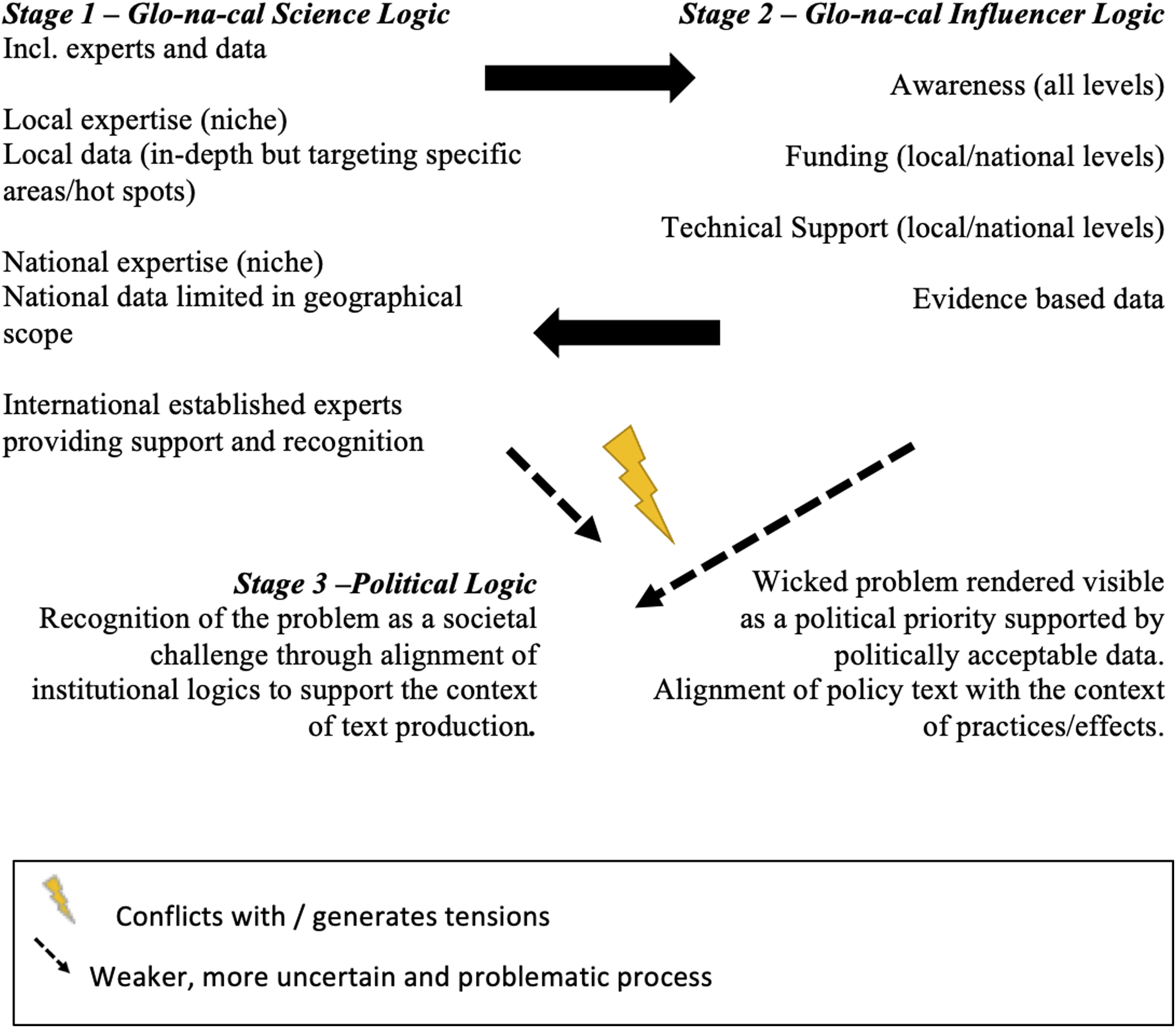
NGOs acting as influencers appreciated that understanding air quality management requires evidence and continuous monitoring to inform discussions within a context of influence. International NGOs engage in national and local policy assemblages to try to encourage acceptance of air quality as a policy priority. One of their roles is to support the development of solutions through raising awareness, then provide some funding and technical resources. Both initiated a glo-na-cal translation of the air quality problem, making it visible in on-going discussions within national and regional contexts of influence and policy text production. A representative of an NGO in Kenya noted that: International NGOs play a very big role, for the simple reason that they have a point of view of benefits that may not be obvious in a local context… On this kind of thing, NGOs played a major role … I mean number one, many NGOs have great leverage with government officials and then, on the other hand, a lot of their support goes all the way to CBOs you know at the local level …so as far as we are concerned, I think we need voices across borders, we need champions in all these (26 October 2018, Non-governmental institution/NGO, Kenya).
The intersections between organisations adopting science versus influencer logics followed a two-stage process. First, the convergence of science and influencer logics initially focused nationally to create evidence-based awareness and to nudge national governments to accept air pollution within ongoing discussions regarding the context of policy influence. This was ineffective and the NGO focus of attention shifted to city-regions with the aim of altering local/regional policy initiatives. Again, there have been limited impacts, despite a range of policy intervention attempts as we will discuss further in the following section. This highlights how local and national politics relegates science (and glo-na-cal knowledge), and those trying to influence local policy, illustrating the tensions between science, NGO influencers, and the state-centric nature of the policy process and assemblages of local actors. There will be continual interactions between individuals/organisations holding a science logic with those working to an influencer logic with this process continuing until the policy cycle concludes with no outcome or a wicked problem is accepted politically (Figure 1 – stage 3). Failure of this process is explained by the absence of a very clear and powerful political logic, per se, supportive of enhancing air quality. The political logic triggers decision-making processes including decisions about where and how to invest and is central to actors/institutions directly involved in political decision-making processes. Central to this logic is a policy prioritization process which, if activated, enables the convergence of science and influencer logics to inform policy formulation, implementation, and enforcement (Figure 1 - stage 3). Political logic legitimacy is not only constructed around the authority acquired by political leaders through the election process as they represent citizen interests, but also through their control over a bureaucracy which shapes policy texts, makes decisions to invest in measurement, monitoring, analysis, implementation, and enforcement.
Within the three cities the interviews revealed that the political process had yet to embrace air pollution as a core local societal challenge. Thus, those involved in trying to configure a context of influence around air pollution failed to have air quality accepted as a core policy priority. One Ethiopian government representative noted that:
There are different teams focusing on different kinds of pollution and their assessment, but on air pollution we are not doing much but when there are complaints from affected people then we take action. Not a priority. Federal government has the power to improve the fleet of imported cars and fuel quality (22 August 2018, Government Representative/City, Ethiopia).
The problem rests on a failure to align air pollution as a wicked problem compared to other societal challenges which have been prioritized in the political process resulting in investment. For Uganda the problem was in trying to: … draft safety law, an amendment to what you already have. . . and that did not pass because it’s political. Why is it political? Because this law is made for, I mean it’s for industries to do better and you know, health and safety and the environment is very expensive. So, the politicians say ‘wait a minute, you have this law in place, you’re going to chase away investors’. So, it gets very political (18 October 2018 Government Representative/National, Uganda).
This Ugandan example highlights an ongoing struggle over the context of influence to develop effective air pollution policy. In these three city-regions air pollution failed to emerge as a priority theme compared to poverty alleviation, economic development (and investment) or housing provision. The procedural actions taken by national governments regarding air quality reflect “the politics of problem denial and supporter denigration” (Howlett, 2014: p. 396). Politicians and officers could not be persuaded to prioritise air pollution and the development of regulatory frameworks for effective air quality management, and this decision came with a set of excuses. Such excuses included focusing on national priorities and highlighting financial constraints whilst disregarding the activities of organisations that have developed influencer and science logics that are focussed on trying to prioritise air pollution as a core policy challenge. Two barriers were identified that prevented air pollution from being prioritised side-lining the role played by science and influencer logics in the context of influence: a problematic integration of logics and related knowledge with localised strategies along with monitoring and measuring problems. We now explore these two barriers.
Policy prioritisation, lack of integration, conflicting logics and localised strategies
Policy emerges within the context of competing political challenges/opportunities with the outcome reflecting some agreement over policy prioritization. In both international programmes and national strategies, air quality is associated with policy themes including health, environment protection, climate change, transport, economic development, energy, and urban growth. These priority themes constitute policy domains involved in the context of influence related to air pollution. A key challenge is policy integration to ensure that each policy domain, for example transportation, acknowledges the contributions that these policies make to air pollution. This type of policy integration in East Africa is problematic given “poor integration of stakeholders as institutions work independently rather than together” (22 August 2018 Government Representative/City, Ethiopia). This results in a failure to develop an integrated approach. An NGO representative noted that: …unless you have a multi-sectoral approach then it will not necessarily work. Because you will engage then with the Department of Public Health in the Ministry of Health, and they will get it. You'll find real champions who are passionate about this who will tell you stories… But unless you have people from the Ministry of Planning, people from the Ministry of Finance, to really begin to engage with some of these processes, I really don't think we can get the kind of reforms that we are looking at (26 October 2018, Non-Government Institution/NGO, Kenya).
The difficulty is in coordinating interlocking systems of power with different actors/institutions in a policy assemblage having very different institutional logics and related policy objectives (Figure 2). This goes beyond levels of urban governance, jurisdictions, and roles. Combined, the outcome is a series of interlocking policy interventions that maintains existing air pollution levels or even increases them. This policy prioritization failure is partly explained by tensions between the levels at which policy is created and enacted, and by failure to develop a coordinated rather than a siloed approach to air quality policy. This policy outcome reflects the interplay between three key network participants and their respective logics – national and international scientists, NGOs and other influencers, and politicians and officers in each city (Figure 1). Each actor/institution involved in this policy assemblage plays a distinct role in the policy cycle and in shaping the context of influence that results in a policy prioritization outcome, and each follows a different institutional logic. However, they do not hold the same degree of power especially in advocating a shift from acknowledging a problem to formulating policy and related enactment and enforcement processes. As a result, there is a power asymmetry between science and influencer logics compared to actors/institutions which hold political logics (Figure 2). Policy prioritisation and integration: challenges and failures.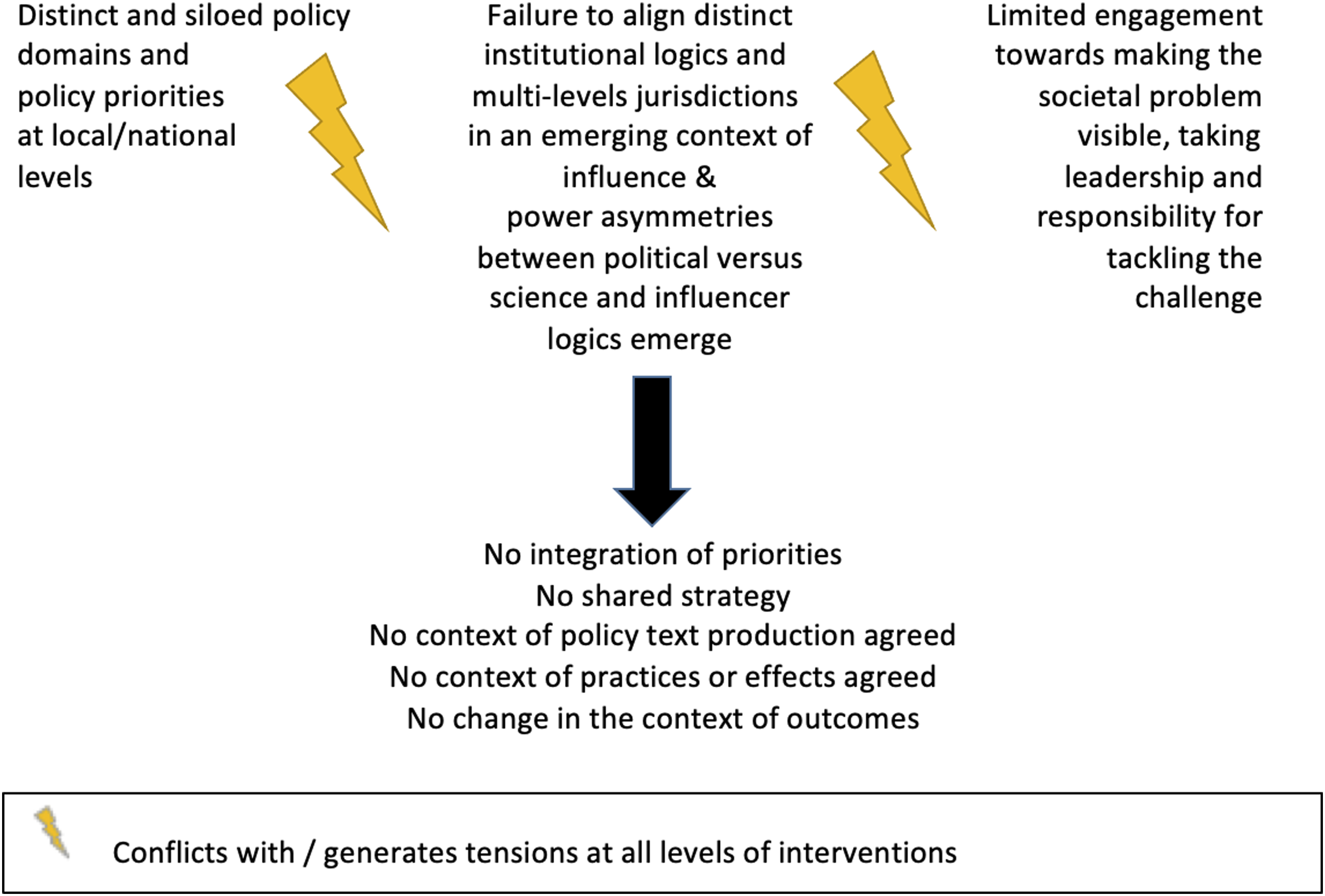
Understanding the disconnect between intent and action requires an appreciation of the tensions that exist between institutions with different and conflicting institutional logics, powers, and responsibilities. Responsibility becomes an important part of this process and reflects the emphasis placed by Vidovich (2007) on state-centred constraints. Urban governance is the outcome of a set of negotiated trade-offs and power relationships between a policy elite, and other network participants. This is a form of path dependency in which the political process attempts to relegate science and influencer logics within the context of influence. For air pollution, this relegation process includes developing air quality policy, but failing to enact or enforce alterations across other related policy domains including transport and utilities. This isolates air pollution within an air quality policy which is not integrated with other policy domains and their contexts of influence, policy development and practices/effects.
At the national level, the Ethiopian government established the Environmental Protection Authority in 1995 to implement environmental protection laws. Yet this country has not developed a comprehensive air quality policy strategy (Mitike, et al., 2016). The same year, the Ugandan government established the National Environment Management Authority, but failed to approve a bill legislating air quality emission standards and regulations (Kiggundu, 2015). Uganda has not developed specific strategic plans for air quality nor emission standards and regulations to guide compliance. The Kenyan government went further and approved regulations on air quality management in 2014, but these regulations were not enforced. All three countries have yet to develop enforceable and effective policy to address high levels of air pollution.
At the city level, Addis Ababa became autonomous as early as 2003 while Kampala and Nairobi obtained administrative autonomy in 2010 (Bjerkli, 2013; Republic of Uganda, 2010; Ngigi and Busolo, 2019). These cities have developed administrative hierarchies that facilitate urban planning, service delivery and environmental and public health regulations bringing urban governance closer to the people (Obeng-Odoom, 2012). Addis Ababa is also responsible for environmental policy and the city’s ambition was to lead the way by shaping city level policies building upon external partnerships. From 2019, a comprehensive air quality management plan had been developed supported by international organisations including the United States Environmental Protection Agency. Nevertheless,
In this city, there is a department for environmental and air quality regulations but no substantive local action plan for air quality improvement. The challenge has been attributed to funding and duplication of responsibilities between the city government and the national government (22 August 2018 Government Representative/City, Ethiopia).
In 2011, the creation of Kampala City Authority led to the formulation of strategic plans to improve air quality. In 2019, the city council developed a draft air quality management plan. In the same year, Nairobi city county government tried but failed to localise national air quality regulations by developing air quality management action plans. These failures highlight serious overlapping jurisdictional challenges preventing the development of effective policy solutions to the local institutional and infrastructure issues associated with urban air quality improvement. While progress has been made in Kampala and Nairobi to develop city-region air quality action plans, political backing from national government must still be obtained as national actors/institutions control decisions over finance and infrastructure and these decisions then play an important role in contributing to city-region air pollution.
Policy implementation can be problematic given conflicts between the context of policy text production and the context of practices/effects with these tensions limiting policy effectiveness; this is the case in our three cities (Figure 1 – stage 3). Policy as text must come with effective monitoring, implementation, and enforcement and without this, policy cannot be translated into transformative change. An Ethiopian government representative noted that:
The constitution specifies the specific mandates of the federal Government and local governments. The federal government formulates legislation and policies providing a general framework. So, the federal government has developed many policy and legal instruments and documents for general legislation. The other lower governments administer and implement these legislations. For this to work the national coordinating body builds capacities, trains local level inspectors, provides technology support and facilitates implementation by working together to set working plans and action points. There are coordination mechanisms in place, yet the problem of enforcement is there (22 August 2018 Government Representative/National, Ethiopia).
This raises significant challenges at city level. For Addis Ababa this meant that “environmental problems were recognised that is why the authority was created. But the authority should have more power to implement regulations; more empowerment and more attention from the higher level” (22 August 2018 Government Representative/City, Ethiopia).
A key difficulty is that the air quality context of influence was diffused across actors/institutions with competing institutional logics and with no leadership being provided by local officials, politicians, and policy elites which would allow clearer political logics to emerge and converge with both science and influencer logics (see Figure 2). An assemblage was forming around air pollution, but competing institutional logics prevented a context of outcomes forming. Measurement and monitoring problems played an important role here combined with skill deficiencies. This is an important point as it highlights the role that competing institutional logics play in the policy cycle and the need to develop an institutional logics informed account of the hybrid framework for policy analysis.
Data politicization and the wicked role of localised data and skills
Policy texts are the outcome of struggles between different institutions and organisations involved in trying to shape the outcome of a context of influence by drawing upon distinct resources, skills, and political influence. These struggles occurred within each of the three cities reflecting the actions of different interest groups trying to shape the development of a policy agenda that might eventually become locked down within a policy text. This process of locking down does not necessarily lead to an alteration in the context of output. This is an important point. An assemblage that leads to the formulation of a new policy and that might be informed by policy mobility, may still be ineffective given difficulties related to implementation including enforcement. Data, skills and resources are essential components in shaping the context of outcomes, and particularly the contrast between required data, skills and resources to support policy formulation and implementation combined with what is locally available and/or politically acceptable. The outcome might reflect tensions between science versus political logics with the political process failing to accept that a societal challenge requires the enactment of policy. Central to this failure is the politization of data (Figure 3). Data, knowledges and the challenges of locking down societal problems within a policy cycle.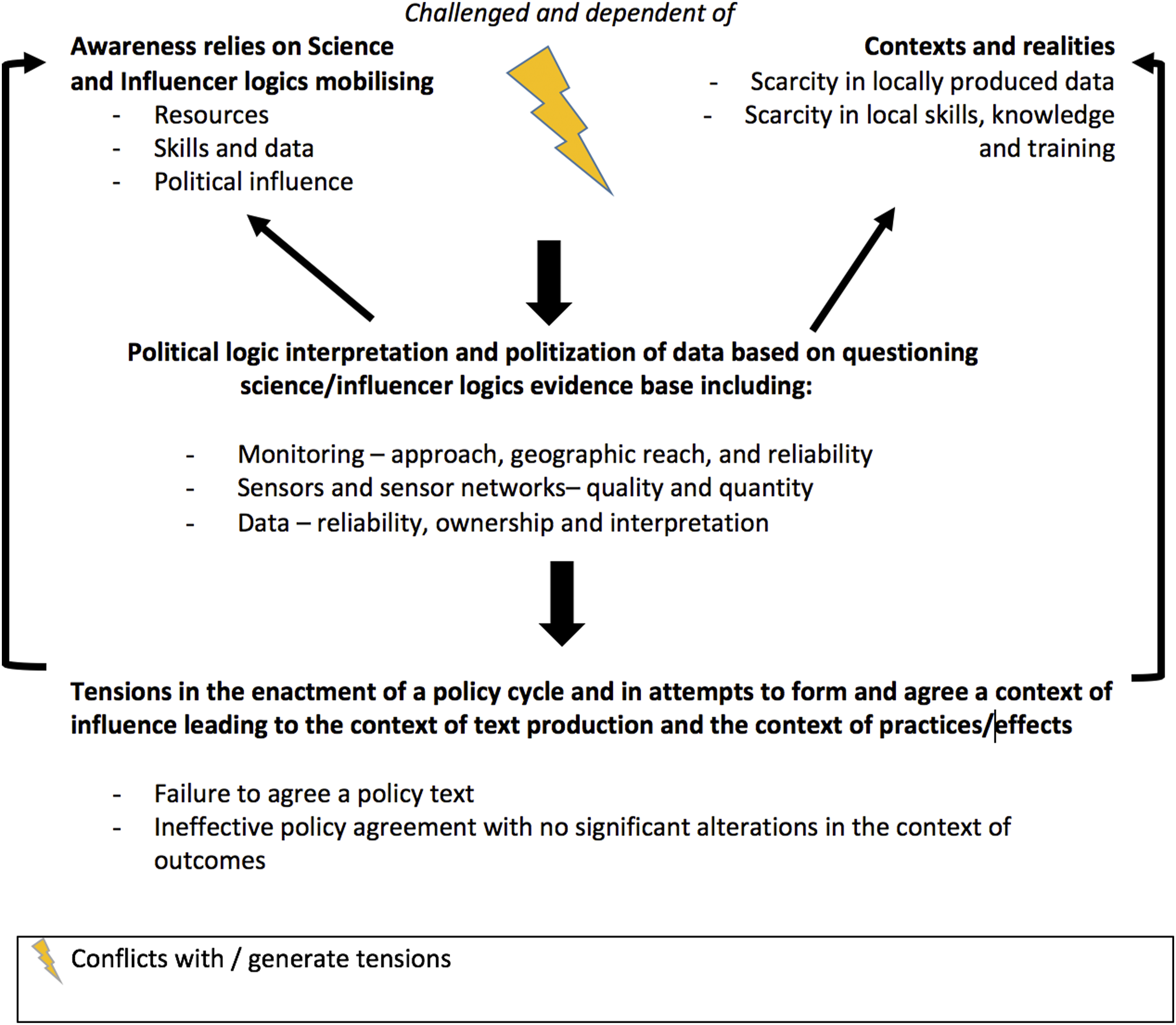
Air pollution has been predominantly related to environmental protection and this partly explains the challenge of developing enforceable policy in East Africa. Countries apply recommendations and develop programmes to improve air quality based on practices developed in other contexts (Schwela, 2012). This informs science and influencer logics and involves transferring knowledge and policy approaches primarily formed in developed market economies which have greater access to resources, skills, and data. Problems of data consistency to inform action, and the political process, makes evidence based policy regarding air quality improvement challenging (Amegah & Agyei-Mensah, 2017; Kiggundu, 2015; Rajé et al., 2018). This impacted on actors/institutions following science and influencer logics as they failed to persuade politicians and policymakers to accept air pollution as a policy priority as the local evidence base to support discussions around the context of influence was considered to be inadequate to frame the development of a context of policy text production and context of practice.
Availability and provision of reliable and localised data are key contributing factors for NGOs as they try to shape an emerging context of influence and context of policy text production. This is not unique to East Africa and can be observed in SSA more widely. The lack of leadership from governments across SSA was attributed to the absence of reliable data on air pollution levels and public health impacts. This was further reinforced by skill deficiencies making it difficult for each city-region to develop the investment case required to invest in air quality monitoring infrastructure (Amegah and Agyei-Mensah, 2017). As a result, international and indigenous agencies, NGOs, foreign aid and consultancy companies including the World Health Organisation (WHO), World Bank, UNEP, Stockholm Environment Institute and European Union as well as foreign governments (e.g. USA) have stepped in as external pressure groups trying to influence local political debates by articulating financial and political pressures. Part of this involved discussions around data, data availability, and the interpretation of evidence. This led to the politicisation of data interfering with political logics - which undermined the contribution that the science logic could play in the policy prioritization process.
The science logic relied on experts targeting educated elites able to understand the data and open to engaging with scientific evidence. Translating the air pollution problem, as defined by science, to actors/institutions following a different logic was challenging (Figure 3). One respondent highlighted this issue as “many environmental issues are so technical and need expertise” (22 August 2018, Government Representative/National, Ethiopia). Resources and capacity were also highlighted by respondents: We have just started implementing air quality regulations. There is not much emphasis on air quality regulation, national policy has not been developed on air pollution… Capacity is one of the challenges, a bit of equipment, technical and human (29 August 2018, Government Representative/National, Kenya).
Most of the barriers are technical capacity both within and outside the institution in terms of skills, knowledge, and equipment. (23 August 2018 Government Representative/National, Uganda)
The lack of technical skills, and related training and awareness, has opened up further spaces for international and indigenous NGOs, and other governments to monitor air quality in Africa. Nevertheless, without strong local political commitment, current actions at city level may not obtain the required financial backing to continue monitoring once foreign assistance stops.
Monitoring is the first step towards enhancing the importance of air pollution within the policy context of influence. Financial and technical challenges were presented as barriers preventing monitoring of air quality from occurring or restricting monitoring to a limited number of locations. Data problems prevent wicked problems from being defined as a policy priority given difficulties with the availability of reliable data. Air quality monitoring requires the design of a sensor network and implementation depends on the availability of adequate funding and staff with the skills required for sensor calibration and for data analysis. Politicians must be persuaded during a context of influence dialogue to invest in monitoring, but this then involves a conflict over resources that could be spent on more immediate priorities. This goes back to the role political logics play in defining wicked problems (Figure 1). The absence of good quality data was recognised as a key concern by government representatives from each of the three countries. Thus:
For air quality regulations the challenges stem from obtaining technical data. There are not many experts in the field of air quality management in Uganda so we hope to get them from development partners and we also need technical guidance (23 August 2018 Government Representative/National, Uganda).
As a result, officials and politicians were able to relegate air pollution as being of secondary or of unknown importance based on the absence of data. Local data is required to support discussions over defining a context of influence and its absence may prevent policy mobility and localisation. This data problem explains difficulties in formulating a context of policy text production and in implementation through shaping a context of practice. NGOs, civil society organisations and other organisations following an influencer logic tried to fill this monitoring gap, but politicians and officials deployed their political logics to block this process by highlighted concerns with reliability, geographic coverage, or sensor calibration. Data from low cost air quality monitoring sensors are not yet considered adequate for regulatory purposes, whilst data from high cost reference sensors, including those located in the US embassies in Ethiopia, Kenya and Uganda, have limited geographic coverage to support policy formulation (De Souza, 2018). Air quality measurement and monitoring problems resulted in a Catch 22 situation developing in which data was unavailable to support a policy debate that would justify expenditure on developing air monitoring networks in each city. This is an important point as air pollution must be monitored over time and across a city-region. Changes in air quality over short time periods occur due to localised weather events rather than policy interventions. Monitoring intended to support scientific studies does not provide the type of sensor network required to support political interventions based on shaping a context of influence to support policy formulation. Data rapidly became politicised during discussions and debates around the air quality context of influence with criticisms focused on data quality and geographic coverage. For example, in Nairobi, an NGO had monitored air quality since 2017 and had released this data for public use (De Souza, 2018). Nevertheless, a court case involving a steel manufacturer and its impacts on air quality in a residential area in Nairobi found that this data was inadmissible.
Such tensions reveal that those following a political logic are engaged in a continual negotiation process involving multiple trade-offs. This explains the state-centred nature of the outcome of a context of influence and decisions regarding enforcement. What is evident from the analysis of the interplay between scientists, NGOs and policymakers is that politicians, during the policy debate over air pollution in these three cities, were able to side-line this problem based on concerns over data reliability, the geography of available sensors, and the limited extent of the monitoring (Figure 3). This is a path dependent outcome founded upon failure to invest in monitoring and measurement reflecting decisions regarding resource allocation, including officer time and funding, to other policy priority areas. Ultimately, these city-regions, and their politicians, can claim to have air quality policies in place, or under development and that air pollution has become a visible policy challenge, and as such that they are taking the issue seriously, but they are not developing enforceable policy or even effective policy. A policy cycle may have led to the development of policy text, but without measurement and monitoring there is no policy enactment or enforcement and no alteration in the context of outcome. The outcome is that air pollution in these three cities continues to impact on life chances enhancing mortality and morbidity.
Discussion and conclusions
This paper’s conceptual contribution is to highlight the need to place the identification and analysis of institutional logics at the centre of the hybrid framework for policy analysis. Developing policy solutions to wicked problems involves a convergence between different contexts of policy making and three main institutional logics: those led by scientists and other actors identifying and characterizing the problem and then a policy translation process that may involve NGOs acting as influencers in order to reach policy makers who hold most of the power required to make a problem effectively visible and a priority. There are important interactions between different scales in this process including policy mobility and subsequent translation or localisation. This then engages with political logics involving actors/institutions with the power to prioritise a societal challenge and this then might lead to transformative changes being initiated. Post-structural approaches to policy formulation have applied assemblage theory to explore regional governance as an ongoing process of assemblage formation and this has included a focus on policy mobility. This paper has developed and extended these approaches by drawing upon institutional logics to reveal the ways in which conflicting logics can prevent the formulation and implementation of policy solutions to wicked problems. It thus makes three key contributions.
First, it extends the analysis of policy formulation by exploring competing institutional logics and the role these play across the policy cycle. This highlights that policy mobility requires a localised evidence base, and that the absence of integration and local data represent major barriers to policy development and implementation. Local is key here and this raises further question about the geography of evidenced-based policy. This localised data collection process rapidly becomes politicised as it involves conflicts over access to resources and is also constrained by skills and capacity shortages within the local policy community with such shortages representing a fundamental weakness in any policy assemblage.
Second, the paper highlights that policy emerges from an initial confrontation between competing stakeholders engaged in a dialogue over a context of influence. Policy mobility plays a different role in each context with the context of influence stage involving influencers who try to alter the existing prioritization of a societal challenge. This dialogue is informed by scientific data and by the role played by influencers as they try to add air quality to on-going political discussions. In the three cities, effective and enforced policy solutions to air quality have yet to be developed. This reflects tensions between stakeholders with different institutional logics. Science has identified and characterised the problem even if localised and longitudinal data remains limited. The accumulation of studies has reached the stage when air pollution needs to be recognised as a serious societal challenge negatively impacting on life chances across East Africa. Stakeholders that adopt an influencer logic have tried to ensure that effective solutions to air pollution are developed locally. Thus far, organisations following science and influencer logics have not been able to ensure that effective local air quality policies emerge and are enforced. This reflects the dominance of state-centred priorities and contrasting political logics within a context of influence. These priorities reflect path dependency and trade-offs regarding the allocation of limited resources and other urgent - at least politically perceived as such - needs (Andres et al., 2021). All are linked to the specificities of wicked problems.
Third, this analysis has provided a new way to unwrap the challenges faced in classifying a ‘wicked problem’ as a policy priority informed by science. This is an important point in that there are different types of policy that range from politically defined policy that is difficult to measure and monitor to policy that is more directly aligned to measurement and monitoring. For the latter, a key issue is determining causality and the timing of any impacts. Immediate policy interventions require a direct and immediate link between cause and effect. For air pollution the link between cause and effect occurs over a longer period, typically much longer than political mandates. This suggests that the political process may fail to prioritise air pollution compared to more pressing political policy challenges and this relegation process applies both regionally and nationally.
The hybrid approach developed by Vidovich (2007) emphasises the role played by non-state stakeholders, including the role of foreign governments and NGOs, in the policy cycle. Nevertheless, post-structural approaches to policy analysis have not yet considered the interplay between institutional logics held by different stakeholders and policy formulation and implementation processes. This paper has revealed that different institutional logics within a policy cycle produce challenges and tensions that may work against the development, implementation, and enforcement of effective policy. For air quality in East African cities, global influencer logics, informed by science logics, have tried to shape discussions and outcomes in ongoing debates involving a context of influence forming around air pollution. These influences have yet to result in alterations in the context of outcome; policy has been developed, but not enforced. This, of course, raises significant concerns as air pollution is one amongst many other factors influencing climate change impacting on the future of current and forthcoming generations particularly in the current context of multiple adaptations and alterations affecting urban spaces (Andres et al., 2022). Developing solutions to climate change is an extremely difficult policy challenge compared to air pollution, but air pollution policy will contribute to addressing climate change. Thus, there is a political argument to leverage solutions to air pollution as one step towards engaging with climate change mitigation.
Footnotes
Declaration of conflicting interests
The author(s) declared no potential conflicts of interest with respect to the research, authorship, and/or publication of this article.
Funding
The data collected from this paper draw upon the ASAP-East Africa research project, funded by the Department for International Development.
