




Abstract
Inspired by Lefebvre’s meditation on the rhythms seen from his apartment in Paris, we develop a novel rhythmanalytic account of urban air pollution, its breathing-in and impact in vulnerable bodies. We conceptualise urban air pollution as entwined in its making and consequence with the diverse rhythms of technologies, social practices and socio-temporal structures, environmental and atmospheric processes, bodily movements in space and time, and rhythmically constituted corporeality. Through this interdisciplinary account we position urban air pollution as integral to the ‘beat’ of the city, both a product of and constituent part of its evolving spatiotemporal form. We build on this foundation to develop a polyrhythmic conceptualisation of how certain places and lives are more dominated by pollution than others. Unequal patternings are made through the structuring effects of rhythmic repetition and by fatal intersections between the rhythms of polluted air and unequal capacities to avoid harmful breathing in and to resist the arrhythmic corporeal consequences that can follow. Understanding inequalities as manifest not within a static landscape of spatial relations, but in sets of unequally unfolding and structured polyrhythmic relations has implications for revealing patterns of inequality and for extending evidence-making more deeply into how rhythms intersect. Which and whose rhythms are to be intervened in are also considered as key ethical and political questions. We draw out implications for activism and community action, and identify the potential for bringing rhythmanalysis into productive engagement with broader environmental justice concerns, including in relation to recent COVID-19 experiences.
Introduction
Whilst known predominantly as an urban-spatial theorist, Henri Lefebvre ‘did not privilege space at the expense of time’ (Kipfer et al., 2008: 9). Most significantly in working with Catherine Régulier (Lefebvre and Régulier, [1985] 2004; [1986] 2004), he sought explicitly to theorise the spatial and temporal together through rhythmanalysis, proposing ‘a new science, a new field of knowledge: the analysis of rhythms: with practical consequences’ (Lefebvre, [1992] 2004: 11). In the best known passage in the main rhythmanalysis text
1
, Lefebvre describes the flow of rhythms ‘seen from the window’ of his apartment on the Rue Rambuteau in Paris, paying particular attention to the movements of traffic and pedestrians, their speeds, intensities and interactions: ‘At the green light, steps and words stop. A second of silence and then it’s the rush, the starting up of tens of cars, the rhythms of old bangers speeding up as quickly as possible. … On this side, people walking back and forth, a mix of young and old, alone and in couples, but no cars alongside culture. After the red light, all of sudden it’s the bellowing charge of wild cats, big or small, monstrous lorries turning towards Bastille, the majority of small vehicles hurtling towards the Hotel de Ville. The noise grows, grows in intensity and strength, at its peak becomes unbearable, though quite well borne by the stench of fumes … Hard rhythms: alternations of silence and outburst, time both broken and accentuated …’ (Lefebvre, [1992] 2004: 38–39)
In this paper, we take on the challenge of making the air and its contamination more present in rhythmanalytic accounts of the city and the multiplicity of flows that run through urban space (Brighenti and Karrholm, 2018; Crang, 2001; Edensor, 2010a; Lyon, 2018; Schwanen et al., 2012). We draw inspiration from rhythmanalysis and related rhythmic writing, to build a novel polyrhythmia of urban air pollution in which the rhythms of gases and particles, their making in polluting technologies, subsequent circulations in the environment, and their breathing in by rhythmically exposed and mobile bodies are spatiotemporally intertwined. Through this account we position urban air pollution as integral to the ‘beat’ of the city, both a product and constituent part of its ever-evolving polyrhythmic form.
This rhythmanalytic conceptualisation provides the foundation for then conceptualising inequalities in air pollution distributions and consequences in spatiotemporal terms. Unequal patternings, we argue are not manifest within a static landscape of spatial relations, as conventionally understood in environmental justice and related assessments, but rather made and remade through interactions and intersections between rhythms and the structuring effects of rhythmic repetition, such that certain spaces and certain lives recurrently become more subject to, and dominated by, the consequences of pollution than others. Giving attention to difference in these terms, we argue, has implications for the assessment of patterns of inequality and for extending evidence-making more deeply into polyrhythmic interrelations, as well as for the ethics of victim-responsive and purposeful interventions into the reproduction of air pollution polyrhythmia.
In developing this approach to air pollution and its inequalities, we seek to add to the growing engagement in social theory with air, its qualities, politics and ‘unbreathability’ (e.g. Adey, 2014; Cupples, 2009; Dupuis, 2004; Graham, 2015; Hauge, 2013; Kenner, 2019; Nieuwenhuis, 2016; Sloterdijk 2009), as well as to the range of topics and concerns explored through rhythm. Forms of movement, transport and mobility have figured in a number of rhythmanalytic accounts (Chen, 2017; Edensor and Holloway, 2008; Edensor and Larsen, 2018; King and Lulle, 2015; Kullman and Palludan, 2011; Sarmento, 2017; Spinney, 2010), but not in terms of their consequences for air quality, or the breathing of polluted air within mobility practices. Thinking with rhythm in relation to a socio-natural phenomenon, such as air pollution, also opens up its multidisciplinary potential. Lefebvre ([1992] 2004; 32) urges the rhythmanalyst to be open to knowledge from “psychology, sociology, ethnography, biology and even physics and mathematics”, but examples that span disciplines are scarce (although see Jones, 2011; Oppermann et al. 2020; Walker, 2021). We also bring a distinctive polyrhythmic perspective into air pollution as a socio-political concern and environmental justice issue. Environmental justice analysis has been critiqued for working with rather simplistic spatial orientations (Holifield, 2009; Walker, 2009), and we seek to explore the potential for seeing inequalities through the rhythmic and the spatiotemporal. Some environmental justice, and related health geography and transport modelling work has moved in this direction (Buzzelli, 2018; Dias and Tchepel, 2018; Gulliver and Briggs, 2005; Vallee, 2017), but in only relatively limited, empirical terms.
We begin by outlining key aspects of rhythmanalysis and what this brings to our focus on urban air pollution, before then working through a polyrhythmic account of how air pollution is made, becomes distributed and has consequence for the breathing-in experienced by mobile and rhythmically constituted bodies.
Key aspects of an ontology of rhythm
Rhythmanalysis ‘defined as a method and a theory’ (Lefebvre, [1992] 2004: 25) provides a rich and open framework for engaging with air pollution as a multidimensional ‘and thoroughly hybrid phenomenon’ (Cupples, 2009: 207), in which the living body, matters of social practice and organisation and environmental processes are in interaction. Rhythm provides a way of conceptualising the spatial and temporal together (May and Thrift, 2001; Schwanen and Kwan, 2012). ‘All rhythms imply a relation of a time to a space, a localised time, or, if one prefers a temporalized space’ (Lefebvre and Régulier, [1986] 2004: 96). In taking inspiration from rhythmanalysis we find value in a number of its key features and concepts.
Rhythmanalysis is typically positioned within Lefebvre’s critique of everyday life (Elden, 2004; Lyon, 2018), but its philosophical scope is more extensive. Taken together, the set of related rhythmanalytic writing provides a treatise on rhythm in all of its ubiquity and diversity. Rhythmanalysis ‘analytically scans rhythms across scale’ (Reid-Musson 2018: 4), from the cosmological in the movement and circling of planets (day/night, seasons, annual cycles), to the corporeal in the many rhythms of bodily function (heartbeat, lungs, digestion), and the social in the rhythmic ordering work of institutions, conventions, schedules and devices (timetables, festivals, opening hours, eating, travelling times and much more). It is thus a call to seeing and seeking out animation in radically different forms. Rhythm is both human and non-human (Edensor, 2010b), a characteristic of ‘every being, every entity and every body’ (Lefebvre and Régulier, [1985] 2004: 89). There is ‘nothing inert in the world, no
For our concern for rhythmising urban air pollution, this engagement with what Jones (2011: 2285) terms ‘ecosocial relational formations between nature and culture’, is particularly important. It is also necessary that rhythms are not considered alone but in their interaction. The notion of polyrhythmia captures exactly this general quality of rhythms co-existing and interrelating. Rhythms flow, vary and change in sets of complex relations with others, including across levels or scales from the cosmological to the corporeal. As Lefebvre and Régulier ([1985] 2004: 82) characterise: ‘Everyday life remains shot through and traversed by great cosmic and vital rhythms; day and night, the months and the seasons; and still more precisely biological rhythms. In the everyday this results in the perpetual interaction of these rhythms’
It is also important to our concerns that rhythmic flows and interactions are understood as (re)producing patterns of difference and inequality. Lefebvre articulates in general terms how some rhythmic orders can come to dominate others, and how rhythmic devices such as timetables are inscribed with power, disciplining the rhythms of capitalist working practices. Others have since done more to recognise the wider power-laden character of polyrhythmic interactions, and to open up questions of difference that extend beyond Lefebvre’s rather narrow view of the everyday (Lyon, 2018; Reid-Musson, 2018). Edensor (2010b: 2), for example emphasises how rhythmic power is instantiated in ‘unreflexive, normative practices’, but does not produce uniform outcomes, so that ‘some conform to dominant routines and timetables, while others reject such temporal structurings, or become sidelined because they are thought to be out of step’. Apparently dominant rhythms are not necessarily dominant for all, and the potential for resistance to generate new ways of being, newly differentiated polyrhythmia is always present. A relatively small but significant literature has begun to develop conceptualisations, and empirical cases of how such power-laden rhythmic differentiations and fragmentations are produced, experienced and negotiated (King and Lulle, 2015; Lager et al., 2016; Reid-Musson, 2018; Schwanen et al., 2012), but not as yet in relation to environmental justice concerns.
A polyrhythmia of urban air pollution
In moving to conceptualise urban air pollution in polyrhythmic terms, utilising the various resources we have outlined, we begin with matters of epistemology. Air pollution is socio-culturally defined (Cupples, 2009), a categorisation of material entities in particle and gaseous form as ‘matter out of place’ (Douglas, 1966), and is necessarily known and evaluated through some system of knowledge or sense-making. At times, in relation to some forms and concentrations, the situated manifestation of air pollution is assessable by the human body. Lefebvre’s reference to the ‘stench of fumes’ is one example, as are the smog-type visibilities of accumulations of larger particles, the varying ‘taste’ of the air, and responses of the body such as stinging eyes, sneezing, or difficulty breathing (Bickerstaff and Walker, 2001, 2003; Bush et al., 2001; Cupples, 2009). A rhythmanalytic account of urban air pollution, which is generally approached as an embodied, sensory method (Lyon, 2018), could remain in this territory, engaged with pollution as an experiential phenomenon.
However, there are limits to embodied capacities to know urban air and the threats it contains. For Whitehead (2009: 2) ‘the notion of atmospheric pollution is a complex and ever-changing category of analysis’ with developments in atmospheric and health science enabling us to now know air pollution in many diverse forms, including those that are invisible to the human senses and toxic in insidious, accumulative and synergistic terms. Lefebvre ([1992] 2004; 32), as already noted, saw rhythmanalysis as needing to ‘receive data from all the sciences’, and in building a cohesive polyrhythmia of urban air pollution we take up this injunction to epistemological pluralism, drawing on diverse knowledges (including from our own expertise) on social, atmospheric and human-biological processes. However, scientific uncertainties and disagreements persist, air pollution data-making practices are differentially evaluated (Garnett, 2017; Yearley, 2006) and the metrological and regulatory regimes that draw on environmental and health sciences have to be approached as partial and political representations of, and responses to, public concerns (Barry, 2005; Calvillo, 2018; Rydin, 1998). Both lay and scientific modes of knowing air pollution therefore are bounded, an observation we shall return to later.
Rhythms of pollution and environments
Whatever knowledge forms are drawn on, it is clear that urban air pollution is not a spatiotemporally constant phenomenon. Gases and particles defined as pollutants in ambient air, circulate, accumulate, disperse and dilute, and sometimes react and chemically change across space and over time, through processes and in patterns that reoccur and repeat: in other words, in rhythms. Rhythm for Lefebvre is defined by repetition, ‘no rhythm without repetition in time and in space, with reprises, without returns’ (Lefebvre, [1992] 2004: 16); not exact repetition though as ‘absolute repetition is only a fiction of logical and mathematical thought’ (ibid 17), with an important opening therefore to emergence and change. Repetitions, as with those found in monitored data tracking air quality in a particular locality, can exhibit many different shapes, phases, curves and measures and be represented at different resolutions. As an example, Figure 1 shows three representations of six years of data from the monitoring station closest to Lefebvre’s apartment in the middle of Paris, with which this paper opened. At this specific point in urban space, hourly averaged particulate matter (PM2.5) levels (Figure 1(a)) trace a clear diurnal rhythmicity with two oscillations towards and away from morning and early afternoon peak concentrations. Across the weekly cycle (Figure 1(b)), there is a recurrent drop in nitrogen dioxide (NO2) levels on Saturday, and further again on Sunday. Across the year (Figure 1(c)) the flux of ozone concentrates in the summer months and falls away in the winter. Despite the averaging involved smoothing out much detailed variation, such underlying rhythms are clear.
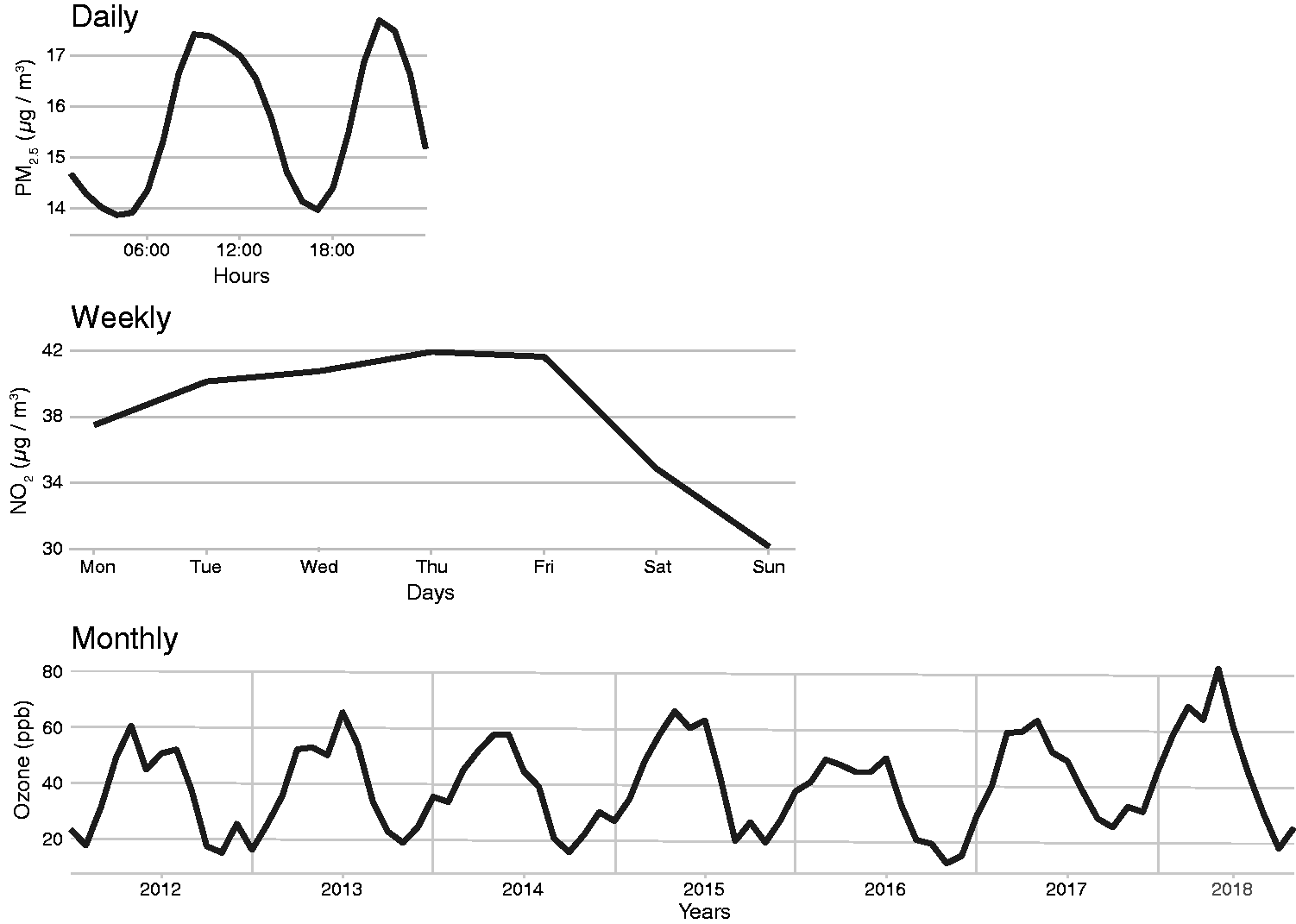
Air pollution concentrations 2012-18 for the ‘Paris Centre’ monitoring station, showing (a) mean levels across all PM2.5 hourly data, Monday-Friday for the daily pattern (b) mean levels across all NO2 daily averages for the weekly pattern (c) O3 monthly averages for the yearly pattern. Source: www.airparif.asso.fr
While the rhythms of different pollutants (rhythms that are related but distinct) can be represented in these particular data-led terms, they are evidently not ‘self-making’ but intimately linked to and ‘entrained’ by (Schwanen et al., 2012) the rhythms of other entities and processes. Pollutants are emitted from technologies that are material elements in the performance of social practices (Shove and Walker, 2014); practices which have their own situated rhythmic qualities (Blue, 2019; Walker, 2021).Most significant and obvious for Paris, as for most other urban areas, are the rhythms of use of mobility technologies (cars, vans, lorries, motorbikes) as people and goods are moved through the day, over the week, and over annual and seasonal cycles, to the ends of diverse practices, purposes and intents. The ‘rush hour’ is the emblematic rhythmic form here; getting to work, and back to home, generating repeating accumulative peaks in traffic and pollution levels focused along particular routes and into particular places.
Much evidently shapes the socio-temporal characteristics of such pollution-making rhythms, including institutionally set working hours, opening/closing, and start/end times, requirements for (co)presence in particular spaces, relational and absolute ‘doing-place’ geographies (Hui and Walker, 2018) and the availability of infrastructures that enable and channel mobility of different forms and orchestrate their flow and interaction (Edensor, 2011). These have various temporal structures in their patterning, making differentiations, for example, between weekdays and weekends, in and out of ‘term time’, and for public holidays and collective vacation periods. And it is not just pollution-emitting transport technologies that are rhythmic in their use. Any emitting source, or set of sources – from spatially dispersed enactments of home cooking and heating (Cupples, 2009), to specifically located industrial processes - have rhythmic qualities coupled to temporal structures. Rhythms of pollution-making are in other words deeply embedded in the rhythms of social and economic life and how these play out in spatial terms.
How pollution in the atmosphere concentrates over space and time is not though just a matter of its production, but also of the rhythms of environmental processes through which pollutants once emitted are dispersed, deposited and sometimes chemically transformed (Everard, 2015). As air pollution science details, patterns of air movement, temperature, solar radiation and humidity can each, in interaction with particular pollutant characteristics, be integral to how ambient pollution levels become spatiotemporally distributed; how they vary over space and flux and flow over time. And such environmental parameters exhibit their own rhythmic patterns of repetition, rhythms in temperature, humidity and solar radiation that are discernible, for example, between day and night, that repeat across seasonal structures (such as the ‘photochemical smog’ of ozone levels in Figure 1(c)), or that have a ‘return period’, a calculated likelihood of an extreme event, such as intense heat waves, or very stable temperature inversions reoccurring and leading to sustained high pollution concentrations (De Sario et al., 2013). Other rhythms also potentially intervene in how pollution once released is dispersed and distributed. The seasonal growing and dying back of leaf cover on urban trees rhythmically enables and limits their capacity to capture and contain particulate dispersion (Maher et al., 2013); the movement of outdoor air into the interior environment of buildings is shaped by the mundane diurnally and seasonally varying patterns of window and door opening (Leung, 2015).
Entwined therefore with the familiar but reductive one-dimensional rhythmic patterning of measured concentrations of gases and particles in the air, exemplified in Figure 1, is a whole ensemble of other variously coupled and tangled rhythms. A situated polyrhythmia of pollutant making and distribution, produced by the coming together of diverse social and environmental rhythms, ‘shot through and traversed’ (to use Lefebvre and Régulier’s phrase) by the great cosmological rhythms of diurnal and annual cycles.
Rhythms of bodies and their movement
However, the polyrhythmia is not as yet complete. We are engaging with the air because of the harm that may be done by its constituent materialities to entities that are socially valued. The rhythms of exposure and vulnerability of ‘at risk’ entities have also therefore to enter our analysis. Our focus here is on the human body 2 , which Lefebvre and Reguliér ([1985] 2004; 88) conceptualise in rhythmic terms, ‘the living – polyrhythmic - body is composed of diverse rhythms, each ‘part’, each organ or function having its own, in perpetual interaction’. In a well-functioning healthy body internal rhythms work together, along with those external to the body, in a ‘eurhythmic’ form. However the potential for ‘arrhythmias’ to manifest as a pathological condition is always present, ‘rhythms break apart, alter and bypass synchronization’ (ibid: 78) beating against or fighting with each other, in the body but also in other polyrhythmic formations (Edensor, 2013). The breathing in of polluted air is one way in which bodily arrhythmia can emerge, become strengthened or exacerbated, both in an acute or tightly rhythmically entrained way, or through the longer-term gradually emerging chronic effects of repetitive immersion. Indeed, two key bodily rhythms – the movement of the lungs and the beating of the heart – are compromised by the interaction of the body with the harmful qualities of the air it is immersed in, with health science documenting with ever more precision the exact qualities and intensities of those interactions (see, for example, Cheng et al., 2015; Hampel et al., 2012). Such corporeal rhythmic breakdowns have further rhythmic consequences, including in constraining the ability of those affected to engage in the routine of everyday activity including school and work attendance, and in generating temporalities of precaution and response. Kenner (2018) deploys the notion of ‘care rhythms’ working across bodily, day-to-day and seasonal timescales to capture the various temporalities and spatialities involved in living with and managing asthma as a widespread respiratory disease condition linked to air pollution. As she argues ‘as an environmental health disease, asthma is produced, triggered and cared for through emplaced practices – embodied responses anchored in specific contexts – that lean into different kinds of rhythms, such as the rhythms of breathing, seasonal rhythms, the timing of paychecks and exercise regimes’ (ibid: 18)
As a final step we also need recognise that corporeal immersion in (polluted) air is not a constant, but shifts as the breathing body both rests in place (at home, work, school etc.) indoors and outdoors, and moves (through walking, running, cycling, being on or in vehicles) through different spaces. Just as Hägerstrand (1996: 651) argues “People are not paths, but they cannot avoid drawing them in space-time” people also cannot help but breathe as their paths take shape. Rhythms of stasis and movement are in turn structured by various spatiotemporal orderings, synchronizations of social practice, timetabled routines, norms and conventions of what is done, where and when – including those that were implicated earlier in the making of pollution emissions. The ‘rush hour’, as an example, is therefore both a rhythm of pollution making, as well as one of bodily movement and potential exposure to polluted air (Gulliver and Briggs, 2005), with contrasting relations of ‘responsibility’ and ‘suffering’ between those getting to and from work by car, or by bicycle or on foot (Rivas et al., 2017).
To summarise, an urban air pollution polyrhythmia, as we have conceptualised it in general terms, and as represented in Figure 2, is a complex, ever-forming assemblage of multiple, diverse, social, environmental, cosmological and corporeal rhythms. An assemblage of rhythms that are integral to the ongoing beat of the city and the human and non-human animations and flows that make its dynamic qualities, and that generate spatiotemporal patternings of pollution emissions, concentrations, exposures and impacts in human bodies. As rhythmically constituted these patterns repeat, and therefore have some degree of order and continuity, including in how they reproduce patterns of inequality. It is to the parameters and politics of such rhythmic differentiation and their relevance to questions of environmental justice that we now turn.
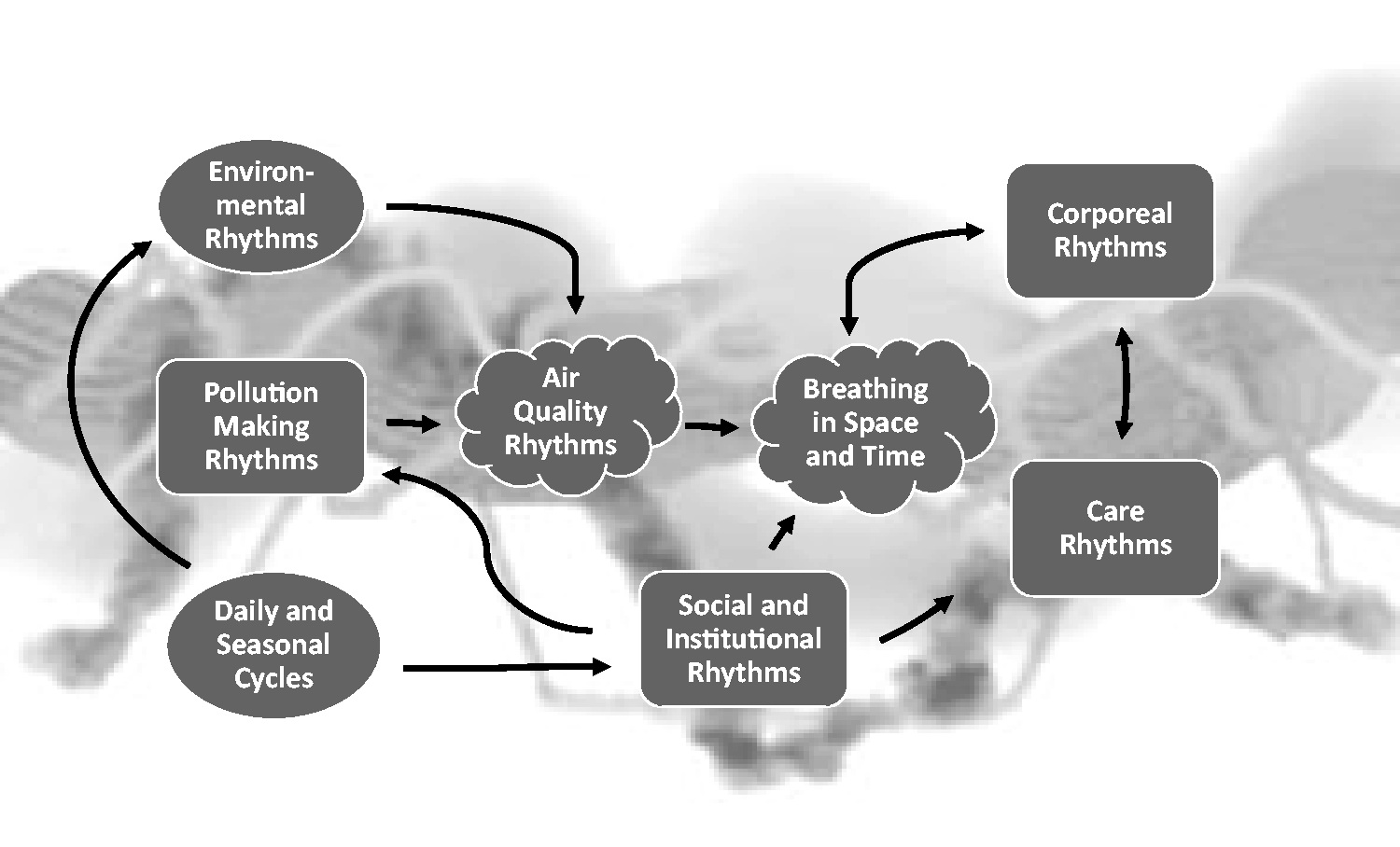
The urban air pollution polyrhythmia indicating main flows of rhythmic interaction.
Unequal rhythms: Intersections and implications
Our rhythmanalytic conceptualisation of urban air pollution has implications for how inequalities in ‘breathing in’ are conceptualised, how they are known and evidenced, and how they are responded to and intervened in. Each of these are addressed in turn.
Conceptualising inequalities
Within environmental justice and related scholarship, many studies have now documented the depth and intensity of air quality inequalities through relating the variation of air pollution over cartographic space to variations in poverty, deprivation, race, age and other socio-demographic indicators (see reviews in Buzzelli, 2018; Chen et al., 2015; Miao et al., 2015; Walker et al., 2018). Such studies have become increasingly sophisticated and concerned with more precisely connecting spatial coincidence to health impacts, but conceptually they predominantly share an understanding of inequalities as spatially constituted; as a matter of where pollution is and where populations, as categorised in chosen terms, are located. Temporalities become part of this spatial orientation in work concerned with tracing the uneven (historical) production of geographies of air pollution (e.g. Harper, 2004; Hurley, 1995; Kruize et al., 2007) and with assessing how the intensity of inequality is evolving over time (e.g. Mitchell et al., 2015), but as noted earlier beyond some limited empirical exceptions, there is little that has been open to the simultaneously spatial and temporal and interrelations that we have laid out in the first half of this paper.
At first sight, a polyrhythmic conceptualisation of air pollution might suggest a landscape of continual dynamic complexity, undermining any sense of structured differentiation in how air pollution is encountered and has consequence. However, as made clear earlier, a specifically rhythmic ontology requires and identifies repetition, emphasising how, through the ongoing re-materialisation and anticipation of repeating patterns, some degree of order to ‘what happens’, where and when is re-produced. This spatiotemporal ordering, combined with unevenness in relations of domination and subordination between rhythms, is integral to how inequalities become established and sustained. As Reid-Musson (2018: 884) argues ‘rhythms are necessarily implicated in the structure and restructuring of social worlds’ such that ‘social differences and social oppressions … are made and remade through spatio-temporal arrangements like rhythms’ (ibid, 886). Schwanen and Kwan (2012) similarly argue that whilst at an aggregate level rhythms are empirically differentiated and structured ‘along lines of gender, class, race/ethnicity and so on’ it is ‘from such rhythms, speeds etc. that social differentiation comes into being’. Following these lines of argument, it is the repetitions that have come into being in the rhythms of mobility, industrial production, energy use and environmental processes that mean certain places will be more inscribed with pollution than others, but how bodies are entangled with, intersected and dominated by these rhythms in unequal ways is what matters for how differences in burdens and consequences become distributed across social categories.
Reid-Musson (2018) in developing a distinctive intersectional rhythmanalysis, uses the notion of ‘fatal intersection’ to capture how subjects are ‘unequally situated’ in the interlacing of power-infused rhythms, producing in her analysis the violent arrhythmia of the death of a migrant worker in a road traffic accident. As she argues ‘what intersects in this context was not social differences per se, but assemblages of human and non-human bodies (i.e. with machines) with unequal capacities to move, work, reside and access services’ (ibid, 891). She also emphasises that such an intersection is not anomalous but rather normalised and ‘deeply ordinary’. In similar terms we can understand the routinely arrhythmic consequences of air pollution exposure, accounting for many thousands of deaths of year, as fatal intersections of the rhythms of gases and particles in the atmosphere with the rhythms of mobile and breathing bodies, structured by unequal capacities to (i) avoid the repeated breathing in of pollutants, and (ii) to resist the breaking apart of bodily rhythms by so doing. Bodies here are unequally positioned both in how they are part of the rhythms of place, as well as in how they are porous to intrusions of emplaced rhythms into the body; in Longhurst (2001) terms forming a ‘corporeography’ within which an extended ecology of rhythms interact.
Unequal capacities to avoid the repeated breathing in of pollutants are made by how the movement of subjects in space and time is ordered in relation to the rhythms of where and when concentrations of pollutants accumulate, spike, decline and persist, over daily and longer timescales. The nature and location of available and accessible work, for example, structures both how breathing in is enacted when in workplaces and during available and accessible modes of movement to and from home. It can be, in such ways, necessary to breathe in polluted air order to partake in the rhythms of making livelihoods, accessing services and enact everyday sustenance. There are ‘polluted routines’ (Da Schio et al., 2019) which repeat in alignment with the differentiated possibilities and obligations of urban life and the unequal resources that are available to sustain well-being.
This is made starkly clear in Graham’s (2015) account of how wealthier elites regulate their exposure to polluted air through routinised vertical movement into dwelling and working spaces that rise above the polluted milieu at ground level and semi-permanent encasement in filtered bubbles of ‘private air’ as they move from one air-conditioned internal space (fixed and mobile) to another; a process of urban ‘air secession’ (Adey, 2013: 299), or of the uneven production of ‘microclimatic enclosure’ (Marvin and Rutherford, 2018: 1147). This means that in an apparently pervasively polluted place, such as Mumbai or Shanghai, wealthy elites have the resources to make spatiotemporal arrangements that evade their bodily entanglement with the urban and breathing rhythms that dominate the lives of others. In stark contrast are those whose rhythmically structured lives are necessarily perpetually immersed in polluted air, such as those walking, working, sleeping and living on city streets, or cooking with poor quality fuels in smoke-ridden indoor spaces, and at all times breathing in their contamination (Véron, 2006).
Unequal capacities of bodies to resist the breaking apart of bodily rhythms by intrusions of pulses of particles and gases bring other differentiated intersections into the mix. Bodies, as liminal spaces in which outside and inside intermingle (Senanayake and King, 2019), become differentially vulnerable to ‘breathing in’ through multiple evolving intersections of poverty, age, ethnicity and gender, such that when gases and particles enter the rhythms of any given corporeal ensemble their agentive consequences are differentiated both by the imprint of history and by present situation. Fatal intersections in this sense arise from both the accumulated consequences of recurring stresses on bodily eurhythmia – a ‘slow violence’ (Nixon, 2011) of repetition and interaction - and specific moments of intense metabolic burden and arrhythmic breakdown. Capacities to hold back fatality are also unevenly structured in terms of both access to effective health care and capacities to manage the rhythms of everyday life to avoid atmospheric triggers than mean tipping from chronic into more acute conditions. Given that, as Kenner (2019) argues, such defensive and protective rhythms of care are emplaced and situated, their enactment and outcome will be differentiated, for example by gender, race, housing quality and age, as well as by location in relation to air quality.
In a number of ways, therefore, a polyrhythmic conceptualisation of inequalities moves away from a static landscape of ordered relations between pollutant patterns and distributed population groups, towards a far more dynamic understanding how unequal consequences of breathing in are produced and reproduced, both in terms of the repetitions that make polluted places and the differentiated intersections that generate and perpetuate harmful outcomes in unevenly mobile, vulnerable and agentive bodies.
Unequal evidence
From following this polyrhythmic conceptualisation of unequal breathing, we can then ask how fit for purpose established ways of knowing air pollution and its consequences are. The evidence that underpins most inequality analysis is that generated by metrological regimes of air pollution monitoring (Barry, 2005). These typically involve measurement at sparsely located monitoring stations undertaken at coarse through to finer temporal resolutions (Buzzelli, 2008; Calvillo, 2018), along sometimes with modelling techniques that can be can be used to ‘fill the space’ between monitoring stations, generating a dynamic air quality surface (Buzzelli, 2018). Such finer grained spatiotemporal representations of air quality are not though routinely available for many urban places around the world, meaning that in practice much of the intrinsic rhythmicity we have been concerned with is invisible or obscured.
More fundamentally, the differentiated and unequal rhythms of moving bodies, with moving lungs, and the intersections that matter to arrhythmic harm are not at all present in the knowledge made by official air pollution regimes. Outside of specific research initiatives, using advanced techniques to include time-activity patterns in assessments of pollution exposure (Dias and Tchepel, 2018) – which have demonstrated just how significant differences between people’s exposure patterns can be (Dons et al., 2011) - there is no routine data on encounters between moving bodies and polluted air, on its actual breathing in. The socio-corporeal domain is in effect held static, an inert, undifferentiated backdrop over which moving concentrations of gases and particles are measured and reported. Epidemiological studies may at a later stage seek to work out the after-effects of breathing in and of harm done to bodies, including through spatiotemporally matching the rhythms of doctor visits or hospital admissions to the rhythms of acute pollution exposures (for example see Vencloviene et al., 2017). But they do so with considerable difficulty in establishing generalizable patterns of causal rhythmic interrelation.
Much therefore remains to be done to bring the unequal spatiotemporalities of lived, polluted experience into view. Community and activist strategies using participatory methods to generate alternative forms of air quality knowledge, part of a wider agenda for ‘epistemic justice’ (Ottinger, 2018), go some way in this direction. Examples include collaborative initiatives that deploy monitoring in locally targeted ways to identify pollution pulses and concentrations that would otherwise be ‘unmeasured’ (Chemin et al., 2019; Gabrys, 2017; Gabrys et al., 2016), and making data through participants wearing low cost personal air quality sensors that record pollution concentrations from the perspective of the mobile body (Steinle et al., 2013). Although there have been criticisms of the accuracy and reliability of such sensors, these do begin to ‘fill in’ knowledge about the rhythms of unequal exposure.
Going further to know the personal, lived experience in other ways can extend deeper into unequal polyrhythmic relations, such as documenting participants own sensing of their bodily reactions to different environmental conditions (Allen, 2018), such as times when asthma-related breathing difficulties are more severe (Brown et al., 2004; de Weger et al., 2014; Sze, 2007). While such lay-knowledge on rhythmic interrelations is not necessarily given credence by professional expertise, in one striking example in London (UK) the death of a 9 year old girl from a severe asthma attack has been pursued through the law courts claiming a direct relation between her worsening condition and air pollution spikes near to her home (Marshall, 2019). Whilst lay intuition in identifying a fatal intersection of accumulated and immediate bodily and atmospheric rhythms has now necessarily moved through to the presentation of expert evidence that can withstand legal scrutiny, this is a potentially significant example of the deployment of knowledge on how interactions within the air pollution polyrhythmia play out. Not across a mass of abstractly estimated deaths attributable to air pollution, but in curtailing the life of a real and differentially vulnerable individual.
Unequal interventions
A further key question emerging from our analysis is which, and whose, rhythmic patterning within the pollution polyrhythmia should be modulated or curtailed to the ends of air quality improvement and harm reduction. Basic principles of justice in how interventions are enacted and targeted can therefore be brought to bear (Walker, 2012). Most fundamental is the expectation that it should not be those who are polluted that are having to act. However, those suffering from the chronic effects of air pollution are often, in quite hidden ways, already having to intervene in their everyday polyrhythmia of activity and movement in order to limit the intersection of their breathing rhythms with dominating pulses of pollution. Without action to cut pollutants at source this becomes the residual victim-centred response, ethically unacceptable but practically essential for some semblance of bodily eurhythmia to be sustained. Governance measures such as issuing advice to those most vulnerable to stay at home or more generally for outdoor exercise or bodily exertion to be avoided on heavily polluted days, only serve to reinforce the domination of pollution-making rhythms across urban space. Everyday rhythms are unjustly curtailed, producing a pollution-induced spatiotemporal unmaking of both the right to breathe and the right to the city.
Interventions that seek to disrupt the rhythms of pollution-making focus more directly, and ethically, on those elements of the pollution polyrhythmia that are fundamental to its harmful outcomes. Critical distinctions can still be drawn though. Examples such as the suspension of traffic and shutting down of polluted factories during the 2008 Beijing Olympics (Witte et al., 2009) to enable the bodily rhythms of sports performance (Edensor and Larsen, 2018); or in Paris to ban cars from the centre of the City on specific days (Airparif, 2017) to demonstrate ‘how different it could be’ (in air quality and other terms), are only temporarily induced ‘discordant’ disruptions (Crang, 2001) to urban beats, before the normal laid out score of repetitions is resumed. Activist interventions to block key roads and routes, or as in ‘Critical Mass’ rides to fill the road with cyclists, are also necessarily only temporary moments of rhythmic interruption. However, they have a more fundamental intent to challenge the hegemony of rhythms that dominate, segregate and discipline public space - and public air - and the routes through this that mobile subjects are expected to follow (Spinney, 2010). In this sense they constitute examples of what Edensor (2010b: 16) terms ‘resistant rhythms’, which, in breaking up repetitions, offer alternative visions to those inscribed in ‘ordered rhythmic flows laid down by the powerful’ (ibid: 17).
Such collective activist strategies also act as a counterweight to neoliberal logics of individualised responsibility for self-protection. Wearing masks, buying pollution protecting make-up, or curtains that strip pollutants out of the air 3 are of questionable efficacy, but also depoliticising distractions from addressing the fundamental drivers of pollution emissions. Indeed, the spatiotemporal perspective pursued in this paper might also be seen as problematically oriented to the individual at-risk subject, particularly, when technologically materialised, for example, in mobile phone apps 4 that indicate in near real-time more and less polluting routes for moving around the city by bike or on foot. Smart and responsible citizens, such technologies suggest, can self-manage their spatiotemporal pathways of pollution exposure, leaving the more polluted streets for others to inhabit. Whilst we recognise such ethical tensions, for us understanding the urban in polyrhythmic terms is more fundamentally about revealing and tracing lines of interconnection, contrast and conflict. For example, co-joining the corporeal and care rhythms of suffering with asthma – the daily routines of breathing exercises, medication, checking air pollution reports and hiding indoors (Kenner, 2018) – with the pollution-making rhythms of the ‘automobility system’ (Urry, 2004), or of contemporary retailing in the shape of next-day, next-hour van delivery schedules. Or, of contrasting the deliberate concealment by car manufacturers of the real-world polyrhythmic complexity of pollution-making by diesel vehicles (Palmer and Schwanen, 2018), with the everyday embodied rhythms of walking through street canyons, waiting to cross the road, and being engulfed by a blast of diesel-emitted pollutants. In such ways thinking (poly)rhythmically we see as a potentially fertile resource for critique, claim-making and the development of activist strategy.
Conclusion
We have in this paper sought to contribute to ‘airthinking’ about ‘what kind of air is inhaled’ (Nieuwenhuis, 2016: 514) in an overtly rhythmic and spatiotemporal formulation. We have demonstrated that there is much in rhythmanalysis, and related writing about rhythm, that can productively animate our understanding of air pollution as a constitutive part, and product of, the beat of the city and the differentiated beats of urban lives. Urban air pollution is repetitively dynamic over multiple time-scales, and entwined in its making and consequence with multiple diverse rhythms. Including rhythms of social practice and institutional temporal structure; of diurnal and seasonal cycles; of environmental and atmospheric processes; and of the functioning and mobility of human bodies. Rhythms we have argued that have consequence in how certain places and certain lives come to be repetitively more polluted and damaged than others, including because of socially differentiated capacities to shape the spatiotemporal trajectories of everyday life.
In engaging with questions of inequality, we have provided a polyrhythmic conceptualisation of how unequal patterns of harm become manifest, moving away from a static landscape of ordered spatial relations between pollution and populations, towards a dynamic understanding how unequal consequences of breathing in are produced and reproduced. There are differentiated ‘fatal intersections’ (Reid-Musson, 2018) between rhythms, we have argued, that generate and perpetuate harmful outcomes in unevenly mobile, vulnerable and agentive subjects and bodies. We have also outlined how a rhythmic, spatiotemporal perspective calls for epistemic and ethical attention to what and who is more or less visible in official air pollution knowledge, and which, or whose, rhythms are being intervened in by air pollution action. We have identified connections with the spatiotemporal character of various instances of environmental justice and community action, but there are broader linkages to follow. A recurrent maxim of environmental justice is that it is about ‘where we live, work and play’ (Bullard, 1999; 7) which can be readily interpreted as a statement of the necessarily spatiotemporal constitution of the everyday and of the burdens of environmental risks this carries and accumulates. A polyrhythmic perspective may therefore have a more expansive contribution to make to environmental justice analysis, politics and claim-making (Walker, 2012), exploring other rhythmic and spatiotemporally structured phenomena, and opening up parallel insights into the continuities, repetitions and inequalities of everyday experience.
There is also much scope for working with rhythmanalysis in alternative ways. Chen (2017: 15) makes clear that there are ‘no set rules’ to forming a rhythmanalytic account, rather a multiplicity of possibilities; including in terms of focus, scale, inclusion, exclusion and boundary drawing and forms of knowledge. We have been broad and open in scope and scale, drawing on our different disciplinary backgrounds to develop a general account of urban air pollution. There are other approaches that could be followed, focusing on particular parts of the general polyrhythmia, on particular rhythms, sets of interactions or outcomes, and/or situating an analysis more specifically in place. Timescales could also be stretched to include rhythms repeating and cycling over longer durations. For example, in terms of ‘life-span’ (Edensor, 2010b; Lager et al., 2016), a longer term progression of identifiable life-stages, through which patterns of bodily vulnerability to air pollution shift and change (Kenner, 2018). In such work, it would also be important to explore questions of commensurability between the quite different knowledge forms that can provide insights into and representations of rhythmic forms. We have not directly problematized such questions in this paper, but they merit more substantial attention and critique if rhythmanalysis is going to more fully develop its multidisciplinary potential.
While we have focused on how repetition (re)produces structure and order in patterns of differentiation and inequality, the insistence of Lefebvre and many others that rhythmic repetition is always with (some degree of) difference, constitutes an intrinsic openness to change, and sometimes significant rupture. Edensor (2010b: 15) notes how approaching rhythm as an ‘ever new becoming’ rather than oppressive routine, suggests potential for creativity and the possibility of the successful playing out strategies of resistance to dominant rhythms. Taking hold of this sense of hope, and of examples of urban settings in which city rhythms are not so dominated by the products of polluting technologies is important. However, it is also apparent that in many cities around the world rapidly shifting rhythms of urban economic activity, mobility and social organisation are generating polyrhythmic interactions that serve only to intensify air pollution dynamics (Cheng et al., 2015); added to, for some cities, by shifting patterns of repetition in environmental and climatic processes (Graham, 2015). The dramatic consequences for air pollution of the wholesale re-making of routinised rhythms of movement and activity during COVID-19 lockdown (Venter, 2020), have offered the possibility of a fundamental re-set in our relationship to the air and the reproduction of rhythms of pollution-making and suffering, including because of interactions between the virus and air pollution exposure. Whether recent experience becomes an extraordinary and only temporary interruption in the continued holding together of urban air pollution polyrhythmia is a key question not only for urban environmental justice, but by extension for the future of environmental, energy and climate justice (Walker, 2021).
Footnotes
Acknowledgements
We are grateful for the supportive and constructive comments of three reviewers.
Declaration of conflicting interests
The author(s) declared no potential conflicts of interest with respect to the research, authorship, and/or publication of this article.
Funding
The author(s) disclosed receipt of the following financial support for the research, authorship, and/or publication of this article: Dr Paul J Young was partially supported by the UK Engineering and Physical Science Research Council for the “Data Science of the Natural Environment” project (grant ref: EP/R01860X/1).
