



Abstract
This article examines the short- and long-term impact of working from home on satisfaction with flexibility, feelings of loneliness, and job satisfaction and contributes towards the understanding of circumstances that determine whether working from home has positive or negative effects on job satisfaction. Theoretically, this study argues in the context of the job demands-resources model that working from home increases job satisfaction in the short-term due to increased flexibility. In the long-term, however, the positive effect of working from home on job satisfaction is expected to decrease because loneliness countervails the positive effect of flexibility. The predictions are tested using data from 16 waves of the Household, Income and Labour Dynamics in Australia Survey. Event-study regressions reveal that working from home permanently boosts satisfaction with flexibility but increases loneliness in the long run. In line with the argumentation, the results indicate that the positive effect of working from home on job satisfaction diminishes the longer employees are working from home.
Introduction
The Covid-19 pandemic has led to a sharp increase in the number of employees working from home. Despite the end of the pandemic, employees continue to ask for working from home opportunities as they got used to the related benefits (Aksoy et al., 2023; Barrero et al., 2021; Fana et al., 2020). However, the long-term impact of working from home on job satisfaction is unclear. Working from home not only entails positive effects but triggers negative consequences for employees’ personal lives (Bellmann and Hübler, 2021: 438). On the one hand side, working from home offers benefits like flexibility, time saved on commuting, and increased autonomy, leading to higher job satisfaction (Gajendran and Harrison, 2007). Conversely, it blurs work-life boundaries, leading to extended and irregular work hours (Laß and Wooden, 2022). Moreover, reduced face-to-face interactions with colleagues and supervisors can result in isolation and negatively affect job satisfaction (Golden and Veiga, 2005). Thus, empirical evidence on the relationship between working from home and job satisfaction is mixed. Several studies find working from home to increase job satisfaction (Bae and Kim, 2016: 366; Boulet and Parent-Lamarche, 2022: 18; Dockery and Bawa, 2014; Fonner and Roloff, 2010; Jamaludin and Kamal, 2023; Kelliher and Anderson, 2010: 91; Makridis and Schloetzer, 2022; Wheatley, 2012: 239), whereas other studies find no relationship between working from home and job satisfaction (Morganson et al., 2010; Vander Elst et al., 2017: e183).
Existing research primarily examines working from home and job satisfaction at a single point in time, lacking insights into its long-term effects (Antolín et al., 2022). As job satisfaction shapes employee’s relationship towards the organization and influences employees’ productivity and commitment, it is vital for organizations to comprehend how working from home impacts job satisfaction over extended periods. This article fills this gap by analysing the impact of working from home on satisfaction with flexibility, feelings of loneliness, and job satisfaction over time.
Specifically, this article contributes to existing research on working from home and job satisfaction in a theoretical and empirical way. Theoretically, this article is the first that explores the relationship between working from home and job satisfaction over time. Applying the job demands-resources model (Demerouti et al., 2001), this article argues that working from home offers job resources like flexibility which help to meet job demands and lead to a positive attitude towards flexibility. However, prolonged working from home reduces job resources such as social support, leading to loneliness. Therefore, this article argues that working from home increases job satisfaction temporarily because of flexibility. However, the positive effect of working from home decreases the longer employees are working from home due to increasing feelings of loneliness that countervail the positive effect of flexibility.
Thus, the theoretical argumentation of this article considers positive and negative consequences of working from home temporarily to address inconsistent findings regarding working from home and job satisfaction from the literature. Golden and Veiga (2005) already considered a trade-off between flexibility and feelings of loneliness, depending on the intensity of working from home. Extending Golden and Veiga’s (2005) trade-off between flexibility and loneliness, this article examines the time-scaled effect of working from home on job satisfaction and responds to Beckel and Fisher’s (2022: 16) call for research to account for ‘how long one has been teleworking when evaluating interpersonal outcomes associated with telework’.
Empirically, this article provides evidence for a non-linear relationship between working from home and job satisfaction over time. Moreover, it investigates long-term effects of working from home on satisfaction with flexibility and loneliness as potential mechanisms. Using panel data from 16 waves of the Household, Income, and Labour Dynamics in Australia Survey (HILDA), results from event-study regressions reveal that working from home positively impacts satisfaction with flexibility. By contrast, feelings of loneliness appear the longer employees are working from home. Consequently, the positive effect of working from home on job satisfaction decreases in the long run. Point estimates of working from home on job satisfaction turn insignificant after 4 years of working from home, implying that the negative effects of loneliness entirely outweigh the positive effects of increased flexibility.
This article relates to the analysis of Torten et al. (2016), who consider a temporal perspective by analysing the linear relationship between working from home experience and job satisfaction. While Torten et al. (2016) only focus on positive effects of working from home experience, this article additionally considers the negative effects of extended periods of working from home on job satisfaction. Thus, this article improves the work of Torten et al. (2016) by allowing the impact of working from home on job satisfaction to change over time. In addition, this article utilizes panel data rather than cross-sectional data. Panel data enable to track changes in job satisfaction within an individual and, therefore, eliminate unobserved time-invariant heterogeneity between individuals that could otherwise bias the effect of working from home on job satisfaction (Laß and Wooden, 2022; Uglanova and Dettmers, 2018).
Theoretical background and hypotheses development
This paper draws on the job demands-resources (JD-R) model from Demerouti et al. (2001) to explain the relationship between working from home and job satisfaction over time. Although the JD-R model is a framework to predict engagement and burnout, it has also been used to investigate other outcomes such as well-being and satisfaction (e.g. Demerouti et al., 2000). The JD-R model categorizes working conditions into either job demands or job resources. Job demands are aspects of a job that require physical and psychological effort and are associated with physical and psychological costs. Job demands include for example time pressure, emotionally demanding interactions, and work-life conflict and are risk factors for exhaustion. Job resources can reduce the undesirable impact of job demands and stimulate personal growth. Examples for job resources are autonomy, social and supervisor support, participation, and feedback (Bakker and Demerouti, 2017; Demerouti et al., 2001). According to the JD-R model, insufficient job resources to meet job demands foster exhaustion and disengagement (Demerouti et al., 2001: 502), which consequently reduce job satisfaction.
This paper follows Beckel and Fisher (2022) and argues that working from home simultaneously provides and reduces certain job resources to meet individuals’ job demands. First, working from home empowers employees with flexibility to adjust work to personal needs which lowers exhaustion and increases engagement (Sardeshmukh et al., 2012). Second, working from home is associated with reduced social support and quality of relationships that lead to feelings of loneliness (Sardeshmukh et al., 2012) and foster disengagement (Schaufeli and Bakker, 2004: 296). While flexibility is expected to increase job satisfaction because of reduced exhaustion, feelings of loneliness can lower job satisfaction because of disengagement. To disentangle the positive and negative effects of working from home on job satisfaction, this article accounts for a time-scaled effect of both job resources, namely flexibility and (missing) social relationships, on job satisfaction. The next sections describe the relationship between working from home and both job resources as well as job satisfaction within a temporal perspective.
Working from home and flexibility over time
Working from home lowers exhaustion due to increased flexibility that enables a reduction of job demands such as time pressure or work-life conflict (Beckel and Fisher, 2022). In particular, working from home enables employees to control over the workplace and schedule (Kelliher and Anderson, 2010: 91; Morganson et al., 2010: 579) and allows to adjust work tasks to personal life demands (Brunelle and Fortin, 2021: 4; Dima et al., 2019: 3; Golden and Veiga, 2005: 302). Also, working from home allows greater boundary control to reduce unplanned and demanding interruptions from interactions with colleagues and supervisors (Dubrin, 1991: 1224).
However, the use of flexibility as a job resource to reduce job demands effectively depends on working from home experience. Transferring to working from home without experience is associated with short-lived overload and uncertainty (Antolín et al., 2022). Longer working from home experience teaches employees how to make use of flexibility to reduce job demands (Torten et al., 2016: 317). Consequently, employees learn to adjust work to non-work commitments after a specific period of working from home which leads to a positive evaluation of the job resource flexibility over time.
Hypothesis 1: Working from home relates positively to satisfaction with flexibility over time.
Working from home and feelings of loneliness over time
Working from home harms job-related relationships because of a reduction in quality and quantity of interactions with colleagues and supervisors (Knight et al., 2022: 10). Due to the reliance on communication technologies, conversation becomes structured, less spontaneous and frequent, and task-focused rather than socially focused. Moreover, technology-based communication lacks of information such as non-verbal cues (Fonner and Roloff, 2010: 337; Kaiser et al., 2022: 206; Windeler et al., 2017: 980). Thus, the decrease of social interactions causes as lack of job resources such as social support (Beckel and Fisher, 2022: 4; Vander Elst et al., 2017: e183) and participation (Knight et al., 2022: 10; Morganson et al., 2010: 583) that result in increased feelings of loneliness (Beckel and Fisher, 2022: 16; Cenkci, 2022: 25; Cooper and Kurland, 2002: 512; Kossen and van der Berg, 2022: 219; Mann and Holdsworth, 2003: 208).
However, this article argues that the lack of job resources such as social support depends on how long employees have been working from home. In particular, working from home causes feelings of loneliness that may intensify the longer employees are working from home. In the short run, employees transferring to working from home are able to stay connected to colleagues and supervisors via communication technology. Due to coordination effort immediately after the transition to working from home, employees maintain already established relationships (Maillot et al., 2022: 14).
In the long run, however, working from home challenges home-based workers to connect with new colleagues and harms already established relationships (Collins et al., 2016: 162), because formal and asynchronous communication via technology restricts non-verbal cues that build trust and healthy relationships (Brunelle and Fortin, 2021). Further, interactions become shorter the longer employees are working from home (Maillot et al., 2022: 14 f.), and managing work and non-work responsibilities simultaneously limits employees’ capacity to connect with co-workers (Walz et al., 2023). Thus, employees who are working from home over a longer time period may suffer from the reduction of their social network (Beckel and Fisher, 2022: 16) which results in a lack of job resources such as social support that increase feelings of loneliness over time.
Hypothesis 2: Working from home increases feelings of loneliness the longer employees are working from home.
Working from home and job satisfaction over time
This article explains the relationship between working from home and job satisfaction over time by a time-related trade-off between the job resource flexibility and a lack of job resources that cause loneliness.
Working from home impacts job satisfaction positively by flexibility that helps to meet job demands and lowers exhaustion. However, working from home rises feelings of loneliness due to the lack of job resources such as social support which fosters disengagement and reduces job satisfaction. To examine the relationship between working from home and job satisfaction over time, flexibility and loneliness can be put into an exchange relationship depending on the duration of working from home. In the short run, the transition to working from home is expected to increase job satisfaction because employees enjoy flexibility to meet job demands (see section ‘Working from home and flexibility over time’) while still feeling social support and belonging to the organization (see section ‘Working from home and feelings of loneliness over time’). Consequently, working from home increases job satisfaction recently after the transition to working from home due to ongoing engagement and lower exhaustion. In the long run, however, rising feelings of loneliness resulting from a lack of job resources such as social support foster disengagement and countervail the positive effect of flexibility (Bloom et al., 2015: 183). Therefore, the positive effect of working from home on job satisfaction is expected to decrease in the long run. 1
Hypothesis 3: The positive effect of working from home on job satisfaction decreases the longer employees are working from home.
Method
Sample
The hypotheses were tested using panel data from 16 waves of the Household, Income and Labour Dynamics in Australia (HILDA) Survey covering the years from 2007 to 2022. HILDA is a longitudinal study that began in 2001 with respondents being interviewed on an annual basis. The initial sample of the HILDA survey consisted of 19,914 individuals from 7682 responding households in 2001. In 2011, the sample was extended by 4009 respondents from another 2153 households (Summerfield et al., 2021: 2; Watson, 2021: 555). The year-on-year attrition rate averages below 10% (Summerfield et al., 2022: 172). Among other topics, HILDA provided information on individual’s recent job circumstances and job satisfaction measures on an annual basis and were therefore well-suited to examine the impact of working from home on job satisfaction, satisfaction with flexibility and loneliness over time. Besides data advantages, Australia was an interesting country to study the consequences of working from home due to two characteristics. First, Australia is one of few countries providing certain groups of individuals the legal right to request flexible working arrangements including working from home (Australian Government, Fair Work Act, 2009). Second, Australian employees spend approximately 1 hour on average on commuting per day (Wilkins et al., 2019: 79). This suggests that more employees benefit from the flexibility of working from home than in other countries. Nevertheless, Australian employees work similar hours from home compared to other Western countries (Laß and Wooden, 2022). Thus, the HILDA survey is suitable to derive implications for all countries with similar levels of working from home.
The analysis was based on 43,423 observations from 6149 individuals. Observations that are unemployed, not working any hours per week or self-employed were excluded from the sample. To observe information on working from home over a continuous period, individuals who switch their employment-status more than twice during the observation-period were refused. As individuals’ working-from-home-status can also switch between not working from home to working from home and vice versa several times over the period of observation, individuals were only considered as long as they work from home after the first transition to working from home (Uglanova and Dettmers, 2018: 1735). Last, individuals who used to work from home since the first period of observation were excluded (Clark et al., 2008: F227; Stutzer and Frey, 2006: 343) since they neither identify treatment effects nor act as valid control group under the parallel trend assumption (Callaway and Sant’Anna, 2021). Thus, the sample was restricted to individuals who never transfer to working from home or who transfer to working from home only during the observation period.
Measures
Dependent variables
The analysis focused on the impact of working from home on satisfaction with flexibility, feelings of loneliness as well as job satisfaction. First, satisfaction with the flexibility to balance work and non-work commitments was a single-item measure on a scale from 0 (totally dissatisfied) to 10 (totally satisfied) (Dockery and Bawa, 2014: 178). Second, this article follows Lim et al. (2023) to measure feelings of loneliness by the average of three items that indicate an employee’s relatedness to and support from other people. Within HILDA survey, employees rated the following statements on a scale from 1 (strongly disagree) to 7 (strongly agree): ‘I often feel very lonely’, ‘I often need help from other people but can’t get it’, and ‘people don’t come to visit me as often as I would like’. The items were related to each other with a Cronbach’s alpha of 0.67. Third, job satisfaction quantified the average satisfaction of six aspects of an employee’s job on a scale from 0 (totally dissatisfied) to 10 (totally satisfied): total pay, job security, the work itself, work hours, the flexibility employees have to balance work and non-work commitments and the overall job (Nikolaev et al., 2020: 459). Cronbach’s alpha of all six aspects of job satisfaction amounted to 0.79.
Independent variable
The independent variable in the analysis referred to the transition from working onsite the workplace to working from home several hours per week. Within the HILDA survey, employees were asked whether any of their usual working hours are worked at home. Respondents who affirmed this question further specify the average number of hours they usually work from home every week. An individual was assumed to transfer to working from home if any hours were worked from home in the current year of observation and no hours were worked from home in the previous year. To identify the effect of working from home on job satisfaction over time, dummy variables that indicate the time to transition to working from home relative to the year before the transition to working from home were created.
Control variables
To control for endogeneity issues, various control variables were included into the analysis (Makridis and Schloetzer, 2022: 9). Those variables covered factors on the individual level as well as job-related factors that have been found to influence job satisfaction in the literature (see e.g. Beckel and Fisher, 2022: 22).
On the individual level, the analysis accounted for the impact of children below the age of 14 years, care responsibilities (García et al., 2007: 560; Uglanova and Dettmers, 2018; Wheatley, 2012: 227; Wheatley, 2017: 575) as well as marital status (Fonner and Roloff, 2010: 342; Khattab and Fenton, 2009: 22) since those factors influence work-life conflict and are associated with job satisfaction. Further, dummy variables controlling for an individual’s highest level of education were included (Makridis and Schloetzer, 2022: 9; Wheatley, 2017: 577). Education levels were based on the Australian Qualifications Framework differentiating individuals holding a masters or doctorate degree (reference category), graduate diploma, bachelor’s degree, certificate III or IV, having completed year 12 or year 11 and below.
Job-related controls referred to contractual characteristics, job characteristics as well as individual specific job-related factors that influence job satisfaction. Within contractual characteristics, the analysis controlled for working hours since longer working hours foster work-life-conflict. Moreover, the analysis accounted for individuals’ wages on a weekly basis (Makridis and Schloetzer, 2022: 9) as higher wages increase job satisfaction (Sousa-Poza and Sousa-Poza, 2000: 532). Within job characteristics, the analysis controlled for job (in)security, time pressure at work and the degree to pursue repetitive tasks since exhausting jobs are associated with lower job satisfaction (Sousa-Poza and Sousa-Poza, 2000: 529). Respondents of the HILDA questionnaire rated on a 7-point scale to what extend they agree to have a secure future in their job, don’t have enough time to do their job tasks, and whether they have to do the same things repetitively. Next, dummy variables controlling whether an individual has supervisory responsibility or has taken part in work-related training during the past 12 months were incorporated (Bae and Kim, 2016: 362; Makridis and Schloetzer, 2022: 38) as working from home may reduce training participation (Bloom et al., 2015), which in turn decreases career opportunities and job satisfaction. Further, dummy variables controlling for the occupation on the 2-digit level of the International Standard Classification of Occupation were included because jobs vary by the possibility to perform tasks at home (Beckel and Fisher, 2022: 6). Within the individual job-related controls, the analysis accounted for tenure, employer changes and the intensity of working from home. Since employees who used to work for the same organization over a longer period are more likely to be allowed to work from home (Virick et al., 2010: 143), tenure was considered in the analysis. Further, employees transition to working from home may be a result of an employer change or promotion. As employer changes and promotions increase job satisfaction (Chadi and Hetschko, 2018: 35) and lead to changes in job characteristics such as earnings and tasks that foster job satisfaction, the analysis controlled for these two factors (Johnston and Lee, 2013: 41; Uglanova and Dettmers, 2018: 1735). Further, as the impact of working from home on job satisfaction also depends on the intensity of working from home (Golden and Veiga, 2005: 309; Virick et al., 2010: 146 f.), the analysis controlled for the hours an individual is working from home per week within a linear and quadratic term to separate the time-driven effect of working from home from the intensity-driven effect of working from home on job satisfaction.
Analytical strategy
The impact of working from home on all three dependent variables was analysed using an event-study regression. The event-study refers to a difference-in-difference design in which individuals transfer to working from home at different points in time (for a similar analysis technique see e.g. Uglanova and Dettmers, 2018; Angrist and Pischke, 2009: 237–239). In particular, the first difference measures the difference in the outcome variable within individuals before and after the transition to working from home. The second difference compares the outcome variable of individuals who are working from home for

Results
Descriptive statistics
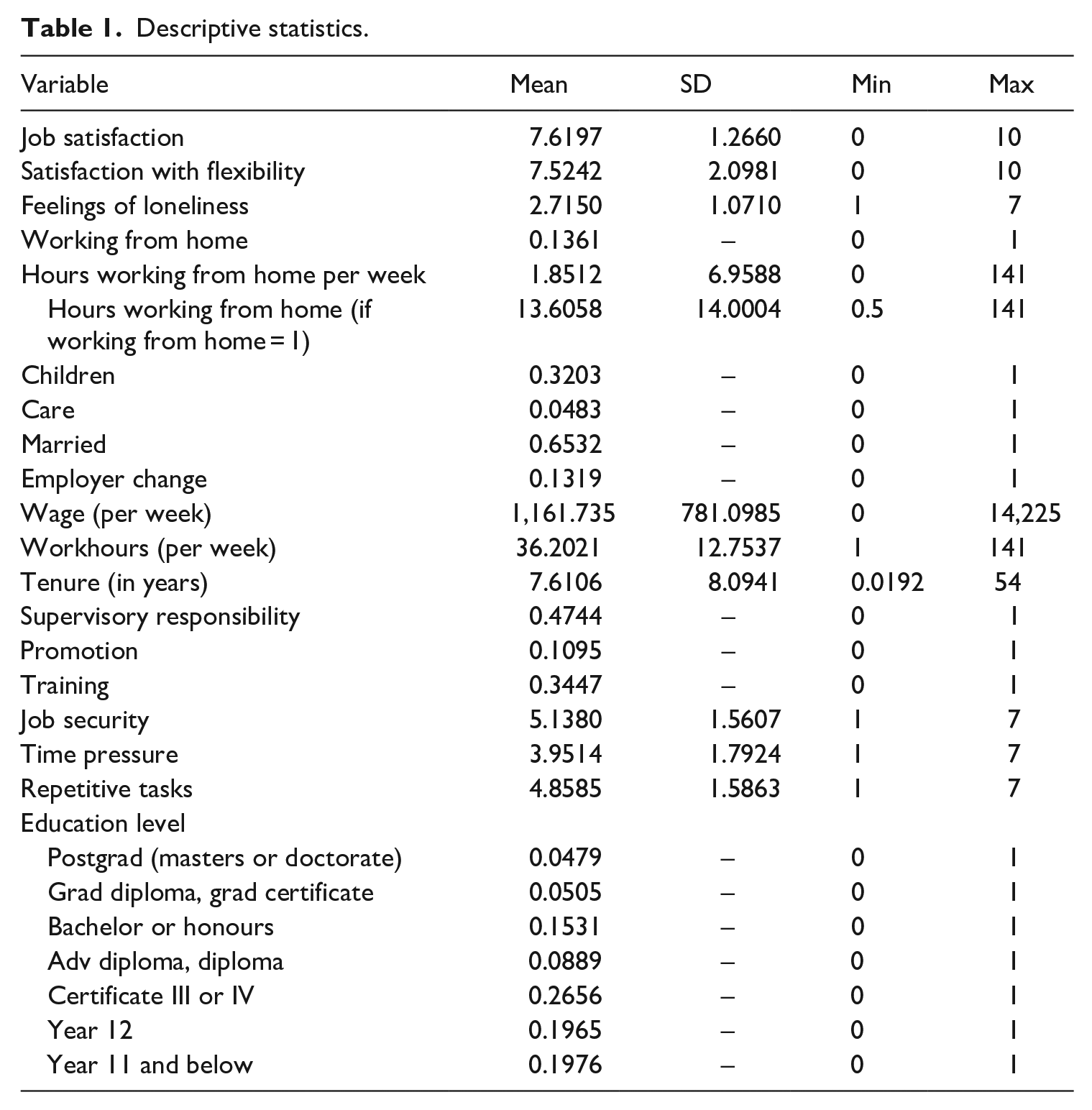
Table 1 provides an overview about the means and standard deviations of the variables. Job satisfaction averages at 7.6197. Overall, observations’ average satisfaction with flexibility to balance work and non-work commitments amounts to 7.5242. The average level of loneliness is 2.7149 in this sample. About 13.61% of all observations are working from home at least 1 year during the period of observation. 1,909 individuals transfer to working from home and are tracked at maximum 15 years before and 19 years after their transition to working from home. Considering home-working observations as well as observations working onsite, the average hours working from home amounts to 1.8511 hours per week. However, the average hours working from home for the subsample of individuals who are in fact working from home amounts to 13.6058 hours per week.
Descriptive statistics.
Results for working from home and satisfaction with flexibility over time
Hypothesis 1 predicts that working from home increases satisfaction with flexibility to balance work and non-work commitments. Figure 1 illustrates the coefficients of the two-way fixed effects regression that were summarized by
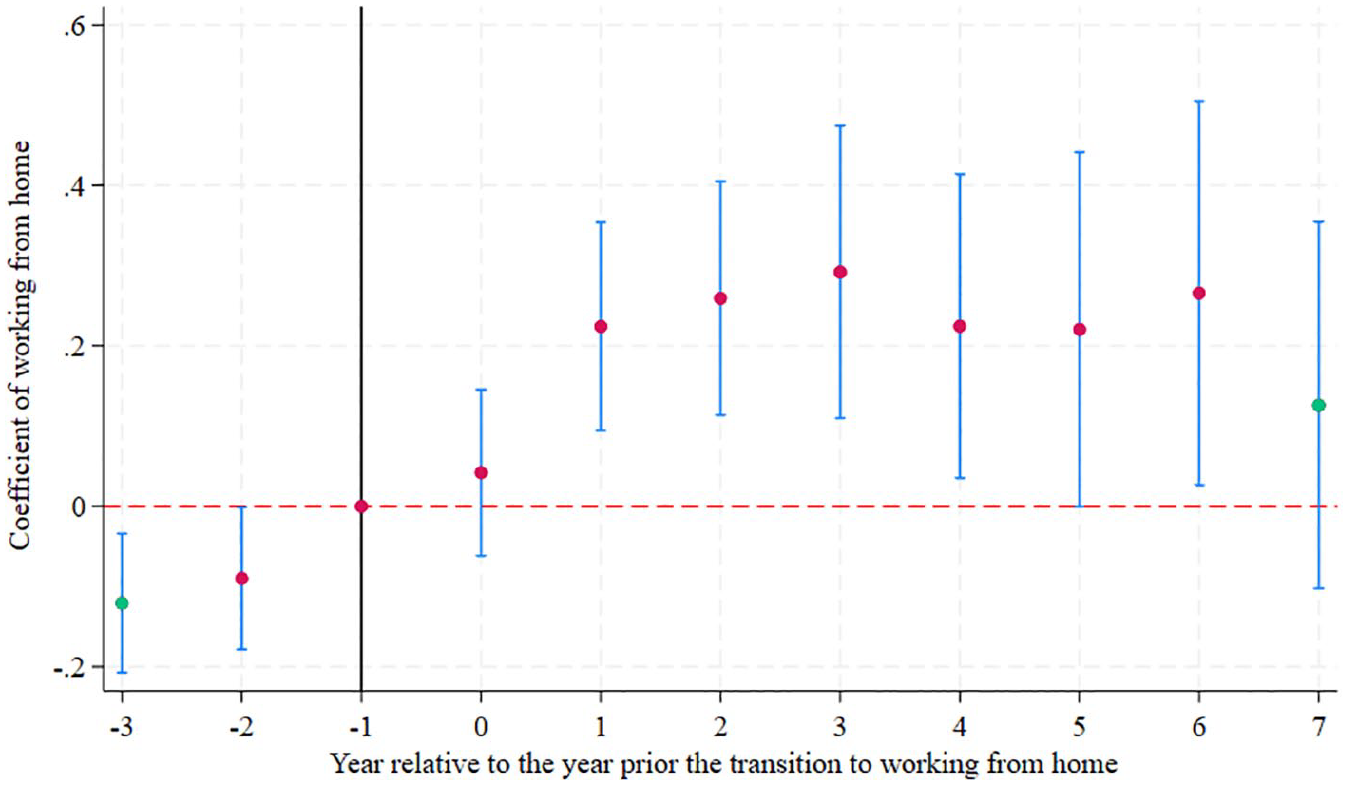
Working from home and satisfaction with flexibility to balance work and non-work commitments over time
As shown in Figure 1, starting work from home has no significant effect on satisfaction with flexibility immediately (
To get further insights whether the effect of working from home on satisfaction with flexibility changes over time, coefficients were tested against each other using Wald-tests. The results reveal that the coefficient of working from home in
Results for working from home and loneliness over time
Figure 2 shows the coefficients of a two-way fixed effects regression estimating the impact of working from home on loneliness over time. Point estimates prior to the transition to working from home are insignificant, favouring the parallel trends assumption. After the transition to working from home, point estimates become positive, yet remain insignificant. Thus, working from home has no impact on loneliness during 4 years after the transition to working from home. However, the coefficient of working from home at
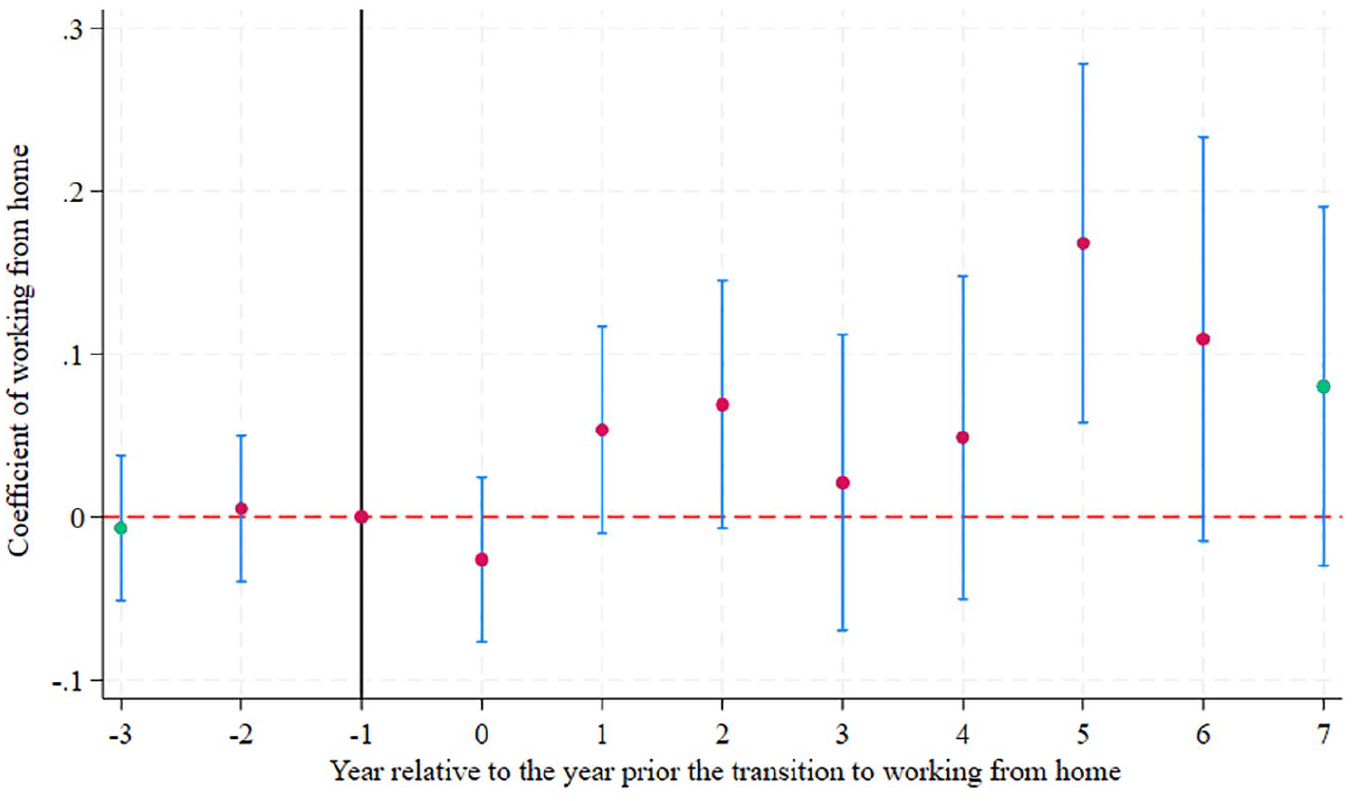
Working from home and loneliness over time.
Results for working from home and job satisfaction over time
Hypothesis 3 predicts a decreasing positive effect of working from home on job satisfaction over time. In line with the parallel trends assumption, point estimates of working from home prior to the transition are insignificant. As shown in Figure 3, (
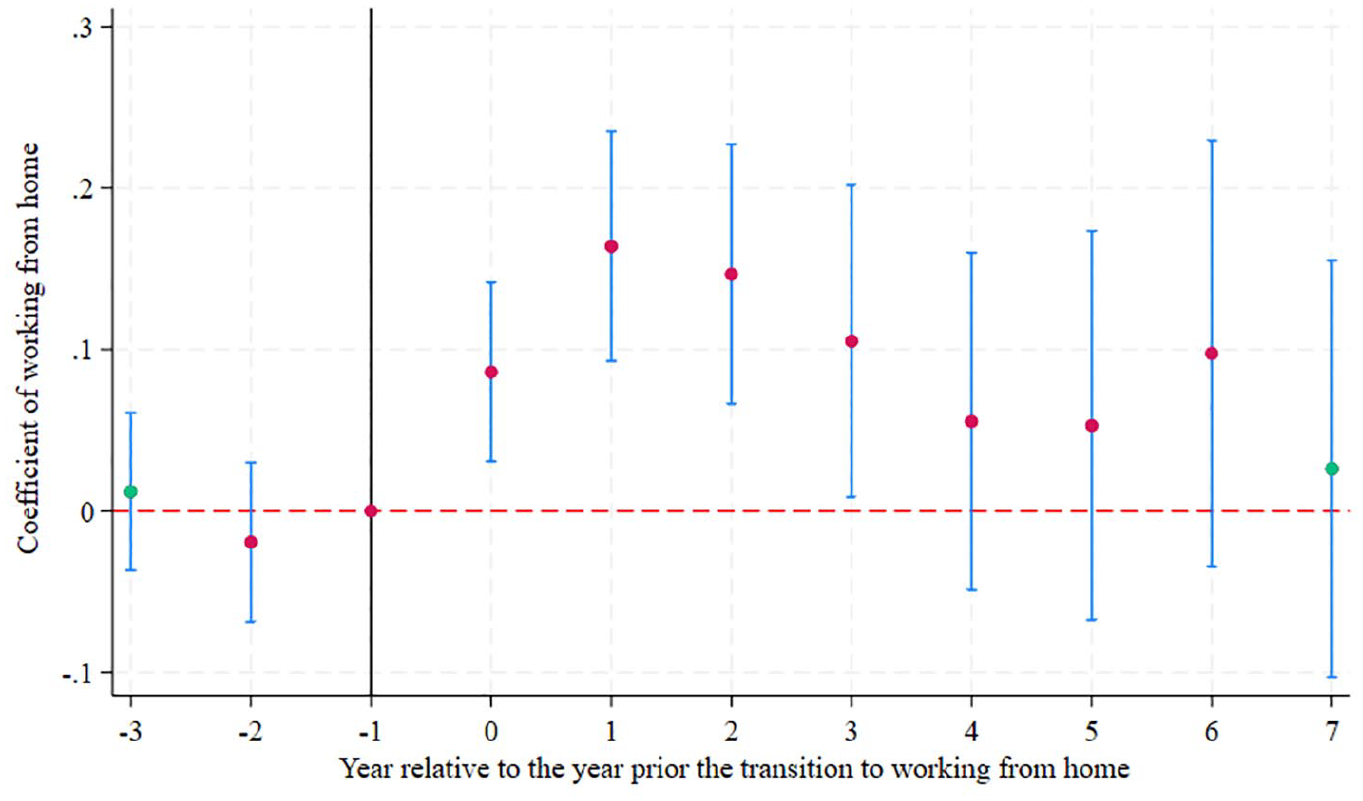
Working from home and job satisfaction over time.
Robustness checks
To examine the robustness of the results, several additional analyses were conducted. First, using a single-item measure for job satisfaction and measuring job satisfaction by the average of only five aspects of an employee’s job, neglecting satisfaction with flexibility, lead to similar results between working from home and job satisfaction (see Figure 4). Second, the analysis was repeated only with individuals who were observed over consecutive survey waves to ensure that individuals do not switch their working from home status during missing survey waves (Stutzer and Frey, 2006: 343). As Figure 5 shows, the results for working from home and job satisfaction as well as loneliness are robust towards observing individuals over sequential years. However, this robustness check indicates that working from home increases satisfaction with flexibility only temporarily between 1 and 3 years of working from home. Third, excluding the Covid-19 pandemic which forced employees to work from home involuntarily and under unusual conditions leads to similar results for the analysis between working from home and job satisfaction as well as loneliness. However, results for working from home and satisfaction with flexibility are not robust against the exclusion of the waves from 2020 to 2022 (see Figure 6). In particular, working from home seems to increase satisfaction with flexibility when Covid-19 waves were included, while the analysis without Covid-19 waves shows barely evidence for a positive effect of working from home on satisfaction with flexibility. This result may be explained by pandemic-induced restrictions that lead to a necessity of flexibility to avoid contagion or manage homeschooling. The missing robustness against the exclusion of the Covid-19 periods indicates that even after controlling for time-fixed effects in the main analysis, unusual circumstances during pandemic limit general implications for all individuals resulting from Hypothesis 1. Implications should be derived only for individuals who demand flexibility more than other groups (e.g. parents, long distance commuters).
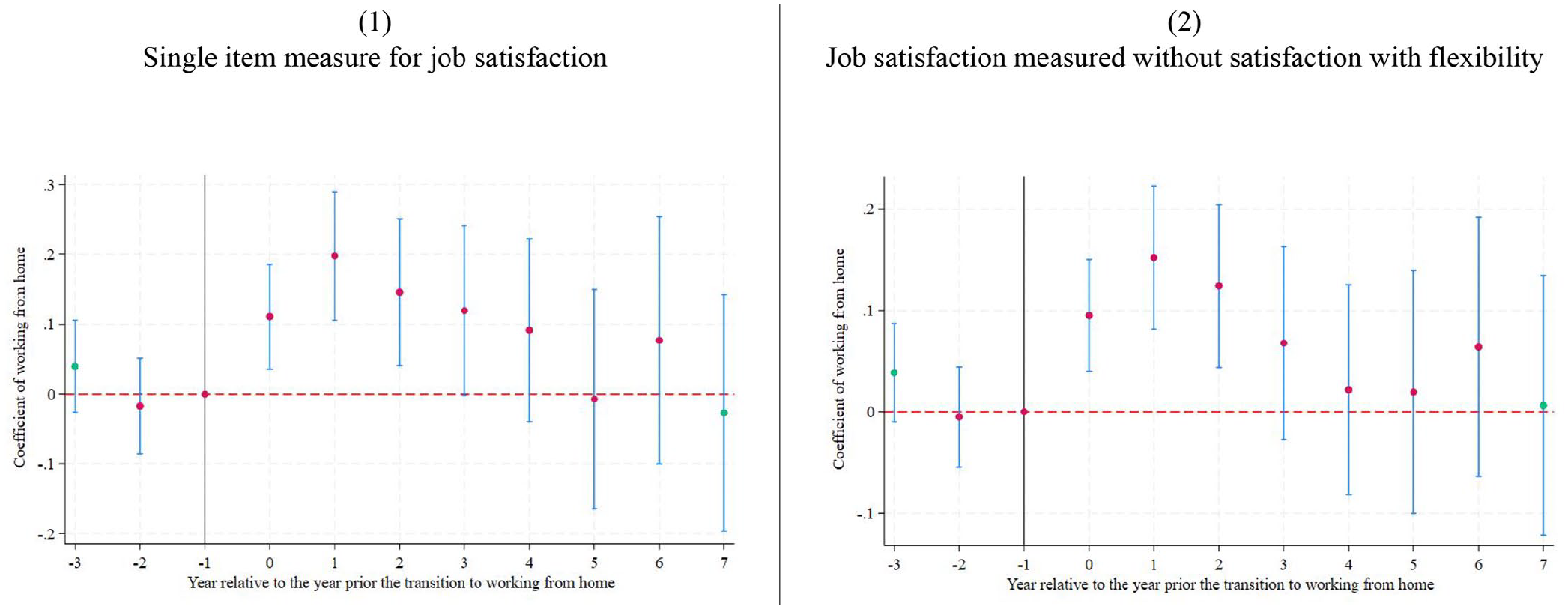
Robustness regarding the operationalization of job satisfaction.
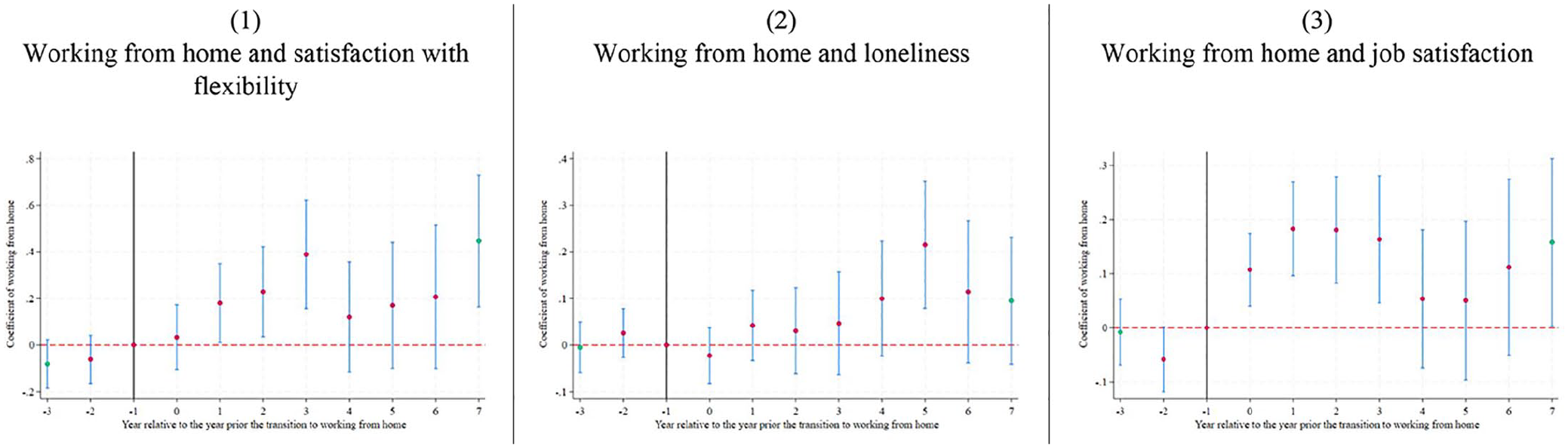
Robustness: observation of individuals in a consecutive period of time.
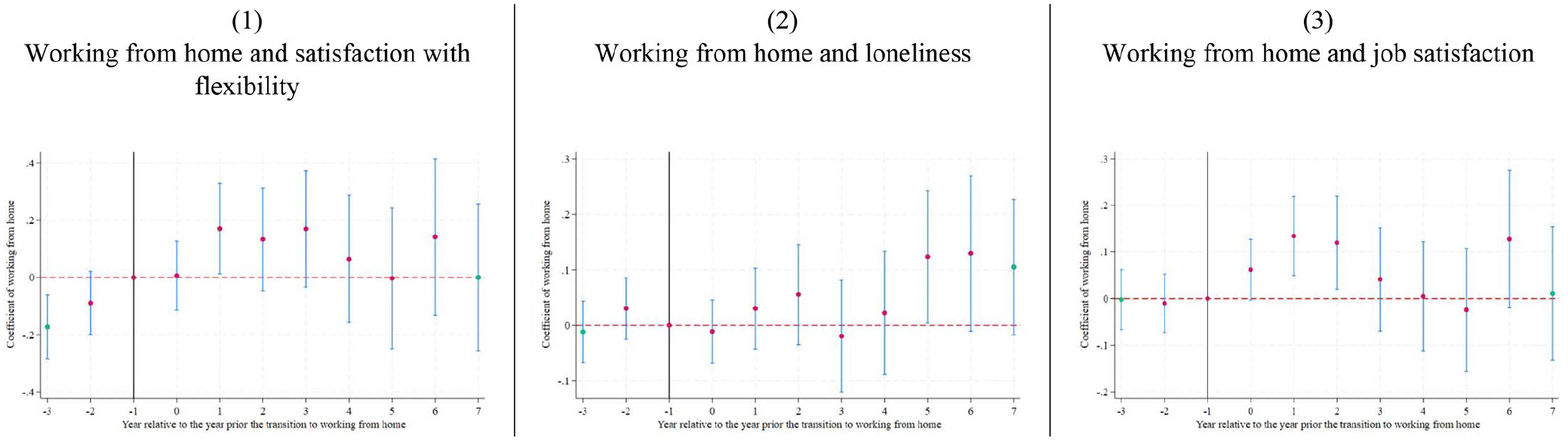
Robustness: exclusion of waves during Covid-19.
Fourth, the analysis was conducted for men and women separately to account for the possibility that men and women could use flexibility for different reasons. Lott (2015) shows that working time flexibility and autonomy positively contribute to a fit between working time and non-work commitments for women, whereas men tend to use working time flexibility and autonomy for work intensification and overtime. Thus, the positive effect of working from home on satisfaction with flexibility as well as job satisfaction could be higher for women than for men as women tend to use flexibility to reduce job demands such as time pressure whereas flexibility could intensify job demands for men. However, the results for gender-related analyses in Figure 7 show no difference in the effect of working from home on the outcome variables between men and women.
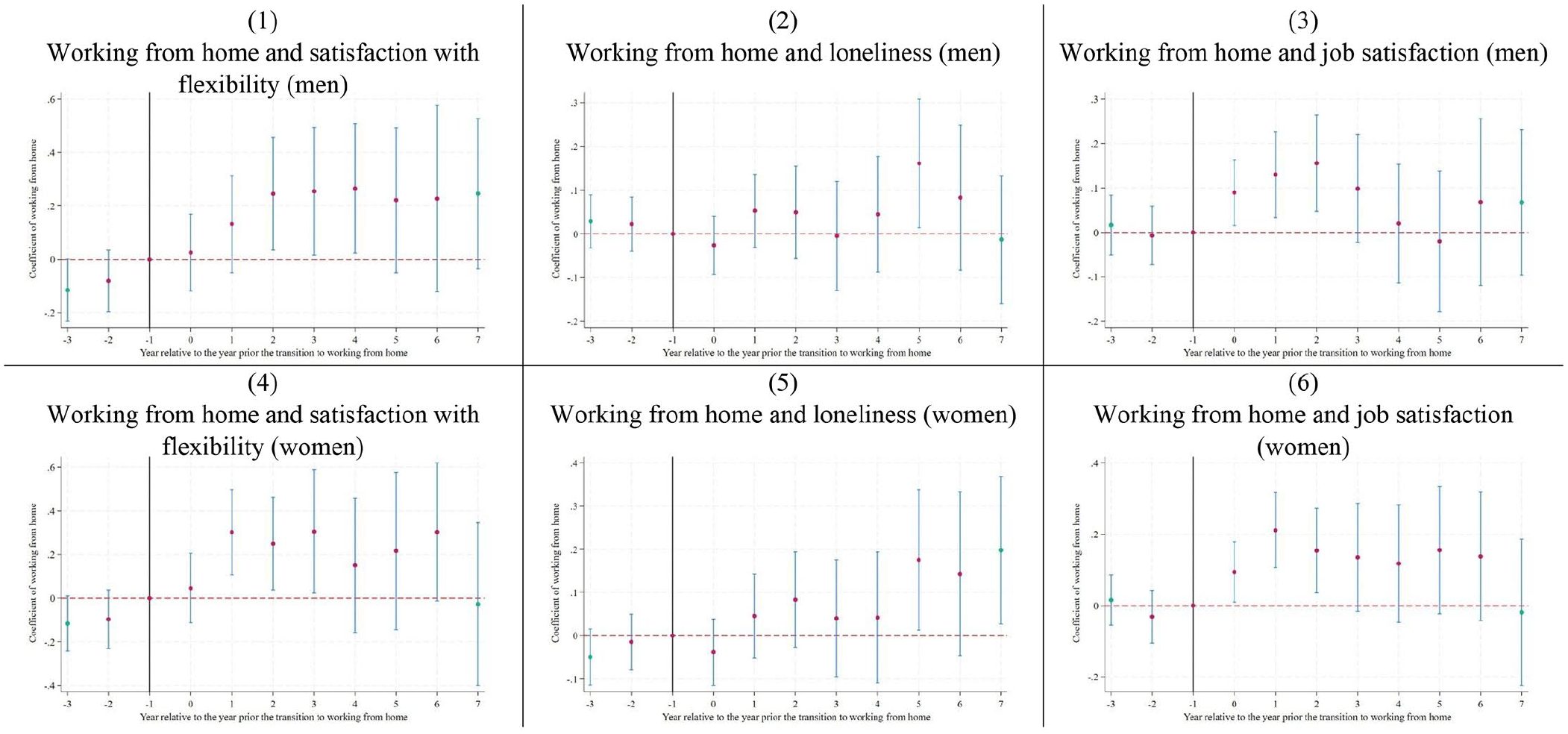
Robustness: gender-specific analyses.
The fifth robustness check takes the intensity of working from home into account. In particular, the fifth robustness check estimates the effect of an increase of the proportion of working from home relative to total working hours per week on the outcome variable after
Robustness check considering working from home intensity.
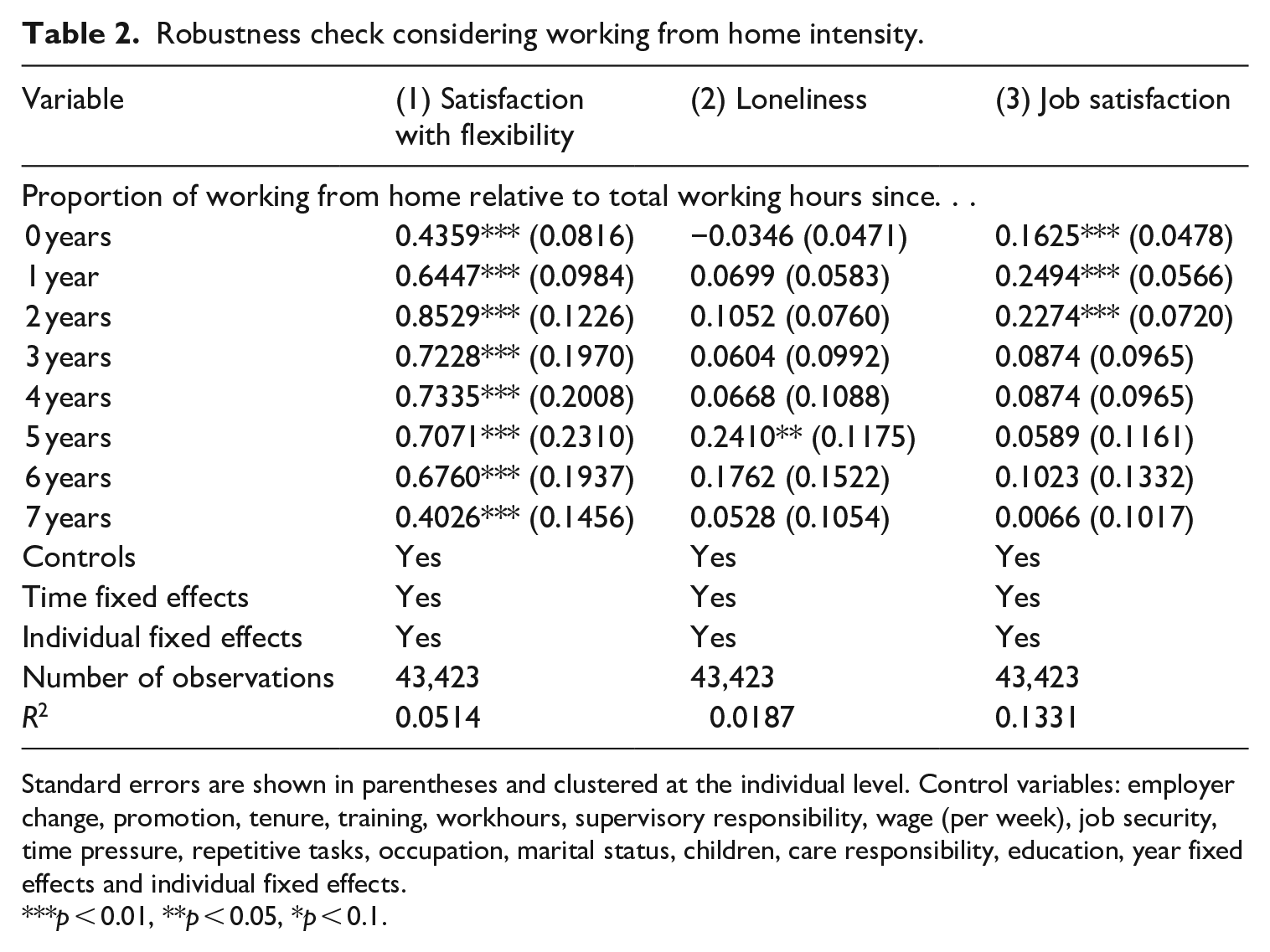
Standard errors are shown in parentheses and clustered at the individual level. Control variables: employer change, promotion, tenure, training, workhours, supervisory responsibility, wage (per week), job security, time pressure, repetitive tasks, occupation, marital status, children, care responsibility, education, year fixed effects and individual fixed effects.
p < 0.01, **p < 0.05, *p < 0.1.
Conclusion and discussion
This article contributes to Golden and Veiga’s (2005) attempt to resolve contradicting findings regarding the relationship between working from home and job satisfaction by analysing the effect of working from home on satisfaction with flexibility, loneliness and job satisfaction over time. Applying the JD-R model, this article argues that working from home activates job resources like flexibility whereas it reduces job resources such as social support that lead to feelings of loneliness in the long run. While flexibility increases job satisfaction, feelings of loneliness have a negative impact on job satisfaction. Considering both effects of working from home in a temporal perspective, this article suggests that the positive effect of working from home on job satisfaction due to flexibility-gains is weakened by negative feelings of loneliness the longer employees are working from home.
The empirical analysis is based on data from the HILDA survey. First, results from event-study regressions reveal that working from home increases satisfaction with flexibility. Second, working from home evokes feelings of loneliness the longer employees spent working from home. Third, working from home increases job satisfaction for 4 years after the transition to working from home. After 4 years, the positive effect of working from home vanishes which is explained by rising feelings of loneliness that contradict satisfaction with flexibility in the long run.
The results lead to theoretical and practical implications. Theoretically, this article reveals that working from home has a different impact on job resources depending on how long individuals have been working from home. Accordingly, considering a temporal perspective when analysing consequences of working from home provides additional explanatory power to integrate countervailing effects of working from home on job satisfaction. Interpreting these results in terms of the theoretical background, the analysis finds evidence that benefits of working from home overweigh downsides in the short run. However, after 4 years of working from home, downsides of working from home outweigh benefits, as no enduring positive effect of working from home on job satisfaction is found in the long run. Thus, the results consolidate conflicting evidence from previous research on working from home and job satisfaction by considering a temporal framework. The short-lasting positive effect of working from home on job satisfaction is in line with research finding a positive impact of remote work on job satisfaction (Bae and Kim, 2016; Boulet and Parent-Lamarche, 2022; Dockery and Bawa, 2014; Fonner and Roloff, 2010; Wheatley, 2012). The vanished relationship between working from home and job satisfaction in the long run is in line with research that finds no significant effect of working from home on job satisfaction (Morganson et al., 2010; Vander Elst et al., 2017).
Practically, when drafting personnel policy to regulate home-based work, employers should keep in mind potential adjustments of working from home arrangements to individual’s needs after a specific period of time. Evaluating the working from home situation after a given time period enables organizations to prevent employees from feelings of loneliness, which at best can result in sustained positive effects of working from home on job satisfaction. Further, especially in the long run employers should aim to sustainably integrate home-based workers by offering regular meetings or feedback, and employees working from home may work in teams such that a minimum degree of interdependence between home-based and office-based workers leads to reduced feelings of loneliness (Golden and Veiga, 2005: 310).
Nonetheless, the analysis has certain limitations that have to be discussed. First, although the results support the theoretical argumentation of the trade-off between satisfaction with flexibility and feelings of loneliness from section ‘Working from home and job satisfaction over time’, the analysis does not test mechanisms behind the relationship between working from home and job satisfaction over time directly. To identify the predicting role of satisfaction with flexibility and feelings of loneliness within the time-related relationship between working from home and job satisfaction, the analysis should account for the mediation effect of satisfaction with flexibility and loneliness that disentangles the total effect of working from home on job satisfaction from section ‘Results for working from home and job satisfaction over time’ into direct and indirect effects. However, mediation analysis in a difference-in-difference framework underlies the strict assumption of random treatment assignment as provided in experimental settings and lotteries (Celli, 2022; Deuchert et al., 2019). As individuals within the HILDA survey are not randomly assigned to working from home, this assumption is violated in this study. Thus, future research should apply randomized treatment assignment to investigate the mediating role of flexibility and loneliness between the relationship of working from home and job satisfaction within a temporal perspective.
Second, due to data availability, the analysis takes loneliness as a proxy for missing social support. However, the operationalization of the variable does not concentrate on the work-context. Noticeably, working from home leads to loneliness also in the private environment. However, a measure for social support at work would represent the loss of this job resource more precisely and the negative effect of working from home on social support at work could be stronger than suggested.
Third, the estimation identifies treatment effects for individuals working from home (average treatment effect on the treated) rather than for all individuals (average treatment effect). Due to self-selection into working from home, the average effect on job satisfaction for those working from home may not be generalizable and overestimates the average effect of working from home on job satisfaction for individuals in general. Further research could analyse the effect of working from home involuntarily (e.g. in organizations with desk-sharing) on job satisfaction over time to obtain more generalizable results.
Last, the relationship between working from home and job satisfaction depends on various circumstances. Fulltime workers or long-distance commuters may value flexibility, while new joiners or single-household employees might prioritize socializing, networking, and gaining information. Thus, the effect of working from home on outcomes such as job satisfaction may be moderated according to a group’s preferences for flexibility and interaction. Moreover, home-based workers may feel more excluded if many colleagues work onsite. Future research should explore heterogeneity in the time-scaled effect of working from home on satisfaction with flexibility, loneliness, and job satisfaction.
Supplemental Material
sj-docx-1-gjh-10.1177_23970022241310999 – Supplemental material for Time will tell: Working from home and job satisfaction over time
Supplemental material, sj-docx-1-gjh-10.1177_23970022241310999 for Time will tell: Working from home and job satisfaction over time by Stefanie Sundermeyer in German Journal of Human Resource Management
Footnotes
Acknowledgements
For helpful discussions and comments on previous versions of the paper, I am grateful to Patricia-Isabella Aich, Stefan Bruckmeyer, Stephanie Funk, Susanne Warning, and to the participants of the 26th Colloquium on Personnel Economics in Zurich, the 18th International (Post-)Doctoral Workshop “Personnel, Education and Organizational Economics” in Paderborn as well as to the participants of the 19th Research Colloquium “Economic and Corporate Policy” in Sion. I am grateful to two anonymous reviewers, an Associate Editor as well as the Editors-in-Chief of this Journal for their comments.
Funding
The author(s) disclosed receipt of the following financial support for the research, authorship, and/or publication of this article: The author is grateful for the financial support of the Young Researchers Travel Scholarship Program of the University of Augsburg.

Data availability statement
This article uses unit record data from general release 22 of the Household, Income and Labour Dynamics in Australia Survey (HILDA) conducted by the Melbourne Institute of Applied Economic and Social Research on behalf of the Australian Government Department of Social Services (DSS) (DOI: 10.26193/24EJST). The findings and views reported in this article, however, are those of the author and should not be attributed to the Australian Government, DSS or any of DSS’ contractors or partners.
Supplemental material
Supplemental material for this article is available online.
Notes
References
Supplementary Material
Please find the following supplemental material available below.
For Open Access articles published under a Creative Commons License, all supplemental material carries the same license as the article it is associated with.
For non-Open Access articles published, all supplemental material carries a non-exclusive license, and permission requests for re-use of supplemental material or any part of supplemental material shall be sent directly to the copyright owner as specified in the copyright notice associated with the article.
