




Abstract
This study investigates the role of two mechanisms – perceived workers’ performance and commitment – in shaping the career opportunities of teleworkers and office-based workers in the post-pandemic context of the United Kingdom. We outline a theoretical framework that integrates economic and sociological literature on work from home (WFH) and careers, and accounts for workers’ gender and parenthood obligations. We test it utilizing data from a discrete choice experiment conducted between July and December 2022 with 937 managers. Our findings reveal that hybrid workers face poorer career prospects than office-based workers because managers perceive them as underperforming. Among full-time teleworkers, reduced career opportunities stem not only from managers’ perceptions of their job performance but also from assumptions that full-time teleworkers are less committed to work. Finally, we demonstrate disparate impacts on promotion and earning opportunities based on gender and parenthood, primarily due to differing employer perceptions regarding work performance and commitment.
Keywords
Introduction
Over the last two decades, developed countries have witnessed a dramatic increase in the incidence of work from home (WFH; also referred to as telework or remote work). This upward trend substantially accelerated during the Covid-19 pandemic. In the United Kingdom (UK), where this study is conducted, employees worked from home 1.5 working days on average in spring 2023; similar numbers were reported for the US (Aksoy et al., 2023). WFH is particularly widespread among parents (Office for National Statistics [ONS], 2023) as it constitutes an opportunity to combine paid work and care (Gajendran and Harrison, 2007; Laß and Wooden, 2023). Given these developments, there is a need to understand how and why WFH affects workers’ careers. We address this need by closely examining the mechanisms through which WFH may impact workers’ career opportunities – such as promotion, salary growth and access to training – with particular attention given to differences based on gender and parental status.
Past research on WFH and workers’ careers overwhelmingly concerns the pre-pandemic period when WFH was far less common. Most of this evidence is based on observational data and provides mixed findings, ranging from negative (Golden and Eddleston, 2020) to positive (Arntz et al., 2022; Heywood et al., 2007; Weeden, 2005) effects. This research may, however, suffer from sample selection bias. It may have produced false positive effects given that mainly the best-performing workers might have been granted this flexibility (Glass and Noonan, 2016). It may have overestimated the negative effects of WFH if workers who requested this mode of work were less oriented at work. Few studies used experimental data to overcome the selection issues. The studies conducted before the pandemic (Bloom et al., 2015; Fernandez-Lozano et al., 2020; Munsch, 2016) largely reported negative effects of WFH on promotion or earnings, in particular among parents. Studies conducted in the post-pandemic context of the UK and Singapore (Kasperska et al., 2024; Wang and Chung, 2023) showed these effects still persist despite the fact that WFH became much more common. Nonetheless, it remains unclear why workers who WFH have poorer career opportunities than those working from the office.
This study contributes to the literature by investigating different mechanisms behind the lower career opportunities of teleworkers found in previous research. To this end, we outline and test a theoretical framework that integrates economic and sociological literature on WFH and careers in connection with workers’ gender and parenthood obligations. We examine sources of the lower career opportunities of teleworkers compared with office-based workers using data from the conjoint experiment fielded between July and December 2022 among 937 managers in the UK. A subset of these data was previously used by Kasperska et al. (2024), who demonstrated that workers who WFH face poorer career prospects than office-based workers. In this article we utilize additional information on workers’ perceived commitment and performance level, collected during the experiment, to test for the possible explanations behind these findings.
Based on economic and sociological literature, we argue that there are at least two mechanisms through which WFH can affect workers’ career opportunities. One of them is teleworkers’ performance and its perception by employers. Managers may be less willing to reward teleworkers with career advancement opportunities if they assess their performance as worse than that of office-based workers. This can be due to the fact that teleworkers can be deprived of knowledge exchange (Emanuel et al., 2023; Gibbs et al., 2023) or suffer from distractions to work from family members (Demerouti et al., 2014; Powell and Craig, 2015). However, it is also possible that managers hold a bias against teleworkers and offer them worse career opportunities even if teleworkers perform as well as office-based workers. Such practices may be driven by managers’ belief that employees should demonstrate high commitment to work by being present at the workplace and continuously available to employers’ needs (Acker, 1990; Blair-Loy, 2005; Williams et al., 2013). In that context, a request for flexible work arrangements may be interpreted by managers as a signal of a low commitment to work and result in career penalties, even if it does not cause a decline in workers’ productivity or quality of the delivered work (Vandello et al., 2013).
Furthermore, considering these two mechanisms helps understand why WFH implies different career opportunities for women than men and how these differences intersect with workers’ parental obligations. This is because employers may form differential expectations towards workers’ performance and commitment once they know or suspect that the request was made due to childcare obligations. On the one hand, employers may expect teleworking parents to perform better at work than parents who work onsite as the former may work longer hours, allocating the time saved on commuting to paid work (Arntz et al., 2022), or work more intensely in exchange for the flexibility they were offered (Kelliher and Anderson, 2010). On the other hand, employers may penalize teleworking parents for the request to WFH, even if they perform equally well at work as office-based parents. This is because a request to WFH suggests that paid work is not central in the life of the working parent, who seeks to integrate paid work around family obligations, thereby signalling a low commitment to work (Burnett et al., 2013; Coltrane et al., 2013, Vandello et al., 2013).
Theoretical framework
The mechanisms behind the career opportunities of teleworkers and office-based workers
Standard microeconomic theory suggests that workers’ performance is one of the key channels through which WFH affects workers’ career opportunities. Performance at work can be understood as the achievement of tasks and goals, measured through a combination of different elements such as productivity, proficiency, quality of work and overall contributions to organizational objectives (Campbell and Wiernik, 2015). Since work performance is not always easily directly observed, employers may infer it on the basis of their past experience with or knowledge of employees who make use of WFH and those who work from the office (theory of statistical discrimination; Arrow, 1973; Phelps, 1972). Thus, WFH should result in better career outcomes (e.g. higher salary, promotion, access to training) if employers consider it to enhance workers’ performance. Likewise, it should reduce workers’ career opportunities if it is associated with productivity losses.
On the one hand, employers may expect WFH to increase workers’ performance. Employees who WFH can perform better as they experience fewer workplace distractions and interruptions (Aczel et al., 2021; Korbel and Stegle, 2020). Teleworkers may also invest more time and energy into work to get noticed or compensate their employers for their lack of presence at the workplace (Belmi and Pfeffer, 2015; Kelliher and Anderson, 2010) or simply because they are constantly wired to the workplace (Demerouti et al., 2014; Mullan and Wajcman, 2019). Teleworkers may work harder and longer using the time saved on commuting for paid work (Arntz et al., 2022) or because they are more satisfied with work and thus more motivated (Gajendran and Harrison, 2007). On the other hand, however, employers can expect WFH to lower workers’ performance. Teleworkers may be deprived of consistent communication with colleagues and supervisors and lack informal learning and mentoring opportunities, face-to-face peer interactions, interpersonal networking and the transfer of implicit knowledge (Emanuel et al., 2023; Korbel and Stegle, 2020), in particular, if they WFH frequently (Golden and Eddleston, 2020). The work performance of teleworkers also can be negatively influenced by disruptions to work from family members (Demerouti et al., 2014; Powell and Craig, 2015). Past empirical studies indeed demonstrated both positive effects of hybrid teleworking on workers’ productivity (Angelici and Profeta, 2023; Bloom et al., 2015) and negative ones, though largely for the group of highly skilled workers in cognitively demanding jobs (Gibbs et al., 2023; Shen, 2023). Other studies, based on subjective assessments of workers’ productivity, reported improvements in workers’ performance due to teleworking but these positive evaluations were stronger among employees and weaker among managers (Criscuolo et al., 2021; Deole et al., 2023).
The differential career opportunities of teleworkers versus office-based workers may not only depend on managerial perceptions of workers’ performance but also result from the culture of presenteeism (Johns, 2010; Ruhle and Süß, 2020) and the stigmatization of flexible work arrangements (Cook et al., 2021; Williams et al., 2013). Namely, managers may view employees who request or utilize flexible work arrangements as less committed to the organization (Coltrane et al., 2013; Vandello et al., 2013). Such a flexibility stigma was argued to be particularly strong in Protestant countries such as the UK and US where presenteeism and devotion to paid work are seen as assets, apart from performance at work, which is highly valued and rewarded by employers (Blair-Loy, 2005; Williams et al., 2013; Glass and Noonan, 2016). In this context workers are expected to be ideal workers; namely, to prioritize paid work above everything else including their personal/family commitments, well-being and health (Acker, 1990; Hadjisolomou et al., 2022). They are supposed to provide long working hours and face time and always be available on employers’ requests (Epstein et al., 1999; Williams et al., 2013). Workers who seek flexible work arrangements, including WFH, deviate from these expectations and thus are perceived as not committed to work. As a result, workers might be denied promotions, salary raises or training opportunities, regardless of their actual performance at work (Chung and van der Lippe, 2020; Coltrane et al., 2013, Vandello et al., 2013).
All in all, these considerations suggest that the effects of WFH on workers’ career opportunities depend on how managers assess the performance and commitment of teleworkers versus office-based workers. The more favourably managers assess the performance of teleworkers relative to their office-based counterparts, the less likely they are to disadvantage them in decisions regarding promotions, salary increases, or access to training. Conversely, if managers view teleworkers’ performance less favourably, they will be more inclined to prioritize office-based workers in these decisions. Nonetheless, managers can also perceive teleworkers as less committed to work simply because of their remote status, irrespective of their performance at work, and for this reason, overlook them while granting promotions, salary increases or training.
Gender and parenthood status
The effect of WFH on career opportunities depends on workers’ gender and parenthood status because of the differential involvement of women and men in childcare obligations and the persistence of the hegemonic beliefs about men’s and women’s social roles. All over the developed world, including the UK, women still perform more childcare and housework than men, while men spend more time in paid work (Altintas and Sullivan, 2017; McMunn et al., 2020). This unequal division of labour is largely responsible for gender inequalities in the labour market (Matysiak and Cukrowska-Torzewska, 2021). Men, in turn, are still considered the main income providers and are expected to be loyal and committed employees, ready to devote long hours to paid work and always be available to meet new work demands (Burnett et al., 2013; Cook et al., 2021). As a result, mothers and fathers have different reasons to request WFH: mothers more often request it in order to accommodate paid work with family demands while for men it is to work longer or to concentrate better at work (Lott and Chung, 2016; Sullivan and Lewis, 2001). There is also evidence that mothers who WFH spend more time on childcare and domestic activities and have more fragmented working time than fathers (Powell and Craig, 2015).
The differences in men’s and women’s social roles likely shape managers’ assessment of the work performance and work commitment of mothers and fathers who request to WFH and, consequently, affect their decisions about promotion, salary increase and access to training. Given that women take greater responsibility for childcare than men, managers may fear a teleworking mother may experience family-related work interruptions at home and consequently perform more poorly at work than a mother who works from the office. Managers may also attribute the request for WFH made by a woman (and a mother in particular) to childcare obligations, which may signal lower work commitment and thus lower women’s chances for a promotion, salary increase or training. In a similar vein, a request for WFH made by a man, and a father in particular, can be interpreted in line with the hegemonic gender roles as a desire to increase performance. Managers also may be less worried that a father, compared with a mother, will experience family-to-work spillovers while working from home. On the basis of these considerations, the request to WFH is expected to lower the career opportunities of mothers – as it implies lower work performance and lower commitment to work, and an increase in the career opportunities of fathers – as it implies higher work performance.
There are also other possible scenarios. Exchange theory suggests that workers who request flexible work arrangements may, in fact, put more effort into work (e.g. work longer hours or more intensely) in exchange for greater flexibility (Felstead and Henseke, 2017; Kelliher and Anderson, 2010). Mothers, who may be particularly keen to WFH in order to better combine paid work and care, may thus work harder when they telework. They may also be more productive as they do not have to worry about arranging childcare in case of unexpected circumstances or simply because they have a better work–life balance (Angelici and Profeta, 2023). The higher work performance of teleworking mothers may thus weaken or even balance out the negative effects of WFH on their career opportunities caused by managers’ assumptions about their work commitment.
One can also formulate an alternative prediction on the impact of WFH on fathers’ career opportunities. This has to do with the growing involvement of men in family lives (Altintas and Sullivan, 2017). Even though women continue to take longer parental leaves and are more likely to ask for flexible work arrangements, such requests are also increasingly made by men (Atkinson, 2023; Duvander, 2014). Employers may thus attribute men’s request to WFH to be driven not by the desire to work more intensely but by a need to take care of children. In such a case, they may not only expect WFH will lead to a decline in fathers’ work performance (due to family-related interruptions) but may also negatively assess their work commitment. Furthermore, the latter assessment may be particularly harsh as fathers are more likely than mothers to break the ‘ideal worker’ norm by making the request to telework (Coltrane et al., 2013; Cook et al., 2021; Vandello et al., 2013). Given the strong prevalence of presenteeism culture in British workplaces (O’Halloran and Thomas, 2024), it is thus likely that WFH will have a negative impact on fathers’ career opportunities if managers perceive teleworking fathers as having a low commitment to work.
Data and methods
Study design and context
We address our research aims by using data from the forced choice conjoint experiment. The study received approval from the Rector’s Committee for the Ethics of Research Involving Human Participants at the University of Warsaw, reference number 145/2022, and has been pre-registered in the Open Science Framework (OSF). A subset of this data was previously used in Kasperska et al. (2024), where we also provided more detailed information than here on the study design and its participants, including the information shown to study participants, examples of workers’ profiles, the questionnaire and more detailed information on the sample.
The experiment was conducted online in the UK between July and December 2022 by an external research company. By this time, WFH mandates had long been lifted: mid-2021 in England and Scotland, and January 2022 in Wales and Northern Ireland (Ferguson, 2022; GOV.UK, 2022). Similarly, shielding programmes for immunocompromised workers had ended around mid-2021 (NHS, 2021). During the study period, approximately 35–40% of workers worked from home – about one-third fully remote and the remainder in a hybrid arrangement (ONS, 2023, 2024). This high prevalence of WFH continued into the summer of 2024 (last available data), despite growing pressure from employers to bring workers back to the office, as widely reported in the media.
Conjoint is a factorial survey experiment, which allows for obtaining reliable measures of multidimensional preferences and estimating the causal effects of multiple attributes on hypothetical choices or evaluations (Bansak et al., 2021). Conjoint design outperforms other experimental techniques (including vignettes) when it comes to external validity and imposes less fatigue on participants (Bansak et al., 2021; Hainmueller et al., 2015). The forced choice conjoint experiment means that respondents had to choose one out of two profiles when answering questions measuring outcome variables (rather than, for example, assessing each of them on a scale), which is what managers often have to do when making promotion-related decisions.
The experiment utilized the between-subject design, which implies that each participant was presented with three pairs of workers’ profiles. First, the respondents were informed that an internal review process for the employees in their team is approaching, which is when decisions about promotions, training and salary raise, etc., are made. Next, the first pair of workers’ profiles was displayed and survey participants were asked five questions, placed underneath; namely, to which employee would they offer (1) promotion, (2) a salary increase, (3) training, and which employee they consider (4) more competent and (5) more committed to work. Afterwards, respondents were presented the second and third pairs of workers’ profiles and each time were asked to answer the five questions about promotion, salary increase, training, workers’ competences and commitment. Each profile included seven attributes that were randomly assigned to the profiles: working mode, gender, number of children, age, work experience, skills ranking and performance rating. The randomization of the performance rating was done for half of the pairs of profiles while for the remaining ones, the performance was set to ‘not provided’ (i.e. experimental treatment: performance known vs unknown). For workers for whom the performance rating was provided, it was randomly set as either satisfactory or exceptional. After comparing all three pairs of workers’ profiles, participants were asked to fill out a survey, which gathered information about the participant and his/her organization.
Study participants
The target sample were managers who work in the UK, supervise at least five employees and are employed in occupations in which the proportion of jobs that can be done from home amounts to at least 50%, as estimated by Dingel and Neiman (2020). This restriction was implemented on purpose so that the workers’ profiles presented to participants, some of which presumed WFH, are realistic. The size of the company in which the managers work was set at 10 or more workers. Quota sampling was employed to achieve a sample that is representative in terms of the size and geographical location of the company, as well as the managers’ gender. The participants were recruited from an online opt-in panel maintained by YouGov and compensated for their participation with points, which can be redeemed for cash or gift cards once a certain amount is accumulated. YouGov’s matched opt-in samples have recently been shown to produce results comparable to those from large-scale probabilistic surveys (Graham et al., 2021).
The data were collected from 1206 participants who met the above-specified conditions. Out of this sample, those individuals were selected who spent at least 15 seconds evaluating the first pair of profiles, at least nine seconds on the second pair and at least five seconds on the third pair. These cut-off points were established at the local minima of the response time distribution for each pair of profiles. These distributions were bimodal and skewed left with the first mode at very low response times, which suggested that a group of respondents provided their evaluations in a very short time and likely with little attention. Setting the cut-off points at the local minima resulted in a loss of 269 respondents, which reduced the sample to 937 participants and 5622 records of data (937 individuals * 3 * 2 profiles that they compare). Out of these 5622 records, around one-half (2818) included information about a performance rank (with only positive values, namely exceptional and satisfactory), while for the remaining ones (2804) the performance rank remained unknown.
The participants included in the sample are mostly 35 years old or older (86%), highly educated (76%) and either childless or with one child (72%). Women constitute 38.5% of the sample, which corresponds to the percentage of female managers in the 2019 Labour Force Survey (LFS) data for the UK. The sample is dominated by IT specialists, accountants and engineers (54% in total). They mostly supervise teams of up to 19 employees (78%) and are responsible for making decisions regarding employees’ promotion (69.7%), training (54.5%), evaluation (90.4%) and employment conditions, such as pay or contract time (55%). WFH is widely practised in respondents’ teams: in only 16% of teams, no-one works from home and in about half of them more than 80% telework at least one day per week. Finally, around a quarter (23.8%) of the companies are located in London and the companies are predominantly large – with more than 1000 employees (40.6%).
Data analysis
Our main explanatory variable is the working mode, which assumes one of the three categories: working fully onsite, working in a ‘hybrid mode’ (two days from home, three days from the office) and ‘full-time’ teleworking (WFH five days a week). We model three outcome variables that describe the career opportunities: (1) promotion, (2) salary increase and (3) training. To obtain the effect of the working mode on outcome variables we estimate regressions, in which we control for the basic set of covariates, namely the gender of the fictitious workers, their age, work experience, skills and number of children. We use logistic regression with standard errors clustered at the respondent’s level. 1
First, we evaluate the general effect of WFH on workers’ career opportunities, regardless of gender and parenthood status in three steps. Namely, we examine whether managers’ perceptions of workers’ performance, with respect to the mode of work, shape the career opportunities of office-based workers and teleworkers (hybrid and full-time). To this end, we regress our outcome variables against the mode of work on the two subsets of the data: the dataset consisting of workers’ profiles with unknown performance of workers (2804 observations) and the dataset containing workers’ profiles with known work performance (2818 observations). We refer to these models as Models 1a–c (unknown work performance) and Models 2a–c (known work performance), with subscripts a–c denoting models for each of the three outcome variables (promotion, salary increase and training). In all these models we control for the basic set of control covariates and in Models 2a–c we additionally account for performance level. The effects of the working mode on workers’ career opportunities estimated from Models 1a–c (unknown work performance), presented also in the earlier study by Kasperska et al. (2024), reflect differences in the career opportunities of hybrid workers and full-time teleworkers compared with office-based workers in a situation in which managers do not have information on their work performance and have to make assumptions about it based on their experience or knowledge. This situation may be close to the real-life circumstances in which perfect information on workers’ performance, in particular if they WFH, might be missing. The effects of the working mode on workers’ career opportunities estimated from Models 2a–c (known work performance), in turn, display differences in the career opportunities of hybrid workers and full-time teleworkers compared with office-based workers in the ‘ideal world’ in which managers have perfect information on workers’ performance. A comparison of the two sets of models reveals the role of managerial perceptions of workers’ performance in shaping their career opportunities depending on the adopted mode of work. A formal test of whether managerial assumptions about workers’ performance matter for the career opportunities of employees who WFH versus employees working from the office is performed by estimating Models 3a–c (Supplementary Table S1). These models are estimated on all data records and allow for an interaction between the working mode and the performance indicator (known / unknown).
Second, we examine whether the potential career rewards or penalties that managers impose on workers who WFH (despite the fact that they show the same performance as the office-based workers) can be explained by managers’ differential assessments of workers’ commitment. We re-estimate Models 2a–c on the sample with known work performance and add work commitment among the controls. These models are referred to as Models 4a–c. Additionally, we estimate a similar logit model as Models 2a–c but with the dependent variable work commitment (Supplementary Table S2). This model shows how the mode of work impacts employers’ perception of workers’ commitment. Last, we perform a mediation analysis to formally test what proportion of the differences in career opportunities due to the adopted mode of work is explained by managers’ assessment of workers’ commitment (Imai et al., 2010). The findings from the mediation analysis are presented in Supplementary Table S3.
Finally, we explore whether the effects of WFH on workers’ career opportunities depend on their gender and parental statuses. To this end, we re-estimate Models 1a–c, 2a–c, 3a–c and 4a–c separately for childless men (N = 986), fathers (N = 1785), childless women (N = 919) and mothers (N = 1932). We refer to these models consecutively as Models 5, 6, 7 and 8 with subscripts a–c for childless men, d–f for fathers, g–i for childless women and j–l for mothers. The Models 5a-l again correspond to those presented in Kasperska et al. (2024) and demonstrate differences in career opportunities of office-based, hybdrid and full-time teleworkers for childless men, mothers, childless women and mothers under the unknown work performance scenario; the remaining models aim at revealing the mechanisms behind the differential career opportunities. The mediation analyses are also performed for each group and displayed in Supplementary Table S4.
Results
Workers’ performance, WFH and career opportunities
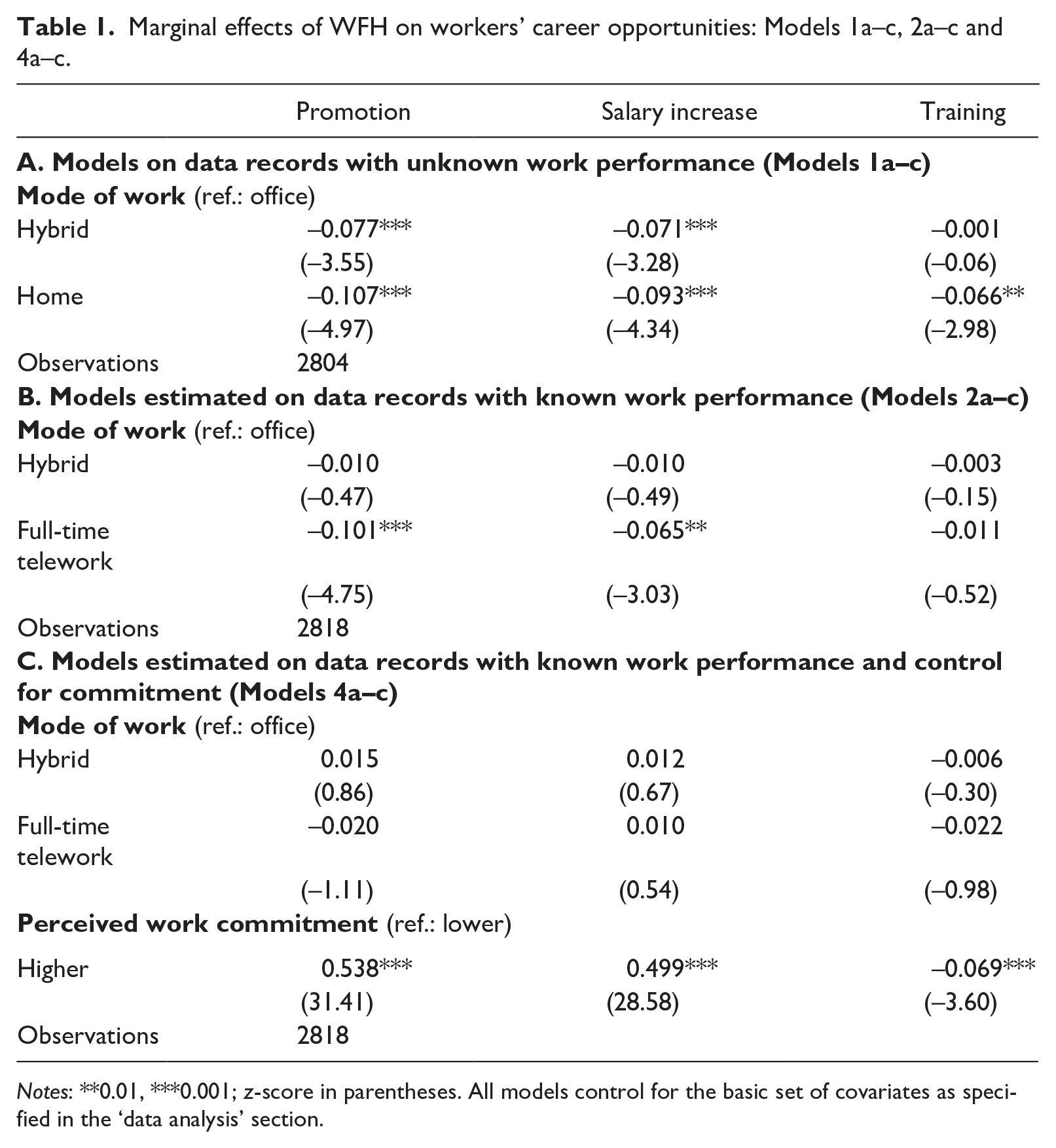
The effects of WFH on career opportunities are presented in Table 1. Under the unknown performance scenario (Panel A: Models 1a–c in Table 1), both hybrid and full-time teleworkers are significantly less likely to receive promotions or salary increases compared with office-based workers. Full-time teleworkers have a 10.7 pp lower chance of promotion and a 9.3 pp lower chance of salary increases, while hybrid workers experience a 7.7 pp and 7.1 pp reduction, respectively. Furthermore, full-time teleworkers are 6.6 pp less likely to receive training than onsite workers, whereas hybrid workers are equally likely to receive it as their office-based counterparts (see also Kasperska et al. 2024).
Marginal effects of WFH on workers’ career opportunities: Models 1a–c, 2a–c and 4a–c.
Notes: **0.01, ***0.001; z-score in parentheses. All models control for the basic set of covariates as specified in the ‘data analysis’ section.
The presented differences in employee rewards based on mode of work can only be partially explained by differential managers’ perceptions of workers’ performance. When managers are aware of workers’ performance (Panel B in Table 1), the negative impact of hybrid work on promotions and salary increases disappears, but full-time teleworkers remain disadvantaged. Interaction models (Supplementary Table S1) confirm that for hybrid workers, the penalties for WFH vanish when performance is known, which is indicated by the interaction term between hybrid work and performance indicator (performance known vs unknown). However, full-time teleworkers continue to face disadvantages, regardless of performance. Only in training opportunities do full-time teleworkers achieve parity with onsite workers once their performance is known.
These findings suggest that differential perceptions of workers’ performance do not explain differences in the promotion and earning opportunities of full-time teleworkers compared with office-based workers. We thus test whether this difference may be due to the fact that full-time teleworkers are perceived as less committed to work. The findings in Panel C in Table 1 are consistent with this hypothesis and show that the mode of work becomes insignificant for promotions and salary increases after we control for work commitment. Mediation analysis (Table S3) leads to similar conclusions.
Gender and parenthood
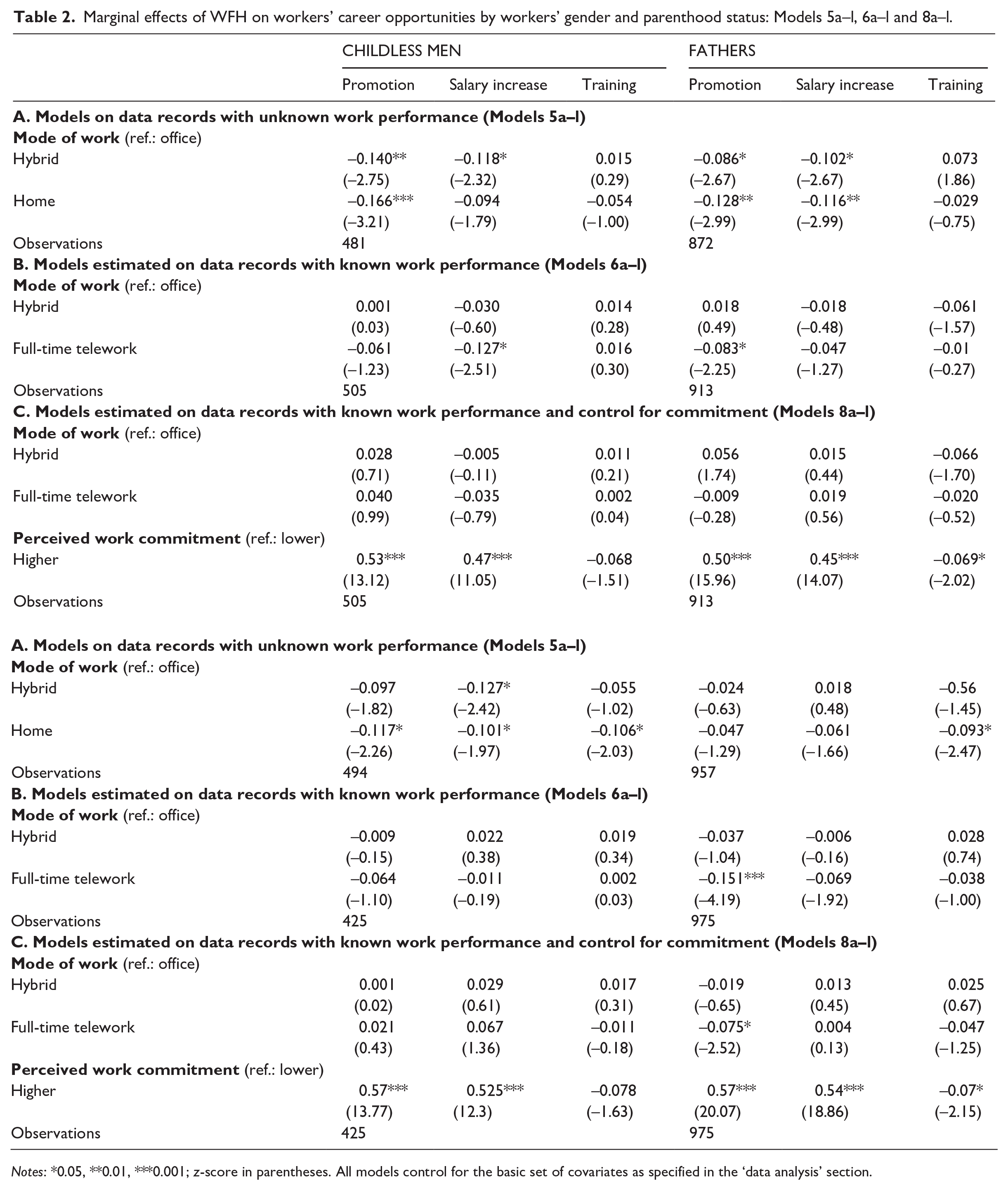
We next examine whether the effects of the working mode on career opportunities differ by workers’ gender in the context of family obligations, following similar steps as before. Results are presented in Table 2 (Models 5, 6, 7 and 8, a–l).
Marginal effects of WFH on workers’ career opportunities by workers’ gender and parenthood status: Models 5a–l, 6a–l and 8a–l.
Notes: *0.05, **0.01, ***0.001; z-score in parentheses. All models control for the basic set of covariates as specified in the ‘data analysis’ section.
When performance is unknown, all workers except mothers face lower promotion and salary prospects when they WFH, either full-time or hybrid (Table 2, Panel A), as was shown earlier by Kasperska et al. (2024). However, once performance becomes known, the negative effects of hybrid WFH for childless men, fathers and childless women on promotions and salary increases disappear (Table 2, Panel B), with interaction effects between hybrid WFH and performance being large but not always significant (Table S1). Full-time WFH still shows negative effects for childless men and fathers (no longer for childless women), though these weaken when performance is known. Controlling for work commitment eliminates penalties for full-time WFH for these groups (Table 2, Panel C). These findings are consistent with those from the mediation analysis (Table S4).
Mothers, in contrast, show different patterns. When performance is unknown, WFH does not affect their promotion or salary prospects (Table 2, Panel A). However, once workers’ performance is revealed to managers, mothers who WFH full-time are less likely to be promoted, with salary increases marginally affected (Table 2, Panel B). Even after accounting for commitment, promotion penalties persist (Table 2, Panel C), indicating that other unmeasured factors affect mothers’ opportunities for a promotion in a negative way.
Our findings regarding training opportunities are again different than for promotion and salary increase. When workers’ performance is not known, full-time teleworking women (either childless or mothers) face reduced access to training (Table 2, Panel A). However, this effect disappears when managers become aware of their performance (Table 2, Panel B). For men, no significant relationship between WFH and training access is observed.
Robustness check
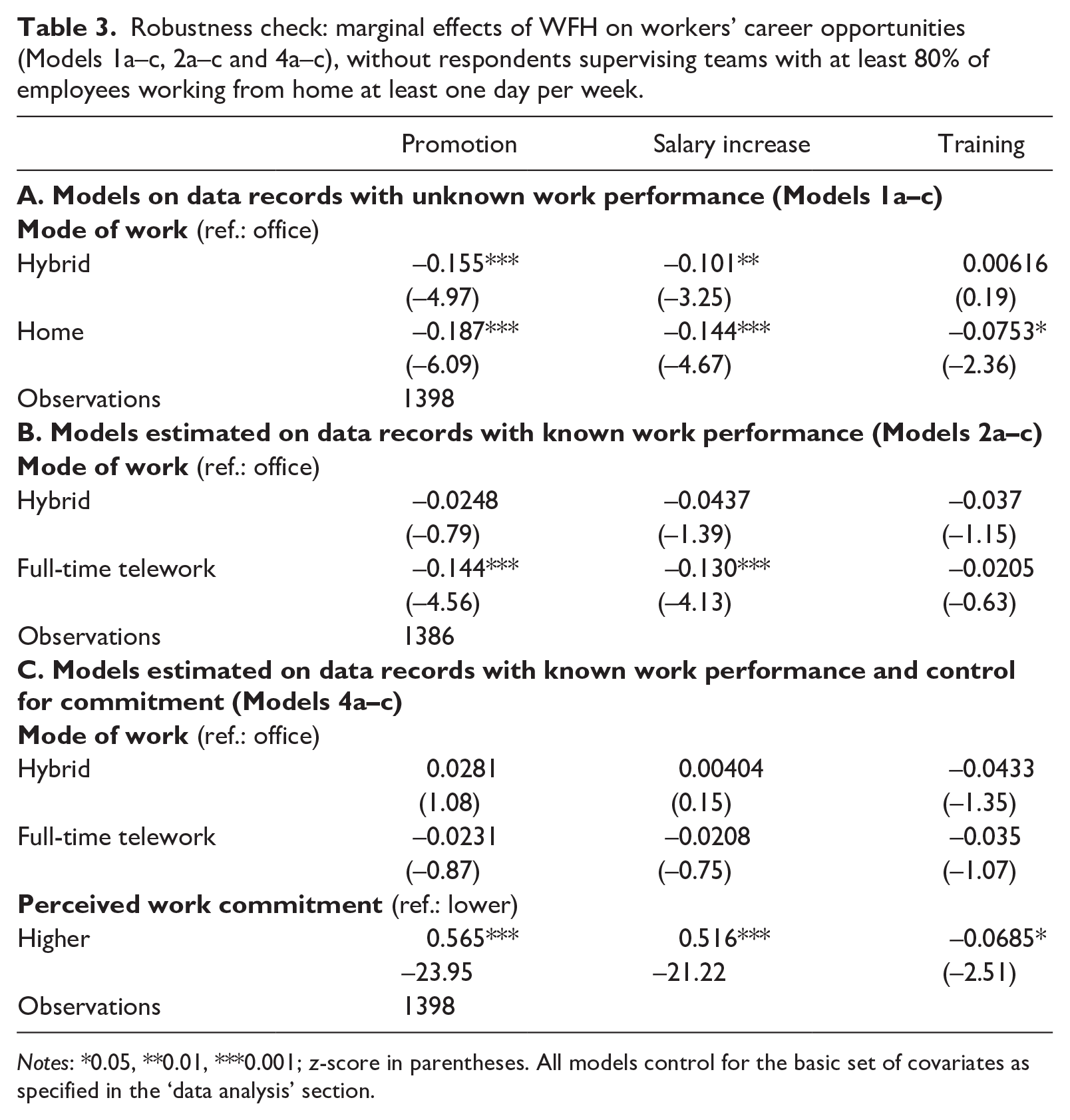
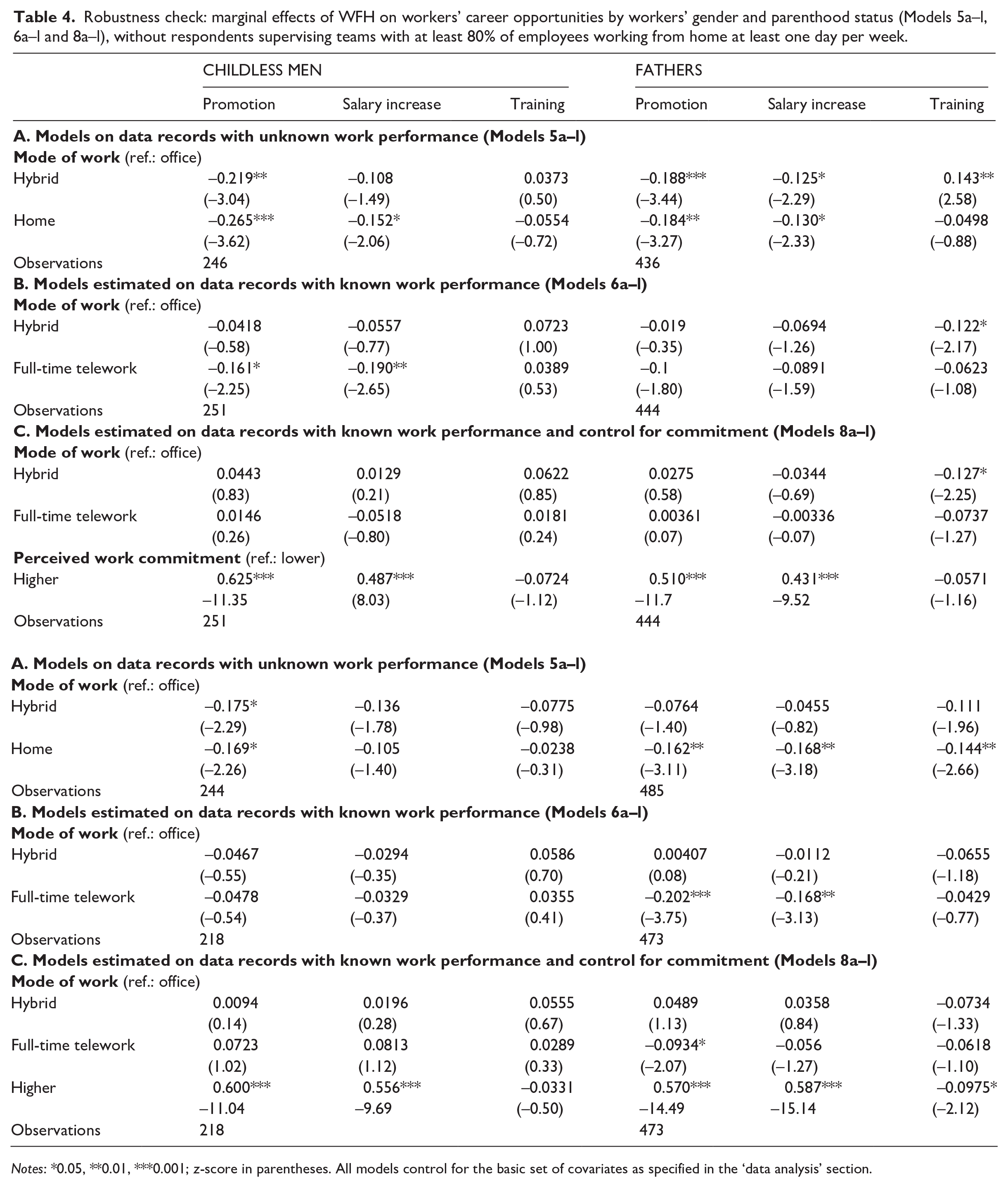
Previous research shows that the frequency of WFH in an organization moderates career penalties for WFH (Golden and Eddleston, 2020; Kasperska et al., 2024). Employees in organizations with more WFH see smaller career penalties than those working in organizations with less WFH. In our sample, 50% of managers supervise teams where at least 80% of employees WFH once a week, potentially weakening these penalties. These managers more often work in large companies with more equal representation of women and men among staff members than managers in whose teams WFH is less widespread. Our findings (not shown here) also indicate that women, particularly mothers, receive preferential treatment in promotion and remuneration decisions. This contrasts with previous empirical evidence on women’s and mothers’ career opportunities, suggesting a selective nature of these work environments. To address this issue, we replicated our analyses on a reduced sample, excluding managers with teams in which at least 80% of workers WFH once per week (Tables 3 and 4).
Robustness check: marginal effects of WFH on workers’ career opportunities (Models 1a–c, 2a–c and 4a–c), without respondents supervising teams with at least 80% of employees working from home at least one day per week.
Notes: *0.05, **0.01, ***0.001; z-score in parentheses. All models control for the basic set of covariates as specified in the ‘data analysis’ section.
Robustness check: marginal effects of WFH on workers’ career opportunities by workers’ gender and parenthood status (Models 5a–l, 6a–l and 8a–l), without respondents supervising teams with at least 80% of employees working from home at least one day per week.
Notes: *0.05, **0.01, ***0.001; z-score in parentheses. All models control for the basic set of covariates as specified in the ‘data analysis’ section.
The results from the reduced sample align with the full sample in terms of direction, though penalties are stronger. As in the full sample, managers’ perceptions of workers’ performance explain differences between hybrid and onsite workers, but not between full-time teleworkers and onsite workers, which stem from differences in perceived commitment.
These patterns hold mostly for childless men and fathers. For childless women, career penalties are fully explained by managers’ performance perceptions, which is consistent with our findings presented in the ‘Gender and parenthood’ section. However, for mothers, the findings differ: full-time teleworking mothers are penalized regardless of whether their performance is known to managers or not and revealing the work performance to managers does not weaken the penalty for WFH. Managers’ perceptions of mothers’ work commitment fully explain the lower earning opportunities of full-time teleworking mothers, compared with their onsite counterparts, but not their promotion opportunities, which partly remain unexplained.
Discussion and conclusions
The Covid-19 pandemic has significantly transformed how people work, leading to a substantial increase in WFH. In the UK, around 40% of employees worked from home during the first two years of the pandemic. Despite efforts to return to the office, this percentage remained stable until summer 2024, although hybrid work has overtaken full-time telework (ONS, 2023, 2024). Previous research shows that post-Covid, teleworkers continue to face worse career opportunities than office-based workers (Kasperska et al., 2024; Wang and Chung, 2023).
In this article, we explored the mechanisms behind this trend in organizations where telework is a viable option. We examined how managers’ perceptions of employees’ performance and commitment affect their evaluations of teleworkers compared with office-based workers, with a focus on gender and parental status. Using an experimental approach, we provided causal evidence and addressed selection issues found in earlier studies. Our focus was on work teams in which telework constitutes a realistic scenario. Namely, in the vast majority (84%) of work teams, some employees worked from home at least one day per week and in half of them at least 80% worked from home at least once per week. Our study is thus not representative for all companies in the UK, but describes the situation in organizations in which WFH is a realistic option.
Our first finding is that the negative effects of WFH on career opportunities can partly be attributed to managers assuming that teleworkers perform worse than office-based workers and partly due to managers’ beliefs that teleworkers are less committed to work. Managers’ assumptions about workers’ performance fully explain the lower promotion and salary opportunities for hybrid teleworkers and the reduced access to training for full-time teleworkers. However, full-time teleworkers are still less likely to receive promotions and salary increases, even when they perform as well as office-based workers, likely reflecting discriminatory practices based on perceived lower commitment. This aligns with research on workplace visibility and presenteeism, which emphasizes that visibility signals commitment (Elsbach et al., 2010; Rogier and Padgett, 2004; Vandello et al., 2013), as well as the literature on ideal worker norms (Acker, 1990; Dumas and Sanchez-Burks, 2015; Williams et al., 2013). Even in the late / post-pandemic context, when WFH was far more common than it used to be before 2020, employees who break these norms by requesting to WFH five days per week get penalized regardless of whether remote work affects their performance or not. Notably, the penalties for full-time WFH net of work performance are more pronounced in organizations where remote work is less common. This suggests that as remote work becomes more widespread, these penalties may diminish over time.
We also examined how perceived performance and commitment affect managers’ evaluation of teleworkers depending on the gender and parental status of workers. Childless men and fathers are most strongly penalized for full-time WFH but these penalties diminish when workers’ performance and managerial perception of workers’ commitment are accounted for. We explain these penalties for WFH among childless men and fathers by the fact that men are expected to be ‘ideal workers’, who are devoted to the needs of the organization and prioritize them over their own (Acker, 1990; Cook et al., 2021). Men who value their free time or face any constraints (either related to health or the family needs) that make them WFH, violate this norm and that leads to negative career consequences (Coron and Garbe, 2023). These findings are against the expectation that managers may consider fathers who request WFH as those who are eager to avoid workplace interruptions and work more intensely because they have to provide for the family.
Childless women also face a penalty for WFH, but unlike childless men and fathers, this penalty is entirely due to employers assuming they perform worse than office-based workers. Managers’ perceptions of commitment do not play a role, meaning full-time teleworking childless women will not face worse career outcomes if they demonstrate the same performance as onsite workers. These findings align with Correll et al. (2007), who found that childless women are rated more positively in hiring than childless men. Correll et al. (2007) proposed two explanations for this phenomenon, which may well apply to our findings. The first explanation is related to the cultural belief that women should have children to be fulfilled, and as a result, women who forgo childbearing may be considered exceptionally oriented to paid work. The second explanation may be the ‘reverse discrimination’, which implies that employers favour childless women to compensate for the fact that they discriminate against mothers. In our study, we indeed found that employers discriminate against mothers who WFH, potentially explaining the more favourable treatment of non-mothers.
Among mothers, the mechanisms underlying employers’ perception of those who WFH are more complex. Namely, we found that the penalties for WFH only become evident after we excluded workplaces from our sample where remote work is widely practised (at least 80% of employees WFH at least once a week). Our data suggest that in workplaces with a high incidence of remote work, mothers are treated preferentially, often being more likely to receive promotions and salary increases than other workers. This is likely because these organizations provide particularly supportive environments for mothers, leading to their selection into such workplaces. However, once these organizations are removed from the analysis, penalties for full-time WFH (though not hybrid WFH) become evident. Interestingly, these penalties cannot be explained by managers’ perceptions of mothers’ work performance, unlike the case for childless women. This suggests that in organizations in which telework is moderate but not widespread, employers may be avoiding promoting or increasing the salaries of mothers who WFH for reasons beyond concerns about potential interruptions from children impacting performance. The penalties for full-time WFH in the case of mothers can be partially attributed to managers’ perceptions of mothers’ commitment, suggesting that employers consider mothers who WFH as less committed to work and penalise them for it. Nonetheless, managerial perceptions of work commitment do not fully explain the differences in promotion opportunities between mothers who work from home five days per week and office-based mothers. Namely, even after accounting for performance and commitment, mothers who WFH five days a week are still less likely to be promoted compared with their office-based counterparts. This suggests that other factors, not considered in this study, come into play when it comes to promotion opportunities of teleworking mothers.
In conclusion, our study contributes significantly to the research on flexible work arrangements and career opportunities by offering a more nuanced view of how WFH impacts workers. Namely, we provide new insights into the mechanisms underlying the negative impact WFH continues to have on workers’ career opportunities in the post-pandemic context. Unlike past research that attributed the lower career opportunities of flexible workers to managerial perceptions of teleworkers’ commitment without performing a formal test of this interpretation (Chung and van der Lippe, 2020; Glass and Noonan, 2016; Munsch, 2016), we formally tested the roles of managerial assumptions of not only workers’ commitment but also workers’ performance in affecting the career opportunities of teleworkers. We demonstrate that both mechanisms play an important role in managerial evaluations of employees. We also find that mothers, who may need flexible work most, are heavily penalized for WFH, with this penalty unrelated to perceived performance issues from potential family interruptions. Childless women, in turn, seem to be in the most advantageous situation as they are the only group for whom the request to WFH is not linked to lower work commitment (though productivity concerns are still in force).
The results of our study are highly relevant for management, HR practitioners, and organizations. While penalties for WFH are weaker in workplaces with widespread remote work, flexibility stigma and managerial bias persist in the post-pandemic world. Organizations should address this by training managers to assess employees fairly, using objective metrics and evaluating outputs rather than relying on subjective judgements (Elsbach and Cable, 2012). Clear career progression guidelines are also essential to ensure remote work does not hinder professional development. A gender-sensitive approach is crucial, as teleworking mothers are held to different standards than fathers (Chung, 2022). Designing policies and evaluations with these disparities in mind can help foster a more equitable environment for all employees.
Our study has limitations that future research could address. Although our sample size is relatively large compared with other experimental studies, it becomes smaller when divided by gender and parental status, leading to larger errors in some subgroup estimates, making them insignificant at p < 0.05. A larger sample size could resolve this. It is worth noting, however, that the sample sizes of other experimental studies in the field were even smaller and rarely conducted on employers with substantial supervisory responsibilities, which compromises their external validity (Hainmueller et al., 2015). Another limitation is that we were able to examine only two specific WFH modes: full-time WFH, which implies WFH five days per week, and hybrid WFH, which we measured as WFH two days per week. However, other configurations, particularly within hybrid work, could exist. Employees might opt for one or three days of WFH per week, or alternate between working one week from home and the next from the office. We were unable to explore the full spectrum of these possibilities, as doing so would have required a significantly larger sample size. However, our findings indicate that the negative impacts of WFH two days a week can be mitigated if employees demonstrate high work performance – an outcome not observed among full-time teleworkers. We believe this mechanism likely applies to other hybrid workers as well, although its effects may vary depending on the extent of teleworking. This variation is an area that future research could explore in greater detail. Finally, while our findings provide a broad assessment of why WFH impacts career opportunities, WFH effects may still vary depending on organizational factors such as company culture and norms, or employer characteristics like gender, parental status, or gender role attitudes. Future research should thus look more closely at how employer and company characteristics, such as organizational culture and norms, moderate the effects of WFH on workers’ careers.
Supplemental Material
sj-docx-1-wes-10.1177_09500170251325769 – Supplemental material for Mechanisms Underlying the Effects of Work from Home on Careers in the Post-Covid Context
Supplemental material, sj-docx-1-wes-10.1177_09500170251325769 for Mechanisms Underlying the Effects of Work from Home on Careers in the Post-Covid Context by Anna Matysiak, Agnieszka Kasperska and Ewa Cukrowska-Torzewska in Work, Employment and Society
Footnotes
Funding
The authors disclosed receipt of the following financial support for the research, authorship, and/or publication of this article: This research was possible thanks to financial support granted by the Polish National Agency for Academic Exchange (Polish Returns Programme 2019) and the ‘Excellence Initiative – Research University (2020–2026)’ at the University of Warsaw (grant number BOB-IDUB-622-63/2021).

Supplemental material
Supplemental material for this article is available online.
Notes
References
Supplementary Material
Please find the following supplemental material available below.
For Open Access articles published under a Creative Commons License, all supplemental material carries the same license as the article it is associated with.
For non-Open Access articles published, all supplemental material carries a non-exclusive license, and permission requests for re-use of supplemental material or any part of supplemental material shall be sent directly to the copyright owner as specified in the copyright notice associated with the article.
