




Abstract
Potential drivers of gender discrimination are recruiters, who are more likely to select applicants with characteristics similar to their own. This study explores whether recruiter characteristics (age, gender, and job position) drive gender discrimination in the recruitment of apprentices for gender-segregated occupations. A factorial survey experiment among 1872 firms in Germany estimates recruiters’ heterogeneous gender choices in male, female, and gender-mixed occupations. The study finds that female applicants are chosen less often for male-dominated occupations and more often for female-dominated occupations than male applicants. Moreover, older recruiters and firm owners are less likely to recruit female applicants for male-dominated occupations but more likely to recruit them for female-dominated occupations than younger recruiters and non-firm owners. By contrast, younger recruiters and HR professionals are more likely to recruit gender-neutrally to an occupation’s dominating gender than older recruiters and non-HR professionals. This study shows that apprenticeship applicants of a gender opposed to the dominant gender of an occupation have a disadvantage in the apprenticeship market and that certain recruiters’ characteristics further impact this disadvantage.
Keywords
Introduction
The segregation of the labour market into male- and female-dominated occupations has consequences for markets and individuals. For one, it affects markets by causing a poorer matching between workers and firms (Altonji and Blank, 1999; Carlsson and Eriksson, 2019; Hsieh et al., 2019). For another, it affects individuals by causing, for example, weaker opportunities in terms of pay and career options for women (Azmat et al., 2006; Bublitz and Regner, 2022; Leuze and Strauß, 2014). Gender discrimination during recruitment is a potential driver of occupational gender segregation (Adamovic and Leibbrandt, 2023). Related studies on the labour market state that recruiters, among other reasons, tend to recruit applicants who have characteristics similar to their own (Levin et al., 2005; Rand and Wexley, 1975) and thus serve as gatekeepers to occupations (Erlandsson, 2019). However, an important yet understudied factor of occupational gender segregation is the apprenticeship market, which could be an important steppingstone for future occupational segregation (Fernandes et al., 2023). So far, little is known about whether recruiter characteristics impact the recruitment of apprentices 1 when they are in the first stage of their occupational career.
This study adds to the literature on gender discrimination by answering the following question: to what extent do recruiters’ characteristics explain gender choices in the recruitment of apprentices for occupations that are typically dominated by either males or females? This question is addressed as follows. First, it focuses on the average recruitment probability of male and female apprenticeship applicants to obtain an impression of general gender differences in recruiters’ hiring preferences. Second, it focuses on the recruitment probability of male and female apprenticeship applicants in occupations that are predominantly performed by one gender (e.g. butcher or nurse) to identify potential gender discrimination patterns by occupation type. Third, it focuses on the role of recruiters’ age, gender, and job position in the relationship between the recruitment probability of male and female apprenticeship applicants in male- and female-dominated and gender-mixed occupations to investigate the impact of recruiters’ characteristics on gender differences in recruiters’ hiring preferences.
To answer this question, this study performed a factorial survey experiment with 1872 recruiters—each recruiter is from a different German firm—who recruit apprentices, presenting hypothetical apprenticeship applicant profiles to each recruiter (Auspurg and Hinz, 2015; Bertrand and Mullainathan, 2004). The recruiter ranks the recruitment probability of six applicants from 1 (lowest) to 10 (highest). Apprenticeship applicants’ characteristics differ regarding their (a) family name (signalling ethnic background), (b) gender, (c) duration of stay in Germany, (d) educational degree, and (e) professional, (f) digital, (g) analytical and (h) social competence level. Moreover, firm-level measurements of gender-segregated occupations and recruiter characteristics (age, gender and job position) are used to analyse potential differences in gender choices.
This study contributes to literature on gender discrimination in recruitment in three ways. First, studies have shown that females are more likely to be recruited for female-dominated occupations, and males are more likely to be recruited for male-dominated occupations (Froehlich et al., 2020). However, it remains uncertain whether employers or employees drive these occupational preferences (Herriot, 2002; Kalleberg and Sorensen, 1979). Recruitment is a two-way interactive process (Herriot, 2002); thus, not only does the employer recruit an employee but the employee self-selects themselves into a firm and occupation. This study contributes by revealing recruiters’ recruitment preferences (Auspurg and Hinz, 2015). This study shows not only the potential relationship between gender and recruitment probability (Kleven et al., 2018) but also the potential mechanism behind it (e.g. recruiters’ characteristics).
Second, previous studies have shown that recruiters’ characteristics relate to gender choices in workers’ recruitment (Erlandsson, 2019; Feld et al., 2016; Levin et al., 2005). To the best of our knowledge, no study has explored the role of recruiters’ characteristics in the gender choices of apprenticeship applicants while differentiating between male- and female-dominated and gender-mixed occupations. This study adds to the literature on gender discrimination by investigating whether recruiters’ characteristics relate to their gender choices when recruiting apprentices.
Third, a previous study on gender discrimination in the German apprenticeship market has found that female applicants are generally less likely to be selected than male applicants (Kübler et al., 2018). However, more recent studies for the Swiss apprenticeship market have found no differences in firms’ gender preferences (Fernandes et al., 2023; Fossati et al., 2020). Additionally, recent studies on gender discrimination for the labour market in OECD countries have reported a trend towards less female and more male discrimination (Birkelund et al., 2022; Lippens et al., 2023). This study investigates whether this trend is also the case in the German apprenticeship market.
Previous literature, theory and hypotheses
Gender discrimination
Males are strong and females are caring—such gender stereotypes are cultural constructs and describe what males and females are ‘known’ to be like in a society (Fiske, 1998; Gorman, 2005: 703; Bertrand, 2020; Pan, 2015). People use stereotyping based on group membership when they have imperfect information about a person or a group (Guryan and Charles, 2013); thus, firms recruiting for gender-segregated occupations more likely select applicants who exhibit gender-stereotypical characteristics (Cejka and Eagly, 1999; Riach and Rich, 2006; Schein, 1973). Literature shows that when an occupations’ selection criteria include more stereotypically gender traits, the respective gender is more represented among newly recruited workers (Gorman, 2005).
Firms recruiting applicants for gender-segregated occupations may discriminate the opposite gender. In this study, gender preference in recruitment is defined as a firm’s conscious or unconscious preference for a certain gender (González et al., 2019). Thus, firms can evaluate males and females differently even though they are equal with respect to all observable productivity-related characteristics (Kübler et al., 2018). The literature on gender discrimination distinguishes between two theoretical models: (i) taste-based discrimination and (ii) statistical discrimination (Aigner and Cain, 1977; Arrow, 1973; Becker, 1995; Guryan and Charles, 2013; Phelps, 1972). Taste-based discrimination is when people of the majority dislike interacting with people of the minority and are willing to pay a financial price to avoid the interaction (Baert and De Pauw, 2014). Statistical discrimination is when people predict a person’s productivity based on a (real or perceived) group’s average performance to supplement imperfect missing information about the person’s actual performance (Baert and De Pauw, 2014). Thus, firms rely partly on group information as a proxy for these variables because true individual productivity is unobserved (Becker, 1985; Heckman, 1998; Kübler et al., 2018). For example, males are, on average, stronger than females and thus better suited for construction work. This leads to the rational assessment of potential employees in terms of productivity (González et al., 2019). Applicant characteristics, such as gender, are used as proxies for traits that are difficult to measure. Because recruiters initially do not know the applicant, they must make recruitment decisions under uncertainty. Thus, recruiters refer to stereotypes based on their knowledge of male’s and female’s typical abilities (González et al., 2019).
Previous literature suggests that females are more likely to discriminate against males (Azmat and Petrongolo, 2014; Baert et al., 2016; Riach and Rich, 1987) but also that the extent to which this is the case is strongly related to firm characteristics, such as gender ratio and occupational status (Booth and Leigh, 2010; Carlsson, 2011; Neumark et al., 1995; Riach and Rich, 2006). Gender discrimination also seems to have changed over time; some evidence suggests a shift towards increasing discrimination among men (Birkelund et al., 2022). The question remains as to whether this shift also occurs in apprenticeship markets, where females are less often recruited than males (Kübler et al., 2018).
Recruiters’ characteristics
A recruiter’s discrimination against certain applicants may be a result of in-group favouritism or ‘similar to me’ effects (Erlandsson, 2019; Feld et al., 2016; Levin et al., 2005; Lin et al., 1992; Rand and Wexley, 1975). In-group favouritism occurs when recruiters are more likely to select applicants who belong to their own membership group, thus promoting the homogeneity of the group, such as gender (Erlandsson, 2019; Hewstone et al., 2002). Relatedly, ‘similar to me’ effects occur when recruiters more likely hire applicants with characteristics similar to their individual self—for example, same humour (Erlandsson, 2019; Levin et al., 2005; Lin et al., 1992; Rand and Wexley, 1975). The literature on discrimination in recruitment distinguishes between different types of influential recruiter characteristics such as gender and age (Desrumaux et al., 2009). This means that recruiters’ (sociodemographic) characteristics may explain gender choices in the recruitment of apprentices for gender-segregated occupations. This study formulates hypotheses on the recruiters’ age, gender and job position.
Recruiters’ age
People who belong to the same birth cohort grow up in a specific historical, economic and, sociocultural context that shapes their outlook on the world (Lyon et al., 2017). They experience similar events and contexts in their formative years and thus share a ‘way of experiencing life and the world’ (Mannheim, 1952: 283; Lyon et al., 2017); moreover, they differ from other birth cohorts with respect to preferences, values and attitudes (Appelbaum et al., 2022). These differences generally remain stable because norms and values are mostly formed during youth and do not change much afterwards (Kalleberg and Sorensen, 1979).
Thus, recruiters from different birth cohorts may be expected to make different recruitment choices because they perceive the work context differently. For example, Fein et al. (2010) show that the leadership styles of people born before and after the fall of communism strongly differ. This underlines the fact that work attitudes are shaped by the political regime one experiences while growing up. Based on a similar reasoning, this study expects people from similar birth cohorts to also share views on gender in the recruitment and work context in general. While older generations have a more traditional view of gender in the work context and are more likely to conform to gender stereotypes, younger generations appear more open to gender fluidity (Appelbaum et al., 2022; Seemiller and Grace, 2019). Thus, we expect that older recruiters are more likely to recruit apprentices conforming to the dominating gender of an occupation in comparison to younger recruiters (see Section Respondents’ age).
Recruiters’ gender
One of the most prominent characteristics of in-group favouritism is gender (Erlandsson, 2019). In case of in-group bias, recruiters favour applicants of the same gender as their own (Hewstone et al., 2002). This is because they perceive a certain similarity in attitudes and values with the in-group, which leads to interpersonal attraction (Graves and Powell, 1995: 86). Interpersonal attraction causes a positive bias when conducting interviews, processing information and making judgements. Although other characteristics can cause such interpersonal attractions, gender seems particularly strong (Graves and Powell, 1995).
However, the empirical literature on in-group gender bias provides mixed evidence (Booth and Leigh, 2010; Graves and Powell, 1995; Levin et al., 2005). A growing body of evidence suggests that not only males favour males (Erlandsson, 2019), but also females favour females because they are aware of their disadvantage (Carlsson and Eriksson, 2019; Rudman and Goodwin, 2004). Thus, in-group bias exist between males and females (Rudman and Goodwin, 2004). This, in turn, may be seen as a cause of gender-segregated occupations because recruiters serve as gatekeepers who tend to keep their group homogeneous (Erlandsson, 2019; Levin et al., 2005). Thus, we expect that male recruiters are more likely to recruit male apprentices for male-dominated occupations than female apprentices. In addition, we expect that female recruiters are more likely to recruit female apprentices for female-dominated occupations than male apprentices (see Section Respondents’ gender).
Recruiters’ job position
Recruiters’ choices for an applicant are also affected by the organisational context (Tomaskovic-Devey and Avent-Holt, 2019), which shapes their ‘perceived opportunities, possible course of action and potentially their beliefs and recruiting preferences’ (Bjørnshagen, 2022: 485).
For example, recruiters who are human resource (HR) professionals more often follow formalised recruitment procedures, which leave less room for personal preferences (Carroll et al., 1999; Stainback et al., 2011). Instead, recruiters who are less aware of anti-discrimination legislation may be biased by their gut feeling and arbitrary criteria, such as in-group favouritism (Bjørnshagen, 2022).
The apprenticeship market comprises mostly small- and medium-sized firms (Soellner, 2014). Such firms are less likely to formalise HR procedures in place, which decreases compliance rates with anti-discrimination legislation and thus provide a more fertile context for discriminatory behaviour (Bjørnshagen, 2022). In these firms, firm owners or other organisational gatekeepers make recruitment decisions more often, and such decisions may be more strongly guided by gut feelings rather than by facts (Imdorf, 2010). Thus, we expect that recruiters who are firm owners are more likely than non-firm owners 2 to recruit apprentices whose gender conforms to the dominant gender of an occupation. Moreover, we expect that recruiters who are HR professionals are more likely than non-HR professionals 3 to be gender-neutral to the dominant gender of an occupation (see Section Respondents’ job position).
Data and experimental design
Data
This study tested the hypotheses with a factorial survey experiment and related survey questions, which are integrated into the panel on qualification and competence development 2021 by the Federal Institute for Vocational Education and Training (short: BIBB qualification panel; Gerhards et al., 2023). The BIBB qualification panel provides firm-level information on the structures, developments and connections between firms’ qualification measures and skill demand. The fieldwork was organised using a computer-assisted personal interviewing method (CAWI). The sample was drawn from the register of firms of the Federal Employment Agency, which contains all German firms with at least one employee (N = 4002). This study used the cross-level information of the BIBB qualification panel 2021, not the panel dimensions.
For information on gender-segregated occupations, the BIBB qualification panel was merged with the vocational education and training (VET) statistics (Uhly et al., 2021) that gather annual data on apprenticeship trainees and contract and examination data of German dual vocational training 4 (see Section Measuring Gender-Segregated Occupations). In the BIBB qualification panel, the survey questions on the firm’s types of occupations were simultaneously integrated with the factorial survey experiment.
The BIBB qualification panel provided the study with 4002 respondents. Of the 4002 respondents, 1844 offered no apprenticeship training (or had a missing). Thus, 2158 respondents were left. Of the 2158 respondents, 2046 participated in the factorial survey experiment (95%) and 112 declined to answer. Thus, of the 2046 respondents, 1889 respondents remained, for whom information on the interviewers’ gender existed. Of the 1889 respondents, 1872 respondents provided valid answers on gender-segregated occupations (99%), and 17 declined to answer. Of the 1872 respondents, 1859 made all six recruitment decisions, 10 made five, 2 made three, and 1 made two. Thus, 11,212 decisions were made by 1872 respondents. Figure 1 provides an overview of how the full BIBB qualification panel sample was narrowed down to the working sample. In Table S.1 in the Supplemental Material, the working sample is compared with the full sample to show that the two do not differ in terms of important characteristics.
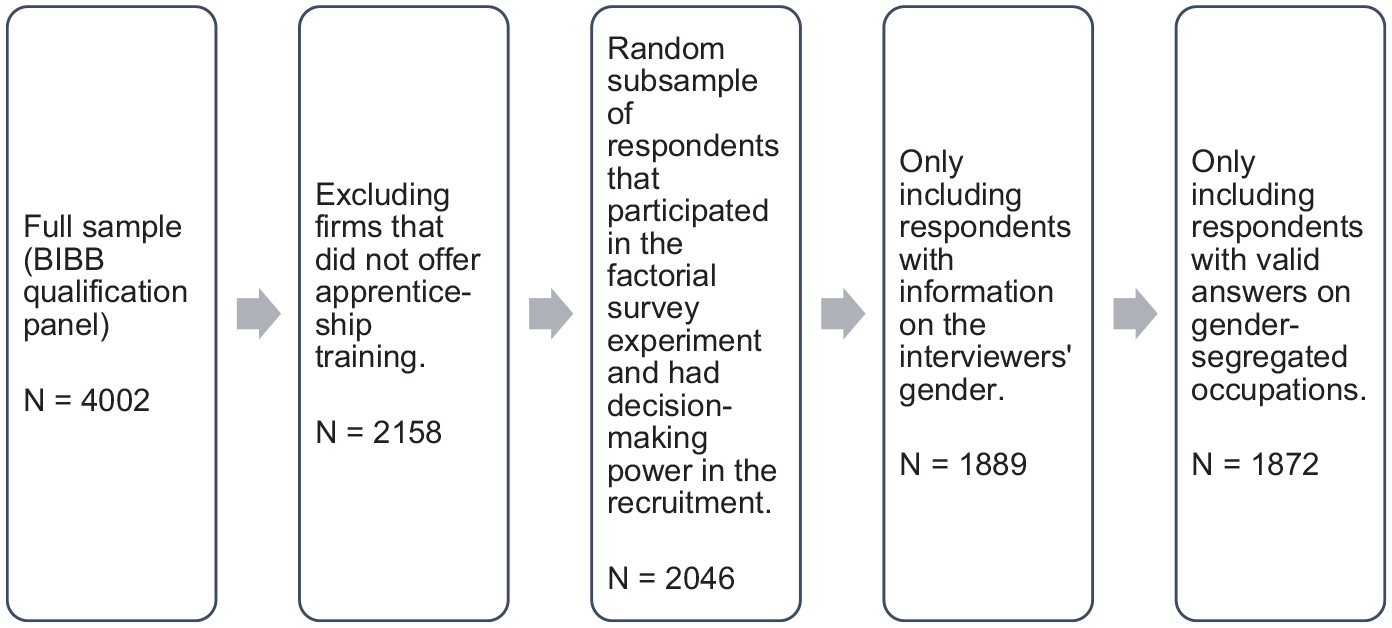
Working Sample.
Table 1 provides a descriptive overview of the working sample, including information on respondent, firm, and interviewer characteristics. Of the respondents, 43% were females and their average age was 47 years. Moreover, 47% of the respondents held an HR position and 28% were firm owners. Of the firms, 5% were in the fields of agriculture, forestry, and mining, while 32% were in manufacturing, 6% were in construction, 15% were in trade and repair, 15% provided business services, 13% provided other services, 4% provided medical and nursing services, and 9% were in the fields of public service and education. In addition, 20% of the firms were located in East Germany and 53% had a personnel board. Concerning the numbers of employees, 17% of the respondents worked at small firms with less than 20 employees, 27% worked in firms with 20–99 employees, 22% worked in firms with 100–199 employees, 24% worked in firms with 200–499 employees, and 10% worked in firms with more than 500 employees. Thirty-six percent of the firms used technology to automate processes and lastly, 23% of the interviewers were females.
Descriptive statistics.
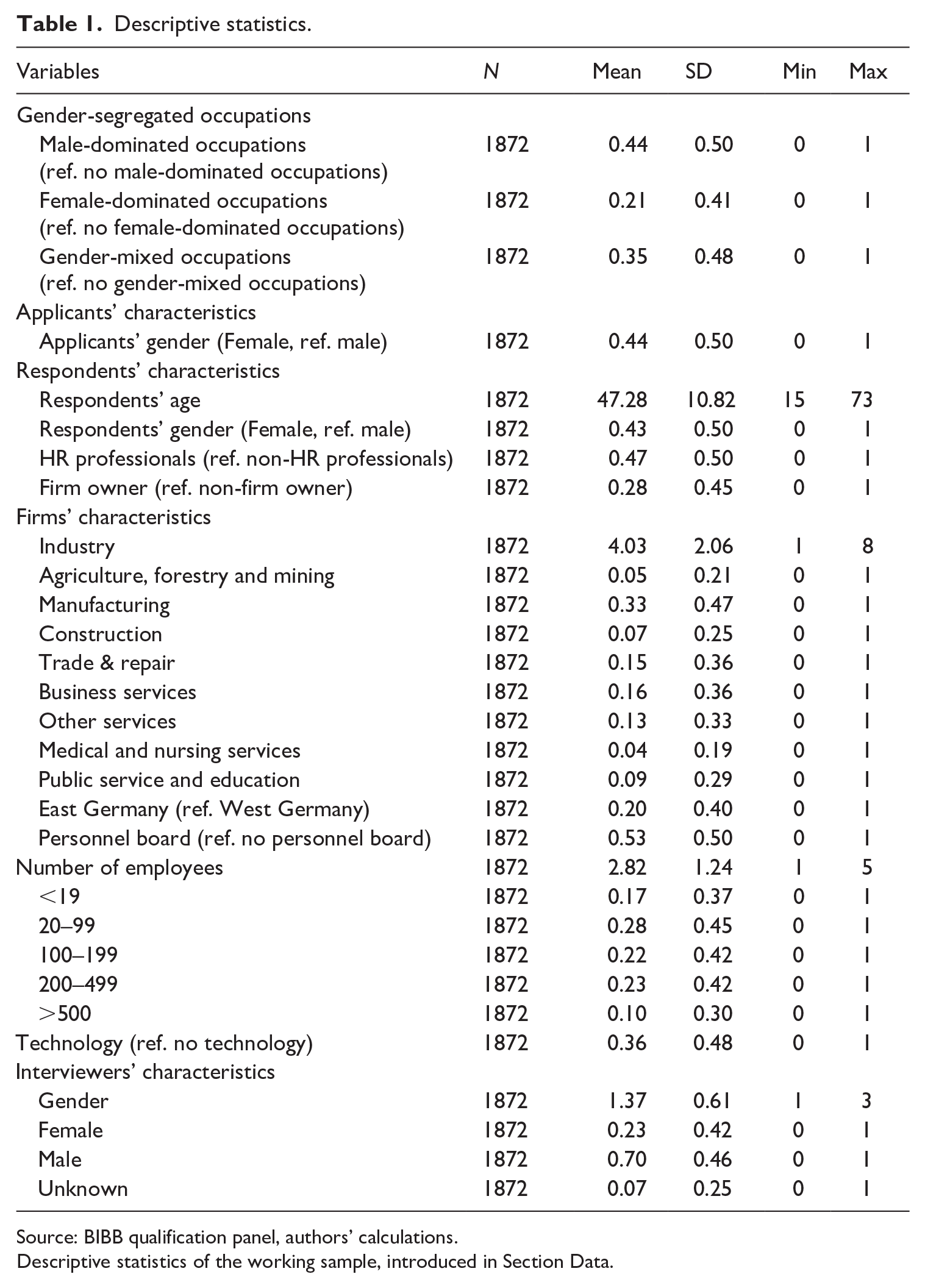
Source: BIBB qualification panel, authors’ calculations.
Descriptive statistics of the working sample, introduced in Section Data.
External validity
The results had a high degree of generalisability because the firms were taken from a random subset of representative firms. As it is the case for studies like these, the real-world decision-making setting is mimicked in a limited version of it. The study strengthened external validity by including only respondents with recruitment power, that is, respondents who decide on their own or in cooperation with others (c.f. Hainmueller et al., 2015). Thus, the respondents had recruitment power in their real work life. We also used attributes known to be a factor in recruiters’ decision-making for apprenticeships positions.
Factorial survey experiment
A factorial survey experiment is a multidimensional experiment in which the respondents make decisions based on hypothetical situations (vignettes). In this study, the recruiter (respondent) ranked recruitment probabilities from 1 (lowest) to 10 (highest) for six different apprenticeship applicant profiles (vignettes).
The factorial survey experiment strengthens this study in three ways. First, the characteristics (attributes) systematically varied within the vignettes, which made it possible to determine the significance of the stated choices in the decision (Auspurg and Hinz, 2015). Second, the experiment randomly assigned vignettes to the respondents who are real-life recruiters, which strengthened their external validity (Hainmueller et al., 2015). Third, randomisation enables to learn about the causal effect on the probability of recruiting males or females and thus identify discrimination (Kübler et al., 2018; Neumark, 2016). This approach overcomes the issue of overestimating discrimination, as in the case of regression-based methods (Kübler et al., 2018).
In addition, the factorial survey experiment was framed in a way that discrimination can be studied along multiple dimensions and thus, other authors like Shirshikova et al. (2023) used this same base vignette but applied it to a different context. While the BIBB qualification panel is already accessible on site of the Federal Institute of Vocational Education and Training, the vignette will be accessible to other users later on.
Apprenticeship applicants’ attributes and attribute values
Table 2 lists the profile information and attribute values of apprenticeship applicants. The names of the apprenticeship applicants varied and were typical of German, Dutch, Arabic and Polish nationalities. The apprenticeship applicants were both males and females, and their duration of stay in Germany was either ‘for a short time’, ‘since the start of secondary school’ or ‘since birth’. The analyses measured educational background by distinguishing between ‘high school diploma’, ‘secondary school certificate’, ‘general qualification for university entrance’ and ‘college dropout’. Finally, the apprenticeship applicants differed between ‘very good’, ‘good’ and ‘satisfactory’ on a 10-points scale in their professional, digital, analytical, and social competence level. 5 Table 3 shows an example of the vignette as shown in the BIBB qualification panel.
Overview of applicants’ attributes and values in the factorial survey experiment.
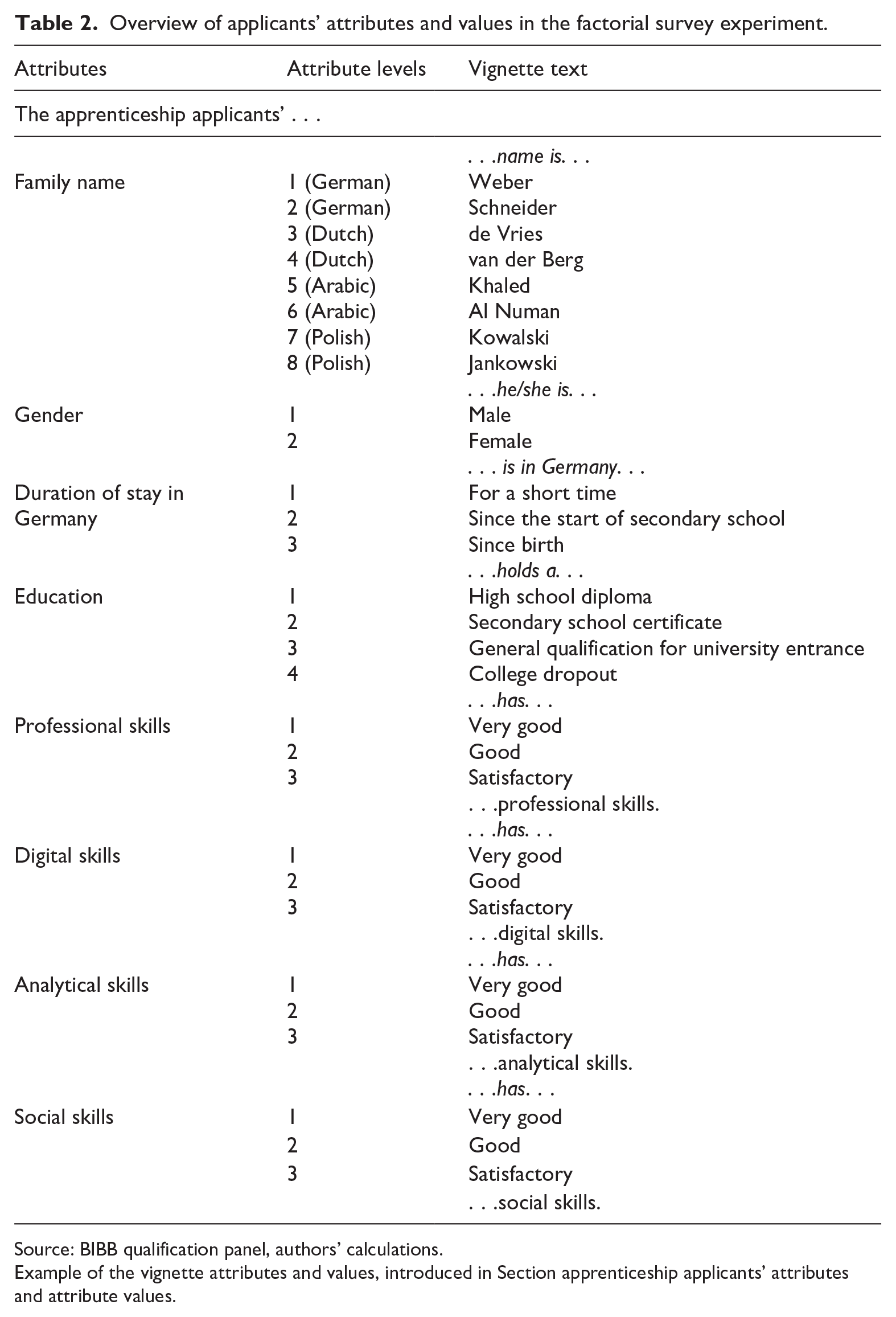
Source: BIBB qualification panel, authors’ calculations.
Example of the vignette attributes and values, introduced in Section apprenticeship applicants’ attributes and attribute values.
Vignette example.
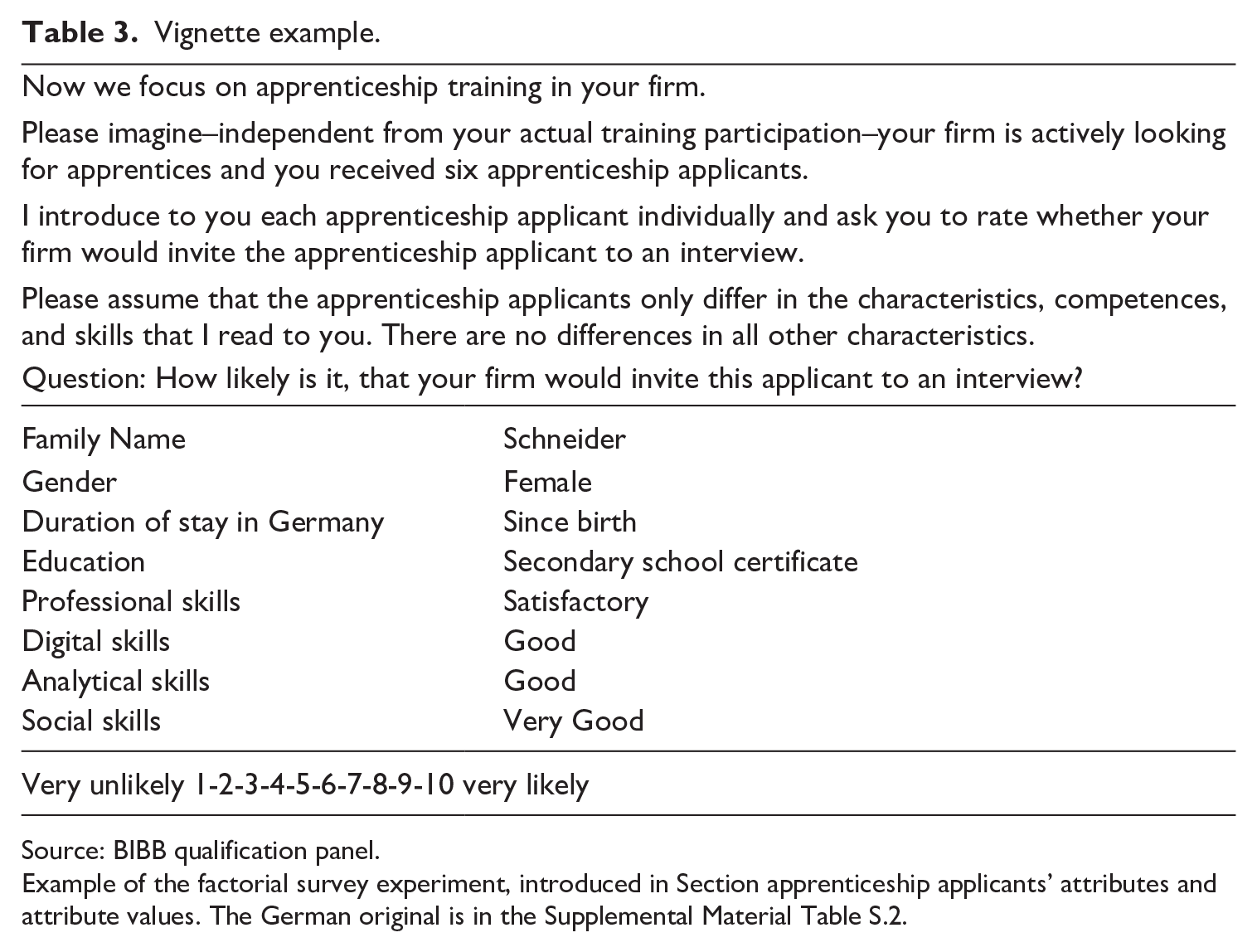
Source: BIBB qualification panel.
Example of the factorial survey experiment, introduced in Section apprenticeship applicants’ attributes and attribute values. The German original is in the Supplemental Material Table S.2.
The apprenticeship applicant profiles differed in only eight characteristics, while all other characteristics remained constant; thus, an applicant’s recruitment probability rating can only be justified by one or more of the characteristics listed in the vignette. Moreover, because each of the applicants’ attributes were potential factors for discrimination (e.g. Bertrand and Mullainathan, 2004; Froehlich et al., 2020; Protsch and Solga, 2015), this study is able to differentiate gender discrimination from other potential drivers for discrimination.
Efficient design
As in most factorial survey experiments, the number of possible combinations of attributes and attribute values (i.e. the applicants’ characteristics) was too large to be included in the survey (4 × 2 × 3 × 4 × 3 × 3 × 3 × 3 = 7776 unique combinations). To reduce the number of combinations, a D-efficient design using the algorithm described in Auspurg and Hinz (2015) was implemented. This algorithm selected the combinations of attribute values with the most statistical power and assured to be nearly orthogonal (i.e. equal frequencies of all attribute values). Thus, the D-efficient design enabled this study to have a similar statistical power even by using fewer combinations and fewer decisions. In total, this study used 750 unique combinations of attribute values with a D-efficiency score of 99.3. The recommended level by Auspurg and Hinz (2015) is above 90. The 750 combinations were divided into 125 blocks, which were randomly assigned to respondents. Each block consisted of six unique descriptions of the hypothetical apprenticeship applicants, which follows related literature recommending to not provide more than 10 vignettes to a respondent to avoid fatigue effects (Auspurg and Hinz, 2015). In addition, both the order of the applicant profiles and the order of the applicant characteristics were randomly varied to avoid learning effects. Moreover, Auspurg and Hinz (2015) recommend at least five respondents per block to adequately evaluate each vignette, because the heterogeneity of the respondent sample increases with the number of respondents. In this study, on average 15 respondents evaluate each block, which fulfilled the recommendation. The design allowed to estimate main effects as well as two-way and three-way interactions (Atzmüller and Steiner, 2010).
Measuring gender-segregated occupations
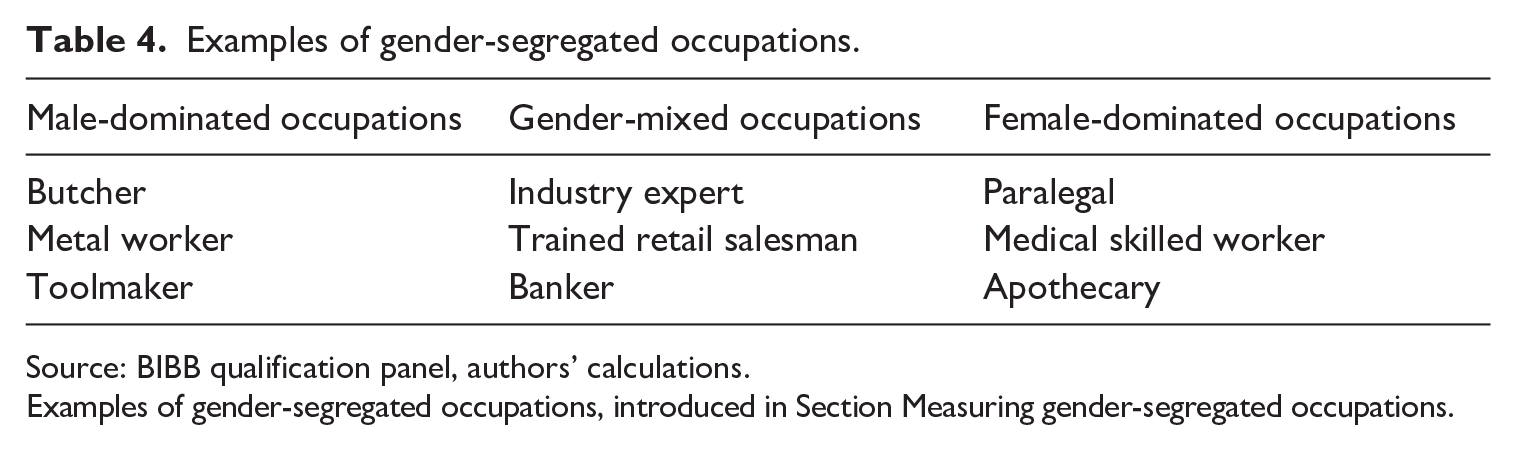
VET statistics for 2021 contain information on the percentage of men per occupation in firms (Uhly et al., 2021). This information was used to create dummy variables for male-dominated (>70% males), gender-mixed (31%–69% males) and female-dominated occupations (<30% males; Frome et al., 2006). Table 4 presents examples of gender-segregated occupations.
Examples of gender-segregated occupations.
Source: BIBB qualification panel, authors’ calculations.
Examples of gender-segregated occupations, introduced in Section Measuring gender-segregated occupations.
Respondents’ characteristics
The factorial survey experiment had the purpose to analyse important drivers for the selection of applicants into the apprenticeship market and gender is considered to be an important driver for selection (Kübler et al., 2018). We further included survey questions on respondents’ characteristics (i.e. respondents’ age, gender, and position) in the BIBB qualification panel to specifically analyse the relationship between applicants’ gender and respondents’ characteristics.
In addition, while the hypotheses of this study were not pre-registered, it acknowledges the potential of the ‘looking elsewhere’ fallacy (Simmons et al., 2011). To enhance reproducibility, this study provided transparency by describing the used data, all statistical tests and analyses conducted, including robustness tests. However, the importance of pre-registration in future research is emphasised.
Respondents’ age
The respondents’ age was measured by asking the following question: ‘May I ask you how old you are?’. The answers ranged from 15 to 73 years old. On average, the respondents were 47 years old. For the analysis, the variable is used in its original form as a metric variable.
The hypothesis on respondents’ age was in line with the literature stating that older and younger generations differ in terms of their view of gender in the work context. While older generations have a more traditional view and are more likely to conform to gender stereotypes, younger generations appear more open to gender fluidity (Appelbaum et al., 2022; Seemiller and Grace, 2019). Thus, Hypothesis 1 stated the following:
Respondents’ gender
The respondents’ gender was measured by the interviewers who were asked to enter the gender of the respondent into the survey. The interviewers could choose between ‘female’ and ‘male’. The sample of respondents consisted of 43% females and 57% males. For the analysis, the binary variable was coded with female as 1 and male as 0.
The hypothesis on respondents’ gender followed the evidence of related literature stating that male and female recruiters serve as gatekeepers to occupations and tend to keep their group homogeneous (Erlandsson, 2019; Levin et al., 2005). Thus, Hypothesis 2 stated the following:
Respondents’ job position
The respondents’ job position was measured by asking the following: ‘What is your job position at your firm?’. The answering options were (1) ‘firm owner’, (2) ‘CEO’, (3) ‘site manager’, (4) ‘human resource manager’, (5) ‘training manager’, (6) ‘division manager’, (7) ‘business manager’ and (8) ‘other position’. This information was used to create two dummy variables. The first dummy variable ‘firm owners’ was coded with (1) ‘firm owner’ and (2) ‘CEO’ as 1 and all other positions (3)–(8) as 0. The second dummy variable ‘HR professionals’ was coded with (4) ‘human resource manager’ and (5) ‘training manager’ as 1 and all other positions (1)–(3) and (6)–(8) as 0. The sample of respondents consisted of 28% firm owners and 47% HR professionals.
The hypothesis on recruiters’ job position is in line with previous literature reporting that recruiters’ choices are affected by the organisational context, for example, the job position (Bjørnshagen, 2022). While HR professionals more often follow formalised recruitment procedures (Carroll et al., 1999; Stainback et al., 2011), firm owners’ recruitment decisions are more strongly guided by gut feelings rather than by facts (Imdorf, 2010). Thus, Hypothesis 3 stated the following:
Econometric Model
A factorial survey experiment is analysed using a three-step approach. The starting point is the econometric model presented by Auspurg and Hinz (2015). The recruitment probability rating

with
where
Second, to detect systematic correlations between the apprenticeship applicant’s gender f and gender-segregated occupations G, the empirical model is modified as follows:

with
where G represents gender-segregated occupations, such as male- or female-dominated and gender-mixed occupations. The apprenticeship applicant’s gender f refers to females or males as a reference group. This model is referred to as M2.
Third, to detect systematic correlations among the apprenticeship applicant’s gender f, gender-segregated occupations G and recruiter characteristics R, the regression formula is modified as follows:

with
where R represents the recruiter’s attributes, such as age, gender, and job position. This model is referred to as M3.
This study uses cross-level information from the BIBB qualification panel 2021. However, within the factorial survey experiment, recruiters are asked to make six recruitment decisions. Since the vignettes are nested in recruiters, the analyses are based on a random-effects model to correct the standard errors for the effect of clustering that follows from the nesting of recruiters’ observations (Auspurg and Hinz, 2015). In the analyses, the recruiters’ characteristics (age, gender, and job position), firms’ characteristics (number of employees, location, industry, personnel board, and use of technology 6 ) and interviewers’ gender were controlled for.
Results
The following section discusses the recruiters’ recruitment probability rating for female and male applicants measured on the Likert scale varying from 1 to 10. This study only discusses results until a significance level of 10%.
Recruiters’ gender choices
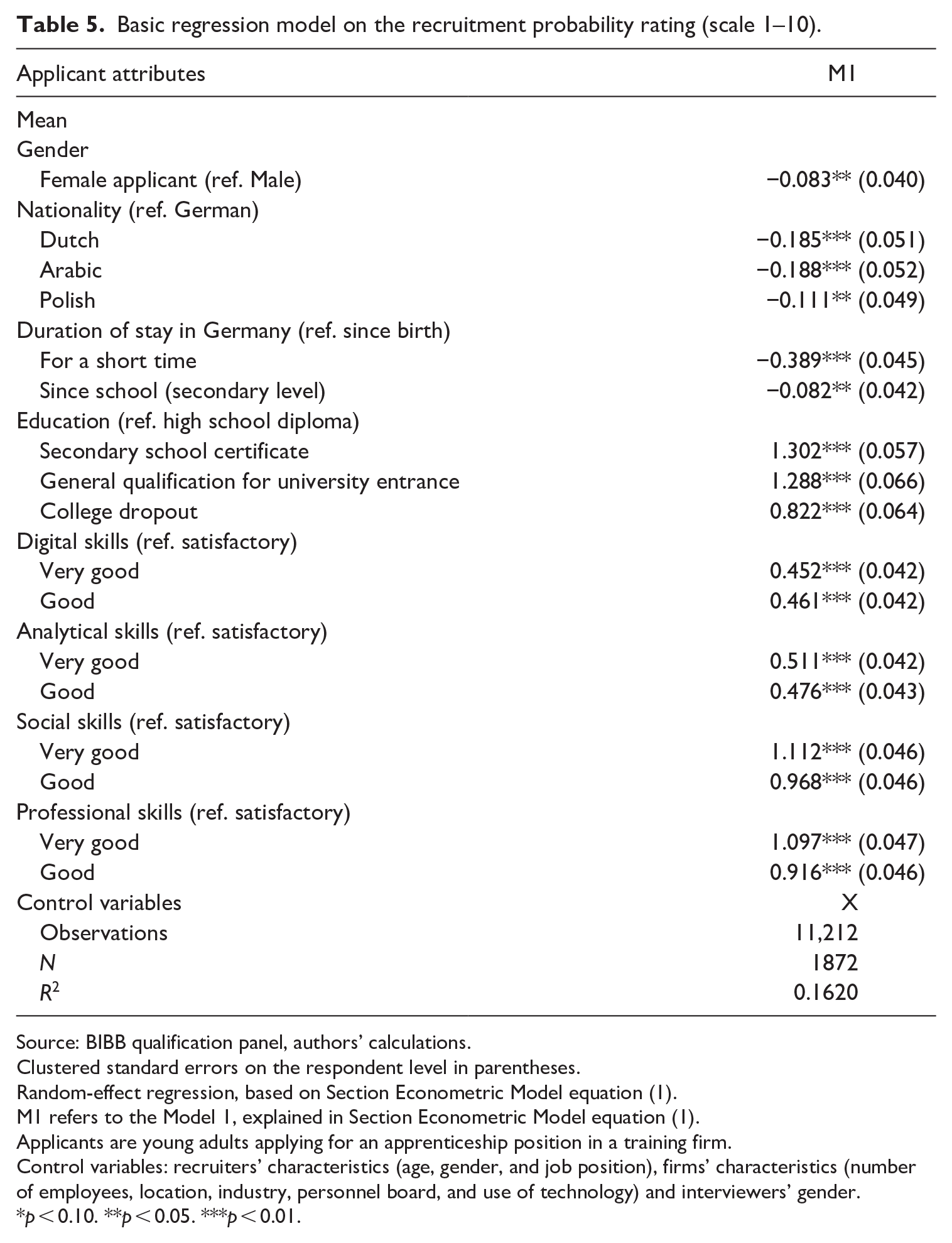
Table 5 presents the regression coefficients of Model 1. On average, recruiters are less likely to recruit a female applicant than a male applicant.
Basic regression model on the recruitment probability rating (scale 1–10).
Source: BIBB qualification panel, authors’ calculations.
Clustered standard errors on the respondent level in parentheses.
Random-effect regression, based on Section Econometric Model equation (1).
M1 refers to the Model 1, explained in Section Econometric Model equation (1).
Applicants are young adults applying for an apprenticeship position in a training firm.
Control variables: recruiters’ characteristics (age, gender, and job position), firms’ characteristics (number of employees, location, industry, personnel board, and use of technology) and interviewers’ gender.
p < 0.10. **p < 0.05. ***p < 0.01.
Figure 2 shows that the recruitment probability rating 7 is, on average, 6.85 for female applicants and 6.93 for male applicants.
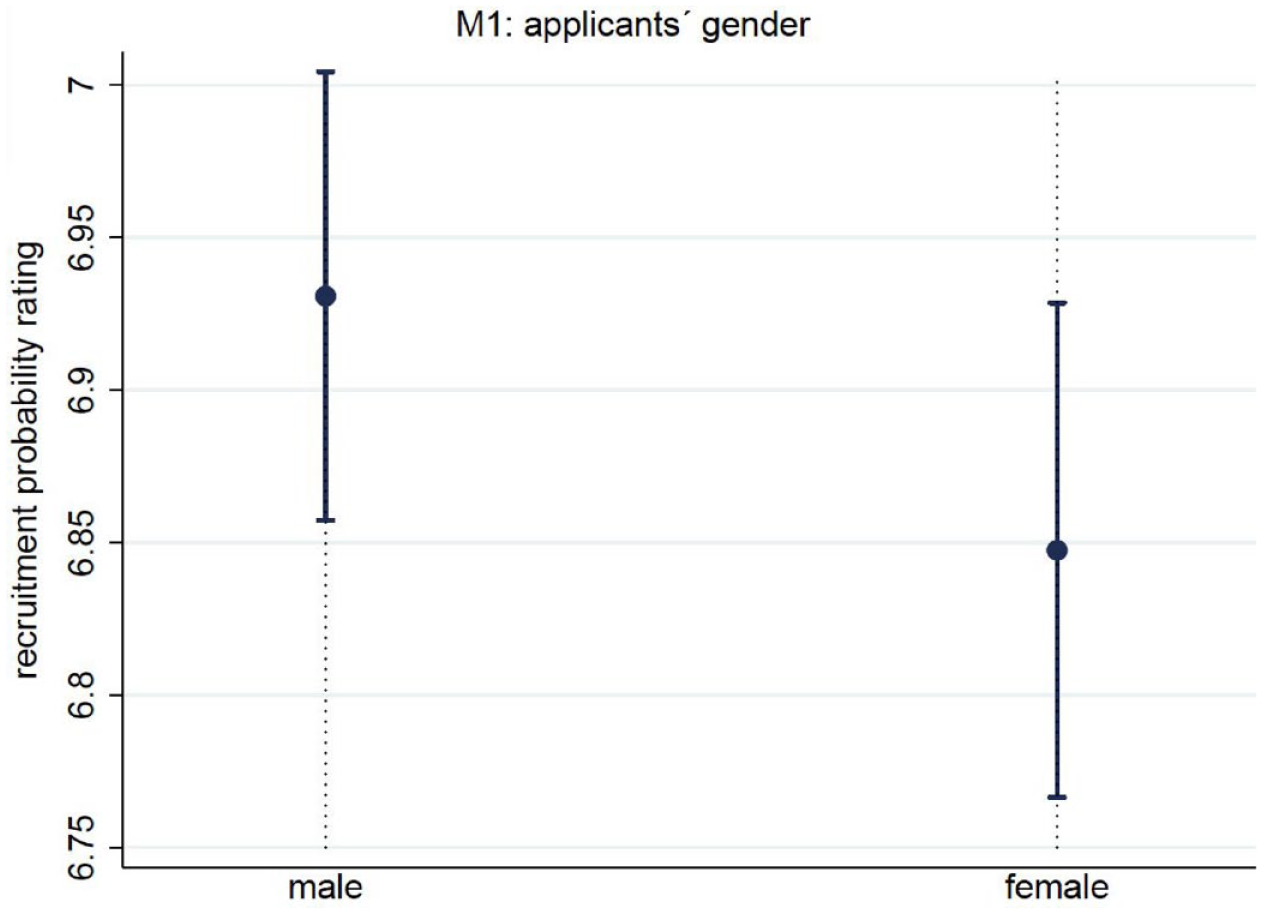
Basic regression model on the recruitment probability rating (scale 1–10).
Recruiters’ gender choices for gender-segregated occupations
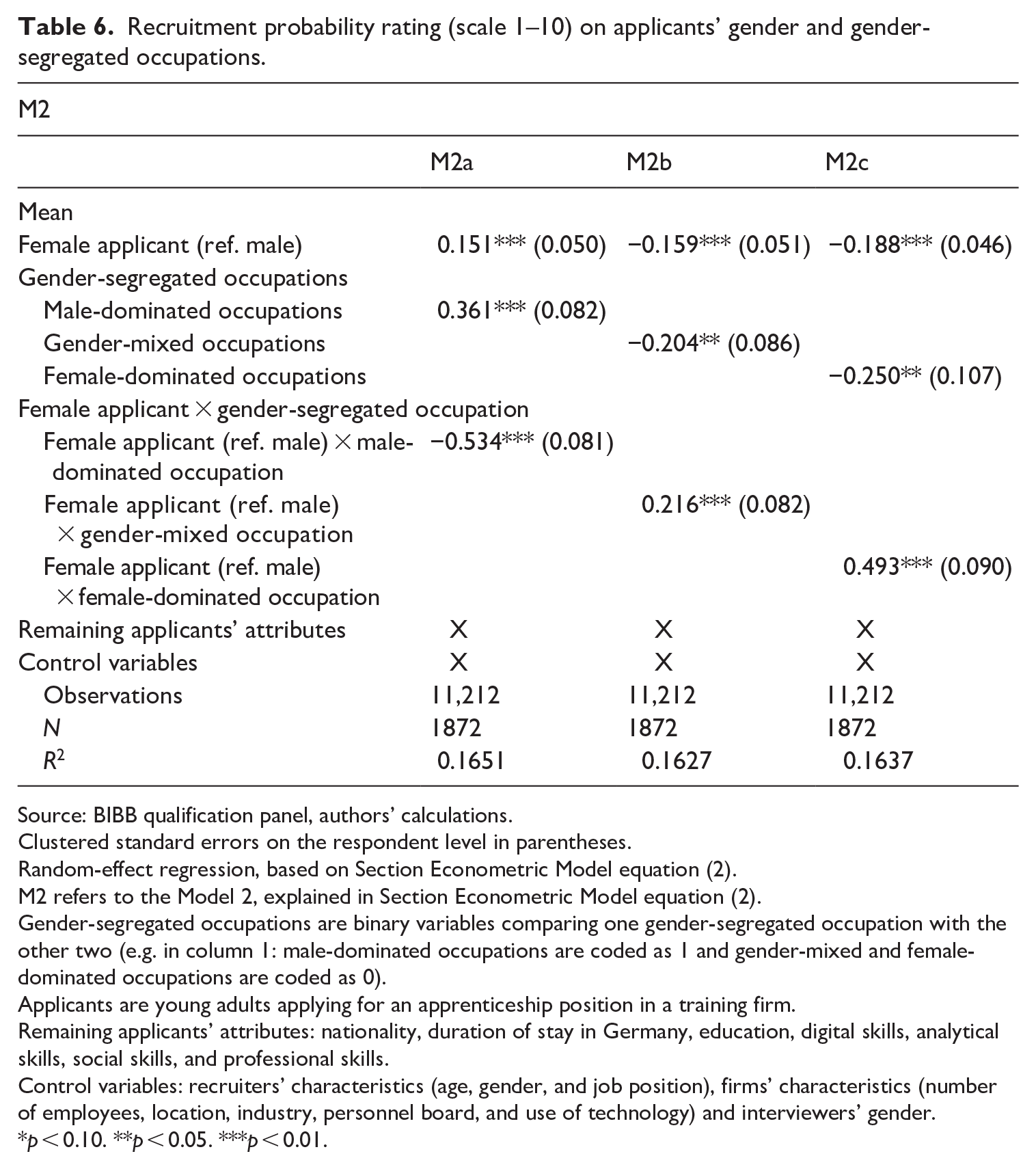
Table 6 shows the coefficients of the interaction effects of apprenticeship applicants’ gender on gender-segregated occupations (Model 2). It shows that recruiters are less likely to recruit a female applicant when recruiting for male-dominated occupations (see column M2a), while they are more likely to recruit a female applicant for gender-mixed (see column M2b) or female-dominated occupations (see column M2c) than a male applicant.
Recruitment probability rating (scale 1–10) on applicants’ gender and gender-segregated occupations.
Source: BIBB qualification panel, authors’ calculations.
Clustered standard errors on the respondent level in parentheses.
Random-effect regression, based on Section Econometric Model equation (2).
M2 refers to the Model 2, explained in Section Econometric Model equation (2).
Gender-segregated occupations are binary variables comparing one gender-segregated occupation with the other two (e.g. in column 1: male-dominated occupations are coded as 1 and gender-mixed and female-dominated occupations are coded as 0).
Applicants are young adults applying for an apprenticeship position in a training firm.
Remaining applicants’ attributes: nationality, duration of stay in Germany, education, digital skills, analytical skills, social skills, and professional skills.
Control variables: recruiters’ characteristics (age, gender, and job position), firms’ characteristics (number of employees, location, industry, personnel board, and use of technology) and interviewers’ gender.
p < 0.10. **p < 0.05. ***p < 0.01.
Figure 3 shows the recruitment probability rating by distinguishing for male-dominated, gender-mixed, and female-dominated occupations. For male-dominated occupations, Figure 3.M2a shows that the recruitment probability rating is 6.75 for female applicants and 7.13 for male applicants. For gender-mixed occupations, it is 6.86 for female applicants and 6.80 for male applicants (see Figure 3.M2b). For female-dominated occupations, it is 7.03 for female applicants and 6.73 for male applicants (see Figure 3.M2c).
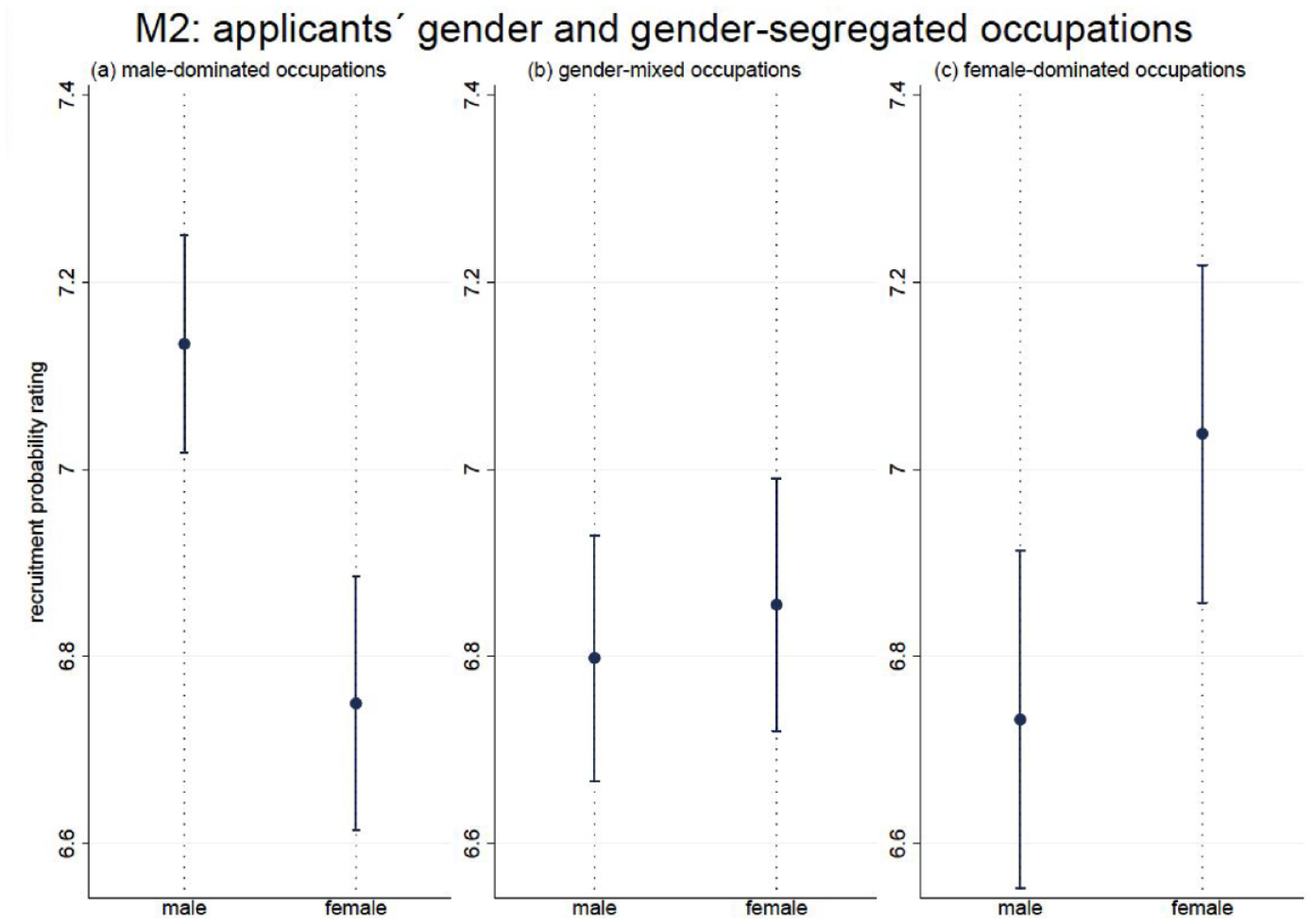
Recruitment probability rating (scale 1–10) on applicants’ gender and gender-segregated occupations.
The role of recruiters’ characteristics on gender choices in the recruitment for gender-segregated occupations
To answer the question to what extent recruiters’ characteristics explain gender choices in the recruitment of apprentices for occupations that are typically dominated by either males or females, three hypotheses are discussed below.
As shown in Table 7, the interaction effects provide strong evidence for Hypothesis 1: Older recruiters are more likely to recruit apprentices conforming to the dominating gender of an occupation in comparison to younger recruiters (see Columns M3a and M3b). They are less likely to recruit female applicants for male-dominated occupations and more likely to recruit female applicants for female-dominated occupations.
Recruitment probability rating (scale 1–10) on applicants’ gender, gender-segregated occupations and recruiters’ age.
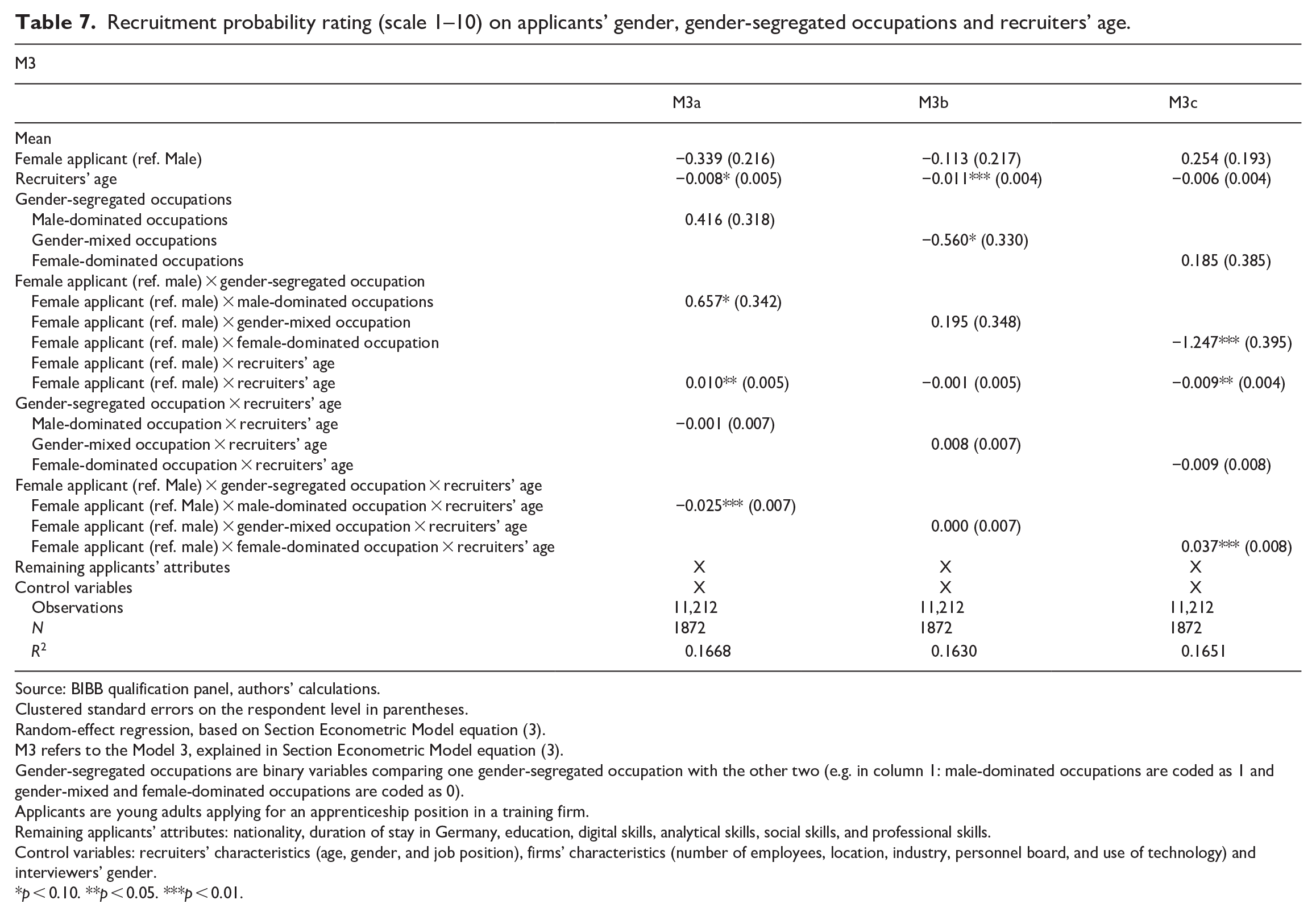
Source: BIBB qualification panel, authors’ calculations.
Clustered standard errors on the respondent level in parentheses.
Random-effect regression, based on Section Econometric Model equation (3).
M3 refers to the Model 3, explained in Section Econometric Model equation (3).
Gender-segregated occupations are binary variables comparing one gender-segregated occupation with the other two (e.g. in column 1: male-dominated occupations are coded as 1 and gender-mixed and female-dominated occupations are coded as 0).
Applicants are young adults applying for an apprenticeship position in a training firm.
Remaining applicants’ attributes: nationality, duration of stay in Germany, education, digital skills, analytical skills, social skills, and professional skills.
Control variables: recruiters’ characteristics (age, gender, and job position), firms’ characteristics (number of employees, location, industry, personnel board, and use of technology) and interviewers’ gender.
p < 0.10. **p < 0.05. ***p < 0.01.
Figure 4 illustrates the recruitment probability rating of this relationship. For male-dominated occupations, Figure 4.M3a shows that the recruitment probability rating of younger recruiters is 7.17 for female applicants and 7.30 for male applicants. The recruitment probability rating of older recruiters is 6.45 for female applicants and 7.01 for male applicants. For female-dominated occupations, Figure 4.M3c shows that the recruitment probability rating of younger recruiters is 6.82 for female applicants and 6.99 for male applicants. The recruitment probability rating of older recruiters is 7.19 for female applicants and 6.55 for male applicants. These results support Hypothesis 1.
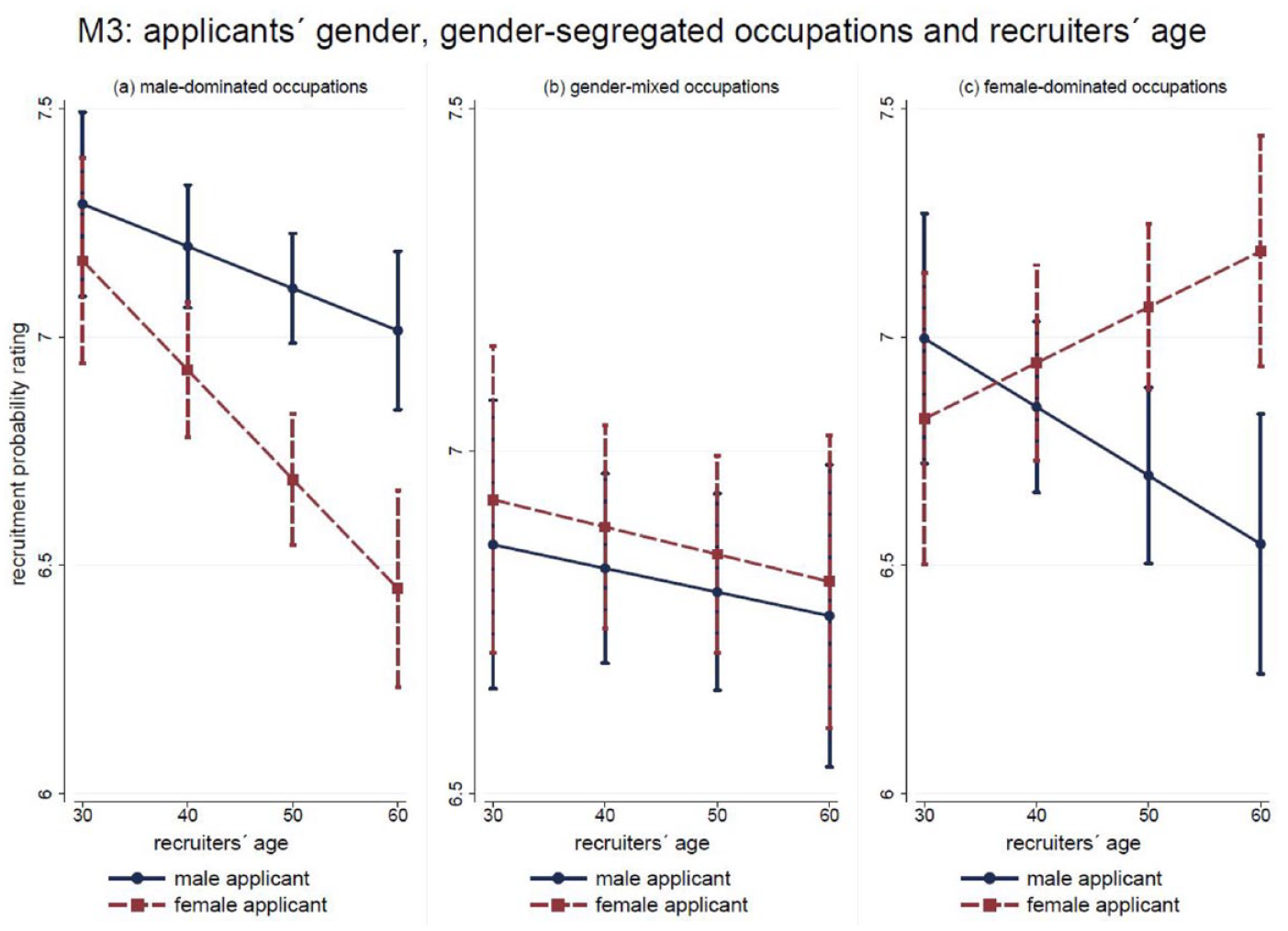
Recruitment probability rating (scale 1–10) on applicants’ gender, gender-segregated occupations and recruiters’ age.
To answer Hypotheses 2a and 2b, this study examines whether male recruiters are more likely to recruit male than female applicants for male-dominated occupations (H2a), while female recruiters are more likely to recruit female than male applicants for female-dominated occupations (H2b). As shown in Table 8, the interaction effects provide no evidence of this theoretical relationship; thus, the results do not support Hypotheses 2a and 2b.
Recruitment probability rating (scale 1–10) on applicants’ gender, gender-segregated occupations and recruiters’ gender.
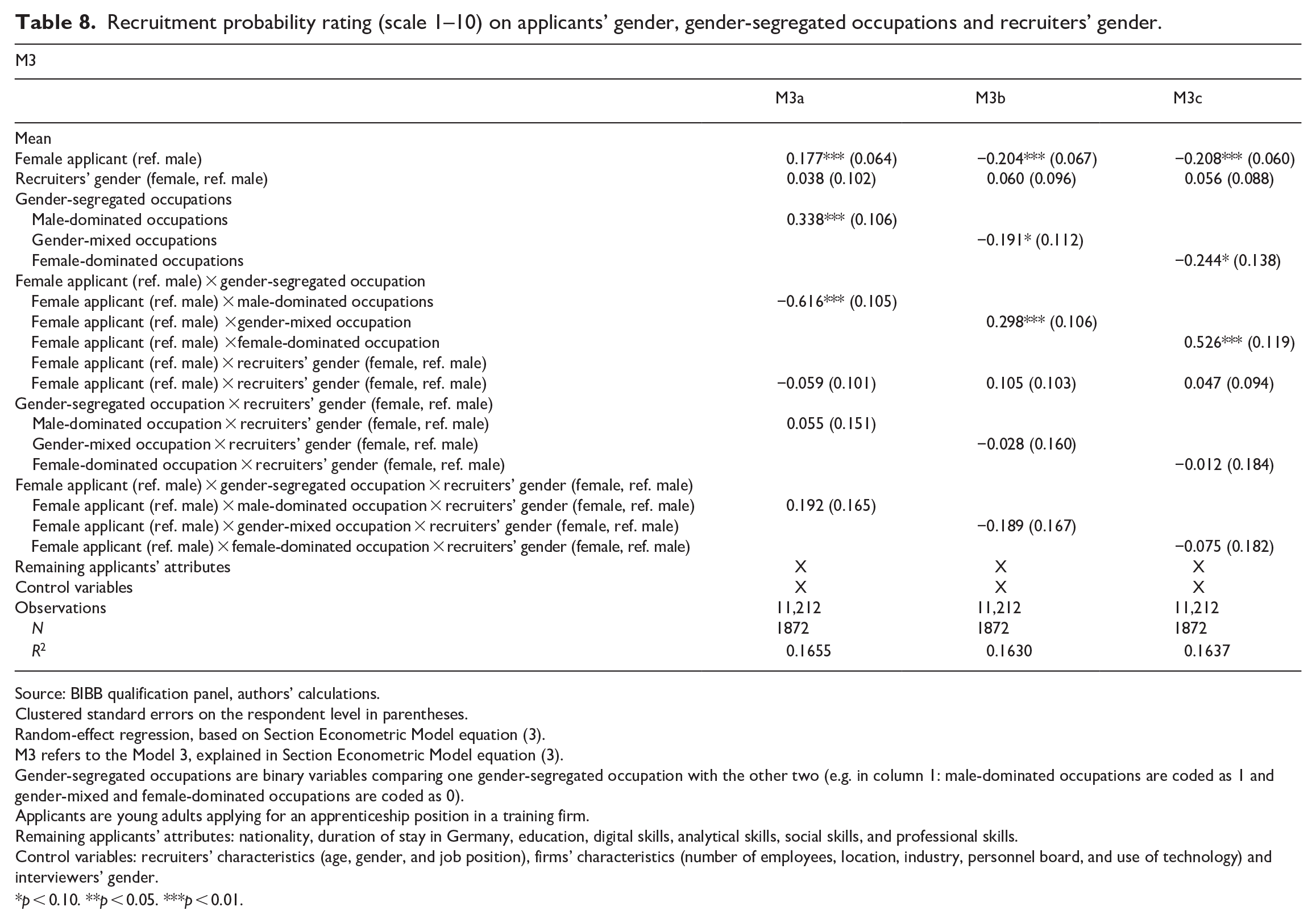
Source: BIBB qualification panel, authors’ calculations.
Clustered standard errors on the respondent level in parentheses.
Random-effect regression, based on Section Econometric Model equation (3).
M3 refers to the Model 3, explained in Section Econometric Model equation (3).
Gender-segregated occupations are binary variables comparing one gender-segregated occupation with the other two (e.g. in column 1: male-dominated occupations are coded as 1 and gender-mixed and female-dominated occupations are coded as 0).
Applicants are young adults applying for an apprenticeship position in a training firm.
Remaining applicants’ attributes: nationality, duration of stay in Germany, education, digital skills, analytical skills, social skills, and professional skills.
Control variables: recruiters’ characteristics (age, gender, and job position), firms’ characteristics (number of employees, location, industry, personnel board, and use of technology) and interviewers’ gender.
p < 0.10. **p < 0.05. ***p < 0.01.
As shown in Table 9, the interaction variables indicate strong evidence for Hypothesis 3a: Recruiters who are firm owners are more likely than non-firm owners to recruit applicants whose gender conforms to the dominant gender of an occupation (see columns M3a and M3b). Compared to non-firm owners, they are less likely to recruit female applicants for male-dominated occupations and more likely to recruit female applicants for female-dominated occupations.
Recruitment probability rating (scale 1–10) on applicants’ gender, gender-segregated occupations and recruiters’ position (firm owner).

Source: BIBB qualification panel, authors’ calculations.
Clustered standard errors on the respondent level in parentheses.
Random-effect regression, based on Section Econometric Model equation (3).
M3 refers to the Model 3, explained in Section Econometric Model equation (3).
Gender-segregated occupations are binary variables comparing one gender-segregated occupation with the other two (e.g. in column 1: male-dominated occupations are coded as 1 and gender-mixed and female-dominated occupations are coded as 0).
Applicants are young adults applying for an apprenticeship position in a training firm.
Remaining applicants’ attributes: nationality, duration of stay in Germany, education, digital skills, analytical skills, social skills, and professional skills.
Control variables: recruiters’ characteristics (age, gender, and job position), firms’ characteristics (number of employees, location, industry, personnel board, and use of technology) and interviewers’ gender.
p < 0.10. **p < 0.05. ***p < 0.01.
Figure 5 shows the recruitment probability rating for the interaction with firm owners. For male-dominated occupations, the recruitment probability rating of firm owners is 6.65 for female applicants, while the rating of non-firm owners is 6.79 for female applicants (see Figure 5.M3a). For female-dominated occupations, the recruitment probability rating of firm owners is 7.42 for female applicants, while the rating of non-firm owners is 6.89 for female applicants (see Figure 5.M3c). Thus, the results support Hypothesis 3a.
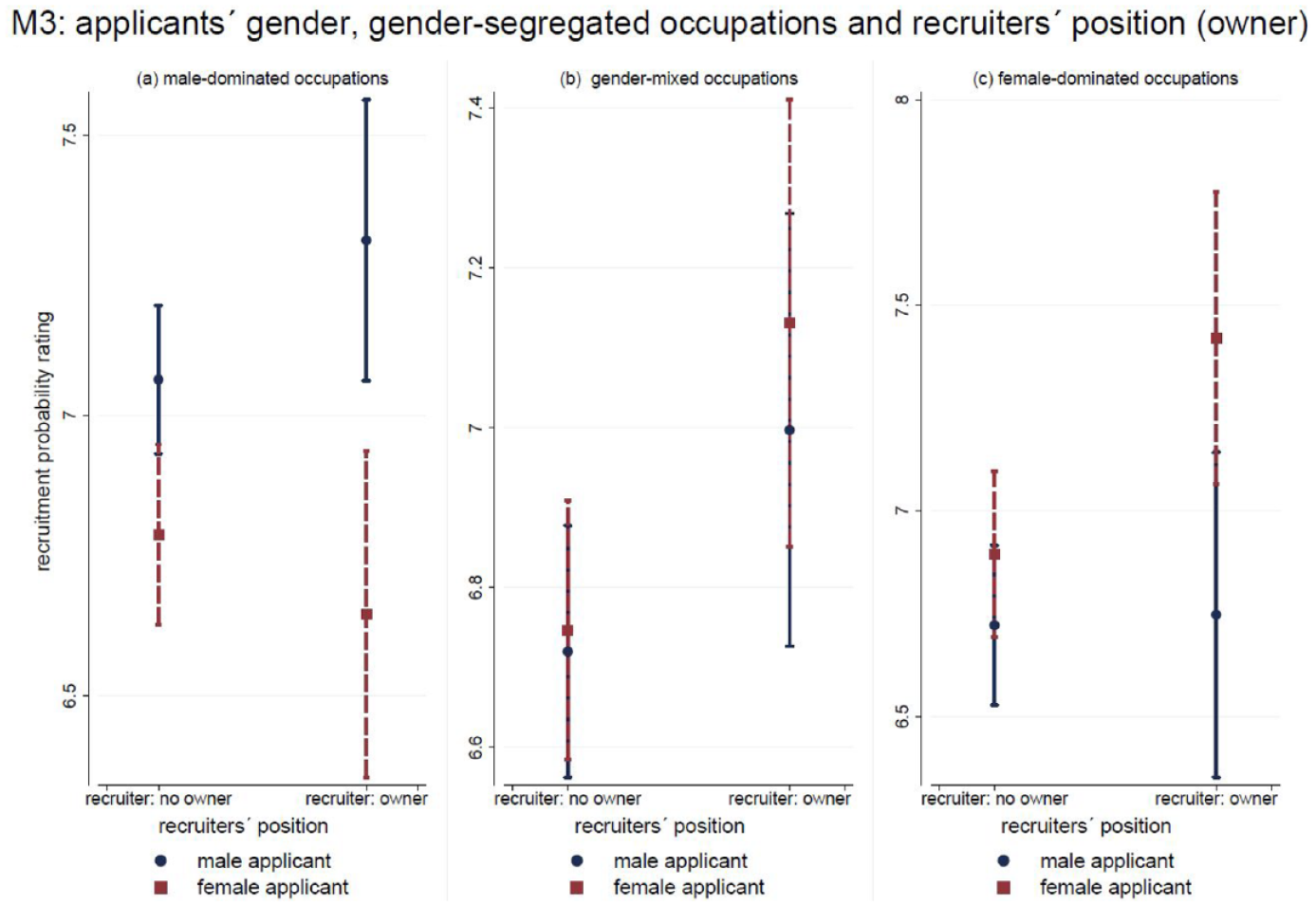
Recruitment probability rating (scale 1–10) on applicants’ gender, gender-segregated occupations and recruiters’ position (firm owner).
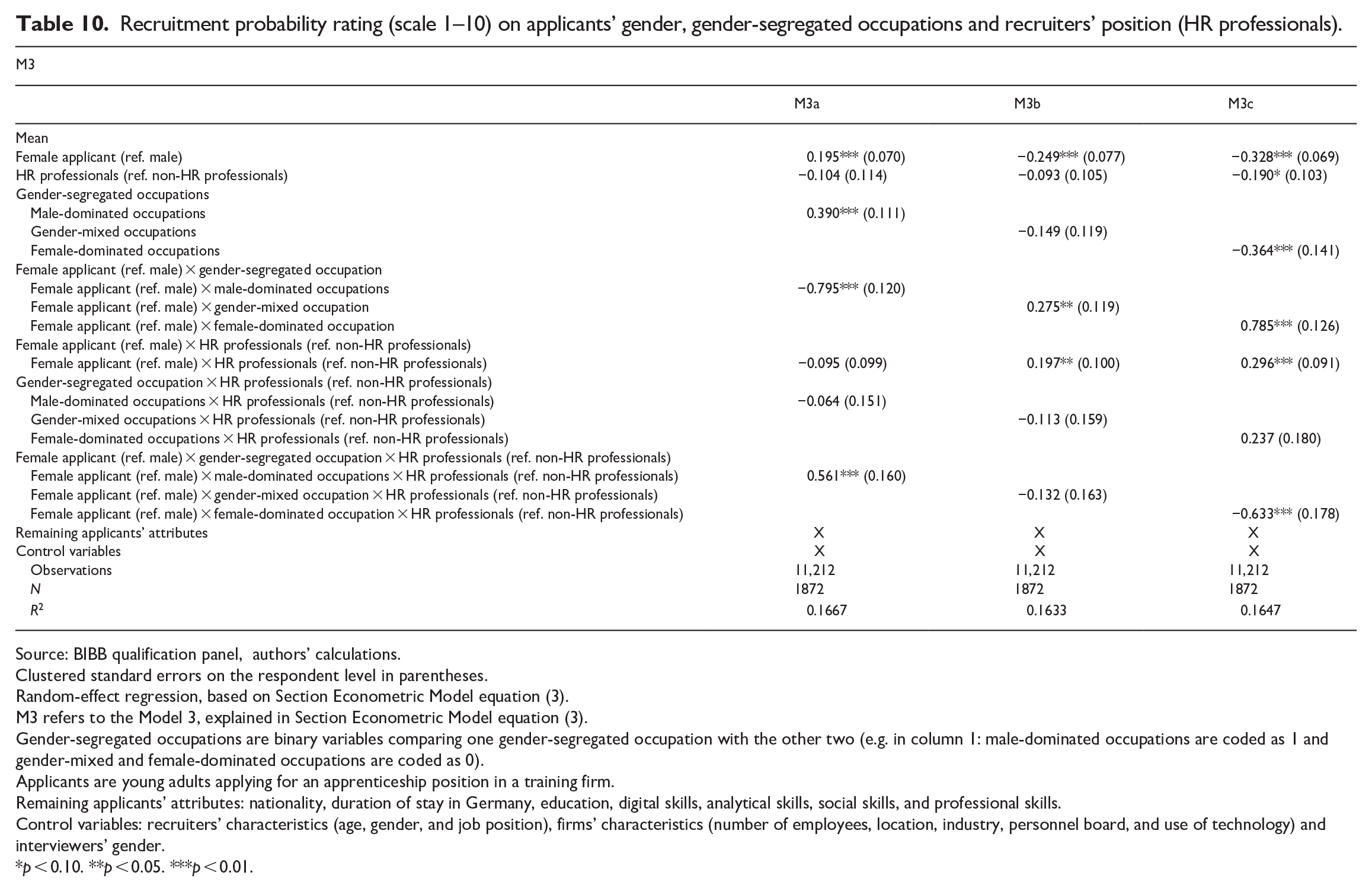
As shown in Table 10, this study provides strong support for Hypothesis 3b: Recruiters who are HR professionals are more likely than non-HR professionals to be gender-neutral to the dominant gender of an occupation. For male-dominated occupations, HR professionals are more likely to recruit female applicants compared to non-HR professionals (see Table 10, column M3a). For female-dominated occupations, HR professionals are less likely to recruit female applicants compared to non-HR professionals (see Table 10, column M3c).
Recruitment probability rating (scale 1–10) on applicants’ gender, gender-segregated occupations and recruiters’ position (HR professionals).
Source: BIBB qualification panel, authors’ calculations.
Clustered standard errors on the respondent level in parentheses.
Random-effect regression, based on Section Econometric Model equation (3).
M3 refers to the Model 3, explained in Section Econometric Model equation (3).
Gender-segregated occupations are binary variables comparing one gender-segregated occupation with the other two (e.g. in column 1: male-dominated occupations are coded as 1 and gender-mixed and female-dominated occupations are coded as 0).
Applicants are young adults applying for an apprenticeship position in a training firm.
Remaining applicants’ attributes: nationality, duration of stay in Germany, education, digital skills, analytical skills, social skills, and professional skills.
Control variables: recruiters’ characteristics (age, gender, and job position), firms’ characteristics (number of employees, location, industry, personnel board, and use of technology) and interviewers’ gender.
p < 0.10. **p < 0.05. ***p < 0.01.
Figure 6 displays the recruitment probability rating for the interaction with recruiters being HR professionals. For male-dominated occupations, the recruitment probability rating of HR professionals is 6.91 for female applicants, while the recruitment probability rating of non-HR professionals is 6.61 for female applicants (see Figure 6.M3a). For female-dominated occupations, the recruitment probability rating of HR professionals is 6.88 for female applicants, while the recruitment probability rating of non-HR professionals is 7.17 for female applicants (see Figure 6.M3c). Thus, the results support Hypothesis 3b.
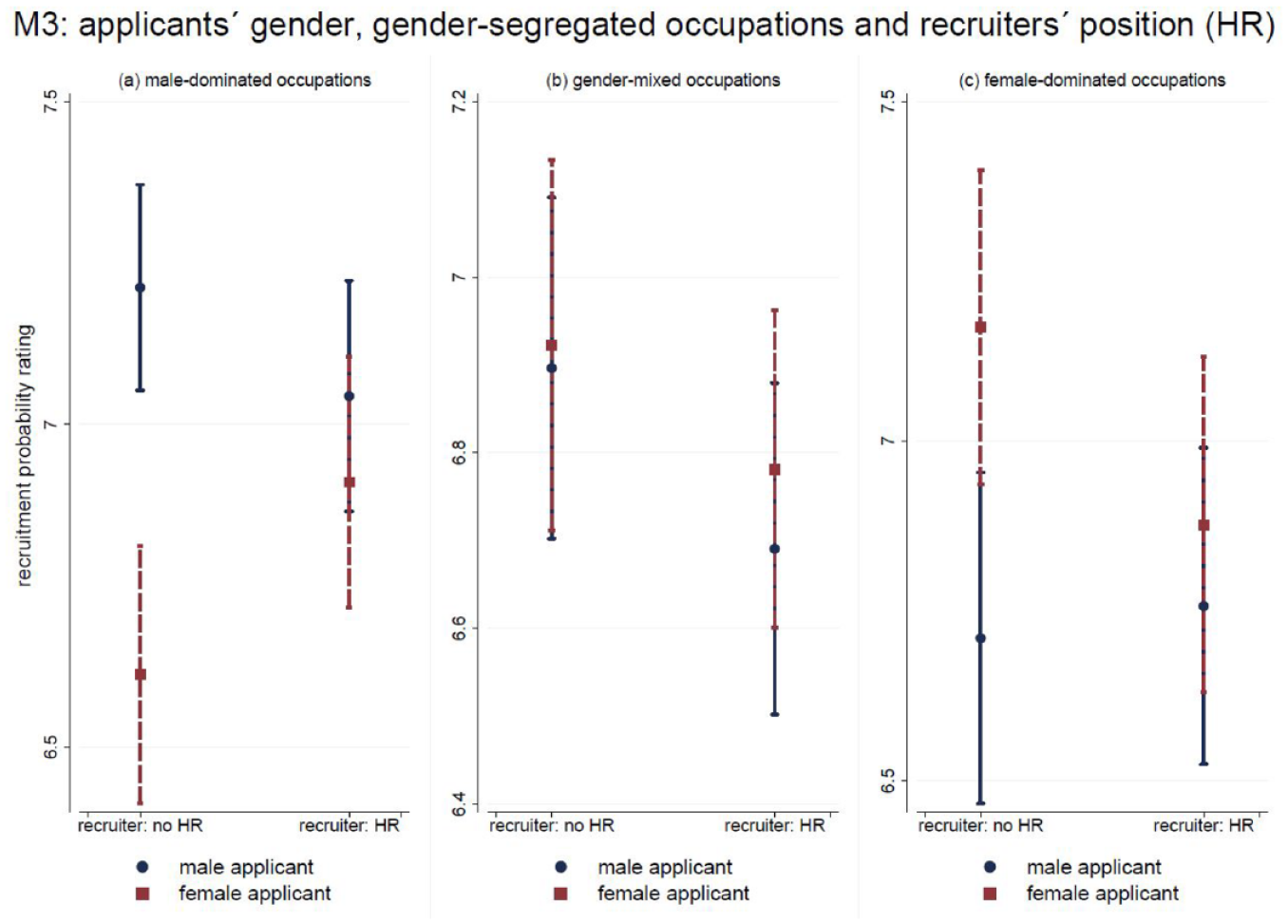
Recruitment probability rating (scale 1–10) on applicants’ gender, gender-segregated occupations and recruiters’ position (HR professionals).
This study finds no evidence related to interaction effects with gender-mixed occupations, which is why it is not discussed further.
Robustness tests
This study was tested for robustness in three ways. First, the results of the RE model were compared with those of an alternative model – the fixed effect model (FE). The results of the FE model were similar to our main results (see Supplemental Material Table S.3). However, an FE model restricts the comparison of different models over groups because it presumes that each recruiter (respondent) has a different level of response, which is fixed in the estimations (Auspurg and Hinz, 2015). Moreover, there is only one true effect size for all recruiters, and possible differences in the observed effects are simply sampling errors (Borenstein et al., 2010). Thus, while the RE model expects a random intercept to ‘represent a random selection from a sample of effects only in RE models’, the FE is rather appropriate for ‘controlling unobserved heterogeneity in time-invariant variables in panel studies’ (Auspurg and Hinz, 2015: 92). The RE model can consistently estimate the impact of the vignette attributes when successfully randomised.
Second, the robustness of the results was tested by adding successively the important control variables listed in Table 1, that is, recruiters’ characteristics (age, gender, and job position), firms’ characteristics (number of employees, location, industry, personnel board, and technology use) and interviewers’ gender. The control variables were added to the regressions M1, M2, and M3 (see Supplemental Material Tables S.4–S.9). The estimation results of these regressions are similar to the main results.
Third, the robustness of the results was tested by including interviewer fixed-effects to control for interviewers’ characteristics. The estimated results of these regression are similar to the main results (see Supplemental Material Tables S.10–S.15).
Discussion
The analyses led to the conclusion that (some) recruiter characteristics explain gender choices in the recruitment of apprentices for gender-segregated occupations.
First, the recruiter’s age is strongly related to gender choice in the recruitment of apprentices for gender-segregated occupations. Older recruiters’ gender choices for apprenticeship applicants were rather traditional (e.g. recruiting apprentices whose gender conformed to an occupation’s dominant gender), whereas younger recruiters’ gender choices were more fluid. This finding is in line with the previous literature on birth cohorts, indicating that the view of work contexts differs depending on shared experiences in the formative years (Appelbaum et al., 2022; Lyon et al., 2017).
Second, recruiters’ gender is not related to gender choices in the recruitment of apprentices for gender-segregated occupations; this may be because recruiters expect no difference in qualifications related to gender (Graves and Powell, 1995). Despite a potential in-group gender bias, recruiters may not have seen demographic similarity effects impacted by the status associated with gender because (young) apprenticeship applicants are at the beginning of their professional career; thus, qualification differences are not as distinct as they are later in professional life.
Third, the recruiters’ job position is related to gender choices in the recruitment of apprentices for gender-segregated occupations. This supports the idea that recruiters’ job position shapes their possible courses of action because recruiters are biased differently depending on their work context (Bjørnshagen, 2022). These results are consistent with those of previous studies. For example, the findings indicate that firm owners are more likely to recruit applicants whose gender conforms to an occupation’s dominant gender. This may have been caused by in-group favouritism (Bjørnshagen, 2022). Moreover, the findings are in line with the related literature, indicating that HR professionals follow a rather formalised recruitment procedure and recruit with fewer personal preferences (Carroll et al., 1999; Stainback et al., 2011), while recruiters who are non-HR professionals are more likely to recruit applicants whose gender conforms to an occupation’s dominant gender.
Conclusion
To conclude, this study found that some recruiters’ characteristics explain the gender choices of apprentices in the recruitment for gender-segregated occupations. These results have implications that should be considered.
First, the factorial survey experiment does not observe actual recruitment decisions but complements findings based on observational and experimental data (Kübler et al., 2018). However, these findings are based on data from a nationally representative survey involving real recruiters, which strengthens the external validity of the study (Hainmueller et al., 2015).
Moreover, this study has practical implications for firms, apprenticeship applicants and policymakers. It shows that apprenticeship applicants of a gender opposed to the dominant gender of an occupation have a disadvantage in the apprenticeship market. Although the recent literature on gender discrimination has found a shift in gender discrimination towards male discrimination in the labour market of OECD countries (Birkelund et al., 2022; Lippens et al., 2023) and no gender discrimination in the Swiss apprenticeship market 8 (Fernandes et al., 2023; Fossati et al., 2020), no evidence for this shift in the German apprenticeship market is available. By contrast, the findings show that applicants with a gender conforming to the that of an occupation are more likely to be recruited, which shows that gender discrimination exists. Moreover, certain recruiters’ characteristics further impact the disadvantage of apprenticeship applicants with a gender opposed to an occupation’s dominant gender. This can potentially lead to a poor matching between workers and firms (Altonji and Blank, 1999; Hsieh et al., 2019), which in turn leads to skill shortages in various industries. In addition, job opportunities for females are affected because female-dominated occupations often have weaker opportunities in terms of pay and career options than male-dominated occupations (Azmat et al., 2006; Bublitz and Regner, 2022; Carlsson and Eriksson, 2019; Leuze and Strauß, 2014; Samek, 2019).
Reasons for the differences in the results are that policies and training aimed at reducing gender discrimination (e.g. diversity training) have an impact. Formally trained recruiters (e.g. HR professionals) recruit more gender-neutrally to the dominant gender of an occupation compared to those who are not formally trained (e.g. non-HR professionals). However, this hypothesis requires further investigation.
Supplemental Material
sj-docx-1-gjh-10.1177_23970022241300060 – Supplemental material for Are recruiters driving gender segregation? Evidence from the German apprenticeship market
Supplemental material, sj-docx-1-gjh-10.1177_23970022241300060 for Are recruiters driving gender segregation? Evidence from the German apprenticeship market by Luisa Minssen, Mark Levels, Harald Pfeifer and Caroline Wehner in German Journal of Human Resource Management
Footnotes

References
Supplementary Material
Please find the following supplemental material available below.
For Open Access articles published under a Creative Commons License, all supplemental material carries the same license as the article it is associated with.
For non-Open Access articles published, all supplemental material carries a non-exclusive license, and permission requests for re-use of supplemental material or any part of supplemental material shall be sent directly to the copyright owner as specified in the copyright notice associated with the article.
