




Abstract
Occupational prestige is an important yet understudied factor in gender labour market inequality. This study examines the relationship between the gender composition of occupations and the prestige of those occupations, and investigates whether men and women differ in their evaluations. A multilevel analysis based on German microdata generated two key findings. First, occupations that are predominantly male or female tend to be rated as more prestigious than mixed-gender occupations when controlling for pay and educational requirements, suggesting a segregation premium in the symbolic valuation of work in Germany. Second, there is no evidence of a gendered in-group bias in Germany; both men and women consider gender-segregated occupations to be more prestigious, with no preference for occupations dominated by their own gender.
Keywords
Introduction
Gender segregation in the labour market contributes to inequality between men and women. Empirical research has repeatedly shown that occupations primarily held by women are lower paid and offer poorer opportunities for advancement, both internationally (Charles and Grusky, 2005; Levanon et al., 2009; Reskin and Bielby, 2005) and in Germany (Bublitz and Regner, 2020; Leuze and Strauß, 2014; Wrohlich, 2017).
Although stratification research has traditionally favoured the study of material inequality, some researchers have emphasised the importance of social prestige in creating and legitimising inequality (Ridgeway, 2014; Zhou, 2005). One mechanism that potentially explains how occupational gender segregation stabilises gender inequality is the devaluation of women’s employment. According to devaluation theory (England, 1992), the lower value placed on women’s work should also translate into lower prestige for female occupations. This assumption is based on the notion that the value of work consists not only of its monetary compensation but also of its social valuation.
The relationship between the gender composition of occupations and their ‘symbolic value’ (Goldthorpe and Hope, 1973; Valentino, 2020), that is, their social prestige, has been examined in various studies; however, the results are far from clear-cut. Some older studies from the US find no relation between the proportion of women in an occupation and the prestige of that occupation (Acker, 1980; England, 1979; Powell and Jacobs, 1984; Treiman and Terrell, 1975), while others observe that occupations primarily held by women are less prestigious (Bose and Rossi, 1983; Touhey, 1974a, 1974b; Xu and Leffler, 1992). In contrast, recent studies from Europe and the US show a nonlinear relation between gender composition and occupational prestige (García-Mainar et al., 2018, for Spain; Magnusson, 2009, for Sweden; Valentino, 2020, for the US). Nevertheless, of these three studies, one finds higher prestige in gender-segregated occupations, whereas the other two find higher prestige in gender-balanced occupations.
No study has yet addressed the relationship between gender composition and occupational prestige in Germany. The present study fills this gap by examining the relation between the share of women in occupations and the prestige assigned to these occupations by using 2017–2018 microdata. It analyses, first, whether a significant relation exists between the share of women in occupations and the prestige valuation of the occupations and, second, whether these evaluations differ between men and women.
This study contributes to the state of the research on gender differences in occupational prestige in several ways. First, Germany represents a previously unexamined case for analysing the relationship between gender composition and prestige. Therefore, this study’s results can further shed light on the impact of national context on individuals’ perceptions of gender inequality.
Second, the data used in this study are representative of the German population and rather novel (2017–2018). Prestige measurements for Germany available up to 2018 were either outdated (i.e. the German Magnitude Prestige Scale (MPS), Wegener, 1984) or not developed specifically for Germany (i.e. the Standard International Occupational Prestige Scale (SIOPS), Ganzeboom and Treiman, 1996; Treiman, 1977). Given that both occupational activities and social norms related to women’s labour market participation have changed greatly since the 1980s (Piasna and Drahokoupil, 2017), using more recent microdata is important for analysing gender differences in occupational prestige.
Third, this study is the first recent study on the gender segregation premium to consider the effect of raters’ subjective perceptions of the pay and educational requirements of occupations in prestige evaluations. This is important, as the actual wages and educational requirements are usually unknown when prestige evaluations are made (see Dräger and Wicht, 2021; Gimpelson and Treisman, 2018). Thus, the inclusion of subjective factors helps account for the social construction of occupational prestige. To validate the findings against previous studies, robustness analyses with actual pay and education are provided.
Fourth, the analysis includes the individual characteristics of the respondents who rated the occupations. Recent research has shown substantial variation in prestige ratings not only across occupations but also across individuals (Lynn and Ellerbach, 2017; Valentino, 2020). Given the likelihood that some raters may be more generous than others in their evaluations, the inclusion of socio-demographic variables at the individual level facilitates controlling for within-person differences in perceptions (Powell and Jacobs, 1984; Valentino, 2020).
Previous literature, theory and hypotheses
Occupational prestige
Broadly speaking, occupational prestige can be described as society’s perception of the desirability of an occupation (Goldthorpe and Hope, 1973). Theoretically, the construct of occupational prestige can be viewed from the perspective of functionalist theory, which describes prestige as an attribute of social positions, on the one hand, and as a characteristic of social aggregates (e.g. Stände) in the tradition of Weber (1978), on the other (for a theoretical discussion, see Wegener, 1992).
Previous research on the factors that determine occupational prestige has shown that they primarily comprise educational requirements, pay and occupations’ moral nature or social utility. Numerous studies have shown that the required education level has the greatest influence on the prestige of occupations (García-Mainar et al., 2018; MacKinnon and Langford, 1994; Powell and Jacobs, 1984; Treiman, 1977; Zhou, 2005). Prestigious occupations are also associated with high wages (Powell and Jacobs, 1984; Treiman, 1977; Zhou, 2005). Most studies have used occupations’ actual mean pay and required education levels as indicators to predict the occupation’s prestige. Occupational prestige comes from subjective evaluation and this approach does not consider that raters rely on their beliefs about pay and education, which usually do not correspond to the actual values in these occupations (Dräger and Wicht, 2021; Gimpelson and Treisman, 2018). Powell and Jacobs (1984) show that individuals’ perceptions of occupations’ income and educational requirements are more strongly correlated with prestige than actual occupational characteristics. Estimations of the moral value or ‘goodness’ of an occupation also play a role in prestige evaluations (MacKinnon and Langford, 1994): people tend to accord higher prestige to occupations that are considered to be highly moral, such as nursing or firefighting (MacKinnon and Langford, 1994).
A key difference between the conceptions of prestige involves whether a disagreement in prestige ratings between individuals or social groups is expected. In the functionalist tradition, the division of labour in modern societies leads to a stable prestige hierarchy (Parsons, 1940). Much of the early work on occupational prestige was influenced by this paradigm of consensus in prestige valuations (Hodge et al., 1964; Kraus et al., 1978; Reiss, 1961; Treiman, 1977). While acknowledging that a shared cultural prestige hierarchy may exist at the aggregate level, several studies have empirically demonstrated that individual prestige ratings are not homogeneous but, rather, are influenced by the social position of the raters (Guppy and Goyder, 1984; Lynn and Ellerbach, 2017; Valentino, 2020; Zhou, 2005): prestige ratings differ according to the gender (Valentino, 2020), education (Guppy and Goyder, 1984; Lynn and Ellerbach, 2017; Zhou, 2005), ethnicity and occupation (Guppy and Goyder, 1984) of the raters.
This previous research on occupational prestige highlights the necessity of accounting for (perceived) pay and educational requirements in predictions of occupational prestige and the importance of considering the differences in prestige evaluations within and between individuals.
Gender composition and occupational prestige
Some literature has focused on the gender composition of occupations as a factor influencing their prestige coming to opposing conclusions. First, several older studies find no relationship between the occupations’ gender composition and their prestige (Acker, 1980; Crino et al., 1983; Glick, 1991; Powell and Jacobs, 1984; Treiman and Terrell, 1975). Some other studies from the same era observe a devaluation in the prestige of occupations when they are predominantly staffed by women or the proportion of women in these occupations increases over time (Beyard-Tyler and Haring, 1984; Bose and Rossi, 1983; Touhey, 1974a, 1974b; Xu and Leffler, 1992). Another group of older studies finds a positive linear relationship between the proportion of women in an occupation and its prestige (Baunach, 2002; Rosenfeld, 1980; Shaffer et al., 1986). All this research was conducted in the US and does not consider possible nonlinearities.
However, three more recent studies from Europe and the US consider nonlinear effects. Magnusson (2009) uses Swedish individual-level data to analyse the relationship between the share of women and SIOPS. To control for nonlinearity, Magnusson specifies the share of women both as a continuous variable and as dummy variables, finding that female-dominated occupations have lower prestige than male-dominated ones, although both have lower prestige than gender-mixed occupations. García-Mainar et al. (2018) use the same method to analyse survey data from Spain and, like Magnusson (2009), find that the occupations with the highest prestige are those with 21–60% women, while those with the lowest prestige are occupations with more than 80% women. These results suggest that the relationship between the share of women and occupational prestige in Sweden and Spain takes the shape of an inverted ‘U’. Valentino (2020) analyses this relationship in the US using a different methodological approach: instead of regressing a single average for each occupation (SIOPS) on the share of women, she uses a prestige module from the General Social Survey containing more recent individual occupational prestige ratings, which allows her to consider differences in prestige ratings between raters. In contrast to Magnusson (2009) and García-Mainar et al. (2018), Valentino’s (2020) results show a U-shaped relationship between the share of women in an occupation and its prestige, indicating higher prestige for gender-segregated occupations relative to gender-integrated occupations.
Given that the empirical evidence presented by previous research is mixed and most studies have been conducted in the US, the present study contributes to the literature by investigating the relationship between gender and occupational prestige in Germany.
Theory and hypotheses
The devaluation hypothesis (England, 1992) is based on the premise that women’s work is valued less in society. The lower status ascribed to women in the labour market manifests itself as lower pay for female-dominated occupations, a reality that also applies to Germany, as several studies have shown (Bublitz and Regner, 2020; Leuze and Strauß, 2014; Wrohlich, 2017). As mentioned above, occupational prestige is another expression of an occupation’s worth to society. Since occupational prestige is partly determined by the material aspects of the occupation, such as pay, it is reasonable to assume that a symbolic devaluation of female-dominated occupations (i.e. a devaluation of prestige) in the population can be revealed statistically. Additionally, devaluation theorists assume that this relationship is causal and persists even when controlling for other occupational characteristics (England, 1992; Kilbourne et al., 1994). Thus, Hypothesis 1a is as follows:
H1a: There is a linear relationship between the gender composition of occupations and their prestige. Occupations comprising a higher proportion of women are rated as less prestigious, even after controlling for pay and educational requirements.
However, the literature on gender stereotypes suggests that other, more specific mechanisms may be at work in the domain of symbolic evaluations. Prestige evaluations are significantly influenced by stereotypes about the typical job incumbent (Glick et al., 1995; Thielbar and Feldman, 1969). In a gender-segregated labour market, such as Germany’s (Busch, 2013), gender is an important characteristic of occupations and stereotypical images about gender-specific skills are prevalent. Requirements and characteristics of occupations that are predominantly performed by one gender are interpreted in a gender-typical way so that congruence between occupational incumbents and requirements is assumed (Cejka and Eagly, 1999). Jacobs and Powell (1985) find that the prestige of an occupation results from the image of the gender-typical incumbent of that occupation.
Research on gender stereotypes shows that women are perceived as ‘nicer’ and more communal but generally less competent, whereas men are perceived as worthier of status and more agentic (Fiske et al., 2002; Ramos et al., 2018). On the one hand, this creates the assumption that occupations primarily associated with men will receive higher prestige than female-dominated or gender-balanced occupations. On the other hand, stereotypical female traits are generally evaluated more positively, which is coined the ‘women-are-wonderful effect’ or benevolent sexism (Eagly and Mladinic, 1994; Glick and Fiske, 2001). Accordingly, it might also be expected that female-dominated occupations would be attributed higher prestige than gender-balanced occupations. Based on the literature on ambivalent gender stereotypes, Hypothesis 1b predicts that:
H1b: There is a nonlinear relationship between the gender composition of occupations and their prestige. Predominantly female and predominantly male occupations are valued as more prestigious than gender-balanced occupations, even when controlling for pay and educational requirements.
As discussed above, prestige estimates also vary according to individual rater characteristics. In terms of gender and prestige, another aspect is whether individual gender has an impact on the prestige ratings of male- and female-dominated occupations. Based on social identity theory (Tajfel and Turner, 1986), we might expect to find considerable variation in the way that men and women apply gender as a criterion in their prestige valuations. Social identity theory suggests that individuals’ self-concept is shaped by their membership in social groups, and evaluations of one’s in-group relative to out-groups are biased by self-esteem-serving comparisons favouring the in-group. An alternative explanation for a possible gender difference in occupational prestige ratings is that women prefer occupations that are deemed beneficial to society because they receive altruistic rewards from the social contribution (Fortin, 2008; Kleinjans et al., 2017; Marini et al., 1996). Because of this, women are more likely to work in fields such as teaching, healthcare and childcare. If the social component of occupations is more important to women, we may expect them to give higher prestige ratings to such occupations. Empirically, Sawiński and Domański (1991) show that women in Poland prefer female-dominated occupations (nursing) to other occupations. Valentino (2020) finds evidence for a gendered in-group bias and demonstrates that women in the US give higher prestige ratings to occupations mostly filled by women, and men give higher ratings to occupations filled by men. Regarding a possible gendered in-group bias, Hypothesis 2 is formulated as follows:
H2: Men assign higher prestige ratings than women to occupations held predominantly by men. Women assign higher prestige ratings than men to occupations held predominantly by women.
Data and methods
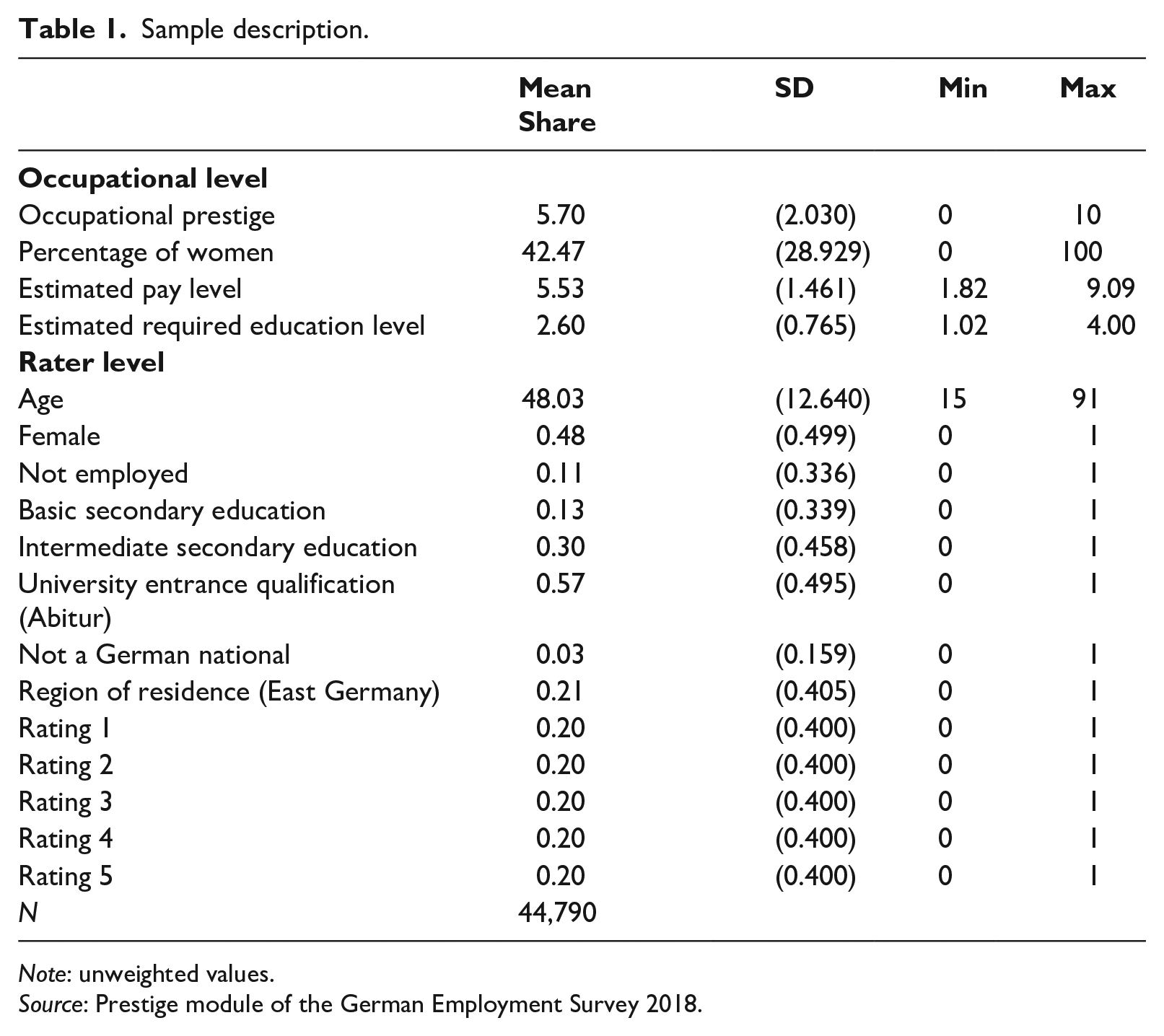
To test the hypotheses, a random sample of the German population collected in 2017/18 as part of the German Employment Survey (Hall et al., 2020) was employed. The dataset contained information on 9011 residents in Germany over the age of 14 (Ebner and Rohrbach-Schmidt, 2021). Detailed descriptive and summary statistics of the data can be found in Table 1 and in the online supplementary appendix.
Sample description.
Note: unweighted values.
Source: Prestige module of the German Employment Survey 2018.
Each respondent rated five occupations that were randomly selected out of a list of 402 occupational titles, resulting in a total of 45,050 ratings. On average, each occupational title was rated more than 100 times. The 402 titles belonged to 380 1 five-digit occupations in the German Classification of Occupations (KldB 2010; Paulus and Matthes, 2013). The 380 occupations represented 87% of all employed persons in Germany (Ebner and Rohrbach-Schmidt, 2021). The prestige judgements of 380 five-digit occupations and 44,790 ratings were examined. The instrument used to measure occupational prestige underwent several pretests, including a qualitative cognitive pretest (Ebner and Rohrbach-Schmidt, 2021). 2
The prestige judgements were collected in the survey via an end-verbalised categorical scale ranging from 0 (= very low prestige) to 10 (= very high prestige). For the 44,790 ratings, the mean prestige was 5.70 and, thus, slightly above the scale mean, with a standard deviation of 2.03 (Table 1). Inspections of the distribution revealed no floor effects and only very small ceiling effects (see Figure A1.1.1 in the online supplementary appendix).
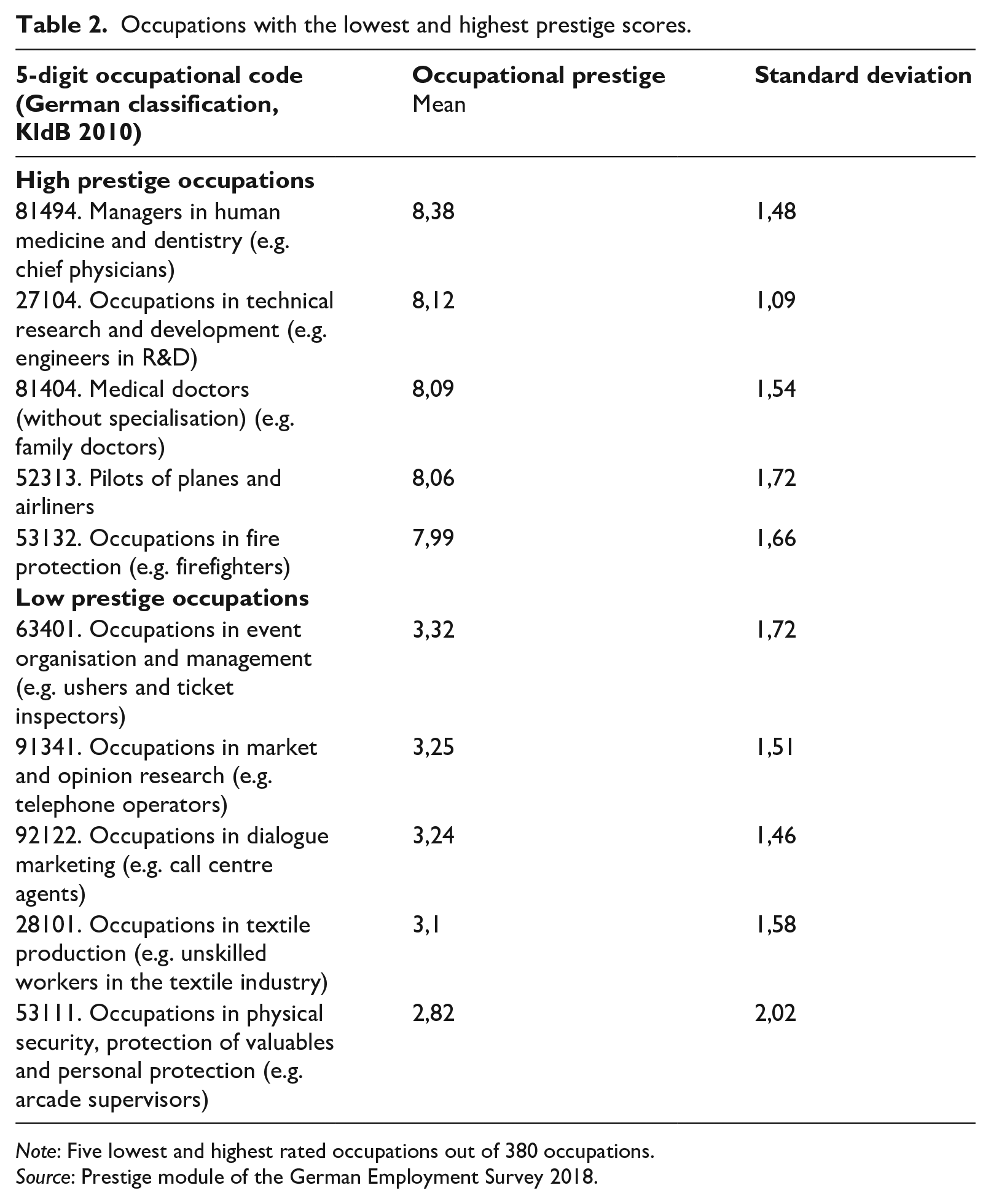
On average, engineers in research and development and chief physicians, for example, had particularly high prestige; in contrast, low prestige was attributed to, for example, security guards and ushers (Table 2). Consistent with previous results from the US (Valentino, 2020), the occupation averages partly masked significant differences in respondents’ judgements of individual occupations, which were apparent in the standard deviations for single occupations (Table 2).
Occupations with the lowest and highest prestige scores.
Note: Five lowest and highest rated occupations out of 380 occupations.
Source: Prestige module of the German Employment Survey 2018.
The key variable for testing the hypotheses was the percentage share of women in an occupation at the five-digit occupational level of the KldB 2010. This share was calculated based on pooled data from the German Microcensus 2016–2018, a large-scale representative household survey, to counter the problem posed by the small size of some occupations. As Table 1 shows, the share of women averaged over each occupation was 42.5%, ranging from 0 (mining shift supervisors, rail transportation technicians and blasting engineers) to 100% (midwives and obstetricians).
The multivariate analyses considered perceptions of the pay and educational requirements of occupations because respondents rely on their subjective assessments of these factors during their prestige evaluations and did not know precise values. These perceptions have usually been unobserved in previous studies, a notable limitation (Valentino, 2020: 51). Perceived occupational pay level was generated as the average of respondents’ answers to the question of how much they estimated the pay of each occupation to be on a scale of 0 (very low) to 10 (very high income) (Table 1). Similarly, the estimated education requirement was calculated as the average of respondents’ assessments of the educational level required for each occupation (1 = no vocational training qualification; 2 = completed vocational training; 3 = further training qualification, e.g. as a master craftsman or technician; 4 = university degree; see Table 1). The analysis also included a robustness check using the actual pay and education requirements of each occupation to facilitate a comparison with previous studies that lacked data on the perceived occupational characteristics (García-Mainar et al., 2018; Magnusson, 2009; Valentino, 2020). Pay was measured using the median income of the five-digit occupations in the 2018 Employment Survey, while education level was based on the requirements of occupations in the KldB 2010, ranging from 1 (no vocational qualification or a regular one-year vocational training course required) to 4 (completed university studies of at least four years required).
As discussed earlier, there may be important differences between raters in their prestige evaluations. Consequently, at the individual level, the multivariate analyses considered the raters’ gender (female = 1, male = 0), age, whether they had German nationality (yes = 0, no = 1), employment status (employed = 0, not employed = 1), region of residence (West Germany = 0, East Germany = 1) and schooling, which was measured in three categories from ‘basic secondary education’ (reference category) to ‘high school diploma/university entrance qualification (Abitur)’ (see Table 1 for the distribution). Additionally, since each respondent rated five occupations, the multivariate models controlled for the order of prestige ratings to account for potential bias due to possible reference behaviours.
To examine the relationship between the share of women in an occupation and its prestige, a multilevel mixed-effects model specification was used (Raudenbush and Bryk, 2002) with individual ratings (N = 44,790) nested in the 380 occupations. The models were estimated using Stata 15 (StataCorp LLC) through the mixed command. The intraclass correlation coefficient (ICC) of the null model indicated that a substantial amount of variance (22.3%) resulted from differences across the occupations and justified the use of a multilevel model rather than a simple regression (Raudenbush and Bryk, 2002). The analyses included an adjustment weight to the 2017 German Microcensus data to obtain representative results for the resident population.
Results
Setting the scene: Correlations between key occupation-level variables
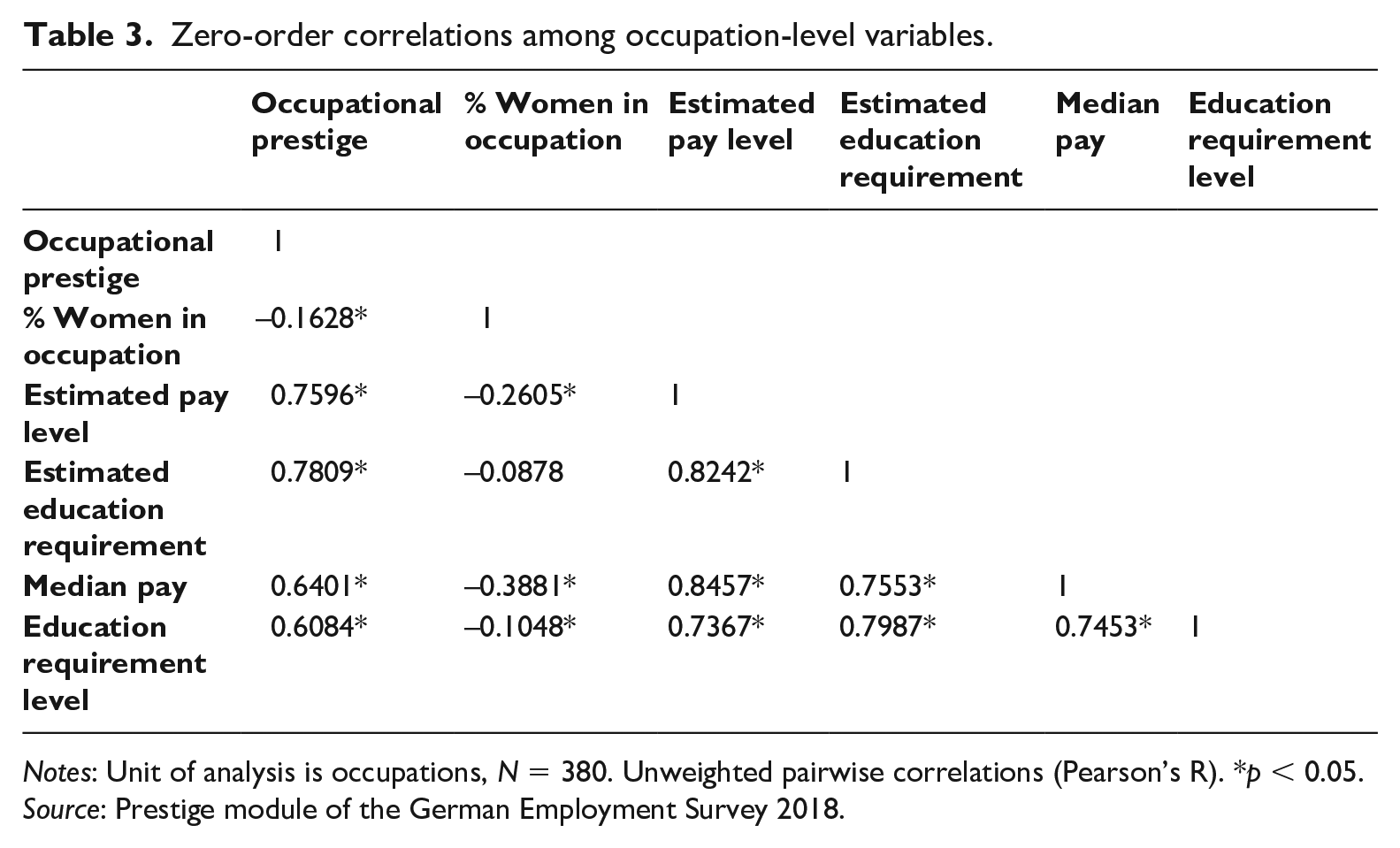
Before presenting and discussing the results of the multilevel models, this subsection describes the bivariate correlations between key variables at the occupation level: occupational prestige, share of women per occupation, perceived pay and perceived required education (Table 3; for correlations between all variables and multicollinearity diagnostics see the online supplementary appendix). The results suggested that perceived education requirements and pay were important factors in respondents’ judgements of occupational prestige and, thus, were compatible with previous studies on the determinants of prestige (cf. Valentino, 2020). Similarly, the results showed that occupations with higher proportions of women were, on average, perceived as lower-paid and requiring less education. These findings also held if actual education requirements and pay were used. On an associational level, the share of women in an occupation was also negatively correlated with its prestige, demonstrating the devaluation of women in the labour market. However, this aggregated view does not show whether the relationship was influenced by rater differences in prestige ratings or how far prestige ratings depended on the gender composition conditional on occupations’ pay and education requirements.
Zero-order correlations among occupation-level variables.
Notes: Unit of analysis is occupations, N = 380. Unweighted pairwise correlations (Pearson’s R). *p < 0.05.
Source: Prestige module of the German Employment Survey 2018.
Results from multilevel models
The study’s main analyses revealed whether the correlation between the share of women in an occupation and its prestige persisted when controlling for relevant factors. In the subsequent tables, the continuous variables are standardised and centred (estimated income, proportion of women and, at the individual level, age) so that all coefficients are comparable to each other and represent the standard deviation units of the prestige scores. This analytical approach was inspired by Valentino (2020).
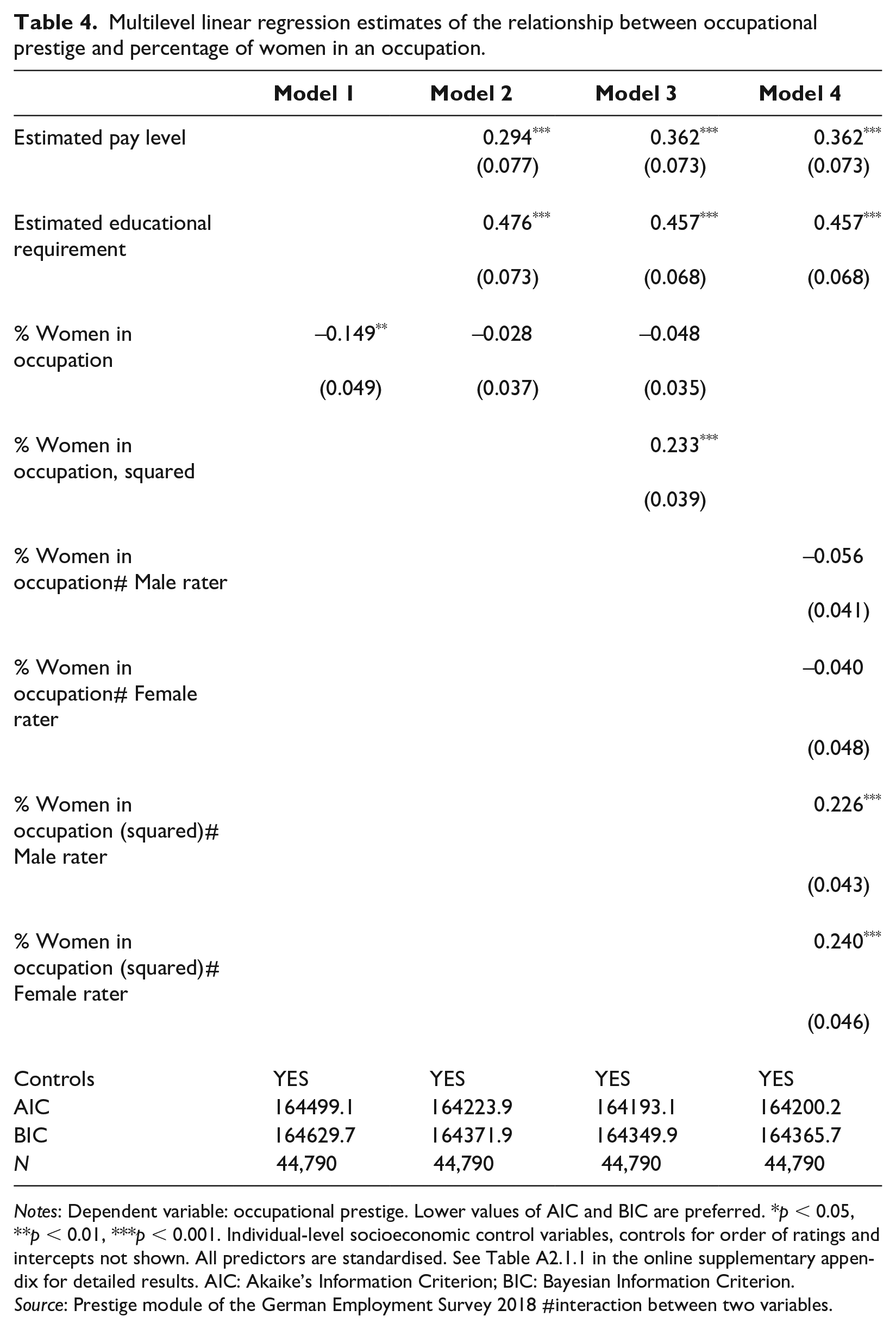
Table 4 shows the results of the multilevel models. The table includes only the key controls; the full results for all specifications can be found in Table A2.1.1 in the online supplementary appendix. Model 1 regressed occupational prestige only on the proportion of women in an occupation. This specification gave preliminary support to the notion of devaluation, indicating a linear negative relationship between the proportion of women in occupations and their prestige. It did not, however, control for relevant occupational-level variables. Model 2 tested Hypothesis 1a, estimating occupational prestige as a linear function of the share of women, controlling for the education requirements and pay of the occupations. Model 3 introduced a squared term of the percentage of women to test Hypothesis 1b regarding a segregation premium. Finally, Model 4 tested Hypothesis 2 regarding the differences between male and female raters in their evaluation of the relationship between the share of women in an occupation and the occupation’s prestige. This was carried out by introducing interaction terms for rater gender and the share of women in an occupation.
Multilevel linear regression estimates of the relationship between occupational prestige and percentage of women in an occupation.
Notes: Dependent variable: occupational prestige. Lower values of AIC and BIC are preferred. *p < 0.05, **p < 0.01, ***p < 0.001. Individual-level socioeconomic control variables, controls for order of ratings and intercepts not shown. All predictors are standardised. See Table A2.1.1 in the online supplementary appendix for detailed results. AIC: Akaike’s Information Criterion; BIC: Bayesian Information Criterion.
Source: Prestige module of the German Employment Survey 2018 #interaction between two variables.
Model 2 showed a small and statistically non-significant effect of the share of women on an occupation’s prestige. Model 3 additionally introduced the percentage of women as a quadratic term. This coefficient was considerably larger than the linear gender composition term and was significant at the 1% level. The results in Models 2 and 3 offer initial support for a segregation premium (i.e. Hypothesis 1b), instead of a symbolic devaluation of women’s work that is independent of key occupational characteristics (i.e. Hypothesis 1a). To understand the shape of the nonlinear estimation, Figure 1 illustrates the predicted values of prestige from Model 3 across the percentage of women in an occupation. The figure shows that the occupations rated with the highest prestige are gender-segregated, confirming Hypothesis 1b. 3 In comparison, gender-mixed occupations were perceived as less prestigious. A calculation of the inflection point showed that below 45%, having more women in an occupation decreases its prestige, while above this point, having more women in an occupation increases its prestige.
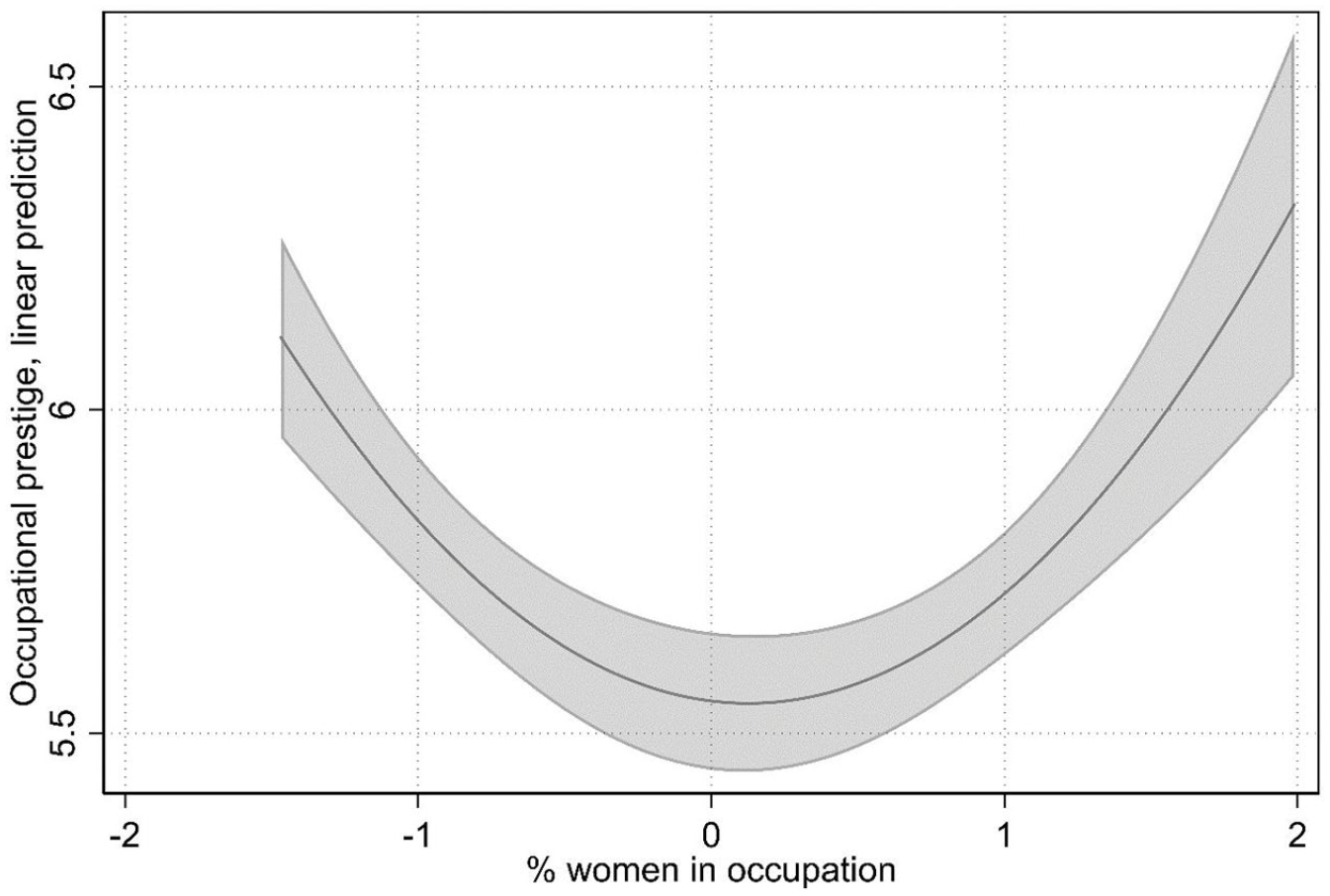
Predicted values of occupational prestige according to percentage of women.
Model 4 included the interaction terms between the raters’ gender and the linear and quadratic percentage of women to test Hypothesis 2. Corresponding to the results of Model 3, only the interaction terms with the quadratic gender composition term were statistically significant. To illustrate how male and female raters applied gender composition as a criterion in prestige valuations, Figure 2 plots the predicted values of Model 4. The figure shows that the curves for male and female raters differed very little. We, thus, failed to reject the null hypothesis. In contrast to previous findings (Valentino, 2020), our results did not indicate a gendered in-group bias in prestige valuations: both men and women in Germany rated occupations as more prestigious if they were predominantly male or predominantly female, rather than gender-mixed. 4
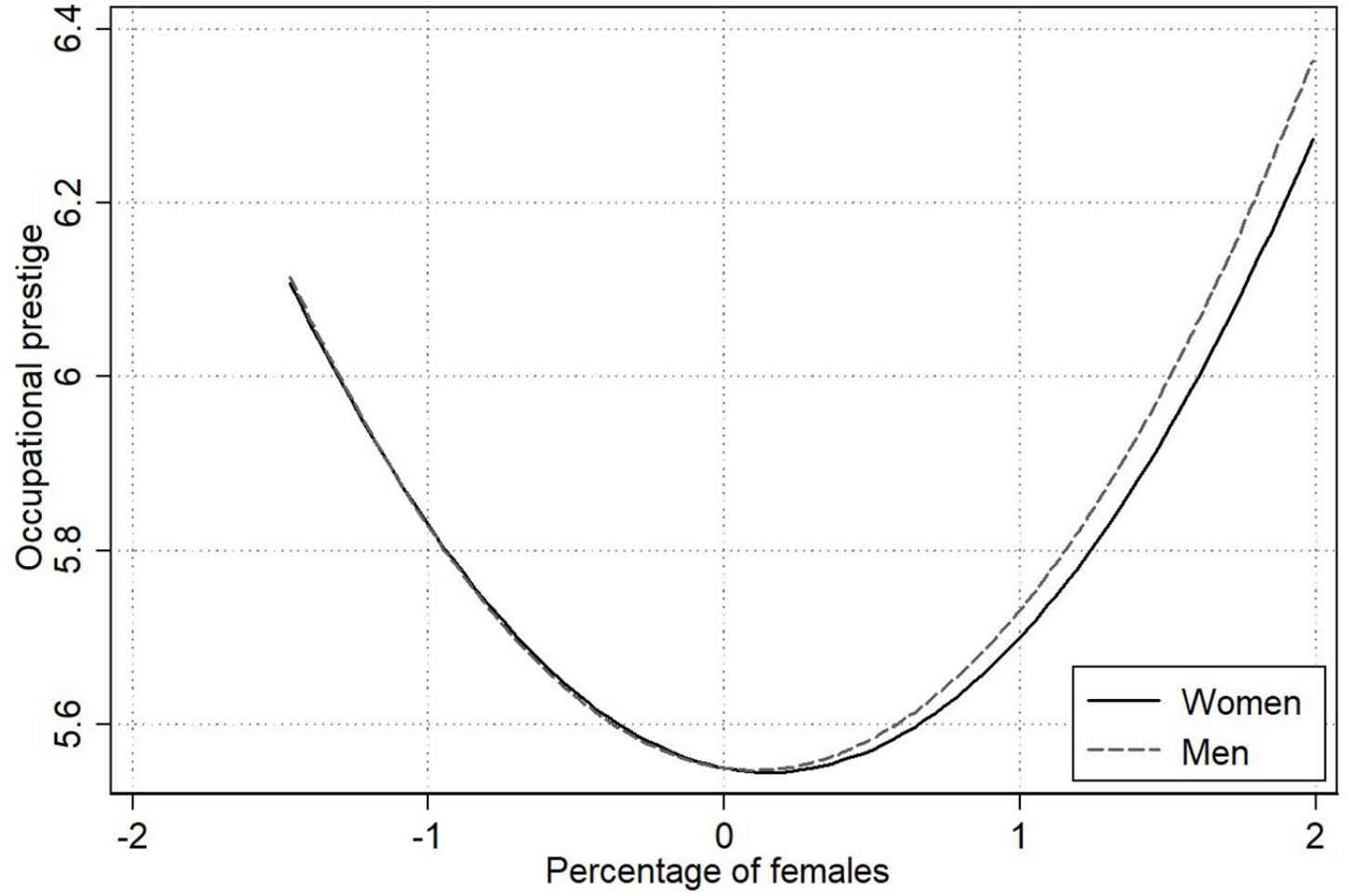
Predicted values of occupational prestige according to percentage of women, by raters’ gender.
Most studies on gender and occupational prestige have focused on occupations’ actual required education levels and pay. To determine if the results of the analysis were affected by the use of the actual pay and education requirements of occupations, rather than respondents’ perceptions of them, a recalculation of Models 2–4 for a reduced sample of the data with complete cases on objective variables was performed (see Table A2.2.1 in the online supplementary appendix for all results). Applying this alternative operationalisation of the occupational variables did not change the central findings of a segregation premium in prestige for occupations held primarily by women or by men, and no evidence for a gendered in-group bias in the prestige ratings was found. An evaluative comparison of the models with perceived and actual pay and education based on the reduced sample size (see Table A2.2.2) using the Bayesian and Akaike’s Information Criterion (BIC, AIC) showed a smaller value for the model using the perceived education requirement/income variables and a higher explained variance (Snijders/Bosker R2) for this model. This finding confirms that income and education are indeed crucial evaluative components of occupational prestige, and adds empirical evidence to Powell and Jacobs’ (1984) finding that perception-based operationalisations of occupational characteristics have greater explanatory power for prestige than actual educational requirements and pay.
Conclusion
Devaluation theory (England, 1992) states that women’s work is less valued than that of men. While many studies have analysed the differences between men’s and women’s work in terms of pay, employment and career opportunities, much less attention has been given to the relationship between the gender composition of occupations and their ‘symbolic value’ (Goldthorpe and Hope, 1973; Valentino, 2020); that is, their social prestige. The present study aimed to determine whether a higher percentage of women in an occupation is related to a lower prestige evaluation of that occupation in the context of Germany’s gender-segregated labour market.
This study is the first to examine the relationship between the share of women in occupations and their prestige in the current German labour market, adding to the existing literature in the field of gender-specific prestige valuations for other countries (García-Mainar et al., 2018; Magnusson, 2009; Valentino, 2020).
An initial descriptive result for Germany is that occupations that are staffed by a higher share of women tend to receive lower prestige ratings on average. However, this symbolic devaluation of women’s occupations is because raters attribute a lower material value (education and, in particular, pay) to women’s occupations. When controlling for both education and pay on the occupational level, multilevel regression models reveal a U-shaped pattern, indicating that higher prestige is given to both female- and male-dominated occupations in comparison with gender-integrated occupations in Germany. This finding diverges from those from Spain (García-Mainar et al., 2018) and Sweden (Magnusson, 2009), where higher prestige is attributed to gender-integrated occupations; however, it is consistent with those of Valentino (2020) from the US. In the German labour market, stereotypical images about gender-specific skills and activities are prevalent. Following ideas of benevolent sexism and ambivalent gender stereotypes, occupations that mainly comprise one gender and are gender-typical in this sense are symbolically rewarded. This indicates that there must be an additional, gender-related evaluative component in prestige judgements. A likely explanation may be the dimension of social utility or ‘goodness’ (MacKinnon and Langford, 1994). Scholars of affect control theory (Freeland and Harnois, 2020; Freeland and Hoey, 2018; MacKinnon and Langford, 1994) call this evaluation and, in studies of the stereotype content model, it is called warmth (Cuddy et al., 2008; Fiske et al., 2002); both models capture very similar content (Rogers et al., 2013).
With regard to devaluation theory, the findings highlight the importance of distinguishing between processes of material and symbolic valuation, which follow different reasonings. The dimension of warmth or goodness could be crucial for explaining the difference in material and symbolic valuation. Freeland and colleagues have shown that it has an effect on deference (Freeland and Hoey, 2018), but not on wages (Freeland and Harnois, 2020). Future work is needed on the evaluative dimensions that influence occupational prestige, especially with regard to the gendered nature of occupations.
Another important result of the present study is that men and women in Germany differ little in their evaluation processes, assigning higher prestige values to gender-segregated occupations in an almost identical manner. To some extent, this is contrary to the situation in the US, where there is some evidence of an in-group bias (Valentino, 2020). The German finding demonstrates a culturally shared consensus, which might have roots in the greater role of occupational profiles in the German labour market. In contrast to the US, the German labour market exhibits a strong credentialism and a formalised vocational education system (Shavit and Müller, 1998). Having the appropriate qualifications is an obligatory prerequisite for recruitment to most occupations in Germany, and the necessary vocational education is regulated by law. Since the tasks of each occupation are so clearly defined, there may be less room for disagreement between women and men in Germany society about their prestige.
Overall, the results indicate that the mechanisms underlying the symbolic valuation of occupations can be highly country-specific. This becomes evident when comparing the results with those from Spain (García-Mainar et al., 2018) and Sweden (Magnusson, 2009), where no segregation premium was found. These diverging patterns may be related to differences in the gender culture (Pfau-Effinger, 1998) and the labour market structure between these countries. Indeed, comparative research on cross-national variation in gender segregation and occupational prestige is needed to give us a better understanding of how these factors contribute to national differences in occupational prestige evaluations.
The absence of a symbolic devaluation in a gender-segregated labour market with one of the highest gender wage gaps in the EU lends support to the argument made by England (1979) and Magnusson (2010) that women receive lower wage returns than men from their occupational prestige. England (1979) argued that occupational prestige is a ‘vacuous’ reward dimension that is unrelated to any meaningful social or economic power for women. Some scholars have, therefore, criticised the use of occupational prestige as an indicator of gender inequality (England, 1979; Fox and Suschnigg, 1989). However, it could be a promising direction for future research to improve our understanding of the role of prestige in legitimising the existing social order. Research on benevolent sexism has shown how such beliefs contribute to the stabilisation of gender inequality by praising women for their ‘feminine’ abilities while assigning greater power and material rewards to ‘male’ jobs (Jackman, 1994; Ridgeway, 2011).
Another question that arises from the present study’s results is whether occupational prestige influences individuals’ occupational choices as it constitutes a non-monetary reward for women in the labour market, as has been argued by Kleinjans et al. (2017). Previous research shows that individuals with higher occupational prestige report more positive social interactions (Matthews et al., 2000) and higher job satisfaction (Weaver, 1977). Thus, rather than being ‘vacuous’, occupational prestige may be a significant dimension that could help us understand the persistence of gender segregation in the labour market.
A further point of discussion relates to the determinants of occupational prestige. While most studies have used objective criteria to determine occupational prestige, this study used subjective perceptions of occupational education and income, as well as objective measures of them. It becomes evident that subjective criteria do a better job, as was also stressed earlier by Powell and Jacobs (1984). Occupational prestige comes from subjective evaluation, and thus, researchers should include subjective measures in their models whenever possible.
One important limitation of the present study is that it does not include the perceived gender composition of occupations (cf. Valentino, 2020: 51). However, Cejka and Eagly (1999: 418) found a very high correlation between the estimated and actual percentage of women in a job. Likewise, Garnham et al. (2015: 5) found that ‘people are generally able to provide an accurate estimate of the true gender ratio’ and there is no obvious reason that this should be different for the German population.
Another limitation of the present study is that it uses cross-sectional data. Other factors may affect both occupational prestige and the proportion of women in an occupation, which cannot be captured in the cross-section. More longitudinal studies are needed to further identify and understand the causal mechanisms. Another issue that could be usefully explored in further research is the impact of job incumbents’ gender on their occupations’ prestige. Naming female and male occupational titles in future surveys (e.g. waiter versus waitress) could add to our understanding of gender biases in prestige evaluations.
Supplemental Material
sj-docx-1-wes-10.1177_09500170221117415 – Supplemental material for Gender Composition and the Symbolic Value of Occupations: New Evidence of a U-shaped Relationship between Gender and Occupational Prestige Based on German Microdata
Supplemental material, sj-docx-1-wes-10.1177_09500170221117415 for Gender Composition and the Symbolic Value of Occupations: New Evidence of a U-shaped Relationship between Gender and Occupational Prestige Based on German Microdata by Sabine Krueger, Christian Ebner and Daniela Rohrbach-Schmidt in Work, Employment and Society
Footnotes
Acknowledgements
Many thanks to Kathrin Leuze for thoughtful comments on an earlier version of this article. Additionally, the authors are grateful for the constructive feedback of the three anonymous reviewers and the editor, which significantly contributed to the improvement of the article.
Funding
The authors received no financial support for the research, authorship, and/or publication of this article.

Supplementary material
The supplementary material is available online with the article.
Notes
References
Supplementary Material
Please find the following supplemental material available below.
For Open Access articles published under a Creative Commons License, all supplemental material carries the same license as the article it is associated with.
For non-Open Access articles published, all supplemental material carries a non-exclusive license, and permission requests for re-use of supplemental material or any part of supplemental material shall be sent directly to the copyright owner as specified in the copyright notice associated with the article.
