




Abstract
Background and aims
The links between gestures and various attentional processes in adolescents with autism spectrum disorder have not been studied sufficiently. Previous studies have highlighted the impact of orienting attention on the efficacy of gestures without exploring the influence of alerting and top–down attentional processes. The aim of the present study was to explore the links between attentional processes and indicators of descriptive, conventional and emotional gestures as well as other aspects of nonverbal communication in adolescents with autism spectrum disorder (N = 46).
Methods
The attention network test and colour trails test were used to measure attentional processes, whereas descriptive, conventional and emotional gestures were assessed using the Autism Diagnostic Observation Schedule and the autism diagnostic interview. Analysis showed a significant correlation between gestures with alerting, orienting and executive attention.
Conclusions
The relevant structural equation model revealed that attentional processes have an impact on gestures, but gestures do not have an impact on attentional processes. Emotional gestures are linked to alerting. Spatial-visual search was related to facial expression and the integration of nonverbal communication with behaviour. There was no significant interaction between executive attention and gestures.
Implications
The obtained results are discussed with reference both to gesture development and studies on attention in adolescents with autism spectrum disorder.
Introduction
According to the diagnostic criteria of Diagnostic and statistical mannual of mental disorders (DSM-5) (American Psychiatric Association, 2013) and International Classification of Diseases (ICD)-10 (World Health Organization, 1992), impairment of both gesture use and recognition of others’ gestures is one of the most significant symptoms of autism spectrum disorder (ASD). These symptoms manifest themselves from infancy in difficulties with reciprocity in non-verbal communication, such as responding to a smile with a smile and pointing one's finger in response to stimuli (Dawson, Hill, Spencer, Galpert & Watson, 2004; Vernetti et al., 2017). Difficulties in non-verbal communication are predictors of delayed verbal communication development in infants diagnosed with ASD (Smith, Mirenda, & Zaidman-Zait, 2007). The broad term non-verbal communication refers to gestures and hand movements, facial expressions, eye contact and body movements (Goldin-Meadow, 2000). Gestures, as opposed to facial expressions, convey both the feelings and thoughts of the speaker (Goldin-Meadow, McNeil, & Singleton, 1996). For this reason, the major focus of the present study is the use of gestures by adolescents with ASD.
Impairment of gestures use entails consequences for a child’s development, as non-verbal communication based on hand gestures supports verbal communication and cognitive skills, such as solving mathematical problems (Goldin-Meadow, 2015). Because of its benefits for verbal communication, social and cognitive development, one of the goals of intervention for children with ASD may be teaching gesture imitation (Ingersoll, Lewis, & Kroman, 2007). However, verbal school-aged children and adolescents with ASD exhibit difficulties with spontaneous coordination between speech and gestures (Salowitz et al., 2013; Silverman, Bennetto, Campana, & Tanenhaus, 2010). Their facial expressions are often inappropriate for the social context (Loveland et al., 1994). Furthermore, receptive processing of non-verbal communication, such as recognition of other people’s facial expressions, is also impaired in persons with ASD (Humphreys, Minshew, Leonard, & Behrmann, 2007; Wallace, Coleman, & Bailey, 2008).
Impairment of non-verbal communication in individuals with ASD was first reported in clinical studies by Asperger (1944) and Kanner (1943). These studies revealed that non-verbal communication is impaired regardless of whether verbal communication is present or not (Tantam, Holmes, & Cordess, 1993). Considering the impairment in social development among this clinical group, it seemed obvious that individuals with ASD would exhibit restricted use of non-verbal communication, especially of gestures. However, while individuals with autism with intelligence that falls within age expectations can use gestures in appropriate situations, frequency and integration with speech are disturbed (de Marchena & Eigsti, 2010).
Comprehensive and appropriate use of language, including the use of gestures and non-verbal communication, requires efficient attentional processes (Lezak, Howieson, & Loring, 2004). In this article, we attempt to answer the question: what is the relationship between gestures and non-verbal communication and alerting, orienting and executive attention processes?
According to the theory developed by Posner and Petersen (1990), attention can be divided into three domains, each mediated by a specific neural network. Alerting is responsible for maintaining an optimal state of sensitivity to incoming stimuli. Orienting attention is involved in selecting and redirecting attention to inputs in visual space (Petersen & Posner, 2012; Posner & Petersen, 1990). Executive attention is the central, unitary theoretical construct on which executive function processes are dependent (Fernandez-Duque, Baird, & Posner, 2000; Miyake et al., 2000). According to Attention Network Theory, executive attention is responsible for monitoring behaviour and cognitive processes, as well as solving processing conflicts and moderating the activity of sensory, cognitive and emotional systems (Posner & Rothbart, 2007). The relationships between gestures and the three attentional domains in adolescents with ASD are explored in the present study.
Researchers have investigated the role of particular attentional processes in the use of gestures and non-verbal communication in individuals with typical development, as well in individuals with ASD.
Alerting is involved in processing and reacting to emotional stimuli (Pessoa & Adolphs, 2010; Posner & Rothbart, 2007). Hence, any disturbances in the regulation of alertness can cause difficulties in the coordination of language with emotional and emphatic gestures and processing emotional stimuli (Corden, Chilvers, & Skuse, 2008). When looking at emotional stimuli, such as the face of a conversation partner, individuals with autism experience an increase in arousal. In consequence, they avoid eye contact and do not direct gestures to their conversation partner or their facial expression to others in order to sustain the optimal level of arousal (Kaartinen et al., 2012). The regulation of alerting is one of the most frequently reported attentional problems in individuals with ASD (Hirstein, Iversen, & Ramachadran, 2001; Orekhova & Stroganova, 2014).
Orienting attention plays a crucial role in gesture development. Visual attention cues, like the hands of the communication partner, guide the observer to a target in space (Salowitz et al., 2013). Orienting attention is also important in imitating descriptive gestures as it constitutes a part of the responsive joint attention process necessary to acquire the skill of using gestures (Ingersoll et al., 2007).
Impairment of the ability to modulate the orientation of attention has been observed in people with autism (Elsabbagh et al., 2009). Deficits in orientation of attention manifest themselves particularly through social stimuli (Chawarska, Macari, & Schic, 2013). Slow shifting of attention interferes with the rapid flow of social interaction that requires spontaneous modulation of attentional resources. Tardif, Lainé, Rodriguez, and Gepner (2007) found that among children with ASD exhibiting slower presentation of facial expressions and other non-verbal communication, the efficacy of gesture recognition and facial expressions in others is comparable to their counterparts. However, people with ASD do not respond quickly and orientation of attention is slow.
The links between executive attention and gesture acquisition have not been the subject of extensive study. Kuhn, Willoughby, Wilbourn, Vernon-Feagans, and Blair (2014) argued that the use of communicative gestures by infants at 15 months is a precursor of later executive function development. Based on neurophysiological changes in brain connectivity in adolescence, Casey and Riddle (2012) reported the opposite relationship – executive functions can compensate for a range of cognitive processes, including communicative skills such as gestures and mimicry. By improving the ability to memorise a context and associate it with certain behaviours in the working memory, executive functions help to predict appropriate reactions. As a result, executive functions can compensate for impairment in the spontaneous use and processing of gestures. Based on these findings, we should consider the existence of a direct relationship between executive attention and gesture ability.
Studies on the links between attention and gestures focus on orientation of attention, including spatial-visual search. Despite the fact that orienting attention plays an important role in developing joint attention (Mundy & Burnette, 2005), other attention processes are important in the spontaneous and appropriate use of gestures, their integration with speech and appropriate facial expression. Executive attention is responsible for adjusting behaviour to the social context (Jurado & Roselli, 2007). Executive attention, supported by nonverbal working memory, coordinates switches from the speech of a conversation partner to one's own and adjusts facial expression to the situation and social context (Barkley, 2001; Kraut & Johnston, 1979). Body movements, such as gestures, can evoke thoughts and ideas (Seitz, 2000). These cognitive processes involve executive attention.
In this paper, we focus on particular gesture types, elements of non-verbal communication and the links between them and attentional processes. The present study explores the efficacy of two categories of gestures in adolescents with ASD: descriptive/conventional gestures and emotional/emphatic gestures. Both forms are treated globally in the Autism Diagnostic Interview-Revised (ADI-R) and the Autism Diagnostic Observation Schedule (ADOS) (Gotham, Risi, Pickles, & Lord, 2007; Rutter, Le Couteur, & Lord, 2003). Descriptive gestures are used to convey a message, for example, what something looks like or how somebody behaves (e.g. by the use of the hands to show size) and they are integrated with speech (Gotham, Risi, Pickles, & Lord, 2007; Rutter, Le Couteur, & Lord, 2003). Additionally, descriptive gestures involve creativity, because our mind does not continually retain a representation of the use of gestures to describe something (Poggi, 2002). This means that both imagination and motor movement are involved in producing descriptive gestures. Executive attention processes, such as updating and inhibition, coordinate these processes (Benedek, Jauk, Sommer, Arendasy, & Neubauer, 2014).
According to the typology of gestures developed by Poggi (2002), descriptive gestures belong to the creative gestures group. This means that the production of descriptive gestures demands a plan and creativity to convey relevant and comprehensive content. Therefore, executive attention is involved in the production of descriptive gestures.
Conventional gestures have an established meaning within a given culture, for example, the ‘bye-bye’ or ‘thumbs-up’ gestures (Krauss, Chen, and Chawla, 1996). The second type of gestures examined in the present study are emotional/emphatic gestures, which include hand movements to show emotional states and feelings (Merola, 2007). Emphatic gestures generally accompany speech to emphasise an emotional state, such as a speaker placing a hand on their chest while saying ‘I'm sorry’ (Poggi, 2001). Facial expression was included in the analysis because it comprises a crucial part of non-verbal communication, and it is natural for individuals with typical development (Ekman, Rolls, Perrett, & Ellis, 1992) as opposed to individuals with ASD with impaired spontaneous mimicking (McIntosh, Reichmann-Decker, Winkielman, & Wilbarger, 2006).
An important aspect which could be impaired in individuals with ASD is the integration of verbal communication with gestures and facial expressions (Tantam et al., 1993). For this reason, our analysis includes the integration of non-verbal communication. The aim of the present study was to investigate the links between the level of descriptive/conventional, emotional/emphatic gestures and the three attentional domains according to Attentional Network Theory in adolescents with ASD (Petersen & Posner, 2012). The main research questions were:
Is there a significant interaction between particular attentional processes with gesture use and non-verbal communication in adolescents with ASD? What is the relationship of attentional processes to specific kinds of gestures and non-verbal communication?
The following hypotheses were formulated:
Orienting attention processes are related to the efficacy of use of all kinds of gestures and facial expressions (Ingersoll et al., 2007; Mundy& Burnette, 2005; Salowitz et al., 2013). Executive attention is a predictor of the performance of descriptive and conventional gesture production (Goldin-Meadow, 2000; Jurado & Roselli, 2007). Alerting is related to spontaneous use of emotional gestures (Kaartinen et al., 2012). Executive attention supports the efficiency of orienting and alerting (Barkley, 2001; Casey & Riddle, 2012).
Methods
The results presented in this paper were taken from a research project referring to attentional processes and their relationship with symptoms of autism. The project included 51 participants with ASD and 50 counterparts in the control group. For the purpose of analysing the relationship between gestures and attention, only individuals with ASD who obtained cut-off scores in the ADOS-2 algorithm for ASD diagnosis were included. Ultimately, the present study included 46 high-functioning adolescents with ASD (44 boys and 2 girls). ADOS-2 and ADI-R were not conducted in the control group. Therefore, efficacy of the use of gestures by individuals from the control group was not studied. ASD is about 4–5 times more common among boys than among girls (Christensen et al., 2016), hence the extensive disproportion in sexes in the present study. The inclusion criteria for the group were as follows: intelligence quotient (IQ) in the normal range (IQ full scale of Wechsler scale > 75), psychiatric diagnosis of autism or Asperger Syndrome based on the International Classification of Diseases, 10th revision (ICD-10) criteria (World Health Organization, 2002), chronological age (12–20 years). In order to be able to use a computerised attention test, we checked the following characteristics of our participants: lack of neurological comorbidities such as epilepsy or serious visual disorders, for example, nystagmus, and the absence/presence of attention-stimulating medication. Additionally, a psychiatric diagnosis of ASD was confirmed in ADOS-2.
ADOS-2 algorithm scores were calculated according to the norms of the Polish validation study (Chojnicka & Pisula, 2017). The participants in the present study obtained cut-off scores for ASD in the following domains:
Communication + Social Interaction, Restricted/Repetitive/Stereotyped Interests/Behaviours and Activities.
Characteristic of the sample (N = 46, boys n = 44, girls = 2) in age, IQ, the intensity of autistic symptoms (ADOS-2 algorithm scores) and ADOS-2 scores in related to non-verbal communication.

ADOS: Autism Diagnostic Observation Schedule; d./c. gestures %: descriptive and conventional gestures; e./e. gestures: emotional and emphatic gestures; F. expression: facial expression; Integration: integration of non-verbal communication; SD: standard deviation; %: percentage of participants who obtained the scores.
The present study also includes the parents of adolescents for whom the Autism Diagnostic Interview-Revised (ADI-R) (Rutter, Couteur, & Lord, 2003) was administered by a qualified researcher. They serve as an additional source of information about the intensity of ASD symptoms.
Adolescents were recruited through diagnostic and psychiatric centres, including the Psychiatry Centre of the Children’s Memorial Health Institute, as well as schools in the Masovian Voivodship and in other regions in Poland. The present study was approved by the Ethics Committee of the Department of Psychology at the University of Warsaw, Poland.
Procedure
Participants completed the attention network test (ANT) on a laptop computer with a 15.6-inch monitor and with the use of E-Prime software. The experiment consisted of 144 trials. Before participants took part in the experiment, they participated in three training sessions. Each experimental session with ANT lasted about 15–20 minutes depending on the length of the participant's break between experimental sessions.
The session with ADOS-2 took place after the break following the ANT session or on a different day; it lasted 40–60 minutes and was recorded on video to provide a reliable assessment. The ADI-R was carried out on the parents of the adolescents with ASD for a period of approx. 90–120 minutes.
All research sessions were conducted either in the research session room of the University of Warsaw Psychology Department, at schools, or in a quiet room of medical centre.
Attention processes efficiency
The ANT is a computerised task created to measure the efficiency of the three attention networks: alerting, orienting and executive function, based on Posner and Petersen's Attention Network Theory (1990). The structure of the ANT is based on the original version of the test (Fan, McCandliss, Sommer, Raz, & Posner, 2002). The ANT consists of four cue conditions: no cue, double cue, spatial cue and centre cue. There are also three flanker conditions: congruent, neutral and incongruent. The double cue condition and no cue condition test alerting efficiency. Orienting is measured by the spatial cue condition and centre cue condition. Flanker conditions (congruent, neutral and incongruent) assess the capacity of the executive function responsible for solving cognitive conflicts. The efficiency of alerting was calculated by subtracting the RT mean of the double cue condition from the RT mean of trials with no cue conditions. The orienting effect was calculated by subtracting the RT mean of trials with spatial cue conditions from the RT mean of the centre cue condition. The efficiency of executive attention was calculated by subtracting the RT mean of trials with incongruent flanker conditions from the RT mean of congruent conditions. The applied calculations were elaborated by Fan et al. (2002) and used in a study of attentional processes in individuals with ASD by Keehn, Lincoln, Müller, & Townsend (2010). Any RTs that were slower than 100 ms or longer than 1200 ms were rejected from the RT calculation. These ranges comprise 2.5% of the lowest and the fastest, which are predicted to be random. The same cut-off RTs criteria in the ANT test were applied in the study of children with ADHD (Johnson et al., 2008
The mean RT value of test–retest at seven task conditions on ANT was highly correlated between two sessions: r = .87. The reliability of alerting, orienting and executive attention ranged from 0.52 to 0.77 (Fan et al., 2002).
The colour trails test (CTT) consists of two trials (D’Elia, Satz, Uchiyama, & White, 1996/2012). The first trial measures spatial-visual search and sustained attention (CTT1). The participant is requested to join up colourful circles in numerical order. In the second trial (CTT2), the participant has to join up circles in numerical order alternating pink and yellow colours. This trial involves attention shifting. Both spatial-visual search and attention shifting involve orienting processes. Test–retest reliabilities (r-Pearson correlations) for execution variables in the Polish adaptation were as follows: for CTT1, r = 0.54; for CTT2, r = 0.86 (Łojek & Stańczak, 2012).
Non-verbal communication assessment
ADOS-2 and ADI-R were used to assess the severity of ASD symptoms, including gesture use impairment. Quantitative position ratings referring to gestures and non-verbal communication were selected from ADOS-2 and ADI-R to investigate the links between attention and gestures in adolescents with ASD. The items in ADOS-2 and ADI-R are scored on a 0–2 or 0–3 scale (0 = no evidence of abnormal behaviour to 3 = markedly abnormal behaviour).
ADOS-2 refers to a semi-structured observation used to assess autism-related social and communication behaviour (Gotham et al., 2007). Module 3 of ADOS-2 was administered to participants under the age of 15. Assessment of the behaviour of adolescents over 16 years of age was based on Module 4 of ADOS-2. The protocols of ADOS-2 and ADI-2, translated into Polish and approved by Western Psychological Services (WPS), were used in the research. We used the norms of the Polish validation study of ADOS-2 to calculate the diagnosis algorithm (Chojnicka & Pisula, 2017). The scales of ADOS-2 in Module 3 and Module 4 of the Polish validation showed high reliability. The alpha values ranged from .68 to .92. We selected the following variables of non-verbal communication and gesture use in ADOS-2 for analysis:
Descriptive and conventional gestures, an item from the Language and Communication Scale (A9). Emotional/emphatic gestures, an item from the Language and Communication Scale (A10), only in ADOS-2, Module 4. Facial expression, an item from the Reciprocal Social Interaction Scale (B2). Integration of non-verbal communication with behaviour, an item from the Reciprocal Social Interaction Scale (B3).
These four domains of non-verbal communication were assessed separately. The percentages of scores obtained from the four categories are presented in Table 1. The use of emotional and emphatic gestures of participants over the age of 15 (n = 22) was assessed using Module 4 of ADOS-2. The emotional/emphatic gestures item is included only in Module 4 of ADOS-2 (Gotham et al., 2007). ADI-R is a semi-structured interview for use on parents or caregivers of a person with ASD (Rutter, Le Couteur, & Lord, 2003). One hundred eleven items comprise three scales: Communication, Social Development and Repetitive, Restricted and Stereotyped Behaviour. We selected the following variables of non-verbal communication in ADI-R for analysis:
‐ Descriptive and conventional gestures, current efficacy of use, from Language and Communication Functioning (45) ‐ Facial expression, current efficacy of use, from Social Development and Play (57) ‐ Inappropriate facial expression to context, current efficacy of use, from Social Development and Play (58) ‐ Gesture ‘yes’ and gesture ‘no’, current frequency, from Language and Communication Functioning (43) and (44).
Results
Scores on gesture use, facial expression and integration of non-verbal communication in the sample were diverse. More individuals exhibited decreased efficacy in the use of descriptive and conventional gestures and facial expression than in emotional & emphatic gestures and integration of non-verbal communication, as is shown in Table 1.
In order to test the hypothesis on the relations between the three attentional domains and gestures, we used Amos 16 to estimate the structural equation model (SEM).
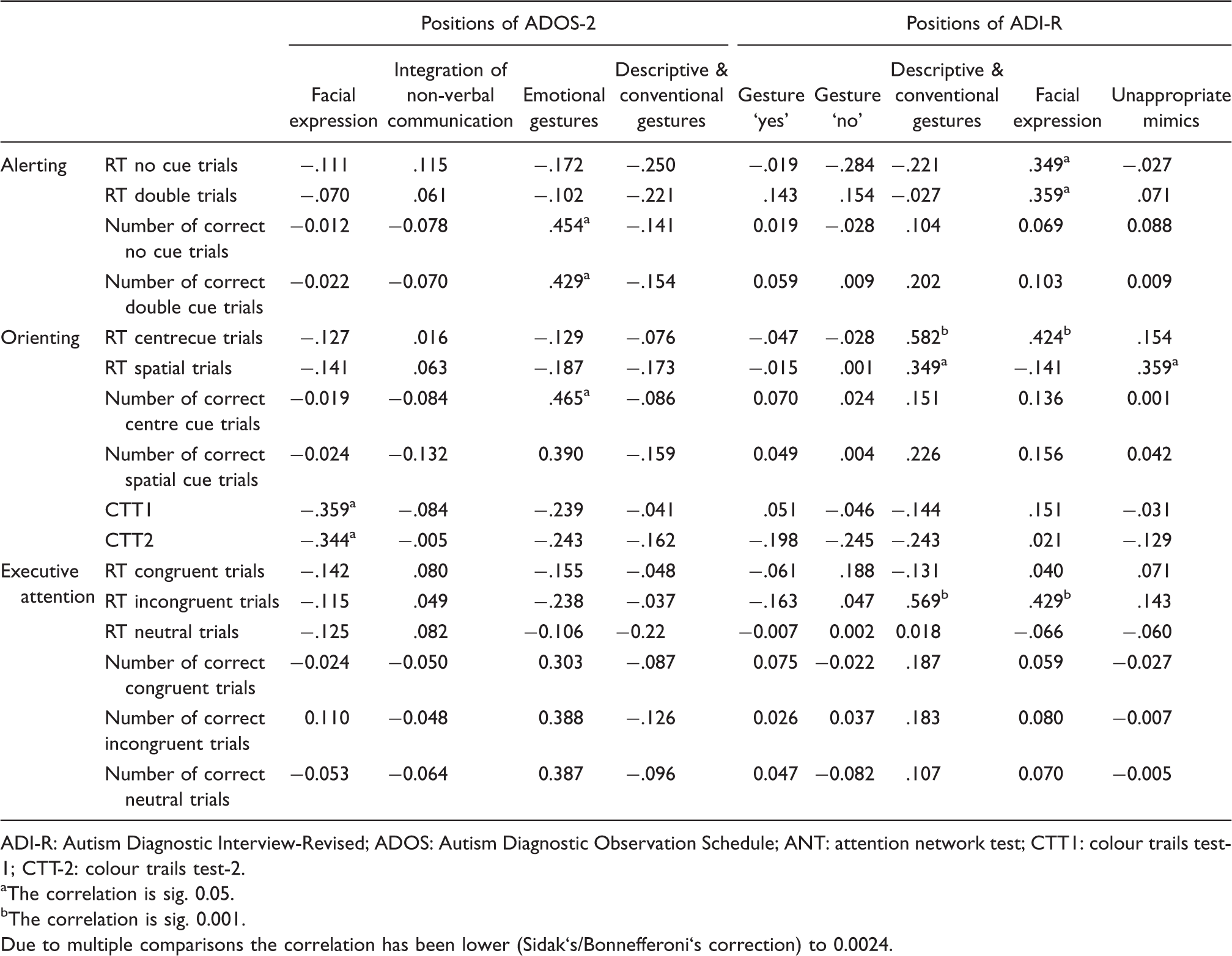
The rho-Spearman correlations calculated attentional measures and production of gestures in individuals with ASD (N = 46).

ADI-R: Autism Diagnostic Interview-Revised; ADOS: Autism Diagnostic Observation Schedule; ASD: autism spectrum disorder.
The correlation is sig. 0.05
The correlation is sig. 0.001
Due to multiple comparisons the correlation has been lower (Sidak's/Bonnefferoni's correction) to 0.0024.
The rho-Spearman correlation between reaction times, number of correct responses in ANT and gesture productions.
ADI-R: Autism Diagnostic Interview-Revised; ADOS: Autism Diagnostic Observation Schedule; ANT: attention network test; CTT1: colour trails test-1; CTT-2: colour trails test-2.
The correlation is sig. 0.05.
The correlation is sig. 0.001.
Due to multiple comparisons the correlation has been lower (Sidak's/Bonnefferoni's correction) to 0.0024.
The positive correlation of alerting effect with coordination of non-verbal communication was investigated (rho = .20; p < 0.05; N = 46). The number of correct practices with no cue correlated positively with production of emotional and emphatic gestures from ADOS-2 (rho = .454; p < 0.05; N = 24). This gesture variable was also related to the number of correct practices with double cue (rho = .429; p < 0.05; N = 24).
Emotional and emphatic gestures, descriptive and conventional gestures and facial expressions directed to others were related to orienting indicators.
The number of correct practices with centre cue correlated positively with production emotional and emphatic gestures in Module 4 of ADOS-2 (rho = .465; p < 0.05; N = 24).
The production of descriptive and conventional gestures assessed by ADI-R correlated positively with RT spatial cue trials (rho = .349; p < 0.05; N = 46) and with RT centre cue trials (rho = .582; p < 0.01; N = 46). CTT1 was related to facial expression directed to others (rho = − .359; p < 0.05; N = 46).
Strong correlations of two executive attention processes with production of descriptive and conventional gestures were investigated. The production of descriptive and conventional gestures assessed by ADI-R was positive and strongly related to RTs of incongruent flankers (rho = .569; p < 0.05; N = 46). The effect of executive attention in ANT was moderate, negative and correlated with production of descriptive and conventional gestures assessed by ADOS-2 (rho = −.366; p < 0.05; N = 46).
The model fits well (χ2/df ≤ 1.45; RMSEA ≤ 0,100; CFI ≥ 0.77). The results of the SEM indicated significant relations between attentional indicators and indicators of non-verbal communication. The SEM graph is presented in Figure 1. Alerting was related directly to the integration of non-verbal communication with behaviour (β = .32; p < .05) and directly to emotional gestures (β = −.29; p < .05). The relation between executive attention and descriptive and conventional gestures was not significant. Spatial-visual search was related directly to facial expression (β = −.36; p < .01).
Structural equation model (SEM) of gestures and non-verbal communication with attentional processes.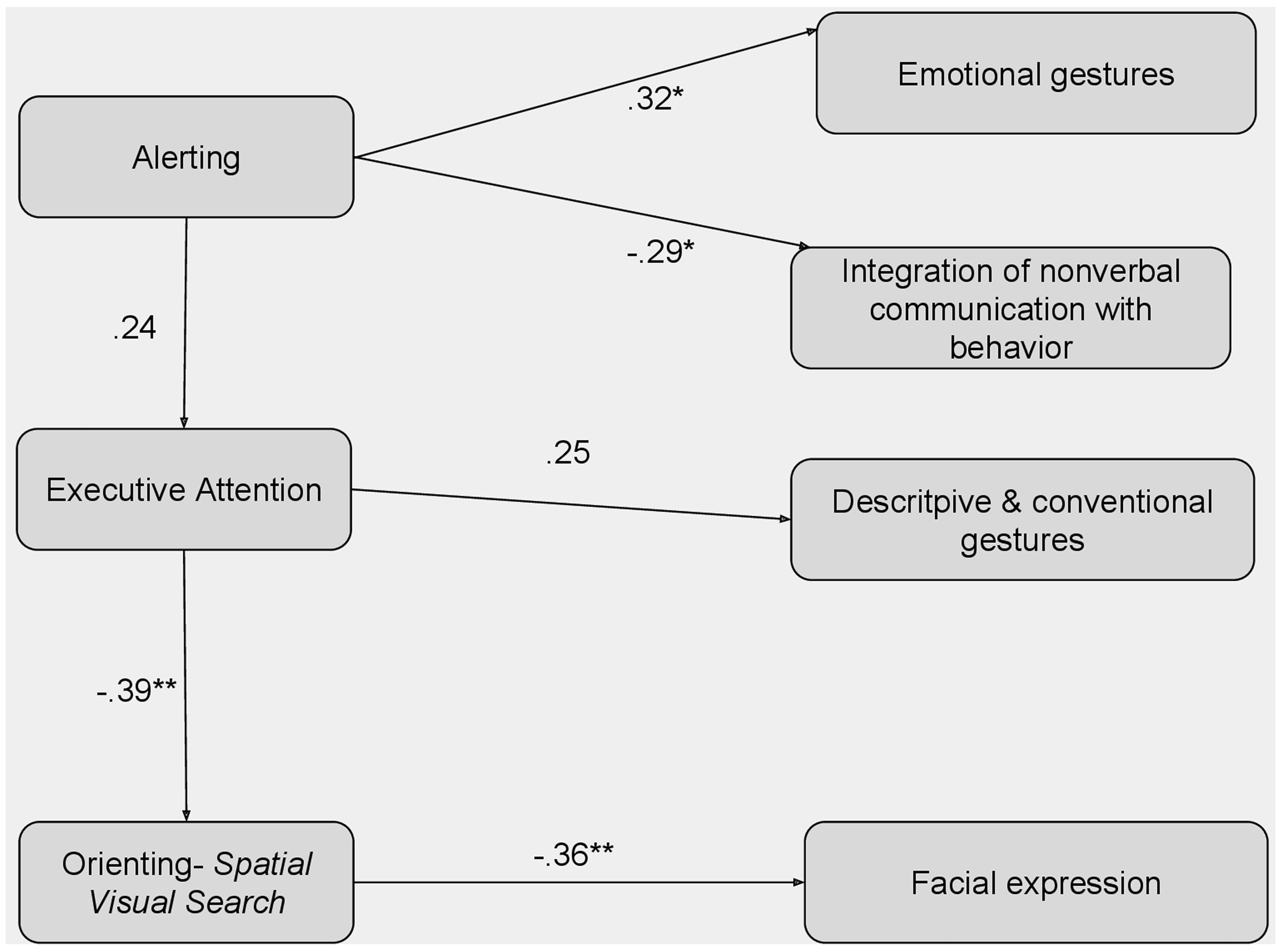
Additionally, we tested whether a relationship exists between executive attention and alerting and spatial-visual search. We predicted that executive attention would support efficiency in alerting and spatial-visual search. The results from the SEM did not confirm the hypothesis. The covariance between alerting and executive attention was non-significant. While executive attention was, admittedly, related to spatial-visual search (β = −.39; p < .01), the negative correlation shows that high performance of executive attention is related to decreased spatial-visual search. The result obtained is incongruent with the hypothesis.
Discussion
Correlation analysis revealed that various attentional processes are related to the use of gestures. Orienting processes were less often correlated with indicators of gestures and the strength of the relationship was weaker in comparison to alerting and executive attention indicators that correlated moderately or strongly with gesture indicators. In the SEM model, high efficiency of spatial-visual search was linked to the frequent use of context-relevant facial expression. These results do not confirm Hypothesis 1 which said that orienting attention is related to the use of all kinds gestures and facial expression its entirely.
Hypothesis 2, that executive attention is a predictor of the performance of descriptive and conventional gesture production, was not confirmed. Admittedly, the executive attention indicators were strongly correlated with descriptive and conventional gestures, but the relationship was not confirmed in the SEM as it was not significant.
One explanation of the lack of impact of executive attention on descriptive gestures may be the difficulties experienced by individuals with autism in the flexible use of executive attention in daily life, for example, in social interactions (Rosenthal et al., 2013). Executive attention (including planning, flexibility, working memory) in adolescents probably does not compensate for the use of descriptive and conventional gestures. As Seitz (2000) postulates, gestures are ‘embodied language’ which is primary to verbal language and cognitive processes, and this is why gesture expression might not be controlled by top–down processes. Another possible explanation for the absence of a relationship between executive attention and descriptive gestures might be the difficulty in representing mental states and deficit in theory of mind in individuals with ASD (Charman & Baron-Cohen, 1992). Because of the impairment in mental representation, the use of gestures is not necessary to convey insight from the speaker to the listener (Goldin-Meadow, 2000).
Correlation analysis revealed that alerting indicators were related to gestures and non-verbal communication variables, that is, integration of non-verbal communication and facial expression. Likewise, SEM showed that alerting was linked to emotional gestures and integration of non-verbal communication. Therefore, the results obtained from correlation analysis and SEM are congruent with Hypothesis 3, which states that alerting is related to spontaneous use of emotional gestures.
The results from SEM seem to indicate that orienting attention is not related to efficiency of production of gestures to the same degree as it is to alerting. Perhaps this is because performance-orienting attention in adolescents with ASD is not decreased (Kawakubo et al., 2007) as it is in children with ASD (Dawson et al., 2004; Elsabbagh et al., 2009; Salowitz et al., 2013). Hence, the relationship of orienting attention processes and non-verbal language is not as obvious in this group of adolescents as that which exists in childhood. These relationships indicate that arousal, or in other words alertness, is not only related to stereotyped symptoms as commonly reported in the literature (Goldstein, Johnson, & Minshew, 2001), but should be considered in the context of the use of emotional gestures and their integration with nonverbal communication. In accordance with the study by Kaartinen and colleagues (2012), who found that arousal increases in individuals with ASD when they maintain eye contact; the avoidance of eye contact indicates a relationship between arousal and social interaction impairment. Perhaps studies on gestures during which physiological indicators would be measured could be beneficial in obtaining information about the relationship between arousal and non-verbal communication for individuals with ASD. Most of the studies concerning gestures and non-verbal communication in individuals with ASD refer rather to recognition than to production.
The next important finding from the present study is the absence of compensatory processes in executive attention for alerting and spatial-visual search, contrary to the assumptions based on neurophysiological processes stated by Casey and Riddle (2012). The results of SEM analysis are incongruent with Hypothesis 4, that executive attention supports the efficacy of orienting and alerting.
In accordance with the increased perceptual capacity in persons with ASD (Remington, Swettenham, Campbell, & Coleman, 2009), individuals with autism who manifest enhanced perceptual capacity in tasks demanding visual search could have been distracted by the task measuring executive attention in ANT with incongruent flankers.
The current study does have its limitations. The first of them is the modest sample size, which means that Root mean square error of approximation (RMSEA) in the model is at merely an acceptable level. Further research is needed to confirm the interaction between gestures and attentional processes. The second limitation is that we measured only the spontaneous use of gestures in ADOS-2 and spontaneous use of gestures reported by parents, while we did not examine imitation gestures in a structured task, in contrast to the study by de Marchena and Eigsti (2010). The third limitation of the present study is the absence of typically developing adolescents, because the ADOS-2 and ADI-R, from which we selected items to measure the efficacy of non-verbal communication indicators, were not administrated to a control group.
This model of the relationship between particular attentional processes, gestures and other non-verbal communication variables could inspire practitioners in interventions with adolescents with ASD. Attention supports all cognitive processes (Scerif & Wu, 2014). The knowledge of what kind of attention processes are related to particular gestures could be useful for interventions dedicated to ASD adolescents. This is particularly the case in interventions based on new technologies, that is, Virtual Reality with Feedback-Focused Interaction. The relationship between attention and gestures could be applied (Wang & Reid, 2011), while tasks could be designed to reinforce the use of gestures in the context in which particular attentional processes are involved.
Summary
The relationship between gestures and the use of non-verbal communication has not been extensively studied, as detailed in the Introduction. The results of the present study provide a consistent model of the relationships between the use of gestures and various attentional processes, which can spur further investigations of the links between attention processes, gestures and non-verbal communication in individuals with ASD.
Footnotes
Acknowledgments
The authors would like to thank the adolescents and their parents who participated in the study.
Declaration of conflicting interests
The author(s) declared no potential conflicts of interest with respect to the research, authorship and/or publication of this article.
Funding
The author(s) disclosed receipt of the following financial support for the research, authorship and/or publication of this article: The study was supported by a grant from the University of Warsaw DSM 1090/2014 and DSM 111700/2015.