




Abstract
Background and aims
Prior work has examined how children and adolescents with autism spectrum disorder who are minimally verbal use their spoken language abilities during interactions with others. However, social communication includes other aspects beyond speech. To our knowledge, no studies have examined how minimally verbal children and adolescents with autism spectrum disorder are using their gestural communication during social interactions. Such work can provide important insights into how gestures may complement their spoken language abilities.
Methods
Fifty minimally verbal children and adolescents with autism spectrum disorder participated (Mage = 12.41 years; 38 males). Gestural communication was coded from the Autism Diagnostic Observation Schedule. Children (n = 25) and adolescents (n = 25) were compared on their production of gestures, gesture–speech combinations, and communicative functions. Communicative functions were also assessed by the type of communication modality: gesture, speech, and gesture–speech to examine the range of communicative functions across different modalities of communication. To explore the role gestures may play the relation between speech utterances and gestural production was investigated.
Results
Analyses revealed that (1) minimally verbal children and adolescents with autism spectrum disorder did not differ in their total number of gestures. The most frequently produced gesture across children and adolescents was a reach gesture, followed by a point gesture (deictic gesture), and then conventional gestures. However, adolescents produced more gesture–speech combinations (reinforcing gesture-speech combinations) and displayed a wider range of communicative functions. (2) Overlap was found in the types of communicative functions expressed across different communication modalities. However, requests were conveyed via gesture more frequently compared to speech or gesture–speech. In contrast, dis/agree/acknowledging and responding to a question posed by the conversational partner was expressed more frequently via speech compared to gesture or gesture–speech. (3) The total number of gestures was negatively associated with total speech utterances after controlling for chronological age, receptive communication ability, and nonverbal IQ.
Conclusions
Adolescents may be employing different communication strategies to maintain the conversational exchange and to further clarify the message they want to convey to the conversational partner. Although overlap occurred in communicative functions across gesture, speech, and gesture–speech, nuanced differences emerged in how often they were expressed across different modalities of communication. Given their speech production abilities, gestures may play a compensatory role for some individuals with autism spectrum disorder who are minimally verbal.
Implications
Findings underscore the importance of assessing multiple modalities of communication to provide a fuller picture of their social communication abilities. Our results identified specific communicative strengths and areas for growth that can be targeted and expanded upon within gesture and speech to optimize social communication development.
Introduction
Little is known about how children and adolescents with autism spectrum disorder (ASD) who are minimally verbal (MV) use their social communication skills during interactions with others. A recent research study found that MV children and adolescents with ASD more often used their speech to request and acknowledge (or disagree/agree) the conversational partner (La Valle et al., 2020). However, social communication includes other aspects beyond speech (i.e. gestures, eye gaze, body language, and facial expressions; Clark & Krych, 2004; Ellawadi & Weismer, 2014; Guha et al., 2016; Pantelis & Kennedy, 2017). It is important to also examine how MV children and adolescents with ASD are using gestures to complement their spoken language abilities. Such information can provide a fuller picture of their social communication skills. This research can be used to inform the implementers of ASD interventions about specific communication strengths that can be harnessed and expanded upon to maximize each child's long-term potential. To our knowledge, this is the first study to investigate gestural communication in children and adolescents with ASD who are MV during a social-interactive context. Our study builds on La Valle’s et al. (2020) research by using the same sample of MV children and adolescents with ASD to (1) explore their use of gestures and how they combine gestures and speech; (2) examine whether children and adolescents differ in their use of gestures, the ways in which they combine gestures and speech, and the purpose (e.g. request and share attention) of each communicative act; (3) determine whether the purpose of each communicative act, including how often it is used, varies depending on whether it is expressed using gesture, gesture and speech, or speech; and (4) to investigate the relation between gesture and speech.
Autism spectrum disorder
Communicative gestures
Gesture is a central aspect of language development (Capone & McGregor, 2004; Iverson & Goldin-Meadow, 2005; Özçalışkan et al., 2017; Ramos-Cabo et al., 2019). Different types of gestures may include deictic, give, conventional, and representational gestures (Iverson et al., 1994; Özçalışkan & Goldin-Meadow, 2005, 2011; Özçalışkan et al., 2016). Like neurotypically developing children, children with ASD produce deictic, give, and conventional gestures in early interactions (e.g. Özçalışkan et al., 2016, 2018). Prior gesture research in the field of ASD has focused mainly on high-risk infants with familial risk for developing the disorder (e.g. Choi et al., 2020; LeBarton & Iverson, 2016), verbally fluent toddlers or children (e.g. Baumann et al., 2019; Manwaring et al., 2019; Mastrogiuseppe et al., 2015; Mishra et al., 2021; Özçalışkan et al., 2016; Wong & So, 2018), and verbally fluent adolescents (e.g. de Marchena & Eigsti, 2010; Medeiros & Winsler, 2014 included a subset of adolescents). A majority of studies revealed reduced gesture rates and gesture delays (e.g. Choi et al., 2020; LeBarton & Iverson, 2016; Manwaring et al., 2019; Mastrogiuseppe et al., 2015; Medeiros & Winsler, 2014; Mishra et al., 2021) when compared to infants at low-risk (no family history) for ASD, children with Down syndrome, and neurotypically developing peers. Limited use of gestures is part of the diagnostic criteria for ASD (APA, 2013). Difficulties and delays in gestural production, particularly in deictic gestures, was found in children and adolescents with ASD compared to neurotypically peers (e.g. LeBarton & Iverson, 2016; Manwaring et al., 2018, 2019; Mastrogiuseppe et al., 2015; Medeiros & Winsler, 2014; Özçalışkan et al., 2016) and children with Down syndrome (e.g. Mastrogiuseppe et al., 2015). Fewer deictic gestures may be due, in part, to difficulties in joint attention skills and sustaining joint engagement states during interactions with others (e.g. Dawson et al., 2004; Mundy et al., 1990; Özçalışkan et al., 2016;). It is deictic gestures which are tied to the immediate context that play a critical role in subsequent vocabulary and spoken language development (e.g. Colonnesi et al., 2010; Özçalışkan et al., 2016, 2017; Talbott et al., 2020).
Gesture–speech combinations
Similar to neurotypically developing children, children with ASD also continue to gesture following the onset of speech, but in combination with words producing different types of gesture–speech combinations (e.g. Özçalışkan et al., 2018; Sowden et al., 2008). Gesture–speech combinations may include reinforcing (gesture expresses the same information as speech), supplementary (gesture adds information to speech), and disambiguating (gesture clarifies speech) combinations. The types of combinations produced relate to emerging speech abilities. Production of reinforcing gesture–speech combinations occurs first, followed by supplementary and disambiguating gesture–speech combinations (e.g. Özçalışkan et al., 2018).
Prior research studies found fewer gesture–speech combinations in those with ASD when compared to neurotypically developing peers (e.g. Özçalışkan et al., 2018). Much of this research has focused on high-risk infants (family history of ASD), who later developed ASD (e.g. Choi et al., 2020), verbally fluent children (e.g. Baumann et al., 2019; Huang et al., 2020; So et al., 2015), and verbally fluent adolescents with ASD (e.g. Morett et al., 2016). Although one study found variable results (Wong & So, 2018), verbally fluent children (e.g. Baumann et al., 2019; Huang et al., 2020; So et al., 2015) and verbally fluent adolescents with ASD (e.g. Morett et al., 2016) produced fewer supplementary gesture–speech combinations when compared to neurotypically developing peers. Supplementary gesture–speech combinations play an important role in language development. Supplementary gesture–speech combinations allow different semantic relations to be conveyed across gesture and speech before one has the ability to express these relations only in speech (e.g. Dimitrova et al., 2017; Iverson & Goldin-Meadow, 2005). The mixed finding from Wong and So’s (2018) study may be due, in part, to differences in the ages of the samples, the social context, and types of tasks included (e.g. Capone & McGregor, 2004; Colletta et al., 2015; Iverson et al., 2008; de Marchena & Eigsti, 2014).
Communicative functions
Examining gesture and gesture–speech combinations should not only include how often they are used in context but why they are used (e.g. Blume et al., 2020). The function of a communicative gesture refers to why it is performed (e.g. Novack & Goldin-Meadow, 2017). Early gestures serve three functions: social interaction (to direct another person's attention to oneself), behavioral regulation (to regulate the behavior of a communication partner), and joint attention (to direct a person's attention to an object to share interest; Bruner, 1981). Difficulties in the use of joint attention gestures are found in those with ASD when compared to infants with other developmental disabilities, children with Down syndrome, and neurotypically developing peers (e.g. Franchini et al., 2019; Maljaars et al., 2011; Özçalışkan et al., 2016; Rozga et al., 2011; Töret & Acarlar, 2011). A consistent finding is reduced pointing to share attention but not pointing to request (Bono et al., 2004; Camaioni et al., 1997; Loveland & Landry, 1986; Mundy et al., 1986, 1990; Özçalışkan et al., 2016; Stone et al., 1997). It is joint attention gestures, such as pointing to share attention, that are strong predictors of concurrent and later language abilities (e.g. Harbison et al., 2017; Luyster et al., 2008).
Minimally verbal children and adolescents with ASD
Communicative gestures
Prior research has contributed to our understanding of gestural communication in children and adolescents with ASD who are verbally fluent. However, little is known about how minimally verbal (MV) children and adolescents with ASD use gestures during social interactions. Estimates indicate that between 25% (e.g. Hus et al., 2007) and 50% (e.g. Pickett et al., 2009) of individuals with ASD do not develop functional spoken language. Characterizing children as MV occurs when they are well past important language milestones of combining words into functional sentences, which often coincides with entry into kindergarten (e.g. DiStefano & Kasari, 2016). Although how MV is defined may vary (e.g. Bal et al., 2016; Bryan, 2020; Koegel et al., 2020), in general, it includes those who may have no spoken words to a few fixed phrases used inconsistently in limited contexts (e.g. Anderson et al., 2007; DiStefano & Kasari, 2016; Kasari et al., 2013).
It is important to understand how MV children and adolescents with ASD may be using other modalities of communication to complement their spoken language abilities during social interactions. Yet, few studies have explored their gestural communication (e.g. Biller & Johnson, 2019). Vidal et al. (2020) conducted a case study analysis examining the communication profile of a nine-year-old child with ASD whose speech primarily comprised single words or two-word combinations. Findings from multiple informant interviews revealed that when gesturing, the participant often used conventional gestures. An earlier research study by Braddock et al. (2015), which examined gestures in 17 children with ASD (Mage: 33 months), who produced few to no intelligible words, also found conventional gestures to be reported most frequently. Sixteen children produced at least one gesture. Seven of the children used deictic gestures. However, for deictic gestures, no distinction was made between whether or not the child made direct contact with the object. Although these children had delays in spoken language development, we do not know if they will continue to be MV past age five (e.g. Anderson et al., 2007; DiStefano & Kasari, 2016). Importantly, findings were based on parent report only rather than direct observation of interactions between the child and conversational partner. It is essential to see how MV children and adolescents with ASD use gestures in context during exchanges with a conversational partner. This can provide critical information about the function (e.g. request) of each communicative act.
Gesture–speech combinations
Like the gesture only studies, little is known about how MV children and adolescents with ASD combine gestures and speech (e.g. Doak, 2019). Biller and Johnson (2019) conducted a case study analysis of a three-year-old child with ASD who, as estimated by the parent, produced 25 spoken words. Based on the parent report, the child was a multimodal communicator who, at times, used spoken language supplemented with gestures. Larger studies examining communication in 55 MV children with ASD (Mage: 6.5 years) found that 82% of their communication interchanges contained spoken language only or in combination with vocalization and gesture (e.g. DiStefano et al., 2016). Although Biller and Johnson (2019) and DiStefano et al. (2016) research studies provided insights into the gesture–speech production of children with ASD who have language production difficulties, unexplored is the communicative functions (e.g. request and share attention) of their gesture–speech combinations.
Comparing children and adolescents
None of the aforementioned studies examined the production of gestures or gesture–speech combinations in MV adolescents with ASD, including similarities or differences in gestural production between children and adolescents with ASD who are MV. In one regard, a prior research study found similarities in how MV children and adolescents with ASD were using their speech during social interactions (e.g. La Valle et al., 2020). Further, the relation between gesture and speech becomes more complex with increasing linguistic skills (e.g. Özçalışkan & Goldin-Meadow, 2009) and both groups are characterized as MV. Given this, we may not see many differences when examining gestural communication in these two groups. On the other hand, given additional social experiences, MV adolescents with ASD may produce more gestures, gesture–speech combinations, and have a more expansive gestural repertoire of communicative functions. Adolescents may use gestures more often as a communication strategy (e.g. Medeiros & Winsler, 2014) to maintain the conversational interaction when speech alone is difficult to produce. Such research can provide important insights into the types of communication strategies they may be using during social interactions.
Communicative functions and modality of communication
Exploring gestural communication in those with ASD who are MV may reveal additional communicative functions than is expressed in their speech (e.g. Krueger, 2013). A prior research study found that MV children and adolescents with ASD more often used their speech to request and acknowledge (or disagree/agree) the conversational partner (La Valle et al., 2020). Unexamined were the communicative functions of their gestural communication. Keen et al. (2002) examined communicative functions of gestures in eight nonverbal children with ASD (aged 3.7–6.11 years). Structured observations in the classroom revealed the most commonly used functions expressed via gesture was to request an object and to indicate disagreement. Left unanswered is how gestures may complement the speech of children and adolescents with ASD who are MV which has important clinical implications. We can determine how MV children and adolescents with ASD are using their social communication skills across different modalities of communication and identify ways to further support and expand these skills within gesture and speech to facilitate language production.
Relation between gesture and speech
Given difficulties in language production, gestures may play a compensatory role for individuals with ASD who are MV. Research investigating children with Down syndrome (e.g. Caselli et al., 1998; Singer Harris et al., 1997; Stefanini et al., 2007, 2008) appears to support this view (see Iverson et al., 2003 for an alternative view). Individuals with Down syndrome and those with ASD who are MV have difficulties in language learning and language production (e.g. Laws & Bishop, 2004; Pickles et al., 2009; Rice et al., 2005). Gesturing may provide an efficient mode of communication to overcome linguistic difficulties. Indeed, children with Down syndrome produced more gestures but fewer spoken responses when compared to neurotypically developing peers (e.g. Stefanini et al., 2007). However, to our knowledge, this pattern between gesture and speech has not been assessed in MV individuals with ASD. Such research is needed to determine the role gestures may play for other groups with language production difficulties, including those who are MV.
Current study
The current study extends La Valle’s et al. (2020) study on spoken language by examining how MV children and adolescents with ASD are using their gestural communication in context with a conversational partner during the first 30 minutes of the Autism Diagnostic Observation Schedule (ADOS). This study can be used to inform clinicians, speech language pathologists, teachers, and other educators about specific communicative strengths and areas for growth that can be targeted and expanded upon within gesture and speech to optimize social communication development in individuals with ASD who are MV.
Our study seeks to answer the following questions:
What are the similarities and differences between children and adolescents with ASD who are MV in their use of communicative gestures, gesture–speech combinations, and communicative functions? How might the type of communicative function (e.g. request), including how often it is used, vary based on the type of communication modality (speech, gesture, and gesture–speech)? What is the relation between gesture and speech?
We predict that children and adolescents would not differ on these key gestural communication variables (e.g. La Valle et al., 2020; Özçalışkan & Goldin-Meadow, 2009).
No priori hypothesis was generated (exploratory).
We expect the total number of speech utterances to be negatively associated with the total number of gestures (e.g. Caselli et al., 1998; Singer Harris et al., 1997; Stefanini et al., 2007, 2008).
Methods
Participants
Participants included 50 MV individuals with ASD (age range = 6–21 years; 12 females) from the La Valle et al. (2020) study. Study procedures were approved by the Boston University Institutional Review Board. Parents of all participants provided written informed consent, in accordance with the recommendations of the Declaration of Helsinki, before their child was enrolled in the study. Participants were excluded if English was not the primary language spoken in the home or if they had a diagnosis of a known genetic disorder. Participants were included if they had an ASD diagnosis confirmed by meeting ADOS-2 (Lord & Jones, 2012) or adapted ADOS (A-ADOS; Bal et al., 2020) cut-off scores on the Autism Diagnostic Interview-Revised (Lord et al., 1994). MV included spoken language abilities ranging from no speech to a few fixed phrases used inconsistently in limited contexts (i.e. module 1 for the ADOS or A-ADOS; Bal et al., 2016). Participants 12 years or younger were classified as children (M = 8.92, SD = 1.96) and received module 1 of the ADOS-2. Those older than 12 years were classified as adolescents (M = 15.89, SD = 2.45) and received module 1 of the A-ADOS. The A-ADOS includes activities and materials modified to be more developmentally appropriate for assessing older MV individuals. The A-ADOS items and activities were created to be comparable to the ADOS-2 (Bal et al., 2020). The average length of the ADOS-2 and A-ADOS in this study sample was ∼37 minutes long. See Table 1 for group characteristics, demographic information, and assessment scores.
Group characteristics & assessment scores of MV individuals with ASD.
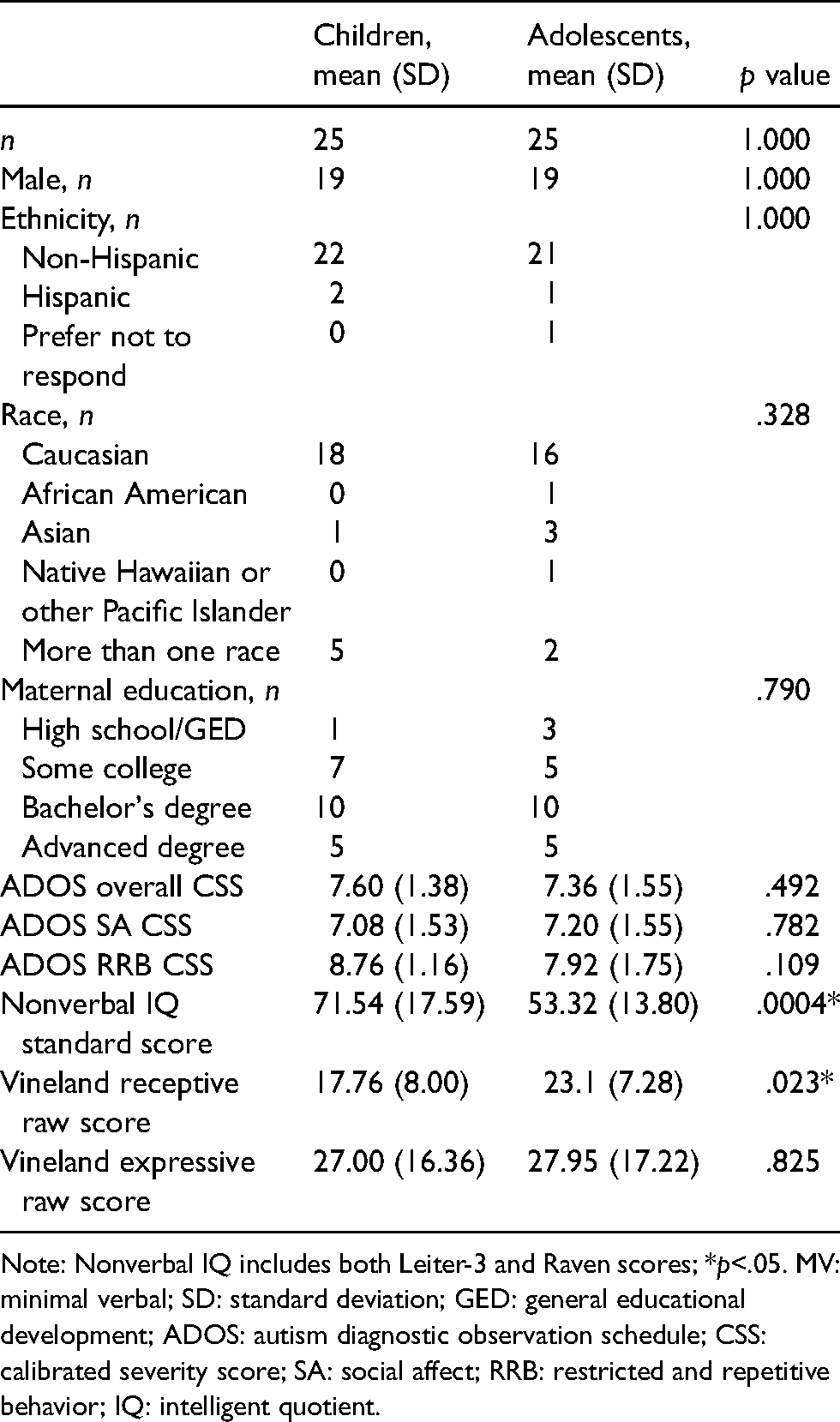
Note: Nonverbal IQ includes both Leiter-3 and Raven scores; *p<.05. MV: minimal verbal; SD: standard deviation; GED: general educational development; ADOS: autism diagnostic observation schedule; CSS: calibrated severity score; SA: social affect; RRB: restricted and repetitive behavior; IQ: intelligent quotient.
Standardized measures
Nonverbal cognitive ability. Since participants were drawn from two separate studies, different IQ measures were administered: the Leiter International Performance Scale (n = 34; Leiter-3; Roid et al., 2013) or the Raven Coloured Progressive Matrices (CPMs; n = 15; Raven et al., 1998). These are the most widely used tests of nonverbal cognitive skills for individuals with ASD (e.g. Kasari et al., 2013). Raw scores were converted into standard scores. One participant did not obtain a score on the Leiter-3. The Leiter-3 has shown good test–retest reliability (.74–.93), internal consistency (.79–.95), and high concurrent validity (.72–.74) (Roid & Koch, 2017). The Raven CPM has also shown good test–retest reliability (.80), internal consistency (.85), and high concurrent validity (.79) (e.g. Cantwell, 1967; Raven, 2003; Raven et al., 1998).
Parent-report measures
Adaptive behavioral functioning. Vineland Adaptive Behavior Scales—parent/caregiver interview form (VABS-2; Sparrow et al., 2005) was used to understand participants communication behaviors, daily living skills, and socialization skills. Five parents did not complete the interview. Receptive and expressive communication subdomain raw scores are reported for 45 participants. Raw scores are used because they provide information about the performance of more affected populations than standard or percentile scores. The VABS-2 has shown excellent test–retest reliability (.95–.99), internal consistency (.97–.99), and high concurrent validity (.93) (e.g. De Bildt et al., 2005; Perry & Factor, 1989).
Coding scheme
Communicative gestures and gesture–speech combinations. The first 30 minutes from the ADOS was coded for communicative gestures, gesture–speech combinations, and communicative functions. This timeframe was selected as language samples of 30 minutes in length provide sufficient time and opportunity to produce a range of responses (Tager-Flusberg et al., 2009). Gestures, gesture–speech combinations, and communicative functions were coded from the participants’ ADOS video recording. Gestural coding from the video was also essential in interpreting the function of each communicative act. Gestural codes were then inputted into each participant’s ADOS transcript using Systematic Analysis of Language Transcripts (SALT; Miller & Iglesias, 2012) software and conventions. Speech or any verbal, phonemic utterance, including nonecholalic speech had already been transcribed and coded in SALT as part of the previous study. 1 The specific gestural categories, gesture–speech combinations, and types of communicative functions that were coded followed prior research studies (La Valle et al., 2020; Özçalışkan & Goldin-Meadow, 2009; Özçalışkan et al., 2016). See the Appendix for definitions of each coding category and Figure 1 for a depiction of the coding scheme. Of the 50 participants, only 13 used manual signs. Since <30% of the participants used signs and these individuals also used other communication modalities (e.g. speech and gesture), analysis of manual signs was considered beyond the scope of this particular study and not assessed further.
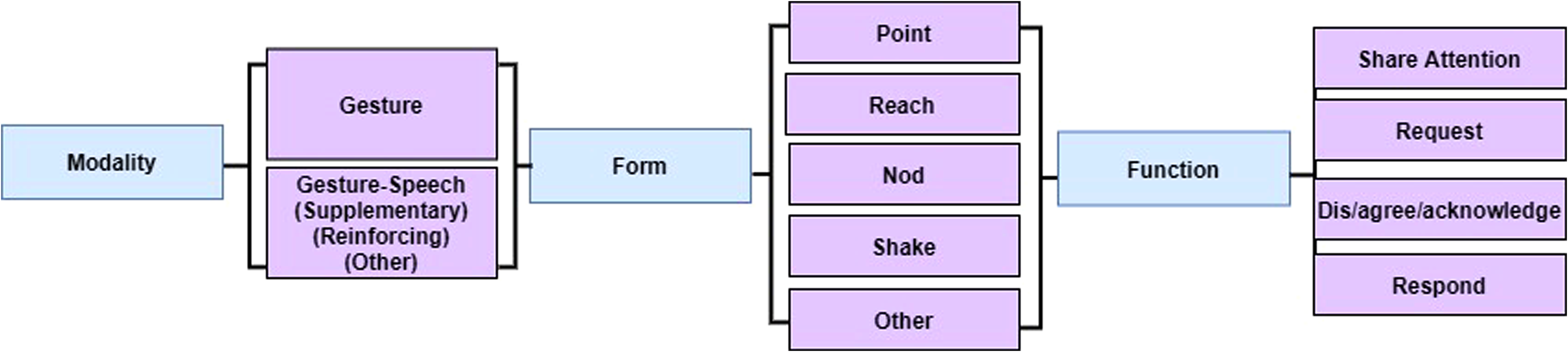
Coding schematic of gestures categorized by form and function.
Communicative gestures
Communicative gestures were first categorized by form (hand shape or head movement) and included the following (Özçalışkan & Goldin-Meadow, 2009; Özçalışkan et al., 2017): reach, point (deictic gestures), head nodding, head shaking (conventional gestures), and other (hand, body, or finger movements not captured by the other form categories) gestures. All gestures that could be interpreted as a point or reach, whether or not they were precisely formed were included. Point and reach gestures could not touch the object of interest or person. Representational gestures (indicate abstract objects or actions) were also coded.
Gesture–speech combinations
Gesture–speech combinations were coded into the following categories (Özçalışkan & Goldin-Meadow, 2009; Özçalışkan et al., 2017): reinforcing: speech was redundant with the information indicated by the gesture; disambiguating: gesture clarified a pronominal referent in speech; supplementary: speech added information to what the gesture indicated; and other: speech was transcribed as unintelligible but was accompanied by a gesture.
Functions of gestures and gesture–speech combinations
Communicative gestures and gesture–speech combinations were assessed for function (building upon the La Valle et al., 2020 coding scheme; Özçalışkan et al., 2016). Functions included request, share attention, dis/agree/acknowledge (included disagreement, refusal, agreement, or acknowledgement), and respond (i.e. to a question). Not all gesture types were used for every function (see Appendix for definitions and examples). If the precise function of the gesture could not be interpreted, it was coded as “unclear.”
Reliability
Coders were trained on the gestural communication coding system. Coders were trained on practice videos until substantial interrater agreement measured by obtaining a Cohen's kappa coefficient of .80 or above was achieved. Coders also attended weekly meetings to discuss coding-related questions. Gestural coding reliability was assessed regularly between two coders. Approximately 20% of the transcripts (n = 10) were randomly selected and double-coded to calculate interrater agreement using Cohen's kappa and percent agreement. Cohen's kappa and percent agreement was calculated for gestures, gesture–speech combinations, and communicative functions. There was substantial interrater agreement for gestures (overall: 90.91%, κ = .888; point: 93.75%; reach: 100%; head nod: 100%; head shake: 100%), gesture–speech combinations (overall: 93.94%, κ = .892; reinforcing: 100%; disambiguating: no occurrence; supplementary: 95%; other: 90%), and communicative functions (overall: 90.91%, κ = .890; request: 87.50%; share attention: 100%; respond: 100%; dis/agree/acknowledge: 100%).
Statistical analyses
The first 30 min from the ADOS was coded for gestural communication. Specifically, we report on participants total number of gestures, gesture–speech combinations, and communicative functions within this 30 minutes timeframe. (1) To test for between-group differences, t-tests or, for nonnormally distributed variables, Mann–Whitney U tests were used for demographic variables, assessment scores, total number of gestures, gesture–speech combinations, and communicative functions. Rank-biserial correlations, r, are reported as effect sizes for Mann–Whitney U tests. (2) To test whether the occurrence of a specific communicative function (request, dis/agree/acknowledge, and respond) differed based on the type of communication modality (speech, gesture, and gesture–speech), Kruskal–Wallis H tests were performed. Bonferroni-adjusted significance tests were used for post-hoc comparisons. (3) A multivariate regression was conducted to quantify the relationship between spoken utterances and gestures. Variables entered as covariates included chronological age, nonverbal IQ, and receptive communication (RC) ability. These variables were selected as covariates as they differed between children and adolescents and were reported to be associated with gestural/language skills in prior studies (e.g. Houwen et al., 2016; Manwaring et al., 2017; Weismer & Kover, 2015; Weismer et al., 2010; Vallotton, 2009). Variables whose distributions were skewed were log-transformed to allow the data to conform more closely to the normal distribution to meet test assumptions.
Results
Differences between children and adolescents
MV children and adolescents with ASD did not differ on any of the demographic variables or assessment scores in Table 1 except on nonverbal IQ (children > adolescents) and VABS RC scores (adolescents > children).
Gestures, gesture–speech combinations, and gesture–speech combination subtypes. Table 2 reports the descriptives for each communication modality and for each type of gesture–speech combination. One child and two adolescents did not produce any communicative gestures. Representational gestures were produced by only one child (produced a c-hand shape to represent a cup) and one adolescent (used an index finger to represent a rocket flying), who each had one occurrence of this type of gesture.
Descriptives of communication modality and types of gesture–speech combinations by group.

Groups did not differ in the total number of communicative gestures (U = 199.0, p = .100, r = .24). The most frequently produced gesture across children and adolescents was a reach gesture, followed by a point gesture (deictic gestures), and then conventional gestures (head nodding/shaking). However, adolescents produced more gesture–speech combinations compared to children (U = 38.0, p = .005, r = .53). Specifically, adolescents produced more reinforcing gesture–speech combinations than children (U = 52.0, p = .037, r = .52). Groups did not differ in the total number of supplementary (U = 80.0, p = .440, r = .16) or “other” gesture–speech combinations (U = 67.5, p = .170, r = .28). No occurrence of disambiguating gesture–speech combinations was found in either group. Children and adolescents produced the highest percentage of supplementary (.55), followed by “other” (.30), and reinforcing gesture–speech combinations (.15).
Communicative functions of gestures. Across children and adolescents, the highest proportion of reach and point (deictic) gestures was to request (.95 and.81, respectively). For conventional gestures, the highest proportion of head nodding was to dis/agree/acknowledge (.56) and for head shaking, it was to respond (.51; see Table 3 for the mean percentage of each gestural function categorized by form).
Mean percentage of each gestural function by form.

Groups did not differ in the total number of reach or point (deictic) gestures to request or to share attention, in the occurrence of head shaking to dis/agree/acknowledge the conversational partner, or in “other” gestures (to acknowledge, request, or share attention). However, adolescents produced more head nodding to dis/agree/acknowledge and to respond to the conversational partner; see Table 4.
Gestural functions by group.

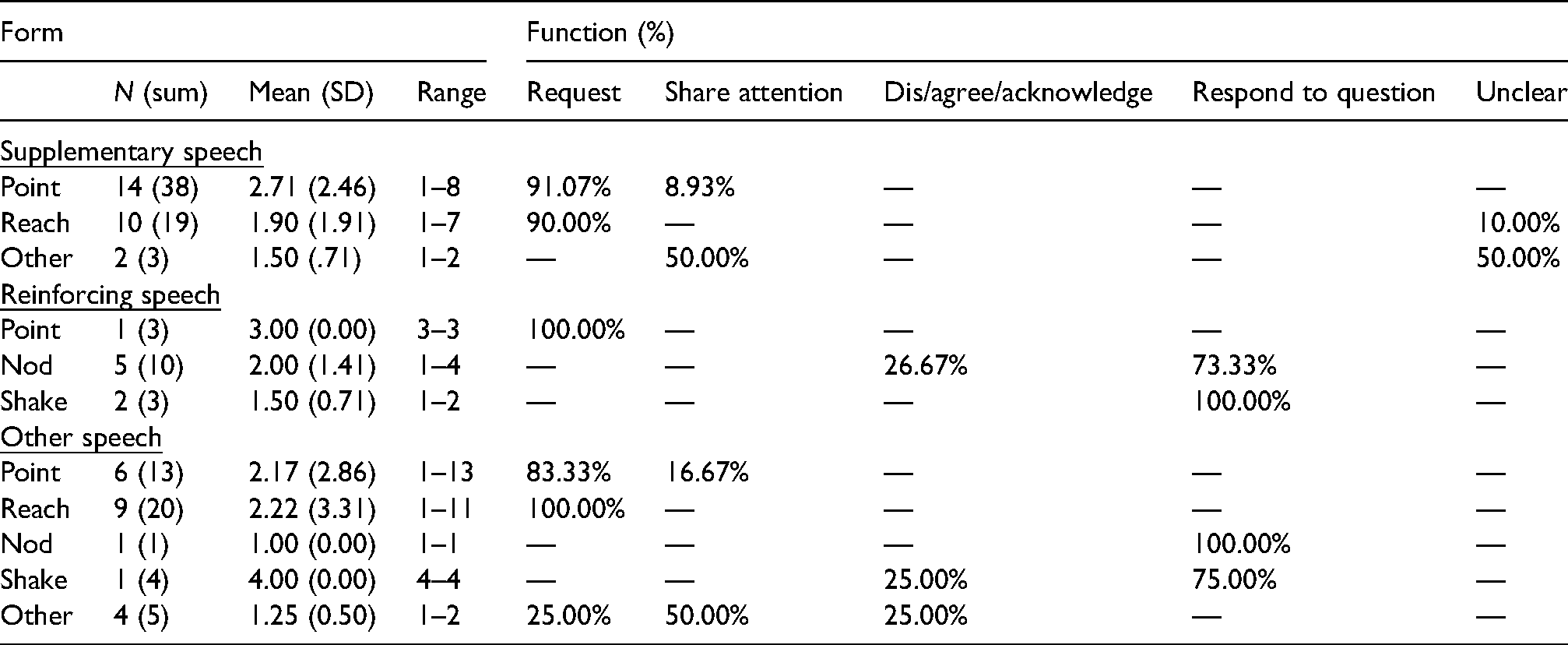
Communicative functions of gesture–speech combinations. Table 5 presents the functions of gesture–speech combinations. Collapsing across the gesture–speech combination categories, adolescents produced more combinations to respond (children: no occurrence, adolescents: M = 3.00, SD = 1.58; U = 250.0, p = .020, r = .33). Groups did not differ in any of the other communicative functions of their gesture–speech combinations.
Mean percentage of gestural function by form for each gesture–speech combination subtype.
Communicative function by modality of communication
For the three primary communicative functions used: to request, dis/agree/acknowledge, and to respond, there was a statistically significant difference by the type of communication modality used (χ2(2) = 25.221; χ2 (2) = 43.141; χ2 (2) = 27.264; p's <.0001, respectively). Children and adolescents produced more requests using gesture (mean rank = 99.01) compared to gesture–speech and speech (mean ranks = 58.59, 68.90, respectively), whereas children and adolescents used speech more often to dis/agree/acknowledge (mean rank = 101.69) the conversational partner than via gesture–speech or gesture (mean ranks = 53.56, 71.25, respectively). Similarly, the function to respond to the conversational partner was conveyed more often using speech (mean rank = 95.85) than gesture–speech or gesture (mean ranks = 61.22, 69.42, respectively).
Relation between gestural production and speech
Three participants (two children and one adolescent) only gestured, with no instances of speech. Overall, however, MV children and adolescents had the highest percentage of communication by speech only (74.53%), followed by gesture only (23.19%), followed by gesture–speech (2.28%). A multivariate regression was performed with total gestures as a predictor and total speech utterances as the outcome variable, with chronological age, nonverbal IQ, and RC ability entered as covariates. The overall model was significant, (F(40) = 7.224, p = .0002). The variables included in the model explained 41.94% of the variability in the total number of speech utterances. Fewer speech utterances was related to more frequent gesturing, after accounting for the covariates (Table 6).
Relation between total speech utterances and total number of gestures, controlling for VABS RC, chronological age, and NVIQ.
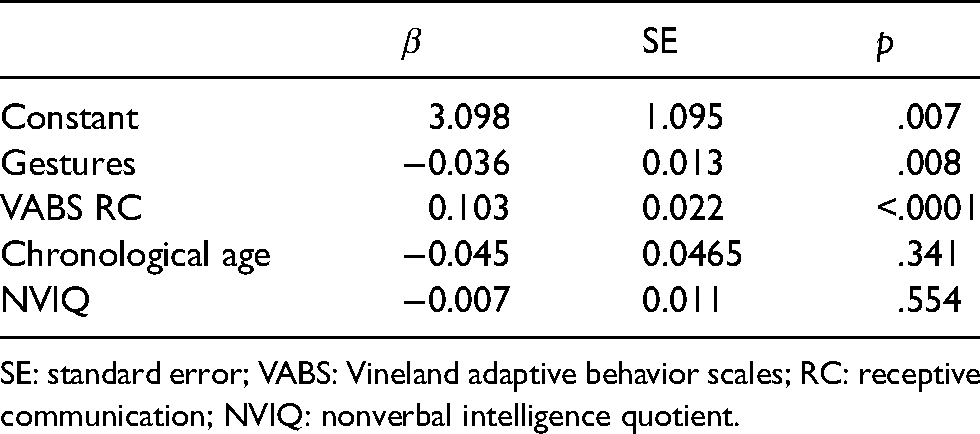
SE: standard error; VABS: Vineland adaptive behavior scales; RC: receptive communication; NVIQ: nonverbal intelligence quotient.
Discussion
This study explored how MV children and adolescents with ASD are using their gestural communication in context with a conversational partner during the first 30 minutes of the ADOS. This study extends La Valle et al. (2020) prior research to lend key insights into how MV children and adolescents with ASD are using gestures to complement their spoken language abilities. The study aims (1) explored the use of gestures, gesture–speech combinations, communicative functions, and examined differences and similarities in gestural communication between children and adolescents; (2) assessed communicative functions across different modalities of communication; and (3) investigated the relationship between speech and gesture. Finding revealed (1) more gesture–speech combinations and different types of communicative functions produced by adolescents; (2) children and adolescents more frequently requested using gesture than speech or gesture–speech but conveyed dis/agree/acknowledge and respond functions more often using speech than gesture or gesture–speech; and (3) fewer speech utterances was related to more frequent gesturing, after accounting for chronological age, RC ability, and nonverbal IQ.
Comparison between MV children and adolescents with ASD
Examining gestural communication, deictic gestures (point/reach) with the intent to request were produced most frequently by MV children and adolescents with ASD. This finding aligns with prior research suggesting difficulty in the use of joint attention gestures (e.g. pointing to share attention) found in those with ASD (e.g. Franchini et al., 2019; Maljaars et al., 2011; Özçalışkan et al., 2016; Rozga et al., 2011; Töret & Acarlar, 2011). Additionally, our study findings revealed the use of conventional gestures produced by MV children and adolescents with ASD, including head nodding/shaking during interactions with a conversational partner. This finding supports prior studies which, based on parent reports or informant interviews, reported the use of conventional gestures in children with ASD who had language production difficulties (e.g. Braddock et al., 2015; Vidal et al., 2020). However, our study provided additional insights into the functions of their conventional gestures which were often to dis/agree/acknowledge or to respond to a question posed by the conversational partner. As such, MV children and adolescents with ASD displayed different types of communicative functions within this communication modality. When combining gesture and speech, children and adolescents with ASD who are MV produced the highest proportion of supplementary gesture–speech combinations. Supplementary gesture–speech combinations play an important role in language development. Supplementary gesture–speech combinations allow one to convey different semantic relations with speech and gesture when it may be difficult to express both elements within a single spoken utterance (e.g. Özçalışkan et al., 2018). Understanding how MV children and adolescents with ASD are integrating multimodal communication can assist in identifying and targeting the production of word–word combinations in their speech to facilitate language production.
Counter to our initial hypothesis, differences emerged between children and adolescents in their use of communicative functions and gesture–speech combinations. Adolescents produced more conventional gestures (head nodding) with the intent to agree/acknowledge and to respond to a question as well as more gesture–speech combinations. In particular, adolescents produced more reinforcing gesture–speech combinations to respond to the conversational partner. The use of this combination resulted in their gesture complementing their spoken language abilities (nodding one's head + saying “yes”). Expressing reinforcing gesture–speech combinations further expanded their range of communicative functions during social interaction. Given additional life experiences, adolescents may have learned to employ different communication strategies to maintain the conversational exchange and to further clarify the message they want to convey to the conversational partner. Longitudinal studies can provide important insights into how communication strategies may evolve over time during social-interactive contexts for individuals with ASD who are MV. Such research can also capture specific factors and mechanisms that may drive developmental changes in communication, including joint attention, social engagement, motivational factors, and participation in intervention services targeting social communication.
Communicative functions and modality of communication
Across gesture, speech, and gesture–speech, MV children and adolescents with ASD conveyed similar types of communicative functions: requesting, dis/agree/acknowledgment, and to respond (i.e. to a question). However, subtle differences emerged in how often these functions were expressed depending on the communication modality. When conveying a request, MV children and adolescents with ASD did this more frequently by gesturing. It is important to consider context. During the ADOS, many items are out of reach. Several opportunities are setup across activities (e.g. construction puzzle, bubbles, and snack) to convey requests by gesturing. In contrast, when conveying dis/agree/acknowledgement or to respond to a question, MV children and adolescents with ASD more frequently used speech to express these communicative functions. A “yes” or “no” speech response may occur more often, in part, given the motor coordination required to convey those functions using gestural communication (Green et al., 2002; Ming et al., 2007; Mostofsky et al., 2007). Such responses, which are learned early in development, are also readily available within one's speech repertoire. These findings provide important insights into specific social communication skills that can be harnessed and expanded upon to optimize social development and language production. Given the overlap of functions across communication modalities, an area to target is the expansion of communicative functions. This includes sharing attention and commenting to provide high-quality social interactions, where conversational partners are sharing experiences. Indeed, sharing attention to objects and events of interest has been found to be positively associated with language gains (e.g. Bottema-Beutel, 2016).
Relation between gestural production and speech
Supporting our initial hypothesis, fewer speech utterances was related to more frequent gesturing after accounting for chronological age, nonverbal IQ, and RC ability. This finding is consistent with previous research studies investigating the relationship between speech and gesture in other groups with language production difficulties (e.g. Stefanini et al., 2007, 2008). Gestures may be used to compensate for difficulties with spoken language. Gestures are global and synthetic, in contrast to speech, which requires a hierarchical organization of smaller units into larger units that combine to create a larger meaning (e.g. Goldin-Meadow, 2006). For gestures, meaning is conveyed simultaneously by the gesture as a whole (McNeill, 1992). The articulation of a speech utterance may place greater demands on planning, memory, and mental representations compared to the production of gestures, which may free resources for other processes (e.g. Goldin-Meadow et al., 2001). Motor limitations may also influence the relation between gesture and speech. In Chenausky et al. (2019) study, ∼25% of MV individuals with ASD met the criteria for apraxia of speech. Their speech production ability was positively related to the number of different words they produced. Gesturing may, in part, serve to compensate for speech when speech alone may be difficult to produce.
Limitations and future directions
Although this study has added to our understanding of how MV children and adolescents with ASD are using their communication skills during interactions with others, caution in the interpretation of the findings should be addressed. No direct motor measure was included (Green et al., 2002; Ming et al., 2007; Mostofsky et al., 2007). Future research studies should investigate the influence of motor abilities on gestural and speech production. Longitudinal studies can evaluate changes in the use of gestures over time and their relation to speech and motor functioning within this ASD subgroup (e.g. Iverson, 2010). Transactional models of communication should also be used to investigate responses by the conversational partner. Given that our study was focused on within group variation (e.g. Tager-Flusberg, 2004), future studies should examine gestural communication in MV children and children who use phrase speech but are not yet verbally fluent to lend additional insights into the relation between gesture and speech in different subgroups. Additionally, few studies have examined gestural communication in adults with ASD (e.g. de Marchena et al., 2019). Future research studies should adopt a lifespan perspective when exploring gestural communication across the full autism spectrum.
Clinical implications
Previous research supports the influential role of gestures on language enrichment (Goldin-Meadow, 2007). Gestures represent one of the highest-quality language learning opportunities by providing a clear communicative signal interactive partners can respond to (e.g. Talbott et al., 2020). Caregivers, conversational partners, speech–language pathologists, and interventionists should continue to respond to and support gestural communication. Responding to gestures and translating their meaning into spoken words may allow the concept to more readily enter the child's spoken vocabulary (e.g. Goldin-Meadow, 2007; Özçalışkan et al., 2016; Wu & Gros-Louis, 2015). Recognition and translation of gestures may aid in bridging the link between gesture and language. Targeting gestures can also support the expansion of communicative functions. If a child has mastered requesting gestures (e.g. pointing to request) an area to target is joint attention gestures to share objects and experiences. Finding opportunities to model gestures for the purpose of sharing will assist in entering the child's own gestural repertoire with the goal of the child subsequently displaying this new skill independently. In turn, noticing and responding to gestures and pairing them with language can further build upon and support children's social communication skills (e.g. Goods et al., 2013; Kasari et al., 2006, 2010).
Conclusion
The current study focused on understanding how MV individuals with ASD use their gestural communication during social interactions and how their gestures may complement their spoken language abilities. We identified different types of gestures and gesture–speech combinations they used, including how they were used in context with a conversational partner. Our findings suggest some overlap in their communicative functions across gesture, speech, and gesture–speech, with nuanced differences in how often they were expressed across different modalities of communication. Findings underscore the importance of targeting the expansion of communicative functions (e.g. share attention), while considering multiple modalities of communication, to further support social development and language production in individuals with ASD who are MV.
Footnotes
Acknowledgements
The authors would like to thank the members of the Center for Autism Research Excellence for their assistance with this project. We are also grateful to our coders including Clara Thörn and Jordan Segal.
Ethical statement
All procedures performed involving human participants in this study were in accordance with the ethical standards of the Institutional Research Board at Boston University and with the 1964 Helsinki declaration and its later amendments or comparable ethical standards.
Declaration of conflicting interests
The authors declared no potential conflicts of interest with respect to the research, authorship, and/or publication of this article.
Funding
The authors disclosed receipt of the following financial support for the research, authorship, and/or publication of this article: This work was supported by the National Institute on Deafness and Other Communication Disorders (grant numbers P50DC013027 and RO1 DC01029003S1).
