



Abstract
Background
Climate change is one of the greatest health threats, yet many medical schools fail to adequately teach students about its impact. This article describes the development and implementation of an online elective in planetary health education.
Methods
The online elective was designed for medical students in the clinical study term and delivered in a blended learning format. It features presentations, lectures, and transformative online teaching methods including a flipped classroom with final reflection, peer role-play for simulation of climate-sensitive health counseling, producing infographics, and problem-based activities. A pre-/post-course survey was conducted at the medical faculty of Goethe University Frankfurt for the years 2021 to 2024 and used to assess how effectively the elective contributed to participants’ knowledge, beliefs, behaviors, and attitudes about the impact of climate change on health.
Results
Overall, participants rated the elective extremely positively. They were very satisfied with the design and content of the elective. The course effectively enhances self-reported knowledge of climate-related health effects and management while strengthening students’ confidence in their role in climate protection. Intentions to apply new knowledge in medical practice and in one's own daily life significantly increased. Participants recommended incorporating the topic into the regular curriculum.
Conclusions
The success of this pilot is evidence in favor of integrating climate change-related health topics into the medical curriculum, while the results provide insights useful to future research and development of online planetary health courses.
Background
Climate change represents one of the greatest global health threats. Worldwide, approximately 23% of deaths are attributable to environmental factors, and an additional 250,000 climate-related deaths per year are forecast for the period 2030–2050. 1 Climate change causes illness, infectious disease outbreaks, disruption in medical treatment, exacerbation of disease, injuries related to extreme weather events, population displacement, and adverse mental health effects. 1 These changes have a disproportionate impact, primarily affecting vulnerable populations such as low-income individuals, the elderly, people with disabilities, children, and those facing existing health disparities or suffering chronic illnesses.2,3 To address the existential threat of climate change, radical alterations must be made in all areas of human activity. This goal requires a transformative approach that goes beyond merely imparting factual knowledge. According to the principles of planetary health, 4 this requires nurturing appropriate values, practical skills, and giving people a sense of self-efficacy. Integrating these elements into people's mindset is essential if they are to understand the need for societal transformation and to become active drivers of change for better planetary health. 5 The concept of Planetary Health is an interdisciplinary approach that explores the relationship between human health and the well-being of natural ecosystems. 2 It is based on the understanding that human well-being depends on the stability and sustainability of Earth's systems, including climate, biodiversity, water, and air quality.
Health professionals need to understand the interlinkages between health and environmental changes in order to reduce harm and to promote climate-sensitive action ability in patient care. 6 However, a global survey from 2019 reported that only 15% of medical schools across 112 countries teach climate science. 7 In Canada, a competency-based learning objective catalog has been developed, and in the United Kingdom, a curriculum centered on planetary health has been introduced. 8 Within the International Federation of Medical Students’ Associations (IFMSA), there are initiatives and collaborative efforts envisioning planetary health in medical curriculum. 7 In collaboration with the World Health Organization, a climate and health training manual was developed for medical students. There is extensive educational guidance available on integrating climate science into standard medical curricula, 7 9–11 including efforts to provide training on climate change communication. 12 Wellberry et al describe potential pathways for incorporating climate-change-related topics into physician training and continuing medical education, but do not describe student assessments. 10 Similarly, Gomez et al give an example of curriculum design without imparting relevant counseling training. 11
In Germany, few medical schools have integrated the topic of “climate change” and/or “planetary health” into their formal curriculum. 13 Since 2021, the PlanetMedEd study has been a pioneering effort in assessing and providing an overview of planetary health education at medical faculties across Germany. 14 Current teaching formats are often organized by students. At the Universities of Giessen and Marburg, a student-led communication training project was implemented without programmatic evaluation of teaching effectiveness, 12 while a mandatory elective was introduced at the Medical Faculty of Ulm, which mainly fosters factual knowledge on climate change and health. 15 Schmid et al 16 reported on a longitudinal mosaic curriculum including planetary health at the Faculty of Medicine in Würzburg, which is still under development. The lack of planetary health education in German medical schools represents an important educational gap.
In view of the above, we developed and implemented an online elective introducing planetary health education for medical students in their clinical study term (years 3-5) and report findings from the course evaluation at Goethe University Frankfurt from 2021 to 2024, measuring the change in student self-assessment of knowledge, beliefs, behaviors, and attitudes in this area.
Methods
Concept
The climate science elective was conceptualized by an interprofessional team of lecturers of the climate change and health working group of the Goethe University Frankfurt. The team included a physician, a health scientist, an educator, and a geoscientist. The elective design was based on a comprehensive literature search and discussions with experts from the working group on teaching at ‘Health for Future’ and the working group on climate change and health at the German Society for General Practice and Family Medicine (DEGAM—Deutsche Gesellschaft für Allgemeinmedizin und Familienmedizin), a professional medical society. ‘Health for Future’ is a movement of healthcare professionals, scientists, and citizens advocating for the recognition of climate change as a health crisis; the working group at the DEGAM aims to integrate climate-related health issues into general practice.
The development of the elective was based on Kern's six-step approach to curriculum development, as displayed in Table 1. This approach consists of the following elements: (1) problem identification, (2) targeted needs assessment, (3) goals and objectives, (4) educational strategies, (5) implementation, and (6) evaluation and feedback. 17 We defined learning objectives using the National Competency-Based Learning Objective Catalogue for Medicine (NKLM—Nationaler Kompetenz-basierter Lernzielkatalog) 18 Although not yet mandatory, the catalogue for Planetary and Global Health represents the first nationwide attempt to operationalize the principles, content, and methods of education for planetary health in a competency-oriented manner. Its development is based on an iterative process of literature review and multidisciplinary peer review. 18 Actionable learning objectives of the catalogue were mapped against the 12 cross-cutting principles of planetary health education, a set of foundational principles proposed to guide teaching in the field of planetary health. 4 The course content of our elective was developed using the NKLM. The Department of Medicine specified that the elective should comprise 16 h over one semester. The elective also required formal approval from the study commission of the medical faculty at Goethe University Frankfurt, which was granted due to the significance of the topic. The “climate change and health” elective was offered for the first time in 2021. It is offered once each academic year at the beginning of the summer term to make it more engaging and stress-free, as there are no exams during this period. Given that planetary health education is a relatively new and rapidly developing field, we took advantage of freely available online resources to offer “blended learning.” Blended learning combines digital and in-person teaching methods. We integrated recorded lectures by external experts into in-person instruction. The use of Internet resources enables students to prepare and review material independently, allowing the actual class time to be used more effectively for interactive learning. Moreover, established multimedia design principles from the Association of American Medical Colleges Institute's report “The Effective Use of Educational Technology in Medical Education” 19 were applied to showing presentations. The elective course was continuously evaluated, and modifications were made to the curriculum from one year to the next. Based on the number of participants, in smaller groups, the focus was limited to specific topics and real-life cases to make the learning experience more impactful and immersive. We retained elements that successfully involved a high degree of interaction, such as group work, and incorporated interactive learning mechanisms integrating infographics and peer role-plays. Final grades were based on active participation during the elective and the reflection. The Defined Criteria To Report INnovations in Education (DoCTRINE) 20 checklist served as the reporting guideline for this study (Supplement file 1).
Curriculum design of the online elective based on Kern's Six-Step Approach to Curriculum Development.

Participants
The elective course was aimed at medical students in their clinical study term (years 3-5) at the Medical Faculty of Goethe University Frankfurt. In total, 20 spots were available for voluntary participation, with enrollment also open to students from other disciplines within the medical faculty, such as dentistry, biochemistry, and related fields. Participants were selected based on “first come, first serve.”
The online elective on climate change and health
The elective applied the following levels of learning by Frenk et al 21 —knowledge, values, attitudes, and transformative skills—reflected in the course's learning objectives (Table 1). According to the needs assessment, the course was aimed to equip medical students with knowledge of how climate influences health; to encourage reflection on individual responsibility to promote health within planetary boundaries; and to develop students’ own ability to implement transformative change processes in healthcare. The course consists of four main sections: (1) the concept of planetary health and the science of climate change, (2) the direct and indirect health impacts of climate change, (3) climate change communication strategies, and (4) a final reflection on professional roles. With regard to climate change communication strategies, we introduced the concept of health co-benefits, which considers how climate change mitigation action, such as diet, active mobility, and contact with nature, can also lead to health improvements. 22 This module also addresses climate resilience in healthcare, highlighting actionable opportunities for adaptation in clinical and practice settings. To accomplish the course objectives, the elective uses presentations and lectures given by multidisciplinary faculty and guest lecturers and features interactive learning mechanisms. The structure of the online elective and a detailed list of the content are presented in Table 2. The course is facilitated by virtual videoconferencing (Zoom Video Communications Inc., San Jose, CA, USA), providing participants with a flexible and interactive learning environment.
The online elective on climate change and health.

NKLM PH, National Competency-Based Learning Objective Catalogue for Medicine (Nationaler Kompetenz-basierter Lernzielkatalog) for Planetary Health.
Transformative online teaching
Our elective course is designed on the principle of transformative teaching on planetary health. 23 This educational approach seeks to inspire shifts in understanding, attitudes, and actions regarding climate change. It goes beyond simply conveying scientific facts and aims to foster critical thinking, problem-solving skills, and personal engagement in order to address the climate crisis. Transformative teaching in this context seeks to provide deep, impactful learning experiences that equip students with the knowledge and confidence to tackle real-world challenges. The course, therefore, emphasizes the development of practical skills, self-efficacy, and resilience, preparing students to respond to complex issues at the intersection of planetary and human health. We used the following teaching methods:
Evaluation
The university required evaluation of the elective by means of a standardized online questionnaire. We used the evaluation template of the Institute of General Practice and the Department of Medicine 25 and included a 28-item pre/-post intervention survey to evaluate the changes in student self-assessment of course goals. Changes in participants’ knowledge, beliefs, behaviors, and attitudes regarding climate change were key outcome measures. This approach was based on a similar study conducted at Stanford University 11 in which students’ self-assessments were used for evaluation in a pre-/post-comparison. The Stanford authors argue that this approach is more appropriate than a knowledge test, given the broad range of topics covered.
The selection of survey questions and response items underwent a thorough development process to ensure that content, internal structure, and wording would work well for the respondents. Before full distribution, we piloted the survey within the author group (DL, JUM, and OA) and cross-checked the results to ensure consistency, demonstrating response process validity. An online link was used to access the questionnaire and to collect the data anonymously. Most items were assessed on a six-point Likert scale, with the points equivalent to the German grading system (1 = very good, 6 = insufficient). Open comment prompts allowed participants to comment on strengths and limitations, as well as any need for improvement. For the purpose of reliability, the same set of questions was used during each year of the study.
Statistical analysis
Descriptive statistics were used in the analysis. There was no significant difference between the characteristics of the four cohorts from 2021 to 2024; thus, the results of the four years were pooled together for analysis (total: 42 students). A one-sided Wilcoxon test at a 5% significance level determined differences in individual survey responses before and after the educational intervention (pre/post comparison). The effect size (r) was calculated to provide an estimate of practical significance, aiding in the interpretation of the effect's magnitude. Effect size was calculated for a single-group design with repeated measures, with values interpreted as follows: less than 0.3 as small, between 0.3 and 0.5 as medium, and greater than 0.5 as strong effects. 26 All analyses and visualizations were performed with the statistical program R. 27
Ethics Approval and Consent to Participate
All methods were carried out in accordance with the Declaration of Helsinki and other relevant guidelines and regulations. Participation in the evaluation was voluntary. To assure confidentiality, each student generated their four-digit pseudonym instead of stating their name or student number on the evaluation sheet. Informed consent for participation and publication of these anonymous evaluation results was obtained from all subjects and/or their legal guardian(s) for reasons of practicability. The institutional ethics committee of the Medical Faculty of Goethe University Frankfurt (Ethikkommission des Fachbereichs Medizin Universitätsklinikum der Goethe-Universität) acknowledged the processes including verbal informed consent, and waived ethical approval.
Results
Four different cohorts participated in the elective course from 2021 to 2024. Of the 51 students over the four years, 42 participated in the final survey (response rate was 82%). Respondents were predominantly female (31/42; 73.8%). The sample included 34 medical students and seven students in various sciences, among which were dentistry and biochemistry. The majority of the respondents were enrolled in clinical semesters ranging from the fourth to tenth semester, with the seventh semester being the mean (Table 3).
Respondent sociodemographic characteristics from 2021 to 2024.

Overall, respondents rated the elective extremely positively (overall school grade 1.3). The majority of respondents were particularly positive about the possibility to participate actively in the course (91% of respondents agreed or strongly agreed), the good organization (81% of respondents agreed or strongly agreed), and the constructive working atmosphere (87.5% of respondents agreed or strongly agreed, Figure 1). The majority “agreed or strongly agreed” that their prior knowledge sufficed to follow the course (98%), that the teaching materials were satisfactory (95%), and that the learning objectives were clearly recognizable (98%). Around 98% of the respondents said they would recommend the elective. 76.2% (32/42) of the students rated the timeframe as “just right,” and 11.9% (5/42) as “too short.” 95.1% (39/42) of respondents regarded the amount of material in the course as “just right.” 85.4% (35/42) of respondents were interested in a more advanced course on this topic. After the educational intervention, the median agreement level reported by respondents significantly improved for the implementation of the topic in the medical curriculum. Evaluation results are shown in Figures 1 and 2 and Table 4.

Didactic evaluation of the online elective “climate change and health.”
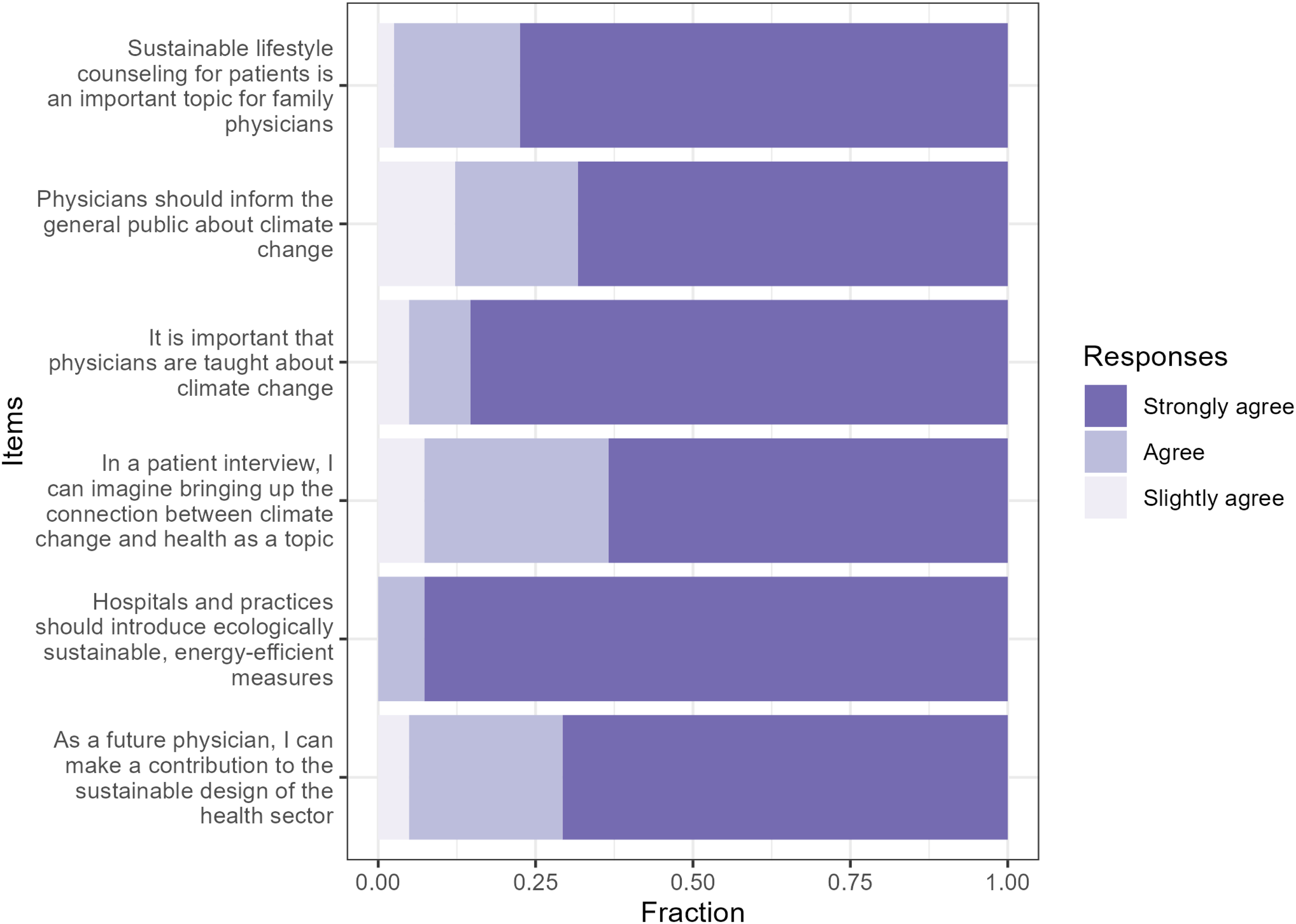
Student professional behaviors and attitudes after the educational intervention.
Self-reported student confidence regarding climate science knowledge, beliefs, behavior, and attitudes before and after the educational intervention.

Likert items range from 1 (strongly agree) to 6 (strongly disagree).
Bolded items indicate a significant value.
Knowledge
After completion of the educational intervention, a significant difference in the assessment of knowledge was shown for all survey items (Table 4). On the post-intervention survey, there was a particularly high effect size in knowledge about the health-related effects of climate change and their management, as well as awareness of the evidence for climate change.
Beliefs
After completion of the educational intervention, agreement with concerns about climate change and its negative impact on life was stronger and more significant than before the intervention (Table 4). The shift in agreement level was particularly pronounced (and highly significant) for the item “I can make a positive contribution towards climate protection.”
Behaviors and attitudes
After completion of the educational intervention, there was a significant shift in agreement with the item on applying principles of sustainability in personal life (nutrition, mobility, waste), and a moderate effect size was noted (Table 4). No change was seen between pre- and post-test in the median agreement level on survey responses for the reflection on a sustainable lifestyle.
As the students could only realistically anticipate their role-related behavior as physicians after having participated in the course, only a post-intervention survey was conducted (Figure 2). Before the course, they lacked the necessary context, knowledge, and experience to accurately assess how they would apply the concepts in their future professional roles. Nearly all respondents agreed or strongly agreed with these statements: “Sustainable lifestyle counseling for patients is an important topic for family physicians” (95% of respondents), “Hospitals and practices should introduce ecologically sustainable, energy-efficient measures” (100% of respondents), “In a patient interview, I can imagine bringing up the connection between climate change and health as a topic” (92.5% of respondents), “It is important for physicians to be educated on climate change” (95% of respondents), “Physicians should inform the public about climate change” (87.5% of respondents), and “As a future physician, I can make a contribution to the sustainable design of the health sector” (95% of respondents).
In additional feedback, the structure and teaching atmosphere of the elective were positively remarked upon. Furthermore, students considered the high levels of interactivity within the group to be reassuring. Students suggested including topics on climate and health, such as the impact of traffic, plastics/ microplastics, and plant-based nutrition in more detail. They wished to connect with each other through a phone number list or a WhatsApp group during the course. There were no negative comments on the teaching methods of the course. Table 5 summarizes representative quotes from student responses in the “climate change and health” elective course.
Common themes and representative quotes from student responses in the “climate change and health” elective course.

Discussion
We found that the completion of a climate science elective for medical school students was associated with a statistically significant increase in self-reported knowledge and students’ beliefs about their own positive contribution towards climate protection. Intentions to apply new knowledge in future clinical practice and in personal life also increased statistically significantly, pre- and post-elective. These effects may help students to develop both an appreciation for this issue and professional responsibility, which may be practice-changing. We therefore met our competency goals by equipping medical students with the knowledge of how climate change influences health, encouraging reflection on their personal responsibility to promote health within planetary boundaries, and developing their ability to identify opportunities for implementing transformative change processes in healthcare. We used a standardized online questionnaire to evaluate the elective, including a pre-/post-intervention survey evaluating the changes in student self-assessment of course goals. Our elective course demonstrates that it is an effective format for integrating climate change education in the medical curriculum and developing transformative competences. The alignment between self-assessment and objective evaluation of learning outcomes has been confirmed in other studies. 28
Overall, more female than male students participated in the elective course, in line with the general gender distribution in medical education 29 and the greater participation of women in environmental activism. 30
To help students achieve transformative competencies, we successfully used online learning techniques with a combination of asynchronous and synchronous models, with a final reflection. After preparation, online interactions broadened participants’ involvement, promoted group discussion, fostered an online community, and enabled students to plan tasks that required real-time feedback. 31 The ability to connect and share experiences with peers could help in shaping a shared vision for the future, thereby addressing the challenge of imagination. The final reflection involves a deep, critical examination of students’ learning experiences, focusing on how they challenge and potentially change viewpoints, beliefs, and behaviors. Critical examination may encourage students to question their assumptions, connect new knowledge to personal and societal contexts, and envision how their learning can drive meaningful change in their personal and professional behaviors. This reflective process is central to achieving the goals of transformative education, as it fosters a deeper understanding and commitment to action that aligns with new environmentally focused values.
Participants were satisfied with the content and design of the elective course, especially with the opportunity to engage with new material. The effectiveness of interactive virtual learning in health education is well established and reflects its substantial contribution to improving access to and availability of resources by removing geographical barriers. 32 Moreover, this educational method offers flexible access to learning materials anytime and ensures continuity of education during crises such as the 2019 coronavirus pandemic. 33 Through the variety of activities to which students are exposed, it fosters interaction and open discussions, enhances classroom dynamics, and helps to investigate complex topics, all of which have been shown to improve students’ learning experience overall.34,35 Role-plays are important in communication skills training 36 by providing targeted practice and useful feedback. 37 Peer role-plays as a component thereof constitute cost-effective education in healthcare. 38 Through their experience, students may develop a better understanding of the involved physician-patient interaction dimensions. 39 Moreover, peer role-plays are a dynamic component of transformative education, enabling students to actively engage with complex issues, reflect critically, 40 and apply their learning in ways that promote personal and societal transformation. 41 In a cross-sectional survey from Switzerland, the majority of general practitioners reported that they address climate change during medical consultations and that the co-benefits approach helps them. 42 Infographics are increasingly becoming a popular medium in academic medicine to boost the visibility and dissemination of journals’ research. 43 Creating an infographic supports teaching complex subjects, such as climate science, and calls on skill sets that medical students do not normally exercise. 15 The process is reinforcing and engaging while allowing for deeper processing of content. 34 Olzdami et al noted that infographics were more effective than traditional methods. 44 Moreover, using infographics to communicate medical information to patients may enhance patients’ decision-making capabilities and improve the practitioner-patient relationship. 45 In a systematic scoping review, the beneficial effects of problem-based learning were reported in improving social and communication skills. 46 Jung et al concluded that online education is as effective as conventional face-to-face teaching, showing no differences in learning outcomes in their review. 47 It should be noted, however, that online courses require teachers’ engagement and students’ collaboration as well as elaborate preparation that is adapted to suit the needs of an online format. 48 Our elective course is one of the first courses of its kind in Germany, so the methods described can be helpful in the further development of the field. It can be replicated in other teaching and learning modalities even when physical distancing is not necessary (eg, in smaller partner universities in rural areas).
Limitations to our study include its small sample size and standard biases associated with self-assessments. In addition, participants’ satisfaction with the elective content may be driven by self-selection, since enrollment was voluntary. Individual teacher factors may influence the learning experience. Moreover, we cannot assess without a formal examination whether participants have achieved the learning objectives for climate education. This would be valuable to future iterations of this elective. Also, the question of why students do not state any change in attitude towards reflection on a sustainable lifestyle will be a matter of further investigation. We considered the linkage between personal and professional attitudes as a possible research target and will focus on this topic during our follow-up.
Conclusions
The “climate change and health” course shows effectiveness in increasing knowledge outcomes, students’ beliefs about their positive contribution towards climate protection, and intentions to apply new knowledge in future practice and personal life. Our findings provide useful insights for future research and development of online planetary health courses. The potential of transformative online teaching methods deserves further exploration.
Supplemental Material
sj-pdf-1-mde-10.1177_23821205251404316 - Supplemental material for Teaching on Climate Change and Health—Development and Implementation of an Online Elective Course for Medical Students
Supplemental material, sj-pdf-1-mde-10.1177_23821205251404316 for Teaching on Climate Change and Health—Development and Implementation of an Online Elective Course for Medical Students by Olga Anastasia Amberger, Svea Holtz, Judith Ullmann-Moskovits, Anette Christ, Armin Wunder, Marischa Fast and Dorothea Lemke in Journal of Medical Education and Curricular Development
Footnotes
Acknowledgements
We would like to thank Anna McSherry for editing the manuscript and Michel Wensing for making suggestions.

Ethical Considerations and Consent to Participate
All methods were carried out in accordance with the Declaration of Helsinki and other relevant guidelines and regulations. Participation in the evaluation was voluntary. To assure confidentiality, each student generated their four-digit pseudonym instead of stating their name or student number on the evaluation sheet. In this way, longitudinal tracking of students is possible, but not the identification of individuals. Informed consent for participation and publication of these anonymous evaluation results was obtained verbally from all subjects and/or their legal guardian(s) for reasons of practicability. The institutional ethics committee of the Medical Faculty of Goethe University Frankfurt (Ethikkommission des Fachbereichs Medizin Universitätsklinikum der Goethe-Universität) acknowledged the processes including verbal informed consent, and waived ethical approval. Descriptive statistics were performed according to SAMPL guidelines.
Authors’ Contributions
OA, SH, JUM, and DL designed the online elective. OA, SH, DL, JUM, AC, and AW were involved in the online elective as lecturers. DL was responsible for retrieving evaluation data and for preparing figures. MF made critical revisions. OA drafted the manuscript. All authors have read and approved the manuscript.
Funding
The authors received no financial support for the research, authorship, and/or publication of this article.
Declaration of Conflicting Interests
The authors declared no potential conflicts of interest with respect to the research, authorship, and/or publication of this article.
Data Availability
The datasets used during the current study are available from the corresponding author on reasonable request.
Supplemental Material
Supplemental material for this article is available online.
References
Supplementary Material
Please find the following supplemental material available below.
For Open Access articles published under a Creative Commons License, all supplemental material carries the same license as the article it is associated with.
For non-Open Access articles published, all supplemental material carries a non-exclusive license, and permission requests for re-use of supplemental material or any part of supplemental material shall be sent directly to the copyright owner as specified in the copyright notice associated with the article.
