



Abstract
Background
Case-based learning (CBL) is currently used in multiple health-care settings around the world. Case Sharing is a WeChat mini-program created by the Chinese Medical Association Publishing House, providing a platform for doctors to record, discover, and discuss clinical cases, allowing cases to be widely disseminated and realize greater value. This research study evaluates, for the first time, the feasibility of utilizing the Case Sharing platform for CBL in our clinical endodontics training.
Methods
The CBL on Case Sharing consists of 4 modules: (1) Residents upload cases to the Case Sharing platform; (2) All residents independently study the cases in advance, formulate questions related to the cases, and propose potential diagnoses and treatment plans; (3) Online meetings for group discussions are conducted; (4) Teachers in every group provide a summary. The participants in the CBL course were 48 residents (1st-, 2nd-, 3rd-year residents) at the School of Stomatology, Wuhan University, China. Then, a 12-item electronic questionnaire was distributed to 48 residents.
Results
The majority of participants exhibited positive attitudes toward the CBL course on Case Sharing platform, attributing its value to the collaborative learning experience that facilitated a faster acquisition and understanding of common diseases of endodontics.
Conclusions
The Case Sharing platform, as described, breaks through the spatial and temporal constraints of traditional CBL. Residents can gain insight into others’ perspectives, enriching their clinical perspectives from multiple angles. Our experience indicates that the application of Case Sharing on CBL contributed to the authentic practice of the endodontics clinical course.
Introduction
Medical education is a vibrant field of study that has experienced a substantial revolution in the recent decades. Within health education, the objectives of medical education programs include: (1) cultivating educational leaders, (2) altering learners’ knowledge, skills, or attitudes, and (3) enhancing educational structures. 1 The traditional teaching is dominated by a teacher-centered method, which emphasizes knowledge, content, teacher-centered classrooms, and exam results. 2 While traditional teaching methods have still facilitated the achievement of some of the objectives to a certain extent, but they have been less effective and not student-centered. Educators now induced many educational techniques into medical education, such as case-based learning (CBL). 3
CBL is a unique form of PBL that takes the learner as the center and guides students’ study and exploration through cases.4,5 Numerous research studies have demonstrated the effectiveness of CBL in improving the clinical practice, problem-solving, and analytical skills of residents and medical students.6,7
However, for traditional CBL, clinical preceptors and residents must gather at specific times and locations to discuss and study cases. Additionally, the cases studied cannot be effectively recorded for future reference, nor can they be conveniently reviewed by learners repeatedly. To address the aforementioned shortcomings, we attempted to utilize the Case Sharing platform for CBL. Case Sharing is a WeChat mini-program created by the Chinese Medical Association Publishing House. It's a clinical case community providing a platform for doctors to record, discover, and discuss clinical cases, allowing cases to be widely disseminated and realize greater value. When the mini-program was online, the department of endodontics at Wuhan University settled the platform immediately.
Given that WeChat is the most frequently used app in China, it's more convenient for us to do CBL in the WeChat mini-program, Case Sharing. 8 In this study, we investigated the feasibility and acceptability of utilizing Case Sharing-CBL for students undergoing the clinical endodontics training.
Methods
Participants
This study was approved by the Medical Ethics Committee of the Stomatology School of Wuhan University (protocol No. 810957). In this study, Case Sharing-CBL was conducted from June to December 2023 at the Hospital of Stomatology, Wuhan University, in China. Resident doctors practicing dental medicine in Department of Cariology and Endodontics participated in this study. Participates were eligible for inclusion, if they (1) have participated in CBL, (2) have completed at least 6 months of clinical rotation or coursework to ensure a basic level of clinical knowledge, (3) were willing to participate in the study, (4) were able to complete the evaluation questionnaire or interviews during the study period. Participates were excluded if they (1) have not received CBL courses or are entirely unfamiliar with CBL, (2) were unable to complete the study due to health or personal reasons, (3) could not reliably access the online learning platform. We selected 48 residents and 6 tutors based on the inclusion criteria to participate in this study (Figure 1).

Participant Flow Chart.
Each participant was equipped with an individual mobile phone, instructed to install WeChat app, and registered in the Case Sharing mini-program. Random assignments were made for the distribution of 48 residents and 6 tutors from Department of Cariology and Endodontics across these groups. Each group comprised 8 students and their designated tutor.
Case Sharing Cased-Based Learning Mode
As a mini-program, Case Sharing is open for all hospital, doctors, and residents in China. Residents and tutors registered in the Case Sharing and belong to Department of Cariology and Endodontics, the Hospital of Stomatology, Wuhan University (Figure 2).

User Interface in Case Sharing Platform.
For the Case Sharing CBL, residents uploaded cases in advance to the Case Sharing platform. Residents were required to preview cases in advance, pose questions, and suggest possible diagnoses and treatment plans. Then, online meetings are held to discuss case contents, address related issues, and determine diagnoses and treatment plans. After discussion, the tutor summarizes and provides feedback (Figures 3 and 4).
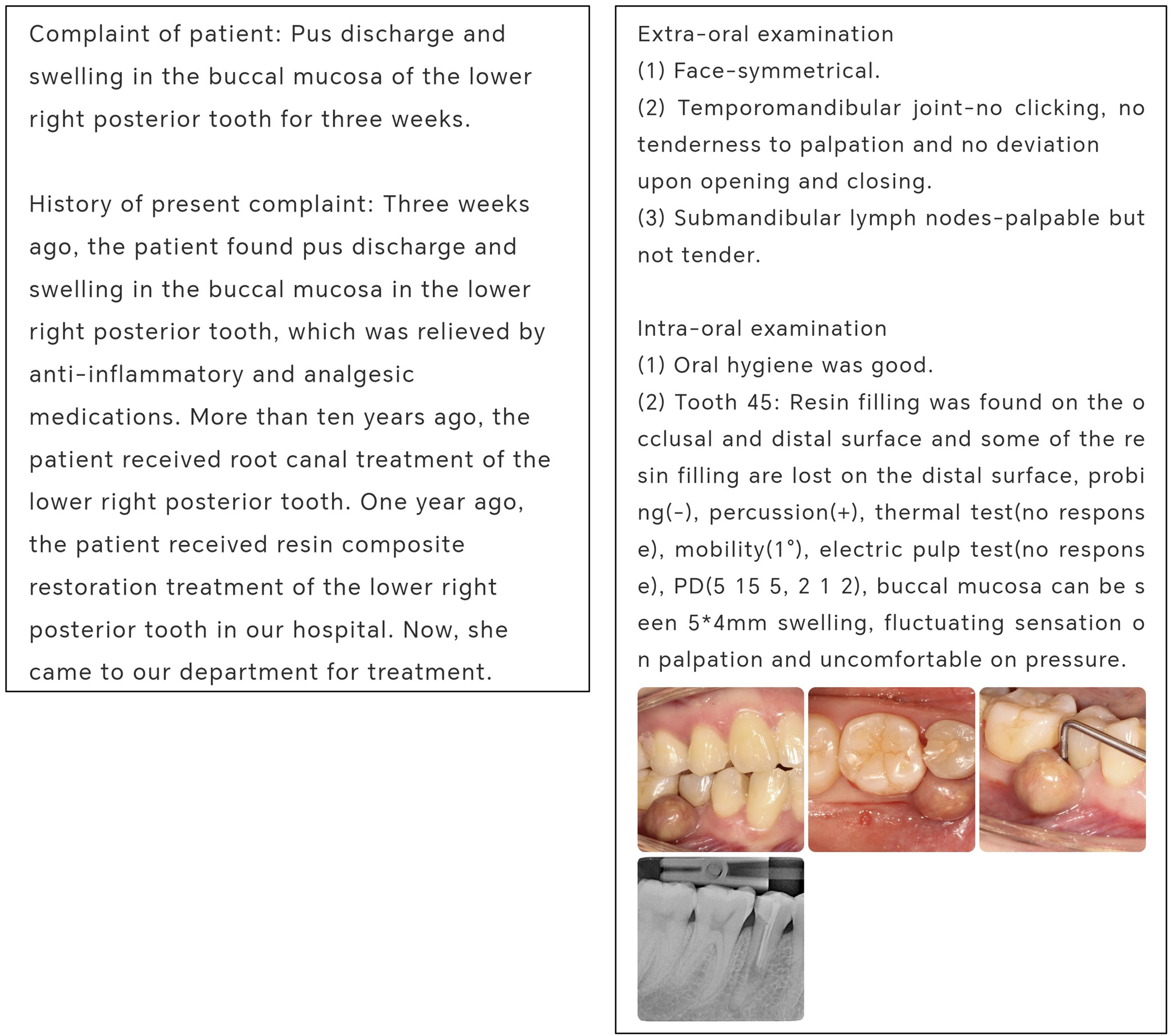
Example of One Case Record on Case Sharing Platform.
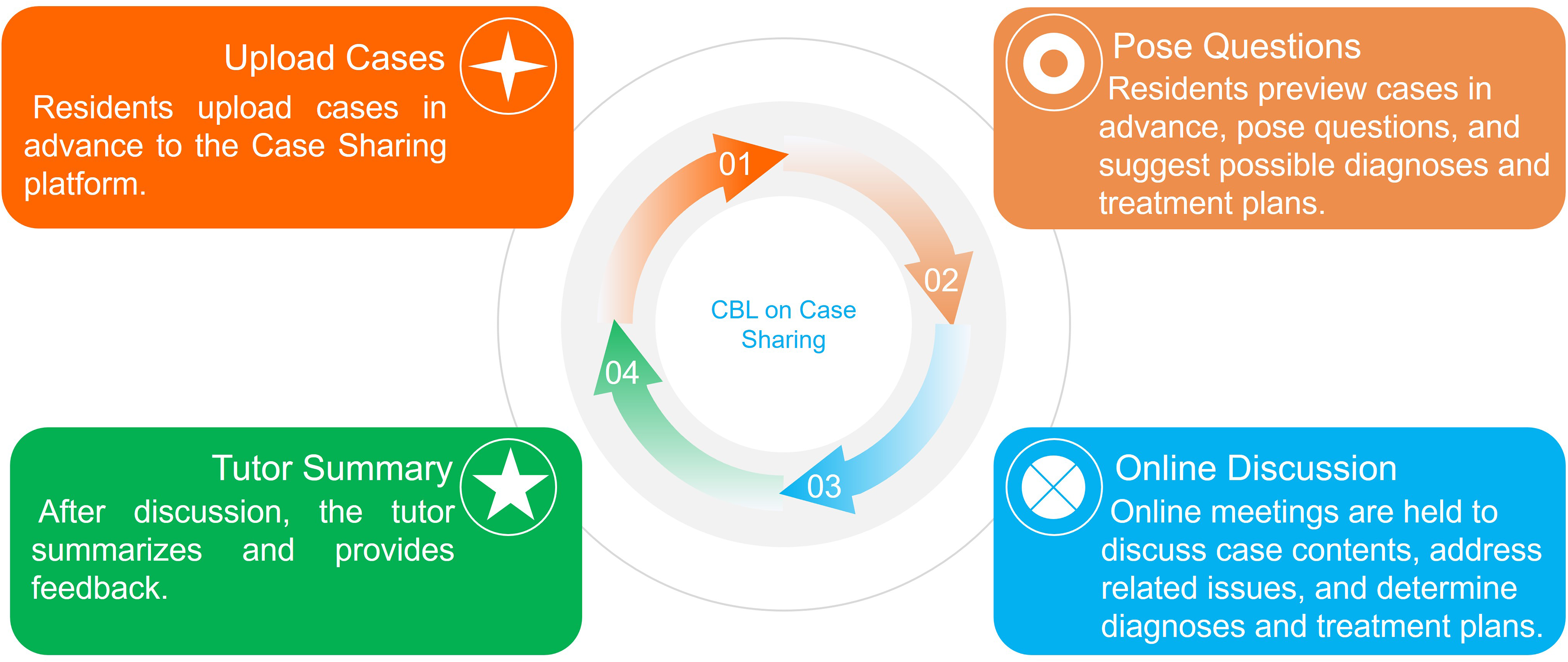
Flowchart Showing the Framework of Case-Based Learning (CBL) on Case Sharing Platform.
Case-based Learning Cases
In this study, Department of Cariology and Endodontics has joined the Case Sharing platform, establishing 8 case collections, including Cases from Doctoral Students, Cases from Master's Students, Cases from Advanced Trainees, Cases from Socially Trained Residents, Classic Cases, Rare Disease Cases, Clinical Classic Cases, and Challenging Cases. Residents totally uploaded 53 cases on the Case Sharing platform. All cases were real clinical cases, including aesthetic anterior composite restorations, dental caries management, integrated crown-root treatment, endodontic microsurgery, apexification. These cases involve common diseases and common treatment techniques in the field of dental pulp and periapical tissues. We selected 36 classic cases for learning. The learning sessions took place 3 times per week, spanning a total duration of 3 months. It often took 40 min to discuss one case.
Evaluation
In order to evaluate the efficiency and acceptability of Case Sharing CBL for residents, the questionnaire was designed based on similar researches.9,10 A Likert scale was used for quantitative scoring: “Strongly Disagree” was assigned 1 point, “Disagree” was assigned 2 points, “Neutral” was assigned 3 points, “Agree” was assigned 4 points, and “Strongly Agree” was assigned 5 points. Higher scores indicated a greater level of agreement with the relevant content among students. Then, it was sent to residents via a web-based survey tool. A total of 48 questionnaires were sent out in this study, and 48 were effectively recovered, with an effective recovery rate of 100%.
Statistical Analysis
Statistical analysis was performed using SPSS 29.0 software. Likert scale scores were presented as mean ± standard deviation and percentage.
The reporting of this study conforms to the STROBE statement. 11
Results
The Attitudes Toward the Case Sharing CBL
To analyze students’ attitudes towards Case Sharing CBL, at the end of the course, participants were asked to submit an anonymous attitude survey. It was ranked on a scale of 1-5, “Strongly Disagree” was assigned 1 point, “Disagree” was assigned 2 points, “Neutral” was assigned 3 points, “Agree” was assigned 4 points, and “Strongly Agree” was assigned 5 points. A total of 48 students participated in this survey.
We use the mean and standard deviation to present the final scoring results. Descriptive analysis showed that the majority of Likert scale mean scores exceeded 4.0, reflecting a predominantly positive perception of the Case Sharing platform for CBL among residents. One item received a slightly lower mean score of 3.94. The standard deviations, consistently around 0.8, indicate moderate variability in responses, suggesting relative agreement among participants (Table 1).
Teaching Effectiveness Feedback Assessment Content.

Next, we conducted a detailed analysis of the questionnaire. Questions 1-4 focused on the personal involvement of residents throughout the learning stages. The results indicate that over 70% of residents were well-prepared for cases before discussions, actively engage in learning, share their acquired knowledge, and provide constructive opinions (Figure S1). Questions 5-8 addressed the role of the Case Sharing platform in the clinical learning of residents. Statistical results show that many students (
Discussion
Traditional clinical learning primarily involves chairside teaching, where tutors guide residents in the diagnosis and treatment of patients during the examination process. However, due to time constraints, this process often limits effective communication between teachers and residents. Clinical issues also heavily rely on the observational skills, practical abilities, and analytical thinking capabilities of the residents themselves. A singular traditional teaching model no longer suffice to meet the needs of medical education. New teaching methods are continually being tested and refined. For instance, the learning outcomes of the flipped classroom surpass traditional teaching, 12 scenario-based teaching can enhance clinical skills, boost confidence, and alleviate stress. 13 In order to better cultivate the clinical skills of residents, we have introduced Case Sharing CBL in our department.
Currently, there is no clear definition of CBL internationally, and researchers from different countries have proposed varying details but with a similar core definition.14–18 We consider CBL as a student-centered, case-driven, inquiry-based teaching approach. It serves as a bridge that helps students connect theoretical knowledge from textbooks with complex clinical situations. CBL aims to facilitate early integration of knowledge, fostering a proactive approach to adapting to clinical practice.4,19 In addition, compared to a singular traditional teaching model, CBL demonstrates superior learning outcomes and is more favored by students.5,20–22
As time goes on, CBL is evolving and progressing; it can be integrated with various teaching tools and platforms. 23 In this study, CBL is conducted on the Case Sharing platform. The results of this study demonstrate that the majority of residents recognize the value of the Case Sharing platform in facilitating CBL and enhancing clinical education. With most Likert scale mean scores exceeding 4.0, it is evident that residents generally find the platform beneficial for improving their clinical reasoning and decision-making skills. This positive reception highlights the platform's potential as an effective supplementary tool for postgraduate medical education.
The Case Sharing that as an online platform, it removes the traditional CBL's constraints on time and location. As long as the residents upload the case to the platform, they can access the case at any time and place, and can record their doubts, insights, diagnostic reasoning, and clinical decision-making about the case on the platform at any time. All members can see the relevant questions and can look up the questions of interest in advance for sharing during online discussions. More and more evidence suggests that spontaneous collaboration and information exchange among medical learners have a significant impact on educational outcomes.24–29 The Case Sharing provides a good platform for sharing educational resources. The cases on this platform are visible to everyone and include diseases of the dental pulp and oral multispecialty lesions. In Case Sharing CBL, real cases are primarily used to facilitate the application of diagnostic thinking and procedural skills that students have already learned. This new model enhances students’ learning enthusiasm and strengthens their practical abilities.
Case Sharing CBL provides a teaching paradigm for current clinical teaching. The Internet has penetrated into all walks of life, and medical education is no exception. Case Sharing CBL provides a teaching paradigm for using the Internet in current clinical teaching. Each resident may encounter certain types of diseases in clinical practice within a limited time. Case Sharing CBL allows residents to learn from a wider range of cases, as well as share cases they are interested. By utilizing this platform, CBL can transform individual learning events into opportunities for everyone to expand their knowledge.
When encountering representative or interesting cases, they stop to record and discuss, deepening clinical thinking. The discussion of multidisciplinary cases helps broaden horizons, with a focus on solving clinical problems, motivating residents to learn independently, consult literature, and transform from traditional passive acceptance of new knowledge to self-directed learning. Combining with real cases, it is more conducive to the training of clinical diagnosis and treatment thinking and the improvement of clinical skills.
The incorporation of internet-based learning platforms has become increasingly prevalent in medical education. 30 A scoping review by Choi-Lundberg et al highlighted that online CBL engages students through active learning in small groups, promoting critical thinking and application of knowledge. 31 Similarly, a study demonstrated that online CBL effectively enhances medical students’ clinical reasoning skills, providing flexibility and accessibility in learning. 32 The Case Sharing platform's digital approach aligns with these trends, offering residents interactive and flexible learning opportunities.
Despite the overall positive feedback, the study also identified areas for improvement. Some residents expressed a neutral stance toward the platform, with one item receiving a mean score of 3.94. This suggests that while the platform is effective, there is room for enhancement. A study emphasized the importance of aligning online learning activities with learners’ needs and preferences to maximize engagement. 33 Addressing these concerns could involve refining the platform's content to better align with residents’ clinical experiences and incorporating more interactive elements to engage users.
Limitation
There are still some limitations in Case Sharing CBL. A few students are not actively participating in the discussion stage. On one hand, this may be due to insufficient preparation, and on the other hand, some students, due to their personality, fear having their viewpoints exposed, opting to conceal their thoughts and passively engage in discussions. To address these limitations, it's necessary for tutors to provide reasonable guidance during online discussion sessions, urging and encouraging these students to express their opinions. Simultaneously, when selecting cases, it's important to choose those that are more likely to spark interest and curiosity to stimulate their engagement. 34
One limitation of this study is the small sample size. The total number of standardized training residents in our department is 48. This discrepancy may limit the generalizability of our findings and reduce the statistical power to detect smaller effects. Future studies with larger and more diverse samples are needed to validate these findings.
Conclusions
In summary, Case Sharing CBL reinforces residents’ understanding of the oral medicine diseases. It aids in cultivating students’ logical thinking, clinical reasoning, and diagnostic interpretation abilities. In conclusion, CBL on the platform of Case Sharing is an effective and convenient method for the standardized training of residents in endodontics.
Supplemental Material
sj-docx-1-mde-10.1177_23821205251334318 - Supplemental material for A Novel Platform for Case-Based Learning in the Clinical Endodontics Training: Feasibility Study
Supplemental material, sj-docx-1-mde-10.1177_23821205251334318 for A Novel Platform for Case-Based Learning in the Clinical Endodontics Training: Feasibility Study by Yuxiu Lin, Rui Zhang, Wei Zhang, Weiwei Qiao, Fushi Wang and Li Wang in Journal of Medical Education and Curricular Development
Supplemental Material
sj-doc-3-mde-10.1177_23821205251334318 - Supplemental material for A Novel Platform for Case-Based Learning in the Clinical Endodontics Training: Feasibility Study
Supplemental material, sj-doc-3-mde-10.1177_23821205251334318 for A Novel Platform for Case-Based Learning in the Clinical Endodontics Training: Feasibility Study by Yuxiu Lin, Rui Zhang, Wei Zhang, Weiwei Qiao, Fushi Wang and Li Wang in Journal of Medical Education and Curricular Development
Footnotes
Acknowledgments
The authors are grateful to the Chinese Medical Association Publishing House for creating Case Sharing and Dr Yuqiao Wang for her help with the usage of Case Sharing platform in this paper.

Ethical Considerations
This study was approved by the Medical Ethics Committee of the Stomatology School of Wuhan University (protocol No. 810957).
Consent to Participate
We obtained informed consent from all participate.
Consent for Publication
All authors gave consent to its publication to the Journal of Medical Education and Curricular Development.
Author Contributions
Li Wang conceived the idea and designed the experiments. Yuxiu Lin did formal analysis and writing. Rui Zhang, Wei Zhang, Weiwei Qiao, Fushi Wang contributed to the analysis and interpretation of data.
Funding
The authors disclosed receipt of the following financial support for the research, authorship, and/or publication of this article: This work was supported by the Fundamental Research Funds for the Central Universities (No.2042023kf0144) and Hubei Provincial Natural Science Foundation of China (No.2023AFB098) to Yuxiu Lin.
Declaration of Conflicting Interests
The authors declared no potential conflicts of interest with respect to the research, authorship, and/or publication of this article.
Data Availability Statement
Data is provided within the manuscript or supplemental information files.
Supplemental Material
Supplemental material for this article is available online.
References
Supplementary Material
Please find the following supplemental material available below.
For Open Access articles published under a Creative Commons License, all supplemental material carries the same license as the article it is associated with.
For non-Open Access articles published, all supplemental material carries a non-exclusive license, and permission requests for re-use of supplemental material or any part of supplemental material shall be sent directly to the copyright owner as specified in the copyright notice associated with the article.
