




Abstract
Introduction
Academic bullying is prevalent in medical schools due to their unique study settings. Globally, the prevalence of academic bullying is increasing markedly; it ranges from 27% to 99.1%. However, the extent, forms, and associated factors of academic bullying among medical students in Tanzania are unknown.
Objective
To determine the prevalence, forms, and factors associated with academic bullying among medical students in Tanzania.
Methodology
This was a cross-sectional study among medical students in 10 medical schools in Tanzania using an online structured questionnaire. Statistical analysis included the use of frequencies, percentages, chi-square and univariate logistic regression at 95% confidence intervals (CIs) and significance at p-value <0.05.
Results
The study included 427 medical students. Majority (71.7%) of the medical students were in their clinical years. Among the participants, 80.8% had heard of academic bullying in medical school. Prevalence of academic bullying was 34.7% while 28.7% had a secondary experience. It was more common in clinical rotation settings (65.4%). Verbal abuse was the most common form of bullying. Factors associated with academic bullying included age, sex, marital status, religion, class category, year of study, presence of mentorship programs, having a mentor or not, presence of bullying reporting system, friendliness of bullying reporting system and students perceived overall rating of the learning environment.
Conclusion
Despite being relatively low compared to most countries, the prevalence of academic bullying among medical students in Tanzania is potentially of both medical education, career prosperity and mental health concern especially among medical students. Collaborative efforts among national respective authorities, medical schools and students are crucial in prevention and control of academic bullying practice.
Introduction
Bullying can be defined as repeated attempts to discredit, destabilize or instill fear in an intended target.1–3 Globally, the prevalence of bullying among students is at peak level than ever before, making it the most common form of aggression and violence. 4 Academic bullying refers to mistreatments done in academic institutions with the intention or effect of disrupting the academic or career progress of the victim (student or staff member). 3 Bullying can take many forms, from overt abuse to subtle acts that erode the confidence, reputation, and progress of the victim. 5 Several mistreatments which affects confidence, reputation and progress of the victim can be regarded as academic bullying. 3 The common ones include humiliation and contempt, negative remarks, yelling and shouting, sexual harassment, academic and personal status threats, gender-based mistreatment, and enforced overwork tasks assigned as punishments.3,6–9
Bullying in medical education has been described as any persisting abusive use of power by the perpetrator that aims to undermine a trainee's integrity through continued undervaluing of an individual's efforts. 3 Unjustified criticism, freezing out, discrimination, denying learning opportunities, and gender and racial insensitivity are the common forms observed during the course of learning. As a type of school bullying, it is often characterized by verbal, physical, sexual or emotional harassment or cyberbullying in some cases. 10
Unless academic bullying, a lot of policies, laws, and authoritative efforts have been made to address gender and racial discrimination and sexual harassment in academic settings. There is neither a clear definition to describe bullying practices nor a collective understanding of trainer's or student's perceptions on bullying which leaves little to no attention on the effects of academic bullying. 11 Further, less has been studied to understand the impact of bullying on students’ academic prosperity, career growth and patient care.
The prevalence of bullying and harassment in higher learning institutions is remarkably high, yet it receives minimal attention. Significant variation has been observed, depending on the study place and design, making comparisons difficult. 12 Africa and Asia have the highest records of bullying and harassment. In Egypt, it found that more than 71.1% of undergraduate students at Tanta University Libya, were exposed to bullying during their medical study. 13 In Nigeria, one study reported a point prevalence of 99.1% and recorded that 94.5% of all respondents had witnessed a physiotherapy student in Nigeria being bullied by a physiotherapy lecturer. 10 In Asia, the results showed that 26.3% of the sample experienced bullying from a cross-sectional study conducted in Saudi Arabia. 14 A 2006 US study, which included 2316 participants from sixteen US medical schools, reported 85% of students being ‘harassed or belittled’, 40% experiencing both, and 13% describing an incident as severe. 15 In a study of United Kingdom (UK) residents, it was reported that 37% self-identified as having been bullied. 16
A 2014 systematic review and meta-analysis of fifty-seven cross-sectional studies and two cohort studies found that 59.4% of medical trainees globally had experienced at least one form of harassment or discrimination. 17 Overall as in 2020, the literature review reveals consistently significant (at least 50%) rates of bullying, harassment and discrimination in medical training worldwide. 18
There is limited literature on the factors associated with academic bullying among students in higher learning institutions, including medical schools in sub-Saharan Africa. However, academic bullying may be associated with student factors such as age, gender, level of study, year of study, enrolled specialty, religion, specific enrolled university, being a mentee to a faculty member or fellow senior student, sponsorship type, knowledge and attitude on academic bullying, and local medical school settings. These settings may include the presence of a friendly bullying reporting system known to students, mentorship programs, and the type of training setting (clinical rotations vs class lectures). One study in Nigeria reported no significant association between students’ age, gender, level of study, and specific university. 10 Another study in USA reported there were no association with students’ sex, ethnicity or religion but there was significant association with participants’ specialty. 15
Furthermore, there is limited documentation of findings attributed to academic bullying and harassment in Tanzanian medical education. A few small-scale studies have been done in primary education levels. In a study that aimed to estimate the prevalence of bullying and its association with suicidal behaviors among in-school adolescents, the prevalence of bullying among adolescents was 27%. 19
Globally, academic bullying is prevalent in medical schools due to the unique nature of study settings, which makes students susceptible and impacts their mental health, professional interaction, career advancement and academic performance.3,5,18,20–24 In Tanzania, there is evidence of significant prevalence of the effects that are attributed to bullying. A prevalence depression was reported to be 41% among undergraduate medical students in Mwanza, 25 while of mental distress was 14% in northern Tanzania. 26 However, it is not known to what extent academic bullying is prevalent among students in medical schools in Tanzania and its associated factors.
This study aimed to determine the prevalence, forms, and factors associated with academic bullying among medical students in Tanzania. The findings will assist institutional policymakers, faculty members, academicians, and stakeholders of medical education in Tanzania and globally to implement informed interventions towards academic bullying. This will help improve the learning environments in medical schools, leading to enhanced mental health, academic performance, and satisfaction among students, as well as increased interest in the medical field among medical students.
Materials and Methods
The reporting of this study has followed the STROBE guideline. 27
Study design
An analytical institutional-based cross-sectional study was conducted among medical universities’ and colleges’ students in Tanzania from June to September, 2023.
Study setting and population
The study was conducted in medical universities and colleges in Tanzania. As of 2022, there were a total of 10 private and public owned medical schools in Tanzania; Muhimbili University of Health & Allied Sciences (MUHAS), Dar es salaam, University of Dodoma (UDOM), Dodoma, Catholic University of Health and Allied Sciences (CUHAS), Mwanza, Hubert Kairuki Memorial University (HKMU), Dar es Salaam, Kilimanjaro Christian Medical University College (KCMUCo), Kilimanjaro, St. Joseph College of Health Sciences (SJCHS), Dar es Salaam, State University of Zanzibar (SUZA), Zanzibar, St. Francis University College of Health and Allied Sciences (SFUCHAS), Morogoro, Kampala International University in Tanzania (KIUT), Dar es salaam, and University of Dar es salaam (UDSM), Mbeya.
Study population
The study included all undergraduate medical students enrolled in any medical college and university in Tanzania, taking a Doctor of Medicine (MD) program and above 18 years of age, excluding those with less than 6 academic months in medical school, visiting or elective students from other countries and those taking health allied programs.
Sample size and sampling technique
The sample size was calculated using the formula for estimating a single proportion, given as [N = Z2p(1-p)/e2], where N is the desired sample size, p is the estimated prevalence of Academic bullying in Tanzania, assumed to be 50%. Moreover, e is the margin of error (5%), and Z is the standard normal value (1.96) corresponding to 95% confidence interval. After adding 10% proportion of non-response, the minimum estimated sample size was 424 participants. Convenient sampling was used to recruit participants.
Data collection methods, tools and procedures
An online survey via the Kobo toolbox platform was used for data collection using a structured questionnaire adapted and modified from previous studies.28,29 The tool was in English language and was tested and modified after a series of consultation with various medical education stakeholders prior to the actual study. It comprised of about 33 questions. The questionnaire's sections included information on the participants’ social demographic characteristics, knowledge and attitude towards academic bullying, participants’ primary (self) or secondary (friends or class mate or fellow students) academic bullying experience and factors closely related with academic bullying among students in medical schools. The questionnaire was self-administered after being disseminated to all medical schools in Tanzania as an online survey link via Kobo toolbox to be accessed by all medical students. The participant was expected to use 10 min at most in filling and submitting the survey. The consent was obtained at the beginning of the survey whether the student was willing to participate in the study or not.
Data management and analysis
The data was cleaned and analyzed using SPSS Version 20. Categorical variables were summarized using frequencies and percentages, while numerical variables were summarized using means and standard deviations. The Chi-Square test was used to compare the self-reported experience of academic bullying with participants’ socio-demographic data and other characteristics, in order to identify factors associated with academic bullying. The logistic regression model was used to estimate the odds ratio (OR) at 95% confidence interval (CI) so as to determine the extent of association at a statistical significance level of p < 0.05. The findings were presented using tables and narratives.
Results
Participants background characteristics
The study included 427 medical students with the mean age of 23.38 ± 2.3 years. Of them, 60.4% were male students and majority (74.7%) were Christians by religion. Nearly half (48.5%) of the study participants came from public universities/colleges with the rest from private owned universities. Majority (71.7%) of the medical students were in their clinical years, however, most respondents (24.1%) were second-year medical students (Table 1).
Socio-demographic characteristics of study participants (N = 427).

Awareness, experience, forms and characteristics of academic bullying among medical students in Tanzania
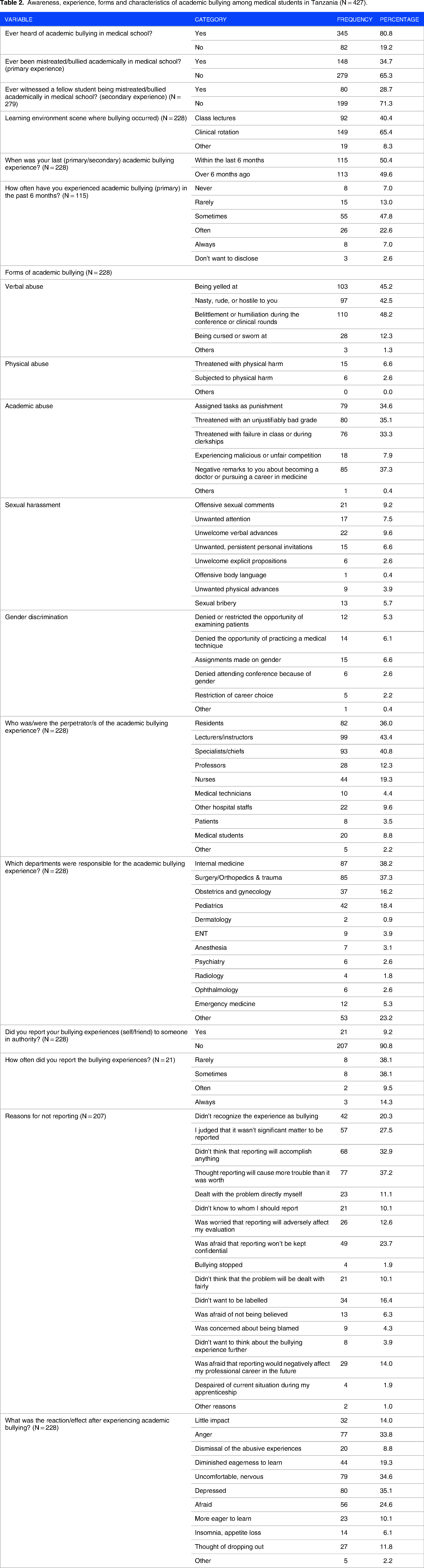
Among the participants, 80.8% had ever heard of academic bullying in medical school. Of them, 34.7% had ever been mistreated/bullied academically in medical school (primary bullying experience) and 28.7% of the rest had ever witnessed a fellow student being mistreated/bullied academically (secondary bullying experience). Academic bullying was more prevalent in clinical rotation settings with 65.4% of all primary and secondary bullying experiences coming from these settings. Half (50.4%) of the students who had either primary/secondary academic bullying experience had experienced bullying within the last 6 months.
Among the forms of academic bullying, verbal abuse was most common with 48.2%, whereby 45.2% and 42.5% reported it in a form of belittlement or humiliation during conference or clinical rounds, being yelled at and being nasty, rude, or hostile to them respectively. Other forms included academic abuse with 35.1% and 33.3% reporting to have been threatened with unjustifiably bad grade and with failure in class or during clerkships respectively.
Lecturers/instructors (43.4%), specialists/chiefs (40.8%) and residents (36.0%) were the main perpetrators of the academic bullying experiences with the most of the experiences coming from internal medicine (38.2%) and surgery/orthopedics & trauma departments (37.3%).
Only 21 (9.2%) medical students had ever reported their bullying experiences to someone in authority, the main reasons of those who didn’t report being the thought that reporting will cause more trouble than it was worth (37.2%) and some didn’t think that reporting will accomplish anything (32,9%). 35.1% of the participants reacted to the academic bullying experience by being depressed, 34.6% became very uncomfortable and nervous and 33.8% were angered by the experience (Table 2).
Awareness, experience, forms and characteristics of academic bullying among medical students in Tanzania (N = 427).
Factors closely related to academic bullying in medicals schools
Majority (62.8%) of the participants reported having an official mentorship program in their respective universities or colleges with only 40.3% of those active in participating in such programs. 58.5% had either a formal or informal mentor. Only 34.4% of the respondents reported having a bullying reporting system for students in their respective universities/colleges of which 68.0% argued that the system is friendly to students. Overall rating of the university's or college's learning environment which was assessed by rating lecturers’ interaction with students, satisfaction and comfortability with lecturers and general academic learning environment was found to be very good (87.4%) (Table 3).
Factors closely related to academic bullying in medicals schools (N = 427).

Determinants of academic bullying among medical students in Tanzania
Academic bullying among medical students was significantly associated with age (p < 0.001), sex (p = 0.046), marital status (p = 0.002), religion (p = 0.007), class category (p < 0.001), year of study (p < 0.001), whether the student had any formal/informal mentor (p = 0.028), availability of bullying reporting system in university/college (p = 0.006), friendliness of the reporting system (p < 0.001) and overall rating of university/college learning environment (p < 0.001).
In crude analysis, medical students who were 24 years of age or older were twice as likely to experience academic bullying (OR = 1.766, 95% CI 1.037, 3.007), p = 0.036; fifth-year medical students were 2.5 times more likely to experience bullying (OR = 2.543, 95% CI (1.040, 6.218), p = 0.041; those who had no any formal/informal mentor were 2 times most likely to experience academic bullying (OR = 2.062, 95% CI (1.215, 3.499), p = 0.007; and those who had rated poorly the university's/college's learning environment were 6 times more likely to experience academic bullying (OR = 6.265, 95% CI (1.578, 24.876), p = 0.009 (Table 4).
Determinants of academic bullying among medical students in Tanzania (N = 427).

*P-value <0.05, COR = Crude Odds Ratio, CI = Confidence Interval.
Discussion
The initial objective of this study was to identify how prevalent academic bullying is in the medical universities in Tanzania. This objective was parallel with identifying the forms of bullying that medical students experience in the course of their education. In this study, it was found out that 34.7% and 28.7% of students had directly experienced bullying and witnessed bullying respectively. This prevalence is relatively lower with respect to the global level that was reported to be 59.4%. 17 In comparison to other studies done in Africa, the prevalence remains lower compared to studies done in Egypt which reported a prevalence of 77% and that of Nigeria done among physiotherapy students which was 99%.10,13 The possible explanation for the lower prevalence of bullying may be attributed to the friendly learning environment and good interaction between students and their lectures as reported in this study.
Based on previous studies, it was hypothesized that factors such as age, gender, level of study, year of study, specialty, religion, specific enrolled university, being a mentee to a faculty member or fellow senior student, sponsorship type, knowledge, and attitude on academic bullying may be associated with academic bullying. The findings of this study support the hypothesis, except for religion and specific university. One unexpected finding was that male students had higher odds of experiencing bullying compared to female students, despite the lack of significance. The results are inconsistent with studies conducted in Germany and Eastern Saudi Arabia.28,30 It might be challenging to pose a direct explanation, but this finding may be attributed to the masculinity ideology, causing the education system to be more demanding and stressful to male students unlike their counterparts.
Regarding the reporting of bullying experiences, majority of students (90.8%) did not report the cases and the major reasons being the feeling that reporting would not change anything or would cause more trouble. These findings raise intriguing questions regarding the nature of the reporting systems in universities but also the students’ perception on the effects of bullying in their medical education. It could also mean that bullying has been normalized or students fear to report on account of negative repercussion it could have on their future career. Other barriers for reporting are the fear of damaging student-tutor relationship, reporting could make them labeled as troublesome, or the decision of students to sympathize with the mistreatment. 31
The absence of mentorship programs has been associated with academic bullying experience. Students without any formal or informal mentorship were two time more likely to experience bullying unlike their counterparts. This is because mentorship does not only provide academic guidance, but also psychosocial support to the mentees, hence students having mentors are likely to be more resilient. 32 Ideal mentors are supportive and empowering to their mentees towards professional development with an academic bullying-free learning environment. 33
Strength and Limitation of the Study
This study is to the best of our knowledge the first to assess the state of academic bullying in medical schools in Tanzania focusing on the prevalence, forms and associated factors. Medical students who met criteria from all medical schools in Tanzania regardless of ownership or location were allowed to participate in the study. This reduced participation bias and enhanced generalizability of the study findings. The study also achieved the desired sample size as per the study sample size calculation and deployed proper data analysis approaches. This has enhanced the precision of the findings and the power of the study.
The study findings may have been influenced by response bias from the participants, leading to under-reporting or over-reporting of the collected data. This could be attributed to the data collection approach used. The data collection tool was not pilot-tested; instead, it was adopted and modified from previous studies, potentially impacting the quality, reliability, and validity of the findings. Moreover, the study was conducted during a period when some classes in most medical schools in Tanzania were in the examination period. This may have affected the diversity of study participants and subsequently, the findings. Furthermore, given the nature of the study aim, data collection from educators and incorporation of a qualitative approach during data collection would strengthen and enhance further the study's findings and conclusions. This has not been done in this study.
Conclusion and Recommendation
Despite being relatively low compared to most countries, the prevalence of academic bullying among medical students in Tanzania is potentially of both medical education, career prosperity and mental health concern especially among medical students.
Study findings suggest several courses of action towards prevention and control of academic bullying among medical students in Tanzania should be taken. Mentorship programs should be designed and implemented, monitored and evaluated to ensure their effectiveness since their presence has been associated with reduced odds of experiencing academic bullying.
To address mistreatment or academic bullying among medical students in medical schools, collaborative efforts among stakeholders are needed to establish and regularly assessing and monitoring academic bullying reporting systems. National authorities should make it mandatory for all medical schools to have this system in place. The system should be easily accessible to all students and prioritize their privacy. It's crucial to follow up on reported complaints effectively and protect the victims from any retaliation. Perpetrators should be officially held accountable, and there should be awareness campaigns to discourage academic bullying among both students and educators.
Footnotes
Acknowledgements
We acknowledge Dr Elichilia Shao of Kilimanjaro Christian Medical University College, Tanzania, for critically reviewing the revised version of the manuscript.
Author Contribution
Data Availability Statement
Data collected during this study are available from the corresponding author upon reasonable request.
Declaration of conflicting interests
The authors declared no potential conflicts of interest with respect to the research, authorship, and/or publication of this article.
Ethical Approval and Consent to Participate
Ethical clearance certificate was sought from Kilimanjaro Christian Medical University College Research and Ethics Review Committee (KCMUCo-CRERC), Tanzania. Moreover, online informed consent was obtained from the participants after reading the overview of the study prior to start filling the survey so that they can make an informed decision to participate or withdraw from the study without losing their dignity. The consent information contained a description of the study purpose, risk and benefits of participation, nature of participant involvement and confidentiality. Also, participants’ information privacy and safety was considered during the study including not collecting their identification details like names. Participation in this study was voluntary and participants were allowed to terminate their participation or not responding to a certain question willingly.
Funding
The authors received no financial support for the research, authorship, and/or publication of this article.
