



Abstract
BACKGROUND
The lifestyle of most people was forced to change due to the COVID-19 pandemic. Perhaps after the pandemic, we will find that these subtle changes in life and from the depths of our hearts are thorough and profound. They may form our conceptual consensus and behavioral habits, becoming part of our long-term personal consciousness. This study explored the impacts of the COVID-19 pandemic on the future life behavior intentions of medical and health-related students studying at universities in China.
METHODS
Electronic questionnaires were distributed to students studying at 3 universities in China. A total of 251 valid questionnaires were obtained, and the chi-squared test was used to compare the corresponding groups.
RESULTS
In the future, students plan to pay more attention to wearing masks and maintaining social distance in public places, do more online shopping, have more meals at home or in the canteen, engage in less international travel, and have fewer gatherings with friends. However, compared with Chinese students, more non-Chinese students plan to increase domestic and international travel and reduce online learning. Furthermore, only among non-Chinese students did gender, urban or rural origin, and family economic conditions influence how the COVID-19 pandemic affected their future life behaviors.
CONCLUSION
The COVID-19 pandemic changed the future life behavior intentions of medical and health-related students. The future behaviors of these students will impact the entire society. This study will help the government and policymakers predict and prepare for general lifestyle changes in our society.
Introduction
A sudden COVID-19 outbreak disrupted most people's lives, affecting almost the entire world.1–5 The impact of COVID-19 is multifaceted, with lifestyle changes being the most noticeable, 6 such as reducing travel as much as possible, wearing masks in crowded places, and increasing online shopping and entertainment time. After the pandemic, we may find that these subtle life changes are thorough and profound, forming our conceptual consensus and behavioral habits, becoming part of our long-term personal consciousness.
College students studying medical and health-related programs will be a new and main force in future national medical and health undertakings. They are the focus of training and protection in every country. Because these students have mastered medical and health-related knowledge, some of their lifestyles will be regarded as healthy by the general public, who may adopt them. In other words, today's medical and health-related college students will be the future advocates of healthy living. Therefore, it is critical to investigate the impact of COVID-19 on the future lifestyle and habits of these students.
Living behavior refers to all the lifestyle and behavioral characteristics formed by people under certain social conditions and guided by certain values to meet their own life needs. It includes the values, morals, and aesthetics of people's material and spiritual life, such as clothing, food, housing, transportation, labor and work, rest and entertainment, social communication, and interpersonal interactions. Theories such as the health belief model and the theory of planned behavior indicate that behavioral intention, which refers to the action tendency and the degree to which an individual wants to engage in a specific behavior, determines personal behavior.7,8
Amidst the COVID-19 pandemic, shifts in living habits are inevitable, yet these changes are likely to vary among individuals, influencing their life behavior intentions. However, the extent to which COVID-19 impacts the future life behavior intentions of medical and health-related students remains uncertain, as does the identification of factors that contributed to these behavioral changes. Therefore, we aimed to investigate the following research question: How do gender, age, family residence, family economic status, and study majors influence the life behaviors and habits of both Chinese and non-Chinese medical and health-related students in the aftermath of the COVID-19 pandemic, particularly in terms of their intention toward future life behaviors? Specifically, we explored the impact of the pandemic on the intention of future life behaviors among these students studying at universities in China.
Our study provides new insights into how the COVID-19 pandemic affected the future lifestyle and habits of medical and health-related students. Unlike previous research focusing on broader societal impacts, our study specifically examines this demographic. By focusing on factors like gender, age, family residence, economic status, and study majors, we uncovered how these elements shaped individual responses to the pandemic. Our findings offer valuable implications for policymakers and educators in preparing future healthcare professionals. Through rigorous empirical analysis, we contribute to academic discourse and offer practical strategies for promoting healthy living and resilience during global health crises.
Methods
Design
This study is interested in the intention changes of future life behaviors caused by COVID-19 in medical and health-related students. A close-ended questionnaire was designed based on the responses from the interviews. It consisted of 2 parts. Part 1 collected the basic information about students, such as their age, gender, and nationality; and Part 2 focused mainly on the impact of the COVID-19 pandemic on students’ future behavioral intentions, which included whether to wear masks in public places, frequency of online shopping, domestic tourism, overseas tourism, online learning, gathering with friends, eating outside, and social distancing. Origin, gender, the economic status of the families, and the majors that will have close or no contact with patients in the future were considered as independent variables.
The study included students currently enrolled in medical, nursing, or other health-related undergraduate programs at universities in China. Participants were required to be 18 years or older and willing to provide informed consent. The exclusion criteria were students not enrolled in health-related programs, participants who provided incomplete responses, and individuals who did not consent to participate. Additionally, participants under the age of 18 were excluded from the study. To ensure a balanced representation in our sample, especially given the relatively small number of international students compared with Chinese students, we implemented a stratified random sampling method. This approach allowed us to proportionally represent both Chinese and non-Chinese students in our sample, ensuring that the diversity of the student body is accurately reflected. The methods used in this study were carried out according to the Strengthening the Reporting of Observational studies in Epidemiology (STROBE).9,10
Sampling and recruitment method
Seven Chinese and 3 non-Chinese medical students were interviewed face to face to discuss the factors influencing their intentions of future life behaviors due to the COVID-19 pandemic. Following an explanation of the survey's objective and administration concerns, medical and health-related students from Xuzhou Medical University, Shangqiu Normal University, and Kangda College of Nanjing Medical University were invited to participate.
Teachers from the above 3 universities distributed the electronic questionnaire to students between October 1, 2020, and January 1, 2021. On the front page of the questionnaire, uniform guidelines were provided to the students to explain the purpose and contents of the survey, and no hints were given beyond the necessary explanations. Participation in the survey was voluntary, and students did not receive any incentives to participate in the study. Informed consent was obtained from all participants, and consent was obtained from parents or legal guardians on behalf of participants under 18.
Ethical considerations
The study received the approval of the Research Ethics Committee of Xuzhou Medical University (XZMU2020117). The study was conducted in accordance with the Declaration of Helsinki (as was revised in 2013).
Data collection
A total of 257 questionnaires were collected. Six uncompleted questionnaires were excluded, and 251 valid questionnaires were obtained. The students included Chinese and non-Chinese from 9 majors, of which 4 majors will involve close contact with patients in the future, such as clinical medicine, nursing, rehabilitation medicine, and stomatology and 5 majors that will have no close contact with patients in the future, such as medical imaging, medical technology, medical information, public health, and basic medicine.
Data analysis
Chi-square (Fisher's exact test) and GraphPad Prism 7.00 were used to analyze the data obtained. Mean differences were compared with statistical significance set at P < .05. Results were represented as tables and graphs.
Results
Characteristics of the population
A total of 251 medical and health-related students studying in the universities of China were included in this study, 126 of whom were Chinese, and 125 were oversea students (non-Chinese); females made up 53.78% of the sample. Their ages were between 18 and 25 years old. The oversea students came from 25 countries in Asia, Africa, and Oceania (Table 1). In this study, the impact of the COVID-19 pandemic on the future lifestyle was investigated with regard to eight items: whether to wear masks in public places, online shopping, domestic tourism, overseas tourism, online learning, gathering with friends, eating outside frequently, and social distancing.
Number of students from regions or country.

P < .05 compared with correspond male.
Different choices of Chinese and non-Chinese original students on future living habits due to COVID-19
Generally, the pandemic of COVID-19 affected the intention of future living behavior and habits of both Chinese and non-Chinese students (Table 2). The impact was the same for Chinese male and female students but not for non-Chinese male and female students.
The impact of COVID-19 on the future living habits of Chinese and non-Chinese students.

Chinese students are 126, in which 63 are female and 63 are male; non-Chinese are 125, in which 72 are female and 53 are male.
P < .05 compared with correspond male.
P < .05 and bbP < .01 compared with Chinese students.
P < .01 compared with other choices under the same item.
Most of the students were going to wear a mask in public places, increase their social distancing, increase their frequency of shopping and learning online, and reduce the frequency of traveling abroad, gatherings with friends, and dining out (Table 2).
Compared with non-Chinese students, Chinese students who chose that they would increase traveling within the national or reduce learning and shopping online were few. In contrast, the majority decided they would reduce traveling within the national border and abroad and increase online learning (Table 2).
Among the non-Chinese students, the majority of females preferred to wear masks and travel within the national border, while most males were not affected.
Different choices of rural and urban original students on future life habits due to COVID-19
There were 126 Chinese students, 69 of whom were from urban areas and 57 from rural areas; there were 125 non-Chinese students, including 97 in urban areas and 28 in rural areas (Figure 1).

Number of students from urban areas and rural areas. Chinese students were 126, of which 69 came from urban and 57 came from rural areas; non-Chinese students were 125, of which 97 came from urban and 28 came from rural areas.
The urban and rural Chinese students had no significant difference in their intentions of future behavior and habits, and so did urban and rural non-Chinese students (Table 3).
The impact of COVID-19 on future life habits of rural or urban original students.

P < .01 compared with corresponding urban Chinese students.
P < .05 and bbP < .01 compared with corresponding rural Chinese students.
Also, the trend of future life changes induced by the epidemic on Chinese and non-Chinese students was similar. Their differences are mainly shown in the following aspects:
Compared with Chinese urban students, more non-Chinese urban students chose to increase domestic tourism, and more Chinese students chose to reduce domestic tourism (Table 3).
In terms of traveling abroad in the future, more non-Chinese students believed they would not be affected by the COVID-19 pandemic. Interestingly, more non-Chinese students preferred to reduce online learning in the future (Table 3).
The impact of COVID-19 on future life habits of students with different family economic conditions
To determine whether family economic conditions affect the intention of future life behavior and habits or not, families of students were divided into 3 types: (1) poor, economically unstable families; (2) normal, an economically stable families that can basically afford usual needs; and (3) rich, financially stable family and can afford all that is needed in life. Chinese students were 126, of which 14 came from poor, 90 came from normal, and 22 came from rich families; non-Chinese students were 125, of which 22 came from poor, 73 came from normal, and 30 came from rich families (Figure 2).
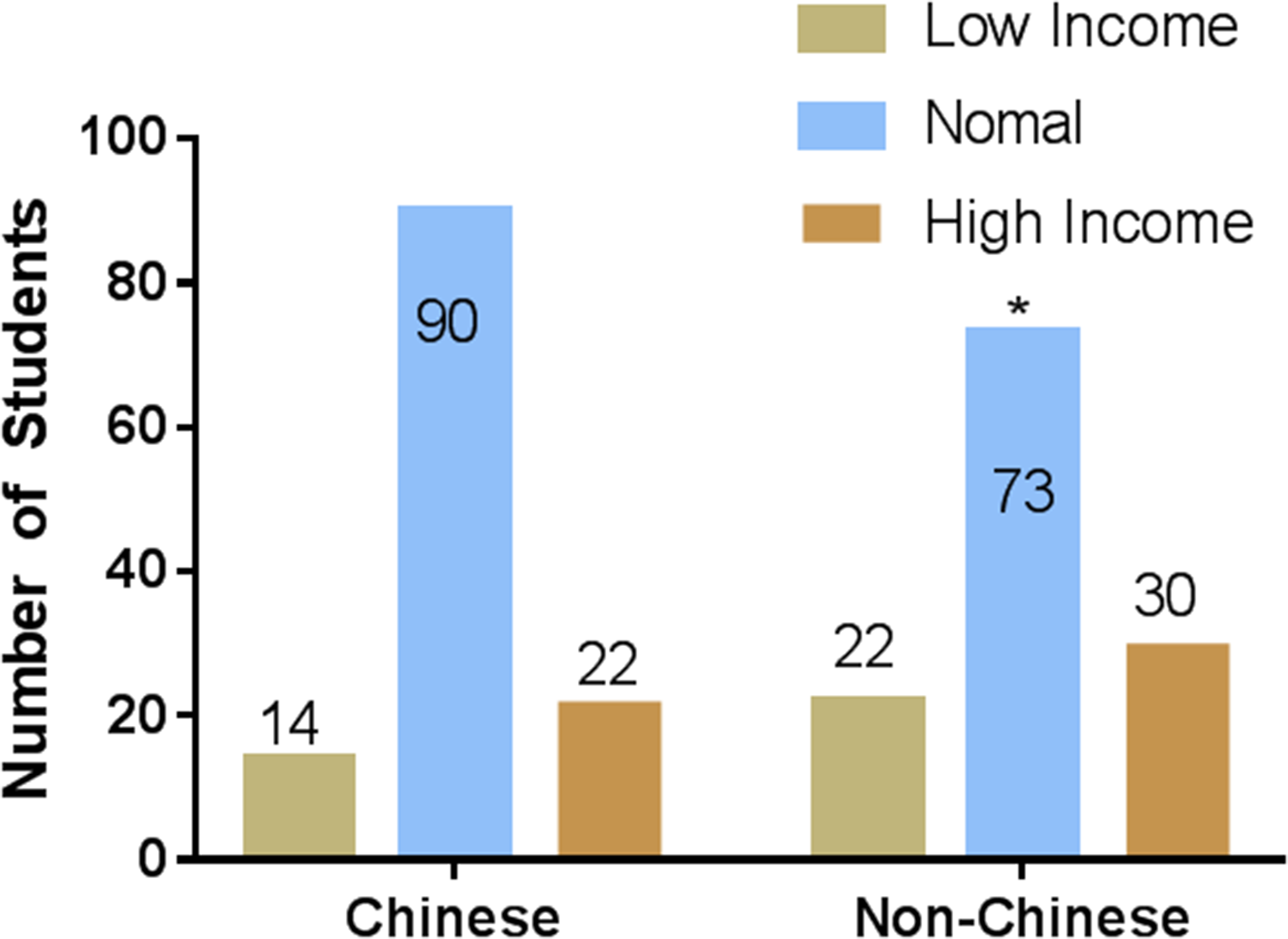
Number of students from low, normal, or high-income families.
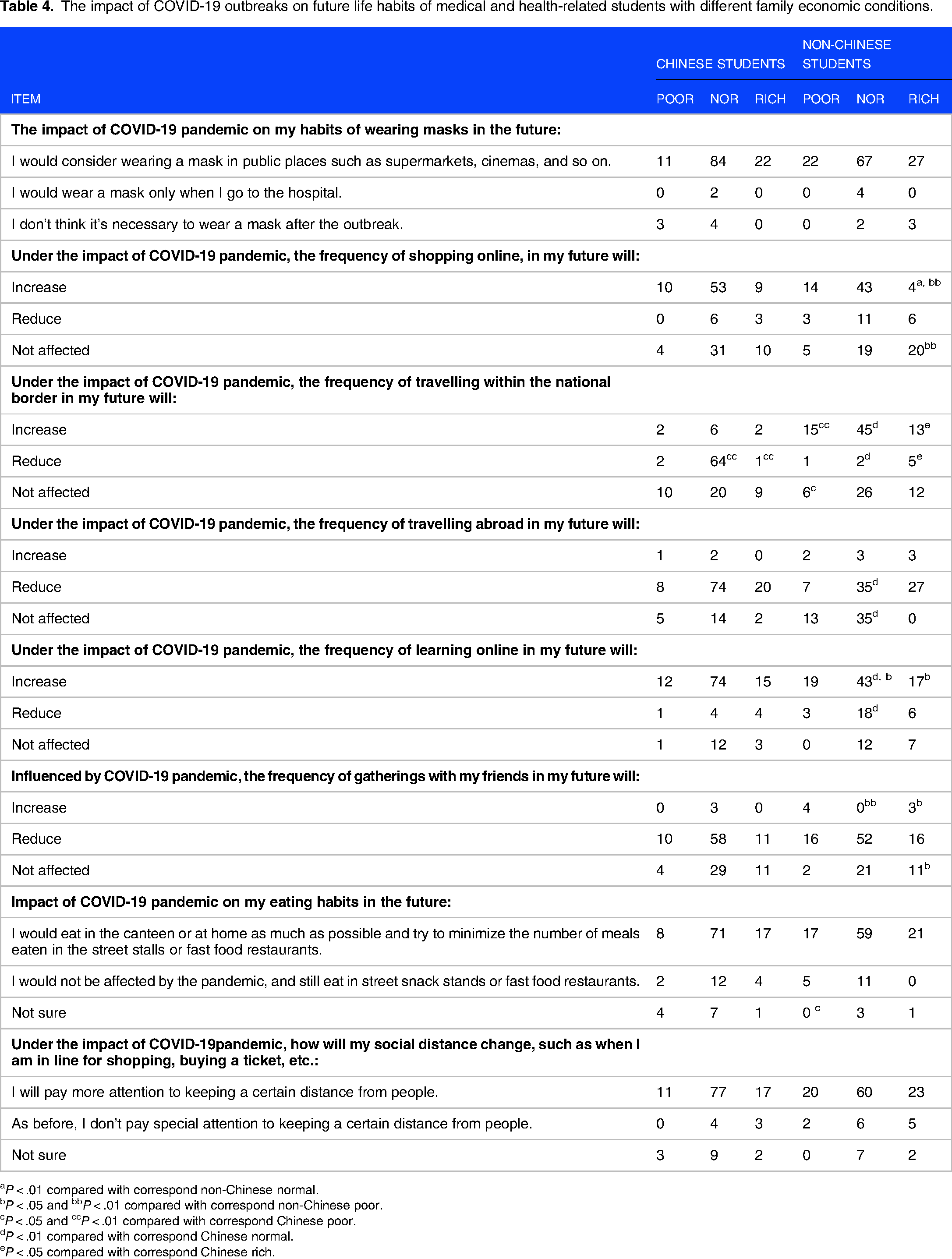
Among poor, normal, and rich Chinese students, there were no significant differences in the impact of the COVID-19 outbreak on their future life habits, except that fewer poor students selected that the frequency of traveling within the national border in their future would be reduced (Table 4).
The impact of COVID-19 outbreaks on future life habits of medical and health-related students with different family economic conditions.
P < .01 compared with correspond non-Chinese normal.
P < .05 and bbP < .01 compared with correspond non-Chinese poor.
P < .05 and ccP < .01 compared with correspond Chinese poor.
P < .01 compared with correspond Chinese normal.
P < .05 compared with correspond Chinese rich.
Among poor, normal, and rich non-Chinese students, fewer rich students chose to increase the frequency of shopping online in the future. More poor students would like to increase online learning. As the item of gatherings with friends in the future, lesser rich and normal students would intend to increase the frequency, while more rich students would not be affected by COVID-19 outbreaks (Table 4).
Compared with Chinese students, most non-Chinese students, including poor, normal, or rich, prefer to increase traveling within the national border in the future. In contrast, fewer normal or rich non-Chinese students decided to reduce their traveling, and fewer poor students were not affected by the COVID-19 outbreaks (Table 4).
About the item of traveling abroad in the future, less normal non-Chinese students chose to reduce it; instead, they chose not to be affected. Less normal non-Chinese students decided to increase the frequency of learning online in the future; on the contrary, more preferred to reduce the frequency (Table 4).
The impact of COVID-19 on future living habits of students with direct and indirect contact with patients
We classified majors in clinical medicine, nursing, rehabilitation medicine, and stomatology as professions that involve close contact with patients and majors in medical imaging, medical technology, medical information, public health, and basic medicine as professions that do not involve close contact with patients. Chinese students were 126, of which 83 students would make close contact with patients in the future and 43 would not. Non-Chinese students were 125, of which 101 students would make close contact with patients in the future and 24 would not (Figure 3).

The number of students in the professions that would have close or no close contact with patients in the future.
Among Chinese students, the impact of COVID-19 outbreaks on future life habits had no significant difference between direct and indirect contact with patient students. Among non-Chinese students, those who had indirect contact with patients were less likely to wear masks than those who had direct contact with patients (Table 5).
The impact of COVID-19 outbreaks on future life habits of medical and health-related students that will have close or no close contact with patients in the future.

P < .05 and aaP < .01 compared with correspond close contact patient Chinese students.
P < .05 and bbP < .01 compared with correspond not close contact patient Chinese students.
P < .05 compared with correspond close contact patient non-Chinese students.
While fewer non-Chinese students preferred to reduce national and international travel and instead increase online learning, the majority of non-Chinese students preferred to minimize shopping and online education and rather increase domestic travel; however, among direct contact patient professions, traveling abroad was unaffected (Table 5).
Among the indirect contact patient professions, compared with Chinese students, fewer non-Chinese students preferred to wear a mask in public places and reduced domestic travel in the future (Table 5).
Discussion
All our lives have been affected by the pandemic of COVID-19 in the recent 2 years. Shopping, traveling, learning, and eating are the most common behaviors in our daily lives. The study found that (1) COVID-19 changed the future life behaviors of all medical and health-related students, including Chinese and non-Chinese students. Thus, they would pay more attention to wearing masks and keeping social distance in public places, more online shopping, more meals at home or in the canteen, more online learning time, less international travel, and fewer gatherings with friends. However, (2) the impact of COVID-19 on their future life behavior was different between Chinese and non-Chinese students. These differences were mainly reflected in domestic and international tourism and online education. Furthermore, (3) gender, urban or rural origin, and family economic problems were all elements that influenced COVID-19 to impact the future life behaviors of non-Chinese students, while Chinese students were basically not affected by these factors. (4) The impact of COVID-19 on students’ future life behaviors was unaffected by whether the major studied will have close interaction with patients or not.
Origin and gender of medical and health-related students induced differences in future lifestyle changes caused by COVID-2019
In general, the pandemic of COVID-19 impacted the behaviors and would change future daily habits of both medical and health-related Chinese and non-Chinese students, but the impacts were different between Chinese and non-Chinese students. This was mostly represented in the fact that Chinese students were more willing to reduce needless international and domestic travel, whereas non-Chinese students were more eager to expand domestic and international travel. Differences in behavior and intentions may arise from varied cultural and living backgrounds.11,12 China is a country long influenced by Confucian culture.13,14 Chinese will think more about the results and pursue stability. Through this epidemic, they realized that unnecessary travel would increase their risk of contracting diseases and the risk of infecting others. It is most important to maintain the health of others and themselves. Therefore, they are willing to reduce travel. Many non-Chinese students studying medical and health-related majors in China came from African countries. These students are enthusiastic and unrestrained. They like to publicize their personality and seek opportunities for self-development. So, they were not willing to reduce travel.
There were significant gender differences in the impact of COVID-19 on the behaviors and habits of non-Chinese students in the future. Now, most college students in China are the only child in their families due to the implementation of the “one child for one couple” policy for more than 30 years, which was stopped about 10 years ago. 15 They are a family's treasure and will not be subjected to gender discrimination by the family. And most importantly, China has long been engaged in eliminating gender discrimination and implementing equal pay for men and women for similar work. 16 However, it is undeniable that gender discrimination still exists in some impoverished developing countries, which affects their young people. 17 This could explain why the effects of COVID-19 on future behaviors and habits differed by gender only in non-Chinese students but not in Chinese students.
With the development of transportation and science technology, especially communication technology, the gap between urban and rural residents in many fields, such as medical security, access to information, and opportunities, is becoming smaller and smaller. As a result, the study's findings may show no difference in the impact of COVID-19 on future behaviors and habits of students from urban and rural areas.
The economic status of the families of medical and health-related students induced differences in future lifestyle changes caused by COVID-19
In terms of the impact of family economic status on COVID-19-induced behavioral changes in Chinese students, there was no difference between students from poor, normal, and wealthy families, except that, compared with students from poor families, more students from normal and wealthy families preferred to reduce travel within the national border. This reflects at least 2 aspects. One is that each family's lifestyle is not very different in China, although their economic conditions are diverse. Another is that China's public health policies and publicity in response to the epidemic, such as traffic control measures during the epidemic and reminders of social distancing, have had a profound impact on Chinese students.18,19
For non-Chinese students, students from different economic families had differences in their choice of behavior and habits. For example, compared with students from low-income families, more students from wealthy families believed they would be unaffected by online shopping and social gatherings and would not increase their online learning, implying that family economic circumstances influenced students’ future lifestyle changes as a result of COVID-19. The finding was supported by others’ observations. 20
Compared with Chinese students from middle-class households, more non-Chinese students from middle-class families would wish to boost domestic travel while decreasing foreign travel and online education. Apart from the reasons mentioned above, these differences between Chinese and non-Chinese students may also be related to the fact that most of these non-Chinese students come from low-income countries; hence, they try to travel to find opportunities for better jobs and good living conditions. This also reflects that non-Chinese students would not like to settle down and study hard enough. Chinese students are relatively stable.
The differences in future lifestyle changes caused by COVID-19 among students who will have close or no close contact with patients in the future
The epidemic increased the workload and infection risk for medical professionals and other staff members who work closely with patients. In this study, we found that programs with or without close contact with patients in the future were not a factor that caused differences in future lifestyle changes induced by COVID-19, except that fewer students who would not have close contact with patients would prefer to wear masks. Our previous studies also suggested that medical and health-related students would not change their current majors to pursue other professions when they face pandemics such as COVID-19. 21
Limitations and future perspective
Despite the fact that this is an intriguing study, the sample size was probably insufficient to ensure high accuracy. This study was also limited to Chinese and non-Chinese students. As a result, future studies with higher sample numbers involving various nationalities are required. Moreover, the questionnaire lacked validation and pilot testing, although it was developed based on preliminary interviews. The future life behaviors of medical and health-related students have a natural impact on society; therefore, it is critical to investigate their future behavioral intentions, which will assist the government and policymakers in forecasting and planning for future lifestyle changes in the society.
Conclusion
A sudden pandemic has forced us to change our way of life in many ways. Some life behaviors taken during the pandemic may continue in the future and become our living habits. The findings of this study suggest that the impacts of the COVID-19 pandemic affected the behavioral intentions of medical and health-related students, and the effects were different among Chinese and non-Chinese students. COVID-19 influenced the intention of future life conduct in non-Chinese students, but not in Chinese students, based on their urban or rural background, gender, and family economic conditions. The majors that required either direct or indirect patient contact had no effect on the intention of future life behavior of students.
Footnotes
Acknowledgments
The authors would like to thank all the students who participated in the study.
Author Contributions
HS and TAC had the original idea for this research. WL led on the ethics application. ZG and WQ advised on the qualitative data collection. HH, TM, XT, and LF advised on quantitative data collection. MH and ZG carried out the data analysis under the supervision of HS. ZG wrote the first draft of the manuscript, which was reviewed and revised by HS and JAA. All authors reviewed and agreed on the final draft of the paper and have accountability for all aspects of the work.
Availability of Data and Materials
The data sets used and/or analyzed during the current study are available from the corresponding author upon reasonable request.
DECLARATION OF CONFLICTING INTERESTS
The authors declared no potential conflicts of interest with respect to the research, authorship, and/or publication of this article.
Consent for Publication
All participants gave written consent for the publication of their data.
Ethics Approval and Consent to Participate
The study was conducted in accordance with the Declaration of Helsinki (as was revised in 2013). Ethical approval was obtained from the Ethics Committee of Xuzhou Medical University (XZMU2020117). Written informed consent was obtained from all participants.
FUNDING
The authors disclosed receipt of the following financial support for the research, authorship, and/or publication of this article: This work was supported by the Natural Science Foundation of Jiangsu Higher Education Institutes of China (grant number 17KJB180016).