




Abstract
This study aims to investigate the influence of students’ knowledge, attitude, and behavioral intention on their behaviors during the COVID-19 pandemic. A survey study was designed using an online questionnaire involving 653 respondents from the first to final-year students at a Malaysian university. A CACQ-COV instrument was designed based on the Theory of Reasoned Action (TRA) model, comprising 67 items in four constructs: students’ knowledge of the current pandemic, emotional engagement, behavioral intention, and behavioral action. The results show that the students learn most about the COVID-19 pandemic from the media and the internet platform; more than 50% of the students rated the television broadcast as the most trusted media. The mean scores of the students’ knowledge about COVID-19 facts and symptoms; emotion, intention, and action are at high levels. In addition, knowledge, emotion, and behavioral intention have significantly influenced the students’ behaviors and actions; it is noted that emotion has the greatest influence compared with knowledge and behavioral intention. The implication is that television broadcast should be the primary choice of media for carrying out future mass campaigns, in preference to social media, especially for announcing urgent matters and disseminating information related to the current issues.
Introduction
Higher education students are amongst those affected by the Malaysian government’s enforcement of the Movement Control Order (MCO). The academic semester had started in February 2020—just 3 weeks before the enforcement of the MCO. A day before the MCO took effect, most of the students were rushing back to their respective hometowns when the Malaysian Prime Minister announced the 14-day closure of all higher educational institutions. In addition, as of 2 April 2020 (14th day of MCO), a total of 4,189 people were arrested for violating the MCO, and more than 1,400 were charged in court (Royal Malaysian Police [RMP], 2020). These figures support the fact that the general public does not understand the purpose of the MCO, which is for suppressing the disease outbreak. Students should not be blamed entirely for breaking the rules, since this is the first time they have encountered a lockdown situation; the amount knowledge and understanding of the MCO and COVID-19 are relatively low during this unfortunate time.
A previous study suggests that multiple factors at the individual level influence the effort or negligence of taking preventive measures, which include intrapersonal traits, interpersonal communications, and knowledge (Lin et al., 2018). Another study reiterates that adequate information is important to determine what actions would be taken by people (Fishbein & Ajzen, 1975; Freedman, 1987), especially the students in this case. Adequate information refers to the students’ knowledge about the disease and symptoms pertaining to COVID-19. Since COVID-19 is a new virus, students were not adequately exposed to the exact information of preventive measures. Thus, it has become the students’ responsibility to take the initiative to gather as much information about the pandemic for self-preservation. The act of taking initiatives for self-preservation and disseminating information can be explained by the Theory of Reasoned Action (TRA). This study attempts to establish relationships suggested in this theory where the immediate determinant of behavioral action is intention. Intention is determined by attitude (emotion) and preceded by belief (knowledge of information).
During a pandemic and the MCO enforcement, students could gather information from multiple sources. They are the generation who actively engage in the information that may lead to unintended action including violating MCO, sharing invalidated information, creating panic, and disseminating false news, etc. In regard to students’ self-initiative and willingness to learn, previous research has shown that the traditional news media (e.g., television) positively affect knowledge of current issues (Shehata et al., 2015). Similarly, the latest media (e.g., social media) contributes more significantly to the knowledge of current issues (Boukes, 2019; Olaniru et al., 2019). For that reason, the internet is an important source of news that is retrievable at anytime from anywhere (Newman et al., 2017). According to the Malaysian Communications and Multimedia Commission (MCMC, 2018) the Malaysian internet penetration rate was 87.4%. This means, practically, everyone has an internet access and have access to social communication apps such as WhatsApp and Telegram and social media including Facebook, Twitter, and Instagram. Boukes (2019) agreed that social media can positively affect a person’s knowledge acquisition of the current issues and the level depends on the individual’s interest and intention.
The COVID pandemic has caused panic in the community. The existence of social media stimulates the spread of information that is mythical, fabricated, exaggerated, and sometimes of questionable validity that spread rapidly among the community (Gupta et al., 2020). This situation if not controlled, will lead to anxiety and depression (Amundsen et al., 2021), which in turn could lead to more severe implications of other depressive symptoms (Amundsen et al., 2021). Students should have good information management skills such as knowledge integration, especially when they are obtaining information through social media in order to avoid being misled and wrongfully influenced. There are people who deliberately share false content in cyberspace to further their political agenda during this pandemic period (Pennycook et al., 2020). Recent studies have shown that fake and real news spread differently on social media, forming propagation patterns that could be harnessed (Monti et al., 2019). A study found that the millennials’ political preference affects their news dissemination; involvement in group chats also increases their news channeling (Abdullah & Syariati, 2020). In Simon et al. (2015), social media provides access and timely information during emergency situations.
Various pieces of information regarding the COVID-19 are critically important for every single citizen. Facts about the disease would help a person know how the virus can spread, and thus reduce the tendency to panic, while knowing the symptoms would help a person seek medical treatment promptly and avert fatality as well as preventing the virus from spreading to others (Ministry of Health Malaysia [MOH], 2020). In this context, getting the right facts from credible sources is the most important aspect of information management in helping students to make good decisions (Citroen, 2011). In several studies, most of the students and public generally possessed a high level of awareness on how to stay safe during a pandemic. There is a significant positive correlation between awareness and attitude, as well as a positive correlation between attitude and practice (Alahdal et al., 2020; Blankstein et al., 2020). This has shed some light on the potential correlation between knowledge (awareness), emotions (attitude), and their safety practices during the pandemic. Nevertheless, we still have a lack of information in the role of behavioral intention to mediate the relationships between emotions and actions. Moreover, there is a lack of previous studies that offers validated instruments on behavioral intention which could be the reason that leads to this gap. For that reason, we do not fully understand why there are always misconceptions on COVID-19 information (e.g., the symptoms or vaccination effectiveness) to which can be easily spread via social communication apps such as Whatsapp, Twitter, and Instagram, all of which are the main medium of exchanging information by university students in Malaysia (Hashim et al., 2020). Therefore, this study uses the TRA model as a guideline to guide the paths from knowledge factor to behavioral action in order to better understand factors influencing higher education students’ behaviors in disseminating information during pandemic.
Understanding of Human Information Management
Understanding of human motivation and behaviors can be a challenge. In the process of information transfer, an individual can be inspired, learn something new, and apply the knowledge after receiving a piece of information. The Theory of Reasoned Action (TRA) model (Fishbein & Ajzen, 1975) has been applied in many research studies to investigate the relationship between mental activities (the cognitive, affective, and conative elements), and actions as well as behaviors (Figure 1). As we know, several studies have been conducted using the TRA model in understanding consumers’ attitude and normative factors on purchase intention particularly (Mansur et al., 2019). However, a study empirically proved that with the employment of the TRA model, online buying intention transcended traditional buying due to COVID-19 pandemic (Ashokkumar & Nagarajan, 2021). Besides, recent study demonstrated that subjective norms were directly related to percentage use of telepsychology, an association that is not directly theorized in the TRA model (McKee et al., 2021). The TRA model aims to explain the relationship between attitudes and behaviors in human action and it is used to predict how individuals will behave based on their pre-existing attitudes and behavioral intentions.

Adaptation model from Fishbein and Ajzen (1975).
Thus, the TRA model is utilized in this research to understand how individuals act during this COVID-19 pandemic. It is assumed that the students tend to act and react based on this cascade of steps. Any disseminated information on social and other media will influence the readers’ beliefs about the new knowledge, and consequently create awareness of the situation (cognitive state). The cognitive state refers to a knowledge-based domain that is also connected with information, opinions, and thoughts (Fishbein & Ajzen, 1975). An individual beliefs in the information received is expected could generate a dynamic feeling toward the pandemic situation. The dynamic feeling can be a negative emotion (e.g., fearful, sad, and panic) or a positive emotion (e.g. appreciate and satisfied), which then will determine their engagement with the information received (affective state).
Fishbein and Ajzen (1975) proposed “intention” as a conative factor and the key determinant of behaviors. Confessore and Park (2004) proposed four conative elements, namely desire, initiative, resourcefulness, and persistence. It is assumed that an individual’s state of emotion will determine the purpose, goal, and his or her intentional behavior while disseminating information (conative state). The conative factor can also be influenced by the person’s attitude to comply with the norms of social practices (representative of an affective domain). These three mental domains (cognition, affection, and conation) have been examined to gain better understanding about factors that influence students’ behaviors during the MCO periods. Results from the examination of the three mental domains are as shown in Figure 1.
The affective factor in the TRA model is suggested to have a moderating role between the cognitive and conative elements. According to Fishbein and Ajzen (1975), the basic attitude is developed based on the love and confidence of knowing something. This study emphasizes that measurements in the relationship of attitudes should focus on the affective domain, and it can be determined by one’s belief in the event or situation (Ayob, 2012). The theory of Reasoned Action presented by Fishbein and Ajzen (1975) suggests that intention is the immediate or key determinant of the corresponding behavior; however, we have a limited understanding of how intention complements knowledge and emotion to influence the behaviors. Based on a study on students’ behaviors, Paimin et al. (2016) have proposed that none of the elements in the TRA models should be neglected in order to fully understand the students’ behaviors, and researchers should give greater attention to the behavioral intention that are less investigated among the other elements.
According to PLOCHBERGER Franz (2014), there are six elements in human information management that could be related to the TRA model. During the process of disseminating information, a new information connection or exchange begins in these following steps: (a) Build a mental relation (In the TRA model, this mental activity is linked to the cognitive domain which can be related to their knowledge or beliefs about a specific event or situation), (b) pay attention to something interesting (this mental activity depends on the state of emotion as represented by the affective domain), (c) start a selective exchange of information (the previous two mental activities form reasoning or intention to perform behaviors as represented by the conative domain), (d) start a direct or common communication (an action driven by external factors as reflected in the common social activities), (e) create a well-being in natural surroundings (an action driven by internal factors as reflected in the mental activities), and (f) start a direct or common cooperation (an action which could be driven by external factors subject to health and safety guidelines and protocols during the Movement Control Order period). By understanding the process of receiving and disseminating information among the students could help the universities and authorities in identifying the most suitable medium of communication with the students. Since the campus is being locked for an indefinite period, the process of disseminating information to students can be a challenge. Identifying their preferred choice of receiving information is seen as vital. Also, understanding how students manage information could help universities in formulating strategies for managing students’ emotions and reactions during this pandemic period.
This study investigates the student’s cognitive domain (awareness of COVID-19’s facts and symptoms), affective domain (emotional engagement), and conative state (intention), all of which are expected to influence students’ behaviors (action) in disseminating information during the COVID-19 pandemic. Specifically, the research questions are: (i) What is the trusted media for information dissemination for students during MCO? (ii) What are the students’ levels of awareness on COVID-19’s facts and symptoms; level of emotion, intention and action? (iii) Do the data variables fit with the TRA model? (iv) Does engagement (affective) mediate or moderate awareness (knowledge) and intention (conative)? (v) Does behavioral intention (conative) mediate or moderate engagement (affective) and behavior (action)?
Methodology
A survey study was designed using an online questionnaire to gather the required data. The online survey is seen more appropriate in collecting the relevant information during the pandemic and for the purpose of analyses. Considering the ease of human-to-human infection and the importance of crowd control during the MCO, online surveys are the better option to get as much data as possible. This study follows data collection procedures during this pandemic which involves several considerations such as (i) assessing risks and ensure protection and safety of researchers, (ii) deciding the type of data collection based on risks identified, and (iii) formulating context-specific recommendation and guideline for data collection instruction (Reach Resource Centre, 2020). Besides, online surveys can be carried out and monitored in a time-efficient manner, minimizing the time taken to gather essential and accurate information (Evan & Mathur, 2005).
Sampling and Population
The sample was randomly selected from a group of higher education students, namely first-year to final-year students from Universiti Tun Hussein Onn Malaysia (UTHM). A total of 653 students volunteered to participate in this research project from the overall population of 16,000 students. The respondents were either under home quarantine (having close contact with COVID-19 patients) or self-quarantine (either at the university hostels or their hometowns) during the 10-week Movement Control Order (MCO) period. The sample size of greater than 100 respondents is considered sufficient for the purpose of this study (Cohen et al., 2003). Chuan (2006) proposed that the minimum sample size required to perform a multiple regression analysis is 116. The online method was chosen due to its capability to reach the whole population and easy access to all the subjects of this targeted population (Tehran, 2017). The students’ participation is voluntarily basis.
Instrument
This study adopted the theory formulated by Fishbein and Ajzen (1975); it comprises 67 items in four constructs: the students’ knowledge about the current pandemic issues (COVID-19 facts and symptoms), emotional engagement, behavioral intention, and behavioral actions during the MCO period. Thus, a self-developed questionnaire with 5-point Likert scale was designed along the lines of cognitive, affective, conative factors, and action based on Fishbein and Ajzen’s (1975) knowledge, emotional engagement, behavioral intention, and behavioral action, respectively. This new Cognitive-Affective-Conative Questionnaire for COVID-19 called CACQ-COV was crafted using the TRA model as a guide to assess intrinsic motivations of the students.
The knowledge components were developed based on the Centre for Disease Control and Prevention (CDC) guideline of the facts and symptoms on COVID-19 virus (Division of Viral Disease, 2020). The emotional engagement components were adapted from Paimin’s (2014) CACQ instrument, maintaining the similar components of emotional reactions of students such as enjoyment, satisfaction, excitement, appreciation, and anxiety toward a situational factor. The behavioral intention items were composed of three factors namely initiative, desire, and resourcefulness, maintaining similar construct of behavioral intentions found in the CACQ instruments (Paimin, 2014). The items were closely linked to the emotional items but minor changes were made to the wordings to represent behavioral intentions. According to Fishbein and Ajzen (1975), the beliefs (represented by knowledge in this research), attitude (represented by emotional engagement), and behavioral intentions are relational factors that should be linked to specific behavioral actions.
As a result, the CACQ-COV instrument comprises a total of 67 items divided into five parts: Part A—the students’ demographics; Part B—measurement of the students’ awareness of facts and symptoms of COVID-19 (cognitive); Part C—measurement of the students’ emotional engagement with COVID-19 (affective); Part D—measurement of the students’ behavioral intention (conative); and Part E—expected behaviors (behavioral action) during the MCO period as per advised by the Ministry of Health and the Malaysian government. Examples of items for each of the constructs are as shown in Table 1. Detailed analysis of items under the behavioral intention construct and discussions of the findings of the descriptive analyses have been discussed in Hashim et al. (2020).
Items Used for CACQ-COV Constructs.
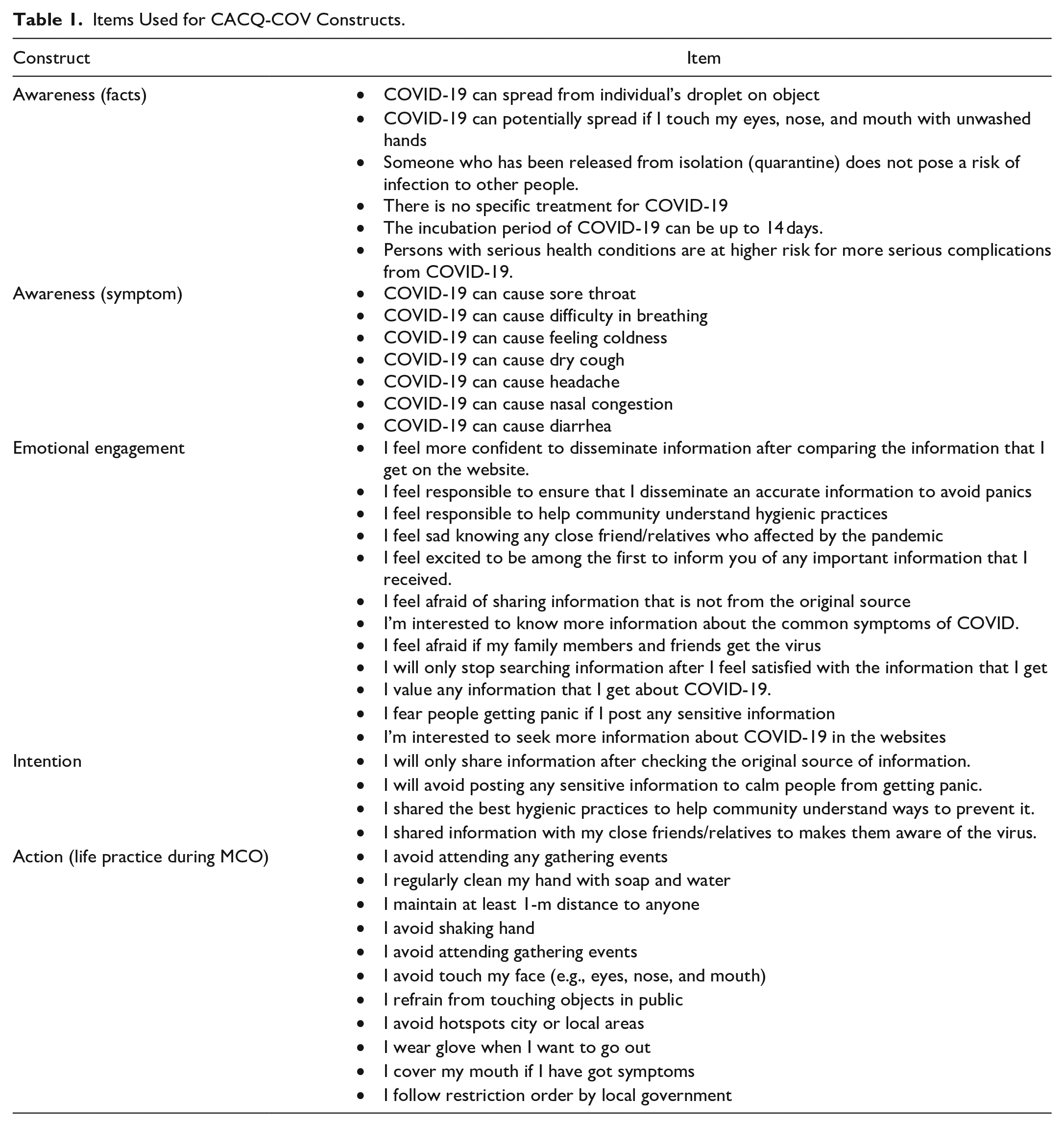
The survey was then pilot tested to 30 students who were under home quarantine at university hostel (this student has had close contact with COVID patients) considering that they have been fully isolated and depended only on online resources to get any information on the pandemic and current situations. The results of reliability analysis are presented in Table 2. This article presents findings of the descriptive statistics analysis, and Partial Least Squares Structural Equation Modeling (PLS-SEM) analysis was performed to test the reliability and validity of the structural model. The use of the PLS-SEM analysis is in line with the objectives of this study which aimed to validate the constructs and test the applicability of the TRA model. Any uncertain measures were eliminated from the constructs. Compared to Confirmatory Factor Analysis, PLS-SEM has several advantages such as the capability in assessing prescriptive and descriptive models. Two steps from the PLS-SEM procedure were used; (i) statistical validation (convergent and discriminant validity) and (ii) structural analysis of the model.
Reliability of Item.
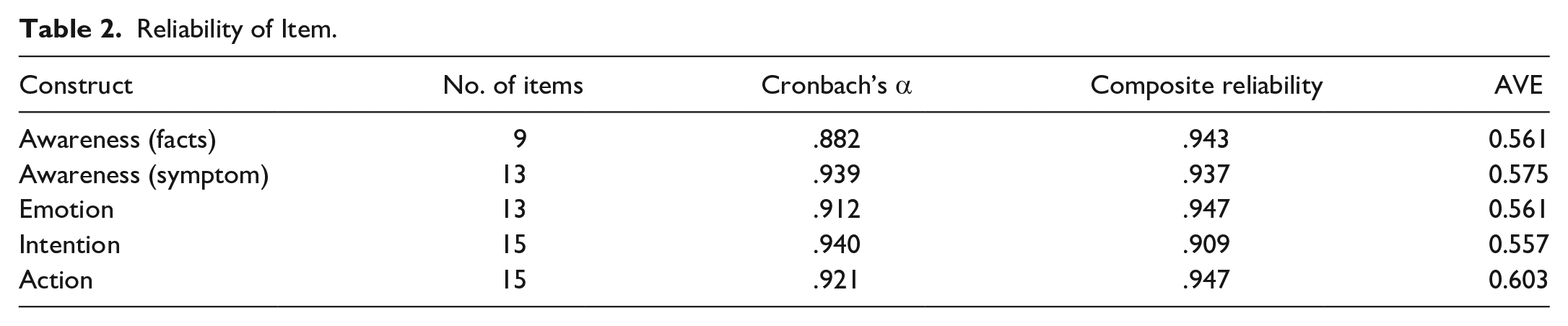
In order to assess the convergent validity for each item in the constructs, factor loadings of the items in the scale were observed. Any score values that have high loading (greater or equal than 0.5) from each construct will be retained (Hair et al., 2018; Kline, 2015; Schumacker & Lomax, 2010). Based on the indicator, only one item was removed from the Knowledge construct which is “someone who has been released from isolation (quarantine) does not pose a risk of infection to other people” with a loading value of 0.449. Additionally, another item under behavioral action construct was omitted that is, “I wear glove when I want to go out” because it yielded a loading value of 0.477. The Alpha Cronbach (α) test is used to determine the reliability index for the items. The reliability coefficient or index value (α) of .60 and above is considered acceptable according to social science study (Perera et al., 2008). Table 2 shows the results of reliability coefficient for each construct, indicating an acceptable value o greater than .70) which is appropriate for the research (Hair et al., 2018).
The analysis proceeded with the composite reliability (CR) and average variance extracted (AVE), to confirm the construct validity for discriminant and convergent validity respectively. As shown in Table 2, The composite reliability demonstrated values higher than .9, therefore internal consistency for each of the constructs was considered accepted. An AVE value greater than 0.5 is considered acceptable (Hair et al., 2018). Findings on Table 2 also indicated that the value of AVE exceeded the advised value of 0.5, therefore, convergent validity was assured.
Data Analysis
Descriptive and inferential statistical procedures are employed to analyze the data related to this research, including mode, frequencies, percentage, and mean of each variable score. Normality test using descriptive method (skewness) was performed for granting a parametric test to be performed on the data including Pearson’s correlation (pre-analysis and linearity) and multiple regression. Inferential statistics are used to determine the influence of variables (awareness, emotion, and intention) on the students’ behavioral actions, mainly based on the Soble test for mediation and moderator test using PROCESS v3.5 by Hayes (2017).
Results and Findings
The majority of the participating students are from the first (32.8%) and second-year classes (33.5%) of the first-degree programs (93.4%); the rest are from the postgraduate programs (see Table 3).
Year of Study of Respondents.

In line with the MCO regulations, more than 80% of the students adhere to the rules to stay at home and are permitted to move within a radius of 10 km only. A total of 13.8% of the students were under surveillance; these are the students who have close contact with COVID-19 patients or visited high-risk countries. A total of 6% of the students are under compulsory quarantine, as instructed by the government authority. The details are indicated in Table 4:
Status During COVID-19.

During the MCO period, the students learnt about the COVID-19 pandemic from various media and the internet. Based on the results, more than 50% of the students rated the television broadcast as the most trusted media. The authorities have fully utilized television broadcasts to disseminate current information and development of COVID-19, which can reach every home in the country. It can be interpreted that the students learnt about COVID-19 facts and symptoms from television broadcasts. Students also gathered information about COVID-19 from medical staff (17.3%). Interestingly, social media (8.1%) ranks fourth in the list of trusted media for COVID-19 information. Findings from the sources of COVID-19 information are indicated in Table 5.
Trusted Media.

Findings from this study provide a reflection that public health authorities initiative to deliver information on COVID-19 situations to the locals using phone messaging and Facebook is justifiable. Since some students also depend on social media as the source of information, official social media accounts should be created as an alternative medium of disseminating information. It is also seen as important for the authorities or universities to increase awareness of the community and students by always referring to an official announcement given by the authorities to avoid any misconceptions and, to increase safety practices and acceptability of the students toward any official orders made by the authorities or universities.
The distribution of data was tested using graphical and descriptive statistical methods (skewness). Patterns of normal distribution were observed on the Q-Q plot as well as in the box plot. Additionally, the skewness value for all constructs (Awareness = −0.93; Intention = −0.73; Engagement = −1.73; and Action = −1.39) were between −2 and +2, which is assumed to be normally distributed (Hair et al., 2018).
Students’ Levels of Knowledge About Facts and Symptoms, Emotion, Behavioral Intention, and Action
The results indicate that the students’ awareness of COVID-19 facts and symptoms is at high levels, with a mean score of 4.58, and a standard deviation (SD) value of .56, while a minimum score of 2 and a maximum score of 5. Moreover, their mean awareness score of COVID-19 facts and symptoms was 4.22 (SD = 0.74) with a minimum score of 1 and a maximum score of 5. Then, the students’ emotion level is also at a high level with a mean score of 4.54 (SD = 0.54) as the minimum score was 1 and a maximum score of 5. Meanwhile, the mean score of the students’ behavioral intention is 4.04 (SD = 0.72) with a minimum score of 2 and a maximum score of 5, which is slightly lower than other independent variables, but still within a higher range. Lastly, the dependent variable of action is also at a higher level, with a mean score of 4.60 (SD = 0.51) with a minimum score of 2 and a maximum score of 5. Table 6 shows the results of the descriptive analysis
Descriptive Statistic.
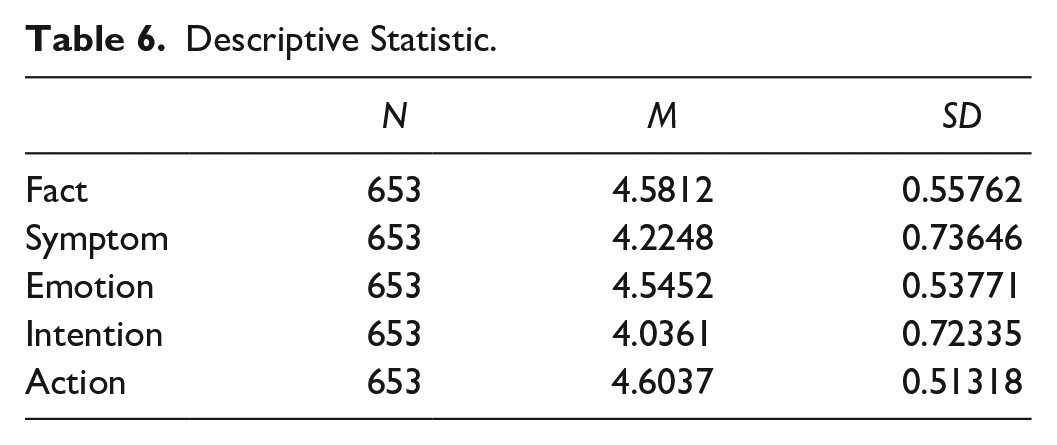
Here is an insight into the analyzed data: the students are well aware of the fact that COVID-19 has snowballed into a global pandemic; this is indicated by the highest mean score of 4.73 (SD = 0.59) for the knowledge level of facts. One possible reason is that the students are well connected with the internet or media, which headline and highlight the global statistics of the COVID-19 infections, virtually every day. Also, the students believe that a person who is out of quarantine does not pose a risk of infection to other people; this item was rated with the lowest mean score of 3.75 (SD = 1.18).
In regard to COVID-19 symptoms construct, the students are aware that the virus can cause breathing difficulties, as indicated by the highest mean score of 4.56 (SD = 0.76) compared to the other means. This is due to the widely spread news informing the public about the danger of COVID-19 where the virus attacks an infected human’s lungs that may eventually cause difficulty in breathing. The lowest mean score is recorded by the item “COVID-19 can cause a sign of heart attack”, with a value of 3.43 (SD = 1.23). This is probably due to only a few threads of news on media reporting details related to this topic.
Concerning the emotion construct, the students appreciate the front-liners who have been working hard to save the infected people of this country. This item was rated the highest mean score among all the 13 items, with a mean value of 4.76 (SD = 0.58). During that period, most of the media have also expressed appreciation to the front-liners. Interestingly, the students rated the item “I feel excited to be among the first to inform any important information that I received” with the lowest mean score of 3.86 (SD = 1.11).
With regard to the behavioral intention construct, the students are keen to share information with their family members and friends to prevent potential infection. This item was obtained the highest mean score of 4.39 (SD = 0.79). However, students rated their behavioral intention of being “among the first to inform any important information that they received” with the lowest mean score of 3.72 (SD = 1.11).
From the viewpoint of action, the students rated the item “stay at home” with the highest mean score of 4.81 (SD = 0.54). The item “do nothing above” (referring to all the actions in the previous items) was rated with the lowest mean score of 2.41 (SD = 1.71).
Students’ Action Predictors
Pre-analysis was conducted to indicate a possible mediator or moderator of engagement between variables studied. Pearson’s correlation between awareness and behavioral intention indicated a correlation of r (653) = .32, p = .000, which is statistically significant. Similarly, a statistically significant correlation between awareness and engagement has been proven when the value of r (653) = .50, p = .000. A correlation between engagement and behavioral action has yielded an r (653) = .54 and p = .000, which indicate that it is statistically significant. Additionally, a correlation between engagement and behavioral intention resulted in a correlation value of r (653) = .59 and p = .000 which also indicate that it is statistically significant. These association is sufficiently large that it may lead to a multicollinearity, where possible role of a mediation or moderation exist therefore, further testing is necessary in two cases as follows:
(a) Case 1: Do engagement (affective) mediate the relationship between awareness (knowledge) and behavioral intention (conative)?
Since this study has a very large sample, it is justifying for using Sobel (1982) test to verify the role of the engagement as a mediator. The regression model of Awareness on Behavioral Intention ignoring Engagement was significant where b = 0.39, CI [0.31, 0.49], and t = 8.65. The regression model of Awareness and Engagement was also significant with values of b = 0.46, CI [0.40, 0.52], and t = 14.89. The Mediation process showed that Engagement, and Awareness, were a significant where b = 0.04, CI [−0.05, 0.13], and t = 0.95. Engagement and Awareness also were a significant predictor of Intention, where b = 0.76, CI [0.67, 0.86], and t = 15.42. A Sobel test indicated the model significantly mediate Awareness and Behavioral Intention (z = 10.79, p < .00; see Figure 2).
(b) Case 2: Does Behavioral Intention (conative) mediate the relationship between engagement (Affective) and Behavior (Action)?
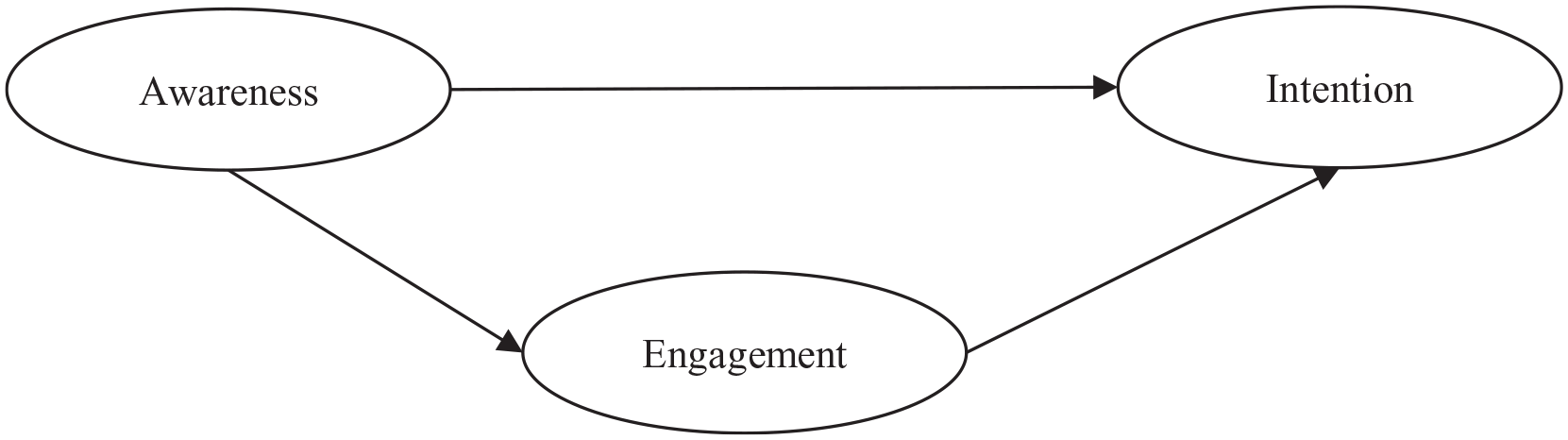
Case 1—Testing engagement as mediator.
The regression model of Engagement on Behavioral Action ignoring Behavioral Intention, was significant where b = 0.52, CI [0.46, 0.58], and t = 16.48. The regre ssion model of Engagement and Behavioral Intention was also significant where b = 0.79, CI [0.70, 0.87], and t = 18.41. The Mediation process showed that the Behavioral Intention, Engagement, was a significant where b = 0.49, CI [0.41, 0.56], and t = 12.60. Additionally, Behavioral Intention, Engagement was not a significant predictor of Action where b = 0.04, CI [−0.02, 0.09], and t = 1.32. A Sobel test indicated that the model was not significant in mediating Engagement and Behavioral Action (z = 1.26, p > .21; see Figure 3).
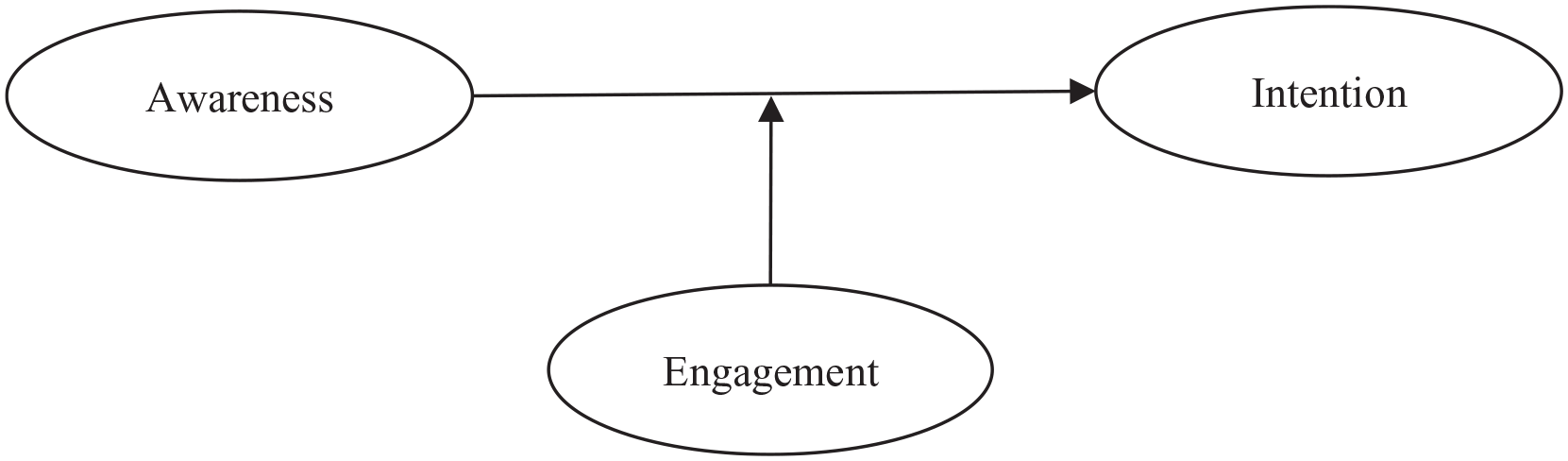
(c) Case 3: Do engagement (affective) moderate the relationship between awareness (knowledge) and intention (conative)?

Case 2—Testing intention as mediator.
The outcome variable was Intention and the predictor variable for the analysis was Awareness. The moderator variable evaluated for the analysis was Engagement. The interaction between Awareness and Engagement was not significant, b = 0.04, CI [−0.05, 0.13], and t = 0.8534 (see Figure 4).
(d) Case 4: Does Intention (conative) moderate the relationship between engagement (Affective) and behavior (Action)?
Case 3—Testing intention as mediator.
The outcome variable was Action and the predictor variable for the analysis was Engagement. The moderator variable evaluated for the analysis was Intention. The interaction between Engagement and Intention was not significant because b = −0.04, CI [−0.09, 0.02], and t = 1.2.296 (see Figure 5).

Case 1—Testing intention as mediator.
Results of the pre-analysis indicated that engagement was a significant mediator, while intention was not significant according to each model in cases 1 and 2. Result also indicated that mediator test were not significant in both cases 3 and 4.
(e) Regression Model of the influence of awareness, engagement, and intention toward behavioral action
A Multiple Linear Regression was conducted to see if cognitive, affective, and conative factors predicted the students’ behaviors (action) in dealing with the COVID-19 pandemic. In this case, the knowledge sub-construct, namely facts and symptoms were combined together as a single variable (awareness). Based on the analysis, the results indicate that a significant regression equation was found where F (3, 649) = 115.311 and p = 0.00, with an R2 = .348. The students’ predicted Action equals to 1.80 + 0.37 (engagement) + 0.23 (awareness) + 0.03 (intention). In other words, these three variables have influenced the students’ behavioral actions, where emotion has the most influencing factor compared to knowledge and behavioral intention. Further details are shown in Tables 7 to 9.
Model Summary.

Predictors: (constant), awareness, intention, and engagement.
ANOVA.

Dependent variable: action (Table 7).
Predictors: (constant), awareness, intention, and engagement.
Coefficients.

Discussion
COVID-19 has been infecting people of all ages and it is spreading very fast, with some succumbing to the disease, especially the elderly, those with chronic critical illness, and those who are late in seeking medical treatment. It is extremely important for the government to take prompt actions in disseminating accurate information to the citizens in order to contain the spreading and minimize the death toll. The Malaysian Government took unprecedented steps to embark on the MCO while ensuring the rules must be justifiable and instructions should be crystal clear. These actions were taken so that the people can take appropriate actions and cooperate with the authorities. Thus, it was important for the people to be willing to practice all the orders and recommendations such as avoiding mass gathering, maintaining social distance, and practicing good personal hygiene. Besides, the citizens should be informed and educated about the COVID-19 pandemic facts and symptoms so that they are fully aware of the dangers. With all the government’s preventive measures in place, coupled with the people’s cooperation in adhering to the rules, it is hopeful that COVID-19 spread can be contained swiftly and ultimately eradicate it.
The findings of this study could shed some light on the important roles of the traditional and online social media in disseminating information to the students of higher educational institutions under pandemic situations. Results of this research study have proven that students do receive the right knowledge about the facts and symptoms of COVID-19, as evidenced by the high mean scores for this construct. Knowledge acquired from the social media has actually fostered positive emotional engagement and right intentions among the students, both of which have consequently influenced their behaviors during the MCO period.
By referring to Figure 1, the sequential relationship of variables to influence students’ behavior were the process from cognitive to action that will go through a mediator which is the conative aspect. Thus, we have found significant mediators and found that the moderators were insignificant. Furthermore, this has explained how the roles of students’ knowledge, emotion, and behavioral intention have significantly influenced the students’ behaviors and actions. Notwithstanding, the main roles of engagement on various information and Behavioral intention to share were not clearly defined as either to mediate or moderate students’ behavioral action. As a consequence, these results will help to describe the phenomena of quarantined-students’ action and decision making, especially during a pandemic.
These findings are aligned with the study from Eqbal et al. (2020), where social media has a significant impact on students’ information about COVID-19. Also, the findings of this study further support the theories of Fishbein and Ajzen (1975) and PLOCHBERGER Franz (2014), that a new information connection or exchange of information can be effective with good human information management. The students’ actions reflect their full cooperation with the authorities during the 10-weeks MCO period by practicing good personal hygiene, and healthy lifestyles as well as restricting their movements and maintaining physical distance in order to mitigate the risks of COVID-19 infections for them and people around them.
The findings of this study also suggest that the students perceived television broadcast and medical staff as more credible sources of information related to COVID-19 facts and symptoms. Social media were not rated as the primary credible information source, thus contradicting the study of Boukes (2019) who said that social media, including Twitter and Facebook, were the primary sources of learning about news. In the case of this study, the finding indicates that more than half of the respondents preferred receiving information from the television, which demonstrates the government’s initiative to approach and educate the community about COVID-19 through television is somehow effective. This finding is also in line with the study of Shehata et al. (2015), who demonstrated that the traditional news media such as television has positively affected the users’ knowledge about the current pandemic situation, and increased their awareness of COVID-19 facts and symptoms. Nevertheless, the important roles of online social media cannot be denied. Even though they were not chosen as the primary credible sources of information about COVID-19, Boukes (2019) suggested that Twitter has positively contributed to knowledge acquisition of the current issues.
The findings also show that the students’ emotion is also at a higher level while their behavioral intention is slightly lower than other independent variables. Further analysis indicates that a combination of the cognitive, affective, and conative factors accurately predicted the students’ behaviors (action) in dealing with the COVID-19 pandemic, with emotion having the highest influence compared to the other independent variables. In other words, these three variables have influenced the students in behavioral actions; emotion has a higher influence than knowledge and behavioral intention. This finding is supported by a research from Blankstein et al. (2020) where there is a significant positive correlation between awareness and attitude, as well as a positive correlation between attitude and practice.
Findings of this study are aligned with the tripartite theory of relationships between the three mental elements (cognitive, affective, and conative) and individuals’ behavioral actions, as proposed by Fishbein and Ajzen (1975) through the Theory of Reasoned Action. It is worth reiterating that the Theory of Reasoned Action (Fishbein & Ajzen, 1975), in the context of this study, has eventually helped the researchers to come up with this beneficial study. From the practical point of view, and given the seriousness of this pandemic that could have a huge impact on the students’ as well as the community’s safety, it can be concluded that the students’ actions can be predicted, as long as pertinent information is available adequately. Any unpredictable situations, such as rushing back to the hometowns right after the MCO announcement, should not have occurred if they received adequate information at the earliest possible time. There is one major limitation of this study: the sampling of students is confined to only one particular higher educational institution. Future studies may expand the generalizability of the findings by including samples from higher educational institutions.
Conclusion
In this study, the students receive their credible information regarding COVID-19 facts and symptoms mostly from the television broadcast and medical staff. From these two sources, the students get to know the critical information about COVID-19 which stimulate their minds to generate emotions and behavioral intention that influence them to take appropriate actions to avoid contraction. Therefore, this series of mental perception and physical actions are in line with the theory of Fishbein and Ajzen (1975). The utilization of television broadcasts to educate students and the community is deemed successful. The students understand the COVID-19 pandemic and its grave consequences, thus indicating the success of the government’s initiatives to disseminate information about the pandemic. The implication of this study is obvious: television broadcasting should be the primary choice of media for carrying out future mass campaigns over other social media, especially in critical times when information needs to reach the general public as quickly and as wide as possible. Future research is suggested to replicate this study for a post-pandemic phenomena and comparison with the quarantined-students sample (in this study) would yield more interesting findings.
Footnotes
Declaration of Conflicting Interests
The author(s) declared no potential conflicts of interest with respect to the research, authorship, and/or publication of this article.
Funding
The author(s) received no financial support for the research, authorship, and/or publication of this article.
