



Abstract
Background
The COVID-19 pandemic has demonstrated the need for medical students to be prepared to make adequate decisions during unique challenges presented during pandemics.
Objective
This review aims to provide a comprehensive look into the current global literature that discusses medical curricula on clinical ethical issues during a pandemic.
Methods
The scoping review methodology was divided into three stages. Phase 1, planning, involved identifying key terms, selecting databases, creating a search criterion, and deciding on inclusion and exclusion criteria. Phase 2, study selection and data extraction, included screening the title and abstract, reviewing the complete text, and extracting data. Phase 3, analysis and write-up, comprised analyzing the extracted information and composing the review.
Results
10 studies were included and underwent data extraction as part of the review. The studies varied by country, study design, institution, education setting, and course titles. Ethical issues identified while reviewing the curriculums were resource allocation, healthcare worker obligations, personal protective equipment, disease control, communication, management protocols, and patient care.
Conclusion
This review revealed a lack of literature regarding the curriculum for medical students on ethical issues during a pandemic. This indicates a need for reform in medical education to cover pandemic preparedness and ethical concerns during a pandemic. If medical schools do not address this gap, future physicians may encounter the same issues healthcare workers faced during the COVID-19 pandemic.
Keywords
Background
The COVID-19 pandemic has demonstrated the need for medical students to be adequately trained to deal with unique challenges presented during pandemics. The lack of adequate preparatory training for healthcare workers can be seen through the overall lack of preparation felt by healthcare workers throughout the COVID-19 pandemic. Healthcare workers have not only been given increasing workloads, but they have received a lack of formal support and minimal training to prepare them for the difficulties that arise during a pandemic. 1 Due to the lack of preparedness, many healthcare workers have felt a fundamental lack of knowledge regarding approaches to pandemic healthcare, resulting in a feeling of hopelessness as healthcare workers. 2 Additionally, the limited number of medical resources available during the COVID-19 pandemic resulted in inevitable triage issues arising in hospitals due to the lack of adequately prepared healthcare workers capable of appropriately navigating a pandemic. 3
Furthermore, there were frustrations at the lack of preparedness and the role of medical students during the pandemic. 4 Involvement in front-line care showed marked benefits in the professional development of students and the formation of their identity as healthcare workers. 5 Being prepared to be put in these pandemic situations, where they can develop their skills, is therefore seen as an imperative part of their education. 6
Several studies have examined pandemic preparedness training programs for medical students. A systematic review conducted in 2020 found that medical students had limited knowledge of disaster preparedness and needed more comprehensive training programs. 7 Additionally, there is a need to plan, develop, and implement pandemic exercises in medical curriculum to improve the overall knowledge of physicians. 8 Adequate training has the potential to increase the resilience of medical students and healthcare workers, helping them cope with traumatic situations during a pandemic. 9 Implementing these training programs could result in more well-rounded medical professionals capable of effectively handling calamities. 7 Nevertheless, there is limited research in terms of medical education relating to ethical issues during a pandemic. Current available ethical guidelines for clinical practice vary regionally. In Europe, there are several ethical guidelines for healthcare.10–13 These guidelines are valuable resources for practitioners, but there is a lack of education on ethical guidelines in medical education. 14
The lack of medical education on ethical issues related to clinical practice during a pandemic is a substantial gap in the current literature.7,15 This study aims to identify the literature regarding pandemic preparedness and ethics modules that address ethical issues related to clinical practice during a pandemic. It is important to note that this study does not consider additional ethical problems related to the pandemic, such as research ethics and public health ethics, due to the variation in these ethical issues and the enormous scope of research it includes. Instead, this study aims to provide a comprehensive look into the current global literature that discusses medical curricula on clinical ethical issues during a pandemic.
Methods
The study was conducted using a three-phase approach outlined in Table 1.
Scoping review methodology broken into three phases.

Phase 1
Data sources
A total of four databases were searched in March 2023 to identify articles for this study. These databases included Web of Science, Medline, CINAHL, and Eric. As a scoping review, a quality assessment was not completed, so the pre-emptive elimination of any potential bias was necessary to maintain integrity and quality. 16
Search string
The search was conducted using the following keywords: “pandemic,” “prepared,” “plan,” “medical,” “health,” “medical student,” “education,” “student,” “train,” “curriculum,” “undergraduate,” “medical school,” “ethic,” “module,” “course,” “program,” “learn,” “teach” with terms exploded and combined as appropriate.
The search string did not include terms such as “epidemics” and “outbreaks” to avoid the inclusion of unrelated publications, such as those discussing the opioid epidemic, which was generated in the search containing terms “epidemic” and “outbreaks.” The terms “emergency” and “disaster” were also excluded as they mentioned issues like emergency medicine and disasters other than pandemics. Lastly, the terms “public health,” “global health,” and “professionalism” were also removed because they did not add any additional refinement to the search, and other key terms could capture the relevant articles.
Searches in MEDLINE and CINAHL were limited to human and peer-reviewed studies, while searches in ERIC were limited to peer-reviewed studies only. Terms related to “pandemic,” “medical school,” and “medical student” were exploded appropriately and incorporated into the search string for the respective databases.
Phase 2
Study selection
The studies selected discussed medical education on ethical issues during a pandemic. Studies included in the review ranged from January 2002 to April 2023 to account for the SARS outbreak in 2002 and reflect on any progress made since then in the literature. Using the software tool, covidence helped review the article used for this publication following the PRISMA-ScR (Preferred Reporting Items for Systematic Reviews and Meta-Analyses Extension for Scoping Reviews) guidelines and recommendations for scoping reviews. 17
Covidence, a systematic review management software, was used for the title and abstract screening, full-text screening, and data extraction. 18 Five total reviewers screened the title, abstract, and full text of each publication. At each stage, every publication was reviewed by two reviewers. Conflicts were resolved by consensus among the five reviewers. Notably, if the study only included outcomes of non-medical students, post-graduate medical students, junior physicians, or consultant physicians, the study was excluded as this study focuses on the current gaps in medical school curricula, not healthcare overall. Non-English language articles were additionally excluded due to the language limitation of reviewers. Articles that included courses or training programs that did not directly discuss pandemic planning or ethical issues arising during a pandemic were also excluded, along with those that did not provide information regarding the course's specific learning objectives or outcomes.
The criteria for studies included were those published in the English language and considered outcomes of medical student populations, discussed curriculums that specifically taught about pandemics and their implications for physicians (ie, pandemic planning, low resource settings, resource allocation, etc), and were published since January 2002, which takes into consideration the 2002 SARS epidemic.
Data extraction
Two reviewers independently extracted relevant information from each selected study using a data extraction proforma on Covidence. 18 As a team, the five reviewers resolved conflicts in the extracted data. Administrative information was recorded, including authorship, institution, country of origin, study design, and year of publication; course-related data, including title of course, duration of course, setting, participating medical students’ year of study, teaching methods, and the specific details relating to ethical issues in pandemic situations that were taught were also recorded. A quality assessment was not conducted on studies as it is unnecessary for a scoping review. 19
Phase 3
Analysis and interpretation
Analysis of included studies aimed to determine trends among the included studies. The primary goal of the analysis was to group studies by country, teaching method (lecture, simulation, etc), and ethical issues taught regarding the pandemic. From the extracted data, trends were identified using Microsoft Excel, Version 17, by identifying the frequency of teaching methods and ethical issues addressed in the course. Further descriptive analysis was gathered by categorically organizing the included studies by country to determine gaps in current pandemic preparedness education by region. Additional descriptive analysis regarding the average duration of the intervention/course, education setting (online or in person), and medical student population (year and number of students) were also analyzed to determine any significant trends among included studies. Additional interpretation of the data included the identification of a gap in the literature, expanding on ethical issues discussed in the identified literature, and providing suggestions for improvement in terms of ethical education for medical students.
Results
This scoping review identified a total of 2633 potentially eligible articles that were published between January 2002 and April 2023 (Figure 1). The results were generated across three databases, namely Web of Science (n = 1491), MEDLINE (n = 806), CINAHL (n = 172), and ERIC (n = 164). Out of these, 781 articles were identified and removed due to duplication. The titles and abstracts of the remaining 1852 articles were screened, and 1806 articles were eliminated. The full texts of 46 papers were further reviewed and compared to fit the inclusion and exclusion criteria model.

Prisma flow diagram.
After the full-text screening process, a total of 36 articles were excluded for the reasons as listed: no specific course (n = 18), no medical students (n = 9), no learning outcomes for pandemic preparedness (n = 7), full text not available (n = 1), and not in English (n = 1). A total of 10 articles that fit the inclusion criteria were included for analysis.8,15,20–27
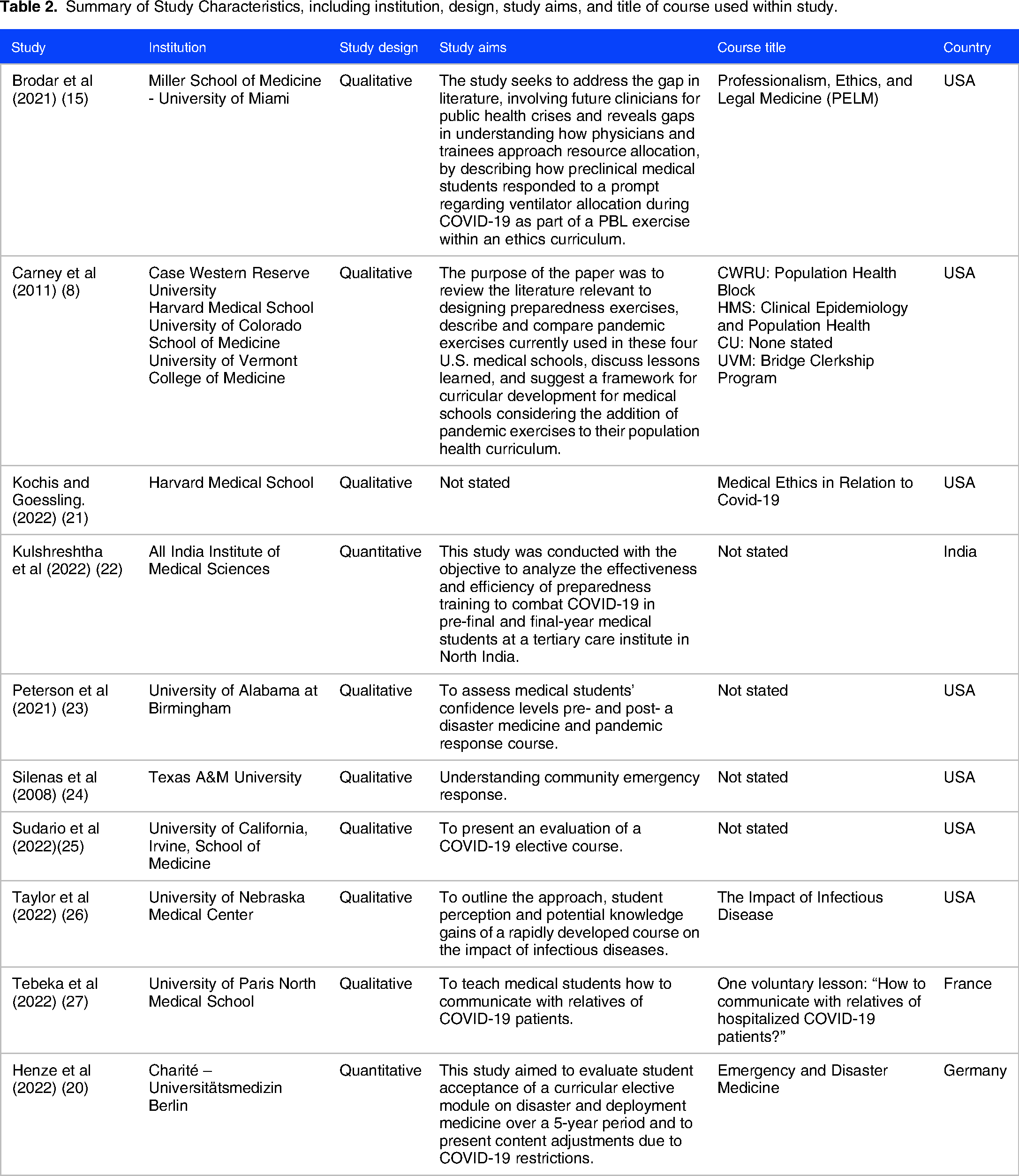
Characteristics of the selected articles and the online materials were tabulated in Table 2. The majority of the articles originated from North America (n = 7), followed by Europe (n = 2) and Asia (n = 1), spanning from 2006 to 2022. Of these, eight studies were qualitative in design and two were quantitative. The study aims were stated in all but one paper, Kochis and Goessling, and are listed in Table 2. Only six of the studies provided the course title used within the study. The medical student populations involved in these courses varied in number, within a range of 51 to 320 students, and in education level, from first year to internship year. One study by Kochis and Goessling involved an online course available to approximately 80,000 users.
Summary of Study Characteristics, including institution, design, study aims, and title of course used within study.
Learning objectives for the courses were included in nine of the chosen studies, listed in Table 3. Of the included courses, four were delivered exclusively online, two exclusively in person, and four were produced using a combination. Teaching methods varied, with 8 of the 10 study courses involving lecture and discussion-based learning, 7 involving computer-based activity, 5 involving scenario simulation, 4 involving roleplay, 3 including case studies and observation-based learning, 2 requiring self-study, and 1 study listing service learning and interview as a method of teaching. Table 3 summarizes the characteristics of the included studies.
Table listing included study course characteristics including objectives, education setting, and teaching methods.

The ethical themes discussed in each study are summarized in Table 4. The ethical issues selected to be identified while reviewing the curriculums were resource allocation, healthcare worker obligations, personal protective equipment, disease control, communication, management protocols, and patient care. Of the 10 studies, resource allocation was discussed in 7 (70%) of the curricula, which included ventilator allocation, resource pooling, distribution, and scarcity, and was by far the most common theme. A total of four (40%) studies discussed curriculums that include ethical dilemmas of patient care in one form or another, such as end-of-life care, treatment, etc, followed by healthcare worker obligations, PPE, disease control, and management protocols, which were included as ethical themes in three (30%) of the studies. The least discussed ethical theme was communication, with only two (20%) studies showing its inclusion in the curriculums taught.
Synthesis of ethical themes discussed in curricula of included studies (n = 10).

Discussion
Ethical preparedness has fueled discourse in research due to the recent COVID-19 pandemic. The finding of this review highlights the shortage of studies conducted in the field of medical education on ethical preparedness during pandemics. A total of 10 studies met the inclusion criteria. The lack of available literature meeting the inclusion criteria suggests the lack of pandemic preparedness training in medical curricula and the need to include it moving forward.9,28,29
Trends in the literature
There were apparent trends regarding the ethics themes covered within the 10 papers included in this review, Figure 1. Resource allocation was the most prevalent ethical theme in 70% of the included studies. This comes as little surprise as resource allocation is a common ethical issue in a clinical setting during pandemics with a high volume of patients requiring advanced medical equipment.30–32 The resources discussed were often ventilators and PPE, and the ethics in which the distribution was regarded as most appropriate. Pooling and distribution of resources is a common issue encountered within a clinical setting, and medical professionals who have not received adequate teaching and training in clinical ethics will struggle when faced with this dilemma. Patient care was another ethical topic, discussing the importance of ethics in pandemic settings where issues in end-of-life care and treatment administration come to light. Healthcare worker obligations and management protocols comprising data protection and confidentiality were also examined, which can be of importance during pandemics when there is a need to protect the patient and the community, which results in an ethical impasse that needs to be mediated by medical professionals. Communication with patients and other healthcare workers was also a trend observed, which can be of increasing significance during situations complicated due to a pandemic setting. The recommendation of introducing clinical ethics in medical teaching to enhance ethical preparedness during pandemic events would help resolve this dispute and help with the expectations of future physicians.
Importance and relevance of ethical issues
The variation in ethical issues seen in Table 4 does not necessarily indicate that the ethical issues mentioned more frequently are more important but instead highlights the inconsistency in ethical issues discussed in these courses. For example, Brodar 2021 mentions resource allocation and patient care, while Tebeka 2022 mentions healthcare worker obligations and communication.15,27 Nevertheless, ethical issues identified in the literature are all important regarding pandemic preparedness.
Resource allocation (n = 7, 70%) was the most widely identified ethical issue, as seen in Table 4. Resource allocation involves distributing limited resources among patients based on varied clinical presentations. This process is challenged during a pandemic when it is essential to maintain distributive justice, ensuring that limited resource distribution is fair and equitable among patients.30,31 When the demand for resources exceeds the availability of supply, healthcare workers must be able to appropriately discern which patient groups demand a greater need for resources (ie, elderly patients, patients belonging to marginalized communities, or those that live with pre-existing conditions).8,15,20
Resource allocation strategies should be integrated into medical school teaching as they equip medical students to distribute scarce resources fairly and justly. 33 Moreover, medical students would be provided insight into the importance of collaborative efforts between healthcare workers and other disciplines concerning allocating resources during a pandemic. 34 Through resource allocation teaching, medical students can identify and navigate their unconscious biases or prejudices that may influence their decision-making regarding which patients receive access to life-supporting medical equipment such as ventilators or PPE in the future.31,32
Patient-doctor confidentiality was identified in three studies, and it is of importance as it must be adjusted during the pandemic.8,21,27 During a pandemic, there is a rising expectation for healthcare workers to collect and share large volumes of patient data to facilitate outbreak investigation, disease surveillance, and contact tracing. 35 Healthcare workers must maintain patient privacy and confidentiality as it alleviates patient anxiety and allows for more effective patient care. Moreover, physicians are confronted with circumstances that require them to disclose a patient's data to a third party without their consent, such as in cases involving infectious diseases. 36 For this reason, patient confidentiality is a critical ethical issue that requires careful consideration during a pandemic curriculum for medical students.
Although a critical ethical skill during the pandemic, communication was identified as an ethical issue in only two studies.8,27 Physicians must explain disease pathology, diagnosis, and treatment options. Moreover, effective communication is the means through which confidentiality is established in a doctor-patient relationship. 37 During the COVID-19 pandemic, communication between physicians and patients was essential, as patients were faced with large volumes of conflicting information regarding the virus. Thus, physicians were crucial in providing patients with up-to-date information regarding the transmission, prevention, symptoms, and treatment options. 38 For this reason, effective communication methods should be integrated into medical school teaching. It would teach medical students how to disseminate new and complicated information to their patients during a pandemic. Moreover, because the pandemic disrupted traditional communication methods and introduced new communication methods such as telemedicine, it is essential to introduce students to innovative ways to communicate with their patients during pandemic-like situations. 39
Disease management protocols were discussed in three studies and play a crucial role during pandemics, as they provide guidelines for identifying, treating, and managing outbreaks of infectious diseases, ensuring that patients receive appropriate care based on their clinical presentation.20,22,24 Thus, medical school students must be informed about the principles underlying these protocols and how to personalize disease management protocols in pandemic settings.
Furthermore, patient care plays a crucial role in healthcare through preventing, treating, and managing illness. The four studies that included patient care as part of the curriculum varied in terms of the discussion of treatment, end-of-life care, and triage concerning patient care during a pandemic.15,20,21,25 Nevertheless, it is beneficial to include different components of patient care in the medical curriculum during a pandemic. Students must be equipped to adjust their approach to patient care in pandemic settings.40–42
Moving forward in ethics curriculum
Medical professionals should be trained on ethical issues during a pandemic. Although most medical students receive some form of medical ethics in their curriculum, the topics covered in medical ethics are not exhaustive and rarely cover the specific ethical dilemmas that arise during a pandemic. Open-access courses could be more widely adopted by medical schools to teach medical ethics concerning pandemics. 43 Not only would this result in continuity of education among future medical students, but it would also provide precise tools for medical students to address future ethical dilemmas such as resource allocation, confidentiality concerns, and privacy. 28 As future pandemics arise, medical professionals must be prepared to deal with clinical care components, such as treatment and diagnosis, and the unique ethical issues that arise during pandemics. 31
In future pandemics, adequately trained physicians could avoid similar rates of burnout, post-traumatic stress disorder (PTSD), and other emotional damage that has accrued during the COVID-19 pandemic. 44 The lack of preparedness of medical professionals is correlated to increased rates of burnout and psychological distress experienced by healthcare professionals. 45 Physicians, therefore, require additional support during highly stressful situations such as pandemics to cope with the ethical issues they face. 46 Nevertheless, while training medical students in ethical pandemic response may support their skillsets surrounding ethical issues, it is unknown how or if such training will improve other vital issues regarding pandemics, such as burnout and PTSD.
Medical students also play a crucial role in relieving the additional burden of a pandemic on healthcare workers. Still, they must be sufficiently prepared for all aspects of a pandemic, including ethical issues. 29 As seen through the COVID-19 pandemic, medical students are willing to volunteer as additional support. Still, they must be adequately trained to deal with the ethical issues they will face. 29 Not only does there need to be a more explicit emphasis on resource allocation in medical ethics curricula in medical schools, but also medical students need to be trained in the unique confidentiality and privacy concerns that arise during a pandemic. 47 These particular confidentiality and privacy concerns include protecting a patient's privacy during contact tracing, ensuring adequate data protection, and ensuring confidentiality while communicating with the patient and their family. 35 Providing this training in medical school ensures that future physicians can effectively deal with a pandemic and that medical students can provide helpful relief to healthcare workers during a pandemic. 48 Nevertheless, it is important to note that training only medical students, and not also practicing physicians, in ethical pandemic response does not address the deficits observed in physicians practicing during the COVID pandemic. Thus, while training medical students in pandemic-related ethical responses is undoubtedly meaningful, it is essential to consider that many practicing physicians have not received such training and may continue to struggle when faced with ethical dilemmas in future pandemics.
Limitations
This scoping review has several limitations that should be considered when interpreting its findings. The review included only the studies published in English, which might have introduced a language bias. Studies had varying levels of quality, potentially affecting the robustness of the synthesized evidence. Excluding grey literature, such as conference abstracts or unpublished reports, may have omitted relevant findings that could contribute to the overall understanding of the research topic. Finally, scoping reviews do not typically assess the methodological quality of included studies. Consequently, the review does not evaluate the risk of bias in the individual studies, which might affect the overall reliability of the findings. Despite these limitations, this scoping review provides a valuable overview of the existing literature, identifying gaps and areas for further research exploration. The findings should be considered as a foundation for future systematic reviews or primary research studies to delve deeper into specific aspects of the topic.
Conclusion
In conclusion, this review has highlighted the gap in the literature regarding available curricula for medical students covering ethical issues during a pandemic. Ten studies were included. The key ethical issues identified in the literature were resource allocation, healthcare worker obligations, personal protective equipment, disease control, communication, management protocols, and patient care. Adequate preparation and training for stressful situations such as a pandemic could reduce unnecessary rates of burnout, PTSD, and other psychological damage experienced by healthcare workers during a pandemic. Addressing this gap in the curriculum and literature could benefit future medical students, ensuring they are adequately prepared for a potential pandemic and mitigating any unnecessary burden they will face during a pandemic.
Footnotes
Author Contributions
Aliza Ali was the principal investigator, screener, extractor, analyst, manuscript writer (background, methods, results, discussion), editor. Azeezat Abodunrin was the screener, extractor, manuscript writer (results). Sarah Al Khayyat was screener, extractor, manuscript writer (discussion). Dunja Novakovic was screener, extractor, manuscript writer (discussion). Niall O’Connor was screener, extractor, manuscript writer (results). Ghaiath Hussein was principal investigator, advisor, editor.
Declaration of conflicting interests
The authors declared no potential conflicts of interest with respect to the research, authorship, and/or publication of this article.
Funding
The authors received no financial support for the research, authorship, and/or publication of sthis article.
