




Abstract
INTRODUCTION
Peer learning and near-peer teaching have been described in many specialties, less so in Radiology. We present near-peer teaching whereby residents present a series of didactic sessions at the course outset in the form of “symposia” and perform a scholarly activity in the form of teaching. We aim to demonstrate how near-peer teaching in symposia front-loaded within an introductory radiology course can improve medical student satisfaction.
METHOD
A total of 169 students were enrolled over a period of 3 years, 55 before (2017-2018) and 114 (2018-2020) after the introduction of the symposium. Anonymous course evaluations were collected from all students. In addition, 240 fourth-year medical students who also attended symposium lectures received satisfaction surveys in 2019 and 2020.
RESULTS
All (169/169, 100%) students taking the course evaluated it. Overall evaluation scores rose from 8.3/10 to 9.0/10 post-symposia. Among student satisfaction surveys, 89/240 (37%) specifically commented on symposia; 91% (80/89) of those found symposia very or extremely informative. 29/71 (41%) of all residents were able to participate in the symposia, 20/29 in multiple years throughout residency, allowing them to fulfill the Accreditation Council for Graduate Medical Education interpersonal and communication skills core competencies and meet scholarly activity requirements.
CONCLUSION
Near-peer teaching in the form of resident-taught interactive didactics grouped in symposia can have a positive outcome on medical student satisfaction.
Keywords
Introduction
Peer learning (trainees teaching trainees) has similar outcomes to faculty teaching in at least one meta-analysis, with courses to train students. 1 Near-peer teaching (teacher is a more advanced trainee) is well-regarded by learners and may have advantages for feedback. 2 It has been relatively unstudied in radiology, other than a few examples of fourth-year medical students and radiologists teaching anatomy to first-year students,3,4 and an example of medical student participation in teaching file development. 5 Because radiology program director surveys list medical student and resident teaching and case conference preparation and presentations as frequent resident responsibilities, 6 near-peer teaching seems beneficial.
Near-peer teaching can also help fulfill core competencies as set out by the Accreditation Council for Graduate Medical Education (ACGME), which establishes annual requirements for residency programs in the United States. Resident teachers meet several ACGME program requirements for Diagnostic Radiology, 7 with didactic teaching listed as a suggested structured didactic activity (IV.A) 8 as one which meets scholarly activity requirements. Near-peer teaching enables residents to fulfill core competencies8,7 Interpersonal and Communication Skills (through educating students) and Professionalism (fulfilling obligations and participating in the institution's educational mission). 7 We describe a near-peer residents–teaching–medical students initiative, specifically in the area of radiology, from March 2017 to February 2020.
Methods
Based on earlier course evaluations citing the lack of exposure to material in the classroom before it was encountered on rotations as a concern, we redesigned the introductory radiology course (RADY 401) in early spring 2018, moving 8 lectures previously throughout the course into 2 blocks of 4 didactic sessions (“symposia”) on the second and third days, offering students an early foundation of basic radiology.
Didactics used a common template, permitting efficient resident preparation, and covering key topics: abdominal pain, chest, emergency, and interventional radiology, head, cervical spine, and body computed tomography (CT), and ultrasound. Employing current cognitive research, 9 sessions began with learning objectives, followed by relevant basics and actual patient cases before closing with a review of teaching points (Figure 1), in a case-based format to increase interactivity. Symposia were available to students taking concurrent radiology electives.
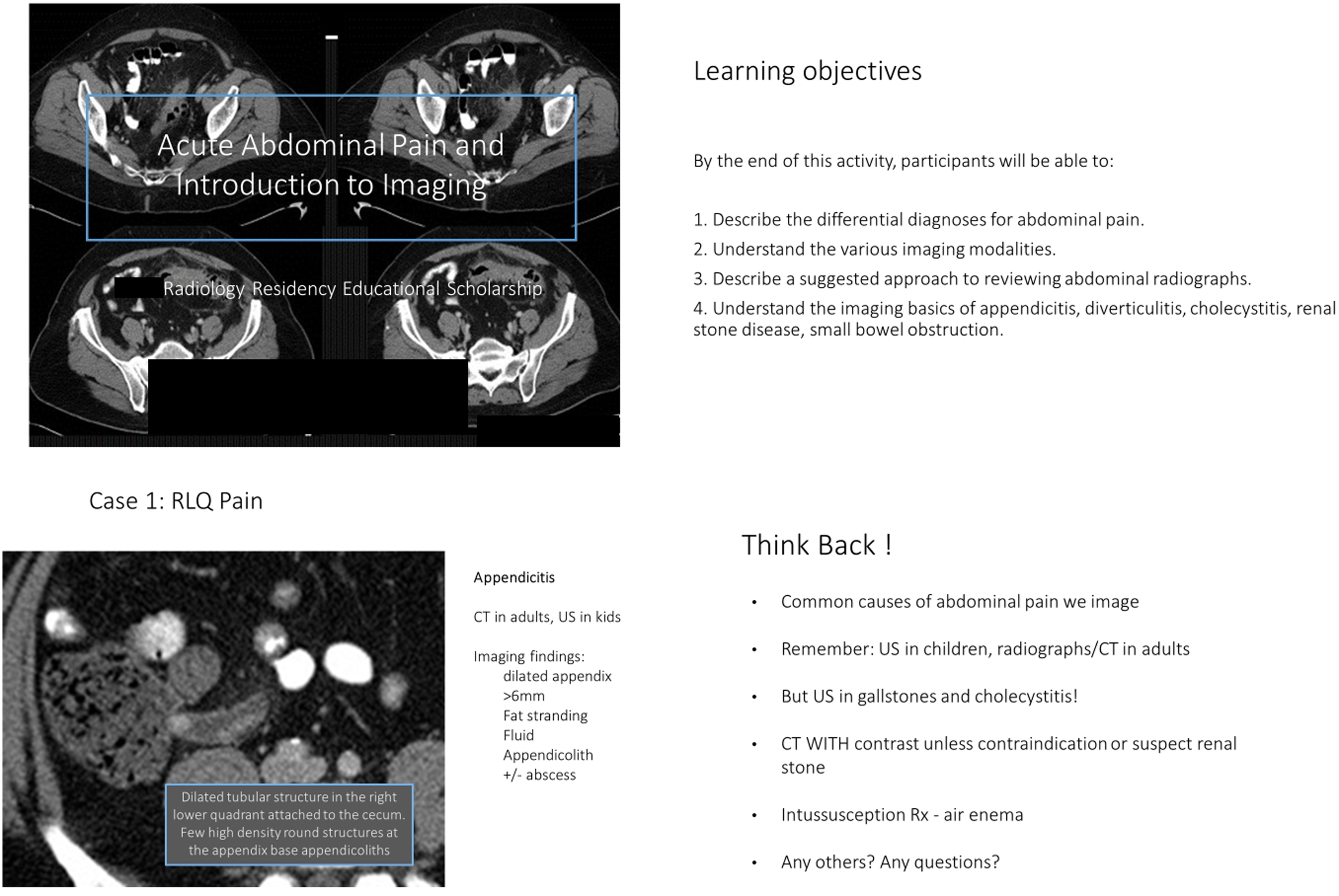
Representative slides from Lecture 1 in the symposia.
Anonymous quantitative and qualitative end-of-course medical student evaluations (Supplemental Table 1) from 2017 to 2018 (pre-symposium) and 2018 to 2020 (post-symposium) for RADY 401 (taken by MS3s and MS4s) were collected using the institutional platform one45 (one45). Students rated the course on a scale of 1 (worst) to 10 (best) with comments and suggestions for improvement. Voluntary anonymous student satisfaction surveys were administered during lecture time in a (separate) required fourth-year course taken in March 2019 and March 2020. The survey (Supplemental Table 2) was offered to 240 students, 152 of whom completed it and 89 of whom had attended symposia and offered opinions (Figure 2). (The purpose of using this data was to ask specifically about the symposia, which were not inquired about on the standardized summary given at the end of the course, which contains questions universal overall medical school classes and hence not tailored to radiology or our particular class schedule). Resident participation 2017 to 2020 was tabulated, including the number of residents per level. The sample size was thus determined by the number of respondents to the surveys for this retrospective study, rather than a power analysis.
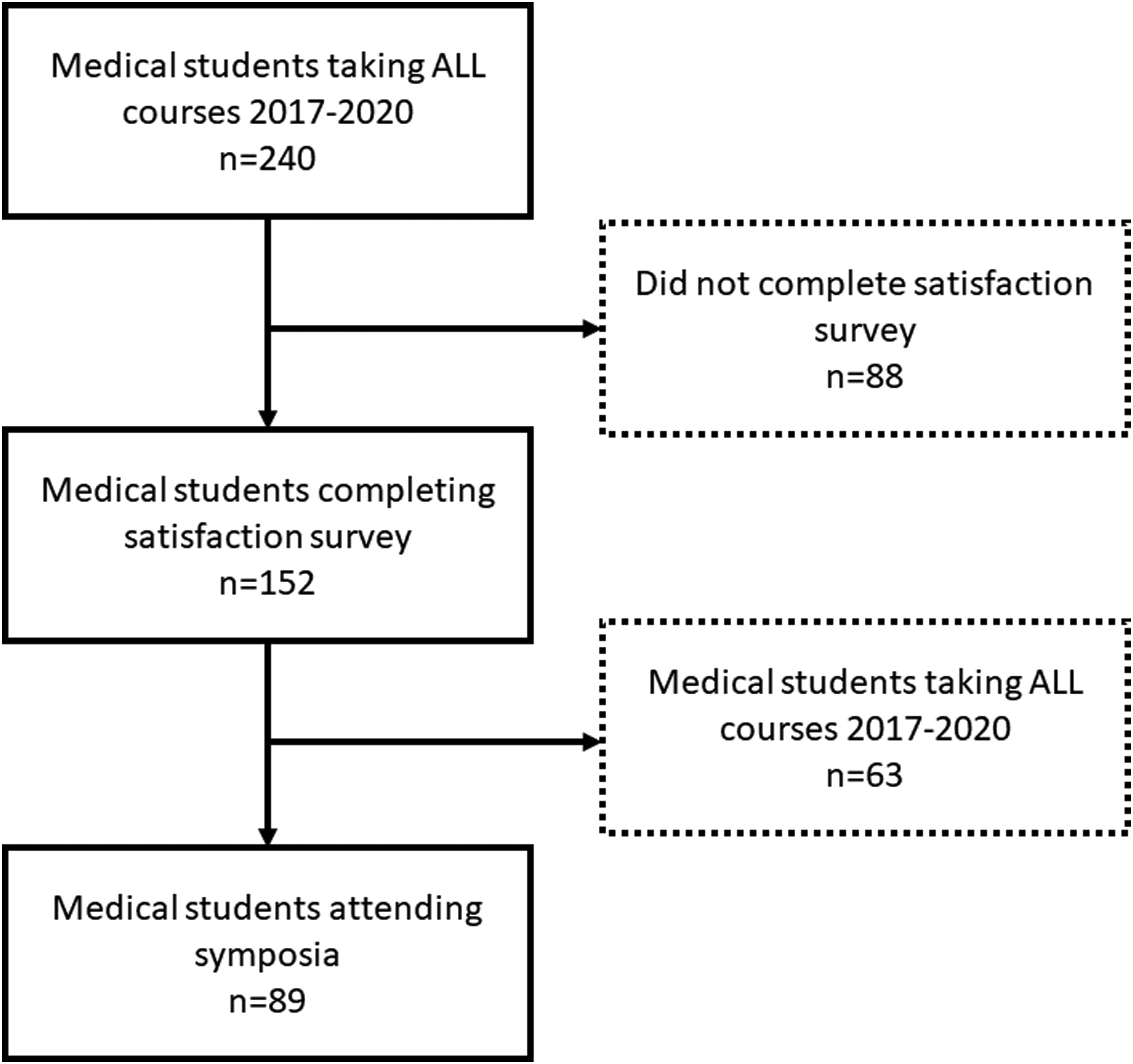
Students taking course, completing survey, and answering questions about symposia.
Data Analysis
Overall summary scores were used to calculate mean differences pre- and post-course. The effect size was calculated using Cohen's d, using the standard interpretation (0.2 = small, 0.5 = moderate, 0.8 = large). 10
This project was exempted by the institution's Human Research Ethics/Institutional Review Board (IRB# 18-1308). Consent was waived for minimal risk (no identifying information) by the IRB.
Results
All 169 students who took RADY 401-55 students pre-symposium, and 114 students post-symposium, completed one45 evaluations (Supplemental Table 1), with mean course score 8.3 pre-symposium and 9.0 post-symposium (9.0 2018-2019, 8.9 2019-2020). Overall symposium results were significantly different based on the 2018 to 2019 evaluation results (Pre: 8.3, Post: 9.0, t = 2.22, P = .03, d = .42) but were not on the 2019 to 2020 evaluation (t = 1.66, P = .10, d = .36). However, the overall mean evaluation in 2019 to 2020 was still 8.9, indicating improved overall rating from pre- to post-evaluation.
Although there were no questions in the course evaluation about the symposia, the questions related specifically to instruction increased: “During this course, how effective was the teaching in the clinical setting: by residents/fellow?” increased from 8.7 before to 8.9 after (both years), “Overall, this course helped me develop skills in analyzing clinical or research problems” increased from 8.6 to 8.9 (both years), “Overall, this course helped me develop judgment in addressing patient management issues” increased from 8.3 before to 9.1 and then 8.9, and “The site director, faculty, and residents promoted a positive learning environment” increased from 8.7 before to 9.5 and then 8.9 after. (As standard deviations are not available here, Cohen's d cannot be calculated.)
Thematic analysis identified patterns within the narrative data. Investigators coded comments and reviewed the coding scheme. Codes were organized into overarching themes (in this case the symposia). 11 Comments about the symposia were overwhelmingly positive, with comments such as “Keep the resident symposia in blocks (as it is!),” “Loved the symposia,” “resident symposia and daily lectures were very informative, interactive, and relevant,” “symposia lectures are great!,” and “The lectures were generally helpful, especially the symposiums.” When asked for course strengths, many students specifically listed the symposia.
The fourth-year student optional satisfaction survey (Supplemental Table 2) had a 63% response rate (152/240). 89 (59%) of respondents had attended the symposia, and 80 of those 89 (89.9%) rated the symposium sessions as “very informative” or “extremely informative” (Figure 3), with the most practical topics being chest radiography, emergency radiology, abdominal pain, and body CT (Figure 4).

Rating of symposium sessions.

Most practical symposium sessions.
Many residents taught in the symposia in 25 schedule blocks (April 2018 through February 2020) inclusive of 3 academic years of residents, totaling 161 resident presentations. (The other 39 symposia lectures were given by the Radiology UME Director, S.J.). Twenty-nine of 71 (41%) residents in the residency program participated in near-peer teaching, 6 as R1s, 10 as R2s, 15 as R3s, and 15 as R4s. Many residents taught multiple years: 5 as R1s and R2s, 4 as R2s and R3s, 9 as R3s and R4s, and 2 as R1s, R2s, and R3s. Ten were inducted into our institution's Academy of Educators, and 10 became chief residents (7 were both).
Discussion
Our near-peer didactic symposia improved course evaluations, particularly in areas related to teaching, and had the incidental advantage of helping meet ACGME requirements.
Students’ ratings improved after the symposia by quantitative and qualitative criteria. Students engaged with the material and praised the results of other residents-as-teachers initiatives, 12 with reinforced learning. 13
Two authors were symposium resident lecturers (JW and JC). One author (JW) took advantage of the first presentation to review course expectations and offer suggestions for optimizing learning during the course; the other author (JC) stated symposia and reading room interactions influenced 2 medical students to pivot to radiology.
Limitations of our study include the single location at a single medical center, and the difficulty of separating near-peer teaching from other curricular enhancements. However, any residency program could adapt our approach and help meet national requirements. The questionnaires were designed for the purposes of evaluating the course and were not validated separately; as such, they measure course satisfaction for the purposes of the office of medical education, but this might be considered a limitation of the study. In addition, the fact that both the instructor and format changed makes it difficult to disentangle the effects of the 2; however, many students rated the symposia positively on the survey. As this was a retrospective study, the sample size was determined by the number of respondents to a preexisting survey, rather than a power analysis. Future directions include the long-term impact of teaching after graduation and measuring if residents’ evaluations by faculty or standardized tests performance benefited from teaching.
Conclusion
Near-peer teaching in the form of resident-taught interactive presentations grouped in symposia can have a significant positive outcome on medical student satisfaction and assists residents in fulfilling ACGME training program requirements.
Supplemental Material
sj-docx-1-mde-10.1177_23821205231162459 - Supplemental material for Near-Peer Teaching in Radiology Symposia: A Success Story in Residents as Teachers
Supplemental material, sj-docx-1-mde-10.1177_23821205231162459 for Near-Peer Teaching in Radiology Symposia: A Success Story in Residents as Teachers by Jorge D Oldan, Sheryl G Jordan, Joshua Wallace, John Campbell, Lynn A Fordham and Gary L Beck Dallaghan in Journal of Medical Education and Curricular Development
Footnotes
Author Contributions
Preparation of manuscript and data collection (JO), discussion of larger GME framework (GBD), description of resident role (JW, JC), preparation of manuscript (LAF), preparation of manuscript, data collection, and conception and design of study (SJ). The manuscript has been read and approved by all the authors, requirements have been met as above, and each author believes this manuscript represents honest work.
DECLARATION OF CONFLICTING INTERESTS
The author(s) declared no potential conflicts of interest with respect to the research, authorship, and/or publication of this article.
FUNDING
The author(s) received no financial support for the research, authorship, and/or publication of this article.

Supplemental Material
Supplemental material for this article is available online.
References
Supplementary Material
Please find the following supplemental material available below.
For Open Access articles published under a Creative Commons License, all supplemental material carries the same license as the article it is associated with.
For non-Open Access articles published, all supplemental material carries a non-exclusive license, and permission requests for re-use of supplemental material or any part of supplemental material shall be sent directly to the copyright owner as specified in the copyright notice associated with the article.
