



Abstract
Objective
This study evaluated a series of 4 weekly, two-hour suture clinics taught using near-peer instruction by trained second year medical students for peer participants at the University of Louisville School of Medicine using a repeated cross sectional mixed-methods study design.
Methods
Seven second year medical student instructors were trained and supervised in providing basic technical skills in suturing by a surgical faculty member (Dr Kasdan). Participants in the suture clinic consisted of 48 second year medical student peers who completed a pre- and post-clinic survey evaluating their interest in surgery, as well as their self-efficacy and confidence in performing basic suture skills. Paired-sample t-tests examined self-perceived changes in participants’ skills, confidence, and interest from pre- to post-clinic sessions.
Results
Quantitatively, student participants showed strong improvement in their knowledge of using the needle driver and suture correctly as well as an understanding of when to use a hand tie versus an instrument tie. In addition, confidence in surgical handwashing, gowning, and gloving improved significantly. Knot tying also showed significant improvements, with the most striking improvements in the ability to perform “Fast-Passes” without excessive movement and “Cross-Passes.” The ability to take symmetrical bites on the suturing block also showed considerable improvement, as well as the ability to perform a simple interrupted knot. Overall, participants’ interest in surgery increased significantly following the suture clinic experience. Qualitatively, student participant responses were analyzed in response to a prompt regarding the impact of the suture clinic experience on student interest in surgery, self-efficacy, and confidence. Thematic analysis highlighted students’ lack of experience, safety, and proficiency of technique.
Conclusion
In sum, the results of this study support the use of near peer teaching in enhancing self-reported student confidence and performance regarding basic surgical skills in advance of clerkship training.
Introduction
According to the 2024 study released by the Association of American Medical College assessing the projected supply and demand of physicians by specialty, surgical specialties are projected to lack between 13,500 and 86,000 physicians by 2036. 1 In addition to physician shortages, factors such as an aging population, aging physician workforce, increasing surgical demand, and a declining number of younger surgeons predict a dismal outlook for both physicians and their patients. 1 Many studies have set out to identify the most effective way to address this shortage by recruiting and retaining interested medical students.2-6
Despite medical students’ interest in surgery, several factors, such as lack of mentorship, early exposure to surgery, and broad work-life balance concerns, are identified as obstacles to pursuing a career in surgery. 6 Mentorship in surgical settings has been recognized as a key factor in a student's decisions to pursue a surgical career.6,7 A lack of hands-on exposure and technical skills training contributes to feeling unprepared during clerkships, sub-internships, and internship year. In a national study evaluating preparedness for surgical residency, feeling well prepared for residency was associated with a 50% lower likelihood of experiencing burnout symptoms. 8 Furthermore, surgical program directors have also noted a lack of preparedness and technical skills in interns relative to interns a decade ago. 9
Early exposure in undergraduate medical education to technical skills, including knot tying, suturing, and learning proper surgical scrubbing techniques, improve students’ performance and reduce perceived anxiety in surgical clerkships. 10 The role and benefits of Near Peer Teachers (NPTs) in undergraduate medical education, particularly in training of technical skills, has been well described in previous studies.11-19 Here, we explore the role and benefit of near peer teaching as a modality to improve medical students’ technical skills and perceived self-efficacy in surgical settings before and after participating in a surgical skills clinic. We describe the curriculum developed to teach knot tying, basic suturing, and gowning and gloving in four weekly two-hour sessions with NPTs. In addition to assessing skills-based outcomes, students’ perceived self-efficacy was assessed. The aim of this repeated cross-sectional mixed-methods study design study was to evaluate the added value of 4 weekly, two-hour suture clinics to preclinical medical education by quantifying changes in self-reported academic knowledge and surgical skills, as well as qualitatively assessing students’ self-reported beliefs on self-efficacy in a surgical setting through thematic analysis.
Methods
The reporting of this study conforms to the “Strengthening the Reporting of Observational Studies in Epidemiology (STROBE) Statement” 20 ; see the Appendix for the STROBE checklist.
Near Peer Teachers (NPTs)
Second year medical students in the Class of 2026 were invited to apply via a competitive selection process to become NPTs. In addition to their interest in surgery, student teachers were selected based on their academic performance, prior experiences in leadership, and interest in medical education. Seven students were chosen to be NPTs out of a pool of 30 applicants. NPTs were required to complete 40 hours of one-on-one training and practice with an experienced plastic surgeon (Dr Kasdan) in order to confirm their competence in the suture clinic skills.
Participants
Inclusion criteria for participation in the suture clinic included status as a second-year medical student in the academic year in 2023-2024. All second-year medical students were offered the opportunity to participate in a lottery system that randomly selected Suture Clinic participants. Eighty-five students expressed interest and were entered into the lottery system (46.7% response rate) and 48 second year medical students were selected to participate in the 4-week suture clinic program in 7 cohorts, averaging 6 students per group. Student participants completed a pre-clinic survey administered at the beginning of the suture clinic experience. The suture clinic experience spanned from August 2023 to February 2024.
Over the course of 4 weeks, student participant cohorts of 6 trained one-on-one with a NPT for 2 hours each week. In week 1, the focus was knot tying, including one- and two-handed knots, as well as fast-passes and cross-passes. Fast-passes refer to a specific, efficient technique used in arthroscopic surgery to pass a suture through tissue, often in a swift, controlled manner, while cross passes involve the action of deliberately passing one strand of the suture over or under another while forming a loop or throw. Week 2 covered simple, interrupted sutures with hand tying and instrument tying; in addition, running sutures were included, focusing on equal bites and appropriate spacing. Week 3 focused on deep dermal sutures, both simple and running types, while week 4 covered mattress sutures, both horizontal and vertical, with review time for participant questions and concerns.
Suture clinic student participants trained with a different NPT for each session. A post-clinic survey was administered at the end of the suture clinic experience. An open-response style question was also posed prompting participants to state in their own words how or if their experience in Suture Clinic impacted their interest in surgery, self-efficacy, and confidence. These responses were analyzed for themes across the participant cohort. Exclusion criteria included students who did not complete the pre-clinic survey and/or the post-clinic survey.
This study was deemed “exempt” by the Institutional Review Board at the University of Louisville (IRB-23.0623).
Data Collection
Participants confidentially completed pre- and post-clinic surveys using Google Forms. Participants rated their confidence in knot-tying surgical instrument handling, general suture material, and performing different suture patterns, as follows.
Participants’ surgical knot tying skills were self-assessed based on a pre-determined criterion. These assessments will be scored on a scale of 1-10, with a score of “1” indicating extremely poor skill and a score of “10” indicating extremely high skill.
I can demonstrate 5 consecutive “Fast-Passes” without excessive extra movement. I can demonstrate 5 consecutive “Cross-Passes” without excessive, extra movements. I can demonstrate 3 consecutive one-hand ties, including movements to follow the knot with their fingertips and crossing their hands when appropriate. I can demonstrate 3 consecutive two-hand ties, including movements to follow the knot with their fingertips and crossing their hands when appropriate.
Participants’ simple interrupted suturing skills were self-assessed based on a pre-determined criterion. These assessments will be scored on a scale of 1-10, with a score of “1” indicating extremely poor skill and a score of “10” indicating extremely high skill.
I use an appropriately sized needle driver with appropriate suture. I know when to employee a hand-tie versus an instrument tie based on the length of a given suture. I take appropriate, symmetrical “bites” on suturing block. I demonstrate the ability to perform a simple, interrupted knot, including 2-4 instrument knots and cutting the suture at an appropriate length. I minimize extra, time-consuming, and laborious movements and demonstrate efficiency when tying multiple knots.
Participants’ confidence in surgical handwashing, gowning and gloving skill, along with their interest in surgery as a specialty were assessed based on pre-determined criteria. These assessments were scored on a scale of 1-10, with a score of “1” indicating low confidence or low interest and a score of “10” indicating extremely high confidence or interest.
Rank your confidence in surgical handwashing, gowning and gloving skills. Rank your interest in surgery.
Participants responded to 2 open-ended questions in both the pre-clinic and post-clinic surveys that were qualitatively analyzed using thematic analysis and grounded theory principles.
Comment on your most significant concern about surgical handwashing, gowning, and gloving in the future. Comment on your most significant concern about suturing in the future.
Thematic analysis and grounded theory principles were used to qualitatively analyze the students’ responses to the open-ended questions. Thematic analysis was independently performed by two NPTs. Each NPT analyzed participants’ responses and generated initial codes, which were then grouped into themes. The results of the thematic analysis were merged and overarching themes were defined.
Statistical Analysis
Quantitative data were exported to Microsoft Excel into SPSS Version 29.0. Paired-sample t-tests were used to examine self-perceived changes in participants’ skills, confidence, and interest from pre- to post-clinic sessions. Cohen's Ds were calculated as a measure of effect size, with an effect size of <0.2 as negligible, 0.2 to 0.49 as small, 0.5 to 0.79 as moderate, and >0.8 as large. All P-values were two-tailed. Statistical significance was set by convention at P < .05.
Results
General Knowledge and Surgical Practices
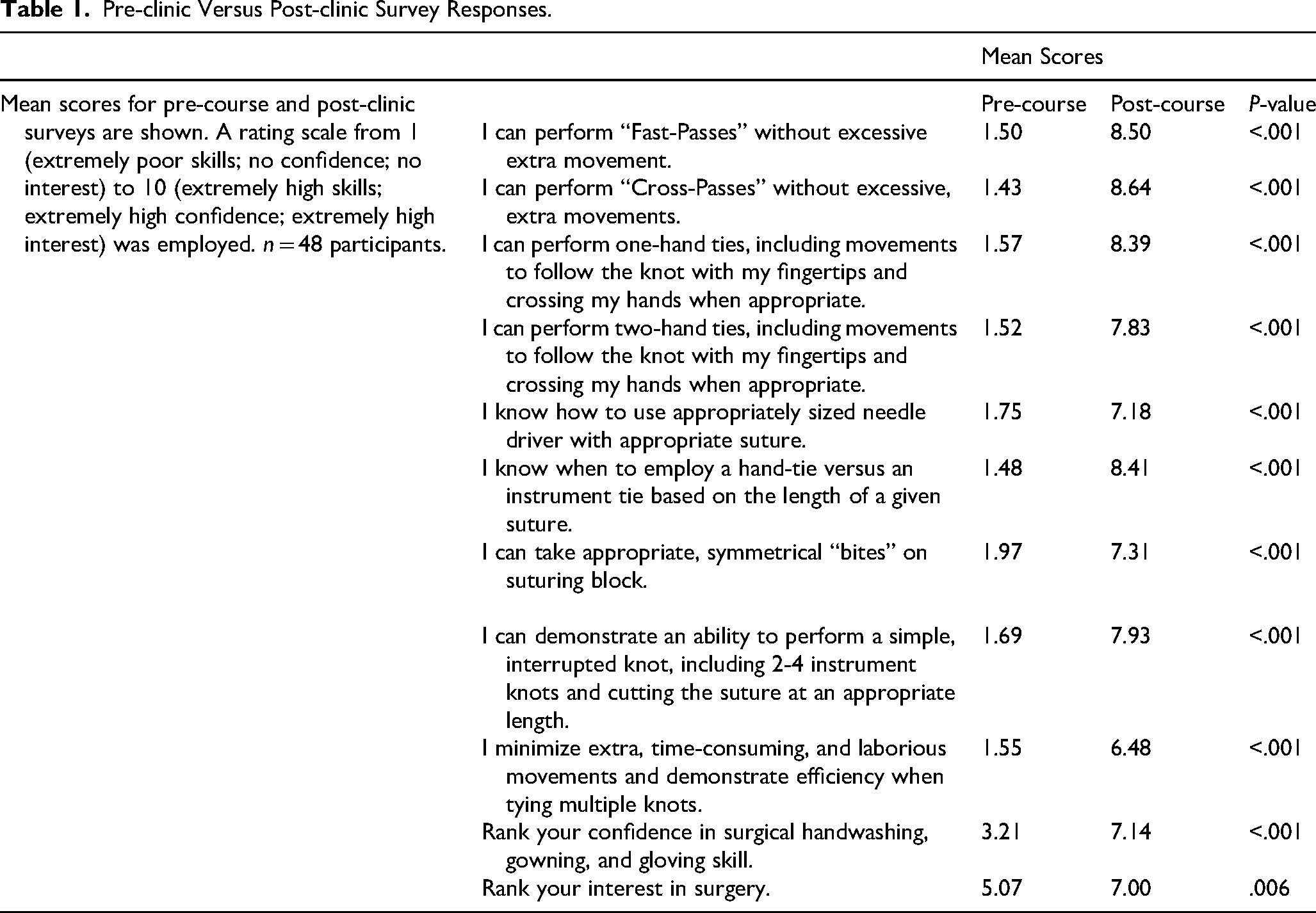
Participants showed strong improvement in their knowledge of using the needle driver and suture correctly (Table 1). Pre-session scores averaged 1.75 (SD = 2.10), rising to 7.18 (SD = 1.81) post-session, a difference of 5.43 (SD = 2.33), with a large effect size (Cohen's d = 2.33, P < .001). Likewise, their understanding of when to use a hand tie versus an instrument tie improved significantly, with pre-session scores of 1.48 (SD = 1.88) increasing to 8.41 (SD = 1.50) post-session (mean difference = 6.93, SD = 2.22, Cohen's d = 3.12, P < .001). Confidence in surgical handwashing, gowning, and gloving also improved significantly. Pre-session scores averaged 3.21 (SD = 2.81), while post-session scores increased to 7.14 (SD = 1.86), with a mean difference of 3.93 (SD = 2.54) and a large effect size (Cohen's d = 1.55, P < .001).
Pre-clinic Versus Post-clinic Survey Responses.
Knot Tying
Knot tying also showed significant improvements (Table 1). Pre-session ratings for one-hand ties averaged 1.57 (SD = 1.79), while post-session ratings increased to 8.39 (SD = 1.52), reflecting a mean difference of 6.82 (SD = 2.11) and a large effect size (Cohen's d = 3.23, P < .001). For two-hand ties, participants improved from a pre-session mean of 1.52 (SD = 1.88) to 7.83 (SD = 1.51) post-session, with a mean difference of 6.31 (SD = 2.09) and a large effect size (Cohen's d = 3.02, P < .001). Participants showed increased efficiency in knot-tying as well. The pre-session score for minimizing extra movements during knot-tying was 1.55 (SD = 1.98), which increased to 6.48 (SD = 2.47) post-session, reflecting a mean difference of 4.93 (SD = 2.80) and a large effect size (Cohen's d = 1.76, P < .001).
Suture Skills
The most striking improvements were seen in the ability to perform “Fast-Passes” without excessive movement and “Cross-Passes” (Table 1). Participants’ skills in these areas improved drastically, with pre-session means of 1.50 (SD = 1.77) and 1.43 (SD = 1.77) respectively, rising to 8.50 (SD = 1.40) and 8.64 (SD = 1.50) post-session. These changes represented large effect sizes (Cohen's d = 3.43 and 3.36), and both differences were highly significant (P < .001). The ability to take symmetrical bites on the suturing block also showed considerable improvement, with pre-session scores of 1.97 (SD = 2.18) rising to 7.31 (SD = 1.82) post-session (mean difference = 5.34, SD = 2.51, Cohen's d = 2.13, P < .001). Participants also made significant strides in performing a simple interrupted knot, with their ratings increasing from 1.69 (SD = 2.11) to 7.93 (SD = 1.49), a difference of 6.24 (SD = 2.26) and a large effect size (Cohen's d = 2.76, P < .001).
Thematic Analysis
Analysis of participants’ pre- and post-survey responses revealed three overarching and persisting themes and six subthemes emerged. The main themes described were lack of experience, safety, and proficiency of technique. The theme of lack of experience included the need for practice in low- and high-stakes environments. The theme of safety included concerns about breaking sterile fields protecting themselves and patients against infection, and a proper handwashing technique. The theme of proficiency of the technique included concerns about remembering steps and speed and efficiency.
Interest in Surgery
Finally, while participants’ interest in surgery increased from a pre-session mean of 5.07 (SD = 3.10) to 7.00 (SD = 2.57) post-session, the effect size was moderate (Cohen's d = 0.56), with a statistically significant difference (mean difference = 1.93, SD = 3.42, P = .006).
Discussion
Surgical specialties are projected to suffer from a shortage of physicians within the next decade.21-22 Among many factors that may impact a medical student's decision to pursue a surgical career, medical students often identify feeling unprepared and a lack of technical surgical skills as a factor influencing their experience on surgical clerkships and ultimately their choice in field of practice. 6 The current medical education literature lacks description of the most common approaches used by medical schools to teach surgical skills. 23 and there is evidence that medical students, trainees, and surgical program directors are not satisfied with the current technical skill level afforded by any such technical skill training available to medical students.24,25 The literature does support medical students’ interest and efforts to seek additional opportunities, outside of their mandatory curriculum and studies, to gain these skills. 26 Previous studies on surgical skills courses have consistently shown improvement in students’ suturing skills26-29; likewise, these data support that early intervention in undergraduate medical education improves medical students’ surgical skills.25,30-33
Constraints on academic surgeon's time present significant barriers to offering pre-clinical surgical skills courses or clinics.34–35 There is evidence in the literature that near-peer instruction may provide a viable academic alternative in order to offer earlier preclinical exposure to surgical skills. Brierly et al 11 published a meta-analysis that showed the academic benefits of near peer teaching, particularly for clinical skills such as suturing. In addition, the literature supports the efficacy of fourth year medical students teaching third year clinical clerks,17-19 as well as second year preclinical medical students.12,16 From a medical student perspective, the literature confirms these findings, with reports of increased confidence and preparation for surgical skills competency.13,36 Our study builds upon this existing literature in presenting a novel approach of training second year medical students as near peer teachers for a suture clinic for second year medical students, with 40 hours of student teacher training with an experienced plastic surgeon and competency assurance before teaching begins. Although this study presents a model of second year medical students teaching their direct peer cohort, similar gains in confidence in knowledge and skills were observed as in the established literature.
There are several limitations of this study that must be considered as its findings are interpreted. The present study did not calculate nor justify the sample size of the study, nor did it document if student participants in the suture clinic had a strong baseline interest in surgery or surgical skill acquisition; this introduced the opportunity for self-selection bias limiting the generalizability of the findings to the broader preclinical cohort. In addition, there was no formal objective assessment or validation of skills by the surgical faculty member; this study relies on participants’ self-reported confidence and skill levels. This study was not fully powered and thus statistically significant results may not be widely applicable to other institutions. In addition, the pre- and post-clinic surveys were not externally validated; the large effect sizes observed in this study may reflect the limitations of the survey. The student participants’ surgical skills were self-assessed in this study, such that the impact of near peer teaching could be influenced by participants’ overestimation of confidence or self-perceived skill level. Finally, the study did not incorporate a control group, which may limit causal interpretation.
Conclusions
In summary, undergraduate medical students found benefit in skills, knowledge, and confidence with participation in a Near Peer Teacher-lead surgical skills workshop. Students learned basic suturing skills and demonstrated an interest in continuing to practice and build upon their skills. Contemporary medical education research consistently supports the utility of surgical skills clinics and workshops as a powerful tool to quickly improve medical students’ skills and awareness of responsibilities in surgical settings. Additionally, this study supports the growing body of literature illustrating the value of Near Peer Teachers teaching practical skills in undergraduate medical education. While medical students’ interest in surgery was only moderately impacted by participation in a surgical skills clinic, factors including their performance on surgical clerkships and intention to pursue surgical residency following clerkships have not been assessed. Future studies could assess the impact of participation in surgical skills clinic on clerkship performance and residency choice.
Footnotes
Acknowledgments
The authors would like to acknowledge the University of Louisville medical students who participated in this study.

Author Contributions
Conceptualization: MK, EM. Data curation: EM, RC, ME, MD, CS, JD, GS. Methodology/formal analysis: EM, RC, ME, MD, CS, JD, GS, JBC. Project administration: EM, JBC. Writing—original draft: EM, JBC. Writing—review & editing: JBC.
Ethical Considerations
This study was deemed exempt by the University of Louisville IRB.
Consent to Participate
The requirement for informed consent to participate was waived by the Institutional Review Board.
Funding
The authors disclosed receipt of the following financial support for the research, authorship, and/or publication of this article: The University of Louisville's Acland Endowment for Anatomy Education provided financial support for the publishing of this article.
Declaration of Conflicting Interests
The authors declared no potential conflicts of interest with respect to the research, authorship, and/or publication of this article.