




Abstract
Data from over 25,000 nationally representative respondents to an online survey conducted in 22 countries were analyzed to understand the predictors and potential mitigators of political polarization. The analysis yielded two key findings. First, perceiving that your country is very divided on key societal issues is not by itself enough to generate affective polarization, the state in which groups that differ ideologically feel hostile toward each other and are unwilling to collaborate in constructive problem-solving: a belief that the ideological divisions are not likely to be overcome is also required. This finding suggests that affective polarization may be mitigated by new types of interventions that try to change perceptions of the dispute itself rather than views of the combatants. Instead of attempting to decrease intergroup animus, such interventions would aim to increase confidence or engagement in dispute-resolution processes. Second, employers were the only institution examined that were able to garner the trust of people who saw their country’s ideological divisions as insurmountable. This ability puts employers in a unique position to address polarization durably and at scale, especially when it comes to interventions centered on fostering positive interactions.
Political polarization often involves not only ideological disagreements over key societal issues but also dislike and distrust of people with opposing views. This kind of polarization is supported and even made likely by a host of fundamental cognitive and social psychological mechanisms that affect perceptions of others, such as the likeability of outgroups.1,2 Consequently, the specter of animosity-charged polarization is constantly lurking, poised to stymie social and economic progress and paralyze the governing process.
At the same time, differences of opinion and arguments on multiple sides of an issue are a natural and healthy part of democracy. 3 When a democratic system is working, debating issues and reaching a consensus lead to more thoughtful, more inclusive, and less extreme policies than are likely when no dissenting voices are urging the group to look at a problem from another perspective. To remain vital, democracies must continuously work to support and facilitate the airing of dissenting opinions while at the same time preventing people’s basic psychological tendencies from pushing society into affective polarization. Affective polarization is a state characterized by animus between groups and antidemocratic attitudes and behaviors, such as abandoning a willingness to compromise and adopting a win-at-all-costs attitude, even if that means subverting elections, flouting institutional traditions, and allowing critical governing activities to grind to a halt.
Staving off affective polarization while encouraging the expression of divergent views is difficult, which may explain why studies of ideological diversity have yielded mixed results: Some research has shown that ideological divisions can engender conflict, antisocial behavior, and a reluctance to engage in a constructive manner with those who do not share one’s beliefs, 4 whereas other research has found that ideological diversity can lead to improved outcomes in working groups. 5
Unfortunately, keeping the negative consequences of political polarization at bay amid ideological diversity is a challenge that many democracies are not currently meeting, as the 2023 Edelman Trust Barometer makes clear. 6 The Edelman Trust Institute, where I am the head of research, publishes the results of the annual Edelman Trust Barometer survey to document and contextualize the current global state of trust in government, media, business, nongovernmental organizations, and other institutions. The 2023 report noted that on average, 44% of respondents in the 22 nonautocratic countries included in the study agreed with the statement “The degree of political and ideological polarization in this country has gotten so extreme that I believe we are in the midst of a cold civil war.” A civil war—whether it be hot, lukewarm, or even cold—is not conducive to progress and prosperity. Perhaps this is why across those same 22 countries, 52% of respondents also agreed with the statement that “democracy is losing its effectiveness as a form of government.”
Recent research suggests that ideological polarization often precedes and drives affective polarization, 1 but the triggers that turn intellectual differences into mutual distrust and animus have not yet been identified. Understanding what converts ideological diversity on political issues into affective polarization and what to do when this happens is critical to maintaining and rebuilding faith in and support for the democratic process. To further this understanding, my colleagues and I at the Edelman Trust Institute reanalyzed the 2023 Edelman Trust Barometer data. Our reanalysis provides some new ideas for ameliorating and reducing the likelihood of affective polarization.
Method
Survey
The 2023 Edelman Trust Barometer survey was a self-administered online questionnaire completed in November 2022 by a general population sample of more than 31,000 individuals across 27 countries. 6 Respondents were recruited from country-specific online panels composed of individuals who had previously opted in to participate in survey research. The data for each country were weighted to be nationally representative for age, gender, and region. In addition, the U.K. and U.S. samples were weighted to be representative for race and ethnicity. Surveys were in each country’s national language or languages.
The survey instrument covered a wide range of topics associated with perceptions of society and social institutions, concentrating on issues related to polarization, social cohesion, and the expected roles of societal institutions in addressing polarization. The survey took about 40 minutes to complete. The data were cleaned before being analyzed to eliminate speeders (who complete the survey too quickly to have given attentive responses), straight-liners (who answer all questions the same way, another sign of inattention), bots, and people who failed a set of standard trap questions used to identify respondents who were not reading the items carefully or taking the survey seriously.
Reanalysis
Because political polarization requires vigorous dissenting opinions and oppositional parties or political factions, for our reanalysis, we removed data collected from countries that lack political pluralism. Specifically, we filtered out respondents from any country that had a 2022 Economist Intelligence Unit Democracy Index score of less than 4.00. 7 Such countries are considered to have authoritarian regimes, meaning they are outright dictatorships or countries where democratic institutions have little substance; elections, if they do occur, are not fair and free; the media is state-controlled; and criticism of the government is suppressed. This decision meant that the United Arab Emirates, Saudi Arabia, and China were not included in the analyses reported here.
In addition, two more countries were excluded from this reanalysis. Thailand was not included because data could not be collected from respondents for several key questions. France was not included due to a translation inconsistency regarding a key variable.
All the countries included in this reanalysis had sample sizes between 1,118 and 1,500.
When designing the original survey, we had hypothesized that polarization might manifest differently depending on two factors: how large and how entrenched people perceived the ideological differences in their country to be. Thus, we included two key questions that asked respondents to rate (a) the degree of division within their country on key societal issues and (b) the likelihood that their country will be able to work through and overcome its divisions.
Note that our approach to measuring the degree of ideological division relied on an individual’s perception rather than on some objective measurement of the actual degree of division within a country. Although perceived and actual degrees of division almost certainly correlate, research suggests that perceptions of ideological divisions are generally greater than the actual divisions because of the media’s sensational coverage of ideological divisions. 8 We chose this approach because previous research indicates that perceived division is more strongly related to negative evaluations of outgroups and other deleterious outcomes than is the actual degree of ideological division. 9
A preliminary examination of the survey data revealed the perceived degree of ideological differences and the perceived level of entrenchment of those differences were not highly correlated. Respondents who said they perceived their country to be very or extremely divided often differed regarding whether they felt their country would be able to overcome its divisions. To disentangle how the perceived degree of difference and the perceived intractability of an ideological dispute are likely to affect people’s attitudes and behaviors, we divided respondents into one of the following three mindset groups (see note A):
not very divided mindset: respondents who see their country as not very divided on key societal issues (55% of respondents)
divided but not entrenched mindset: respondents who see their country as very or extremely divided on key issues but who believe these divisions are not a problem or are likely to be overcome (16% of respondents)
divided and entrenched mindset: respondents who see their country as very or extremely divided on key issues and who also believe these divisions are not likely to be overcome (29% of respondents)
Results
Mindset differences in attitudes associated with affective polarization
When we compared the three groups, we found that the existence of divisions alone, even those characterized as very or extremely large, was not enough to engender attitudes commonly found when a society is mired in affective polarization. Specifically, as is shown in Table 1, we found that even among respondents who saw their country as very or extremely divided on key issues, attitudes important for compromise, cooperation, and constructive engagement were still present. That is, the majority of people in both the not very divided mindset group and the divided but not entrenched mindset group felt that people in their country had a sense of interconnection, shared values, a common purpose, an openness to listening to differing opinions, belief in a shared set of facts, and confidence that others would not turn violent or vindictive if one expressed a different opinion regarding a contentious issue. (The percentages were somewhat lower in the divided but not entrenched mindset group, however.) But these attitudes and beliefs shriveled significantly to minority-view status for respondents in the divided and entrenched mindset group, who felt their country’s divisions were insurmountable—as can be seen in the last column of the table.
Social cohesion & potential for constructive engagement by mindset
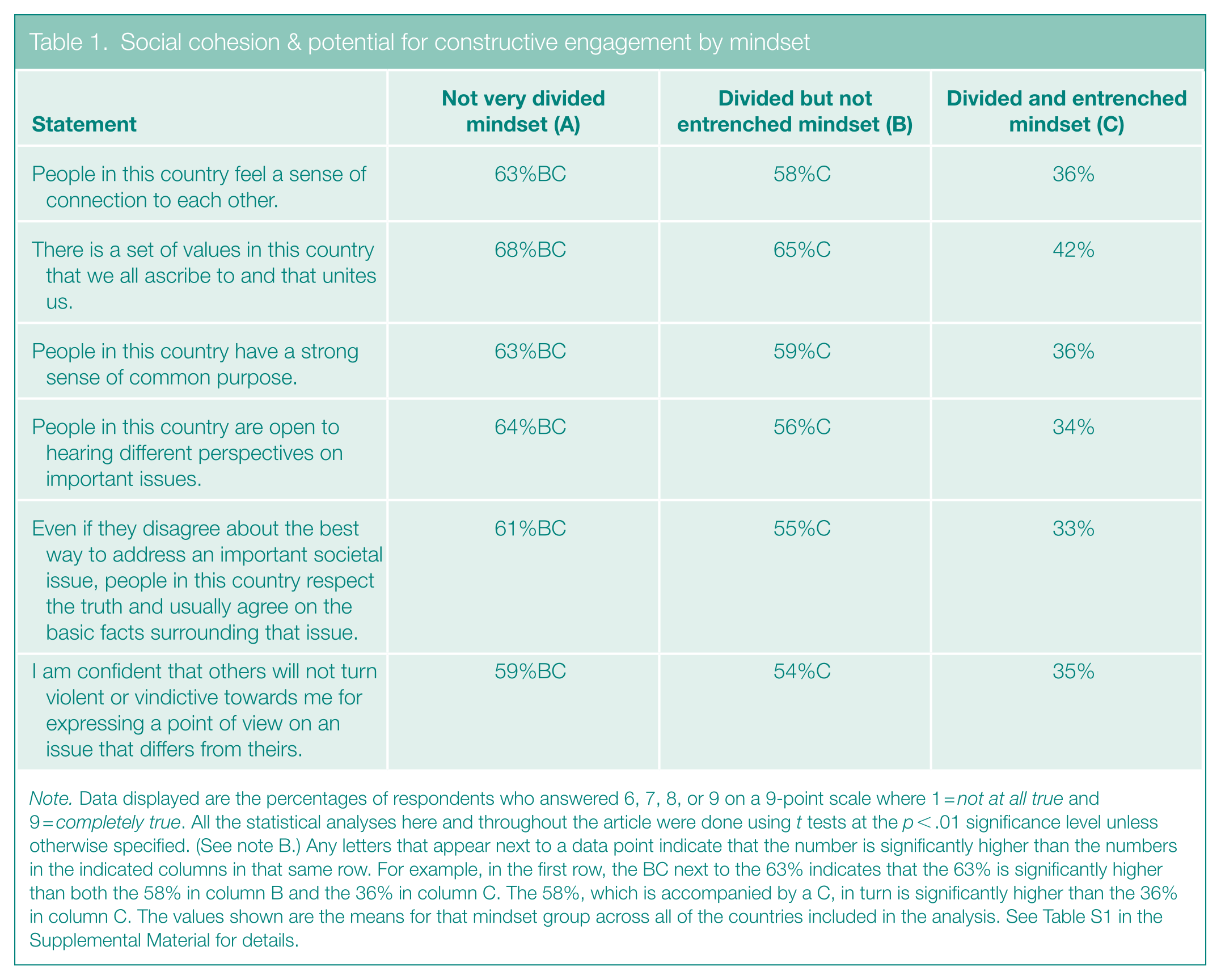
Note. Data displayed are the percentages of respondents who answered 6, 7, 8, or 9 on a 9-point scale where 1 = not at all true and 9 = completely true. All the statistical analyses here and throughout the article were done using t tests at the p < .01 significance level unless otherwise specified. (See note B.) Any letters that appear next to a data point indicate that the number is significantly higher than the numbers in the indicated columns in that same row. For example, in the first row, the BC next to the 63% indicates that the 63% is significantly higher than both the 58% in column B and the 36% in column C. The 58%, which is accompanied by a C, in turn is significantly higher than the 36% in column C. The values shown are the means for that mindset group across all of the countries included in the analysis. See Table S1 in the Supplemental Material for details.
We also found differences in trust and the willingness to compromise across mindset groups. As Table 2 shows, both hopelessness and perceptions of deep ideological division were required before a major diminution of trust in others and signs of a breakdown in the social contract appeared in the data. That breakdown is indicated by less willingness to make sacrifices for the greater good and a weakening of the belief that having a smoothly functioning society, where people cooperate and are willing to make compromises, is more important than maximizing personal freedom.
Interpersonal trust & willingness to participate in the social contract by mindset
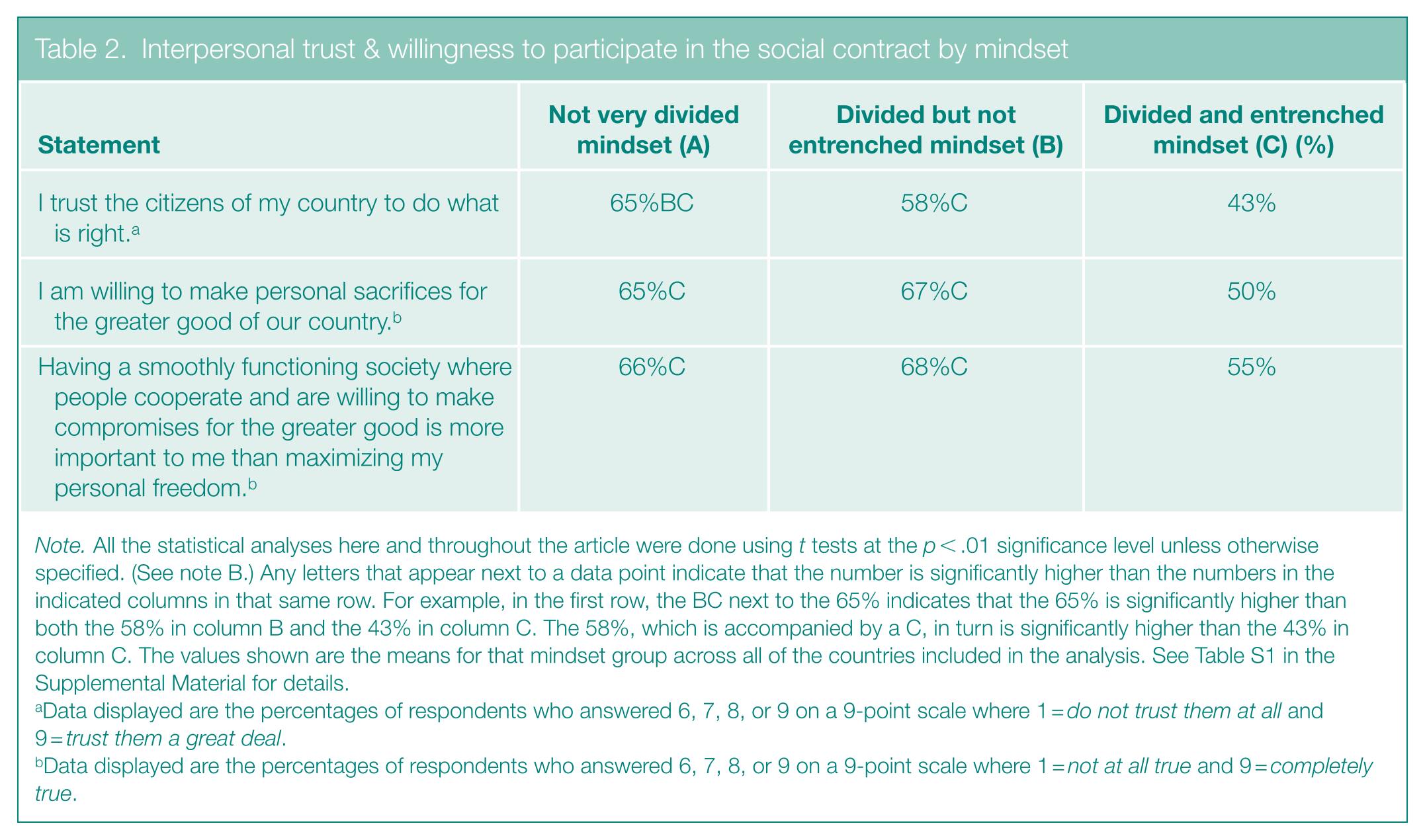
Note. All the statistical analyses here and throughout the article were done using t tests at the p < .01 significance level unless otherwise specified. (See note B.) Any letters that appear next to a data point indicate that the number is significantly higher than the numbers in the indicated columns in that same row. For example, in the first row, the BC next to the 65% indicates that the 65% is significantly higher than both the 58% in column B and the 43% in column C. The 58%, which is accompanied by a C, in turn is significantly higher than the 43% in column C. The values shown are the means for that mindset group across all of the countries included in the analysis. See Table S1 in the Supplemental Material for details.
Data displayed are the percentages of respondents who answered 6, 7, 8, or 9 on a 9-point scale where 1 = do not trust them at all and 9 = trust them a great deal.
Data displayed are the percentages of respondents who answered 6, 7, 8, or 9 on a 9-point scale where 1 = not at all true and 9 = completely true.
These analyses indicate that it is not the magnitude of ideological differences alone that leads to the negative attitudes often associated with affective polarization; it is the perception that big differences exist and that they are insurmountable. This outcome suggests that the relationship between ideological and affective polarization is mediated by the belief that existing ideological differences are not likely to be overcome.
Underpinnings of the belief that divisions are intractable
In an attempt to understand what predicts feelings of hopelessness and entrenchment in the context of ideological division, we ran an analysis—a linear regression—to look for associations between a set of attitudes and the likelihood of seeing one’s country as being very or extremely divided without much hope that those divisions can be overcome.
The potential predictor variables we tested fell into three distinct groupings: those related to institutional trust (specifically, distrust in government and media), those related to perceptions of whether the system is working for the respondent (specifically, perceived systemic unfairness and personal economic pessimism), and those related to social cohesion (specifically, a lack of shared identity). (See Table S2 in the Supplemental Material for a description of each of the predictor variables and how they were scored.) All of these variables have been linked to affective polarization in past research. We wanted to see whether they were also related to the belief that the ideological differences within one’s country were not likely to be overcome in addition to predicting the intergroup animus often engendered by those differences.
This analysis, reported in Table 3, showed that the strongest predictor of a divided and entrenched mindset (as indicated by it having the largest coefficient) is distrust in government, followed by lack of a shared identity, belief in systemic unfairness, pessimism about one’s economic future, and distrust in the media. That is, as each of these feelings deepens, so too does the likelihood of feeling that the ideological divisions within one’s country are large and insurmountable.
The predictors of a divided & entrenched mindset
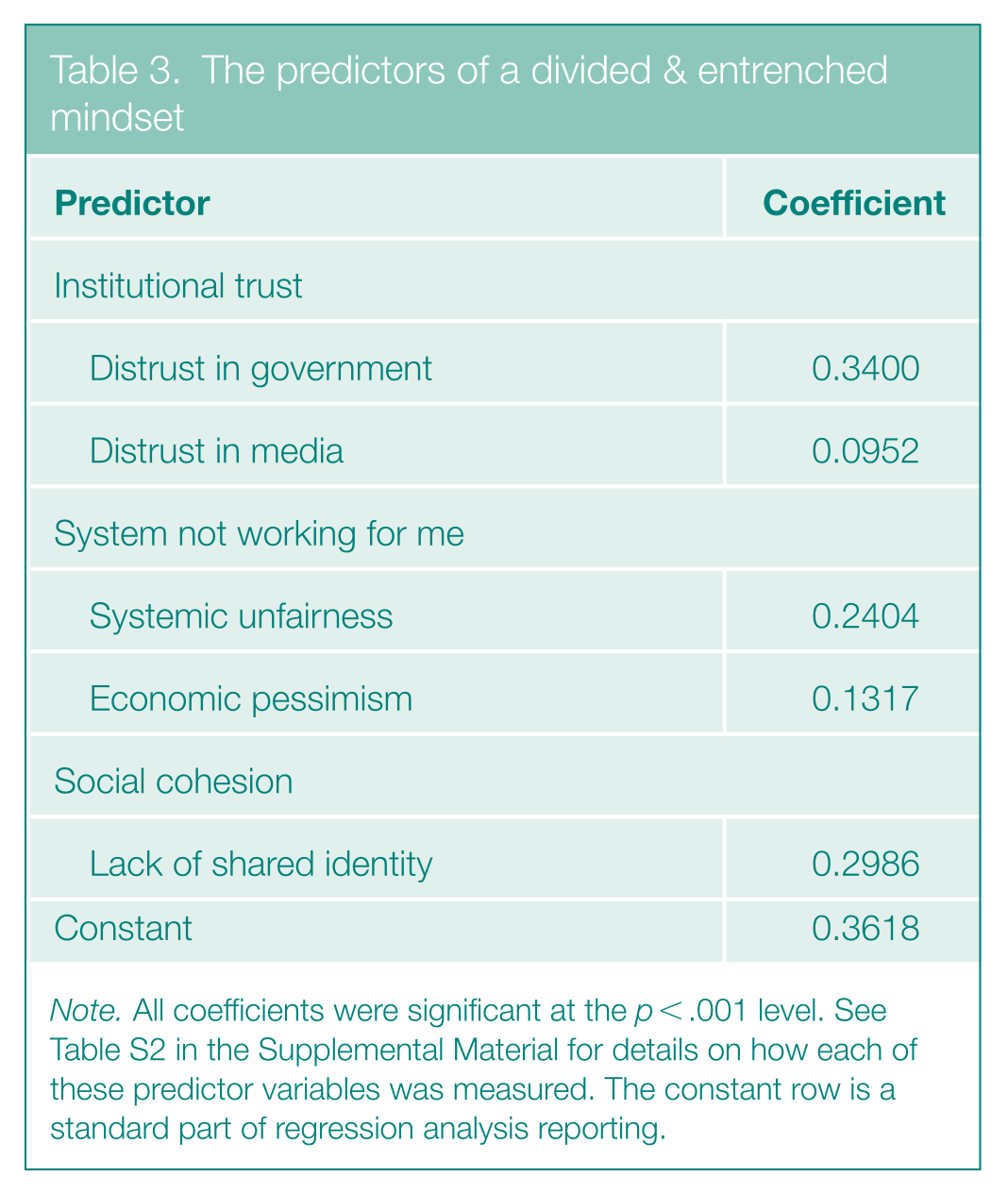
Note. All coefficients were significant at the p < .001 level. See Table S2 in the Supplemental Material for details on how each of these predictor variables was measured. The constant row is a standard part of regression analysis reporting.
The analysis also indicated that these five predictors are not the only possible influences. We calculated that as a set, they accounted for 16.0% of the observed variance between respondents in whether they feel their nation’s divisions are insurmountable. This figure is considered meaningful in social science research, but it also indicates that other variables we did not examine also play a role.
Institutional trust & polarization
The importance of distrust in government and media as predictors of hopelessness about overcoming ideological divisions raises the question of which institutions are able to maintain trust amid affective polarization. After all, such institutions would, in theory, be in the best position to take the lead on addressing the problem. Although trust in general is a recurrent theme in the polarization literature, little consideration has been given to the issue of which institutions, if any, retain the trust necessary to command the respect of people on both sides of an ideological divide and get them to work past and through their differences.
So as our analyses turned from uncovering the roots of political polarization to identifying strategies for addressing it, we began by looking for institutions whose trust levels were robust in the face of affective polarization—that is, which institutions were trusted by the divided and entrenched mindset group. When we compared levels of trust in government, media, businesses, nongovernmental organizations, and “my employer” across our three mindset groups, we found that a comparable majority of both the not very divided and the divided but not entrenched mindset groups reported having trust in these institutions (with the exception of government, which was trusted by only 46% of the divided but not entrenched mindset group). In contrast, the divided and entrenched mindset group did not manifest high trust in these institutions, with the notable exception of their employers, which were trusted by over two-thirds of these respondents; see Table 4.
Institutional trust by mindset
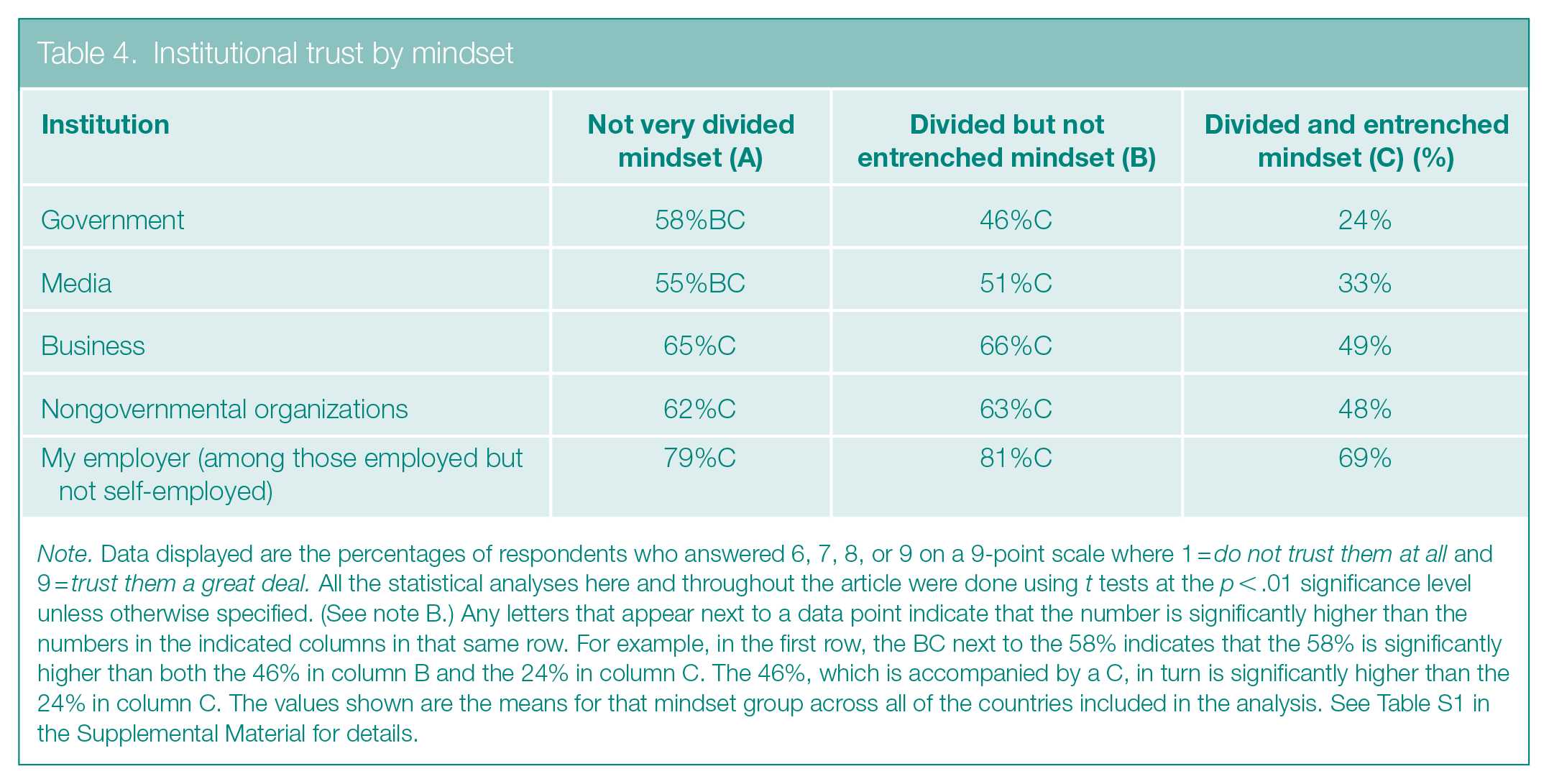
Note. Data displayed are the percentages of respondents who answered 6, 7, 8, or 9 on a 9-point scale where 1 = do not trust them at all and 9 = trust them a great deal. All the statistical analyses here and throughout the article were done using t tests at the p < .01 significance level unless otherwise specified. (See note B.) Any letters that appear next to a data point indicate that the number is significantly higher than the numbers in the indicated columns in that same row. For example, in the first row, the BC next to the 58% indicates that the 58% is significantly higher than both the 46% in column B and the 24% in column C. The 46%, which is accompanied by a C, in turn is significantly higher than the 24% in column C. The values shown are the means for that mindset group across all of the countries included in the analysis. See Table S1 in the Supplemental Material for details.
In the context of identifying solution strategies, it is also important to understand which institutions are seen as having the standing or responsibility to address polarization. The survey asked respondents who they thought had a significant role to play in “identifying a set of shared values, establishing a sense of common purpose, and encouraging people to work across ideological divides in this country.” The top three groups identified as having a big or huge role by those with a divided and entrenched mindset were teachers and educators (66%), government leaders (59%), and business leaders (48%). (A “big” or “huge” role was indicated by a score of 4 or 5 on a 5-point scale where 1 = no role at all and 5 = a huge role.)
Of the three, business leaders are in the best position to have a significant influence. In the 2023 Edelman Trust Barometer data, we found that only 24% of those with a divided and entrenched mindset trust government to do what is right, and 68% see their government as a dividing rather than a unifying force in society. Thus, today’s government leaders lack the credibility necessary to address affective polarization effectively. Although teachers and educators are generally seen as unifying forces in society, even among those with a divided and entrenched mindset, their sphere of influence is almost exclusively among the young. Certainly, they have an important role to play in shaping the future of polarization, but their ability to mitigate the problem in the near term is limited. That leaves business leaders. Although only 48% of those with a divided and entrenched mindset said business leaders have a big or huge role to play, that number went up to 59% when they were asked in particular about the role of chief executives in helping to strengthen the social fabric.
More specifically, our divided and entrenched mindset respondents indicated that CEOs are strongly obligated to
create and nurture an environment of civility and mutual respect in the workplace, where people can have constructive discussions about contentious issues (59% of respondents);
pull their organization’s advertising money out of media platforms and news outlets that do not adequately control the spread of misinformation (48%);
hold societal leaders who spread false and misleading information and provoke mistrust between groups of people accountable for their actions (44%); and
use their communication platforms and access to the media to identify and rally people around a set of shared values, ideals, and interests (40%).
Finally, although business in general may not enjoy the trust of the majority of those with a divided and entrenched mindset, the individual businesses that are their employers are trusted by 69% of this segment.
Discussion
The findings from our reanalysis of the 2023 Edelman Trust Barometer data have several implications for ameliorating affective polarization.
Addressing attitudes regarding the possibility of resolving a conflict
First, the goal of a polarization intervention does not have to be to decrease the perceived ideological divergence between two groups or to directly reduce intergroup animus; instead, the aim could be to make perceived ideological differences seem surmountable—to help people feel that a resolution to an ideological conflict is possible. As I said at the start of this article, divergence of opinion can be a good thing: it can facilitate the avoidance of groupthink and prevent rushes to judgment. But feelings of hopelessness about conflicting groups finding common ground have no utility, defining, as they do, the tipping point where ideological diversity turns from a productive force to a destructive one.
This insight has the potential to widen the aperture for identifying ways to overcome affective polarization. In a recent review article, Rachel Hartman and her coauthors developed a taxonomy of polarization interventions. 10 Their proposed TRI framework encompassed three types, defined by their focus on either thoughts (for example, correcting misconceptions and highlighting commonalities), relationships (for example, building dialogue skills and fostering positive contact), or institutions (for example, changing public discourse and transforming political structures). 10 In general, these interventions aim to mitigate or contain negative affect toward the people with whom one disagrees.
Having other strategies that do not center on narrowing perceived ideological divides or reducing negative affect toward others is also important, however, because sometimes those goals cannot be accomplished. For instance, overcoming historic animosities may be impossible, or the actual ideological differences between two groups may really be as big as they are perceived to be, or no amount of positive interaction will decrease the negative views of a given outgroup. In such cases, interventions aimed at changing perceptions of the intransigence of a dispute rather than changing attitudes toward the combatants are likely to have a better chance of getting people to work together on ways to find a path forward. Rather than decreasing intergroup animus, the proximal aims of such conflict-focused interventions would be to increase confidence or engagement in dispute-resolution processes and/or to suppress antidemocratic sentiments and violent or obstructionist behaviors—goals that recent research suggests may require different intervention strategies. 11
Our survey data do not point to specific interventions for meeting these aims, but other research suggests some general approaches. Some work indicates, for instance, that interventions that correct misperceptions about how antidemocratic the other side is or that highlight the potentially disastrous consequences of democratic collapse can be effective in reducing support for antidemocratic practices. 12 Both types of intervention can be seen as fostering confidence or engagement in the dispute-resolution process. The first demonstrates that one’s opponents are still invested in the process, thereby bolstering faith that a resolution is still possible. The second makes salient the consequences of failing to address differences in a democratic way, thereby increasing people’s motivation to try to reach a resolution despite ongoing animosities.
People with a divided and entrenched mindset generally have some awareness of the potential consequences of polarization. The 2023 Edelman Trust Barometer data revealed that the most-mentioned outcomes foreseen by this group if their country’s divisions continue to go unaddressed are violence in the streets (57%), a slowing in the rate of economic development (54%), the worsening of prejudice and discrimination (53%), and an inability of the nation to adequately address its societal challenges (52%). 6 Interventions that make these unsavory outcomes more salient might motivate people on opposite sides to work harder to resolve a dispute, especially if they are shown evidence that each side is still willing to engage in and abide by the resolution process.
That progress can be made even in the face of deeply held ideological differences and historic animosity is illustrated by the Good Friday Agreement that ended the ethnic violence in Northern Ireland, the Camp David Accords that led to peace between Israel and Egypt, and the negotiations between Nelson Mandela and F. W. de Klerk that brought an end to apartheid in South Africa. These conflicts did not end because intergroup animosity was quelled. They ended because the prospect of continued violence and upheaval came to be perceived, by both sides, as being worse than cooperating and compromising with “the enemy.”
Another potential way to increase investment in the conflict resolution process and suppress antidemocratic behavior is to ameliorate the feelings of systemic unfairness and personal economic pessimism we found to be associated with a divided and entrenched mindset. We hypothesize that perceptions of equity, social justice, and optimism about one’s economic prospects are important for preventing disengagement with the resolution process because they make the democratic system of conflict resolution and compromise seem worth fighting for and preserving; they help ensure fair play, even in tough encounters, because they decrease the impulse to blow up the system rather than let the other side win. In contrast, those who feel cheated by the system and who see a bleak future for themselves have much less to lose by fomenting upheaval and adopting a win-at-all-costs mentality. Such people are likely to have fewer qualms about doing things like undermining the integrity of the electoral process. Politics makes strange bedfellows, as the saying goes, but only if the parties involved see a greater upside for themselves in working together than in continuously trying to take each other down.
Interventions aimed at suppressing antidemocratic attitudes and behaviors are not the only conflict-focused, polarization-mitigation strategies that can be attempted. Other potential approaches include taking actions that boost confidence that a given dispute resolution process is robust in the face of mutual animosity; moving people away from a zero-sum, win-lose mentality regarding ideological disputes; emphasizing the ability to revisit outcomes if things change or do not go as projected; and demonstrating that paralysis is a worse outcome than compromise when it comes to furthering one’s causes.
Leveraging trust in employers
The distinctive ability of employers to garner trust among those with a divided and entrenched mindset puts employers in a unique position to help reknit the social fabric, get people to work past their differences, and ensure that actions are being taken on the basis of trustworthy information. It also suggests that the workplace should be a major focus of both the research and the practitioner communities when it comes to finding ways to reduce affective political polarization.
Other research also points to the potential importance of employers in addressing polarization. For instance, Peter Coleman, author of a book on polarization, 13 calls workplaces examples of “latent bubbles”: entities in the community that are already successful in preventing or mitigating destructive patterns of interaction or promoting constructive ones. Within the workplace, employers cannot allow affective polarization to arise, or their companies will cease to function. They therefore maintain strong norms against intransigence and in favor of constructive engagement. They also have rules for decorum and zero tolerance for violence. In addition, unpublished data collected for the 2023 Edelman Trust Barometer Special Report: Trust at Work 14 show that, across demographics, employees generally see their employer as a source of reliable information. (For the data, see Table S3 in the Supplemental Material.) This reputation for trustworthiness allows them to break through information silos and move people toward a shared set of facts.
Employees themselves see opportunities to export the civility from workplaces into society at large. In unpublished data 15 collected for the 2022 Edelman Trust Barometer Special Report: Trust in the Workplace, 16 50% of employees agreed with the statement “I would like my employer to make trustworthy information about social and societal issues and other important topics on which there is not general agreement in our country today available to the general public,” and 53% agreed that “employers have a responsibility to train their employees on how to have constructive debates about contentious issues both inside and outside of the workplace.”
Employers have the potential to be particularly effective at implementing interventions that focus on relationships as outlined in the TRI framework put forward by Hartman and her colleagues. Their research suggests that the predictors of success for interventions focused on improving interactions between partisan groups include equal status among the interacting groups, common goals, the need for intergroup cooperation to achieve success, the support of authorities, the potential for friendship, and training in dialogue skills. 10 Employers are in a position to meet these conditions at scale and over the long term—two challenges associated with creating interventions that can address affective polarization at a societal level. 10
Interventions that operate at the individual level will not, however, resolve affective polarization on their own, even if they are executed at scale and over the long term. The underlying social structures that spawn and nurture polarization must also be addressed. That means, among other things, that the political incentives to inflame and weaponize affective polarization for political gain must be reduced or eliminated. 17 In many ways, the polarization occurring today is fostered and facilitated by a political reward matrix that has been corrupted. Until the rewards in society—be they in the form of money, power, or influence—are greater for spreading truth than for spreading misinformation and for facilitating cooperation rather than fomenting divisiveness, the social fabric that binds people together despite their sociopolitical differences will continue to fray and weaken. To shift the reward structure, businesses and nongovernmental organizations must become stronger forces for moderation and consensus building by defending the truth, pulling money from media platforms that allow the spread of misinformation, and supporting politicians and media that emphasize the common ground between people and foster cooperation—all actions that a significant number of our survey respondents saw as CEO responsibilities.
A limitation of this study is that it cannot demonstrate causality. Being a nonexperimental, single-point-in-time survey, it allowed my colleagues and me to determine relationships and co-occurrences but not the direction of causal arrows. That said, I believe that the path from ideological diversity to full-blown affective polarization involves a series of feedback loops. To wit, ideological differences lead to an initial fraying of the social fabric and the politicization of social issues, both of which make it difficult for opposing groups to resolve disputes and for lawmakers who represent those groups to reach consensus and pass legislation. This gridlock, in turn, makes government seem ineffective and unworthy of trust. It also makes people on the opposing sides seem more different from each other than they probably are and perhaps even as threats to things they each value—flames that many media outlets are only too happy to fan. These outcomes make future political disputes even more difficult to resolve, which serves as fodder for villainizing the opposition, thereby further deepening societal divisions and weakening the social fabric. This process continues to repeat itself, as hopelessness about the nation’s ability to work through its differences becomes deeper and ever more well-founded and antidemocratic attitudes and behaviors increase in scope and severity. I hope the findings reported in this article will lead to more research that uncovers new ways to prevent or disrupt this destructive cycle.
Democracies must continuously work to support and facilitate the airing of dissenting political opinions while at the same time preventing people’s basic psychological tendencies from pushing society into affective polarization—which is marked by hostility between groups that differ ideologically and an unwillingness to work together on solutions.
Unfortunately, keeping the negative consequences of affective polarization at bay amid ideological diversity on key societal issues is a challenge that many Western democracies are currently failing.
It is not the magnitude of intergroup ideological differences that spawns affective polarization. Rather, it is the perception that big differences exist and that they are insurmountable.
Affective polarization might therefore be reduced by new types of interventions that aim to increase engagement in conflict-resolution processes instead of attempting to reduce animus directly.
The only institutions that have been found to be trusted even by people who view their country’s political differences as intractable are employers. Employers, then, are well-positioned to be a constructive force in decreasing affective polarization.
Researchers
Further examine the finding that perceiving ideological differences as intractable engenders affective polarization.
Explore why and how the perception of intractability contributes to intergroup hostility.
Develop and test interventions aimed at changing perceptions of the intransigence of a dispute rather than changing attitudes toward the disputants, especially in situations in which overcoming historic animosities may not be possible.
Study ways to increase investment in conflict resolution processes and suppress antidemocratic behavior.
In particular, focusing efforts on interventions that address perceptions of systemic unfairness and pessimism over one’s personal economic future could be useful, because both views are associated with the feeling that ideological divisions are insurmountable. In contrast, perceptions of equity, social justice, and optimism about one’s economic prospects make the democratic system of conflict resolution and compromise seem worth fighting for and preserving.
Practitioners & Policy People
When the ideological differences between groups are extreme or no amount of positive interaction will decrease the negative views of a given outgroup, focus on interventions aimed at increasing the groups’ investment in democratic processes of conflict resolution.
Given that even employees who view their country’s political differences as intractable tend to trust their employers, partner with employers to develop and implement interventions aimed at ameliorating affective polarization both within and, more importantly, outside the workplace.
Address the underlying social structures that spawn and nurture polarization by developing rules and policies that eliminate the incentives or ability to inflame and weaponize affective polarization for political gain.
Supplemental Material
sj-docx-1-bsx-10.1177_23794607241238037 – Supplemental material for Overcoming political polarization: Strategies for diminishing intransigence and reducing intergroup animus
Supplemental material, sj-docx-1-bsx-10.1177_23794607241238037 for Overcoming political polarization: Strategies for diminishing intransigence and reducing intergroup animus by David M. Bersoff in Behavioral Science & Policy
Footnotes
Author’s note
I am grateful for the work of the entire Edelman Trust Institute team in executing the original research upon which this article is based, with particular thanks to Susannah Ferris for serving as my research assistant in the preparation of this article and to John Zamites for performing the statistical analyses.
Declaration of Conflicting Interests
The author declared no potential conflicts of interest with respect to the research, authorship, and/or publication of this article.
Funding
The author received no financial support for the research, authorship, and/or publication of this article.

Notes
References
Supplementary Material
Please find the following supplemental material available below.
For Open Access articles published under a Creative Commons License, all supplemental material carries the same license as the article it is associated with.
For non-Open Access articles published, all supplemental material carries a non-exclusive license, and permission requests for re-use of supplemental material or any part of supplemental material shall be sent directly to the copyright owner as specified in the copyright notice associated with the article.
