




Abstract
Supporting evidence-based management and policy decisions by government officials is a key objective for behavioral scientists. Yet researchers often face formidable barriers to developing effective working relationships with government officials. In an interview, former New York City mayor Bill de Blasio argues that researchers can overcome these challenges by making a commitment to building long-term relationships and, critically, trust with government officials. Doing so requires persistence, especially because efforts to connect with officials often fail—at least at the outset. Researchers also can develop skills for communicating more effectively with officials, who are neither specialists in policy domains nor experts in research methods. He suggests highlighting core messages from complex data and beginning communication of those messages with straightforward solutions to problems; only after those proposals are under consideration should issues related to their complexities be raised. Last, de Blasio suggests that the best way for researchers to develop trusting relationships with government officials, as well as a deeper appreciation of the challenges they face, may be to devote time to government service in posts that embed them in decision-makers’ daily work. He illustrates his points with lessons from the successful adoption and implementation of policies and programs in New York City, including those that aimed to provide free prekindergarten education (Pre-K for All), respond to the COVID pandemic, reduce traffic accidents and fatalities (Vision Zero), and prevent overdose deaths through the use of supervised drug-consumption sites.
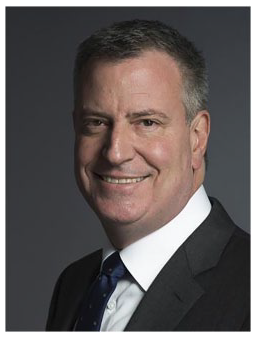
Bill de Blasio was the mayor of New York City for two terms (2014–2022). Before that, he served as the New York City public advocate and as an elected member of the New York City Council, the city’s lawmaking body. Early in his administration, he successfully launched a universal free prekindergarten (pre-K) education program known as Pre-K for All. He also steered the city through the COVID-19 pandemic. Other key achievements of his administration include the construction of more than 200,000 affordable housing units and the passage of legislation mandating a $15 minimum wage for all employees in the city.
At the annual Behavioral Science & Policy Conference in May 2023, I asked de Blasio about the barriers to making evidence-based decisions he encountered during his tenure and ways behavioral scientists might be able to overcome the barriers they encounter when trying to share their knowledge and insight with decision-makers. We began the interview with the former mayor giving some examples of the challenges he faced when trying to make evidence-based decisions. The transcript that follows has been edited for clarity and length.
I’m happy to discuss these issues because I know everyone here is trying to “crack the code,” as it were, to figure out different and better ways to get evidence into the decision-making and policymaking processes. It is a daunting task. In New York, things got very difficult because of the intensity we were dealing with every day. There are almost 9 million people in the city, which has an annual budget of about 100 billion dollars and 400,000 city employees. And, of course, we were the epicenter of the COVID pandemic in this country.
This environment made it very difficult to have a coherent, consistent approach to bringing in the very best data to make decisions. This does not mean we didn’t try. Of course, there were good days that were more organized and objective, but in that kind of environment, decision-making is never going to be systematized perfectly.
The pre-K program is a great example. This is a case where a lot was implicitly understood, although fortunately the studies and the carefully organized data kept backing up the impact pre-K education would have on our children and the city going forward. That said, you’d be amazed at how things like this are still debated around the country. One of the problems is that even when the data are there, being considered, and given their rightful place, it does not mean that the surrounding public debate honors, focuses on, and dignifies the data.
The challenge of transmitting information is critical and is something for scientists to understand and engage in systematically. When a picture is painted of how decisions are made in high-intensity environments, that picture is often about a trusted group of decision-makers, a very quick time frame, and imperfect information. I think it’s possible to figure out in any decision-making scenario who are the people in the loop, who is most accessible, who is most receptive to information, and what type of carefully chosen information will have the biggest impact. One of the challenges is that many experts want to share everything with those of us who are decision-makers when, in fact, what we need is something quite narrow and specific.
This is a good moment to tell a quick story that is extremely dramatic, because it concerns the decision to go to a much more aggressive shutdown of New York City at the beginning of the pandemic. My experience in the epicenter was that my own health care professionals didn’t agree on the information we had. And they also rightfully kept telling me what they didn’t know, which left a huge vacuum.
What changed the course of things was not information I received from a member of my immediate team nor from a healthcare expert. It was information from an economist, Professor Jeffrey Sachs of Columbia University. Although I’d gotten to know him through kindred political work and I had built trust with him, he would not be the person I would have turned to in the first instance to ask about shutting down New York City. But he reached out to me emphatically and energetically. He said what the rest of my team was not saying: “You know, no matter how hard it is, this is the moment.”
And he gave his own evidence and data, which made for a more straightforward, sharper argument than anything I’d heard internally or from the experts we were trying to consult who were outside the government. The hinge of this was the successful example of San Francisco, which had gone to shutdown just ahead of New York, a move that was already proving to be effective. I called the mayor of San Francisco, who was also a friend. She quickly showed me what she was doing and why it was working. And by chance, my former police commissioner, Jim O’Neill, happened to be working in San Francisco. I called him and he validated what the mayor said. I went immediately to the people of New York City to say that we should prepare for a shutdown and to shelter in place.
It was precisely three people who helped to inform this decision: one entirely outside government, who was an academic, a friend, and a respected ally; a parallel colleague, who was another mayor; and a former employee who had held a trusted, high position in my administration. These three people became more important in that discussion, with all due respect to the other players, than everyone else. Sometimes it’s one person. I think researchers can either become one of those people to a decision-maker or get to know who those crucial links are.
For all of you who have powerful ideas and evidence and are frustrated when it doesn’t get through to decision-makers, I’m going to give good news: In some ways, the barriers are more navigable than might be evident at first blush. There are strategies you can use. This example was so powerful to me because it was those outside voices that probably saved a very large number of lives in New York City. They certainly used the best available evidence. But it was the way they presented the evidence—with urgency, clarity, and simplicity—that allowed me to make the right decision.
I’d like to hear additional examples of how you made major decisions.
The Vision Zero program to improve road safety and our overdose prevention program also are great examples. [Editor’s note: The Vision Zero program involves a broad suite of actions, such as creating pedestrian islands, curb extensions, raised crosswalks, and protected bike lanes.] I did not walk in the door convinced that we could radically reshape our approach to traffic, crashes, fatalities, and injuries on the roads. The chaos of New York City and its intensity made me wonder if reworking our culture was possible. The evidence from other jurisdictions—particularly from France, Spain, and Sweden—was so impressive, though, that once I stopped and listened, I was jolted into the recognition that we might be able to do a lot more, and more quickly than I would have imagined. I became a true believer, and we really leaned into it. It had a huge impact. We saw a deep decrease in traffic fatalities and injuries, and we saw a culture change begin with New York City drivers.
At the end of my administration, we authorized the establishment of supervised consumption sites to deal with opioid overdoses. I went from being someone who had not studied the concept and didn’t understand it to engaging some advocates who, because of their advocacy, got me to start talking to members of my team who believed in this approach. And that led us to study what was happening in Western Europe and Canada, which gave us tremendous confidence.
Yet the New York City police department [NYPD]—the finest police department in America, I would argue—had real concerns about allowing people to go into a space, even a medical space, and inject an opioid because they were unfortunately addicted. The police had concerns on a legal level, and they had concerns about ancillary impacts on neighborhoods and possible increases in crime, disorder, or quality-of-life problems. So we sent a senior team of analytically focused members of the NYPD to Vancouver and Toronto to meet with the folks who were doing the work there and to meet with the police there. And they came back with a wonderfully nuanced report.
They said that there are some real problems but that they had ideas on how to address them. They also said that they were able to see what worked and, although they were a little cautious, they now knew what they needed to do if we were to do this. That had a hugely positive impact. That’s a great example of how evidence won the day, and the evidence led us to find even more evidence that we needed to turn the idea into action. We did it in the fall of 2021, and I have already seen it having a helpful impact on other jurisdictions. Here’s another thing to remember: A great idea has to succeed in only one place to be validated and to spread.
Stepping back from these examples and thinking about your entire career as a public official, could you categorize some of the barriers to evidence-based decision-making?
Sure, and I can draw on my experiences from the two other public positions I held before I was mayor as well.
The problem was always the clarity and credibility of the information, especially in the age of the internet and social media: too many voices and too many that showed evident ideological bias in discussions. There also was often too much information that was dense and hard to fathom. I was constantly facing a torrent of information and trying to find the grain of truth.
I would rely on my own instincts. But, in addition, I consistently relied on academics, advocates, or former government officials with whom I had come to have a particular connection, whether because I had respect for their work or a personal connection or we had been through an experience together. From a very human position, I could hear them and connect with them, and they could get through to me far better than most experts did.
I used to hold hearings as the chair of the city council’s social services committee, and we’d have, in a single day, 20 different voices. But typically only one or two really registered fully with me. Not that I wasn’t listening, but I had to have more than just a broad argument made with a particular set of data, because, as we all know, the use of data can be subjective. There had to be some kind of trust that had developed, and usually that took multiple encounters.
Part of this is extremely human. It should not be a surprise if you don’t hit a home run your first time at bat. If you lack the relationships or the reputation that might draw someone to you or give you instant validity, or if your reputation is sterling but only in a narrow universe, it shouldn’t be surprising that decision-makers who are generalists might have trouble seeing and hearing your message. But that is not a reason to give up.
That’s a reason to hone a strategy to find and build relationships. It doesn’t take much. I have found with government officials that it matters a lot if another official “adopts” an academic or someone who’s a great visionary or an advocate and promotes them to others. It matters a lot if someone who’s a colleague is vouching for the ideas and evidence that an individual brings forward. This is not because we all agree with each other as colleagues, but because we relate to each other.
A lot of times, we were trying to figure out a meaningful regulation or piece of legislation. We would, of course, try to identify some of the most kindred and important voices to turn to. But that was against a rush of priority agenda items that were constantly incoming.
“The more that experts made themselves available to us, the easier it was to engage with them.”
So, not to put all the burden on experts, but the more that people made themselves available to us, the easier it was to engage with them. This is not shocking, but engaging took persistence, and it took hits and misses on the part of the experts. It took people being willing to engage and not always achieve their goal, or not even always be heard, but who keep coming back. Over time, their arguments would inevitably grow on us.
That’s very helpful. I want to play it back to you to see if I’m getting it right.
It seems that connecting with decision-makers comes down to two main factors. One has to do with the communication skills and the ability of experts to bring before a decision-maker information and data that makes sense and is accessible to that person or the person’s advisors. Two, relationships matter a lot, too. You have emphasized trust: A person may seem trustworthy because of a long-standing relationship with you or because they’re in a network of people you trust. It’s typically difficult to develop a trusting relationship with someone over a short period of time.
Yes, that’s right. I also emphasize the “how-to” of that process, which is, we’re all human, so some of it is just chemistry, shared values, or dumb luck: right place, right time. It’s all those realities.
“What is actionable is the willingness to take complex information, draw out the core strands, and think intentionally about how to communicate it to those of us who are not experts in your field.” “Help decision-makers see solutions in the information. We are not interested in abstract studies of issues.”
But what is actionable is the willingness to take complex information, draw out the core strands, and think intentionally about how to communicate it to those of us who are not experts in your field. Help decision-makers see solutions and possibilities in the information rather than just playing background music. We are not interested in abstract studies of issues. Most of us are dealing with multiple issues each day. We don’t get to dwell on one issue. So it made a big difference when people who had expertise were willing to meet us where we were.
I would argue that the best way to engage decision-makers is not to put your own ground rules on the discussion first. Experts may be right that their issues are complex and nuanced, and they may be morally right about the need for decision-makers to acknowledge complexity. But if you want to be pragmatic about making a connection with decision-makers, lead with a solution and a simple idea. And then, as you build that connection and trust, say, “Guys, we have to have this conversation now about the complexities and the subtleties,” and it’s right to do so.
But, there’s a bias at play here, and it’s a natural one: Experts are typically much more educated than the people they are speaking to. As a result, it is entirely human for experts to inadvertently go right over the head of decision-makers. That is human and normal.
Some of the listeners on the receiving end will drive you crazy with their lack of nuance and perception. But the vast majority of government officials are pretty sincere and reasonably smart people who, if you meet them halfway, will work with you. The experts must ask themselves, “Am I doing everything to make this idea as accessible as possible, to connect with this policymaker on their own terms?” Because if not, it’s easy for the policymaker to just walk away—not out of disrespect, just out of the realities of life, schedule, and demands.
On this point, I often tell my students that my advice is good advice—it is evidence-based—but human nature gets in the way of following it. It makes sense that we need to be able to communicate effectively, but it does not necessarily come naturally for us because of who we are and the worlds we operate in.
I appreciate how much work people have put into their careers and that the work you’re all doing is to try to better the human condition. But I would say there is a contradiction if 100% of your time goes into the research and perfecting the analysis and very little or none of your time goes into trying to figure out how to get it to the place where action can be taken on that analysis.
You could say, “Well, there’s a natural division of labor.” But I would argue that that’s not the perfect use of time and energy. For anyone who has great ideas and information that should be infused into the policymaking process, it is time to reassess your calendar and put more time into honing the communication of your ideas and data and meeting leaders where they are.
If someone said to me, “Teach me how to meet leaders,” I’d say there are any number of public meetings, receptions, conferences, and places where, within an hour, you can meet a lot of the folks that you want to connect with. And then, of course, you must keep going to the next one and the next one until they know you by first name and want to talk to you.
There seems to be a “tree falling in the woods” problem here. Incredible work, ideas, and solutions are staying in the four walls of academia or staying in narrow expert circles and not reaching decision-makers. Comfort with this reality needs to be disrupted because we humans need solutions. We’re arguably in the most dynamic, most difficult moment in human history now with climate change. I also would argue that artificial intelligence [AI] and the threats of AI may even surpass the threats of climate change. We also need to address racial justice and income inequality. We are really on the razor’s edge.
Government leaders need every great idea. We need as much evidence as we can get: It cannot stay in the laboratory, the classroom, the professor’s office, or the institute. It needs to get to the front line where fast decisions are being made.
Those comments are a great segue, because I want to ask about applied research units embedded in government in several nations. For example, some of our colleagues in the United States work in the Office of Evaluation Sciences, and in the United Kingdom, there are behavioral scientists working for the Behavioral Insights Team. Do you think this approach can help behavioral scientists promote the practices you’re describing?
On a hierarchy, the lowest rung is great research and ideas that stay within a narrow group of experts and do not reach the decision-making points in public policy. The next rung up is what you’re describing: offices within government that gather experts for the purpose of conducting analyses that government should use. That’s a step in the right direction, but it’s a big jump from doing the analysis to turning the results into action, and it is not a given. The next level up is the one I’d like to urge people to consider for themselves or colleagues. If you look at the model around much of Western Europe over the last 75 years post–World War II, it has been quite common for academics to go into government at high levels, with many following their chosen field but also some becoming leaders in a more generalist vein. I think one great aspect of this model is the respect given to intellectuals and academics in a number of those societies. We’re in a different reality in the United States, and I’m sometimes troubled by that reality, but it is who we are.
However, I have met many strong academic researchers and theorists who have made themselves available to go into government. This changes the entire dynamic. One recent example from the pandemic is Dr. Ashish Jha leaving Brown University to go to the White House. [Editor’s note: Jha served as the White House COVID-19 response coordinator from April 2022 to June 2023.] He not only brought his expertise, but he also brought his whole network with him.
I think the move allowed him to understand better how government works. He will bring this understanding out to the world of the many experts he knows. Although I don’t know him personally, I don’t have the impression that he set on his wish list the idea “I’ll go into government at one point.” But I would argue that people should put doing a “tour of duty” or two on their wish lists. This service allows you to talk to anyone in government with validity. To draw again on a military analogy, veterans are veterans, and any veteran can relate to any other veteran. If you have been in government, especially if it is not so much in just the research and analysis shop but closer to the decision-making core, you can invoke that experience.
This is not a solution for everyone, but it’s a solution for many people. If you want to supercharge your work and its impact, which requires getting your ideas and evidence to decision-makers in government, put yourself in that work in some way. There’s a massive demand for talented people, and few people are willing to do the work. Go volunteer; make yourself available. Once you have that experience, it will change pretty much everything else you do when you encounter and engage government.
Are there other thoughts you want to leave with scientists?
Simply speaking, the need to connect may be greater than ever. The intensity of the challenges humanity faces and the speed at which decisions are being made have increased significantly. Regarding artificial intelligence, scientists and policymakers must grapple with it now and get ahead of it before we are dealing with a host of challenges, including potentially millions of unemployed people in this country alone. We need great ideas and great evidence to get in the bloodstream quickly.
If you feel that you already have a great connection to key influential people in government or to others who can reach those people in government, I commend you. If you don’t, I would say to stop to reassess and find that way in. Talk to others who have found the way in and try to emulate them, because a single great idea right now could make so much difference. With these kinds of speed dynamics and their consequences, it pains me to think there might be a solution out there that never sees the light of day. I’m making a simple moral-imperative case here to work with all of us in government to find a way through, because we can’t afford not to hear the ideas and the evidence we need.
You’re putting a lot of burden on us, the researchers, to do the communicating. Isn’t there something that government decision-makers can do to become better collaborators with us?
Unquestionably, yes. The overdose prevention centers and the Vision Zero and Pre-K for All programs all involved a lot of collaboration. This included me and sometimes senior members of my team engaging with the folks who did the research and had the evidence and ideas. It’s always a two-way street. But I would argue—and I’m saying this to be provocative—“Physician, heal thyself.”
Yet I’m not saying that it shouldn’t be a two-way street. I’m not saying government can’t and shouldn’t do better. Of course it should: I’m not satisfied with the way government engages expertise. I’m not even close to satisfied. But I don’t like that many people scoff at government or feel “better than the government” or like the burden is on government to show up and knock on your door. If you’re doing that, you’re not fully participating. And if you really believe in your ideas and research and the conclusions you’ve come to and the proposals you have, if you hold those cards close to your vest, you’re not getting the full impact from all the work you’ve done. We are all in this together.
I’ve worked in government a long time. I’ve been frustrated as all hell with government and its extraordinary inefficiencies and imperfections. But even in the most frustrating moments, I have tried to find that one lane that would get us somewhere. To borrow from scripture, it’s better to light a single candle than to curse the darkness. If you are struggling with the imperfections of government, it is so much better to try to find a way through than to simply throw up your hands—because, again, it takes only one idea to make difference. It sometimes takes only one piece of research to open someone’s eyes.
It sometimes takes only one relationship to put an idea on a fast track. The people who made a great impact on me in all those situations I just described were assertive. They did not stay in the ivory tower. They found their way to me and my team, and we found our way back to them. And sometimes it’s the other way around.
I urge you: If you believe you have something that will help, then you must sell it. I mean that in the most noble sense. You’ve got to present it and make it accessible. You’ve got to get out there with it. If that doesn’t sound fun or easy, you’re right. But it beats the alternative of the great idea being missed.
The Mayor’s Advice in Brief
Make it a mission to build long-term relationships with government officials and, importantly, earn their trust. Be persistent. You may not be able to establish a strong personal connection on your first attempt.
Develop skills for communicating effectively with officials. Keep in mind that they are not likely to be well-versed in your research area or in research methods.
Extract the key messages from your data and start by sharing easily understood solutions to problems. Discuss complexities and complicating issues only after the official begins to consider your proposals.
Devote time to doing a “tour of duty” or two working in the government, particularly in posts where you will witness decision-making in action. The experience will promote trusting relationships with officials and provide insight into their decision-making challenges.
Footnotes
Declaration of conflicting interests
The author declared no potential conflicts of interest with respect to the research, authorship, and/or publication of this article.
Funding
The author received no financial support for the research, authorship, and/or publication of this article.