




Abstract
Prior research suggests that women researchers face penalties for being less specialized, contributing to gender gaps in academia. However, how field characteristics shape these patterns remains underexplored. The author examines gender differences in research specialization and their impact on academic outcomes across different field contexts in social sciences and humanities. Using 1,120,175 publications by 39,135 social scientists and humanities scholars at U.S. universities (1950–2025) from OpenAlex, the author maps academic fields using word embeddings and analyzes specialization patterns by gender. The findings show that gender gaps in research specialization are deeply conditioned by field context. In male-dominated fields, women have significantly broader research interests than men, while this gap diminishes and reverses in more gender-balanced fields. Although broader publication trajectories help women increase publication output, this strategy carries steeper citation penalties for women than for men. The results suggest that academic fields act as sites of inequality production, channeling women toward research patterns that boost immediate productivity while undermining long-term scholarly influence. This calls for greater focus on meso-level analysis to understand how complex feedback loops create gendered pathways in academic careers.
The enduring gender gap remains one of the most pressing challenges in academia, as decades of research document systematic disparities in scholarly productivity, career trajectories, and recognition (Cole and Zuckerman 1984; Cole 1983; Ecklund, Lincoln, and Tansey 2012; Weisshaar 2017; West et al. 2013; Winslow and Davis 2016). Recent studies present seemingly contradictory findings regarding this gender gap. On one hand, some studies suggest that productivity and citation differences between men and women are less pronounced than previously thought (Ceci et al. 2014; Lynn et al. 2019; Nielsen 2017; Williams and Ceci 2015). When controlling for field and qualifications, such as publications, training, university prestige, hiring probabilities appear comparable between genders, with some institutions even prioritizing female candidates as part of their diversity, equity, and inclusion (DEI) initiatives (Borrego et al. 2010; Leslie, Manchester, and Dahm 2017). Yet despite increased awareness and numerous interventions, observational studies continue to reveal a pervasive gender divide in academia. Female scientists consistently show lower productivity rates (Astegiano, Sebastián-González, and Castanho 2019; D’Amico, Vermigli, and Canetto 2011; Huang et al. 2020), their career advancement lags behind their male counterparts (Ceci and Williams 2011; Ginther and Khan 2004; Glazer-Raymo 2008; Nielsen 2017; Valian 1999), and their contributions frequently receive less recognition (Beaudry and Larivière 2016; Caplar, Tacchella, and Birrer 2017; Frietsch et al. 2009; Maliniak, Powers, and Walter 2013; Ross et al. 2022).
A key factor in these persistent disparities lies in horizontal segregation—the tendency of male and female researchers to pursue different specializations, methodologies, and career strategies. Studies show that even within the same disciplines, men and women often gravitate toward different subfields (Bandelj 2019; Su and Rounds 2015; Weeden, Thébaud, and Gelbgiser 2017). These choices significantly influence research methods, publication patterns, and scholarly recognition. For instance, a study in political science reveals that women more frequently engage with topics such as race and health care, which can lead to fewer publication opportunities in top-tier journals (Key and Sumner 2019). This pattern extends to methodological approaches, with women more likely to adopt research methods that are often undervalued in academia (Grant, Ward and Rong, 1987; Key and Sumner 2019). These gender-based differences, although appearing as personal preferences, substantially contribute to the observed productivity gap.
Recent studies have identified a critical yet underexplored dimension of the gender gap, differences in research specialization patterns. Traditionally, specializing—adopting a specific, consistent research focus to become a recognized expert (Heiberger, Munoz-Najar Galvez, and McFarland 2021:1165)—was seen as a key driver of academic success. For decades, researchers believed that specialists who published consistently within a domain would gain deeper expertise, leading to advantages such as more citations and greater recognition (Gieryn 1978). However, the gender dynamics of this process were largely ignored until recently. A seminal work by Leahey (2006) revealed that women scholars tend to pursue more diverse research topics, while men benefit from a sustained focus on specific areas. This difference in specialization patterns, Leahey argued, could account for a significant portion of the gender productivity gap, suggesting that women’s broader interests might inadvertently hinder their productivity.
This study advances the understanding of gendered research specialization in two significant ways. The gender dynamics of specialization patterns differ systematically across academic fields, particularly in relation to their gender composition. Research on gender representation emphasizes that departmental culture and hostility toward certain genders often matter more than numerical representation alone (Thames and Williams 2013; van Veelen and Derks 2022). Yet gender composition remains consequential because the relative representation of women reflects deeper institutional structures and historical patterns of inclusion (Biswas, Roberts, and Stainback 2021; Casad et al. 2021; Miller, Eagly, and Lynn 2015). These structural differences create distinct contexts within which scholars develop their research trajectories.
Prior research has established that organizational contexts matter for gender inequality in academia, with important work examining departmental effects on productivity and career outcomes (Allison and Long 1990; Fox and Mohapatra 2007). However, systematic examination of disciplines as the primary unit of analysis remains rare. Weisshaar (2017) found that productivity explained vastly different proportions of gender gaps in tenure across three fields—minimal in English, moderate in sociology, substantial in computer science—suggesting that disciplinary context fundamentally shapes both productivity patterns and their evaluations. Building on this insight, this study treats disciplinary fields not as demographic backdrops but as active mechanisms that transform how identical behaviors produce gendered outcomes. This meso-level analysis reveals two interconnected patterns: fields themselves generate gender gaps in specialization that disappear when field context is removed, and the gender composition of fields fundamentally alters how specialization strategies affect career trajectories. Rather than assuming specialization operates uniformly, this study demonstrates that academic fields function as sites where gender inequality is actively produced through the differential conversion of individual strategies into unequal outcomes.
Methodologically, this study addresses long-standing measurement challenges in studying research trajectories. Traditional categorical measures of specialization often fail to capture the nuanced, multidimensional nature of scholarly work. In this study I use a word embedding model that creates vector-based representations of both scholars and fields (Rodriguez and Spirling 2022; Yin et al. 2023). Unlike binary measures of interdisciplinarity, this method detects subtle patterns of research overlap and boundary-crossing by positioning scholars within a continuous space of disciplinary relationships. The result is a more precise measurement of how individual researchers navigate across and within academic boundaries.
This study analyzes the complete publication histories of 39,135 social science researchers in the United States from 1950 to 2025. I collected publication data directly from OpenAlex and estimated researcher gender using a Python package and genderize.io. The word embedding model then measured each scholar’s degree of research specialization, or breadth, allowing me to examine how specialization’s impacts on productivity and citation vary between men and women across different disciplinary contexts.
Two research questions guide this analysis. First, how does a field’s gender composition shape gendered patterns of research specialization? Second, how do these disciplinary contexts alter the effects of specialization for women and men? Through these questions, I examine how such patterns contribute to broader gender inequalities in academia.
Literature Review
Specialization Advantage and Gendered Reality
Academic wisdom has long held that research specialization serves as a cornerstone of scholarly success. This conventional understanding rests on compelling empirical evidence: scholars who maintain focused research trajectories consistently outperform their more generalist counterparts across key metrics of academic achievement. The mechanism underlying this advantage operates through what Leahey (2006) and Leahey, Crockett, and Hunter (2008) described as a self-reinforcing cycle of expertise accumulation. As researchers consistently publish within their chosen field, they develop crucial tacit knowledge about their academic community, understanding which literature must be covered, how to frame arguments effectively, and which methodological approaches resonate with their audience. This specialized knowledge creates remarkable efficiency in the research process, translating directly into increased publication output and enhanced research quality.
The benefits of specialization extend far beyond raw productivity metrics (Gieryn 1978; Ziman 1987). This specialized identity yields significant rewards in the academic marketplace, where maintaining a consistent scholarly persona proves crucial for securing research funding (Hoppe et al. 2019), building favorable professional reputations (Trapido 2015), and becoming successful doctoral advisers (Heiberger et al. 2021). De Rassenfosse, Higham, and Penner (2022) offered empirical support for specialization’s cumulative benefits, documenting citation increases of 25 percent per standard deviation of research focus, with newly established scholars benefiting most substantially at 75 percent gains. The academic community’s preference for specialization is evident in how scholars with focused expertise are viewed more favorably than those who frequently shift between research domains (Becher and Trowler 2001; Zuckerman et al. 2003).
Yet this established pathway to academic success reveals a striking gendered pattern. Women scholars consistently demonstrate less specialized research trajectories than men, a phenomenon documented across multiple disciplines and career stages. Leahey’s (2006, 2007) seminal investigations of sociology and linguistics scholars revealed that women were significantly less likely than men to consistently publish within their primary field of expertise. This pattern extends to interdisciplinary research, where women devote more time to such endeavors and are overrepresented in interdisciplinary research centers, particularly within the social sciences (Rhoten and Pfirman 2007). Hofstra et al.’s (2020) comprehensive analysis of U.S. PhD dissertations revealed that women and other demographically underrepresented scholars more frequently introduced novel combinations of ideas in their work. However, despite this tendency toward innovation and interdisciplinary thinking, these approaches less frequently translated into academic job opportunities.
The career implications of this gendered difference in specialization are deeply concerning. Men’s more focused publication patterns contribute directly to their higher productivity rates, with Leahey (2006) arguing that these specialization differences explain a substantial portion of the persistent gender productivity gap in academia. Women pursuing interdisciplinary work face multiple challenges that encompass much more than productivity alone. Researchers engaging in cross-boundary studies encounter substantial coordination costs, including the cognitive demands of mastering new domains and the time invested in bridging field differences (Cummings and Kiesler 2005; Jain and Mitchell 2022; Narayanan, Balasubramanian, and Swaminathan 2009; Yegros-Yegros, Rafols, and D’este 2015). These scholars also face structural obstacles such as less predictable career trajectories, difficulties publishing in traditionally prestigious journals, and greater barriers to securing research funding and career advancement (Bruce et al. 2004; Daniel et al. 2022; Pischke et al. 2017; Rhoten and Parker 2004). This creates a strategic dilemma for women who gravitate toward interdisciplinary approaches. Although specialization enhances productivity through efficiency, broader intellectual engagement may limit career advancement despite its potential for innovation and social impact.
Structural Constraints and Field-Level Mechanisms
This empirical landscape implies that women’s exploratory research patterns stem not from individual choices but from structural constraints that shape academic careers. Women operate within the same institutional structures as their male colleagues, yet these very structures channel women scientists toward broader, less specialized research trajectories. This paradox suggests that seemingly gender-neutral academic institutions may harbor embedded mechanisms that produce differential outcomes for women and men. Empirically, Liu et al. (2023) illustrated this complexity, finding that significant gender differences in interdisciplinarity exist primarily in behavioral science, biological science, and engineering, while health and medical sciences, mathematical science, and physical sciences show minimal gender disparities. Understanding these mechanisms requires examining the organizational contexts within which research careers are constructed and constrained. This study therefore shifts focus to the field level, investigating how institutional structures shape research specialization patterns.
Research has long found that academic fields function as organizational contexts that systematically distribute opportunities and resources unequally between women and men (Fuchs, Stebut, and Allmendinger 2001; Ridgeway 2009; Van den Brink and Benschop 2012; Xie and Shauman 2004). As Fox and Stephan (2001) observed, “sciences are fundamentally social and organizational,” with scientific work relying heavily on cooperation between individuals and groups. The pursuit of specialized research, a strategy crucial for publication success and career advancement, depends heavily on access to critical resources including research networks, mentorship relationships, collaborative opportunities, and protected research time. Yet the distribution of these resources often follows existing gender hierarchies, creating systematic differences in researchers’ ability to develop the focused expertise that academic reward systems valorize (Acker 2006; Tomaskovic-Devey and Avent-Holt 2019).
Within these fields, gender stereotypes, differential access to resources, and varying practices for achieving career success create disparities whose magnitude differs across disciplines. Women often face limited access to crucial academic resources that facilitate successful specialization, including mentorship, funding, and collaborative networks (Bailyn 2004; Ceci et al. 2014). Studies document women’s restricted participation in research networks (Ductor et al. 2023; Fox and Stephan 2001; Zeng et al. 2016) and limited access to role models and mentoring (Bettinger and Long 2005; Rask and Bailey 2002). Given the collaborative nature of academia, these resource constraints can significantly affect women’s research trajectories.
In this situation, women’s exploratory research patterns sometimes emerge as strategic adaptations rather than personal preferences. Facing systematic exclusion from the field-internal resources essential for specialization, women navigate toward interdisciplinary approaches as alternative pathways to recognition and advancement. This shift toward exploration can thus represents a calculated response to institutional barriers—a professional survival strategy rather than an innate intellectual tendency.
These constraints subsequently drive women toward emerging academic territories that promise more hospitable conditions for career development. Research finds that newer, less entrenched fields often provide the flexibility and opportunity structures that traditional disciplines deny (Rhoten and Pfirman 2007; Smith-Doerr 2004). Rhoten and Pfirman’s (2007) interviews with junior scholars revealed that women demonstrated more exploratory research interests and greater willingness to take intellectual risks, attributes they linked not to personal preferences but to the expanded opportunities available in emerging, less hierarchical fields. Indeed, Smith-Doerr’s (2004) empirical analysis showed this dynamic at work. Women life scientists proved eight times more likely to advance in network-based organizational settings compared with traditional hierarchical structures, a finding that underscores how institutional context, rather than individual inclination, shapes these exploratory trajectories.
Gender Composition and Its Consequences
To understand how field-level contexts shape the effectiveness of women’s research strategies, this study examines the gender composition of academic disciplines as a key structural characteristic. Although women may develop exploratory research patterns in response to constrained environments, the outcomes of these patterns depend critically on the institutional contexts they navigate. Gender composition serves as a powerful indicator of these environments, reflecting deeper patterns of resource distribution, professional norms, and network structures that determine whether exploratory approaches yield career benefits or face systematic penalties.
Kanter’s (1977) seminal theory of proportions provides crucial insight into these dynamics. In fields in which women are a small minority, they often experience exclusion from informal networks and crucial professional connections. Although this tokenism effect weakens as gender representation becomes more balanced—allowing personal abilities to matter more than gender—women in male-dominated fields continue to face significant barriers to accessing field-internal resources and building professional networks essential for career advancement.
Empirical evidence consistently demonstrates this impact (Blake-Beard et al. 2011; Griffin 2020; Settles et al. 2022; Torre 2017). Main’s (2018) research revealed that departments with higher proportions of female faculty better retain female doctoral students, whereas male students’ retention rates remain consistent regardless of faculty gender composition. This pattern reflects how gender composition enables the formation of supportive relationships that significantly influence women’s educational outcomes. Female students make better progress in courses with higher proportions of women (Beekhoven et al. 2003), and gender differences in retention relate directly to the numerical representation of women and men in academic programs (Severiens and ten Dam 2012). These dynamics hold true across diverse contexts, from economics doctoral programs (Neumark and Gardecki 1996) to undergraduate science, technology, engineering, and mathematics (STEM) courses (Bettinger and Long 2005) and online STEM communities (Blake-Beard et al. 2011).
Although categorizing fields by their gender composition may appear reductive, research demonstrates that numerical representation often reflects deeper institutional patterns and power structures (Biswas et al. 2021; Casad et al. 2021; Miller et al. 2015). Although the percentage of women in a field does not directly prove discrimination (Begeny et al. 2020; van Veelen and Derks 2022; Thames and Williams, 2013), it serves as a meaningful indicator of whether an environment facilitates equal professional development and advancement. Studies consistently show that gender composition predicts patterns of inequality in professional settings (Kanter 2008; Miller et al. 2015; Tomaskovic-Devey and Skaggs 2002), making it a valuable lens for understanding the effects of institutional contexts.
The consequences of this interaction between gender composition and research strategy create divergent career trajectories that compound over time. In male-dominated disciplines, established norms and historical biases may lead to a systematic devaluing of women’s exploratory research, creating a scenario where women receive even lower returns on their investment in broad research approaches. When women encounter institutional constraints in such fields, they often turn to out-of-field collaborations as an adaptive response to limited internal resources. However, this exploratory strategy may work against them, as their lack of strong internal networks undermines the effectiveness of their boundary-spanning efforts. This creates divergent outcomes where women may be pushed toward broader research strategies while men typically maintain their network advantages, even when they represent minorities in female-dominated fields.
These theoretical insights reveal three mechanisms that structure the relationship between gender, field composition, and research specialization. First, gender composition shapes resource access and network formation: as Kanter’s (1977) theory predicts, women in male-dominated fields face systematic exclusion from internal networks, leading them to seek collaborations beyond field boundaries. Second, the effectiveness of exploratory research strategies depends critically on institutional context, as boundary-spanning work requires robust internal networks to be recognized, valued, and converted into career advancement. Third, these forces converge to create a systematic disadvantage: the same structural constraints that channel women toward broader research patterns simultaneously undermine the professional returns to those strategies.
This theoretical framework leads to three specific hypotheses:
Hypothesis 1: Women will demonstrate broader research patterns than men, and this gender difference will be more pronounced in male-dominated fields in which network constraints are most severe.
Hypothesis 2: Research specialization will positively predict career advancement, but this relationship will vary by gender, with women receiving systematically lower returns to specialized research than their male counterparts.
Hypothesis 3: The career penalty for research breadth will be greatest for women in male-dominated fields.
Data and Method
I collected publication histories for social sciences and humanities researchers from OpenAlex, an open bibliographic catalogue of scientific papers, authors and institutions. OpenAlex serves as a powerful tool for large-scale analysis because of its rapidly evolving nature and free application programming interface accessibility. It offers a robust alternative to proprietary databases such as Scopus and Web of Science, with comparable coverage of references, citations, metadata, and other key features (Alperin et al. 2024; Culbert et al. 2025).
The data collection was a two-stage process. First, I identified researchers by searching for authors classified under the Social Sciences domain using the topic classification in OpenAlex. 1 OpenAlex organizes topics or fields hierarchically with four levels: 4 domains, 26 fields, 252 subfields, and 4,516 topics; for example, the domain Social Sciences contains the field Social Sciences, which includes the subfield Demography, which encompasses the topic Family Dynamics and Relationships. The subfields, fields, and domains in OpenAlex correspond to Scopus’s All Science Journal Classification (ASJC) structure. I searched across all 1,487 topics within the Social Sciences domain to identify relevant authors, then gathered all their works using their unique author identifiers.
Second, to ensure disciplinary focus at the individual scholar level, I applied a publication history criterion: I only included researchers if the majority (>50 percent) of their individual publications, as determined by ASJC subfield classifications, fell within the Social Sciences domain 2 (which includes Humanities; see Table 1 for the most frequent subfields in the sample). I restricted the sample to researchers at U.S. educational institutions who published their first article after 1950 and have at least 10 research articles in their publication record, covering the period from 1950 to 2025.
Distribution and Gender Composition of Top 10 Research Subfields among Social Scientists and Humanities Scholars (n = 39,135).

Note: ASJC = All Science Journal Classification.
The distinction between Sociology and Political Science (ASJC code 3312) and Political Science and International Relations (ASJC code 3320) is somewhat arbitrary, with the former emphasizing sociological approaches to political phenomena and the latter focusing on formal political institutions and international affairs. These classifications serve journal categorization purposes and may not align with traditional academic departments.
I chose to focus on social science and humanities subfields because they offer unique analytical advantages for studying gendered specialization patterns and field context. First, these disciplines feature more fluid interdisciplinary boundaries compared with disciplines such as physics or chemistry, where specialization is often defined by technical equipment or laboratory requirements. This fluidity makes research specialization and breadth more meaningful analytical concepts, as scholars have greater opportunity to choose their degree of focus across related subfields. Second, social sciences and humanities provide advantageous conditions for examining how field gender composition shapes research patterns. These disciplines have substantial variation in gender representation across subfields—from male-dominated areas such as economics to more gender-balanced fields such as education. This variation creates the analytical leverage necessary to test how field context mediates the relationship between gender and specialization. Third, social sciences and humanities present a particularly compelling case for studying subtle inequality mechanisms. Despite having higher overall female representation than STEM fields (Bucior and Sica 2019; NCSES 2021), these fields continue to show persistent gender gaps in career outcomes, including salary differentials and underrepresentation in senior positions (Casad et al. 2022; Ginther and Kahn 2004; van Veelen and Derks 2022). This context allows me to contribute additional insights into gender gaps by examining more nuanced processes such as differential returns to research strategies, complementing existing explanations for academic inequality.
I required researchers to have published at least 10 articles because measuring specialization requires sufficient publication records per individual. However, this requirement inevitably introduces selection bias. Researchers who accumulate this level of publication output represent accomplished scholars who have survived ruthless academic evaluation and attrition processes. At this career stage, gender-based effects may be somewhat attenuated. Although requiring a minimum publication threshold remains necessary for analyzing publication trajectories, this approach risks underestimating gender inequality by overlooking pipeline issues.
A further limitation stems from restricting the analysis to journal articles while excluding books and book chapters. Although journal articles provide more standardized metrics for comparing research output such as citation counts, this approach may systematically underrepresent certain scholarly contributions. This proves particularly problematic given that women in social sciences more frequently adopt qualitative methods (Clemens et al. 1995; Grant, Ward, and Rong 1987; Key and Sumner 2019), which often find better publication outlets in book form rather than journal articles. I address these limitations further in the “Discussion” section.
The final dataset includes 39,135 researchers and 1,120,175 publication records, translating to an average of 28.6 articles per author.
Variables of Interest
Research Breadth
Research specialization and breadth represent opposite ends of a continuum describing scholars’ publication patterns. While specialization indicates focused research within narrow domains, breadth captures the variance in research interests across diverse academic fields. I created a measure of research breadth by first mapping the relationships between academic fields using researchers’ publication patterns.
Using Word2Vec, a machine learning algorithm that learns how words relate by analyzing their context in text, I treated each researcher’s publication history as a “sentence” (that connects words) where academic subfields were “words” (see Waller and Anderson 2021; Hoffman 2019). This approach maps intellectual relationships by analyzing how frequently different fields appear together in researchers’ careers, positioning related fields close together in a high-dimensional space. For example, if many scholars publish in both Marketing and Accounting, these fields appear near each other in this conceptual map. Fields that researchers rarely combine remain distant from each other.
To measure each scholar’s research breadth, I calculated the variance of their field positions across all dimensions of this space, weighted by how often they publish in each field. This variance captures how intellectually dispersed a researcher’s work is—those publishing across distant, unrelated fields show high variance (broader interests), while those focusing on closely related areas show low variance (specialized expertise). Because the underlying space reflects actual research practice rather than administrative categories, this measure captures meaningful intellectual distance between a scholar’s different research areas.
Productivity and Citation Impact
I examine two key dimensions of research performance: productivity and citation impact. Productivity is measured by the total number of publications an author has produced over their career. Then, considering the skewness, I applied the natural logarithm of publication counts. Citation impact, which serves as a proxy for research influence and quality, uses multiple measures including h index, citation percentile rankings for the top 10 percent and top 20 percent of papers.
For citation percentiles, I collected citation counts as of June 2025, when the data collection happened, and standardized them by publication decade and field to account for systematic variations in citation patterns. Different fields have distinct citation cultures, with some disciplines typically generating higher citation counts than others. Additionally, papers published in different time periods face varying citation opportunities, such as recent publications receiving fewer citations because of limited time for accumulation, while older publications benefit from longer exposure periods. These temporal differences are further complicated by factors such as the expanding number of journals and changing publication practices over recent decades. Thus, I standardized citation counts and then calculated the percentiles for the top 10 percent and 20 percent of publications for each individual scholar.
Gender Estimation through Multiple Processes
I used a multistage approach to infer researcher gender. This methodology combined automated name-based classification with manual searches to reduce, though not eliminate, misclassification.
I began with the gender guesser Python package, which analyzes first names for initial classification. Although older, this method produces a few misclassifications but generates high rates of “unknown” results (Santamaría and Mihaljević 2018; VanHelene et al. 2024). In this initial pass, I assigned individuals with “mostly female” classifications (n = 1,359) to the female category and those with “mostly male” classifications (n = 844) to the male category. After this step, 10.1 percent of individuals (n = 3,939) remained classified as “androgynous” or “unknown.” The initial distribution showed 21,251 men and 13,945 women.
For the second stage, I used genderize.io to classify the remaining 3,939 individuals, providing full names for improved estimation. This step left approximately 200 cases still unclassified. For these remaining cases, I conducted manual searches to gather additional information, prioritizing pronouns used in authors’ official institutional biographies, professional Web sites, or event introductions. When such text-based information was unavailable, I examined author photographs where available. I made inferences on the basis of these available cues, recognizing that such external indicators are imperfect proxies that may not reflect individuals’ actual gender identities. I dropped approximately 20 cases from the sample when gender could not be reasonably inferred. This second stage yielded 2,266 additional men and 1,673 additional women.
The final sample distribution comprises 60.1 percent male (n = 23,517) and 39.9 percent female (n = 15,618) researchers. To assess the inference performance of this approach, I randomly sampled 100 individuals from each gender group and conducted verification searches using the same methods described above (prioritizing pronouns in official biographies, then photographs when unavailable). This validation exercise yielded agreement rates of 94 percent for women and 97 percent for men, suggesting that while the inference method performs reasonably well for capturing broad demographic patterns. These error rates should be kept in mind when interpreting results, particularly given that misclassification may not be randomly distributed across all demographic subgroups.
It is crucial to acknowledge that gender is not directly observable through bibliographic data or external searches, and researchers must rely on inference methods that are inherently imperfect. Most name-based and externally derived gender classification approaches serve as proxies that are subject to heterogeneous errors—meaning misclassification rates vary systematically across different demographic groups, potentially reinforcing existing biases in how scholars are recognized and categorized (Lockhart, King, and Munsch 2023). The resulting gender classifications should be understood as approximate demographic proxies rather than definitive categorizations.
Researcher’s Main Subfield and Gender Composition
I used Scopus’s ASJC codes to categorize each publication record of researchers. OpenAlex provides 4,516 topics and 252 subfields that correspond with ASJC, where subfields represent broader disciplinary categories. I used subfields rather than topics because topics tend to be overly granular for capturing the broader patterns of research breadth that this study seeks to understand. Although topics offer fine-grained specificity, they may fragment the analytical picture by creating too many narrow categories, making it difficult to identify meaningful patterns in researchers’ publication trajectories.
To determine each researcher’s primary subfield, I calculated the most frequently appearing field in their publication records. On average, researchers published 39.7 percent of their work in their primary field, revealing the inherently interdisciplinary nature of social scientists and humanities scholars. Critics might argue that assigning a single subfield to each researcher overlooks how scholars’ disciplinary affiliations shift over time. However, incorporating temporal dimensions would substantially complicate the study design, requiring division into career phases and more complex analytical frameworks. Given this study’s focus on individual-level research breadth, I acknowledge this temporal limitation while noting that analysis by career stage would provide valuable complementary insights for future research.
Then, I computed the percentage of female and male researchers on the basis of their primary subfields, using the publication records of the sample. Recognizing that gender representation in academic fields has changed significantly over time, I calculated each subfield’s female percentage on the basis of the mean decade of each researcher’s publication career. For instance, if a researcher first published in 1972 and last published in 2002, I used the 1980s as their career midpoint to determine the gender composition of their primary subfield during that period.
Table 1 presents the distribution of primary research fields and their corresponding gender composition among scholars in the sample. The most common primary subfield is Education (16.18 percent), followed by Sociology and Political Science Education (13.49 percent), and Political Science and International Relations (7.88 percent). Clinical Psychology (6.42 percent) and Economics and Econometrics (5.46 percent) were the fourth and fifth most common fields. The gender composition varies considerably across disciplines, with female representation ranging from a low of 18.10 percent in Religious Studies to a high of 55.63 percent in Developmental and Educational Psychology. Psychology-related fields generally show higher female representation, with Clinical Psychology (53.11 percent) and Social Psychology (48.34 percent). In contrast, fields such as Political Science and International Relations (24.77 percent) and Economics and Econometrics (25.63 percent) show notably lower female participation rates.
Control Variables
This study includes several control variables to account for potential confounding factors. I used first publication year to capture cohort effects, as researchers from different generations may exhibit distinct career patterns and mobility behaviors. Career length is measured as the difference of years between a researcher’s first and last publication. I also calculate the average number of authors per publication for each researcher. Additionally, I include dummy variables for each primary research field in all models to control for disciplinary variations in publication practices, career patterns, and specialization strategies.
Research design
First, I gathered researchers’ publication histories and constructed subfield embeddings using a Word2Vec skip-gram model to locate academic fields in high-dimensional space. This approach treats academic disciplines as interconnected communities, where relationships between fields are determined by researchers who publish across multiple areas. The fundamental idea is that scholars serve as bridges between disciplines, and their publication patterns reveal connections in the academic landscape.
The model was created using Python’s Gensim Word2Vec package. Word2Vec is a neural network algorithm originally designed to learn semantic relationships by analyzing how words appear together in text. Applied to academic fields, each researcher’s publication history is treated as a “sentence,” where fields are “words.” It operates on the assumption that fields appearing in similar researcher contexts tend to have similar intellectual orientations. Unlike cocitation or coauthorship analyses that examine document-level connections, this method captures how researchers combine fields in their publication portfolios. Fields that frequently appear together in researchers’ portfolios become positioned closely in the embedding space, revealing intellectual proximities as expressed through publication patterns.
The skip-gram architecture with negative sampling was selected for its effectiveness with infrequently occurring fields. Key parameters included 300-dimensional vectors for representing complex interfield relationships, a context window of 100 publications to capture career-spanning connections, and minimum field frequency of 0 to include emerging disciplines. To assess the robustness of the dimensionality choice, I tested embeddings across multiple dimensionalities (50, 100, 150, 200, 250, and 300 dimensions) and examined correlations between them. The results showed very high correlations ranging from 0.95 to 0.99, indicating that the core field relationships are stable across different dimensionalities.
Finally, I used the variance of field vectors as a measure of research breadth to examine gender differences among scholars. I examined whether research breadth varies between male and female scholars through linear regression analysis, controlling for their primary field, first publication year, average number of authors, publication counts, and research impact (h index, top 10 percent and 20 percent citation percentiles). I then investigated how research breadth relates to various career outcomes, including citation performance and productivity, and tested whether these relationships differ across fields with varying gender representation.
To address concerns about inherent differences between male and female scholars that might confound these comparisons, I used coarsened exact matching (CEM) as a robustness check. CEM is a statistical technique that creates balanced comparison groups by matching individuals who share identical characteristics across specified variables. Unlike traditional matching methods that find “close” matches (e.g., propensity score matching), CEM requires exact matches on key variables, ensuring that compared individuals are truly comparable. This approach reduces model dependence and eliminates the risk for comparing fundamentally different types of scholars. Thus, this matching procedure paired male and female researchers with identical primary fields and first publication decades, plus equivalent levels of career length, number of publications, number of authors, and h index (matched within deciles). By creating these matched pairs, I could isolate the relationship between gender and research breadth while excluding fundamentally incomparable scholars from the analysis. This approach helps adjust for systematic differences in career characteristics or academic positioning between men and women.
Results
Descriptive Statistics
Table 2 presents the descriptive statistics for the social science researchers in this study. Men constitute 60.1 percent of the sample (n = 23,517), while women represent 39.9 percent (n = 15,618). This composition reflects both historical and contemporary academic cohorts, though recent decades show increased female participation in academia. The percentage of women in fields averages 38.4 percent overall, with men typically working in fields in which women constitute 35.0 percent of scholars, while women find themselves in more gender-balanced contexts averaging 43.3 percent female representation.
Descriptive Statistics (n = 39,135).

p < .001.
The variable of interest, research breadth measured by variance between fields in which researchers have published, demonstrates a well-balanced distribution with a mean of 2.621 and standard deviation of 0.729. Men average 2.631 (SD = 0.740) while women average 2.605 (SD = 0.713), with values ranging from 0 to 5.83. This study uses multiple measures of research outcomes, both productivity and citation performance to capture research quality. For productivity, I applied a natural logarithm transformation to publication counts to address the positive skewness of the raw measure, yielding an average of 3.072 (translating to 28.62 raw counts). The minimum value of 2.303 corresponds to 10 publications, while the maximum of 7.747 represents 2,315 publications, though 97 percent of the sample falls within the range of 10 to 100 publications. Citation performance measures, designed to capture the quality dimension, include h index and top 10 percent and 20 percent citation percentiles (standardized by period and field). The h index is highly skewed, averaging 8.6 and ranging from 0 to 174, with 76 percent of the sample falling within an h index range of 0 to 10. Citation percentiles for top 10 percent and 20 percent performance average 77.8 and 69.3, respectively.
Research outcomes reveal notable gender differences. Men average 3.135 publications compared with women’s 2.978. Men achieve slightly higher h indices (8.943 vs. 8.091) with greater variation, while citation percentiles remain remarkably similar between genders. Both 90th percentile and 80th percentile citations show minimal gender differences when standardized by period and field. Temporal patterns reveal important cohort effects. Men began publishing earlier on average (1988 vs. 1995) and maintain longer career spans (29.46 vs. 24.27 years), reflecting historical gender imbalances in academic entry and retention. Women collaborate more extensively, averaging 2.963 coauthors per publication compared with men’s 2.471, suggesting different collaboration strategies across genders. The diversity of the sample demonstrates comprehensiveness but also raises concerns about selection bias, as male and female scholars occupy different positions in academia given the rising percentage of women scholars over time. This dynamic necessitated robustness checks by creating comparable samples through matching processes, while survivorship bias is addressed later in the “Discussion” section.
Gender Gap in Variance with Fields
I examined gender differences in research breadth and how field gender composition shapes this relationship through interaction effects, using linear regression analysis (Table 3). The analysis incorporates key control variables including publication counts (natural log), citation performance measures (h index, 90th and 80th citation percentiles), average number of authors, first publication year, career length, and researchers’ primary field dummy variables (included but not displayed).
Gender Differences and Field’s Gender Composition in Research Breadth.

Note: Researcher’s primary field is included as a dummy variable but is not shown. Bold numbers highlight the interaction effect between variance and gender-field composition. The coefficient for women in lower female % fields (–.492) indicates that women in male-dominated fields experience a stronger penalty from publication variance on their h-index (–1.12) compared to their male counterparts. In contrast, there is no significant gender gap in how variance affects h-index in fields with higher female representation.
p < .05. **p < .01. ***p < .001.
Model 1 establishes the baseline relationship, revealing virtually no gender difference in research breadth without considering field context. This null finding changes dramatically in model 2, which introduces the interaction between gender and field composition. Women demonstrate significantly greater research breadth than men, yet this advantage depends critically on their field’s gender composition. The main effect for women becomes strongly positive (.195, p < .001), while the interaction term is negative and significant (−.455, p < .001). This pattern indicates that women’s research breadth diminishes as the percentage of women in their field increases, with women in male-dominated fields pursuing notably broader research trajectories. Figure 1 illustrates this model 2 relationship clearly, showing how the gender gap in breadth varies across the spectrum of field gender composition.

Predicted research breadth (variance) by gender and field gender composition.
Models 3 and 4 partition the sample by field gender composition using the median threshold of 40 percent female representation to test whether these patterns persist across different contexts. In lower percentage female fields (model 3), women maintain significantly higher research breadth (.057, p < .001), confirming that gender differences in specialization are most pronounced in male-dominated disciplines. The relationship reverses in higher percentage female fields (model 4), where women exhibit slightly narrower research breadth than men (−.027, p < .01). This reversal suggests that as fields approach gender parity or female dominance, women’s strategic need to maintain broad research portfolios may diminish. The robust consistency of control variable effects across all models reinforces these findings, with publication counts, career length, and collaboration patterns consistently associated with greater variance.
Relationship between Specialization and Research Outcomes
Table 4 examines how research breadth is associated four key academic outcomes—h index, 90th and 80th citation percentiles (top 10 percent and 20 percent), and publication counts (natural log)—using linear regression models. The analysis tests whether the benefits or costs of research breadth depend on gendered contexts within academic disciplines.
The Effects of Research Breadth on Research Outcomes.

Note: Researcher’s primary field is included as a dummy variable but is not shown.
p < .05. **p < .01. ***p < .001.
Research breadth, in general, shows consistently negative effects on citation-based impact measures. Variance shows negative associations with h index scores (−1.12, p < .001), 90th citation percentile (−3.62, p < .001), and 80th citation percentile (−4.55, p < .001), suggesting that interdisciplinary researchers face citation penalties compared with their more specialized colleagues. However, research breadth positively correlates with publication counts (.069, p < .001), indicating that broader researchers maintain higher productivity levels despite lower citation impact. This pattern reveals a fundamental tension between quantity and quality in academic careers. In other words, interdisciplinary scholars face the classic academic dilemma: broader research trajectory yields more publications but lower citation impacts, as specialized portfolios get better recognitions within established networks.
The gender and field context interactions reveal complex patterns in how research breadth is associated with research outcomes. The critical finding emerges in the differential effects of research breadth for women and men within different field contexts. In fields with lower percentages of women, women experience different returns to research breadth than men. The interaction term comparing variance effects between women and men in these fields is negative and significant for h index (−.492, p < .001) and marginally significant for 80th citation percentile (−.756, p < .05), while showing no effect for 90th citation percentiles. However, the positive coefficient for the same interaction in the publication counts model (.028, p < .01) confirms a trade-off relationship: women in male-dominated fields who have broader publication histories achieve higher productivity but face steeper citation penalties. Conversely, in fields with higher percentages of women, these gendered penalties for breadth largely disappear, with interaction coefficients approaching zero and losing statistical significance. The Appendix presents results using fractionalized citation percentile (citations divided by the number of co-authors) to account for gender differences in collaboration patterns. The main findings remain consistent, with the gender gap in citation impact becoming even more pronounced under this measure.
Figure 2 illustrates these complex relationships by plotting predicted outcomes across the variance spectrum on the x-axis, with lower values indicating specialized paths and higher values representing broader ones. The top two plots in the left side show that in male-dominated fields, women face steeper declines in both h index and citation performance as their research becomes more interdisciplinary. The productivity panel (bottom left) reveals a compensation mechanism of women achieving higher publication rates as their research broadens, and ultimately approaching comparable publication levels with men. Conversely, the right panels demonstrate that in more gender-balanced fields, these patterns converge, with men and women experiencing similar returns to research breadth across all outcome measures.

Predicted effects of research breadth (variance) on research outcomes by gender and field gender composition.
Robustness Check using CEM
The observed results in research breadth may reflect selection bias stemming from systematic differences between male and female scholars in career characteristics and field positioning. I used CEM to construct comparable pairs of women and men researchers, minimizing these potential confounders. The matching strategy uses six covariates, as the initial analysis did: number of publications, h index, career length, average number of coauthors, first publication decade, and primary field. Exact matching was done for first publication decade and primary field, while the remaining variables were categorized into deciles for coarsened matching. From the original 39,135 researchers, this process yielded 17,246 matched researchers (8,923 men and 8,323 women), with substantial portions remaining unmatched (14,594 men and 7,295 women).
Matching effectiveness appears in the improved balance statistics. The multivariate imbalance measure (L1) dropped from 0.884 to 0.839, while local common support rose from 5.9 percent to 8.1 percent. Figure 3 illustrates these improvements by comparing standardized mean differences before and after adjustment. The matched sample achieves near zero differences across most covariates, particularly for career timing variables, while substantially reducing disparities in productivity and collaboration measures. This balanced sample reduces concerns about selection bias driving the observed patterns. The matched scholars share similar academic profiles across key dimensions, strengthening the robustness of the initial analysis.
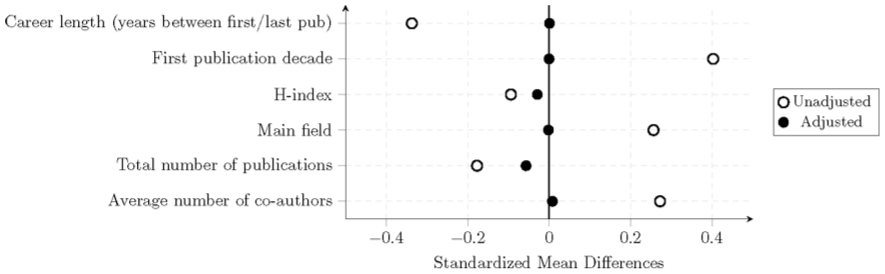
Standardized mean differences before and after matching.
Finally, I replicated the entire analysis using the matched sample to assess the robustness of the main findings (See Tables 5 and 6 below). The results remain remarkably stable across all models, with identical patterns and directions of effects observed in the original analysis. The core findings regarding gender differences in research breadth and the moderating role of field gender composition persist with only minor changes in statistical significance levels. Table 6, examining the effects of research breadth on academic outcomes, shows a slight decrease in significance levels for some coefficients, likely reflecting the reduced sample size from matching, but the substantive conclusions remain unchanged. The consistency of these results across both the full and matched samples provides strong evidence for the robustness of the observed patterns.
Replicating Table 3 with Matched Samples (n = 17,246).
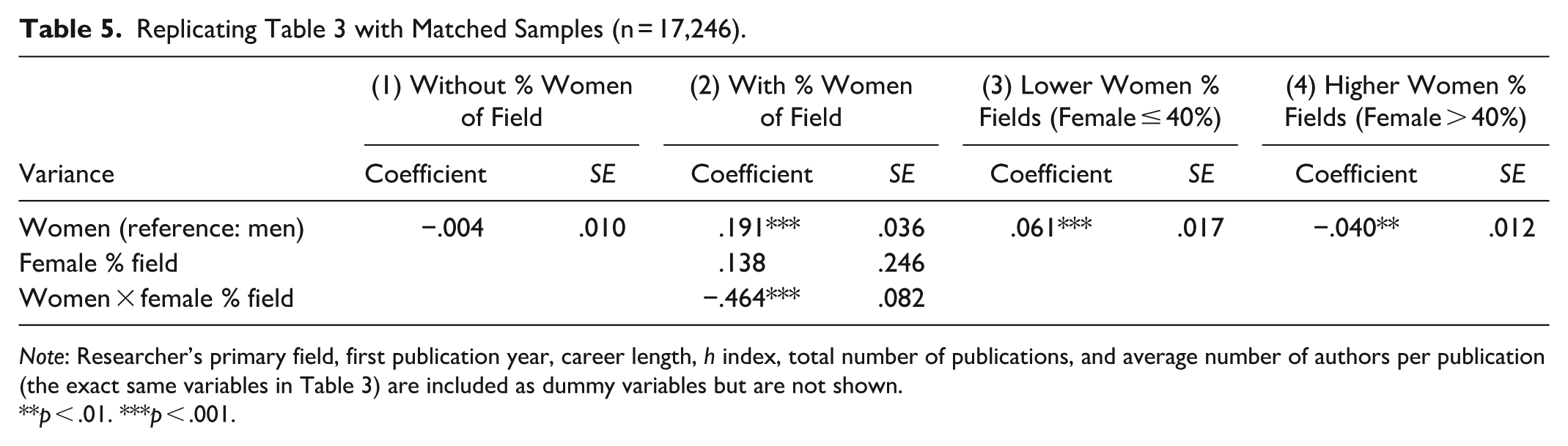
Note: Researcher’s primary field, first publication year, career length, h index, total number of publications, and average number of authors per publication (the exact same variables in Table 3) are included as dummy variables but are not shown.
p < .01. ***p < .001.
Replicating Table 4 with Matched Samples (n = 17,246).

Note: Researcher’s primary field, first publication year, career length, h index, total number of publications, and average number of authors per publication (the exact same variables in Table 4) are included as dummy variables but are not shown. Bold numbers are used consistently in both Tables 4 and 6 to enable direct comparison of interaction effects across models.
p < .05. **p < .01. ***p < .001.
Discussion
How do gender differences in research specialization shape academic career outcomes, and how is this process mediated by the gender composition of a scholar’s field? This study contributes to our understanding of gender inequality in academia by finding that the research specialization patterns are not a universal phenomenon, but ones deeply conditioned by field’s characteristics.
This study reveals a complex, field-dependent relationship between gender and research specialization strategies. Women in male-dominated fields show significantly greater research variance—broader, more diverse research trajectories—compared with their male colleagues. Critically, this pattern represents not an intrinsic gender difference, but a context-dependent response: in fields with greater gender parity, these differences diminish, and levels of research breadth converge between men and women.
It goes further by revealing that the returns on these distinct research strategies are not equitably distributed. Although diversifying one’s research portfolio is often framed as an individual strategic choice, the findings suggest that it functions as a response to institutional and disciplinary pressures. For women in male-dominated fields, broader research portfolios serve as a pathway to increase publication output, which is a key metric for career advancement. However, this strategy carries a significant and disproportionate cost. The observed trade-off between research breadth and citation impact affects women more severely. Women face steeper citation penalties when they explore broader research interests, even while successfully increasing their publication rates. This creates a paradoxical situation where women develop research patterns that boost immediate productivity measures but undermine long-term scholarly impact.
This pattern reveals a subtle but powerful mechanism through which gender inequality becomes institutionally reinforced. The structures and incentives within male-dominated fields appear to channel women toward research patterns that, although yielding higher publication counts, fail to generate equivalent prestige and scholarly influence compared with their male counterparts. This dynamic reflects a fundamental tension in academic careers: the conflict between immediate, tangible benefits of increased publications (essential for hiring, tenure, and promotion decisions) versus long-term, more elusive rewards of deep scholarly impact and disciplinary recognition. The findings indicate that women in male-dominated fields are systematically channeled toward prioritizing the former at the expense of the latter.
This study contributes to understanding gender inequality in academia by moving beyond universalist views of research specialization. By revealing how field characteristics condition specialization patterns and their effects, this work highlights a previously underexplored mechanism through which inequalities persist: the unequal rewards and penalties of widely practiced academic behaviors shaped by disciplinary structures. This calls for deeper attention to meso-level analysis, focusing on institutions as units of inequality production.
Building on these findings, future research could productively extend this work in several directions. First, incorporating institutional context would deepen our understanding of how organizational factors shape research specialization trajectories. University rank and prestige likely moderate the relationship between research breadth and career outcomes, as scholars at elite institutions may face different incentives and have different resources for pursuing interdisciplinary work. Although OpenAlex’s current institutional affiliations data presents challenges—including inconsistent linking, missing affiliations, and institutional moves that are not well captured over time—emerging efforts to improve institutional data quality will enable future work to examine how university context influences both the adoption of specialized versus broad research strategies and their differential effects by gender across different types of institutions.
Similarly, examining coauthorship networks and collaborator characteristics would illuminate important relational dynamics that shape research specialization possibilities and their recognition. Coauthor prestige, network position, and collaborative team composition may all affect both scholars’ ability to pursue broad research agendas and the rewards they receive for doing so. Disentangling whether prestigious coauthors enable research mobility across fields or whether mobile scholars attract prestigious collaborators requires longitudinal network analysis that could reveal the mechanisms through which collaborative relationships shape gendered patterns of research specialization. More broadly, investigating the role of mentoring networks and other informal mechanisms could help clarify how these relational dynamics influence whether scholars specialize narrowly or range broadly across their careers, and how these choices intersect with gender to produce differential career outcomes.
Extending the analysis to early-career scholars and understanding patterns of attrition would provide crucial insights into how research specialization patterns emerge and relate to persistence in academia. Although this study focuses on scholars with substantial publication records (at least 10 journal articles), examining earlier career stages would reveal how specialization patterns develop initially and how they relate to retention. Evidence shows that academic attrition varies systematically by gender and career stage (Cidlinska et al. 2023; Kwiek and Szymula 2025), with women disproportionately exiting during early career phases (Casad et al. 2022; Spoon et al. 2023; Xu 2008) when pressures to establish scholarly identity may be most intense. Preliminary analysis suggests that early career scholars show larger gender gaps in specialization patterns, which appear to diminish as scholars advance through initial career hurdles. Understanding whether early specialization choices predict attrition, and whether this relationship differs by gender, could reveal how research strategies connect to academic survival.
In this context, a stage-by-stage analysis examining how research specialization patterns evolve from graduate training through tenure and beyond represents a particularly promising direction. Such research could explain the mechanisms underlying the observed gender gaps in specialization and reveal whether they reflect stable preferences, strategic adaptations to evaluation systems, or responses to changing opportunities and constraints across career phases. For instance, recent research by Tripodi et al. (2025) demonstrated that faculty members increasingly produce novel, high-risk research after securing tenure, though this shift toward novelty comes with a decline in citation impact. Understanding how the academic pipeline shapes specialization choices across different career milestones, and how these dynamics intersect with gender, could provide deeper insights into how gender inequality is produced and potentially interrupted at different career stages.
This study has several important limitations that should be considered when interpreting its findings. First, the focus on journal publications excludes other forms of scholarly output that may be particularly relevant for understanding gendered research patterns. Evidence suggests that women in the social sciences use qualitative methods more frequently than men (Clemens et al. 1995; Grant et al. 1987; Key and Sumner 2019), while qualitative research findings are often disseminated through books and book chapters rather than journal articles. By analyzing only journal publications, this study may systematically underrepresent certain types of scholarly work and potentially mischaracterize the true extent of research specialization for scholars who publish across multiple formats. Although I attempted to account for such variations by controlling for the number of authors, number of publications, and field dummies, these controls cannot fully capture the complexity of methodological and outlet differences. The observed patterns of research specialization may therefore reflect, in part, gendered differences in publication venue choices rather than actual differences in research breadth.
Second, this study relies on automated author disambiguation, which introduces potential measurement error. OpenAlex’s author disambiguation system represents the current industry standard for large-scale scholarly analysis, but it is not without error (Alperin et al. 2024; Zhang et al. 2024). The disambiguation process may incorrectly merge publications from different authors with similar names or, conversely, split a single author’s work across multiple profiles. These errors are particularly problematic for authors with common names, those who publish under name variations, or scholars who have changed names during their careers (e.g., women changing their last names after marriage). Although manual verification of author identities would be impractical for a study of this scope (covering >39,000 researchers), future research using smaller, more focused samples could benefit from strictly verified author disambiguation.
Footnotes
Appendix: Robustness Check with Fractionalized Citations
To address potential concerns that coauthor team size might confound citation measures, I conducted robustness checks using fractionalized citation percentiles, dividing each paper’s citations by the number of coauthors before field normalizing and calculating percentiles. Contrary to the hypothesis that fractionalization would reduce women’s citation counts, the data reveal that women in this sample have significantly higher average coauthor counts than men (2.96 vs. 2.47; see Table 2). Consequently, fractionalization disproportionately reduces women’s citation metrics relative to men’s.
When reestimating the main models with fractionalized citations, the breadth penalty for women in male-dominated fields becomes substantially stronger. For the 90th percentile threshold (Table 4, column 2), the coefficient for “women in lower female % field × variance” increases from −0.510 (0.333) to −1.170 (0.310) (p < .001), more than doubling in magnitude and achieving statistical significance. Similarly, for the 80th percentile, the coefficient strengthens from −0.756 (0.369) (p < .05) to −1.315 (0.351) (p < .001). These results confirm that the main findings are robust and, if anything, conservative estimates of the breadth penalty women face. I retain field-normalized percentiles without fractionalization in the main text as the primary specification to avoid systematically underestimating women’s research impact, while noting that both approaches yield consistent substantive conclusions about gendered effects of research specialization.
2
Scopus uses a classification of four domains: Physical Sciences, Health Sciences, Social Sciences, and Life Sciences. The Social Sciences category serves as an umbrella term for all non-STEM disciplines, encompassing Humanities as well as other fields, including Arts and Humanities, Business, Management and Accounting, Decision Sciences, Economics, Econometrics and Finance, Psychology, Social Sciences, and Multidisciplinary. The complete list of 65 subfields within Social Sciences is available at  .
.