




Abstract
The U.S. Department of Government Efficiency has targeted U.S. federal workers through downsizings, funding reductions, and delegitimization efforts. When we target federal workers, whom are we targeting? The author offers a three-dimensional description of civilian federal workers, highlighting commonalities, inequalities, and majority composition. Data come from the Current Population Survey, the Office of Management and Budget, and the Equal Employment Opportunity Commission. Federal workers are prevalent across metropolitan and nonmetropolitan areas in red states, blue states, and swing states. About 1 in every 28 children in 2024 lived with a federal worker, potentially targeted by the Department of Government Efficiency in 2025. In veterans’ households, that number was about 1 in 9 children. Federal workers are prevalent across all ethnoracial groups. Most federal workers are White, and most downsized federal workers are likely to be White. But Black, Native American, and multiracial people are overrepresented among federal workers, and Native American federal workers may be even further overrepresented among the downsized. So whom are we targeting? People who resemble most Americans, people supporting millions of children across the country, and, disproportionately, veterans and members of several marginalized ethnoracial groups. Moving forward, this type of three-dimensional description can be applied to understand populations beyond federal workers.
In January 2025, President Trump established the U.S. Department of Government Efficiency (DOGE) (The White House 2025). DOGE is downsizing the civilian federal workforce (MacColl 2025). Proponents believe that this downsizing could reduce wasteful spending (Antoni 2025) and increase productivity (McCusker, Ferrari, and Harrison 2025). Skeptics worry that it could harm recipients of government services (Konish 2025), slow economic growth and innovation (Hubbard 2025), reduce health and safety (Abbasi and Rubin 2025), undermine data security and competition (Butler et al. 2025), hinder international relations (Reilly 2025), and trade expertise for party loyalty (Slodysko and Tau 2025). And of course, DOGE affects federal workers themselves. Downsized workers must rethink their careers (Sheffey et al. 2025). Workers not downsized face changing workloads and missions (Godfrey 2025; Savage 2025), budget cuts (Popli 2025), and delegitimization (Hinckley, Babcock, and Matusek 2025). Russell Vought, between terms directing the Office of Management and Budget, discussed his goals of inflicting “trauma” on federal workers and portraying them as “villains” (quoted in Redden, Kroll, and Surgey 2024).
Who are the targets of this trauma? Who are civilian federal workers? Soon, oral histories will offer rich answers (OAH 2025). Here, I use several sources—including 2024 Current Population Survey data (Flood et al. 2024), which underlie official employment statistics (U.S. Census Bureau 2024), plus White House downsizing plans (Merrill, Perry, and Bogage 2025; OMB 2025c), and federal workforce data (EEOC 2024)—to provide three perspectives on federal workers, including those potentially subject to cabinet-level departments’ force reductions.
First, federal workers are widely disbursed across geographic areas and social groups (Figure 1A). In 2024, about 2.6 percent of employed civilians were federal workers, totaling nearly 4.2 million people. 1 About 3.4 percent of all people and 3.6 percent of children lived with a federal worker. That is, about 1 in every 28 children in 2024 lived with someone potentially targeted by DOGE in 2025. This general pattern repeats across metropolitan and nonmetropolitan areas in blue states, red states, and swing states, although the exact numbers vary (see also Leubsdorf and Wilson 2024). Likewise, federal workers are prevalent across all ethnoracial groups. They are especially prevalent among veterans, who receive federal hiring preferences (OPM 2025b) and whose service may increase their public commitment (Braender and Andersen 2013). In veterans’ households, about 1 in every 9 children lived with a federal worker in 2024. This first perspective highlights that federal workers are interwoven throughout U.S. society.
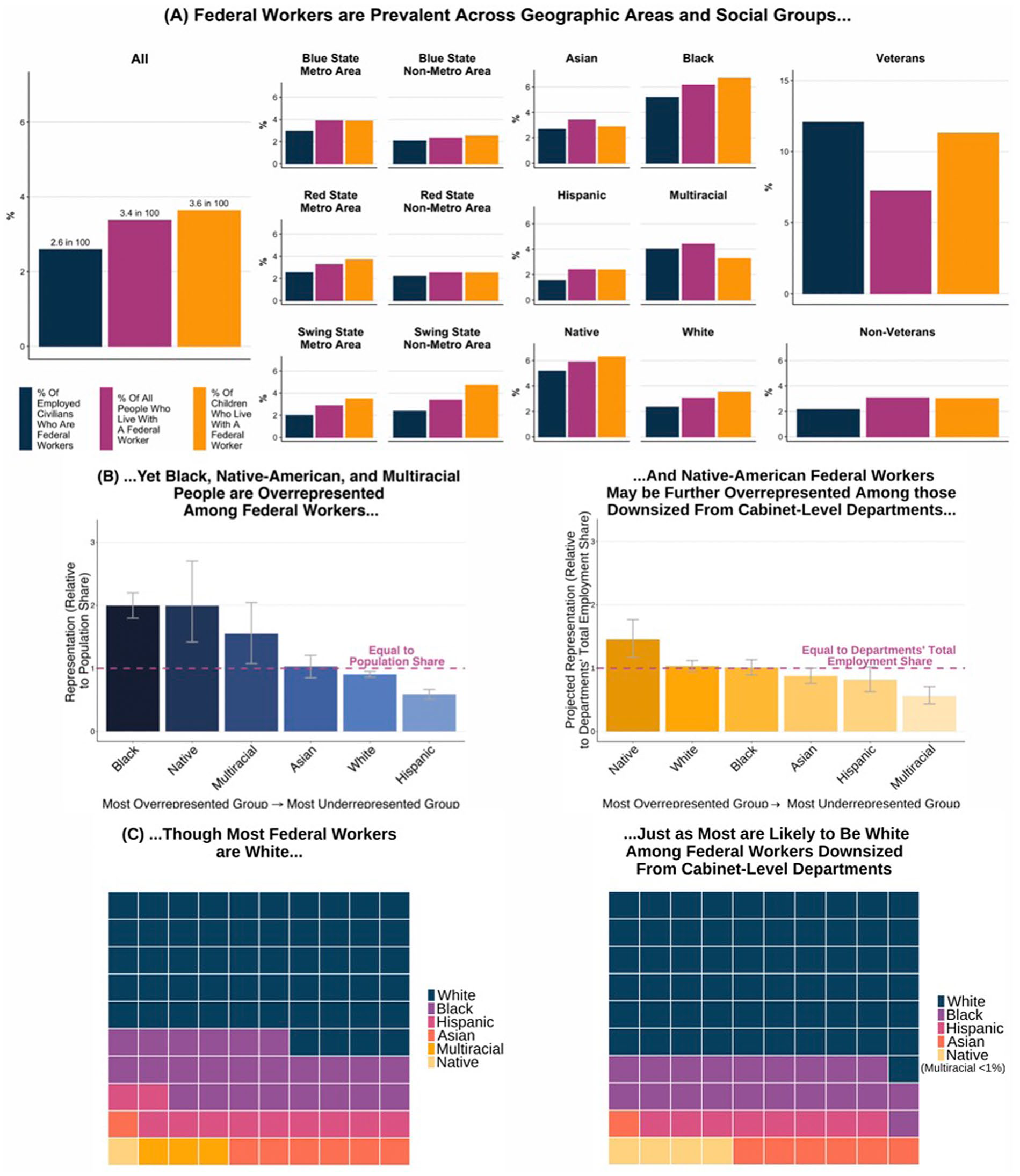
Three perspectives on federal workers: they are widely disbursed (A), several marginalized ethnoracial groups are overrepresented among them (B), but they are mostly White (C).
Second, Black, Native American, and multiracial people are overrepresented among federal workers (Figure 1B, left column). 2 Government jobs may provide some reprieve from private sector discrimination, partly because of clear bureaucratic personnel policies (Choi 2011; Laird 2017). Yet even among federal workers, Native Americans may be disproportionately affected by cabinet-level departments’ force reductions (Figure 1B, right column; see the supplement for details). This would be a second force driving Native American overrepresentation among the downsized. 3 This second perspective highlights how federal workers reflect inequalities that permeate American life.
Third, most federal workers are White (Figure 1C). Because most U.S. adults are White, so are most federal workers (left column). Likewise, most federal workers affected by cabinet-level departments’ force reductions will likely be White people, followed by Black people (right column), particularly Black women (Roy 2025). This third perspective highlights how federal workers take after most Americans. Also, it differentiates relative versus majority representation (Figure 1B vs. Figure 1C), to reduce misperceptions (Kardosh et al. 2022).
So, when we target federal workers, whom are we targeting? Mainly people who resemble most Americans, people supporting millions of children all across the country, and, disproportionately, veterans and members of several marginalized ethnoracial groups.
Moving forward, Figure 1’s three perspectives can be applied to populations beyond federal workers. The first perspective emphasizes commonalities (via raw prevalences). The second highlights inequalities (via relative prevalences). The third reveals majority contributions (via aggregate shares). Together, these perspectives paint a three-dimensional picture of a population.
Supplemental Material
sj-pdf-1-srd-10.1177_23780231251382962 – Supplemental material for When We Target Federal Workers, Whom Are We Targeting?
Supplemental material, sj-pdf-1-srd-10.1177_23780231251382962 for When We Target Federal Workers, Whom Are We Targeting? by Deirdre Bloome in Socius
Footnotes
Acknowledgements
I gratefully acknowledge important comments and insights shared by the Socius editors and reviewers, Linda Bilmes, Nicole Deterding, and Jack Dohahue.

Supplemental Material
Supplemental material for this article is available online.
Notes
Author Biography
References
Supplementary Material
Please find the following supplemental material available below.
For Open Access articles published under a Creative Commons License, all supplemental material carries the same license as the article it is associated with.
For non-Open Access articles published, all supplemental material carries a non-exclusive license, and permission requests for re-use of supplemental material or any part of supplemental material shall be sent directly to the copyright owner as specified in the copyright notice associated with the article.
