




Abstract
Combining sociological, legal and political science approaches, our article investigates some pandemic-related national policy measures and analyses survey studies on the reactions of the labour market and its actors to the COVID-19 pandemic in Hungary, a neoliberal national-populist country. Our surveys conducted with employers and employees show that job losses and working time reductions especially hit vulnerable groups of employees, among them young people and low wage earners, increasing existing social inequalities. The legislative changes seriously damaged the employees’ individual and collective rights and did not prove to be overly helpful for the employers either. The pandemic did not initiate any substantial policy changes, as the Hungarian autocratic regime was not very interested in effectively tempering its shocking effects on public health and the labour market. Instead, the government took the situation as a pretext in order to further reduce pluralism in the country's policymaking processes.
Keywords
Policymaking in a Neoliberal National-Populist Democracy
The COVID-19 pandemic affected all countries in the world deeply and in multiple ways. The single most important effect of any pandemic can be measured in terms of lives lost, however, social scientific research has been busy analysing the social and economic consequences as well. According to the data of the John Hopkins University, Hungary is among the top three countries worldwide with the most COVID-19-related deaths proportionally to the population size (504.76 COVID-related deaths were registered per 100,000 inhabitants). By way of comparison: the U.S. had 341.1 fatalities per 100,000 inhabitants, and Germany registered 203.2 deaths per 100,000 inhabitants 1 .
Hungary has been at the forefront of scientific attention and a subject of international social and political inquiries in the last few years. Related narratives have evolved around the notions of illiberalism, nationalism, hybrid regimes and populist policies (most recently, e.g. Webber, 2023). In this paper, we study the effects of the COVID-19 pandemic on the Hungarian labour market, combining sociological, legal and political science approaches. The focal points of our analysis are twofold: first, we claim that the erosion of social dialogue resulted in emergency legislation, which did not serve the interest of either employers or employees; second, we argue that the proliferation of emergency decrees significantly reduced legal certainty, which eventually led to the arbitrary interpretation of labour regulations. Our analysis sheds light on crucial aspects of policy-making mechanisms and their social effects in a populist autocracy.
Social inequality and vulnerability are key aspects in every crisis, as it has already been shown for the case of Western-European COVID-19 pandemic policies (McConnell & Stark, 2021). Some research has recently been conducted on labour market policies introduced in Eastern Europe since 2020 (i.e., Bohle et al., 2022). These investigations mostly deal with the fact that the pandemic was used as a pretext to weaken labour rights, an important part of the picture that we aim to complete using extensive legal and sociological data. Our study draws on survey data, among other sources, to explore how, and with what consequences, the population and the businesses experienced the policies adopted by the government in a country that we define as a national-populist neoliberal one (Scheiring, 2022) – a rare approach in two ways: the scholarly world usually focuses solely on the analysis of the content of measures when discussing policymaking during the pandemic, missing out on empirical analyses of its practical, often serious effects among the population. Additionally, such research mainly concentrates on Western countries, even though the analysis of the CEE region offers a unique perspective on how new(er) democracies in times of advancing populism face such challenges.
Our analysis of labour market policies during the pandemic is a case study of how such a populist regime governs in times of rapid change and massive economical stress. Based on several recent survey studies and the relevant Hungarian and European comparative policy analyses, we investigate the amount and the context of job losses, the challenges employers and employees had to face, and how the government reacted to this unprecedented crisis. We aim
to analyse how the Hungarian government, as an illustrative example of national-populist neoliberal regimes, treated the pandemic, to compare the policies adopted by the government with other European practices of the region and with previous policies of the Orbán regime, and to study how these policies affected the population and the businesses.
In 2010, Viktor Orbán's Fidesz party regained the majority, and after eight years in opposition, he became prime minister again. Hungary has since been a focal point of a growing body of literature about regimes that are often called, or that call themselves, ‘populist’ or ‘illiberal’. One of the main differences between policymaking processes of liberal democracies and populist regimes may be found in their level of consistency and cumulative character. While policymaking in liberal regimes is usually based on a more or less coherent system of ideas following a mainstream policy paradigm and characterised by incremental policy changes, in populist regimes it appears as a multifaceted ‘puzzle’ of different ideologies, combining conservative, neo-liberal and etatist elements (Bartha et al., 2020). At the level of policy processes, the main difference between the two ideal types is that while policymaking in liberal democracies is constrained by a variety of formal and informal institutions representing a wide range of interest groups, policy formation in populist regimes is dominated by a top-down approach in which the aforementioned actors have only limited (if any) power, and the institutions are ‘replaced’ by direct communication with the ‘people’. An important characteristic of the latter feature is that policy-making disregards competing ideas, like the opinion of social partners and represses any attempt to create a social dialogue between social partners or civil society representatives at stake. Finally, at the level of policy discourse, the distinguishing feature is that there is a competition for discursive framing in liberal democracies, while populist regimes are overly dominated by Manichean discourses (contrasting the ‘elites’ and the ‘people’) strongly built on highly emotional communication and the constant menace of existential crisis.
Social Dialogue in an Anti-Pluralist ‘Work-Based Society’
The aim of the first post-2010 Orbán government was to create a so-called ‘work-based society’ and the most flexible labour market in Europe, a policy goal that can be confidently characterised as neoliberal (Bartha et al., 2020; Scheiring, 2022). Neoliberalism, developed in response to the growth of mass democracy, is meant to curtail excessive democratic intervention in business affairs. It leads to a decline in labour share, deregulated labour markets and a strive to insulate economic policymaking from popular pressures emanating from trade unions (Scheiring, 2022). National-populist neoliberalism entails a new power bloc comprising both national and transnational capitalists, preserving the core elements of neoliberal accumulation strategy, while modifying some of its non-core tenets to ensure its political viability. In the course of instituting this approach, Orbán's government devised a series of economic policy instruments to facilitate the profitability of transnational manufacturing capital (TNC). Despite Orbán's mobilisation of disgruntled national capitalists, transnational capital retains its dominant position in the most significant sectors of Hungarian economy. Direct foreign investments in manufacturing doubled between 2010 and 2019 as a percentage of the GDP, significantly increasing the dependence of this sector and the power of German automotives. Manufacturing TNCs remained central to the power bloc, becoming one of the biggest winners of Orbán's populist regime (Scheiring, 2022).
At the national level, governmental measures were accompanied by the sidelining of social dialogue and a general effort to weaken its formal and informal institutions. Such processes could be observed in social policy and employment policy. The following patterns can be identified as characterising policymaking processes in these fields:
‘Somewhat paradoxical anti-institutionalism’: on the one hand, the participation of different social actors in policy making processes were highly limited but, on the other hand, governmental decisions were rapidly codified as Fidesz has had a comfortable majority in the Hungarian Parliament since 2010, often involving a two-thirds supermajority (Bartha et al., 2020: 76). Another key feature was the ‘peculiar timing and tempo of reforms’: especially the latter, the speed being relevant from an employment policy perspective and closely related to the limited role of social dialogue and a stable parliamentary majority (Bartha et al., 2020: 76).
Hungarian policymaking can thus be characterised by two distinctive features: proliferation of legal measures and anti-pluralism. Hungarian labour and social law reforms may not derive from the playbook of populism, yet their major characteristics are traceable in the new institutional setup. Their landslide victory allowed the Fidesz-KDNP coalition under Orbán to re-codify major policy areas, including the Constitution, the Civil, Criminal and Labour Codes and Procedural Codes, with virtually no opposition, while triggering substantial attention from national and European institutions due to the removal of democratic guarantees from political processes. This kind of anti-pluralism rests on the populists’ claim to be the sole representatives of the people (Schmidtke, 2023), understood as a homogenous entity; those who dissent from the populist direction and aim to represent autonomous interests (such as trade unions or civil society organisations) are subject to banishment and labelled as traitors of the ‘real’ people (Müller, 2016: 3). Authoritarian capitalist/neoliberal tendencies (Bohle et al., 2022) in Hungary have led to the dismantling of collective rights and institutions, of access to social security, and to forcing the surplus population into exploitative working relations.
The tripartite National Interest Reconciliation Forum was abolished in 2010, and a two-tier social dialogue model has emerged in Hungary. There is an official body, the National Economic and Social Council (NESC 2 ), which is a consultative, drafting and advisory body independent from the parliament and the government. It involves representatives from many different areas of society, but operates without any government agents. The NESC's rights are, however, narrowly formulated, which casts a shadow on its importance as a consultative forum that could strive for national consensus in substantive economic and social questions. Albeit envisaged as a comprehensive consultative forum, the NESC lacks the necessary elements to be qualified as a genuine forum for social dialogue: the absence of the formal participation of the government implies the weak position of the Council. Consequently, the government does not consult the NESC about important topics, such as the minimum wage, making its operation highly contested. At the same time, there is an informal council established by the government by a civil law contract, which only selected organisations loyal to the government are part of.
Given that the NESC is no more than a window display, it has not been consulted on the merits of policymaking; instead, the government has decided on the new social policy directions unilaterally. As a result, guarantees and protective measures have been severely curtailed in social policy, amplifying the insecurity and material deprivation of those losing their jobs. Unemployment benefits were minimised, and compulsory public employment programs were introduced (Szikra, 2014). Amendments to the Act on Strikes 3 concerning minimum service levels curbed the rights of trade unions in industrial sectors where organisation rates were traditionally high, most notably in public transport. These reforms prevented social partners from fulfilling their roles in protecting workers vis-a-vis employers by securing the freedom of meaningful participation in regulating the economy. However, the autonomy of economic actors was severely curbed, too, and pluralism was diminished in society in general and industrial relations in particular.
Materials and Methods
This article is based on two main sources:
relevant measures of Hungarian policymaking and two survey studies:
Residential survey: The Institute of Sociology of the Centre for Social Sciences (Budapest, Hungary) carried out a self-administered online survey between 29 November 2021 and 11 December 2021. The random sample was taken using a non-probability quota method. The quota was defined by age, gender, type of municipality and level of education. Data was collected by a Hungarian public opinion polling company (NRC). Due to its length, the survey consisted of two separate questionnaires. Participation in the survey was voluntary. Respondents were identified by unique identifiers that were not recorded. There was likely to be a negligible degree of overlap between the two groups of respondents answering the two questionnaires. In both cases the sample included 1000 respondents, who were asked to answer some basic socio-demographic and COVID-19 related questions.
4
Employer's survey: The Confederation of Hungarian Employers and Industrialists, which is one of the major general employers’ associations, surveyed its members four times during the pandemic. Data was collected between April and May 2020.
5
The online questionnaires were sent to the members of the association – employers’ federations and their members. Participation was voluntary but not anonymous, as interest representation required the identification of respondents. Answers were collected in each questionnaire from a wide range of industrial players, concerning the field of their activity and the size of the enterprise. About 20% of respondents came from micro-enterprises employing less than 10 workers, 29% from small enterprises with 10–50 employees, 31% represented medium-sized companies employing 50–250 people, and 16% belonged to large corporations employing more than 250 employees. The four surveys covered the following issues: Questionnaire 1 (Q1): Survey of the impact of the epidemic on Hungarian enterprises, n = 459; Questionnaire 2 (Q2): COVID-19: Preliminary business survey on the impact of planned government measures, n = 332; Questionnaire 3 (Q3): COVID-19: Survey of measures planned/implemented by enterprises, n = 347; Questionnaire 4 (Q4): Survey of home office experiences, n = 147.
Our paper is structured as follows: After describing our methodology, we outline the context of labour regulations in Hungary in 2020. Subsequently, we discuss the new measures adopted during the pandemic. We then present our findings on how the pandemic affected the Hungarian labour market and the employees. For this, we analyse the survey results in more detail, from the perspective of employees and their specific needs. We conclude with the most important lessons learned from this policy analysis exercise.
Labour Policies in Hungary During the Pandemic
In order to respond to the COVID-19 crisis in Hungary, the national government introduced emergency governance. The Fundamental Law includes a very detailed separate chapter on such a ‘special legal order’, allowing deviation from the ordinary legislative process. A specific type of special legal order listed in the Fundamental Law is the ‘state of danger’ (veszélyhelyzet). During a state of danger, although the Parliament may remain in session, the basic legislative power temporarily resides with the Government. The Government is entitled to adopt decrees to suspend or derogate from certain Acts, or provisions of Acts, or take some other extraordinary measures; the executive authority at the central governmental level thereof has the power to adopt, amend or repeal every extraordinary state of danger measure. The Government decree declaring the state of danger expires after 15 days, according to the Fundamental Law, if there is no further parliamentary authorisation for its prolongation. On 23 March 2020, the Government submitted a proposal to the Parliament to extend the applicability of the Government decrees until the end of the state of danger period, which the Parliament authorized. This was technically an unlimited temporal scope for governmental actions, as the end of the state of danger was supposed to be declared by the Government.
The pandemic was not the first time the Hungarian government relied on this extraordinary measure. The first occasion was in September 2015, allegedly as a response to the migration crisis from the Middle East. This form of extraordinary governance was extended from a regional level (applied near the southern borders of Hungary) to a national level in March 2016, and was prolonged 11 times before September 2022 (Antal, 2022: 5). Emergency governance may be the most illustrative example of the authoritarian shift of the government (Webber, 2023), especially that in parallel, other emergency states were declared under the COVID-19 crisis: thus from 1 March 2020 to the summer of 2022 there were only about 150 days during which no special emergency state was in force (Antal, 2022: 5). During these emergency periods, the parliament gave special authorisation to the government. With this authorization, the government had the right to suspend the application of certain laws, to deviate from legal provisions and to take other extraordinary measures like the restriction of mass events and visits to institutions, or increased border control (Antal, 2022) by decrees. This means that the parliament is circumvented and other ordinary consultation forums, like the different institutions of social dialogue, are bypassed as well. It is obvious that, after the first two or three waves of the pandemic (i.e. from spring 2021), the main motive for these measures did not have much to do with the health crisis but the political goals of the government.
In these years, we can observe an exponential growth of the legal corpus. As in the case of the EU and its Official Journal of the European Union, all Hungarian legal acts must be published in the Official Gazette of Hungary. According to some estimates, the number of pages of this journal was less between 1945 and 2005 than between 2010 and 2014, during the first term of Viktor Orbán's two-third majority government 6 . Such an intense codification activity deeply undermines legal stability and creates uncertainty not only among the citizens but in the system of law enforcement as well. The sheer amount of legal text causes uncertainty in the population and our survey data on whether employers were able to follow the ever changing labour and employment laws shows that clearly (see below).
Parallel to the proliferation of the rules, under-regulation also causes significant problems at the workplace level. Government Decree 47/2020 modified the provision of the Labour Code, introducing changes fundamentally alien to labour law: Article 6 (4) allowed the employee and the employer to derogate from the provisions of the Labour Code by their agreement. This meant that any rule of the Labour Code, whether for the benefit or the disadvantage of employees, could be altered by an agreement between the parties with no statutory limits. Thus, the law did not protect the weaker party anymore, which has utmost importance, especially when it comes to dismissal, damages of health and safety measures. In the same spirit, employers were allowed to modify the announced working time schedule differently from the notification rules laid down in Article 97(5) of the Labour Code: it meant that the employer could modify the announced working time schedule at any time, even immediately before starting or during scheduled work. Moreover, employers could unilaterally assign the employee to home office and telework schemes: there was no need for a mutual agreement for telework, and home office could be ordered without a time limit (opposed to yearly 44 working days in Article 53). However, as discussed below, there had been no statutory law concerning ‘home office’ until June 2022, which left essential issues such as liability for accidents open. Finally, employers were entitled to take the necessary and justified measures to control the employee's health: it meant relaxed health protection obligations. However, guidelines on necessary or minimum protection measures, like distancing, using facemasks, and vaccination, were often contradictory and frequently changed.
Moreover, the emergency measures effectively undermined collective autonomy at the workplace and have contributed to the anti-pluralist tendencies of the Orbán-government. Article 6(3) of Decree 47/2020 provided that provisions of collective agreements contrary to this Decree could not be applied during the state of danger. Subsequently, Government Decree No. 104/2020 (10.VI.) allowed the employer to impose a 24-month working time banking limit unilaterally. Although most of the provisions were repealed as of 1 July 2020, the unilateral imposition of a 24-month working time banking limit remains possible in the interest of the national economy. According to Article 56 (4) of Act LVIII of 2020, which incorporated some of the emergency regulations to the permanent corpus of Hungarian law, the Békés County Government Office, acting as the public employment body, may authorise an employer to use a maximum of 24 months as a basis for employment. The permission shall be granted if the implementation of the working time banking system is in the national economic interest. However, a Government Office cannot be regarded as a body that is supposed to represent the interests of workers – unlike trade unions, which have no part to play in such a scenario when it comes to amending the employment regulations.
Overall, the changes to the Labour Code left employers alone to decide on crucial questions like workplace safety or working conditions in an unprecedented emergency situation. This freedom also meant that employers should be responsible for their decisions. As our research results show, employers were unprepared for such tasks, and legal uncertainty about unlimited freedom eventually prevented efficient operations.
Social Effects of Labour Policies During the Pandemic
The pandemic represented an unprecedented challenge for governments in the EU member states, where right after immediate health risks concerns about labour market consequences were prioritised in the agenda. Lockdowns and the subsequent collapse of global supply chains put all governments across the EU under pressure to elaborate new policy solutions to cushion the negative impacts of the economic crisis. Two main policy tools played an especially important role: increased unemployment benefits and general allowances for those affected by the crisis, and different job retention schemes (JRS) aimed to prevent massive unemployment. However, in Hungary, JRS were:
not inclusive in their scope (e.g. public sector employees were excluded from them, Müller et al., 2022), restrictive in their volume (e.g. net wage, instead of gross wage, was taken as a reference, which made a substantial difference at the detriment of the employees), less efficient (e.g. there were no positive measures taken to support low-wage earners, and with 50% of the average wage the cap level was among the lowest in Europe), and did not contribute to the strengthening of labour market institutions (e.g. there was no requirement for employee involvement to become eligible for JRS).
Among the four Visegrad countries (Czechia, Hungary, Poland and Slovakia), compensation measures in Hungary were the least generous (Lukáčová et al., 2022). The Hungarian government implemented a short-time work job retention subsidy just until the end of August 2020 (after that date only companies in the cultural and hospitality sectors were eligible to apply for it) and no other compensation measures were adopted. The government did not extend the eligibility period of the three-month-long unemployment benefit either. As far as policymaking processes are concerned, trade unions had been fragmented and weakened long before the crisis and thus were unable to successfully protest against governmental actions aimed at further limiting the role of social dialogue in policy formation (Lukáčová et al., 2022: 9).
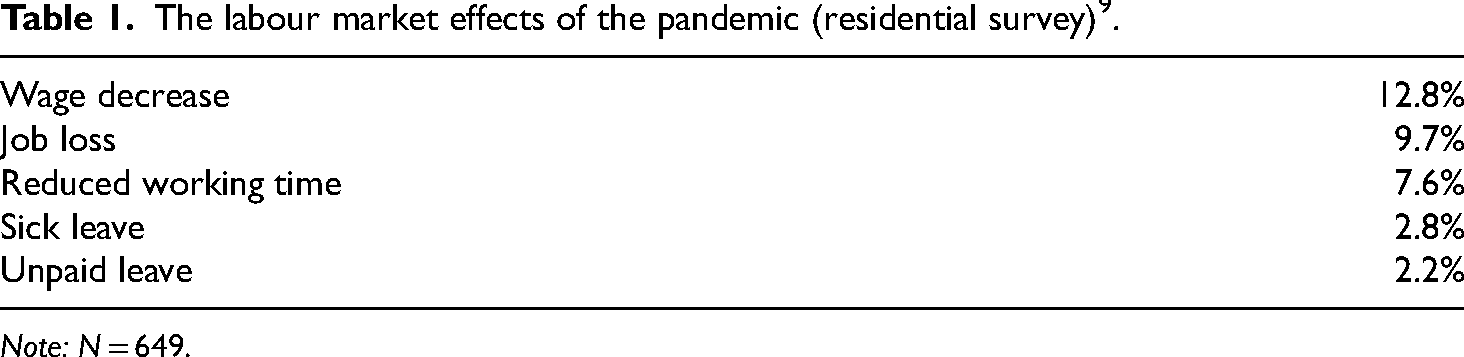
The lack of efficient compensation measures hit those people hard who lost their jobs: Two of the most direct impacts of the pandemic on the labour market in Hungary were the loss of jobs and the decrease in wages (Table 1). In our survey, 9.7% of those in employment reported that their job was lost due to the pandemic. This represents a significant share of respondents, especially taking into consideration that an additional 12.8% reported wage decrease, 7.6% experienced reduced working time, and 5% were forced to take a (paid or unpaid) leave. Overall, a third of employees experienced difficulties or negative labour market impacts due to the pandemic; a situation that was exacerbated by the lack of policy measures to help these groups.
The labour market effects of the pandemic (residential survey) 9 .
Note: N = 649.
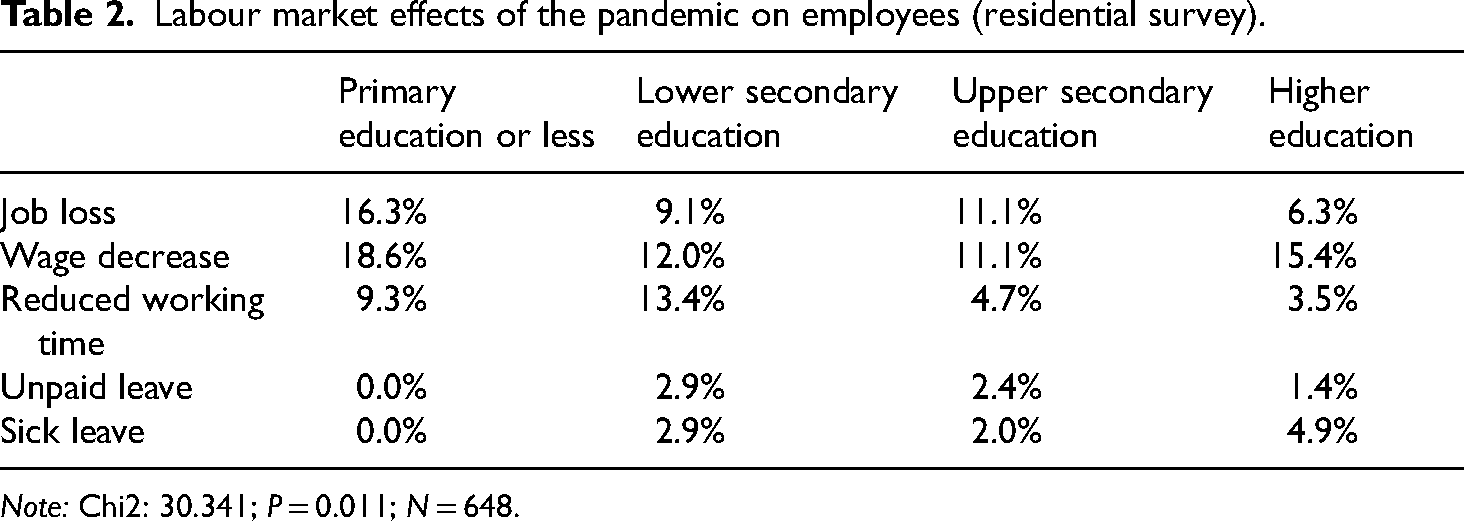
The analysis of the labour market effects of the pandemic among employees (Table 2) shows that the least educated people were at the highest labour market risk: 16% of employees with primary education or less lost their jobs, while another almost 20% experienced wage decrease. By contrast, people holding a higher education degree were relatively well protected against these ills, while those having secondary education were in an in-between situation. The pandemic hit the least advantaged groups the hardest, and they are those who suffered from the neoliberal labour policies in the most severe way: being those whose workforce can be replaced rather easily.
Labour market effects of the pandemic on employees (residential survey).
Note: Chi2: 30.341; P = 0.011; N = 648.
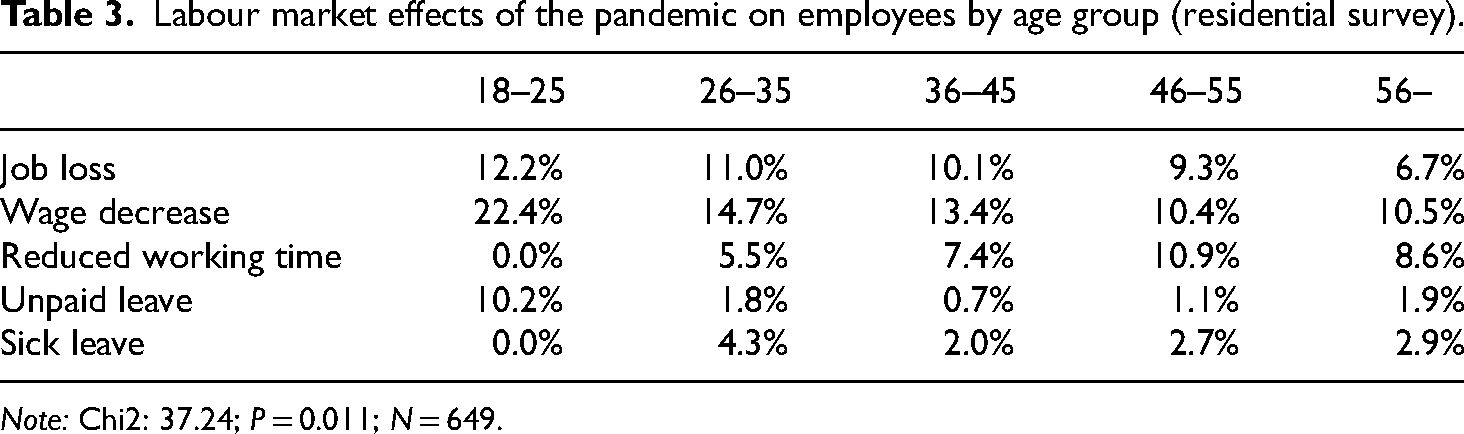
The two most serious negative effects of the coronavirus pandemic, job loss and wage decrease, impacted age groups differently (Table 3). Older employees were relatively better protected than younger ones. More than one-third (34.6%) of the youngest respondents experienced either job loss or a decrease of their salaries due to shortened working time during the pandemic. The same ratio is 25.7% among those aged 26–35, and this figure decreases monotonously with the increase of age. It is worth noting that – contrary to international and European experiences (Carli, 2020; Gender equality, 2021) – there were no statistically significant differences in how COVID-19 affected employees by gender.
Labour market effects of the pandemic on employees by age group (residential survey).
Note: Chi2: 37.24; P = 0.011; N = 649.
As it was often the case in similar situations in the past, the present crisis also increased income inequalities. During the survey we asked respondents about how they would evaluate their monthly income adequacy to maintain their living standard. They answered on a 4-point response scale.
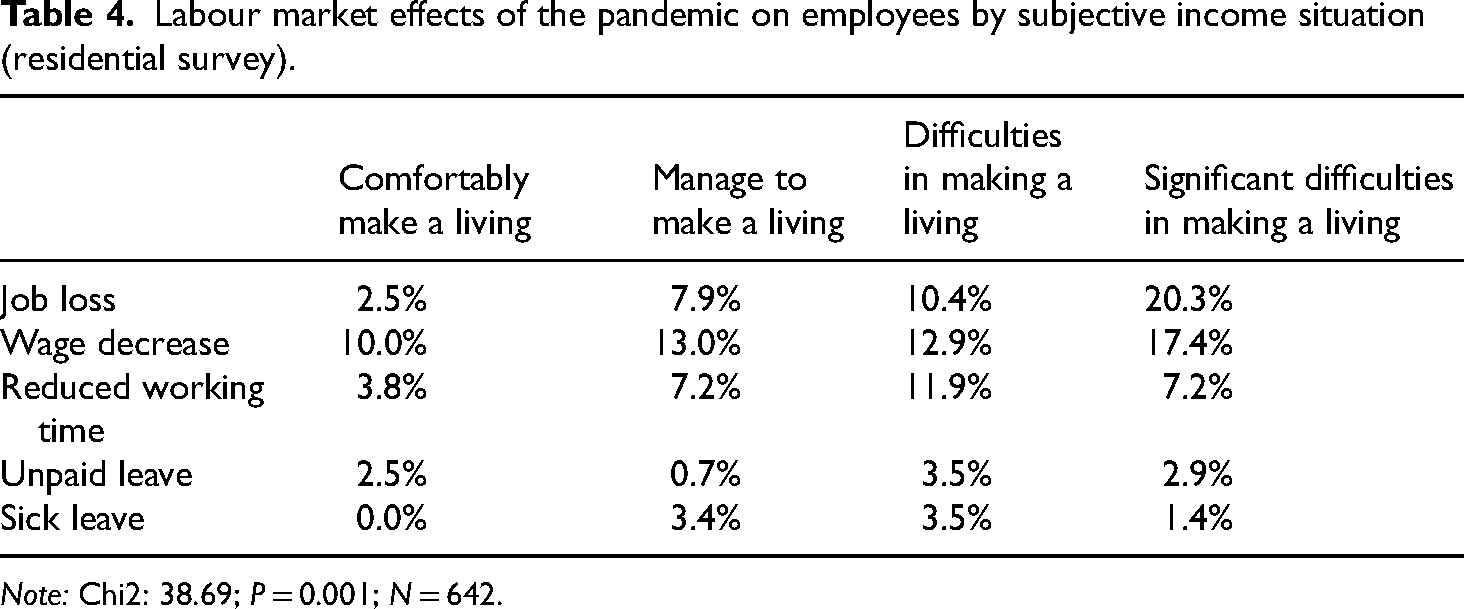
The subjective income situation correlates negatively with the labour market shock caused by the pandemic (Table 4): the lower the score on the subjective income situation, the harder the labour market consequences of the pandemic are. Of those who said that they had significant difficulties in making a living from their income, approximately 20% lost their job, and another 17.4% experienced a decrease in their exiguous income. By contrast, among those comfortably making a living, the same ratios were 2.5% and 10%, respectively. Again, we see that the neoliberal labour policies during the pandemic hit the most disadvantaged groups the hardest: the data reveal that the pandemic represented a sudden and deep shock on the labour market and hit every social group differently. Job losses and working time reduction especially hit vulnerable groups of employees, among them young people and low wage earners, further increasing existing social inequalities.
Labour market effects of the pandemic on employees by subjective income situation (residential survey).
Note: Chi2: 38.69; P = 0.001; N = 642.
When the pandemic hit Hungary, the government was suddenly left alone in an unprecedented situation, without any meaningful consultative institutions – which had been demolished by the government itself in the previous years (see above). What was left was its ambition to solve the problematic situation by force. Thus, without consultation with the social partners (or any agents of civil society), the government introduced the so-called Economic Protection Action Plan – a loose umbrella term for measures to provide economic relief during and after the pandemic. All of the new rules were adopted by government decrees bypassing the parliament, social partners and economic actors.
State of danger regulations have often been based on amendments of existing legal measures and subject to frequent modifications. The regulation of Government Decree 47/2020 and 104/2020, which allowed full derogation from the statute, essentially redesigned the general system of the hierarchy of sources of labour law. According to these provisions, social partners enjoy a certain level of discretion. However, deviations from the statute and collective agreements should only be agreed upon in favour of the employee. By enabling derogation from the rules of the convention without restriction, the government decree placed the responsibility to make workplaces safer on employers in this unprecedented situation. Such an extension of individual autonomy also raises constitutional questions, as the Fundamental Law and other decrees and acts allow the Hungarian government to introduce extraordinary measures in times of emergency. However, the Fundamental Law does not allow to delegate this power to private parties, and to do so in a way that removes the public authority-like protection of parties in unequal contractual positions.
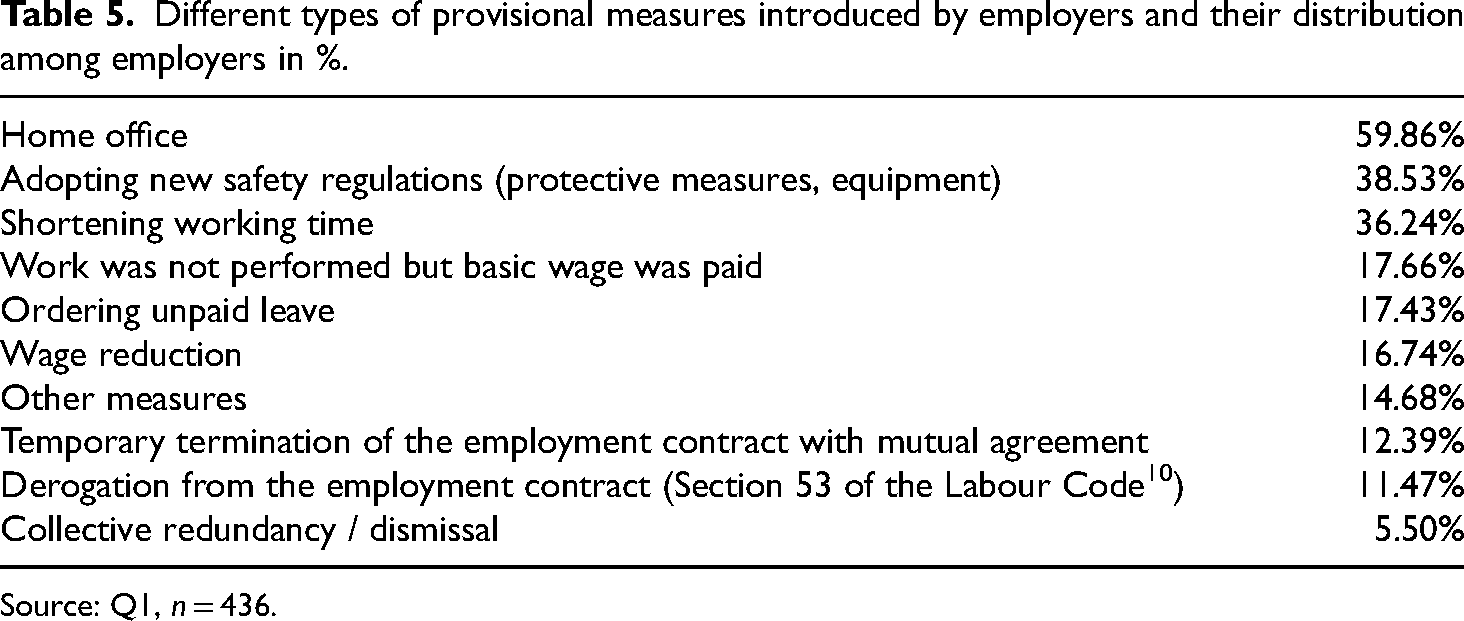
The parallel presence of over- and under-regulations had a paralysing effect on employers. As the research data suggest, most employers could not or did not dare to rely on the freedom provided for by Government Decree 47/2020. Employers were interested in keeping their workforce until the end of the pandemic, in order not to lose their businesses, and keep their employees as healthy as possible. They implemented various measures to retain their businesses (Table 5), often compensating for the lack of efficient state-wide governmental policy on health measures.
Different types of provisional measures introduced by employers and their distribution among employers in %.
Source: Q1, n = 436.
These data are backed up by results from our residential survey: about three quarters of the respondents reported that they had rules on keeping a distance and mask use at the workplace (even though the government did not introduce such regulations except in the hotel industry and retail sectors). Legal regulations did not particularly protect the health of workers in Hungary, as there were no state-subsidised measures to regularly test workers or provide them or workplaces with masks. Our results show that employers decided to get financially involved in the management of the epidemic, with around 62% of workers receiving free masks and around a fifth of them being tested monthly or more often.
Most notably, although home office and telework arrangements were promoted by the government, the related regulations for liability for damages occurring at home were not regulated, despite the repeated requests of social partners. The differences between teleworking and home office rules are not clear in Hungarian labour law. The situation is further complicated by the fact that the legislation on telework, which was adopted in the wake of the experience gained during the pandemic, only entered into force in May 2022 7 . According to the law, telework is any work performed by an employee outside the employer's premises (as opposed to the previous rules, which considered only work carried out using information and communication technologies). Although the motion was adopted by the parliament, it did not enter into force due to an individual decision of the Prime Minister, who created an ex-lex situation (Ferencz, 2022). The survey data show that employers were rather reluctant to introduce telework schemes during the pandemic due to the legal uncertainty caused by the delay in entry into force of the amending law. Not only that this legal arrangement caused gross legal uncertainty affecting about a hundred thousand employees (Kun, 2021), but it did not fit the logic of ordinary legislative procedures either: the applicability of an act adopted by the parliament should not be dependent on a unique act of the head of the executive. This is yet another instance demonstrating the operational mechanisms of the populist exercise of power: after largely ignoring social partners’ opinions concerning the content of the act, the Prime Minister technically bypasses the legislature, too.
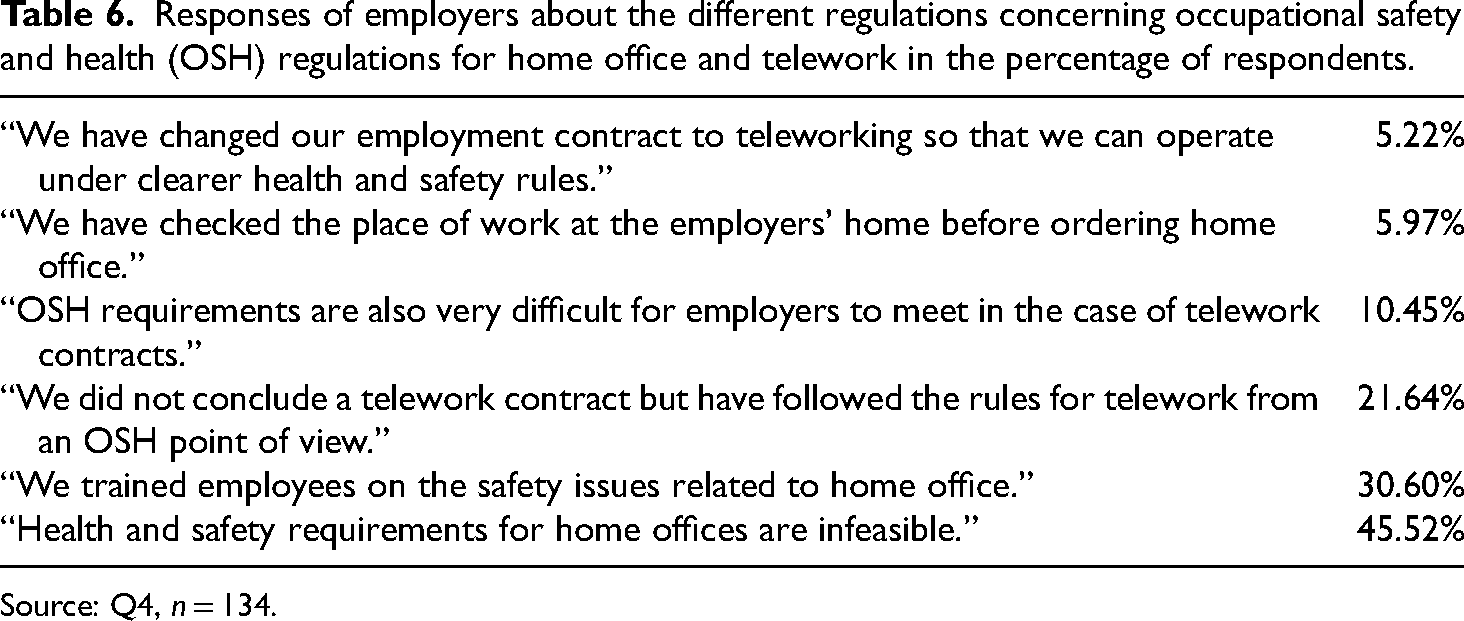
No specific regulations were adopted during the state of danger concerning occupational safety and health (OSH) for telework and home office, so employers had to apply the vague general rules. Despite legal uncertainties and the lack of official guidelines, telework and home office were widely used during the pandemic – again a measure of employers to try to keep businesses running as normally as possible. According to the survey, by the end of May 2020 82.43% of the employers used home office or telework, which affected 17% of the employees or about 760 thousand people (Central Statistical Office, 2018). This was a significant increase, considering that before the pandemic only 3.7% (or 144 thousand employees) had worked in telework or home office arrangements. However, uncertainty was quite high concerning applicable regulations and how to follow them (Table 6). About 56% of the respondents considered the OSH regulations concerning telework difficult to apply also in practical terms; about 11% of the employers concerned nevertheless chose to apply these rules, as they were still more transparent and reliable than home office regulations.
Responses of employers about the different regulations concerning occupational safety and health (OSH) regulations for home office and telework in the percentage of respondents.
Source: Q4, n = 134.
While the government delegated the decision-making power to private parties in these issues of fundamental importance, collective autonomy was systematically reduced or even denied (Kiss, 2020: 503–512). Moreover, parts of the emergency regulations denying collective autonomy adopted under the auspices of the pandemic remained in force after the emergency was lifted and they have become part of the permanent legal order. Although these provisions expired on 18 June 2020, it remains possible to unilaterally impose a 24-month limit for working time banking in the interests of the national economy. In addition, the possibility of individual modification of the rules on teleworking and home working has been retained.
The Quality of Labour Market Policies During the Pandemic
As far as the support of employees in the realm of workfare-oriented social and employment policies is concerned, no new general demogrants and social insurance based aids were introduced during the pandemic. Administrative rules related to social benefit claims were not eased either, leading to longer procedural times. The most important characteristic of the Hungarian measures is that no cash transfers were introduced for workers and no amendments were made related to unemployment benefits, pensions, health care insurance support, and social security contributions either. When COVID-19 infection qualified as an occupational disease (e.g. in the case of teachers, as the Minister of Human Resources declared in a Facebook video, see Kásler, 2020), employees were eligible for 100% of their absentee fee, instead of the general sickness benefit replacement rate, which is its 50–60%. However, as general rules related to reimbursement claims still applied, the Social Insurance Fund could reclaim 100% of the social benefit paid to sick employees from their employers. Thus employers were not motivated to acknowledge that COVID-19 occurred as an occupational disease. As a consequence, many infected people ended up with a lower level of benefit. Moreover, there has been no regulation concerning long-Covid or post-Covid cases, further increasing the financial uncertainty of infected employees. In addition, while employers were in charge of deciding on the necessary and justified measures to control the health of the employee, employees concerned about the adequacy of the safety measures taken by the employer were allowed to refuse to take up work. If the employee believed that their health is in immediate and serious danger at work, they could legitimately refuse to work. From a legal point of view, this is seen as a refusal by the worker to comply with the employer's instructions to be ‘on call’ and to carry out the work obligation. If the employer considers that the refusal to comply with the instruction is unfounded, it may dismiss the employee with immediate effect.
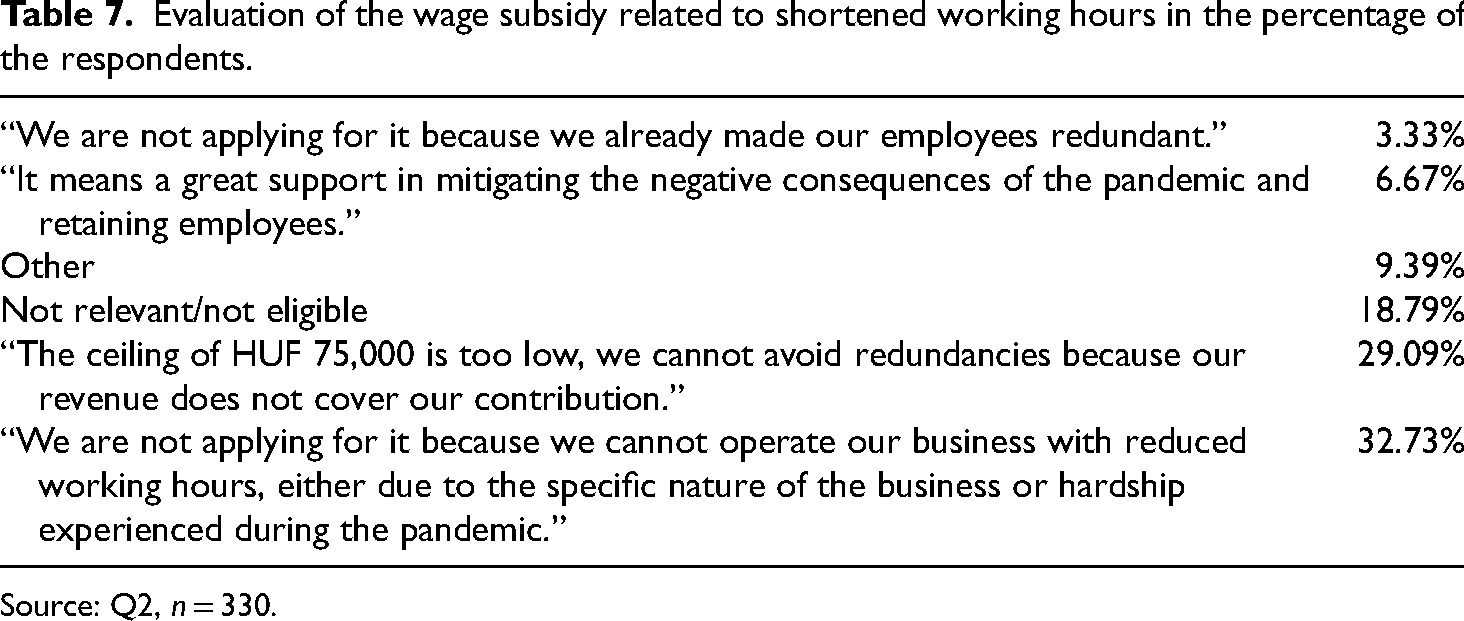
Even though the labour-related measures affected hundreds of thousands of employees, social partners were not consulted concerning the labour law regulations during the state of danger. The majority of employers were not satisfied with the fiscal emergency measures of the government (Table 6). Concerning the wage subsidy for shortened working time arrangements, less than 7% of the respondents considered this measure of significant support (Table 7). The program was criticised mostly because of the short period (initially set for three months, which was then extended to a total of nine months) when wage subsidies could be claimed. Only 22.8% of the respondents considered this period sufficiently long; 37.2% claimed that it was definitely too short, while 42% responded that three-month subsidy period could be of significant help if it did not include the HUF 75,000 (approx. EUR 190) monthly subsidy wage cap (usually a rather insignificant amount of money for employers) and/or the requirement for a 15–50% reduction of working hours.
Evaluation of the wage subsidy related to shortened working hours in the percentage of the respondents.
Source: Q2, n = 330.
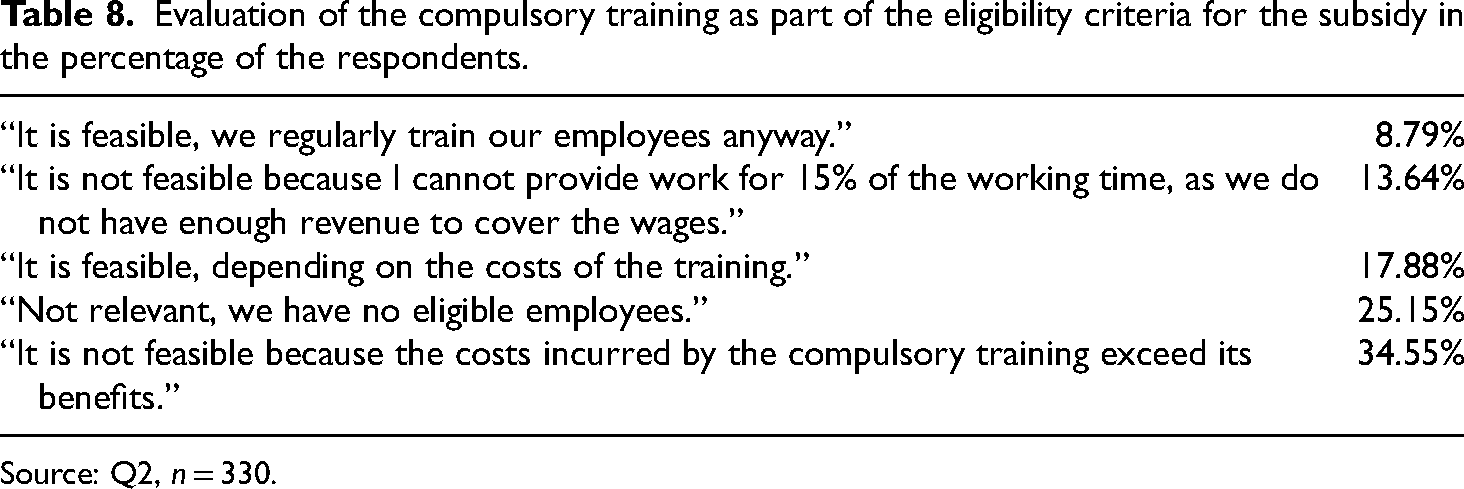
Moreover, the condition of compulsory training in 15% of the working time raised feasibility concerns: 48% of the respondents did not find the support feasible (Table 8).
Evaluation of the compulsory training as part of the eligibility criteria for the subsidy in the percentage of the respondents.
Source: Q2, n = 330.
Even the possibility to increase the reference period for working time banking to 24 months was not considered to be overly helpful by the majority of the respondents, either because they use the general reference period provided for by the Labour Code (20%), or they are not applying working time banking at all (34.9%). About 35.5% of the respondents use working time banking, and only 9.5% of the survey participants considered this measure very helpful (data from Q3).
Conclusion
The Orbán-led Fidesz party won the Hungarian parliamentary elections in 2010 and has been governing the country ever since, with a two-thirds majority most of the time. This allowed Prime Minister Viktor Orbán to transform the political, economic and social landscape and to create a new, increasingly authoritarian form of governance during a decade-long period of exceptional economic growth. This was based on cheap workforce, a deregulated labour market, the negligible role of social partners, and on subsidies from the European Commissionforthcoming 2] 8 . As a result, in the decade preceding the pandemic, the number of people in employment rose to an unprecedented level, but wage polarisation and the proportion of the working poor in employment increased. This system was hit hard by the pandemic, which meant an unprecedented challenge for the government and the enterprises as well as for the population in general.
In our study, we analysed how the authoritarian regime that we identify as national-populist neoliberalism (Scheiring, 2022) reacted to the new situation, and whether the global crisis induced any changes in the policy formation processes. We have found that the pandemic did not initiate any substantial changes, either in the form or in the content of policy formation. The role of the parliament decreased long before the health crisis (Sebők et al., 2020). Earlier measures aimed to narrow down the role of social partners (including the downplaying of the national level tripartite consultative body, curtailing collective rights, etc.) have not been revised. Even the provisions of mutually agreed existing collective agreements concerning working time arrangements were suspended in some cases. During the pandemic, no direct cash transfers of any kind were introduced that could have represented immediate help for those in trouble, be they infected employees, unemployed, pensioners, or people in any other vulnerable situation. This practice amplified the insecurity and material deprivation of those losing their jobs. The government left employers alone to decide on questions like workplace safety or working conditions, a freedom that also meant that employers should bear the responsibility for their decisions. We have shown that employers were not prepared for such tasks during the pandemic and legal uncertainty related to the unlimited freedom eventually prevented efficient operations. The emergency situation has been used to further weaken individual and collective rights, as demonstrated by the regulatory changes of working time banking practices.
Institutions of social dialogue are formally in place and operating in Hungary, meeting the formal criteria of democratic provisions. However, social dialogue as a democratic process is dysfunctional, since institutions and mechanisms are not implemented democratically, and thus no genuine dialogue or actual debates can take place. Instead, these mechanisms work in a top-down manner, the state and the central government taking direct orders from their strategic partners to serve their needs regarding employment policy, leaving no room for a transparent democratic dialogue with the relevant social partners, further deregulating labour markets, and insulating economic policymaking from pressures from trade unions. The lack of an autonomous social dialogue supports anti-pluralist trends, a characteristic feature of populist governance in a government mixing conservative, neo-liberal and etatist elements.
Working time reduction and job losses during the pandemic especially hit vulnerable groups of employees, among them low wage earners and young people, increasing existing social inequalities. Around one-third of employees experienced negative labour market impacts due to the pandemic, the less educated people being at the highest labour market risk. Although the legislative changes seriously damaged the employees’ individual and collective rights, survey results demonstrate that these did not prove to be overly helpful for the employers either. Direct financial support paid to employers and employees remained low compared to other European countries. Frequent changes in the regulatory environment and the fact that no specific regulations were adopted concerning OSH created uncertainties, sometimes contradicting logic or ordinary legislative procedure, effectively undermining the rule of law, and leaving employees and employers to face serious and unprecedented epidemiologic risks. This resulted in a situation where a considerable amount of employers contributed financially to the mitigation of workplace risks by providing regular free tests and masks to their employees: healthcare measures that the government failed to introduce during the pandemic to protect people.
The populist model of policy formation has not changed substantially in Hungary during the pandemic: backed by neoliberal ideologies, employment policy aimed to maintain the employment model based on low-cost manpower and substandard labour relations, facilitating the profitability of TNC. Compared not only to other EU member states but also its closest counterparts (such as the Visegrad countries) in terms of historical, social, cultural and economic legacies, employment policy in Hungary was left relatively intact by the shock of the pandemic.
The labour market policy reforms introduced during the pandemic had no direct relevance to the COVID-19 epidemic, but measures adopted during the pandemic remained in force after the virus had weakened and the emergency situation had been lifted. Workers’ and trade unions’ rights have been permanently curtailed. The government has extended and refined the use of ‘governance in the state of danger’, first tested during the migration crisis–not an uncommon trait of populist political actors: Schmidtke (2023) has shown on the example of Germany's AfD that the perpetual state of exception is populism's lifeblood. This not only reduced the role of checks and balances, but further weakened employees’ individual and collective rights. Since March 2020, even though the Hungarian parliament remains in session, the basic legislative power resides with the current government, breaching the separation of powers and clearly signalling the authoritarian shift of the government (Webber, 2023). This demonstrates the operational mechanisms of the regime that largely ignores social partners’ opinions and technically bypasses the legislature, too.
Our results are in line with those of Müller et al. (2022): Hungarian labour market policies during the pandemic were not inclusive in their scope but restrictive in their volume and inefficient, which substantially weakened the position of labour market institutions. The health crisis represented a negative structural turning point in labour market positions (resulting in unemployment, reduced working hours and wages, social isolation, etc.). At the same time, the Hungarian government spent an enormous amount of money to support multinational companies and Hungarian firms owned by the cronies of the reigning Fidesz party (Bohle et al., 2022: 11). The fundamental elements of democratic control, such as participation or trade union rights, have been largely eliminated to further block employees’ rights to strike and to cement the executive power of Orbán's Fidesz. Hence, we conclude that, for a number of reasons, social dialogue in Hungary does not fulfil its role neither at the national, nor at the workplace level.
All these developments, together with the fact that, at the moment of submitting this article, Hungary is officially still in a state of danger and the majority of restrictive measures remained in force after the pandemic, lead us to say that the Hungarian neoliberal national-populist regime has not been very interested in effectively tempering the shocking effects of COVID-19. Instead, it took advantage of the situation in order to make the country's political system even less pluralistic.
Footnotes
Acknowledgements
We are grateful to the Confederation of Hungarian Employers and Industrialists that provided us the data of their surveys. We thank Gergő Medve-Bálint and Dorottya Szikra for their valuable comments on an earlier version of this paper.
Declaration of Conflicting Interests
The authors declared no potential conflicts of interest with respect to the research, authorship, and/or publication of this article.
Funding
The authors disclosed receipt of the following financial support for the research, authorship, and/or publication of this article: One of the surveys this paper analyses was conducted and financed by the Institute of Sociology, Centre for Social Sciences, Budapest. The research was carried out within the framework of the project “The responsiveness of the legal system in post-COVID societies: risks and opportunities” (05016764) funded by the High Risk Grant for research on post-COVID phenomena of the Hungarian Academy of Sciences.
Research Data
The research data used for the article are available in the Research Documentation Centre, the digital institutional repository of the Centre for Social Sciences, Budapest. DOI: 10.17203/KDK581 and DOI: 10.17203/KDK590.
