




Abstract
The authors explore how the coronavirus disease 2019 (COVID-19) pandemic amplified a broad range of care practices for women in academia. Engaging the lived experiences of faculty and research staff members, the authors investigate the entangled impact of care on work-life productivity during the first year and a half of the global pandemic. Mixed-methods data include roundtable accounts focusing on the COVID-19 experiences of woman employees at a Canadian university with supplementary analyses from a related institutional survey. The findings demonstrate a triangulated configuration of care responsibilities: care directly associated with work, care outside of work without disruption to professional excellence, and pressures of self-care. The authors conclude by describing the “cruel optimism” of care that is at once rewarding but simultaneously diminishing to personal flourishing. This article contributes to analytical efforts to critically redefine care in higher education as an ambivalent set of laborious practices steeped in inequities.
The social ills generated from the coronavirus disease 2019 (COVID-19) pandemic have renewed critical discussions about gendered inequities in the workplace, including professional women in postsecondary institutions. Emergent research has exposed immediate consequences of the pandemic on women in academia, revealing inequitable impacts on research outputs, teaching loads, and responsibilities related to advising, mentorship, and service (Malisch et al. 2020; Oleschuk 2020; Shalaby, Allam, and Buttorff 2021; Staniscuaski et al. 2021). Research has also postulated the generative, long-term effects of the pandemic on women in academia, namely how their labor during the global health emergency will have negative consequences on merit evaluations that determine tenure and promotion (Deryugina, Shurchkov, and Stearns 2021; Malisch et al. 2020; Staniscuaski et al. 2021). The impact of parental care responsibilities has trended in discussions on the gendered impacts of the pandemic to work-life balance, however there is a need for further inclusion of women’s firsthand, lived experiences of broader care work in higher education. Using a phenomenological approach is critical in considering how a wide range of care responsibilities have reverberated into all facets of women’s professional academic lives, limiting the ability to thrive and succeed.
What follows is an exploration of how several dimensions of care work performed by women in Canadian higher education during the COVID-19 pandemic were enmeshed in their professional lives. We sought to understand the scope of care that women academics were either institutionally mandated to perform or personally positioned to undertake. The questions guiding this research were the following: first, what are the lived care experiences of women faculty and research staff members during the COVID-19 pandemic? And second, how has caregiving affected the work-life flourishing of these women? Through an innovative mixed-methods dataset of quantitative survey results, qualitative open-ended survey responses, and narrative roundtable accounts, we submit that women employed professionally in academia performed multiplicities of care work that preexisted but were severely amplified by the pandemic. These diverse labors of care, which affected women’s productivity and professional advancement, have yet to be fully accounted for theoretically and institutionally. This study contributes to incipient interdisciplinary discussions on the ambivalences of care as a set of practices that can be simultaneously rewarding and troubling (Murphy 2015). We mobilize the theory of “cruel optimism” (Berlant 2011) to discuss how care as a response to pressures of productivity structurally harms women while also presenting labors of care as fruitful and naturalized. Additionally, we contribute a discussion about self-care, a configuration of laborious care that is often overlooked. By focalizing the lived experiences of academic faculty and research staff members, we investigate an employment domain that has not traditionally been viewed as care intensive.
After providing an overview of how COVID-19 created shifts in the academy, we discuss key theoretical literature that contextualizes the care work of women. Subsequently, we describe the mixed-methods research design before using the accounts of women to illuminate three different but overlapping configurations of care for academic women during COVID-19. First, some performances of care were directly associated with their professional roles, including caring for students, fulfilling care-intensive service roles, and doing community partner work. Second, other performances of care unrelated to their roles as academics, namely caring for family, were expected not to impact their employment productivity. Finally, institutional self-care discourse was promoted in lieu of formal support resourcing and without the infrastructural ability to forge time for self-care. Our discussion showcases how care work as a form of cruel optimism comes with promises of academic success but also structural disadvantage. The conclusion summons a call for continued research into relationships between care, productivity, and well-being to further understand how pressures to care are embroiled in the academy in ways that can be insidious and invisible.
Shifts in the Academy and the Labor of Care
Care work in higher education is deeply affected by market models of research and education. A regime of “academic capitalism” pervades higher education where neoliberal values of productivity and efficiency affect the lives of students, faculty members, and administration alike (Gardner 2022; Slaughter and Leslie 1997; Slaughter and Rhoades 2004; Winslow 2015). Under this system, failing to meet standards of productivity can cause dire consequences related to tenure, promotion, pay, and loss of employment (Walker 2014). Given expectations of unending and continuous productivity, time is a valuable commodity under the neoliberal university (Walker 2009), where academics are continuously expected to generate more outputs with less time to devote to teaching and research activities (Walker 2014). Academic capitalism has been problematized in the United States, and to a lesser extent in Canada, but both contexts have been highlighted as countries that are similarly and particularly affected (Slaughter and Leslie 1997). It is against the backdrop of North American neoliberal universities that we overview literature on gendered care work during COVID-19 from the points of view of emotional labor, pink-collar work, and cruel optimism. We engage an interdisciplinary literature across sociology, education studies, and anthropology to reflect our interdisciplinary research team and to bring together critical literatures on care that sociological studies can benefit from.
The care work of women in academe has been documented since long before the onset of the COVID-19 pandemic. The professional productivity and personal well-being of women academics suffer because of asymmetric caregiving duties compared with men, especially in relation to familial support (Blair-Loy et al. 2015). Outdated ideas of home/work separation still predominate culturally in North America, with engrained expectations that women perform more care work—or embrace the adaptability to prioritize caring for others (Davies and Frink 2014). Academic mothers in higher education also face gender inequities as they disproportionately sacrifice career advancement opportunities in favor of caring for children and aging relatives (Ward and Wolf-Wendel 2016). These factors contribute to women’s occupying fewer positions of administrative authority and power in higher education (Allan 2011). It is thus worrisome that COVID-19 inspired an increased attitudinal endorsement of traditional gender roles, for example that mothers should be responsible for taking care of children’s scheduling, the belief that mothers are happier in domestic spaces, and that mothers with young children should not work while raising kids (Mize, Kaufman, and Petts 2021).
From the early stages of the COVID-19 pandemic, scholars identified worsening gender inequities with long-term consequences for the employment of women (Landivar et al. 2020). In academia specifically, the onslaught of the pandemic in 2020 precipitated countless shifts at homes and universities, increasing the number of care-related duties taken up by women both personally and professionally (Deryugina et al. 2021; Yildirim and Eslen-Ziya 2021). Campus closures and remote teaching and learning meant massive pedagogical shifts for professors that changed students’ needs and expectations and altered how professors provided emotional support to students. For those with young children at home, primary and secondary school closures and virtually nonexistent daycare setups also dramatically shifted the work-family interface for faculty members, leading to work-family as well as family-work conflict (Young et al. 2024). The pandemic has reconfigured care in the academy for women, a cohort whose responsibilities of care have shifted and been silenced in various ways. These often-unspoken responsibilities provide essential context in understanding long-standing and newly emerging involvements of care that were both baked into and budding in the academy during COVID-19. The employment productivity of women has suffered, and academia is a useful case study through which to understand the social impacts of institutional disruption given that academic productivity is measurable through concrete metrics such as publishing (King and Frederickson 2021).
There is a growing interdisciplinary call to challenge the analytics and assumptions of care, and to investigate its ambivalences (Duclos and Criado 2020; Kleinman 2015). This movement is driven by a broader effort among feminist scholars to redefine care, which has assumed meanings of warm positivity, willing generosity, reciprocal nurturance, and happiness (Ahmed 2010; Murphy 2015; Puig de la Bellacasa 2017). We contribute to this critique by analyzing the structural, emotional work that professional academic women perform and by expanding our assumptions of what work constitutes care. Embracing an “open-ended recognition of care” that “resists finalizability” is intentionally inclusive of diverse and unrecognized practices of support (Cubellis 2020:3). In doing so, we gesture toward but expand upon the literature on emotional labor in higher education. Emotional labor involves the suppression and expression of emotions performed in the workplace, where the management of displayed feelings is tied to a person’s perceived performance in that role (Hochschild 1983). Being mindful that the concept of emotional labor has become so inclusive as to lose its critical edge (Wingfield 2021), what follows is a broader conversation underscoring how women employed in higher education have experienced and interpreted the complexities of care enmeshed in their occupational lives during a global pandemic.
Classic discussions on pink-collar labor narrowly consider how care work associated with traditionally female dominated occupations punctuate profitmaking careers in ways that hinder progression compared with men (Howe 1977). That the care work performed by women is taken for granted, often unremunerated, and undervalued as legitimate work in the economic sense (even though it is central to neoliberal public health policies and the economy) has been well documented (Abel and Nelson 1990; Boris and Salazar Parreñas 2010; Howe 1977). As the gendered nature of care is naturalized, the emotional work of women is “socially and economically invisible” (Liebelt 2015:23). Academic work is not normally considered traditional pink-collar work, because academia is a domain historically dominated by male leadership, and because higher education has relatively inconspicuous attachments to service and caregiving sectors. Therefore, academia has often been excluded from discussions on pink-collar work. We unravel how caring for others and the self seeps into the professional lives of academic women, affecting their workplace productivity and their personal and professional lives.
We frame the care work of women in higher education as a form of cruel optimism, in which the objects and efforts of one’s desire may actually inhibit their flourishing (Berlant 2011). Care is shrouded in promises of relational well-being in the academy, whereas in practice care often means trudging through precarious demands of professional excellence. Women academics’ roles as caretakers have diffused through the academy in a ways that feel ordinary and naturalized, where their belonging is often contingent on caring for others. We follow this critical line of work to explore how the global pandemic has created new and exaggerated forms of cruel care for professional academic women. Although countless anecdotal accounts of care work in higher education circulate, we contribute an evidence-based, mixed-methods study that directly attends to care within academic capitalism, which remains underexplored.
Methods
We present the lived care experiences of women faculty and research staff members in the academy during the COVID-19 pandemic on the basis of a mixed-methods dataset. Qualitative data are from roundtable sessions hosted via Zoom in the summer of 2021, each lasting one and a half hours. These roundtable gatherings were organized by the university’s provost as town halls at which representatives from their woman-employed constituency could voice concerns about the pandemic’s impact on their cohort. Attendees were also invited to offer suggestions on navigating postpandemic recovery for women at their institution. Roundtable sessions were composed of two activities. First, each began with four invited panelists delivering statements on the needs and experiences of academic women in their roles and departments, which cumulatively lasted a half hour. Key speakers included women faculty and research staff members from diverse faculties and departments across the university with varying research, service, and administrative programs. Second, panels were followed by a question and discussion period among all attendees that lasted one hour, composed of a similarly interdisciplinary group of researchers and research staff. Participants joined from the faculties of health science, social science, humanities, engineering, and the school of business. Excluding organizers, there were 45 attendees at the first roundtable and 37 at the second. Some topics and questions raised during these open-forum periods included what sources are leading to burnout among women in the academy, how we account for the parenting and care work that disproportionately disrupts women’s curricula vitae (CVs), how laboring at home affects career work, where messages of pernicious productivity are coming from, and how we keep the momentum of COVID-19 accommodations going in a post-COVID-19 world. Panelists and attendees were contacted retroactively to retrieve consent for use of their comments in this study after receiving institutional ethics clearance. We transcribed recorded sessions and transcripts included data from consenting respondents alone.
To supplement qualitative findings, we draw from the University Impact of Covid-19 Study (UICS) (n = 475), an institutional research survey investigating the COVID-19 experiences of faculty and research staff members at the same Canadian university measuring impacts on research, health, and community. The survey provides additional qualitative findings through a series of open-ended questions about (1) what respondents missed about being on campus, (2) their experiences providing long-term care, (3) suggestions for improving the campus environment, and (4) an open-ended field for any additional comments. All qualitative data were analyzed through thematic analysis using Braun and Clarke’s (2006) six-phase approach, in which the phenomenological themes presented in this article were devised by (1) familiarization with data, (2) generating initial codes, (3) searching for themes, (4) reviewing themes, (5) defining themes, and (6) writing results.
This mixed-methods study uses a triangulated design methodology whereby qualitative and quantitative data were analyzed separately and then assembled to leverage multiple perspectives, combining strengths and eliminating shortcomings (Creswell et al. 2003). The UICS survey data provide an understanding of key trends across the population of the university at hand, while open-ended comments and roundtable transcripts provide more in-depth, phenomenological narratives. Other mixed-methods studies using a blend of interviews, surveys, and open-ended comments have successfully explored issues related to emotional labor, compassionate work, and coping at work (Baum and Wallace 2022; Lemaire and Wallace 2010; Polachek and Wallace 2018). Our interlocutors, who span from postdocs and early-career scholars to secure and tenured faculty members as well as new and experienced research staff members, contribute a rich tapestry of experiences to draw from.
Quantitative Measures and Analyses
We analyzed three outcome variables related to the gendered impacts of care during the pandemic in academia: (1) reporting providing much more support to students (binary), (2) the degree of family-to-work conflict (continuous, modeled for parents in the sample only), and (3) having provided COVID-19-related care outside of one’s immediate family (binary). First, reporting much more support to students (coded 1) was compared with those who provided more, the same, less, or much less support to students since the start of the pandemic (coded 0). We provide a visual breakdown of these categories in Appendix A. We dichotomized the five-item Likert-style variable at much more because of a skewed distribution; interactions with students were disrupted for all teaching faculty and staff members, and thus we sought to understand inequities in who provided the most additional supports (Davis et al. 2022; Gonzales and Griffin 2020). We measured family-to-work conflict by averaging scores of four commonly referenced items on the basis of the National Study of the Changing Workforce (Aumann, Galinsky, and Matos 2011; Bond, Galinsky, and Prottas 2002). See Appendix B for family-to-work conflict question list. From the resulting index (α = .924), higher scores represent greater conflict. Models assessing family-to-work conflict were restricted to participants who are parents to capture how childcare affected family-to-work conflict in a COVID-19 context. Although the UICS survey also addressed work-to-family conflict, this research is particularly interested in how gender dynamics in the home influence work-related outcomes in academia, resulting in a focus on family-to-work conflict. Having provided COVID-19-related care outside of one’s immediate family was assessed using a one-item measure that asked, “Since the start of the pandemic in March 2020, have you provided related support for those outside of your immediate family to help them cope with the impacts of the pandemic?” Responses included “yes” and “no” (the reference category).
We used logistic and ordinary least squares regression to model binary and continuous outcomes respectively with gender as the focal independent variable. We used logit coefficients and linear β coefficients to estimate the odds ratio (OR) and unit change in outcome for women compared with men. For each outcome, we produced three models: (1) using bivariate regression, we assessed the crude association between gender and the outcome, (2) we additionally controlled for job position and job tenure (greater than five years [coded 1] vs. less than or equal to five years in the job [reference]), and (3) we then further controlled for being a parent of a child six years or younger (coded 1, compared with those with older or no children) and, in the case assessing the degree of family-to-work conflict, the number of hours worked from home per week (continuous measure).
Description of the Analytical Sample
This study was conducted at a research-intensive university that consistently ranks in the top five research universities in Canada. The university has more than 35,000 students, with just under 20 percent being international students. This study, however, focalizes the university’s faculty and research staff members. After excluding respondents on key focal measures, we had a total of 445 respondents in our analytical sample. Of these, an equal number of survey participants identified as men (n = 210) and women (n = 214). Respondents tended to have moderate experience in their positions, with 63 percent of women and 60 percent of men indicating more than five years of tenure. Most participants (49 percent of women, 55 percent of men) were associate or full professors. Twenty-six percent of women and 15 percent of men worked as research staff members, administrators, or other roles. Women reported providing more emotional support than men (Mwomen = .429, Mmen = .276; p < .01) but the same levels of family-to-work conflict (parents only) and the same likelihood of providing COVID-19 support. Table 1 provides the descriptive statistics for the study sample, and see Appendix C for a breakdown of the survey study sample by race/ethnicity. Ethics approval was obtained from McMaster University’s research ethics board for both the survey (protocol #5483) and roundtables (protocol #5575).
Descriptive Statistics for Study Sample.

Note: COVID-19 = coronavirus disease 2019.
Much more emotional support provided. See Appendix A for a breakdown of responses by categories for this survey question by gender.
Reduced sample of parents, only (mothers, n = 92; fathers, n = 100).
p < .01 and ***p < .001 (based on t tests and χ2 tests).
Findings Theme 1: Caring Directly Associated with Work
Although not always formally mandated labor, providing support was undertaken by academic women in ways that felt morally valued, socially expected, or institutionally necessary. Roundtable attendees were asked whether they had provided additional emotional support to students during COVID-19 and if so, how they had been coping with this extra work. The question was met with knowing nods and shared expressions of recognition. Women successively recounted stories about the inflated emotional support they have extended to students, whose suffering they have been confronted with and whose needs they felt compelled to address. Sensing the dialectic pedagogical and emotional difficulties of students, who faced dire challenges in their personal and academic lives because of the pandemic, professors adopted new forms of support for students, including words of compassion and accommodating assignment policies. Faculty particularly worried about graduate students, whose positions and well-being they viewed as more precarious and felt responsible for. Sensing the mounting distress among her graduate students, one supervisor distributed her personal phone number for use in emergencies. Faculty members described supporting students through the tumult of COVID-19, yet still feeling like they were coming up short. One supervisor said, Many of my graduate students have had family members hospitalized, they’ve been supporting families, many have their own children, they have difficulties with data collection. They’re depressed, anxious, they don’t want to deal with this anymore. More have said they do not want to enter academia so I’ve been supporting them in finding jobs in industry and government. I think as supervisors we just try to support our students in living their best life, fulfilling their own potential, but there’s only so much you can do.
Women experienced pressure to maintain a public facing image of positivity and coping to serve as hopeful role models for their students, one saying, “I know particularly my female students look at you and they are envisioning whether this is the future career that they want.” Women were conflicted between encouraging students to continue in academia while also questioning their own futures; 36 percent of women indicated in our survey that they had considered leaving academia during the pandemic.
Several women described that counselor, psychologist, nurse, and caregiver were among the new hats they had to wear during the pandemic. One faculty member shared a troubling story about a crisis in her lab; a graduate student ended up hospitalized following a suicidal incident, and several other students with marginalized social identities were living with incapacitating overwhelm because of the news cycle. The faculty adviser became an ostensible mental health professional in caring for the students in her lab during COVID-19, saying, I am doing a social work job without being trained for it, especially for some of our more vulnerable students. That is part of my personal toll, every day I have been exhausted trying to deal with their pain on top of my own.
Evidently, the pandemic amplified the amount of support women faculty members provided to students, in addition to their own teaching loads, managing disrupted research programs, and dealing with health, families, and lives outside of work. Faculty members also provided care to students through financial support, either spending more dollars on students or guiding them through new funding opportunities: In terms of funding, there’s been delays so I’ve had to increase funding for many of them. I make a point of telling them it’s not their fault they don’t have a job, it’s COVID. And stay positive and really try to get them to talk to each other. I have noticed a huge difference in students for sure over the last year and a half and tried to as a supervisor really . . . support them.
This faculty member not only redirected more personal funding dollars to students but also supported them emotionally by keeping morale up, even when they were having difficulties themself and caring for college-age children at home.
The UICS survey included an open-ended question prompting respondents to provide suggestions to the university for postpandemic recovery. Several women faculty and staff members used the opportunity to advocate for improved working conditions for students and to promote student mental health. Using their limited platform to promote the needs of the students they teach and supervise was a profound demonstration of care. Faculty members advocated for extended graduate student tenure, increased student funding, stipends for students most affected by COVID-19, and improved undergraduate student mental health supports. One faculty members abstained from answering a question about improvements to childcare, stating, I was neutral on the childcare question because I know how valuable it is, but I can’t justify making 150K a year and having accessible childcare that my post-doctoral fellows, temporary and casual employees, and graduate students can’t access. They tend not to be considered “employees” in these sorts of decisions, which is unfair.
Of course, the mental health and available supports of students cannot be disentangled from the well-being of the faculty and staff members who teach, advise, and work alongside them, because the provision of support to students has taken a significant toll.
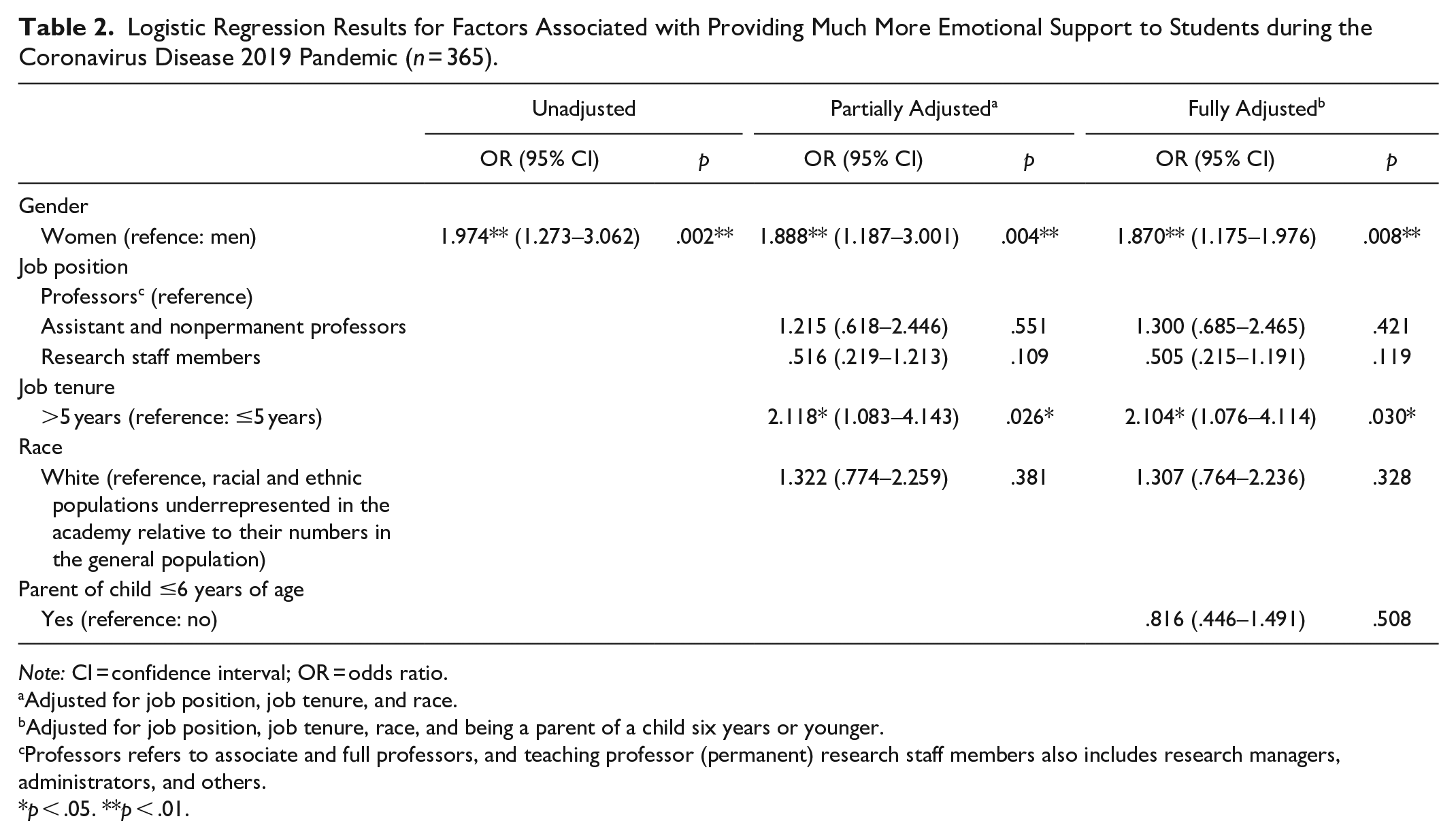
Quantitative data from our survey also demonstrate a gendered burden associated with providing support to students during the pandemic. Although women tended to students’ emotional needs before the pandemic, UICS survey results indicate that COVID-19 disproportionately increased this burden for women. To assess the degree to which gender was associated with a greater burden of student support, we analyzed a series of logistic regression models (Table 2). In the unadjusted model, women had 1.94 times (95 percent confidence interval [CI] = 1.27–3.06, p < .005) the odds of providing much more emotional support to students compared with men. After adjusting for job position, job tenure, race, and having a child six years and younger, the effect of gender on the odds of providing emotional support is attenuated but still suggested that women, compared with men, were more likely to provide much more emotional support to students (OR = 1.87, 95 percent CI = 1.175–1.976). We also analyzed a partially adjusted model controlling for job position, job tenure, and race, which yielded similar results (OR = 1.89, 95 percent CI = 1.187–3.001).
Logistic Regression Results for Factors Associated with Providing Much More Emotional Support to Students during the Coronavirus Disease 2019 Pandemic (n = 365).
Note: CI = confidence interval; OR = odds ratio.
Adjusted for job position, job tenure, and race.
Adjusted for job position, job tenure, race, and being a parent of a child six years or younger.
Professors refers to associate and full professors, and teaching professor (permanent) research staff members also includes research managers, administrators, and others.
p < .05. **p < .01.
The gendered burden of care at work was a contradictory experience for women during the pandemic, posing as both a barrier and facilitator to job fulfillment: At the university level, we could give more recognition to the service and mentoring that so many women do. In academia this is a problem . . . well I don’t want to say it’s a problem. I love serving, I love helping students, this is why I’m here. But particularly in a year like this, I look at other people getting grants and doing the type of work that I’m not able to do right now and I feel like my service might be subsidizing someone else’s successful outcomes. And that’s a hard feeling.
This faculty member is not trying to absolve herself of care responsibilities, which she finds fulfilling, but rather provides a moving message about how her materially underappreciated work supporting students enables others to participate in more valued labor.
The care work performed on the job by women faculty and research staff members also extends to their engagement with community. Sitting on committees, conducting community engaged scholarship, and participating in justice-oriented efforts are disproportionately undertaken by women on campus. Although this phenomenon is not novel, the first year of the pandemic was a time particularly fraught for community work. One roundtable participant relayed how her leading position on an equity, diversity, and inclusion committee overlapped with the tragedies of George Floyd’s murder, Indigenous woman Joyce Echaquan’s death in Quebec, an Islamophobic terrorist attack in Ontario, and the discovery of 215 Indigenous children’s bodies in Kamloops. She struggled to express the heartbreak involved with this work tied so closely to care and her communities. An Indigenous scholar who does research with her community relayed how her work program took a pause, or “a respectful social distance,” to heal from “a state of emergency, physical barricades put up at all entry points of the reserve, very high death rates, and community grief.”
For our interlocutors, care work focused on mentorship, service, and community-engagement receive less formal recognition and remuneration compared with traditional research, grant, and publishing efforts. Survey respondents pleaded for a change in this status quo, writing, “we need to start measuring community engagement and service and crediting it for CP/M [Career Progress and Merit] and T&P [tenure and promotion], this valuable work should be considered equally valuable as research.” They exposed and critiqued the gendered nature of undertakings rooted in the service of care. Once more, faculty conveyed that caring dedication to their scholarly communities bred both affection and resentment in their work: With the pandemic, we’re seeing the existing inequalities in terms of who does service, who takes extra time for mentoring of students, and for community engagement. The amount of time I’ve certainly devoted over my career to my students, to sitting on committees, to doing the work that needs to get done to keep things running. And I do it because I care about it, but during COVID when I have such limited time, I’ve used up a lot of time doing service. I think that is an issue many women do deal with.
The global pandemic inflated the care work of women, which was described by our interlocutors as a draining but also a fundamental part of their professional lives.
Findings Theme 2: Caring Outside of Work
Our second theme focuses on performances of care that took place at home among families but were expected not to affect the professional excellence of women. For example, although caring for children is outside of the mandated duties of university employees, parental caregiving duties still affected work because women researchers were expected to mother without disruption to work productivity. Our interlocutors documented how their amplified at-home care responsibilities during COVID-19 led to unaccounted stressors and complications in their professional lives. A word that came up frequently was delay. As one faculty relayed, It’s been a tough year. I feel quite ineffectual, especially in the home. Trying to home school, teach, be excellent at doing laundry, and short order cook for picky children. I’m lucky that I have a partner who can help in the evenings and on some weekends, there are faculty and staff who are doing this alone in the home. So I’m grateful for that but I guess I’ve been thinking about this word productivity and who really gets to be productive and then about the word . . . delay.
Delays in academic capitalism are not just a personal frustration but, as this academic implies, suspend opportunities for professional growth. Faculty members described how the delays precipitated by care work will have long-term impacts for women: Care work is often taken up as delays and these will show up on CVs in a few years as blank spaces, as empty bullet points. When thinking about solutions going into the future, I’m thinking about the trickle-down effect of a lack of peer review processes, a lack of time to write, what that means for two years down the line. How will merit be considered at our university when we “return to normal,” which will still not be a state of normal, especially for women faculty?
Although the at-home care work of women faculty members may be institutionally imperceptible, this labor has clear material consequences, especially in the long term.
One faculty member described how juggling career work and caring for children resulted in a “24 hour work day” that affected her ability to meet professional deadlines. Some suggested that “the university should have specific initiatives in place for women’s post-pandemic career recovery. Research has demonstrated that women have been more adversely affected than men and have taken on more household duties and caring responsibilities than their male partners.” Yet another pleaded for a reevaluation of productivity, writing, “the university should recognize that certain demographics, like mothers, had their work negatively impacted for a structural reason during the pandemic and should place a higher value on work achieved despite these circumstances in progress evaluations.” Although their university offered temporary tenure clock extensions and provisional recovery plans to counteract the extensive care work undertaken by women, our interlocutors relayed that these supports were inadequate given the long-term effects that caring at home would have on their career advancement. Moreover, accessing these COVID-19 supports was not a straightforward decision, as disclosing personal caregiving responsibilities is a challenging choice for women in academia, who may be resultantly discriminated against and overlooked for career advancing opportunities.
Caring at work and home intersected in complex ways, which amplified feelings of burnout. One senior faculty member made this poignant note about her children and graduate students, both of whom were struggling: My biggest thing has been just keeping everyone buoyant. Keeping my lab buoyant, making my students feel like they have a future. And keeping my kids buoyant, who have lost the ability to go to a prom, graduate from school, and have meaningful work experiences. It’s really hard to keep our students and our kids buoyant through this time. So I had this dual work to support my biological family, support my academic family, and I’m exhausted from trying to do that for the last year and a half.
The joint parental and advisory commitments bled into feelings of fatigue, burnout, and hopelessness for many.
Quantitative responses suggest that parents in the workforce have experienced disproportionate impacts from the pandemic as they navigate new configurations of work and family obligations. We sought to investigate gendered experiences of parental work-family conflict in a COVID-19 context. We performed a linear regression among only the parents in the sample to identify group differences in experiences of family-to-work conflict (Table 3). In both the adjusted and unadjusted model, gender was not significantly associated with increased family-to-work conflict among parents. This finding contrary to the qualitative responses is not uncommon. Several studies show parity in quantitative averages of work-family conflict outcomes, despite qualitative reports of differences in these experiences by gender (Aumann et al. 2011; Nomaguchi 2009; Young 2019; Young and Schieman 2018). These paradoxical reports could result from nonresponse or selection biases, given that women (and mothers, particularly) who experience higher conflict may not be represented in the survey data, or choose to adjust their work schedules accordingly thereby deflating averaged responses (Young, Milkie, and Schieman 2023; also see Orgad 2019; Stone and Lovejoy 2004 for similar arguments).
Ordinary Least Squares Regression Results Predicting Family-to-Work Conflict Scores among Parents (n = 153).

Note: CI = confidence interval; OR = odds ratio.
Adjusted for job position, job tenure, and race.
Adjusted for job position, job tenure, race, and being a parent of a child six years or younger, and hours worked from home per week.
Professors refers to associate professor and full professors, and teaching professor (permanent) research staff members also includes research managers, administrators, and others.
p < .05. **p < .01.
Adjusting for gender, parents of children six years and younger experienced similar family-to-work conflict to parents with children older than six. Additionally, working more hours from home was associated with decreased family-to-work conflict (b = −.009, p = .05). This may support findings that some parent academics benefit from the flexibility of virtual work options and continuing to provide academics with flexibility after COVID-19 will support greater equity within the academy.
Beyond parenting responsibilities, women expended increased energy caring for aging and ailing relatives during COVID-19. Amplified elder care during the pandemic added to women’s care burden in ways that were sometimes more concealed and less accounted for than childcare, yet expectations of productivity were not adjusted accordingly. One woman whose “responsibility for elder care has skyrocketed” described how caring for a parent with dementia was a workload akin to administrative work. Markedly, 100 percent of the survey respondents who addressed the issue of elder care in the survey’s open-ended questions were women (n = 27). One participant described all the hidden labor she has performed in caring for her aging parent: When my mother’s retirement home was on complete lockdown, she was not even allowed to leave her suite. Her mental and physical health deteriorated tremendously, while I had to do errands for her. Now I am her essential caregiver and provide many basic services like cut her hair, cut her toenails, constantly shopping for drugstore items, and visiting as often as possible.
Several interlocutors, including the following, describe how this care burden is not only time costly and physical, but deeply emotional as well. One respondent reflected on the gendered impacts of elder care, stating, From the outset of the pandemic, I jumped into action with my parents. The evidence is clear, there is a mental health toll when it comes to caregiving and recent reports indicate higher levels of anxiety and depression amongst women.
Although the gendered nature of familial caregiving duties is not new, their amplification during the pandemic has not resulted in an adjustment to duties at work, which systematically disadvantages women in the long term.
Outside of nuclear families, the COVID-19 pandemic also severely shifted the social support people provided to friends, community members, and extended family. We sought to investigate gender dynamics of providing COVID-19-related supports among university staff members and researchers using logistic regression (Table 4). In both unadjusted and adjusted models, being a woman was associated with greater odds of providing additional supports during the pandemic, however, this finding was not statistically significant (adjusted OR = 1.27, p = .29). We also assessed the possibility that gender acts as an effect modifier in the relationship between parenting and providing support through stratification and found no evidence of interaction. Once again, our small sample size and low power may be preventing reaching statistical significance. Furthermore, it is possible that a nonresponse bias biased our results toward the null. Not only were men participants more likely to avoid responding to this question, but previous research has also identified a gender bias whereby emotional and care work performed by women often goes unmeasured or is underestimated (Daniels 1987; Moyser and Burlock 2018). Despite inconclusive findings regarding whether women provided more support overall, we do find gender differences in the types of support provided. Among those who reported providing COVID-19-related supports, a greater proportion of women compared with men indicated providing caregiving support (63 percent vs. 37 percent) and volunteer organizing support (64 percent vs. 36 percent) compared with men. Women also provided more financial and volunteer delivery support, but these differences were less than the former categories (see Appendix D).
Logistic Regression Results for Factors Associated with Providing Coronavirus Disease 2019–Related Support Outside of One’s Immediate Family (n = 378).

Note: CI = confidence interval; OR = odds ratio.
Adjusted for job position, job tenure, and race.
Adjusted for job position, job tenure, race, and being a parent of a child 6 or under.
Professors refers to full professors, associate professors, and permanent teaching professors; research staff members also includes research managers, administrators, and others.
We end this section with a quotation from one of our interlocutors that validates how, despite the institutional invalidation (or at the very least ignorance) of care work as productivity, their labors of care have yielded incredible accomplishments: I know many of us have been extremely productive. We have learned new skills in terms of online teaching, teaching our children, at home. These skills, some of them are not necessarily reflected in our CVs or in merit processes but nevertheless we have been incredibly, incredibly productive.
Findings Theme 3: Caring for the Self
Our third theme demonstrates that women experienced frustrations around self-care, a facet of care that has rarely been attended to in the literature. Over the first waves of the pandemic, employees were the recipients of institutional advertisements for self-care programming from their university. Our interlocutors found the self-care messaging inadequate compared with the realities of their support needs. Women pointed out the gendered nature of self-care promotion and relayed that the university was, “continually sending ‘thank you for your efforts’ messages and information about individual wellness initiatives that ignore structural realities of COVID.” Although women had been systemically disadvantaged in part by the policies and processes of their university, they felt little institutional accountability: The impacts for the pandemic are gendered. The institution’s response has been to capitalize on productivity and weaponize employee wellness. Creating lunch sessions where staff and faculty are to improve their own wellness creates more of a burden and places the onus on us to improve ourselves rather than improving the work environment. As a working parent that also has to school their children at home, do you think I have time to add these sessions into my already packed teaching and meeting schedule? If the institution actually cared about improving wellness and supporting us during the pandemic, they would have revised work expectations, not increase[d] them.
Women faculty and staff members felt abandoned by their university, which they hoped would have extended support in return for their hard care work. As one participant put it, “the university needs to invest in its people and in real ways. Promoting self-care workshops is insulting. We will lose some of our best and brightest.”
Much frustration stemmed from the fact that self-care communications from the university were discordant with pressures to be professionally available and attentive: The hardest part of this past year has been the mixed messages from the University. On the one hand, there are words saying that we need to be kind to ourselves and take advantage of wellness programs, extra days off. But on the other, expectations of excellence and productivity don’t change. We are expected to excel at all things all the time. It is a pervasive culture and during COVID, the mantra has increased about how productive everyone has been and how the university’s excellence continues to shine. Just once, it would be nice if the message was “take this off your plate” or “it’s okay to not be excellent at everything all the time.” All of us are doing our absolute best and working ourselves to the point of exhaustion all the time.
Although messages to take care of oneself were met with frustration, women still craved essential leisure time. They introspected how self-care feels at the same time demanding, necessary, hopeful, impossible, relaxing, and isolating. One professor acknowledged the necessity of carving out spaces to care for oneself in academia, stating, “women in particular tend to put everyone else ahead of themselves as caregivers. It is important, taking that step back and making sure we are also taking care of ourselves so that we can take care of others.” Even here, the necessity of self-care is framed by the goal of maintaining competence in providing care to others.
Discussion: Cruel Care
Our interlocutors experienced unmanageable expectations around work output while also facing expectations to care for students, communities, families, and themselves, all while underresourced. This sweeping caregiving during COVID-19 undoubtedly created tension at the work-family interface, which have persisting consequences to academic women’s careers. During the global pandemic, women faculty have been caught in a cycle of cruel optimism (Berlant 2011). Care work is an element of their job that they value, excel at, feel validated by, and connected through. However, professional care work has simultaneously been burdensome, gratuitous, and unrewarding. Studies have explored the “complex and paradoxical experience of compassionate work” as both satisfying and fatiguing (Polachek and Wallace 2018:228). Evidence also shows that people reframe the burdensome elements of care labor as meaningful positives as a method of coping (Baum and Wallace 2022).
The cruel optimism of care takes many shapes. In their professional roles interacting with students, doing university service, and working with communities, care comes with the promise of recognition, merit rewards, social change, personal fulfillment, and upward mobility. Conversely, care at work is undervalued and diminishes capacity for more narrowly defined career generating activities. Relatedly, in their roles as parents and caretakers for aging and ailing relatives, care comes with the promise of moral fortitude and a happy, healthy, and connected family unit. However, amplified familial caregiving duties results in professional delays.
The cruel optimism of women’s care work was reflected in participants’ survey responses; women were nearly two times more likely to provide additional supports to students than their male counterparts. Whether because of internalized or externalized pressures, the expectation and responsibility of supporting students fell disproportionately on women, even when this work is personally valued. This finding aligns with previous research outlining how long-standing gender roles within teaching occupations, as well as universities more broadly, have resulted in greater expectations of student caregiving for women instructors (Bird 2011; Guarino and Borden 2017). Our findings suggest that not only was women’s burden of work exacerbated by the pandemic, but, as qualitative findings highlight, these professional contributions were undervalued and largely rendered invisible.
Scrutinizing the labors of care inherent in academia for women—labor that keeps the institution of higher education operational—enables us to understand academic work as a contemporary form of pink-collar labor (Howe 1977). Our inconclusive survey finding regarding the impact of amplified caregiving on family-to-work conflict aligns with the lens of cruel optimism; women may be less likely to view their domestic and care work as burdensome, despite carrying a heavier load of these tasks. Additionally, some professional women transitioned out of employment during the pandemic because of heightened childcare needs (Zamarro and Prados 2021). These women would not have been captured by the survey, thus omitting those whose work had been most affected by family obligations. Although our finding that women were 1.34 times more likely than men to report providing COVID-19-related supports to extended family, community members, and friends was not statistically significant, we found that women provided more support in roles requiring care-specific labor, such as caregiving and volunteering. In this case, the inconclusive quantitative findings are clarified and strengthened by qualitative data, which convey how home and community care are valued while also being tremendously burdensome and the catalyst for inequities in the workplace, highlighting the benefits of our mixed-methods design. The narrative experiences of our interlocutors depict the cruel optimism of care as valued work but also as an additional care responsibility that women absorbed. The interpretation of our qualitative findings illuminates how women’s perception of their own care work as rewarding may have resulted in biased survey measurements that underestimate their burden.
Finally, the work of self-care, which is being increasingly promoted as a viable form of mental health promotion since COVID-19 (Gordon 2024, Unpublished manuscript), comes with the promise of managing stress, personal leisure time, and flourishing well-being. However, messages of empowering self-care trump substantial, tangible supports for professionals who are suffering in no small part because of the care work they have been involved in. Moreover, institutional demands are so consuming that self-directed care is unattainable. Self-care has become a third shift; after the first shift of paid academic work and the second shift of unpaid domestic labor, we posit a third shift of self-directed mental health care to maintain emotional well-being (Hochschild and Machung 1989).
A most troubling component of cruel care embroiled in work during the pandemic is the amplification of long-lasting inequities that academic women will endure. Countless roundtable and survey participants gestured toward the enduring inequities that the uneven distribution of care will have on academic women even as the critical effects of the pandemic subside, because care work has disrupted their progress toward institutionally recognized metrics of productivity. Still, women flipped the script on narratives of traditional productivity, communicating how they had been involved in extraordinary labor that does not count toward institutionally recognized metrics of productivity.
Women are advocating for a desire to “move beyond traditional metrics of scholarship” so that their care work can be recognized, redistributed, and remunerated. In the academy, women’s care work is in a state “in which absence and presence are fragile and reciprocally bound” (Cubellis 2020). Although women express a passion and appreciation for the care they feel honored to contribute to their campus and personal communities, there is a mounting yearning to escape the grips of cruel optimism (Berlant 2011).
Limitations
Although our findings reveal gendered disparities, the data largely represent privileged voices. Intersecting identities create additional, often severe burdens of care. For example, disruptions such as childcare closures during COVID-19 disproportionately affected Black, Latino, and Asian families in the United States, which further widened existing inequities (Lee and Parolin 2021). Additionally, stress due to discrimination can affect factors related to scholarly productivity (Eagan and Garvey 2015). Fewer than 10 percent of UICS survey respondents identified as Black or Indigenous, which reflects the still inequitable landscape of academia. Additionally, individuals who identified as nonbinary and “another gender” were excluded from quantitative analyses because their scarce presence (n = 3) in the survey made them easily identifiable and because they could not be analyzed against women and men. As an additional consideration, BIPOC and 2SLGBTQ+ faculty members have expressed burnout being called to represent their communities on panels during the pandemic. We acknowledge the reproduction of silences on the work-life of racialized and marginalized women and nonbinary people (Mirchandani 2003).
Although we controlled for available sociodemographic and work variables, residual confounding could have influenced effect estimates. For instance, we lacked information on total hours, despite controlling for hours worked from home in models predicting family-to-work conflict. Selection bias may have occurred whereby participants experiencing the most dramatic burdens lacked the time to participate, biasing results toward the null. A differential nonresponse bias may have also biased results toward the null; men were less likely to provide responses regarding the performance of care work. If those who performed such work were more likely to respond, men’s care work would be overestimated.
Conclusion
This research expands insipient discussions about care as a form of labor that is marked by ambivalence and sometimes cruelty. The structural burden of care performed by women in higher education, both personally and professionally, has inhibited their productivity. The university proved how flexible and accommodating it can be during the pandemic by swiftly adjusting its procedures and going virtual, when it benefited the majority. We need not accept axioms of the university as a structurally static entity; the pandemic set a hopeful precedent for creating change that has long been necessary.
We forward two implications to the intersection of care and higher education. First, we must include care in our models of productivity. Efforts to trouble the neoliberal university are not new, for example, McKeachie (1982), who argued that the concept of productivity undermines research as learning. Our research suggests that women’s care—for students, loved ones, communities, and selves—is one factor confounding productivity. Where research productivity is viewed as an utmost accomplishment both socially and economically in higher education (Fairweather 2002), we need to create spaces where care is viewed as a social and economic accomplishment. Care and the academy cannot be decoupled. As postsecondary institutions are unsustainable without networks of care, especially during moments of upheaval as the global pandemic, a reconsideration of how care is valued is necessary. We have shown that despite the coupling of care and academic work, women were nearly twice as likely to have provided the most emotional support to students in the pandemic. We openly invite a postpandemic culture shift that ushers in more discussion on emotive realities in the workplace, to combat the cruel optimism of care.
Second, we must work toward crafting compassionate campuses, where collegiate openness around the labor of care is invited. This support must also take intersectionality into account. We draw from an autoethnographic piece by Perez et al. (2023), a group of racially minoritized higher education scholars, who shared insights on fostering community care among research teams. They described how communities of care require both connection and resistance to established status quos in higher education to make academia more “humanizing” (Perez et al. 2023). In efforts to potentiate spaces of valued care, critical considerations of self-care must be included so that self-directed support does not become a band-aid for substantial institutional supports and so that meaningful self-care can be enacted. These implications are essential for emergency scenario preparation such as the COVID-19 pandemic, but more importantly to handle increasing landscapes of social unrest and inequity that come to bear on well-being.
When discussing postpandemic recovery in universities, we must consider how care labor can be equally distributed and properly recognized and remunerated. Although high-level merit reform is necessary, many women advocated for simply injecting interpersonal care into campus life. An openness to care as an imperative component of academic excellence involves transparency and a destigmatizing effort around conversations of care and well-being at work, home, at the work-home interface, in our classrooms, meetings, and offices. Further research is needed about how exposing care work affects emotional burnout. Care transparency will also result in more analytical accuracy; gendered biases around the amount of care worked performed can muddle quantitative findings that seek to uncover care performed by groups that have historically been forced to care in silence, or with cruel optimism.
Care work is undervalued and made invisible in part because we do not speak and write about it, so we need to commit to making our campuses more care-full spaces. Moreover, sociological studies must commit to the theoretical project of scrutinizing and shedding light on care. Our article contributes to a broad effort to collect phenomenological experiences of care to expose its lived realities from all angles.
Footnotes
Appendix A.
Appendix B: Work to Family Conflict Questions
Response choices include “very often” (5), “often” (4), “sometimes” (3), “rarely” (2), and “never” (1).
Acknowledgements
We would like to thank Dr. Diana Singh for help in reviewing earlier versions of this article.
Funding
This research was supported by the Social Sciences and Humanities Research Council Canada Research Chair in Mental Health and Work-Life Transitions under grant CRC-2019-00301 (Dr. Marisa Young, principal investigator).
