




Abstract
Recent analyses of responses to coronavirus disease 2019 (COVID-19) have posited that men’s dismissive attitudes toward the risks of the virus reflect their attempts to conform to masculine norms that valorize bravery and strength. In this article, the authors develop an alternative account of the gender differences in attitudes toward COVID-19. Drawing on three waves of in-depth interviews with college students and members of their households (n = 45) over a period of 16 weeks (for a total of 120 interviews), the authors find that men and women in comparable circumstances perceive similar risks of COVID-19, but they diverge in their attitudes toward, and responses to, these risks. Connecting scholarship on gender and care work with research on risk, the authors argue that gender differences in attitudes toward risk are influenced by the unique and strenuous care work responsibilities generated by the COVID-19 pandemic, which are borne primarily by women—and from which men are exempt.
Early research on the effects of the coronavirus disease 2019 (COVID-19) pandemic has revealed alarming evidence of sharpening gender inequalities (McLaren et al. 2020). With daycare and school closures, working mothers are becoming more deeply entrenched in the domestic sphere even as they attempt to juggle professional and familial obligations (Collins et al. forthcoming; McLaren et al. 2020), and economic research predicts that the impending recession will more likely harm women than men (Alon et al. 2020). Scholars have also expressed concerns about an increase in domestic violence because of stay-at-home orders that limited women’s ability to escape abusive relationships and/or seek outside help (Bradbury-Jones and Isham 2020). Meanwhile, academics and popular media writers alike have pointed to men’s dismissive attitudes toward COVID-19, as manifested in, for instance, their less committed handwashing and mask-wearing habits (Capraro and Barcelo 2020). Consistent with an extensive literature on men’s health behaviors and risk (e.g., Courtenay 2000; Mahalik, Burns, and Syzdek 2007), some argue that men’s behaviors during the COVID-19 pandemic reflect attempts to conform to masculine ideals that valorize bravery, confidence, and strength (Ewig 2020; Glick 2020; Willingham 2020). Women and men thus seem to be experiencing the same pandemic differently. How do men’s and women’s attitudes toward the risk of COVID-19 compare? And what might explain the differences in these attitudes?
Drawing on a qualitative longitudinal data set that captures the shelter-in-place period through the weeks immediately after stay-at-home orders were lifted, we find that men and women assess personal risks for contracting COVID-19 in similar ways but differ drastically in their attitudes toward, and subsequent responses to, the pandemic. We conducted three waves of in-depth interviews with college students and, where possible, members of their households (n = 45) at a socioeconomically and racially diverse university in the northeastern United States. As college students experience disruptions to their education, social relationships, and housing, they have been acutely affected by multiple challenges and uncertainties engendered by COVID-19. We argue that women’s fearful and anxious responses to the pandemic stem from the care work they perform. Men’s relaxed attitudes, on the other hand, are not simply a reflection of their efforts not to appear “weak” (Palmer and Peterson 2020); instead, these attitudes also reflect their protection from the unique and burdensome care work demands generated by a global pandemic.
Existing research has shown that women often express greater perceived risk with regard to health (Morioka 2014), environmental concerns (Davidson and Freudenburg 1996; Xiao and McCright 2012), and crime (Harris and Miller 2000; Smith and Torstensson 1997). Advancing this area of research, our study demonstrates how care work demands during a period of extreme crisis disproportionately place social and psychological strain on women. This strain, we argue, manifests in narratives of heightened distress as women are forced in their day-to-day lives to confront the potentially devastating consequences of COVID-19. Importantly, because the majority of our participants are college students younger than 30 (Table 2), our findings highlight that even women who have yet to assume conventional roles characterized by caregiving, specifically motherhood and marriage, have become immersed in care work during the pandemic. Meanwhile, men are protected from the anxieties that women experience because of their distance from care work.
Literature Review
Gender and Risk
A large body of scholarship has revealed differences in how men and women perceive risk (Gustafson 1998; Panno et al. 2018; Reid and Konrad 2004), but fewer studies have focused on why gender differences in risk perceptions exist (Marshall 2004). In a review of the literature, Gustafson (1998) found that different research methodologies yield mixed, and sometimes even contradictory, explanations for gender differences in risk perceptions. Quantitative findings indicate that men and women generally worry about the same risks, but “women constantly worry a bit more” (Gustafson 1998:806). Qualitative interviews, on the other hand, suggest that men and women worry about somewhat different risks, with women focusing more on threats to their families and homes, while men worry about threats to their work lives (Jakobsen and Karlsson 1996). There is also evidence to suggest that gender differences in risk perceptions are explained by the fact that the same risk might have different meanings for men and women (Gustafson 1998).
Scholars have indicated the need to investigate further why gender differences in risk perceptions exist (Finucane et al. 2000; Johnson and Gleason 2009). Current research in this area has proposed that women’s socialization and their enactment of traditional roles as nurturers partly explain why they express greater concern about others’ well-being across multiple contexts (Baines 2006; Davidson and Freudenburg 1996). Furthermore, men’s concern with economic issues may undermine their concern about specific risks, such as those associated with health and the environment (Morioka 2014). Risk research on the intersection of race and gender has further complicated the relationship between gender and risk, revealing a “white male effect” whereby white men report lower risk perceptions than women and racial minorities. For instance, in his survey of residents of “Cancer Alley” in Louisiana (a region characterized by its high levels of chemical pollution), Marshall (2004) found that in communities with chemical plants, more black and women participants perceived environmental risk as a problem compared to white and men participants. Moreover, he observed a significant difference between white men’s and black women’s perceptions of environmental risks, with black women having greater concern. Marshall theorized that this difference could be explained by black women’s social disadvantages and care responsibilities for younger children. Similar patterns emerged in Campbell, Bevc, and Picou’s (2013) research on perceived risk of exposure to environmental toxins following Hurricane Katrina.
Another possible explanation for race and gender differences in risk, labeled the “institutional trust” hypothesis, posits that white men’s willingness to accept risk is influenced by their power, status, and trust in authorities (Flynn, Slovic, and Mertz 1994). Recent research, however, has called into question this “white male effect,” finding that when exposed to similar environmental conditions, white men actually report higher risk perceptions than women and nonwhite individuals (Sansom et al. 2019). This may be because, compared with white men, women and racial minorities who live in areas characterized by long-term exposure to environmental harm are influenced by communal norms that obscure local dangers (Sansom et al. 2019). In another critique, Olofsson and Rashid (2011) proposed renaming the “white male effect” the “social inequality effect,” contending that privilege, rather than race and gender, explains differences in risk perceptions. Studying Sweden, a more gender equitable country than the United States, they found that men and women shared similar perceptions of risk. However, they also found that foreign-born racial/ethnic minorities, who face discrimination in Sweden, perceived higher risk. These studies highlight that power, control, and vulnerability are key mechanisms that shape perceived risk.
Despite the contributions of existing research on gender and risk, scholarship in this area would benefit from stronger connections to sociological research on gender. Although not frequently focused on risk perceptions explicitly, the literature on gender and care work provides a fruitful starting point for exploring the relationship between gender and risk navigation more fully.
Risk Management as a Form of Care
Scholars focusing on gender and work have argued that the past few decades have witnessed a “stalled” gender revolution (England 2010; Hochschild and Machung 1989) whereby women have successfully subverted legacies of inequality to enter the paid labor force, but men still lag behind women in contributions to family life. Despite some optimism about the possibility that men will be compelled to adopt great caregiving responsibilities in the near future because of changes in the economy and family structure (Maume 2016), women continue to bear a disproportionate load of domestic responsibilities (England 2010; Hochschild and Machung 1989), even as they shoulder greater professional responsibilities.
Given our focus on risk perceptions, scholarship on the relationship between care work and risk navigation is particularly important. Sociological studies on environmental exposure have shown that women are often assigned the responsibility of managing their family’s risk through consumer choices. Mackendrick (2014), for example, explored how mothers navigate their maternal responsibilities by engaging in “precautionary consumption” to manage their children’s exposure to environmental chemicals. This “precautionary consumption,” Mackendrick argued, is a particularly labor-intensive gendered practice because it requires that women manage their personal exposure to chemicals for the duration of their reproductive trajectories and that they manage their children’s risk for exposure as well. While men are often exempt from the task of managing their children’s health risks, women are held accountable for their children’s health both before and after birth (Mackendrick 2014; MacKendrick and Cairns 2019).
The precautions women take are often driven by their roles as mothers (Mackendrick 2014), even though the “maternal thinking” that orients women toward the preservation and growth of children is not exclusive to mothers (Ruddick 1980). Scholars have found that even before they are mothers, women are tasked with managing the risk for exposure for children not yet conceived (Lappé 2016; Waggoner 2013). Both Waggoner (2013) and Lappé (2016) contended that recent shifts in reproductive health recommendations have created opportunities to construct women’s bodies as potentially toxic environments for fetuses. Despite the lack of evidence supporting preconception care interventions, women’s behaviors and lifestyle choices are tied to the health of their “phantom fetuses” (Waggoner 2013). This reproductive framework favors women with middle-class resources and directs blame toward those who have unhealthy or sick children. As MacKendrick and Cairns (2019) argued, women who are responsible for shielding their families from environmental harms bear the burden of individual blame for systemic failures.
In times of environmental crisis, leaders of grassroots activist movements are most often women (Brown and Faith 1995; Kimura 2016; Krauss 1993). Women of color, for instance, are critical actors in mobilizing environmental justice movements to protect the health of their local communities (Gomez, Shafiei, and Johnson 2011; Rainey and Johnson 2009). However, women’s opportunities to act effectively during crisis are also constrained by gender roles and divisions of power. For instance, in Morioka’s (2014) research on responses to radiation exposure following the 2011 Fukushima Daiichi Nuclear Power Plant explosion, she found that men were dismissive of the potential dangers, while women, specifically mothers, worried about protecting their children (who are more vulnerable to long-term health effects). Gender differences in perceived risk generated conflict within families and an unequal division of power stymied women from acting on perceived risk (Kimura 2016; Morioka 2014). Crises thus further highlight women’s sense of responsibility to their families and communities, even when they are not explicitly or individually called to action.
The bulk of existing research on gender, care work, and risk has focused on how women who are already in caregiving roles (such as mothers) perceive and manage risk. In this study, we advance current research by exploring how even unmarried and childless women have been plunged into intense care work responsibilities during a global pandemic. We argue that these responsibilities shape women’s fearful attitudes toward, and responses to, the risk of COVID-19.
Methods
A defining feature of the COVID-19 pandemic has been the rapid pace at which new recommendations and orders have emerged. To explore how perceptions of risk and experiences of sheltering in place evolved over time, we adopted a longitudinal study design involving in-depth interviews with our participants at three different times.
Sampling
To recruit participants, we widely circulated a solicitation e-mail in March 2020 to the undergraduate and graduate students of a highly diverse (both socioeconomically and racially) university in the Northeast. The e-mail solicitation included information about the study, its aims, and the researchers’ contact information. Prospective participants directly contacted the researchers to schedule the first interview. Both researchers conducted interviews independently, which began on April 1, 2020, and ended on July 20, 2020 (Table 1).
Interview Waves.
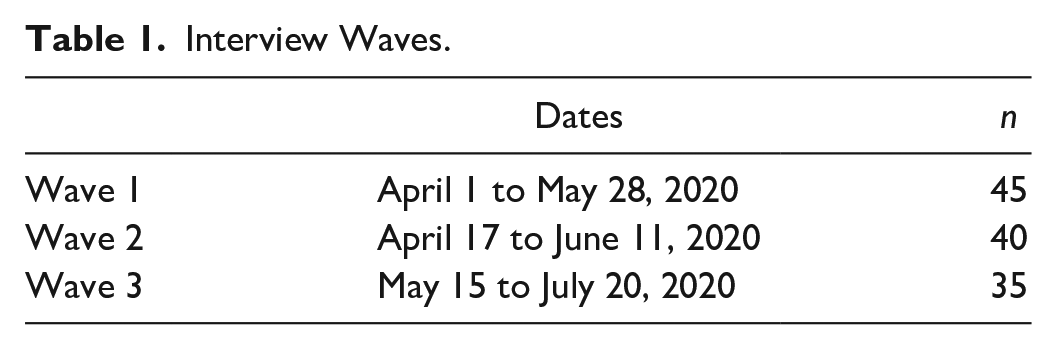
At the end of the first interview, we asked participants two questions. First, we asked participants if any household members might be interested in participating in the study, and if so, we asked participants to have interested household members contact us directly. We ultimately interviewed four of our participants’ household members. Second, we requested participation in a follow-up interview in two weeks. At the end of the second interview, we again requested participation in one final interview four weeks later. There was some anticipated attrition between the interview waves (Table 1), which we attribute mostly to the beginning of the phased reopening of the economy and participant exhaustion.
In total, we conducted 120 interviews with 45 participants (see Table 2 for demographic data). Each first-wave interview lasted 45 minutes on average (ranging between 30 minutes and 2 hours). Follow-up interviews lasted 30 minutes on average (ranging between 15 and 90 minutes). Given physical distancing requirements, we asked participants to select the mode of virtual communication with which they were most comfortable, such as phone or video conferencing. We conducted most interviews on Zoom, a password-protectable video conference platform (Gray et al. 2020). With our participants’ consent, we audio-recorded all interviews, which were then deidentified and transcribed verbatim.
Demographic Data (at First Interview).

In addition to asking participants whether they or any of their family members and close friends had tested positive for COVID-19, first-round interviews consisted of open-ended questions related to three thematic areas: perceptions of risk, experiences with uncertainty (both short and long term), and experiences with confinement and isolation (including attitudes toward enforcement of stay-at-home orders). Our second and third waves of interviews served as “check-ins” to examine changes in how participants were experiencing the pandemic.
Data Analysis
We used a grounded theory approach in our data analysis (Charmaz 2014). Our theoretical findings emerged through an inductive, iterative process of data collection and analysis, involving the search for reappearing themes in the data until we reached saturation (the point at which continued data collection was unlikely to generate new findings). We conducted analyses both manually and using Dedoose, qualitative data analysis software. We first developed initial codes and searched for emerging patterns in codes across interviews. Next, we performed focused coding to develop more abstract categories, and we used analytic memos to draw connections between codes and categories. Finally, we synthesized the data to develop discrete themes, which form the basis of our findings. Throughout this process, both researchers compared coding and negotiated discrepancies to reach consensus.
Findings
Our interviews reveal that men and women participants in comparable circumstances (whether staying at home or working outside the home) assess similar levels of personal risk for contracting COVID-19. We observe that despite similar risk assessments, women more frequently expressed heightened concern and anxiety. Put differently, women and men are similar in their perceptions of risk but diverge considerably from one another in their attitudes toward risk.
We argue that when contemplating the risks of COVID-19, women’s experiences of anxiety and distress are closely tied to their care responsibilities. During the pandemic, more women (including those who are not married and who do not have children) than men reported having increased care responsibilities as they and their families adjusted to disruptions related to COVID-19. We argue that protection from these demands, rather than just efforts to embody a “tough” masculinity, explains men’s more dismissive attitude toward the risks of COVID-19.
We present our findings in two sections. First, we describe the similarities in the participants’ perceptions of the risks of COVID-19 and the differences in their attitudes toward these risks. Next, we trace the connections between care work and attitudes toward risk to highlight how women’s more fearful attitudes toward COVID-19 are influenced by their strenuous caregiving responsibilities during the pandemic.
Similar Perceived Risk, Different Attitudes toward COVID-19
Among the 43 participants who had not been diagnosed with COVID-19 at the time of the initial interview, we find that men and women participants in comparable circumstances assessed similar levels of personal risk for contracting COVID-19 (Table 3). For instance, participants who were not working outside the home tended to perceive low personal risk, which they attributed to limited physical contact with others. Whether staying at home or working outside the home, men and women also expressed similar views on the factors that may affect their risk for contracting COVID-19 (such as biological vulnerabilities on the basis of preexisting medical conditions, family members working outside the home, or their own exposure to people outside their home). Although men and women’s similar risk perceptions imply comparable understandings of disease transmission and vulnerability, close analyses of the participants’ narratives indicate that their attitudes toward the seriousness of COVID-19 are qualitatively different at every level of perceived personal risk (Tables 4 and 5).
Perceived Level of Risk (at First Interview).

Note: Excludes the participant who indicated gender nonbinary and two participants who had been diagnosed with coronavirus disease 2019.
Men’s Attitudes toward the Risk of COVID-19.

Note: COVID-19 = coronavirus disease 2019.
Women’s Attitudes toward the Risk of COVID-19.

Note: COVID-19 = coronavirus disease 2019.
As illustrated in Table 4, men participants reported following basic public health recommendations (by washing their hands and limiting social contact, for example), but they concurrently expressed a relaxed approach toward disease prevention, diminishing the seriousness of COVID-19. Benny (23, black), for instance, classified his risk for contracting COVID-19 as low because he was staying at home as much as possible. However, he noted that his parents were still working outside the home and that he and his siblings were still meeting their romantic partners. Despite recognizing that “any contact [with people outside the household] is a risk in itself,” Benny insisted that his anxiety levels related to his risk were “relatively low.” Elaborating on this sentiment, Benny emphasized that he saw little merit in strictly obeying stay-at-home orders when others were not doing the same because “our country isn’t closing down.” His narrative differs radically from that of Minnie (21, white) (Table 5), who similarly emphasized her own low risk levels (because she is young and “pretty healthy”) but simultaneously described a steadfast commitment to obeying stay-at-home recommendations because “you should take precautions for everybody else.”
Even men who assessed elevated personal risk, like Andrew (21, white) and Percy (26, black) (Table 4), questioned the extent to which they and others should heed public health recommendations. Andrew had picked up more hours at his uncle’s roofing company after his college classes moved online, and Percy, who works in support services at a hospital, had also increased his hours because of a surge in patients during the pandemic. In April, both participants characterized other people’s caution (as reflected in their commitment to, for instance, staying home or wearing a mask) as “annoying” and “outlandish.” Similarly, although Arnold (26, black) noted that he was staying home as much as possible, he felt that the risks surrounding COVID-19 had been needlessly amplified by the media, which “made it a bigger deal than it actually is” by “treating it as, like, the plague.”
Given the extent to which existing explanations of gender differences in attitudes toward COVID-19 focus on masculinity (Ewig 2020; Glick 2020; Willingham 2020), it is important to consider the possibility that the narratives of the men in our sample reflect their adherence to masculinity norms that valorize bravery and strength. In particular, it may be tempting to attribute men’s narratives of their cavalier attitudes to their efforts to protect their masculine selves by “revealing no vulnerabilities and uncertainties” (Schwalbe and Wolkomir 2001:94). Our confidence in our interpretation of the findings is supported by the fact that interviews with men participants were as emotionally textured, sensitive, and rich as those with women participants. For instance, Walter (22, black) had moved back home when the pandemic became serious, and he openly described several life challenges stemming from the disruptions related to COVID-19. His emotional turmoil was evident when he discussed how the pandemic had affected a new romantic relationship: I wasn’t able to see this wonderful woman that I had made a new relationship with . . . the only people before that that I ever loved was my mother, and my father, and my family, so I never really understood what all of that romantic tension and feelings were. And I had to kind of step back from it, and it made me sad. Because at first, it all felt so right, but then COVID happened and it’s like, “okay, is this somebody telling me that, oh, this wasn’t right for me? Or like, is this the way of God telling me what I need?”
Despite the men’s willingness to express vulnerability, missing from men’s stories were the feelings of anxiety and fear that women expressed when discussing the risks of COVID-19. Men participants’ dismissive attitudes toward the risks of COVID-19 were also evident in their reports of the concrete actions they took in response to perceived risks. Before it became required, for instance, Percy admitted that he wore his mask in public “honestly, about 60 percent of the time,” and he questioned the necessity of wearing masks for COVID-19 when this was not previously recommended to avoid other infectious diseases (such as tuberculosis). To Percy, the unprecedented nature of these measures seemed excessive: I’m resisting to fall in line with it because to me, we weren’t doing it before. We weren’t wearing masks to the grocery store and the lady [in] aisle seven could have a bad cough, she’s in there shopping, but no one thinks to, “Oh, I have to put on gloves.”
Men’s narratives thus focused on their feelings of reluctance, annoyance, and coercion when discussing preventive measures to protect themselves and others from COVID-19. When narratives of prevention did emerge among men participants, they focused far more on self-protection rather than communal protection, unlike the narratives of women participants. Bryce (20, black) represents an interesting divergence from the general finding that men did not express fear about the pandemic. Unlike most other men in the sample, Bryce expressed a great deal of anxiety about the pandemic, as can be seen in the excerpt below: Well, in my city I do know that we have some of the highest cases that are in [the state] right now so I am very nervous about that, but I haven’t left the house since I’ve gotten back from school. So, I’ve been really nervous and scared about this stuff so I try to just keep myself in the house as much as I can but you don’t know.
At the time of the interview, Bryce was living with his grandmother and mother, both of whom he identified as vulnerable to contracting COVID-19 because of their age and a preexisting health condition, respectively. Bryce commented that his “concern wasn’t really for [himself]” but for the “people around” him, yet he nevertheless said that he rarely left the house himself, instead allowing his grandmother to manage all the domestic chores: “I just go down there and get food and stuff. So, I really don’t have much responsibility. My grandmother cooks, she cleans, she does all that.” While relying on his vulnerable grandmother, Bryce worried that she might undermine his personal efforts to stay safe: Well, I mean, if I’m going to be completely honest, I feel like my grandmother doesn’t take as much precaution as she should with wearing a mask and traveling. I don’t know if she wears a mask when she goes out to the grocery store, which is a big worry for me. And I feel like she really should. I think maybe she has now since it’s gotten more serious. But that is scary for me. She’s cooking my food. She’s putting all the groceries away and stuff, so she’s touching a lot of things.
Comparatively, at every level of perceived risk, women participants articulated greater anxiety and concern about the risks of COVID-19 (Table 5). Like Andrew, Laurel (25, black) started working more hours at a home improvement store after her university moved online. While Andrew expressed scorn for the excessive “freak out” about COVID-19, Laurel noted that going to work made her feel “terrified” and “anxious” (Table 5) despite the protective measures (such as wearing a mask and gloves) that she had adopted.
Women also reported engaging in extreme measures to prevent the contraction and transmission of the virus. For example, Beatrice (23, white), who lives with her boyfriend and his mother (an essential worker), said that she used to love going outside, but has now developed a deep fear of being outdoors: “I think I’m freaking agoraphobic I feel at this point. . . . I just feel like I’m very scared now and hypersensitive and definitely neurotic, not going to lie.” Filene (30, black) similarly took leave from her essential job at a grocery store because she feared that her exposure to customers could increase her risk of contracting COVID-19. As the primary income earner in her household, Filene struggled with having to choose between financial strain and the risk of infection, and she expressed grave worries about her future: After, I’m thinking, will I be broke? Will I have money to secure myself and my family? Will I be able to pick up from there? Will I have to maybe look for another job since I am afraid to go back to work? What will my life be after this?
Fortuitously, when our participants reported their family members’ behavior during the pandemic, they offered us a window into a more age-diverse demographic than the one that we intentionally sampled. These accounts demonstrate that gender differences in attitudes toward COVID-19 are not limited to young adults and that risk perceptions are informed by gender more so than age. For example, Kandice (26, white) reported that she and her mother encountered resistance when they tried to convince her father to stay home from his management job at a local country club. Kandice worried that her father was not taking the pandemic seriously even though his age and preexisting health conditions place him at higher risk for severe illness, and she expressed distress about his disregard for the potential harm that could come to the entire family if he contracted COVID-19: Well, the biggest conflict was my dad saying, “I have to run a business. I have to go. I have to go there and check on things.” And my mom is like, “You’re going to die. You’re going to get sick. You’re going to bring this home, and we’re going to die.” So, that was the biggest problem, and she was really mad at him and he wasn’t taking it seriously and was kind of just like laughing it off. We had to kind of say, “No, this is a serious thing and if you are to get sick, you’re overweight. You’re older. You have high blood pressure. You could die, and then you’re the sole provider of this household. Where does that leave us? You have to think about other people. It’s not just you.”
Similarly, Maya (21, Hispanic) described how the pandemic has generated conflict between her mother and father. She shared that her mother is immunocompromised and has been extremely cautious about protecting herself from COVID-19, while her father (who works at a blood bank) leaves the home more than necessary, despite knowing that doing so jeopardizes his wife’s health: My mom and my dad butt heads a lot about COVID. . . . So, my mom’s more worried about everyone staying home and following the rules, but my dad still goes to the store whenever he can because he needs to get out of the house. My dad’s not really worried about it because he’s taking his precautions, but since my mom doesn’t like that he keeps going to stores. They kind of argue a little bit about it.
If these men and women share perceptions of personal risk, why do they so clearly diverge in their attitudes toward COVID-19? We next examine the dominant explanation that emerged from the data for the gender differences in attitudes toward risk: women’s disproportionate shouldering of care work during the pandemic.
Gender and Care Work during COVID-19
In this section, we explicitly link the unique care work generated by the COVID-19 pandemic to women’s fearful attitudes toward risk. We present our findings in two parts. First, we describe the novel caregiving responsibilities that have emerged during the pandemic, highlighting how women are disproportionately managing these responsibilities. Next, we connect these responsibilities to women’s narratives of fear and anxiety. Notably, the findings we describe remained stable across the three waves of interviews even as the social and political climate experienced tumultuous change, with protests erupting against mask wearing, extended closure of the economy, and, most notably, racial injustice and police brutality after the killing of George Floyd.
Care Work during the COVID-19 Pandemic
Consistent with recent reports (McLaren et al. 2020; Power 2020), we find that the COVID-19 pandemic has pushed more women participants into traditional caregiving roles, with 35.3 percent of men participants mentioning changes in their care responsibilities, compared with 59.2 percent of women. Beyond just mothers and wives, even women who are unmarried and childless reported being overwhelmed with new care obligations at home. For instance, during the pandemic, Megan’s (22, white) father was staying home after being laid off while her mother continued to work at a local grocery store. Living at home with her father after her college campus was shut down, Megan assumed her mother’s domestic responsibilities, stating that it was her “responsibility to make sure the house doesn’t fall down.” Between cooking, cleaning, and helping her father file for unemployment, Megan reported having little time to devote to her own academic pursuits, and she described this time as “overwhelming.”
It’s stressful. My father has been laid off, and it’s been a struggle trying to get through with unemployment, file claim and all that. I get up at eight o’clock every morning and spend majority of my day trying to get through unemployment because he speaks English, but he’s not very good with technology. So, he needs someone to help him. I’m that person for him. I spend most of my day trying to get through and help him out with that. It’s been a struggle because I literally can’t get through for the life of me. And then I have to cook and clean and still try and fit to do homework in.
Like Megan, Liniksha (24, Asian) was staying at home during the pandemic and had taken on more caregiving responsibilities. Although her family was experiencing immense financial strain, her parents asked her to quit her job as a certified nurse’s assistant at a rehabilitation center after a patient contracted COVID-19. Liniksha said that she and her family were most concerned about the health of her seven-year-old brother, with whom she shares a close relationship: My brother, he’s really attached to me, because since little, he has been very close to me, so we didn’t want to risk myself contracted with the COVID-19 and then giving it to my brother. That’s why I don’t have the job anymore.
Although Liniksha was her younger brother’s primary caregiver even before COVID-19 emerged, the pandemic has generated a new layer of caregiving obligations pegged to homeschooling. As she struggled to manage her own online learning, Liniksha described the challenges of being solely responsible for managing her brother’s homeschooling: “I do have to take care of all my brother’s school stuff and everything, because my parents really can’t go check the e-mail for him. They don’t know how to use the computer or anything, so stuff like that.”
Even women participants who worked outside the home described added care responsibilities during the pandemic. For instance, Maryam (20, Asian) (the only daughter in her family) was working in food service at the time of the first interview, but was also expected to help her mother with domestic duties such as cooking for her brothers and taking care of her grandmother. Maryam’s narrative about her family life provides further evidence of the gendered nature of care work during the COVID-19 pandemic. In her first interview, Maryam reported that her brothers were working from home, and by the next interview, her mother’s mounting frustration with her brothers became increasingly evident: She just has to cook and clean a lot more than usual because usually the times that she would be cleaning the house they’d be at work, and they’re just home now so they just keep making messes and my mom’s so mad.
By the final interview two and a half months later, Maryam emphasized her own frustration with the inequitable gender division of domestic care work. She described her older brothers as “children” who had been “put on a pedestal” during their formative years, and she criticized her parents for their disparate treatment of her and her brothers: “The mess, the constant neediness. And I was like, ‘Mom, if you taught them how to, like, survive without their mother, they wouldn’t be like this.’”
In contrast to women’s more willing commitment to care work, the men in our sample who performed care work described it as an explicit demand or burden placed upon them by other members of their household. Alfred (33, white) was living with his aunt, Dana (54, Hispanic), and uncle, Drew (59, white), when the pandemic erupted. At the time of the second interview, Dana’s elderly mother had been living with the family for a few weeks, and her elderly father had recently moved in as well. Alfred explained that because he works in a densely populated space, he remains relatively uninvolved in his elderly relatives’ lives to limit their potential exposure to COVID-19. Nevertheless, he described Dana’s father’s arrival as an “unwelcome change” that “made things very stressful,” pointing to the specific care work responsibilities that his arrival had triggered: “It’s been interesting and stressful for everybody. It’s like having a patient here and we’re all part-time nurses.”
Fabian’s (23, Hispanic) narrative also reveals how, even when men in the sample are delegated care work to assist the household, they minimize the burden of these responsibilities. With his mother at work, the rest of his family agreed to divide up cooking responsibilities. When it was his turn to cook, Fabian decided to order take-out: I didn’t cook. Everybody was waiting for me, it was around three o’clock. I get out of my bed, I go upstairs, they were literally waiting and going, “When are you going to cook?” And then my mom had to go to work right after, and so I just cooked something for her, like some rice, chicken, some eggs, fried eggs. That’s all I gave to her. And then I ordered some takeout.
Having established the extent to which the COVID-19 pandemic has created novel and burdensome care responsibilities primarily for women, we turn to a discussion of how women’s commitment to these responsibilities influences their fear of COVID-19.
Gender, Care Work, and Attitudes toward Risk
Our findings reveal that both men and women with caregiving responsibilities approached the pandemic with greater concern and anxiety, explicitly linking their fears of COVID-19 and their obligations to others. For these participants, fears of COVID-19 directly stem from their obligations to protect the people for whom they are responsible. Dale’s (61, black) narrative, for instance, reveals how specific care work obligations influenced his attitude toward COVID-19 and risk management. Dale was especially concerned about his 86-year-old mother’s well-being, and after he and his siblings learned that geriatric populations are “the number one candidates for this COVID-19,” they agreed to stop gathering in person and share the care responsibilities (delivering food and necessities) for their elderly mother who lives alone: I didn’t want to be responsible for giving my mother anything, or bringing any kind of harm to her. So immediately me and my brothers and sisters all decided to, “Hey, we won’t do that. We’ll just call, and if we need to take her something we’ll leave it at the door, and she can retrieve it like that.”
Recall that Bryce expressed significantly more fear and anxiety about the pandemic than most other men in our sample despite reporting few explicit care responsibilities at the time. Later in the interview, Bryce revealed that he was once solely responsible for taking care of his disabled mother during the nights when his father was at work. He recalled one traumatic incident when his mother fell down while under his care: “I went into her room to help her up because I would help her up when she fell and she was, like, shaking. It scared me. It really did scare me.” Although he has since turned all his care work responsibilities to his grandmother, like other men in our sample with care work, Bryce’s implicit sense of responsibility toward his mother is reflected in his attitude toward COVID-19. Describing his mother’s more recent medical emergency, he remembered fearing that she had caught the virus: I was talking to her and she couldn’t even form words. She was just “mm” stuff like that. [My grandmother and I] called 911 and at that point we’re all freaking out. We’re like, what if she has the virus? It was super scary. You know, we were all crying and it was scary.
For both men and women, pandemic-related anxieties are thus rooted in a sense of responsibility toward others, but women experience these anxieties much more sharply than do men precisely because they carry a disproportionate share of the novel care work responsibilities precipitated by the pandemic. During the pandemic, Coral (23, black) continued to work in a group home for adults with disabilities, and she described severe anxiety about effectively following safety procedures to protect her health and that of her family. At the time of the first interview, Coral’s sister and stepmother, both nurses, had been diagnosed with COVID-19, and two extended family members had died from COVID-19. Although her family has been directly affected by the pandemic, and despite her fear of COVID-19, Coral framed her decision to continue her work as an act of faith and selflessness: I want to say I didn’t want to be selfish. I knew the clients obviously need us because they can’t do for themselves daily things that we can do for ourselves. The specific house where I work at, there’s not too many people who work there. So, losing one staff or two staff is pretty drastic for the clients. So just not wanting to be selfish and just continuing to . . . how do I say it . . . almost do God’s work for helping and providing for others is pretty much the reason why I didn’t quit.
Gertrude’s (68, black) narrative provides the most extreme example of the emotional and psychological impact of gendered care work during the COVID-19 pandemic. In her first interview, Gertrude reported that both she and her husband had been diagnosed with COVID-19. After enduring an exceptionally traumatic hospital stay, and despite struggling with the lingering effects of COVID-19 and myriad other health issues, Gertrude felt compelled to return to her domestic duties while her husband recovered: Nebulizers, four times a day in treatment, I’m on six different . . . actually five, five different lung medications, two heart medications to keep the heart going. These regimens, that begins at 5:30 every morning. And since I’m up at 5:30, I have a regimen because I need to help my husband. So, I’m strong enough now where . . . I got to keep the house clean. So, once I do the meds, I wipe down everything. I clean, I wipe down that kitchen.
By the second interview, Gertrude had lost several friends and family members to the virus and she was buckling under the stress of mounting care demands from people in her community and her fear of more loss from COVID-19. Overwhelmed, she decided to disengage, which elicited additional feelings of guilt: I want to hear good things but I can’t get away from it. My friends, I’m about to do a terrible thing. I’m about to cut off so many people and maybe that’s the best thing for me is to not take on the problems of everyone else because I’m always that go-to person. . . . I have a girlfriend that I see she literally called me and texted me nine times in the middle of the night in total panic. I’m reading her messages. I read them and she’s like, “I’m so depressed, I’m so down, I can’t take it in here. We’re locked down in New York,” and I know I should’ve reached out to her, but it was something that I normally wouldn’t do. I would just find a spot and soothe her. I found myself saying, “Really? I don’t care.” I normally wouldn’t do that. I feel like this thing is making me the Bride of Frankenstein.
Gertrude’s intense care work responsibilities may be explained by her role as a wife, mother, and grandmother, but interviews with younger, unmarried, and childless women revealed similar connections between care work and fearful attitudes toward the risks of COVID-19. Valencia (29, Hispanic), for example, described a sense of obligation when trying to manage not just her own exposure, but that of her entire household (which includes her mother, fiancé, and tenant): “Right now, basically I cook for my whole family. I’ve been doing that, and shopping for them. Just to minimize how many people are going out of the house.” She emphasized the pandemic as a collective experience for her household and was frustrated with having to convince everyone else to take the risks of COVID-19 seriously: I’m like, “It’s our health. Any one of us go to the hospital, we’re going alone.” And that’s one thing I keep thinking about. They make it a point. You’re going to be there alone. If you get even worse, you just die alone. That’s really depressing. So, why would you want to not try to just not have that happen?
Valencia’s concerned and fearful narrative stands in stark contrast to Cameron’s (22, white), in which he articulated a tired resignation about the possibility of his elderly parents dying because of COVID-19. Cameron was dismayed about his parents’ refusal to obey stay-at-home recommendations (especially given their elevated risk factors), but he adamantly refused to take responsibility for managing their exposure to COVID-19 and protecting their health. In fact, he explained that his parents’ recklessness made him relax his own response to COVID-19: “Yeah, I should be doing my part to minimize the risk but at this point, it just seems like it’s all for naught.” Cameron succinctly summarized his attitude toward his parents’ risk when he said that he was “over it,” accepting his parents’ contraction of COVID-19 as an inevitability: I’ve sort of just accepted that it’s going to be a big possibility that they catch it if this thing continues to go on. I don’t like to constantly think about negativity. I don’t think that’s helpful. So, it’s just I’m kind of just waiting. And then I guess I’ll see how I’ll deal with it then.
Dana’s narrative in the first interview brings into sharp focus the disproportionate burden of care work that women bear during the pandemic and how these responsibilities increased their worry. In March, shortly after COVID-19 was declared a global pandemic, Dana urgently moved her elderly mother from New York City into her own home, located in a small suburban town. Dana worried that her father’s dismissive attitude toward COVID-19 increased her mother’s risk for contracting the virus: “Unfortunately, [my father] is out every day pretty much. He goes out every day. He doesn’t get it. So that’s our biggest concern right now.” Dana also asked her father to move in with her at that time, but, like so many men we interviewed, her father steadfastly denied the seriousness of the pandemic: He’s like, “I think you’re crazy.” That’s what he told me, “oh, you’re just so crazy.” And I’m like, “Dad, I am serious.” And then I’m like, “Dad, wash your hands.” He’s like, “Why?” I was there for three and a half hours and he didn’t do it just to spite me.
With Dana’s mother at home, the entire family ramped up their COVID-19 prevention strategies, cleaning the house regularly, sanitizing the groceries and doorknobs, and staying home. Interestingly, the responsibility of caring for Dana’s mother also caused a shift in the attitudes of the men in her household (her husband, Drew, and his nephew, Alfred). After Dana’s mother moved in, Alfred took the maximum allowance of two weeks off from work to limit his risk for transmitting COVID-19, stating that he “didn’t want to bring anything home to [Dana’s mother].” Alfred also described feeling uncharacteristically anxious during the pandemic, which he directly related to his care responsibilities: “I think [the pandemic has] given me more anxiety in general, which I usually don’t have. I’ve been constantly thinking of ‘what can I do and what should I do?’ Just for the sake of others, not really myself.”
Drawing an explicit connection between his attitude toward the risk of COVID-19 and his responsibility toward the well-being of Dana’s mother, Alfred imagined that if Dana’s mother were not living with them, his family would not “be as careful.” For Alfred, the presence of Dana’s mother amplified his sense of caution: I think she is the epicenter of us making sure everything is perfect. It would be less hectic around here, for sure. But I think it’s better that she’s here than in New York, especially with her stubborn husband, who likes to go outside all the time.
The interviews with Dana and the men in her household demonstrate how women’s care work compels men to take the risks of COVID-19 more seriously. Another such example can be found in Sal’s (30, Hispanic) interview, in which he described wearing a mask and gloves primarily because his pregnant girlfriend pressures him to do so: I honestly really just do it to not hear my girlfriend yell at me. Most of the times if I do go, we go together and she’s really on top of it and I’m just like, “Okay, I’ll just wear it,” to make her happy I guess.
Although care work appears to influence the attitudes of men and women toward COVID-19 in similar ways, the stark gender differences we found in the data are explained by the fact that men simply have fewer care work responsibilities during the COVID-19 pandemic than do women. Perhaps most tellingly, every single man with care work responsibilities in our sample expressed concern about contracting and transmitting COVID-19. It is important to acknowledge that the men with the heaviest care work responsibilities (such as Dale and Drew) were older than the median age of the sample. This suggests that men may embrace care work later in their life course, and that their attitudes toward risk and disease prevention may correspondingly evolve as they age. However, our participants’ reports of the behavior of their older male relatives (such as those provided by Kandice and Maya) provides further support for our argument that commitment to care work, rather than age alone, shapes men’s attitudes toward the risks of COVID-19.
Finally, the significance of the finding that young, child-free, and unmarried women expressed serious fears about the risks of COVID-19 because of their care work, while their male counterparts did not engage in care work and appeared dismissive about these risks cannot be overstated. Taken together, these findings reveal the ways in which the COVID-19 pandemic has further entrenched women in care work duties while men are largely exempt (both socially and psychologically) from these novel and burdensome responsibilities. As a result of their fear and anxiety, women described engaging in cautious, careful, and deliberate disease prevention strategies. Meanwhile, most men expressed cavalier attitudes toward risk—shaped by the absence of care work responsibilities—and reported engaging in behaviors that increase the risk that they will contract and transmit COVID-19.
Conclusion
In early July, as COVID-19 remained uncontrolled in the United States, the president commanded the nation’s 3.5 million teachers, 76 percent of whom are women, to return to the classroom in September. Of course, this is not the first time women have been asked to sacrifice their safety during a pandemic. In their research on women’s roles in Brantford, Ontario, during the 1918 influenza pandemic, Godderis and Rossiter (2013) found that a gendered “duty of care” placed women at higher physical and emotional risk when city leaders exhorted women to volunteer as nurses. In examining differences in attitudes toward the risks posed by COVID-19, this article extends Godderis and Rossiter’s (2013) findings by revealing the gendered emotional, social, and psychological toll of this current pandemic.
We have argued that gender differences in attitudes toward, and subsequent responses to, the risks of COVID-19 are shaped by the inequitable division of the unique care work obligations that have emerged during the pandemic. Specifically, the findings indicate that both men and women take the risks of COVID-19 more seriously when they have caregiving responsibilities. During the pandemic, however, women have taken on a disproportionate share of these responsibilities. As a result, they experience greater distress when contemplating the potentially devastating consequences of COVID-19 to themselves and those around them. Men, on the other hand, are not compelled (whether by external expectations or an internal sense of obligation) to adopt comparable responsibilities. We contend that the distance that men enjoy from close caretaking relationships protects them from the fear and anxiety that women reported. These findings paint a different picture from existing analyses that argue that men’s attitudes toward COVID-19 reflect their conformity to a rigid model of masculinity (Ewig 2020; Palmer and Peterson 2020). Although our sample does not rule out the importance of masculinity norms in shaping men’s attitudes toward COVID-19 (Glick 2020), there was little evidence in our sample of men’s efforts to be “tough” and “strong” when contemplating the risks of the virus (Palmer and Peterson 2020). It is important to note, however, that masculinity norms may explain why so few men embrace care work in the first place. We thus do not deny the significance of masculinity in conversations regarding COVID-19; rather, we argue that inequitable gender divisions of care work more fully explain the gender differences in attitudes toward COVID-19 in our sample.
Our research contributes to existing literature on gender, care work, and risk management by drawing attention to how a global pandemic generates uniquely burdensome care responsibilities that are borne primarily by women, including those who have yet to enter conventional caregiving roles (e.g., motherhood) and who have thus far been neglected in studies on women’s domestic responsibilities during COVID-19 (Collins et al. 2020; McLaren et al. 2020). Perhaps most importantly, the findings we have outlined underscore the dangerous public health implications of men’s exemption from care work. Insofar as both men and women with caregiving responsibilities expressed greater concern about the risks of COVID-19, the findings suggest that disease prevention would be more successful if men accepted an equal burden of care work during the pandemic and were therefore more invested in the well-being of others.
As our sample consists mostly of college students, our study also illuminates an aspect of educational inequality during the pandemic that is often eclipsed by more immediate concerns of a “digital divide” and families’ financial distress (Eshoo 2020; Sorenson Impact 2020). Although all college students are experiencing disruptions to their education because of COVID-19, our study shows that more women students have care responsibilities that are competing for their time and attention. The disruptions caused by women’s disproportionate care work responsibilities may have lasting impacts on future employment and educational opportunities, and institutions of higher education should thus consider care work challenges as they develop and hone their support services.
Future research should investigate populations in different life stages to understand how gendered care demands change over the life course and how these changes might shape responses to risk. To advance scholarship on the “social inequality effect” (Olofsson and Rashid 2011), it is also important to examine how economic advantages that allow individuals to reduce care burdens (e.g., by hiring private nannies, tutors, and/or housekeepers) might shape collective efforts to prevent disease. Finally, while our participants’ self-described gender identities oriented us toward comparing men and women, it is important to investigate how other gender identities might shape care work management and in turn influence individuals’ experiences of the pandemic. To improve national responses to the present and future pandemics, it is critical to understand how differential experiences and attitudes influence the efficacy of public health recommendations.
Footnotes
Acknowledgements
We thank Kimberly Dawn Lucas as well as the editors and anonymous reviewers at Socius for their helpful comments on earlier drafts of this article.
