




Abstract
To what degree is explicit care/work policy taught in family courses in Canada’s leading research-intensive universities? We analyze family courses in sociology departments and in political studies and women’s/gender studies programs in Canada’s 15 R1 universities to make a contribution to the scholarship of teaching and learning. This national scan marks a methodological innovation from curriculum studies that generally adopt a single-program or single-site focus. From a Canadian universe of 74 family courses, we identify 15 whose formal course calendar description explicitly addresses care/work family policy (measures to reconcile caring for young children with employment, through early learning and childcare, parental leaves, and child benefits). Sociology predominates among courses where family policy is taught, yet care/work policy content is not common. Given growing concerns about the care crisis and the care deficit in Canada, the low profile of care/work family policy content in family courses is significant. This study sheds light on the value of national postsecondary education curricular reviews and suggests that family curriculum renewal is warranted.
Keywords
In Canada, childcare, parental leave, and child benefits are a political priority, and sweeping reforms to care/work policy have recently occurred at the national and provincial levels. In response, we set out to understand how and to what extent care/work family policy is addressed in family courses in Canada’s research-intensive universities. Many countries with liberal social policy architectures are wrestling what has been called a “care crisis” and a “care deficit” (Esping-Andersen 1990; Langford, Prentice, and Albanese 2017), and so the timeliness and the importance of care/work family policy are clear.
The profile of families is high in Canada. Most recently, under the ravages of the COVID-19 pandemic, the direct links between caregiving and care provision and the ability of parents to engage in paid work soared in prominence. In 2021, the Canadian government launched the country’s most ambitious early learning and childcare plan, committing more than $30 billion over five years to massively expand childcare services (Government of Canada 2020). Major changes were made to Canada’s parental leave regime in 2016 and 2019, and a significant expansion of child benefits occurred in 2017 (Mathieu, Doucet, and McKay 2020; Prentice and White 2018). New Canadian parents now enjoy up to 18 months of paid parental leave, can receive a Canada Child Benefit of over $7,400 CAD/year per young child, and now pay just $10/day for licensed childcare in many provinces. These dramatic changes to programs signal the importance of care/work to the political agenda. Canada’s experience before and during the pandemic is not unique—the United States is also witnessing widespread political and public interest in care/work family policy, along with the United Kingdom and other Anglo countries.
These issues have broken through a liberal welfare consensus and have been powered by social movement activism. Decades of feminist work have pointed to the many ways that care is not socially valued, is regularly assigned to female kin in the private domestic sphere, and is poorly paid feminized and racialized work. An intersectional lens has made visible the highly differentiated classed, raced, and gendered assumptions behind long-standing North American myths that families are not organized by politics or power and that public policy is not germane to family studies. Canadian scholars have made distinct contributions to the field, particularly on social reproduction (Arat-Koc 1989; Eichler 1997; Ferguson 2008; Luxton 1980, 2006; Smith 1987; Ursel 1992). Yet we wondered to what degree these insights have been integrated into the broad field of family courses directed to general liberal arts undergraduate students. In asking this question, we take up Howard’s (2010:89) charge to “study our own backyard,” which can too often go unexamined.
Not very long ago, family courses were sometimes seen as marginal in North America, sidelined with the quip that they often taught little more than “matching, hatching, and dispatching.” Today, as care/work family policy is increasingly linked to economic policy and social justice, with especially strong effects on intersectional gender relations, critical understanding of care/work family policy is vital. There are multiple reasons for this focus, and there are important theoretical/conceptual and empirical questions to tackle. Pragmatic and applied considerations are also implicated. From the perspective of public policy and administration, skills and knowledge are essential to care/work family policy development, implementation, and evaluation. Equally importantly, citizens need to understand the policies that play key roles in shaping and constraining personal possibilities and social capacities.
Definitions of family policy as a scholarly field vary widely. More than two decades ago, Gauthier (1999:32) observed that family policy is a “wide umbrella.” Daly (2020:27) has recently argued family policy always belongs to a “wide social policy constellation.” The family policy field is typically understood to refer to state measures to reconcile employment and caregiving for families with young children, including cash transfers, tax credits and tax allowances, childcare services, and employment leaves and arrangements (Daly 2015). Such policy is only one of the many ways states attempt to shape and respond to family realities. Through a broad lens, it is obvious that immigration, city planning, education, health care, labor law, and child welfare are among the many domains that affect or touch on family life (Kamerman and Kahn 1978). A very large share of colonial interventions, both historically and in the current period, focus on family policy, with violent and harmful effects on First Nations, Inuit, and Metis peoples and nations and racialized and newcomer communities. These insights set parameters for any study of family policy. We are mindful that many courses in a wide range of disciplines may draw on a family perspective or use a family lens. In this curriculum project, however, we focus on exploring the degree to which explicit care/work family policy (i.e., measures to reconcile caring for young children with employment, through early learning and childcare, parental leaves, and child benefits) is present in “family” courses.
Our review of family policy content in Canada’s leading research-intensive university family courses offers a contribution to the scholarship of teaching, specifically to the scholarship of curriculum practice. Hubball and Gold (2007:10) introduced this field of study and defined it as “the ongoing learning and dissemination of practice-driven curricula research in peer review contexts.” To date, the typical approach to a curriculum project is a single program or site. Our national review is thus a distinct methodological contribution to the field. We suggest that in making national curriculum content visible for analysis (Wijngaards-de Meij and Merx 2018), our findings bear relevance across disciplines and complement similar disciplinary reviews about relevant to curriculum (e.g., Watts, Hooks, and McLaughlin 2020). Our aim is to amplify collegial reflection and conversation about knowing and acting on what is being taught and learned in Canada. We undertake this work to build on the constructive advice offered by scholars of teaching and learning, namely, to reflect on, integrate, and then initiate positive changes to curriculum (McKinney 2018).
Background and Context
Nearly two decades ago, American Bogenschneider (2006:16) noted that “family policy courses have the potential to benefit policymaking, fill a void in undergraduate and graduate education, strengthen families, and prepare students for lifelong political engagement.” Despite this, she observes that family policy has proven to be challenging to teach—because the field’s boundaries are ambiguous, fluid, and context-dependent and because the topic is “inherently fraught with values and political perspectives” (Bogenschneider 2006:16). Around the same time, Ooms (2002) made a similar point: Only a handful of family policy courses were being taught. In particular, she underscored that what she identified as a “family vacuum” in graduate training created a lacuna that was then further reflected in subsequent scholarship (Ooms 2002:ix). Despite how much family matters, it has often been sidelined, reflecting the ideological power of the mythic public/private divide. A neglect of family studies is closely connected to the historic marginalization of gender in public policy more generally (Jenson 1986; O’Connor, Orloff, and Shaver 1999; Ursel 1992). This intellectual and practical history finds expression in the academy and in the teaching of family courses.
Research on curriculum in higher education is situated within the broad field of scholarship of teaching and learning. Introduced by Boyer (1990), this field is defined by The Society for Teaching and Learning Canada as having “at its core the goal of improving student learning. This is achieved through scholarly inquiry about learning, about teaching, and about how to best make public the resulting findings” (Society for Teaching and Learning in Higher Education n.d.).
Within the broad field, scholarship of curriculum practice literature tends to analyze student benefits (Driscoll et al. 2021) or address the development of methods for curricular evaluation (Reniers et al. 2022). There are also a handful of theoretical contributions (Fraser and Bosanquet 2006). Although curriculum review is well understood as an opportunity for collegial reflection and dialogue about how to enhance student learning (Lam and Tsui 2016), others note that mandated cyclical program reviews can politicize and undermine authenticity following neoliberal logics (Dickeson 2010; Senter, Ciabattari, and Amaya 2021). Senter et al. (2021:3) observe that program review tends to be prescriptive. Arafeh (2016:606) thus recommends broader tools and models to inform curriculum mapping because limited reviews cannot determine “whether students are getting appropriate topic coverage or skill practice.” Several authors call for more empirical studies to improve curriculum practice legitimacy (see e.g., Hoare and Goad 2021).
Our literature scan found that scholarship on teaching and learning research on curriculum content tends to be limited to a single program or site. For example, Halvorson-Bourgeois, Zipse, and Haynes (2013) analyze cultural and linguistic diversity content in one speech-language pathology master’s program, and Lam and Tsui (2016) analyze the alignment of subject learning outcomes and assessment within one department. These typify the single-case nature of many curriculum content analyses. The closest study to our goals is David and Kanno (2021), who conducted a multistate analysis of English as a second language (ESL) programs at U.S. community colleges and who based their analysis on college catalogues. Their research offers a “bird’s-eye view” of course content and other information in all ESL courses offered in 2017–2018, in nine states, in 272 colleges. Our focus is neither program-level nor institutional curricular reform and is distant from individual pedagogical practices in the classrooms. Instead, we undertake an evidence-based mapping of where explicit care/work family policy is found in selected social science family courses, if family policy is addressed, and what it touches on when it is present. In this respect, we offer several contributions to the scholarship of curriculum and more broadly the scholarship of teaching and learning field. Through undertaking an inquiry at a national scale, we open up questions that rarely emerge when single departments or programs are the unit of analysis. We believe this national content review supports genuine curriculum reflection and may contribute to enhancing curriculum effectiveness.
Methodology and Procedures
Canada’s 15 research-intensive medical-doctoral universities (the U15) 1 correspond to R1 universities in the Carnegie classification system (Indiana University Center for Postsecondary Research n.d.). The Canadian U15 represent a small share of the 98 members of Universities Canada, but their impact is significant. Together, these 15 large research-intensive institutions teach 46 percent of Canada’s university students and graduate more than 75 percent of the country’s doctorates (U15 n.d.). They are awarded close to 80 percent of competitive university research grant funding in Canada. They educate nearly half of all undergraduates and do the lion’s share of preparing future faculty. As Canada’s elite postsecondary institutions, they have an outsized reputation and influence. Although not a representative sample of Canada’s postsecondary institutions, they make an important pool for analysis.
We are interested in the content of family courses in the faculties of what are variously named Arts, Arts and Science, or Social Sciences in Canada’s U15. Together, these big faculties teach the largest swatch of undergraduate and graduate social science students. Social science courses on the family are often seen to belong to sociology. Yet given our interests in policy alongside the inextricably gendered nature of care and work within families, there is scope in both women’s and gender studies (WGS) and political science to also address this type of family policy. Thus, we set out to analyze Canadian sociology, WGS, and political science family courses with an eye to interrogating the degree to which they address care/work family policy. We underscore that this is not a scan of all courses that teach or potentially teach family policy—which may well be found in a range of disciplines. We did not include courses in economics because the “dismal science” has a long history of ignoring family relations (England and Kilbourne 1990; Folbre 2001). Psychology’s unit of analysis is generally the individual, and so we also excluded psychology programs. Given our focus on broad liberal arts training, we do not include applied or professional programs (e.g., faculties of human ecology, social work, community health studies, public administration, and similar specialized units). We anticipate future work that builds on this pilot study that will include a broader range of arts disciplines and may include other faculties and schools.
Our guiding research question is: To what extent is care/work family policy taught in family courses at U15 sociology, WGS, and political science departments? To create a universe for analysis, we generated a database of courses that explicitly focus on families. Because our focus is to understand the place of work/care family policy in family courses, the frame was clearly family courses.
We used both course titles and calendar course descriptions in our review. Our logic for relying on calendar course descriptions rests on several assumptions. First, calendar descriptions are relatively stable because they represent the long outcome of collegial decision-making. As formal and enduring descriptions of courses, they reflect sustained input at departmental, faculty, and senate levels. Calendar descriptions are expressly designed to be shared—multiple professors can and do teach a course with a single calendar description. Although individual faculty enjoy broad latitude to tailor a course, the calendar entry stands as a collective declaration of core content. It is such shared understanding of a course that permits a minor, major, specialization, or honors degree criteria to be met and forms the basis for graduate foci, comprehensive and field exams, and the like. Typically, there is a finite period (often five years) in which a course is permitted to remain in the university calendar if it has not been taught, and so calendar descriptions are also relatively current. Finally, course calendars are publicly accessible, posted on university websites.
It is worth noting some limitations to our analytic strategy. The most obvious is that a family course may indeed include care/work policy even if the calendar description does not specify that. A study of syllabi might have revealed a second limitation: A course might not actually teach care/work policy, notwithstanding a calendar description that includes the content. We nevertheless assume that instructors teach what is stated in the course calendar. We limited our scan to three social science disciplines, and it is possible that family courses in other departments teach policy. Finally, special topic courses are excluded from our analysis (because there is no stable calendar entry) even though special topics courses may well pilot care/work family policy in a family course prior to being made permanent. Thus, we assume that our counts should be considered more as floors than as ceilings.
A further limitation rests on the fact that the three selected social science disciplines have different organizational relationships to the academy. Sociology and political science are long institutionalized. Both are departments and are generally roughly similar in overall size of faculty and students. In contrast, WGS is often a program rather than a department and generally mounts many fewer courses than either sociology or political studies. A limitation in presenting absolute numbers, therefore, is that the differential in the denominator of the two larger and one smaller discipline is less evident.
Our search relied on courses offered over two academic years, 2021/2022 and 2022/2023 (our online calendar searches were undertaken over July to October 2021 and in August 2022). We systematically searched the online calendars of the U15 for family courses in each university’s sociology, women’s and/or gender studies, and political science programs in arts or equivalent faculties. We proceeded through three stages. To begin, we created a universe of family courses, using course titles to create the larger pool for analysis (N = 74 courses). Once compiled, we used the larger pool to review the calendar descriptions of family courses to determine if care/work family policy was included. Our search identified 15 courses in which calendar descriptions indicated that care/work family policy was explicitly taught. Finally, we undertook content analysis of the 15 care/work family policy courses calendar descriptions to discern themes in care/work family policy courses.
Our search of U15 calendars filtered course titles to create the universe of family courses. If a course title identified a “family” keyword, it was included. Our keywords, with various suffixes, were family, mother, parent, child, generation, marriage, divorce, kin, and their French translations. This initial search identified 74 family courses across the three disciplines. We arrived at this strategy through a pilot phase in which we considered courses that might signal families by having keywords in the title such as policy, work, economy, aging, social structure, gender, sexuality, demography, or the state. We read the calendar descriptions and decided to exclude any that did not also include a “family” keyword because there was no indication that an instructor would be required to include families in the course content.
We then read calendar descriptions of the 74 family courses to determine whether care/work family policy content was included. In addition to the obvious keyword of family policy, we also searched for care, caregiving, employment, government, labour force, labour market, law, legislation, paid/unpaid work, paid/unpaid labour, public/private, state, work, work-family reconciliation, workforce, social reproduction, and French translations. Where either family policy or keywords were found, we deemed the course to be a care/work family policy course. We identified 15 care/work family policy courses among the U15’s 74 family courses.
We made a methodological decision that if a family course calendar noted that content addressed political, social, and/or economic factors without specifying care/work policy, we excluded it. Our reasons were conceptual, and an example can explain the logic. A family course, for example, might address marriage and divorce legislation as matters of political, social, and economic importance. This would not ensure, however, material on explicit care/work family policy, that is, measures to reconcile caring for young children with employment, through early learning and childcare services, parental leaves, and child benefits. Thus, a simple calendar declaration that a family course addressed social, economic, and/or political content was insufficient for inclusion.
Findings and Discussion
We offer insights into the 74 family and 15 care/work family policy courses in U15 sociology, political studies, and WGS departments through six lenses: distribution of family courses, share of care/work policy within family courses, discipline, program level (graduate or undergraduate), region, and a brief overview of other thematic content. Each U15 university taught at least two family courses, with lowest numbers at University of Montreal, Laval University, University of Waterloo, and Queen’s University to a high of 13 courses at University of Toronto (across all its campuses.)
First, most of the 74 family courses do not have calendar descriptions that include care/work family policy content. The share of family courses with explicit care/work family policy content is modest, at 15 of 74, or 1 in 5. This means that 80 percent of family courses in the selected social science programs do not include care/work policy. As family policy specialists, we expected the share to be small but were surprised that it was as underwhelming as it was.
Second, we identify marked patterns of difference across the three disciplines in the teaching both of family and care/work family policy courses. Sociology teaches over 90 percent of family courses, with 68 of the total of 74 courses (graduate and undergraduate combined). WGS teaches four. Given that WGS is often a program and not a department, the low number of courses is both commendable and understandable. Political science, however, teaches even fewer family courses than WGS, at just two. Figure 1 presents the disciplinary distribution of family and care/work family courses in the selected U15 disciplines.
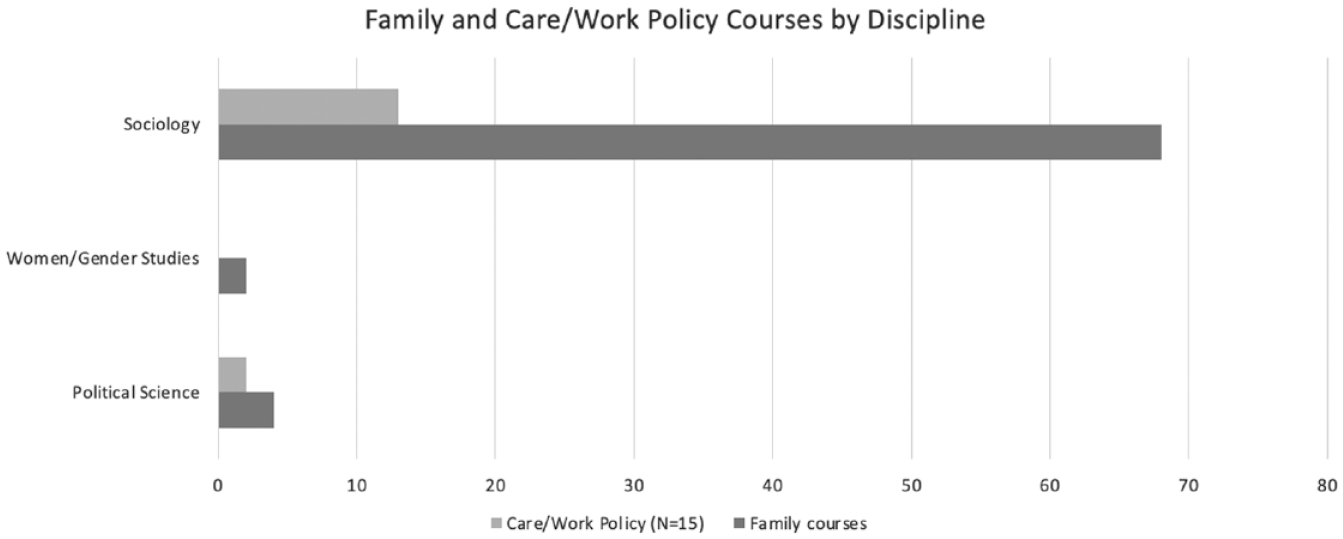
Family and care/work policy courses by discipline.
Similar disciplinary patterns emerged among the smaller pool of family courses where care/work policy was included. Of the 15 care/work family policy courses, sociology offered 13 (87 percent), and 2 (or 13 percent) were in political studies. Interestingly, the only two courses with care/work family policy in the course titles were political science courses, both offered at the same institution. Despite the centrality of gender to the field, there were no care/work family courses in WGS identified in our scan.
When it comes to cycle or course program level, about three-quarters of care/work family policy courses (11 of the 15) are undergraduate. Of 11 undergraduate care/work family policy courses, none are at the 100 level, five are at the 200 level, three are at the 300 level, and three are at the 400 level. Only four are graduate courses, and all of them were in sociology—meaning none in WGS or political science. The low numbers of graduate care/work family policy courses indicate little specialized training for sociology, WGS, and political studies master’s and doctoral students in care/work family policy via family courses.
Of the four care/work family policy graduate courses, two are taught in the French-speaking province of Quebec (at Laval University and McGill University) and two at the University of Ottawa, a bilingual university that shares a provincial border with Quebec. That Quebec schools teach half (two of the four) of the graduate courses seems to align with provincial policy architectures. Given Quebec’s markedly superior family policy regime (Mathieu et al. 2020), it might be expected that Quebec would “punch above its weight” when it comes to teaching care/work family policy, and our findings seem to bear this out. In contrast, Canada’s most conservative province is Alberta, with some of the weakest provincial care/work policy architecture (Harrison, Johnston, and Krahn 1996; Langford 2011). In neither of Alberta’s two U15 schools is a care/work policy family course offered. These findings seem to indicate region matters.
Where is care/work policy taught in family courses? The 15 care/work family policy courses we identified are offered at nine universities, primarily in Ontario (reflecting the concentration of U15 institutions in that province), leaving large swathes of the country without curricular coverage. Western University teaches four care/work family policy courses; University of Ottawa, Laval University, and University of Toronto each teach two; one course is offered at University of British Columbia, University of Manitoba, McMaster University, Queen’s University, and McGill University. At six of the U15, we did not identify a single family course that addressed care/work policy course in the selected disciplines: University of Alberta, University of Calgary, University of Saskatchewan, University of Waterloo, University of Montreal, and Dalhousie.
Finally, what content is taught in a family course that includes care/work policy? A thematic analysis of the 15 courses generated several findings about both empirical content and theoretical/conceptual approaches. More than half the courses directly adopted an historical stance, one that stressed the dynamic, variable, and socially constructed nature of families. This was found in calendar course descriptions that spoke to “evolution,” “change,” comparative approaches, and a debunking of “persistent myths” about the family.
Empirically, the most common other theme among the 15 care/work family policy courses was intimate relationships (the framing of which was more common than references to marriage): 10 of the 15 family courses included this topic, often in conjunction with the life course. No other thematic topic was found in more than five courses. About a third of courses highlighted “diversity,” including of household forms and structures, immigration status, and ethnicity. About the same number included the word violence. Four courses also took up the theme of unpaid, household, or domestic work. Gender itself is directly cited in only four courses, although it is clearly implied across many of these subthemes.
In family courses where care/work policy is addressed, teaching seems to acknowledge the embedded nature of gender, the complexity of intimate relationships, and the challenges of parenthood and work-family reconciliation. They prioritize an historicized approach to the ways family/domestic life is dynamic and embedded in larger social relationships. To our view, these are intellectually rich approaches to teaching and learning.
Conclusion
Our review of care/work policy content in family courses in U15 sociology, WGS, and political science programs is illuminating. Through our national curriculum content review, we find that care/work policy has a low profile in these current family courses in Canada. Six of the U15 teach none, and five teach just one family course that includes care/work policy, and so a large number of Canadian university students have little opportunity to learn about the issue. Just three of the U15 teach a graduate family course that includes care/work policy in our target disciplines.
Conceptually, we suggest that the finding that few family courses explicitly address care/work policy reflects a persistent approach to family study that reproduces assumptions and mythologies about a putative public/private divide, social reproduction, and the politics of families. Pragmatically, in terms of preparing future professionals who are knowledgeable about care/work policy, this is insufficient. As Canada moves to redesign childcare, parental leaves, child benefits, and other aspects of explicit care/work family policy, U15 graduates from key social science programs are unlikely to be in a position to contribute based on their coursework. In all cases, students are also unlikely to be well-informed citizens with a broad understanding about care/work family policy.
We thus raise observations for family courses in the U15: Despite their leadership role in the Canadian postsecondary ecosystem, a major tranche of social science family courses reflects a near absence of care/work family policy. This has immediate bearing on the ability of social science courses to provide theoretical, conceptual, and empirical learning on the equity dimensions of care/work family policy, most strikingly as it reflects gendered, classed, racialized, Indigenous, LGBT2SQ+, and new family formation realities. The realities of, consequences for, and public policy responses toward the contemporary care crisis and care deficit are too often absent in the U15 family courses we examined.
Our study contributes methodologically to the scholarship of curriculum practice and scholarship of teaching and learning. Taking a national approach to family courses enables high-level observations through a systematic, replicable approach to the interinstitutional level. Our findings are an opportunity for reflective dialogue on the scholarship of teaching and learning that we hope inspires colleagues to also undertake national reviews of curriculum. We wonder if care/work policy is equivalently absent in family courses in Canada’s comprehensive and primarily undergraduate institutions beyond the U15. In future research, we hope to tackle this question.
Further to the question of family curriculum renewal: if care/work policy is rarely taught in family courses in sociology, political studies, and WGS, are there other disciplines where it does play a more central role? If so, what explains why a new focus has emerged in these disciplines and yet not in disciplines—like sociology—with a long-standing history of studying the family? We further wonder about the place of family policy in applied and professional programs, especially public administration and similar programs, and we recommend further investigation.
Through this study, we have made the relative absence of care/work policy in U15 social science family curriculum visible. In doing so, this study makes a case for scholarly and practical concern about what happens when important content is not taught and not learned. As Boyer (1990) reminds us, our courses are an essential index of the priorities of the professoriate—and from this scan, we believe family curriculum renewal emerges as a key project.
Footnotes
Acknowledgements
An earlier version of this work was presented by Susan Prentice, Lindsey McKay, and Trina McKellep in May 2022, as “Teaching and Learning Canadian Family Policy,” at the Canadian Sociological Association Annual Conference in the session “Reimagining Childcare, Parental Leave, and Employment Policies for Diverse Canadian Families.” Thanks to Kenya Thompson for fine research support.
Editor’s Note
Reviewers for this manuscript were, in alphabetical order, Catherine Fobes, Sue Nash, Laura Sanchez, and Jackie Zalewski.
Funding
The author(s) disclosed receipt of the following financial support for the research, authorship, and/or publication of this article: This project was supported by the “Reimagining Care/Work Policies Project,” a seven-year Partnership Grant from the Social Sciences and Humanities Research Council of Canada. More information at  .
.