




Abstract
Employment interruption is a common experience in today’s labor market, most frequently due to unemployment from job loss and temporary lapses to care for family or children. Although existing research shows that employment lapses cause disadvantages at the hiring interface compared to individuals with no employment disruptions, competing theories predict different mechanisms explaining these hiring penalties. In this study, the author uses an original conjoint survey experiment to causally assess perceptions of fictitious job applicants, focusing on a comparison of unemployed applicants and nonemployed caregiver applicants, who left work to care for family, to currently employed applicants. The author examines whether disadvantages for job applicants with employment gaps are receptive to positive information (and therefore represent a form of “informational bias”) or are resistant to information (reflecting “cognitive bias”) and further assesses which types of information affect or do not affect levels of bias in fictitious hiring decisions. Results show that positive information on past job performance and social skills essentially eliminates disadvantages faced by unemployed job applicants, but nonemployed caregiver applicants remain disadvantaged even with multiple types of positive information. These findings suggest that unemployed applicants face informational biases but that nonemployed caregiver applicants face cognitive biases that are rigid even with rich forms of positive or counter-stereotypical information. This study has implications for understanding the career consequences of employment disruption, which is especially relevant to consider in light of labor market disruptions during the recent pandemic.
Keywords
The recent coronavirus (COVID-19) pandemic and ensuing economic disruption contributed to a dramatic uptick in the rates of employment lapses experienced by many workers in the United States (Blustein et al. 2020; Gallant et al. 2020; Landivar et al. 2020). The two most common reasons for disrupted employment are unemployment from job loss and leaving work to care for family members or children (Bureau of Labor Statistics 2020). Both underlying reasons for nonemployment spiked in prevalence during the pandemic. Business closures and reduction in work demand pushed unprecedented numbers of Americans into involuntary unemployment: the peak unemployment rate was about 14.7 percent in April 2020 and remained relatively high at about 7 percent to 9 percent in subsequent months (Bureau of Labor Statistics 2020). Meanwhile, caretaking responsibilities increased, whether because of ill family members or to provide care for children at home during remote learning or closed schools; the rate of working-age parents (typically mothers) who reported not working to care for family increased during this period as well (Landivar et al. 2020).
Although the pandemic context has heightened concerns of high rates of nonemployment, employment lapses were quite prevalent in years prior to 2020 as well. Between 2015 and 2019, unemployment rates in the United States ranged from 3.5 percent to 5.7 percent, and rates of working-age parents who reported being out of the labor force for family care reasons were about 10 percent to 11 percent (18 percent to 19 percent among mothers and 1 percent to 2 percent among fathers) (Bureau of Labor Statistics 2020; Flood et al. 2020). These point-in-time estimates are amplified when considering the cumulative likelihood of an employment lapse: by some estimates, more than 70 percent of individuals experience periods of nonemployment at some point in their careers (Rothstein 2016). Aside from substantial loss of wages and economic security (Alon and Haberfeld 2007; Arulampalam 2001; Gangl and Ziefle 2009; Lu, Wang, and Han 2017; Weisshaar and Cabello-Hutt 2020), existing research documents how employment gaps can lead to disadvantages in the hiring process when applicants attempt to regain jobs (Pedulla 2016, 2020; Weisshaar 2018). Recent correspondence audit studies of employers, conducted prior to the COVID-19 pandemic, demonstrated that relative to continuously employed applicants, unemployed job applicants experience penalties in the likelihood of receiving a callback (Eriksson and Rooth 2014; Pedulla 2016; Weisshaar 2018), and parents who temporarily “opted out” 1 of work to care for children incur even greater penalties than otherwise equivalent unemployed applicants (Weisshaar 2018). This body of research suggests that employers exhibit some type of bias or aversion toward individuals who have employment gaps, especially viewing nonemployed caregiver job applicants negatively.
Although it is well established that employment lapses contribute to disadvantages at the stage of hiring decision makers’ review of applicants, existing scholarship offers competing predictions as to which underlying reasons account for these disadvantages. Literature on stereotyping and discrimination suggests two overarching approaches that could reflect the hiring experiences of job applicants with employment lapses, compared to those without. First, hiring disadvantages could stem from a lack of clear information about the applicants, which pushes decision makers to draw assumptions on the basis of the information they have at hand. For instance, employers could assume that someone who has been laid off or decided to leave work is a lower quality worker than someone who remained in work. Regardless of whether this assumption is true, existing research shows that employers tend to believe that gaps in employment signify an inferior worker (Arulampalam, Gregg, and Gregory 2001; Gangl 2006; Pedulla 2020). If observed hiring biases are simply a reflection of insufficient information, then biases should be reduced or eliminated when decision makers have positive and rich information to counteract stereotypes and assumptions (Correll and Benard 2006; O’Brien and Kiviat 2018; Rissing and Castilla 2014). In other words, this type of bias is a form of “informational bias” in that some type of information will largely explain the observed disadvantages (Aigner and Cain 1977; Correll and Benard 2006; Ewens, Tomlin, and Wang 2014; Neumark 2018; Pager and Karafin 2009; Phelps 1972). On the other hand, a competing perspective suggests that decision makers may remain biased in light of rich, positive, and counter-stereotypical information, with stereotypes and cultural beliefs creating more rigid biases that are relatively persistent and difficult to change (Correll and Benard 2006). This type of bias reflects information-resistant “cognitive bias” (Correll and Benard 2006; O’Brien and Kiviat 2018; Pager and Karafin 2009). In short, biases against applicants with employment lapses could be responsive or resistant to information, and existing literature presents a puzzle as to which overarching process is taking place. Differentiating between these two processes is important to understand how persistent hiring biases are toward the nonemployed. If hiring decisions toward nonemployed applicants do reflect informational biases and are therefore responsive to positive information, scholarship on employment lapses suggests multiple possible types of information that could reduce biases, which I explore empirically in this study.
In this article, I weigh in on the type of bias (informational or cognitive) faced by job applicants with employment lapses and further test different possible informational mechanisms that could account for underlying hiring biases. To do so, I use a novel forced-choice conjoint survey experiment of fictitious job applicants, in which multiple pieces of information about job applicants were simultaneously randomized. The experiment was fielded in 2015 on a national sample of U.S. adults. Importantly, the experimental design presents respondents with high levels of information on applicants, including information that is not typically available to real employers, to causally assess whether such information affects decision makers’ perceptions of nonemployed job applicants. By comparing “hiring” rates in the experiment across the fictious applicants’ employment histories and across the valence (negative/stereotypical or positive/counter-stereotypical) of the provided information, I assess whether information counteracts biased perceptions or whether biases remain even in the context of detailed positive and counter-stereotypical information.
First, the results confirm findings from existing studies (e.g., Weisshaar 2018) and show that in the fictitious hiring scenario, on average unemployed applicants face a hiring penalty compared with continuously employed applicants. Applicants who have left work for family reasons face an additional penalty relative to the unemployed, net of detailed information about their background and employment.
Next, I find that information about job performance and social skills essentially eliminates the penalty faced by unemployed job applicants. However, none of the positive or counter-stereotypical informational treatments—for example, signaling increased time availability or future family intentions—make up for the bias faced by nonemployed caregiver job applicants, who took time out of work to care for family but desire to return to work. Considering these findings, in this article I suggest that unemployed applicants’ disadvantages align with a typology of informational bias, while more rigid cognitive biases are more representative of nonemployed caregiver applicants’ hiring disadvantages.
This article contributes theoretically and empirically to our understanding of the consequences faced by job applicants with employment lapses. Understanding the specific typology of bias and the role (or lack thereof) of informational mechanisms in explaining bias faced by job applicants with employment lapses is important to understand how inequality in hiring by job applicants’ employment history occurs. Although the empirical study presented here was conducted prior to the COVID-19 pandemic, these findings also have important implications for considering how job interruptions during the pandemic may exacerbate inequality in subsequent career outcomes.
Negative Effects of Employment Lapses on Career Outcomes: Theoretical Accounts and Mechanisms
Background: Employment Lapses and Labor Market Outcomes
Economists, labor market theorists, and sociologists alike generally agree that lapses from employment have the potential to cause negative short- and long-term outcomes for individuals’ careers upon employment reentry, including hiring prospects, wages, and occupational prestige (Aisenbrey, Evertsson, and Grunow 2009; Alon and Haberfeld 2007; Arulampalam et al. 2001; Eriksson and Rooth 2014; Gangl and Ziefle 2009; García-Manglano 2015; Hotchkiss and Pitts 2007; Lu et al. 2017; Pedulla 2016; Stone and Lovejoy 2019; Weisshaar and Cabello-Hutt 2020). The primary rationale is straightforward: a break in employment, no matter the reason, can lead to skill deterioration, which in turn leads to difficulty in finding a job, reduced wages, and lower occupational prestige (Kollman 1994; Lundberg and Rose 2000; Ma and Weiss 1993). In other words, the longer an individual has not held a job, the less sharp their skills become, and this makes them less desirable to employers as they seek new jobs. Skill deterioration could occur for a variety of reasons: skills become rusty over time, individuals miss out on new technological advances, or industry practices have shifted in their absence and workers would require additional training to learn newly relevant skills (e.g., Ma and Weiss 1993). This framework, rooted in human capital theory (Becker 1983), generally does not distinguish between types of employment lapses; it simply assumes that increased duration of nonemployment is associated with greater skill deterioration and more negatively affects job attributes at the time of employment reentry (Weisshaar 2018).
Observational studies of wage variation after employment lapses have consistently shown that employment lapses are associated with short-term reductions in wages and in some cases incur long-term wage penalties as well (Alon and Haberfeld 2007; Arulampalam 2001; Gangl and Ziefle 2009; Jacobsen and Levin 1995; Lu et al. 2017; Weisshaar and Cabello-Hutt 2020). For example, Arulampalam (2001) documented a wage decrease of approximately 14 percent associated with those who have experienced bouts of unemployment relative to those who have not experienced unemployment, and Jacobsen and Levin (1995) found that mothers who take time off for childcare purposes and return to work experience a lasting decrease in wages of approximately 30 percent.
Although scholarship on wage penalties associated with employment lapses sheds important light on the economic costs of job loss and employment interruptions, questions about selection processes and unobservable respondent characteristics (e.g., preferences or job search strategies) have motivated recent experimental research that attempts to causally isolate the effects of employment lapses on career outcomes, specifically during the hiring process. Evidence from both survey experiments that consist of fictitious hiring scenarios and correspondence audit studies of real employers documents a causal association with employment lapses and disadvantages in hiring screening outcomes (Pedulla 2016, 2020; Weisshaar 2018).
This experimental work also acknowledges the limitations of a “pure” skill deterioration theory in predicting how intermittent employment affects hiring prospects and other work outcomes. A recent audit study of employers examined whether, among parents, employment lapses for taking care of children produce different hiring opportunities than lapses due to unemployment, holding constant the length of each lapse spell (Weisshaar 2018). Results from this study showed that applicants with family-related lapses (i.e., stay-at-home parents who want to return to work) receive almost half the callback rate of unemployed applicants who were laid off from their most recent jobs, who in turn received fewer callbacks compared with continuously employed applicants (Weisshaar 2018). If skill deterioration were the only process at play, both types of lapses would produce similar outcomes, and yet employers preferred applicants who were unemployed compared with equivalent stay-at-home parent applicants (see also Pedulla [2016, 2020], focusing on other types of nonstandard employment). Overall, existing experimental research documents demand-side biases (i.e., employer preferences or aversions) that limit hiring outcomes for current out-of-work job applicants. The specific underlying reasons for these biases, and whether there are ways to reduce such biases through information, presents a puzzle given competing theoretical predictions, which I detail below.
Typologies of Hiring Bias
The underlying processes representing employer bias in hiring can be represented by two overarching typologies: informational bias and cognitive bias (Bills, Di Stasio, and Gërxhani 2017; Correll and Benard 2006; Neumark 2018), which reflect two competing processes by which employers are biased against particular types of job applicants. Although sociologists, economists, and social psychologists vary in their exact formulas for describing these theoretical typologies, they are consistent in the primary differentiator between each typology: whether biases are responsive or resistant to clear, detailed, and positive or counter-stereotypical information (Bertrand and Mullainathan 2004; Biernat and Fuegen 2001; Bills et al. 2017; Bosch, Carnero, and Farré 2010; Correll and Benard 2006; Ewens et al. 2014; González, Cortina, and Rodríguez 2019; Kunda and Sherman-Williams 1993; Neumark 2018; Pager and Karafin 2009; Rubinstein, Jussim, and Stevens 2018). Informational bias, related to statistical discrimination in economics, occurs when decision makers are faced with insufficient information during the decision-making process and use assumptions about group characteristics to make inferences about a specific candidate (Aigner and Cain 1977; Chambers and Echenique 2018; Correll and Benard 2006; Neumark 2018; Phelps 1972). In other words, under this framework, rational evaluators fill in informational shortages with their own knowledge or with group-level stereotypes. The upshot is that with the right type of positive or counter-stereotypical information, evaluators would be less biased or unbiased in their decision-making outcomes (Correll and Benard 2006; Neumark 2018; Pager and Karafin 2009).
Whereas informational bias theories suggest that when given sufficient information, evaluators will correct their biases, cognitive bias theories underscore the rigidity of stereotypes, preferences, and cultural beliefs, even in the face of relevant positive and counter-stereotypical information (Bertrand, Chugh, and Mullainathan 2005; Correll and Benard 2006; Handel and Schwartzstein 2018; Ridgeway 2011; Uhlmann and Cohen 2007). As described by Correll and Benard (2006), this framework suggests that “actors’ cognitive abilities are biased” and evaluators have “biased cognitive processes acting on ostensibly accurate performance information” (p. 99). Information resistance may stem either from explicit employer preferences or aversions or from unconscious associations that reflect deeply held stereotypic beliefs. Economists, drawing from Becker’s (1971) “taste-based discrimination” concept, suggest that such rigidly held biases are the result of blatant and explicit preferences: “tastes” for or against hiring certain groups of people (Carlsson and Rooth 2012; Ewens et al. 2014; Neumark 2018). Sociologists and social psychologists tend to adhere to the unconscious bias model in which decision makers may not even be aware of their implicit biases but still rely on stereotypical associations of groups when making evaluation decisions (e.g., Correll and Benard 2006; Kunda and Sherman-Williams 1993). Importantly, whether explicit or implicit beliefs reflect the underlying cause of biased decisions, this process reflects deeply rooted cognitive biases that are difficult to change and are less responsive to information (Correll and Benard 2006; Correll and Ridgeway 2003; Kunda and Sherman-Williams 1993). Decision makers will remain biased in the same direction and will find unconscious or conscious ways to justify their biased decisions, and positive, counter-stereotypical information will not “offset” their biases in the same way as they would under a system of informational bias.
Informational Mechanisms Associated with Employment Lapses
With respect to the case of employment interruptions, existing scholarship does not clearly adjudicate between informational and cognitive bias, highlighting the need for an empirical and theoretical differentiation between these competing theories. However, the specific content of stereotypes associated with employment gaps, and subsequently the types of information that could counteract stereotypes, are relatively clear from existing scholarship. In this section, I detail the key assumptions and stereotypes related to employment lapses and then consider how collectively these stereotypes may inform predictions about the overarching bias typology.
Applicant Quality and Job Performance
Signaling theories suggest that a period of unemployment sends a “scarring” signal to employers, implying that applicants are of lower quality or are less productive than applicants with no bouts of unemployment (Arulampalam 2001; Gangl 2006; Pedulla 2016, 2020). Employers question whether there is an unobserved reason as to why the applicant became unemployed and lost his or her job in the first place and further question why an applicant remained unemployed and has been unable to regain work until now (Eliason and Storrie 2006; Gangl 2006; Pedulla 2020). This framework has been applied primarily in existing literature to unemployed applicants who lost their job, but could be relevant to nonemployed caregiver job applicants as well (Weisshaar 2018). For example, employers could be concerned that applicants who left work for family reasons did so in part because of low job performance (Anderson, Binder, and Krause 2003). As the mechanism proposed by quality and productivity signals exists because of employers’ lack of clear productivity or performance information, if this informational mechanism explains hiring biases, then clear, positive information about job performance could reduce or eliminate hiring penalties.
Soft Skills and Interactions
Related to the previous mechanism, employers may hold concerns of job applicants’ soft skills when not employed, compared with applicants who are currently employed (Pedulla 2020; Roscigno, Garcia, and Bobbitt-Zeher 2007). Organizational scholars have posited that perceived “fit,” including personality traits and interpersonal communications, are important considerations of employers when making hiring decisions, in part because of the increase in team-based work environments (e.g., Rivera 2012). Recent evidence suggests that employers question the soft skills held by the unemployed and worry that a negative trait at their past job contributed to their job loss or continues to contribute to their inability to find a new job (Pedulla 2020). Furthermore, given that work and family decisions are wrought with moral and normative evaluations of what individuals “should” do, caretakers attempting to return to work may face judgments of their likability, for example, being perceived as selfish or cold for not continuing full-time care work (Benard and Correll 2010; Correll and Ridgeway 2003; Fuegen et al. 2004). These processes suggest that positive information on soft skills or interpersonal interactions could reduce hiring biases against nonemployed applicants.
Ideal Worker Norms and Perceptions of Commitment
“Ideal worker norms” are expectations that employees ought to be highly dedicated to work, prioritizing their jobs over all other areas of life, including family (Brumley 2014; Davies and Frink 2014; Dumas and Sanchez-Burks 2015). These expectations are demonstrated in literature on the high rates of “overwork”—working 50 hours per week or longer (Cha 2013; Cha and Weeden 2014) in professional occupations; the blurring of work into nonwork time (e.g., checking e-mail, answering phone calls) (Dumas and Sanchez-Burks 2015; Kelly, Moen, and Tranby 2011); and expectations of always being “available” at a moment’s notice (Blair-Loy 2009; Cha 2013; Kelly et al. 2011; Wharton and Blair-Loy 2006; Williams, Blair-Loy, and Berdahl 2013). Leaving work to care for family signals a violation of ideal worker norms because it demonstrates a previous commitment to family, signaling to employers that an applicant might be less committed to work (Weisshaar 2018). Unemployment is less relevant to ideal worker norm violations, given that unemployed applicants are typically assumed to have faced involuntary nonemployment (Weisshaar 2018).
Findings that leaving work for caregiving reasons signals a violation of ideal worker norms align with literature on flexibility stigma and caretaker biases. Employees who serve as caretakers for children or family members outside of work might seek flexible work arrangements, such as telecommuting or working part-time, to coordinate the demands of work and family. There is a growing body of evidence that suggests that those who take part in flexible work arrangements face stigmas at work from coworkers and managers (Anderson et al. 2003; Cech and Blair-Loy 2014; Coltrane et al. 2013; Gerstel and Clawson 2014; Munsch 2016; Rudman and Mescher 2013; Stone and Hernandez 2013). Even when not using flexible work arrangements, primary caretakers, particularly mothers, experience penalties in hiring and discrimination at work, in part because of perceptions that caretakers are less committed to work than employees without caretaking responsibilities (Benard and Correll 2010; Correll, Benard, and Paik 2007; Ridgeway and Correll 2004). These findings again relate to notions of the ideal worker and how expectations of motherhood are incompatible with demanding workplaces (Blair-Loy 2009; Turco 2010).
The ideal worker norm literature thus suggests that ideas of commitment and prioritizing work over family are central in hiring decisions, and groups that violate these expectations may face penalties in hiring (Weisshaar 2018). Perceptions of commitment are expected to operate both in the short and long term. In everyday work, employees are expected to be available to work at a moment’s notice and be committed to work tasks that spill over into nonwork hours. Being busy with other responsibilities outside of work, including caretaking, could lead to perceived work interference with these day-to-day responsibilities. In the longer term, commitment reflects ideas that an employee is dedicated to a company or workplace for continued employment. Applicants who had previously left work could violate long-term commitment expectations if employers are concerned that they may leave work again because of future plans to have another child. These commitment mechanisms predict that biases against nonemployed caregiver applicants could be reduced by giving information about day-to-day availability (reflecting short-term commitment) or future family plans (representing long-term commitment).
Predictions Relating Stereotypes to Bias Typologies
As illustrated above, existing literature demonstrates multiple areas of stereotyping and assumptions that could be contributing to biased decision making against hiring job applicants with employment gaps. How does this ensemble of stereotypes relate to the bias typologies? Although there are no clear adjudications between whether informational or cognitive bias may be occurring, there are some suggestive reasons to expect that disadvantages faced by the unemployed may fall under informational bias, whereas bias against nonemployed caregivers could reflect cognitive bias. The primary motivation for this prediction is that many of the stereotypes and assumptions about unemployed applicants fall under specific concerns about performance and skills (Pedulla 2020; Weisshaar 2018), whereas stereotypes related to nonemployed caregiver applicants reflect broad cultural understandings of their lack of alignment with “ideal worker norms,” which could be more deeply held and less easy to modify with positive information (Weisshaar 2018). I therefore suggest that positive information on job performance or soft skills could reduce some or all of the bias against unemployed applicants, whereas levels of bias faced by nonemployed caregiving applicants may be more persistent across counter-stereotypical information and reflective of cognitive bias.
Data and Methods
Data
The data are drawn from an original conjoint survey experiment conducted on a national sample of U.S. adults. The survey was fielded twice in 2015 (March and June), each on a sample of 1,000 respondents. Responses from each survey were combined to form one data set. 2 The survey was fielded through YouGov, an Internet survey firm. 3 The respondents were asked to complete an omnibus survey, in which my experiment was the first module.
National survey experiments, such as the one described in this article, provide benefits associated with both laboratory study experiments (e.g., assessing causality) and national surveys (e.g., having a diverse sample of American respondents). However, the sample is notably not representative of employers or other hiring decision makers. As noted below, results should be interpreted as widely held perceptions of job applicants with varying employment histories, rather than reflective of specific employer reactions to specific job applicants. Table 1 shows descriptive characteristics of respondents in the sample.
Sample Descriptive Statistics.

Source: YouGov conjoint surveys fielded in 2015.
Note: Family income was coded at midpoint values from a 17-point categorical variable. n = 2,000.
The hiring experience question was asked only on the second survey (n = 999).
Conjoint Experimental Design
I use a forced-choice conjoint experimental framework, which allows for random and independent variation of multiple independent variables, the primary variable of interest being employment history. This experimental design also allows me to control for applicant traits, including demographic characteristics such as gender, race, or parental status and human capital factors such as work experience, while experimentally manipulating key potential sources of informational mechanisms, as highlighted above (Hainmueller, Hangartner, and Yamamoto 2015; Sniderman 2018).
The conjoint design is ideal for simultaneously examining multiple causal factors, providing a clear causal estimation of how informational treatments affect outcomes. As all experimental treatments are randomized independently to one another, all treatments are uncorrelated, and this independence limits respondents’ assumptions about co-occurring characteristics. This type of design also allows testing of informational treatments that would not typically be presented in a résumé-based audit study of employers. For example, although employers may have assumptions about future family plans based on information provided on a résumé, information such as this is rarely directly reported in application materials. The conjoint experiment framework is not intended to simulate real application materials but instead to distill the decision-making process on the basis of easily interpretable treatments (Hainmueller et al. 2015; Hainmueller, Hopkins, and Yamamoto 2014).
Survey Experiment Setup
In the survey experiment respondents are told they are evaluating applicants for a job opening in a marketing and analytics company. They then receive three or four pairs of applicant profiles. 4 For each pair of applicants, respondents are asked to choose one applicant to hire. Applicant profiles consist of 10 characteristics presented in a table, and each characteristic uses short phrases or statements to enable easy processing of information. Because each experimental attribute is independently randomized, respondents may view repeated information across both profiles, but it is statistically unlikely to have substantial overlap across the two profiles given that there are more than 30,000 possible combinations of attributes. 5
The primary experimental treatment of interest, employment status, is described as follows. In the “currently employed” condition, applicants’ profiles read, “Is currently employed and has been working since college.” Unemployed profiles state, “Has been unemployed for the past year; otherwise was working since college.” Nonemployed caregiver applicants’ profiles include the following line: “Has been taking time off work for family reasons for the past year; otherwise was working since college.”
The informational treatments provided, derived from theoretical predictions above, consist of respondents’ job performance, soft skills (operationalized as interactions with coworkers), day-to-day availability and commitment (operationalized as level of responsibilities outside of work), and long-term commitment (operationalized as future family intentions). In addition to employment status and the four informational treatments, additional characteristics are shown in each applicant profile to hold constant demographic and experience assumptions of applicants. Specifically, information on applicants’ gender, race/ethnicity, parental status, marital status, and years of experience are included on profiles. 6 The full set of treatments and attributes are described in Table 2. For further information on the experimental setup, see the example profiles in Appendix A.
Profile Attributes and Attribute Values.

Source: YouGov conjoint surveys, 2015.
Note: For exact wording, see survey items in Appendix A.
Analytical Strategy
Analyzing the conjoint data consists of assessing the treatment effect of each attribute value after averaging across all other attributes; this is called the average marginal component effect (AMCE) (Hainmueller et al. 2014). Each treatment effect is calculated by comparing group means, or by estimating an ordinary least squares (OLS) regression. Coefficients from the OLS model are interpreted as the change in probability of selecting an applicant with a particular characteristic to “hire,” net of all other attributes (see Hainmueller et al. 2014). 7 Models pool all applicant profiles (n = 13,992 after excluding missing responses), and standard errors are clustered by respondent.
I first present the main effect of employment history on hiring, which is interpreted as the average effect of employment history, net of all other treatment attributes. In other words, this main effect represents whether respondents hold preferences for or against fictitious applicants with particular employment histories, net of work experience, performance, social skills, time availability, family plans, and applicants’ sociodemographic characteristics. I then test interactions with employment history and each of the four informational treatments to assess whether under conditions of viewing applicants with positive, counter-stereotypical information, the effects of intermittent employment differ compared with when respondents view applicants with negative or stereotypical information. I present predicted probabilities of “hiring” unemployed or nonemployed caregiver applicants, relative to continuously employed applicants, across each information treatment. Put simply, this analysis allows a test of whether positive counter-stereotypical information makes up for any hiring disadvantages faced by unemployed or nonemployed caregiver applicants, compared with when respondents receive less positive information that may confirm their stereotypical assumptions about these applicants. For this analysis, I present interactions across negative (stereotypical) and positive (counter-stereotypical) informational treatments, which required collapsing variables into two categories to have adequate statistical power. More specifically, for informational variables with three or more categories, I combined the negative and neutral or stereotypical attributes to compare to the positive, counter-stereotypical attributes. I present results as the unemployment and nonemployed caregiver effects relative to the currently employed applicants, because relative hiring gaps speak to the key question about whether information makes up for hiring penalties; absolute hiring rates are presented in Appendix B.
Results
The Effects of Employment Lapses on Hiring Preferences
Figure 1 shows the effects of employment status on hiring preferences in the fictitious hiring scenario. The figure depicts the mean rate and associated 95 percent confidence intervals for choosing a profile to hire across each employment status: continuously working, currently unemployed, and currently not working for family reasons. Results show that on average, respondents preferred applicants who are working continuously over those who are currently not working. Respondents chose profiles with currently working applicants 54.0 percent of the time, unemployed applicants 49.5 percent of the time, and nonemployed caregiver applicants 46.6 percent of the time; there are statistically significant differences across each employment status (p < .05). These average rates are net of all other randomized attributes, meaning that there exists a disadvantage for those who left work for caregiving reasons relative to the unemployed, and the unemployed relative to continuously employed, net of other experimentally manipulated characteristics, such as work experience or demographic traits such as gender or parental status.

Mean rates of hiring by applicant’s employment status, with 95 percent confidence intervals.
Table 3 shows the AMCE of employment status, work experience, and each informational treatment on hiring from an OLS linear regression. On average, unemployed applicants experience a 4.5 percentage point reduction in hiring and nonemployed caregiver applicants a 7.3 percentage point reduction, relative to currently employed applicants. The nonemployed caregiver effect is statistically significantly different from the unemployed effect (p < .05). Table 3 also shows that many of the informational treatment measures, along with work experience, significantly predict hiring decisions. For example, having higher job performance yields a positive and significant effect on hiring preferences, as does having positive social skills. Having reduced time availability by being extremely busy outside of work negatively predicts hiring, as does intending to have children in the future compared with not planning to have children. Years of experience provides an interesting comparison with the employment status measures, as each of the nonemployed applicants were out of work for one year. The average effect of one additional year of experience on hiring is about 5.24 percentage points. In relative terms, the unemployed applicants are disadvantaged in hiring, relative to the continuously employed applicants, by the equivalent of .85 years of missed experience. The applicants who left work for family reasons receive a penalty equivalent to about 1.39 years of experience, which is more than the amount of time than they have been away from work.
Average Marginal Component Effects for Employment, Experience, and Informational Treatments on Hiring Decision, from Ordinary Least Squares Linear Regression.
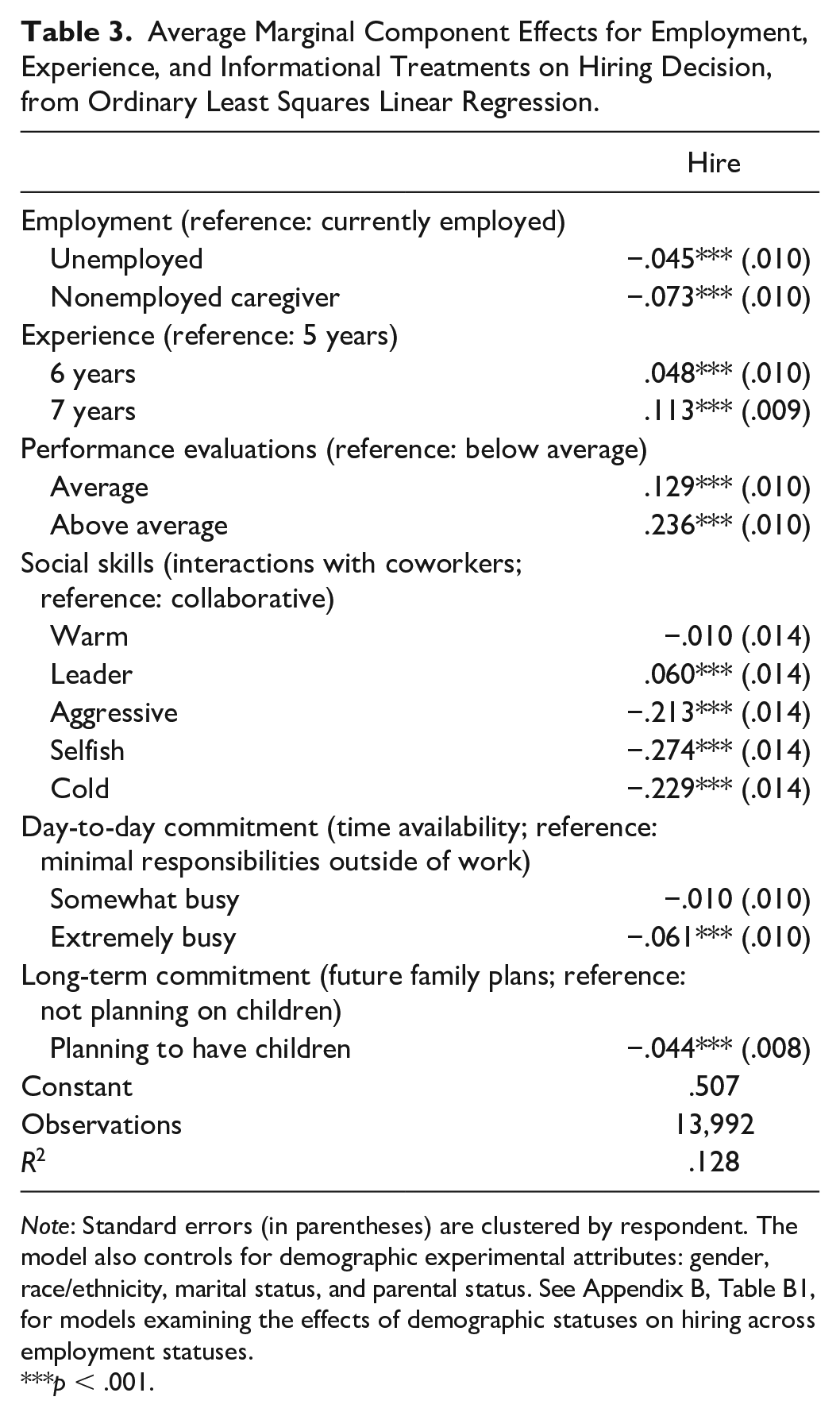
Note: Standard errors (in parentheses) are clustered by respondent. The model also controls for demographic experimental attributes: gender, race/ethnicity, marital status, and parental status. See Appendix B, Table B1, for models examining the effects of demographic statuses on hiring across employment statuses.
p < .001.
Taken together, the main effects of employment history confirm existing research (e.g., Weisshaar 2018): nonemployment has a negative impact on hiring preferences relative to continuous employment, and leaving for caregiving reasons produces larger negative effects than unemployment from job loss. These findings further illustrate the shortcomings of a “pure” skill deterioration argument, given both the variation in effects across reason for nonemployment, and the finding that nonemployment for caregiving yields a penalty greater than the equivalent effect of lost work experience time.
Variation in Effects of Employment Lapses across Informational Treatments
The main effects presented in the previous section document variation in hiring preferences across employment status, net of each informational treatment and demographic characteristic presented in the profiles. The subsequent analysis will test whether the effects of employment history vary across positive and negative types of information, for the four informational treatments: job performance, social skills, day-to-day commitment (availability), and long-term commitment (future family intentions). Because interaction effects require additional statistical power, this analysis collapses each informational treatment into two categories: low and average job performance compared with above average, negative social skills compared with positive, and minimally and somewhat busy outside of work compared with extremely busy. 8 For each informational treatment, I present graphs depicting the predicted relative hiring gap between currently employed and unemployed or nonemployed caregiver applicants. Each graph shows the marginal effect of employment history on hiring, along with 95 percent confidence intervals. Confidence intervals that overlap with zero indicate nonsignificant effects. 9
Figure 2 shows that both unemployed and nonemployed caregiver applicants face significantly lower hiring rates than currently employed applicants under the negative, stereotypical information treatments: having lower job performance, negative social skills, low time availability, and planning to have children in the future are associated with significant hiring disadvantages for nonemployed applicants. Note that these effects do not mean that applicants are not affected by negative information (see absolute graphs in Appendix B) but that the relative gap between employment groups remains when presented with negative information. Comparing both employment lapses with each other, opting out is associated with larger negative effect sizes than unemployment across most informational treatments, except in the low job performance condition, for which both nonemployed groups face similar magnitudes of penalties.
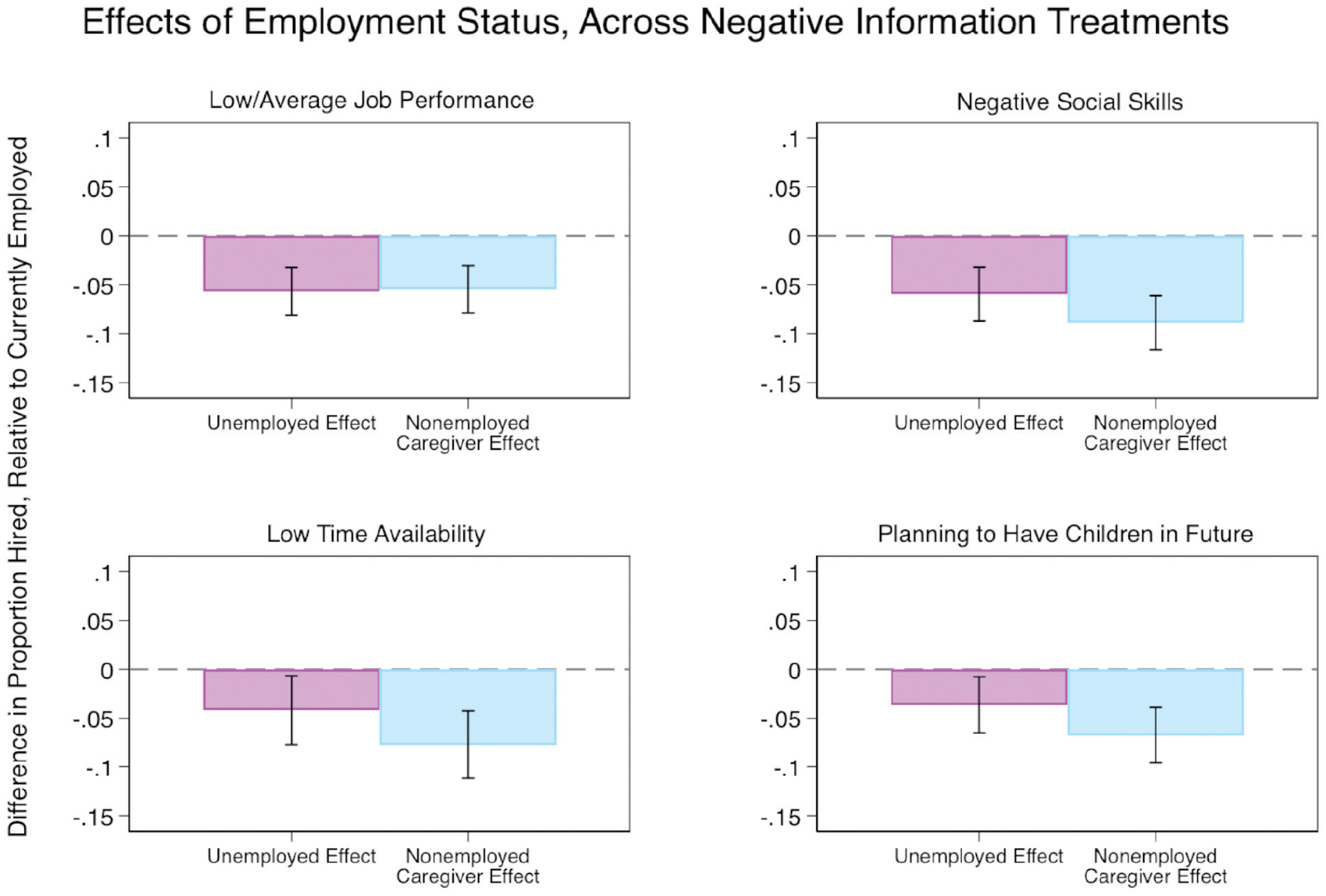
Relative hiring differences of unemployed and nonemployed caregiver applicants, compared with currently employed applicants, among profiles with negative or stereotypical information treatments. Error bars are 95% confidence intervals.
Figure 3 shows the relative hiring gap by employment among profiles with positive information treatments. The findings here show that in each positive information treatment, the nonemployed caregiver penalty remains negative and statistically significant compared with employed applicants. Unemployed applicants also face a penalty in hiring across positive information treatments; however, this penalty becomes statistically nonsignificant for the treatment with positive job performance information. In other words, among profiles with above average job performance, the negative effect of unemployment is reduced to nonsignificance.

Relative hiring differences of unemployed and nonemployed caregiver applicants, compared with currently employed applicants, among profiles with positive or counter-stereotypical information treatments. Error bars are 95% confidence intervals.
Given employers’ concern about unemployed applicants’ quality in terms of both job performance and social skills, I examined the nonemployment effect across both job performance and social skill treatments simultaneously, with a three-way interaction model. Figure 4 shows that regardless of having positive social skills, the unemployed face a hiring penalty when profiles also indicate lower job performance. With above average job performance but negative social skills, unemployed applicants incur a penalty that is marginally significant (p < .10). However, with above-average job performance and positive social skills, unemployed applicants experience no penalty at all relative to employed applicants (p = .919). These findings suggest that positive information on job performance and social skills together can counteract negative assumptions about unemployed applicants, enabling them to have similar hiring outcomes to currently employed applicants.

Relative hiring differences of unemployed and nonemployed caregiver applicants, compared with currently employed applicants, across combinations of profiles with negative and positive performance and social skill informational treatments. Error bars are 95% confidence intervals.
In contrast, no two combinations of positive informational treatments affect the negative penalty experienced by nonemployed caregiver applicants (see Appendix B, Figure B6). Although it is difficult to wholly confirm this null effect of positive information on the gap between nonemployed caregiver applicants and employed applicants because sample size limitations and reduced statistical power prohibit testing four-way interactions, the lack of any movement in the negative nonemployed caregiver penalty suggests that this disadvantage is quite stable with positive and counter-stereotypical information.
Conclusion and Discussion
The U.S. labor market is marked by constant volatility, with workers moving in and out of multiple jobs throughout their careers. Even prior to the COVID-19 pandemic, which led to an explosion in the numbers of individuals out of work, periods of nonemployment have been commonplace in our modern economy for the past several decades (Killewald and Zhuo 2015; Percheski 2008; Rothstein 2016; Weisshaar and Cabello-Hutt 2020). And although existing research documents clear disadvantages in subsequent career opportunities (e.g., wages and hiring) faced by the nonemployed, two competing theories offer different predictions as to the social-psychological mechanisms underlying these hiring disadvantages. On the one hand, hiring biases could reflect a type of informational bias, in which decision makers need key pieces of positive, counter-stereotypical information to offset their stereotypical assumptions about applicants. On the other hand, if biases are due to deeply rooted cognitive biases, we would expect to see that evaluators are resistant to changing biases even with clear, positive, and relevant counter-stereotypical information about applicants.
Using an original conjoint survey experiment, I examine these competing mechanisms corresponding to the disadvantages faced by unemployed applicants and nonemployed caregiver job applicants, who left their prior jobs to care for family in hiring screening processes. I find that in a fictitious hiring scenario, positive information about job performance and social skills effectively eliminates the hiring penalty faced by unemployed job applicants compared with currently employed applicants. This finding suggests that biases toward unemployed job applicants are reflective of informational biases: employers have a shortage of information during hiring screening decisions and make assumptions about applicant quality on the basis of applicants’ job history information. In contrast, hiring penalties for job applicants who left work for family caregiving reasons appear to be the result of information-resistant cognitive biases: no counter-stereotypical information about job performance, day-to-day commitment (time availability), long-term commitment (future family intentions), or social skills significantly reduce the disadvantages faced by nonemployed caregiver job applicants.
The finding that unemployed job applicants face informational biases, whereas nonemployed caregiver applicants experience more rigid cognitive biases, has theoretical implications for our understanding of hiring processes and stereotyping. I suggest that two key differences across these specific cases (unemployed vs. nonemployed caregiver applicants) may inform our understanding of more general theoretical processes. First, unemployment is typically perceived as involuntary, whereas leaving work for family reasons is perceived to be voluntary (Stephens and Levine 2011). This “choice” framing attached to nonemployed caregivers may correspond to the more resistant biases faced by this group, in that the decision to leave work is perceived to reflect their personal orientation and attributes (as opposed to circumstances that may or may not be in their control). Second, whereas “opting out” of work for family reasons reflects violations of ideal worker norms, unemployment may be tied to more specific concerns about performance and skills (Pedulla 2020; Weisshaar 2018). This study shows that ideal worker norm violations pervade hiring evaluation processes, and providing evaluators with key pieces of work and family information to counteract these ideal worker norm violations does not translate into increased hiring chances for nonemployed caregiver applicants.
This distinction has implications for our theoretical understandings of hiring processes more generally. “Choice discrimination,” which has been studied in relationship to other groups such as mothers and gay men (Kricheli-Katz 2012, 2013; Stephens and Levine 2011), may be less modifiable with information and more challenging to combat than biases against applicants who are not viewed as having a choice in their status. Moreover, attributing situations to personal choice can lead to a denial of inequality or discrimination and lack of effort to remedy existing inequality (Rhode 1999; Stephens and Levine 2011). Additionally, assumptions related to violations of diffuse, widely held cultural beliefs (e.g., ideal worker norms) may be more resistant to informational updating than more specific stereotypes (e.g., about job performance). Although more research is needed to explore the scope conditions of this theoretical proposition, this idea could help explain the persistence of hiring disadvantages in other contexts as well: for example, gendered and racialized assumptions across occupational contexts or stigmas associated with criminal records, each of which corresponds to widely held stereotypical beliefs (Darolia et al. 2016; Pager 2003; Quillian et al. 2017; Ridgeway 2011; Yavorsky 2019).
There are several remaining questions that arise from this study, each of which inspires fruitful future research directions. First, there are some limitations with respect to the survey sample and design that could be studied further. The benefits of using a national sample of respondents, as I do in this study, are that it allows a test of general perceptions of job applicants and arguably better reflects hiring decision makers than, for example, a sample of undergraduate students. The primary drawback is that the survey sample may not reflect the understandings of specific hiring managers within and across particular occupations. 10 More research is needed to understand when and how national samples differ compared with hiring manager samples, in this context and in other employment decision contexts (for a related discussion, see Pager 2007; Pager and Quillian 2005). Additionally, conjoint experiments distill key pieces of information into easy-to-interpret presentational forms and phrases, which are not intended to mirror real-life decisions in their format or type of information (Hainmueller et al. 2015). To test informational treatments about assumptions employers may make, the study design prioritized having rich and detailed information over providing information only typically available to employers. Yet in the context of hiring screening decisions, it is worth considering how the experimental design itself, both the format and informational treatment phrasing, might affect results. The replication of the main effects of unemployment and nonemployed caregiving compared with previous audit studies and survey experiments (Weisshaar 2018) lends reassurance that, at the very least, similar interpretations of the key independent variables hold across this survey format compared with others, but more research is needed in this area.
Next, although the lack of movement on the nonemployed caregiver effect is suggestive of a form of cognitive bias, it is possible that some other type of information or way of conveying this information could make headway on reducing the nonemployed caregiver penalty. Put another way, there remains the possibility that the nonemployed caregiver penalty reflects a type of information bias subject to information not provided in this study. It would be useful to explore whether different operationalizations of informational treatments lead to any different findings; perhaps directly stating applicants’ commitment to the company, availability for long work hours, or ability to travel for work would has a somewhat different outcome than the commitment statements provided in this experiment. Additionally, most employers will not have information on future family plans or time availability for real job applicants and may infer such qualities from more subtle signals. Therefore, it is worthwhile to further explore whether the content of information and more subtle information presentations of information (e.g., in resumes or cover letters) yields similar or different outcomes than the results presented here.
There are several areas for future research that involve extensions of this experimental design and the theoretical implications from this study, to test whether processes apply across other contexts and outcomes. First, this type of experimental design could be used to study types of discrimination faced by other groups and across other contexts. It can shed light on decision-making processes that are typically not observable in audit study contexts. For example, what types of hiring biases apply to those who have criminal records, to Black and Latinx applicants, or job applicants with physical disabilities? By examining decision making in the context of high information and precise informational treatments, experimental studies can better understand what kinds of bias other disadvantaged groups face. Second, future research could test the contexts and outcomes for which discriminatory outcomes are reflective of informational or cognitive types of bias, for instance examining including promotion or salary decisions at work or discrimination in rental or housing markets.
This article complements recent research examining supply-side processes and how nonemployment (from both unemployment and “opting out”) has gendered consequences in terms of mothers’ and fathers’ job search strategies and responses to nonemployment (Damaske 2020; Stone and Lovejoy 2019). For example, mothers may adjust work expectations after a period of caregiving (Rao 2020; Stone and Lovejoy 2019), and fathers may take longer to attempt to return to work or urgently search for work, dependent on their class position (Damaske 2020). The job search strategies (e.g., changing careers, seeking flexible work, returning to the same occupation; Stone and Lovejoy 2019) on the supply side likely have connections to evaluations on the demand side. Understanding the interplay between supply- and demand-side processes, and the gendered consequences of this relationship, is an important area for continued research.
Although these findings do not directly speak to gender differences in career outcomes by employment status (see Appendix B, Table B1), the very nature of leaving work for caregiving reasons is gendered, and it is important to remember that women and mothers represent the vast majority of this group in the U.S. context. Even so, fathers who actively participate in caregiving may face additional sanctions given their heightened accountability to ideal worker or breadwinner norms in the first place (Weisshaar 2018). The ways that gender norms and expectations are interwoven in evaluations, and the role that information plays in shaping outcomes across gender, is an area that could be explored more thoroughly in future research (see also O’Brien and Kiviat 2018; Pedulla 2020).
Finally, the COVID-19 pandemic has dramatically reshaped the U.S. labor market, and there has been a surge of unemployment from job loss, as well as increased rates of parents and caregivers temporarily “opting out” to fulfill caretaking duties such as remote school (Collins et al. 2021, forthcoming; Landivar et al. 2020). Meanwhile, job openings have dropped sharply (Forsythe et al. 2020), meaning that each available job could be even more competitive. It remains to be seen how temporary employment lapses during the pandemic affect subsequent career opportunities. On the basis of the research presented here, I would expect that nonemployed caregiver applicants will face disadvantages compared with unemployed applicants, especially given that stereotypes about the unemployed may apply less strongly during the pandemic, as it is somewhat clearer that layoffs and closures were the result of the economy, rather than individual employees’ traits. However, the context around leaving work has changed as well: remote schooling and reduced childcare availability could reframe nonemployed caregiver decisions and their repercussions in this time period. It may well be that employers interpret leaving work for family reasons during the pandemic as less of a violation of ideal worker norms than they would under prior conditions. It will be important to conduct additional research on how employment lapses affect job applicants during and following the pandemic, to understand whether inequality in hiring will be heightened or reduced during this volatile period.
Overall, this study builds on and extends past research showing that individuals who have left work for family reasons or are unemployed face difficulty regaining employment. Given that cognitive biases, rather than informational biases, appear to be driving disadvantages faced by nonemployed caregiver job applicants, solutions to remedy this problem can be developed to tackle the cognitive biases in play. Changing widely held ideal worker norms in workplaces and occupations may be the most fruitful avenue for increasing job opportunities and reducing the workplace conflicts with expectations of parenthood and caregivers, particularly mothers. Recognizing the organizational and structural processes that push caregivers out of work, instead of attributing decisions to leave work as a matter of “personal choice,” may be another approach to address these processes. Until we are able to change widely held cultural expectations and professional norms, we will likely continue to see high levels of work-family conflict, inequality in job opportunities, and biased evaluations from employers.
