



Abstract
Women’s underrepresentation in science, technology, engineering, and mathematics (STEM) is related to the hierarchical social structure of gender relations in these fields. However, interventions to increase women’s participation have focused primarily on women’s interests rather than on STEM managers’ hiring practices. In this research, we examine STEM hiring practices, explore the implicit bias in criteria used by STEM managers, and suggest possible corrective solutions. Using an experimental design with 213 men and women STEM managers, we show that when evaluating a female candidate, women and men STEM managers apply differential selection criteria, with men demonstrating implicit in-group gender favoritism in their hiring decisions. Specifically, the ability to work long hours was a more important criterion for male managers when evaluating a female candidate, forming an implicit gender bias, whereas female managers gave greater importance to problem-solving ability, a more gender-equal criterion. Adding a personal note to the curriculum vitae stating that the candidate had hired a full-time nanny was useful in decreasing the importance of the ability to work long hours criterion for men managers. We suggest individual and institutional interventions to reduce this bias, as a path to increasing women’s participation in STEM.
Keywords
There is a major underrepresentation of women in the science, technology, engineering, and mathematics (STEM) fields) (Bird and Rhoton 2021). Men are employed in STEM fields twice as frequently as women (Landivar 2013). Gender disparities in transitions to STEM jobs are common in computer sciences and engineering even when women have degrees in these fields (Sassler et al. 2017). Although women’s participation in STEM has increased worldwide (Murphy and Oesch 2016), large gender disparities still remain (Mcquillan and Hernandez 2021). Increasing women’s representation in STEM promotes social justice and economic vibrancy (Kossek and Buzzanell 2018). Currently, the demand for STEM workers is increasing (Singh et al. 2018), and women can boost the pool of recruitment (Weisgram and Diekman 2015).
Gender inequality in STEM fields reflects prevalent social structures (Lockhart 2021), as science fields have been dominated by men for centuries, thus putting them in positions of power (Britton 2017). Organizational cultures and practices in STEM are socially constructed in ways that disadvantage women (Bird and Rhoton 2021; Cech 2013). Organizational practices limit women’s participation in STEM and originate from societal expectations that women have primary responsibility for child and family care and housekeeping. Thus, women are perceived as unable to work outside the home for as many hours as men (Kiser 2015). Furthermore, there is the tendency to underestimate women’s professional abilities along with an expectation that men are naturally inclined to science, mathematics, and practical pursuits—also challenging men who may not be inclined to gender-stereotypical roles (Eagly and Karau 2002; Hall et al. 2019).
Gender stereotypes are reflected in women’s self-bias toward their fit to STEM fields (Correll 2001) and in gender bias among men and women managers (Bird and Rhoton 2021). Most interventions have tried to increase women’s interest in science and confidence in their STEM abilities (Casad et al. 2018). However, fewer interventions focused on STEM managers, who make the hiring decisions (Botella et al. 2019). Yet STEM managers may discriminate against women in hiring decision making (Stamarski and Son Hing 2015). Diversity training aims to reduce implicit biases in managers’ perceptions of women’s and minority candidates’ abilities (Pritlove et al. 2019). However, this intervention was deemed ineffective in most cases (Dobbin and Kalev 2018).
The goals of this paper are, first, to identify an implicit bias in differential criteria of hiring a STEM project manager by men and women STEM managers, when evaluating two critical attributes of candidates: the ability to work long hours and problem-solving abilities. Second, we sought to test the effects of an intervention aimed at reducing the implicit ability to work long hours gender bias criterion among managers.
Figure 1 presents a conceptual model that summarizes the literature on the influence of explicit (conscious) and implicit (unconscious) perceptions and criteria on the hiring decision outcome, mainly focusing on implicit perceptions (e.g., women are unconsciously perceived to have lower ability to work long hours than men).
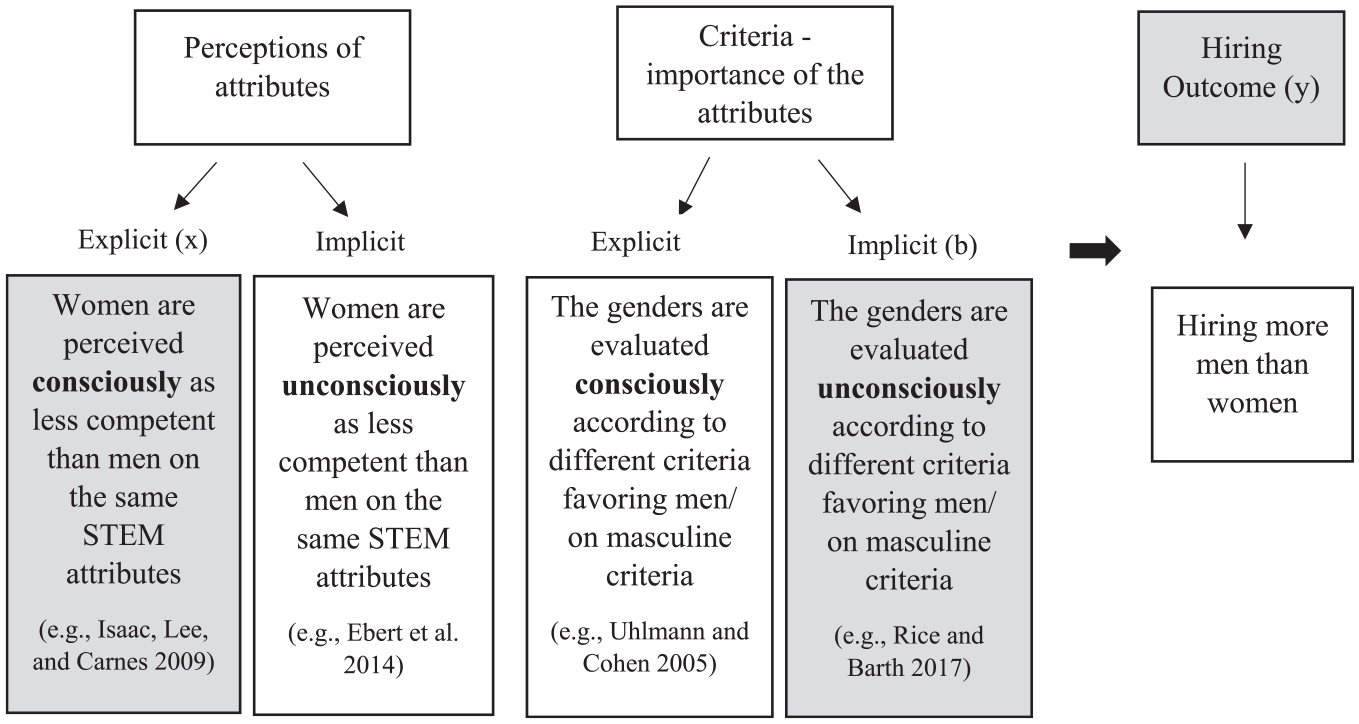
Conceptual Model: The Sources of Gender Bias in the Hiring Process
To explore implicit criteria, we designed an experiment for men and women STEM managers in evaluating male and female curriculum vitae (CVs) (explicit perceptions) and the likelihood of hiring (outcome). Given that the ability to work long hours criterion was expected to be more important for men managers who are the dominant decision makers in STEM hires (Botella et al. 2019), we designed an intervention to reduce the importance of the ability to work long hours criterion. The treatment group received CVs with the addition of a personal note implying candidates’ ability to work long hours, whereas the control group did not. Using regression models, we found a differential use of the ability to work long hours criterion for men compared with women STEM managers in their evaluation of women candidates but not men candidates, and the intervention reduced the importance of the ability to work long hours criterion for men managers.
Our paper makes several contributions. First, we investigated an understudied implicit source of gender bias in hiring decisions of applicants, a criterion that favors male candidates. Second, ability to work long hours is an external, structural criterion that often disadvantages women, unrelated to the candidate’s skills. It is understudied in the context of hiring processes, although it is extensively studied in the “ideal worker literature” (e.g., Neely 2020; Padavic, Ely, and Reid 2020). We identify ability to work long hours as influencing hiring decisions and manipulated it by designing an intervention that reduced gender bias.
Third, the existing research shows contradictory findings regarding the hiring decisions of women managers toward women candidates. A body of literature suggests in-group gender favoritism, so that each gender favors candidates of their own gender in hiring decisions (e.g., Bendick and Nunes 2012). Other literature suggests that women managers also internalize the masculine point of view and implicitly favor men (e.g., Miller 2004). Our paper resolves this contradiction by showing that men and women managers highlight different hiring criteria for female candidates. Specifically, men emphasized a masculine criterion (ability to work long hours) while women emphasized a more gender-equal criterion (problem-solving ability).
Fourth, numerous interventions were designed to increase women’s participation in STEM. Most of these have targeted women, starting in their childhood—young girls, female students, and employees rather than managers (Botella et al. 2019). By targeting STEM managers, we aim to reveal the hidden organizational structures, cultures, and decision-making practices that are present in the STEM fields.
Theory and hypotheses
Historically, science fields possess androcentric values that are imbued with male biases (Thelwall, Abdullah, and Fairclough 2022). Women’s underrepresentation in STEM fields is still evident today (Bird and Rhoton 2021) and is related to the hierarchical nature of gender relations in these fields (Fox 2001), such as gender biases leading to discrimination in hiring and promotion (Wynn and Correll 2018). Because hiring is the initial stage in entering STEM, we focus on the hiring decisions of managers.
Sources of Gender Bias in Hiring Decisions Among Managers
Gender bias in the hiring process limits the proportion of women in male-dominated fields (Rice and Barth 2016). This bias derives from beliefs about gender-stereotypical social roles (Eagly and Wood 2012) that are defined within “culturally patterned relations” between a person and a social circle, influencing decisions and behaviors (Lopata and Thorne 1978). Thus, women are expected to care for children and to have stereotypical “feminine traits” (i.e., warmth, nurturing), and men are expected to fulfill instrumental roles at work. People tend to strive for congruence between stereotypes and job requirements, so women tend to be hired for female-dominated jobs consistent with gendered expectations (Eagly and Karau 2002).
Indeed, the outcome of hiring is that men are more frequently hired than women for prestigious high-income jobs (Koch, D’Mello, and Sackett 2015). This outcome may be influenced by explicit (conscious) or implicit (unconscious) biases (Blommaert, van Tubergen, and Coenders 2012). We define implicit bias as the general unconscious mental processes related to perceptions and decision-making processes that may produce discrimination (Greenwald and Krieger 2006) and affect organizational practices (Foley and Williamson 2019).
We built a conceptual model that divides hiring gender bias into two sources: biases rooted in the perceptions of a candidate’s abilities and biases rooted in the criteria affecting the hiring decision, which can be either explicit or implicit (see Figure 1). Bias in the perceptions of a candidate’s attributes is influenced by the worker’s gender rather than their performance (Isaac, Lee and Carnes 2009). Women explicitly received lower STEM attribute ratings than men even when their job qualifications are identical to or better than those of men (Reuben, Sapienza, and Zingales 2014).
But these perceptions can also be implicit when employers unconsciously perceive men to be more competent and better suited to science (Pritlove et al. 2019). This implicit bias is usually measured by the gender–science Implicit Association Test (IAT) and its variations (S. M. Jackson 2011; Nosek, Greenwald, and Banaji 2005). These tests measure the strength between implicit associations (e.g., women and science) and assume that individuals will respond more rapidly on a computer test when exposed to two associated concepts (Smeding 2012).
Similar to perceptions, we suggest that bias can be explicit or implicit in criteria that are different for the two genders (Rice and Barth 2017) or if both genders are evaluated based on a specific masculine criterion that men more commonly possess (Uhlmann and Cohen 2005). It is explicit when employers are aware of their criteria, or implicit when they are not aware (Greenwald and Krieger 2006).
Gender differences in implicit bias in perceptions have been extensively studied (e.g., Ebert, Steffens, and Kroth 2014), whereas gender differences in implicit bias in criteria have seldom been studied (Phelan, Moss-Racusin, and Rudman 2008). Asking managers what their criteria are for hiring men or women applicants may not necessarily yield the same results as implicitly assessing the criteria (Friedmann and Lowengart 2018). For example, managers can state explicitly that they use the same hiring criteria for women and men applicants, evaluate them similarly on ability to work long hours and problem-solving ability, and have the same hiring probabilities for both applicants. In this situation, there is no explicit gender bias. However, an implicit bias in hiring criteria may appear when men managers evaluate women candidates as high on ability to work long hours, and prefer to hire them rather than women they evaluate with low ability to work long hours. Such a finding may point to implicit bias used by managers to favor their gender.
Existing Interventions to Increase Women’s Hires in STEM Industries
Over the past two decades, the discourse on implicit bias and how to reduce it has grown (Nelson and Zippel 2021). For example, Wang and Degol (2017) maintain that it is not enough to focus on girls’ implicit bias toward math and science and women’s lack of personal fit to STEM careers (the supply of female workers for STEM). Interventions must focus on all relevant groups such as parents, teachers, and employers (who generate the demand for trained STEM workers). Indeed, most interventions focus on the initial stages of the “problem” when women developed their career aspirations and less on later stages focusing on the managers who make the hiring decisions (Botella et al. 2019).
The STEM organizational culture may also contribute to patterns of behaviors affecting the supply side (women’s choices) and the demand side (managers’ decisions). It is important to identify organizational mechanisms that hinder institutional changes (Cech 2013; Seron et al. 2018).
Dozens of interventions have been developed to increase women’s participation in STEM (e.g., Casad et al. 2018) focusing on the supply, demand, or culture. Such interventions include the following: (1) empowering women—interventions developed for girls and women in diverse settings, such as improving their skills, confidence, interest, and sense of belonging to the field (Friedmann 2018); (2) diversity training—workshops to reduce implicit gender bias that are directed at academic faculty, industry employees, and managers (Dobbin and Kalev 2016). These include delivering information about women’s barriers to improve attitudes toward women in STEM (S. M. Jackson, Hillard, and Schneider 2014). Diversity training was found questionably effective (Dobbin and Kalev 2018). Some researchers have even suggested that this training harms women’s interest in STEM because it emphasizes their minority status, exacerbating inequality (Wynn and Correll 2018). And (3) structural approaches include programs that foster pro-family policies or federal agencies that provide tax breaks for childcare expenses (Goulden, Mason, and Frasch 2011). These focus on organizational support to reduce gender bias in the long run (Madva 2020).
In a review, Nelson and Zippel (2021) applied the use of implicit bias as a concept to structural interventions in STEM academic frameworks. The implicit bias concept has five key features that promote its translatability into practice. It is demonstrable (there is empirical evidence), relatable (people have experienced this), versatile (can be relevant for different settings and organizations), actionable (applicable), and impartial (not assigning blame) (Nelson and Zippel 2021). These features are challenging for planning institutional change (such as hiring practices) if they do not reveal the hidden structural roots of gender bias. In this paper, we focus on implicit gender bias in STEM hiring practices, which aim to reveal some of the hidden sources of gender bias present in STEM organizational culture as reflected in managers’ hiring decisions.
Differences Between Men and Women Managers: Implicit Perceptions and Criteria
The literature on how men and women differ in gender biases is equivocal (Wynn and Correll 2018). Several experiments examined the implicit bias in perceptions using IAT, demonstrating that men perceive women to be less effective than men, but that women see themselves as equally competent as men (e.g., Ebert, Steffens, and Kroth 2014).
Some scholars have posited that women managers may adopt evaluation criteria used by their male counterparts (Miller 2004). Other scholars suggested that women and men behave differently as managers (Adams and Funk 2012) and that women managers are less gender biased (Rice and Barth 2017). Diversity training of managers has reduced men’s but not women’s implicit gender bias, suggesting that women may be less biased than men (Moss-Racusin et al. 2016). To investigate differences between women and men STEM managers in implicit gender bias in criteria, we built on Fishbein and Ajzen’s (1975) expectancy–value model, suggesting that hiring decisions are a function of explicit attribute perceptions and implicit criteria (i.e., attributes’ importance).
Explicit Perceptions and Implicit Criteria of Hiring Outcomes
In examining perceptions and criteria, we focus on (1) ability to work long hours, which is especially relevant in STEM (Kaushiva and Joshi 2020) and relates to organizational success (Van Dalen, Henkens, and Schippers 2010), and (2) problem-solving ability, which is the ability to find solutions to difficult or complex issues, specifically solving real-world STEM problems (Tati, Firman, and Riandi 2017). This ability is highly valued by STEM managers (Rayner and Papakonstantinou 2015). Very little is known about managers’ ability to work long hours and problem-solving ability perceptions and criteria. However, skills alone are not sufficient for work readiness (e.g. problem-solving ability), and candidates’ attributes and external work-related attributes (e.g. ability to work long hours) are both considered in the hiring process (D. Jackson 2016a).
The 24/7 STEM work ethic demands that the “ideal worker” can work long hours and is always available (Kaushiva and Joshi 2020). Men usually have an advantage in the ability to work long hours (W. M. Williams and Ceci 2012) because high-commitment careers are difficult to combine with family and housework responsibilities, particularly for women (Fritz and van Knippenberg 2018). Women, even those without children, often are perceived as having lower ability to work long hours than men because they are perceived as responsible for other domestic activities and duties (besides childcare), and may be viewed as future mothers (Bertogg et al. 2020).
Parents in general are perceived as less committed to their jobs, but parental status influences women more than men (Fuegen et al. 2004). In masculine-cultural organizations such as STEM, these stereotypes penalize mothers and may benefit fathers (Benard and Correll 2010). “Maternal-wall bias” is a form of organizational bias against mothers, including negative competence assumptions (J. C. Williams 2004). For example, pregnant women managers were perceived by employers as less committed to their jobs, and more irrational (Correll, Benard, and Paik 2007). The negative competence assumptions are higher for mothers of children younger than two years (Cuddy, Fiske, and Glick 2004). Women in their child-bearing years, with and without small children (Fuegen et al. 2004), encounter these stereotypes more often than older women and are the most penalized group in terms of wages (Correll, Benard, and Paik 2007). These negative perceptions discriminate against women in hiring, promotion, and salary decisions (Benard and Correll 2010). Thus, the working 24/7 STEM norm (Kaushiva and Joshi 2020), combined with the perception that women cannot work as long hours as men (Kelly et al. 2010), is expected to lead to implicit gender bias in criteria favoring men in STEM.
On the other hand, the criterion of problem-solving ability, which is central in any STEM field (Mitts 2016), implies a high level of function, where the solution is not obvious, and analytical thinking is required to solve the problem (Gomez and Albrecht 2014). Problem-solving abilities are comparable between both genders (Argaw et al. 2017; Else-Quest, Hyde, and Linn 2010). Problem-solving ability was one of the strongest hiring criteria among STEM employers (McGunagle and Zizka 2020).
Ability to work long hours benefits men structurally compared with women, and is something less controllable for women, whereas problem-solving ability is perceived as a gender-balanced ability. We examine the criteria and perceptions of both ability to work long hours and problem-solving ability attributes.
In-Group Favoritism
A social group is a collection of individuals with a shared identity (Turner et al. 1987). In-group favoritism, the preference for those who resemble “me” over out-group members, may influence hiring decisions (Fu et al. 2012; Tajfel and Turner 1979). Because the STEM fields tend to be masculine, a woman’s social identity as an outsider is salient (Richman, van Dellen, and Wood 2011). Thus, favoritism by men managers for men applicants might occur.
Many organizations are striving toward equity in their hiring decisions (Chesley 2011). Therefore, gender bias research has shifted from explicit to implicit (Uhlmann and Cohen 2005). We suggest that in-group gender favoritism has shifted to an implicit in-group gender favoritism by the use of a subtle strategy that fashions the hiring criteria to favor applicants of one gender in particular. Thus, we predict the following:
Because the ability of women to work longer hours is perceived to be limited (Kiser 2015), we expect that women managers will evaluate women on a more balanced criterion related to job performance than would men managers—problem-solving ability. This would give women a fairer chance of entering STEM, unlike the ability to work long hours criterion that is disadvantageous for women (Luxton 2017). Thus, we predict the following:
Because whether the ability to work long hours is expected to be an important hiring criterion for men STEM managers, and because women candidates are perceived as having limited ability to work long hours (Kiser 2015), we focused our experimental intervention on ability to work long hours and not problem-solving ability. Therefore, we expect that the exposure of STEM men managers to a CV that promotes women’s ability to work long hours will reduce the importance of the ability to work long hours criterion. We predict a significant three-way interaction between gender of the manager, ability to work long hours rating, and the CV intervention note emphasizing ability to work long hours to demonstrate among men managers the lower importance of ability to work long hours criterion in the treatment group (with the note) compared with the control group (without the note).
Hence, we predict the following:
For the research model, see Figure 2.
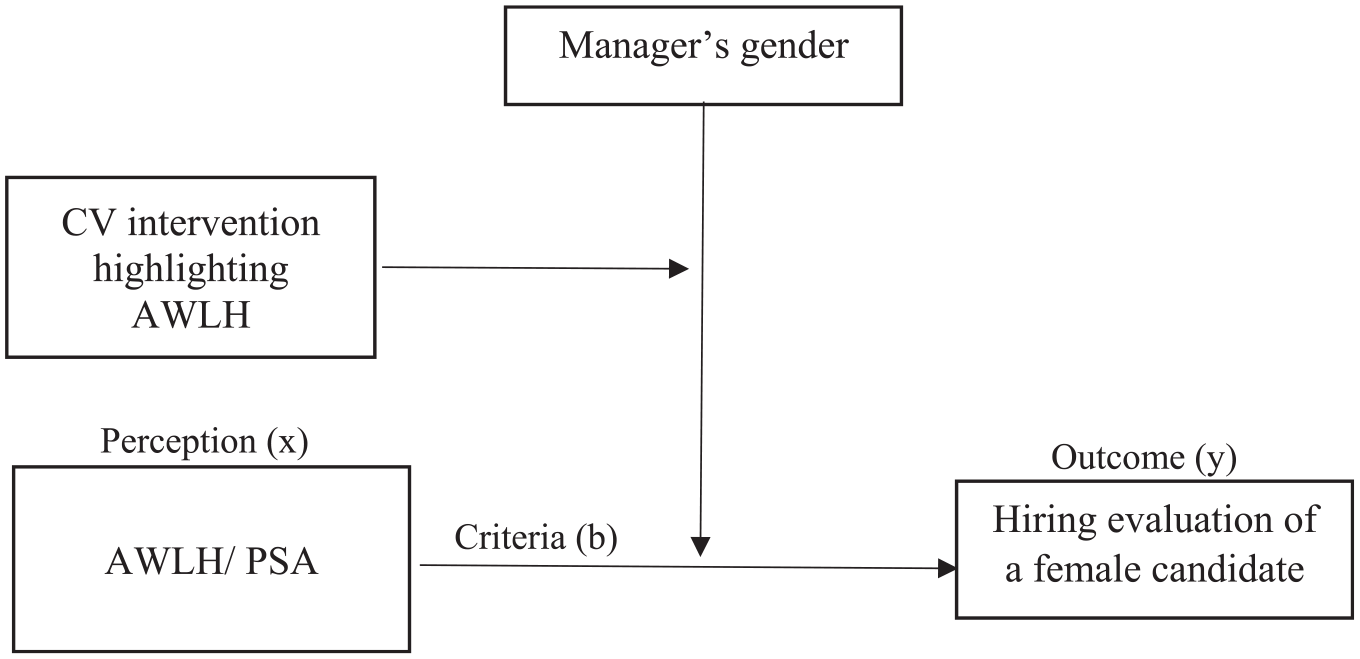
Research Model
Method
Pretest
Focus Group
Before the main study, we conducted an online focus group with five STEM managers (four men and one woman), which reflects the gender representation in STEM: 80% men, 20% women, Mage = 41 years, standard deviation (SD) = 1.58 (Committee on Equal Opportunities in Science and Engineering [CEOSE] 2015). The managers came from computer science and biorobotics industries from the center of Israel and were recruited through a snowball sampling. First, we asked them to identify the attributes important to them as managers considering a project manager hire. They suggested 11 attributes: the ability to solve STEM-related problems, work long hours, take initiative, apply technical knowledge, be time-efficient, learn new skills, work in a team, work independently, be assertive, present ideas in front of audiences, and take personal responsibility. The gender of the candidate was not mentioned as an important attribute. They chose ability to work long hours and problem-solving ability as the two most important attributes (similar to D. Jackson 2016b).
CV Intervention
We developed two versions of CVs, identical except for candidates’ gender, represented by gender-specific first names (see Online Appendix B). We chose names that implied majority-group race and class (Bertrand and Mullainathan 2004; Gaddis 2017). When designing the CV, we took five CVs that were submitted to a STEM manager’s position call and we used the same elements in the study’s fictional CVs. We created two versions because the use of an identical CV for different genders is not realistic, and we created two CVs in different STEM fields to generalize to STEM. The two versions were counterbalanced by fields (biopharma and biorobotics) and gender so that managers received two CVs to evaluate: a woman’s biopharma CV and a man’s biorobotics CV or vice versa. Each version of the CV contained equivalent academic background and was constructed mostly of instrumental achievements with some interpersonal management and experience. We did not note whether the candidate had children or not, because it is illegal to ask these questions in a job interview. These two versions were used as a control and treatment condition: control: CVs without any personal note; treatment: CVs with a personal note highlighting the ability to work long hours: “I am fully committed to my career, and therefore hired a full-time nanny to take care of family and household chores” (for both male and female CVs). See Table 1 for intervention manipulation check which confirmed that the note increased ability to work long hours perceptions but not the problem-solving ability perceptions.
Manipulation Check
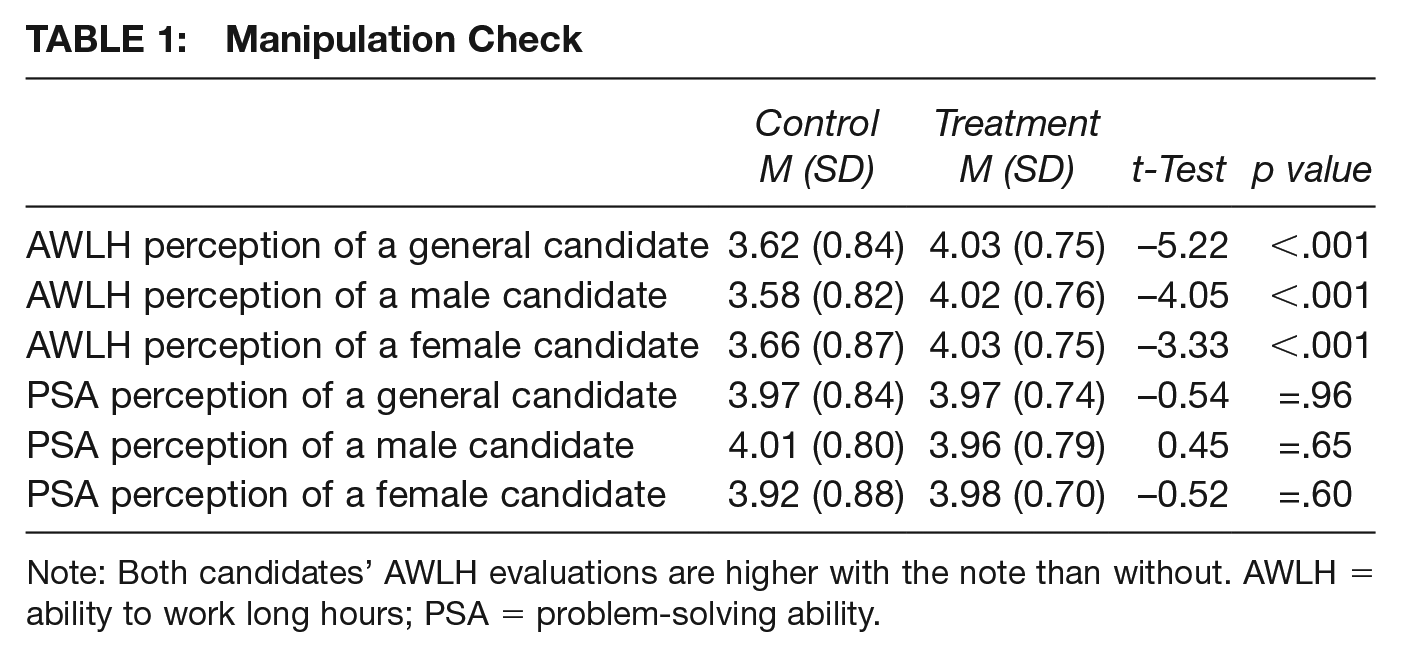
Note: Both candidates’ AWLH evaluations are higher with the note than without. AWLH = ability to work long hours; PSA = problem-solving ability.
Pretest of CVs
The STEM managers from the focus group were given the two versions, without the name and the gender of the applicant, and were asked to evaluate the candidate on the 11 attributes and hiring likelihood. No significant differences were found between the two versions, showing that both versions adequately represent STEM and were not biased in favor of one subfield.
Sample and Procedure
The sample size was determined using G*power for a multiple linear regression with 12 predictors. A minimum sample of 130 participants is required for power of 0.8, with 1-alpha = 95%, to detect a medium effect size (Cohen’s d = 0.15). We recruited 213 STEM managers from the United States and United Kingdom (38% women managers, Mage = 40.07, SD = 9.80) through Prolific 1 (treatment: n = 115, control: n = 98). Prolific is an online platform that recruits survey respondents of different demographic and work-related profiles for a modest fee. We prescreened for English language and managerial positions with hiring experience in STEM: computer sciences, engineering, chemistry, biochemistry, biomedical sciences, and physics.
This was a 2 (gender of the manager, between) by 2 (gender of the candidate, within) mixed research design. First, the STEM managers were randomly asked to read the CVs of two job applicants. After reading the CV, participants were asked three questions to ensure their attention to the CV’s details. Then they evaluated the candidates on their capacity for problem-solving ability and ability to work long hours, along with other attributes (to represent the evaluative process) and evaluated their hiring probabilities. Finally, respondents reported their demographics and were debriefed and paid.
Measures
Perception of ability to work long hours and problem-solving ability attributes were measured by asking “please rate the candidates’ ability to work long hours” and “please rate the candidates’ ability to solve problems at work.” Responses were rated on a 5-point Likert scale ranging from 1 (very low) to 5 (very high).
Outcome—Hiring evaluation probability was measured by asking “how likely is this candidate to be accepted for the position?” Responses were on a 5-point Likert scale ranging from 1 (not likely at all) to 5 (very likely). For demographics, we asked participants’ age, gender, family status, and education level.
Statistical Analyses
First, we computed correlations, means, and standard deviations for all variables and examined the effectiveness of the manipulation using a t-test. Then, to examine H1a and H1b, we performed linear regression. The dependent variable was the hiring evaluation of the male or female candidate. The independent variables were ability to work long hours, problem-solving ability, candidate gender × manager gender interaction while controlling for the specific field listed on the CV (biopharma or biorobotics), age, education, and family status, because these could influence their decisions (Gilbert and Malone 1995). The same analyses were performed for the treatment and control conditions.
Next, to examine H2, we used PROCESS, a modeling tool, to compute a set of regressions that fit the expected model (Hayes 2017). We ran a three-way interaction (model 3) between the gender of the manager × candidate’s ability to work long hours × CV intervention (G × ability to work long hours × CV) when predicting the hiring evaluation probabilities of either a female or male candidate, controlling for the same manager’s demographics as above. We used Hayes’ (2017) simple interaction (model 1) to illustrate the triple interaction results.
To examine whether the criteria are influenced by the candidates’ gender, we ran a mixed linear regression for men or women managers separately to examine the potential gender of the candidate × attribute (ability to work long hours or problem-solving ability) when predicting hiring decisions, for each condition of the CV intervention. This mixed regression analysis was done because each manager rated the job qualifications and hiring probabilities of a woman and man candidate in the same survey, so the random effect of participants’ identity was controlled for.
Finally, to test whether possible initial explicit gender bias in hiring outcome or ability to work long hours/problem-solving ability perceptions exists, we examined the control condition. We used a repeated-measures analysis of variance (ANOVA), where the manager’s gender served as a between-subject factor predicting the likelihood of hiring a female versus male candidate, so the hiring outcome evaluation of the two candidates served as the within-subject factor. The same analysis was used to examine explicit bias in the perceptions when the manager’s gender was the between-subject factor to predict either the ability to work long hours or problem-solving ability perceptions of female versus male candidates (within-subject factor).
Results
Correlations, means, and standard deviations are presented in Table 2. As shown in Table 3, in the control condition, when evaluating a female candidate, ability to work long hours was more important for men than for women managers (B manager’s gender × ability to work long hours = ‒0.38, SE = 0.18, p < .05). However, problem-solving ability was more important for women than for men managers (B manager’s gender × problem-solving ability = 0.45, SE = 0.20, p < .05). This confirmed H1a and H1b.
Correlations, Means, and Standard Deviations for the Control CV Intervention (CV without a Note) and Treatment CV Intervention (CV with a Note)
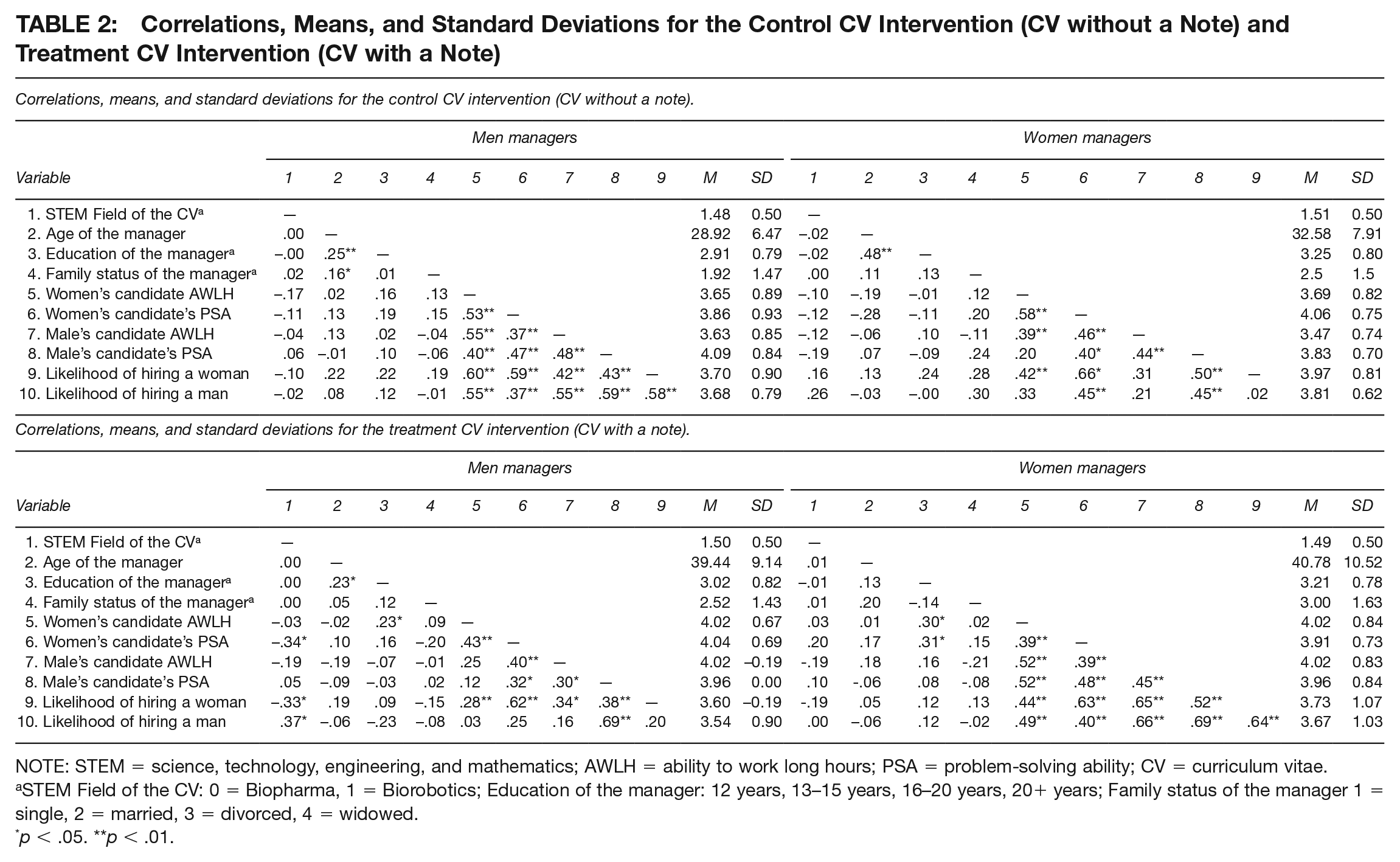
NOTE: STEM = science, technology, engineering, and mathematics; AWLH = ability to work long hours; PSA = problem-solving ability; CV = curriculum vitae.
STEM Field of the CV: 0 = Biopharma, 1 = Biorobotics; Education of the manager: 12 years, 13–15 years, 16–20 years, 20+ years; Family status of the manager 1 = single, 2 = married, 3 = divorced, 4 = widowed.
p < .05. **p < .01.
Regression Analysis When Predicting Hiring Evaluations of Women and Men Candidates: Control Condition (CV without a Note)
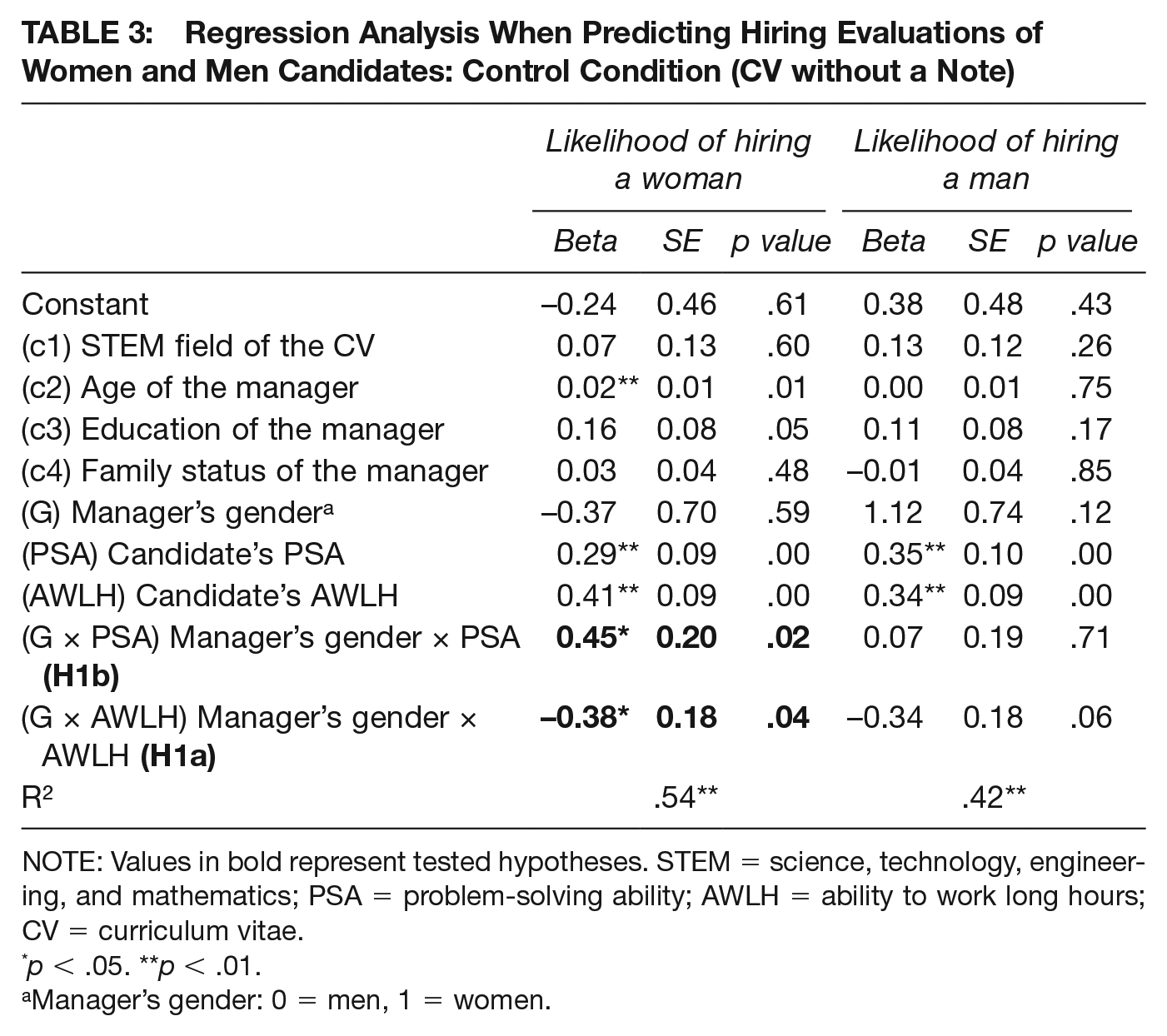
NOTE: Values in bold represent tested hypotheses. STEM = science, technology, engineering, and mathematics; PSA = problem-solving ability; AWLH = ability to work long hours; CV = curriculum vitae.
p < .05. **p < .01.
Manager’s gender: 0 = men, 1 = women.
When evaluating a male candidate, the gender of the manager did not interact with problem-solving ability or the ability to work long hours. As can be seen in Table 4, in the treatment condition compared with the control, when the CVs included a note to deal with ability to work long hours, women candidates’ ability to work long hours was a significantly less important criterion for men managers than it was for women managers (B manager’s gender × ability to work long hours = 0.71, SE = 0.19, p < .001).
Regression Analysis When Predicting Hiring Evaluations of Women and Men Candidates: Treatment Condition (CV with a Note)
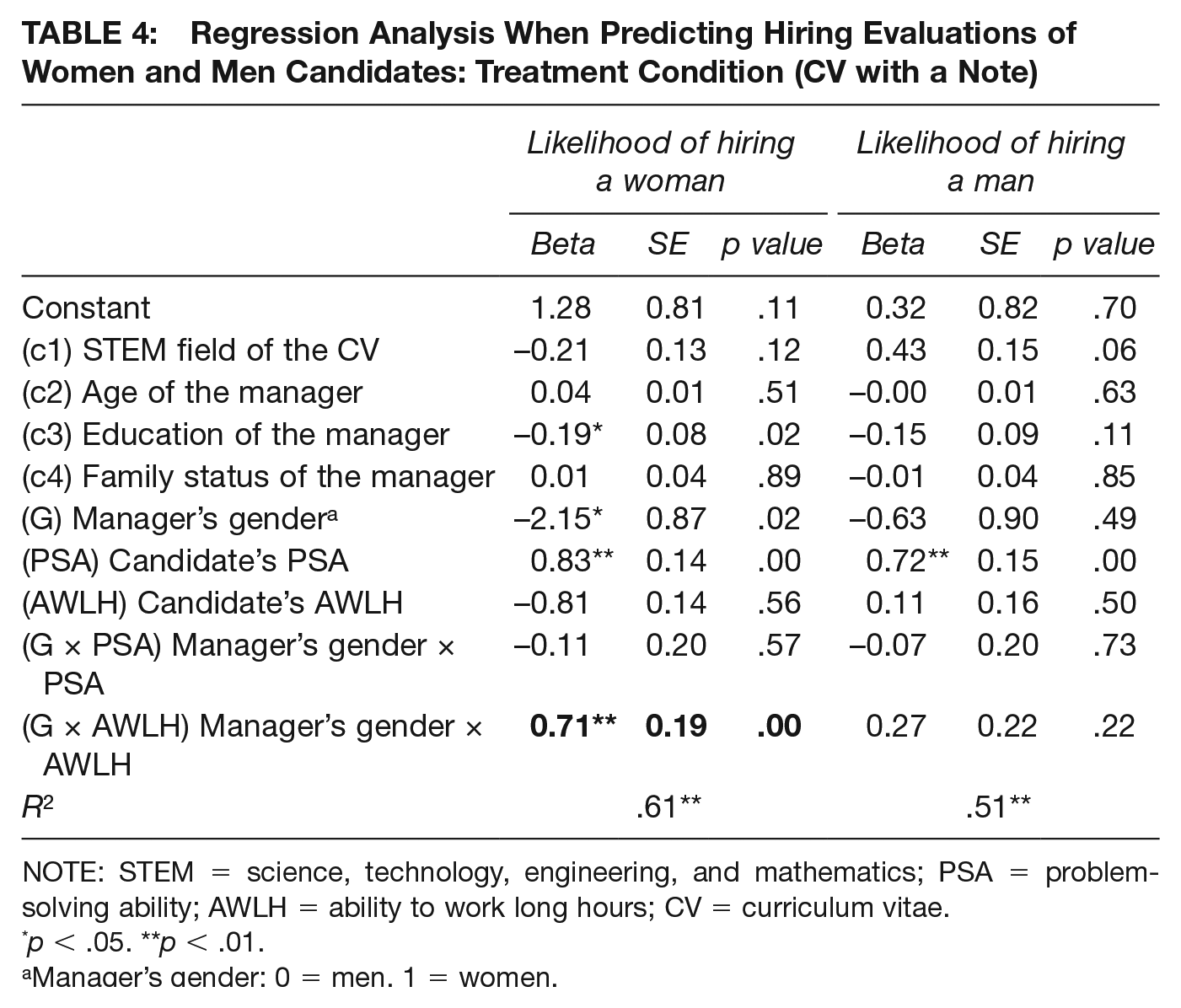
NOTE: STEM = science, technology, engineering, and mathematics; PSA = problem-solving ability; AWLH = ability to work long hours; CV = curriculum vitae.
p < .05. **p < .01.
Manager’s gender: 0 = men, 1 = women.
The CV intervention succeeded in lowering the ability to work long hours (AWLH in equations) criterion for any candidate among men managers (BCV intervention = ‒1.76, SE = 0.62, p < .001; BAWLH = 0.32, SE = 0.12, p < .01; BCV intervention × AWLH = 0.35, SE = 0.16, p < .05), while it did not change the importance of the ability to work long hours criterion when evaluating any candidate among women managers (B CV intervention = 0.47, SE = 0.52, p = .37; BAWLH = 0.56, SE = 0.07, p < .001; BCV intervention × AWLH = ‒0.23, SE = 0.13, p = .08).
To confirm that the importance of the ability to work long hours criterion differs between the control and treatment conditions in the CV intervention, for the women and men managers, we examined the interaction of manager’s gender × candidate’s ability to work long hours × CV intervention. As shown in Table 5, this interaction was significant when evaluating hiring probabilities of a woman candidate (B manager’s gender × AWLH × CV intervention = 0.79, SE = 0.28, p < .01), but not when evaluating a male candidate (B manager’s gender × AWLH × CV intervention = 0.47, SE = 0.29, p = .13). See Figure 3 for the illustration of the manager’s gender × candidate’s ability to work long hours × CV intervention interaction. The intervention did not aim to change problem-solving ability (PSA in equations), so no change in the importance of this criterion was expected nor observed.
Regression Analysis When Evaluating the Effect of the CV Intervention Among Women and Men Candidates Separately (Hayes Model 3)
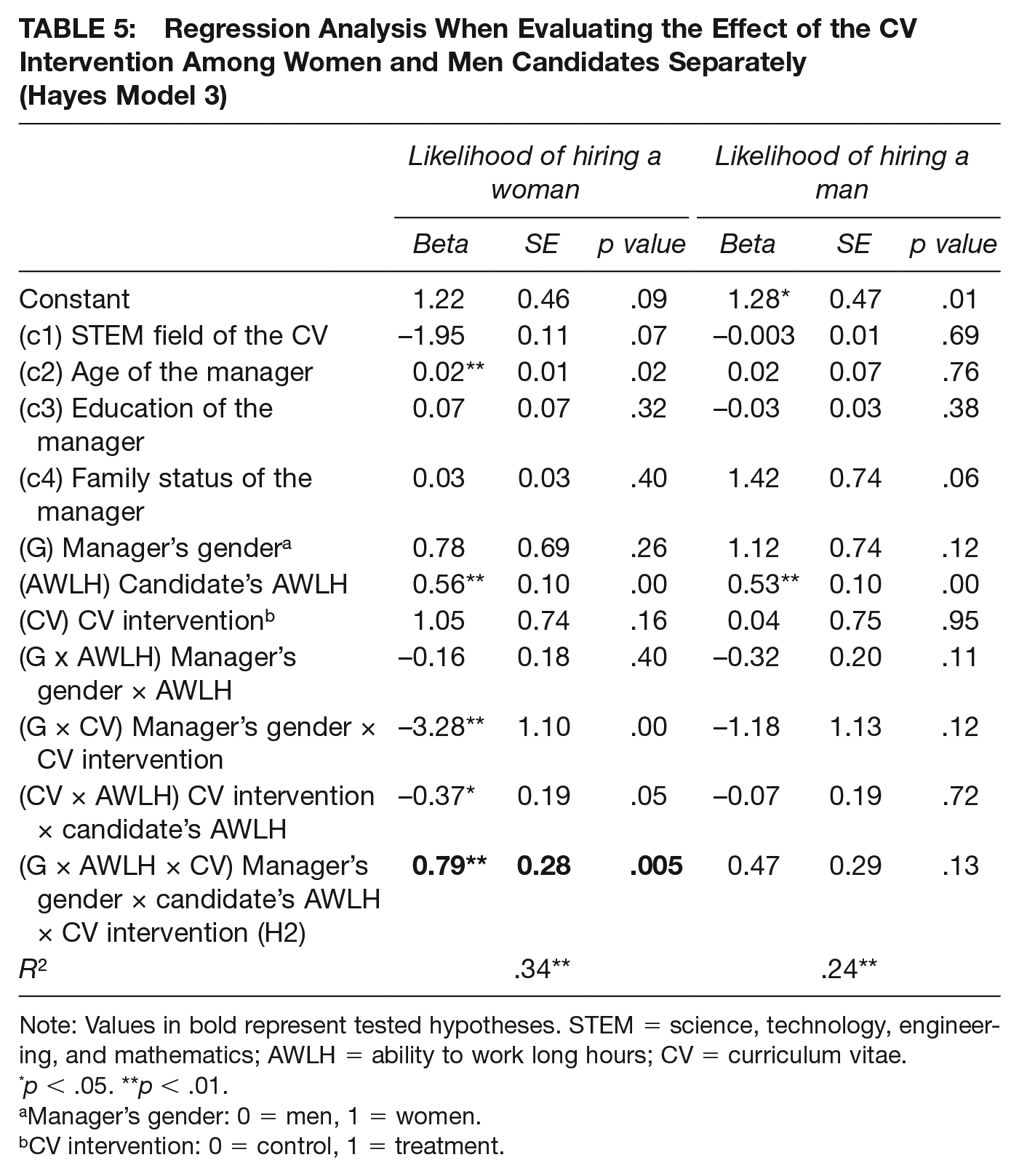
Note: Values in bold represent tested hypotheses. STEM = science, technology, engineering, and mathematics; AWLH = ability to work long hours; CV = curriculum vitae.
p < .05. **p < .01.
Manager’s gender: 0 = men, 1 = women.
CV intervention: 0 = control, 1 = treatment.
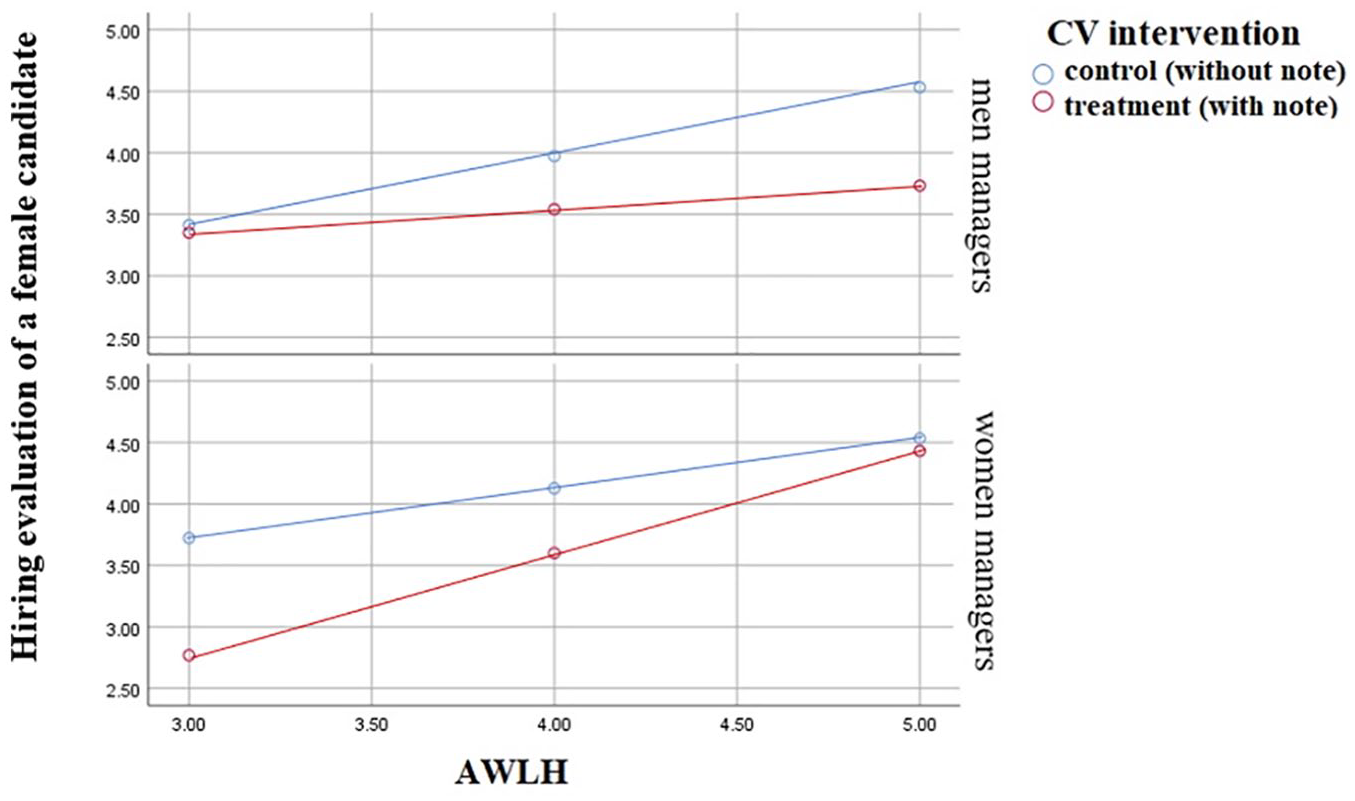
The Moderating Role of CV Intervention and Manager’s Gender on AWLH Importance When Predicting the Hiring Evaluation of a Female Candidate
As Table 6 shows, when predicting the hiring evaluation of a female candidate for men managers, the intervention decreased the importance of ability to work long hours criterion, while unexpectantly the intervention increased the importance of ability to work long hours criterion for women managers. As expected, the male candidate’s evaluation did not yield a significant interaction effect.
Regression Analysis for Managers, Evaluating Candidates, Separately per Gender (Hayes Model 1)
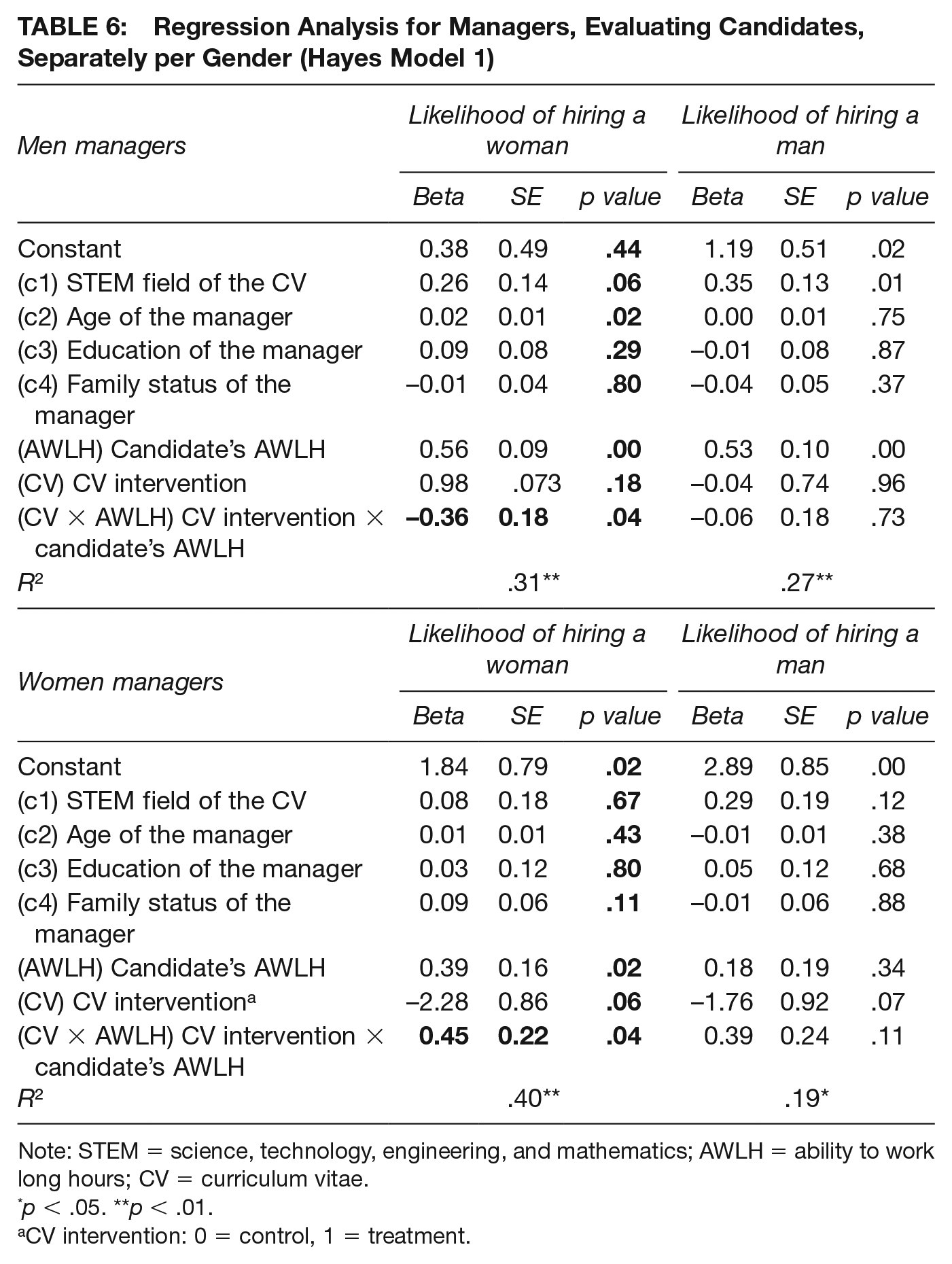
Note: STEM = science, technology, engineering, and mathematics; AWLH = ability to work long hours; CV = curriculum vitae.
p < .05. **p < .01.
CV intervention: 0 = control, 1 = treatment.
The mixed regression analysis was performed on women and men managers separately and examined whether they used different criteria based on the candidate’s gender. The women and men managers assigned equivalent levels of importance to the attributes of the woman and man job candidates in the control condition (Male managers: BCandidate’s gender × AWLH = 0.06, SE = 0.14, p = .63; MCandidate’s gender × PSA = ‒0.04, SE = 0.14, p = .79; Women managers: BCandidate’s gender × AWLH = 0.005, SE = 0.20, p = .98; MCandidate’s gender × PSA = 0.33, SE = 0.21, p = .13) and in the treatment condition (men managers: BCandidate’s gender × AWLH = ‒0.21, SE = 0.20, p = .30; M Candidate’s gender × PSA = 0.20, SE = 0.20, p = .31; women managers: BCandidate’s gender × AWLH = 0.32, SE = 0.21, p = .14; MCandidate gender’s × PSA = 0.04, SE = 0.23, p = .86). This means the criteria were stable across candidates.
The CV intervention succeeded in lowering the ability to work long hours criterion for any candidate among men (BCV intervention = ‒1.76, SE = 0.62, p < .001; BAWLH = 0.32, SE = 0.12, p < .01; BCV intervention × AWLH = 0.35, SE = 0.16, p < .05), while it did not change the importance of the ability to work long hours criterion when evaluating any candidate among women managers (BCV intervention = 0.47, SE = 0.52, p = .37; BAWLH = 0.56, SE = 0.07, p < .001; BCV intervention × AWLH = ‒0.23, SE = 0.13, p = .008). See Figure 4 for the summary of results for the ability to work long hours criterion.
The Importance of AWLH Criterion, with or without a Personal Note for Men and Women Managers, Evaluating Candidates
To test whether possible initial gender bias in explicit ability to work long hours perceptions was evident, we found that the interaction was insignificant, F(1, 107) = 1.03, p = .31. Managers did not perceive women and men candidates differently on the ability to work long hours attribute (men managers: MWomen’s AWLH = 3.65, SD = 0.90; MMen’s AWLH = 3.68, SD = 0.80; women managers: MWomen’s AWLH = 3.69, SD = 0.82; MMen’s AWLH = 3.47, SD = 0.73). The same pattern was evident in the problem-solving ability perceptions, and the interaction was insignificant, F(1, 107) = 2.37, p = .13. Managers did not perceive women and men candidates differently on the problem-solving ability attribute (men managers: MWomen’s PSA = 3.87, SD = 0.94; MMen’s PSA = 4.10, SD = 0.77; women managers: MWomen’s PSA = 4.06, SD = 0.75; MMen’s PSA = 3.81, SD = 0.71). Thus, we did not find any explicit gender bias in perceptions hiring.
Last, to test whether possible initial gender bias in the hiring decision outcome exists, we found an insignificant interaction between the factor (hiring male vs. female candidate) by the manager’s gender: F(1, 107) = 0.009, p = .92 (men: MHiring women = 3.69, SD = 0.89; MHiring men = 3.70, SD = 0.76; women: MHiring women = 3.97, SD = 0.81; MHiring men = 3.72, SD = 0.66). These results indicate that in general, men were not preferred over women, and that there was no explicit bias in the initial hiring outcome.
Discussion
Our goal was to explore implicit and explicit bias in hiring practices in STEM focusing on hiring criteria, specifically ability to work long hours and problem-solving ability among men and women managers. We tested an intervention to deal with one criterion (ability to work long hours) that particularly affects women as they seek entry into STEM work.
We exposed an implicit gender bias in a specific criterion, as men managers gave greater importance than women managers to the ability to work long hours, and displayed a type of implicit in-group gender favoritism. This was not explicit discrimination because the importance of the ability to work long hours criterion was exposed indirectly when examining explicit ability to work long hours and problem-solving ability perceptions on the hiring outcome, while there were no significant differences between men and women candidates in the explicit ability to work long hours and problem-solving ability perceptions. These findings stress the hidden androcentric values in STEM (Thelwall, Abdullah, and Fairclough 2022) and reveal the salience of gender biases in STEM hiring practices.
Woman managers (compared with men managers) gave greater importance to problem-solving ability, which is a more gender-balanced criterion, as problem-solving ability was conceptualized as concrete STEM-related problem-solving. This criterion allowed women with relevant skills to be considered competent for the job. By contrast, women managers attributed less weight to the ability to work long hours criterion, which challenges many women.
The ability to work long hours intervention reduced men managers’ importance of the ability to work long hours criterion; however, it elevated women managers’ importance of the ability to work long hours, as they expected the female candidate to have ability to work long hours capacity. This is a type of gender backlash: Women who possess masculine attributes are more severely judged due to their inconsistency with gender expectations (Rudman and Fairchild 2004). This “win some, lose some” consequence was unexpected, suggesting that women managers may unconsciously self-correct their hiring criteria according to the STEM (male-oriented) norms. This consequence should be kept in mind, as women managers are still the minority in STEM.
Our research is supported by the claim that the 24/7 work criterion is more achievable for men than for women, and this sustains workplace inequality (Padavic, Ely, and Reid 2020). Thus, the bias we found in the form of differential criteria for women and men STEM managers, referring to female candidates, is a gender bias that perpetuates social power structures (Nelson and Zippel 2021). However, one must wonder about how this criterion became implicitly important for men managers today. There are two possible explanations: (1) Women’s perceived low ability to work long hours caused this structural disadvantage, which in turn leads to discrimination in the hiring process, or (2) discrimination against women is a priori, and justified by their perceived low ability to work long hours. In this case, if we address this criterion individually to reduce hiring disparities, then we might bring about the selection of a different criterion that will justify the discrimination. The two explanations together create a circular reality, in which it is not clear how this implicit ability to work long hours normative criterion was institutionalized for men managers, but it is unlikely to change unless structural mechanisms address the needs of all workers.
Theoretical Contributions
Our research has several theoretical contributions. First, we show that an implicit gender bias in criteria is present in STEM hiring. Past literature has suggested explicit and implicit gender biases, focusing on implicit gender bias in perceptions of candidates’ abilities using the IAT test. We differentiated between two forms of implicit biases used for hiring decisions when referring to implicit bias in perceptions and criteria. Second, this paper is the first to demonstrate the importance of an external attribute: ability to work long hours, in a theoretical model that was empirically tested. Third, existing literature was equivocal regarding whether women and men STEM managers both internalize the masculine point of view in the criteria they use for hiring decisions. We show that they hold different criteria, which fits the prediction of in-group favoritism model in a subtler form. Thus, we suggest the implicit in-group gender favoritism model. Only the men managers kept the ability to work long hours barrier for hiring female candidates, whereas the women managers focused on problem-solving ability, which does not give one gender an advantage. Fourth, we targeted managers (instead of candidates) and demonstrated a successful intervention to deal with gender bias.
Practical Implications
This paper makes four practical contributions, two individual and two organizational. First, women can take the perspective of managers and choose to specify their ability to work long hours in the hiring processes, in the form of a personal note or a comment made in an interview. Neumark (2018) recommended that women should add job-relevant information to their CV because their gender may influence the manager’s hiring decision. However, this recommendation highlights the women’s ability to work long hours paradox: While the recommended note may ultimately reduce implicit gender bias in STEM hires, it may explicitly highlight inequality and preserve traditional gender expectations, by acknowledging that women do not usually have the ability to work long hours. This is aligned with Judith Lorber’s Paradoxes of Gender: women’s fight to erase the effects of sex differences, invokes them (Lorber 1994). The recommendation to add this note assumes gender inequality, as found in most STEM organizations (Thébaud and Charles 2018). Thus, in the STEM fields, the note is expected to be beneficial, but is not without hidden costs.
Second, managers should be aware of ability to work long hours as an implicit bias criterion in making hiring decisions, because sometimes awareness of the implicit bias (e.g., through professional journals or in diversity training) can bring about individual attitudinal change (Forscher et al. 2019). If they design the training, they should provide information on this type of implicit bias. This will make the implicit bias more demonstrable and relatable (Nelson and Zippel 2021).
Individual changes among candidates and managers may be effective in the short run, but this might individualize inequality while leaving structural roots of gender bias hidden (Nelson and Zippel 2021). Thus, we offer two additional organizational suggestions that strive to deal with the roots of the problem. The first involves accepting the need of the organization for employees who can work long hours and supporting employees by adding salary to cover home and child care expenses for all employees, similar to travel expenses. Intel introduced an intervention during COVID-19 lockdowns that provided all employees with activities for entertaining children and reimbursement for family care. This reduced work–family imbalance related to COVID-19 (Chung et al. 2021). Such structural interventions emphasize that women are not solely responsible for home and childcare chores, thus dealing with the roots of the social problem.
The other organizational change is to challenge the need for ability to work long hours by decreasing the demand for over-long work hours. This expectation of long hours may be how gender discrimination is embedded in the organization itself, illustrating how inequalities between women and men continue despite attempts to erase them (Acker 2006). This change of norms in STEM fields might dismantle a hidden structural barrier for women.
Conclusion
Although the note in the CV reduced implicit bias for men managers, there might be other types of biases that were not measured here. For example, we examined two attributes in hiring decisions, but other attributes, such time efficiency or interpersonal skills, might also be related to gender bias. We also manipulated only ability to work long hours, whereas future interventions might manipulate other attributes (such as problem-solving ability). It is possible that women’s adding a personal note highlighting exceptional problem-solving ability may increase the importance of this criterion as compared with ability to work long hours. We do not claim that this is the sole source of implicit gender bias in STEM, because women’s interest in the field, educational choices, or prior relevant work experience may also handicap their hiring chances. Future research should also focus on women’s implicit bias toward their fit to STEM careers.
The use of a nanny note in the CV relates to parents seeking STEM employment, and interventions of this type should include household help, which is applicable to both men and women hires. Both men and women have additional needs (e.g., housekeeping, care of pets, care of elderly). A “domestic help” note would increase the generalizability of the findings. Examining the effect of other types of domestic help can also clarify whether ability to work long hours is more about motherhood/fatherhood than about gender. If not, future studies should explore the impact of a note stating that the partner has job flexibility allowing him responsibility for domestic chores.
Other issues to explore include how the importance of the ability to work long hours criterion may change for older/younger candidates who are parents of young or older children. It might be that the age of the candidate or age of children will be more relevant than actual parenting status, as young candidates can potentially have children in the future. Future studies should explore the actual effectiveness of this intervention using real hiring situations, beyond the use of experimental design that has disadvantage of limited external validity.
In our research, the note was written based on the assumption that gender is viewed as binary. However, nowadays, gender is conceptualized on a broader continuum, including people with undefined gender (Alfrey and Twine 2017). Future studies should consider recommendations for the employment of these populations beyond the traditional gender dichotomy. In addition, many STEM hiring decisions depend on hiring committees, not just on individual hiring decisions. Thus, the group decision context may be further studied.
Some women in the STEM fields might not wish to prioritize career over family or utilize the salary budget for childcare. Future studies should explore the proportion of women who feel comfortable adding this note or outsourcing home and childcare chores. The intervention suggested might be class biased: Only those who can afford a nanny can add such a note. However, the high salary in STEM fields might suggest this recommendation is less class relevant (Bannikova and Petrov 2014).
This study did not control for many managers’ characteristics such as level of religiosity, race, and religion, since most STEM professionals are relatively homogeneous in their class, mainly Caucasian, high socioeconomic status, men (Ma and Liu 2015; McMorris 2016). Future studies should further control for less stereotyped STEM managers because the results may vary for them.
The experiment was conducted before COVID-19, which has turned into a real-life intervention that might lower the importance of AWLH as employees increasingly worked from home. Future research should explore whether the COVID-19 pandemic has altered hiring criteria in STEM relating to long hours or attendance in person in the workplace.
In summary, the low percentage of women working in STEM careers reflects implicit gender bias (Reuben, Sapienza, and Zingales 2014). We found that when evaluating female candidates, men managers have an implicit in-group gender favoritism. We further suggest that individual and institutional interventions may reduce the importance managers assign to the ability to work long hours criterion. This paper adds to the previous literature, which recommends interventions for women rather than changing the implicit gendered culture in STEM hires.
Supplemental Material
sj-docx-1-gas-10.1177_08912432221137910 – Supplemental material for Gender Bias in Stem Hiring: Implicit In-Group Gender Favoritism Among Men Managers
Supplemental material, sj-docx-1-gas-10.1177_08912432221137910 for Gender Bias in Stem Hiring: Implicit In-Group Gender Favoritism Among Men Managers by Enav Friedmann and Dorit Efrat-Treister in Gender & Society
Footnotes
Authors’ note:
We thank Gal Gutman, Niza Yanay, and Idit Fast for reviewing the paper, and giving their insightful comments that helped us improve our work.

Supplemental Material
Supplemental material for this article is available online.
Notes
Enav Friedmann, Ph.D. Assistant professor at the Guilford Glazer Faculty of Business and Management at Ben Gurion University (BGU) in Israel. Enav is the head of the BGU marketing lab. She holds a Ph.D. in Business Administration from BGU and was a visiting scholar at Ca’ Foscari University in Venice, Italy. Her current research includes brand preferences and purchasing choices, tailoring to heterogeneous consumer strata, specifically gender-related marketing, and social marketing.
Dorit Efrat-Treister is a Senior Lecturer at the Guilford Glazer Faculty of Business and Management, Ben-Gurion University of the Negev. She received her Ph.D. in Organizational Behavior at the Technion, Israel Institute of Technology, and continued as a postdoctoral fellow at the Sauder School of Business, University of British Columbia.
References
Supplementary Material
Please find the following supplemental material available below.
For Open Access articles published under a Creative Commons License, all supplemental material carries the same license as the article it is associated with.
For non-Open Access articles published, all supplemental material carries a non-exclusive license, and permission requests for re-use of supplemental material or any part of supplemental material shall be sent directly to the copyright owner as specified in the copyright notice associated with the article.
