



Abstract
White, male-dominated professions in the United States are marked with substantial gender and racial inequality in career advancement, yet they often face pressures to increase diversity. In these contexts, are theories of employer biases based on gender and racial stereotypes sufficient to explain patterns of hiring discrimination during common career transitions in the external labor market? If not, how and why do discrimination patterns deviate from predictions? Through a case study of software engineering, we first draw from a large-scale audit study and demonstrate unexpected patterns of hiring screening discrimination: while employers discriminate in favor of White men among early-career job applicants seeking lateral positions, for both early-career and senior workers applying to senior jobs, Black men and Black women face no discrimination compared to White men, and White women are preferred. Drawing on in-depth interviews, we explain these patterns of discrimination by demonstrating how decision-makers incorporate diversity value—applicants’ perceived worth for their contribution to organizational diversity—into hiring screening decisions, alongside biases. We introduce diversity commodification as the market-based valuative process by which diversity value varies across job level and intersectional groups. This article offers important implications for our understanding of gender, race, and employer decision-making in modern U.S. organizations.
White, male-dominated professions in the United States—including those in science and technology sectors—are marked with gender and racial inequality in career advancement, such that women and minoritized racial groups experience relatively slower progression to subsequent job levels in the organizational hierarchy, greater risk of mid-career stagnation, and higher attrition from the occupation compared to White men (Han and Tomaskovic-Devey 2022; Neely, Sheehan, and Williams 2023; Simard et al. 2008; Thomas et al. 2021). Because many workers attempt to advance their careers in the external labor market (Kalleberg and Mouw 2018), a key “demand-side” explanation for this inequality (Rivera 2020) is employer discrimination in hiring decisions against workers seeking job mobility. Conventional social psychological theories predict that hiring discrimination against Black women, Black men, and White women workers is heightened when workers seek higher-status positions, because gender and racial stereotypes will influence employer decision-making to a greater degree compared to when workers apply to lateral positions (Gorman 2006; Gorman and Kmec 2009).
At the same time, U.S. corporations face pressures from external and internal audiences to reduce inequality and increase diversity—with particular pressures targeted toward occupations and industries that remain dominated by White men (Berrey 2015; Dobbin and Kalev 2021; Han and Tomaskovic-Devey 2022; Portocarrero and Carter 2022b). By some accounts, organizations in recent years may be motivated to respond to these pressures as they have become more transparent and are held more accountable for addressing their lack of diversity (Bromley and Powell 2012; Dobbin and Kalev 2021).
In White, male-dominated occupations that face strong pressures to increase the gender and racial diversity of their workforces, are predictions based on conventional theories of stereotypes and employer biases sufficient to understand patterns of discrimination toward Black women, Black men, and White women in hiring decisions during common career transitions? If not, how and why might patterns of hiring discrimination deviate from predictions? Existing scholarship offers important theoretical and empirical insights into the effectiveness of formal organizational diversity efforts (e.g., Castilla 2015; Dobbin and Kalev 2022; Kalev, Dobbin, and Kelly 2006) and the nature of corporate diversity ideologies (e.g., Embrick 2011; Leong 2013; Mayorga-Gallo 2019), but prior work is ambiguous as to how, to what extent, and for whom diversity pressures modify discriminatory decision-making in hiring—if they do at all. This theoretical ambiguity is coupled with a lack of relevant and decisive empirical evidence.
We address these questions with two studies in the context of software engineering, an occupation that remains highly dominated by White men and faces intense pressures to diversify (Han and Tomaskovic-Devey 2022; Neely et al. 2023; Twine 2022). We first conduct a clear empirical test of predictions from social psychological bias theories by using a large-scale correspondence audit study (N = 11,190) to assess patterns of discrimination in employers’ hiring screening decisions toward Black men, Black women, and White women seeking job transitions, compared to White men. We find unexpected patterns of discrimination that do not align with stereotype-based bias predictions. In our second empirical study, we provide a necessary interpretation of the quantitative findings through a qualitative analysis of interviews with decision-makers (Small 2011). In doing so, we conceptualize a novel organizational process that explains how and why these unexpected patterns of discrimination occur.
The audit study is designed to measure gender and racial discrimination in hiring screening decisions across three common applicant–job transitions in software engineering: early-career applicants applying laterally to early-career positions (I); the same early-career applicants seeking upward mobility to mid-level positions (II); and mid-level applicants applying laterally to mid-level positions (III). The findings demonstrate clear discrimination in trajectory I: Black men, Black women, and White women each face callback penalties relative to White men when applying laterally to early-career positions. However, when applicants apply to mid-level positions, we unexpectedly find that White women are preferred over other groups, and that Black men and women face no callback penalties relative to White men, regardless of whether the applicants are attempting upward (trajectory II) or lateral (trajectory III) transitions.
In our second study, we illuminate the underlying forces behind the anomalous patterns of discrimination in the audit study by conceptualizing the observed levels of discrimination as a product of not only stereotypes and biased assessments but also applicants’ diversity value—a market-based appraisal reflecting applicants’ perceived worth toward organizational diversity. Drawing from in-depth, semi-structured interviews with 62 hiring decision-makers, we describe a novel organizational process in which decision-makers (a) conceptualize “diversity” and seek to identify diversity-relevant job applicants; (b) assess applicants’ diversity value; and (c) incorporate applicants’ diversity value into their hiring screening decisions along with their stereotyped biases. We call this valuative process diversity commodification, aligning with the notion from critical diversity scholarship that to extract value from an individual’s identity through exchange is to commodify it (Leong 2013:2183; see also Berrey 2015; Embrick 2011; Mayorga-Gallo 2019).
The process of diversity commodification specifies the mechanisms by which diversity value for White women, Black women, and Black men varies across job levels in the context of software engineering hiring, thus explaining the patterns of discrimination in the audit study. Decision-makers in this context assess an applicant’s diversity value based on a competitive market for “diversity,” a catch-all conceptualization that includes workers who are women or Black (or both). These market forces correspond to position level: as position level rises, the supply of applicant diversity declines and the demand for employee diversity strengthens, resulting in higher diversity value for White women, Black women, and Black men. And yet, because decision-makers consider anyone who is a woman and/or Black as contributing to overall diversity, decision-makers subtly prefer to accrue diversity through White women to avoid what they perceive as costs associated with Black representation, namely costs to organizational comfort and, counterintuitively, to the company’s diversity image. As White women are implicitly in greater demand than Black men or Black women, they possess the highest relative diversity value.
This article makes three major contributions. First, we show that in the context of a White, male-dominated occupation under strong pressures to diversify, conventional stereotype-based bias theories do not fully explain patterns of gender and racial discrimination at the hiring screen across job transitions. Second, we introduce diversity commodification as an organizational process by which decision-makers assess job applicants’ diversity value and incorporate that value into their hiring screening decisions along with other biases they may possess. As diversity value is a crucial part of the decision-making calculus, explanations for the observed patterns of hiring discrimination in this context should account for variation in diversity value. Finally, our empirical documentation of widespread patterns of hiring discrimination in software engineering—where the exclusion of women and racialized minority workers is an ongoing social problem (Neely et al. 2023)—provides clarity for researchers, businesses, and policymakers as to when and for whom hiring discrimination occurs. More generally, we argue that through diversity commodification, organizations may avoid some forms of blatant and discriminatory exclusion in hiring decisions, but by placing an instrumental value on women and Black applicants, they fall short of offering full inclusion to these groups, much less disrupting gendered and racialized organizational structures.
Stereotypes, Bias, and Predicted Patterns of Hiring Discrimination Across Job Transitions
In occupations dominated by White men, women and minoritized racial groups tend to become increasingly underrepresented as careers progress from early- to mid-career and beyond (see Neely et al. 2023). Gender and racial inequality in career advancement is a result of multiple underlying processes, including unequal access to networks and organizational resources, constrained preferences, and human capital differences (Hull and Nelson 2000; Shih 2006; Tomaskovic-Devey, Thomas, and Johnson 2005). We focus on a “demand-side” explanation (Rivera 2020): that gender and racial inequality in career progression is shaped, in part, by employer discrimination against Black men, Black women, and White women, in favor of White men, in evaluation and selection decisions during workers’ attempted job transitions. Job transitions may occur when workers seek a new position, either within their current organization or across organizations in the external labor market (Kalleberg and Mouw 2018). We center our attention on discrimination in the external labor market, that is, at the point of hire.
Drawing from psychological and social psychological theories, a conventional approach to understanding hiring discrimination depicts organizational gatekeepers as motivated to select the best person for a given position, but hampered by cognitive biases that skew their perceptions and assumptions about workers (see Rivera 2020). In occupations dominated by White men, gender and racial stereotypes influence employers’ evaluations of workers’ performance and their resulting decisions (Correll and Ridgeway 2003). The specific content and extent of stereotypes differ across intersectional groups (Ridgeway, Korn, and Williams 2022; Rosette et al. 2018), yet, in general, both Black men and Black women are stereotypically depicted as less competent and less suitable for positions of authority compared to White men (Correll and Ridgeway 2003; Ridgeway et al. 2022; Rosette et al. 2018). General stereotypes of competence appear less relevant for White women (e.g., Rosette et al. 2018), but White women and Black women both face gendered assumptions of lower technical and analytic competence in specific occupational domains, such as science, technology, and engineering (Eaton et al. 2020).
When a position is structured around the abstract image of a White man, filled by White men, and associated with the skills and abilities White men are assumed to possess, decision-makers are expected to rely on gender and racial stereotypes as a cognitive shortcut, biasing evaluations and decisions in favor of White men and against Black women, Black men, and White women (Acker 1990; Correll and Ridgeway 2003; Gorman 2006; Gorman and Kmec 2009; Ray 2019; Ridgeway et al. 2022). For stereotyping to influence employer decisions, decision-makers must have some degree of uncertainty about an individual’s abilities; when there is sufficient information or high certainty about a worker’s performance, stereotypes are less relevant as cognitive shortcuts (Gorman and Kmec 2009). Hiring decisions are rife with uncertainty (Botelho and Abraham 2017; Rivera 2020), but the extent of uncertainty likely varies across the type of job transition attempted—resulting in clear theoretical predictions regarding which common job transitions incur more or less discrimination.
Figure 1 offers a visual depiction of common types of external career transitions to orient these predictions. We use the terms “junior” and “senior” to indicate the relative hierarchy of positions, rather than a specific level of seniority within the corporate hierarchy. When considering how discrimination could affect career advancement for a relatively junior worker seeking a higher-level position, it is helpful to offer comparisons to lateral transitions at both junior and senior levels, as both the worker’s job level and the position’s job level could shape discrimination. We first compare predictions for applicants making upward transitions (junior-to-senior) to the same applicants making lateral transitions (junior-to-junior), in effect holding the applicant’s level constant while the position level varies. We then compare predictions for the junior-to-senior upward transition to the senior-to-senior transition to consider how variation in applicants’ job level affects predicted levels of discrimination. 1
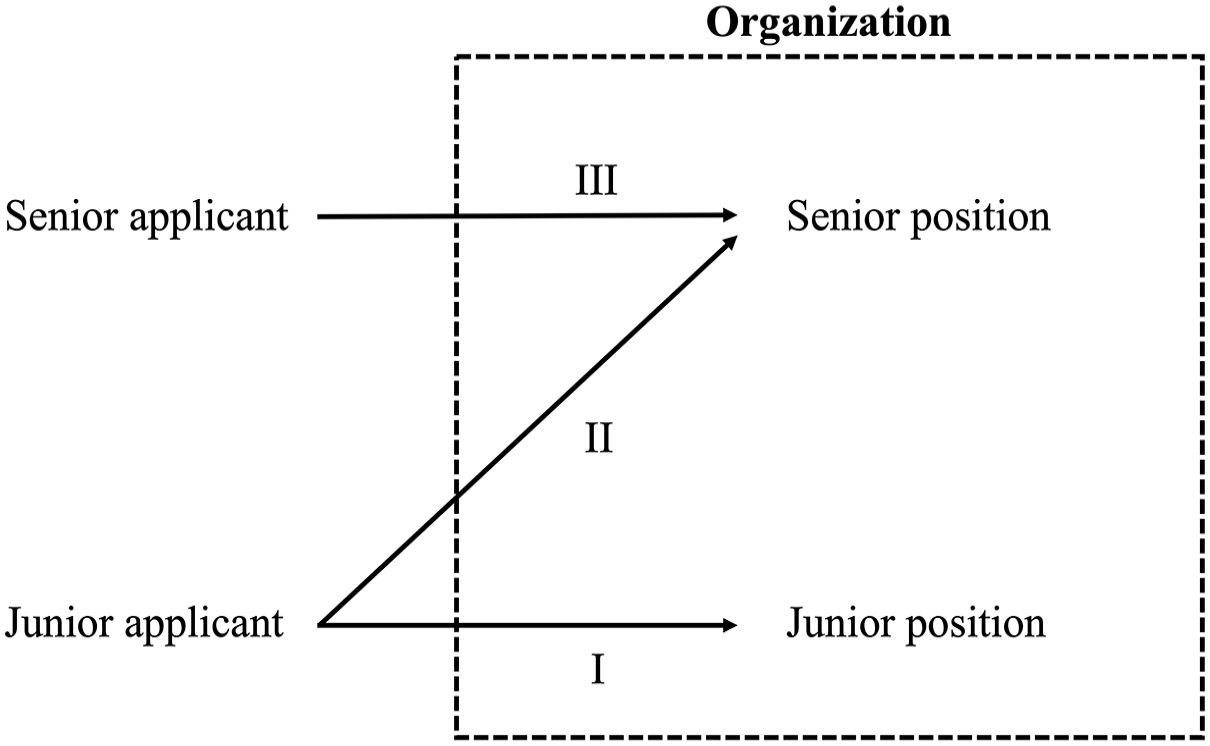
Applicant–Job Trajectories of Interest
First, the previously-described theories of intersectional stereotypes and biased decisions would predict that White women, Black men, and Black women face some level of discrimination for all three common transitions: junior-to-junior, junior-to-senior, and senior-to-senior transitions. Beginning with the junior-to-junior transition to orient comparative predictions, conventional theories of stereotype-based biases support the following prediction: 2
Prediction 1: Black men, Black women, and White women will experience discrimination compared to White men in junior-to-junior transitions.
Second, workers seeking upward mobility are expected to face more discrimination than the same individuals seeking a lateral transition to a junior-level position—while decision-makers may be uncertain that junior applicants will successfully perform in a job similar to the one they currently hold, they will be even more uncertain when applicants apply to a new, higher-level position (Gorman 2006; Gorman and Kmec 2009). Moreover, higher-level positions may have even stronger associations with White men and the traits and abilities they are assumed to possess because they are increasingly filled by White men (Petsko and Rosette 2023). Both of these factors strengthen the relative influence of stereotypes that advantage White men in the upwardly-mobile transition attempt (trajectory II) compared to lateral junior transitions (trajectory I):
Prediction 2: Discrimination against Black men, Black women, and White women, relative to White men, will be greater in junior-to-senior transitions compared to junior-to-junior transitions.
Finally, under a similar logic, junior workers applying to senior positions are expected to face more discrimination than senior workers attempting a lateral move. In senior-to-senior transitions, where discrimination is also expected, employers are more certain of a worker’s ability to fulfill the senior-level position duties because the worker has already successfully attained a higher-level position (Gorman 2006; Gorman and Kmec 2009):
Prediction 3: Discrimination against Black men, Black women, and White women, relative to White men, will be greater in junior-to-senior transitions compared to senior-to-senior transitions, where discrimination against these groups is also expected.
Patterns of Discrimination Under Pressures to Diversify
The White, male-dominated occupations in which theories of stereotypes and bias offer clear predictions regarding patterns of discrimination are often the same occupational contexts in which pressures to diversify are strong (Han and Tomaskovic-Devey 2022). Diversity pressures may come from multiple sources, including legal concerns to avoid civil rights litigation; social and cultural influences from the media and the public; stakeholder demands for workforce diversity; institutional norms; and employee expectations for inclusivity (see reviews in Dobbin and Kalev 2021; Portocarrero and Carter 2022b). The outstanding theoretical question is whether the above predictions hold under strong pressures to diversify, or whether such pressures result in less discrimination, or different patterns of discrimination, than predicted.
A large body of scholarship examines diversity efforts within organizations, typically focusing on formal organizational DEI (diversity, equity, and inclusion) policies, practices, and interventions, often adopted in response to diversity pressures (Castilla 2015; Correll 2017; Dobbin and Kalev 2021; Kalev et al. 2006). This literature suggests organizations may attempt to address discrimination by adopting formal practices meant to reduce decision-maker cognitive biases through training and education, or through policies aimed at reducing the influence of bias on decisions by making the process transparent or by making decision-makers feel accountable for their decisions (Dobbin and Kalev 2022). There is evidence that some DEI practices, particularly those that increase decision-making transparency and assign accountability, are associated with fewer discriminatory and unequal outcomes (Castilla 2015; Dobbin and Kalev 2022). However, formal organizational efforts to reduce cognitive biases or limit their influence on decision-making are likely not enough to systematically alter the levels of hiring discrimination that women and minoritized racial groups face during job transitions.
There are two main reasons for this assertion. First, while corporate DEI efforts are common, they often do not accomplish their intended purpose (Kalev et al. 2006); for many organizations, implementing DEI practices—not their effectiveness—is an end in itself (Bromley and Powell 2012). Beyond being ineffective, some DEI practices may result in backlash and an accentuation of decision-maker biases against women and minoritized groups if not implemented carefully (Dover, Kaiser, and Major 2020). Second, given the insidiousness of stereotypes and bias, DEI practices that do seem to effectively limit the role of biases during decision-making are often difficult and costly to implement (Correll 2017; Dobbin and Kalev 2021). For instance, Correll (2017) outlines an effective approach for limiting biased assessments during personnel decisions involving a thorough examination and recalibration of evaluation criteria and formalization of the resulting practices to reduce ambiguity. To be sure, some organizations may have the motivated personnel and access to resources and knowledge to implement practices successfully that limit the influence of stereotypes and bias in the decision-making process. Nevertheless, in the aggregate across organizations, stereotypes and biases are likely still influential, and discrimination patterns predicted by conventional bias theories are likely to hold.
And yet, it is theoretically plausible that discrimination may be reduced through a different mechanism other than curbing the influence of biases in decision-making. Scholarship critical of corporate approaches to diversity argues that organizations under pressure to diversify gain status and legitimacy by showcasing the diversity of their workforce, leading employers and other decision-makers to value workers who contribute instrumentally to this organizational objective (Mayorga-Gallo 2019; Okuwobi, Faulk, and Roscigno 2021). Indeed, a defining feature of the employer–worker relationship under pressure to diversify is the valuation of workers for their contribution to diversity (Leong 2013). 3 Importantly, decision-makers may value individuals as beneficial for organizational diversity while still holding strong biases about their performance capacities (Warikoo 2016). Additional insights from this scholarship include the corporate preoccupation with demonstrating numerical diversity rather than ensuring full inclusion of workers into the organization (Berrey 2015; Leong 2013), and how diversity rhetoric flattens differences between distinct identities considered to fall under the diversity banner (Bell and Hartmann 2007; Douds 2021; Edelman, Fuller, and Mara-Drita 2001; Embrick 2011; Mayorga-Gallo 2019). Although these theoretical insights are not typically applied to hiring and other personnel decisions, they suggest that patterns of discrimination may be systematically lessened in occupational contexts facing strong pressures to diversify, not because the decision-making process is free from the influence of bias—decision-makers may remain biased in their assessments of workers’ performance—but because employers prize workers’ contribution to diversity.
These insights from critical diversity scholars, while intriguing, do not coalesce into an explanatory theory as to how or to what extent hiring discrimination across career transitions, or even across intersectional gender and racial groups, will vary. If patterns of hiring discrimination are found to deviate from the predictions of conventional bias theories, a more nuanced theoretical explanation will be needed.
Limited Empirical Evidence of Hiring Discrimination During Career Transitions
The uncertainty of whether predictions of conventional bias theories hold under strong diversity pressures is due in large part to the lack of relevant and decisive evidence regarding the empirical patterns of hiring discrimination across job transitions. Evidence from audit studies—field experiments that hold applicant information constant to observe different treatment from employers during hiring screening (Gaddis 2018)—has documented racial discrimination across occupational contexts, typically comparing Black men to White men (Quillian et al. 2017), or gender discrimination in (White) masculine occupational contexts, often focusing on White women compared to White men (see Galos and Coppock 2023). Yet, surprisingly, hiring discrimination has not been directly measured and compared between upward and lateral transitions in White and male-dominated occupations under pressures to diversify—where gender and racial stereotypes are clearly potent, as evidenced by the continued hostile and exclusionary work environments that women and minoritized racial groups experience (Melaku 2019; Portocarrero and Carter 2022a).
Gathering decisive evidence is essential for our study because the available circumstantial evidence offers an ambiguous and conflicting picture. On one hand, some scholarship that examines upward mobility through internal promotions demonstrates that women and minoritized racial groups face significant barriers to advancement (Gorman 2006; Gorman and Kmec 2009; Weisshaar 2017; Yap and Konrad 2010). While consistent with stereotyped-bias theories, it is not clear whether these findings translate to the hiring setting. On the other hand, some studies hint of less discrimination in career transitions than we might predict. Fernandez and Campero (2017) find women job applicants are advantaged over men in obtaining certain higher-level IT and engineering positions in high technology firms; and Zeng (2011) shows that in some career stages, White women and underrepresented racial minority men and women transition at higher rates than White men to positions with greater authority (see also Williams and Ceci 2015). More generally, there is some evidence that diversity concerns are top-of-mind for some decision-makers under pressures to diversify; for example, diversity seems to be taken into consideration in selecting members of corporate boards (Chang et al. 2019), as well as in recruitment and hiring processes (Jackson 2023).
Given the lack of decisive evidence available, our first goal is to directly measure and compare hiring discrimination across job transitions under strong diversity pressures by conducting a large-scale correspondence audit study in software engineering—an occupation dominated by White men and subject to pressures to diversify (Han and Tomaskovic-Devey 2022; Neely et al. 2023). If the appropriate data and methods reveal evidence contradictory to bias theory predictions, we will then assess possible explanations for the divergent findings.
The Context of Software Engineering Hiring
Software engineering is a highly technical profession associated with stereotypically masculine skills, abilities, and traits—technical and analytic skills, and also traits such as aggression, competitiveness, and an orientation to things (Robinson and McIlwee 1991). It is a profession dominated by White and Asian men—women comprise only about 19 percent of software engineers nationwide, a level that has barely changed in the past several decades (Neely et al. 2023; Zippia 2022). While 32 percent of software engineers are Asian, less than 5 percent are Black, less than 8 percent are Latino, and only 3 percent of all computing professionals are Black women (NWCIT.org 2019; Zippia 2022). Like other U.S. professions dominated by White men, there is evidence that the representation of women and Black workers decreases as job level increases (Han and Tomaskovic-Devey 2022; Simard et al. 2008). Software engineering has been the focus of strong public pressures to diversify due to its historic underrepresentation of women and Black and Latino workers (Han and Tomaskovic-Devey 2022; Luhr 2023; Twine 2022). 4
We center our analysis on the critical career transition from an early-career software engineering position to a senior software engineering position. Senior software engineering positions are generally considered the first “terminal” level engineers reach (Orosz 2021). After senior software engineer, they may (or may not) continue to a highly technical “individual contributor track” or switch to a management track (Alegria 2019; Indeed 2023b; Simard et al. 2008). Both early-career and senior software engineering positions require strong technical skills—senior software engineers are more experienced and have deeper technical and analytic skill sets but are not primarily managerial in nature (Indeed 2023b). By focusing on two successive software engineering positions, we compare transitions across positions that differ in seniority and expertise but that do not categorically differ in their type of work. We also focus on discrimination against workers who directly apply to job openings through public job advertisements, which is a common means for both early-career and senior software engineers to connect to job openings (Glassdoor Team 2014). 5
Study 1: Establishing Hiring Discrimination Patterns Across Job Transitions
Data
We conducted a correspondence audit study from September 2020 to October 2021 in which we sent 11,190 résumés of fictitious software engineering job applicants to real software engineering job postings. The applications covered three applicant–job trajectories—an early-career software engineer applying to an early-career software engineering position (“junior-to-junior,” trajectory I); an early-career software engineer applying to a senior software engineering position (“junior-to-senior,” trajectory II); and a senior software engineer applying to a senior software engineering position (“senior-to-senior,” trajectory III).
To select the job postings for application, we used web scraping techniques to gather all job postings for early-career and senior software engineering positions on a popular online job-listing website, in the 40 most populated U.S. metropolitan areas (U.S. Census Bureau 2021). We then took a random sample of each of the two job levels. We manually checked all job titles to ensure we appropriately captured early-career and senior software engineering positions. A team of research assistants submitted two applications to each job opening, typically one or two days apart. All applications for junior positions were junior applicants; for senior positions, we randomly assigned either junior or senior applicants. Our sample is about evenly split between applications to junior (N = 5,872) and senior (N = 5,318; 2,707 are junior-to-senior applications and 2,611 are senior-to-senior applications) positions. For each job application, we randomly assigned names to signal applicants’ gender (man, woman) and race (White, Black), using four sets of first and last name combinations from Gaddis’s (2017) analysis of perceptions of names.
Résumé and cover letter details, including applicants’ skills, universities, and employers, were randomized independently and varied across applicants to avoid “template bias” (Lahey and Beasley 2018). Applicants graduated from a highly-ranked public university with a bachelor’s of science degree in computer science and worked at a large technology company. Applicants were currently employed, held common technical and software engineering skills, and completed two internships during their college years. Early-career applicants had three or four years of experience at one company, and senior software engineer applicants had four, five, or six years of experience and had recently been promoted to senior software engineer. For each job, two of the four gender/race groups (Black women, Black men, White women, White men) were randomly selected without replacement and randomly assigned as the first or second applicant. For additional details about the audit study design, see Part 1 of the online supplement.
Variables and Methods
The dependent variable is a “callback,” which was recorded when an applicant received a request for an interview or a positive response from an employer asking for additional information. Our primary independent variables are the applicant’s signaled gender and race and applicant–job trajectory. We conducted a logistic regression model predicting callbacks, with applicant gender/race interacted with applicant–job trajectory, and standard errors clustered by the job. 6 From this logistic regression model, we present an absolute measure of discrimination within each trajectory—the average marginal effect (AME) of gender/race, which is the percentage-point difference between the predicted callback rates for a gender/race group relative to White men. We also present a relative measure of discrimination within each trajectory—the percent (rather than percentage point) difference in predicted callback rates for a gender/race group relative to White men. This relative measure is a simple rescaling of the absolute measure, calculated as the group’s AME relative to White men, divided by White men’s callback rate, and multiplied by 100.
The relative measure is useful when attempting to compare levels of discrimination across job trajectories. One difficulty in comparing absolute measures of discrimination is that the baseline—predicted callbacks for White men—fluctuates across trajectories, meaning the same percentage-point difference could indicate a relatively larger or smaller gap, depending on White men’s baseline callbacks. The relative measure, on the other hand, allows for a more intuitive comparison of magnitude. We compare relative discrimination across trajectories by calculating the percentage-point difference (e.g., Black men’s relative discrimination in one trajectory compared to another trajectory). Our final calculation examines how each gender/race group’s callbacks vary across trajectory by calculating the AME of job trajectory within gender/race group (e.g., Black men’s predicted callback rates in junior-to-senior compared to junior-to-junior transitions). Although not a measure of discrimination, this calculation is informative to illustrate within-group patterns across trajectories.
Audit Study Results
We first consider the callback rate patterns and levels of discrimination within each applicant–job trajectory. Table 1 shows the logistic regression model estimates, and Panel A of Table 2 presents the predicted callback rates and within-trajectory absolute (AMEs) and relative (percent difference in callbacks) measures of discrimination across applicant gender and race, compared to White men.
Logistic Regression Model Predicting Callback Receipt
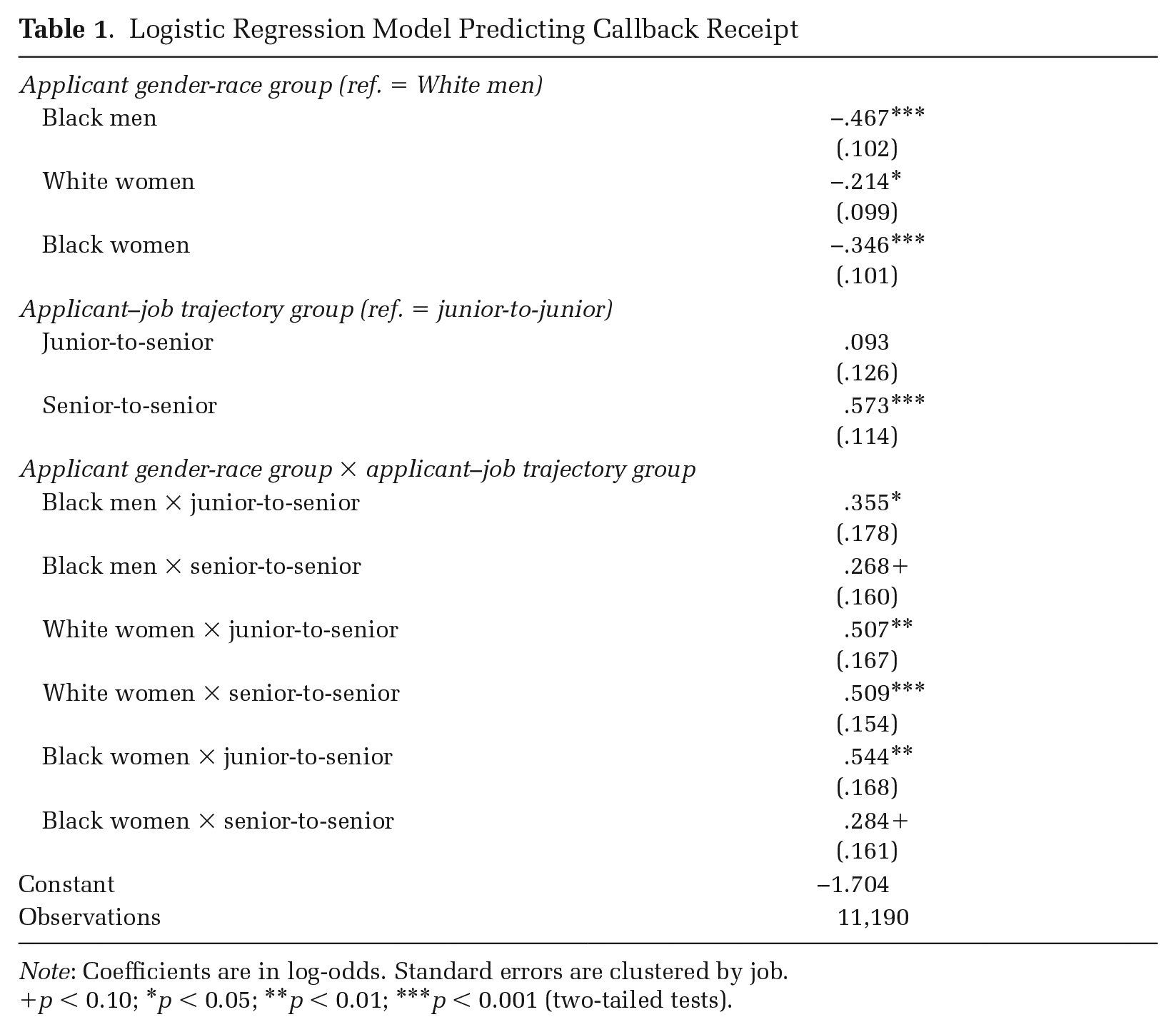
Note: Coefficients are in log-odds. Standard errors are clustered by job.
p < 0.10; *p < 0.05; **p < 0.01; ***p < 0.001 (two-tailed tests).
Audit Study Results, within and across Applicant–Job Trajectories
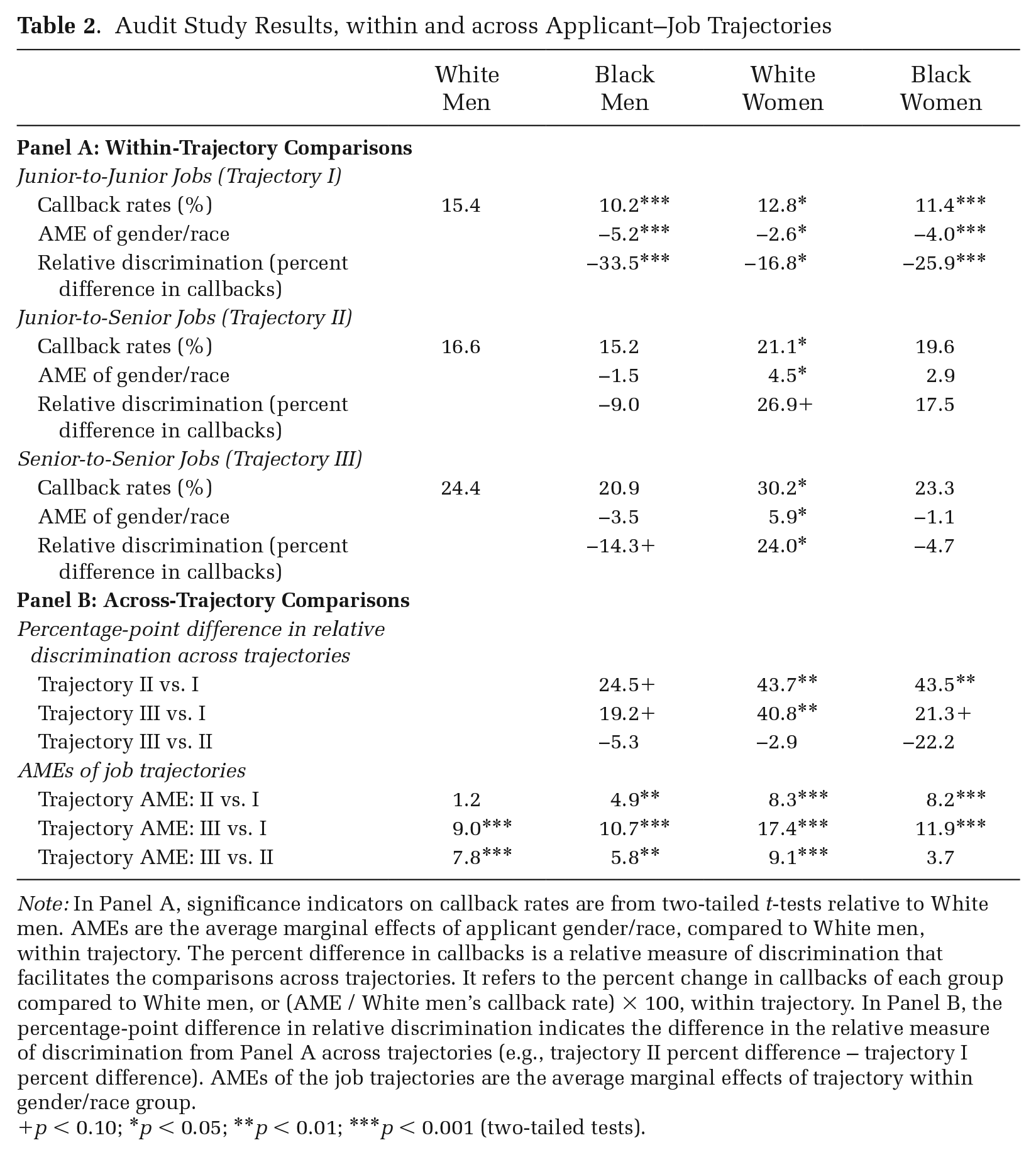
Note: In Panel A, significance indicators on callback rates are from two-tailed t-tests relative to White men. AMEs are the average marginal effects of applicant gender/race, compared to White men, within trajectory. The percent difference in callbacks is a relative measure of discrimination that facilitates the comparisons across trajectories. It refers to the percent change in callbacks of each group compared to White men, or (AME / White men’s callback rate) × 100, within trajectory. In Panel B, the percentage-point difference in relative discrimination indicates the difference in the relative measure of discrimination from Panel A across trajectories (e.g., trajectory II percent difference – trajectory I percent difference). AMEs of the job trajectories are the average marginal effects of trajectory within gender/race group.
p < 0.10; *p < 0.05; **p < 0.01; ***p < 0.001 (two-tailed tests).
Beginning with junior-to-junior jobs in Panel A of Table 2, we find evidence of a preference for White men applicants. In this trajectory, White men had a callback rate of 15.4 percent, which is significantly greater than Black men, who had a callback rate of 10.2 percent (5.2 percentage points lower than White men, p < 0.001), Black women, who had a callback rate of 11.4 percent (4.0 percentage points lower than White men, p < 0.001), and White women, who had a callback rate of 12.8 percent (2.6 percentage points lower than White men, p < 0.05). Put differently, we find that early-career Black men applicants applying to early-career positions experienced a relative penalty of about 33.5 percent, Black women received a penalty of around 25.9 percent, and White women a penalty of about 16.8 percent, compared to early-career White men junior applicants applying to the same early-career positions. For these junior-to-junior transitions, the magnitude of discrimination levels relative to White men are not statistically different across groups. Overall, we find evidence in support of Prediction 1: Black men, Black women, and White women face discrimination in callbacks compared to White men in junior-to-junior applications.
Turning to findings for junior-to-senior applications (trajectory II), an unexpected pattern emerges. Whereas Prediction 2 expects greater discrimination against Black women, Black men, and White women in upwardly mobile attempts, we find no evidence of an advantage for White men early-career applicants applying to senior positions over other gender and racial applicant groups. White men’s callback rate of 16.6 percent is not statistically different from Black men’s callback rate (15.2 percent), nor is it statistically different from Black women’s callback rate of 19.6 percent. Surprisingly, White women received a statistically significantly higher callback rate than White men (p < 0.05): early-career White women applying to senior positions had a callback rate of 21.1 percent, which is about 26.9 percent higher than White men’s callback rate. In fact, in this trajectory, White women’s callback rate is significantly higher than Black men’s callback rate (p < 0.01), although it is not statistically different from Black women’s callback rate.
Considering the final trajectory, senior software engineer applicants applying to senior positions (trajectory III), we find a pattern remarkably similar to trajectory II. Black women’s callback rate, at 23.3 percent, is not statistically significantly different from White men’s callback rate of 24.4 percent, nor is Black men’s callback rate of 20.9 percent. Similar to trajectory II, we find that senior White women applying to senior positions received statistically higher callback rates than White men, with a callback rate of 30.2 percent, or an advantage of 5.9 percentage points (p < 0.05) and about a 24 percent higher rate. White women’s callbacks are also statistically higher than Black men’s (p < 0.001) and Black women’s (p < 0.01) in this trajectory. Taken together, these findings contradict Prediction 3, as we observe no evidence of discrimination relative to White men, in either junior-to-senior or senior-to-senior transitions.
The left panel of Figure 2 illustrates the predicted callback rates across groups, and the right panel displays the percent difference in callback rates of each group relative to White men, within trajectory. It is clear that discrimination toward Black men, Black women, and White women occurs among junior-to-junior applicants (Prediction 1), but for applications to senior positions, the disadvantage is eliminated for Black applicants and even becomes an advantage for White women applicants.
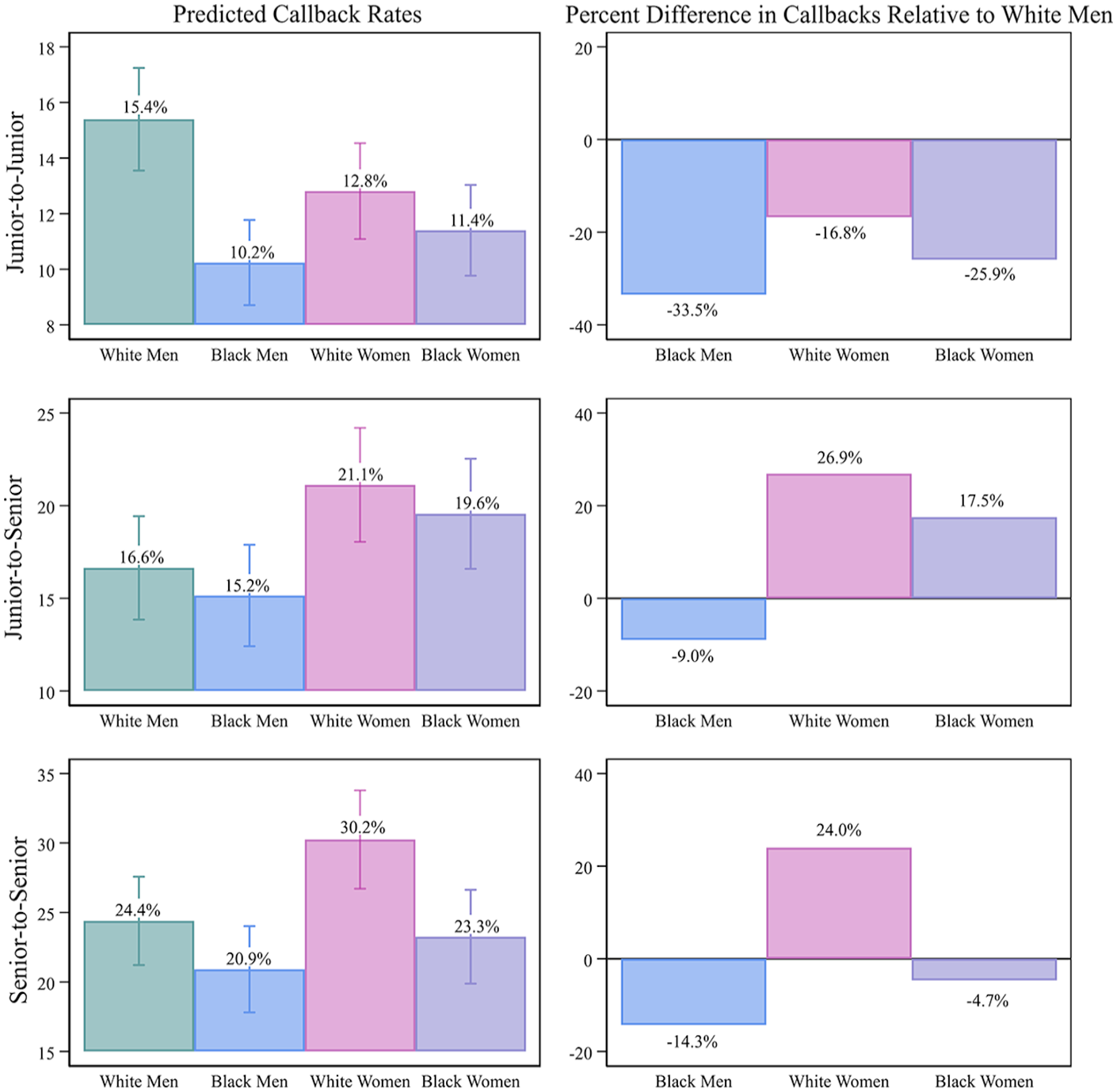
Predicted Callback Rates across Applicant Gender/Race and Percent Difference in Callback Rates Relative to White Men, within Applicant–Job Trajectory
Examining changes in relative discrimination allows for a more intuitive comparison of the magnitude of discrimination across trajectories. Panel B in Table 2 shows the percentage-point difference in relative discrimination across trajectories; positive numbers indicate that groups’ relative position to White men improved from one trajectory to another. In trajectories II and III, Black men, Black women, and White women each experienced significant improvements in their relative position to White men compared to the penalty they experienced in trajectory I. For example, early-career White and Black women applicants’ relative position to White men improved by almost 44 percentage points when applying to a senior position compared to a lateral early-career position (both p < 0.01). Compared to trajectory I, Black men’s relative position improved by 25 (p < 0.10) and 19 (p < 0.10) percentage points in trajectories II and III, respectively. Finally, trajectories II and III have no significant variation in the percentage-point difference in relative discrimination, indicating similar patterns within these trajectories. These results show that Black men, Black women, and White women hold a significantly better position in terms of receiving callbacks compared to White men when applying to senior positions—whether as junior or senior applicants—compared to when they are junior applicants applying to junior positions.
To further explore these unexpected findings, we compare applicants’ callback patterns across trajectories. The bottom of Panel B in Table 2 presents the AMEs of the job trajectories, within each applicant gender/race group. Of note from this calculation is that early-career White men applicants do not receive statistically different callback rates when applying to early-career or senior positions, but early-career Black men, Black women, and White women applicants each had higher callback rates in applications to senior positions than junior positions (all p < 0.01). Put differently, the callback rate patterns in trajectory I compared to trajectory II appear to be due to junior women and Black applicants receiving higher callback rates when seeking senior positions compared to lateral transitions, in contrast to junior White men’s relatively stable callbacks.
Summary and Interpretation of Audit Findings
Overall, the audit study results illustrate a surprising pattern that does not fully align with our predictions of discrimination across applicant–job trajectories. While we find support for Prediction 1—White men are preferred over Black men, Black women, and White women in junior-to-junior transitions—we find no support for Predictions 2 and 3 or evidence of heightened discrimination for applicants making an upwardly mobile attempt. Our stereotype-bias theories accurately predict hiring screening discrimination patterns in the junior-to-junior transition, but they cannot explain why discrimination patterns change for the same applicants when applying to senior positions—in theory, discrimination should increase in this trajectory, not decrease (Gorman 2006; Gorman and Kmec 2009). Moreover, in applications to senior positions, the markedly similar patterns by gender and race regardless of the applicant being junior or senior goes against our conventional understanding and suggests applications to senior positions are unique. Finally, the findings illustrate intersectional patterns: White women were advantaged over other groups—including White men—when applying to senior positions, whereas Black men’s and Black women’s callbacks were comparable to White men’s. Given that these results do not align with our expectations based on existing theory, we turn to a second study that we conducted to better understand the processes underlying these hiring discrimination patterns.
Study 2: Explaining Hiring Discrimination Patterns
Data and Methods
To interpret the audit study findings, we drew on an analysis of semi-structured, in-depth interviews with 51 recruiters and other employees with direct involvement in software engineering hiring, and with another 11 individuals with general experience in corporate hiring. For recruiters, hiring was their main function, but for other employees, hiring constituted part of their jobs but was often not their main focus (see Rivera 2012).
We recruited participants through snowball sampling. We found our initial participants by drawing on our preexisting contacts of recruiters and software engineers from a study of a mid-sized firm in Silicon Valley conducted in 2013 by one of the authors (Chavez 2021). These participants then referred us to individuals in their own networks who fit our main selection criterion—direct involvement with software engineering hiring—who, in turn, referred us to others. By leveraging multiple individuals’ professional networks, we avoided an overly homogeneous sample across geographies, industries, and positions.
Among the 51 individuals directly involved in software engineering hiring, we interviewed 21 women and 30 men. Thirty-one respondents were White, 10 Asian, 6 Black, and 4 Latino/Hispanic. Twenty-seven respondents were primarily involved in recruitment, 12 in interview evaluations and hiring decisions, 5 were in management, and 7 were hiring analysts or consultants; all respondents had extensive experience in software engineering hiring, including reviewing résumés. We interviewed an additional 11 individuals who were involved in corporate hiring for technical positions outside of software engineering. These interviews gave important context to the findings from the software engineering interviews presented here and provided contrasts to develop our key concepts.
The primary aim of the interviews was to capture what respondents looked for when evaluating software engineering applicants and résumés generally, and to better understand how, if at all, respondents incorporated applicants’ gender and race into their screening decisions. We spent considerable time asking respondents to recall, in detail, their specific experiences reviewing applicants, in addition to more general questions about their experience in hiring, their résumé review process, and their hiring priorities. We did not enter the second study with assumptions that diversity pressures played a role in hiring screening decisions—we only came to this realization through our qualitative investigation. We recorded interviews and transcribed them verbatim using a transcription service, and we relied on detailed handwritten notes for three respondents who did not consent to being recorded. We analyzed the resulting transcripts using Dedoose, a qualitative analysis software, which we used to apply thematic codes to excerpts from the transcripts and to compare themes across respondents (Timmermans and Tavory 2012). In the following sections, all respondent names are pseudonyms. For more details on the qualitative methodology and coding process, see Part 3 of the online supplement.
Diversity Commodification and Pressures to Diversify in Software Engineering
Our respondents described, with conviction, intense norms regarding the importance of diversity in software engineering, and the acute and ubiquitous pressure to increase diversity within their organizations’ software engineering ranks. “It is coming from all over the place, to be honest,” Eddie Russo told us. “It’s coming from investors, employees, from the general markets, from internally because . . . it’s about perception. . . . No company wants to, now, in the current state, be seen as non-diverse or not trying to encourage diversity.” The pressure came from job applicants as well. As respondent Jennifer Baker said, “Candidates directly ask, ‘what’s the percentage [of] women, or what’s the breakdown of Black and Latinx . . . and what’s the plan.’ Candidates are asking very directly.” Pressure to diversify appeared to be felt across the organizational field rather than limited to particular individuals or organizations. Respondents in our sample described much being at stake as a result of increasing diversity (or not)—including funding from investors, the ability to attract talented leaders, and even the success of the company.
Within this context, we identify a widespread organizational process in which decision-makers involved in software engineering hiring conceptualize diversity and diversity-relevant job applicants, assess their diversity value based on a market for diversity, and incorporate that value—along with other biases, prejudices, and preferences they might have—into their screening decisions. We call this valuative process diversity commodification at the hiring screen. As we will describe, diversity commodification offers a clear explanation for the audit study findings, including the observed lack of discrimination against Black men and Black women, compared to White men, and the preference for White women, in applications to senior positions. Diversity commodification draws on insights from critical diversity scholarship, which we highlight in our analysis (Bell and Hartmann 2007; Douds 2021; Embrick 2011; Leong 2013; Mayorga-Gallo 2019; Warikoo 2016).
Conceptualizing Diversity and “Diverse” Workers
The first stage of the diversity commodification process is the conceptualization of diversity. In the most general sense, decision-makers conceptualize organizational diversity as the numerical representation of individuals who categorically contrast with the default schema of the typical software engineer (Acker 1990; Ray 2019; see also Luhr 2023). While this conceptualization enables flexibility when talking and thinking about organizational diversity, the predominance of White and Asian men in software engineering positions means that gender and race reflect the dimensions of diversity that were of primary importance to decision-makers.
Under this conceptualization of diversity, decision-makers tend to view applicants who are either women or Black (or both) as commensurate, meaning that despite being qualitatively different, unique, and incomparable, applicants with these identities are rendered comparable and interchangeable as numerical contributions to general diversity (Espeland and Stevens 2008:408). As far as most decision-makers are concerned, increasing the representation of software engineers who are women and/or Black will make the organization look more diverse to important constituents. This process of commensuration echoes the insight from critical diversity literature regarding the leveling of differences between distinct identities under the banner of “diversity” (Bell and Hartmann 2007; Berrey 2015; Edelman et al. 2001; Thomas 2018). For example, Rebecca Smith told us her firm sought different forms of diversity, and clearly considered the applicants categorized under each form as interchangeable: “We had, at some point, explicitly stated that we were trying to increase representation of women, and of women of all ethnicities, and Black and Latino men. 7 . . . In engineering, all three of those categories were underrepresented . . . and so we honestly just kind of lumped it together as, like, we’re recruiting for all of those things.” Rebecca illustrates how applicants with these identities were, at her firm, perceived as similar enough to be “lumped together” toward their goal of increasing general diversity.
Commensuration is evident in how decision-makers categorize applicants as “diverse” (or not) at the hiring screen, “diverse” meaning an applicant who is perceived to contribute to organizational diversity. 8 As Spencer Jackson put it, “that right there is the market 101, you get somebody who is diversity, you get somebody . . . who is anybody but a White male or an . . . Indian . . . [they are] in.” 9 As Spencer described, someone who represents “diversity” contrasts with the typical software engineer, most importantly in terms of gender and race. Jada Thomas said she immediately categorizes any applicant who is either a woman or Black as diverse, and if she cannot surmise gender and race from the résumé she “really just look[s] at LinkedIn profiles. On the surface are they Black? Are they White? Are they Hispanic, Latino? Are they male? Are they female? I’ll just look at people’s faces, or names, or however I may think that that person would identify.” Categorization as diverse reduces individuals with distinct identities—including being a woman and/or being Black—into a single category.
Assessment of Diversity Value
The second stage of diversity commodification is diversity valuation, in which decision-makers implicitly assess an applicant’s worth regarding their identity’s contribution to organizational diversity—or their diversity value. Decision-makers express diversity value as the energy they are willing to spend, the work they are willing to do, or simply their desire to interview a particular applicant.
We find that a competitive market for diverse workers—one that, in line with the conceptualization of diversity outlined above, groups Black women, Black men, and White women together—figures prominently in the valuation process and corresponds to the imagery from critical diversity scholarship in which corporations instrumentally value workers’ identities through market exchange (Leong 2013:2183; see also Mayorga-Gallo 2019; Okuwobi et al. 2021). Respondents shared that the market for diversity affects the entire hiring process—the intense competition makes it difficult to recruit diverse workers into the applicant pool, and to secure them at the end of the selection process, as decision-makers anticipate diverse applicants will receive multiple offers from other companies. “With all DEI candidates that we’ve engaged, they have [had] multiple offers,” Andrew Kim told us, implicitly equating White women and Black women and men. “That just speaks to . . . how competitive this market is. Generally, it’s candidates who are pitting offer against offer and having us negotiate against one another, company against company.” We found several factors related to the market for diversity that contribute to variation in applicants’ perceived diversity value across job level and across intersectional groups.
Variation in diversity value across job level
Job level within the organization is a key factor in the market for diversity: as job level increases, the supply of diverse applicants decreases while demand for diversity increases. These factors result in diverse applicants incurring relatively higher diversity value when applying to senior software engineering positions compared to more junior, early-career positions.
Harnessing market reasoning, Chloe Marks emphasized the relative scarcity of diverse applicants to senior software engineering positions to explain why they are more valuable than diverse applicants to early-career positions. She used an analogy of coffee beans, expressing how the more rare the bean, the more valuable they are, and the more energy and effort they deserve: Let’s say there are two types of coffee beans, and when you wanna make a perfect cup of coffee, you need like 80 percent of one type of bean and 20 percent of the other bean. But the bean where you need 80 percent is really easy to find, it’s available everywhere. And the bean that you need 20 percent of is really hard to find. So, even though you only need 20 percent of this one, you’re gonna spend a lot more of your energy looking for this bean because it’s rare and it’s harder to find.
Other decision-makers expressed the same relationship between job level, supply, and diversity value. A few recruiters told us they could count the number of women they remembered applying to a senior software engineering position; others did not remember a single Black man who applied. Brian Garcia told us, “Ugh, it’s so hard to get diverse candidates who are senior-level candidates. . . . And so we need to work really, really hard to find a woman candidate, search a lot longer, whatever. Either consciously or subconsciously people will want to interview a woman candidate, because we know they are far and few between.” Although Brian switched to “women” in conversation, the referent was diverse applicants generally. By comparison, respondents did not feel any individual diverse applicant was as valuable when hiring for early-career software engineering positions. As Noah Davis explained, “There’s just a ton of applicants looking for jobs at entry-level so employers can be a lot pickier, where[as] for senior [software engineering positions], not as many people have that experience [and] so . . . that’s where the candidate shortage comes up.” 10
In addition to increased scarcity of diverse applicants, the diversity value of diverse workers is greater in senior software engineering positions due to the higher demand for diversity, primarily grounded in the belief that visible and demonstrable diversity is more important as position level increases (see Mayorga-Gallo 2019). Our respondents expressed the perspective that more visible diversity in senior positions helps a company attract more diverse workers in general, and that senior diversity holds symbolic value—helping to improve a company’s public image and shield the company from public criticism (Berrey 2015; Mayorga-Gallo 2019; Thomas 2018). John Anand captured this sentiment in his comments about senior software engineering women, but his sentiment carried to all diverse workers: They ended up being talent magnets themselves. As they’ve been working through their career, they’ve ended up mentoring other female engineers and those engineers want to go work alongside these people. It’s great from a branding and diversity standpoint, you end up highlighting and promoting those people. You send them to speak at panels and talk on behalf of the company. So there’s a very strong set of companies that will fight for as much senior women engineering talent as they can.
Decision-makers can “sell” the company to prospective diverse applicants, either telling them about the diversity in senior software engineering positions, or showing them by having a diverse employee as one of the interviewers. As Aaron Ramos explained, “I’ve had candidates press me on things like that. Like . . . ‘how many people do you have in senior- or staff-level engineer [positions] that are female?’ It’s something that, at least in terms of getting people interested and excited, that’s a big factor.” 11 Diversity in early-career positions is also, although not equally, important to decision-makers: without visible gender or racial representation in senior software engineering positions and above, decision-makers believe they will lose the ability to successfully attract future diverse workers at any level. As Eric Walker explained, recruiting women and Black workers for early-career positions is helpful for an organization’s diversity numbers, but a company also does not “want a situation where everyone who’s senior is a man, or White, and all the junior people are women or Black or Latino because that’s also a challenging power dynamic . . . it could be perceived as worse actually.” Decision-makers are wary of having visibly fewer diverse workers as position level increases, as it might signal the company does not invest in the inclusion and career advancement of women and underrepresented racial minorities. In brief, diversity value increases with job level, in relation to fluctuations in the perceived supply and demand for diversity.
Variation in diversity value across intersectional identities
Decision-makers are concerned with demonstrating diversity— any diversity—to interested parties, and thus variation in diversity value by job level closely corresponds to general diversity supply and demand. But by treating anyone who is a woman (of any race) or Black (of any gender) as a contributor to diversity, decision-makers can hold subtly greater demand for some sources of diversity more than others. Decision-makers generally prefer to accrue diversity through women because, as we develop fully below, gender diversity in the software engineering context resonates more than racial diversity, and increasing Black representation is associated with clear costs. The upshot is that by avoiding costs they associate with Black workers, decision-makers implicitly prefer White women as a source of diversity over Black women and Black men, and as a result, White women are generally associated with relatively higher diversity value.
Our respondents recognized that “women” were preferred as a source of diversity, yet only a few, namely racial minorities themselves, directly identified the true consequences of commensuration for White women. Amina Johnson, a Black woman, said succinctly: “Diversity is defined as ‘we’re hiring more White women.’” Importantly, White women’s relative advantage in diversity value is a direct result of commensuration under a broad banner of diversity—if increasing women’s representation and Black representation were generally considered separate goals, Black women, rather than White women, would likely have the highest diversity value as they would contribute to both efforts. We next detail the differences in felt resonance between gender and racial diversity, and the perceived costs of Black representation, that lead to the subtly higher demand for White women as a source of organizational diversity.
Gender diversity resonance
Regardless of any official diversity policy, gender diversity resonates with decision-makers—that is, it strikes a “responsive chord” (Snow et al. 1986:477)—as the pressing problem to solve in software engineering, one decidedly more pressing than racial diversity. For decision-makers, software engineering is historically associated with pressure to increase gender diversity, although Black representation has become a more salient concern following the Black Lives Matter protests in the summer of 2020. Gender diversity resonates because the lack of women software engineers is a seemingly obvious everyday issue and experience. In contrast, decision-makers experience a substantial amount of racial (and ethnic and nativity) diversity among software engineers, just not representation of Black (or Latino) workers (Twine 2022; Zippia 2022). The presence of several forms of racial diversity means decision-makers view gender goals as clearer, whereas goals to increase racial diversity feel more ambiguous. Benjamin Miller explained: [With] gender diversity, [it] is easier to identify the issue. You can say, “we need more gender diversity, because 70 percent of the tech workforce at this company is male, and that’s not true of the population.” It’s harder to make the number arguments with racial diversity because there are more than two groups under consideration. If you say, “there are very few Black people in the [tech] workforce compared to the population, shouldn’t we be doing something to even that out?” [Others] can say “[there] are way more East Asian and South Asian people in the tech workforce than in the population.”
Benjamin, and other respondents, described the issue of women’s underrepresentation as easier to rally behind than increasing racial diversity—and subsequently viewed gender as the first diversity priority to solve.
Black diversity costs to comfort norms
Decision-makers associate Black representation with clear costs. Increasing Black representation—and, in particular, the specter of Blackness becoming salient—inherently conflicts with norms of comfort in White organizational spaces, and any discussion, advocacy, or acknowledgment of Blackness is often interpreted as “controversial” and disruptive (Moore 2008; Thornhill 2015). “It’s this huge avoidance of race as a conversation,” Tony Russell told us. “[Management] will [talk about] ability status, neurodiversity, they’ll go to all these other things, but race seems to be completely avoided [as a topic of discussion].”
Conversely, an increasing presence of White women software engineers coexists with, and reinforces, comfort in White organizations, as White women are assumed to possess the appropriate White-coded social skills (Alegria 2019) and to prefer environments free of tension. Indeed, efforts to increase women’s representation are couched in the language of inclusivity and making the workplace comfortable by reducing the tension often associated with hostile masculine work environments (Berrey 2015:228–32). A heightened prominence of Blackness in the workplace feels, to some decision-makers, antithetical to the common organizational approach of focusing on comfort to promote gender inclusivity. Sean Ward made this conflict between comfort and the salience of Blackness clear: We really do try to keep these places happy. We want [Sean references a Black woman engineer co-worker], or anyone, to be able to come in on a Saturday at midnight and pass out there [if working late]. Anything that’s politically charged [author’s emphasis] in the software engineering culture is generally like, “Hey, this is not the place to talk about that. You wanna talk about coding? You wanna talk about your craft? That’s good. . . . But there’s a big push [i.e., an effort to avoid or censor the topic] when things become hot like that. The race thing? Managers will come through and sweep that stuff out of the room.
Sean articulated the connection between efforts to increase gender diversity by, in his words, making the workplace so comfortable that a woman engineer could sleep there if working late into the night. Importantly, Sean was comfortable with a Black woman engineer who he wanted to feel safe working in a highly masculine environment, but what he was apprehensive about—what disturbed the cultivation of comfort—was when Black race became salient. Because Blackness brings discomfort, it has little place in a work environment striving to be as comfortable as possible. Previous scholars have argued that avoidance of racial discomfort limits the effectiveness of diversity in addressing racial inequalities (Bell and Hartmann 2007; Moore and Bell 2011); we demonstrate the flipside of such avoidance: the acceptance of White women as sources of diversity.
Black diversity costs to diversity image
Calls to increase Black representation specifically cultivate a fear that higher Black representation would hurt, rather than help, a company’s image as a diverse, modern, and open-minded place to work. As extreme numerical tokens, Black software engineers face particularly pernicious stereotypes of Black incompetence and are particularly visible as Black workers (Kanter 1977; see also Wingfield and Wingfield 2014). It is precisely due to these effects of tokenism that decision-makers anticipate that Black applicants may underperform if hired, and that firing low-performing Black employees will be highly visible and perceived to be racist by the employee, by other employees, and most importantly, by the public. John Anand encapsulated these dual fears of Black incompetence and public scrutiny: We have the situation where we have one Black person in engineering who’s struggling and we have one Black person [on another team] who is also struggling. Totally unrelated teams, don’t know each other, but the optics for the company [if we] let go of both these people at the same time [are] disastrous. That could be really, really complicated to disentangle and explain to the company and convince [them] that no, there is actually a performance thing here. It’s not that we’re prejudiced and we’re just getting rid of Black employees.
Perversely, the extreme underrepresentation of Black men and Black women offers a rationale as to why increasing the representation of Black employees is risky: hiring Black employees means potentially firing them for underperforming and being labeled as a racist organization as a result (see also Riley 2022).
In summary, decision-makers deemed it important to display diversity in general for the benefit of interested audiences, yet they still implicitly considered the costs and benefits associated with their sources of diversity. With Black representation being associated with potential costs to organizational comfort and a firm’s diversity image, and with racial diversity being less resonant as an issue than gender diversity, decision-makers preferred to accumulate diversity through White women rather than through Black women and Black men. In other words, decision-makers implicitly held higher demand for White women, resulting in White women having the highest relative diversity value.
Incorporation of Diversity Value into Screening Decisions
The final stage of diversity commodification is the incorporation of diversity value into screening decisions alongside biased assessments of ability. Our analysis suggests that in the audit study, the diversity value of White women, Black men, and Black women applying to early-career positions is not sizable enough to overcome the biases against them; they still face discrimination in callbacks. Yet when applying to senior software engineering positions, Black men and Black women applicants have enough diversity value to reduce discrimination to non-detectable levels; and White women’s diversity value is strong enough to produce a preference in comparison to White men. This pattern aligns with a crucial insight from critical diversity scholarship: individuals can, and often do, value others for their contribution to organizational diversity, while simultaneously believing they are less capable than other organizational members (see Warikoo 2016).
Indeed, our respondents often confided to us their assumptions that women and Black software engineers, no matter the applicant level, were less technically competent than White or Asian men. Some, like Sam Harper, framed their perspectives as the result of the pressure to diversify itself: “Candidly, you’ll see résumé inflation amongst women sometimes. . . . You’ll see somebody that on paper you expect a certain level, but then you realize—it’s kinda like affirmative action. They’ve been pushed along further than they would have otherwise if they were a White guy.” Other respondents drew on a politically progressive frame, particularly for Black workers, for whom they pointed to “systemic” problems and lack of opportunity as the root causes of ability differences. Still other respondents toyed with the idea that women and Black engineers were innately less capable—why else do they perform poorly despite massive investments by educational institutions and corporations? The clear expression of these beliefs illustrates that gendered and racialized assumptions of performance shape perceptions of Black women, Black men, and White women as less technically capable—and likely contribute to hiring screening decisions.
Nevertheless, decision-makers are willing to accept the (biasedly assessed) lower technical ability of women and Black applicants during screening decisions in exchange for their diversity value, a process our respondents described as lowering their screening standards for acceptable ability. As Spencer Jackson told us, “In my head, I lower the bar a little bit because I’m like, I gotta send this guy [through to the interview] because I’m too afraid not to. If I ever talked to a woman . . . or a Black guy . . . I’m just saying.” At lower job levels, diversity value may not be enough to completely counteract stereotype-based biases; yet as diversity value increases with job level, decision-makers are more willing to alter their screening behavior for diverse applicants. After tiptoeing around the question, Chloe Marks explained the situation as clearly as possible: “To be extremely explicit, because companies are so hungry for senior women talent, they will take more risks in terms of who they bring in.” Meghan Phillips described a similar change in her screening behavior for senior software engineering positions: “I [might] have some question marks about how experienced they are with the type of tech I would care about. Now, I want to go look at LinkedIn to see if I can make any guesses about this person’s ethnicity. . . . If this is a Black man, I will put them through no matter what.” 12
The commingling of decision-makers’ biased performance expectations and the incorporation of diversity value into screening decisions leaves many decision-makers feeling ambivalent about their efforts to increase diversity—they believe diverse applicants will bring value to the organization, but they simultaneously assume these applicants will struggle to perform. Decision-makers, recruiter Jada Thomas told us, were “kind of clouded by their ultimate goal of wanting to hire someone [who]’s diverse . . . but then does that set up that person for failure?” Many respondents shared her fear that by selecting presumably low-performing diverse applicants, these candidates are “set up to fail” later in the hiring process or once hired. At the same time, incorporating diversity value into the screening decision allowed respondents to feel like they were addressing diversity pressures. “We’re . . . pretty good at hiring folks for diversity,” Paul Young told us.
Because the incorporation of diversity value into callback decisions reduces discrimination in the hiring screening outcome without altering gender and racial biases in expected performance, diverse candidates may face inequality in later hiring stages. For instance, some respondents suggested that in an effort to acquire senior diversity, they might call back junior-applicants applying to senior-level positions, reserving the possibility of sorting them into early-career positions if they do not perform well during interview evaluations—a process they called “down-leveling” (see also Fernandez and Mors 2008). Jack Davies explained, “I will do my utmost to put candidates in front of hiring managers that are diverse, and then say, ‘okay, great, let’s get this person on the team.’” If the applicant performed poorly during the technical interview evaluations, Jack’s thinking was clear: he would push to “hire them for a lower position. . . . Let’s just make it work.” For decision-makers, down-leveling is a tool in the pursuit for diversity that mitigates the perceived risk associated with calling back a diverse early-career applicant for a senior position. Without down-leveling in response to diversity value, Black men, Black women, and White women in the audit study would likely have received fewer callbacks for upward transition attempts.
Alternative Explanations
We argue that diversity value is incorporated into decision-making at the hiring screen, and thus accounting for variation in diversity value is necessary to fully explain the patterns of discrimination found in the audit study. Yet, we must also consider whether existing theories offer alternative explanations for our audit study findings. We do not claim that these alternative explanations are irrelevant for discrimination in this setting, but rather that they cannot fully explain the discrimination patterns without accounting for diversity value in decision-making as well.
First, one possibility is that White women, Black men, and Black women applicants applying to senior positions were perceived as “exceptional” compared to others in their marginalized group—either because they were attempting an upward move or had already achieved a higher-level position—thus reducing, perhaps even reversing, the discrimination they faced at the hiring screen (Monk, Esposito, and Lee 2021). If this were the case, we would expect that individuals from the most stigmatized groups receive the highest returns to signals of exceptionalism (Monk et al. 2021). Instead, we find that the most stigmatized groups in this context—Black women and Black men (see also Neely et al. 2023; Twine 2022)—did not benefit most in the senior-to-senior and junior-to-senior transitions. Exceptionalism alone also does not fully explain the qualitative findings, where there was relatively little talk of the “exceptional” qualities of White women, Black men, or Black women senior software engineers, and even less evidence that engineers applying upward in their careers were viewed as exceptional for simply applying.
Second, one may wonder whether the audit study findings are the result of senior software engineering positions being more closely associated with skills and abilities compatible with stereotypes of women and Black workers compared to early-career positions. For instance, Alegria (2019) finds that White women, although not Black women, software engineers are encouraged by their superiors to enter middle management positions under the assumption they have the “people” skills those positions require. This is likely not the case here. Unlike middle management positions, senior software engineering positions are highly technical. Our respondents accordingly did not perceive people skills as a particularly unique requirement of senior software engineering positions compared to early-career positions. Diversity value was by far the most salient explanation emerging from the qualitative data for the patterns of discrimination found in the audit study.
Conclusions and Discussion
Diversity Commodification in Software Engineering: Summary and Contributions
A key explanation for gender and racial inequality in career advancement in White and male-dominated occupations is that during job transitions—such as when workers apply to jobs in the external labor market—gender and racial stereotypes bias employer assessments of worker abilities, leading to discrimination against women and racialized minority groups (Correll and Ridgeway 2003; Rosette et al. 2018; Thomas et al. 2021; Wynn and Correll 2018). But are stereotype-based biases alone sufficient to explain patterns of discrimination under pressures to diversify, in particular at the point of hire? And if not, how and why might discrimination deviate from conventional predictions?
Using a large-scale audit study of software engineering positions, we document empirical patterns of hiring screening discrimination across three types of applicant–job trajectories: early-career applicants to early-career positions; early-career applicants to mid-level positions; and mid-level applicants to mid-level positions. In line with predictions of conventional stereotyped bias theories, we find evidence of discrimination in favor of White men against early-career Black women, Black men, and White women applicants seeking lateral transitions to early-career positions. However, in contrast to predictions, we find no evidence of discrimination against Black men and Black women, and preference for White women, when they apply to mid-level positions, regardless of whether applicants are themselves early career or mid-level. To make sense of these unexpected findings, we draw from a qualitative analysis of interviews with hiring decision-makers. We introduce an organizational process found in software engineering hiring that we call diversity commodification, which influences the extent of discrimination in hiring screening decisions against “diverse” workers through variation in diversity value—a distinct type of worth attached to an individual’s categorical identity—alongside well-studied employer biases.
The diversity commodification process we identify consists of three stages: conceptualization of diversity and “diverse” applicants, assessment of applicants’ diversity value derived from a market for organizational diversity, and incorporation of diversity value into hiring screening decisions. In the context of software engineering hiring, decision-makers treat White women, Black men, and Black women as “diverse” applicants who contribute to organizational diversity, and whose diversity value increases with job level, as the supply of diverse applicants decreases and the demand for diversity intensifies. Diversity value between intersectional groups differs systematically as well. By focusing on a broad conceptualization of diversity, decision-makers have the freedom to subtly prefer White women as their source for diversity, avoiding the perceived costs they associate with Black representation. Finally, variation in diversity value by job level and intersectional identity is incorporated into hiring screening decisions along with decision-makers’ other biases and stereotyped assessments. The incorporation of diversity value into hiring decisions offers an understanding of the audit study findings beyond explanations from existing theories.
This study makes three major contributions. First, we build on conventional bias theories by showing that although these theories offer important insights into employers’ decision-making at the point of hire, they do not fully explain patterns of discrimination in White and male-dominated occupations under strong diversity pressures. We offer an alternative to the dominant model: under diversity commodification, hiring discrimination outcomes are a function of stereotype-based biases as well as applicants’ diversity value, and we offer an explanation for how and why diversity value varies across job level and intersectional identities to explain discrimination patterns. The incorporation of diversity value into personnel decisions aligns with some recent management scholarship that argues that corporations take representational diversity into consideration when selecting personnel for top positions, such as on corporate boards (Chang et al. 2019; see also Leslie, Flaherty Manchester, and Dahm 2017). More broadly, we specify diversity value as a key disruptor of the connection between biased assessments and discriminatory decisions, contributing to scholarship that suggests the context of decision-making matters for this linkage (Pedulla and Adler 2023; Rivera 2020).
Second, by identifying a novel organizational process that can reduce gender and racial discrimination during hiring screening decisions, diversity commodification contributes to the literature on corporate diversity efforts as well as scholarship critical of those efforts. Unlike other practices to reduce discrimination highlighted in corporate diversity literature (Castilla 2015; Correll 2017; Dobbin and Kalev 2021), diversity commodification is based on decision-makers’ response to a market for diversity rather than more formal organizational policies. Diversity commodification reduces discrimination by including diversity value in the screening calculation, rather than solely via limiting the influence of employer biases during evaluations. In our study, diversity commodification occurred regardless of whether the organization had established formal practices such as transparent processes, targeted recruitment, or diversity goals.
In addition, diversity commodification builds on critical scholarship on diversity ideology (Bell and Hartmann 2007; Douds 2021; Embrick 2011; Hirschman and Garbes 2021; Leong 2013; Mayorga-Gallo 2019; Warikoo 2016). This scholarship often focuses on the ideology itself or the consequences of such processes, namely the dehumanization and objectification of minoritized racial groups (Embrick 2011; Leong 2013; Mayorga-Gallo 2019), and while it offers insights into how identities can be marketized for corporate benefits, it is less clear about whether and how decision-makers incorporate diversity value in actual personnel decisions, such as when hiring. Our analysis applies insights from critical diversity theories to the hiring setting, and we extend these theories by developing an explanatory model of discrimination at the hiring screen.
Our final major contribution is the direct empirical measurement of patterns of gender and racial discrimination in software engineering job transitions in the external labor market. Software engineering is a profession in which White women, Black men, and Black women report experiencing exclusion and discrimination (Aguilar et al. 2023). It is also a site of massive investments and interest in increasing the representation of women and Black workers and their equal treatment compared to White men (Han and Tomaskovic-Devey 2022). Thus, the knowledge of where, for whom, and to what extent discrimination exists in job transitions is important for researchers, policymakers, and practitioners alike.
Unambiguous measurement of discrimination is vital, particularly because the assumptions of interested parties may not align with reality (see Luhr 2023). For instance, many organizational diversity outreach efforts are aimed at college recruitment or early-career workers (Dobbin and Kalev 2022). We find, somewhat ironically, that the relatively greater diversity among workers in early-career stages was one reason why individual diversity-relevant workers had less diversity value at those stages and experienced more discrimination. In addition, many of our respondents were completely shocked when, at the end of the interviews, we told them about our emerging audit study findings that showed no advantages in hiring screening outcomes for Black women—they had assumed Black women would benefit additively from both their gender and their race. It was often easy for respondents to view diversity value as a benefit for women and minoritized racial groups, while ignoring the unevenness of this perceived benefit (Portocarrero and Carter 2022a).
Opportunities for Future Research
Future research opportunities to refine the scope conditions of the diversity commodification process are abundant. In our case study, decision-makers held a shared conceptualization of which social groups contribute to diversity and had the infrastructure to identify, categorize, and engage in a competitive market for applicants belonging to those groups. These conditions may be necessary for diversity commodification to occur in other White, male-dominated occupations that face pressures to diversify. However, even with these conditions set, diversity commodification may not occur if decision-makers find it distasteful and have the organizational capacity to increase organizational diversity in other ways. In line with recent work that highlights that managers may view transactional approaches to diversity recruiting as repugnant (Jackson 2023), our respondents were often ambivalent about diversity commodification, as they felt it reduced applicants to representations of their gender or race. While some respondents hoped to treat applicants more humanly and holistically, they often expressed feeling coerced into engaging in diversity commodification, given the pressure to diversify coupled with the lack of time, resources, and support to devise an alternative.
Future research could also examine variation in diversity commodification when it occurs, and the consequences for discrimination outcomes. For instance, the numerical representation of particular diverse groups in the relevant broader context (e.g., the occupation, the organizational field) may be an important source of variation in multiple aspects of diversity commodification. Compared to exceedingly small groups, higher representation may decrease the perceived risk to a company’s diversity image—in our study, Black workers were considered a risk in part because they were so extremely underrepresented in software engineering. However, it seems likely that past some threshold, higher representation could contribute to a decrease in resonance, all else equal.
Numerical representation may also influence the extent to which potentially distinct groups are subsumed under a larger diversity banner. We suspect that incorporation into a higher-order category of diversity is more likely if diversity-relevant groups are perceived as numerically too small to feasibly treat as a unique form of diversity that needs attention (Apfelbaum, Stephens, and Reagans 2016). In our case, decision-makers generally treated workers who were women or Black (or both) as commensurate under general diversity, in part because they considered Black workers too numerically sparse to focus on separately. In another context in which Black workers are more strongly represented, decision-makers may attempt to address gender and racial diversity separately, which could increase the diversity value of Black women who would contribute to both. 13 As numerical representation may affect at least three aspects of diversity commodification—resonance, risk, and the conceptualization of diversity—the relationship between representation and diversity value in other contexts is an interesting empirical and theoretical direction for future research. 14
Future research should also address several limitations of the current study. First, it is unclear whether or how diversity commodification in software engineering applies to later stages of the hiring process after the hiring screen, such as the interview stages and job offers. For example, White women are preferred for senior positions at the hiring screen in our study, but our study cannot speak to their fate after the callback stage. There is reason to think diversity commodification could have less of an impact in later hiring stages (see Rivera 2012:83–87), but more work in this area is needed. Second, it would be beneficial to understand whether diversity commodification extends to discrimination in hiring screening decisions and internal promotion decisions across different job levels (Alegria 2019), and more broadly to other evaluations and personnel decisions (Correll et al. 2020). Third, this study took place during the COVID-19 pandemic, after the Black Lives Matter protests in 2020, and during a period of relatively strong demand for software engineers (Indeed 2023a). These circumstances may have influenced patterns of hiring discrimination (see, e.g., Chavez, Weisshaar, and Cabello-Hutt 2022), so it is incumbent on future research to determine whether or how our findings vary across time periods. Fourth, it is important to consider other types of job applicants—including less clearly qualified ones, who might face greater performance biases than the applicants we use in our audit study (Foschi, Sigerson, and Lembesis 1995)—to examine varying combinations of performance uncertainty, bias, and diversity value in hiring screening decisions.
Finally, it is critical to look beyond a Black-White racial comparison to consider whether and how diversity commodification applies to Latino and Asian job applicants. In our interviews, respondents often referred to Latino workers interchangeably with Black workers, suggesting some similarity in their diversity value. In contrast, respondents did not consider Asian workers to contribute to organizational diversity, although research suggests that in the software engineering context, decision-makers may consider Asian women to contribute to diversity as women, rather than as racial minorities (Chow forthcoming). More research into how diversity commodification applies to job applicants of intersecting gender and racial groups is needed.
Broader Implications for Inclusion and Exclusion
Scholars of inequality have stressed that while sociological research largely focuses on processes of exclusion to explain unequal outcomes, forces of inclusion are highly consequential for the patterns of inequality we see today (McMillan Cottom 2020). And yet, inclusion is often uneven, limited, or even “predatory” (Seamster and Charron-Chénier 2017). In our study, the unevenness of inclusion is clear: decision-makers prefer to accrue diversity through White women rather than Black workers, in part due to the insidiousness of beliefs about Blackness embedded in racialized organizations (Ray 2019). Such uneven inclusion across gender and racial intersections is consistent with previous scholarship that argues White women tend to benefit more than Black men and women when organizations attempt to include historically excluded groups (Crenshaw 2006:129; hooks 2000). For organizations and managers intent on improving organizational diversity, strong evidence of the unevenness of their inclusionary efforts may prompt them to change their hiring processes; for instance, by reassessing their conceptualization of diversity to ensure they are not simply privileging the types of “diversity” that are most comfortable and least disruptive, therefore upholding existing racist and sexist structures in organizations (Acker 1990; Ray 2019).
Besides the unevenness of inclusion, our study demonstrates how it is limited—diversity commodification might result in the lack of overt discrimination or even preferences compared to White men in some job transitions, but this does not indicate that Black women, Black men, and White women are treated equally, possess equal opportunities, or are more generally advantaged in career progression relative to White men. Solely being labeled as “diverse” could affect candidates’ sense of belonging in an organization or result in the need to counteract other employees’ assumptions that they were hired “for diversity” (Portocarrero and Carter 2022a). From facing discrimination in early-career transitions, to outsized expectations of failure at the interview stage and beyond, to being objectified to serve the organization’s needs—the incorporation of diversity value into hiring decisions that we observe does not paint a picture of organizations fully valuing and including the workers who possess this instrumental value as their careers progress. Rather, the lack of explicit exclusion in the form of discrimination at some job levels obscures the limited and uneven inclusion that diversity commodification provides.
Supplemental Material
sj-pdf-1-asr-10.1177_00031224241245706 – Supplemental material for Hiring Discrimination Under Pressures to Diversify: Gender, Race, and Diversity Commodification across Job Transitions in Software Engineering
Supplemental material, sj-pdf-1-asr-10.1177_00031224241245706 for Hiring Discrimination Under Pressures to Diversify: Gender, Race, and Diversity Commodification across Job Transitions in Software Engineering by Katherine Weisshaar, Koji Chavez and Tania Hutt in American Sociological Review
Footnotes
Acknowledgements
We are endlessly thankful to our entire research team of graduate and undergraduate students. Our graduate researchers included Alyssa Browne, who helped conduct and analyze interviews, Katie Furl and Katie Johnson, who managed the audit study data collection, and Anne Kavalerchik and Pat Casey, who contributed to data management and analysis. Our dedicated undergraduate team included Erin Arikan, Olivia Christensen, Kayla Cook, Olivia DeCrane, Jane Dorsey, Natalia Fuentes-Rohwer, Valeria Galvez, Brianna Halliburton, Lexi Huchko, Maria Martinez, Suhail Mohammed, Nathan Norris, Kemal Perdana, Heather Riesebeck, Lissie Rivera, Erika Ross, Maddy Ruprecht, Jonny Webber, and Veronica Zinke. We gratefully acknowledge invaluable feedback from Sharla Alegria, Adia Harvey Wingfield, Cecilia Ridgeway, Michael Rosenfeld, Jessica Su, Lisa Pearce, Fenaba Addo, and the ASR editors and anonymous reviewers. This work benefited from presentations at ASA, the Department of Sociology at Western University, the Stanford Sociology Family Workshop, the IU Department of Sociology, the IU O’Neill School, and the UNC Inequality workshop. We thank our interview participants for their time and contributions to this study. Finally, we are appreciative of innumerable conversations with and feedback from our colleagues, family members, and students.
Editors’ Note
This article was reviewed under the former Editors at Indiana University. To avoid any possible conflict of interest, the Indiana ASR Editors were not involved in the evaluation of this paper. The review process was handled by a Deputy Editor who is not affiliated with Indiana University.
Authors’ Note
The first and second authors contributed equally.

Notes
References
Supplementary Material
Please find the following supplemental material available below.
For Open Access articles published under a Creative Commons License, all supplemental material carries the same license as the article it is associated with.
For non-Open Access articles published, all supplemental material carries a non-exclusive license, and permission requests for re-use of supplemental material or any part of supplemental material shall be sent directly to the copyright owner as specified in the copyright notice associated with the article.
