




Abstract
Research has documented the decline of trust in science among Republicans, ideological conservatives, and fundamentalist religious groups. However, less is known about the nature of party polarization in these trends: did polarization only increase because of changes among Republicans? In this study, the author tests a two-sided polarization thesis using data from the General Social Survey (1974–2018). The findings show that a significant share of the growth in party polarization is due to an increase of trust in science among Democrats. In fact, by the 2010s, Democrats became significantly more likely than either Republicans or independents to have high confidence in science. Moreover, the results also show that the aggregate party-level changes are driven largely by trends among conservative Republicans, moderate Democrats, and liberal Democrats. Together, these findings have implications for our understanding of the nature and potential causes of partisan polarization in beliefs about the cultural authority of science.
The ongoing pandemic due to coronavirus disease 2019 (COVID-19) has renewed public interest in debates about the cultural authority of science. In August 2020, Joe Biden indicated that if recommended by scientists, he would be willing to shut the country down to slow the spread of the virus (Verhovek 2020). To what extent should the scientific community influence public policies that affect millions of lives? Over the past two decades, there has been a dramatic increase in the sociological literature on public attitudes toward scientists, scientific research, and scientific institutions (Ecklund and Scheitle 2017; Evans 2013; Gauchat 2008, 2012; Johnson et al. 2015; Mann and Schleifer 2020; McCright and Dunlap 2011; O’Brien and Noy 2020; Scheitle et al. 2018). This body of scholarship is significant not only because of its serious practical implications (e.g., public trust in science is associated with the willingness to take vaccines) but also because it often involves the study of science as a social institution with cultural authority (Gieryn 1999; Oreskes 2019). This has, for instance, long been an area of interest among sociologists of knowledge, scientific knowledge, and culture (DiMaggio et al. 2018; Shapin 1995; Swidler and Arditi 1994).
One of the most influential and widely cited studies in this literature is an article published in the American Sociological Review by Gauchat (2012). Using repeating cross-sectional data from the General Social Survey (GSS; 1974–2010), Gauchat found that public confidence in science remained at relatively stable levels over a 36-year period, except for notable declines in confidence among ideological conservatives and those who frequently attend religious services. This study was subsequently extended in important ways by other sociologists of religion and science (Evans 2013; Mann and Schleifer 2020; O’Brien and Noy 2020; Sherkat 2017). However, what these studies generally have in common—as well as many of the articles citing them—is that they tend to focus on the politicization of scientific research and institutions among ideological conservatives, Republicans, and conservative or fundamentalist religious groups. There are certainly good reasons for this line of research, given the high costs of distrust in scientific expertise.
In this article I address the following two research questions. First, to what extent did changes among Democrats contribute to the growing partisan gaps in beliefs about the cultural authority of science? Second, how similar are the trends across major ideological subgroups within each party? I argue that elite messaging on the trustworthiness of the mainstream scientific community has come from both parties, including the modern Democratic Party (e.g., Gore 1992, 2006; Verhovek 2020). As such, there are compelling reasons to expect the observed growth in the partisan gap to be attributed to opposing changes that have occurred among both Democrats and Republicans in the general population. This elite messaging narrative is related more broadly to arguments in political science suggesting that mass polarization is ultimately a product of (or that it follows) elite polarization (Fiorina and Abrams 2008). 1
Ultimately, I show that party polarization in trust increased between the 1970s and 2010s because Democrats became more likely to trust science while Republicans became less likely to trust science. In fact, the results indicate that more than half of the increase in the partisan gap during this period is due to the changes that occurred among Democrats. These findings complement existing studies by advancing our understanding of the nature of partisan polarization in beliefs about the cultural authority of science (Gauchat 2012; Mann and Schleifer 2020; O’Brien and Noy 2020; Sherkat 2017). Moreover, the results indicate that if there were any one-sided polarization at all, it would ironically make more sense to argue that it occurred among Democrats, who by the 2010s were significantly more likely than either Republicans or independents to have high confidence in science (by about 8–9 percentage points, net of covariates). On the other hand, the gradual decrease in trust among Republicans led to their becoming indistinguishable from independents by the 2010s in their trust in science.
In addition, the results also indicate that the increases in trust among Democrats and decreases in trust among Republicans are driven disproportionately by changes occurring among specific ideological subsets of the parties: conservative Republicans, moderate Democrats, and liberal Democrats. That is, these aggregate party-level trends in beliefs about the trustworthiness of science do not reflect attitudinal changes that have taken place broadly within either party. This finding contributes to the literature by providing some support for a potential mechanism behind these aggregate partisan trends (particularly among Republicans): that is, a growth in selective exposure to partisan media outlets, which are much more common among more ideologically extreme or committed partisans (de Benedictis-Kessner et al. 2019; Prior 2013; Stroud 2010).
Literature Review
Recently, scholars have raised concerns that science is being increasingly politicized by certain political and religious elites in the United States (e.g., Alumkal 2017; Evans 2013; Gauchat 2012; McCright and Dunlap 2011). In this article I focus on the link between party identification, political ideology, and trust in science—and how these relationships have changed over time in the U.S. context. To assess trends over time, we need a measure that is consistently available throughout the period of interest. Fortunately, the GSS has asked a question about confidence in science since 1973.
To my knowledge, there are five published studies that have used this GSS measure to study trends in political identity and trust in science (Evans 2013; Gauchat 2012; Mann and Schleifer 2020; O’Brien and Noy 2020; Sherkat 2017). The first and most influential of these studies is that of Gauchat (2012). Using data from the GSS (1974–2010), Gauchat tested three theoretical perspectives about possible temporal trends in public confidence in science: the cultural ascendency thesis, alienation thesis, and politicization thesis. In short, the first two theories predict either a uniform increase or decline in public confidence in science, and the third (the politicization thesis) suggests group-specific effects among conservatives. Gauchat’s results provide no support for the broad uniform trends predicted by the cultural ascendancy and alienation theses. Instead, as predicted by the politicization thesis, trust in science has decreased over time among conservatives and those who frequently go to church (p. 179).
More recent studies have extended these findings in important ways (Evans 2013; Mann and Schleifer 2020; O’Brien and Noy 2020; Sherkat 2017). For example, using structural equation models, Sherkat (2017) demonstrated why trust in science has declined among ideological conservatives and Republicans. That is, this trend is largely a function of how the meaning of political conservatism has changed over time: today, it is associated more with socially conservative views and religious fundamentalism. O’Brien and Noy (2020) contributed to this literature by analyzing the extent to which the partisan gap in trust in science and religion (i.e., jointly) has changed over time.
Is the Party Polarization Asymmetrical?
Because they have focused on addressing other research questions, the foregoing studies did not involve designs that allow us to assess whether the partisan polarization has been asymmetrical (i.e., driven entirely by changes among Republicans) or is due to changes within both parties. For example, in Gauchat (2012), Evans (2013), and O’Brien and Noy (2020), the reference group for party identification is Democrats. This is suitable for testing a hypothesis about whether the partisan gap in trust has increased over time (or not), as Republicans can be compared with Democrats in period A and period B; however, it is not appropriate for testing hypotheses about the relative contribution of each party to the observed growth in polarization.
For instance, if we want to examine the effects of Republican elite messaging on rank-and-file Republicans, we cannot compare Republicans with Democrats, because both Republicans and Democrats are regularly exposed to messages from their own party’s elites (Carmichael and Brulle 2017; Lau and Redlawsk 2001). That is, we need a theoretically determined reference group, which has not been subject to elite messaging from either party during the period (e.g., independents). Table 1 displays the reference group for political ideology and party identification for the five key studies in this literature. The reference group is shown only if the variable was coded as a categorical variable.
Reference Groups for Political Ideology and Party Identification by Study.

Note: NA = not applicable.
In Sherkat, ideology was operationalized as a seven-point continuous variable.
In Mann and Schleifer, party identification was not included as a control in the main analyses.
In O’Brien and Noy, ideology was not included in the main analyses (their main predictor of interest was party identification).
What about Intraparty Heterogeneity?
Second, by implication, little attention has been paid to intraparty heterogeneity in these trends. Simply comparing pure independents with Republicans and Democrats would yield insights that are also limited in their utility. Doing so assumes that Republicans and Democrats are monolithic groups, yet we know that both parties are quite heterogeneous with respect to ideology, class, and demographic characteristics (Groenendyk, Sances, and Zhirkov 2020). Moreover, there are theoretical reasons to believe that the overall (or net) effects of the elite messaging by party leaders may vary quite significantly across ideological subgroups within the parties; this has to do with the idea that because of motivated reasoning, ideologically committed partisans (i.e., conservative Republicans, liberal Democrats) are more likely to selectively consume information from partisan sources (Kunda 1990; Prior 2013; Stroud 2010).
Hypotheses
A Two-Sided Party Polarization Thesis
Cultural authority refers to the idea that, by virtue of their relevant expertise or training, certain actors have the right to influence a society’s norms, values, or rules (Gauchat 2015; Gieryn 1999; Jasanoff 1990; Oreskes 2019). Starting in the late 1970s and early 1980s, largely in response to the rise of regulatory science, many prominent politically conservative groups were seeking to undermine the epistemic and cultural authority of mainstream scientific institutions. For example, many prominent Republican leaders and their allies argued that scientists at leading research institutions were overwhelmingly ideologically liberal and thus biased against Republicans and conservative causes (Mooney 2006). By implication, the research produced by scientists (e.g., on global climate change) was simply not reliable. This largely one-sided politicization thesis has been described in much greater detail in the existing literature (e.g., Alumkal 2017; Gauchat 2012; Mooney 2006; Otto 2016).
I argue that this narrative, although certainly valid, often downplays the role played by Democratic elites, liberal groups, and their allies (O’Brien and Noy 2020). During this period, Democratic Party elites have also been frequently making public remarks regarding the trustworthiness and reliability of scientific research; in particular, they often invoke studies or the testimonies of leading scientists to justify their legislative agenda (e.g., Gore 1992, 2006). In doing so, Democrats have promoted the cultural authority of science, by suggesting that scientific studies can and should guide how Americans are governed (Gauchat 2015; Oreskes 2019). I provide several examples to illustrate.
In 1972, George McGovern was the Democratic Party’s nominee for president; this was around the time when many environmental protection laws were being proposed on the basis of new scientific research. That year, the party ratified a platform that explicitly committed to increasing federal support for scientific research and using insights from scientists to advance policy goals in numerous domains (University of California, Santa Barbara 1972): The Democratic Party is committed to increasing the overall level of scientific research in the United States, which has been allowed to fall under the Nixon Administration. And we are eager to take management methods and techniques devised for the space and defense programs, as well as our technical resources, and apply them to the city, the environment, education, energy, transportation, health care and other urgent domestic needs.
The next few examples come from public remarks given by prominent members of the Democratic Party. In September 1997, Vice President Al Gore gave a speech at Glacier National Park in Montana. During his prepared remarks, he repeatedly urged his listeners to take the climate change crisis seriously, justifying his warnings as being based in science (Gore 1997): More than 2,000 scientists from all over the world on a special panel on climate change found that the evidence shows, and I quote, “a discernable human influence on global climate.” If we stay on our present course, scientists predict that average global temperatures will rise by 2 to 6 degrees Fahrenheit in the next century. . . . That’s why, if we fail to act, scientists believe the human impact of global warming will be severe.
Since the 1970s, Democrats in Congress have also regularly cited scientific studies to justify their positions during debates and hearings. A keyword search in the Congressional Record yields numerous results. For example, in his May 1995 speech before the U.S. House of Representatives, Congressman Bruce Vento (a Minnesota Democrat) cited a report by the National Academy of Sciences to explain his support for an amendment to House Resolution 961 (U.S. House of Representatives 1995): On May 9, the National Academy of Sciences issued a report which confirmed that there is absolutely no scientific justification for the wetland provision currently in H.R. 961. . . . We should use sound science to make environmental policy and not fall prey to the politics of the moment and legislation by anecdote.
The previous examples suggest that since the 1970s and 1980s, particularly on the issue of climate change (but also in defense policy, public education, etc.), Democratic elites have frequently argued that they are on the side of science (Gore 1992, 2006). More recently, high-profile members of the party such as president Joe Biden, House speaker Nancy Pelosi, and Senate majority leader Chuck Schumer have criticized Republican leaders for failing to follow the guidance of the scientific community aimed at slowing the spread of the ongoing pandemic (e.g., Speaker’s Press Office 2020; Verhovek 2020). Rank-and-file Democrats in the general public who have been exposed to this elite messaging are thus likely to have become more supportive of the cultural authority of science (Bisgaard and Slothuus 2018); after all, their party’s elites have for decades been relying on scientific studies to advance their legislative agendas.
On the basis of this discussion, I propose the following hypothesis:
Hypothesis 1: After the 1970s and 1980s, trust in science decreased among Republicans and increased among Democrats (compared with independents).
Ideology, Selective Media Exposure, and Group-Specific Polarization
In the foregoing review of the relevant political history, the primary theorized mechanism predicting aggregate changes in attitudes toward the scientific community is based on partisan elite messaging. An implication of this argument is that subgroups within the parties that are the most likely to be exposed to such messaging would also be the most likely to move toward the perceived preferences of these copartisan elites. In particular, I argue that the most ideologically committed partisans (i.e., conservative Republicans and liberal Democrats) are the most likely to seek out attitude-consistent news sources (i.e., partisan media outlets); as such, the most significant changes between the 1970s and 2010s likely occurred among these groups.
The logic is as follows. One of the most significant findings in social psychology during the twentieth century is that people often engage in motivated reasoning, which entails a biased information search and/or evaluation process (Kunda 1990). This literature suggests that those with more intensely held priors (or desires to maintain priors) are more likely to engage in motivated reasoning; in this context, this suggests that conservative Republicans and liberal Democrats are the most likely to seek out attitude-consistent sources of information. In the 1980s and 1990s, partisan news networks and media companies proliferated (e.g., Fox News, MSNBC); today, there are more options for partisan viewers than ever before. These partisan media outlets often selectively invite party officials, legislators, and other elites to share views that are largely consistent with the outlet’s preferred political leanings (Levendusky 2013; Prior 2013). Opposing views are often deemphasized or preemptively refuted. Accordingly, some research suggests that exposure to information from partisan media outlets can increase polarization (de Benedictis-Kessner et al. 2019; Stroud 2010). In sum, the most ideological partisans are the most likely to selectively consume information from these attitude-consistent sources; be exposed to consistent partisan elite messaging (without encountering disconfirming evidence) on science, among other issues; and ultimately hold views that are more in line with those of their party’s elites.
Hypothesis 2: After the 1970s and 1980s, trust in science decreased the most among conservative Republicans and increased the most among liberal Democrats.
Data and Methods
Data
To test my hypotheses, I use the repeating cross-sectional data from the GSS (1974–2018). The GSS uses a multistage, probability-based sampling method that generates nationally representative samples of U.S. adults (Smith et al. 2018). The GSS was administered annually between 1972 and 1994; since 1994, it has been administered once every two years.
Outcome
Since 1973, the GSS has asked respondents to indicate their degree of confidence in the leaders of a number of institutions, such as organized religion, major companies, scientific communities, press, television, and so on. They are referred to as the “confidence in institutions” questions. There are four possible responses: “great deal of confidence,” “only some confidence,” “hardly any confidence at all,” and “don’t know.” The responses were recoded to create a binary outcome: 1 = great deal of confidence; 0 = not a great deal of confidence (e.g., see Gauchat 2012; Evans 2013; O’Brien and Noy 2020). 2 Respondents who did not respond to this question were removed from the analysis (this affected <1 percent of the respondents). The results are substantively similar if a one- to three-point numeric scale is used as the outcome.
Partisan Groups
There are seven groups in total. Using the political ideology and party identification variables, all respondents are coded as belonging to one of the following groups: conservative Democrats, moderate Democrats, liberal Democrats, conservative Republicans, moderate Republicans, liberal Republicans, and pure independents (the reference group).
Controls
On the basis of well-known correlates of the main explanatory and outcome variables, the following controls are used (e.g., Gauchat 2012; O’Brien and Noy 2020; Sherkat 2017): survey year (as a categorical variable), age, age squared, gender, race/ethnicity, generation or birth cohort (based on birth year), educational attainment (years), household income (in constant dollars and logged), rural, South, and high confidence in medicine. 3 Some individuals may have more or less confidence in institutions more generally, and this can vary across decades; I account for this by including a control for confidence in medicine. Medicine is an appropriate control because like science, it is an expert institution; unlike science, medicine has not been politicized over the previous 40 to 50 years.
The summary statistics for the final analytic sample are displayed in Table 2. Both weighted and unweighted sample means and proportions are displayed.
Sample Summary Statistics.

Source: General Social Survey, 1974 to 2018 (n = 35,030); General Social Survey weight variable: wtssall.
Note: Unweighted and weighted means and proportions are displayed.
Analytic Method
First, I divided the data set into five separate subsets on the basis of decade: 1970s, 1980s, 1990s, 2000s, and 2010s (e.g., see Sherkat 2017). Next, I ran separate logistic regression models within each of these time periods. 4 In addition, to control for year-specific deviations within each period, I also included a set of dummies for year in each model. The coefficients produced by logistic regression models are measured as logged odds, which are difficult to interpret. Thus, although the regression tables are presented, the quantity of interest in the analyses is the difference in average marginal effects (AMEs) for a given partisan group across time (Leeper 2018). In this context, AMEs refer to the average effects of membership in a particular group (relative to membership in the reference group) net of covariates; for more details, see Online Appendix A. All analyses use sampling weights provided by the GSS (wtssall), but the results are substantively similar when weights are not used (see Online Appendix D). 5
Results
Is the Party Polarization Asymmetric?
First, I assess whether net of covariates, the partisan gap is being caused by changes among only Republicans or both Democrats and Republicans (per hypothesis 1). The results of the first set of binary logistic regressions are displayed in Table 3. According to the results, relative to independents, there are notable changes among both Democrats and Republicans. During the 1970s, Democrats were not significantly different from independents in their probability of having high confidence in science; however, by the next decade, Democrats became significantly more likely to trust science, and the differences remained stable until they increased further between the 2000s and 2010s. Conversely, Republicans were more likely to have high confidence in science compared with independents between the 1970s and 1990s, but these differences became insignificant during the two most recent decades.
Binary Logistic Regressions of High Confidence in Science by Decade (Party Identification).

Source: General Social Survey, 1974 to 2018 (n = 35,030); General Social Survey weight variable: wtssall.
Note: Other controls include age, age squared, birth cohort (generation), gender, race/ethnicity, and year (as dummies).
p < .05. **p < .01. ***p < .001.
To get a more intuitive sense of the magnitude of these effects, one can examine changes in the AMEs over time by party (relative to independents). They are displayed in Figure 1. According to the results, the AME among Democrats was about 3 percentage points in the 1970s; that is, compared with independents, Democrats were on average about 3 percentage points more likely to have high confidence in science (net of covariates). By the 2010s, the AME increased to 9 percentage points among Democrats. The AMEs for Republicans did not begin to decline until the 1980s; in the 1980s, the AME was 7 percentage points; it gradually declined until the AME became indistinguishable from zero by the 2010s.
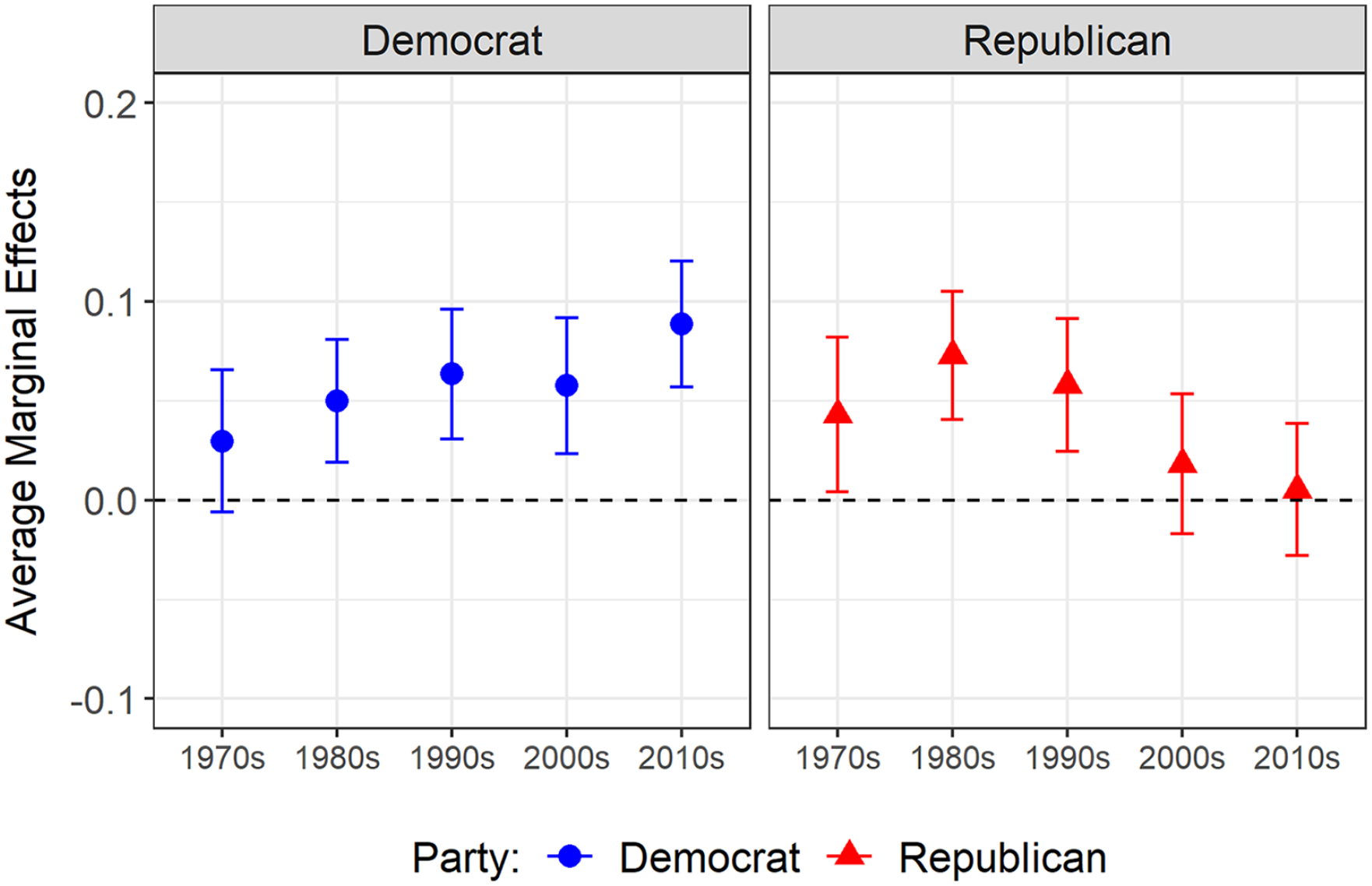
Average marginal effects of party identification on high confidence in science by decade.
There are several key takeaways thus far. First, at the aggregate level, the partisan gaps in AMEs during the 1970s and 1980s were quite small (e.g., it was about 1 percentage point in the 1970s). However, it increased to about 8 percentage points by the 2010s. It is worth noting that given the context, this is not a trivial change. As indicated in Table 2, the average probability of having high confidence in science across the full analytic sample is about .42 (or 42 percent); thus, a change of about (+) 7 percentage points in the partisan gap of AMEs between the 1970s and 2010s represents a 17 percent deviation from the overall mean. This growth in the partisan gap is even more interesting because it is net of changes due to the increasing politicization of active membership in certain religious groups, such as among Protestant fundamentalists (Table 3; also see Evans 2013). Who is responsible for this growth in polarization?
Importantly, the results provide little evidence that an asymmetric party polarization has taken place. In fact, between the 1970s and 2010s, about 59 percent of the total change in AMEs occurred among Democrats; if we use the 1980s as the base year, as that is when the decline in AMEs began among Republicans, we would still see that about 33 percent of the total change in AMEs occurred among Democrats (for the method, see Online Appendix B). That is, regardless of the base year, the results indicate that changes among Democrats (largely over the two most recent decades) have significantly contributed to the growth of the partisan gap in confidence in science. Moreover, the multivariate analyses provide additional insights on the net implications of these party trends: over the past several decades, Republicans have become increasingly similar to independents, whereas it is the Democrats who have moved away from this “neutral” reference group.
Is There Intraparty Heterogeneity in These Trends?
Next, I examine whether the changes in AMEs are evenly distributed across important ideological subgroups within the parties. That is, is there evidence of significant intraparty heterogeneity in these trends? The results of the second set of binary logistic regressions are displayed in Table 4, and the corresponding AMEs are displayed in Figure 2. 6 The results generally support hypothesis 2, at least among Republicans. Among Republicans, there are no notable or consistent changes in the AMEs among ideological moderates; there is some evidence of a decline in AMEs among liberal Republicans between the 1990s and 2000s, although that trend is somewhat reversed in the 2010s. The clearest and most consistent changes occurred among Republicans who are conservative (i.e., or the most “ideologically committed” to their party): a decline of about 10 percentage points between the 1980s and the 2010s. Among Democrats, the AMEs increased among both ideological moderates and liberals by 6 percentage points between the 1970s and 2010s. However, among conservative Democrats, the AMEs actually declined between the 1970s and 2000s (i.e., moving in the opposite direction compared with other Democrats), before returning to somewhat above the 1970s level in the most recent decade.
Binary Logistic Regressions of High Confidence in Science by Decade (Partisan Groups).

Source: General Social Survey, 1974 to 2018 (n = 35,030); General Social Survey weight variable: wtssall.
Note: Other controls include age, age squared, birth cohort (generation), gender, race/ethnicity, education (years), household income (constant dollars, logged), South, rural, confidence in medicine, and year (as dummies).
p < .05. **p < .01. ***p < .001.

Average marginal effects of partisan group on high confidence in science by decade.
These results are important because they indicate that the aggregate party-level trends (i.e., increase in party polarization) displayed in Figure 1 are being driven largely by specific trends among conservative Republicans, moderate Democrats, and liberal Democrats. Not only are the changes in the AMEs the largest in magnitude among these ideological subgroups, but the relative sizes of these subgroups have also been increasing over time (Figure 3). In the 1970s, ideologically moderate and liberal Democrats together made up 76 percent of their party; by the 2010s, this share had increased to 85 percent. In the 1970s, conservative Republicans alone made up 47 percent of their party, but by the 2010s, that proportion had increased to 63 percent. Some of these trends, particularly among the more ideologically committed subgroups (conservative Republicans, liberal Democrats) may be due to gradual processes of ideological sorting, among other forces (Fiorina and Abrams 2008; Hill and Tausanovitch 2018).

Party composition (percent share) by ideological subgroup and decade.
Discussion
On August 27, 2020, at her weekly press conference, House speaker Nancy Pelosi directly condemned Republicans for repeatedly downplaying the guidance of the scientific community (Speaker’s Press Office 2020): Let me just say three words about the wildfires and the hurricanes and about the coronavirus, three words: science, science, and science. The science that the Administration has chosen to ignore, and the Republican Party for a long time, before the Trump Administration, has ignored.
The politicization of science is a widely publicized and studied social phenomenon, attracting interest among concerned journalists and academic researchers alike (Alumkal 2017; Mooney 2006; Oreskes and Conway 2010; Otto 2016). It is even more salient now because of the serious public health effects of distrusting scientific guidance during a global pandemic (e.g., social distancing, wearing masks). This article contributes to the literature by advancing our knowledge of both the nature and potential causes of party polarization in trust in science.
First, by using independents as a relatively “neutral” reference group, the article offers a direct test of the two-sided polarization thesis developed in this study, which suggests that the growth of the polarization is due to changes in both parties. This contrasts with the well-known one-sided alternative, which focuses primarily on the politicization of science among Republicans and/or conservatives (e.g., Alumkal 2017; Dunlap and Jacques 2013; Gauchat 2012; Jacques, Dunlap, and Freeman 2008; Mann and Schleifer 2020; Mooney 2006). Ultimately, the results show that since the 1970s, more than 50 percent of the increase in the partisan gap is due to changes among Democrats (mostly over the two previous decades); if the base decade is the 1980s, the contributions of Democrats to the total change are smaller but still significant.
The results of the present study suggest that if differential patterns of trust in science are indeed the basis for issue-specific political coalitions (e.g., on public funding for science), polarization may (ironically) be due more to Democrats than to Republicans. Between the 1970s and 2010s, trust in science declined among Republicans and increased among Democrats (relative to independents); however, because of where they started, by the 2010s these trends meant that Democrats became significantly more likely than either Republicans or independents to have high confidence in science (by about 8–9 percentage points, net of covariates). When science enjoys greater cultural authority, people are more likely to believe that it is worthy of public funding and that scientific research should affect public policies (Gauchat 2015; Gieryn 1999; Oreskes 2019); the findings of this study suggest that at least on certain issues, the views of independents may be more aligned with those of Republicans than with those of Democrats. Future research could assess this interesting possibility and its consequences for policy making.
Second, this is also one of the first studies to examine intraparty heterogeneity in these trends. The results show that most of the aggregate changes in party polarization are being driven by specific trends among conservative Republicans, moderate Democrats, and liberal Democrats. That is, the aggregate party-level trends in beliefs about the cultural authority of science do not reflect attitudinal changes that have taken place broadly within either party. Thus, when we speak of the growth in party polarization, it is more accurate to speak of polarization with respect to specific ideological subgroups within the parties, for example, comparing conservative Republicans with moderate and liberal Democrats (cf. O’Brien and Noy 2020).
In addition, these findings are significant because although they do not prove that the aggregate party-level trends are due to partisan elite messaging, they do offer some supporting evidence for this explanation (particularly among Republicans). There is little evidence of a broad decline in trust among Republicans; instead, these patterns are highly concentrated among conservative Republicans, who are also much more likely to selectively consume news from partisan media outlets compared with fellow copartisans (Levendusky 2013; Prior 2013; Stroud 2010). Finally, this study extends the existing literature (e.g., Gauchat 2012; Mann and Schleifer 2020) by showing that the trends among ideological conservatives also differ by party: among Republicans, there is a consistent decline since the 1980s; yet among conservative Democrats, trust in science has significantly increased over the two most recent decades.
This study also has certain limitations. The main one is that the GSS confidence-in-science measure does not fully capture the two key dimensions of trust in any institution or agent: perceived competence and goodwill regarding the issue at hand (Robbins 2016). Moreover, it also does not explicitly operationalize the implications of cultural authority, such as the belief that scientific research should receive government support (Jasanoff 1990; Oreskes 2019). Unfortunately, these items are not available for the period of interest (1970s to 2010s). However, items measuring the key dimensions of trust in science and the cultural authority of science are available in the GSS starting in 2006. Using these items as new outcomes, I performed supplementary analyses using models with very similar specifications (see Online Appendix C). In both weighted and unweighted analyses, conservative Republicans are less likely to support federal funding of scientific research; in contrast, moderate and liberal Democrats are more likely to support it. Liberal Democrats are also consistently more likely to support the idea that scientific research should guide the development of public policy. For the two indicators of trust in scientists (perceived competence and goodwill), the results are more mixed. 7 These findings may suggest that the GSS confidence-in-science item is doing a better job of capturing how people think about the proper role of science in society rather than the trustworthiness of scientists per se.
In addition, to improve our basis for causal inference, which is more limited with observational data, future research could use experimental designs to assess whether partisan elite messaging on the trustworthiness of science has differential effects across important ideological subgroups within the parties (e.g., de Benedictis-Kessner et al. 2019). Finally, the findings of this study suggest that additional research is needed on the mechanisms driving changes in public beliefs about science, particularly among ideological liberals and Democrats, whose opinions have been understudied in this literature. For example, to what extent has adopting a “proscience” orientation become a part of what it means to be a “good” liberal or Democrat? What happens when people receive conflicting messages from religious and political leaders on the cultural authority of science (e.g., fundamentalist Democrats)? These types of questions could be investigated using many different methods including survey experiments, in-depth interviews, participant observation, and focus groups.
Supplemental Material
sj-pdf-1-srd-10.1177_23780231211010101 – Supplemental material for Party Polarization and Trust in Science: What about Democrats?
Supplemental material, sj-pdf-1-srd-10.1177_23780231211010101 for Party Polarization and Trust in Science: What about Democrats? by John J. Lee in Socius
Footnotes
Acknowledgements
The author is grateful for the helpful comments received during the review process, as well as from Lincoln Quillian. The author also thanks his department, which covered the APC for this article.
Supplemental Material
1
Another possibility related to differential patterns of elite messaging is that voters with more proscience orientations gradually became more likely to identify with Democrats, whereas those with opposing views became more likely to identify with Republicans (per “party sorting” theory).
2
There is an important theoretical reason for this binary coding: in this study, as in much of this literature, the outcome of interest is whether a group has high confidence in science, not merely marginally more confidence. Cultural authority is less meaningful if most people have “only some confidence” in an institution, which implies a high degree of uncertainty (Gieryn 1999;  ).
).
3
4
The final analytic sample includes only cases with complete (i.e., nonmissing) data on all of the variables used.
5
In fact, the effect sizes tend to be somewhat larger in the unweighted analyses.
6
The models displayed in Tables 3 and 4 are identical except that the parties are replaced by partisan groups in Table 4. Because a major purpose of the second set of analyses is to disaggregate the trends in party polarization observed in , the same reference group is used (to ensure comparability): political independents.
7
In the weighted analyses, none of the six partisan groups are significantly different from political independents in their beliefs about the competence and goodwill of scientists. In the unweighted analyses, however, liberal Democrats are more likely to believe that scientists are competent, and conservative Republicans are less likely to believe that scientists have good intentions.
Author Biography
References
Supplementary Material
Please find the following supplemental material available below.
For Open Access articles published under a Creative Commons License, all supplemental material carries the same license as the article it is associated with.
For non-Open Access articles published, all supplemental material carries a non-exclusive license, and permission requests for re-use of supplemental material or any part of supplemental material shall be sent directly to the copyright owner as specified in the copyright notice associated with the article.
