




Abstract
This study demonstrates whether and how climate protest increases or decreases the “sentiment pools” available to the climate movement. Using an experimental vignette survey design (n = 1,421), the author finds that compared with a control condition, peaceful marches are effective for both independents and Democrats, while civil disobedience has a positive effect among Democrats. These effects are isolated to those who are most certain of anthropogenic climate change. No effect is observed among Republicans. Despite evidence from other studies suggesting the possibility, no “backfire” effects are observed for any group or protest type. This study (1) lends supports to the use of tactical diversity within the climate movement and (2) demonstrates how the broader forces of partisanship interact with protest to shift the pool of supporters available to movements, extending our nascent collective knowledge of how partisanship shapes the outcomes of social movements and protest.
The climate crisis is getting worse. Activist groups are responding by using protest to amplify the urgency of the situation and subsequently motivate the public and policy makers to act. The Climate Strike and Extinction Rebellion protests most vividly capture this effort, but other smaller or less prominent protests take place in cities across the world every year. For their part, environmental sociologists have identified social movements and protest as crucial to achieving the social transformations needed to address climate change (Aronoff et al. 2019; Foster, Clark, and York 2011; York, Rosa, and Dietz 2003). Yet it is not clear what effect climate protest has on changing the dynamics of climate action. Does it shift public opinion? Does it alienate bystanders? Does it motivate policy makers?
To better understand the effectiveness of climate protest, in this study I evaluate whether climate protest increases what McCarthy and Zald (2002) referred to as “sentiment pools,” or the “reservoirs of support for changes in the structure of society” (p. 549; see also Kim and McCarthy 2016; Zald and Ash 1966). Sentiment pools are the well from which public sympathy and solidarity are drawn. Research shows that protest has the ability to sway the public and policy makers and that these effects are critical for movements to achieve their goals (Agnone 2007; Andrews, Beyerlein, and Tucker Farnum 2016; Burstein and Linton 2002; Gamson and Modigliani 1989; Rochon 2000). Yet it is not clear if and how climate protest has done this.
The aims of this study are to (1) directly test the effectiveness of climate protest on public sentiment and (2) demonstrate how partisanship constrains the effect of protest generally. I focus on three factors that are likely to influence the relationship between climate protest and public sentiment: (1) a member of the public’s partisan affiliation, (2) his or her belief in anthropogenic climate change, and (3) the form a protest takes. In the section that follows, these three factors, their relationships, and their role in shaping the effect of protest on sentiment pools are described. I then use an experimental vignette survey to test these relationships, finding that climate protest appears to increase sentiment pools under specific conditions.
Climate Change, Partisanship, and Protest
What do we know about the effects of climate activism? Studies that have directly examined the effects of climate protest are relatively few. Existing research shows that internalized environmentalism by legislators (Dietz et al. 2015) and state-level environmental protest (Muñoz, Olzak, and Soule 2018) are associated with reduced carbon dioxide emissions. At a more local level, the presence of local environmental nongovernmental organizations is associated with reductions in local carbon dioxide emissions from power plants (Grant and Vasi 2017). Some research has focused on the autobiographical effects of climate activism, specifically the transformation of bystanders into participants (Fisher 2019; Kleres and Wettergren 2017; Swim, Geiger, and Lengieza 2019; Van Laer 2017). Other research on the climate movement focuses on its organizational structure (Fisher 2010; Hadden 2014; Wahlström, Wennerhag, and Rootes 2013) and variation in and use of collective action frames (Evensen 2019; Hein and Chaudhri 2019; Knight and Greenberg 2011). To date, no studies appear to have addressed the question of how or if climate protest influences public sentiment.
To better anticipate the effects of climate protest, and how they occur, we can turn to other bodies of literature. I focus on studies of partisanship, protest tactics, and climate change cognition. Research in these areas suggests that although the climate movement will need to increase or tap into public sentiment to change policy (Agnone 2007; Giugni 2007), partisan-motivated reasoning may prove a substantial hurdle to doing so. Building on these areas of scholarship also points to a broader issue in the study of protest: how does a political environment defined by hyperpartisanship constrain the effects of protest?
The partisan nature of climate change is rooted in the institutional characteristics of the climate movement and countermovement. The climate change movement emerged largely from within the scientific community and is today supported by a network of scientific and advocacy organizations as well as most Democratic lawmakers and voters. However, as scientists began to raise the alarm on climate change, a robust response was formed by industry to obfuscate climate science (Oreskes and Conway 2011) and lobby to forestall government action to address the problem by establishing the “non-problematicity” of climate change (Freudenburg 2000; McCright and Dunlap 2000). Recent research shows that oil and gas companies continue to invest in legislators who oppose climate and other environmental policies (Goldberg et al. 2020).
Although initially driven by industry interests, the climate countermovement is now deeply entangled with the U.S. conservative movement (Jacques, Dunlap, and Freeman 2008; McCright and Dunlap 2000, 2003). The climate countermovement is composed of a network of advocacy organizations, think tanks, and trade associations whose financial support comes primarily from conservative foundations, which themselves often have deep ties to primary and energy industries, such as ExxonMobil and Koch Enterprises (Brulle 2014; Farrell 2016a, 2016b). The climate countermovement uses public attempts, such as congressional testimony, appearances in mass media, and public statements from Republican lawmakers, to refute climate science and deny the need for and efficacy of climate stabilization policies. The polarization of climate change legislation has been disproportionately driven by Republicans (Dunlap, McCright, and Yarosh 2016), consistent with research on asymmetric politics (Grossmann and Hopkins 2016).
One of the principal effects of the contest between the climate change movement and countermovement has been to polarize public opinion on climate change and climate policy (Dunlap et al. 2016; McCright and Dunlap 2011). Public opinion research has repeatedly demonstrated this fact. Democrats, liberals, and progressives are far more likely than Republicans and conservatives to believe in the existence of anthropogenic climate change (McCright and Dunlap 2011) and to support policy action to address the problem (Egan and Mullin 2017). Recent estimates from the Climate Change and the American Mind Survey show that 97 percent of liberal Democrats and 87 percent of moderate Democrats believe in and are worried about anthropogenic climate change, compared with 63 percent of moderate Republicans and 40 percent of conservative Republicans (Ballew et al. 2019). A new report from this same group shows that a slight majority (53 percent) of Americans support climate activists who urge officials to act on the issue, but that this support is highly polarized along partisan lines. Among Democrats, support for climate activists is at 84 percent. Independents and Republicans are far less supportive, at 50 percent and 23 percent respectively. Likewise, 58 percent of Democrats, 41 percent of independents, and 13 percent of Republicans say that they identify with climate activists (Leiserowitz et al. 2019).
The polarization among policy makers and movement leaders is a major force shaping the polarization of public opinion. This process, known as elite cueing, is central to understanding public opinion on climate change: public attitudes toward climate change are driven in part by the information received from party elites (Carmichael and Brulle 2017; McCright and Dunlap 2011; Merkley and Stecula 2018). In short, as elites signal disagreement on climate change, the polarization of those same elites is transferred to the public, driving belief and disbelief in anthropogenic climate change, engendering higher or lower support for climate policy, and ultimately polarizing belief along partisan lines. The institutional polarization of the climate movement and countermovement is thus explicitly linked to the polarization of public opinion on climate change.
The polarization of the climate movement, countermovement, and public opinion has implications for understanding the effects of climate protest. As a highly partisan movement, events occurring under the climate movement (and countermovement) umbrella are likely to trigger partisan motivated reasoning (Bolsen, Druckman, and Cook 2014). Partisan-motivated reasoning occurs when an individual interprets new information as a member of a partisan group. That is, the individual understands in processing new information that his or her goal is to align this new information with group commitments, in this case the individual’s partisan group. This is consistent with recent work that has demonstrated powerfully that political party identification is a consequential social identity (Huddy, Mason, and Aarøe 2015; Iyengar and Westwood 2015; Mason 2018).
Protest is likely to interact with partisan identities because social movements become entangled with social groups and identities themselves (Klandermans 2014; Polletta and Jasper 2001). Movements use identity to actively create perceptions of ingroup and outgroup conflict. That is, identity is a tool for movements to cast a conflict as “us versus them,” motivating support and action through the activation of social identities and group boundaries (Hunt and Benford 1994; Klandermans 1997; Polletta and Jasper 2001; Vestergren, Drury, and Chiriac 2018). As Mason (2018) noted, partisanship has become a sort of “mega-identity,” capturing numerous other social identities. And, as Mason demonstrated, this can also include identification with a social movement. This is possible because today’s parties act as “broad umbrellas under which various constituencies—including mobilized social movement wings—co-exist in uneasy alliances” (McAdam and Tarrow 2010:535).
Partisan-motivated reasoning, driven by increasingly overlapping social and political identities, is likely to influence the effects of protest on public opinion. For example, studies have shown that providing conservatives and Republicans with climate information not only may have no effect but can instead produce “backfire” effects wherein support for climate policy or belief in anthropogenic climate change is actually reduced because of exposure to conflicting information (e.g., protests) (Dixon, Bullock, and Adams 2019; Hart and Nisbet 2012; Zhou 2016). The effectiveness of protest at swaying public opinion, as with other forms of climate communication, is likely to face substantial resistance along partisan lines, thus limiting its capacity to increase public support for the movement. This presents a crucial challenge for the climate movement as well as a host of other movements operating in hyperpartisan contexts. Public opinion is a critical mediating factor in the relationship between protest and policy outcomes: protest is unlikely to effect policy change unless it is able to tap into or change public opinion (Agnone 2007; Giugni 2007).
Of course, protests are likely to target more intuitively sympathetic audiences. In cases of highly partisan issues, this means targeting copartisans, or those whose partisan identity aligns with the protest or social movement. But targeting copartisans alone may not lead to the increases in public sympathy and solidarity that movements seek. As such, a key target audience may be nonpartisan independents, or those who do not identify strongly with any party. Like copartisans, this group may be sympathetic to the issue. Unlike outgroup partisans, they may not experience partisan-motivated reasoning when confronted with social movement activism.
There is also the possibility that partisanship is merely correlated with underlying ideology and political beliefs (Carsey and Layman 2006; Levendusky 2009). On the issue of climate change, there is a strong relationship between partisanship and belief in anthropogenic climate change. This suggests that rather than an identity-based mechanism filtering the perception of climate protest, it is a disbelief in the legitimacy of the issue and the protest that may drive partisan differences (Simpson, Willer, and Feinberg 2018; Wang and Piazza 2016). Recent polling data clearly indicate that there is far from a perfect correlation between partisanship and belief in anthropogenic climate change. In 2017, 40 percent of conservative Republicans indicated that they believed in anthropogenic climate change and were concerned about the issue (Ballew et al. 2019). It seems, then, that belief in anthropogenic climate change and partisan-motivated reasoning may both play a role in shaping how climate protest shapes public support, as is explored here.
Climate Protest Tactics
No two members of the public are quite the same; neither are protests. To understand the effects of climate protest, then, we must also consider the ways in which climate protest varies, as different protest tactics may produce different effects. The examples of climate protest provided here and those used in the ensuing study are not only reflective of the real tactical diversity of the movement but also overlap with debates within social movement studies that argue over the effectiveness of different levels and types of protest (Feinberg, Willer, and Kovacheff forthcoming; Gamson 1975; McAdam and Su 2002; Piven and Cloward 1978; Simpson et al. 2018). One crucial way that protests vary is in the degree to which they engage in lawful or unlawful social disruption. This could include, among other things, violence, peaceful civil disobedience, or lawful, peaceful marches, the three protest types explored here.
The Extinction Rebellion, one of the largest transnational climate protest organizations, has blocked traffic outside of the headquarters of the New York Times, occupied the Scottish Parliament’s chambers, and used roadblocks during London’s Fashion Week. Hundreds of protesters have been arrested across several countries. These protests are decidedly nonviolent, and the movement self-identifies as practicing civil disobedience. Civil disobedience has long been seen by social movement scholars as an effective tactic for achieving movement ends. Highly disruptive tactics are more effective in gaining media attention (Andrews et al. 2016; Gamson and Modigliani 1989), largely because of their “newsworthiness” (Andrews and Caren 2010; McCarthy, McPhail, and Smith 1996; Oliver and Meyer 1999), and are therefore a crucial protest tool available to movements seeking to increase public support. More broadly, civil disobedience, compared with violence, enhances the legitimacy of the movement, encourages broader participation, and is more difficult for authorities to legitimately suppress (Chenoweth and Stephan 2011).
Contrast the Extinction Rebellion protests with the Climate Strike. On September 20, 2019, protesters around the world, in the largest single climate change protest in history, marched to demand action on climate change. Although different from the Extinction Rebellion in its magnitude (i.e., far larger), it was also distinct from Extinction Rebellion in its strategy: the march was peaceful, short-lived, and although somewhat disruptive not in ways that were illegal or targeted for maximum disruption, as would be the case with more extreme forms of civil disobedience. Although some Climate Strike and Fridays for Future (an affiliated protest movement) events have taken on the characteristics of civil disobedience by occupying meetings and public events, others have resembled the events of September 20. At the least, the actions of the Climate Strike, Fridays for Future, and Extinction Rebellion protests offer some indication that climate protest can vary substantially in the degree to which it is socially disruptive.
On exceptionally rare occasions, climate protest has turned violent (Australian Associated Press 2019; Willsher 2019). Violence is a somewhat frequent occurrence during protests, and social movement scholars have long debated its general efficacy (Chenoweth and Stephan 2011; Gamson and Modigliani 1989; McAdam and Su 2002; Piven and Cloward 1978). Recent research, however, suggests that the presence of violence during a protest is likely to lower public support by lowering the perceived legitimacy of the protest and associated movement (Feinberg et al. 2020; Simpson et al. 2018; Thomas and Louis 2014). Given the extent to which social movement scholarship has contrasted civil disobedience and peaceful protest with violence, and the escalating seriousness of climate protest, it is worth examining as a potentially productive or, perhaps more important, counterproductive protest tactic for the climate movement.
Summary
Given the partisan nature of climate change belief and the evidence for backfire effects in climate communication, it is reasonable to ask whether climate protest can shift available sentiment pools or even reduce them. Given the variation in types of climate protest, we may also wonder whether certain types of protest may be more effective than others. This study involves an experimental vignette survey to disentangle these factors and evaluate if and how climate protest works to shape support for the climate movement. By experimentally observing the effects of three representative types of climate protest—while accounting for established social-psychological factors shaping climate change-related attitudes and beliefs—this study offers causal, theoretically informed data on the effects of climate protest on public sentiment.
Bringing the streams of literature just reviewed together, in this study I address three research questions. First, given the emphasis in social movement research on the differential effects of protest tactics, I examine whether climate protests are more or less effective depending on whether they deploy peaceful marches, civil disobedience, or violence.
Research Question 1: Does the effect of climate protest on public support vary by protest tactic?
Second, given the substantial findings of research on partisan identity and climate change cognition, I examine whether protest tactics and partisanship interact to shape public support.
Research Question 2: Does the effect of climate protest on public support vary by protest tactic and partisan identity?
Finally, given the coupling of partisan identity and belief in anthropogenic climate change, I examine how the effects of protest tactics and partisan identity are further conditioned on belief in anthropogenic climate change. This helps disentangle whether observed effects are caused by partisan identity or perceptions of protest legitimacy.
Research Question 3: Does the effect of climate protest on public support vary by protest tactic, partisan identity, and belief in anthropogenic climate change?
Data and Methods
Building on developments in social movement and protest research (Bloemraad, Silva, and Voss 2016; Simpson et al. 2018; Wouters and Walgrave 2017), I use an experimental vignette design to expose respondents from an online panel to three types of protest. The survey has a total of 1,421 respondents. Two respondents dropped out after beginning the survey. The sample for this study was provided by Qualtrics, which relies on numerous online panels (with total number of participants in the millions) for generating samples. Qualtrics-generated panels are generally quite representative of the U.S. population, but they are not a randomly selected national sample. Participants self-select into online panels on which Qualtrics then draws to gather respondents. All respondents are compensated for their time. A complete description of all survey items is included in the online supplementary materials for review and reproduction.
The data were collected between October 23 and November 1, 2018. In Table 1, two types of information are given regarding the demographic information of the sample. First, I report the percentage of respondents in my sample who fit each category. Second, I compare this with the most recent American Community Survey estimates (2017). Generally, the sample looks similar to the U.S. population according to these factors, though this is a more educated and less Hispanic group than the national average. 1
Comparison between Sample and U.S. Population.

Note: NA = not available.
Respondents who participated in the study were tasked with (1) answering several background questions, (2) reading a mock news story about a protest, (3) answering a series of questions about that protest, and (4) answering standard demographic questions. The three protest styles are (1) violent, (2) civil disobedience, and (3) peaceful march. The general experimental design is depicted in Figure 1.

Overview of experimental design.
Each of the protests represents a group advocating for action on climate change. In the control condition, respondents are informed that there are climate protest groups and asked to evaluate, using the same items as for the three treatment groups, those groups without being exposed to any details about the group’s strategy or protest style.
At the beginning of the questionnaire, and prior to reading the vignette, respondents answer questions pertaining to their political leanings and their beliefs about climate change. A quota was used to ensure a given number of Republican (30 percent), Democrats (30 percent), and Independents (40 percent). Respondents who selected “other” were removed from the survey immediately and did not proceed. The only other quota for this sample was gender, where the quota was roughly a 50/50 split.
Following completion of the background questions, respondents were tasked with reading only one of the vignettes or skipping the treatment (control), to which they are randomly assigned, making this a between-subjects design. In order to be able to derive unbiased causal estimates, subjects are assigned at random to one of the conditions (Charness, Gneezy, and Kuhn 2012). A between-subjects design ensures that the order of the questions does not introduce issues of nonindependence (Auspurg and Jäckle 2017; Charness et al. 2012; Grice 1966). For a full description of the vignettes and control condition, refer to the online supplementary materials.
After reading the vignettes (or not, if assigned to the control), respondents then answer a series of questions that serve as the outcome variable. The variable measures support for the movement via four items. The first is a simple support/opposition question, similar to what appears in a wide range of attitudinal survey work around climate change and energy (Boudet 2019). The next three items measure moral or sympathetic support for the organization they read about in the vignette. Taken together, these four variables represent an operationalization of McCarthy and Zald’s (2002) aforementioned concept of sentiment pools. For analysis, these variables are collapsed into a single index of support. This index has a Cronbach’s α value of .94, indicating high reliability.
Finally, respondents are asked several demographic questions based on items from the U.S. census, including age, race, education, and gender. At the completion of the survey, respondents were informed that the story they read was not true, and the purposes of the study and why deception was necessary are described. After reading the debriefing section, respondents were thanked for their participation and exited the survey.
Results
Unsurprisingly, Democrats are more supportive of climate protest regardless of the experimental condition they are in (Figure 2). 2 Interestingly, independents and Republicans are about equally supportive. Clearly, the tendency is for independents to have similar levels of support for climate activism to Republicans, not Democrats. On a rating scale of 1 to 5, 3 represents the median value of support on the scale, while the overall mean is 3.55. The mean value for Democrats is above both the median value and the mean at 3.88, while independents and Republicans are below the mean at 3.36 and 3.44, respectively, though both are above the median scale value.
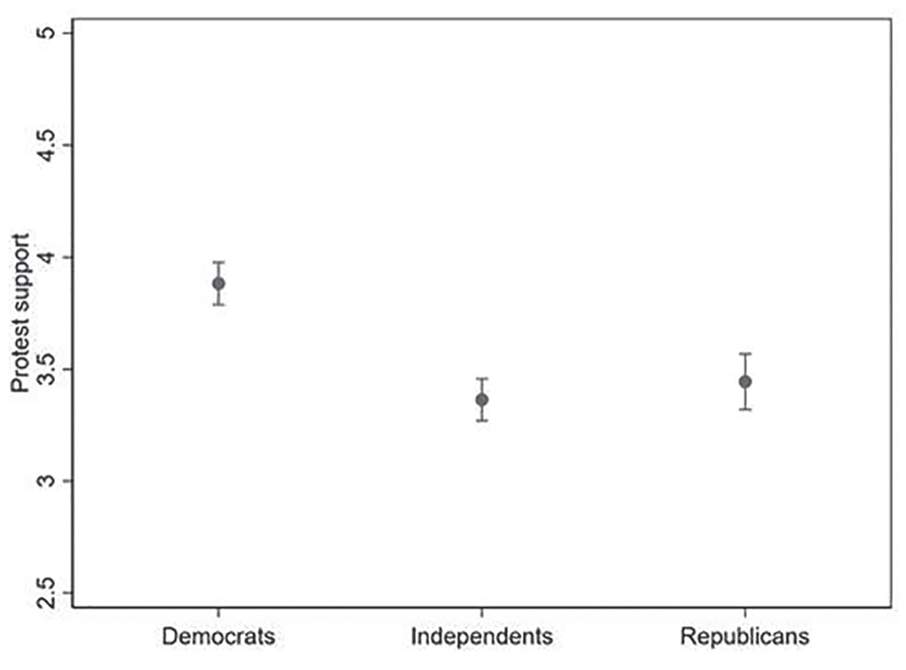
Mean support by party.
The first research question of this study is “Does the effect of climate protest on public support vary by protest tactic?” Figure 3 shows mean values of protest support by protest tactic. This figure shows a clear relationship between public support and protest: peaceful protest and civil disobedience clearly raise public support compared with a control condition, whereas violent protest does not. The source table for this figure is included in the online supplementary materials.

Protest support by protest tactic.
The second research question for this study is “Does the effect of climate protest on public support vary by protest tactic and partisan identity?” To evaluate the effects of climate protest on public support conditioned on partisan identity, I use ordinary least squares regression on the composite measure of support. I include an interaction term with protest tactics and partisan identity (Democrat, Republican, independent). Figure 4 separates out the results by party identity. Rather than focusing on the relative values of support between parties, I instead focus on within-group differences across protest types, as this shows where activists are likely to see change in public support through protest relative to a baseline (i.e., control). Figures showing estimates for between-group comparisons are included in the online supplementary materials along with the source regression table.

Protest support by tactic and partisanship.
By comparing the effects of protest across partisan affiliations in Figure 4, we see that climate protest does not uniformly drive public opinion. For both Democrats and independents, protest increases support compared with a control condition. Critically, we observe no effect among Republicans. This is useful to emphasize if only because no effect is quite different from a negative effect. Protest events simply do not influence how Republicans view the climate movement.
However, the effects of different forms of protest are not uniform. Civil disobedience, often seen as a crucial tool in the protest toolkit, has mixed effects. Civil disobedience increases support among Democrats but has no effect on independents, though the confidence intervals overlap by only .02 points. Civil disobedience still has a net increasing effect, but it is limited to a partisan in-group. Peaceful marches, on the other hand, increased support among both Democrats and independents, suggesting that less disruptive tactics may appeal to a broader coalition.
Increasing support among Democrats and independents, combined with a lack of backfire effect among Republicans, suggests a “no-risk” scenario for protest leaders considering the effects a protest event will have on public support. That is, peaceful protest will increase support both within the partisan base (Democrats) and outside (independents) without causing a backfire among Republicans, as might be anticipated by research on climate change opinion “backfire” effects (Dixon et al. 2019; Hart and Nisbet 2012; Zhou 2016). Importantly, these findings also counter the narrative that partisanship has made protest a form of “preaching to the choir” or that disruptive protest alienates bystanders and is ultimately counterproductive, a claim that has been made against both Black Lives Matter and Extinction Rebellion protesters.
The third and final research question in this study is “Does the effect of climate protest on public support vary by protest tactic, partisan identity, and belief in anthropogenic climate change?” One of the principal consequences of the partisan nature of climate change is that it shapes whether voters believe that anthropogenic climate change is occurring or not. Reviews of partisan-motivated reasoning and climate change suggest a need to disentangle the effects of directional (i.e., partisan) versus accuracy (i.e., climate change belief) motivations in how climate information is processed (Druckman and McGrath 2019). In other words, the effects of protest are not only variable by partisan affiliation but are also conditioned on whether someone believes in anthropogenic climate change. Additional ordinary least squares regressions are performed to examine how variation in climate beliefs interacts with variation in protest tactics across different partisan groups. Interaction terms that condition the effect of protest type on preexisting climate beliefs and partisan identity are introduced. Postestimation techniques were used to evaluate whether the significant effects on the interaction terms were consistent across the range of values for climate belief for both Democrats, independents, and Republicans. The source regression table is included in the supplementary materials.
Certainty of climate change belief is coded on a scale ranging from 1 to 8, wherein the dichotomous answer to the question “Do you think that climate change is happening: yes or no?” is multiplied by the question “How sure are you that climate change is happening or not: extremely sure, very sure, somewhat sure, not at all?” “Yes” is coded 1, and “no” is coded as −1. “Extremely sure” is coded 4, “very sure” is coded 3, “somewhat sure” is coded 2, and “not at all” is coded 1. The ensuing scale, from −4 to 4 (excluding 0), is recoded from 1 to 8, with 8 representing those most certain that anthropogenic climate change is occurring and 1 representing those most certain that it is not.
Figures 5 to 7 demonstrate the relationship between protest, belief in anthropogenic climate change, and partisanship. For peaceful protest (Figure 5), conditioning the effects of protest on certainty of climate change belief demonstrates that peaceful protest is effective at shifting support only among independents and Democrats most certain that anthropogenic climate change is occurring. The largest increases by far are among independents, with increases occurring across most levels of belief in anthropogenic climate change. The largest effects occur among independents most strident in their belief in anthropogenic climate change. No effect is observed among Republicans, even among those most certain that climate change is occurring.

Protest support: peaceful protest by climate beliefs and party.

Protest support: civil disobedience by climate beliefs and party.

Protest support: violent protest by climate beliefs and party.
Civil disobedience (Figure 6) also increases support among Democrats and independents, with the effect again isolated to those most certain about anthropogenic climate change. However, civil disobedience reduces support among independents most certain that anthropogenic climate change is not occurring. This is suggestive evidence for a backfire effect.
However, as shown in Figure 4, the reducing effects among independents are counterbalanced by the increasing effects among those most certain that anthropogenic climate change is occurring, leading to no aggregate backfire effect. As with peaceful protest, no backfire effect is observed among Republicans exposed to civil disobedience. The null finding on Republicans across the board suggests that party identity overrides even strident belief in the underlying movement issue in shaping support for a movement. By examining effects among Republicans who strongly believe in anthropogenic climate change, we can see how partisan identity and issue belief interact to shape support for a movement. In this case, it appears that party identity overrides issue belief.
As with civil disobedience, violence reduces support among independents most certain that anthropogenic climate change is not occurring. It also increases support among independents most certain that anthropogenic climate change is occurring. Again, as Figure 4 shows, there is no aggregate effect among independents. No other effects for violent protest are observed, including, crucially, among Republicans.
Discussion
The effects of climate protest on public support for the climate movement were evaluated as a function of the interaction among partisanship, belief in anthropogenic climate change, and protest strategy. That is, climate protest cannot be understood without considering the partisan nature of the movement or the tactics selected by protest groups and the interaction of the two. I find that both civil disobedience and peaceful marches increase support from the public for the climate movement, with the effect isolated to Democrats and independents who believe in anthropogenic climate change. No type of protest influences Republicans. Importantly, there is no backfire effect observed here for any form of protest or for any partisan group. Despite the plausible concern that certain forms of protest may cause the type of backfire effect observed in climate communication research, I find no evidence to justify that concern. What limited evidence there is for a backfire effect—independents who do not believe in anthropogenic climate change exposed to civil disobedience or violent protest—balances out in aggregate. This finding supports recent research suggesting that backfire effects are likely quite rare (Guess and Coppock 2018; van der Linden, Leiserowitz, and Maibach 2018; Wood and Porter 2019).
Perhaps the key finding of this study is that it lends empirical support to activists who pursue tactical diversity. The tactics of both civil disobedience organizations such as Extinction Rebellion as well as peaceful marches in the vein of the Climate Strike may very well find success in generating support from the public. The demonstrated effect of civil disobedience is particularly crucial, as media are more likely to cover disruptive protest events (Andrews and Caren 2010; McCarthy et al. 1996; Oliver and Meyer 1999), so these events may reach a broader audience than peaceful marches, all else being equal. Therefore, it seems likely that the most accurate interpretation of this study is that civil disobedience and peaceful protest are complementary rather than contradictory. This finding supports the argument that tactical diversity within social movements is likely to be advantageous (Johnson, Agnone, and McCarthy 2010), challenging classic arguments over the efficacy of apparently mutually exclusive tactics (Gamson 1975; Piven and Cloward 1978). This finding should be taken cautiously, however; a combinatorial research design that exposed participants to multiple strategies would be ideally suited to test this argument.
Finally, research on social movements has generally pointed toward a theory of social change that in part depends upon movements increasing public support. By increasing public support, climate protesters can shift public opinion (Andrews et al. 2016; Gamson and Modigliani 1989; Rochon 2000), turn bystanders into movement participants (McCarthy and Zald 1977), and put pressure on policy makers and other elites (Agnone 2007; Burstein and Linton 2002). This study offers evidence that climate protest is facilitating precisely this form of social change. This supports findings from other recent research showing that climate protest increases the likelihood that bystanders will participate in collective action (Swim et al. 2019) and has an effect on state-level carbon emissions (Muñoz et al. 2018). To tentatively answer the question posed by the title of this study, then: yes, climate protest works.
Moving beyond climate protest, my findings have implications for the general study of social movements, protest, and partisanship. Despite Klandermans’s (2014) call for a deeper evaluation of the role of partisan identities in the study of social movements, little research has emerged that addresses this issue. This study provides insight into the partisanship-protest dynamic by bringing together sociology and political science around the role of partisan social identities. Although intuition would suggest that Republicans would be unmoved by climate protest because of low support for the issue, recent research suggests that as many as 50 percent of Republicans believe in anthropogenic climate change. This study shows that even when accounting for these beliefs (Figures 5–7), protest is still unable to sway Republican voters. The overriding dynamic in shaping how partisans respond to protest is not sympathy to a cause but sympathy to a group. It does not matter whether one believes in the argument presented by an outgroup protest movement; the fact that the issue is associated with and/or presented by an outgroup is sufficient grounds to reject it. The logical conclusion of this study, then, is that efforts of activists to appeal to outgroup partisans, even those who may agree on underlying issues, are unlikely to succeed in an era of hyperpartisanship. The more likely pathway for protest of any kind to be effective in a context of hyperpartisanship is to use a combination of peaceful marches and civil disobedience to activate sympathetic copartisans and independents. This finding is critical in an era of hyperpartisanship, when the context in which many activists operate is one increasingly dominated by political identity.
This study suffers from two primary limitations. Most generally, a limited number of variable aspects of protest are controlled for. Additional important factors are likely to be the scale of the protest event (McAdam and Su 2002) and the specific frames used by protesters (Cress and Snow 1996). This latter issue is especially important given the diversity of collective action frames within the climate movement (Evensen 2019; Hein and Chaudhri 2019; Knight and Greenberg 2011). Future research should consider the independent effects of alternative protest strategies and features of protest on climate change movement support.
Second, as with any experimental study, there is the problem of ecological validity. This study imitated the actual way that a member of the public is likely to encounter a protest event—through a news story—but it necessarily fails to capture the full complexity of how someone would experience such an event. It is likely that individuals would be exposed to repeated stories, over several days or perhaps weeks, and such news coverage would likely be highly editorialized. Fox News and MSNBC would almost certainly frame the same protest event very differently. Future research will be needed to adapt the underlying logic of this study to observational data or more in-depth experimental efforts. As such, this study should be taken only as a starting point for future research that will need to consider the source of information, the role of repeated exposure, and variation in editorial decisions about how to frame climate protest.
Supplemental Material
Online_Supplementary_Materials_Socius – Supplemental material for Does Climate Protest Work? Partisanship, Protest, and Sentiment Pools
Supplemental material, Online_Supplementary_Materials_Socius for Does Climate Protest Work? Partisanship, Protest, and Sentiment Pools by Dylan Bugden in Socius
Footnotes
Funding
The author disclosed receipt of the following financial support for the research, authorship, and/or publication of this article: The research reported here was supported by Cornell University Agricultural Experiment Station Hatch Research Program.
Supplemental Material
Supplemental material for this article is available online.

Notes
Author Biography
References
Supplementary Material
Please find the following supplemental material available below.
For Open Access articles published under a Creative Commons License, all supplemental material carries the same license as the article it is associated with.
For non-Open Access articles published, all supplemental material carries a non-exclusive license, and permission requests for re-use of supplemental material or any part of supplemental material shall be sent directly to the copyright owner as specified in the copyright notice associated with the article.
