




Abstract
How do radical movements seeking fundamental social change engage with nearer-term policy dilemmas? Disciplinary boundaries and practical obstacles have limited research into protester policy engagement. Using a hybrid method combining participant-observation and expert-led focus groups, we document activist attitudes concerning controversial climate policy options. Data gathered at ‘Climate Camps’ in six national contexts are presented alongside evidence from similar ‘participant-instigator’ events at Green Party conferences. We find activists engaged in direct action outside the established political system had policy knowledge and agendas comparable to or surpassing those active within the system. Support for radical change appears correlated with – rather than opposed to – knowledge and interest in policy agendas. As climate protests escalate it is important to understand ‘protester policy engagement’ – the processing, production and communication of changes proposed from a position outside the established political system and to theorise this with, rather than in contradistinction to, social movement identity.
Keywords
Introduction
Climate protests are on the rise. Extinction Rebellion (XR) protests closed parts of central London throughout 2019, while ‘Fridays for Future’ school strikes inspired by Swedish schoolgirl Greta Thunberg proliferated. XR has demanded holding climate assemblies and reaching net-zero greenhouse gas emissions by 2025. However, doubts about whether protest movements take policy choices seriously are commonly heard, even on the left. For example, Srnicek and Williams (2015: 7) viewed the Occupy protests as ‘politics transmitted into pastime – politics-as-drug-experience, perhaps – rather than anything capable of transforming society’. Lloyd (2001: 42) lamented the ‘protest ethic’ of anti-globalisation movements arguing protesters’ alternative ‘can be offered only at the level of oppositional activism and political or rhetorical challenge – their actions are, in every sense, symbolic’. Studies of earlier waves of UK climate protests suggested that internal movement differences over tactics and split identity (Saunders, 2008; Schlembach, 2011) made grassroots climate campaigners ‘unable to translate a feeling that there is a problem into agreed conceptualisations of what should be done about it’ (North, 2011: 1595).
But how do social movement protesters engage with policy questions? Disciplinary boundaries have not always been helpful in analysing activities straddling institutionalised and non-institutionalised political spheres. The latter were marginalised in early disciplinary self-definitions of Political Science, which saw ‘normal’ politics as its domain (McAdam et al., 2001: 6) leaving political engagement outside settled institutional settings to others, notably Sociology. Some scholars focused on organisational aspects of social movements (Della Porta and Diani, 2009) but until the 1960s, ‘observers used the obvious emotions of crowds to dismiss protesters as irrational’ (Jasper, 2014: 346). Subsequently, sociological research, particularly in a British context, was slow to include social movements or ‘collective action’ (Millward and Takhar, 2019). Building on Blumer (1951), social movements only slowly began to be framed as rational reactions to grievances or political opportunities and subsequently as identity projects (Cohen, 1985). More recently, affect and emotions have been reconsidered without the stigma of irrationality (Hardt, 2007; Jasper, 2014) but protest and other forms of ‘contentious’ politics were for many years still often defined in opposition to – and studied separately from – institutionalised politics and policy (Tarrow, 1996: 874). As Meyer (2003: 4) described, ‘scholars concerned with public policy OR with social movements often recognise the importance of the other phenomena in their subject of interest, but do not generally go beyond that recognition’.
However, a shift from ‘government’ to ‘governance’ served to blur perceived ‘boundaries between state and society’ (Orsini and Smith, 2010: 38) bringing policy and social movement literatures closer together. Far from being separate, social activism is now recognised to overlap and intersect in complex ways with policy processes, knowledge production and insider expertise (Roth, 2016). Some now even argue that ‘the relationship between demonstrating and participating in institutional politics in general is now established as mutually co-constitutive’ (Roth and Saunders, 2019: 527). Activists engage with and use expert knowledge critically or strategically, not necessarily submitting to post-political scientism (Grundy and Smith, 2007; Parthasarathy, 2010). Recent climate protests have been noted for their radicalism and their emphasis on ‘the science’ and ‘truth’ and demanding state-led policy action (Doherty et al., 2018) – although some argue this reliance on scientific knowledge scientises climate rendering it a post-political issue (Schlembach et al., 2012; Swyngedouw, 2010).
We build on those bringing social activism and policy studies together, exploring ‘first wave’ (roughly 2006–2012) climate protesters’ knowledge and attitudes to climate policies and technology options. Our study presents data gathered through surveys and workshops with activists at six European ‘Climate Camp’ events as well as at Green Party conferences in the UK from 2009 to 2011. ‘Camp for Climate Action’ was, like XR and other ‘second wave’ climate protests, a non-violent direct-action phenomenon, but targeted coal-fired power stations, airport expansion projects and publicly owned banks. Our study examines climate policy knowledge, preferences and beliefs inside and outside institutionalised politics, in particular in relation to a then-relatively new set of technologies, carbon capture and storage (CCS). As an option almost exclusively justified in terms of climate abatement but controversial among environmentalists, studying CCS in the context of other climate technologies provided a window into how technological and societal choices are evaluated and understood by climate protesters. Overall, we find climate activists were often also professionals who evaluated policy options from perspectives informed by expert knowledge, and that this approach coexisted with their interest in radical social change.
We first review how contemporary climate activism has been understood primarily in terms of social movement tactics, group identity and culture, and suggest this may partly derive from disciplinary boundaries marginalising activism in Policy Studies and silencing policy discourse in Sociology of protest. Second, we explain how survey data on radical activists and their policy preferences were obtained using a specially tailored hybrid workshop format that combined elements of focus group research with participant-observation – what we term a ‘participant-instigator’ method. New data on radical activists and Green Party members are then presented, showing similarities in levels of knowledge of policy options and preferences criss-crossing the expert-lay and radical-incrementalist divisions. Finally, we briefly discuss the specificity of our results to climate activism and argue that ‘protester policy engagement’ needs to be integrated better into theories and studies of social activism.
Understanding Climate Protest and Policy
The sociology of protest has not always been attuned to protester engagement with policy and formal politics. Early social psychological studies made sense of protests in terms of mass excitement but social movement analysts from around 1960 sought to understand them first as rational responders to grievances and opportunity structures, after which identity-oriented approaches were advanced particularly to understand New Social Movements (NSM) (Cohen, 1985). NSM literature viewed them ‘less as organisations of common interest and more as new forms of collective identity engaged in discursive struggles’ essentially over self-understandings and cultural codes (Carroll and Hackett, 2006: 87) rather than policy battles, guiding battles. This guided focus ‘away from focussing on the concrete aims of the movements’ (Millward and Takhar, 2019: NP2). For King and Pearce (2010: 253), social movements (especially environmental ones) ‘frequently mobilise to contest particular values, beliefs, or identities’ and so identity rather than policies was posited as the central mechanism, and a key outcome, of protest movements (Polletta and Jasper, 2001). Similarly, for what became Mobilisation Studies, ‘the defining question [was] how groups mobilize [. . . whereas] the puzzle of political orientation [. . .] largely dropped out of the theoretical discourse in the subfield of social movements’ (Walder, 2009: 400). A notable exception is policy impact studies, a subfield of studies assessing the success of protests in terms of cultural shifts (Amenta et al., 2010; Amenta and Polletta, 2019; Guigni, 1998) and sometimes impacts on policy and parties, for example as a result of feminist social movement mobilisations (Evans, 2016; Weldon and Htun, 2013).
Emerging as a public issue from the late 1980s (Jaspal and Nerlich, 2012), climate change became a focus for contentious protest and direct action during the 2000s. Long before XR and Fridays for Future climate protests, the Camp for Climate Action (‘Climate Camp’) emerged in the mid-2000s deploying high-profile direct-action tactics. These drew inspiration from earlier anti-roads direct-action protests (Doherty, 1999) as well as earlier environmental movements, which sometimes sought to maintain more institutional channels of influence (Rucht and Roose, 1999). Climate Camp involved small numbers of highly motivated protesters coalescing around a tripartite strategy: (1) non-violent but disruptive direct-action events targeting ‘root causes’ of global warming (e.g. coal power stations, coal mines, airports and banks); (2) experimenting performatively with sustainable alternative living practices (ecologically inspired camping, veganism); and (3) mutual education and issue exploration (open workshop ‘jamborees’) (Climate Camp, 2010; Saunders and Price, 2009). Climate Camps began to spread from the UK (to Australia, the USA and across Europe) officially dissolving in 2012. 1
Literature on climate protest movements partly reflects how formative disciplinary distinctions between Sociology and neighbouring disciplines marginalised protester policy engagement. So far, the Camps have been understood mainly in terms of schisms related to political strategy, tactics and group identity and much less in terms of policy engagement and knowledge. Saunders (2008) examined group identities while others looked at mobilisation tactics (North, 2011) and cultural politics (McGregor, 2015). Dernbach (2011) considered whether non-violent direct-action methods might cause further mobilisation, while others examined network structures and ‘partial organization’ (Frenzel, 2014: 903). In her studies of UK environmentalism, Saunders (2008, 2012) found the overall movement (and Climate Camp) divided (or diverse) in terms of strategy and group identities. Focusing more on impact, McGregor (2015: 359) identified the public pedagogy of the Climate Camp movement as an attempt to redefine climate action as ‘a collective expression of citizenship’, to highlight ‘root causes’ and redefine the role of the state, arguing this largely failed. Past studies employed mostly participant-observer methods (North, 2011; Schlembach, 2011) or interviews (e.g. Bergman, 2014).
Such studies did not highlight climate protesters’ policy priorities and using expert policy knowledge was interpreted mainly as a political weakness. Schlembach et al. (2012: 818) assert Climate Camp’s ‘strong affiliation to “official” climate science, the perceived urgency of the task, and a moral framework stressing individual responsibility’ hindered more radical systemic critiques: ‘carbon counting came to eclipse radical political imperative’. This description resonates with what Swyngedouw identified as depoliticisation of the climate movement by adopting an existential crisis frame couched in scientistic terms. For him, presenting ‘climate change as a global humanitarian cause produces a thoroughly depoliticised imaginary, one that does not revolve around choosing one trajectory rather than another, one that is not articulated with specific political programs or socio-ecological project or revolutions’ (Swyngedouw, 2010: 219). Similarly, Schlembach (2011) emphasised conflicts inside Climate Camp between carbon-oriented framings and those foregrounding societal power structures and injustices.
However, in other contexts, scientific discourse has been found to not necessarily preclude a radical social message. Social movements engage with expert scientific knowledge in complex and diverse ways, sometimes contesting such knowledge, at other times strategically reproducing or adding to it (Grundy and Smith, 2007; Parthasarathy, 2010) or expanding the notion of evidence-based policy to include practical knowledge and power relations (Oliver and Pearce, 2017). Social movements often emerge in relation to and through engagement with scientific expertise (Orsini and Smith, 2010: 39) and protest activity has been found, in general, to be positively correlated with participation in formal politics (Saunders, 2014) or other forms of formal work (Newman, 2012). Rather than depoliticising climate protest, engagement with expert knowledge could form part of protesters’ challenge to dominant framings.
Whether this is the case requires examining protester knowledge and attitudes to policy options as well as their wider aims. Our study explores engagement with expert knowledge and policy dilemmas and offers indicators of how this might compare to more ‘formal’ insider politics. We focus on how Climate Camp participants related to expert knowledge and a variety of practical policy measures and technologies while engaging a wider agenda of social transformation. In so doing, we seek to assess the role of expertise in activism and social movements’ engagement with policy processes generally and climate strategies in particular. Recent climate protests including Extinction Rebellion have been deemed novel in turning away from civil society to focus squarely on governments and policy (Doherty et al., 2018). XR is also judged to ‘break with recent radical climate actions in the UK which have explicitly sought to connect public policy and consumption practices with questions of social class, poverty, ethnic minority exclusion, and neo-colonialism’ (Doherty et al., 2018). Closer examination of its major predecessor, Climate Camp, may help inform the evolving relationship between radical action and the climate policy debate.
Methods: Researching Policy Agendas in Contentious Zones
Beyond asking about a wide range of policy options and overall strategies to tackle the climate problem, given the attention paid to coal and coal-fired electricity generation at many of the Climate Camps, we chose to use the case of CCS – the process of capturing CO2 from large point sources and storing it underground in depleted oil and gas fields or in deep geological formations – as a special thematic focus for exploring how policy options are compared and evaluated by contentious movement activists. CCS’s relative novelty at the time helped avoid re-recording entrenched positions in older debates (such as nuclear) and the varied positions of leading environmental non-governmental organisations (NGOs), most of which are neutral or ambivalent (Corry and Riesch, 2012), made CCS suited to exploring criteria of assessment among activists.
Participants at workshops held over a period of two years at five ‘Camps for Climate Action’ were surveyed for their views on climate change as a political problem and potential measures to deal with it. Activists were also asked about their overall attitude to social change and technological solutions as well as their levels of knowledge of policy options and their trust in different sources of information. Identical surveys were distributed to Green Party members in the UK taking part in workshops organised at annual Party conferences. This was designed to provide a basis for evaluating levels of knowledge about policy objectives and modes of evaluating policy ideas in groups working inside and those outside the established political process.
Formidable barriers confront any researcher wanting to survey people engaged in radical (sometimes illegal) direct action who organise in non-hierarchical network structures in opposition to mainstream institutions and culture. Protesters were understandably wary and suspected police infiltration (worries which turned out to be valid, Ballard, 2011) added to the complexity of our positionality as researchers. Olaf Corry had longstanding contacts with the UK environmental movement but arrived to the Camps as a junior academic representing an elite academic institution running a project funded by CSIRO, the research council of a country infamous for its coal industry (Australia). David Reiner had conducted extensive research into public and stakeholder views on low-carbon technologies, notably CCS, but these were generally in more institutional settings and in so doing he had extensive contacts with more traditional environmental groups, government and industry.
Furthermore, many climate policy options including CCS are ‘emergent’ or based on less well-known technologies making it difficult to study opinions without some introduction. Evaluating ‘unpopular’ policy options would not necessarily be visible using participatory methods alone or by gathering movement-produced materials, which tend to highlight favoured technologies (such as renewables).
For these reasons, what we term ‘participant-instigator’ workshops were developed to set up encounters with activists at Climate Camps, first at a pilot workshop in Wales and later at Climate Camps in Switzerland, Sweden, Germany and Scotland (for details see Corry and Reiner, 2011). The participant-instigator model, developed for the purpose, is a hybrid between researcher-led ‘focus groups’ on the one hand and participant-observation methods on the other. Whereas focus group research typically creates an ‘unnaturalistic’ setting tailored to research and presents a chosen sample of a population with pre-prepared stimuli and questions, participant-observation methods tend to rely on an unobtrusive ‘naturalistic’ researcher-presence in already existing social settings (Suter, 2000). In so doing, we draw on methods developed through participatory action research (PAR) (Chevalier and Buckles, 2019). Within the ‘big tent’ of PAR (Rowell et al., 2017), our time-limited intervention meant we focused on the participatory element whereby we worked to jointly understand the problem rather than seeking ways to address the problem itself.
Our ‘participant-instigation’ workshops, we suggest, create research forums but do so collaboratively within activist-defined settings. Climate Camps and Party conferences are particularly suited to this method. Due to Climate Camp’s open invitation for co-creation, the jamboree element provided an entry point for researching climate activists’ views while contributing to the spirit and content of the Camps as open spaces for debate and exploration.
At each participant-instigator workshop, a short introductory presentation (presented by a CCS expert rather than the workshop facilitator) was followed by a group discussion. We sought experts from organisations that might engender trust such as scientists and NGOs, as we discuss in the next section (Corry and Reiner (2011) provides details on the experts). We chronicled discussions since audio recording and filming were not options – activists were suspicious and sometimes keen to stay anonymous. Participants were asked to fill in short surveys before and after the event to assess any changes in their views or level of knowledge. In addition, the dialogic element was designed to encourage interaction and draw out discursive structures that otherwise might have remained unarticulated (Kitzinger, 1994: 106) but in a more authentic setting than if the group had been assembled purely for research purposes. Questionnaires were designed to explore a wider range of climate and energy policies and elicit individual views, to avoid relying solely on group discussions. The ‘participant’ element of participant-instigation thus refers not to ‘native’ participation (we openly declared ourselves as researchers) but making the research workshop an integrated element of the Climate Camp educational jamboree, educating both activists and researchers.
Nine Climate Camps in Western Europe were contacted with requests to run workshops (Corry and Reiner, 2011). Two explicitly refused, two failed to respond while five accepted and were attended by one social science researcher and at four of them an expert presented CCS from a technical angle describing the three main elements: capture, transport and storage of CO2. The workshop results were later triangulated through qualitative one-to-one interviews with climate activists and supplemented with analysis of printed and online materials gathered from Climate Camps and other secondary sources.
Participant-instigation workshops were also conducted as fringe events at Green Party conferences for Scotland (Edinburgh – see Figure 1) and England and Wales (Cardiff) using a similar approach, which were the only such events available to us. One minor difference in methodology used at political party gatherings related to the relatively hierarchical setting – we were encouraged to include a local Green luminary to respond to the initial expert presentation before general discussion ensued. This may have homogenised the Party conference feedback relative to Climate Camps and an informal opinion-leader effect may have performed a similar function in Camp settings (see Ayrton, 2019), although the agreed modes of intervention – using consensus-oriented hand signals similar to those found in other protests such as Occupy – helped diminish such behaviour (Poisson, 2011). Further, a pre-workshop questionnaire gathered responses prior to group discussions. One could argue though that group settings are more authentic than individual questionnaires reflecting how political opinion-formation generally happens socially. At two Climate Camps (Germany and the UK) and the Party conferences, there was potential self-selection since activists could choose among several alternative sessions. This may exaggerate average knowledge levels but may point in different directions: those particularly critical of and/or those keen for technological solutions may have been attracted. At other Climate Camps, virtually the entire camp population took part. Findings were similar across country-settings, indicating that self-selection may not compromise results on policy preferences and levels of knowledge although for Green Parties the only geographical variation was England/Wales versus Scotland.
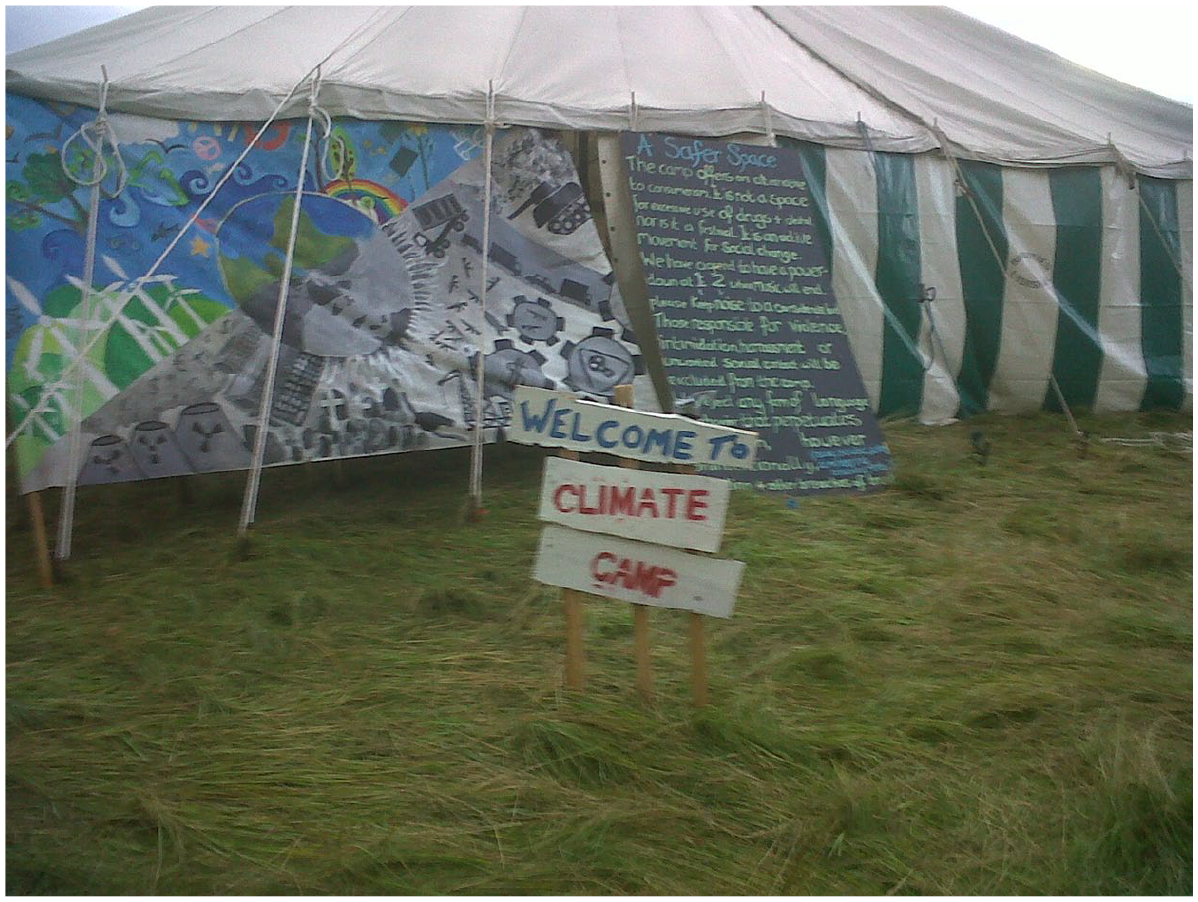
Welcome tent, Climate Camp 2010, Edinburgh (Photo: Olaf Corry).
Overall, 101 Green Party activists and 75 Climate Campers returned surveys, although more actually took part in workshop discussions (we estimate 15% attended but declined to return questionnaires). Since, as noted, there were often competing events, we cannot claim our results are representative of all attendees. While the closed-form nature of many survey questions limits a richer description of views, workshop discussions helped provide a more rounded picture. Party side events were quite large (~50 for each), whereas Camp workshops ranged in size from 10 to 30.
Policy Orientations of Climate Activists
We present evidence of climate activists’ policy knowledge, policy optimism, policy preferences and levels of trust in information sources.
Policy Knowledge
First, far from being purely oriented towards identity or protest tactics to challenge societal values, activists were found to be engaged in relatively expert technical debates even regarding then-lesser-known technologies such as CCS. Only 10% of Climate Campers and 1% of Greens said they had ‘never heard’ of CCS compared to 64% of UK adults at the time (DECC, 2012).
CCS is intended to remove CO2 from fossil fuel combustion (up to 90%) but is not expected to have significant impact on other environmental problems such as air or water quality. Therefore, a straightforward test of understanding was to ask participants whether CCS could help tackle problems other than global warming (which it cannot), for example toxic waste, ozone depletion, smog or water pollution (Reiner, 2011). Climate Camp participants appear somewhat more knowledgeable of CCS as a technology than Party conference attendees (Table 1), but both groups were far better informed than the general population. For example, only 7% of Climate Campers and 19% of Greens incorrectly thought CCS could improve water quality compared to 24% of European citizens and only 28% of Climate Campers and 31% of Greens thought it would improve air quality or reduce smog, compared to 53% overall in Europe (Eurobarometer, 2011: 83).
Pre-workshop ‘wrong’ answers regarding CCS.
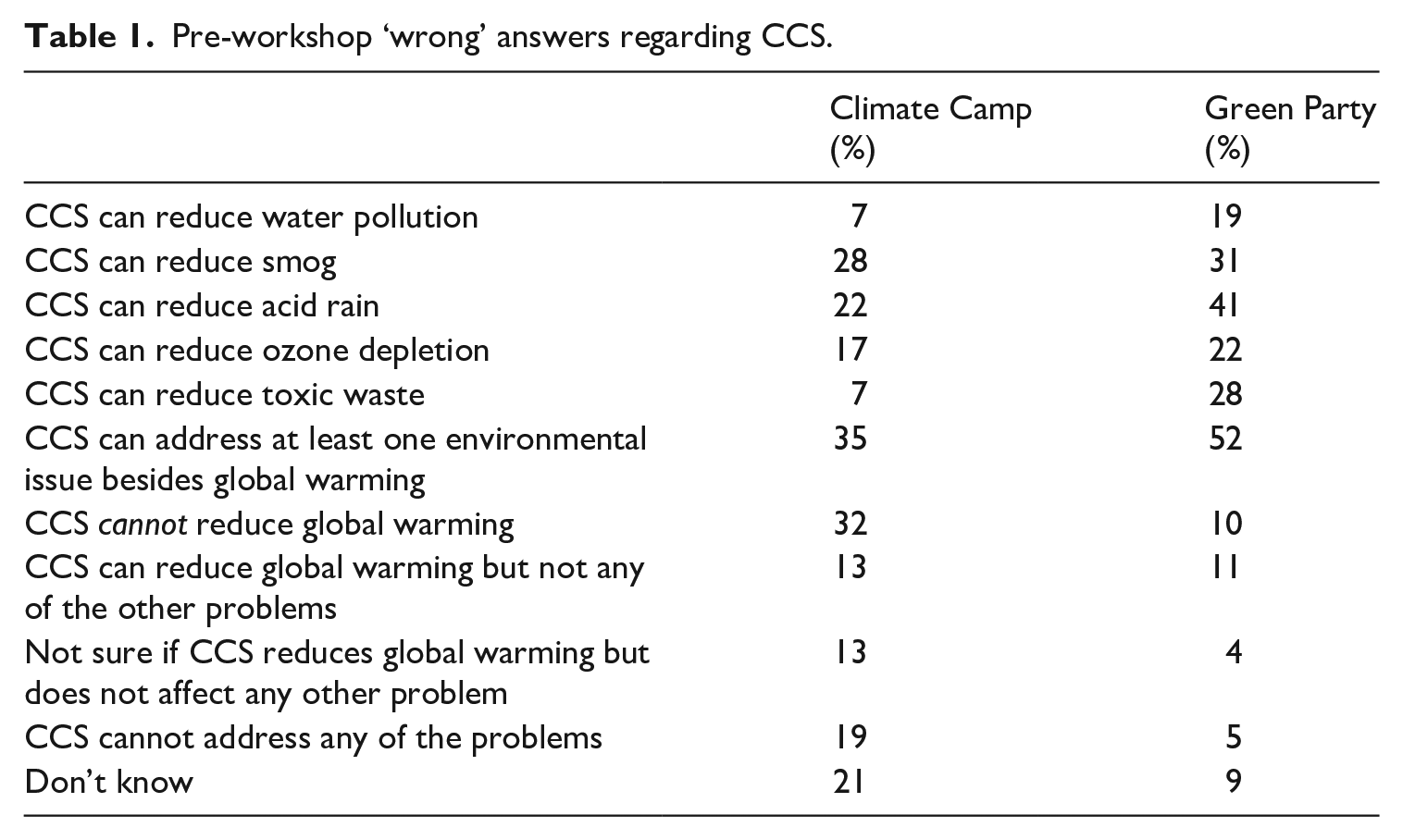
Despite strong opposition to CCS in general, only 10% of Green Party activists answered CCS could not ‘reduce global warming’, compared to roughly one-third of Climate Campers. Workshop discussions indicated that scepticism was not primarily based on technical misunderstandings, but on worries that CCS would cause further fossil fuel ‘lock in’ and be poorly implemented. Climate campers concentrated on wider societal impacts; for example, ‘it seems the whole framework of debate in CCS is to maintain current levels of consumption and the political and economic system’ (Welsh Climate Camp questionnaire) or when CCS would be ready relative to climate thresholds; for example, ‘there isn’t time for CCS to stop us reaching the climate change tipping point’ (UK Climate Camp questionnaire).
Relatively high levels of policy knowledge chime with Climate Campers and Greens being, on average, highly qualified and disproportionately likely to be working professionally on environmental issues or climate change (Table 2). Almost 70% of Climate Campers and fully 85% of Greens had a degree or more, compared to the British average of 23.8% (ONS, 2012).
Level of education among activists.
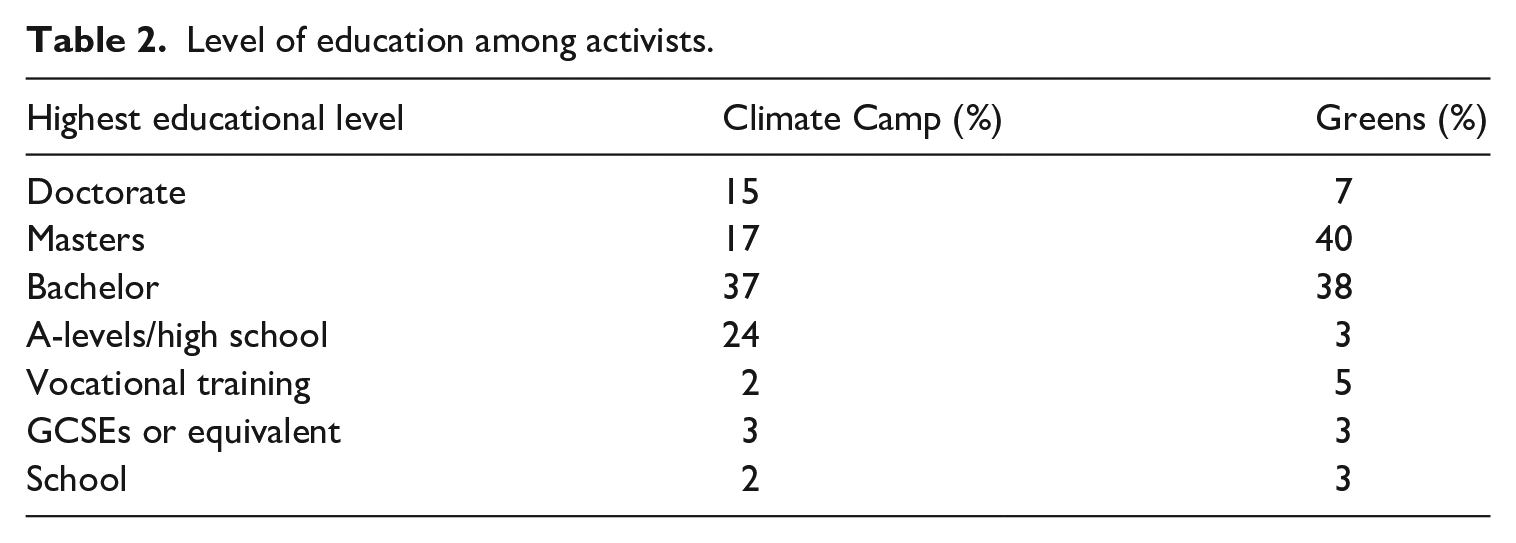
Climate Camp activists were also often professionally engaged in these topics. Almost half of respondents (44%) worked on environmental issues in some way including a third (31%) on climate change. Strikingly, over two-thirds of Greens (68%) were professionally involved in environmental issues, although somewhat fewer (22%) worked on climate change. Despite any self-selection bias, high levels of awareness and knowledge of climate policy options among activists are both plausible and easily explained, supporting the idea that professionalism and activism are not mutually exclusive (Newman, 2012; Roth, 2016).
Policy Optimism
Radical climate activists who distrust politicians and governments might also be expected to dismiss the idea that policy changes could make a real difference to a problem as intractable as climate change. Although a ‘catastrophist’ emergency framing among climate activists is claimed to result in depoliticising climate as a problem (Schlembach et al., 2012; Swyngedouw, 2010), such catastrophism seems to be a minority position among participants – roughly two-thirds (in roughly equal measure) believed adaptation or mitigation likely to succeed, whereas only 20% of Climate Campers and 23% of Green Party activists predicted neither would be successful. Thus, urgency is used to dismiss CCS rather than to depoliticise and promote ‘carbon counting’.
Turning to preferred strategies (rather than predictions), there was support for neither a purely technological approach to tackling climate change nor reliance solely on behavioural and structural change (Webb, 2012). This also contradicts the suggestion that post-political approaches squeezed out radical politics at the Camps. Climate Campers were strongly oriented towards science but also radical social change – the majority (51%) answered ‘only radical social change’ would work versus almost one-third of Greens (31%). However, over half of Greens (52%) and a large minority of Climate Camp respondents (39%) believed technology had a role to play alongside behaviour change (i.e. ‘need to alter behaviour and values but also use new technology’).
Espousing radical social change may not be inconsistent with ‘traditional’ policy options since massive investment in energy efficiency measures or widespread deployment of small-scale renewables are key elements of activists’ desired transformation. Thus, even among those claiming ‘only radical social change’ could solve global warming (we dub these ‘radicals’), 94% would ‘definitely use’ energy efficiency measures in designing a climate plan. Further, 66% would use land use change and forestry while none favoured nuclear power.
Commitment to radical social change was, in fact, linked to better understanding of CCS. Over half (51%) of radicals demonstrated a basic understanding of CCS whereas for those who answered that technology had some or a leading role, the proportion was 34% and 38% respectively. Under one-third of radicals showed poor understanding of CCS, whereas half of those whose preferred strategy was ‘primarily better technology’ did not grasp the basic questions on CCS. Interestingly, this suggests belief in radical social change may be correlated with – rather than opposed to – policy knowledge and interest in policy agendas.
Policy Preferences
Those surveyed inside and outside formal political settings seem to largely share priorities. For both groups, global warming was, unsurprisingly, by far the most common choice as a top environmental problem – 76% of Climate Campers and 82% of Greens, of which roughly 60% of each group listed climate change as the single most important problem. For both Greens and Climate Campers, the next three problems were similarly ranked: ‘destruction of ecosystems’ (37% and 49% respectively); overpopulation (26%/27%); and resource depletion (18%/17%). Traditional conservationist agenda items such as species extinction, green spaces, toxic waste, water and air pollution were rarely top priorities (none scoring above 8%), whereas problems given highest priority are all ‘systemic’. By contrast, public surveys in the UK and EU found more traditional problems such as air and water pollution ranked ahead of systemic considerations (except climate change) (Reiner et al., 2006). Climate Camp thus offers a different type of ‘grassroots’, since traditionally such groups tend to focus on local impacts and conservation, whereas NGOs tend to ‘target issues not so easily resolved such as climate change’ (O’Brien, 2012: 650). Now the grassroots are engaged in macro system critiques.
When asked to prioritise solutions to climate change, both groups of activists pointed primarily to investment in wind, solar, energy-efficient buildings or public transport in roughly equal numbers rather than large-scale technologies such as hydro, nuclear or perceived ‘end-of-pipe’ solutions such as CCS. This is consistent with a systemic problem definition and activists maintaining a strong link between environmental degradation and societal structure. In Climate Camp’s publicity material, the capitalist system’s orientation towards growth and profit figures as the root cause of global warming (Climate Camp, 2010). The slogan ‘system change, not climate change’ adopted by the umbrella organisation for grassroots climate activists, Climate Justice Action, sums up this approach. 2 Arguably, this came out most clearly in the choice of Royal Bank of Scotland (RBS) as the 2010 Climate Camp venue, citing RBS’s public ownership and loans to fossil fuel extraction (see Figure 2).
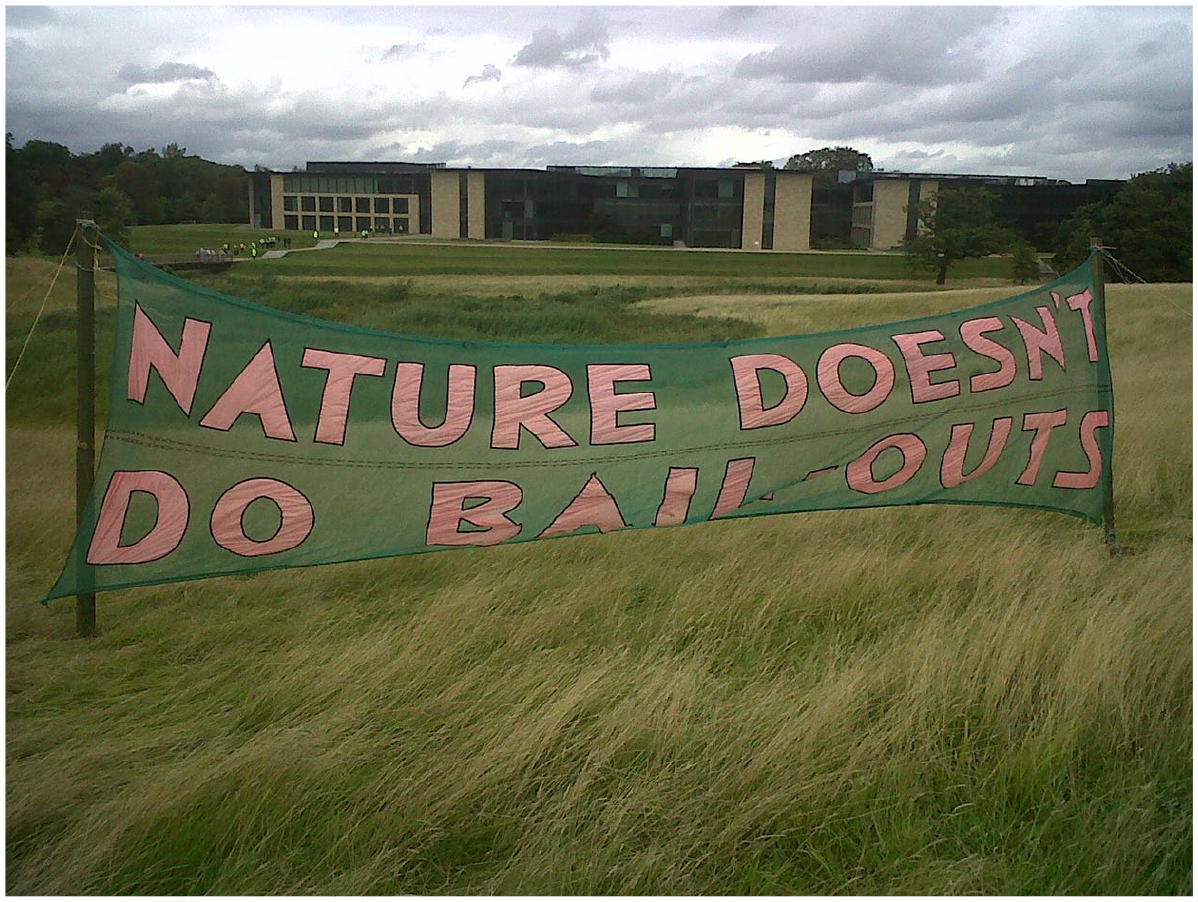
A Climate Camp banner in front of the Royal Bank of Scotland headquarters, Edinburgh. August 2010 (Photo: Olaf Corry).
Defining problems and potential solutions in system-transformation terms is also evident in more detailed data on how CCS is evaluated. Questionnaire results as well as workshop discussions indicated environmentalist opposition to CCS is closely tied to concerns over perpetuating a fossil fuel economy/society and marginalising small-scale renewable technologies. Over two-thirds of Climate Campers (68%) and almost half of Green Party respondents (49%) reported they would ‘definitely not’ or ‘probably not’ use CCS with coal (CCS with natural gas was slightly more palatable) (Table 3). Concerns were roughly evenly split between operational risks such as possible leakage from CO2 storage sites and more systemic societal concerns. Almost half of Climate Campers (45%) listed perpetuating fossil fuels as their main concern compared to roughly one-third (34%) who emphasised direct health and safety risks such as leakage. A typical workshop comment was ‘it’s like sweeping dirt under the carpet’ or, even more evocatively, ‘CCS is like staying in a violent relationship because you have to pay the rent’; that is, staying wedded to fossil fuels to maintain access to cheap energy (Workshop notes, Nordic Climate Camp).
Concerns about using CCS with coal and with biomass.
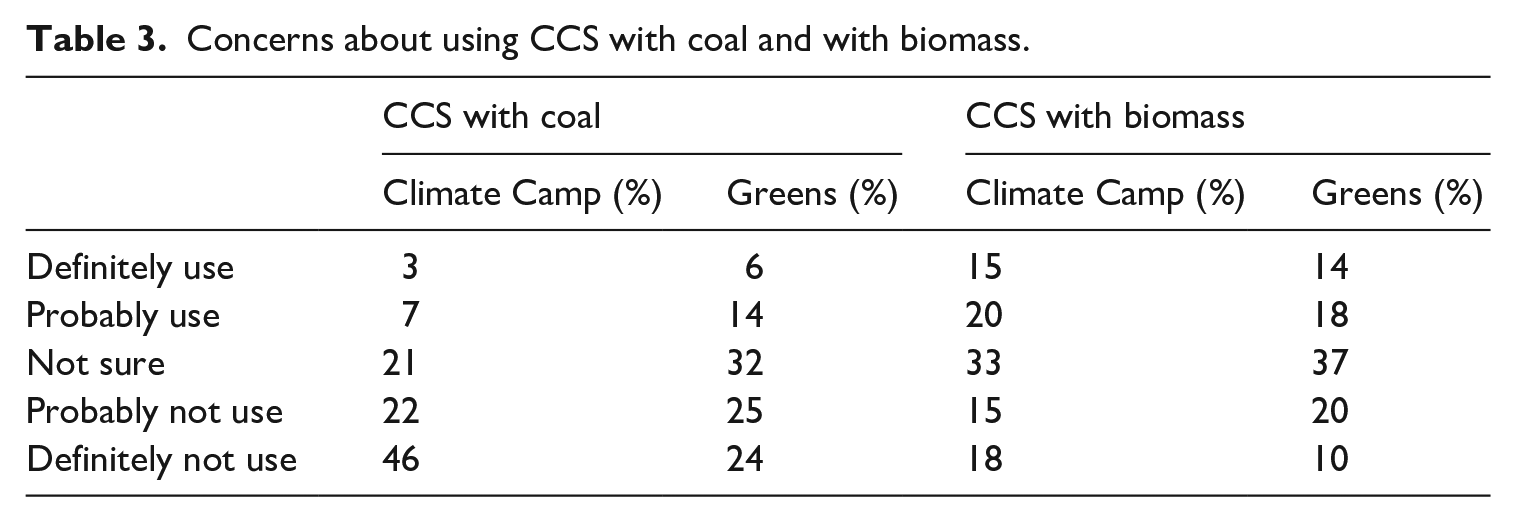
However, a significant softening of opposition to CCS among activists becomes apparent when asked to consider CCS with bioenergy (BECCS). If biomass (such as wood or agricultural residues) was employed, those willing to use CCS increased dramatically (from 10% to 35% for Climate Campers) and those who would definitely not use CCS declined from 46% to 18%. This was because BECCS could allow CO2 captured by plants to be stored underground creating so-called ‘net negative’ emissions.
The appreciation of net negative emissions among both sets of activists at this time is striking as it reflects understanding of both technology and climate systems. For those seeking aggressive climate action, negative emissions technologies could be tolerated if they could help return atmospheric CO2 concentrations to pre-industrial levels (Buck, 2016), which, since the 2015 Paris Climate Agreement, has risen up the political agenda. It could, of course, also be interpreted as evidence of a propensity for a ‘carbon counting’ approach to climate change among activists. However, one should be careful in overinterpreting the results for BECCS or negative emissions more widely since our discussions pre-dated recent debates and critiques over ‘carbon neutrality, land availability, competition with food production, and competing energy demands for bioenergy’ (Anderson and Peters, 2016: 183). Recent push-back against ‘net zero’ targets from climate campaigners such as Greta Thunberg point to similar fears of systemic lock-in and perpetuating fossil fuels that Climate Campers had of CCS now being applied to BECCS while XR focus on ecocide and mass species extinctions as much as climate and carbon (Eisenstein, 2020). 3
Trust in Authorities
Actors outside – or hostile to – the established political system may be thought to be distant from policy debates that draw on ‘authoritative’ knowledge validated by the officialdom. Because climate change is not directly open to sensory perception (unlike weather), it is particularly reliant on scientific knowledge systems and bodies such as the Intergovernmental Panel of Climate Change (IPCC) (Hulme, 2009: 3). ‘Trust’ in environmental information and risk perceptions depend on multiple factors, including different risk cultures based on different lived experience as well as knowledge, disagreement among experts and the conditions for production of knowledge in a society in general (Sjöberg, 1999). Climate Camp activists surveyed indicated strong distrust of governments, political parties (including Green Parties) and energy companies. Fully two-thirds of Climate Campers and almost three-quarters of Greens distrust governments (Table 4) while the least trusted, by far, were energy companies. Non-Green politicians were distrusted by both Climate Campers and Greens, while Climate Campers did not fully trust Green politicians, confirming the somewhat divided group identity structure within the environmental movement found by others (e.g. Saunders, 2008).
Activists’ trust in sources of information.
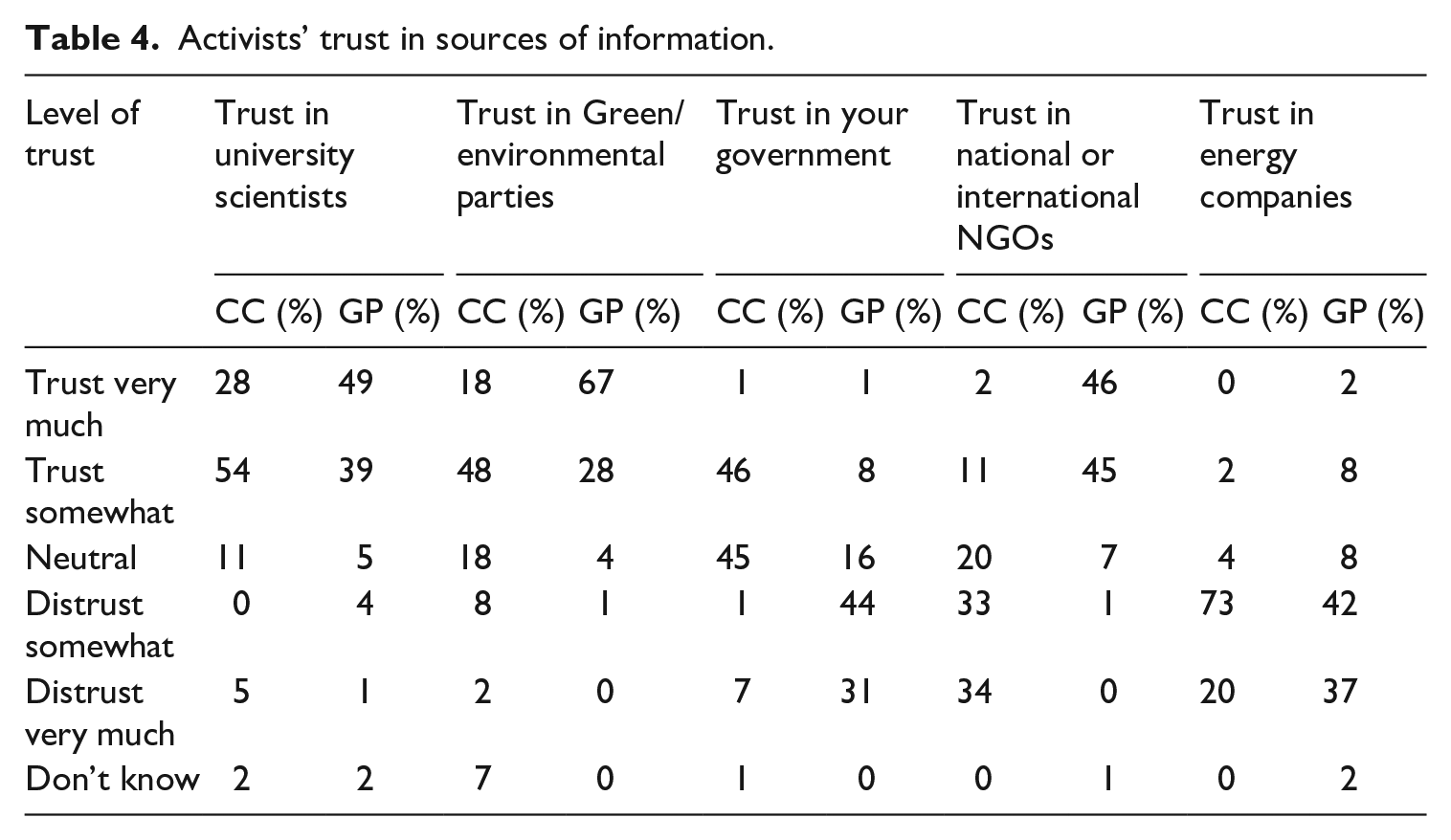
Information coming from NGOs and university academics was judged more trustworthy. This finding echoes the Schlembach et al. (2012) claim that climate activism has become ‘scientised’, although we contest that this necessarily implies adoption of a post-political or managerialist view of the climate problem. One slogan used by climate change demonstrators: ‘we are armed . . . only with peer-reviewed science’ (Archer, 2008) resembles scientism but may partly reflect mistrust of government and business. Contentious actors wishing to engage in policy discussions draw on and indeed bolster sources of knowledge that come from outside what they perceive as the political and economic system and can engage strategically with science by deploying established expertise and introducing alternative policy-logics (Parthasarathy, 2010). For one workshop participant ‘there needs to be a place where we speak as though politics didn’t exist – where only the science counts’. But such scientism went alongside – or even created discursive space for – calls for alternative societies: ‘The only way to prevent catastrophic climate change is to stop burning fossil fuels by leaving them in the ground and building alternatives. Not just an alternative energy supply, but an alternative society.’
Discussion
Extant literature and disciplinary boundaries contributed to framing contentiousness as belonging to an ‘outside’ of proper politics, and, in the process, recognition of policy knowledge and engagement among social movement actors suffered. Literature on climate activism has focused primarily (though not exclusively) on group identities and tactics. As climate protests intensify globally, this might lead to a false picture of ‘outsider’ radical activists engaged in affective identity-making and ‘insiders’ engaged in science and policy debates.
We have presented some of the first systematic data concerning policy knowledge and preferences among direct-action climate protesters. Alongside deep distrust of governments and support for radical social change, we find, overall, climate protesters understood technological policy options, trusted scientists and, despite perceiving climate change as urgent, were relatively optimistic regarding the possibility of solving the problem via societal and/or technological transformation. Despite divergent methods and group identifications, our outsider and insider activists broadly shared priorities and problem-definitions of climate change, prioritising similar systemic changes. Both groups evaluated new technologies according to their ‘societal fit’, rejecting CCS in large part because of its perceived conservative influence on overall patterns of production and ownership as well as long roll-out times for CCS. Although Climate Camp activists strongly distrusted companies and political parties, they were happy to draw on information from publicly financed scientists and established NGOs.
One possible explanation specific to the climate issue is the ‘politicisation’ of climate science (Gauchat, 2012), which may allow contentious activists to claim the backing of science without compromising anti-establishment identities. Indeed, many activists present were scientists or environmental professionals themselves. Also, in line with Saunders (2014), the contentious activists surveyed were not disillusioned with politics as such: though strongly suspicious of government, politicians (including Green Parties) and corporate actors, those engaged in (at times illegal) direct action were actually the more optimistic of the two groups concerning the effectiveness of political action on climate change. Although such activists had a wider agenda of (sometimes revolutionary) societal change, they had developed policy agendas and internally consistent preferences. In short, having identities as system outsiders and placing a strong emphasis on alternative tactics and methods does not preclude trust in and deployment of expert knowledges. When it comes to climate action, radicalism (belief in the necessity of system-change and use of extra-institutional methods) and science-led policy are increasingly seen as not contradictory (Shah, 2019).
These findings support ideas mooted elsewhere, that although contentious climate activists demand deep systemic societal change they simultaneously ‘perceive that immediate action is necessary’ (Stevenson and Dryzek, 2014: 145). There is therefore an appetite among climate protesters for piecemeal policy measures within the current system. For instance, groups within Climate Camps targeted specific proposed fossil fuel power stations and aviation infrastructure proposals, but they linked their opposition to wider social agendas of justice and critiques of capitalism. Schlembach et al. (2012: 5) claim climate activists also support ‘less radical measures such as green taxes, population control and state-imposed consumption restrictions’ although one might contest characterising the latter two policies as ‘less radical’. These authors criticise what they regard as an overly individualised, ‘scientised’ and ‘post-political’ discourse of personal responsibility among climate protesters such as tackling individuals’ ‘carbon footprints’. Our data suggest that scientism can coexist with – or even reinforce – more radical aims.
A degree of policy orientation among contentious activists also chimes with the wider history of climate action in the UK, where the Climate Camp movement began. Recent Extinction Rebellion protests are, like their predecessors, grassroots efforts deploying civil disobedience in aid of societal transformation but put the onus on governments to act (Doherty et al., 2018). Infrastructure and energy policy decisions led Climate Camps to set up in the locations they did (power stations, airports and banks), which shaped key messages and alliances (e.g. with Plane Stupid). This presaged XR’s recent focus on state-led policy change, reliance on ‘science’ and Greta Thunberg’s rejection of business-as-usual environmentalism at Davos (Maxton-Lee, 2020: 455).
Concluding Remarks: Paying Attention to Protester Policy Engagement
Our study supports those sociologists of protest who, while acknowledging the expressive dimension of environmental social movements, assert: ‘Protest is not merely a badge of membership aimed at achieving a sense of belonging and of being a member of a moral select’ (Doherty et al., 2000: 14). Doherty (2005: 220) suggests ‘more radical groups also play a role in affecting environmental policy’ although he adds that this is done ‘most often discursively, by altering the terms of debate’. We found support for radical social agendas is by no means antithetical to interest in science and policy. Climate Camp engaged with policy agendas and appealed to scientific authority alongside radical societal critiques. This does not deny potential contradictions in protester policy engagement, as targeting ‘the system’ implies it takes responsibility for enacting change.
These interactions between views ‘outside’ and ‘inside’ the political system may be conspicuous in climate politics due to the prominent diagnostic role of science (Forsyth, 2004) and the ‘wickedness’ of the climate problem (Head, 2008) rendering rapid revolutionary change non-credible. However, our findings might also apply to other spheres: medical activism and sexual politics show similar formal–informal interactions (Grundy and Smith, 2007; Oliver and Pearce, 2017; Orsini and Smith, 2010). Ours might even be considered a ‘hard case’ for protester policy engagement: hostility to institutionalised politics runs particularly deep among direct-action groups such as Climate Camp; the environment is often considered the paradigmatic example of New Social Movements motivated by ‘deeply held views about justness or ethics of a cause’ (Libby, 2013: 10); and identities have previously been found to divide the climate movement (North, 2011; Saunders, 2008; Schlembach, 2011) militating against consensus on policy questions. Thus, if our activists engage with technological and expert knowledge production, then it is entirely possible other NSMs and traditional activists do the same.
Overall, sociologies of activism should be alert to policy engagement among contentious protesters and this could even be theorised with rather than in contradistinction to identity. If collective identity is defined as a ‘cognitive, moral, and emotional connection with a broader community, category, practice, or institution’ (Polletta and Jasper, 2001: 285), then such practice may include policy engagement. There is no reason why one of the cultural materials that collective identities are expressed through could not consist of commitments to specific policy options or even technologies; for example, renewable energy. Heterogeneous groups can overcome factionalism via ‘highly elastic collective identities’ (Flesher Fominaya, 2010: 401) formed variously through boundary work relating to defining out-groups and ‘shared emotional experiences’ (2010: 401) – so why not also via a common policy focus and social production of knowledge (Jamison, 2010)?
As climate emergencies are declared and citizens’ assemblies proliferate, we suggest it is increasingly important to recognise ‘protester policy engagement’ – the processing, production and communication of plans for societal change from a position outside the established political system. How this is conceived, evaluated and communicated and how it fits into social movement identities become important aspects of a general sociology of activism that spans both rationalist and emotive registers. In practical terms, access to radical gatherings can be difficult and systematic data-gathering is arduous although events such as ‘teach-ins’ associated with Fridays for the Future offer possible opportunities (George, 2019). Future research might build on our ‘participant-instigation’ method and seek new ways to examine, not just in and out-group boundary making, social identity-formation and social movement impacts, but also policy ideas as they appear and move within contentious movements.
Footnotes
Acknowledgements
We wish to express our thanks to the activists at Climate Camps and Green Party conferences who welcomed and put up with us. Thanks also to those individuals we asked to accompany us to events to help with presentations concerning carbon dioxide capture and storage: Gabriella von Goerne, Mike Stephenson, Stuart Haszeldine, Filip Johnsson and Lasse Wallquist. We wish to thank Patrick Harvie, MSP and Dr David Toke for serving as discussants at the Edinburgh and Cardiff Green Party conferences respectively. We also would like to acknowledge Rebecca Firth and Ioanna Boulouta for their assistance with coding data. All errors or omissions remain the responsibility of the authors.
Funding
We gratefully acknowledge the financial support of the Commonwealth Scientific and Industrial Research Organisation (CSIRO) of Australia, and project support from Peta Ashworth and Anne-Marie Dowd, in making this research possible.
