




Abstract
The article analyzes utopian thinking within the current climate movement, with a particular focus on the Finnish movement, and develops analysis of contemporary society through utopias. Empirically, it is based on material collected in the context of a protest week called ‘Utopia rebellion’, in Helsinki in 2022. We use material such as statements, blog posts, and social media content produced by climate activists, as they aimed to form an idea of utopian society beyond their demands on climate policy. We argue that in order to understand any utopian vision properly, one needs to understand not only how it conceptualizes the ideal society, but also how it (implicitly) interprets the nature and problems of the existing one, and the function of utopias. From this starting point, we develop an analysis of the movement by looking at its utopias, conceptions of the present, and uses of utopias. In the image of the movement formed this way, the key components emerging from the analyses are related to redefinitions of work, reconnecting with one’s community, and the possibilities of identities to flourish.
Introduction
The ongoing ecological crisis in general and climate change in particular create a pressing need for social alternatives, as it is ever more evident that the existing trajectories will lead to catastrophic consequences. This also reveals the need and thereby opens new spaces for critical utopian thought that facilitates social change. While utopian thought is seen as detached and distinct from the concerns within existing society, either because it is ‘unrealistic’ or because utopia by definition departs significantly from society as it exists today, the relation between utopia and the present society can be also seen through interpreting utopian articulations of imagined possible societies as implicit criticisms of the existing one. Thereby, utopian ideas can also facilitate social change, even beyond ‘real’ utopias (Wright, 2010) or ‘working utopias’ (Crossley, 1999), which explicitly take the present as their starting point.
In this article, we look into the Finnish climate movement from the perspective of its utopian thought and the implications of this utopianism. We are particularly interested in how articulations of utopia involve implicit or explicit conceptualizations of the present, and what kinds of functions these utopias have. Our analysis is based on material collected in the context of a protest week called ‘Utopia Rebellion’, in Helsinki in 2022. The event was arranged by Extinction Rebellion (XR) Finland (‘Elokapina 1 ’ in Finnish). As this event was focused on the need to think of the utopias of the climate movement, it provided explicit articulations of the movement’s utopian ideas. During the protest week, Elokapina tried to explore and articulate explicitly utopian ideas for venturing beyond the given state of affairs. This enabled our approach to utopias: in addition to highlighting the tacit utopian elements in a social movement, we could also use clearly articulated utopian ideas to analyze how the movement sees the existing society.
In addition to the material produced by Elokapina in the context of the Utopia Rebellion protest week, we use other relevant material produced by the Finnish climate movement, such as statements, media content produced by the activists, blog posts, and social media content. On the basis of this material, we ask, what kinds of images of the existing society are implied in the articulations of utopia within the movement. Our aim is to both develop this methodological approach to analyzing utopias as social criticism and to shed light on the climate movement’s social thinking beyond the immediate climate issue.
Absolutist versus relationalist approach to utopias
Utopian thought is often associated with what can be called an ‘absolutist’ conception of utopia. This conception interprets utopias as closed and static blueprints of a perfect society. Sociologist Ralf Dahrendorf (1958: 116) argued that utopias are based on the universal consensus of values and institutional arrangements. According to Dahrendorf, utopias are ‘perfect–be it perfectly agreeable or perfectly disagreeable – and consequently there is nothing to quarrel about’ (Dahrendorf, 1958: 116). Other examples of absolutist interpretations of the meaning of utopia can be found from Jacob Talmon (1952: 252) who defines utopia as ‘complete harmony of interests’ and from J.C. Davis (1983: 38–40) for whom utopia is essentially a closed perfection that only allows ‘freedom from disorder and moral chaos, freedom from moral choice altogether’ (Davis, 1983: 384). Eventually, such absolutist conceptions of utopia have come to be associated with totalitarianism and violence (see, e.g., Achterhuis, 2002; Arendt, 1970: 51–52; Gray, 2007; Popper, 1963: 357–358; Popper, 1957).
In recent decades, there has been plenty of talk about the end of utopias and utopianism in general (see, e.g., Fisher, 2009; Fukuyama, 1989; Habermas, 1986). The idea of historical progress has been questioned and future-oriented utopias that could facilitate large masses of people have largely vanished from the political landscape. As Fredric Jameson has written, postmodernism is characterized by the loss of the sense of ‘New’, the idea that society can be radically transformed (Jameson, 1991: 311). However, as Andreas Malm (2020: 11) has argued, climate change and ecological crisis in general force history alive again: ‘History has sprung alive, through a nature that has done likewise’. XR and other similar movements can be seen as expressions of a post-post-historical situation. The utopian orientations of such movements, when they exist, can be seen communicating the desire for the rediscovery of the New when they (as will be shown below) imagine, for example, an anticolonialist society organized around the principles of non-alienated communal care work, gift economy, or degrowth.
In contrast to absolutist approaches to utopia, we opt for a ‘relationalist’ interpretation. For us, utopia is essentially a method of theorizing alternatives for the present society (see Eskelinen et al., 2020; Levitas, 2013). More than a ready-made system or blueprint of a perfect society, utopia in this interpretation, has a function of showing the problems and contradictions of the present, by laying out an image of a radically different and significantly better alternative world. This image of an alternative, however, is dependent on the image of the present we draw from the analysis of our current historical situation. Utopian counter-images can be seen as visions of alternative social reality where the problems that are seen as most pressing in the present are solved and the core contradictions have been overcome. Utopianism as a form of critical social theory then crystallizes the core problems of the present and forces us to question the collective goals of the existing society.
The purpose of utopian thought is not to create static and absolutist blueprints for a new society but to create critical counter-images of a society in which radically new principles and practices are created. Utopias are critical reflections of the existing social institutions, social relations, and the social totality as a whole. The role of utopias as counter-images of the current society makes them relational and historically conditioned.
Understood this way, utopian thought is a call to practice political imagination (Sargisson, 2013). Political imagination in general can be defined as ‘a way of transcending political reality, and thus challenging conformity’ (Duncombe and Harrebye, 2021). For many utopian thinkers, the notion of utopia refers to orienting oneself to look beyond the given state of affairs. For example, sociologist Karl Mannheim (1979: 173) defines utopian mentality as something that ‘breaks the bond of the existing order’. For philosopher Leszek Kołakowski (1968), utopia is ‘a state of social consciousness, a mental counterpart to the social movement for radical change in the world’ (p. 69). For Ernst Bloch, utopia means ‘venturing beyond’ (Bloch, 1986: 4). Understood this way, utopia is a form of ‘social dreaming’ (Sargent, 1994: 3–7) and a subcategory of the phenomenon of political imagination, or ‘the radical imagination’ (Haiven and Khasnabish, 2014).
Departing from the ‘absolutist’ view, utopias can then be studied through their function (how utopias are used, what utopias do by their existence, and what kinds of acts are articulations of utopias), in addition to or instead of their content (how they depict future society). Here we follow sociologist and utopian scholar Ruth Levitas’ definition of three possible functions of utopias: the function of preventing social change (the compensatory and escapist functions of utopias), the function of facilitating social change (utopias as goals for political action) and the function of critique (Levitas, 2010). Although utopias usually entail all these functions with varying emphases, here we emphasize the function of critique. From the perspective of this function, utopia as an imaginary construction is always at least implicitly critical towards the present society and expresses the need for social change. Articulations of utopia mean a juxtaposition of the imaginary utopian society and actually existing one. This creates a contrast effect, where the current society will be seen as more unjust, more faulty, and more problematic than the imagined utopia’s society. The mere articulation of utopia leads then more or less deliberately to illuminating the problems of the current society.
Utopia as a critical counter-image of the present
We suggest that from the perspective of the critical function, utopia can be defined as ‘counter-image criticizing the present motivated by a desire for better being’. This definition can be broken down to three basic components: ‘a critical counter-image’, ‘the present’, and ‘a desire for a better being’.
‘Critical counter-image’ expresses the contents of the utopian vision offered as an alternative to the existing society. With this notion, we emphasize the critical function of utopias as not only images of the possible but also implicit criticisms of what exists. Utopia is indeed not only an image but a counter-image always reflecting the social context of its conception.
‘The present’ expresses this conception of the existing society. It can be understood here as ‘the historical totality of material conditions and social relations’ in the context of which the utopian subject imagines and/or realizes her utopias. Apart from the context within which alternatives are sought, it is also the material and social totality for which these alternatives are sought by the utopian writer or actor. This component expresses the fundamental historicity of utopia: the present is in constant change and therefore utopias too have to be open for change.
The final component of this definition of utopia, ‘a desire for a better being’ is also a formulation suggested by Ruth Levitas (2010). This component refers to the overall orientation of all utopias: utopias are about a state of being that is significantly better than the current one, yet not perfection. They are an embodiment of the human inclination of searching for a better life.
Understood this way, utopias are relational and historically conditioned. 2 They are critical reflections of existing social institutions, social relations, hegemonic values, and goals of society. Furthermore, utopias ‘relativize’ the present (see Bauman, 1976: 13), meaning that the present is always only a moment in an open-ended historical process. This has two implications: (1) the present can always be imagined to be different and (2) the present does not determine the future, but can lead to a number of different futures depending on choices made in the present. Utopias are then tools for extrapolating the possibilities of the present. Utopias do not transcend the current reality but draw from the experiences and cravings of their own time.
We argue that in order to understand any utopian vision properly, one needs to understand not only how it depicts a possible future, but also how it conceptualizes the present and the nature of currently existing problems. Utopia is in this sense a critical concept that can be used to identify ideas, movements, and organizations that orient themselves beyond the boundaries of the present.
However, what is considered a better society or better being is obviously also subject to historical change. How we understand the nature of the present defines how we imagine the alternative for it. It would be naïve to think that utopias can reflect the present without any mediations. A utopian counter-image that aims to depart from the problems of the present cannot be constructed without an idea of the present itself. Without such vision of the present and its central tendencies and latent potentialities, the function of utopia as social criticism cannot exist. Utopian counter-images are always conceptually mediated: the nature of the utopian counter-image depends on how we understand and conceptualize the present. This means that not only the present itself but also conceptualizations of it guide the construction of utopias of alternative societies. Assumptions about social reality then guide the way utopian alternatives are understood. (Lakkala, 2021a, 2021b)
Although utopias can formally speaking have almost any kind of contents (hence the logical possibility of fascist utopianism that is otherwise more likely to be recognized as dystopian rather than utopian), utopian thought nevertheless forms a continuum, in which certain normative commitments have consistently marked most utopian depictions of an alternative society. Some of these commitments can be described with such terms as ‘universal brotherhood and communal work’ (Jacoby, 2005: x) or with the concept of ‘enhanced sociability’ (see, e.g., Claeys, 2013). Utopian tradition can be seen as having a general normative basis in the ways it has during its history linked itself to discourses on sociability and belongingness ‘where our experience as social beings greatly exceeds the norm in our own societies’ (Claeys, 2022: 41–42). This general normative grounding is useful in understanding the specifically utopian character of Elokapina’s Utopia rebellion event.
Case presentation: ‘The Utopia Rebellion’
As the climate emergency has been developing into ever more acute and alarming scenarios, the climate movement has, as a natural reaction, emerged and strengthened. Protest typically comes in ‘waves’ (Della Porta, 2022), in addition to being reactive to political events, and the climate movement has been undergoing a phase of intensive action and mobilization, apart from the brief general paralysis of civil society under COVID restrictions. XR is strongly associated with the ongoing global wave of climate protest (Neas et al., 2022; Pickard et al., 2020). This phase has been characterized particularly by school strikes, initiated by Greta Thunberg (Boulianne et al., 2020), and globally spreading forms of protest, including XR. As is often the case with social movements, the core of the movement consists of young activists: obvious in the case of school strikes, but true more generally (Wahlström et al., 2019).
XR is, according to their own words, ‘a decentralised, international and politically non-partisan movement using non-violent direct action and civil disobedience to persuade governments to act justly on the Climate and Ecological Emergency’ 3 . XR has brought a new wave of radicalism into the movement (Berglund and Schmidt, 2020a). While radicalism is a debatable concept, civil disobedience actions such as street blockades have been characteristic in the strategy of XR. The spread of the movement has been remarkably rapid, with over a thousand local groups emerging within a very short moment of time, accelerating after visible key protests (Gardner et al., 2022). It has also created democratic innovations (Berglund and Schmidt, 2020b).
The Finnish branch of XR makes no significant departures from the general political styles and tactics of the international movement. It is focused on the general themes of climate change and extinction, and stylewise on visible actions such as street blockades. It was launched in 2018, almost immediately after the birth of the movement in the UK (Elokapina, 2023). Since then, it has remained a visible counterpolitical agent and a subject of much public debate. While the Finnish XR engages in continuous action, the activities concentrate in specific weeks of action, usually taking place in summer and autumn. These action weeks often have specific themes, and include both protest and various kinds of discussion and culture events. Both protest and other events use a specific place called ‘The Rebellion Centre’ as the hub of events. Practically, this means a place with tents, other light infrastructure, and loudspeakers, where activists and random visitors spend time and various kinds of events and programme take place. This place is set in a visible spot in the city centre.
Here, we focus particularly on an action week in summer 2022, the aim of which was to articulate and envision utopias. It was a rare moment, in which the movement not only reflected broader social change instead of focusing on climate issues, but also put emphasis on reflecting a possible future society, rather than reactive protest, and made significant effort to facilitate discussion on these utopian perspectives. This is generally rare among social movements which typically see themselves as protests, and are rarely motivated by explicitly stated, unifying collective utopian goals (see, e.g., Endnotes, 2020; Klein, 2017). Usually, a more interpretative or ‘archeological’ (Levitas, 2013: 153–174) mode of utopian method needs to be used to discern the more utopian ambitions of social movements, but here the utopian orientation is exceptionally articulated openly. 4
The idea of this action week called Utopia Rebellion was to both temporarily materialize a micro-utopia in the form of trying to form an alternative community around the Rebellion Centre with discussions on safe spaces and the like, and reflecting on broader social utopian futures, in many debates on what kind of world the protesters would like to see. It was a display of diversity of ideas and impulses, emphasizing this explorative aspect in its programme, rather than aligning towards fixed and clear goals. The programme took place over a weekend at the ‘Rebellion Centre’. In addition to the more obvious speeches and demonstrations, the programme included a variety of events such as yoga, mindfulness, and meditation; lectures, reading group meetings, strategy discussions, interviews, and panel discussions (e.g., with a fiction author); and live music, poetry reading, and choir rehearsal, as well as (scheduled) relaxation. As Elokapina (2022b) itself describes the event: ‘In a colorful demonstration, the dream is realized by dancing, celebrating new possibilities and creating space for a sustainable alternative future’.
All in all, on the basis of its programme, Utopia Rebellion appeared to be more like a bazaar of ideas than a display of a fixed programme of a vanguard. The range of topics of lectures and discussions was notably broad, ranging from the more obvious themes of climate and species extinction to safe spaces, parenthood in the time of ecological crisis, and emotions. It also included a discussion on degrowth, as well as on learning from the Kurdish liberation movement. Apart from the events around the Rebellion Centre, the reflection of utopias was accompanied with a radio programme, in which XR members reflected on their utopias.
Description of the data and method
While events like the Utopia Rebellion are also ethnographically interesting, here we chose to focus on the publicly available material produced by Elokapina about the Utopia Rebellion. We collected material from Elokapina’s main website elokapina.fi, Elokapina’s official Facebook page, Elokapina’s official Instagram profile, and Elokapina’s official Twitter (also known as ‘X’) account. In addition to these, we also collected material from various public Instagram and Twitter profiles used by some more visible prominent Elokapina activists functioning as kinds of unofficial spokespersons, and the subsection of Elokapina known as Scientist Rebellion Finland. Material was gathered also from Elokapina’s five-part radioshow ‘Eloradio’ in which utopias and utopianism were discussed from several perspectives. One video about the Utopia rebellion event found from Elokapina’s official YouTube channel was also used as material for our analysis. We also collected material from different media that reported about the Utopia Rebellion event. Especially we focused on the reporting of Helsingin Sanomat (the largest newspaper in Finland) and YLE (the national broadcasting company). However, some material was also found from tabloid newspapers such as Iltalehti and from Kirkko ja kaupunki (the largest newspaper in Finland associated with the national Evangelical Lutheran church). We benefitted particularly from the radio programmes, in which social utopias were very explicitly discussed. In addition, we discussed with some of the organizers, in order to obtain background information, and used the declarations and social media content of the event as data.
A more detailed quantitative analysis of the data can be seen in the following table:
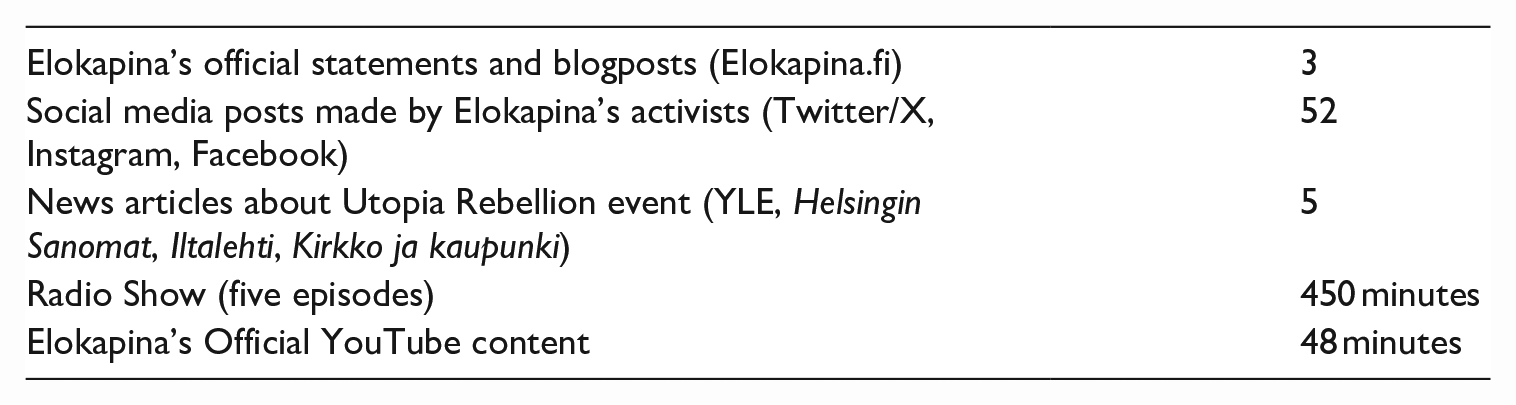
We analyzed the data from the perspective suggested above, using the means of qualitative content analysis. This means that we took an approach emphasizing an interpretive close reading of the text (Julien, 2008: 121). While the ideas of activists are diverse, we looked for ideas that are often repeated and/or seldom contested, as well as official declarations which can fairly be interpreted as the consensus or the ‘official’ voice of the movement. These ideas were then organized into themes. After locating the utopian content, we used it to ask, what kinds of images of the present these utopian ideas imply. Subsequently, we continued the analysis to lay out the utopian images themselves, as well as the conception of utopia expressed by the Utopia Rebellion. Both authors participated in collecting and analyzing the data with an equal contribution.
Our methodological approach can be seen representing the ‘archeological’ mode of utopian method (see, e.g., Levitas, 2013: 153) that aims to find utopian qualities from all sorts of utopian and even from seemingly non-utopian texts. Although Elokapina’s utopian visions are in many cases stated very explicitly, there are still elements of utopian imagination that need interpretation. Thus, our approach can also be described as a form of utopian hermeneutics, that aims through interpretation to find utopian elements in all areas of human culture. This kind of orientation can be found, for example, in the works of Ernst Bloch (1986), Douglas Kellner (1997), and Fredric Jameson (1979). Especially in Bloch’s The Principle of Hope (1986), utopian archaeology (or utopian hermeneutics) finds utopian, premonitory, and prefigurative images of the future from the works of the past and the present.
Our approach is to pay attention to both sides of the relationalist conception of utopia laid out above: the utopian orientations embedded in the climate movement’s ideas, slogans, and their declared goals, and the way in which their analysis of the present (their ‘social theory’) alludes to certain utopian orientations. This means that articulations of the present are read from articulations of utopia and vice versa. When criticism is directed towards certain aspects of the existing society, we read this as a way to implicitly express a desire for an alternative. The way a movement understands the present and its problems influences their utopian visions. Conversely, when utopian values or models are described, we interpret them as implicit criticisms of the existing society. As neither the utopia nor the ‘social theory of the present’ can be described in detail, it is particularly noteworthy, what aspects in them are highlighted. To properly understand the utopian visions within the climate movement, we analyze the ‘social theory’ on which they build their utopian theses. This analysis needs to take into consideration three things: (1) the social condition in which these utopian visions are developed in, (2) the different ways this social condition itself has been interpreted by the actors in climate movement, and (3) the particular context in which utopian imagination is put into practice. Our research questions are: What are the utopian counter-images of the present of this movement, and how does it understand the present society? In addition, we look at the functions of utopia as they appear in the context of the Utopia Rebellion: are utopias produced in order to critique that existing society, to facilitate political action, or to offer consolation and hope in the bleak present?
Utopian visions in Utopia Rebellion’s ideas
To begin with the utopian visions more or less directly articulated by Utopia Rebellion, a utopian world seems to be one in which particularly work is redefined and community life receives more attention. These themes are noteworthily emphasized in the utopias of the movement.
The new meaning of work focuses considerably more on care and culture. In the utopian future, people enjoy more leisure time and do not devote their life to meaningless activities. This is complemented with a socialist (or gift economy-based) logic of contribution: everyone contributes according to their capacities. Work is focused on caring for other people and the environment; in other words, it is a world where reproductive rather than productive work is prioritized. On the contrary, culture is valued over consumption representing mere survival: to the extent that productive work is valued, it takes place mostly within an immaterial realm.
Work, the act of working, and the worker should have meaning. In our utopia, work aims to protect the conditions of living everywhere and to reduce suffering. In a utopia society, the concept of work has been re-evaluated, as well as what kinds of work and action are desirable for the continuity of our life. The priorities of society have been chosen with the planetary boundaries and the equal well-being of individuals, communities and ecosystems in mind (Elokapina, 2022).
Work is also not limited to waged labour, but a broader definition is applied. It includes care and many activities that are today categorized as ‘volunteering’. Thereby, it is motivated by a sense of what is valuable, rather than what is profitable: this goes beyond the distinction between use value and exchange value. ‘Worth doing’ then assumes a new, normatively motivated meaning in the domain of work. This meaning also involves a notion of incommensurability; in other words, a single measure of value will not be applied. What this logic of valuation steering economic activity means in terms of relation to money, markets, or capitalism is not explicit. In any case, the approach to work focuses on the repoliticization or the category of work, instead of mere redistribution (Weeks, 2011), thereby following many small-scale utopian experiments, for which a specific conception of the meaning of labour is central (Salmenniemi and Ylöstalo, 2023).
Furthermore, work is radically localized, or ‘deglobalized’. Much more of what is called work is done within and for the community, yet the exact meaning and scope of ‘community’ never gets defined very precisely. On the consumption side, naturally also affecting the organization of work, a sense of sufficiency functions as the overarching key principle. People have a sense of having enough. Production and consumption are also informed by drawing a clear line between necessity and excess. This is ever more pronounced when one takes into account that downshifting consumption as such is hardly mentioned; so the logic is not to decrease, but to redefine. Deglobalization does not necessarily mean disconnecting, but rather seeking new ideas for global solidarity, as displayed by the emphasis on the social ecology-inspired Kurdish-led attempt at revolution in Rojava in the programme. 5
Redefinition of work and localization of the economy and social life are captured by the notion of degrowth as an alternative to the irrational consumption of resources and destructive and alienating growth of society. Degrowth was explicitly endorsed as a utopian goal in Utopia Rebellion and as a general term capturing the utopian aspirations of the movement. Although the concept of ‘degrowth’ can be seen as an umbrella term for various movements and frameworks it can also be understood as a concrete utopia which (1) enables global ecological justice (transforms and reduces the material metabolism of society), (2) strengthens social justice and self-determination while striving towards good life for all, and (3) redesigns social institutions and infrastructure so that they are not dependent on economic growth and continuous expansion of their functioning (see, e.g., Latouche, 2009: 32; Schmelzer et al., 2022: 191–195).
As the branch of Elokapina (2022a) known as ‘Scientist Rebellion Finland’ put it in their degrowth-themed session at the Utopia Rebellion event:
The core idea of degrowth is that continuous economic growth isn’t necessary for human wellbeing. Our goal should be ensure the wellbeing of everyone. Economic growth has been seen as the way to do that, but it’s increasing clear that that’s not true. When our economy grows, those gains are largely captured by the wealthy few. The result is greater inequality, not greater wellbeing.
Furthermore, the utopian society enables and facilitates a connection with something bigger than oneself. There is also a strong sense of connection to ‘the world’, in other words to the nature, and to other human beings. While one could hear a spiritual tone in the talk of ‘connection to something bigger’, this is first and foremost an institutional matter.
Community is emphasized by practices of grassroot-level deliberative democracy based on affinity. Explicitly, village councils rule instead of governments; yet here, ‘village councils’ possibly should be understood to possibly also mean urban communities of affinity. Whatever the setting, there is more community life and less sense of solitude. This notion of simultaneous care for people and the planet has sometimes been called the ‘regenerative culture’ of XR (Westwell and Bunting, 2020).
These imagined communities of affinity are places in which all identities flourish and are fundamentally egalitarian. A utopian space is described as one in which one does not need to explain oneself, even if one is a member of both sexual and ethnic minority, for example. In contemporary political parlance, such a community is a kind of extended safe space, in which structures of oppression which cover nature, gender, and minorities, are undone.
In this way, the utopian reality looks like a return to pre-capitalism, and one could see the notion of ‘village councils’ also as surprisingly premodern in tone. At least no ‘ecomodernist’ or technology-oriented utopianism is visible in these images of a desired society. A utopian society focuses on people and nature, well-being in the sense of care, sharing, and communal life and abandons technological-productive solutions and visions of a future lifestyle. Yet interestingly, the authority of science is vocally emphasized in the context of climate change. Apparently, scientific statements of nature are not parts of the cultural machinery of oppression.
Yet another dimension of the Utopia Rebellion’s particular form of utopianism ought to be mentioned here. In its attempts to realize its utopian dreams ‘by dancing, celebrating new possibilities and creating space for a sustainable alternative future’ (Elokapina, 2022b), Utopia Rebellion can be understood as a form of ‘lived utopianism’ (Sargisson and Sargent, 2017) where utopia itself is created temporarily in the here-and-now. Here the ideas of Mikhail Bakhtin about the connection between carnivalism and utopia seem to hold true: similarly to medieval carnivals Utopia Rebellion attemps to merge the utopian with the reality and to celebrate ‘temporary liberation from the prevailing truth and from the established order’ (Bakhtin, 1984: 10).
How Utopia Rebellion sees the present
These utopian ideas lead us to the image of the contemporary society and its problems, implicit in the utopias. This image of society as it emerges in the context of Utopia Rebellion can be described as generally irrational and delusional. It is based on misguided assumptions of infinite resources and it benefits only white westerners – and eventually not even them. It is not only environmentally destructive but also structurally racist, and based on selfishness as the guiding value.
The belief in limitless economic growth itself is part of a narrative causing environmental destruction, mass extinctions, and climate change. Crucially, it forms barriers of imagination: it makes it difficult for people to imagine life with less consumption. Excessive consumption persists as alternatives are lost of sight.
[We] hold on to the prevailing utopia of continuous economic growth at the expense of our own health and the lives of the global south and future generations (Elokapina Instgram account, 14.6.2022).
6
More precisely, this image of contemporary society can be described with four key categories. First, labour as it currently exists is seen as a key problem. Not only is it destructive by actively or passively contributing to climate change and general environmental destruction, but it is also alienating. Perhaps somewhat surprisingly considering the otherwise non-Marxist tones, the aspect of alienation is emphasized. Work in the existing society is seen to be devoid of meaning, conducted for its own sake; consequently, the present society runs on meaningless work.
This has also a connection with (especially mental) health problems, seen as symptomatic of our time:
The ecological crisis is a health crisis. In the Global South, larger and larger areas are becoming uninhabitable and deadly heat is becoming more common everywhere. In the North, the health effects of the eco-crisis are currently visible in, for example, mental health problems (Elokapina 2022, Instagram post 14.6.2022).
According to Elokapina (2022b), well-being talk has turned well-being into a self-healing project for individuals that can be advanced primarily with money:
Despite all of the well-being talk, more and more people in society are not doing well. People of all ages are exhausted and tired as a result of constantly feeling inadequate.
Second, current society does not have a sense of sufficiency or moderation. This is because it is based on the imperative of economic growth. This imperative practically means that the society fails to ask fundamental questions about sufficiency and is unwilling to make any significant distinction between necessary and excessive goods. This is strongly related to the prior point: the quest for eternal growth determines how we work: practically the growth imperative forces people to meaningless and alienating work. As Elokapina (2022b) argues in their press release concerning the Utopia Rebellion event:
[At] the moment, the resources of four Earths would be needed if all the people of the world used natural resources as much as Finns. It’s hard for people to imagine life with less resources, so together we have to show that sustainable life can also be good life.
Third, the current society enforces alienation even further by upholding conditions in which individuals are unable to create meaningful connections with their community and their natural environment. Connections to community and nature are often discussed together as a single phenomenon or capacity, under a broader problem of loss of connection. Alienation leads people to seek satisfaction and self-expression from consumption. People consume as they lack a meaningful connection to their community, neither can they use their working time in a meaningful way but have to undertake activities which serve only the purpose of growth.
Fourth, traditional systems of cultural oppression still define accepted roles or limits to self-expression. Racist and gender-based discrimination, together with a host of other oppressive practices, limit the social space of those who do not meet the norms of current society, based on the supremacy of white male identity. Racism is also structural in the sense that the climate crisis causes particularly severe suffering in the global South: these all form together a single system of oppression.
So, the problems with existing society are not limited to environmental destruction. Environmental destruction is entangled with a broader cultural crisis, or seen as only one of its materializations. This cultural crisis is the state of the alienated self, a lack of connections to one’s community and the nature that would give meaning to life, and a lack of possibility to do anything meaningful for work. These mechanisms of the economy and politics also categorize people in hierarchical ways.
It is noteworthy how the problems of the present society are, in this interpretation, related to both excessive emphasis of individualism and limits to individual self-expression. Emphasis on individualism is part of the alienating effects of the growth society: we are forced to live detached from the relevant community. However, on the contrary, racial and gendered hierarchies also form obstacles to self-realization and communication of one’s true identities: this self-realization is seen as significant. This kind of multitude of identities is seen to exist ‘naturally’, and it is only the currently imposed hierarchies that push this naturally existing diversity aside and force into existence a system of oppression of both nature and human beings. Structures of oppression are like a cage preventing the flourishing of self-expression and meaningful connections.
Approach to utopias
As noted above, utopias can have various functions. So, to analyze Utopia Rebellion from the perspective of utopias, it is not enough to note the content of its reflections and what they imply about the existing society. It is also noteworthy, what utopias are seen to be.
A part of Utopia Rebellions narrative is to play with the double meaning of utopia. On one hand, the concept of ‘utopia’ refers to something unrealistic. This colloquial meaning of the concept reduces utopia to ‘escapist nonsense’ (Levitas, 2010: 1) and something that can provide temporary comfort at best and destructive patterns of thought at worst. To use the words of Lewis Mumford in his classic study The Story of Utopias (1922: 20), this colloquial meaning of utopia seems to lead to losing the ‘capacity for dealing with things as they are’. What Utopia Rebellion calls ‘the utopia of growth’ is seen as the root cause of the recently seen, widespread and fatal heat waves. In an interview made by YLE, Elokapina’s media contact person explains this view as follows:
The utopia of our current society (i.e. the dream of the future) is based on delusional ideas of infinite resources and on selfishness and the well-being of white westerners and overconsumption. We should be able to build sustainable well-being (Yle, 21.6.2022).
7
On the other hand, Utopia Rebellion also clearly acknowledges the more critical dimensions of the concept of utopia. Utopia is also something that offers a horizon beyond the given social and material circumstances, and political conflict is seen as a clash of utopias. It is defined as a counter-narrative to the harmful hegemonic narrative of economic growth:
Utopia Rebellion is not just a utopia of a better world. It is also a rebellion against the prevalent utopia. The capitalist model of growth that depends on consumption and that is considered rational is not based on facts but on the delusion of endless resources and blind egotism. The current absurd fantasy cannot continue. In order to build a new kind of exploitation-free society, we must be able to imagine it (Elokapina, 2022).
Generally, utopia is seen not only as imaginary compensation for the troubled reality, as a form of escapism, but it also presents a critique to the existing society. The idea of utopia is understood here as both an escapist fantasy and an expression of desire for a better being. This is why Utopia Rebellion not only wants to call out the destructive utopia of growth but also offers a utopia of its own. This utopia is an image of a world that prioritizes the well-being of humans and ecosystems globally within planetary boundaries.
In terms of functions of utopias as analyzed by Levitas, two are clearly present, but it can be asked what is the state of other functions. Particularly, the facilitating function seems vague: while critical ideas on the present are expressed with utopian images, it is less clear how these utopian images would facilitate change. On one hand, earlier studies on the climate movement and utopias have noted the orientation to ‘everyday utopias’ such as slower travel (Piispa, 2023), not necessarily presenting a major departure from existing society and, on the other hand, have noted the use of ‘disruptive’ utopian methods (Friberg, 2022) in which utopias are used to break a trajectory leading to catastrophic scenarios.
Yet interestingly, not only utopias involving collective imagination are seen as facilitating social change, but also to a very large extent science. The justification for particularly degrowth is seen to derive from science, rather than politics or visions of a better world. This apolitical approach to degrowth is strikingly in tension with the more clearly utopian ideas of Utopia Rebellion, although not necessarily with the broader climate movement: for example, Greta Thunberg has often framed her political message in the lines of ‘listen to the scientists’ (see, e.g., Thunberg, 2023). For example, the Scientist Rebellion Finland branch of Elokapina justifies its anticapitalist political stance not on political but mainly scientific grounds: ‘When researchers have looked at how well countries have been able to separate economic growth from environmental impact, they’ve found a relatively small uncoupling of the two, nowhere nearly enough to avoid catastrophe. In theory, we might be able to do better, but we’re quickly running out of time to try’ (Elokapina, 2022a). Anticapitalism is not here seen mainly as a political project but as a scientific necessity.
The facilitating approach to utopia also involves a conception on whose responsibility it is to act (and thereby also to state their utopias). A declaration of the rebellion states that the responsibility of all white, privileged and well-being westerners is to ‘come and do this yourself’, as the movement ‘will not do this for you’. So, egalitarian agency also creates responsibilities to act as one can. This could be interpreted as an ‘avant-garde’ or ‘vanguardist’ approach (Weaver, 2024). A utopia is a world without inequality and racism, but it is the specific duty of privileged westerners to carry the world to this utopia.
Synthesis and conclusion
Above, we have approached utopias both in terms of their content and functions and as a tool to analyze the present. While utopias are always images of a possible society, they are also implicitly critical images of the contemporary society. By using the Utopia Rebellion as an example, we have aimed to show how expressions of utopia can be read to analyze the present, or at least images of the present. Generally, utopias include many possibilities for functioning as this kind of indirect methodologies, or implicit criticism.
The Utopia Rebellion served as a highly interesting case as social movements are rarely very explicit about the process of imagining alternatives, despite being vehicles for the very purpose of changing society for the better. As the action week very explicitly sought to discuss its utopias, we could discern both ideas on utopian ideal society and criticisms of the existing one.
As noted, key utopian elements were related to redefining labour, connections, and community. Localization appears to be more important than decreasing consumption as such, yet ‘degrowth’ serves as an organizing idea. Degrowth in itself is, however, treated mostly as a rational and seemingly non-political programme designed and carried out by scientists and other experts. In this sense, Elokapina’s degrowth utopianism is in line with what has been called ‘post-political’, ‘post-democratic’, and ‘populist’ form of climate politics (see, e.g., Swyngedouw, 2010). It seems that Elokapina’s utopian vision assumes a social consensus where ‘everybody’ ultimately buys in and benefits. This vision also seems to sidestep some tough questions about social and political conflicts, struggles, and contestation.
Interestingly, there is also a significant emphasis on individual self-definition, despite the very community-oriented general approach, critical of consumerist individualism. This is a key tension that can be noted in these utopian expressions. Many of the presented ideas have a Marxist tone (alienation and work), yet in an interesting mix with identity politics and postcolonial and feminist critique. According to these ideas, there is a structure preventing people from living a meaningful life, but structures are understood more culturally than a traditional Marxist reading would do: in line with ecofeminism, the exploitation of nature and women/minorities are seen as outcomes of the same system of power. These all problems are seen as being caused by a single structure, leading to sometimes romantic images on returning to a pre-capitalist state, yet without explicitly talking about ‘return’. It is possible to read these ideas against the utopian tradition’s core value of ‘enhanched sociability’ (Claeys, 2013) where the extension of community is the main orientation.
We also analyzed Utopia Rebellion from the perspective of the functions of utopia. Clearly, these utopian visions have a critical function, as the utopias also function as criticisms of the present. Also, the notion of utopia is used in an escapist sense, and this double sense of utopias was a key element in the rhetoric.
Yet the facilitating function of utopias is more complex. The utopian visions of Utopia Rebellion seem to stem from the real needs and concerns of our time, and they are also meant to facilitate socio-political action. However, in terms of functions of utopia, this facilitating function does not seem to be very focused, beyond climate politics. Also interestingly, a major role in facilitating social change is given to science, apparently not seen as a part of the cultural machinery of capitalism. Utopia Rebellion’s vision seems to acknowledge the main problems of our current society (the function of critique seems to be alive and well here), but it is less clear, if courses of action can be derived from the articulations of utopia. Furthermore, the utopia of Utopia Rebellion seems to be more of a work in progress. Here the critical and compensatory functions are the dominant functions: this adds to the importance of understanding these critical implications. In this case study we have focused strictly on one specific event organized by the Finnish branch of the XR movement. However, we believe that the approach presented here can be utilized even in other much less explicitly utopian contexts. Any movement with ambitious ecological goals in social transformation must have some kind of vision of a societal alternative. This vision can be stated explicitly or it can have a more implicit character. Especially in the latter case, our method helps not only to uncover the utopian vision motivating ecologically oriented social movements but also to understand what kind of understanding of the society itself is behind their utopian visions.
For future studies, this framework of pure (utopian and social theoretical) ideas must, however, be superseded. These ideas themselves can be seen as having social origins that also need to be taken into consideration when analyzing utopian alternatives.
What is here left unanswered (but what hopefully will be answered sometime in the future) is the question of how, for example, factors such as class, gender, ethnicity, and age shape the way utopian alternatives are imagined. How do, for example, the social class positions of Elokapina’s activists (or activists in any social movement) affect both the content of their utopias and how these utopias are expressed in their ideology and in their practice? In this case study, we have only exemplified certain kinds of methodological ideas, but there is still much to do in analyzing and creating a concrete overall picture of utopian visions that strive to change the society in Finland as well as globally.
Footnotes
Funding
The author(s) disclosed receipt of the following financial support for the research, authorship, and/or publication of this article: Keijo Lakkala’s research has been funded by the Maj and Tor Nessling Foundation.