



Abstract
From the Women’s March to Unite the Right, the Trump presidency has gotten underway during an extraordinary period of mobilized American protest. If nothing else, he may very well be making protest great again.
Courtesy Michael T. Heaney
The past two decades have been an exceptional period for political protest in the United States, across the political spectrum. The protests surrounding the World Trade Organization’s Ministerial Conference in 1999, known as the Battle of Seattle, mark a beginning to this period. Tens of thousands of protesters surrounded the conference to advocate for greater justice for developing nations. When clashes broke out between demonstrators and police, the protests garnered worldwide attention. It was the most visible event of what would become known alternatively as “the anti-globalization movement” or “the global justice movement.”
The Battle of Seattle was followed by massive social movements, each with a penchant for protest. Protests against the U.S. wars in Iraq and Afghanistan began shortly after the September 11th attacks and continued for about ten years. In 2006, millions of immigrants took to the streets to challenge draconian immigration restrictions under consideration in Congress. After Barack Obama was elected president of the United States in 2008, a new right-leaning movement known as the Tea Party formed around the goals of reducing taxes, ending illegal immigration, repealing the Affordable Care Act, and removing President Obama from office. In 2011, the left-leaning Occupy Wall Street movement arose in New York and spread quickly around the world contesting economic inequality and pressing for greater citizen participation in democracy. And starting in 2013, the Black Lives Matters movement grew in response to the shooting deaths of numerous unarmed African-American citizens. Collectively, these events represent a period of protest that rivals or surpasses the 1960s. Americans are increasingly turning to protest as a way to express their dissatisfaction with government.
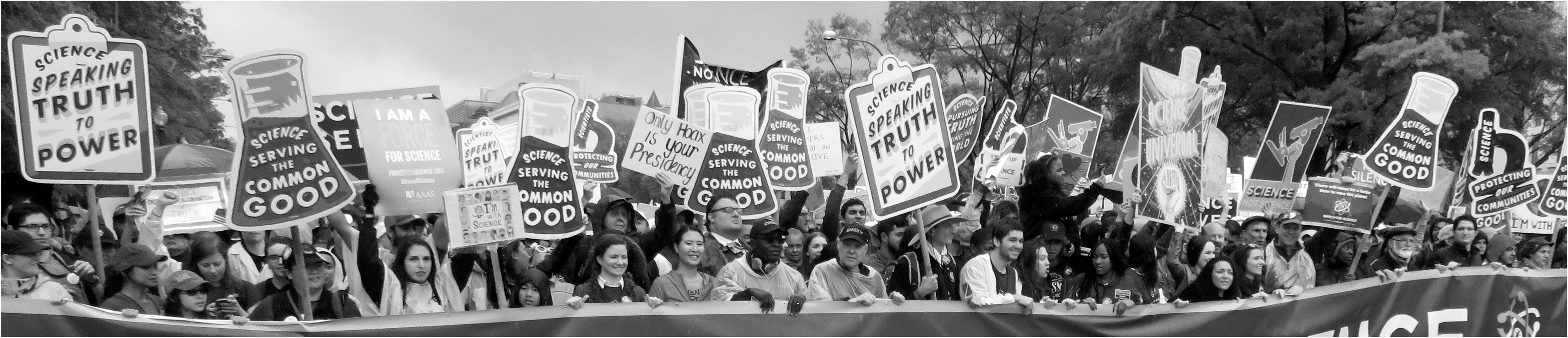
Even against the backdrop of an extraordinary period of protest, the first year of the Trump presidency was a remarkable time for its use as a political tactic. No president in recent memory has faced protests from so many different directions at once. On the left, it is notable how many different groups staged major demonstrations. Efforts included the Women’s March, the March for Science (pictured above), the People’s Climate March, and the March for Racial Justice (see Audra Buck-Coleman’s photo essay in this issue). Protests on the right were smaller than leftist protests—understandable given the fact that Republicans control the Presidency, House, Senate, Supreme Court, and the majority of governorships and state legislatures. Conservatives have many reasons to be satisfied with their political leaders. Yet it is also notable that Trump’s rise corresponds with an emboldening of the far right, including elements with Nazi and Ku Klux Klan sympathies. A Unite the Right Rally held in Charlottesville, Virginia in August 2017 (see Viewpoints, this issue) led to the murder of one woman and the injury of over 30 other counter-protesters by individuals associated with the rally.
Beyond traditional street protests, activists used the internet in creative ways to amplify their voices and command media attention throughout 2017. We need look no further than the rise of specific hashtags—social media labels that make it easy to find content about a specific topic. Alongside #BlackLivesMatter, #TakeAKnee became a new, high-profile manifestation of the Black Lives Matter movement, initiated when San Francisco 49ers football player Colin Kaepernick refused to stand during the National Anthem in opposition to police brutality and racial inequality. And with revelations of systemic sexism and misogyny, the #MeToo and #TimesUp hashtags became ways for women to draw greater attention to problems of sexual harassment and assault. No single reason accounts for the omnipresence of protest during the Trump presidency. The enormous disappointment of Hillary Clinton’s supporters is one good reason for the surge, as is many activists’ readiness to protest. The ways in which Facebook, Twitter, and other online platforms reduce the costs of organizing protests offers a third. Yet there is no denying that Donald Trump himself is a major factor in this agitation.
During his campaign, Trump explicitly insulted large segments of the population, such as women, immigrants, Mexicans, Muslims, the disabled, and African Americans (Mary Romero’s feature in this issue provides numerous examples). As president, his executive actions and inactions have altered policies on immigration, refugees, climate change, health care, and taxation in ways that have angered millions of people. Further, his personally undiplomatic nature stimulates rather than resolves conflict. Trump has taken a period that would have seen protests regardless of the winner of the 2016 presidential election and helped to turn it into a time of nearly continuous grassroots resistance.
In order to yield a better portrait of who is protesting and why, as well as how these answers differ across the political spectrum, this article looks at the major 2017 protests on the National Mall in Washington, D.C. In particular, it examines the participants, including their demographic characteristics, political allegiances, personal histories, and opinions. I conclude with suggestions for questions interested citizens, journalists, and scholars might ask as we watch protest evolve under the Trump administration.
Gathering Data
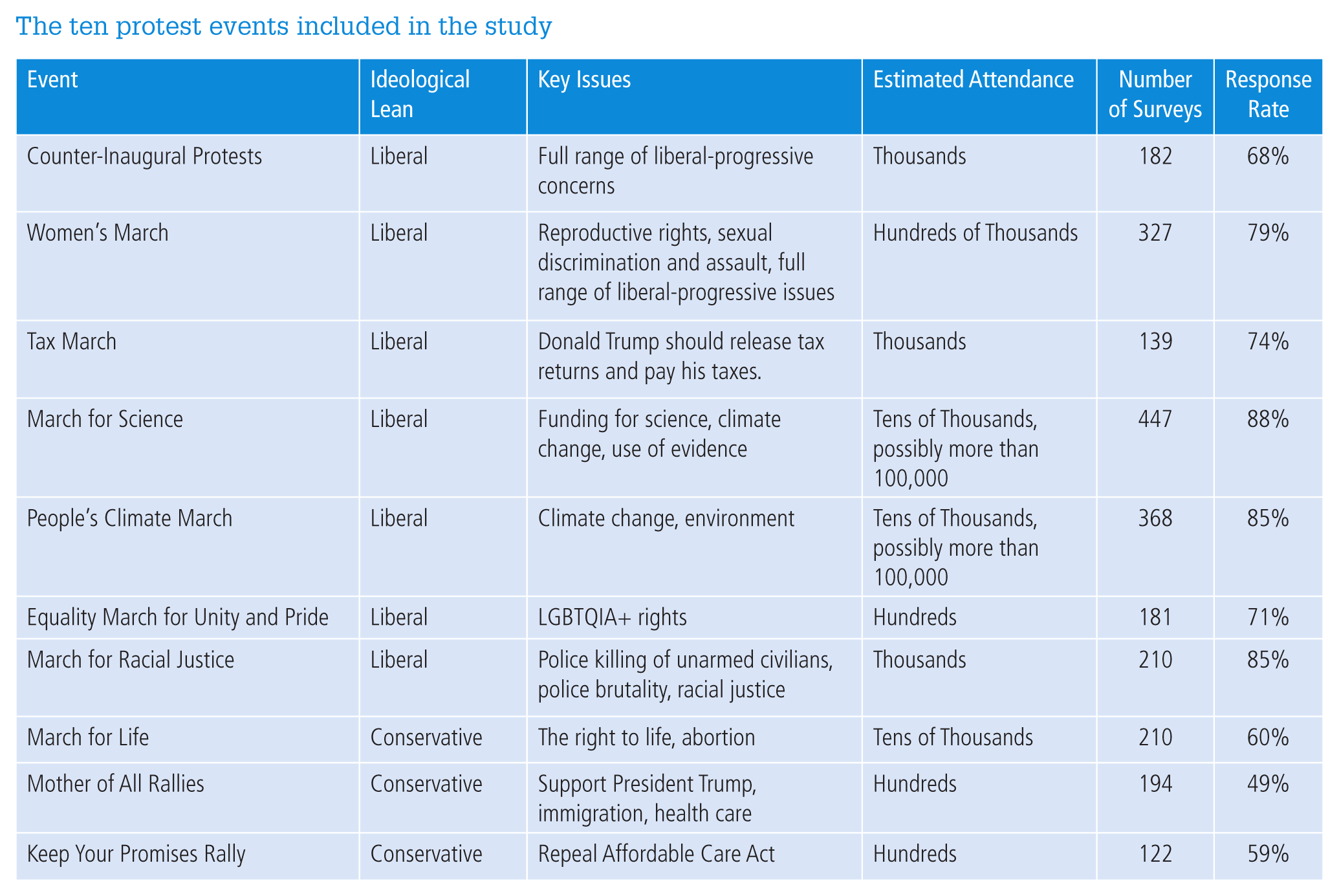
I began by selecting a series of protests scheduled to take place on the National Mall in Washington, D.C. in 2017—the largest and most significant events as well as events on both the political right and left. I made these judgements based on news accounts, social media, and personal contacts with protest organizers. A list of the ten events in the study and their characteristics is reported in the table below.
The ten protest events included in the study
Importantly, this study is by no means a representative sample of all protests around the country. Indeed, the nature and composition of protests is likely to vary based on geographic location. However, by focusing on protests staged in the same, highly symbolic place it is possible to obtain a sense of how protests differ depending on their issues and ideologies.
At each event, I hired a team of approximately ten surveyors to conduct pen-and-paper surveys (funding was provided by the National Institute for Civic Discourse as well as the University of Michigan’s Institute for Research on Women and Gender, the National Center for Institutional Diversity, the Undergraduate Research Opportunity Program, and the Organizational Studies Program). I distributed the surveyors around the perimeter of the rally, instructing them to look into the crowd, non-randomly select a single person (called the “anchor”), and count five persons to the right of the anchor. The anchor was not invited to participate in the study, but the fifth person to their right was invited. Continuing to count five persons to the right, an invitation was extended to each fifth person until three surveys were accepted. Once those three surveys were completed, a new anchor was selected and the counting process resumed. In order to calculate response rates, non-responses were recorded, along with the estimated race / ethnicity and sex / gender of those refusing.
In total, we were able to survey 2,380 respondents, with a response rate of 73%. Of these surveys, 526 surveys were conducted at conservative events, with a response rate of 55%, while 1,853 were conducted at liberal events, with a response rate of 80%. The difference in the response rate between conservative and liberal events is statistically significant; it may be attributable to the suspicion that some conservatives have of academics and research. Survey weights are used to account for differences among demographic groups in their response rates.
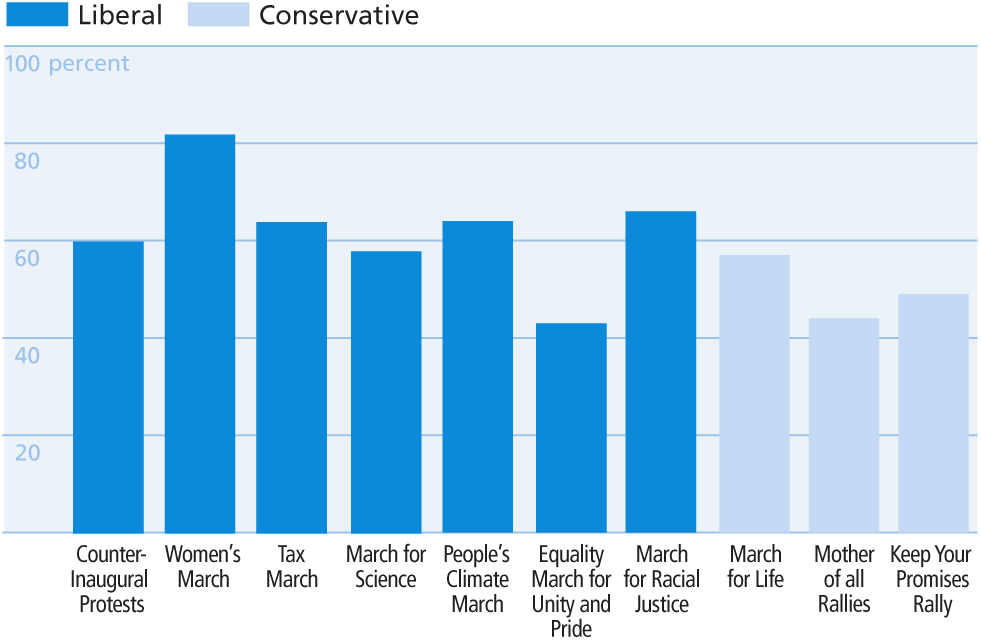
Female participants at liberal and conservative protests in Washington, D.C. in 2017
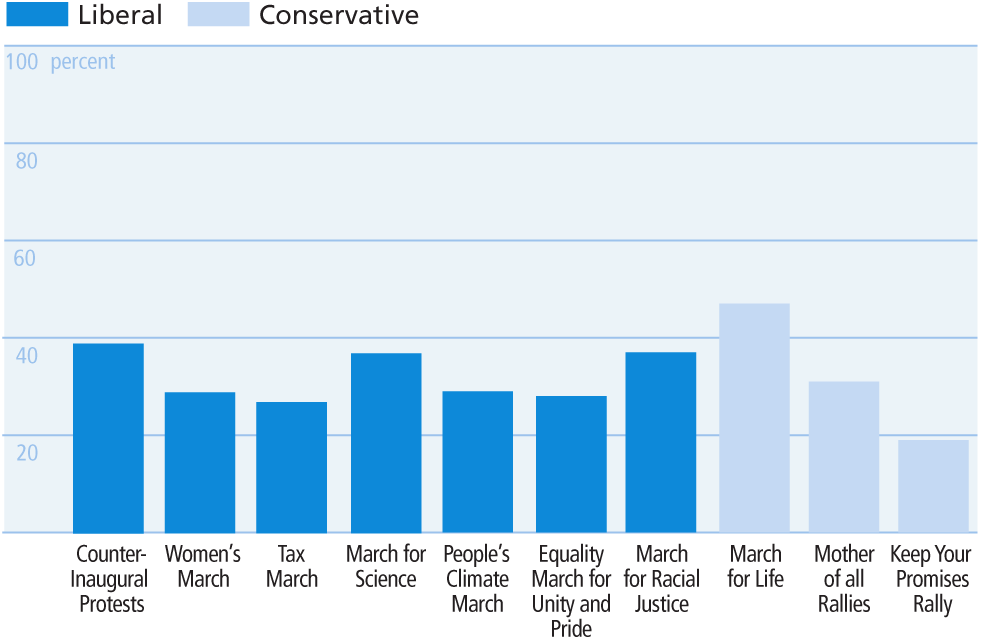
Non-White participants at liberal and conservative protests in Washington, D.C. in 2017
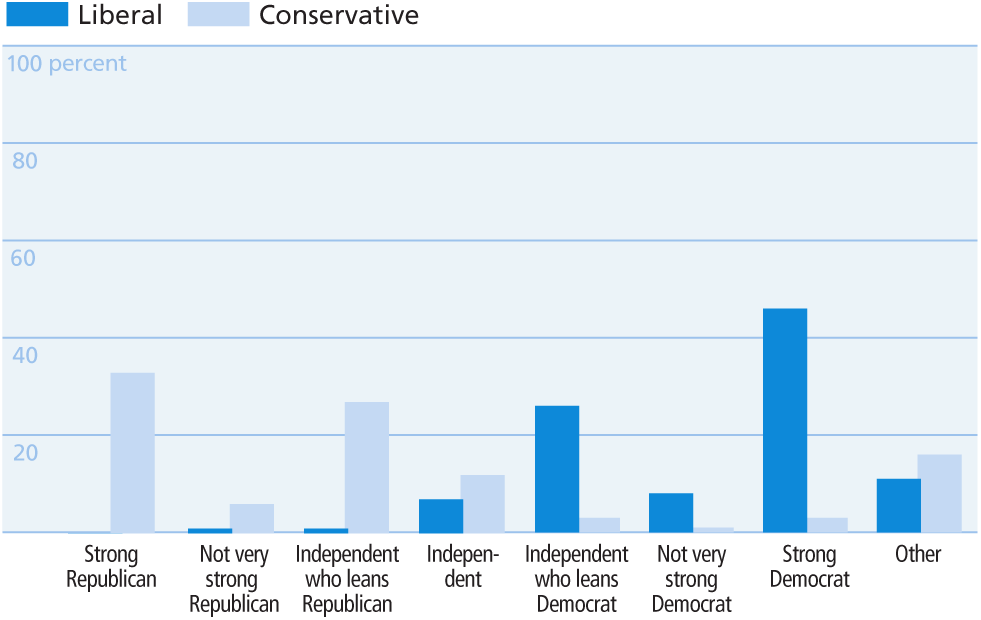
Partisanship at liberal and conservative protests in Washington, D.C. in 2017
A Portrait of Protest
A starting point for understanding the composition of protest is to assess their basic demographics. In doing so, I find that sex / gender is a characteristic on which protests vary. The results reported in the top figure (this page) reveal that liberal and conservative protests are significantly different with respect to the percentage of women attending their events. About 63% of respondents at liberal events were women, while about 50% of participants at conservative events were women. This difference of means is statistically significant (t=4.80, p≤0.001).
For the most part, these differences held up at individual rallies. The Women’s March had the greatest percentage of women (82%). The only liberal rally that did not have at least 50% women was the Equality March for Unity and Pride, which had 43% women. This event for LGBTQIA+ issues was most strongly supported by gay men, which is often the case at pride events. Among conservative rallies, the March for Life (an anti-abortion event) drew the strongest contingent of women (57%). The other two conservative events drew about 50% women, or somewhat less than that. Overall, there is a tendency for women to be drawn more than men to liberal events, while there is greater gender balance at conservative events.
Racial and ethnic composition is another relevant demographic variable. I code a respondent as “non-White” if her or his background included African, Asian, Pacific Islander, Latino, or Native ancestry. I find no significant differences between liberal and conservative events with respect to race / ethnicity in the results reported in the middle figure on the left (t=0.45, p≤0.653). Respondents at liberal events were approximately 32% non-White, while respondents at conservative events were approximately 34% non-White. This compositional similarity is surprising, because racial-and-ethnic minorities are generally considered an important part of the liberal-progressive-Democratic coalition, but the same is not assumed with regard to the conservative-Republican coalition. This finding also underscores the reality that these types of protests are often overwhelmingly White affairs.
Considering individual events, there were no clear racial or ethnic differences between those organized by liberals and conservatives. The most racially / ethnically diverse event was the March for Life, a conservative event (47% non-White), and the least was the Keep Your Promises Rally (19% non-White), a Tea Party event. Even the March for Racial Justice, framed as a chance to bring the concerns of non-Whites to the fore, was only 37% non-White.
Shifting from demographics to political allegiances, liberal and conservative events are highly segregated based on partisanship, as would be expected. As is reported in the bottom figure (this page), respondents at liberal events were likely to be independents who lean Democrat or strong Democrats, while respondents at conservative events were likely to be independents who lean Republican or strong Republicans. These differences are statistically significant (t=25.55, p≤0.001).
A less obvious element of these findings is that respondents at liberal rallies exhibited stronger partisanship than did those at conservative rallies. To measure this propensity more precisely, I created a folded index of partisanship that was scored in the same way regardless of whether the respondent was at a liberal or conservative rally. “Strong” Republicans and Democrats received a score of 3, “not very strong” respondents got a score of 2, and “indpedents who lean” received a score of 1. Pure indpendents and those in the “Other” category received a score of 0, while those that leaned toward to opposite side of the spectrum (e.g., a Republican at a liberal rally) received negative scores.
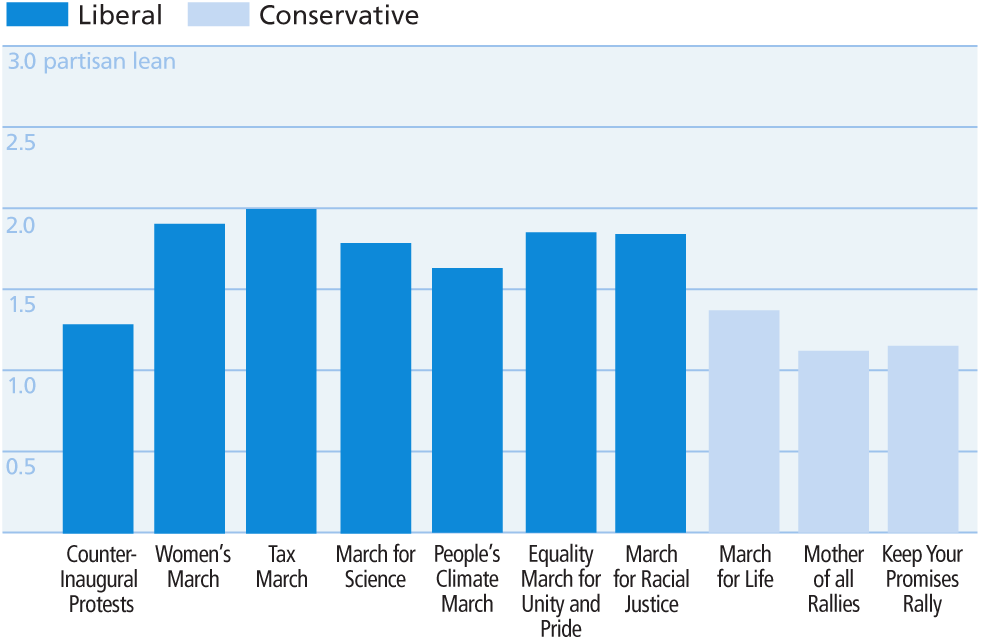
Partisan lean at liberal and conservative protests in Washington, D.C. in 2017
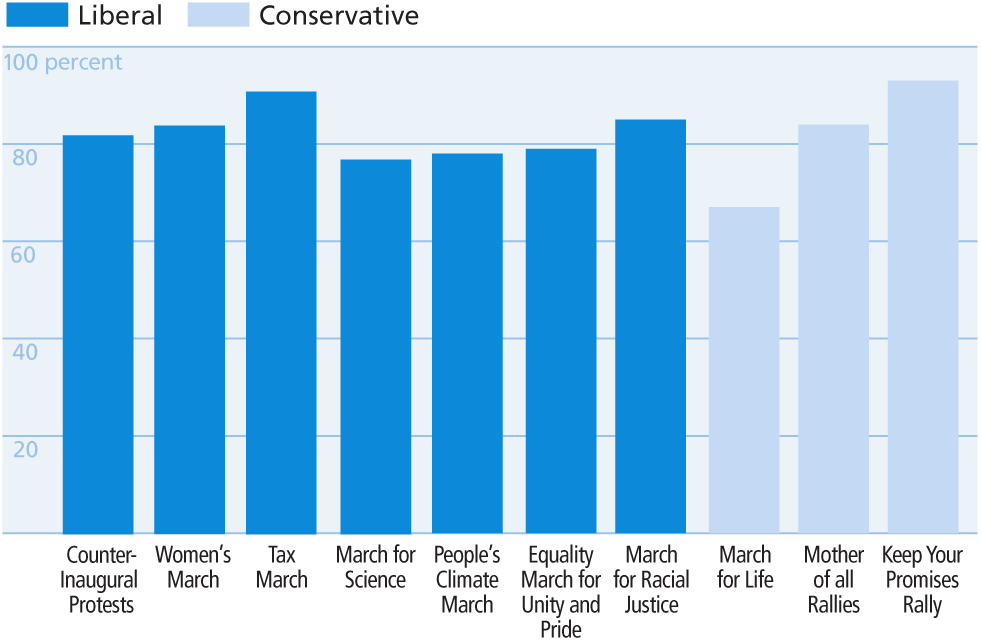
Party and campaign activity by participants in liberal and conservative protests in Washington, D.C. in 2017
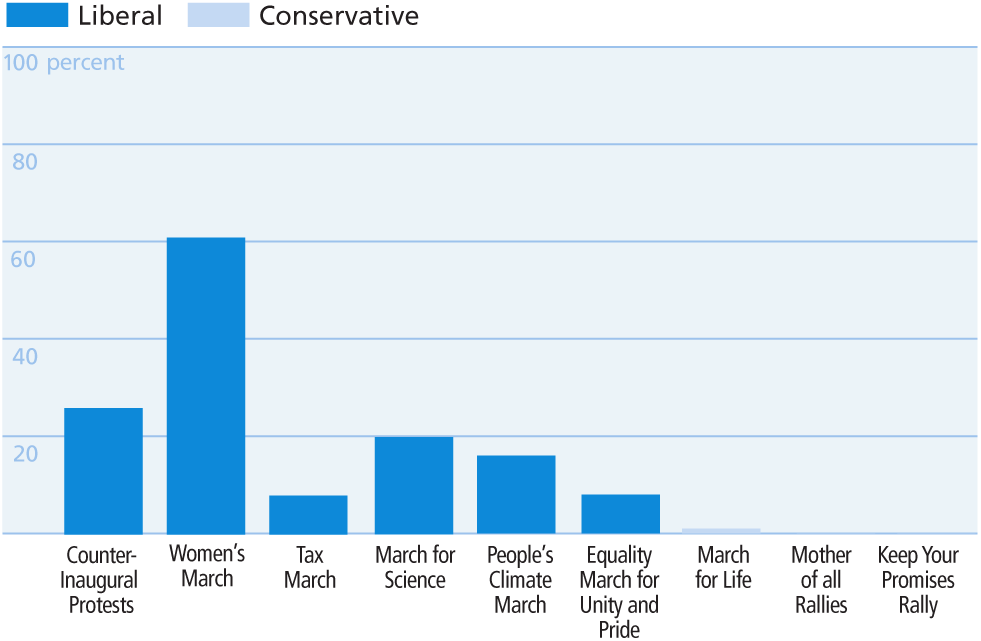
Attendance by March for Racial Justice participants at prior 2017 marches in Washington, D.C.
The results of the folded partisan analysis are reported above (top figure). The folded partisanship of respondents was consistently higher at liberal rallies than at conservative rallies. The one exception to the rule was the Counter-Inaugural Protests, which had a somewhat lower partisan score (1.29) than other liberal rallies. The Tax March was the most partisan rally, with an average folded score of 2.00, with the Women’s March close behind at 1.91. The rally with the lowest folded partisanship was the Mother of All Rallies, with an average of 1.12. The overall liberal average was 1.74, while the conservative average was 1.22, which are significantly different from one another (t=6.87, p≤0.001). Thus, during the Trump presidency, liberal rallies on the National Mall have been much more closely attached to the Demcratic Party than conservative rallies have been aligned with the Republican Party.
It is also important to review participants’ histories of political involvement. Are liberal and conservative protesters also involved in more traditional and institutional forms of politics? Are there differences between the two groups in this respect? I asked respondents if they had participated in activities to help a candidate or political party in the last four years. The results, reported on the left (middle), reveal that this was overwhelmingly the case. About 81% of those attending liberal events had aided a candidate or party, and the same was true for about 79% of those attending conservative events. This difference is not statistically significant (t=0.87, p≤0.387). The Tea Party’s Keep Your Promises Rally was strongest in this regard (93%), and the March for Life was the weakest (67%). There is little doubt that protesters are highly involved in other forms of partisan politics.
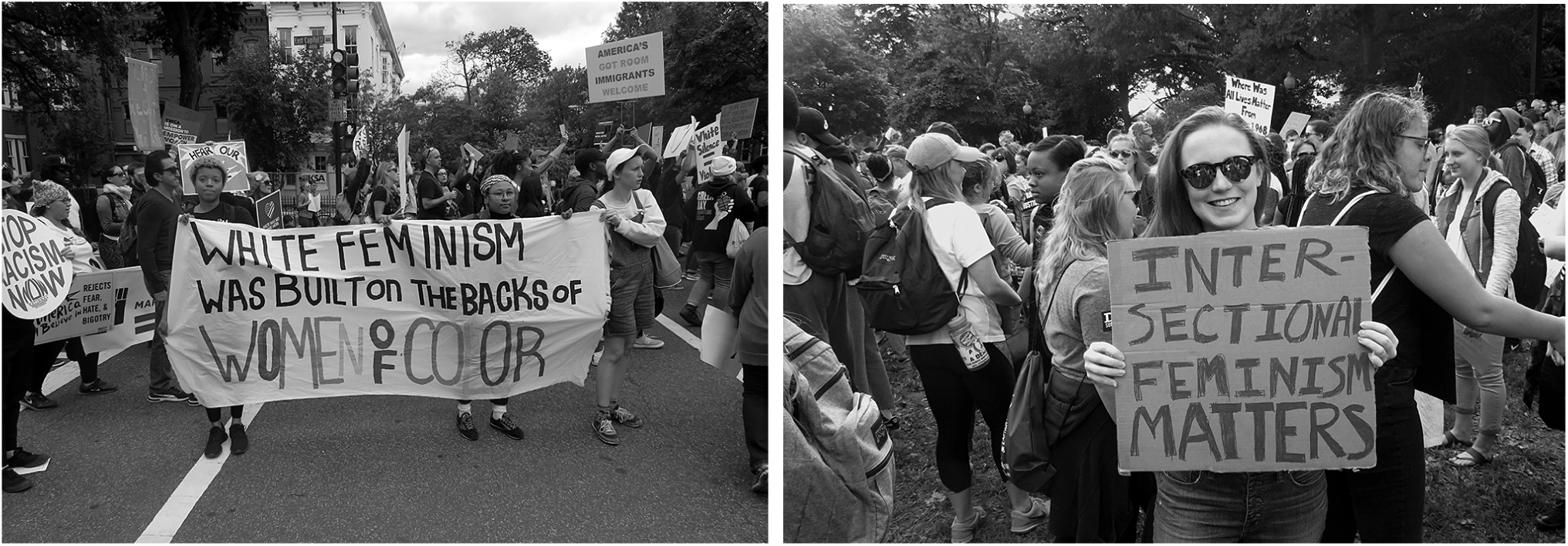
In thinking about political involvement, it is also worth considering whether people participate in just one rally, or if the various protest events are interlinked in some way. To address this question, I examined data from the March for Racial Justice, the most recent of the ten rallies at which I conducted surveys. I asked respondents whether they had attended the other nine events in the study. The results, reported in the bottom figure (this page) show that there are noteworthy connections between the March for Racial Justice and most of the liberal rallies. However, there is little connection with the conservative events. This difference is statistically significant (t=18.45, p≤0.001). A handful of March for Racial Justice participants also attended the conservative March for Life, but the same was not true for the Mother of All Rallies or the Keep Your Promises Rally. The strongest connection was between the March for Racial Justice and the Women’s March, with about 61% of those at the March for Racial Justice having attended the Women’s March. This finding underscores the connection that scholars of intersectionality have stressed between social movements focsed on sex / gender and those focused on race / ethnicity. This connection is also highlighted by the photos presented on p. 47.
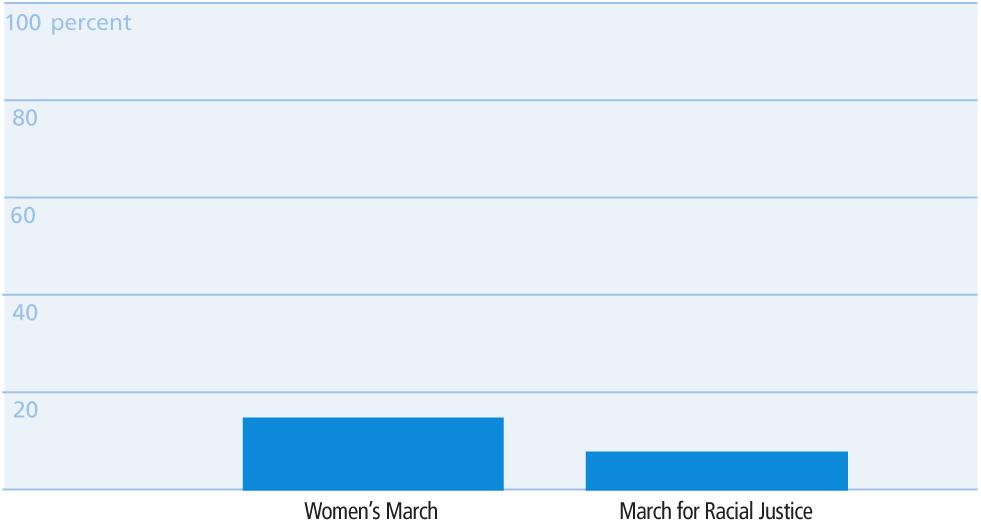
Finally, similarities and differences of opinion between participants in different events are helpful in considering the coalitional politics that might unfold in the coming months and years. Given the connections between the Women’s March and the March for Racial Justice reported above, I elected to examine the extent to which participants at these two events think about issues of intersectionality. To do so, I took the responses to an open-ended question about why respondents attended the event and coded them for mentions of diversity, intersectionality, or the concerns of intsectioning groups (e.g., concern about African Americans at the Women’s March, mentioning immigrants at the March for Racial Justice). The results, reported in the figure below, show that approximately 15% of those at the Women’s March expressed intersectional concerns, while only 8% of those at the March for Racial Justice did the same. This difference is statistically significant (t=16.68, p≤0.001).
Courtesy Michael T. Heaney
This analysis gives some sense of the extent to which intersectional concerns were at the top of people’s heads when filling out the survey, so it yields a high-bar estimate of their interest. It is reasonable to assume, though, that had I asked directly about intersectionality, a larger percentage of respondents would have expressed this motivation. Nonetheless, the results do suggest that there is stronger motivation by inersectionality among Women’s March participants than among March for Racial Justice participants.
Questions for Attentive Observers
The Trump presidency began with a momentous year of protest. The massive demonstrations seen in 2017 were spurred on through the increased ease of mobilizing people using the internet, the relatively high level of protest preparedness by liberal-progressive-Democratic movements, and the bombastic nature of the president. The result is a cacophony of voices in Washington, D.C. and around the world, all crying for change in American government. All citizens, journalists, and scholars who care about democracy should be paying attention.
Expression of intersectional concerns by Women’s March and March for Racial Justice participants
To that end, I close with four issues for attentive observers to examine as the next three years of Trump’s administration unfold. First, as groups form around bringing underrepresented groups into elected office, we need to ask how protest participation will affect the 2018 midterm elections, from recruiting candidates and activists to changing the demographics of our legislatures. Second, we might ask what types of protests attract the “usual suspects” of ideological and partisan allies, and which draw in moderates and even potential opponents. A third issue is whether emerging Trump-era social movements have lasting power to institutionalize for long-term impact, and a fourth is whether intersectionality is a mere buzzword or an organizing principle within these emergent sites of activism. The only thing that is truly clear is that this is a fruitful time for scholars of social movements and the civic sphere.