




Abstract
The author investigates the impact of law-and-order schools, defined as those that rely heavily on exclusionary discipline (i.e., suspension and expulsion) as a form of punishment, on neighborhood crime. Additional analyses are performed to assess whether the effects of punitive school discipline on local crime are moderated by neighborhood disadvantage. Findings suggest that suspensions are associated with increases in local crime—evidence of a macro-level school-to-prison pipeline—while expulsions are generally associated with fewer crime incidents. Although disciplinary exclusions appear to increase crime at fairly consistent rates across levels of neighborhood disadvantage, both exclusion types are associated with more aggravated assault in areas with higher levels of disadvantage. As such, institutional processes of the school appear to help explain variations in community crime.
Keywords
Schools and their communities share a dynamic relationship. Just as the neighborhood can influence institutional processes of the local school, so too can school practices influence the neighborhood. One of the most common school practices, at least in terms of discipline, is exclusionary by nature. That is, schools issue suspensions (temporary exclusions) and expulsions (permanent exclusions) as a way to deal with student misbehavior. In the 2013–2014 school year, more than 2.6 million public school students received one or more out-of-school suspensions, and more than 111,000 students were expelled in the United States (U.S. Department of Education, Office of Civil Rights 2014). Exclusionary school discipline removes a misbehaving student from the school setting without any consideration of the impact of this practice on the local community. As such, the punitive, law-and-order approach to school discipline, which focuses on punishment through formal exclusion rather than behavioral corrections through learning and cooperation, may inadvertently displace misconduct from the school into the neighborhood.
A growing body of research has focused on the effect of school exclusions on student outcomes (for a review, see Hirschfield 2018). In addition to lowered academic performance and success (Perry and Morris 2014; Rausch and Skiba 2005), longitudinal analyses of school exclusions and deviant behaviors have confirmed the suspicion that students who are suspended or expelled are more likely to drop out of school and have future contact with the juvenile and criminal justice systems (Costenbader and Markson 1998; Fabelo et al. 2011; Mowen and Brent 2016; Ramey 2016; Shollenberger 2015; Wolf and Kupchik 2017). Increased delinquency and crime as a result of school practices is known as the school-to-prison pipeline. As Crawley and Hirschfield (2018) noted, “The [school-to-prison pipeline] metaphor encompasses various disciplinary policies and practices that label students as troublemakers, exclude students from school, and increase their likelihood of involvement in delinquency, juvenile justice, and subsequent incarceration” (p. 1). One study revealed no differences between racial or gender groups in the effect of exclusions on arrest (Monahan et al. 2014), meaning that the increased likelihood of arrest following a school exclusion applies to all students. Moreover, exclusionary discipline can have long-lasting effects, as students who have been excluded from the education system are also excluded from important forms of bonding and development.
A recent call in the field of criminology stressed the need for more “analytical criminology” that incorporates micro- and macro-levels of explanations of crime (Matsueda 2017). Matsueda (2017) advocated for more research that focuses on explaining micro-macro relations (social interaction effects) and discussed the policy implications for doing so. An analytical criminology, for instance, would shed light on the appropriate points of intervention. He explained the utility of this approach as follows: With respect to macro-interventions, the obvious implication is that, unless causality truly operates at the macro-level, as argued by methodological holists, social policies targeting social structure and groups to alter macro-level outcomes will benefit from a microfoundation. Such a foundation would specify an individual-level causal mechanism, a link between the macro-policy and individual mechanisms, and a link between individual outcomes at macro-outcomes. (p. 511)
Research on the impact of exclusionary discipline on the neighborhood, then, would benefit from theorizing and analyzing the specific causal mechanisms by which the punishment of individual students manifests as community-level crime. Identifying the potential causal mechanisms inducing this phenomenon allows more specific (and apposite) attempts for intervention, whether it be at the individual or neighborhood level or both.
At present, no study has spatially assessed whether punitive school practices influence local crime. A handful of studies have examined the effect of school presence on neighborhood crime (Bernasco and Block 2009; Kautt and Roncek 2007; Roncek and Maier 1991; Willits, Broidy, and Denman 2013, 2015), but most did not account for variable characteristics of the school beyond level and type. This study is the first to investigate a macro-level effect of the school-to-prison pipeline by asking the following question: Does exclusionary school discipline increase neighborhood crime? A macro focus on school punishment is necessary to fully understand the impact this common school practice has on the surrounding community and to design interventions that target the appropriate causal mechanisms, yet prior attention to the phenomenon, whereby criminalization and punishment practices at school yield more delinquent behaviors, has been focused exclusively on the individual. Drawing on three key criminological theories—social bond, social disorganization, and routine activity—to form an integrated theoretical approach, I proposes that the collateral consequences of punitive school punishment may extend beyond the individual by increasing crime in the community. Law-and-order schools are posited to alter the routine activities of at-risk students and contribute to the conditions present in socially disorganized neighborhoods, thereby increasing local crime.
Schools and Community Crime
School is one of the primary socializing agents for children and adolescents, and research has shown a negative relationship between school engagement and delinquency (Henry, Knight, and Thornberry 2012; Hirschfield 2018; Hirschfield and Gasper 2011; Li et al. 2011). For some children, school might be the only institution from which they learn socially acceptable behaviors. As such, the importance of school reaches far beyond educational attainment alone; it is a fundamental institution for the socialization of children. This may explain why students who have been excluded from school as a form of punishment experience a host of negative consequences compared with students who were not excluded, including an increased likelihood of repeating a grade level, dropping out, and engaging in delinquent behaviors (Fabelo et al. 2011). In addition to falling behind and performing worse in school, students who have been forced out of school by way of exclusion are removed from a setting of social control, and this has important consequences.
Specific processes within the school, such as the school’s approach to social control, can explain variations in the effect of schools on local crime. School punishment may influence local crime by stimulating the social conditions conducive to crime. Schools that regularly use exclusionary discipline signify a law-and-order approach to student violations. Rather than addressing the causes of misconduct, exclusionary discipline simply removes the misbehaving student from the setting. This social control method is often discussed in contrast to the school climate approach, which focuses on providing a safe and stable learning environment by building trusting relationships and repairing harm. Law-and-order schools, on the other hand, rely on punitive punishment methods and have greater levels of disorder within the school (Christle, Jolivette, and Nelson 2007; Gerlinger and Wo 2016; Gregory, Cornell, and Fan 2011; Hirschfield 2018; Welsh 2000, 2003), even after controlling for student characteristics and peer associations. Schools with greater internal disorder have also been shown to have common discipline problems, including unclear, inconsistent, and unfairly enforced rules (Gottfredson and Gottfredson 1985), suggesting that students who are not provided well-defined expectations are more likely to break the rules. Furthermore, schools that handle disorder by removing students use reactive rather than preventive methods and often fail to make meaningful changes to future student behaviors (Theriot, Craun, and Dupper 2010). Law-and-order schools, therefore, exhibit a recursive problem involving punitive school discipline and problem behaviors.
Theoretical Influences on the Study of Schools and Community Crime
The prominence of school as a socializing agent is highlighted in Travis Hirschi’s (1969) social bond theory. This theory attests that people with strong bonds to conventional society are less likely to engage in deviant behaviors compared with those with weak bonds. Hirschi argued that there are four elements of social bonding: attachment, commitment, involvement in conventional activities, and a belief in common values. Adolescents who demonstrate strong bonds to social institutions, such as the school, will have a lower propensity to commit crime. Jenkins (1997) applied these elements to the school social bond, specifically, explaining that certain social interactions in school may “prevent some students from developing school ties of attachment (caring about others in school and their opinions and expectations), commitment (valuing educational goals), involvement (participating in school-related activities), and belief (accepting school rules as fair and consistently enforced)” (p. 340). All of these elements, besides involvement, were inversely related to school misconduct, school crime, and school nonattendance. Negative social interactions at school, such as exclusionary discipline, also contribute to negative feelings about the school environment (Bracy 2011), which can weaken student bonds to school. Because this punitive form of punishment curtails school social bonds by catalyzing poor school performance and generating feelings of dissatisfaction, it is not surprising that students who have been formally excluded from school are more likely to be delinquent.
In addition to individual-level explanations of crime and delinquency, macro-level theories that focus on the place, rather than the individual, are also useful frameworks for understanding the relationship between exclusionary school discipline and neighborhood crime. Research testing social disorganization theory has shown that social ills found in some neighborhoods inhibit the community’s ability to administer informal social control, leading to higher rates of unfavorable behaviors by community members (Bursik and Grasmick 1999; Kornhauser 1978; Kubrin and Weitzer 2003; Sampson and Groves 1989). More specifically, social disorganization theorists argue that through social ties, informal social control, and collective efficacy, communities may contribute to or depress crime and delinquency in a socially disorganized area. Although the relationship between schools and their communities is bidirectional, schools exacerbate conditions present in disorganized neighborhoods by bringing together youths with limited ties to the neighborhood and its socializing institutions at a single location (Roman 2004; Willits et al. 2013, 2015). In this study I contend that punitive school discipline practices may further contribute to the disorganization of a community by weakening school bonds and removing at-risk students from an important form of social control.
Similar to both social bond and social disorganization theories, one of the central tenets of routine activity theory is that informal social control is a vital component of crime control. Routine activity theory is based on the premise that crime occurs when suitable targets, motivated offenders, and the absence of capable guardians all converge in time and space (Cohen and Felson 1979). This theory contends that the structural patterns of people’s routine activities might encourage greater criminal opportunities. The research on schools and neighborhoods from a routine activity perspective, particularly studies that account for time of day and season (Murray and Swatt 2013; Roman 2004; Willits et al. 2015), confirms that patterns and practices that emerge from the school directly influence community crime (Bernasco and Block 2009; Roncek and Lobosco 1983; Willits et al. 2011, 2013); a disciplinary practice that removes at-risk students from school and sends them into the community without supervision could be a contributing factor.
Micro-Macro Mechanisms of the School-to-Prison Pipeline
The impact of exclusionary school discipline on the local community has not been tested. Law-and-order schools may inadvertently increase crime in the neighborhood by generating larger numbers of detached and disengaged youths who are periodically or permanently released into the community without supervision. In other words, law-and-order schools contribute to community disorder by weakening school social bonds, increasing social disorganization, and altering the routine activities of at-risk students, and this manifests as community crime.
In reference to the highly influential work of James Coleman (1986, 1994) on macro-micro-macro mechanisms (known as “Coleman’s boat” or “Coleman’s bathtub”), Figure 1 displays the macro-micro-macro relationship between law-and-order schools and community crime. First, law-and-order schools operate with a heavy reliance on punitive discipline for student infractions, which results in a large number of student suspensions and expulsions (line 1, macro-level context influencing a micro-level predictor). The next step in this process reflects a change in the excluded students’ behaviors, which contributes to the social conditions present in disorganized neighborhoods (line 2, a micro-level predictor influencing a micro-level outcome). School removals produce two concurrent circumstances that increase community disorder: (1) weakened social bonds, a reduction in legitimate opportunities, and limited ties to a major societal institution (increased social disorganization) and (2) more motivated offenders and a lack of supervising adults (a change in routine activities). As students disassociate from the values and expectations taught in traditional schooling, particularly following the collateral consequences of school punishment, social bonds are broken, and disengaged youths are free to socialize and interact with the local community. The first circumstance, weakened social bonds, is an internalized process that manifests at the community level as disorder. Simply put, a community of residents who have rejected traditional values is more likely to exhibit dysfunctional social conditions, such as crime, and less likely to effectively enforce informal social control. The second circumstance, a change in routine activities, is an immediate effect following a disciplinary exclusion. Students who would normally spend a significant portion of their day in the classroom and participating in school activities are sent home, where they might not receive any adult supervision. Specific to routine activity theory, there are more motivated offenders and a potential absence of handlers—those who control potential offenders (Eck 2003)—when students are removed from school. Finally, this phenomenon is expressed at the macro level as community crime (line 3, a micro-level outcome predicting a macro-level outcome). Crime results from an increase in disorderly community members with greater opportunities to offend, paired with a lack of adult supervision to thwart antisocial behaviors. With law-and-order schools providing a steady supply of disengaged, at-risk youths to the local community each year, an increase in community disorder is anticipated.

Micro-macro framework of the school-to-prison pipeline.
In short, law-and-order schools (as measured by the frequent use of exclusionary discipline) neglect to promote prosocial behaviors to their pupils and instead produce large numbers of disengaged youths. This in turn intensifies crime in the surrounding community by increasing social disorganization and changing the routine activities of young locals by providing more opportunities to engage in criminal conduct.
Exclusionary Discipline in Disadvantaged Neighborhoods
Some scholars argue that the punitive policies of law-and-order schools are heightened in poor communities and schools, suggesting that institutional inequities in education concentrate in areas with the most at-risk youths (Heitzeg 2009; Hemphill et al. 2010; Hirschfield 2008; Kupchik and Ward 2014). Similarly, the adverse effects of law-and-order schools may disproportionately concentrate in disadvantaged neighborhoods, where the desired social mechanisms to counter actions by disengaged youth are often noticeably absent. For instance, communities with greater levels of disorganization are less likely to have social ties and resources available for the supervision of excluded students; these communities are not expected to exert informal social control through shared parenting and collective monitoring (Osgood and Anderson 2004; Sampson 1987). Parents of excluded students in more affluent, organized communities may be able to hire an adult or rely on relationships with other community members to watch their children during the disciplinary exclusion period, whereas working parents in disadvantaged neighborhoods may have no choice but to leave their children unsupervised. Alternatively, it is possible that juveniles are more motivated to commit crime in places of deprivation, as previous research has shown that motivated offenders may commit crime only under specific circumstances (Smith, Frazee, and Davison 2000). In sum, law-and-order schools may disproportionately affect crime in disadvantaged communities, as they lack the necessary resources to counter the actions of disengaged youths.
The Present Study
Several studies have linked exclusionary school discipline to delinquency and crime, but this is the first to test a macro-level effect of the school-to-prison pipeline in which law-and-order schools are associated with increased crime in the surrounding community. Law-and-order schools in disadvantaged neighborhoods—where informal social control and resources to combat delinquent behaviors are routinely insufficient—are also examined in a separate analysis. Southern California is used as a research site to examine whether public secondary school suspensions and expulsions affect various crimes in the surrounding neighborhood. 1 Because juveniles account for one third of all property crime arrests but fewer than one fifth of those for violent crimes (Crowe 2000), stronger effects are anticipated for property crimes than violent crimes. 2
Data and Method
The data used in this study were retrieved from various sources. Several data sets were combined to create block-level data from 2004 to 2011. This small geographic unit (i.e., blocks) allows analyses with precise locations of crime, making the observed link between schools and local crime more reliable. 3 Demographic data came from the 2000 and 2010 censuses and the American Community Survey. Block-level data that were not provided by the U.S. Census Bureau were imputed by applying a synthetic estimation for ecological inference approach, which uses information from the block groups in which these blocks are nested. Rather than impute values from the block groups by assuming homogeneity, the synthetic estimation approach models the predicted values using the higher level of aggregation (i.e., block groups). More specifically, the process is as follows: (1) block group coefficient estimates are used to obtain values at the block level, (2) imputed block-level data are adjusted to sum the value in the block group, and (3) uncertainty is added to the block-level values on the basis of the uncertainty of the block group model (for more information, see Boessen and Hipp 2015). After the block data were generated, these data were linearly interpolated across years.
Crime data were collected from local police agencies in Southern California. School discipline data were provided as counts for suspensions and expulsions by the California Department of Education for school years 2004–2005 to 2010–2011. Other school characteristics were retrieved using the California Department of Education’s DataQuest resource. The final data set includes school and neighborhood information for all public middle, high, and alternative schools in the following Southern California counties: Los Angeles, Orange, San Bernardino, Riverside, San Diego, and Ventura. Both crime and school data were geocoded using ArcGIS. The final sample contains 129,318 blocks from these six counties.
California currently permits exclusionary school discipline for a host of school violations, though the state mandates suspension (and requires a recommendation for expulsion) only for violations that cause or attempt to cause physical harm to another person or that involve the selling of controlled substances. Recently, there has been a drastic decline in suspensions for “willful defiance,” a category that made up 43 percent of all suspensions in 2012 (Public Counsel 2014). Although this violation category has since been formally removed, this study contains school discipline data from school years 2004–2005 to 2010–2011, when California permitted exclusions for numerous discretionary and behavioral violations. Thus, during the study period, California excluded students at approximately the same rate as the national average.
Dependent Variables
I examine the effects of exclusionary school discipline on six types of crime: aggravated assault, burglary, larceny-theft, motor vehicle theft, murder, and robbery. These crime types are those most likely regulated by informal social control, which is a central tenet of both social disorganization and routine activity theories. The expected impact of school discipline on these crimes varies on the basis of the average level of adolescent involvement; for instance, because students commit relatively few murders (Sickmund and Puzzanchera 2014), 4 the impact of recently unsupervised, disengaged students on the total number of local murders is likely minor.
Previous school and neighborhood studies have also identified significant relationships between school presence and proximity and these crime types, including assault, robbery, motor vehicle theft, and burglary (Bernasco and Block 2009; Murray and Swatt 2013; Roncek and Lobosco 1983; Willits et al. 2013), though effects are not always in the same direction. The inconsistency in findings may be explained by the failure to account for more specific school socialization characteristics, such as school punishment. The descriptive statistics for all variables are displayed in Table 1.
Descriptive Statistics.

Note: N = 787,237. Disadvantage and residential stability are factor scores. Values reflect average frequencies, proportions, or scores per block.
Independent Variables
School Characteristics
The primary variables of interest are the number of suspension and expulsion incidents per school year. Suspensions are temporary disciplinary responses to student misbehavior, while expulsions are permanent exclusions typically reserved for only the most serious offenses, which require approval from the district board. Both exclusion measures are counts, as it was hypothesized that crime in the neighborhood increases as the number of exclusionary incidents increases. 5 Exclusion counts were logged to obtain a normal distribution and improve model fit.
To estimate the effects of school exclusions on neighborhood crime, two-mile spatial buffers were created with an inverse distance decay function (blocks closer to the school are assigned higher values than those further away) for each school characteristic such that any school within the buffer was associated with the focal block. If more than one school was within two miles of the focal block, the suspension and expulsion counts were summed, separately. By using spatial buffers, as opposed to ZIP codes, catchment areas, or aggregate census data, this study is not met with a boundary problem in which the effects of schools closest to the boundaries are limited by the boundary itself.
Two-mile spatial buffers were selected for a number of reasons. First, a random selection of school district boundaries within the six counties in this study revealed that most blocks are well within a two-mile radius from the center, meaning most students likely reside within two miles of their schools. Second, journey-to-crime research demonstrates that offenders generally travel short distances to commit crime (Bernasco and Block 2009; Townsley and Sidebottom 2010), and this is particularly true for juveniles (Drawve, Walker, and Felson 2015), who have more limited means for traveling greater distances. Third, as demonstrated by Wiles and Costello (2000), any node familiar to the offender can be the origin of the offender’s journey to crime. High school students spend a great deal of time in and around the school, such that they are well acquainted with the neighborhood surrounding the school, even if it is not their immediate home neighborhood. Thus, a two-mile spatial buffer captures both the school attended by local students and the most probable offending area.
Several school characteristics are used as controls in this study. One concern might be that the results are an effect of disorderly schools on neighborhood crime rather than suspensions and expulsions, specifically. Truancy was therefore included in the models for two reasons: (1) truancy reflects low school attachment, and this measure serves as a control for overall school delinquency that is unrelated to discretionary punishments, and (2), following Monahan et al. (2014), truancy was included to control for students who are willingly absent from school (compared with excluded students, who are forcibly removed). Students who occasionally skip school should not be considered delinquent. However, habitual truancy at the school level is problematic and indicates low school attachment. This study assumes that a large number of truants is reflective of larger problem behaviors in the school. A second school characteristic is school enrollment. As delinquent behaviors among youth are typically on the rise at this age (Farrington 1986), this controls for the average level of delinquency expected given the number of students who frequent the area on a typical day. This also controls for differences between schools of varying sizes. Student disadvantage is measured by the percentage of students receiving free or reduced-price lunch, and the last school characteristics are counts for the number of middle, high, and alternative education schools that contribute to the exclusion buffer. Student demographic variables, such as race and ethnicity, were highly correlated with the neighborhood variables and therefore omitted from the models.
Neighborhood Controls
Several neighborhood demographic variables were included to isolate the relationship between exclusionary school discipline and crime: population (logged), (percentage) black, Latino, occupied housing, ages 5 to 14, ages 15 to 19, and four land-use measures (i.e., industrial, office, residential, and retail). Two measures of the proportion of younger residents were included because they represent those most likely to commit crime (Farrington 1986; Stolzenberg and D’Alessio 2008) and may explain fluctuations in crime that are unrelated to the disciplinary practices of the local secondary school. Finally, some areas may report more crime on the basis of the availability of desirable resources or report fewer crime incidents because of limited access to desired goods and more guardianship. As such, four types of land-use measures were used to account for these differences.
A few neighborhood measures are products of two or more variables. The racial/ethnic heterogeneity measure was based on the Herfindahl index using five racial categories: white, black, Latino, Asian, and other. Greater levels of ethnic heterogeneity are posited to decrease social interaction, thereby increasing crime (Sampson 1991). Measures of disadvantage and residential stability were created using confirmatory factor analysis. Specifically, disadvantage was captured by percentage below poverty, average household income, persons with a bachelor’s degree, and single-parent families. Residential stability was measured as the mean of the standardized values of percentage home owners and average length of residence.
All neighborhood characteristics were included for the focal block as well as a quarter-mile spatial buffer around the focal block. Year and county dummy variables were used to account for differences in crime that may be explained by county-level responses to crime and general fluctuations in crime that were unrelated to school exclusions. For instance, both national (Puzzanchera 2014) and local crime rates (Hipp et al. 2012) had decreased during the study period.
Analytic Strategy
School data were integrated with longitudinal crime and demographic data for small geographic units (census blocks) in six Southern California counties. All models were estimated using fixed-effects negative binomial regression because the outcome crime variables are overdispersed counts. Fixed-effects models permit within-unit comparisons as opposed to between-unit comparisons (Allison 2005); that is, variations in the dependent variable are based on changes experienced by the unit rather than differences between units. For this study, fixed-effects models are used to understand how changes in school discipline affect crime within that block.
Each crime outcome was estimated in a separate model for a total of six individual models. These annual models, with blocks as the unit of analysis, are expressed by the following equation:
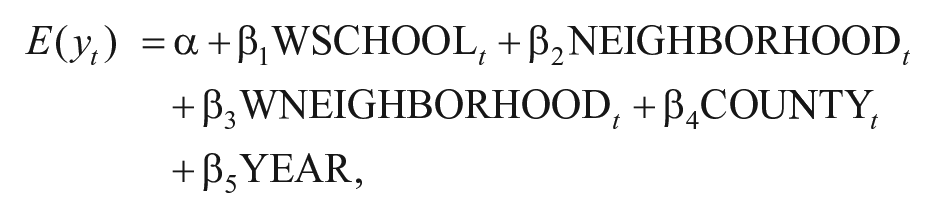
where y represents the crime incidents in that year, α is an intercept, WSCHOOL represents school characteristics in the spatial buffer in that year, NEIGHBORHOOD is a matrix of the block demographic characteristics in that year, WNEIGHBORHOOD is a matrix of the neighborhood characteristics in the .25-mile spatial buffer in that year, COUNTY is a matrix for the county dummy variables, and YEAR is a matrix of year dummy variables. 6
Suspensions and expulsions for each school type (i.e., regular middle and high schools and alternative education schools) were combined into single measures (total local suspensions, total local expulsions) to represent all suspensions and expulsions in the area. In other words, suspended and expelled students from regular schools were treated the same as suspended and expelled students from alternative schools. Once excluded, each student was presumed to process the removal from school, and the time spent unsupervised, in the same way. Furthermore, because Southern California is a densely populated area, the average two-mile buffer contained at least one middle, high, and alternative school; assumptions about which students were associated with changes in neighborhood crime would be largely unsubstantiated. 7 To address variant effects by school type, counts for the number of each school type within the spatial buffer were included in the models.
Finally, I examine whether the impact of exclusions on crime is moderated by the level of disadvantage in the neighborhood. To do this, an interaction between exclusions and neighborhood disadvantage was added to each model separately. This created an additional component to the model (+ β6EXCLUSION × DISADVANTAGE t ).
There was no evidence of multicollinearity in these models, as variance inflation factor values for all variables were below 10; all primary variables of interest were below 5. Spatial autocorrelation—when values of a variable are spatially clustered—was checked for using Moran’s I. Spatial autocorrelation violates the assumption that observations are independent from one another and therefore must be corrected if detected in the models; if not addressed, it can result in biased parameter estimates. One way to account for this issue is to include spatially lagged predictors, which captures the spatial impact of the exogenous measures. The I statistic was calculated using ArcGIS for both the counts and residuals for each crime type. The Moran’s I values for the counts were between .014 and .148, which indicated some clustering among the crime counts. However, the results for the residuals (an assessment of problematic clustering) were between .003 and .01, suggesting that the models adequately accounted for most of the spatial clustering. As such, problematic spatial autocorrelation does not appear to be present in the models.
Results
Table 2 displays the results of the models predicting the six crime types. Increases in the number of suspensions from schools within two miles yields significant results in all models. Higher suspension counts are associated with more aggravated assault (b = .091, p < .001), burglary (b = .013, p < .01), larceny-theft (b = .028, p < .001), motor vehicle theft (b = .010, p < .05), murder (b = .069, p < .001), and robbery incidents (b = .027, p < .001). 8 Suspensions have the strongest impact on local aggravated assault and murder, though murder is a very rare event; on average, there are fewer than .004 murders per block each year. Thus, this effect constitutes a negligible practical change with a standard deviation increase in suspensions above the mean only yielding a 5.8 percent increase in murder. 9 For aggravated assault, a significantly more common offense type (.17 incidents per block each year), a standard deviation increase in suspensions above the mean results in a 7.7 percent increase in assaults. Notably, the relationships between suspensions and crime are all positive in direction.
Negative Binomial Models Predicting Neighborhood Crime Using Local Suspensions.

Note: N=787,237. Dummy variables for year and county are included in the models but not displayed.
p < .05. **p < .01. ***p < .001.
Expulsions are substantively different exclusion types that were also expected to increase crime in the surrounding areas. However, expulsions are negatively associated with every crime outcome except aggravated assault. Neighborhoods with more expulsions tend to have more aggravated assault incidents (b = .070, p < .001) but fewer larceny-theft (b = −.021, p < .01), motor vehicle theft (b = −.046, p < .001), murder (b = −.059, p < .001), and robbery (b = −.069, p < .001) incidents. Expulsions have the greatest impact on aggravated assault and robbery, though the directions of the effects are different for the two violent crimes. One standard deviation increase in expulsions above the mean yields a 7.3 percent increase in aggravated assaults and a 7 percent reduction in robberies, holding all else constant.
Truancy, which was used as a proxy for general school delinquency and as a control for students who are willingly absent from school, is significant in every model except when predicting robberies. Interestingly, among the significant truancy effects, the association is positive only with aggravated assault (b = .033, p < .001) and motor vehicle theft (b = .016, p < .01); all other significant associations between truancy and crime are negative. This suggests that after controlling for various neighborhood characteristics, more willingly absent students in the area is generally associated with less crime, while more forced temporary removals from school are associated with increased crime. The other school characteristics include enrollment, percentage of students receiving free or reduced-price lunch, and the number of schools within two miles. For every crime except aggravated assault (b = −.162, p < .001), larger schools relate to more crime in the area. Blocks near schools with higher percentages of students receiving free or reduced-price lunch are associated with more crime; this relationship is statistically significant for all crimes except aggravated assault. In general, having more public middle and high schools in the neighborhood is associated with fewer crime incidents. Murder, however, is unaffected by the number of high schools, and the number of burglary incidents is unassociated with the number of local schools. Increased numbers of alternative education schools are associated with more aggravated assault, larceny-theft, murder, and robbery. Thus, alternative schools appear to be more criminogenic than traditional public secondary schools.
Neighborhood demographic variables were included to control for spurious results. Because they are not the focus of this study, findings for the neighborhood demographic variables are discussed in brief. Overall, the results for these variables were in the theoretically expected directions. Neighborhoods tend to experience more crime when they have greater racial/ethnic heterogeneity and higher proportions of black and Latino residents. Violent crime is higher in areas with greater disadvantage, while property crimes are more frequent in less disadvantaged areas. Neighborhoods with higher levels of residential stability experience fewer property-related crimes, including robbery. Finally, areas with more residents aged 15 to 19 are associated with increases in two violent crimes—aggravated assault and murder—but are unrelated to any of the property crimes in these models.
Exclusions in Disadvantaged Neighborhoods
The second set of models explores whether the relationship between exclusionary school discipline and neighborhood crime is moderated by neighborhood disadvantage. If exclusions disproportionately increase crime in disadvantaged communities, the desire to maintain immediate order in the classroom may be at the long-term expense of disadvantaged communities. The results of these models are displayed in Table 3.
Fixed-Effects Negative Binomial Models Predicting Neighborhood Crime with Interactions.

Note: N=793,081. All school and neighborhood demographic characteristics, as well as dummy variables for year and county, are included in the models but not displayed.
p < .01. ***p < .001.
Suspensions
The suspension and disadvantage interaction term yields significant results for every crime outcome. To better understand the relationships between exclusionary discipline and crime in context, the interaction effects were plotted for all crime outcomes. The exclusion variables and disadvantage were centered to eliminate collinearity issues; therefore, the averages are set to zero, as shown in the figures. High and low contexts are generated as 1 standard deviation above and below the mean, and this applies to both the number of suspensions and the level of disadvantage in the spatial buffer.
For each crime type, the intercepts vary on the basis of the level of neighborhood disadvantage, but the slopes for suspensions and crime are fairly uniform. Thus, although there is variation by the level of neighborhood disadvantage, suspensions do not disproportionately affect disadvantaged communities in a noticeable way. When suspensions are associated with increases or decreases in crime, this occurs in all neighborhoods. The only plot in which crime appears to increase at a slightly higher rate is displayed in Figure 2, in which the effect of suspension on aggravated assault increases at a faster rate in disadvantaged neighborhoods. Plots for the other crime types are not presented, because they were relatively similar to the aggravated assault model results.

Effect of suspensions on aggravated assault, moderated by neighborhood disadvantage.
Predicted probabilities for blocks near high- and low-suspension schools were estimated by low and high neighborhood disadvantage. This exercise was conducted to gauge whether there are significant differences in the effect of high-suspension schools (i.e., law-and-order schools) compared with low-suspension schools when neighborhood disadvantage is considered. Among the blocks near high-suspension schools, the average number of aggravated assault incidents is 67 percent higher in high-disadvantage neighborhoods compared with low-disadvantage neighborhoods. The same is true for blocks near low-suspension schools; there is a 67 percent difference in the number of assaults in high- versus low-disadvantage neighborhoods. Thus, the percentage difference between high- and low-disadvantage neighborhoods is the same, but the impact of suspensions is still higher in disadvantaged neighborhoods in terms of the number of assaults committed.
Expulsions
In the models without a contextual interaction measure, the direct effects of expulsions on crime were primarily negative in direction. That is, expulsions were associated with fewer crime incidents, with aggravated assault as the exception. The models with an expulsion and neighborhood disadvantage interaction term indicate there is considerable variation by disadvantage. An increase in expulsions is associated with an increase in the number of aggravated assaults, and this occurs at a slightly higher rate in disadvantaged neighborhoods. 10 Interestingly, the difference between the effects of high- and low-expulsion schools on assault is the same as the effects of high- and low-suspension schools. For blocks near both low- and high-expulsion schools, aggravated assaults are 67 percent higher in disadvantaged neighborhoods compared with more affluent neighborhoods.
Negative associations between expulsions and crime include burglary, larceny-theft, motor vehicle theft, and robbery. The first three crime types decrease as the number of local expulsions increases, but they tend to be highest in areas that are less disadvantaged. Robbery, however, occurs more often in disadvantaged neighborhoods, and the number of crimes decreases with more local expulsions. 11
Discussion
Exclusionary school discipline has been associated with a host of negative consequences, including grade retention, lowered school performance, dropping out, increased delinquency and crime, and future contact with the criminal justice system. Although the relationship between school discipline and future criminality has been demonstrated in longitudinal studies, no research to date has examined how school punishment affects crime in the neighborhood. The work on schools and community crime has revealed that areas surrounding schools tend to have more crime, but these studies have ignored important school characteristics that might further explain this relationship, such as the school’s approach to social control. This study is the first to assess how suspensions and expulsions affect neighborhood crime and whether school punishment has a greater impact on local crime in disadvantaged neighborhoods compared with more affluent neighborhoods. The findings provide some evidence of a macro-level school-to-prison pipeline—that suspensions reinforce rather than curb antisocial behaviors—but this study did not reveal strong evidence that the effect of punitive school punishment on crime is heightened in disadvantaged neighborhoods. Instead, it appears that crime increases with the number of local suspensions in all neighborhoods.
In general, suspensions were associated with more crime in the neighborhood, while expulsions related to fewer crime incidents. The exception for the negative relationship between expulsions and crime was aggravated assault; in neighborhoods with large numbers of permanent school removals, aggravated assault incidents tended to be higher. Although school exclusions were expected to have a greater influence on property crimes than on violent crimes—namely, because juveniles commit a high proportion of the property crimes included in this study—the findings did not support this hypothesis; suspensions and expulsions were more strongly associated with violent crimes than property crimes. Thus, at the macro level, removing students from school may have detrimental effects on the neighborhood and put students and other community members at risk. The specific process whereby law-and-order schools contribute to community violence through the use of exclusionary school discipline cannot be identified in this study, but an integrated theoretical approach helps elucidate this micro-macro transition.
From a social disorganization perspective, law-and-order schools contribute to neighborhood disorder by removing youths from a major socializing institution, which manifests at the macro level as neighborhood crime. Students who are forced out of school as a form of discipline may turn to antisocial values and behaviors as their prospects for legitimate social and economic opportunities decline. Although this finding alone demands reconsideration by school administrators regarding the use of exclusionary school discipline, there may be other serious consequences that are less apparent and beyond the scope of this study. Young people who are not in school, in the workforce, or in the military (referred to as institutionally “isolated” or “disconnected” youths), for example, “are disconnected from the roles and relationships that set young people on pathways toward productive adult lives. They lack the skills, supports, knowledge, or opportunities they need to succeed” (Shore and Shore 2009:2). Disengaged youths face economic challenges that, as has been documented in myriad studies, are closely aligned with a host of other social hardships. Thus, if disciplinary practices of the local school reinforce social and economic disparities in the community, the consequences of school punishment are systemic rather than individually based. Moreover, because exclusionary school discipline is posited to reflect a school approach to social control based on law and order, and these types of schools have higher levels of school disorder (Christle et al. 2007; Gregory et al. 2011; Welsh 2000, 2001, 2003), it might be that all students, not just those who are suspended or expelled, are more likely to commit crimes in the neighborhood compared with those attending schools with other approaches to school punishment. If this is the case, exclusionary school discipline might be a proxy for a larger emergent property of law-and-order schools that increases crime in the surrounding neighborhood.
The findings generally support the hypothesis that exclusionary school discipline increases local crime from a routine activity perspective. More unsupervised, disengaged youths in an area were expected to increase the likelihood of crime occurring, and this was supported by the suspension models. Additionally, the number of truants—students who willingly skipped school—was more often associated with reduced rather than increased crime. This suggests that forced school removals, and the collateral consequences following that removal, influence student behaviors beyond just increased opportunities for crime. Suspended students may be more likely to engage in delinquent behaviors than students who are simply skipping school (a status offense). In other words, if excluded students are more likely to be motivated offenders, this provides yet another reason for schools to prioritize in-school detention or other alternatives to exclusionary school discipline. This also supports the hypothesis that crime manifests in the neighborhood when the rejection of societal values is concurrent with a change in routine activities. Finally, there might be some concern that these students become targets of violent crime when left unsupervised in the community (because of a lack of guardians rather than a lack of handlers), in which case both school exclusions and truancies should have been associated with more local crime.
The exact mechanisms by which students become more delinquent following a school removal has only recently been investigated. Among the few studies that have assessed the potential moderating or mediating mechanisms between exclusions and criminality, it seems that suspended students may turn to deviance following an increase in deviant peer relationships. Novak (2019) assessed both school commitment and deviant peer exposure and found that only deviant peer exposure predicted later justice system involvement. Although school commitment was not significant in this study, in contrast to the hypothesis put forth by the present study, it is possible this was a result of the measures used. School commitment and suspension by age 12 were used to predict school commitment by age 14; the effect of suspension on school commitment may have already occurred by age 12, explaining the lack of statistical significance by age 14. A study by Pyne (2019) examined whether suspensions change student attitudes about school, and although this was not measured in relation to delinquency, the findings are relevant to understanding how forced removals from school can shape attachment to school. That study demonstrated that suspensions decrease both school trust, defined as positive relationships with adults, and identification with the school, defined as “the degree to which students care about and place importance on doing well in school” (p. 65). If disassociation from school also increases the likelihood of delinquency, as theories of crime suggest, then school attachment might help explain the relationship between suspensions and crime. Finally, Jacobsen (2020) also interrogated the relationship between suspensions and deviant peer association using labeling theory as a central framework. This study revealed that suspended students were more likely to experience a discontinuity in their friendships and peer rejection, leading to an increased preference for and involvement with antisocial peers. In sum, if students retreat from prosocial influences after experiencing a suspension, as these recent studies have indicated, this common school practice can lead to concentrations of increased criminality in the local area.
The negative relationship between expulsions and crime is perplexing, particularly given the nature of expellable behaviors. The number of students permanently removed from school for serious violations was not associated with increased local crime, as hypothesized, but instead related to fewer criminal incidents in the neighborhood. Rather than interpreting this finding to mean that expelled students are less criminally active than suspended students, as prior research has found that both suspended and expelled students are more likely to be arrested during the month of the forced removal (Monahan et al. 2014), it makes sense to consider the routine activities of expelled students.
One possible explanation for the negative association between expulsions and local crime is that some students were arrested outside of school grounds for offenses committed at school. In such instances, the arrest and exclusion may not be within the same two-mile spatial buffer. Another possibility is that students who have been permanently removed from a school or school district spend their time elsewhere or reenroll in a school district that is further from their home neighborhood. Whereas suspended students are temporarily removed from school and return shortly afterward, expelled students no longer have direct ties to their local school. If students enroll in another school following expulsion, they may elect to spend more time near their new school (i.e., not their home neighborhood) even if they still live in the same neighborhood as the school from which they were expelled. It is possible that crimes committed by expelled students are displaced and/or undetected by the analyses performed in this study. However, considering that more than 45,000 (40.6 percent) of the 111,144 students expelled in the 2013–2014 school year did not receive alternative educational services, this explanation should be examined further with suitable data (U.S. Department of Education, Office of Civil Rights 2014). To capture this effect, future research should examine precisely where and when excluded students commit crimes, as well as the routine activities of students who have been permanently removed from school.
Fortunately, school exclusions do not affect disadvantaged neighborhoods to a greater degree than more advantaged neighborhoods for most crime types. It was posited that disadvantaged neighborhoods already have heightened levels of social disorganization, as previous research has indicated (Kubrin and Weitzer 2003), rendering them less able to combat antisocial behaviors with informal social control. Although statistically significant, most of the effects were only marginally different in a practical sense. Aggravated assault, however, was positively associated with both suspensions and expulsions and was influenced to a greater degree by exclusionary school discipline in disadvantaged neighborhoods. This finding suggests that disadvantaged communities lack the willingness or capacity to prevent violent incidents. When local schools force students out of an important socializing institution without any regard to adult supervision, the detrimental impact of this event may be even worse for poorer communities. Exclusionary school discipline appears to exacerbate the dangers present in disorganized neighborhoods.
Limitations
Southern California is a diverse megapolitan area, but the sample used in this study was based on convenience and may not be representative of school and neighborhood dynamics in other regions. Furthermore, because this study involves a macro-level analysis of all crime, not juvenile crime, student involvement is unclear. The results of the truancy variable indicated that the large number of crimes associated with suspensions was more likely attributed to student offenders than victims, however, which supports this study’s hypothesis. In the future, scholars might include only juvenile crime to make a stronger argument about the relationship between school discipline and student offending. Another limitation of this study stems from the general lack of knowledge of when students become in contact with the criminal justice system after exclusion. This study uses exclusions from the school year to predict crime in the calendar year. For example, exclusions from school year 2010–2011 determine crime in 2011. The significant results suggest that this time frame captures some effect of exclusions on neighborhood crime, but a future study examining the time between school removal and criminal offense would contribute more to understanding the nature of the micro-macro mechanisms present in this study. This study is also limited by the lack of available data on neighborhood drug crimes. Schools have been shown to increase drug offenses in the school neighborhood, but no study has examined whether exclusionary school discipline contributes to this relationship. Additionally, the discipline data used in this study reflect the number of suspension and expulsion incidents per school year, but it might be true that the number of students who experience a disciplinary exclusion, rather than the number of exclusion incidents, better explains the relationship with local crime. It is also possible that neighborhood crime increases only once the school hits some threshold of students who have been excluded a certain number of times (e.g., once 10 percent of the school’s students have been suspended three or more times). Future research should explore how the number and extent of students affected by exclusionary school discipline influence local crime. Finally, a social network analysis of excluded students might also shed important light on the routine activities of these youths and their impact on community crime.
Conclusion
The problems associated with exclusionary school discipline at best impose on the individual and at worst trouble families and communities over multiple generations. Despite decades of research demonstrating that the law-and-order approach to discipline often produces more harm than good, local educational agencies continue to use it on a regular basis. The present results suggests that the school-to-prison pipeline may manifest at the community level in neighborhoods that contain law-and-order schools. To protect the community from this detrimental process, schools must break the routine application of exclusions for student misbehaviors. This can be accomplished using a number of approaches, including keeping students in school during disciplinary periods (i.e., in-school detention), instituting alternative interventions (e.g., restorative justice circles), and responding to problem behaviors with corrective rather than punitive methods (e.g., schoolwide positive behavior supports). Whether the focus is on the individual, the school, or the neighborhood, empirical analyses of exclusionary school discipline consistently support a careful reconsideration of this common practice.
Footnotes
Funding
The author disclosed receipt of the following financial support for the research, authorship, and/or publication of this article: This research was supported by the National Institute of Justice (2016-R2-CX-0007) and the Vice President for Research and Partnerships of the University of Oklahoma.
1
Elementary schools were not included, because students in this age group are much less likely to be involved in the crimes analyzed in this study. Discipline data for private schools were not available.
2
Among the three property crimes examined in this study, juveniles make up a significant portion of arrests for each crime type: motor vehicle theft (36 percent), burglary (35 percent), and larceny-theft (32 percent) ( ). Therefore, because juveniles are more active in property crimes than violent crimes, and these data include crimes committed by adults and juveniles, an increase in unsupervised juveniles is posited to increase all three property crimes to a greater extent than the violent crimes.
3
Other studies examining the effects of schools on neighborhood crime also used the census block as the unit of analysis (Murray and Swatt 2013; Roman 2004; Roncek and Faggiani 1985; ).
4
In 2010, for instance, juvenile offenders were involved in approximately 8 percent of all murders.
5
Counts for suspension and expulsion were used because it is posited that increases in the number of disengaged students will increase the number of crime incidents. If rates were used instead, schools with similar exclusionary discipline rates but much different enrollments would be treated the same in the model, though it is more plausible that a larger law and order school (affecting a larger study body) will have a larger impact on the local community. Student enrollment, as well as the percentage of young people in the community, are included in all models to control for differences on the basis of the size of the school.
6
These models include both suspensions and expulsions. Models estimating these exclusionary discipline measures separately yielded similar results.
7
To check the validity of this assumption, the Bayesian information criterion (BIC) statistic was calculated to compare the models with the combined measures to the models with separate school variables by school type. The BIC assesses overall fit of a model and allows comparisons of nested and non-nested models. Unlike many pseudo-R2 measures, the BIC has penalties for including variables that do not improve model fit and is particularly useful for large samples (). Three of six BIC results indicated “very strong” support for the model with the combined measures, while the other half indicated “very strong” support for the models with separate measures (BIC differences ranged from 90 to 720). Thus, the results were generally inconclusive and likely due to statistical noise.
8
These computations can also be considered incident rate ratios.
9
Standard deviation changes were estimated using the following formula: exp{b × [log(mean + SD) – log(mean)]}.
10
11
All interaction plots not displayed are available upon request.