




Abstract
Social ties and neighborhood organizations play a crucial role in crime prevention in both developed and developing countries. However, the results are mixed, especially in rural areas, and the effects of various community structural factors can differ from one country to another. This paper examines how community structure and participation in different types of neighborhood organizations influence crime rates at the community level in Vietnam, a developing post-communist country. Using balanced panel data derived from the Vietnam Provincial Governance and Public Administration Performance Index survey conducted from 2017 to 2020, the empirical results support the hypotheses of Social Disorganization Theory regarding the connection between community structure, organizational participation, and overall crime rates in this context. The study also found that urbanization moderates this relationship, though its impact on each dimension of social disorganization and the crime rate varies. The paper contributes to the existing theory by emphasizing the significance of neighborhood organizations – especially voluntary ones – and the quality of community participation in crime prevention. Additionally, the findings offer managerial implications applicable in countries with similar contexts.
Introduction
The geography of crime has long been an important research topic, with the Social Disorganization Theory being one of the prominent theories in the field. Initially developed by Shaw and McKay (1942), the theory clarified the link between the community structure – often defined in terms of economic status, racial heterogeneity, residential mobility – and crime. The theory has been tested by growing literature in different contexts, including developed countries where socioeconomic status, ethnic heterogeneity, and residential mobility have been good predictors of local friendship networks and organizational participation (Bursik and Grasmick, 1993; Cahill and Mulligan, 2003; Jobes et al., 2004; Lowenkamp et al., 2003; Strandbygaard et al., 2020) and developing ones where they have a variety of internal social problems resulting from the high rates of crime (Berg et al., 2024; Breetzke, 2010; de Melo et al., 2015; Kemp et al., 2021; Villarreal & Silva, 2006). Even though developed for the urban contexts, the Social Disorganization Theory has also been applied to studies on crime in rural areas, mostly in developed countries (Jobes et al., 2004; Kaylen and Pridemore, 2013; Melde, 2006; Petee and Kowalski, 1993; Rogers and Pridemore, 2016).
The findings of the previous studies are mixed. Many studies found similar results regarding the effect of community structure on crime through its impact on informal social control (Cahill & Mulligan, 2003; Konkel, 2020; Sampson & Groves, 1989; Warner & Konkel, 2019) and the effects of each factor on crime differ across countries. When applied to rural areas, the results are so diversified that some authors question applying the theory to rural contexts (Donnermeyer, 2015; Donnermeyer et al., 2013; Kaylen and Pridemore, 2013). Some studies prove that poverty is the primary determinant of crime (Cahill and Mulligan, 2003; Warner, 1999), while other factors are less important. Thus, several meaningful questions need to be answered: First, can Social Disorganization Theory be applied to explain crime in rural areas of a developing post-communist country context? Second, how do different types of organizational participation and participation quality affect the crime rate?
To address these questions, the study investigates the effects of community structure, participation in socioeconomic and community-based organizations, and the quality of participation on community-level crime in Vietnam using balanced panel data adapted from the Vietnam Provincial Governance and Public Administration Performance Index from 2017 to 2020. Vietnam was chosen for this study for two reasons. First, Vietnam has transitioned into an open market under a traditional socialist ideology (T. V. Nguyen et al., 2015; Painter, 2003), with a landscape of community/neighborhood organizations far different from that of previously studied contexts. These organizations, although often criticized for being the state’s means for “control through welfare provision” and “control through limited participation” (The Cuong & Thi Viet Phuong, 2016), hence rendering citizen participation relatively symbolic, have grown significantly in number (Thayer, 2009) and contributed to the communities in term of social ties and were praised for being poor-friendly (Đặng & Bùi, 2011). Second, Vietnam is an emerging and transitional economy in the early stage of urbanization. Rapid urbanization in this country with inadequate urban governance creates many social issues in urbanized and rural areas (T. V. Nguyen et al., 2015), which may result in more crime. The country’s crime index rank of 63 out of 136 sample countries (World Population Review, 2023) is concrete evidence. This combined sociopolitical and economic background makes Vietnam a suitable context for the study, providing important theoretical and managerial implications for other developing and post-communist nations worldwide.
The remainder of this paper is organized as follows. Section “Literature Review” provides a literature review, while section “Methodology” discusses the methodology. Empirical results are presented in section “Estimated Results and Discussion.” Section “Implications and Conclusion” discusses theoretical and managerial contributions and concludes the paper.
Literature Review
Social Disorganization Theory
The Social Disorganization Theory, initially developed by Shaw and McKay (1942), argues that such a community structure, where there is a lack of social cohesion and weak social networks, leads to “the inability of a community structure to comprehend the common values of its inhabitants and preserve effective social controls” (de Melo et al., 2017), hence the higher crime. In other words, crime is mainly associated with the structural and cultural conditions of the community (Warner, 2007). However, the mechanism through which these characteristics are associated with social disorganization was not proven or measured until the late 1980s (Cahill and Mulligan, 2003; de Melo et al., 2017; Sampson and Groves, 1989; Warner, 2007). Sampson and Groves (1989) showed that three intervening measures of social disorganization – namely, low level of friendship networks, low level of organizational participation, and the inability to supervise youth peer groups – mediated much of the effect of the community structure on crime.
The theory has been empirically and extendedly tested by a growing body of literature in the contexts of developed countries (Berg et al., 2024; Bursik & Grasmick, 1993; Cahill & Mulligan, 2003; Jobes et al., 2004; Lowenkamp et al., 2003; Strandbygaard et al., 2020) as well as in developing ones (Breetzke, 2010; de Melo et al., 2015; Kemp et al., 2021; Villarreal and Silva, 2006). While the main findings generally support the theory (Andresen, 2006; Cahill and Mulligan, 2003; de Melo et al., 2015; Lowenkamp et al., 2003; Sampson and Groves, 1989), the effects of the variables on specific types of crimes are diverse (Andresen, 2006; Cahill & Mulligan, 2003; de Melo et al., 2017; Ejiogu, 2023; Jacob, 2006; Ramos et al., 2024; Valente et al., 2024; Villarreal & Silva, 2006). Thus, there is still a call for new tests of the theory, particularly to determine differences in crime between urban and rural areas (Abraham & Ceccato, 2022).
The Effect of Community Structure on Crime
Economic Deprivation
Literature has generally established the link between economic deprivation and crime (Cahill and Mulligan, 2003; Kaylen and Pridemore, 2013; Melde, 2006; Warner, 1999). Economic deprivation leads to a lack of formal and informal controls, resulting in a high crime rate. It is also hypothesized to be associated with a low organizational participation rate (i.e., low density of social ties), leading to weak informal social control and less intervention, thus resulting in more crime. However, tests in different contexts provide diverse results. For instance, de Melo et al. (2017) found that home ownership and households in the acquisition, which represented high socioeconomic status, did not reduce Brazil’s burglary and residential robbery rates. In the context of Canada, Andresen (2006) found that economic deprivation, particularly unemployment, was positively correlated with a higher crime rate, but Jacob (2006) showed that high income led to a higher youth crime rate.
In the context of Vietnam, a country with a socialist ideology that is primarily pro-poor, poor people are supported by the local governments in different ways. Households with poor household books are provided with welfare payment, free medical checking and treatment in public hospitals, and exemption from tuition fees up to the high school level. Given that Vietnam is still a low-middle-income country, these supports are evidence of notable efforts from the government at all levels. Regarding organizational participation, T. V. Nguyen et al. (2015) found that “officially poor people” participate in local governance more than non-poor people in the cities. In the countryside, Đặng & Bùi (2011) suggested that voluntary organizations are “poor friendly,” suggesting that poor people can effectively participate in their activities. The authors thus argue that in this unique situation, poverty’s effect would be different from that in previously tested contexts (e.g., Bursik and Grasmick, 1993; Patterson, 1991). Specifically, while economic deprivation would hinder people’s participation in formal organizations and reduce their participation quality, it might motivate people to join organizations that are more open to them (i.e., voluntary/informal). To further clarify the different effects of economic status, whether high or low, this paper employs two variables measuring economic deprivation (DEP) and high socioeconomic status (SES). The authors expect DEP to have only an indirect effect on crime and SES being directly and indirectly negatively associated with crime.
Residential Instability
Residential Instability (RI) is often hypothesized as weakening social relations, thus leading to a higher crime rate. At the same time, Residential Stability (RS) leads to strong social ties and better guardianship, hence a lower crime rate. Although some rare works provide evidence that denies the effect of Residential Instability/Stability on crime (e.g., Cahill & Mulligan, 2003), this hypothesis was supported in both the original work by Sampson and Groves (1989), the re-test by Lowenkamp et al. (2003) and other studies. This paper adapts RS as a structural variable from Lowenkamp et al. (2003), expecting to find the same effect in the context of Vietnam.
Ethnic Heterogeneity
Ethnic Heterogeneity (EH) is usually hypothesized by previous literature to prevent a community from achieving consensus and to lead to weak social relations, thus, a higher crime rate. Many works have found EH positively associated with crime (Cahill and Mulligan, 2003; Kaylen and Pridemore, 2013; Sampson and Groves, 1989). Breetzke (2018) and Kubrin et al. (2022) found that neighborhoods with racial homogeneity tend to have lower crime rates, while those of mixed races tend to suffer from higher crime rates. However, there is also evidence against this hypothesis. For instance, Andresen (2006) and de Melo et al. (2017) found EH negatively associated with vehicle thefts in Canada and Brazil.
In the context of Vietnam, historically, there have been several waves of migration leading to Kinh people’s socio-economic dominance in various regions of the country, which in turn resulted in occasional conflicts with the local minority groups, including the Khmer people in the Mekong River Delta (McHale, 2013) or in the Central Highland (Tam & Linh, 2022). However, the norm is coexistence; thus, daily inter-group violence is rare. Although inequality and poverty still exist among ethnical minority groups, as found by several studies (Imai et al., 2011; H. T. M. Nguyen et al., 2017), the absolute gap in poverty between the majority (Kinh people) and the minority has been notably narrowed, from 47.4% points in 2010 to 26% points in 2020 (World Bank, 2023). People from minority groups also migrated for better economic chances and lived in “mixed communes” with the Kinh people (H. T. M. Nguyen et al., 2017; World Bank, 2023). Minority groups are generally supported in healthcare, education, social assistance, and poverty reduction programs. They are also encouraged to participate in community-level sociopolitical organizations. Even though people from such groups might need support to integrate into communities dominated by the Kinh (partly due to the language barrier, as suggested by H. T. M. Nguyen et al., 2017), they would still participate well in the local sociopolitical network and with high participation quality compared to the Kinh people without support. In turn, these factors contribute to crime prevention in the communities. Thus, the authors expect EH to have both direct and indirect negative effects on the crime rate.
The Role of the Neighborhood Organizations
The Social Disorganization Theory suggests that higher socioeconomic status leads to better organizational participation, a lower crime rate, and vice versa. The findings from most previous studies support this hypothesis (Cahill and Mulligan, 2003; Lowenkamp et al., 2003; Sampson and Groves, 1989). Some recent works in the context of developed countries, such as Warner and Konkel (2019), Konkel (2020), and Warner and Berg (2020), stretched the critical role of neighborhood organizations – churches in particular – and social ties in enhancing informal social control and crime prevention. However, da Silva (2014) proposed that in specific contexts, such as in a developing country where crime and violence have been prevalent (e.g., Brazil), people would participate in many organizations as a “strategy of daily survival” which was also suggested by some previous works (Villarreal & Silva, 2006). They found organizational participation, measured by the rate of people participating in formal or voluntary institutions in their neighborhoods, to be positively associated with certain types of crime (including vehicle robbery and property crime) and the total crime rate. These mixed results suggested that different kinds of neighborhood organizations in different contexts might affect crime differently.
There are two types of organizations in the Vietnamese communities. First are the six sociopolitical organizations (SPOs) prescribed by the 2013 Constitution of the Socialist Republic of Vietnam. They include the Vietnam Fatherland Front, The Trade Union, The Ho Chi Minh Communist Youth Union, The Vietnam Women’s Union, The Vietnam Farmers’ Association, and The Vietnam War Veterans’ Association. These organizations are crucial in the Vietnamese political system – alongside the Communist Party of Vietnam. The second type is voluntary or community-based organizations (CBOs), such as sports teams, professional groups, charities, or religious groups. These organizations have grown significantly in number since Vietnam switched to a market-oriented economy in 1986 (Thayer, 2009). According to Dang (2015), being a member of the CBOs is also a way to integrate into the Vietnamese village’s social life, enlarging one’s social network beyond family and kinship. CBOs, thus, provide an important source of social ties and social control. To clarify the possibility of different effects from these two types of organizations, this paper employs two variables to measure the participation in each type: Socio-Political Network and Community-based Network.
Moreover, recent works in the context of Vietnam examined citizen participation at the local level, not only in terms of opportunities for participation but also in terms of civic knowledge, equality elections, and voluntary contributions (Hue, 2023). Thus, the present research follows previous literature and employs more variables reflecting all these four sub-dimensions of participation. Organization Participation reflects whether citizen participation is symbolic or substantive or if it serves only as a “strategy of daily survival” as in other studied contexts (da Silva, 2014; Villarreal & Silva, 2006), while Participation Quality reflects their civic knowledge, equality elections, and voluntary contributions. The authors reason that, in the context of Vietnam, these quality facets of participation might contribute more than opportunities for participation (measured by Socio-Political Network and Community-based Network) to crime prevention. Detailed measurements of the variables are explained in section “Measures of Variables.”
The Rural Context and Moderating Effect of Urbanization
The Social Disorganization Theory was initially developed for the urban context but many scholars apply it also to their works on rural crime (Abraham & Ceccato, 2022), mainly in developed countries (Jobes et al., 2004; Kaylen and Pridemore, 2013; Melde, 2006; Osgood and Chambers, 2000; Petee and Kowalski, 1993; Rogers and Pridemore, 2016; Wells and Weisheit, 2004). Most of them, however, suffer from one or both of these two limitations. First, the lack of appropriate data allows only testing the direct effects of the communities’ structural characteristics – namely poverty, ethnic heterogeneity, residential instability, and family disruption (Kaylen and Pridemore, 2013). Second, the focus is on one specific context (i.e., rural), resulting in the lack of comparison with the other context (i.e., urban).
The findings are also mixed. For instance, Osgood and Chambers (2000) and Wells and Weisheit (2004) found that family disruption strongly predicted rural violent crime, while poverty was unrelated. In contrast, Melde (2006) provided empirical evidence that poverty is the only consistent predictor of violent rural crime. He also found residential instability, one of the classic antecedents of social disorganization, to be unrelated. Later studies, such as Donnermeyer (2015), Donnermeyer et al. (2013), and Kaylen and Pridemore (2013), criticized the application of social disorganization and other urban-based concepts theory into rural contexts, suggesting rural disorganization might not share the same antecedents with that of the cities.
Logically, urbanization is not a direct cause of crime but instead creates conditions that can contribute to its occurrence. For instance, several studies found it challenging for citizens in big cities (places of high urbanization) to establish and maintain their social networks (Kelleher & Lowery, 2009; Yang & Callahan, 2007). Rapid population growth, residential mobility, and cultural diversity in urban areas can weaken social bonds, disrupt social control mechanisms, and contribute to social disorganization. In developing countries like Vietnam, urbanization is strongly associated with economic growth, industrialization, migration, and diverse populations (Albrecht et al., 2010; T. V. Nguyen et al., 2015); thus, it can result in social challenges, including increased inequality, social exclusion, and crime. Recent works also found a detrimental effect of urbanization on citizen participation at the local level (Hue, 2023). To clarify the power of Social Disorganization Theory between urban and rural contexts, the authors incorporate Urban (i.e., whether the studied community is urban or rural) as a moderating variable. Therefore, the paper hypothesizes that the effect of the intervening dimensions of social disorganization on crime is stronger in urban rather than rural areas.
Methodology
Research Context
Vietnam is among the fastest-growing economies in the world and an important market in Southeast Asia. After the almost three-year-long COVID-19 pandemic, GDP growth was 2.9% in 2020, 2.6% in 2021, 8.0% in 2022, and 5.1% in 2023. Nevertheless, the country is still low-middle-incomed, with more than two-thirds of the population and 95% of people experiencing poverty still living in rural areas (C. V. Nguyen, 2019), while rapid growth is usually accompanied by social issues; among them, street and petty crime are becoming severe. The crime rate index of Vietnam is 46.2, ranked 63 out of 136 surveyed countries. The crime rate is on average, and Vietnam is considered to have a relatively low crime rate compared to other countries (World Population Review, 2023).
However, the most notable difference between Vietnam and previously studied contexts is the one-party-led political system, sometimes called “mono-organizational socialism” (Thayer, 2009). In this system, the Communist Party of Vietnam (CPV) exercises “hegemonic control over state institutions, the armed forces, and other organizations in society”– CPV comprehensively leads the country. Prior to the 1986 economic reform, known as Doi Moi, the sociopolitical organizations dominated Vietnamese political and social activities, even at the community level. There are five other sociopolitical organizations besides the Vietnam Fatherland Front, which acts as an umbrella organization for all registered sociopolitical, socio-professional, mass organizations, and special interest groups, totaling 29 in number (Thayer, 2009).
After the Doi Moi, non-government voluntary associations, commonly known as “community-based organizations” (CBOs), have rapidly grown at the community level nationwide. A study in Tu Son town (Bac Ninh province), which is roughly 20km North of Hanoi, found as many as 22 different types of CBOs (Đặng & Bùi, 2011) at the village and commune levels, ranging from hobby clubs, professional groups, religion groups, and sports clubs. Some CBOs, particularly sports clubs, might have hundreds of members and host daily activities. Despite often being criticized for being the state’s means for “control through welfare provision” and “control through limited participation” (The Cuong & Thi Viet Phuong, 2016), Vietnamese CBOs are also found to provide benefits in terms of health and social ties (Đặng & Bùi, 2011), to contribute to “managing natural resources, combating environmental pollution, promoting development for a sustainable livelihood, income generation and disseminating knowledge” (Thayer, 2009), or to “serve as fundamental platforms for the changing dynamics of governance in Vietnam” (Bui, 2013). This combined sociopolitical and economic background renders Vietnam a great context to test the Social Disorganization Theory and shed light on the role of different community-level organizations in crime prevention.
Theoretical and Estimated Models
The Social Disorganization Theory hypothesizes that community structures – often defined in terms of economic status, racial heterogeneity, and residential mobility – directly and indirectly impact crime. While these structural variables and their measurements are straightforward, the intervening dimensions of social disorganization are not. Most of the previous studies focus on the density of social ties (i.e., friendship networks), assuming that quantity ensures quality, that is, the higher the density of ties, the better the informal social control, and thus the lower the crime rate. This paper argues that quantity is not always accompanied by quality, particularly in a developing country like Vietnam, where organizational participation is often symbolic rather than substantive. Thus, in this sense, focusing on the impacts of the quality of participation in explaining crime would be essential and would bring more insightful and practical implications.
Additionally, this paper tests the Social Disorganization Theory in more than 400 urban and rural communes across Vietnam, which differs from previous literature, where the theory is often applied to communities of a specific city or in a relatively small region. By investigating the role of urbanization on the impacts of social disorganization variables on crime, the paper tests whether urban crime predictors apply to rural settings. The testing model is described in Figure 1.
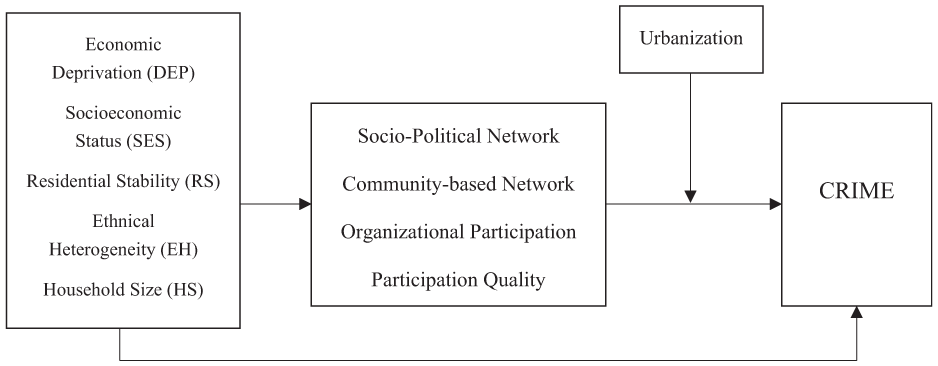
Research model.
Based on the research objectives, theoretical framework, and literature review, crime (total victimization rate) is directly and indirectly affected by community structure variables through density and quality of social ties with the moderating roles of urbanization. Since crime in the community is measured in percent as a censored variable at the community level over time, the Tobit regression model for panel data is appropriate for estimating and testing hypotheses.
The estimated model has the following forms:

in which, Y is crime rate; X is a vector of community structural variables, including DEP, SES, RS, and EH; M is a vector of social disorganization variables, such as Socio-Political Network, Community-based Network, Organizational Participation and Participation Quality; U is a dummy variable indicating that the community is either a rural or urban one; β, ρ, γ are vectors of estimated parameters; and ε is error terms that are independent and identically distributed. Thus, the detail Tobit estimated model for panel data is:

in which, the subscripts l represents Organizational Participation and Participation Quality, i is for the community, and t represents time; υ and ϑ are error terms.
Sample
The data used in this research are adapted from the Vietnam Provincial Governance and Public Administration Performance Index (PAPI). The annual survey has been jointly conducted by the Centre for Community Support Development Studies (CECODES) and the United Nations Development Programme (UNDP) in Vietnam since 2009. PAPI is currently the largest annual survey in Vietnam, capturing the experiences of over 14,600 citizens in 416 communes and wards from all 63 provinces. While the questionnaire mainly focuses on policy making, policy implementation, and the monitoring of public service delivery, it also incorporates other aspects of the respondents’ social life, such as social ties, networking, and security concerns. The studied sample consists of data from four years, 2017 to 2020, at the individual level. The raw data was then cleaned, and all variables at the individual level, described in the following section, were aggregated to the commune level for analysis. The commune and ward are the third-tier subdivisions of Vietnam in rural and urban areas, respectively. They are the closest subdivision to the neighborhood in the Western countries with data available and thus were chosen as analytical units. The final sample consists of 416 communes/wards annually, or 1664 observations in the whole sample.
Measures of Variables
Measures of Intervening Variables
The information on the types of organizations in which the respondents participated was extracted from the PAPI questionnaire. In previous studies, friendship networks (also referred to as organizational participation in many works) were usually measured by the number of friends that the respondents had living in the local community (Lowenkamp et al., 2003). da Silva (2014) saw all individuals participating in formal or voluntary institutions in their neighborhood as having organizational participation. In this study, the authors employ two variables, Socio-Political Network, and Community-based Network, to clarify the effects of formal and voluntary organizations. The respondents are considered to have Socio-Political Network if they are participating in at least one of the social-political organizations mentioned in section “Research Context” (e.g., Fatherland Front, Women’s Union, or Farmers’ Union) at the local level or are members of the Communist Party, which requires official periodical meetings. The respondents are considered to have Community-based Network if they report participating in at least one of the local community-based organizations, such as a sports team, a charity group, or a religious group.
Sampson and Groves (1989) measured Organizational Participation by the percentage of respondents who reported participating in meetings of clubs or committees the week before the interview. Lowenkamp et al. (2003) used the percentage of people who reported participating in club or committee meetings the last time they were out in the evening.
The respondents’Organizational Participation is measured based on the question, “Do you express your opinion comfortably in the meetings of the organization where you are most active?”. The answer “yes” represents a substantive participation in the organization(s), while “no” means that their participation is only symbolic.
Finally, Participation Quality reflects three sub-dimensions of citizen participation: civic knowledge, equality elections, and voluntary contributions. The variable is defined as the sum of the Z-score of three items, which are measured by three questions respectively: (a) Did you vote in the election for the head of your neighborhood, and did the person you voted for win the election (equality elections)? (b) Did you contribute money or labor to construct or repair your neighborhood’s public infrastructure (voluntary contributions)? (c) Do you think your opinion was adapted and presented in the ward’s financial and/or land use report (civic knowledge)?
Measures of Structural Variables
Most of the structural variables in this study are constructed consistent with previous literature (Bursik and Grasmick, 1993; Lowenkamp et al., 2003; Sampson and Groves, 1989). Socioeconomic Status (SES) is the sum of the Z-score of high education (the rate of people holding university degrees or higher), occupation (people with professional or managerial jobs), and high income (people with high incomes). Lowenkamp et al. (2003) measured income by the percentage of respondents reporting incomes in the top two income brackets. Due to the differences in data, this study defines high income as the rate of respondents reporting incomes higher than median income. Economic Deprivation (DEP) is adapted from the work of Bursik and Grasmick (1993), being the sum of the Z-score of unemployment (the rate of people over 18 years old and having no job at the time of the survey), poverty (the rate of households with poor household books), and under 18 (the rate of people under the age of 18). Vietnam’s current policies use an official poverty line to identify poor households. Households would be assessed by commune officials. If they are found living below the local poverty line, their poverty status would be certifies by poor household books issued by local governments (T. V. Nguyen et al., 2015). Thus, the rate of households with poor household books is appropriate for poverty in Vietnam.
Residential Stability (RS) was measured by Sampson and Groves (1989) as the percentage of people brought up in the area within a 15-min walk from home. Lowenkamp et al. (2003) measured it with the percentage of people who reported “living in the area” for ten or more years. This study follows the latter and measures RS by the percentage of people living in the same commune/ward for ten or more years.
Ethnical Heterogeneity (EH) is the rate of non-Kinh people in the community. In Vietnam, the Kinh people (also known as Viet people) are the dominant out of the 54 ethnicities, contributing to 85.3% of the 96 million people population in 2019 (General Statistics Office of Vietnam, 2019). Thus, this study only differentiates the Kinh people from other minority groups.
Household Size is the average household size in the communities. Male is the rate of male respondents in the communities. Finally, Urban was coded as either 0 or 1, where 1 represents an urban commune/ward and 0 otherwise.
Measures of Crime
Crime is measured by the total victimization rate, as suggested in the previous studies (Lowenkamp et al., 2003; Sampson and Groves, 1989). However, one important difference is that the data is self-reported. The respondents were asked whether, within 12 months before the survey, they or any family members were met with one of the four types of crime: vehicle theft, burglary, robbery, and assault. The sum of these four crimes was then aggregated to the commune level.
In Vietnam, it is a widespread norm that it is terrible luck if one must rely on legal action. The legal procedure is so complicated that people tend to solve problems in conventional or informal ways. As a result, many minor crimes, such as livestock theft, might not be reported, particularly in the countryside, because the victims believe that the police would not do anything. This problem is also found in other developing countries (de Melo et al., 2015; Kemp et al., 2021; Neubacher et al., 2024). Police distrust leading to non-reporting crime occurrences is another problem that can hardly be solved with official data sources (de Melo et al., 2017; Warner, 2007), and relying on police records was pointed out as a limitation of previous studies (Kaylen and Pridemore, 2013). Thus, the self-reported data from the PAPI survey is relevant for crime measures. The description of the survey sample and data are presented in Table 1.
Descriptive Statistics of Variables.

Estimated Results and Discussion
The paper conducted multicollinearity and Hausman tests to check whether independent variables are independently correlated and whether a random or fixed effects model is appropriate for estimation. As expected, the correlation coefficients of the Pearson matrix are low, ranging from .0016 to .4360, implying no multicollinearity exists. The Hausman test was also conducted, and it was found that the null hypothesis on the consistency of the random effect model was rejected, meaning the fixed effects model is appropriate. Since crime rate is a censored variable, the Tobit fixed effect regression models were used. The estimated impacts of community structural variables on the dimensions of social disorganization are presented in Table 2.
Effects of Community Structure on the Dimensions of Social Disorganization.

Note. Standard errors are in parentheses; *p < .10. **p < .05. ***p < .01.
Table 2 shows that the community structure is associated with the dimensions of social disorganization, supporting the theory’s indirect hypothesis. Notably, SES and DEP have opposite effects on all the dimensions of social disorganization: while SES is positively associated with Socio-Political Network, Organizational Participation, and Participation Quality, DEP is negatively associated with all these three dimensions. DEP is only positively associated with Community-based Networks, which is negatively associated with SES. In other words, the high-status people in Vietnam tend to participate more in socio-political organizations, where their participation tends to be more substantive and of higher quality. In contrast, disadvantaged people rely more on voluntary community-based organizations, which are poor-friendly (Đặng & Bùi, 2011); their participation, however, tends to be lower quality.
As expected, RS has a similar effect on the dimensions of social disorganization compared to SES. People who have lived more than ten years in the same community tend to participate more in local socio-political organizations and less in community-based organizations; their participation also tends to be more substantive and with higher quality. This finding aligns with Lowenkamp et al. (2003) and Sampson and Groves (1989).
As explained in previous sections, minority groups in Vietnam are politically supported to participate more in socio-political organizations with and of higher participation quality even though they struggle in community-based organizations. The results in Table 2 prove that EH is negatively associated with Community-based Networks while positively associated with all three other dimensions of social disorganization. The empirical results support the authors’ expectations. The effects of structural variables on dimensions of social disorganization are generally in line with the original hypotheses. The only exception is the effect of EH, which can be explained by the aforementioned support policy of the Vietnamese Government and the norm of coexistence between ethnic groups. In other words, the Social Disorganization Theory holds in the context of developing rural and urban communities in Vietnam.
Table 3 shows the effects of the community structural variables and the dimensions of social disorganization on crime. Model 1 presents the main effects; Models 2, 3, 4, and 5 additionally include interaction terms of the dimensions of social disorganization, including Socio-Political Network, Community-based Network, Organizational Participation, and Participation Quality, respectively. The empirical results show the robustness of estimates.
Effects of Community Structure and Dimensions of Social Disorganization on Crime.

Note. Standard errors are in parentheses; *p < .10, **p < .05, ***p < .01.
Both network dimensions of social disorganization (Socio-Political Network and Community-based Network) negatively correlate with crime, proving that the main hypothesis of the theory holds in the context of Vietnam. The arguments on the roles of SES, DEP, and EH are also supported, with SES and EH being negatively associated with crime across all five models, while DEP has a statistically insignificant effect. Similarly, RS has a negative but statistically insignificant effect on crime.
Participation Quality and Organizational Participation have positive effects on crime but are statistically insignificant. These results do not support the argument or the theory’s original hypothesis. As da Silva (2014) suggested, the positive correlation between organizational participation and crime might be a “strategy for daily survival” in violent areas. Organizational participation refers to individuals’ participation in formal or voluntary institutions in the neighborhood. These results imply that the “strategy for daily survival” requires people to participate and express themselves well in their organizations to be known and protected by the community, leading to a positive correlation. At the same time, participating in organizations helps them establish and maintain their social ties, resulting in lower crime following the original hypotheses of the Social Disorganization Theory. This “double effect” finally appeared as a statistically insignificant coefficient, as seen in Table 3.
The case of Participation Quality is more complicated. One possible explanation is the political and economic clientelism in Vietnam. In this scenario, even though people exercise substantive participation in their organizations and contribute to their communities in various ways, they act primarily for their faction’s benefit – for example, voting for their candidates to be the leader of the community, contributing only to infrastructure that directly benefits them – and at the same time isolating disadvantaged community members that do not belong to their faction. Similar situations were observed in rural areas of other developing countries such as India (S. Anderson et al., 2015).
The moderating effect of Urban on the relationship between the dimensions of social disorganization and crime exists. Specifically, the positive coefficient of PQ*Urban means the effect of participation quality on crime is stronger in urban than rural areas, as hypothesized by the authors. Since Participation Quality is a three-facet variable (see section “Measures of Variables”), this result suggests that citizens in big cities have better civic knowledge, equality elections, and voluntary contributions than their rural counterparts. Similar findings from recent works, Hue (2023) provides additional support for this empirical results. However, the effects of other intervening dimensions of social disorganization on crime are not as expected. The negative coefficient of CBN*Urban implies that the crime prevention effect of community-based organizations is weaker in the city than in the countryside. This finding is similar to previous studies suggesting that establishing and maintaining social networks is more difficult in big cities (Kelleher and Lowery, 2009; Yang and Callahan, 2007). Community-based organizations are poor-friendly by nature, enabling low-status people in the countryside to participate in and integrate into their community’s social life. The authors originally expected that this characteristic, combined with Vietnam’s pro-poor policies, might help mitigate the negative impact of urbanization on citizens’ social networks. However, given the context of Vietnam, where 95 percent of people living in poverty are in rural areas (C. V. Nguyen, 2019), rural community-based organizations can attract more members, creating more social ties and, thus, contributing more to crime prevention than their urban counterparts.
The positive but non-significant coefficients of SPN*Urban and OP*Urban suggest that the relationship between citizens’ formal networks and citizens’ organizational participation on crime rate are not affected by the context – either rural or urban. On the one hand, this result provides evidence that Vietnamese citizens have good participation opportunities to participate in local SPNs and have substantive participation. On the other hand, when combined with the statistically insignificant positive correlation between Organizational Participation, Participation Quality and crime, this result might imply that political and economic clientelism is an emerging issue.
Implications and Conclusion
This study investigates the impacts of community structure and neighborhood organizations on crime under the framework of Social Disorganization Theory in the context of Vietnam. Using data from the Vietnam Provincial Governance and Public Administration Performance Index at the community level, the empirical results support the main hypotheses of the Social Disorganization Theory along with the differences predicted by the authors for the context of Vietnam, for example, poverty does not directly lead to a higher crime rate. At the same time, ethnic heterogeneity contributes to crime prevention. However, mixed results regarding the relationship between community structure, participation quality, and crime suggest that the situation in Vietnam is more complicated than expected, possibly with strong clientelism that hinders crime prevention efforts.
This paper has three limitations. First, the Organizational Participation and Participation Quality variables were proxied by individual self-reports and aggregated at the commune level. Even though self-report data has its advantages, the results could be more consistent with a better measure of participation quality. Second, the authors did not examine the role of different types of social control, including community-based policing and grassroots units such as communal/ward police stations, in crime prevention. It might be fruitful for future works to dive deeper into this topic. A combination of quantitative and qualitative methods might be useful to shed light on the dynamics of social control and social organization in Vietnam and how they influence the dimension of social disorganization. Third, the paper does not consider the spatial effect on crime. Spatial contagion of crime exists among communities; thus, the issue was left for another research strand using spatial econometric methodology. Another promising scope of research emerges from the mobility and boundaries of communities, i.e., their spatial and social heterogeneity, that are not within the scope of the present study. Despite these limitations, the results were theoretically consistent and robust and provided theoretical and managerial implications.
From a theoretical perspective, this study has two main contributions. First, it reinforces the findings from previous tests and suggests that the Social Disorganization Theory is a useful framework for analyzing crime in developing countries (Lowenkamp et al., 2003; Sampson and Groves, 1989). Although crime-related theories are claimed to be “fundamentally geographical” as “theoretical expectations change when the place changes” (de Melo et al., 2017), the present study tested the Social Disorganization Theory in a transitional post-communist country, where the landscape of neighborhood organizations is far different from that of the Western developed countries and Latin American nations. It contributes to the debate on the applicability of the theory outside the traditional contexts. Second, empirical results highlighted the role of neighborhood organizations (rural community-based ones in particular) and the quality of participation in crime prevention. Vietnam is a collectivistic society (Dinh & Ho, 2020), where people tend to participate in social life as part of delegations rather than as individuals (Dang, 2015). In such a context, participating in neighborhood organizations is not only a “strategy of daily survival” but a “strategy of social integration.” Even if people join organizations for survival in the first place, they can eventually establish and maintain their social ties, leading to a more organized community. Despite the possible serious clientelism, which can weaken the organizations’ effect and hinder crime-fighting efforts in the long run, the paper argues that improving participation quality is still essential in crime prevention, as it helps strengthen governance and improve local economies. These factors, in turn, would contribute to better community structure, resulting in lower crime in the long run. Future applications of the Social Disorganization Theory in developing post-communist contexts should consider the intervening variables proposed in the present study as dimensions of social disorganization for better predicting and explaining crime.
From a managerial perspective, this paper provides several policy implications. First, it implies the importance of socioeconomic status and economic deprivation on crime. Specifically, thanks to the pro-poor policies, economic deprivation only has an indirect impact on crime. Meanwhile, high socioeconomic status contributes to crime prevention both directly and indirectly. Thus, improving local people’s income, creating jobs, and providing better education would be primary among the crime-preventing efforts. Second, increasing the quality of community-level organizations is a potential solution for crime-preventing efforts as they help people establish and maintain social ties. Empirical results show that people with better socioeconomic status tend to participate less in community-based organizations (i.e., voluntary organizations). Thus, it is essential to find measures to encourage them to join and improve their participation quality in these organizations. Third, promoting urbanization with control would benefit crime-prevention efforts. Urbanization can contribute to economic growth and social development by promoting industrialization, creating employment, providing urban services, and improving socioeconomic conditions, which eventually reduces criminal activities (Bursik and Grasmick, 1993; Donnermeyer, 2015; Sampson and Groves, 1989). As T. V. Nguyen et al. (2015) found, the bigger the city, the harder it is for its people to establish and maintain social ties. Urbanization, accompanied by the development of neighborhood organizations, might be a crime-prevention measure for developing countries.
In conclusion, economic growth with a relatively low crime rate is one of the successes of the Doi Moi process in Vietnam under the Communist Party’s ideology. It is even more pertinent when the country pursues the aspiration of industrialization and modernization through market-oriented reforms. This process causes community structure to change, disturbs social ties, and increases crime at the community level. Like other transitional countries, Vietnam struggles to balance promoting growth and sustaining security. Controlled urbanization, accompanied by the development of neighborhood organizations, will be a solution with great potential. In this sense, the experience of Vietnam can be valuable for other transitional/post-communist countries.
Footnotes

Ethical Considerations
It is not applicable.
Funding
The authors disclosed receipt of the following financial support for the research, authorship, and/or publication of this article: This research is funded by the National Economics University under grant number CBQTT1.2021.14.
Declaration of Conflicting Interests
The authors declared no potential conflicts of interest with respect to the research, authorship, and/or publication of this article.
Data Availability Statement
Data sharing is not applicable to this article as no datasets were generated or analyzed during the current study.