




Abstract
Research has explored many different relationships between contextual influences, such as levels of immigration or economic condition, and attitudes about immigrants, with mixed results. These have largely been international comparative studies using cross-sectional data, therefore they have been unable to make claims about changes in environmental context translating to changes in attitudes of respondents. Furthermore, the previous literature has almost exclusively tested these relationships using data from adults, despite research showing that attitudes are most subject to change during adolescence. This study addresses these issues by using a longitudinal data set of repeated measures of 2,328 German adolescents (about 14–18 years old) over four response waves (2010–2014). Using a multilevel analysis, results show that contextual changes, including the percentage of foreign-born people and unemployment rates within respondents’ states, correspond to changes in attitudes toward immigrants consistent with group threat theory. These results were stable even when controlling individual-level factors.
Although many studies have been published in recent decades researching the influence of contextual factors such as levels of immigration and economic condition on peoples’ attitudes about immigrants, consistent findings have been elusive. This research has been driven predominantly by group threat theory (Blumer 1958) investigating factors that influence how the dominant group in a society perceives a minority out-group. Typically, these studies have been comparative, using cross-sectional data and at times even longitudinal designs, including multiple waves of comparative data, which have yielded mixed results (Coenders and Scheepers 1998; Hjerm 2009; Kuntz, Davidov, and Semyonov 2017; Meuleman, Davidov, and Billiet 2009; Quillian 1995). Although some studies show a significant relationship, others find only weak evidence, or evidence that a relationship only exists in specific areas where these contexts interact. The discrepancy in findings is commonly attributed to varying dimensions of spatial analysis (e.g., region vs. country level) or varying operationalizations of independent and dependent variables of analysis (Pottie-Sherman and Wilkes 2015; Weber 2015).
However, a crucial issue the previous literature has overlooked when exploring the relationship between context and people’s attitudes about immigrants is that the sample population has been composed almost exclusively of adults. This is true despite evidence from the psychological literature suggesting that by the time people reach adulthood, their attitudes are “crystalized” and less subject to change than at earlier stages in the life course (Henry and Sears 2009; Rekker et al. 2015; Sears and Funk 1999). Instead, the literature supports the impressionable years hypothesis, which argues that the most pivotal time for attitudinal change, including in attitudes toward immigrants, is in childhood and adolescence. Therefore, it is possible that at least part of the mixed findings in the current research is because the time when contextual effects were most important in the sample population has passed.
The theoretical perspective used in this article follows the example set out by Meuleman et al. (2009) and later by Lancee and Pardos-Prado (2013), which suggests a dynamic process whereby changes in context, such as an increase or a decrease in immigrants, should correspond to changes of anti-immigrant attitudes within individuals over time. This idea is then applied to a sample of adolescents, whose attitudes are expected to be most subject to change. In this case, the previous literature may have yielded mixed results because researchers had been searching for evidence of a dynamic relationship in insufficient nonlongitudinal data composed of respondents whose attitudes are change averse. Because of data availability, previous studies have not been able to model if changes in attitudes toward immigrants are a reflection of changes in the larger contextual environment of the individual.
This study addresses the issues in the literature through the use of a repeated-measures data set that follows the same adolescent individuals across a five-year time period from 2010 to 2014 to test two aspects of group threat theory. Following in the footsteps of Quillian’s (1995) study, I test two focal predictors: the proportion of out-group immigrants and unemployment rates. I apply a multilevel model with three levels, making it possible to parse within- and between-individual change as contextual factors at the German state level are also changing. This is a good time because the data span the period during the lead-up to the most recent migration wave, which peaked in 2015, so there is considerable variation in both levels of immigrant populations as well as economic conditions.
Group Threat Theory and Adolescence
In an attempt to better understand the drivers of anti-immigrant attitudes, researchers have frequently asked, in one form or another, “Do the numbers really count?” (Hjerm 2007; Pettigrew, Wagner, and Christ 2010; Pottie-Sherman and Wilkes 2015; Quillian 1995; Strabac 2011). This question has been prompted by group threat theory, which posits that in-group members in a society develop prejudicial attitudes toward out-groups, such as immigrants, because of a perceived feeling of threat (Blumer 1958). Blumer argued that the development of these feelings of threat is a process of group relations whereby the relationships between the groups are the drivers of prejudicial attitudes. A change, which might indicate the slipping in position of in-group members vis-à-vis the out-group, would trigger feelings of threat in individuals and thus increase prejudice, as a response to intergroup dynamics. Therefore the relative size of the out-group as well as the economic condition of the country should be reflected in attitudes about the immigrants of that country. Quillian (1995) found this relationship, in what began more than 20 years of empirical studies.
However, the literature following Quillian’s study has yielded mixed results. A recent meta-analysis of studies specifically looking for evidence of a relationship between the size of out-groups and anti-immigrant sentiment found that “some studies show a positive relationship between immigrant group size, others show a negative relationship or no relationship at all” (Pottie-Sherman and Wilkes 2015:243). For example, Quillian’s study has been followed up by others that show similar results (Kunovich 2004; Schlueter and Scheepers 2010), but as traced in the meta-analysis, others have found the opposite relationship or no relationship (Coenders and Scheepers 2008; Hjerm 2007; McLaren 2003; Strabac 2011; Weber 2015) or that the relationship exists only for certain types of immigrants (Schneider 2008).
Similarly, research looking for a relationship between the economic conditions in respondents’ area and their attitudes about immigrants has also yielded mixed results. Some literature suggests a negative relationship consistent with group threat theory whereby more strained economic conditions, such as higher unemployment rates or lower gross domestic product, correspond to higher levels of prejudicial attitudes of the respondents in that area in response to economic threat (Billiet, Meuleman, and De Witte 2014; Meuleman et al. 2009; Quillian 1995). However, as was the case with proportion of immigrants, other studies found no relationship between the contextual effects of economic condition on attitudes about immigrants (Coenders and Scheepers 2008; Kuntz et al. 2017; Meeusen and Kern 2016; Schneider 2008). What is common in the literature is that economic condition is important only when it interacts with other factors. For example, Hjerm (2009) found in a multilevel analysis of municipalities that economic condition is important to anti-immigrant attitudes only in areas that are poor and have comparatively high levels of immigrants. Other studies have found that economic conditions are related to anti-immigrant attitudes when they interact with inequality (O’Connell 2005) or with the individual’s ideological political preferences (Pardos-Prado 2011).
What are the reasons for the inconsistency in the literature as it applies to group threat theory? One reason may lie in the idea that the theory suggests a dynamic nature whereby intergroup conflict is perhaps important only when changes in environmental context present themselves. As noted above, Blumer’s theory of intergroup threat has traditionally been interpreted in a static fashion in which the presence, or perceived presence, of threat induces prejudicial attitudes. However, another interpretation of the theory suggests that intergroup threat occurs as a dynamic process whereby prejudice is a reaction within the individual in response to an increased threat to his or her dominant group vis-à-vis a subordinate group. Meuleman et al. (2009) forwarded this dynamic interpretation of the theory, arguing that it is changes in, instead of absolute levels of, threat factors that induce prejudicial attitudes. This means that “actual competition could remain constant at a high level without affecting outgroup attitudes. It is only when sudden changes in minority group size or economic conditions occur that outgroup attitudes evolve” (p. 354). In this case, the findings of previous studies may be clouded by the fact that even high proportions of immigrants in an environment, if stable, do not necessarily correspond to higher levels of anti-immigrant attitudes, because the intergroup power dynamics are also stable. Furthermore, even poor economic conditions in a society may not trigger negative attitudes toward immigrants if the economic issue is not made salient by a recent change. This could be because, as Blumer noted, prejudice is a response to the threat individuals perceive toward their in-group. In other words, the perception of threat is relative to the environment of the perceiver, so higher levels of prejudice should occur only when there is a perceivable change in the environmental context. This is evidenced by research suggesting that individual perception of the economy is important (Kuntz et al. 2017), so areas with persistently high long-term unemployment rates may not receive as much attention compared with areas with sudden increases.
To trace the impact of changes in social context on attitudes about immigrants, some recent studies using longitudinal research designs have begun to model these dynamic processes among groups with more consistent results. With their advancement of the dynamic theoretical interpretation, Meuleman et al. (2009) used a repeated cross-sectional design to look for a relationship between changes in threat factors and attitudes toward immigrants. They found a growing openness to immigration in countries that experienced weak immigration flows, as well as decreasing unemployment rates that were associated with more positive attitudes toward immigrants. Similarly, Coenders and Scheepers (2008) found that the absolute level of foreigners had no relationship to negative attitudes toward them but that a recent change in the level of foreigners did influence attitudes. In the U.S. context, Hopkins (2010) found similar results: places that experienced increases in proportions of immigrants were more likely to consider anti-immigrant legislation, and this effect was compounded in places that experienced increases in unemployment rates at the same time. In addition to Meuleman et al.’s study, others have also used repeated cross-sectional designs to capture influences on attitudes toward immigrants (Coenders and Scheepers 1998; Kuntz et al. 2017; Quillian 1995). Modeling differences among waves of the study, they hope to capture changes in economic condition and proportions of foreign-born in relation to trends in attitudes. Although these studies have offered significant insight, their design prevented them from capturing how changes in context correspond to changes within individuals over time. To my knowledge, only Lancee and Pardos-Prado (2013) were able to model within-person attitudinal change with access to panel data as it relates to the changes in context outlined in this study. They found that changes in attitudes corresponded to changes in both individual’s perceived and objective economic conditions, regardless of the number of immigrants in their area. Their models showed a relationship between level of foreigners and concerns about immigration, but the effect disappeared when controlling for overtime regional variation, suggesting that it is levels rather than differences in proportions of immigrants that are important.
Another reason for the mixed empirical findings may be that all of the studies discussed here have been conducted among adult populations. This is interesting given what the psychological literature tells us about both attitude development and its susceptibility to change. Research has shown that prejudicial attitudes are formed in childhood and adolescence (Raabe and Beelmann 2011) and that once these attitudes are formed, they become stable and crystalized throughout the life course (Henry and Sears 2009; Rekker et al. 2015; Sears and Funk 1999). If this is the case, then it is possible that at least part of the reason for the mixed results is that researchers have been looking for evidence of contextual influence at a time when respondents are change averse, as was found in the null over-time results of foreign-born changes in Lancee and Pardos-Prado’s (2013) study. In short, we may have been looking in the right place, but perhaps just not at the right time in the life course.
Although research has shown that adolescents’ prejudicial attitudes are influenced by many different types of social contexts, such as their parents (Miklikowska 2016, 2017), their peers and friendship networks (Hjerm, Eger, and Danell 2018; Miklikowska 2017; Poteat 2007; Van Zalk et al. 2013), and classrooms (Mitchell 2019), very little research has been conducted to test if adolescents’ attitudes are subject to influence from macro-contextual factors such as unemployment rates and proportions of immigrants. This is startling considering the breath of research on the topic on adults, the theoretical and empirical psychological research on attitudinal development, and the consistent cultural trope of individuals’ attributing how they feel about others to the conditions of where they were when they were growing up. Probing this idea, and in addition to contributing to the framework for modeling change, Coenders and Scheepers (2008) found that if respondents were confronted with a macro-level context with a high level of unemployment during adolescence, they showed strong resistance to social integration at the time of the survey, potentially many years later. This finding suggests that adolescents are indeed sensitive to macro-level contextual influences. It could mean that the influence from these macro-contextual factors is “trickling down” through parents, teachers, and other adults in the adolescents’ lives, it could be that they are more sensitive to their environmental conditions than previously thought, or it could be a combination of the two. 1 Although the micro-level mechanisms that transmit feelings of threat have been investigated, as cited above, the commonalities that groups of adolescents are experiencing in response to environmental social changes have remained largely unexamined. However, if evidence is found here that conditions previously tested among adults are influencing adolescents, then this area certainly deserves more attention.
In this article I address gaps in the literature concerning within-individual change in adults in response to contextual changes by applying a longitudinal research design using panel data on adolescents. Given the literature on attitudinal development in adolescence, in conjunction with the literature on macro-level contextual influence among adults, the following hypotheses have been developed:
Hypothesis 1a: Adolescents’ attitudes toward immigrants will be more negative in states with higher absolute proportions of foreign-born people.
Hypothesis 1b: Adolescents’ attitudes toward immigrants will be more negative in states with higher absolute levels of unemployment.
Furthermore, incorporating a dynamic empirical test of group threat theory’s assertion that prejudice is a reaction to changes in group dynamics between the dominant group vis-à-vis other groups, the following hypotheses have been developed:
Hypothesis 2a: Adolescents’ attitudes toward immigrants will become more negative over time in correspondence to increases in the proportion of foreign-born in their state.
Hypothesis 2b: Adolescents’ attitudes toward immigrants will become more negative over time in correspondence to increases in the unemployment rate in their state.
Data
Participants in this study consist of adolescents from the Children of Immigrants Longitudinal Study in Four European Countries (CILS4EU) from 2010 to 2014 (Kalter et al. 2017; Kalter, Kogan, and Dollmann 2018). Although the study initially covered four countries, only the German sample included repeated measures of the same respondents over multiple waves covering the five-year time span. Additionally, the German sample included a variable that indicated what state (Länder) the participants resided in, allowing a longitudinal analysis using state-level indicators. Therefore, only the German portion with multiple waves of the CILS4EU data is used in this study. 2 To focus on the attitudes of German adolescents, the sample was further restricted to include only respondents who indicated that both their mothers and fathers were born in Germany. This resulted in a sample size of 2,328 individuals (14–18 years old), of whom 1,907 to the dependent variables in the first wave. Attrition is a part of any longitudinal study with repeated measures as the research team loses contact with individuals over time. In this instance the population had decreased by 28 percent to 1,372 by the final wave. The technical report of the data does not suggest that this attrition was systemic in any way, so missingness at random is assumed in the models. With repeated measures, the models include 6,352 observations at four time points.
A thermometer scale was used to measure the attitudes of respondents toward Turkish, Polish, and Russian people. Although immigrants to Germany come from many different places, during the time of the sample these three groups together represented 38.5 percent of all immigrants in Germany in both 2010 and 2015 (United Nations, Department of Economic and Social Affairs, Population Division 2017), making them a salient representation of respondents attitudes about immigrants generally. For each group respondents were asked, Please rate how you feel about the following [survey country] groups on a scale that runs from 0 to 100. The higher the number, the more positive you feel, and the lower the number, the more negative you feel towards this group.
At each of the time points, attitudes toward each group correlated highly with each other (>0.54 at T0, >0.67 at T1, >0.64 at T2, and >0.68 at T3). To create the measurement of general attitudes toward immigrants, a scale was constructed by averaging the three items from the German portion of the sample; therefore on a scale ranging from 0 to 100, more positive feelings are indicated by higher values. 3 The thermometer items were collected for waves 1, 3, 4, and 5 of the study and omitted during wave 2 of the study, resulting in four response waves with unequal intervals. This scale produced high internal consistency across all time points (Cronbach’s α: 0.84 at T0, 0.89 at T1, 0.87 at T2, and 0.89 at T3).
In this study I analyze two items that have consistently been used in the literature as predictors of peoples’ attitudes toward immigrants: percentage foreign-born and percentage unemployed. These state-level predictors are available for every wave of the study (years 2010, 2012, 2013, and 2014). Data are drawn from the German statistical offices of the Länder. In Germany, “foreign-born” is defined as all residents living in German who hold non-German passports, which does not include foreign-born residents with German passports or citizens with dual passports or their descendants. Unemployment rates come from the same statistical offices. Other models testing gross domestic product per capita and population density were also tested and revealed consistent results.
The choice of states as the geographical unit of analysis was made for both theoretical and practical purposes. From a theoretical point of view, the 16 states within Germany are politically salient entities that allocate and make key decisions that are relevant to this topic. For example, although the German federal government is responsible for immigration and refugee policy as well as the administration of some integration programs, allocation of funds, housing, and policies regarding the relocation and care of unaccompanied minors are all managed by the German states (offices of Bundesministerium der Finanzen). If these policies are a reflection of, or have an impact on, respondents, then for analytical purposes grouping them by state is appropriate. From a historical perspective, west German states have a history of immigration in contrast to those states in the former German Democratic Republic, and there remains a persistent economic effect of pronounced unemployment in the eastern German states (see Appendix). For the purposes of this study, these historical differences draw a stark contrast between stable differences in immigrant populations or unemployment rates between states and the changes within them. There are smaller geographic regions in Germany, but the CILS4EU data does not locate respondents into these regions. Although having a more nuanced geocode would have been helpful for this study, other authors have found that their results are consistent across German geographical units when analyzing attitudes in relation to the independent variables used here (Schmidt-Catran and Spies 2016).
Individual-level control variables were also included. The gender control variable was coded 1 for male and 2 for female. A socioeconomic indicator was included in the analysis with a question that read “How often do you miss out on activities with your friends because you can’t afford it?” with responses on a four-point scale (1 = “always” and 4 = “never”) on which higher values indicate higher socioeconomic status. To control for interethnic contact, a variable was included that measured contact on a five-point scale; the question read “How often do you spend time in your neighborhood with people from another background?” (1 = “never” and 5 = “every day”), so that higher values indicate more contact. A school performance variable was constructed by averaging self-reported scores of how respondents felt they were doing in German, English, and math (1 = “not well at all” and 5 = “quite well”). Finally, to capture differences that might exist between respondents living in east versus west Germany, a dummy variable was created with which the states Saxony, Saxony-Anhalt, Thuringia, and Mecklenburg-Vorpommern are categorized as “east” and all others as “west”. 4
Methods
Longitudinal multilevel analysis with repeated measures using the lme4 package (Bates et al. 2015) in the R environment was used for this study, and p values were obtained using the lmerTest package (Kuznetsova, Brockhoff, and Christensen, 2016). The models constructed have a nested three-level structure with responses at different time points (level 1) nested within individuals (level 2) nested within German states (level 3). A “model building” approach was taken, whereby multiple data analysis runs are conducted in a stepwise fashion with growing complexity: first, an unconditional model is created and tested against different error structures to obtain good model fit, then the predictors percentage foreign born and levels of unemployment of within and between states are added, and finally a full model with individual controls is constructed. Assuming that the outcome changes linearly with time (see the unconditional model tests below), this model is written as follows:

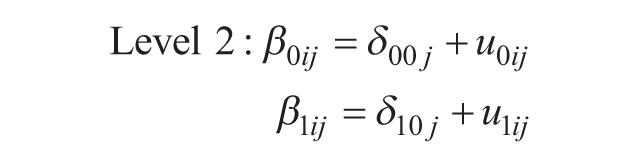

where j indexes group, i indexes individual, and t indexes observation. In the level 1 part of the model, the first two terms are the fixed effects, capturing the average change over time. The term
To capture the relationships in individuals’ attitudes toward immigrants and the differences between states, for example, the over-time effect of living in a state that has a consistently higher proportion of foreign-born compared with those that do not, a time-invariant predictor was created for both foreign-born population and unemployment rate. This was done by averaging the (individual) state-level measurements across time periods for both of the predictors. To capture the relationship between the changes in contextual factors and changes within individuals’ attitudes toward immigrants, two group mean–centered variables were created. This was done by taking the observed state-level measurement for both percentage foreign-born and unemployment and subtracting the average of those measurements across all time points (Fairbrother 2014). For example, “within-state foreign-born” equals percentage foreign-born in a given state in a given year minus the average percentage foreign-born across all years in that state. Because this variable is centered on the mean, respondents with large changes in their states are assigned values further away from zero. Both the “between-state” and “within-state” predictors are included in model 2. Model 3 is the full model, incorporating within and between variables for both foreign-born and unemployment rates as well as the individual-level predictors: gender, the east/west dummy variable, socioeconomic status, contact with out-group members, and school performance.
Because this study incorporates a three-level model, there are three levels of random effects. Model fit statistics including the Akaike information criterion, Bayesian information criterion, and log likelihood for each of the models were calculated; generally, model fit improves with the addition of new covariates.
Results
Descriptive statistics for participants’ attitudes toward immigrants are shown in Table 1. On the 100-point scale, respondents’ attitudes remain relatively stable across the time points, with the biggest change occurring during the two-year gap between T0 and T1 (from 49.43 to 56.7), followed by a small drop in the following two waves (55.56 at T2 and 52.98 at T3). The unemployment rate was generally in decline during the time of the study (M range from 9 to 7.8), and as the unemployment rate falls, so too does the standard deviation (from 2.96 to 2.32). The mean number of immigrants per 1,000 people increases over time in the German states (M range 71.2–80.8) with large standard deviations (SD = 43.46–45.72). There is a dip in the immigration level in the first two waves of the study between 2010 and 2012. See Appendix for descriptive statistics grouped by state.
Descriptive Statistics of Dependent and Independent Variables.

The analytic results presented in Table 2 show the fixed and random effects for each of the models. For example, in model 1 the random-effects residual (
Longitudinal Multilevel Models, Dependent Variable: Attitudes toward Immigrants.
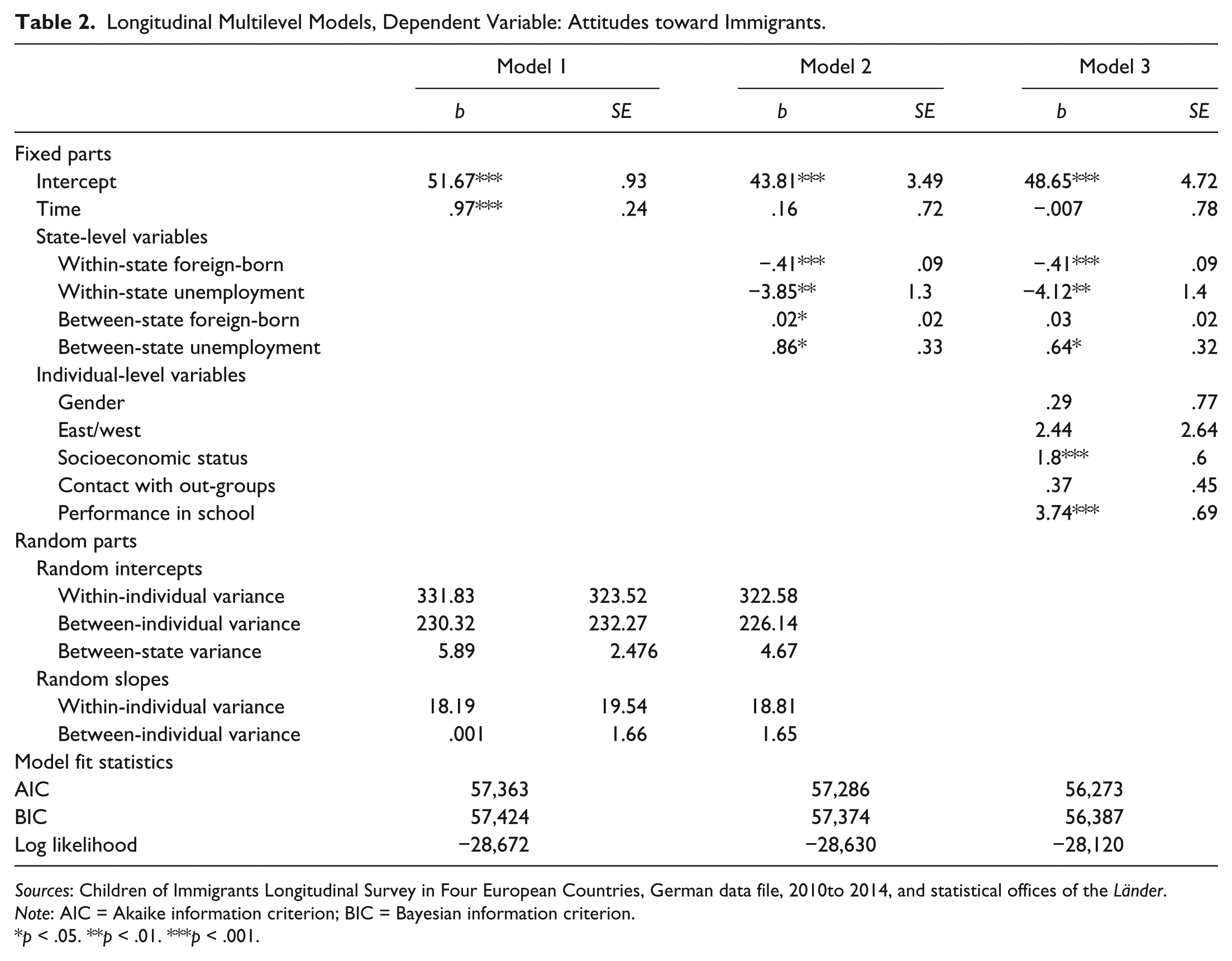
Sources: Children of Immigrants Longitudinal Survey in Four European Countries, German data file, 2010to 2014, and statistical offices of the Länder.
Note: AIC = Akaike information criterion; BIC = Bayesian information criterion.
p < .05. **p < .01. ***p < .001.
Model 2 incorporates both the time-variant and time-invariant macro-level variables. Here, the effect of time is no longer significantly different from zero, indicating that the over-time changes modeled previously are being captured at least in part by the newly added variables. The time-invariant variables are included to test if there is an over-time difference experienced between groups in the sample related to hypotheses 1A and 1B. Although these two variables are both statistically different from zero (at the <.5 level), they each have substantively small regression coefficients (0.02 for percentage foreign born, 0.82 for unemployment), showing that the absolute levels of threat conditions do not appear to have a large influence on the adolescents in the sample. This model also includes the group mean–centered variables that are designed to test the relationship of the within state changes in levels of immigrants and unemployment rates and within-individual attitudes toward immigrants. Both are statistically different from zero, showing that over-time within-state changes in levels of immigrants and unemployment rates influence the attitudes of the adolescents in the sample, confirming both hypotheses 2A and 2B. For people in states that experienced increases in immigrants during the sample period, the average change in attitudes corresponded to −0.41, a decrease that is both significant and substantial on the 100-point scale. In this case, states that saw a one-unit increase (of immigrants per 1,000 people) between time periods saw a decrease in positive attitudes toward immigrants by 4 percent. Figure 1 illustrates change in the scale in responses to changes in immigrant populations during the sample period, with confidence bands. Similarly, for people in states that saw changes in unemployment rate, this corresponded to a significant change in the attitudes of respondents of −0.378. Figure 2 illustrates a similarly large average change in over-time attitudes of 9.8 points on the 100-point scale, complete with confidence bands. The confidence bands are wide in Figure 2, but I believe that is because there were not many cases in which individuals lived in states with rapidly rising rates of unemployment during this time period. This suggests that attitudes of respondents are not subject to levels of immigration or unemployment rates per se; rather their attitudes are more subject to sudden, in this case nearly year-to-year, changes in their area. In other words, it appears that the attitudes toward immigrants of respondents who live in places with high percentages of foreign-born people or higher levels of unemployment are not influenced, unless those rates are subject to change.

Predicted values: within-state foreign-born.

Predicted values: within-state unemployment.
Model 3 includes the individual-level control variables. Gender is not significantly different from zero, nor are those respondents separated between east and west Germany. Individual-level socioeconomic status has a positive relationship to friendly attitudes toward immigrants. Similarly, students who report better grades in school also harbor more positive views toward immigrants. Interestingly, the variable controlling for contact with members of an out-group is significantly different from zero, but the effect size is relatively small, representing only about a 3-point total potential mean difference in the respondents attitudes out of 100. As mentioned above, the time-invariant level 3 predictor capturing the between-state differences in levels of immigrants in states is no longer significant, and although the between-state unemployment rates remain significant, they are substantively quite small. Instead, the time-varying covariates modeling within-state changes remain significant, even after incorporating the individual-level controls in the fully constrained model.
Conclusions
This study contributes to the literature in two key ways. First, it uses repeated measures of the same individuals to test how aspects of group threat theory, specifically proportions of immigrants and economic condition, influence attitudes toward immigrants. Because of the longitudinal nature of the research design, it was able to map the dynamic aspects of prejudice development as is suggested by the theoretical interpretation of Meuleman et al. (2009). That is to say, changes in contextual conditions should correspond to within-individual changes in attitudes. Second, it tested if these macro-contextual conditions had influence over a sample surveyed during the crucial formative years of adolescence, when they should matter most.
Generally, the findings of this study show support for the dynamic aspects of group threat theory, that year-to-year within-state changes in proportions of immigrants and unemployment rates have a substantial and significant relationship with respondents’ attitudes toward immigrants. Conversely, the stable between-state levels of foreign-born populations and unemployment rates do not appear to be important. This is in line with the previous, albeit limited, longitudinal research on the topic (Coenders and Scheepers 2008; Lancee and Pardos-Prado 2013; Meuleman et al. 2009). Furthermore, this study shows that adolescents are sensitive to changes in macro-level conditions. The findings also support other more established bodies of literature on adolescent attitudes, for example, that respondents who have more contact with out-groups show more positive attitudes toward immigrants, as do students who believe they are performing better in school and students with higher socioeconomic status. Still, even after controlling for these individual-level factors, state-level changes in proportions of immigrants and unemployment rates remained important. These interesting findings may be due in part to the “trickling down” of the attitudes of the people around them, but it is also likely that the adolescents in the sample are sensitive to changes in the material conditions around them. For example, as the sample gets older they get closer to either entering the labor market or attending university; in both cases this may be a time when they take stock of the environment around them and are vulnerable to the threat-inducing macro-contexts analyzed here.
Several limitations of this study should be acknowledged. First, the question of whether the level of geographic analysis has influence over the results is not addressed here, and some scholars have attributed the mixed results in the empirical tests of group threat theory to this varying spatial analysis (Hjerm 2009; Weber 2015). For example, Weber (2019) noted that in the German context, the effect of contact appears to be positive when analyzing cities, but at the level of neighborhoods, the effect of threat dominates. Although the differences in geographic units are not included in this study, it does appear that at least a part of the differences seen in the literature can be attributed to these different classifications. That being said, states in Germany are a good “mezzo” level, between the country and municipal levels (Schmidt-Catran and Spies 2016). Also, a longitudinal analysis with a longer time frame than the five years included here would enable insight into when young people begin to be sensitive to macro-contextual factors such as those studied here. It should also be acknowledged that the dependent variable scale is constructed by questions about Polish, Russian, and Turkish people, groups that do not constitute the most recent wave of immigrants to Germany from the Middle East and northern Africa. Although this is notable, the findings indicate that there is still an influence on attitudes by the threat factors analyzed here. It is likely that if the survey included respondents from the contemporarily salient out-groups, the results would be consistent or perhaps of an even larger magnitude (Hopkins 2010). Because of the historical timing of various waves of immigration into Germany, it is possible that cultural and ethnic minorities whose parents are both born in Germany are included in the “native” population used in the sample. Previous research has shown that some respondents’ attitudes about immigrants are more pronounced when the immigrant group in question is of similar or different ethnic groups (Schoon and Anderson 2017). However, research into attitudes of minorities in Germany suggests that assimilating to the prejudicial attitudes of the host society may be a part of acculturation for ethnic minorities (Zick et al. 2001). This certainly deserves more attention in future research. Finally, although Germany is a good test case for this type of analysis because of the amount of immigrants it was allowing into the country at the time, further longitudinal research into this area should include other countries, or perhaps even a longitudinal comparative analysis could be possible.
These findings suggest that researchers should keep in mind the dynamic aspects of group threat theory when designing future studies. With more longitudinal data becoming available, I expect a growing body of research that supports the findings produced here. Also, there are profoundly different implications for policy makers and media pundits who tout contextual factors such as proportions of immigrants or unemployment rates to explain the anti-immigrant sentiments in their states or countries, when studies such as this show that the absolute value may not matter in comparison with recent changes that are occurring within a specific context. Furthermore, although it appears that research has been looking in the right place for contextual influences on attitudes toward immigrants, this study suggests that more attention be given to looking at the right time for people to be sensitive to these influences in their life course. Finally, this article advocates for a dynamic interpretation of group threat theory to advance research on how attitudes toward immigrants change, arguing that changes in conditions make salient the perceived threat of the in-group members, thus contributing to anti-immigrant sentiments.
Footnotes
Appendix
Descriptive Statistics of Unemployment Rates and Levels of Foreign-Born in Germany, 2010 to 2014.

| 2010 | 2012 | 2013 | 2014 | |||||
|---|---|---|---|---|---|---|---|---|
| State | Foreign-Born | Unemployed | Foreign-Born | Unemployed | Foreign-Born | Unemployed | Foreign-Born | Unemployed |
| Baden-Württemberg | 118.6 | 5.5 | 114.2 | 4.4 | 119.3 | 4.5 | 125.7 | 4.4 |
| Bayern | 95.0 | 5.1 | 90.2 | 4.2 | 96.0 | 4.4 | 102.9 | 4.3 |
| Berlin | 136.5 | 15.9 | 126.3 | 14.5 | 134.2 | 13.9 | 143.1 | 13.2 |
| Brandenburg | 26.7 | 12.4 | 20.3 | 11.3 | 22.7 | 11.0 | 26.1 | 10.5 |
| Bremen | 124.6 | 13.2 | 118.7 | 12.3 | 124.8 | 12.3 | 134.1 | 12.2 |
| Hamburg | 135.5 | 9.5 | 130.5 | 8.6 | 134.0 | 8.6 | 139.1 | 8.7 |
| Hessen | 111.5 | 7.2 | 117.9 | 6.4 | 123.0 | 6.6 | 130.4 | 6.5 |
| Mecklenburg-Vorpommern | 23.8 | 14.0 | 19.2 | 13.2 | 21.7 | 12.9 | 25.9 | 12.2 |
| Niedersachsen | 66.8 | 8.4 | 57.8 | 7.3 | 61.3 | 7.3 | 66.6 | 7.2 |
| Nordrhein-Westfalen | 105.2 | 9.6 | 95.5 | 8.9 | 99.0 | 9.2 | 104.6 | 9.1 |
| Rheinland-Pfalz | 77.1 | 6.4 | 72.6 | 5.9 | 76.6 | 6.1 | 82.5 | 6.0 |
| Saarland | 84.2 | 8.2 | 71.0 | 7.3 | 74.2 | 7.9 | 78.7 | 7.8 |
| Sachsen | 27.5 | 13.2 | 22.3 | 10.9 | 24.6 | 10.5 | 28.9 | 9.9 |
| Sachsen-Anhalt | 18.7 | 13.5 | 20.4 | 12.4 | 22.7 | 12.1 | 26.7 | 11.6 |
| Schleswig-Holstein | 51.2 | 8.5 | 45.1 | 7.7 | 48.3 | 7.8 | 53.2 | 7.6 |
| Thüringen | 22.0 | 10.9 | 18.0 | 9.4 | 20.5 | 9.1 | 25.0 | 8.6 |
Note: Foreign-born per 1,000 residents. Unemployed is percentage of the population unemployed. All numbers are taken from the statistical offices of the Länder.
Funding
The author(s) disclosed receipt of the following financial support for the research, authorship, and/or publication of this article: Marianne and Marcus Wallenberg Foundation (no. 2014.0019), Swedish Foundation for Humanities and Social Sciences (Riksbankens Jubileumsfond) (no. P14-0775:1), Swedish Research Council for Health, Working Life and Welfare (FORTE) (no. 2016-07177).
1
How macro-level contexts influence attitudes in adolescence is certainly an interesting research question, although it is not addressed in this study. However, the same question is raised by any comparative study analyzing the influence that macro-contextual indicators have on values or attitudes regardless of the age of the sample population.
2
The full version of the CILS4EU data set used for this analysis is accessible at the Secure Data Center ( ) of the GESIS Data Archive for the Social Sciences (Cologne, Germany). Researchers are required to sign a special use agreement and to work within an individually tailored secure virtual workspace.
3
All of the models in this study were tested with the single thermometer scale item about Turkish people to test if there was what could be considered a Muslim- or ethnicity-specific bias, but they yielded similar results. For robustness reasons the multi-item scale is presented here.
4
Brandenburg is also a former east German state, but it was not possible to differentiate respondents in the CILS4EU sample between those responding in Brandenburg and those responding in Berlin, part of which was a west German state. However, models that included Brandenburg coded “east” did not differ substantially from the models presented here.